AI Native Daily Paper Digest – 20260724 – EdiT5 | Long-Context Attention
Today’s digest delves into breakthroughs from notable players like DeepSeek and Llama, setting the stage for an exploration of agentic systems. Highlighting advancements in reinforcement learning, these papers discuss new methods like predictive state representations, achieving improved performance in dynamic environments. Another study examines the application of long-context attention mechanisms, demonstrating a 20% efficiency boost over current models in processing extensive data sequences. The findings also reveal how hybrid models can enhance real-time decision-making in robotics applications.
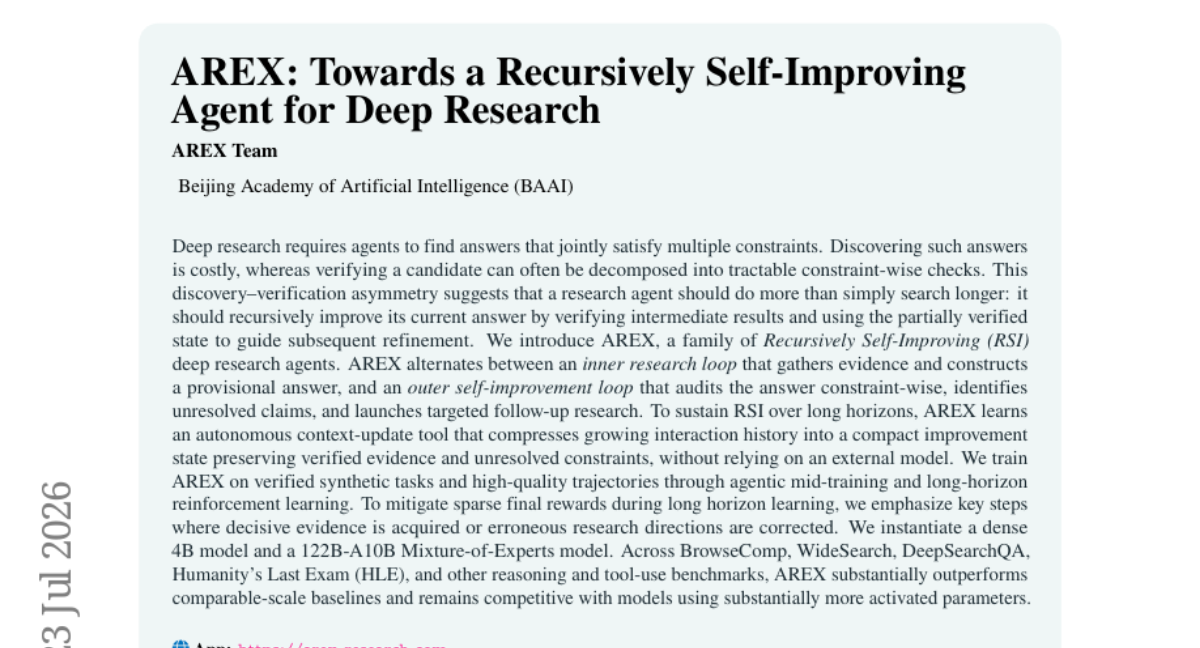
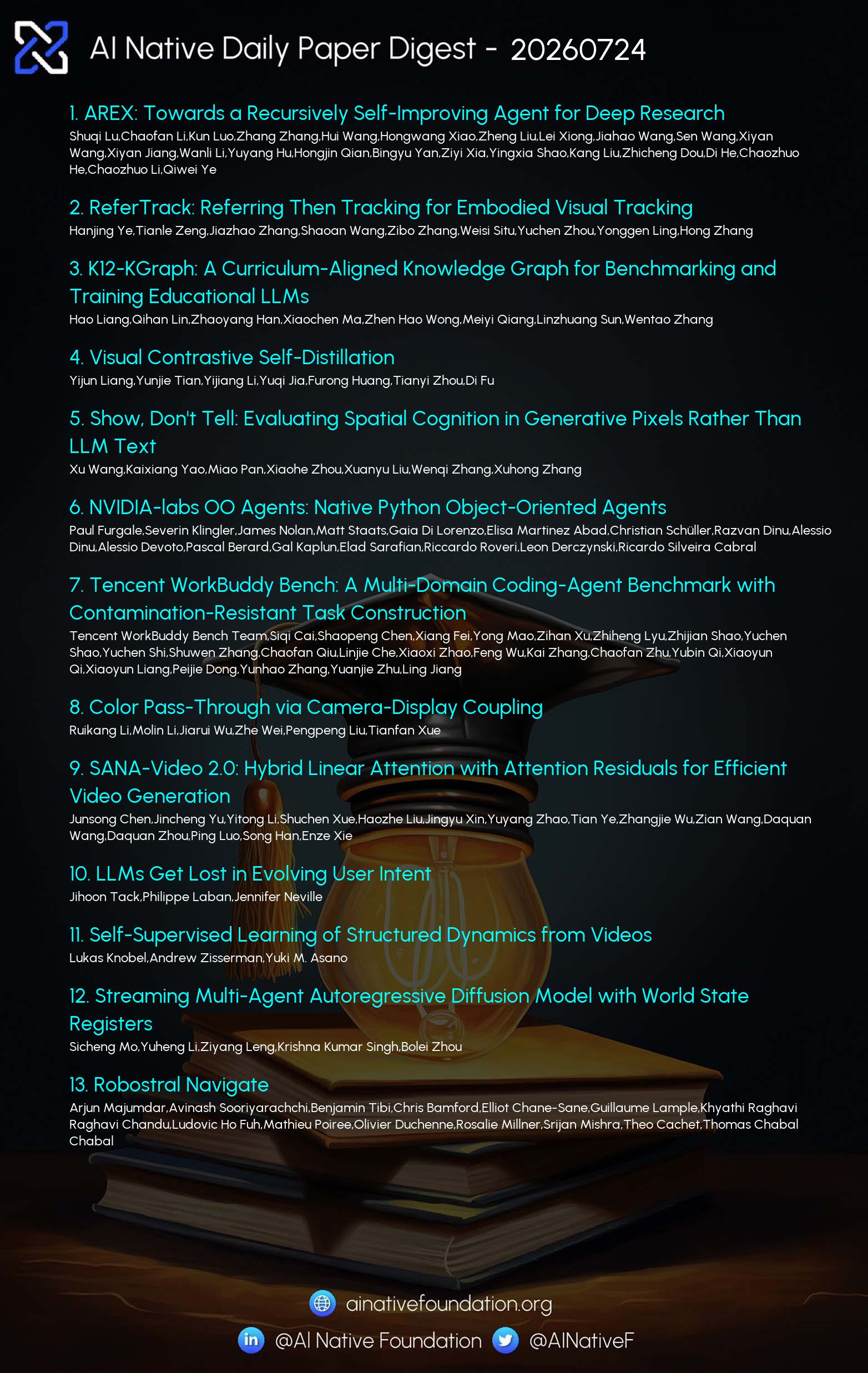
1. AREX: Towards a Recursively Self-Improving Agent for Deep Research
🔑 Keywords: Deep research agents, Recursively Self-Improving, AREX, Reinforcement Learning, Mixture-of-Experts
💡 Category: Reinforcement Learning
🌟 Research Objective:
– To develop an agent system called AREX that can recursively self-improve by verifying and refining intermediate research results while addressing multiple constraints effectively.
🛠️ Research Methods:
– AREX employs a dual-loop system involving an inner research loop for gathering evidence and constructing provisional answers, and an outer loop for auditing and refining these answers.
– Utilizes an autonomous context-update tool and undergoes training on synthetic tasks and reinforcement learning scenarios.
💬 Research Conclusions:
– AREX significantly surpasses comparable-scale baselines and competes well with models having substantially more activated parameters across various reasoning and tool-use benchmarks.
👉 Paper link: https://huggingface.co/papers/2607.21461
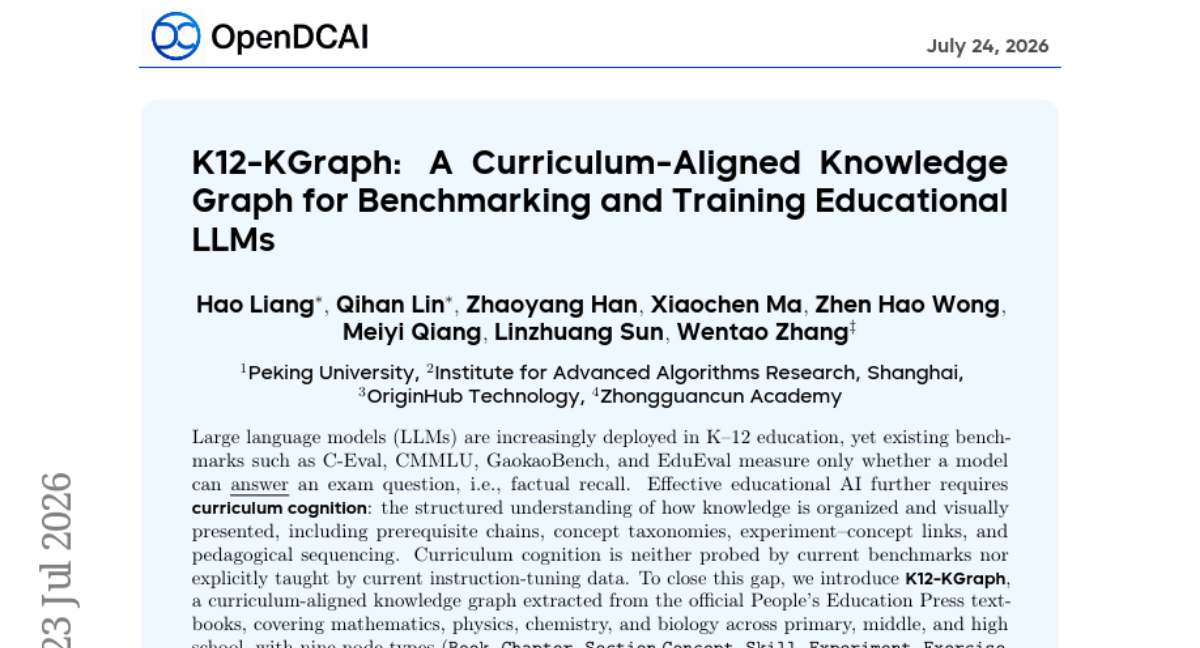
2. K12-KGraph: A Curriculum-Aligned Knowledge Graph for Benchmarking and Training Educational LLMs
🔑 Keywords: curriculum cognition, knowledge graph, K12-Bench, multimodal VQA, domain-specific supervision
💡 Category: AI in Education
🌟 Research Objective:
– To explore curriculum cognition through a knowledge graph aligned with K-12 education curriculum and evaluate language models’ ability to understand structured curriculum knowledge.
🛠️ Research Methods:
– Development of K12-KGraph and K12-Bench, a multi-select benchmark, to test large language models, including a supervised fine-tuning corpus called K12-Train with text and multimodal data.
💬 Research Conclusions:
– Gemini-3-Flash and Gemma-4-31B-IT show differing levels of success on the K12-Bench with room for improvement in tasks like Prereq and Neighbor. Domain-specific supervision displays potential in reducing performance gaps, with K12-Train leading to better performance across benchmarks.
👉 Paper link: https://huggingface.co/papers/2605.09635
3. Show, Don’t Tell: Evaluating Spatial Cognition in Generative Pixels Rather Than LLM Text
🔑 Keywords: Spatial intelligence, ProVisE, SpatialGen-Bench, Image-generation models, Text-output VLMs
💡 Category: Computer Vision
🌟 Research Objective:
– Develop a benchmark-agnostic framework called ProVisE to evaluate image-generation models’ spatial reasoning capabilities compared to text-output VLMs.
🛠️ Research Methods:
– Introduce ProVisE to generate protocol-constrained visual answers and parse them into structured predictions. Implement SpatialGen-Bench, a diagnostic benchmark with varied spatial tasks and evaluate models under a unified setting.
💬 Research Conclusions:
– Image-generation models perform competitively in pixel-space spatial reasoning, whereas text-output VLMs excel in compositional spatial reasoning, highlighting complementary strengths.
👉 Paper link: https://huggingface.co/papers/2607.21072
4. Tencent WorkBuddy Bench: A Multi-Domain Coding-Agent Benchmark with Contamination-Resistant Task Construction
🔑 Keywords: Tencent WorkBuddy Bench, coding agents, cross-model leaderboard, contamination resistance, reproducible protocol
💡 Category: AI Systems and Tools
🌟 Research Objective:
– To introduce Tencent WorkBuddy Bench, a multi-domain evaluation suite designed to assess the performance of coding agents across various work domains, including Code, Web, Office, and Security.
🛠️ Research Methods:
– Development of an evaluation framework integrating real-world coding tasks, rewritten as colloquial requests for security reasons, and implementation in a reproducible, open-access format with dataset versioning.
💬 Research Conclusions:
– The framework provides a comprehensive, contamination-resistant evaluation through a uniform task-directory format, supporting reproducibility and auditability across different coding agent evaluation subsets, with the establishment of a cross-model leaderboard for performance assessment.
👉 Paper link: https://huggingface.co/papers/2607.20911

5. SANA-Video 2.0: Hybrid Linear Attention with Attention Residuals for Efficient Video Generation
🔑 Keywords: SANA-Video 2.0, Hybrid Linear-Softmax Attention, linear attention, video diffusion transformer
💡 Category: Generative Models
🌟 Research Objective:
– Introduce SANA-Video 2.0, a high-quality video generation model leveraging a hybrid diffusion transformer architecture for scalability and efficiency.
🛠️ Research Methods:
– Deploy Hybrid Linear-Softmax Attention to balance quality and computational efficiency; incorporate Block Attention Residuals for deep-layer enhancement and anchor-feature reuse.
💬 Research Conclusions:
– SANA-Video 2.0 delivers competitive video quality with reduced latency and cost, achieving significant speed improvements over larger softmax models, and enhances expressiveness at full-softmax levels using full-stack Sol-Engine optimization.
👉 Paper link: https://huggingface.co/papers/2607.21553
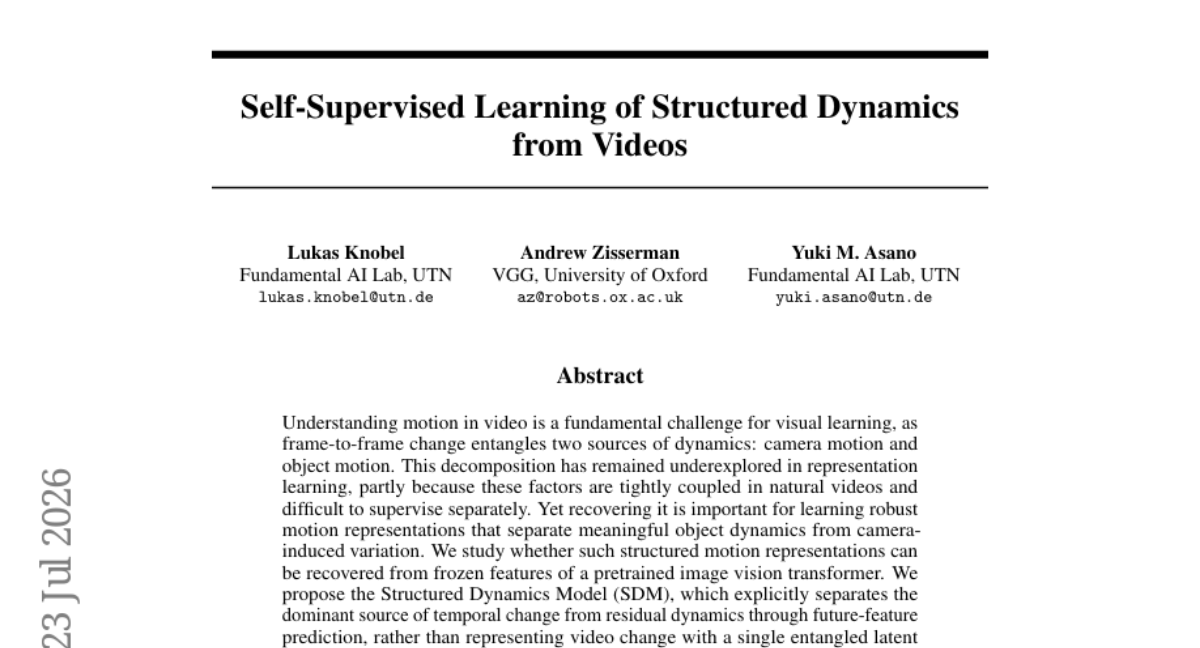
6. Self-Supervised Learning of Structured Dynamics from Videos
🔑 Keywords: motion in video, Structured Dynamics Model, representation learning, weak supervision
💡 Category: Computer Vision
🌟 Research Objective:
– The study aims to determine if structured motion representations in videos can be extracted from pretrained image vision transformers to separate object dynamics from camera motion.
🛠️ Research Methods:
– The Structured Dynamics Model (SDM) is proposed to separate dominant temporal changes using future-feature prediction, combining self-supervised learning on real video and weak supervision on synthetic data.
💬 Research Conclusions:
– SDM shows superior performance compared to baseline models, suggesting that pretrained image models can effectively be reused for structured video-dynamics representations.
👉 Paper link: https://huggingface.co/papers/2607.21576
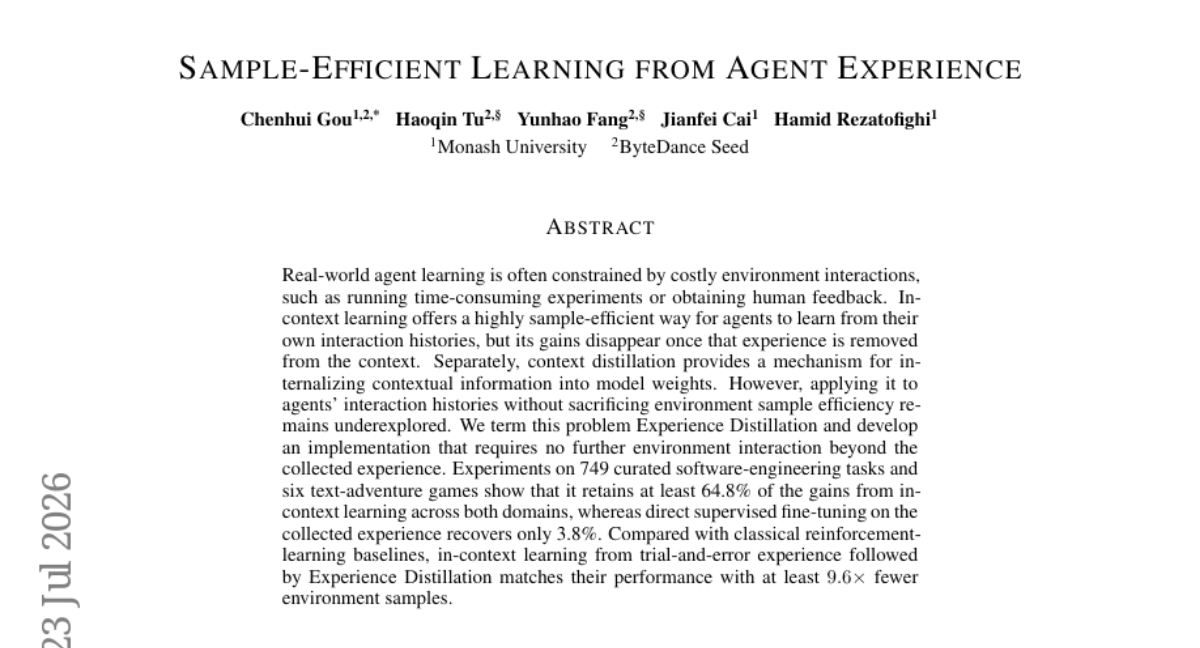
7. Sample-Efficient Learning from Agent Experience
🔑 Keywords: Experience Distillation, In-context Learning, Sample Efficiency, Reinforcement Learning
💡 Category: Reinforcement Learning
🌟 Research Objective:
– The research aims to explore a method called Experience Distillation, which internalizes agents’ interaction histories without sacrificing sample efficiency in real-world scenarios.
🛠️ Research Methods:
– The study implements Experience Distillation, a process that does not require additional environment interactions beyond collected experience, and tests it on 749 software-engineering tasks and six text-adventure games.
💬 Research Conclusions:
– Experience Distillation retains at least 64.8% of the benefits from in-context learning, significantly outperforming direct supervised fine-tuning, which only retains 3.8%. This method requires at least 9.6 times fewer environment samples than traditional reinforcement learning baselines to achieve similar performance.
👉 Paper link: https://huggingface.co/papers/2607.21051
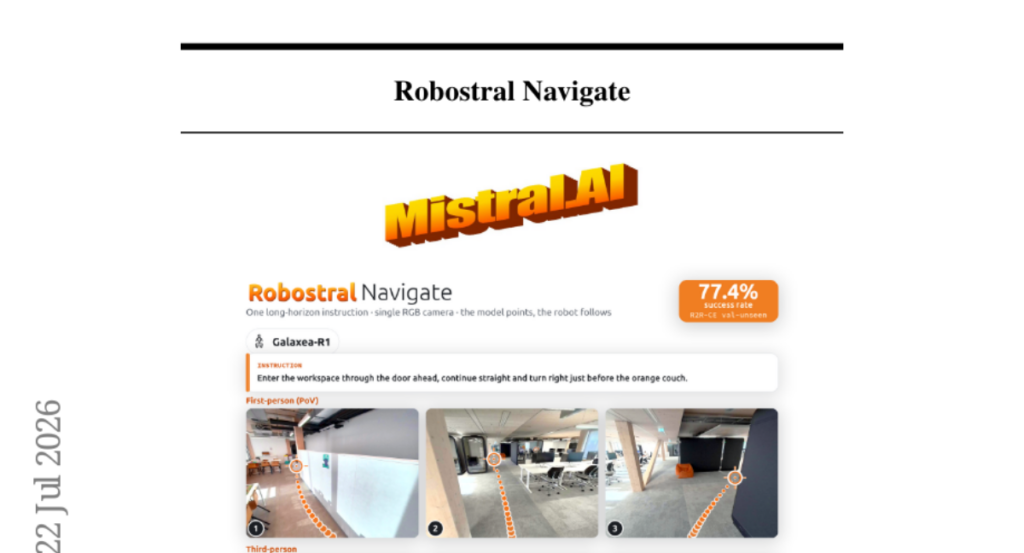
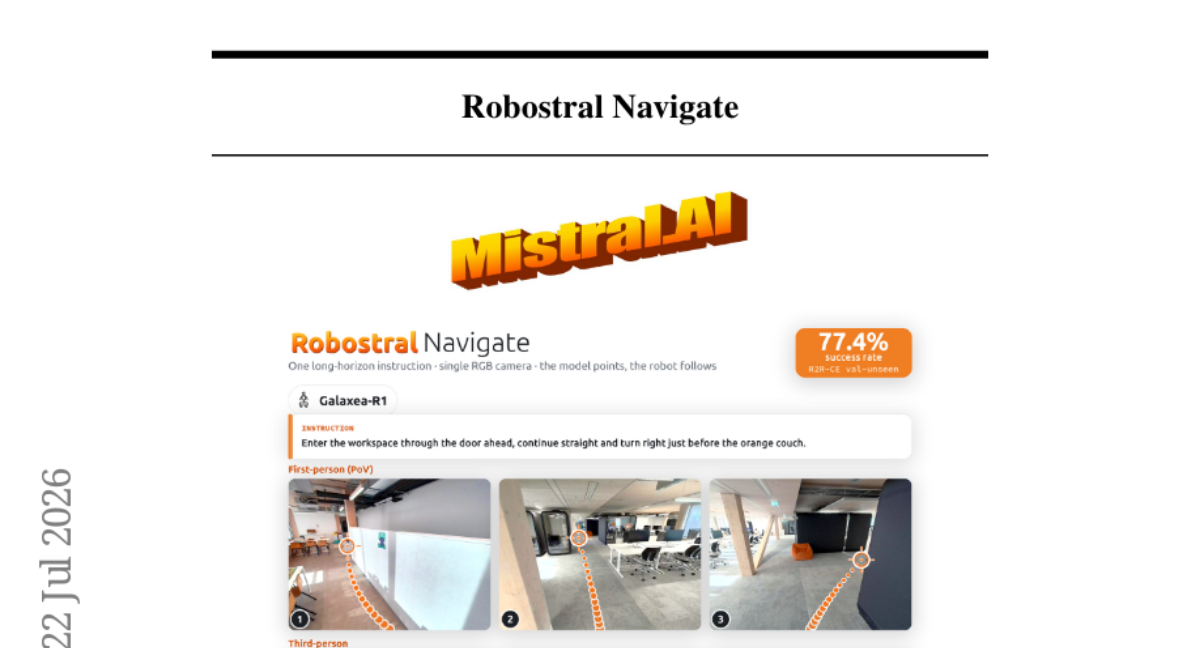
8. Robostral Navigate
🔑 Keywords: Monocular RGB, Robostral Navigate, Reinforcement Learning, Scalability, Vision-Language Model
💡 Category: Robotics and Autonomous Systems
🌟 Research Objective:
– The study aims to develop a scalable navigation system, minimizing sensor assumptions and enabling generalization across different robotic embodiments.
🛠️ Research Methods:
– Introduces Robostral Navigate, a vision-language model using only monocular RGB images to predict waypoints.
– Utilizes a prefix-caching training technique and a tree-based attention mask for efficient training and action prediction.
💬 Research Conclusions:
– Robostral Navigate achieves a new state of the art on R2R-CE and RxR-CE benchmarks, outperforming existing monocular and multi-sensor systems with just a single RGB camera.
👉 Paper link: https://huggingface.co/papers/2607.20785
9. FinanceComplexQA: Benchmarking Agentic Reasoning on Industrial-grade Financial Documents
🔑 Keywords: Agentic Reasoning, Finance-LaTeX SKILL, FinanceComplexQA, AI in Finance
💡 Category: AI in Finance
🌟 Research Objective:
– To design a skill named Finance-LaTeX SKILL for synthesizing financial documents with complex layouts based on expert knowledge.
🛠️ Research Methods:
– Developed Finance-LaTeX SKILL to generate 2,000 financial documents and 6,000 Q&A pairs, evaluated by introducing FinanceComplexQA benchmark across multiple scenarios and tasks.
💬 Research Conclusions:
– A comprehensive evaluation of agentic reasoning tools highlights their capabilities and limitations in various tasks such as numerical computation and multi-hop reasoning, offering insights into system performance and areas for improvement.
👉 Paper link: https://huggingface.co/papers/2607.19238

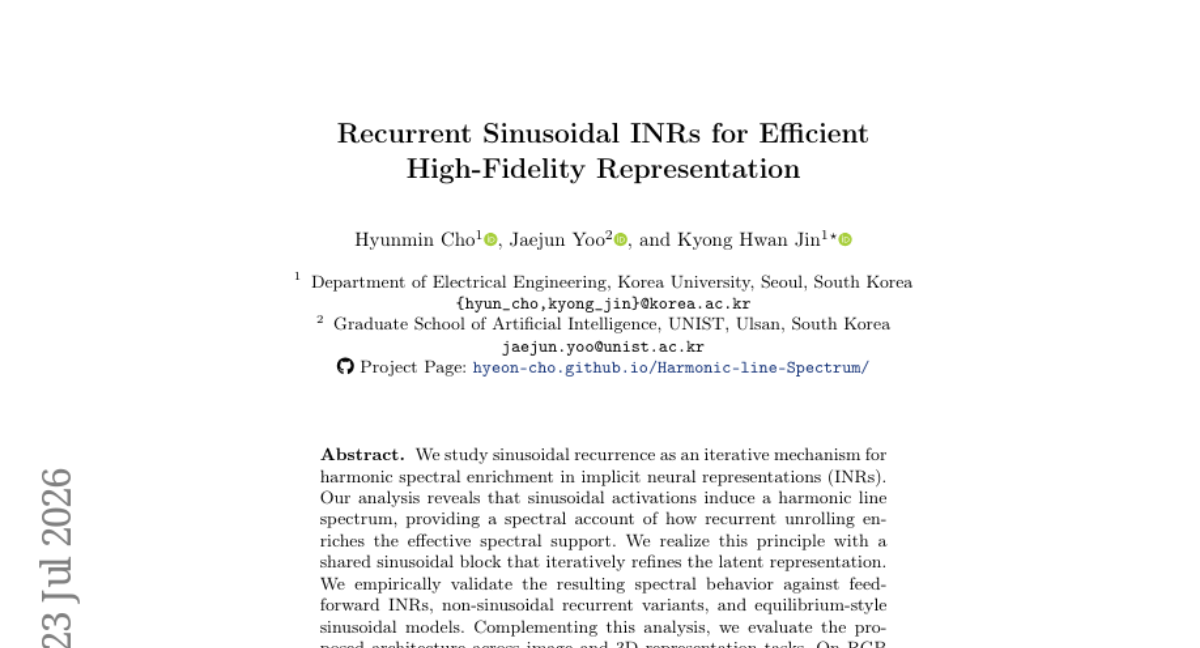
10. Recurrent Sinusoidal INRs for Efficient High-Fidelity Representation
🔑 Keywords: Sinusoidal recurrence, Implicit Neural Representations (INRs), Harmonic spectral enrichment, Spectral support
💡 Category: Machine Learning
🌟 Research Objective:
– To study the effect of sinusoidal recurrence on harmonic spectral enrichment within Implicit Neural Representations (INRs).
🛠️ Research Methods:
– Employ analysis of sinusoidal activations to highlight a harmonic line spectrum and evaluate the proposed sinusoidal block against feed-forward and non-sinusoidal models.
💬 Research Conclusions:
– The proposed methodology showcases superior performance in image and 3D representation tasks, promising efficiency improvements with fewer parameters and optimization steps compared to existing models.
👉 Paper link: https://huggingface.co/papers/2607.21485
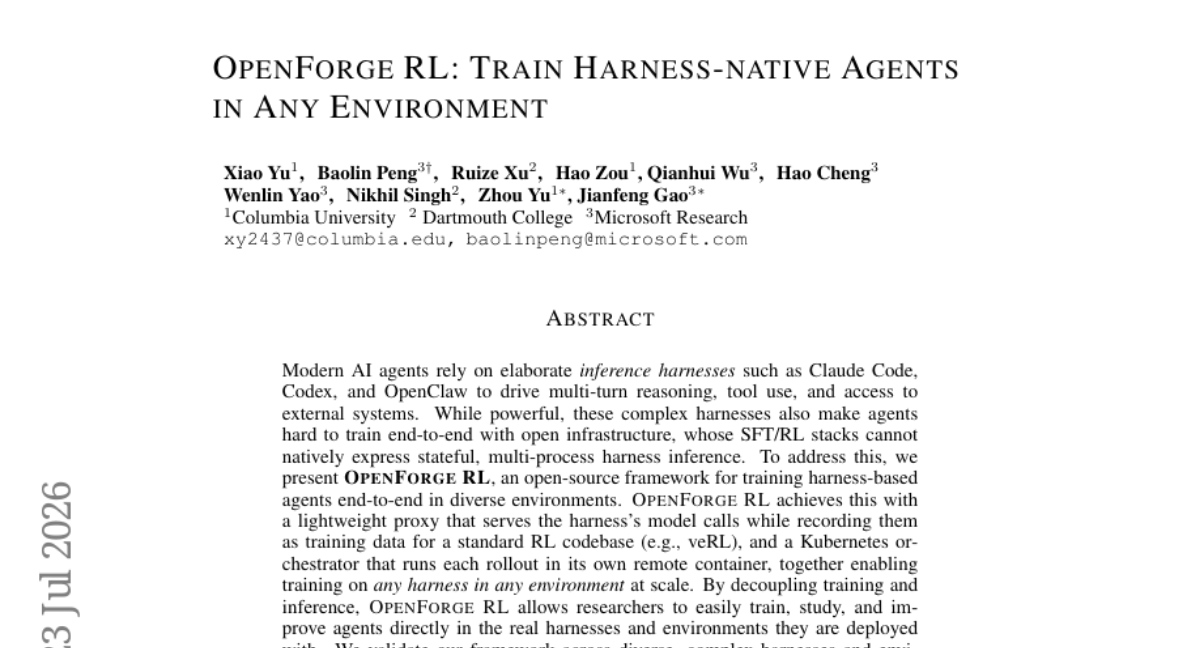
11. OpenForgeRL: Train Harness-native Agents in Any Environment
🔑 Keywords: OpenForgeRL, Reinforcement Learning, harnesses, scalable training, AI agents
💡 Category: Reinforcement Learning
🌟 Research Objective:
– The study introduces OpenForgeRL, a framework aimed at enabling end-to-end training of AI agents utilizing complex inference harnesses across diverse environments.
🛠️ Research Methods:
– The framework employs a lightweight proxy for handling model calls from different harnesses and utilizes Kubernetes for orchestrating training rollouts in separate remote containers, facilitating scalable training within any environment.
💬 Research Conclusions:
– OpenForgeRL demonstrates superior performance on various benchmarks compared to baseline models by decoupling training and inference processes, allowing optimal utilization in real-world harness environments. However, some harnesses present greater learning challenges, and critical agent features like error recovery remain limited.
👉 Paper link: https://huggingface.co/papers/2607.21557
12.
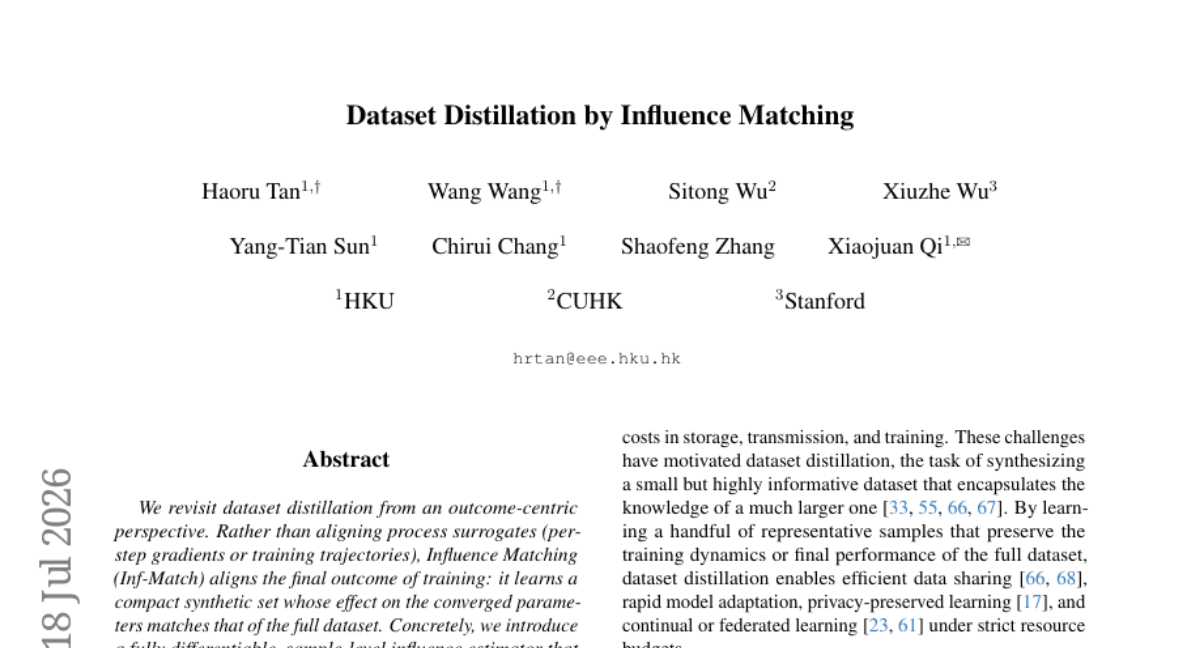
13. Dataset Distillation by Influence Matching
🔑 Keywords: Dataset Distillation, Influence Matching, Vision-language Distillation, Classification Benchmarks
💡 Category: Machine Learning
🌟 Research Objective:
– The objective is to develop an efficient dataset distillation method, Influence Matching (Inf-Match), that aligns synthetic training data with the outcome of the full dataset.
🛠️ Research Methods:
– Introduces a fully differentiable sample-level influence estimator for parameter shifts, optimizing influence without inverse-Hessian products or convexity assumptions.
💬 Research Conclusions:
– Inf-Match yields superior accuracy on standard classification benchmarks and scales effectively to vision-language distillation tasks, outperforming existing process-matching methods.
👉 Paper link: https://huggingface.co/papers/2607.16859
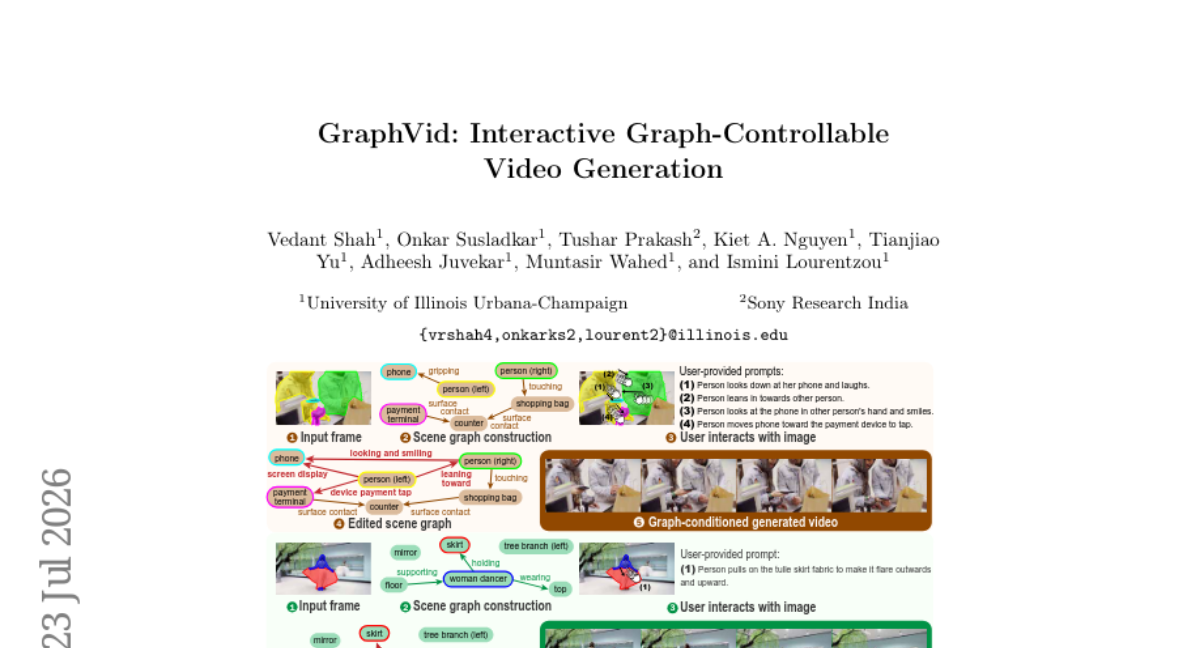
14. GraphVid: Interactive Graph-Controllable Video Generation
🔑 Keywords: GraphVid, video generation, multi-object interactions, structured interaction graphs
💡 Category: Generative Models
🌟 Research Objective:
– The aim is to achieve flexible yet precise control in video generation by using a graph-conditioned model to handle multi-subject interactions.
🛠️ Research Methods:
– Introduction of GraphVid, an image-to-video generation model using structured interaction graphs for control.
– Development of GraphVid-Bench, a dataset for training interaction-aware video models.
💬 Research Conclusions:
– GraphVid offers strong controllability and improved video quality with less data and parameters, outperforming previous methods like Motion-I2V by significant margins in metrics such as FID, FVD, PSNR, and SSIM.
👉 Paper link: https://huggingface.co/papers/2607.21580
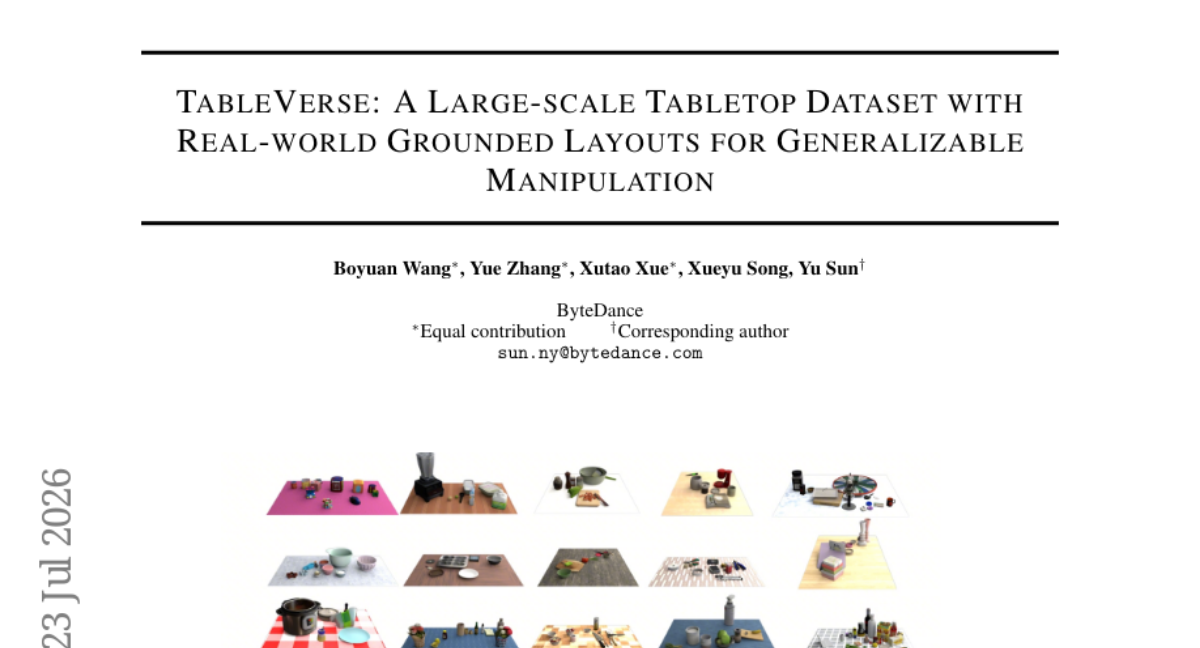
15. TableVerse: A Large-scale Tabletop Dataset with Real-world Grounded Layouts for Generalizable Manipulation
🔑 Keywords: Real2Sim, robotic manipulation, TableVerse-100K, AI Native, automation
💡 Category: Robotics and Autonomous Systems
🌟 Research Objective:
– The objective of this research is to develop a generalizable robotic manipulation framework that uses a fully automated Real2Sim pipeline for environment reconstruction from unstructured image data.
🛠️ Research Methods:
– The researchers introduced TableVerse, a pipeline that transforms unscripted internet media into high-fidelity, simulation-ready environments, integrating an automated, task-conditioned trajectory generation framework.
💬 Research Conclusions:
– The study resulted in the creation of the TableVerse-100K Dataset, comprising 100,000 unique environments with collision-free manipulation trajectories, establishing a scalable and high-fidelity data foundation for advancing robotic manipulation research.
👉 Paper link: https://huggingface.co/papers/2607.21017
16. Multi-Turn On-Policy Distillation with Prefix Replay
🔑 Keywords: On-Policy Distillation, LLM Agent, Multi-turn Interaction, Replayed-Prefix On-Policy Distillation, Scalability
💡 Category: Reinforcement Learning
🌟 Research Objective:
– Investigate an alternative to fully online on-policy distillation for tasks requiring multi-turn interactions between a large language model (LLM) agent and its environment.
🛠️ Research Methods:
– Propose “Replayed-Prefix On-Policy Distillation” (ReOPD) to utilize pre-collected teacher trajectories as prefixes, reducing the need for fresh student rollouts and new teacher queries.
💬 Research Conclusions:
– ReOPD maintains or enhances OPD-level accuracy with zero tool calls during student training, achieving at least 4 times faster rollouts compared to traditional OPD, thereby facilitating scalable distillation.
👉 Paper link: https://huggingface.co/papers/2607.04763
17. Predictive Divergence Masks for LLM RL
🔑 Keywords: Reinforcement Learning, Large Language Models, Trust Region, Predictive Divergence Mask
💡 Category: Reinforcement Learning
🌟 Research Objective:
– Investigate a new direction criterion for reinforcement learning of large language models that improves alignment with divergence changes by introducing a predictive divergence mask.
🛠️ Research Methods:
– Analyzes the limitations of existing PPO-style approaches and introduces a divergence-based direction criterion. Derives a closed-form prediction method for discrete softmax policies and develops lightweight top-K estimators to accommodate production constraints.
💬 Research Conclusions:
– The divergence-based direction criterion better aligns with the change of the divergence than traditional ratio-based methods, leading to improved RL training performance across various model scales and precision settings.
👉 Paper link: https://huggingface.co/papers/2607.10848
18. Streaming Multi-Agent Autoregressive Diffusion Model with World State Registers
🔑 Keywords: Multi-agent, Video Diffusion, World State, Mixture-of-Transformers, Logical Consistency
💡 Category: Generative Models
🌟 Research Objective:
– The study aims to improve multi-agent video generation by developing a model that maintains consistent world states across agents and views.
🛠️ Research Methods:
– Introduction of WorldWeaver (W^2), a streaming multi-agent video diffusion model that uses cross-agent world state registers and a Mixture-of-Transformers design for separated world state and visual frame modeling.
💬 Research Conclusions:
– WorldWeaver enhances logical consistency and generation quality in multi-agent settings, demonstrated through experiments in Minecraft video generation.
👉 Paper link: https://huggingface.co/papers/2607.21594
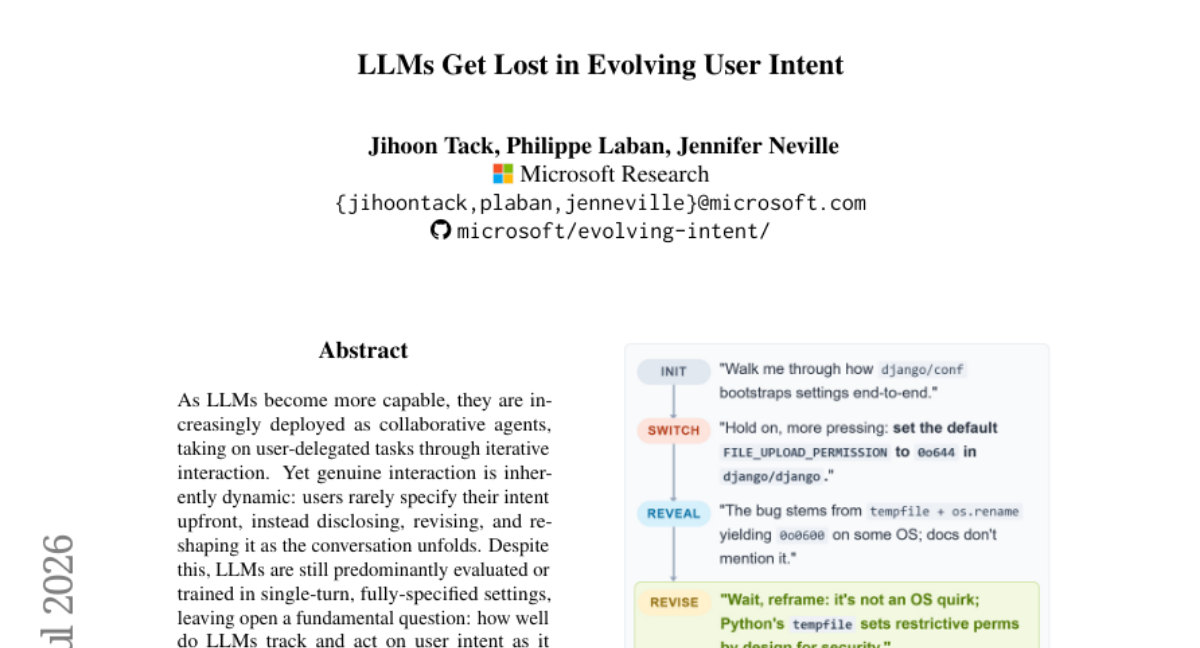
19. LLMs Get Lost in Evolving User Intent
🔑 Keywords: LLMs, collaborative agents, evolving user intent, conversational AI
💡 Category: Human-AI Interaction
🌟 Research Objective:
– To investigate how well LLMs track and act on evolving user intent in dynamic multi-turn conversations.
🛠️ Research Methods:
– A framework was introduced to convert static, single-turn tasks into dynamic multi-turn conversations for studying evolving user intent, using existing benchmarks as controlled testbeds.
💬 Research Conclusions:
– LLMs that perform well in static settings show significant performance drops in evolving-intent scenarios, indicating a gap in their ability to track and act on user intent as it evolves.
👉 Paper link: https://huggingface.co/papers/2607.20734
20. Color Pass-Through via Camera-Display Coupling
🔑 Keywords: Color Pass-Through, End-to-End Optimization, Camera-Display Coupling
💡 Category: Computer Vision
🌟 Research Objective:
– To address color, brightness, and contrast discrepancies between captured images by smartphones and their real-world counterparts through an end-to-end learned framework.
🛠️ Research Methods:
– Developing the Color Pass-Through framework that treats camera and display as a coupled system for holistic optimization.
💬 Research Conclusions:
– The proposed method achieves significant improvements in perceived color reproduction with a user study score increase of +2.0 points and over 2x enhancement in quantitative metrics compared to existing methods.
👉 Paper link: https://huggingface.co/papers/2607.12746
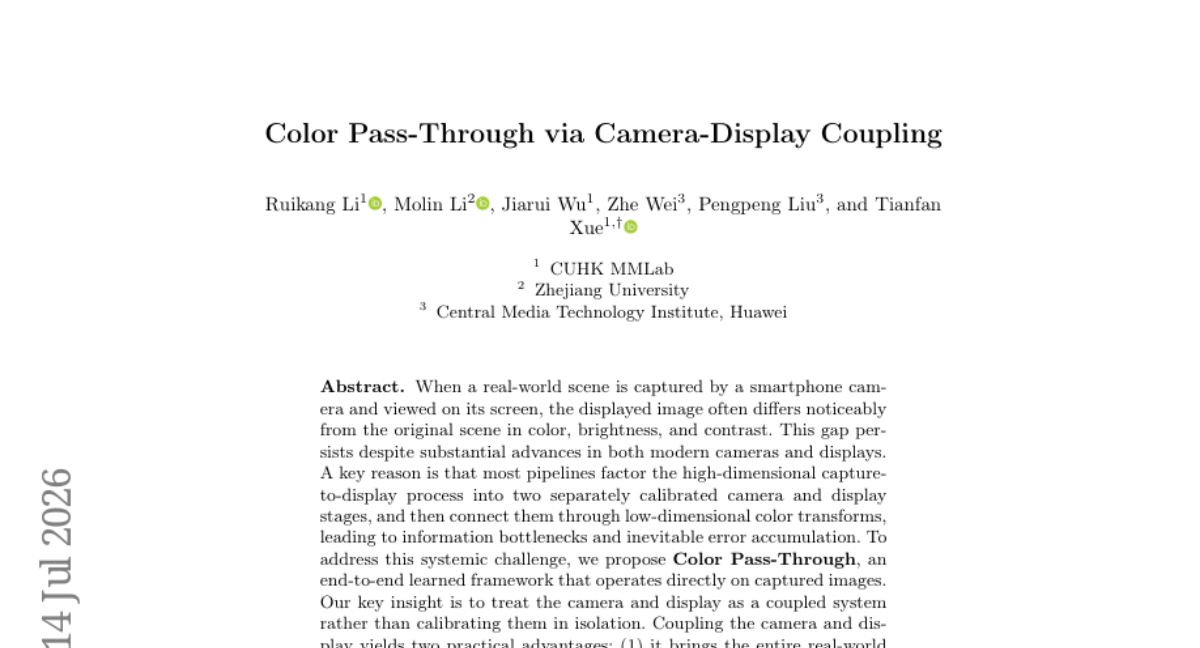
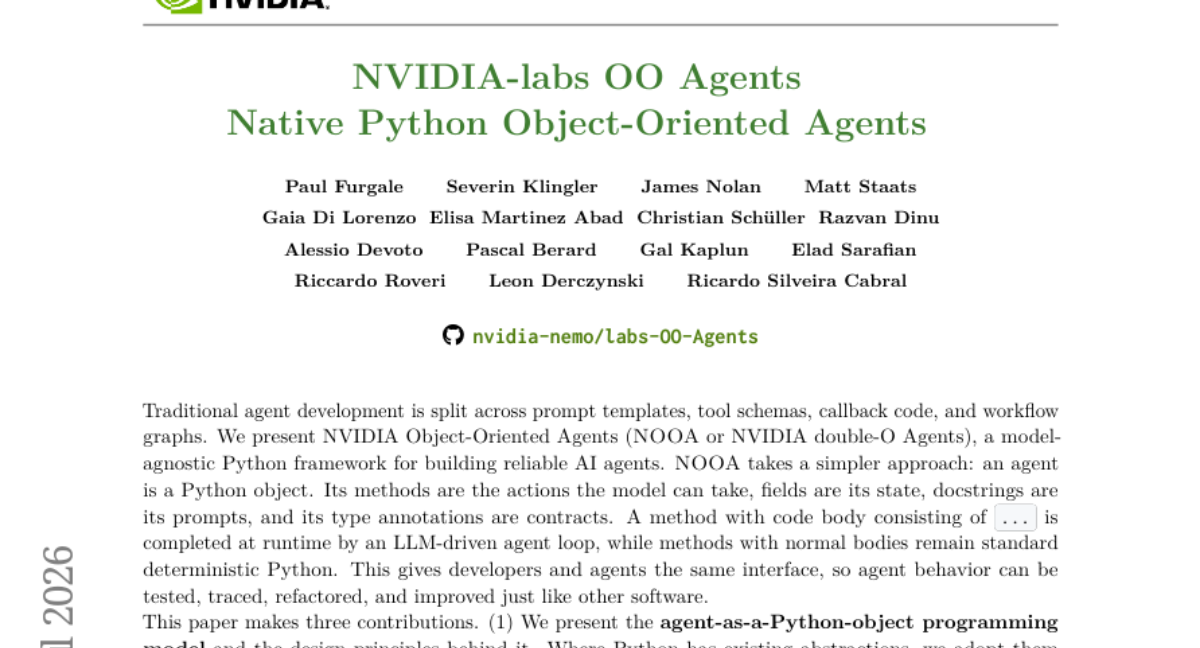
21. NVIDIA-labs OO Agents: Native Python Object-Oriented Agents
🔑 Keywords: NVIDIA Object-Oriented Agents, Python framework, LLM-driven agent loop, AI Agents
💡 Category: AI Systems and Tools
🌟 Research Objective:
– Introduce NVIDIA Object-Oriented Agents (NOOA) to simplify AI agent creation using Python object-oriented principles.
🛠️ Research Methods:
– Developed a model-agnostic Python framework where agent behavior is encapsulated as Python objects.
– Identified and combined six unique model-facing ideas within the framework to enhance agent functionality.
💬 Research Conclusions:
– Demonstrated effective use of the NOOA framework through various capability tests and benchmarks like SWE-bench Verified, Terminal-Bench 2.0, and ARC-AGI-3.
👉 Paper link: https://huggingface.co/papers/2607.20709
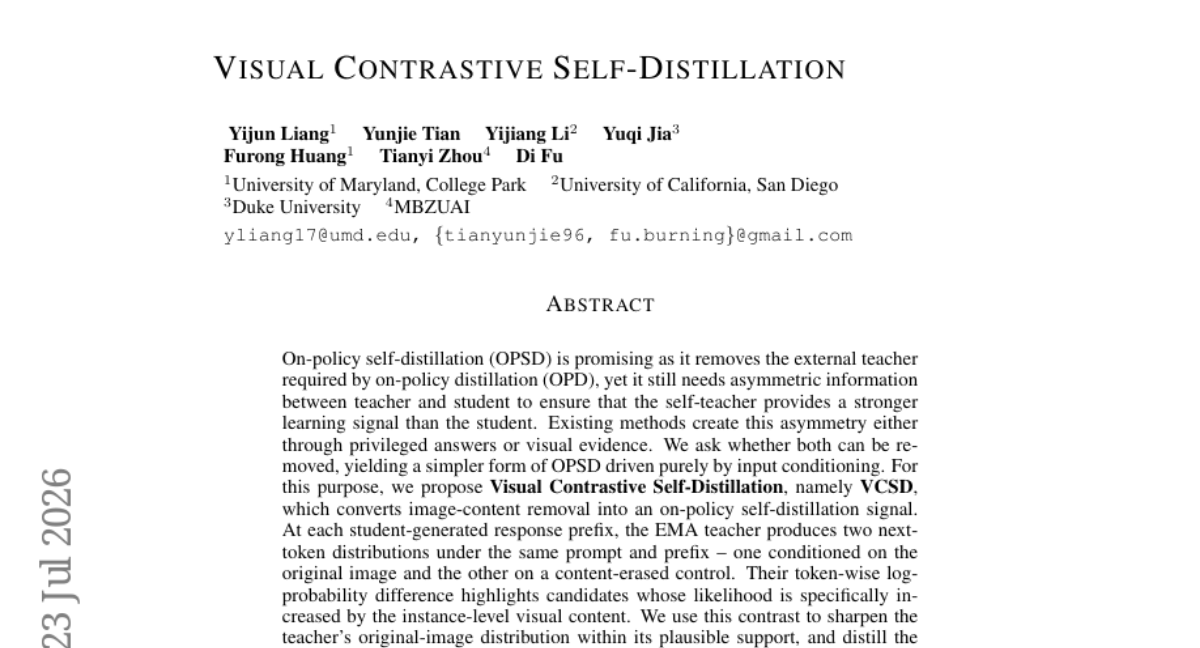
22. Visual Contrastive Self-Distillation
🔑 Keywords: On-policy self-distillation, Visual Contrastive Self-Distillation, input conditioning, self-teacher, performance improvement
💡 Category: Machine Learning
🌟 Research Objective:
– The study aims to explore whether on-policy self-distillation can be simplified by removing privileged answers and visual evidence, focusing instead on input conditioning to provide a stronger learning signal from the self-teacher to the student.
🛠️ Research Methods:
– The proposed method, Visual Contrastive Self-Distillation (VCSD), uses image-content removal as a self-distillation signal by comparing token distributions produced by an EMA teacher under different image conditions.
💬 Research Conclusions:
– VCSD effectively improves performance across several benchmarks without the need for external teachers or additional inference costs, demonstrating significant increases in aggregate benchmark scores when compared to conventional OPSD methods.
👉 Paper link: https://huggingface.co/papers/2607.21556
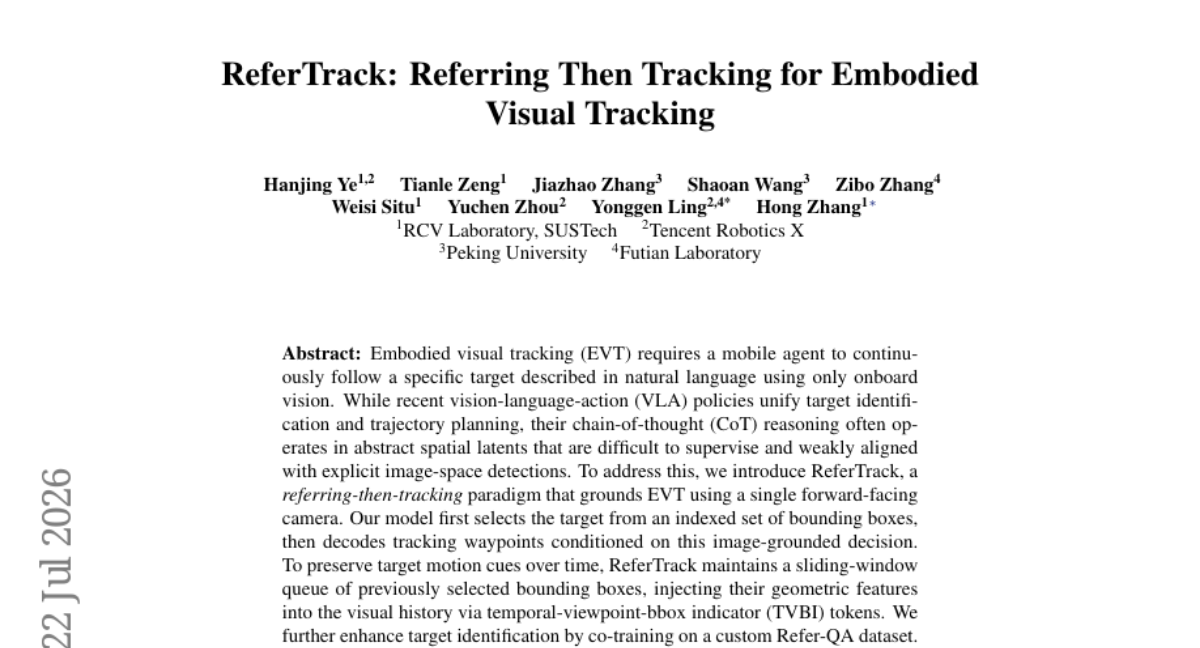
23. ReferTrack: Referring Then Tracking for Embodied Visual Tracking
🔑 Keywords: Embodied Visual Tracking, Vision-language-Action (VLA), ReferTrack, Temporal-Viewpoint-Bbox Indicator (TVBI)
💡 Category: Computer Vision
🌟 Research Objective:
– To improve embodied visual tracking by developing a new model called ReferTrack that enhances target identification and tracking using a single forward-facing camera.
🛠️ Research Methods:
– A referring-then-tracking paradigm with specific target selection from indexed bounding boxes and tracking waypoints decoding.
– Introduction of Temporal-Viewpoint-Bbox Indicator (TVBI) tokens to inject geometric features over time, enhancing the tracking history.
💬 Research Conclusions:
– ReferTrack achieves state-of-the-art performance on EVT-Bench with high success rates in different tracking scenarios, surpassing some multi-camera systems.
– The model’s robust sim-to-real transfer is validated in real-world deployments on robots.
👉 Paper link: https://huggingface.co/papers/2607.20061