Global AI Native Industry Insights – 20260804 – OpenAI | Google | more
Today’s digest leads with breakthroughs from both OpenAI and Google, showcasing advancements in mathematics, theoretical computer science, and web browsing technology. OpenAI’s Astra model has generated 10 new results on open problems in its field, while Google’s Gemini Spark introduces agentic web browsing through Chrome’s Auto Browse integration. Additionally, OpenAI has unveiled GPT-Live, a real-time voice AI system developed in just six months, highlighting rapid deployment in AI technology. These achievements underline the accelerating pace of innovation in AI system capabilities and integration. Discover more in Today’s Global AI Native Industry Insights.
1. OpenAI’s Astra Model Produces 10 New Results on Open Problems in Mathematics and Theoretical Computer Science
OpenAI announced that an internal version of its next major model, Astra, has produced new results on 10 longstanding open problems in mathematics and theoretical computer science, with problems that had seen no central progress for at least a decade. The research spans areas including group theory, high-dimensional geometry, coding theory, arithmetic circuit complexity, quantum complexity, lattice cryptography, and extremal combinatorics. Notable results include a construction proving the existence of non-sofic groups, a disproof of Connes’s rigidity conjecture, new sphere-packing bounds, and resolutions of several problems posed by mathematician Paul Erdős. Machine-checkable Lean proofs were published on GitHub. OpenAI stated the work was produced for roughly $2,000 in compute at GPT-5.6 Sol API rates, positioning Astra as a practical research tool for scientists and mathematicians.
Read more: https://openai.com/index/ten-advances-in-mathematics/
Video Credit: @OpenAI on X
2. Google’s Gemini Spark Gains Agentic Web Browsing via Chrome Auto Browse Integration
Google has announced that Gemini Spark can now leverage Google Chrome’s auto browse feature to perform complex online tasks on behalf of users. With user permission, Gemini Spark is able to use logged-in browser accounts to carry out errands such as scheduling apartment viewings or researching and initiating flight bookings. The integration positions Gemini Spark as an agentic AI assistant capable of handling multi-step web interactions. The feature requires explicit user consent before accessing any accounts or performing actions.
Read more: https://blog.google/innovation-and-ai/products/gemini-app/gemini-spark-updates-july-2026/
Video Credit: @Google on X
3. How OpenAI Built GPT-Live: A Responsive Realtime Voice AI System in Six Months
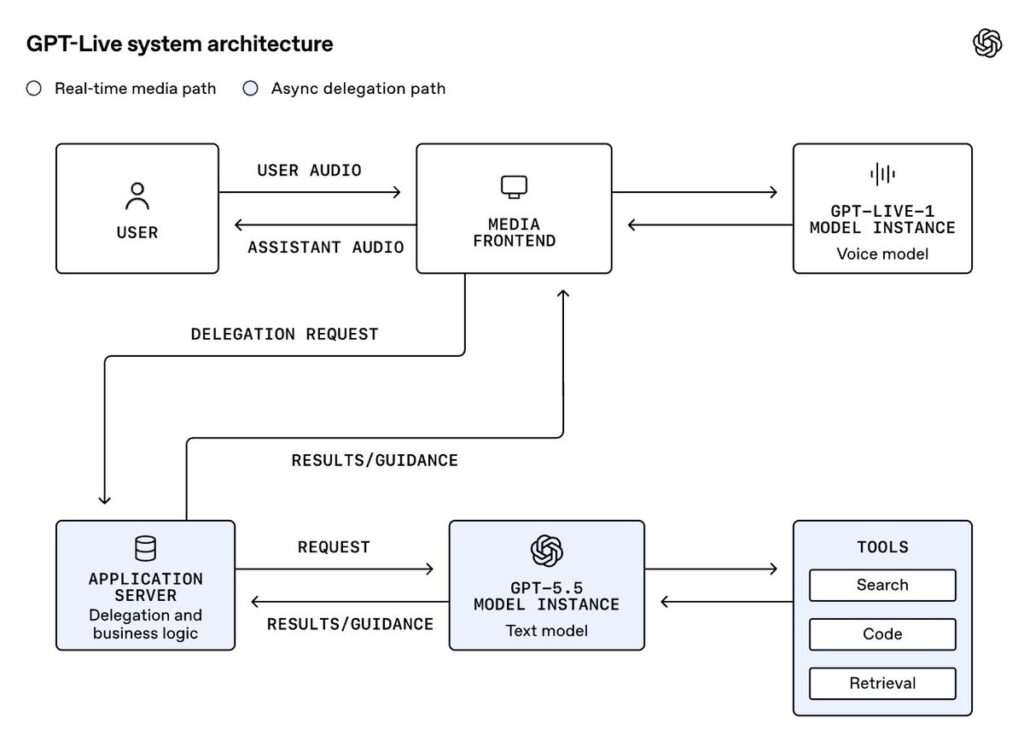
OpenAI details the architecture behind GPT-Live, its third-generation voice system. Unlike prior turn-based voice AI that relies on separate “turn detector” models, GPT-Live uses a full-duplex model that can listen and speak simultaneously, and can asynchronously consult frontier models like GPT-5.5 for deeper reasoning without interrupting conversation. The team rewrote the core voice path in Go (replacing Python asyncio) and built new protocols, WARP and Instant Connect, cutting the network round trips needed to start a session from six to one. Before launch, the system was validated in production through a silent shadow test alongside real traffic. GPT-Live now powers ChatGPT Voice and will underpin the upcoming GPT-Live API.
Read more: https://openai.com/index/continuous-voice-interaction-with-gpt-live/
Video Credit: NotebookLM
That’s all for today’s Global AI Native Industry Insights. Join us at AI Native Foundation Membership Dashboard for the latest insights on AI Native, or follow our linkedin account at AI Native Foundation and our twitter account at AINativeF.