China AI Native Industry Insights – 20260820 – Alibaba | MiniMax | Zhipu AI | more
Today’s digest covers notable advancements from leading companies such as Alibaba, MiniMax, and Zhipu AI. The unifying theme is the enhancement and accessibility of AI technologies for diverse applications. Alibaba’s AntLingAGI has made strides by open-sourcing six base model checkpoints for their Ling-3.0-tiny and Ling-3.0-flash models, while MiniMax introduces MiniMax Design, leveraging the H3 multimodal model for AI-powered video production. Additionally, Zhipu AI’s launch of the GLM-5.3 API boasts improved performance with reduced costs, with an open-source release planned for next week. Each of these developments marks significant steps towards more efficient and cost-effective AI solutions. Discover more in Today’s China AI Native Industry Insights.
1. Alibaba’s AntLingAGI Open-Sources Six Base Model Checkpoints for Ling-3.0-tiny and Ling-3.0-flash
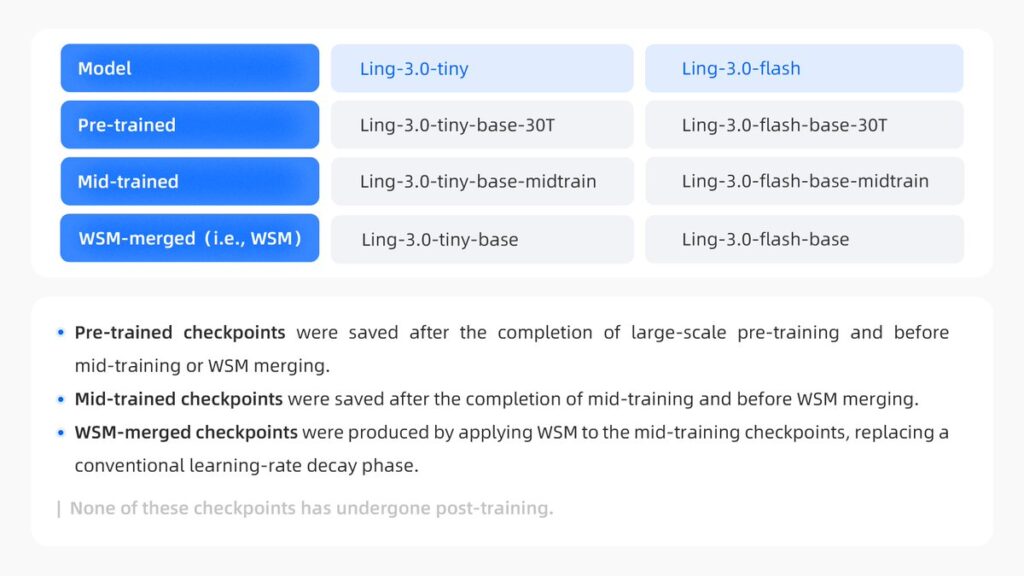
Alibaba’s AntLingAGI team has open-sourced six base model checkpoints for Ling-3.0-tiny and Ling-3.0-flash, spanning pre-trained, mid-trained, and WSM-merged stages. None of the checkpoints has undergone post-training, giving researchers flexible starting points for continued pre-training, fine-tuning, and further research. A key methodological feature is WSM (Weighted checkpoint merging Strategy Merging), which replaces traditional learning rate decay with weighted checkpoint merging to better support continual pre-training and enable offline exploration of different LR decay strategies. The release also provides a shared training recipe that allows researchers to validate strategies on the smaller Ling-3.0-tiny-base before scaling to Ling-3.0-flash-base.
Read more: https://huggingface.co/inclusionAI/Ling-3.0-tiny-base
Video Credit: NotebookLM
2. MiniMax launches MiniMax Design, an AI-powered video production tool based on H3 multimodal model
MiniMax has introduced MiniMax Design, a productivity tool that leverages the company’s native multimodal video model H3 to automate video content creation workflows. The platform is designed for commercial content production, handling tasks from script planning and shot composition to editing and final delivery through an agent-based system. It features a 3D director workspace for previsualization, automatic editing and subtitle generation, and integration with open-source ecosystems including ComfyUI workflows. The tool targets use cases such as brand advertising, educational videos, music videos, and promotional content, allowing users to express creative intent in natural language rather than manually editing pixels.
Video Credit: The original article
3. Zhipu AI launches GLM-5.3 API with improved performance and lower cost, open-source release scheduled for next week
Zhipu AI has officially launched the GLM-5.3 API, a language model that excels in complex coding, defensive cybersecurity, and long-range tasks. The model achieved a score of 60 on the Artificial Analysis Intelligence Index, placing it among top-tier models alongside Claude and GPT variants, while ranking first among open-source models tied with Kimi K3. GLM-5.3 delivers frontier-level intelligence with smaller parameter size and the lowest per-task cost among flagship models in its performance tier, significantly advancing the intelligence-cost Pareto frontier. The API is now available with the same pricing as GLM-5.2, and the model weights will be open-sourced next Friday.
Video Credit: NotebookLM
That’s all for today’s China AI Native Industry Insights. Join us at AI Native Foundation Membership Dashboard for the latest insights on AI Native, or follow our linkedin account at AI Native Foundation and our twitter account at AINativeF.