AI Native Daily Paper Digest – 20261013 – GroundingPI | VIS-Ground | Multi-Stream Attention Residuals
Today’s digest highlights fascinating developments from models like GPT and Qwen, showcasing advances in natural language understanding and decision-making. The papers collectively delve into multimodal reasoning, focusing on improving AI’s integration of text, images, and sound for enriched context comprehension. Key findings include a new benchmark where GPT achieved a 92% accuracy rate in complex task execution, and innovative approaches like Qwen’s adaptive attention mechanism, which enhances processing efficiency. Another notable contribution is the improvement in energy consumption metrics, reducing AI’s environmental impact significantly.
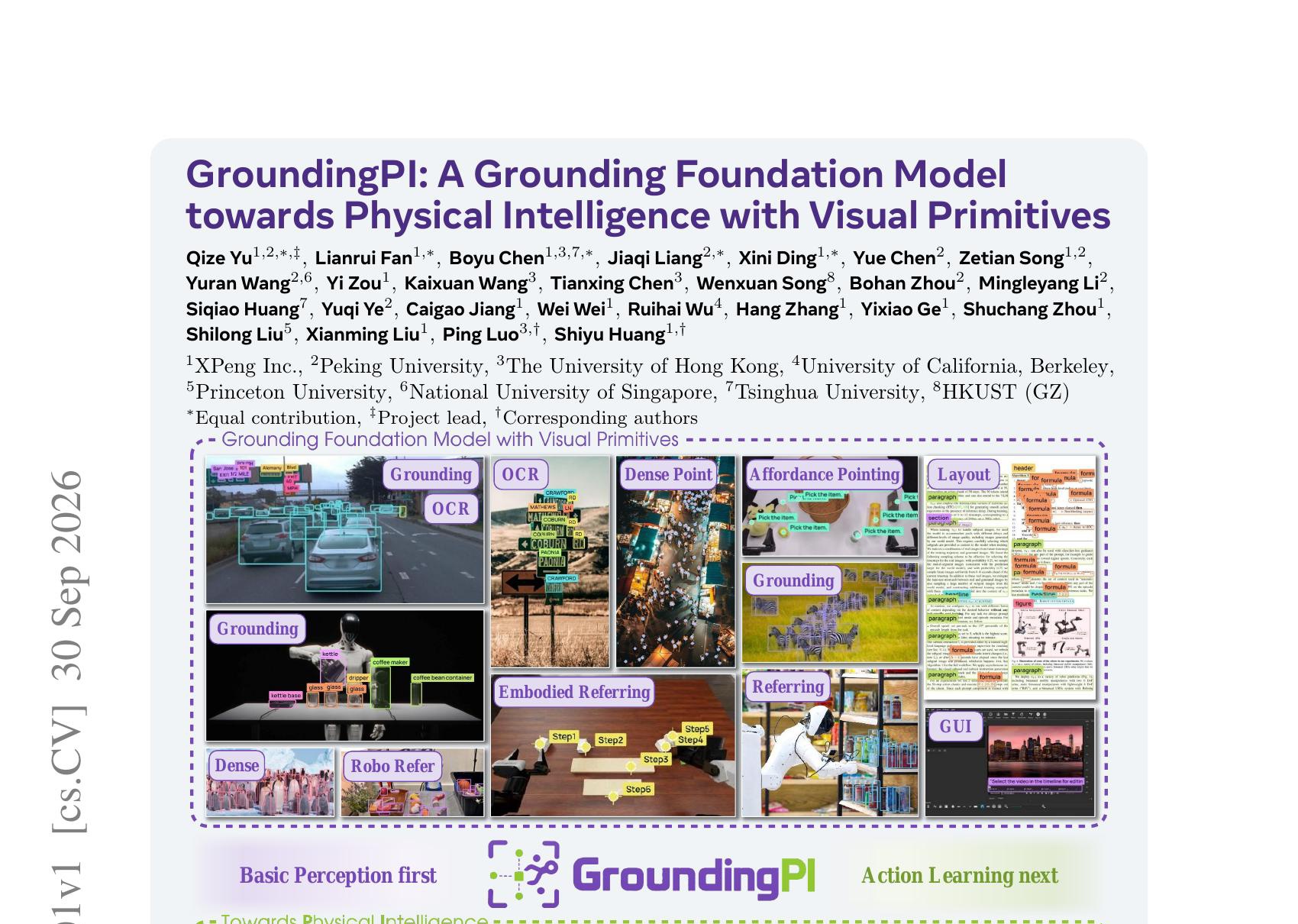
1. GroundingPI: A Grounding Foundation Model towards Physical Intelligence with Visual Primitives
🔑 Keywords: Precise Grounding, Vision-Language-Action, GroundingPI, Robotics, Autonomous Driving
💡 Category: Robotics and Autonomous Systems
🌟 Research Objective:
– The objective was to establish a precise grounding model, GroundingPI, that can efficiently specify and locate target objects, contributing to closed-loop control systems in cluttered environments and for tiny objects.
🛠️ Research Methods:
– GroundingPI employs a combination of multimodal and spatial pretraining, supervised fine-tuning, and reinforcement learning with GRPO. It utilizes supervision from public datasets and dedicated data engines to enhance its performance.
💬 Research Conclusions:
– GroundingPI sets a new benchmark in grounding tasks, outperforming larger models like GPT-6 Astra across numerous perceptual capabilities. It notably enhances performance in robotic manipulation and autonomous driving. The model’s effectiveness is demonstrated through significant improvements over mainstream backbones in various out-of-distribution scenarios, proving the benefits of perceptual pretraining and OCR for perceptual learning.
👉 Paper link: https://huggingface.co/papers/2609.39601
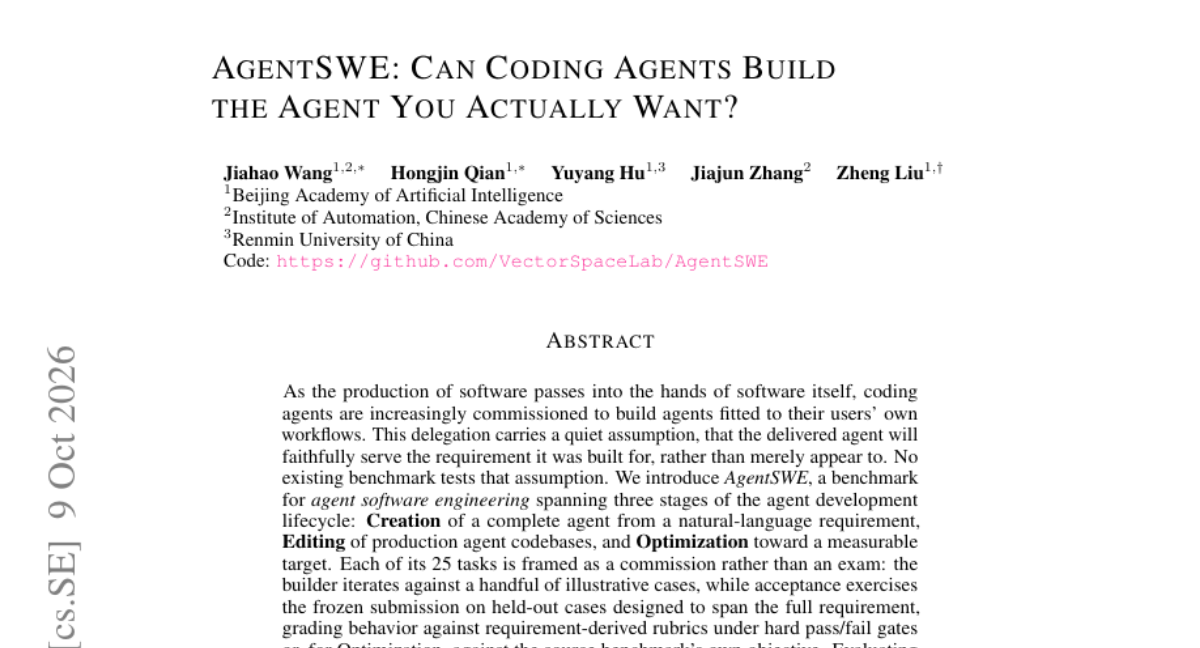
2. AgentSWE: Can Coding Agents Build the Agent You Actually Want?
🔑 Keywords: AgentSWE, coding agents, software engineering, benchmark
💡 Category: AI Systems and Tools
🌟 Research Objective:
– Introduce AgentSWE, a benchmark designed to evaluate the performance of coding agents across the agent development lifecycle.
🛠️ Research Methods:
– The benchmark spans three stages: creation, editing, and optimization of agent software, using 25 tasks framed as commissions.
💬 Research Conclusions:
– Existing coding agents fail to meet the requirements fully, highlighting issues like overfitting and unsupported completion claims.
👉 Paper link: https://huggingface.co/papers/2610.13361
3. VIS-Ground: Video Interactive Storytelling with Contextual Grounding
🔑 Keywords: Video Interactive Storytelling, Contextual Grounding, VIS-Ground, Structured Context Abstraction, Constrained Video Generation
💡 Category: Generative Models
🌟 Research Objective:
– The paper seeks to address how to transform heterogeneous, unstructured inputs into grounding contexts for video generation, focusing on enabling active viewer intervention.
🛠️ Research Methods:
– Introduction of VIS-Ground, a framework that includes Structured Context Abstraction to discern grounded states and cross-context dependencies, along with Generation Constraints Induction to create candidate-specific constraints for Constrained Video Generation.
💬 Research Conclusions:
– VIS-Ground consistently outperforms existing baselines by achieving a higher composite score, with significant improvements in narrative and knowledge grounding, but challenges in dependency extraction and video rendering remain.
👉 Paper link: https://huggingface.co/papers/2610.09326

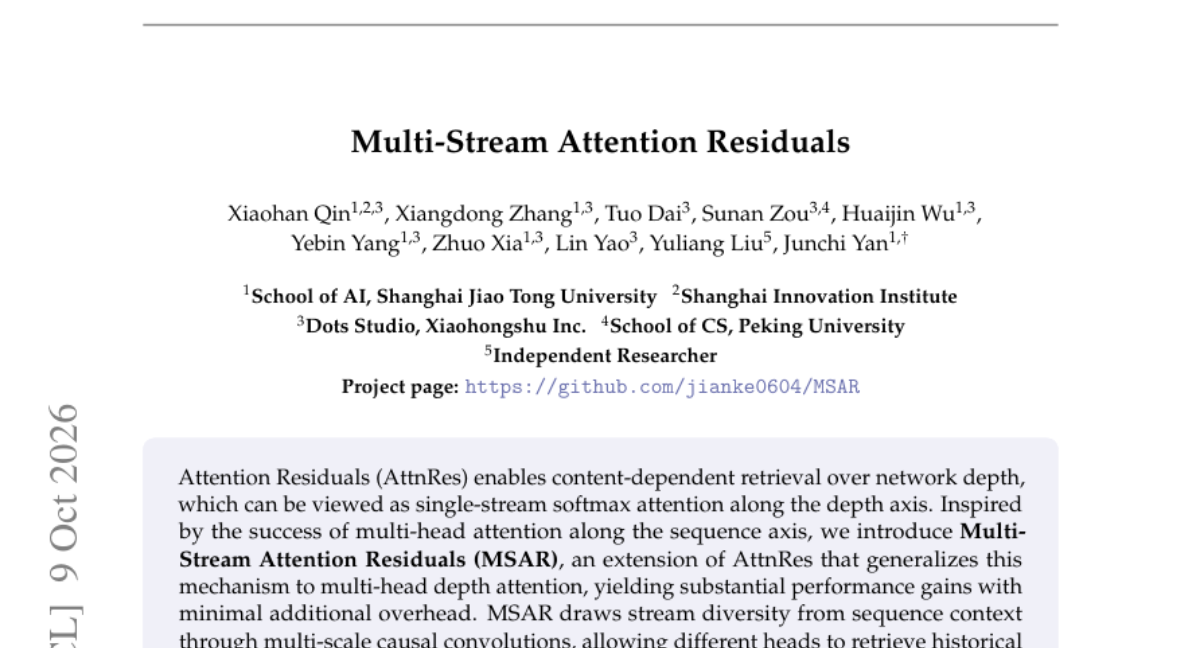
4. Multi-Stream Attention Residuals
🔑 Keywords: Multi-Stream Attention Residuals (MSAR), Attention Residuals (AttnRes), multi-head attention, depth attention
💡 Category: Machine Learning
🌟 Research Objective:
– The paper introduces Multi-Stream Attention Residuals (MSAR), an extension of Attention Residuals (AttnRes), to improve content-dependent retrieval over network depth through multi-head depth attention.
🛠️ Research Methods:
– Utilizes multi-scale causal convolutions to provide diverse contextual views for different attention heads, enabling efficient retrieval of historical representations without the need for persistent multi-stream storage.
💬 Research Conclusions:
– MSAR consistently outperforms standard residual variants across benchmarks at large scales and achieves significant compute speedup, making it a promising architecture for large-scale pre-training.
👉 Paper link: https://huggingface.co/papers/2610.13630
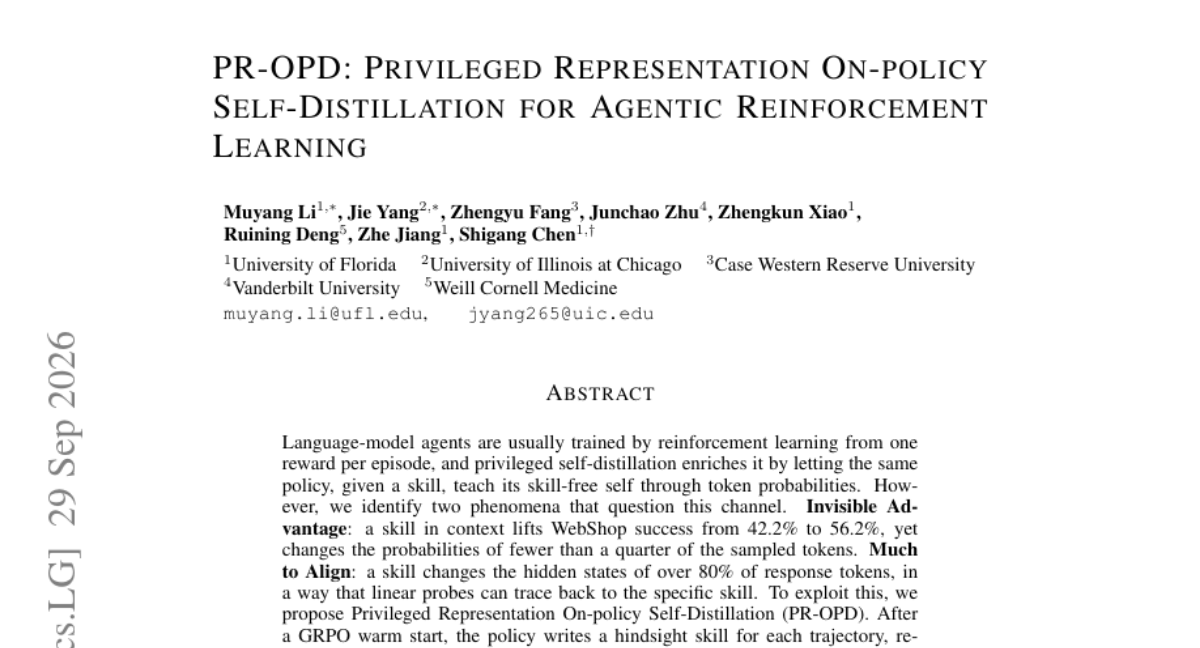
5. PR-OPD: Privileged Representation On-policy Self-Distillation for Agentic Reinforcement Learning
🔑 Keywords: Reinforcement Learning, Privileged Self-Distillation, WebShop, ALFWorld
💡 Category: Reinforcement Learning
🌟 Research Objective:
– To enhance language-model agents through Privileged Representation On-policy Self-Distillation (PR-OPD) by investigating skill impacts on performance and exploring invisible advantages in Reinforcement Learning frameworks.
🛠️ Research Methods:
– Implemented PR-OPD after a GRPO warm start to align projected hidden states with a hindsight skill within trajectories and evaluated it across ALFWorld and WebShop environments.
💬 Research Conclusions:
– PR-OPD outperformed previous GRPO benchmarks with significant improvements in ALFWorld and WebShop, achieving up to 4.7 points better success in ALFWorld and 14.0 points increased accuracy in WebShop.
👉 Paper link: https://huggingface.co/papers/2609.36642
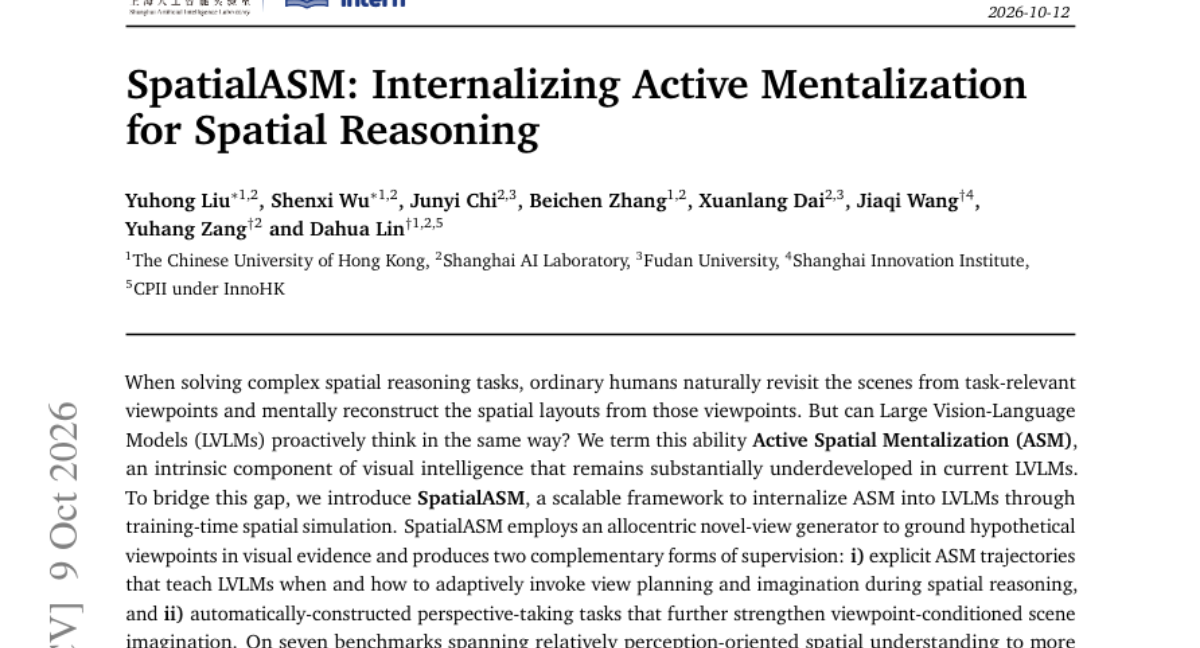
6. SpatialASM: Internalizing Active Mentalization for Spatial Reasoning
🔑 Keywords: Active Spatial Mentalization, Large Vision-Language Models, SpatialASM, visual intelligence, viewpoint-conditioned scene imagination
💡 Category: Computer Vision
🌟 Research Objective:
– The study aims to enhance the capacity of Large Vision-Language Models (LVLMs) for spatial reasoning by introducing Active Spatial Mentalization (ASM) through the SpatialASM framework.
🛠️ Research Methods:
– SpatialASM employs training-time spatial simulation using an allocentric novel-view generator, providing explicit ASM trajectories and automatically-constructed perspective-taking tasks to improve LVLMs’ spatial reasoning abilities.
💬 Research Conclusions:
– SpatialASM improves average accuracy across seven spatial benchmarks and offers a scalable method for eliciting active viewpoint exploration and mental scene simulation in LVLMs without compromising their general vision capabilities.
👉 Paper link: https://huggingface.co/papers/2610.13832
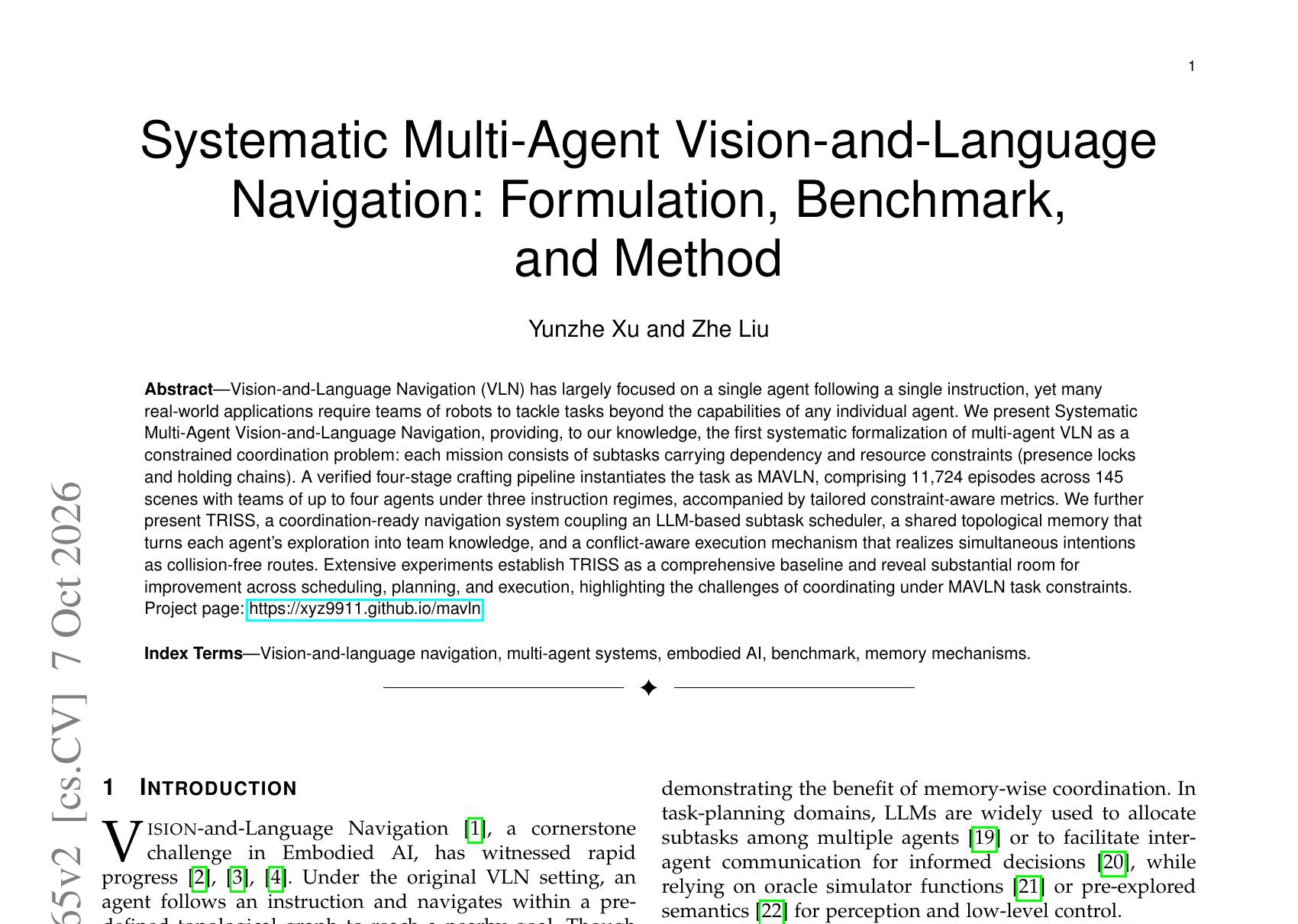
7. Systematic Multi-Agent Vision-and-Language Navigation: Formulation, Benchmark, and Method
🔑 Keywords: Vision-and-Language Navigation, Multi-Agent, Coordination, LLM-based scheduler, Collision-free routes
💡 Category: Robotics and Autonomous Systems
🌟 Research Objective:
– The research aims to systematically formalize multi-agent Vision-and-Language Navigation (VLN) as a constrained coordination problem, suitable for tasks involving multiple robots.
🛠️ Research Methods:
– The study introduces Systematic Multi-Agent VLN (MAVLN), featuring a four-stage crafting pipeline applied to 11,724 episodes across various scenes, using metrics aware of constraints such as dependency and resource management.
– TRISS is presented as a system integrating an LLM-based subtask scheduler, shared topological memory, and a conflict-aware execution mechanism for smooth coordination.
💬 Research Conclusions:
– Experiments demonstrate TRISS as a robust baseline highlighting the difficulties in scheduling, planning, and executing tasks under MAVLN constraints, pointing towards substantial areas for improvement in multi-agent coordination.
👉 Paper link: https://huggingface.co/papers/2609.35965
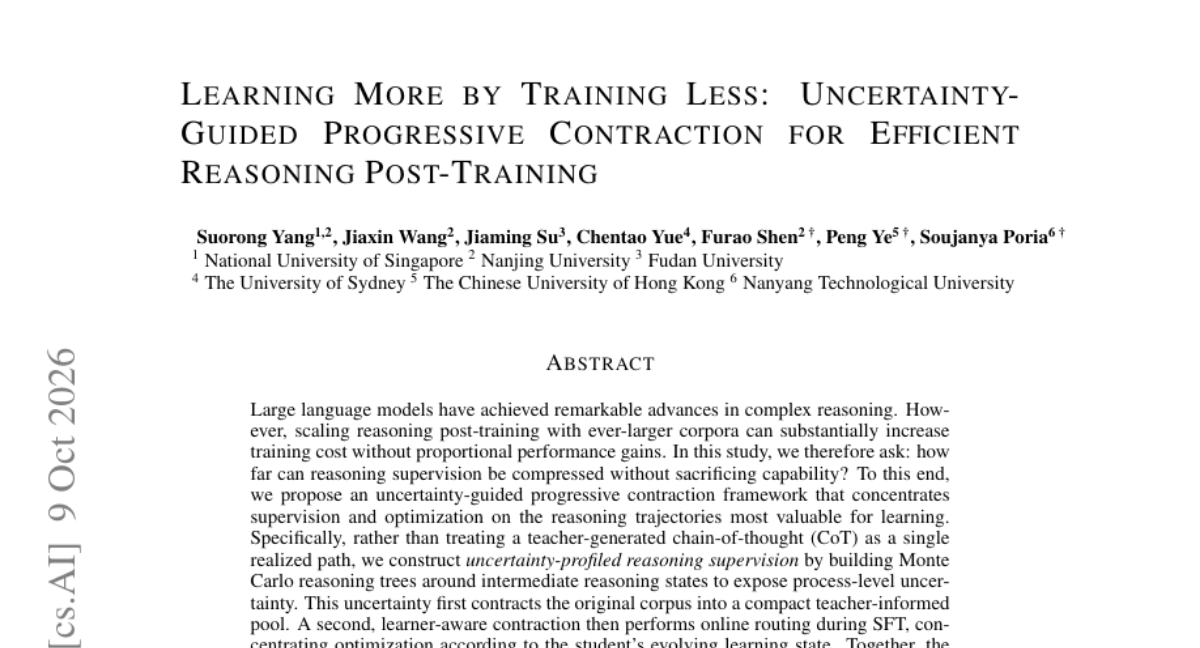
8. Learning More by Training Less: Uncertainty-Guided Progressive Contraction for Efficient Reasoning Post-Training
🔑 Keywords: Large Language Models, Reasoning Supervision, Uncertainty-guided, Optimization Budget, Transfer Learning
💡 Category: Knowledge Representation and Reasoning
🌟 Research Objective:
– To explore how reasoning supervision can be compressed without losing capability in large language models.
🛠️ Research Methods:
– An uncertainty-guided progressive contraction framework is introduced, utilizing Monte Carlo reasoning trees and a dual-stage contraction to reduce training costs.
💬 Research Conclusions:
– The proposed method significantly reduces the training budget by using only 0.22% of the optimization budget of full-data SFT, maintaining or even improving reasoning performance and showing generalization across diverse models.
👉 Paper link: https://huggingface.co/papers/2610.12933
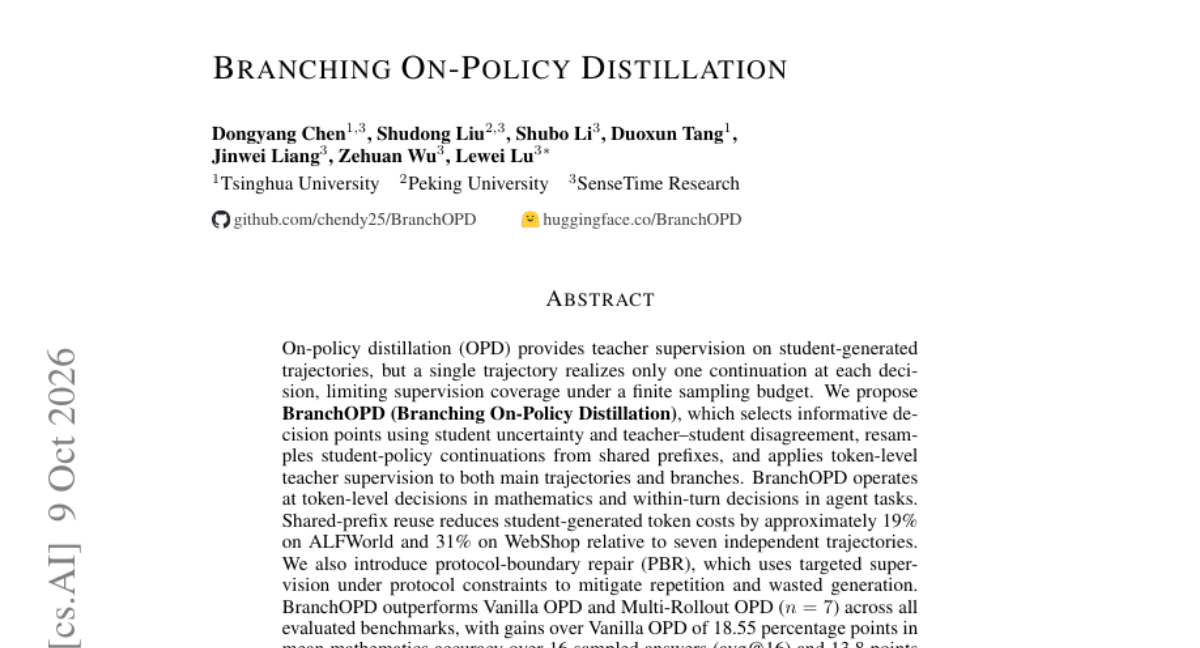
9. Branching On-Policy Distillation
🔑 Keywords: On-policy distillation, BranchOPD, student-generated trajectories, token-level supervision, protocol-boundary repair
💡 Category: Reinforcement Learning
🌟 Research Objective:
– The objective of this study is to address the limitation of supervision coverage in on-policy distillation by proposing BranchOPD, which increases decision point information and resamples student-policy continuations.
🛠️ Research Methods:
– BranchOPD uses student uncertainty and teacher-student disagreement to select decision points, applies token-level teacher supervision on both main and branched trajectories, and introduces protocol-boundary repair to enhance learning outcomes.
💬 Research Conclusions:
– BranchOPD outperforms existing methods (Vanilla OPD and Multi-Rollout OPD) in mathematics accuracy and success in agent tasks, demonstrates efficient cost reduction, and shows that branching at uncertain decisions improves behavior coverage.
👉 Paper link: https://huggingface.co/papers/2610.13481
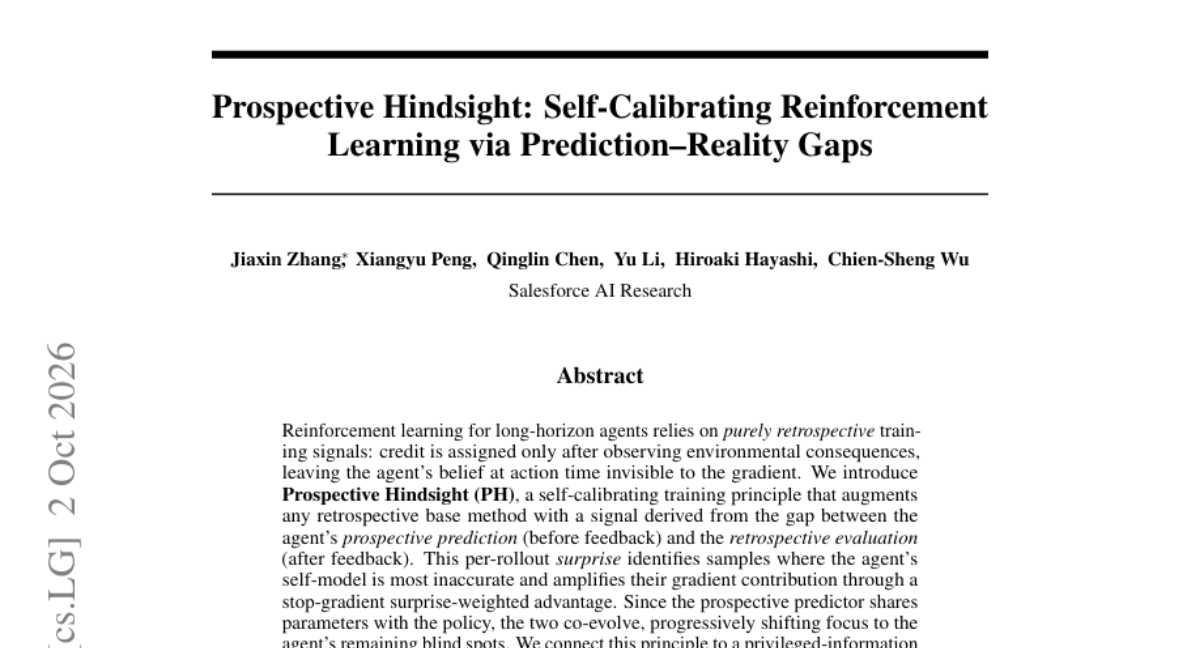
10. Prospective Hindsight: Self-Calibrating Reinforcement Learning via Prediction-Reality Gaps
🔑 Keywords: Reinforcement Learning, Prospective Hindsight, Calibration, Self-Model, Miscalibration
💡 Category: Reinforcement Learning
🌟 Research Objective:
– Introduce the Prospective Hindsight principle to augment retrospective training.
🛠️ Research Methods:
– Utilize a self-calibrating signal to enhance gradient contributions based on prediction gaps.
– Application of the principle in single-turn and multi-turn tasks with GRPO and on-policy distillation.
💬 Research Conclusions:
– Prospective Hindsight improves task performance and calibration across models.
– Successfully addresses miscalibration modes in both single and multi-turn scenarios.
👉 Paper link: https://huggingface.co/papers/2610.02740
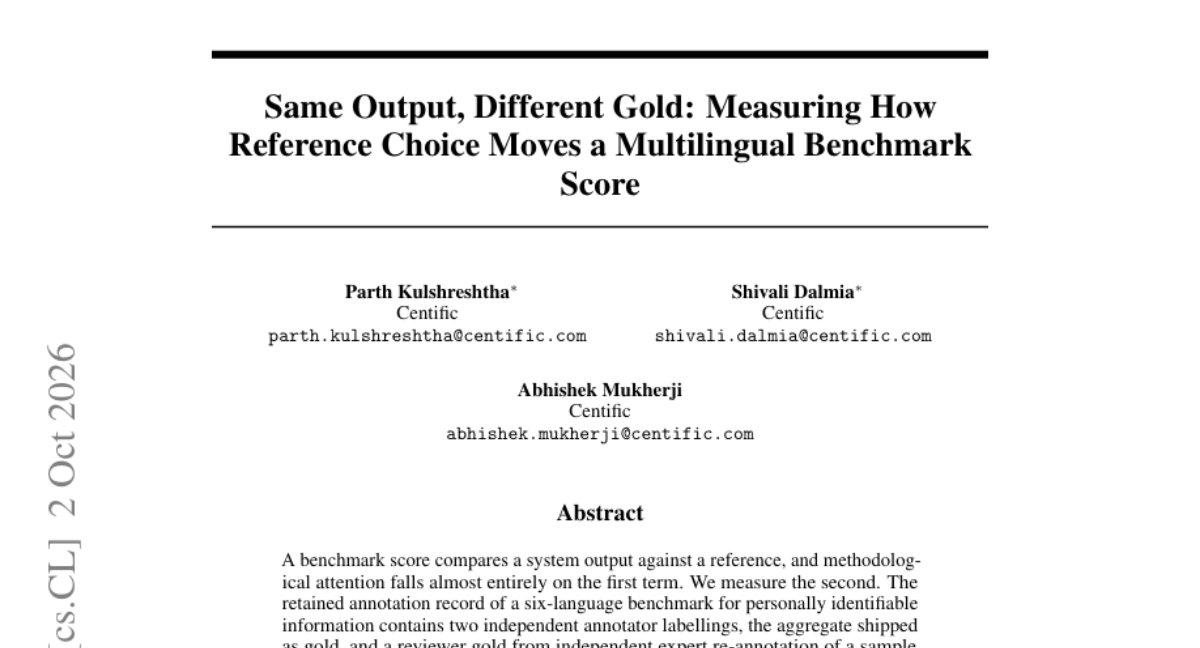
11. Same Output, Different Gold: Measuring How Reference Choice Moves a Multilingual Benchmark Score
🔑 Keywords: benchmark score, personally identifiable information, reference-sensitivity
💡 Category: Natural Language Processing
🌟 Research Objective:
– To measure the impact of reference sensitivity on benchmark scores within a multi-language context, particularly for personally identifiable information.
🛠️ Research Methods:
– Utilized a six-language benchmark with two independent annotator labellings and a reviewer gold standard, fixing the scored output but varying the reference to measure score variability.
💬 Research Conclusions:
– The benchmark score showed significant variability (up to 7.55 F1 points) based on reference sensitivity, due to undocumented aggregation defaults. The study proposes a reference-sensitivity band calculation to accompany scores for more accurate benchmarking.
👉 Paper link: https://huggingface.co/papers/2610.03825
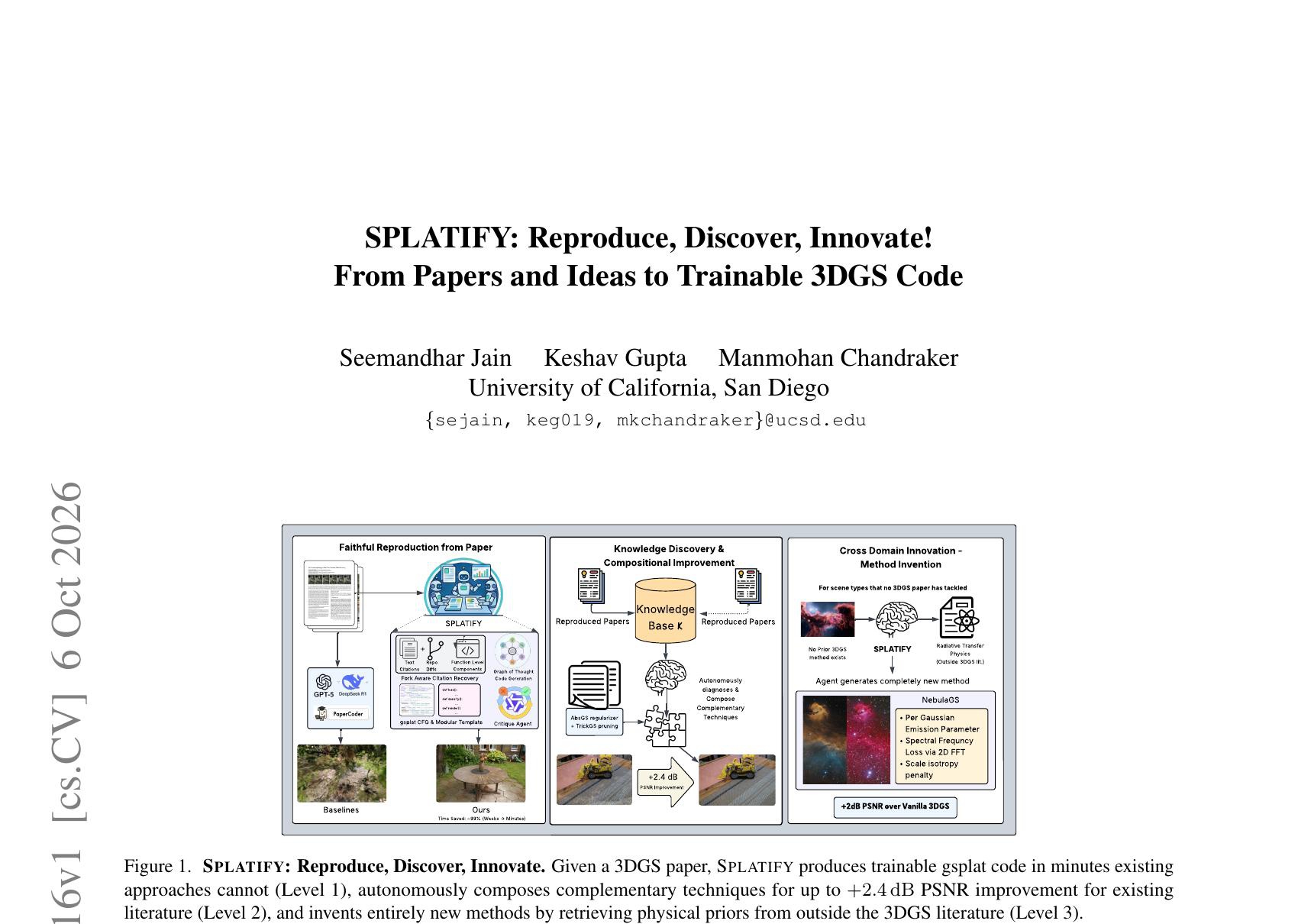
12. SPLATIFY: Reproduce, Discover, Innovate! From Papers and Ideas to Trainable 3DGS Code
🔑 Keywords: 3D Gaussian Splatting, SPLATIFY, multi-agent framework, trainable implementations, PSNR improvement
💡 Category: AI Systems and Tools
🌟 Research Objective:
– The objective is to introduce a framework called SPLATIFY to transform 3D Gaussian Splatting papers into functional and trainable implementations automatically and efficiently.
🛠️ Research Methods:
– SPLATIFY employs a context-free grammar, modular method templates, fork-aware citation recovery, and Graph-of-Thought synthesis to ensure accurate and efficient code generation. It also includes a knowledge-driven compositional improvement mechanism and interdisciplinary method discovery.
💬 Research Conclusions:
– SPLATIFY significantly reduces development time from weeks to minutes. It also enhances performance, achieving up to a 2.4 dB improvement in PSNR on 3DGS papers without public code. Additionally, SPLATIFY demonstrates new methods in domains such as volumetric nebula rendering.
👉 Paper link: https://huggingface.co/papers/2610.09116
13.
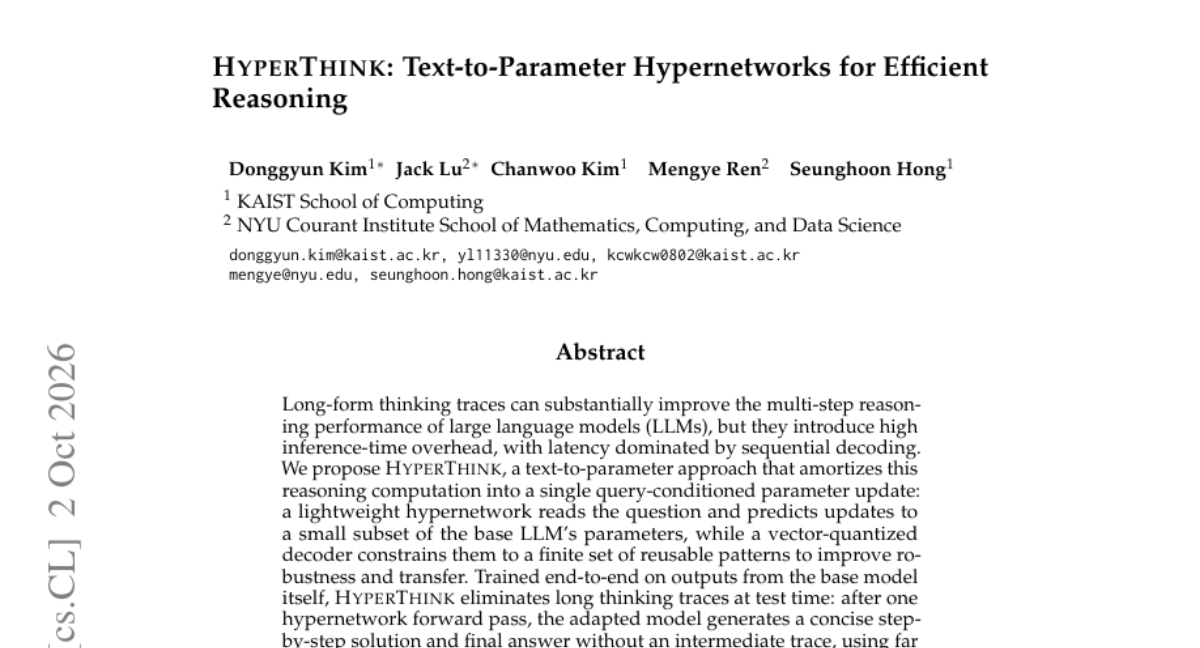
14. HyperThink: Text-to-Parameter Hypernetworks for Efficient Reasoning
🔑 Keywords: HyperThink, large language models, reasoning performance, inference-time overhead
💡 Category: Natural Language Processing
🌟 Research Objective:
– Propose HyperThink, a method to improve reasoning performance of large language models while reducing inference-time overhead.
🛠️ Research Methods:
– Use a text-to-parameter approach with a hypernetwork that predicts parameter updates, coupled with a vector-quantized decoder.
💬 Research Conclusions:
– HyperThink improves the accuracy-latency trade-off in reasoning tasks by eliminating long thinking traces and retaining strong reasoning performance.
👉 Paper link: https://huggingface.co/papers/2610.03039
15. UNITAS: A 3D-Native World Action Model for Embodied Manipulation
🔑 Keywords: World Action Models, 3D-native, UNITAS, AI Native, Robotics
💡 Category: Robotics and Autonomous Systems
🌟 Research Objective:
– To develop UNITAS, a 3D-native world action model integrating observations, actions, and scene dynamics in a metric 3D space for robotic interactions.
🛠️ Research Methods:
– Introduction of world-aligned 3D positional embeddings and a physical-time trajectory tokenizer for encoding 3D point trajectories, unified across human and robot embodiments.
💬 Research Conclusions:
– UNITAS surpasses existing methods in action-conditioned scene prediction with lower displacement errors and achieves state-of-the-art manipulation success, with significant performance on the RoboTwin, LIBERO, and real-world tasks.
👉 Paper link: https://huggingface.co/papers/2610.12099

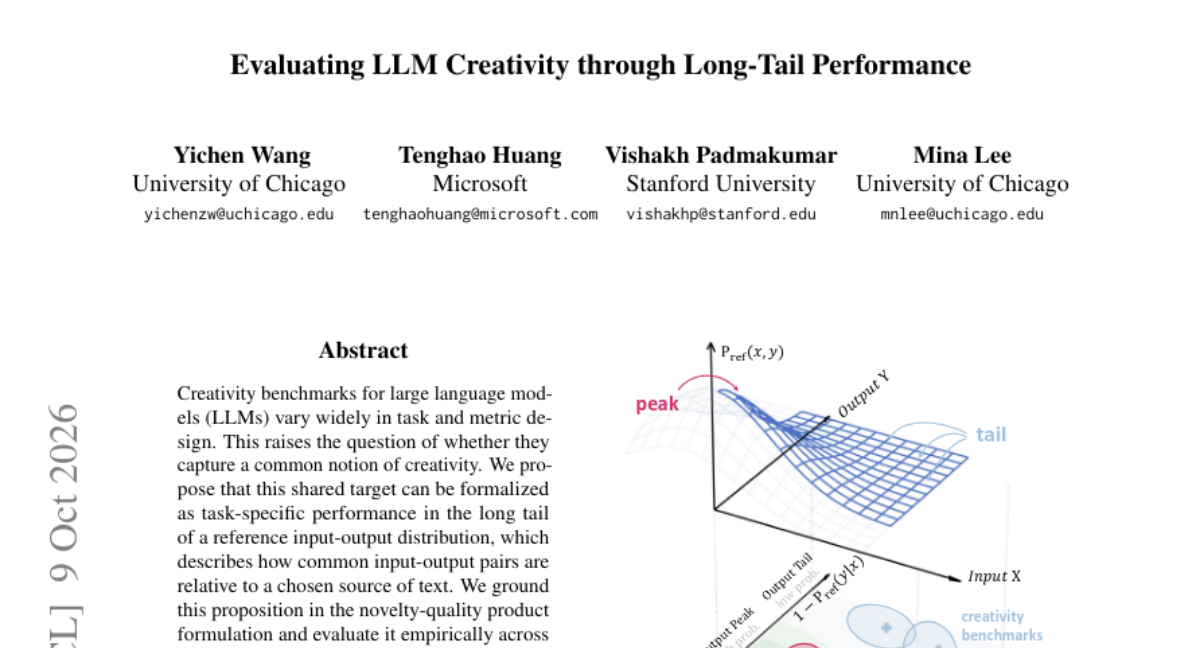
16. Evaluating LLM Creativity through Long-Tail Performance
🔑 Keywords: Creativity benchmarks, Large Language Models, Task-specific performance, Novelty-quality, q@Tail(α)
💡 Category: Natural Language Processing
🌟 Research Objective:
– The paper aims to investigate if common notions of creativity can be captured through specific task performance in the long tail of a reference input-output distribution.
🛠️ Research Methods:
– Evaluating 15 benchmarks and 26 open-weight models using n-gram absence as a novelty proxy to assess creativity. Introducing q@Tail(α) as a diagnostic tool for measuring creativity.
💬 Research Conclusions:
– Creativity benchmarks tend to lie further in the input-output tail regions compared to standard benchmarks. Models’ rankings on high-tail subsets align better with human creativity judgments. There’s potential for improving LLM creativity with enhanced tail performance.
👉 Paper link: https://huggingface.co/papers/2610.12998
17. Visual Grounding Safety in Vision-Language Models
🔑 Keywords: Vision-language models, safety alignment, visual grounding, fine-tuning, refusal improvement
💡 Category: AI Ethics and Fairness
🌟 Research Objective:
– To systematically analyze the safety alignment of output channels in Vision-language models, specifically in their use of visual grounding.
🛠️ Research Methods:
– Repurposing three safety benchmarks (direct harm, social bias, and situational safety) to create 15,401 harmful request pairs and analyze model responses, comparing grounding with free-text answers.
💬 Research Conclusions:
– Found that Vision-language models are less likely to refuse grounding requests compared to text-based answers, with a fine-tuning approach proposed to improve grounding refusal by significant margins while maintaining model capabilities and controlling over-refusal.
👉 Paper link: https://huggingface.co/papers/2610.05637
18. Initialization Improves LLM-Driven Discovery
🔑 Keywords: Large Language Models, harness design, diversity, iterative optimization, initialization
💡 Category: Natural Language Processing
🌟 Research Objective:
– To study the relationship between previous iterates’ population and discovery success in LLMs, and generalize harness design for improved discovery tasks.
🛠️ Research Methods:
– Developed a suite of 12 ‘Modular’ harnesses across 5 diverse discovery tasks to analyze sensitivity to harness design and identify failure modes like mode collapse.
💬 Research Conclusions:
– Discovery success is sensitive to harness design with mode collapse as a common failure. Early discoveries predict success; hence, an initial stage of parallel exploration before iterative optimization improves outcomes across harnesses and applications.
👉 Paper link: https://huggingface.co/papers/2610.00707
19. ARCS: Towards Precise Text-to-SQL via Structured Disambiguation
🔑 Keywords: Text-to-SQL, Ambiguity, Structured Disambiguation, ARCS, gpt-6-sol
💡 Category: Natural Language Processing
🌟 Research Objective:
– The objective is to tackle ambiguity in text-to-SQL systems as they are deployed in real-world scenarios, proposing structured disambiguation for resolving these ambiguities.
🛠️ Research Methods:
– Introduction of the ARCS benchmark which features naturally occurring ambiguities in real-world databases with comprehensive annotations to facilitate ambiguity resolution.
💬 Research Conclusions:
– The study demonstrates the challenge of ambiguity in text-to-SQL systems, evidenced by gpt-6-sol achieving only 51% execution accuracy, highlighting the insufficiency of existing models.
👉 Paper link: https://huggingface.co/papers/2610.09396
20. T3lescope: Arbitrary-Resolution High-Fidelity Generative Surface Reconstruction from Images
🔑 Keywords: 3D scene reconstruction, multi-view images, generative methods, T3lescope, global geometric consistency
💡 Category: Computer Vision
🌟 Research Objective:
– To reconstruct high-fidelity 3D scene meshes from posed multi-view images across varying scales without per-scene optimization.
🛠️ Research Methods:
– The development of T3lescope, a single fixed-resolution generator applied in a coarse-to-fine cascade to establish scene layout and recover surface details, trained on individual cells at multiple scales.
💬 Research Conclusions:
– T3lescope outperforms existing methods in diverse scenes, effectively generalizing across different view counts and image resolutions, and is capable of recovering fine structures including glossy and transparent surfaces.
👉 Paper link: https://huggingface.co/papers/2610.03308

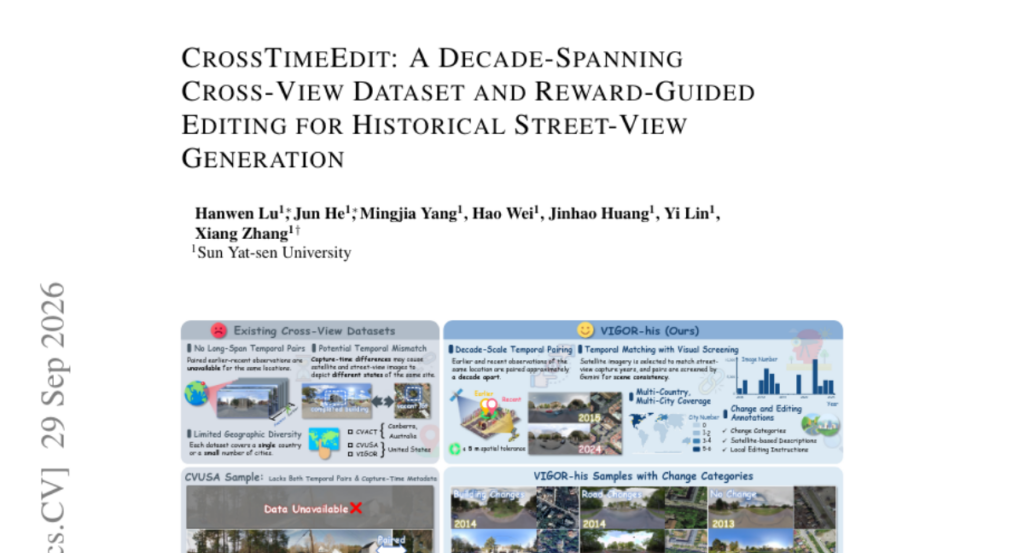
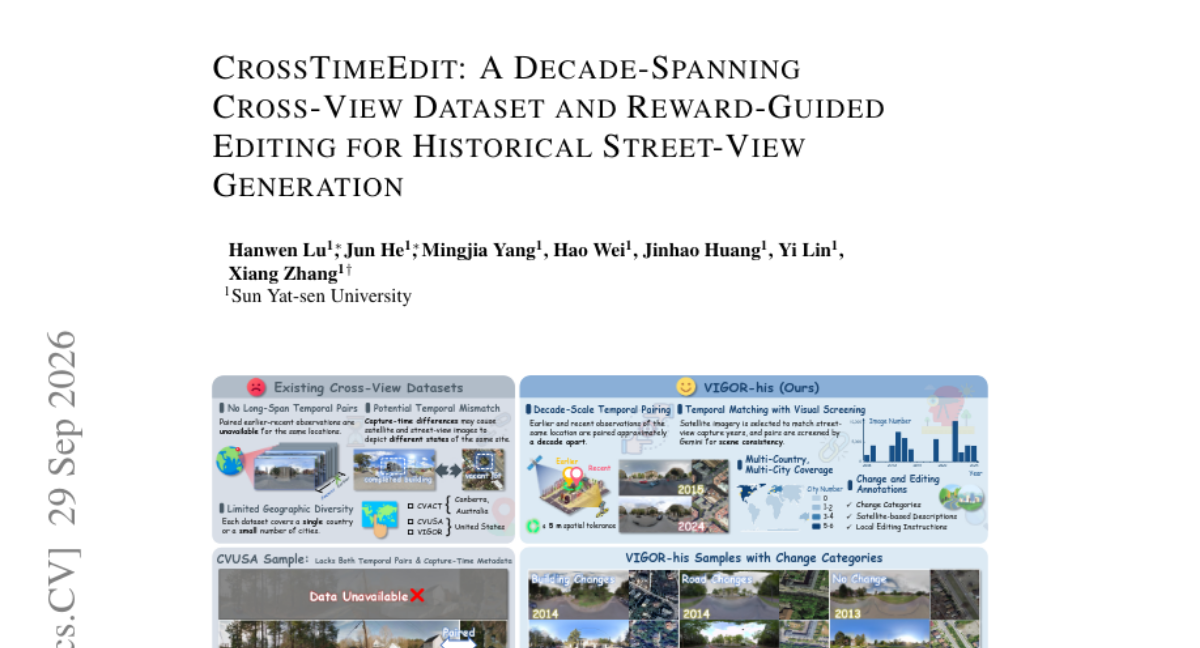
21. CrossTimeEdit: A Decade-Spanning Cross-View Dataset and Reward-Guided Editing for Historical Street-View Generation
🔑 Keywords: Urban Evolution, CrossTimeEdit, Historical Imagery, Reinforcement Learning, Street-View Editing
💡 Category: Computer Vision
🌟 Research Objective:
– Addressing gaps in historical urban imagery by generating plausible past appearances of street views using the VIGOR-his dataset.
🛠️ Research Methods:
– Development of the VIGOR-his dataset with automated pipelines for spatial pairing and consistency.
– Proposal and training of the CrossTimeEdit model using supervised fine-tuning and online reinforcement learning.
– Implementation of criteria for street-view editing as reward dimensions in RL.
💬 Research Conclusions:
– CrossTimeEdit improved overall performance by 17.12% over the pretrained baseline.
– Demonstrated superior results in scene consistency, visual realism, and perceptual quality over existing models.
👉 Paper link: https://huggingface.co/papers/2609.36616
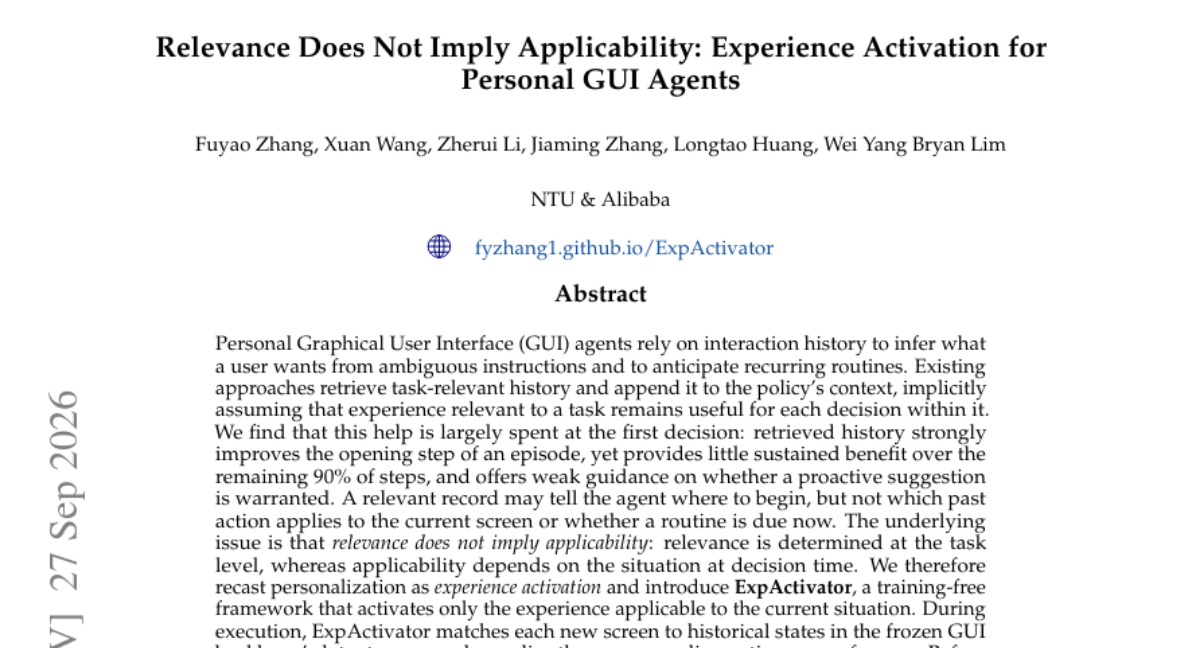
22. Relevance Does Not Imply Applicability: Experience Activation for Personal GUI Agents
🔑 Keywords: Personal GUI agents, interaction history, ExpActivator
💡 Category: AI Systems and Tools
🌟 Research Objective:
– To recast the personalization of Personal GUI agents from simply using interaction history to actively activating only applicable experiences by introducing ExpActivator.
🛠️ Research Methods:
– Developed a training-free framework, ExpActivator, that matches each new GUI screen to historical states using a latent space model, activating experiences based on current context relevance.
💬 Research Conclusions:
– ExpActivator enhances step success by 28% on average across different GUI backbones, effectively utilizing fewer history tokens and vastly improving personalization by ensuring that experience is activated, not just appended, leading to higher performance metrics compared to proactive baselines.
👉 Paper link: https://huggingface.co/papers/2609.33304
23. GroundAnything: Reconciling Parallel Decoding with Precise Visual Grounding at Flash Speed
🔑 Keywords: Autoregressive, Diffusion, GroundAnything, Visual Grounding, Reinforcement Learning
💡 Category: Computer Vision
🌟 Research Objective:
– The paper introduces GroundAnything, a 4B-parameter grounding foundation model designed to improve spatial localization and prediction efficiency by leveraging bidirectional diffusion techniques.
🛠️ Research Methods:
– The model integrates grounding pretraining from public datasets, combines AR-to-diffusion conversion with joint objectives, and utilizes supervised fine-tuning and GRPO-based reinforcement post-training.
💬 Research Conclusions:
– GroundAnything-VLM establishes a new state-of-the-art among similarly sized models with a 72.42% score on grounding benchmarks, surpassing previous leading models like GPT-6 Astra. Further, it achieves significant speedup in decoding strategies, emphasizing its efficiency in latency-sensitive applications.
👉 Paper link: https://huggingface.co/papers/2609.39600

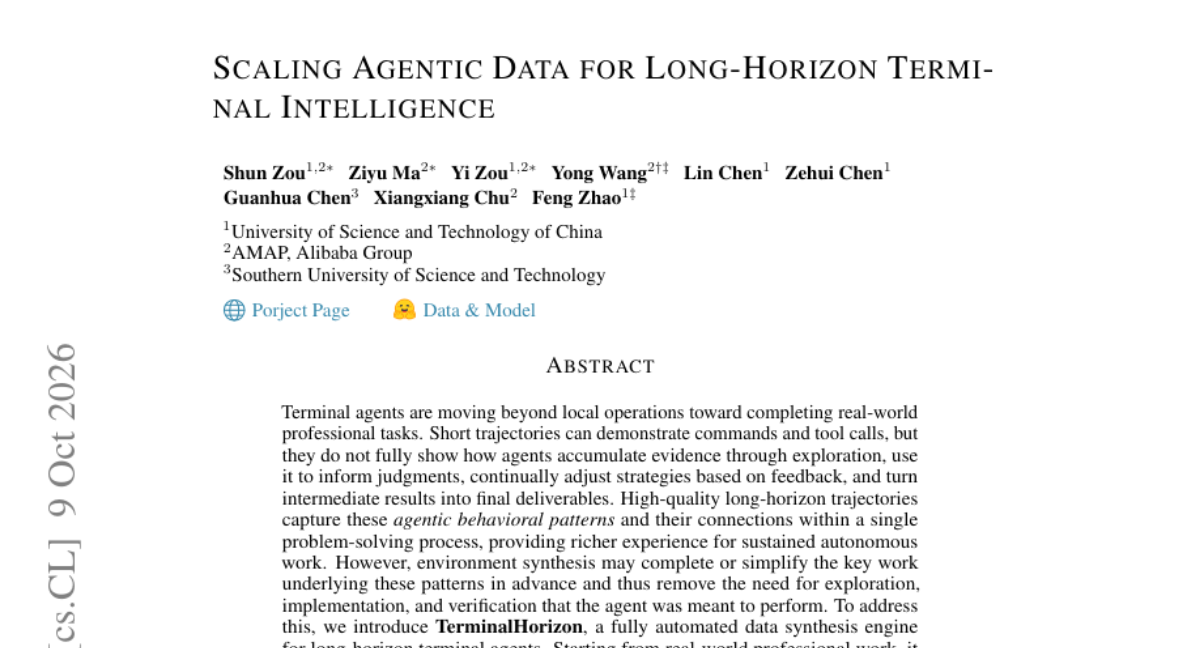
24. Scaling Agentic Data for Long-Horizon Terminal Intelligence
🔑 Keywords: Terminal agents, Long-horizon trajectories, Autonomous work, Environment synthesis, TerminalHorizon
💡 Category: Reinforcement Learning
🌟 Research Objective:
– The study aims to advance terminal agents beyond short trajectories to handle sustained professional tasks autonomously, capturing agentic behavioral patterns in a cohesive problem-solving process.
🛠️ Research Methods:
– Introduction of TerminalHorizon, a fully automated data synthesis engine that reconstructs environments and expands tasks to gather evidence for long-horizon terminal agents.
– Construction of 1.5K task environments and fine-tuning of the Qwen3.5-27B model, resulting in the TerminalHorizon-27B.
💬 Research Conclusions:
– The enhanced model exhibits substantial performance improvements across various benchmarks, allowing it to continue experimentation and improve deliverables through feedback and iteration.
👉 Paper link: https://huggingface.co/papers/2610.13166
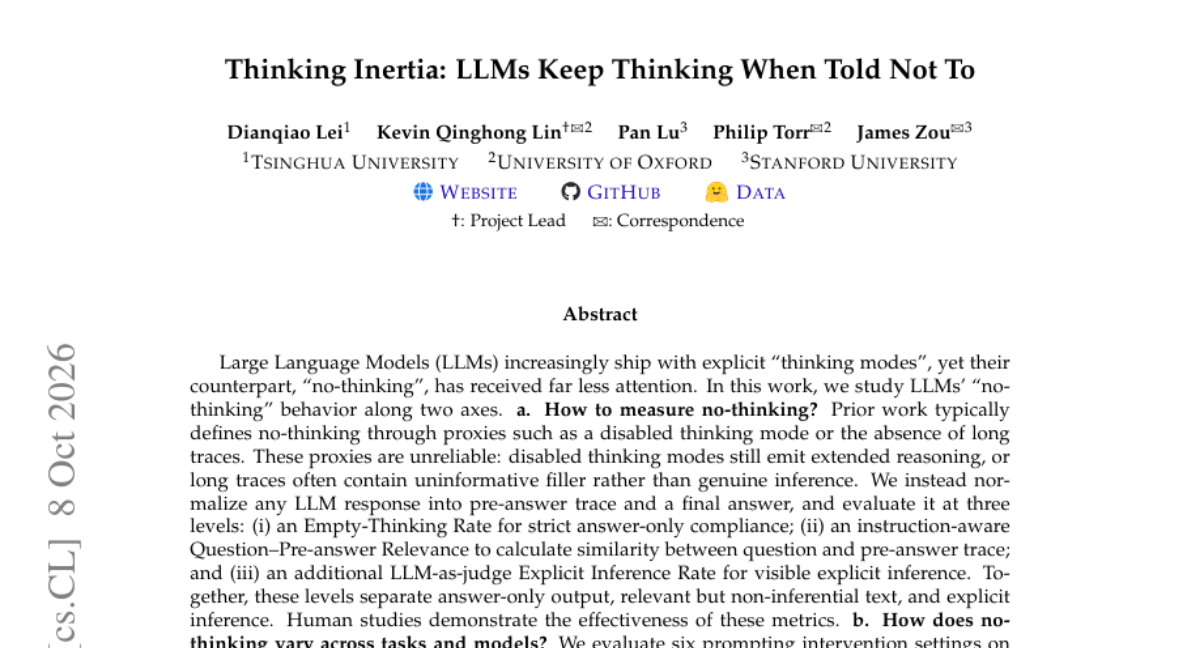
25. Thinking Inertia: LLMs Keep Thinking When Told Not To
🔑 Keywords: Large Language Models, Thinking Modes, No-Thinking, Explicit Inference, Thinking Inertia
💡 Category: Natural Language Processing
🌟 Research Objective:
– The study focuses on understanding and measuring the “no-thinking” behavior in Large Language Models, contrasting it with the explicit “thinking modes.”
🛠️ Research Methods:
– Introducing a novel evaluation approach through three metrics: Empty-Thinking Rate, Question-Pre-answer Relevance, and Explicit Inference Rate, to assess the no-thinking behavior across different tasks and models.
💬 Research Conclusions:
– Explicit controls to enforce no-thinking in LLMs are unreliable as models show Thinking Inertia, wherein explicit inference persists despite controls. There’s a trade-off between answer-only compliance and task accuracy in open-ended tasks, while Boolean and multiple-choice tasks maintain accuracy.
👉 Paper link: https://huggingface.co/papers/2610.11765