AI Native Daily Paper Digest – 20261020 – SpecMRL | InfiniDream | OpenVLHarness
Today’s digest features major advancements from Llama and DeepSeek, shedding light on new methods in AI capabilities. The collection centers around themes of agentic systems and robotics, with a focus on enhancing cognitive functions and physical interactions. One paper highlights a novel approach using reinforcement learning to improve robotic arm precision, achieving a 15% increase in task accuracy over previous benchmarks. Another study presents a deep dive into optimizing multi-agent collaboration, demonstrating connectivity improvements within complex environments. The findings underscore the significant potential of deploying these models in real-world applications.
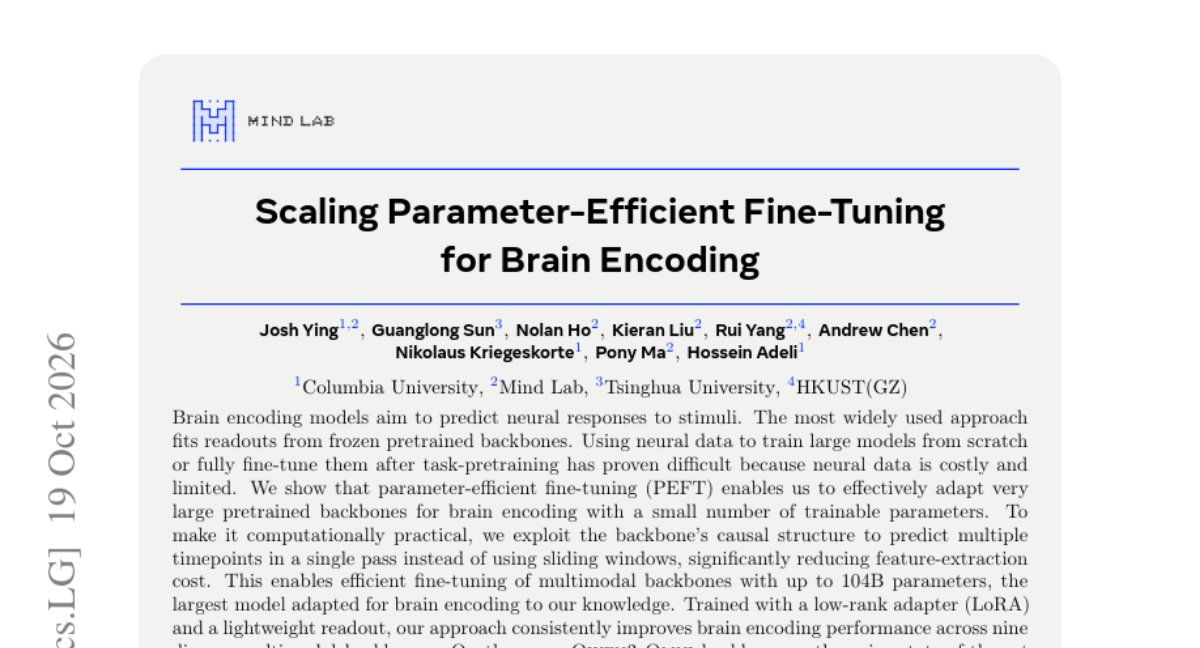
1. Scaling Parameter-Efficient Fine-Tuning for Brain Encoding
🔑 Keywords: Parameter-efficient fine-tuning, Brain encoding, Multimodal backbones, LoRA, Neural adaptation
💡 Category: Multi-Modal Learning
🌟 Research Objective:
– Demonstrate the effectiveness of parameter-efficient fine-tuning for adapting large multimodal backbones to improve brain encoding performance with reduced computational cost.
🛠️ Research Methods:
– Utilize low-rank adapters and lightweight readouts to efficiently fine-tune multimodal backbones, exploiting causal structure for computational practicality.
– Develop a multi-LoRA kernel to enhance joint training and enable a large ensemble of adapted models.
💬 Research Conclusions:
– The approach significantly improves brain encoding performance across diverse multimodal backbones, achieving state-of-the-art results on the Algonauts 2025 Challenge and maintaining model interpretability and efficient neural adaptation.
👉 Paper link: https://huggingface.co/papers/2610.26802
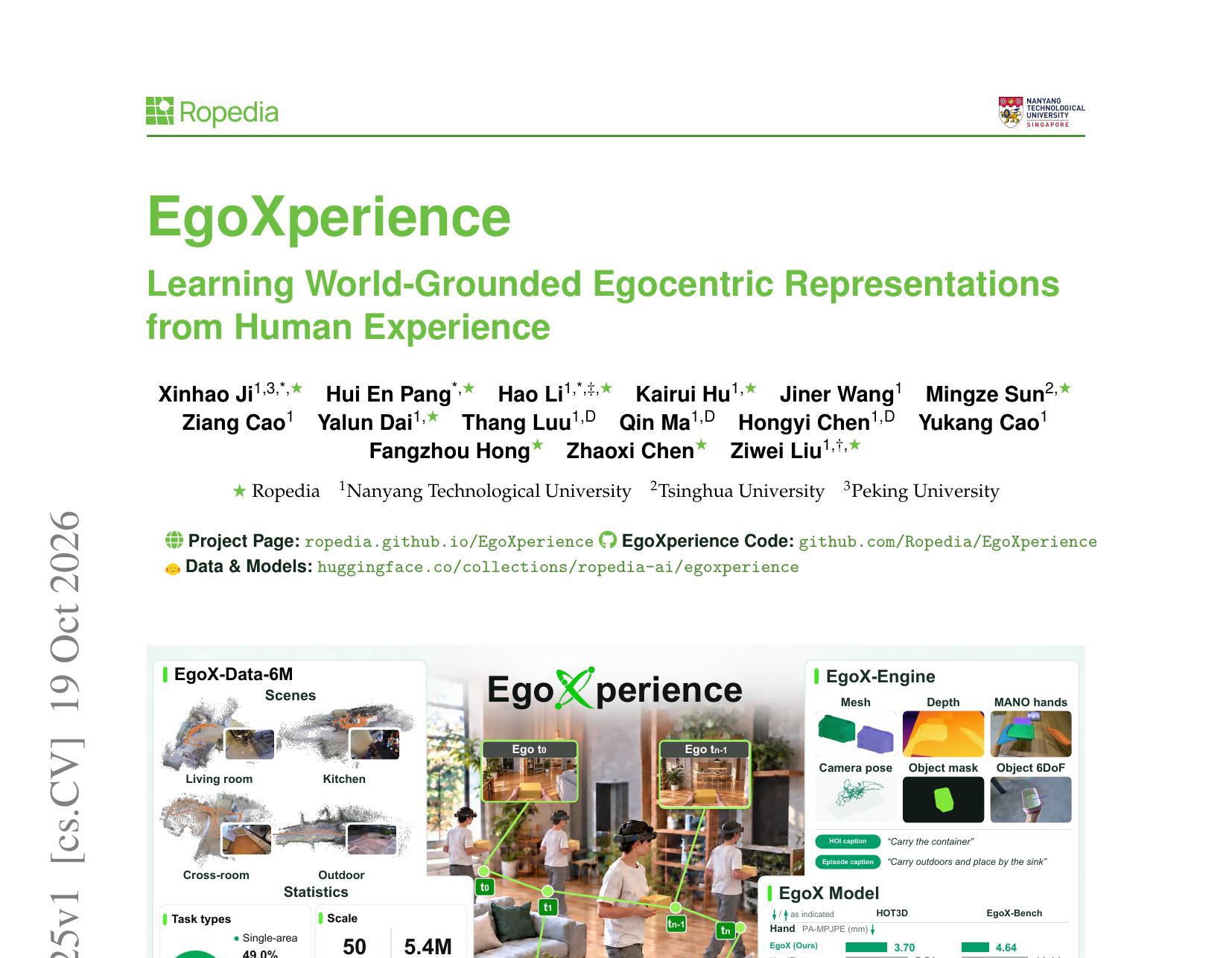
2. EgoXperience: Learning World-Grounded Egocentric Representations from Human Experience
🔑 Keywords: EgoXperience, Egocentric Video, Joint Reconstruction, Object Tracking, Scene Estimation
💡 Category: Computer Vision
🌟 Research Objective:
– The study aims to develop a unified framework, EgoXperience, for the joint reconstruction of camera motion, scene geometry, hands, and objects from egocentric video.
🛠️ Research Methods:
– It involves an automatic annotation engine, EgoX-Engine, which integrates geometrically verified object tracking with SLAM-based world alignment, and uses a dataset named EgoX-Data-6M for training.
💬 Research Conclusions:
– EgoX achieves state-of-the-art performance in scene estimation and world-space hand-object pose recovery, significantly reducing camera, hand, and depth errors while improving object pose scores against baseline methods.
👉 Paper link: https://huggingface.co/papers/2610.26625
3. Holi-World: Building Holistic World Intelligence from Human-Ego Experience
🔑 Keywords: Egocentric Experience, Automated Data Construction, Dynamic Perception, World Representation, HOLIWORLD
💡 Category: Computer Vision
🌟 Research Objective:
– Develop an integrated ecosystem, HOLI-WORLD, to automate the creation of learning resources from egocentric recordings to enhance machine understanding of dynamic scenes and interactions.
🛠️ Research Methods:
– HOLI-WORLD connects experience capture, world representation, automated data construction, model learning, and evaluation. It organizes data from 100 self-collected scenes and constructs world records to support learning at scale.
💬 Research Conclusions:
– HOLI-WORLD demonstrates strong performance in static perception and dynamic tracking. Training on HOLIWORLD-Data significantly enhances spatial and temporal reasoning abilities, providing a practical foundation for expanding learning resources from human experience.
👉 Paper link: https://huggingface.co/papers/2610.26549
4. OpenVLHarness: Real World Visual Agentic Tool-Use with Multimodal Memory
🔑 Keywords: OpenVLHarness, multimodal reasoning, persistent multimodal memory, heterogeneous tools, iterative evidence composition
💡 Category: Knowledge Representation and Reasoning
🌟 Research Objective:
– To enhance multimodal reasoning capabilities by integrating persistent memory, diverse tool interfaces, and iterative evidence composition across multiple benchmarks.
🛠️ Research Methods:
– Developed a new multimodal reasoning harness called OpenVLHarness, which utilizes a capability layer that combines task-level tool interfaces with evidence rendering for heterogeneous backends, and employs a persistent multimodal memory for managing diverse data artifacts.
💬 Research Conclusions:
– OpenVLHarness demonstrated significant improvements across 22 benchmarks, showing an increase of 9.7-12.6 points over baseline models without tools, indicating its effectiveness in multimodal evidence acquisition and reasoning.
👉 Paper link: https://huggingface.co/papers/2610.26860
5. SpecMRL: Redesign Matryoshka Representation Learning within Parametric Spectrum
🔑 Keywords: SpecMRL, Matryoshka Representation Learning, spectral basis, prefix readout, representation compression
💡 Category: Machine Learning
🌟 Research Objective:
– The study aims to improve compressed embeddings by introducing SpecMRL, which reorganizes features using a learned spectral basis to enhance informative direction prioritization.
🛠️ Research Methods:
– SpecMRL extends Matryoshka Representation Learning (MRL) by implementing a spectral basis derived from parameters and performs prefix readout in this newly organized spectral space.
💬 Research Conclusions:
– SpecMRL consistently outperforms standard MRL at reduced dimensions, achieving substantial gains under aggressive compression settings. It surpasses the performance of full-dimensional MRL using only half the embedding dimensions.
👉 Paper link: https://huggingface.co/papers/2610.26824

6. CoworkEnv: Synthesizing Training Environments for Long-Horizon Cowork Agents
🔑 Keywords: AI coworkers, Supervised Fine-Tuning, Reinforcement Learning, Training Environments, Policy Optimization
💡 Category: AI Systems and Tools
🌟 Research Objective:
– The primary aim is to synthesize executable training environments for AI coworkers, enhancing their ability to coordinate tools, communicate efficiently, and respect workflow constraints.
🛠️ Research Methods:
– Utilizes workflow-guided task construction and programmatic validation for generating training experiences, employing both Supervised Fine-Tuning and Reinforcement Learning to train compact PocketWorker models.
💬 Research Conclusions:
– Demonstrated improvement in AI coworker’s performance, raising the mean score significantly in the Claw-Eval benchmark, particularly in Multi-turn tasks, with evidence supporting policy optimization.
👉 Paper link: https://huggingface.co/papers/2610.24960
7. Interlock: From Local Correctness to Task Completion in Long-Horizon Agents
🔑 Keywords: Long-horizon tasks, Typed completion graph, AI Native, AutomationBench, Qwen3.6
💡 Category: AI Systems and Tools
🌟 Research Objective:
– The study aims to improve large language model agents’ handling of long-horizon tasks in complex environments by using Interlock, which synthesizes tasks as typed completion graphs and enforces cross-component constraints.
🛠️ Research Methods:
– The framework employs agent-based verification and self-training, involving grounding edges, coupling hyperedges, and realization edges, resulting in the creation of resettable workspaces and public evaluations. Two Qwen3.6 backbones were fine-tuned on accepted trajectories.
💬 Research Conclusions:
– Training with synthesized experiences increased task pass rates in benchmarks like AutomationBench and JobBench, demonstrating the effectiveness of the method in enhancing agent performance across various task environments.
👉 Paper link: https://huggingface.co/papers/2610.19686

8. Kronecker Delta Rule for Long Context Linear Attention
🔑 Keywords: KronLSTM, Kronecker Delta Rule, Linear Attention, Associative Memory, Long-Context Modeling
💡 Category: Natural Language Processing
🌟 Research Objective:
– Introduce KronLSTM, a novel linear attention architecture utilizing Kronecker Delta Rule for stable memory updates in long-context modeling.
🛠️ Research Methods:
– Implements a memory-revision mechanism that minimally disrupts existing associations and uses Markov chain mathematics for steady-state assurance without additional normalization.
💬 Research Conclusions:
– KronLSTM demonstrates competitive, often superior performance over existing linear attention frameworks, proving effective for long-context benchmarks with stable associative memory.
👉 Paper link: https://huggingface.co/papers/2610.26834

9. MemPilot: Orchestrating On-Demand Multimodal Memory Curation for LLM Agents
🔑 Keywords: MemPilot, reinforcement learning, LLM agent, query-specific curation, multi-modal agent-memory
💡 Category: Multi-Modal Learning
🌟 Research Objective:
– Develop MemPilot, a flexible framework balancing performance, cost, and latency for dynamically curating multimodal agent memory.
🛠️ Research Methods:
– Utilizes reinforcement learning to optimize a multi-step LLM policy for memory curation, leveraging query-specific curation and adaptable model selection.
– Implements objective-wise advantage decoupling and prefix-based marginal utility estimation to fine-tune policy optimization in multi-step rollouts.
💬 Research Conclusions:
– Experiments on multimodal agent-memory benchmarks demonstrate MemPilot’s superior trade-offs in performance, cost, and latency compared to existing baselines.
👉 Paper link: https://huggingface.co/papers/2610.06830

10. InfiniDream: Open-Ended Photorealistic 3D Worlds Through Procedural Generation
🔑 Keywords: InfiniDream, Procedural Generation, Vision-Language Model (VLM), Photorealistic 3D Worlds, Scene Placement
💡 Category: Generative Models
🌟 Research Objective:
– The study aims to introduce InfiniDream, a vision-language model framework designed for generating open-ended, editable, and photorealistic 3D worlds using symbolic procedural asset creation and deterministic scene placement.
🛠️ Research Methods:
– Utilized Symbolically Constrained Asset Generation to produce novel photorealistic assets, maintaining editability and diversity.
– Developed an end-to-end text-to-world pipeline combining semantic scene planning with Deterministic Frustum-Guided Grid Placement for accurate scene creation and object placement.
💬 Research Conclusions:
– Extensive evaluations on diverse tasks show that InfiniDream improves across four perceptual metrics, with diversity analysis and human evaluations supporting its effectiveness.
👉 Paper link: https://huggingface.co/papers/2610.26853

11. Manga2Animate: An Agentic Framework for Faithful Manga Animation with Script and Storyboard Planning
🔑 Keywords: Manga2Animate, multi-agent framework, animation script, visual storyboard
💡 Category: Generative Models
🌟 Research Objective:
– The study aims to develop Manga2Animate, a framework for adapting existing manga into coherent animation that stays faithful to the source material.
🛠️ Research Methods:
– The proposed framework employs a multi-agent system using paired creator and reviewer agents to generate two intermediate representations: an animation script and a visual storyboard. These are progressively refined before synthesizing the final animation.
💬 Research Conclusions:
– Extensive experiments and a user study reveal that Manga2Animate produces animations more faithful to the source manga and more consistent across shots compared to state-of-the-art methods.
👉 Paper link: https://huggingface.co/papers/2610.26851

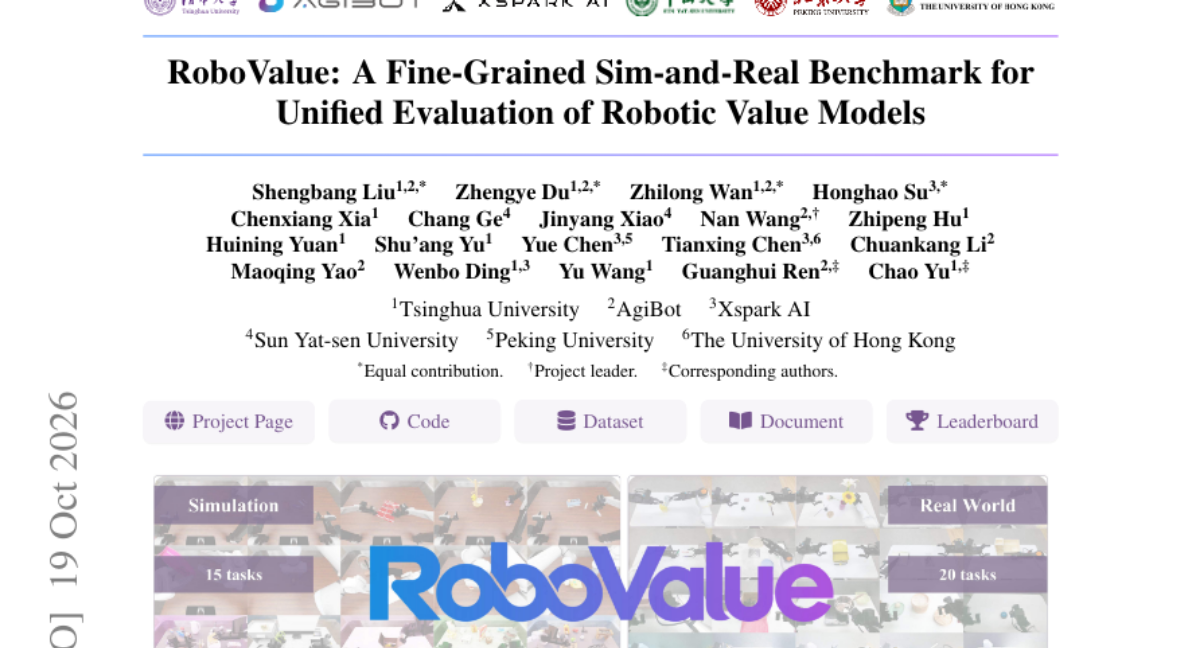
12. RoboValue: A Fine-Grained Sim-and-Real Benchmark for Unified Evaluation of Robotic Value Models
🔑 Keywords: RoboValue, robotic value models, task-state understanding, failure recovery, value consistency
💡 Category: Robotics and Autonomous Systems
🌟 Research Objective:
– The paper introduces RoboValue, a benchmark to comprehensively evaluate robotic value models in both simulated and real-world tasks, focusing on task-state understanding, progress tracking, failure recovery, and consistency.
🛠️ Research Methods:
– RoboValue evaluates four capability dimensions through shared interfaces and includes 15 simulation and 20 real-world manipulation tasks, providing expert demonstrations and annotated trajectories for fine-grained assessment.
💬 Research Conclusions:
– Findings indicate errors in instruction grounding, progress tracking, and recovery assessment. Value gains vary across execution orders, pinpointing targets for value supervision. The benchmark aids in ongoing assessment and feedback reliability improvement.
👉 Paper link: https://huggingface.co/papers/2610.26663
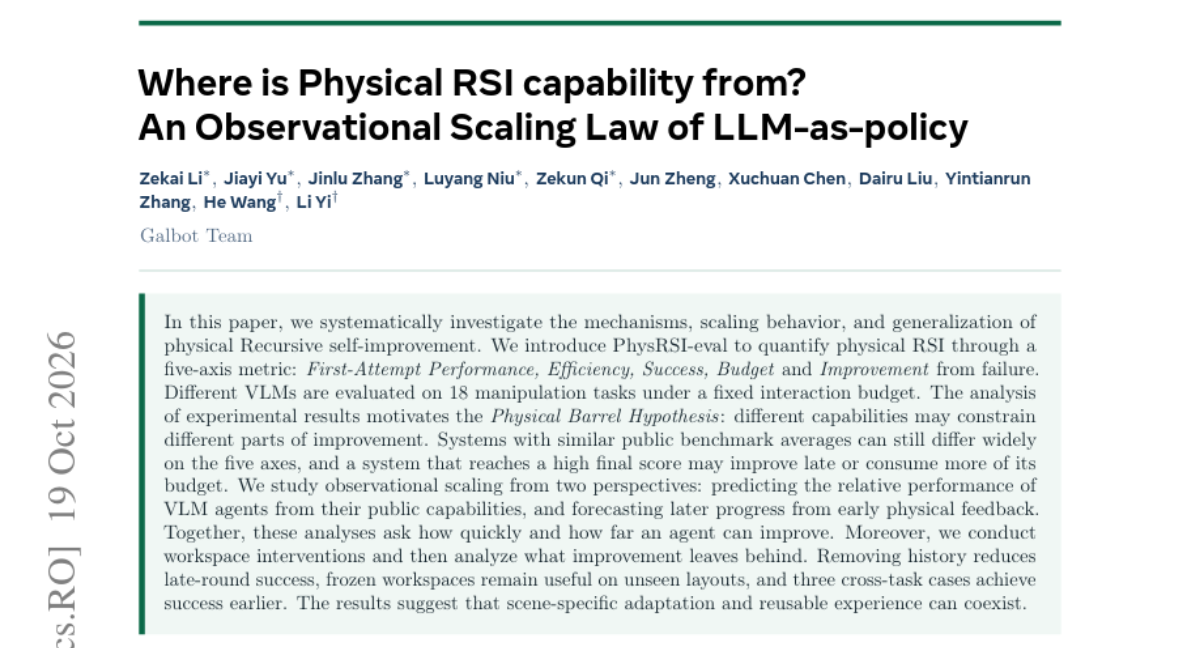
13. Where is Physical RSI capability from? An Observational Scaling Law of LLM-as-policy
🔑 Keywords: Recursive self-improvement, VLM, five-axis metric, Physical Barrel Hypothesis, workspace interventions
💡 Category: Robotics and Autonomous Systems
🌟 Research Objective:
– To systematically investigate the mechanisms, scaling behavior, and generalization of physical Recursive Self-Improvement in vision-language agents.
🛠️ Research Methods:
– Introduction of PhysRSI-eval to quantify physical RSI using a five-axis metric; evaluation of different VLMs on 18 manipulation tasks under a fixed interaction budget; observational scaling, and analysis of workspace interventions.
💬 Research Conclusions:
– The study suggests that scene-specific adaptation and reusable experience in VLMs can coexist, with limitations set by different capabilities affecting improvement differently, as per the Physical Barrel Hypothesis. The five-axis metrics demonstrate that high scores do not necessarily correlate with early or efficient gains.
👉 Paper link: https://huggingface.co/papers/2610.26848
14. AffordanceWAM: Affordance-Aware Joint World-Action Modeling for Robot Manipulation
🔑 Keywords: AffordanceWAM, robot manipulation, affordance-aware, World Action Model, human-to-robot transfer
💡 Category: Robotics and Autonomous Systems
🌟 Research Objective:
– The study aims to improve robot manipulation by using affordance representations from human videos to predict future scenes and actions, without relying on human action labels.
🛠️ Research Methods:
– Development of AffordanceWAM, a generative model utilizing a pretrained video diffusion Transformer, which incorporates World and Action Experts connected through Masked Joint Self-Attention to predict future scenarios and actions.
💬 Research Conclusions:
– Experiments show that leveraging affordance-annotated human videos in training can enhance robot performance in manipulation tasks, proving the effectiveness of affordance as an interface for learning and transfer between vision, language, and action.
👉 Paper link: https://huggingface.co/papers/2609.22332

15. Frechet Forcing: Training Long-Horizon Streaming World Models from Short Clips
🔑 Keywords: Fréchet Forcing, Streaming Video World Models, Context Fidelity, Reality Matching, Generative Anchoring
💡 Category: Generative Models
🌟 Research Objective:
– The objective is to prevent long-horizon drift in streaming video world models without requiring teacher models or long videos.
🛠️ Research Methods:
– The research introduces Fréchet Forcing, which fine-tunes world models using self-generated rollouts and real-data statistics under constraints like Generative Anchoring, Context Fidelity, and Reality Matching.
💬 Research Conclusions:
– The proposed method allows for stable rollouts beyond 4,000 frames, ensuring realistic and action-following outcomes in applications like robot manipulation and camera-controlled exploration, using a compact training framework.
👉 Paper link: https://huggingface.co/papers/2610.25666

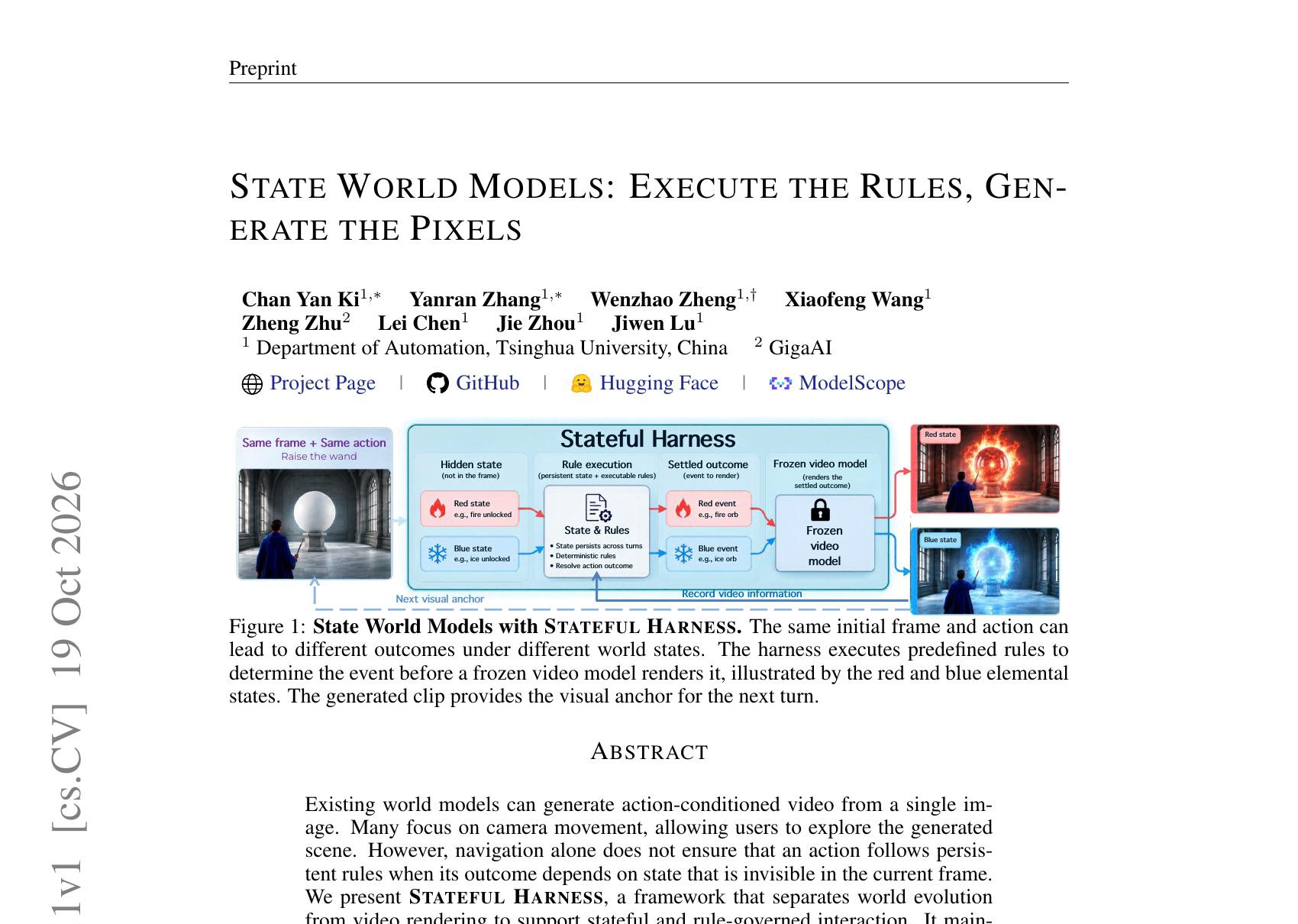
16. State World Models: Execute the Rules, Generate the Pixels
🔑 Keywords: Stateful Harness, WorldState-Bench, world evolution, video rendering, hidden state
💡 Category: Generative Models
🌟 Research Objective:
– The study introduces the Stateful Harness framework to improve consistency in interactive world models by separating rule-based world state updates from frozen video rendering.
🛠️ Research Methods:
– The evaluation is conducted via the WorldState-Bench benchmark, comprising 50 counterfactual twin pairs sharing an initial frame and action but differing in hidden state and required outcome.
💬 Research Conclusions:
– The study found that separating rule execution from video rendering significantly improved the accuracy of rule compliance, with the full harness achieving a 92% success rate in producing the required endings.
👉 Paper link: https://huggingface.co/papers/2610.26811
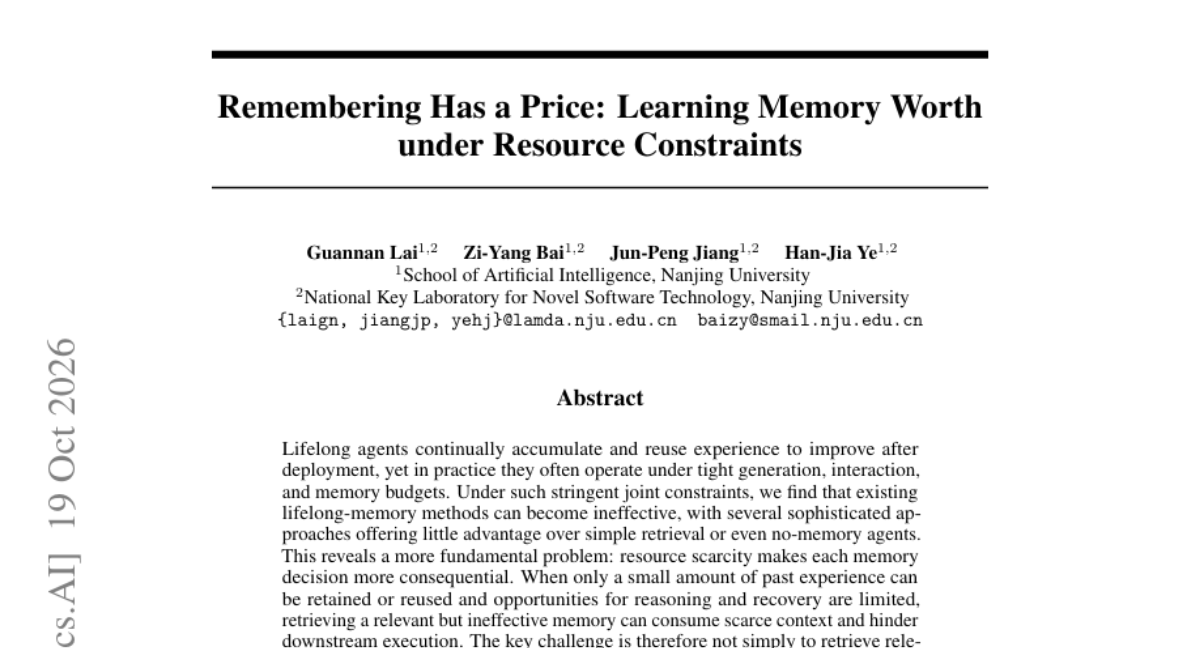
17. Remembering Has a Price: Learning Memory Worth under Resource Constraints
🔑 Keywords: TokenWorth, lifelong agents, memory constraints, resource scarcity, query-dependent memory worth
💡 Category: Reinforcement Learning
🌟 Research Objective:
– The paper introduces TokenWorth, a lightweight online memory framework designed to enhance lifelong agents’ success under tight resource constraints by efficiently determining which past experiences are worth retaining and reusing.
🛠️ Research Methods:
– TokenWorth employs query-dependent memory worth learned from sparse execution feedback to manage memory retrieval and bounded memory management across various environments and deployments.
💬 Research Conclusions:
– The study concludes that effective lifelong adaptation under resource constraints is more about learning what experiences are valuable to remember, rather than accumulating more memories. TokenWorth outperforms other methods by achieving the highest task success rate while using fewer output tokens.
👉 Paper link: https://huggingface.co/papers/2610.26453
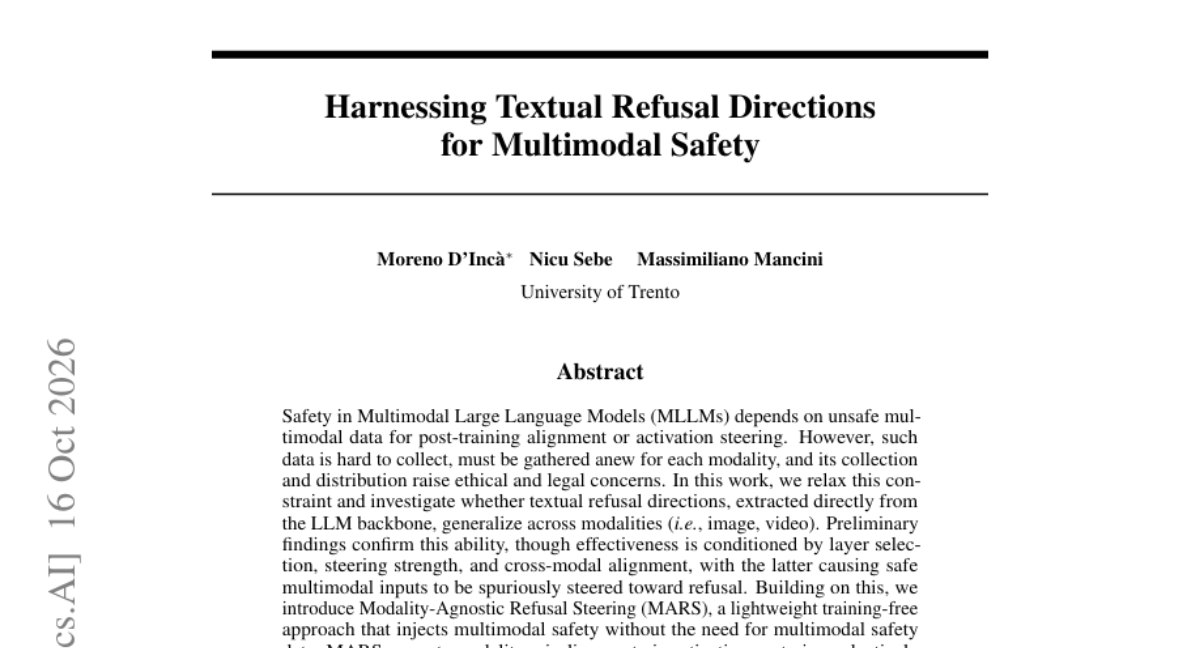
18. Harnessing Textual Refusal Directions for Multimodal Safety
🔑 Keywords: MARS, multimodal safety, textual refusal directions, cross-modal alignment, activation centering
💡 Category: Multi-Modal Learning
🌟 Research Objective:
– Explore the capability of textual refusal directions to generalize multimodal safety steering across different modalities without relying on multimodal safety data.
🛠️ Research Methods:
– Introduce MARS, a training-free approach, which utilizes activation centering and adaptive steering strategies for modality misalignment correction.
💬 Research Conclusions:
– MARS successfully enhances safety in multimodal large language models by leveraging shared safety structures without compromising utility due to over-refusal.
👉 Paper link: https://huggingface.co/papers/2606.31876
19. ECHO: Efficient Causal Self-Recursion Beyond Auxiliary Multi-Token Prediction
🔑 Keywords: ECHO, Multi-token prediction, Dynamic Depth Sampling, Efficient Causal Self-Recursion
💡 Category: Natural Language Processing
🌟 Research Objective:
– The main objective is to integrate multi-horizon prediction into the model backbone to enhance pretraining efficiency and inference drafting without relying on auxiliary modules.
🛠️ Research Methods:
– The study introduces ECHO, which leverages Efficient Causal Self-Recursion and Dynamic Depth Sampling to eliminate additional module costs by having the backbone’s final layer predict every horizon.
💬 Research Conclusions:
– ECHO’s approach allows for improved downstream accuracy in pretraining and maintains draft-target alignment in inference, outperforming post-hoc methods even under increased token budgets and repeated training.
👉 Paper link: https://huggingface.co/papers/2610.24766

20. Self-Evaluating Recursive Agents
🔑 Keywords: Recursive language agents, Subtask decomposition, Self-Evaluation, Rubric generation
💡 Category: Reinforcement Learning
🌟 Research Objective:
– To enhance decomposition, solving, and self-evaluation of recursive language agents with minimal external supervision through the generation of evaluation rubrics for subtasks.
🛠️ Research Methods:
– Implemented SERA (Self-Evaluating Recursive Agents) to train recursive agents by generating rubrics, employing a ranking objective and a complementary leaf-coverage signal.
💬 Research Conclusions:
– Training agents to generate and evaluate rubrics improves task solving capabilities more effectively than traditional supervision, demonstrated by performance improvements on TextCraft-Synth and TextWorld-Sync benchmarks.
👉 Paper link: https://huggingface.co/papers/2610.04902
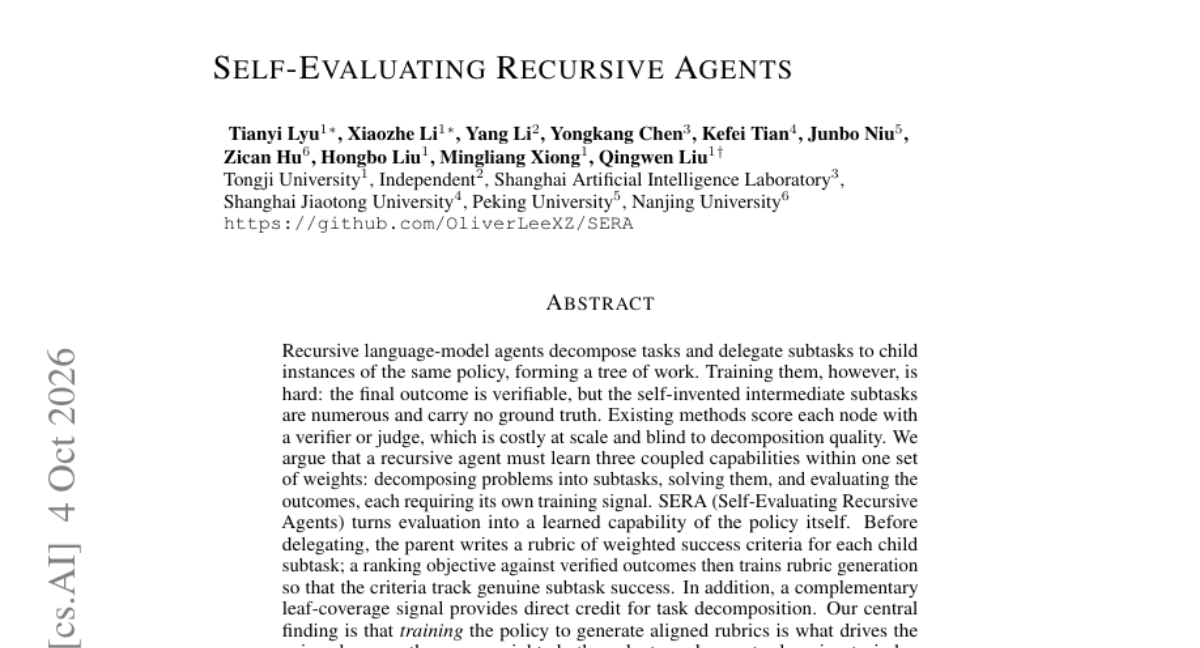
21. UniAVC: Unified Audio-Video Creation via Progressive Training and Asymmetric Scheduling
🔑 Keywords: cross-modal generation, instruction-guided editing, unimodal dataset, modality-decoupled schedulers, noise schedule
💡 Category: Multi-Modal Learning
🌟 Research Objective:
– To develop a unified audio-video creation model capable of text-conditioned joint synthesis, bidirectional cross-modal generation, and instruction-guided editing using both abundant unimodal data and scarce paired data.
🛠️ Research Methods:
– UniAVC employs independent noise schedules and asymmetric supervision to train separate audio and video branches, which later align using limited paired data for cross-modal tasks.
💬 Research Conclusions:
– UniAVC effectively addresses limitations by using modality-decoupled schedulers and facilitates intent-aware editing, enabling robust audio-video creation without relying heavily on task-specific adapters.
👉 Paper link: https://huggingface.co/papers/2610.24791
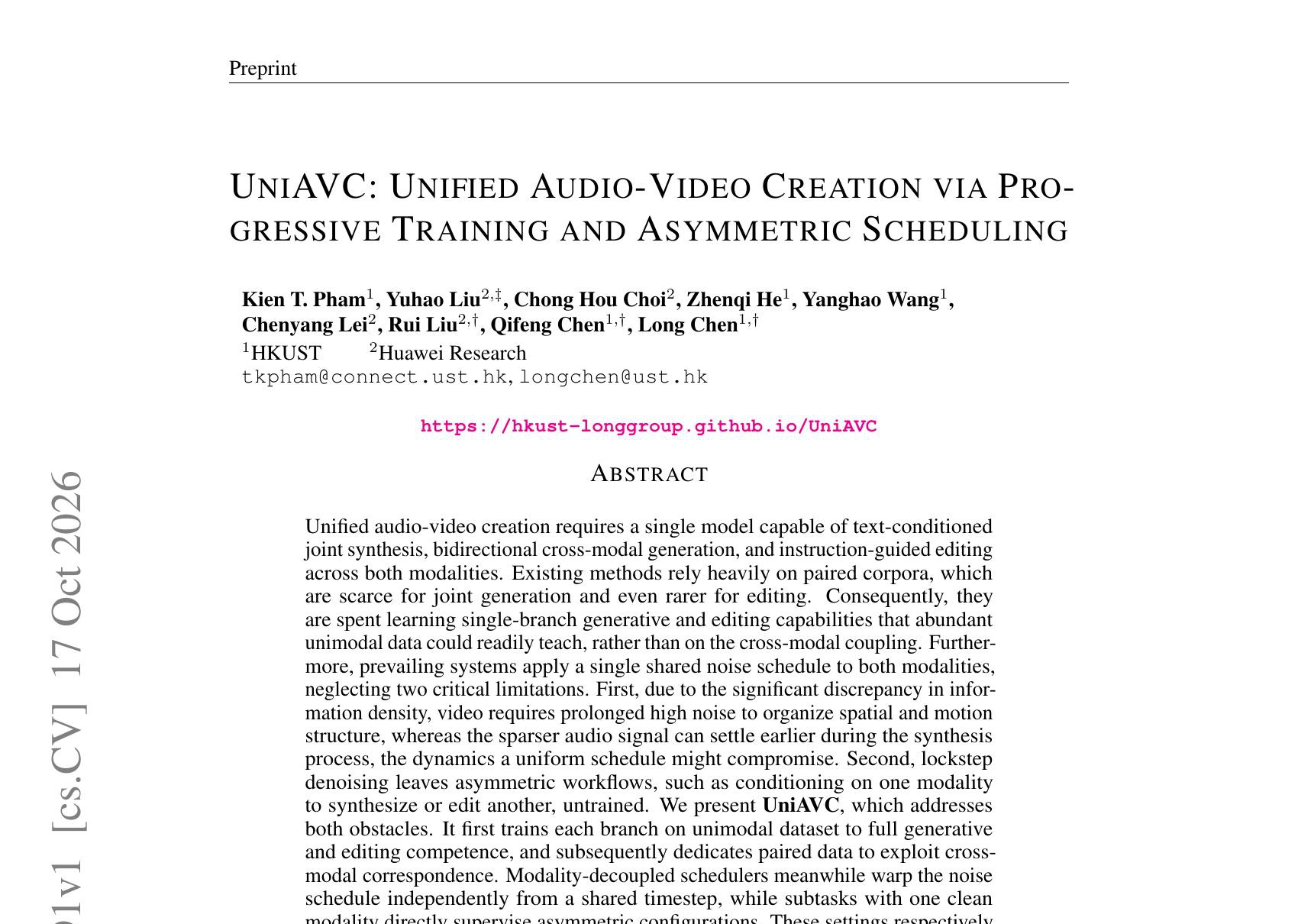
22. Factorization-Guided Training and Inference for Diffusion-Drafted Speculative Decoding
🔑 Keywords: DScout, Speculative decoding, Diffusion drafters, Mean accepted tokens, Throughput
💡 Category: Natural Language Processing
🌟 Research Objective:
– The study aims to improve speculative decoding throughput by aligning diffusion drafter training and inference with prefix acceptance and latency trade-offs.
🛠️ Research Methods:
– The introduction of DScout, which employs two complementary factorizations for training and inference to guide diffusion drafter configurations, focusing on position-wise loss factorization, mixed-horizon training, intra-block unmasking, and acceptance-weighted loss.
💬 Research Conclusions:
– Across six benchmarks, DScout achieves significant speedups, specifically 3.84x and 4.14x over autoregressive decoding, with additional gains in mean speedup over state-of-the-art baselines and configuration policies providing further improvements.
👉 Paper link: https://huggingface.co/papers/2610.23935
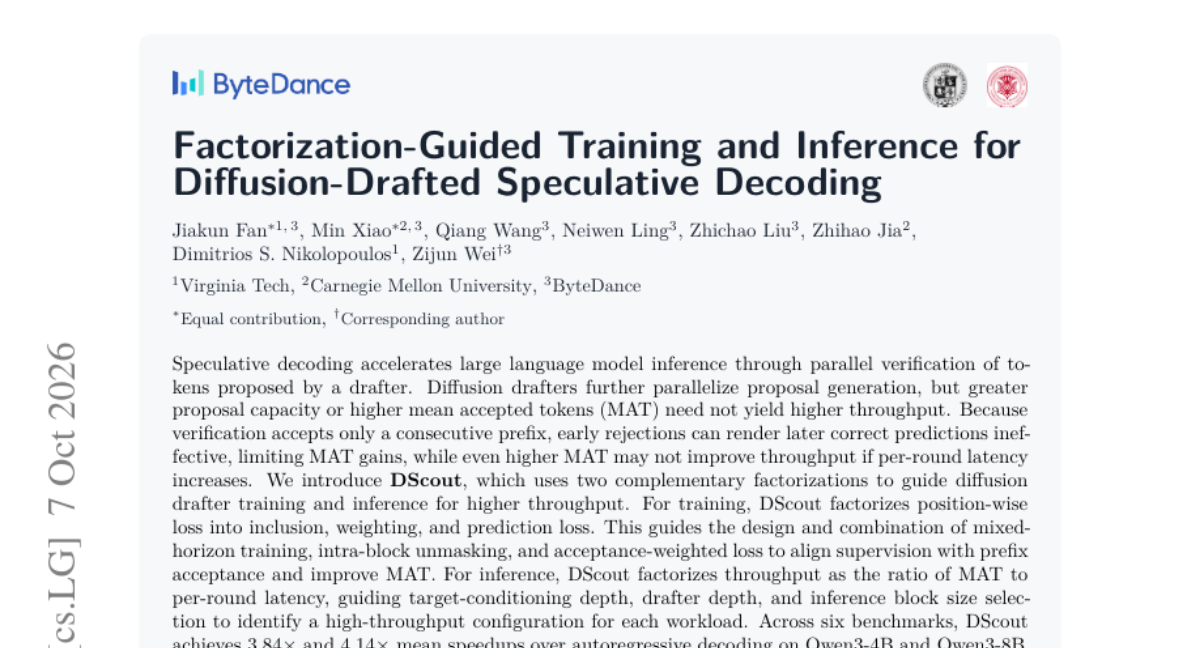
23. World Model Interpretability: From Decoding Representations to Understanding Latent Worlds
🔑 Keywords: JEPA, latent world models, interpretability, latent variables, causal verification
💡 Category: Foundations of AI
🌟 Research Objective:
– The paper aims to redefine the focus of interpretability in Joint-Embedding Predictive Architectures (JEPAs) from merely decoding representations to understanding how latent variables interact, evolve, and drive predictions through a structured process.
🛠️ Research Methods:
– The authors propose a four-stage research agenda involving Grounding, Structuring, Verifying, and Acting to enhance the interpretability of latent world models.
💬 Research Conclusions:
– The perspective calls for a shift towards a comprehensive latent-world interpretability agenda, arguing that understanding, validating, and acting on latent worlds will provide a significant advancement over current representation-focused efforts.
👉 Paper link: https://huggingface.co/papers/2610.25296
24. Progress-Aware Distillation for Mitigating Stagnation in Small Language Model Agents
🔑 Keywords: Progress-Aware Distillation, small language models, reasoning efficiency, progress stagnation, success rates
💡 Category: Natural Language Processing
🌟 Research Objective:
– To improve reasoning efficiency and success rates in distilled small language models by detecting and penalizing stagnation.
🛠️ Research Methods:
– Utilization of Progress-Aware Distillation, which encodes the stagnation gap into an adaptive margin to penalize potential stagnation.
💬 Research Conclusions:
– Extensive testing showed that Progress-Aware Distillation significantly reduces progress stagnation and enhances both success rates and task-completion efficiency across various small language models.
👉 Paper link: https://huggingface.co/papers/2610.19439
25. ActionRoPE: action as coordinates for spatially consistent control in planar-camera game world models
🔑 Keywords: ActionRoPE, world coordinates, camera motion, Coordinate-Conditioned Noise Scheduling
💡 Category: Generative Models
🌟 Research Objective:
– The research aims to address the challenge of spatially consistent control in planer-camera worlds, such as top-down and isometric games, through an innovative approach called ActionRoPE.
🛠️ Research Methods:
– ActionRoPE converts action-driven camera displacement into world-coordinate rotary positions to retain positional consistency. It also utilizes Coordinate-Conditioned Noise Scheduling for stable region generation.
💬 Research Conclusions:
– The proposed method surpasses traditional action-conditioning mechanisms, reducing the revisit drift by 66% over the strongest baseline. It demonstrates robustness across different video backbones and out-of-distribution scenes.
👉 Paper link: https://huggingface.co/papers/2610.25861

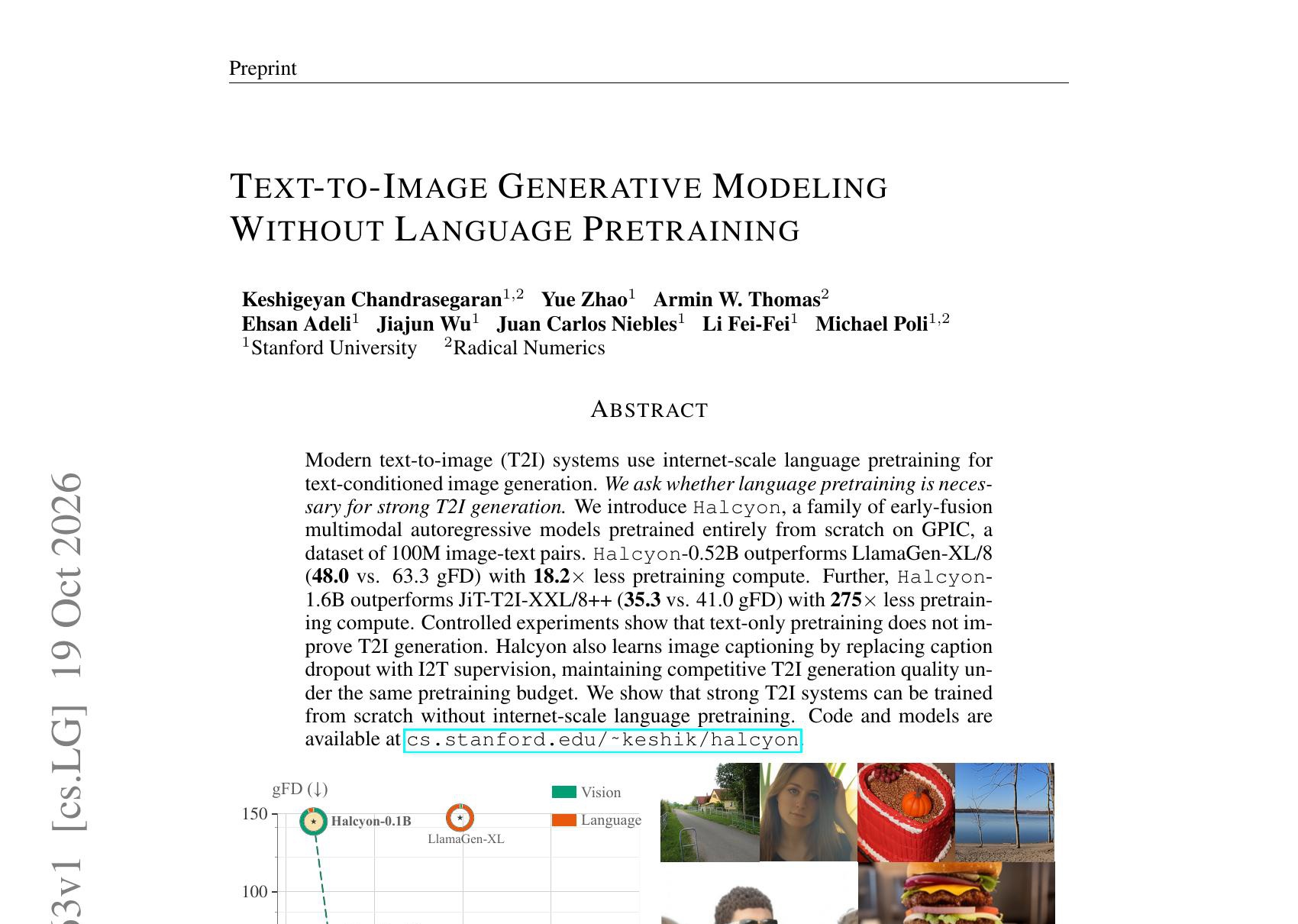
26. Text-to-Image Generative Modeling Without Language Pretraining
🔑 Keywords: Halcyon, text-to-image generation (T2I), multimodal autoregressive models, language pretraining, I2T supervision
💡 Category: Multi-Modal Learning
🌟 Research Objective:
– The study investigates whether strong text-to-image generation can be achieved without internet-scale language pretraining.
🛠️ Research Methods:
– Introduction of Halcyon, multimodal autoregressive models trained from scratch on a dataset of 100M image-text pairs.
– Controlled experiments were conducted to test the impact of language pretraining on T2I generation quality.
💬 Research Conclusions:
– Halcyon outperforms existing models with significantly less pretraining compute, demonstrating that strong T2I systems can be developed without relying on large-scale language pretraining.
– The model also maintains competitive T2I generation quality using I2T supervision instead of caption dropout.
👉 Paper link: https://huggingface.co/papers/2610.26863
27. HandsOn: A Large-Scale Simulation Benchmark for Generalizable Dexterous Manipulation
🔑 Keywords: HandsOn, dexterous manipulation, multi-task policy, sim-to-real transfer, skill composition
💡 Category: Robotics and Autonomous Systems
🌟 Research Objective:
– To introduce HandsOn, a platform and benchmark designed to evaluate generalization of dexterous manipulation across various robotic embodiments, objects, and tasks.
🛠️ Research Methods:
– Utilization of HandsOn which includes five robotic arms, six dexterous hands, and around 200 assets, using 18,000 human demonstrations alongside 66 tasks to test skill composition and transferability without task-specific training.
💬 Research Conclusions:
– Revealed significant gaps in current multi-task policies and highlighted failure points like contact establishment and action coordination across tested scenarios.
👉 Paper link: https://huggingface.co/papers/2610.26765
28. Heterogeneous Agentic Coevolution
🔑 Keywords: HACE, specialized foundation models, self-improving LLM agents, evolutionary search, reciprocal learning
💡 Category: AI Systems and Tools
🌟 Research Objective:
– To develop Heterogeneous Agentic CoEvolution (HACE), a framework for the joint evolution of specialized foundation models and LLM agents to enhance performance in domain-specific applications.
🛠️ Research Methods:
– Utilized reciprocal learning combining supervised learning for specialists and on-policy reinforced self-training for agents.
– Employed evolutionary search to optimize the interaction harness between models.
💬 Research Conclusions:
– Demonstrated that HACE outperforms existing self-improving methods across recommendation systems, protein function prediction in biology, and crystal stability prediction in materials discovery, highlighting the effectiveness of heterogeneous coevolution.
👉 Paper link: https://huggingface.co/papers/2610.16078

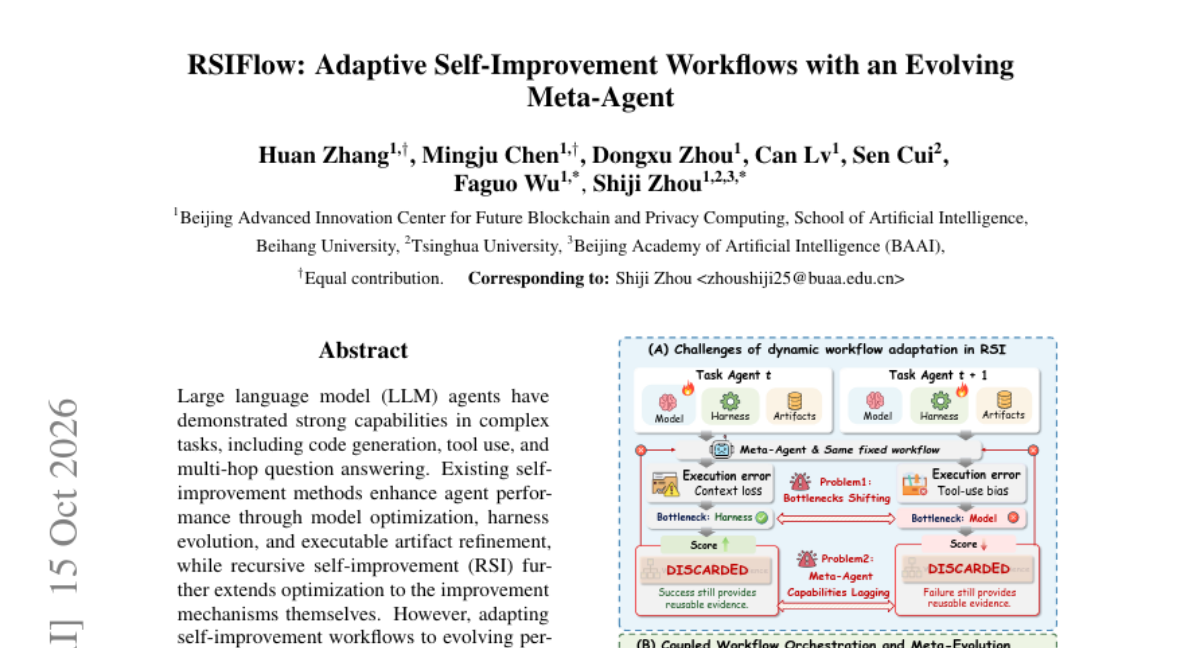
29. RSIFlow: Adaptive Self-Improvement Workflows with an Evolving Meta-Agent
🔑 Keywords: Recursive Self-Improvement, Adaptive Workflow Orchestration, Meta-Agent, Component-Specific Skills, LLM Agents
💡 Category: AI Systems and Tools
🌟 Research Objective:
– To develop a framework, RSIFlow, that enhances recursive self-improvement by integrating adaptive workflow orchestration with the evolution of meta-agent capabilities.
🛠️ Research Methods:
– Utilization of execution feedback to dynamically select and improve component-specific workflows.
– Analysis of task-agent trajectories and environmental feedback to identify and address performance bottlenecks.
💬 Research Conclusions:
– RSIFlow achieves state-of-the-art (SOTA) performance across six benchmarks and two models.
– The framework demonstrates significant improvements via adaptive workflow orchestration and meta-harness evolution.
👉 Paper link: https://huggingface.co/papers/2610.21791
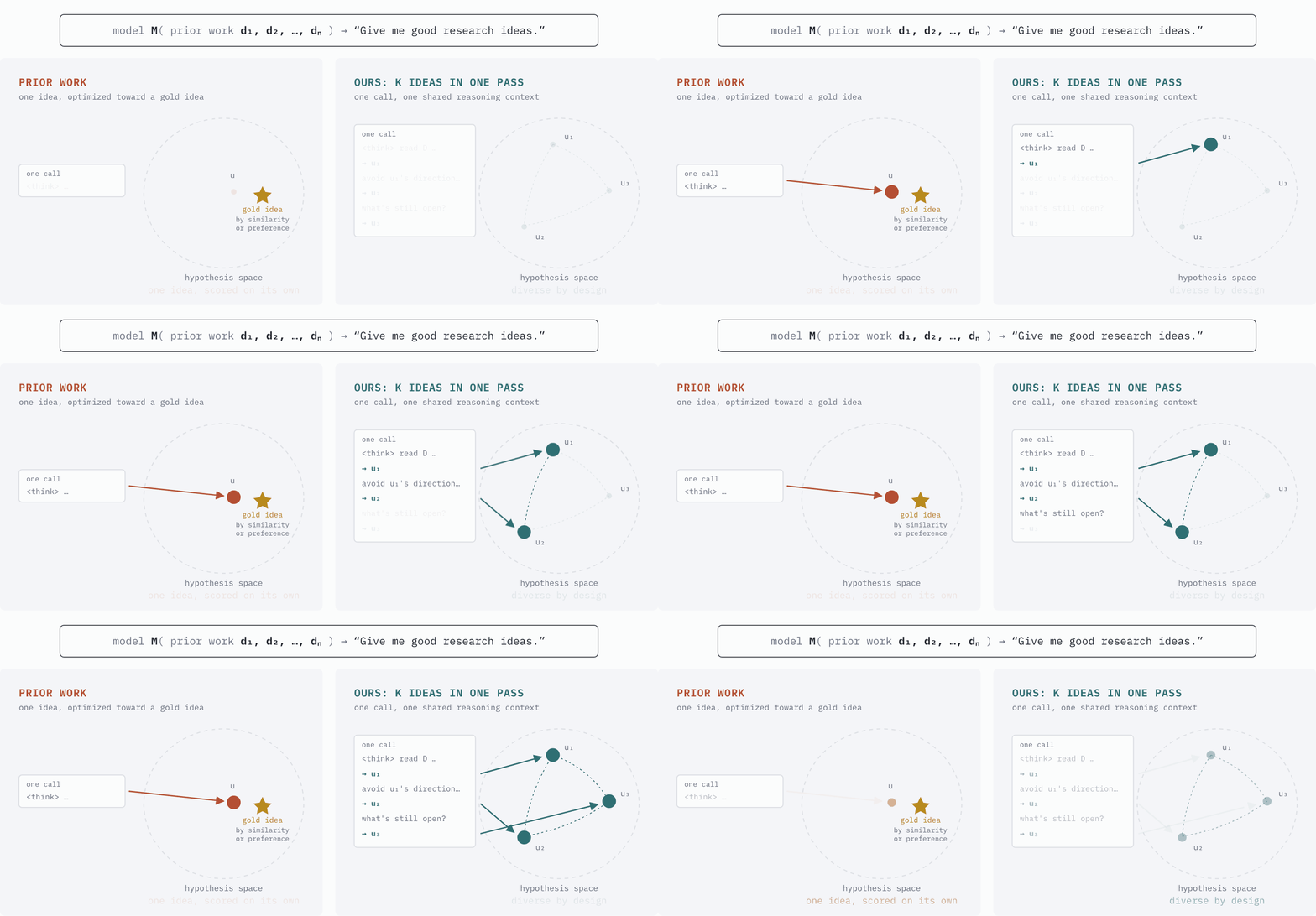
30. Training Reasoning Models to Generate Diverse Scientific Ideas
🔑 Keywords: set-level reinforcement learning, large language models, document-grounded ideation, creative utility, idea diversity
💡 Category: Generative Models
🌟 Research Objective:
– The research aims to enhance creative utility by focusing on the diversity and quality of ideas generated by Large Language Models (LLMs), ensuring they are grounded in input documents.
🛠️ Research Methods:
– The proposed approach utilizes a set-level reinforcement learning objective, training the model to generate structured idea cards grounded in source documents with increased diversity and quality.
💬 Research Conclusions:
– The trained 8B model demonstrated higher creative utility compared to larger models such as Claude Opus 4.8 and GPT-6 Astra. Expert evaluations confirmed the model’s ability to produce promising and unique ideas, with comparable success rates in proof-of-concept experiments.
👉 Paper link: https://huggingface.co/papers/2610.22324
31. Token-Set Choice Confounds POPE: A Systematic Audit of Yes/No Extraction in VLM Hallucination Evaluation
🔑 Keywords: POPE benchmark, hallucination-mitigation, F1 shifts, token lookup, LLaVA-1.5-7B
💡 Category: Multi-Modal Learning
🌟 Research Objective:
– To reproduce and evaluate hallucination-mitigation results on the POPE benchmark using vision-language models.
🛠️ Research Methods:
– Analysis of evaluation readout choices and quantization effects on reported results.
– Conducted nine inference-time corrections and a four-readout audit across different models and tokenizer families.
💬 Research Conclusions:
– Evaluation readout choices significantly influence F1 scores and confound hallucination-mitigation gains.
– The adversarial split’s F1 shifts suggest unresolved issues in model evaluation protocols.
– Tokenizer-derived readouts maintain accuracy better than ported ID readouts across models.
👉 Paper link: https://huggingface.co/papers/2610.25964
32. QD-Rec: Open-Ended Evolution of Recommendations via Quality-Diversity
🔑 Keywords: Quality-Diversity Optimization, Foundation Models, High-Stakes Decision-Making, Contextual Bandit, Archive
💡 Category: Foundations of AI
🌟 Research Objective:
– Extend quality-diversity optimization and foundation models to generate diverse recommendations for critical decision-making scenarios.
🛠️ Research Methods:
– Propose QD-Rec, a method using contextual bandit and foundation models to create diverse, well-reasoned recommendations stored in an archive to identify novel or superior choices.
💬 Research Conclusions:
– In domains such as M&A, customer targeting, and others, QD-Rec demonstrated the highest mean quality and expanded the largest archive of recommendations in most settings.
👉 Paper link: https://huggingface.co/papers/2610.23470
33. Vision-Language-Delta-Action: Learning Compact Deltas as Actionable Transition Interfaces for Robotic Manipulation
🔑 Keywords: Robotic manipulation, Vision-Language-Action, Delta variable, Action generation, LoongForge
💡 Category: Robotics and Autonomous Systems
🌟 Research Objective:
– This study aims to enhance robotic control by reformulating it as compact transition modeling using a Delta variable, bridging vision-language understanding and action generation.
🛠️ Research Methods:
– The researchers implemented the Vision-Language-Delta-Action (VLDA) paradigm, which involves tasks like the Local Transition Filter (LT-Filter) and Global Transition Anchor (GT-Anchor) to learn a Delta variable for effective state changes.
💬 Research Conclusions:
– VLDA demonstrates improved long-horizon consistency, robustness, and generalization, validating the Delta variable as an effective alternative to direct action prediction and complete future-state modeling.
👉 Paper link: https://huggingface.co/papers/2610.25874

34. CyberArena: Benchmarking AI Agents in Live Symmetric Attack-and-Defense Combat
🔑 Keywords: AI agents, Cybersecurity, Adversarial benchmark, Multi-round combat
💡 Category: AI Systems and Tools
🌟 Research Objective:
– The primary objective is to evaluate AI agents’ offensive and defensive cybersecurity capabilities in dynamic and evolving environments using a dynamic adversarial benchmark named CyberArena.
🛠️ Research Methods:
– CyberArena is built around multi-round attack-and-defense combat in isolated sandboxes, allowing agents to act as both attackers and defenders. It uses a dynamical scoring model to map match dynamics into a unified, multidimensional score.
💬 Research Conclusions:
– CyberArena separates model capabilities where single-agent baselines hit a ceiling, demonstrating agents’ ability to adapt in real-time, and serves as a scalable experimental platform for future cybersecurity agents research.
👉 Paper link: https://huggingface.co/papers/2610.19005

35. HERA: Harness-Environment Co-Evolution for Reliable Agentic Abstention
🔑 Keywords: agentic abstention, harness-environment co-evolution, LLM, task completion, abstention accuracy
💡 Category: Natural Language Processing
🌟 Research Objective:
– The study aims to improve agent abstention and task completion across diverse Large Language Models (LLMs) without model-specific tuning using HERA.
🛠️ Research Methods:
– Introduction of HERA framework that co-evolves agent harnesses and task environments by automatically constructing verifiable pairs of feasible and infeasible tasks and adapting harnesses based on previous task failures.
💬 Research Conclusions:
– HERA significantly improves abstention accuracy from 61.7% to 83.3% and feasible-task completion from 68.3% to 76.7%, and the best harness effectively transfers across 19 other LLMs with improved abstention accuracy by 15.3 percentage points on average.
👉 Paper link: https://huggingface.co/papers/2610.06563
36. Empowering Edge Agents: A Systematic Analysis of Edge-Cloud Collaboration in LLM Agent Execution
🔑 Keywords: Edge-cloud collaboration, LLM agents, EC2-Bench, Privacy exposure, Cloud invocation decision-making
💡 Category: AI Systems and Tools
🌟 Research Objective:
– The research introduces EC2-Bench, a benchmark evaluating edge-cloud collaboration in long-horizon LLM agents to understand the trade-offs among performance, resource usage, and privacy.
🛠️ Research Methods:
– EC2-Bench provides executable tasks and a unified evaluation framework to empirically study various forms of edge-cloud collaboration, focusing on performance, resource usage, and privacy.
💬 Research Conclusions:
– Edge-cloud collaboration achieves a balance between task performance, resource usage, and privacy exposure better than edge-only or cloud-only execution.
– As edge models enhance, collaborative execution performance approaches that of cloud-only setups, with privacy remaining strategy-dependent.
– Stronger edge capabilities shift the preferred mode of collaboration towards edge-controlled execution over cloud participation.
👉 Paper link: https://huggingface.co/papers/2610.17816

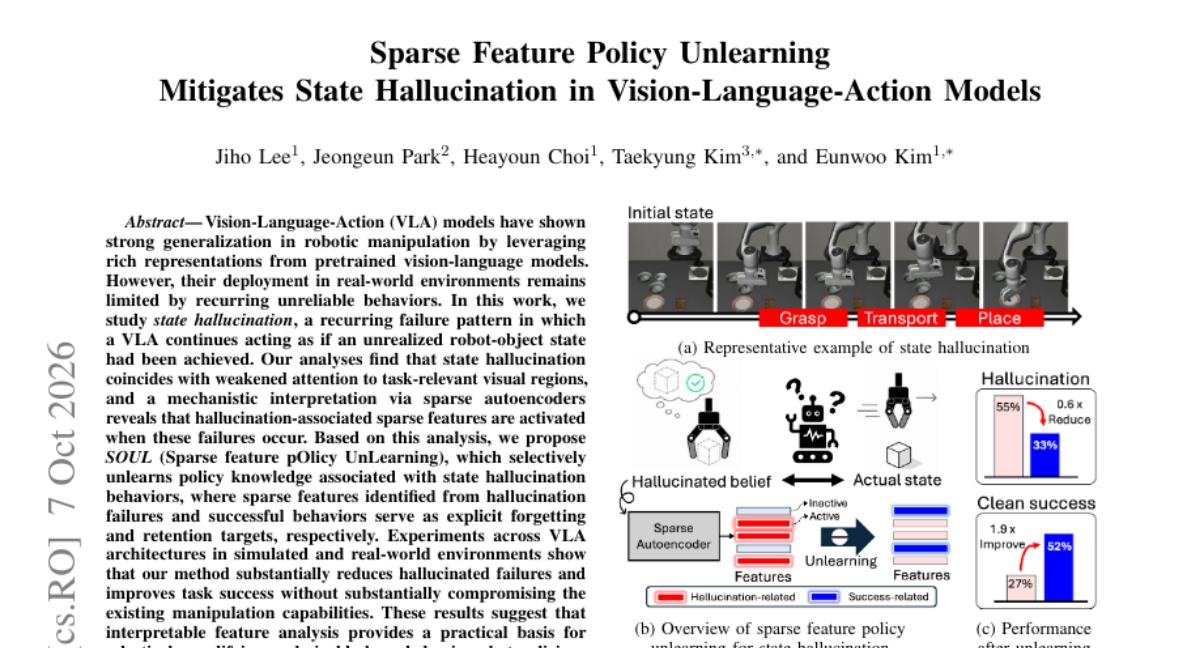
37. Sparse Feature Policy Unlearning Mitigates State Hallucination in Vision-Language-Action Models
🔑 Keywords: Vision-Language-Action models, state hallucination, sparse feature unlearning, SOUL, robotic manipulation
💡 Category: Robotics and Autonomous Systems
🌟 Research Objective:
– The study aims to identify and mitigate state hallucination in Vision-Language-Action models to improve robotic manipulation in real-world environments.
🛠️ Research Methods:
– The researchers utilize sparse autoencoders to analyze attention patterns and propose the SOUL method to selectively unlearn policy knowledge associated with hallucination failures.
💬 Research Conclusions:
– Experiments demonstrate that the proposed method significantly reduces hallucinated failures, enhancing task success while maintaining the inherent manipulation skills of the models.
👉 Paper link: https://huggingface.co/papers/2610.09496
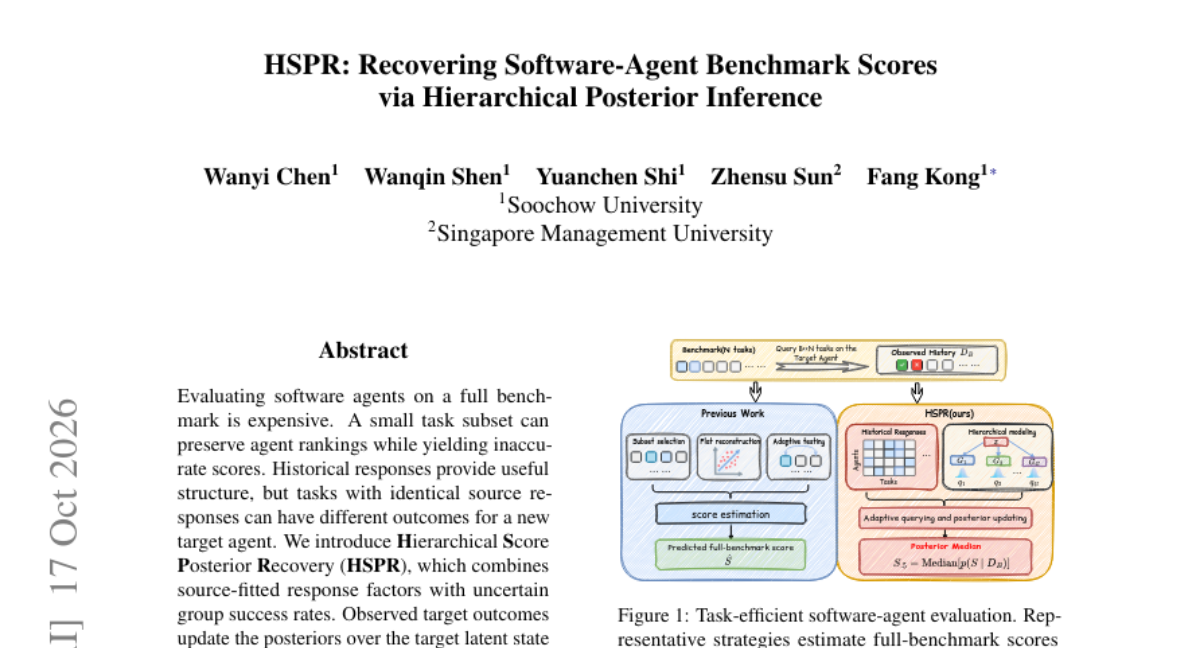
38. HSPR: Recovering Software-Agent Benchmark Scores via Hierarchical Posterior Inference
🔑 Keywords: Hierarchical Score Posterior Recovery, HSPR, adaptive task selection, SWE-bench, AI Systems and Tools
💡 Category: AI Systems and Tools
🌟 Research Objective:
– The study aims to improve agent evaluation efficiency by estimating full benchmark scores from small task subsets using Hierarchical Score Posterior Recovery.
🛠️ Research Methods:
– The method combines historical response patterns with adaptive task selection, using source-fitted response factors, uncertain group success rates, and posterior-guided acquisitions.
💬 Research Conclusions:
– HSPR achieves the lowest mean absolute error (MAE) and maximum absolute error (MaxErr) in evaluations, showing improved efficiency compared to other methods, while macro MAE decreases across a 5-20% task budget.
👉 Paper link: https://huggingface.co/papers/2610.24611
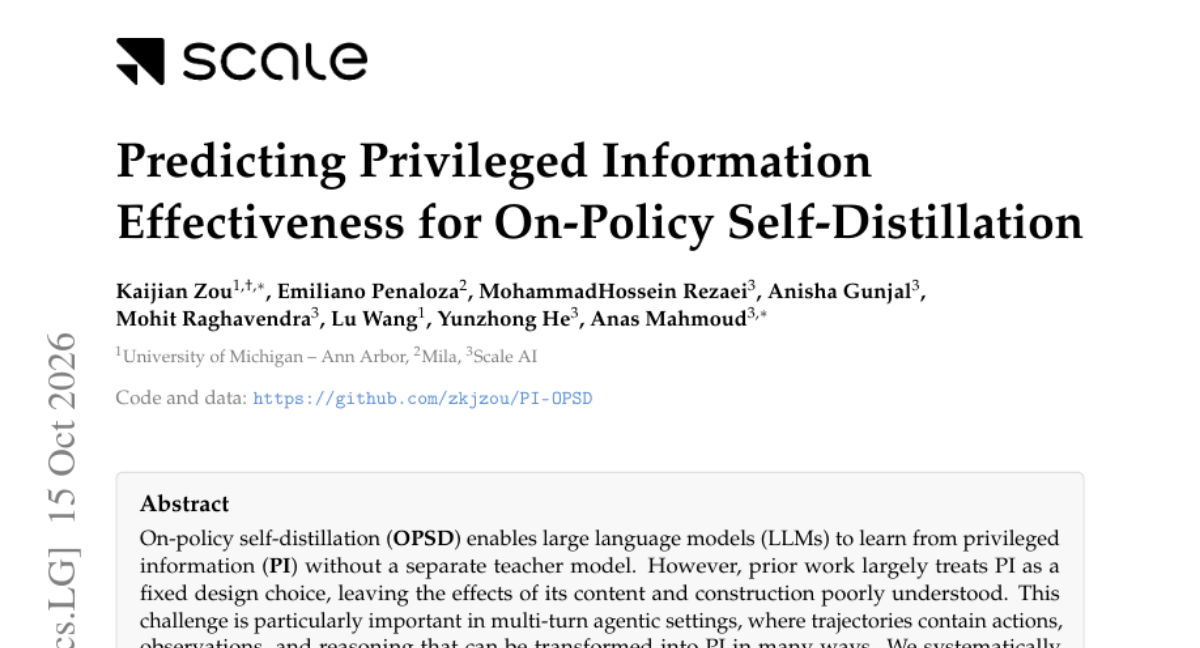
39. Predicting Privileged Information Effectiveness for On-Policy Self-Distillation
🔑 Keywords: On-policy self-distillation, privileged information, multi-turn agent, KL-based metrics, GRPO
💡 Category: Reinforcement Learning
🌟 Research Objective:
– This research investigates how on-policy self-distillation with privileged information affects the performance of multi-turn agents, focusing on the content and source of the privileged information.
🛠️ Research Methods:
– Systematic evaluation of 16 privileged information configurations across three benchmarks and three student models, supported by KL-based metrics to predict training gains.
💬 Research Conclusions:
– The effectiveness of privileged information in improving performance varies based on its content and generation source, with KL-based metrics providing consistent performance tracking. Additionally, the method proves effective when combined with GRPO, outperforming a strong baseline.
👉 Paper link: https://huggingface.co/papers/2610.22512
40. N-Gram Memories at Two Bits: Quantizing Lookup Tables in Large Language Models
🔑 Keywords: Conditional Program, language-model embedding, Gaussian trellis, n-gram memory
💡 Category: Natural Language Processing
🌟 Research Objective:
– The paper introduces the Conditional Program (CP) to compress language-model embedding tables efficiently by reconstructing only the requested rows via shared codes and local scales.
🛠️ Research Methods:
– CP employs a compressed representation instantiated with a Gaussian trellis, norm restoration, and independently decodable row records, utilizing a two-bit code to link row requests to increased fidelity.
💬 Research Conclusions:
– CP reduces storage by 75% while maintaining or improving fidelity, demonstrating superior performance in compressing embedding tables compared to other methods, evidenced by a reduction in table storage from 203GB to 51GB for DeepSeek.
👉 Paper link: https://huggingface.co/papers/2610.21810

41. StopLoss: Teaching Agents to Predict Failure and Stop Early
🔑 Keywords: StopLoss, failure recognition, early stopping, fine-tuned language model, Outcome supervision
💡 Category: AI Systems and Tools
🌟 Research Objective:
– The study introduces StopLoss, a lightweight external monitor designed to predict coding-agent failures, aiming to reduce compute costs and preserve successful outcomes by aborting doomed runs early.
🛠️ Research Methods:
– The approach involves learning from completed trajectories and verifier outcomes using a fine-tuned language model. It evaluates StopLoss against general-purpose judges with trajectories from GPT-family SWE-rebench and compared on SWE-bench datasets with various executors.
💬 Research Conclusions:
– StopLoss successfully reduces costs while maintaining a high rate of successful outcomes. It can lower costs per retained solve significantly compared to other approaches, showcasing the efficiency and potential of outcome-trained small monitors in cost-effective failure recognition for early stopping.
👉 Paper link: https://huggingface.co/papers/2610.25525

42. Co-Evolving Acting and Forecasting for Language Agents
🔑 Keywords: CoPE, agentic reinforcement learning, multi-step action sequences, sample efficiency, temporal ensemble
💡 Category: Reinforcement Learning
🌟 Research Objective:
– The paper introduces CoPE, a method that improves agentic reinforcement learning by training policies to generate multi-step action sequences from trajectory histories, enhancing sample efficiency without adding inference overhead.
🛠️ Research Methods:
– CoPE employs multi-step action targets in successful on-policy trajectories, allowing the policy backbone to absorb temporal ensembles during training, while still making inferences one step at a time without overhead.
💬 Research Conclusions:
– CoPE achieves stronger aggregate performance and greater sample efficiency compared to GRPO and other RL baselines, especially on benchmarks such as ScienceWorld. It accomplishes these improvements with a single policy backbone and without additional models, pretraining, or inference overhead.
👉 Paper link: https://huggingface.co/papers/2610.20597

43. Competing Learning in Hybrid Architectures
🔑 Keywords: Hybrid language models, Competing Learning, softmax attention, staged training, retrieval-related tasks
💡 Category: Natural Language Processing
🌟 Research Objective:
– To explore the competing learning dynamics in hybrid language models incorporating linear-time recurrence and softmax attention.
🛠️ Research Methods:
– The study introduces a staged training procedure aimed at improving hybrid architecture pre-training by mitigating competition between recurrence and attention layers through weight update management.
💬 Research Conclusions:
– Empirical results indicate that the proposed training method significantly enhances language modeling performance and retrieval-related tasks in models up to 1 billion parameters.
👉 Paper link: https://huggingface.co/papers/2610.26830

44. A Conditional No-Hair Theorem for Transformers: How Language Models Forget Their Prompt
🔑 Keywords: Autoregressive Transformers, Attention Dilution, Hidden States, Conditional No-Hair Theorem, Logit Bias
💡 Category: Foundations of AI
🌟 Research Objective:
– The study explores how much an autoregressive transformer retains its prompt influence after generating t tokens, focusing on the decay in the difference between hidden states from different prompts.
🛠️ Research Methods:
– The research utilizes a power-law model to assess the memory retention rate of trained versus untrained models, demonstrating how this rate (with α value variation) affects memorization.
💬 Research Conclusions:
– It concludes that the prompt’s influence diminishes as text grows, confirmed by the conditional no-hair theorem, showing the necessity of attention dilution for measured forgetting and the role of logit bias in influencing this decay.
👉 Paper link: https://huggingface.co/papers/2610.24133

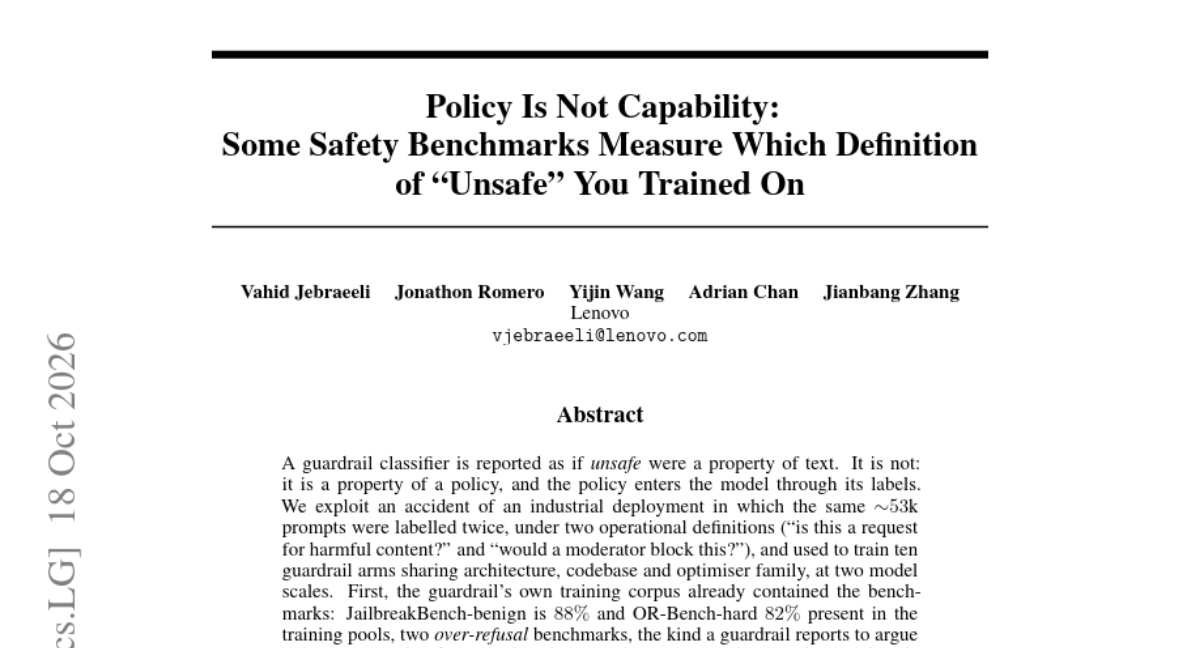
45. Policy Is Not Capability: Some Safety Benchmarks Measure Which Definition of “Unsafe” You Trained On
🔑 Keywords: Guardrail, Labeling Policy, Detection Ability, Training Contamination, Safety Benchmarks
💡 Category: AI Ethics and Fairness
🌟 Research Objective:
– The study aims to demonstrate that guardrail benchmark scores are influenced more by labeling policy than by the actual detection ability of models.
🛠️ Research Methods:
– Researchers analyzed results derived from identical prompts labeled under two different definitions to train guardrails, highlighting how minor parameter changes and training contamination affect safety metrics.
💬 Research Conclusions:
– The findings emphasize that policy-driven labels significantly impact benchmark scores, suggesting the necessity for guardrail evaluations to incorporate considerations about labeling definitions and report contamination transparently.
👉 Paper link: https://huggingface.co/papers/2610.25060
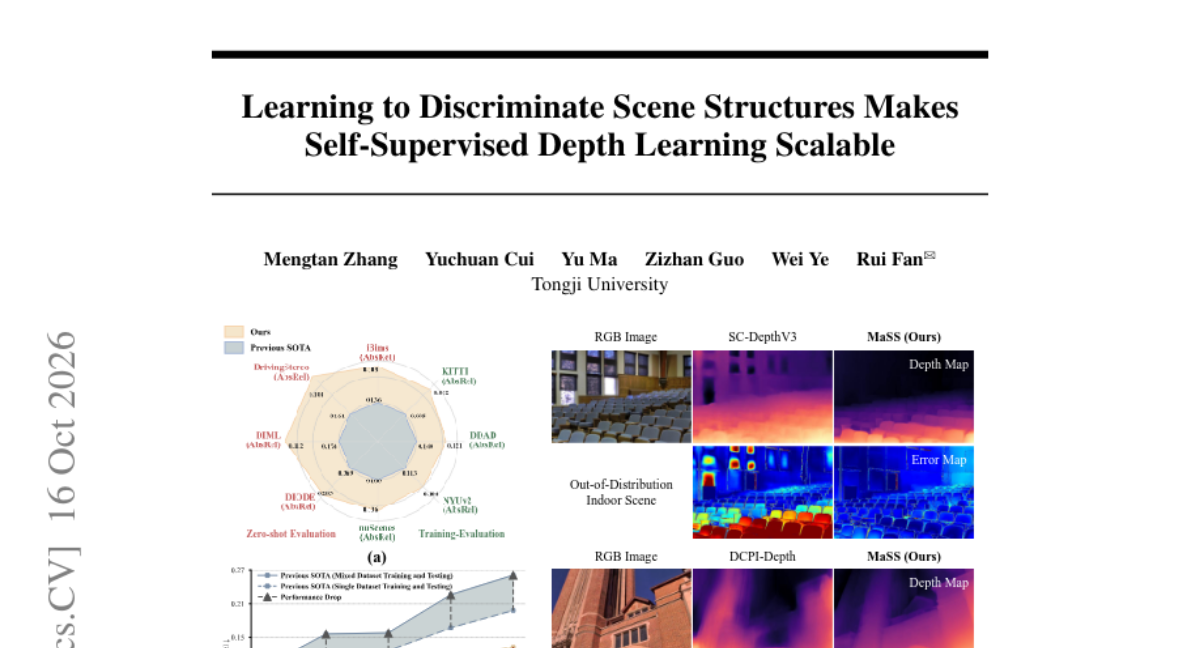
46. Learning to Discriminate Scene Structures Makes Self-Supervised Depth Learning Scalable
🔑 Keywords: MaSS framework, self-supervised monocular depth estimation, scene-structure discrimination objective, structural representation pathway, zero-shot evaluation
💡 Category: Computer Vision
🌟 Research Objective:
– The study aims to enhance self-supervised monocular depth estimation by decoupling structural representations from contextual features, facilitating scalable, mixed-domain training, and achieving strong zero-shot generalization.
🛠️ Research Methods:
– Introduction of the MaSS framework, which incorporates a structural representation pathway and a novel scene-structure discrimination objective, trained on diverse datasets both individually and jointly.
💬 Research Conclusions:
– MaSS significantly outperforms previous methods in self-supervised depth learning and shows remarkable generalizability in zero-shot evaluation against out-of-distribution scenes across multiple datasets.
👉 Paper link: https://huggingface.co/papers/2610.23600
47. LIBERO-Industry: Benchmarking Robotic Manipulation under Industrial Process Constraints
🔑 Keywords: LIBERO-Industry, generalist robot policies, flexible manufacturing, industrial constraints, AI Native
💡 Category: Robotics and Autonomous Systems
🌟 Research Objective:
– Introduce LIBERO-Industry, a benchmark to translate industrial manufacturing constraints into controllable robot learning tasks to evaluate generalist policies under realistic production conditions.
🛠️ Research Methods:
– Developed on LIBERO, presenting 216 tasks across three scenarios: Static-to-Dynamic (S2D) loading, Dynamic-to-Static (D2S) unloading, Dynamic-to-Dynamic (D2D) transfer, systematically varying object geometry, conveyor speed, interaction-window duration, and geometric acceptance regions.
💬 Research Conclusions:
– Performance declines as industrial constraints are introduced and combined. However, the LIBERO-Industry co-training condition achieved greater success in target-transfer completion compared to the original LIBERO condition.
👉 Paper link: https://huggingface.co/papers/2610.16782

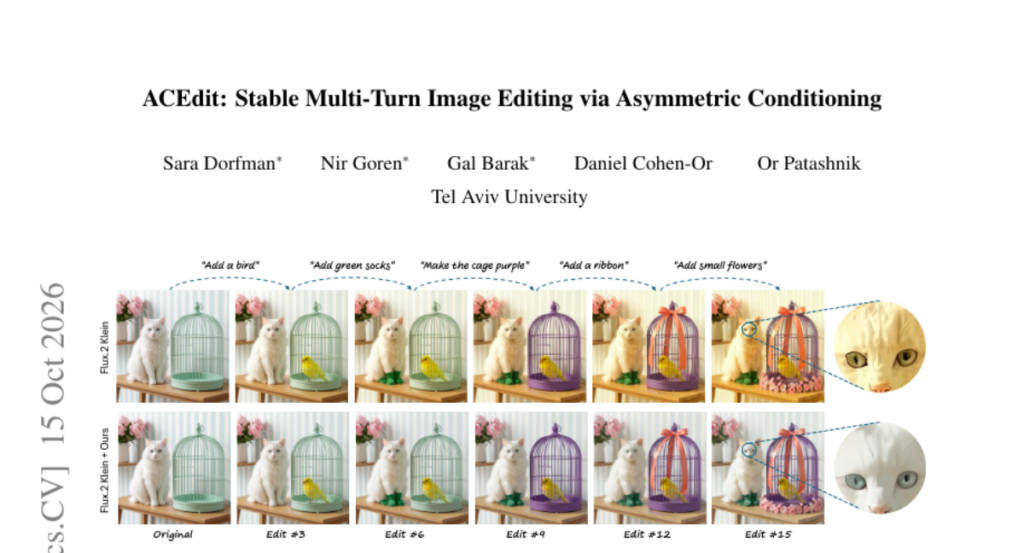
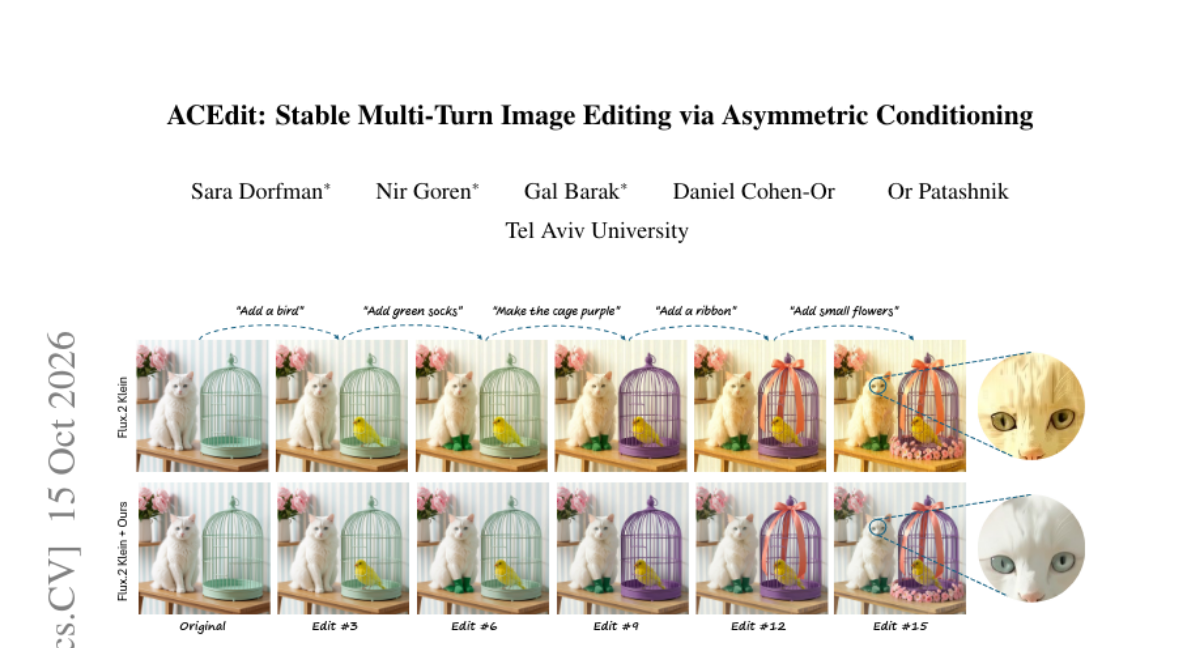
48. ACEdit: Stable Multi-Turn Image Editing via Asymmetric Conditioning
🔑 Keywords: Self-Forcing, Teacher Distillation, Multi-turn Image Editing, Distribution Shift, Asymmetric Conditioning
💡 Category: Computer Vision
🌟 Research Objective:
– Introduce a training scheme to stabilize multi-turn image editing against accumulating distribution shifts.
🛠️ Research Methods:
– Implement Self-Forcing training with a teacher distillation objective to handle deviations from ground-truth trajectories.
– Utilize asymmetric conditioning to ensure reliable training signals by combining sequential student edits with a teacher anchored to the original image.
💬 Research Conclusions:
– Experiments demonstrate a significant reduction in degradation over long multi-turn editing sequences, maintaining high editing quality and instruction adherence.
👉 Paper link: https://huggingface.co/papers/2610.22328
49. DeOverlay: A Benchmark and Source-Anchored Flow for Video Overlay Removal
🔑 Keywords: DeOverlay, Video Overlay Removal, DVTE-Bench, Temporal Aggregation, Source-anchored Flow
💡 Category: Computer Vision
🌟 Research Objective:
– The study introduces DeOverlay, a novel method designed to remove video overlays such as subtitles, titles, and logos, while preserving the scene structure.
🛠️ Research Methods:
– The authors utilized source-anchored flow matching and visibility-normalized temporal aggregation to reconstruct clean videos, supported by a shared velocity network and region-weighted flow matching.
💬 Research Conclusions:
– Experiments showed DeOverlay’s superior performance over four baseline methods, significantly reducing Mask LPIPS and Mask VFID, with an evaluation conducted using the newly introduced DVTE-Bench benchmark.
👉 Paper link: https://huggingface.co/papers/2610.26081

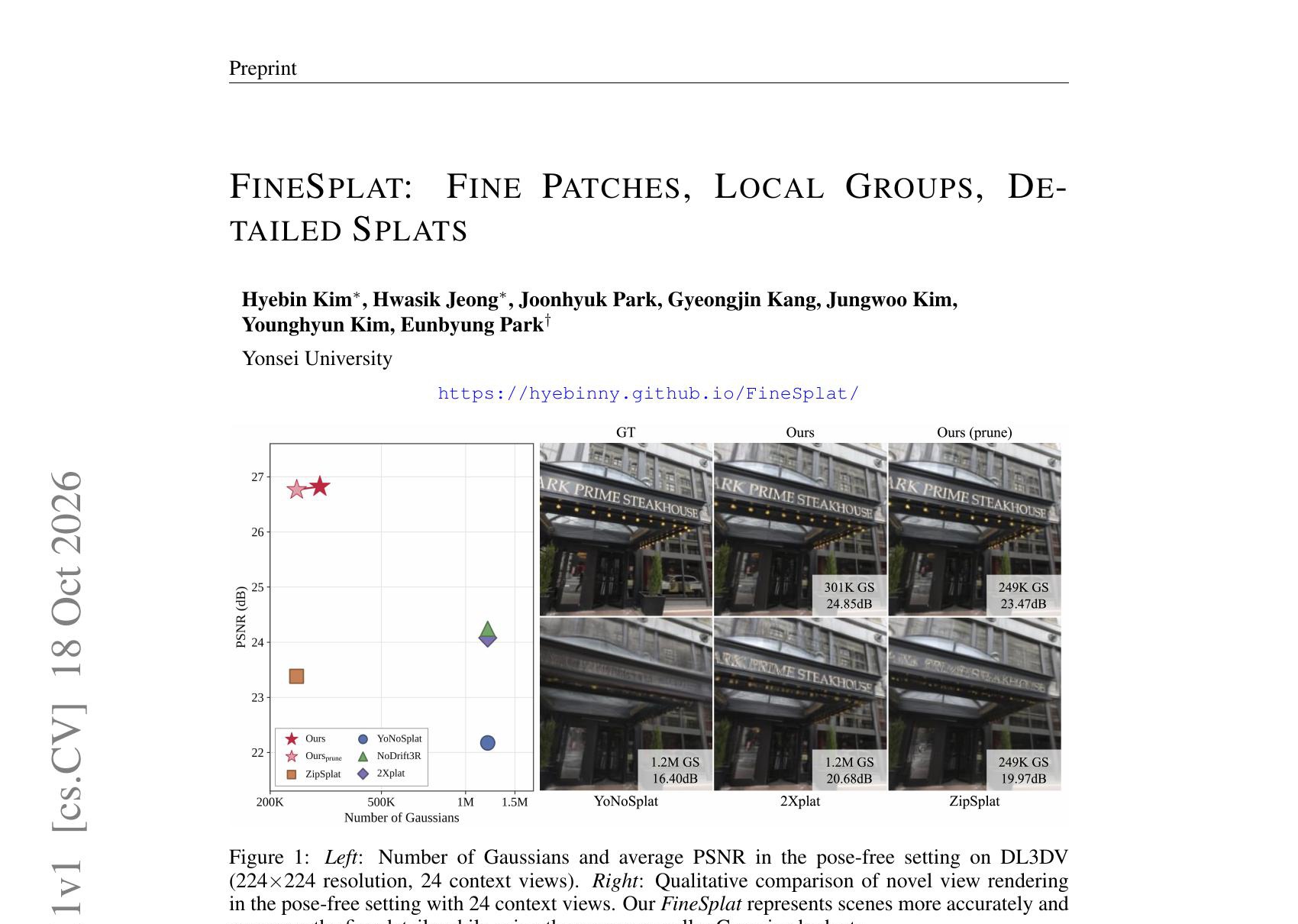
50. FineSplat: Fine Patches, Local Groups, Detailed Splats
🔑 Keywords: Fine-grained patches, Dual grouping, 3D Gaussian Splatting, Rendering-based feedback, Compact Gaussian generation
💡 Category: Computer Vision
🌟 Research Objective:
– The paper aims to improve feed-forward 3D Gaussian Splatting (3DGS) by developing a novel framework, FineSplat, to enhance scene reconstruction quality and novel-view synthesis.
🛠️ Research Methods:
– Introduced fine-grained image patches and a dual-grouping strategy to efficiently manage multi-view interactions and reconnect geometrically related tokens.
– Employed rendering-based feedback to leverage reconstruction error as a signal for refining geometry and appearance.
– Utilized a compact Gaussian generation scheme to maintain the efficiency of fine-grained features.
💬 Research Conclusions:
– FineSplat successfully enhances the recovery of rich geometry and appearance in 3D scenes, achieving state-of-the-art results efficiently and compactly compared to existing methods.
👉 Paper link: https://huggingface.co/papers/2610.25011
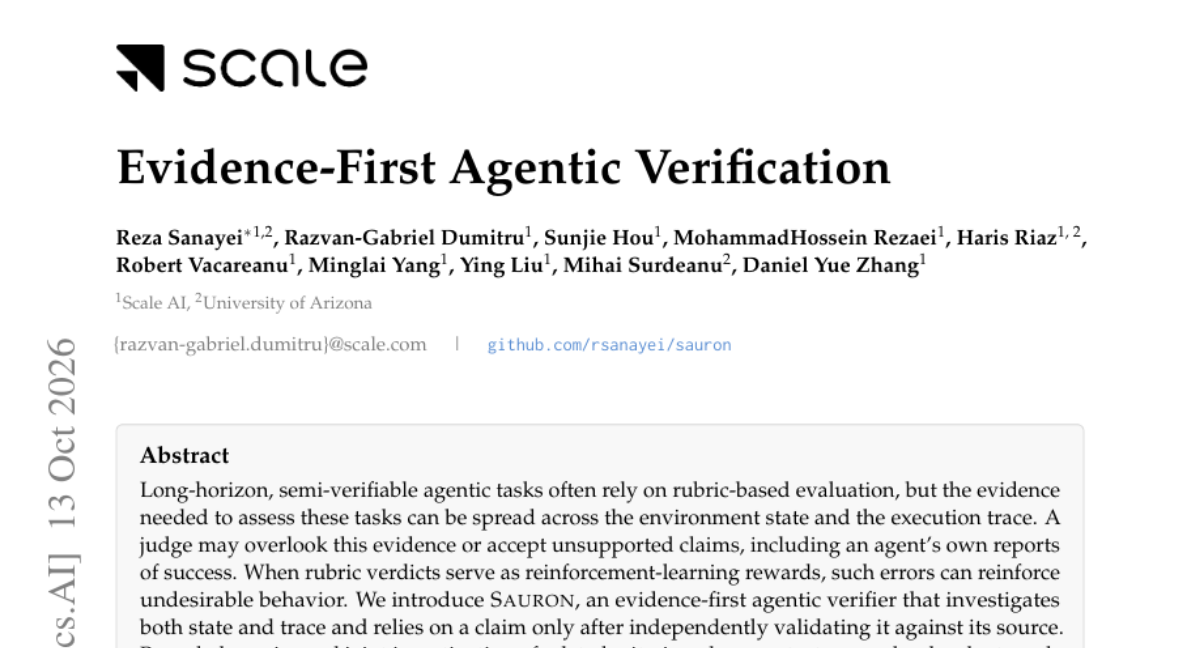
51. Evidence-First Agentic Verification
🔑 Keywords: Sauron, agentic verifier, rubric-based evaluation, reinforcement-learning rewards, auditable receipt
💡 Category: Reinforcement Learning
🌟 Research Objective:
– The research introduces Sauron, an evidence-first agentic verifier, designed to independently validate claims against the environment state and execution traces to improve evaluation accuracy and reduce reinforcement-learning reward errors.
🛠️ Research Methods:
– Sauron investigates both state and execution trace, utilizing bounded queries and joint investigation to minimize context use and redundant work, providing an auditable receipt for each verdict.
💬 Research Conclusions:
– Across multiple tests, Sauron outperforms existing verifiers such as Gandalf in achieving higher F1 scores while remaining cost-effective, and it excels in benchmarks for detecting agent errors and injected failures.
👉 Paper link: https://huggingface.co/papers/2610.17724
52. Think Visually Across Space and Time: Grounded Reasoning for Video Segmentation
🔑 Keywords: Video Reasoning Segmentation, Temporal Chain of Video Primitives, supervised fine-tuning, chain-aligned reinforcement learning
💡 Category: Computer Vision
🌟 Research Objective:
– The paper introduces Temporal Chain of Video Primitives (TCoVP), a spatiotemporally grounded video reasoning chain that links entities to timestamped visual evidence, aiming to improve reasoning and mask prediction across benchmarks.
🛠️ Research Methods:
– Utilizes supervised fine-tuning and chain-aligned reinforcement learning through TCoVP-SFT-15k and TCoVP-RL-13k datasets to enhance model representation.
– Integrates query-relevant observations into a chronological reasoning chain, associating entity references with temporal support and timestamped spatial evidence.
💬 Research Conclusions:
– Extensive experiments demonstrate the strong performance of TCoVP across five Video Reasoning Segmentation benchmarks and three model backbones, highlighting its effectiveness in organizing spatial and temporal evidence within the reasoning process.
– All models and code will be publicly released, promoting transparency and further research.
👉 Paper link: https://huggingface.co/papers/2610.25090
53. BlenderWorld: Benchmarking Visual Agents for 3D Creation from Real-World References
🔑 Keywords: BlenderWorld, multimodal large language models, 3D creation, AI Native
💡 Category: Multi-Modal Learning
🌟 Research Objective:
– The paper introduces BlenderWorld, a comprehensive benchmark for evaluating multimodal large language models on realistic 3D creation tasks.
🛠️ Research Methods:
– BlenderWorld comprises 223 tasks driven by text, image, video, and structured specification inputs, with a unified evaluation protocol using rendered outputs and binary rubrics.
💬 Research Conclusions:
– The benchmarking reveals significant gaps in spatial coherence in current models, highlighting room for improvement in 3D-native agentics while identifying GPT-6-Astra as the top-performing model.
👉 Paper link: https://huggingface.co/papers/2610.23986
54. HarnessPro: Recursive Harness Self-Improvement with Pareto Optimization for Performance-Cost Trade-offs
🔑 Keywords: AI agent harnesses, label-free, execution cost, trajectory diagnosis, weighted selection
💡 Category: AI Systems and Tools
🌟 Research Objective:
– Introduce HarnessPro, a label-free method to enhance AI agent harnesses, improving task performance while reducing execution costs.
🛠️ Research Methods:
– Use LLM-generated tests to evaluate harnesses without ground-truth solutions, employing specialized agents for trajectory diagnosis and plan updates.
💬 Research Conclusions:
– HarnessPro offers cost-focused, balanced, and performance-focused harnesses, with significant improvements in pass-rate and cost reduction compared to RSI.
👉 Paper link: https://huggingface.co/papers/2610.26770
55. RoAR-VAE: Improving Latent Diffusability through Robust Prediction
🔑 Keywords: RoAR-VAE, visual tokenizer, robust prediction, latent diffusion, reconstruction fidelity
💡 Category: Generative Models
🌟 Research Objective:
– To improve visual tokenizers by enhancing robust prediction of semantics and reconstruction from corrupted latents, thereby balancing fidelity with diffusion learnability.
🛠️ Research Methods:
– Introduced the RoAR-VAE model with two objectives: RobustAlign for predicting semantic features from corrupted latents and RobustRecon for reconstructing clean images.
💬 Research Conclusions:
– RoAR-VAE achieves improved generation benchmark performance and increases small-text reconstruction accuracy, demonstrating a favorable balance between reconstruction fidelity and downstream generative learnability.
👉 Paper link: https://huggingface.co/papers/2610.26216

56. AdaExploreBench: Benchmarking LLM Agents for Proactive Exploration and Test-time Adaptation in Evolving Environments
🔑 Keywords: AdaExploreBench, LLM agents, proactive exploration, test-time adaptation, implicit rule drift
💡 Category: Natural Language Processing
🌟 Research Objective:
– This study introduces AdaExploreBench, a benchmark designed to test whether Large Language Model (LLM) agents can proactively discover hidden environmental rules and adapt to evolving conditions.
🛠️ Research Methods:
– The research involves evaluating eight leading LLMs on their ability to acquire evidence and infer changing rules in dynamic environments and to adapt to implicit rule drift, where changes occur without announcement.
💬 Research Conclusions:
– The study reveals that current LLMs struggle with proactive exploration and adaptation, as demonstrated by the performance of GPT-6 Sol, which attained only 61.9% accuracy. Improvements in evidence provision or rule drift handling can increase performance by nearly 10%, indicating a significant challenge in the current capabilities of LLM agents.
👉 Paper link: https://huggingface.co/papers/2610.25950
57. AnyGoal: On World Model Generalization Beyond Expert Rollouts
🔑 Keywords: AnyGoal, world model, dynamics generalization, planning, goal-shifted
💡 Category: Reinforcement Learning
🌟 Research Objective:
– To assess whether world models can generalize dynamics to unseen combinations of familiar states and actions for planning.
🛠️ Research Methods:
– Introduction of AnyGoal, a benchmark with goal-shifted task variants and an open-source library, designed for evaluating world model’s capability to recombine familiar state and action factors into valid dynamics.
💬 Research Conclusions:
– Current world models often fail to generalize to new planning tasks across various environments, underrepresented state-action recombinations, and interaction regimes.
👉 Paper link: https://huggingface.co/papers/2610.26844
58. MT Forcing: Towards Stable and Consistent Multi-Turn Image Editing with Autoregressive Diffusion
🔑 Keywords: MT Forcing, multi-turn image editing, Single-Turn Distribution Matching Distillation, Teacher-Forcing Guidance
💡 Category: Multi-Modal Learning
🌟 Research Objective:
– The research aims to enhance multi-turn image editing by improving visual quality and maintaining cross-turn consistency.
🛠️ Research Methods:
– Introduces a novel training paradigm, MT Forcing, which includes Single-Turn Distribution Matching Distillation (DMD) for visual-quality guidance and Teacher-Forcing Guidance for consistency across editing turns.
💬 Research Conclusions:
– The approach significantly enhances the multi-turn image editing capabilities, providing more stable visual quality and stronger consistency between editing turns.
👉 Paper link: https://huggingface.co/papers/2610.25404

59. Self-Evolving Coding Agents via Harness-Policy Optimization
🔑 Keywords: Self-HPO, reinforcement learning, coding agents, policy optimization, harness optimization
💡 Category: Reinforcement Learning
🌟 Research Objective:
– The paper introduces Self-HPO, a recursive framework aiming to improve coding agents’ performance by simultaneously optimizing harnesses and policies to target evolving failure modes through reinforcement learning.
🛠️ Research Methods:
– Self-HPO involves a recursive self-improving process where the policy analyzes its failures to propose new harness candidates, then updates through reinforcement learning under the selected harness, continuing to optimize the harness based on evolving failure modes.
💬 Research Conclusions:
– Self-HPO outperforms both harness-only and policy-only baselines across coding benchmarks, achieving a significant increase in average resolve rate and generalizing to out-of-distribution settings, with further gains evident when using a stronger external model as the harness proposer.
👉 Paper link: https://huggingface.co/papers/2610.22791
60. ScaleNav: Scalable Internet Video Pretraining for Language-Conditioned Local Navigation
🔑 Keywords: ScaleNav, language-conditioned local navigation, goal-directed visual dynamics, real-world navigation
💡 Category: Robotics and Autonomous Systems
🌟 Research Objective:
– The aim is to explore language-conditioned local navigation, where a robot navigates to a text-specified target visible in its initial observation and stops at the described location.
🛠️ Research Methods:
– The study utilizes internet egocentric videos for scalable real-world navigation experience, applying a three-stage training model with instruction-conditioned video pretraining, action alignment with simulated data, and joint fine-tuning to optimize navigation performance.
💬 Research Conclusions:
– ScaleNav achieves high success rates in navigation tasks within simulation and real-world environments, achieving 86.5% on Short-Horizon OVON and 94.9% on HabitatGS-LN, showcasing its ability to generalize and effectively navigate real-world settings.
👉 Paper link: https://huggingface.co/papers/2610.25690
61. Learning from Fleet Experience: A Collective Learning Paradigm for Robots
🔑 Keywords: Failure-guided retrieval, Asynchronous training, Collective experience learning, Robotics, Policy reliability
💡 Category: Robotics and Autonomous Systems
🌟 Research Objective:
– To enhance the reliability of robotics policies by leveraging collective experience learning without requiring additional expert corrections.
🛠️ Research Methods:
– Implement collective experience learning (CEL) using failure-guided experience retrieval fine-tuning (FERT).
– Utilize a fault-tolerant asynchronous training system (FATS) to manage experience collection and policy distribution across fleets.
💬 Research Conclusions:
– The approach achieves high success rates (93.3%-99.2%) in real-world tasks, demonstrating the effectiveness of CEL and FERT in improving policy reliability.
– Scaling up robot fleets increases experience diversity and enhances policy success rates, notably improving multi-stage tasks.
👉 Paper link: https://huggingface.co/papers/2610.25736

62. MemT-1.0: Towards Memory-Native Evolution
🔑 Keywords: Memory-native architecture, AI Native, foundation models, Gated DeltaNet-2, Mixture-of-Storage
💡 Category: Foundations of AI
🌟 Research Objective:
– To introduce MemT-1.0, a memory-native architecture that enhances long-context efficiency and task performance by embedding continuous memory into foundation model computation.
🛠️ Research Methods:
– Development of MemT-1.0 using a combination of Gated DeltaNet-2 for token-level memory updates and Mixture-of-Storage for scaling native memory capacity, involving a two-stage training pipeline with continued pre-training and post-training.
💬 Research Conclusions:
– MemT-1.0 demonstrates superior performance over parametric memory baselines and competitiveness with retrieval-augmented methods, achieving significant improvements in inference speed and storage efficiency, along with improved task success on agentic tasks.
👉 Paper link: https://huggingface.co/papers/2610.26825
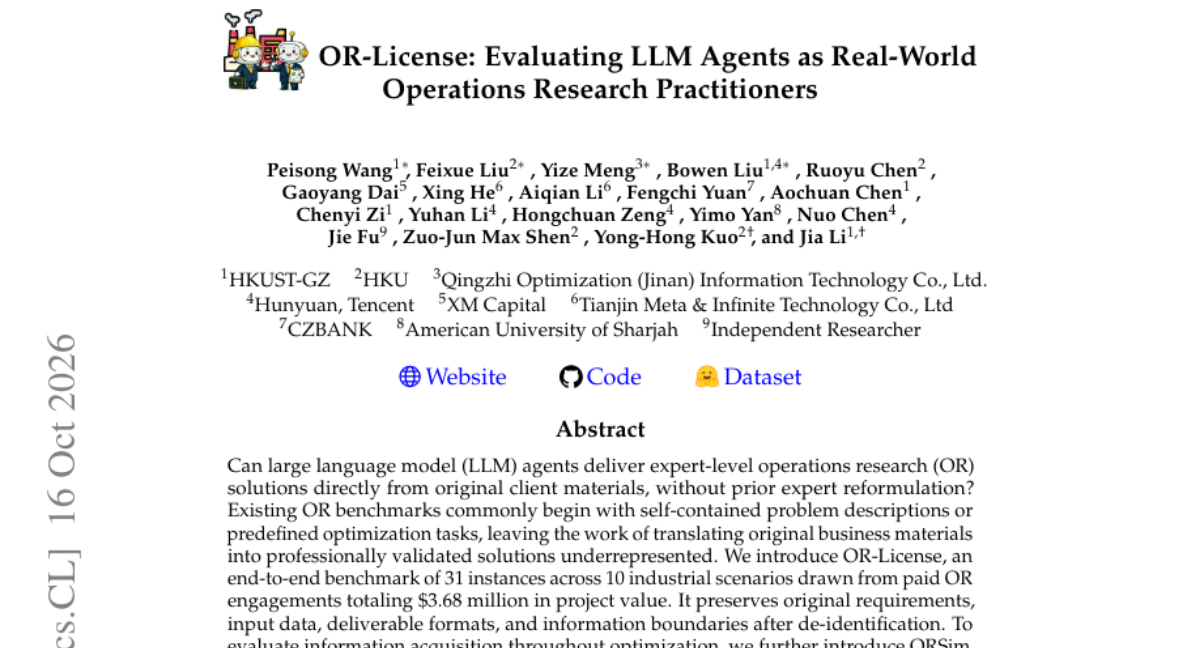
63. OR-License: Evaluating LLM Agents as Real-World Operations Research Practitioners
🔑 Keywords: LLM agents, operations research, OR-License, feasibility, Deployment-Adjusted Quality
💡 Category: Natural Language Processing
🌟 Research Objective:
– Assess the ability of LLM agents to solve real-world operations research problems using original client materials without expert reformulation.
🛠️ Research Methods:
– Introduced OR-License, an end-to-end benchmark with 31 instances across 10 industrial scenarios to evaluate feasibility and Deployment-Adjusted Quality (DAQ).
– Used ORSim, a controlled client simulator, to study information acquisition without supplying OR expertise, and evaluated outcomes against expert solutions.
💬 Research Conclusions:
– Although certain LLM configurations surpassed expert references in conditional objective quality, none achieved expert-level DAQ.
– Identified frequent formulation and implementation failures; highlighted the need for closing information gaps and improving problem formulation and validation processes for long-term LLM agent reliability.
👉 Paper link: https://huggingface.co/papers/2610.24087