AI Native Daily Paper Digest – 20261022 – Qwen | DeLoop | StreamEval

Today’s digest features notable advancements from Gemma and Qwen, pushing boundaries in the field of multimodal reasoning. At the heart of this collection are innovative techniques for improving model adaptability, with several papers highlighting the efficacy of novel neural architectures and attention mechanisms. Among the discussed works, a new benchmark for context-length handling shows promising results with a 15% accuracy improvement over previous models. Additionally, significant strides have been made in reducing computational costs for large-scale datasets, demonstrating enhanced efficiency without sacrificing performance.
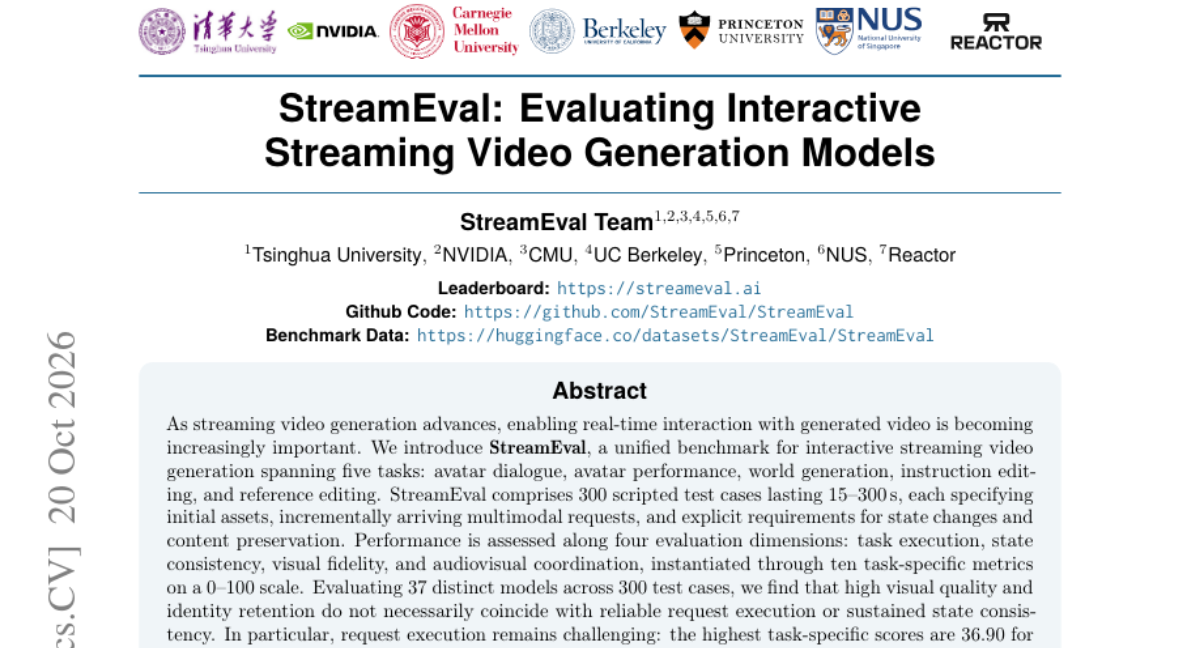
1. StreamEval: Evaluating Interactive Streaming Video Generation Models
🔑 Keywords: interactive streaming video generation, StreamEval, state consistency, real-time interaction, mult-modal requests
💡 Category: Multi-Modal Learning
🌟 Research Objective:
– StreamEval was developed as a comprehensive benchmark to evaluate the effectiveness of interactive streaming video generation across five distinct tasks, addressing the need for real-time interaction with generated video content.
🛠️ Research Methods:
– The benchmark encompasses 300 scripted test cases, with evaluations focusing on task execution, state consistency, visual fidelity, and audiovisual coordination, assessed through ten task-specific metrics on a 0-100 scale.
💬 Research Conclusions:
– Despite high visual quality, challenges persist in reliable request execution and maintaining state consistency. The research identifies reliable request execution under specific constraints as a central obstacle for advancing real-time interactive systems.
👉 Paper link: https://huggingface.co/papers/2610.28402
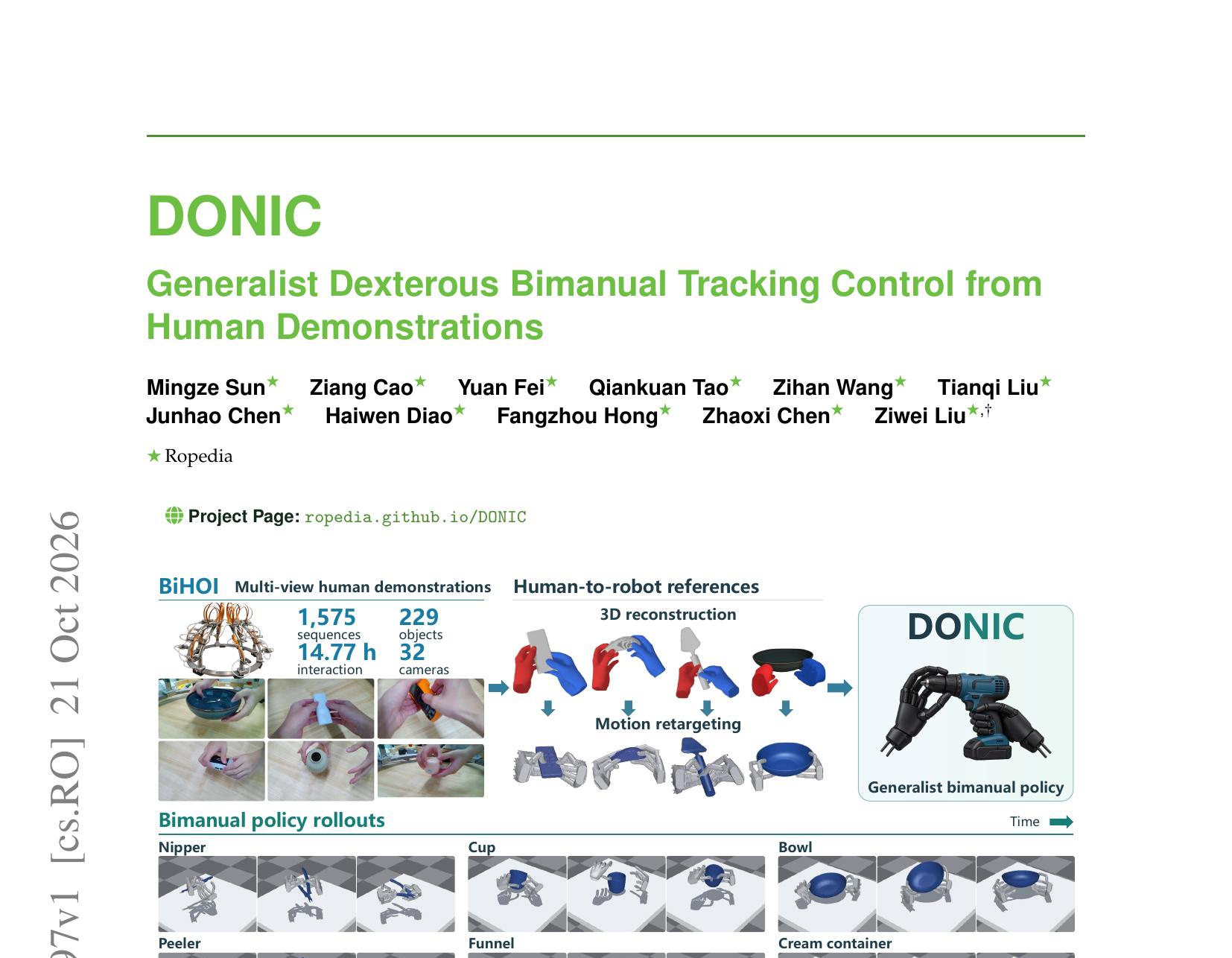
2. DONIC: Generalist Dexterous Bimanual Tracking Control from Human Demonstrations
🔑 Keywords: Generalist Bimanual Tracker, Reinforcement Learning, Bimanual Dexterous Behaviors, Per-hand Rewards, Behavioral Cloning
💡 Category: Robotics and Autonomous Systems
🌟 Research Objective:
– To develop DONIC, the first generalist bimanual tracker that effectively handles diverse human-motion data for high success in unseen object manipulation.
🛠️ Research Methods:
– Utilization of reinforcement learning with recycled demonstrations, and combination of proximal policy optimization with behavioral cloning in a feedback loop.
💬 Research Conclusions:
– DONIC achieves remarkable success rates of 86.79% on unseen trajectories and 57.32% on held-out objects, significantly outperforming existing bimanual tracking baselines.
👉 Paper link: https://huggingface.co/papers/2610.29997
3. Looking Ahead: Modeling Future Evolution in Autoregressive Video Generation
🔑 Keywords: Future Chunk Prediction, Autoregressive video diffusion, teacher forcing, visual evolution, structured representation
💡 Category: Generative Models
🌟 Research Objective:
– To enhance autoregressive video diffusion by incorporating Future Chunk Prediction, improving physical plausibility in video generation with reduced training cost.
🛠️ Research Methods:
– Implementation of Future Chunk Prediction as an auxiliary objective that predicts temporally separated chunks without intervening visual context during training.
💬 Research Conclusions:
– Future Chunk Prediction provides more physically plausible video outputs with lower computation requirements, showing effectiveness in modeling visual evolution and potentially aiding the development of autoregressive world models.
👉 Paper link: https://huggingface.co/papers/2610.29989
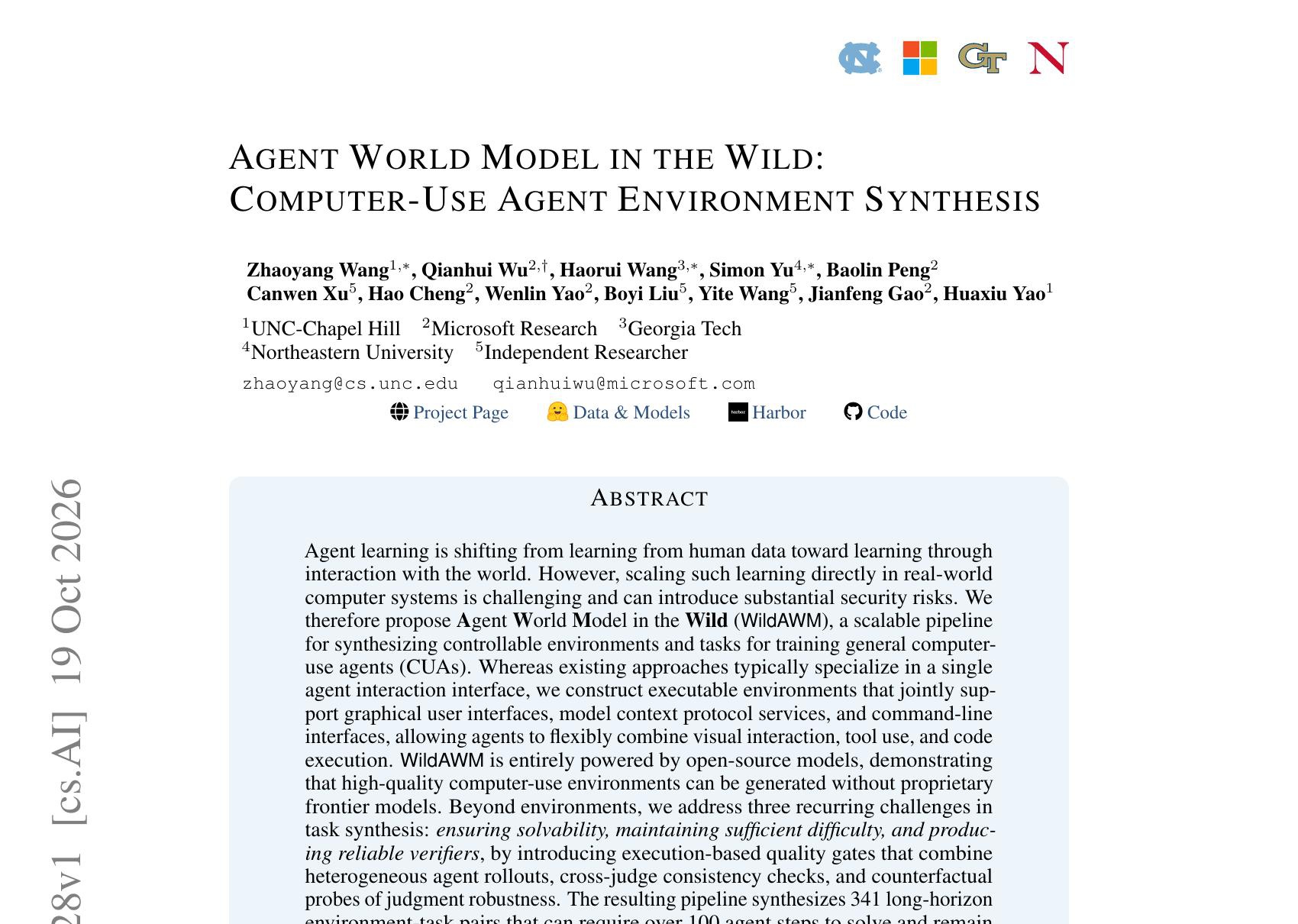
4. Agent World Model in the Wild: Computer-Use Agent Environment Synthesis
🔑 Keywords: WildAWM, general agents, execution-based quality gates, model context protocol, open-source models
💡 Category: Reinforcement Learning
🌟 Research Objective:
– The study aims to enhance out-of-distribution performance of general computer-use agents through the synthesis of controllable environments and tasks for training.
🛠️ Research Methods:
– Utilization of WildAWM, a scalable pipeline that generates environments supporting GUI, CLI, and model context protocol services, along with execution-based quality gates to ensure task solvability, difficulty, and verification.
💬 Research Conclusions:
– WildAWM effectively synthesizes diverse and challenging environment-task pairs, improving general agent learning across multiple benchmarks, and demonstrating substantial gains beyond current frontier models.
👉 Paper link: https://huggingface.co/papers/2610.26828
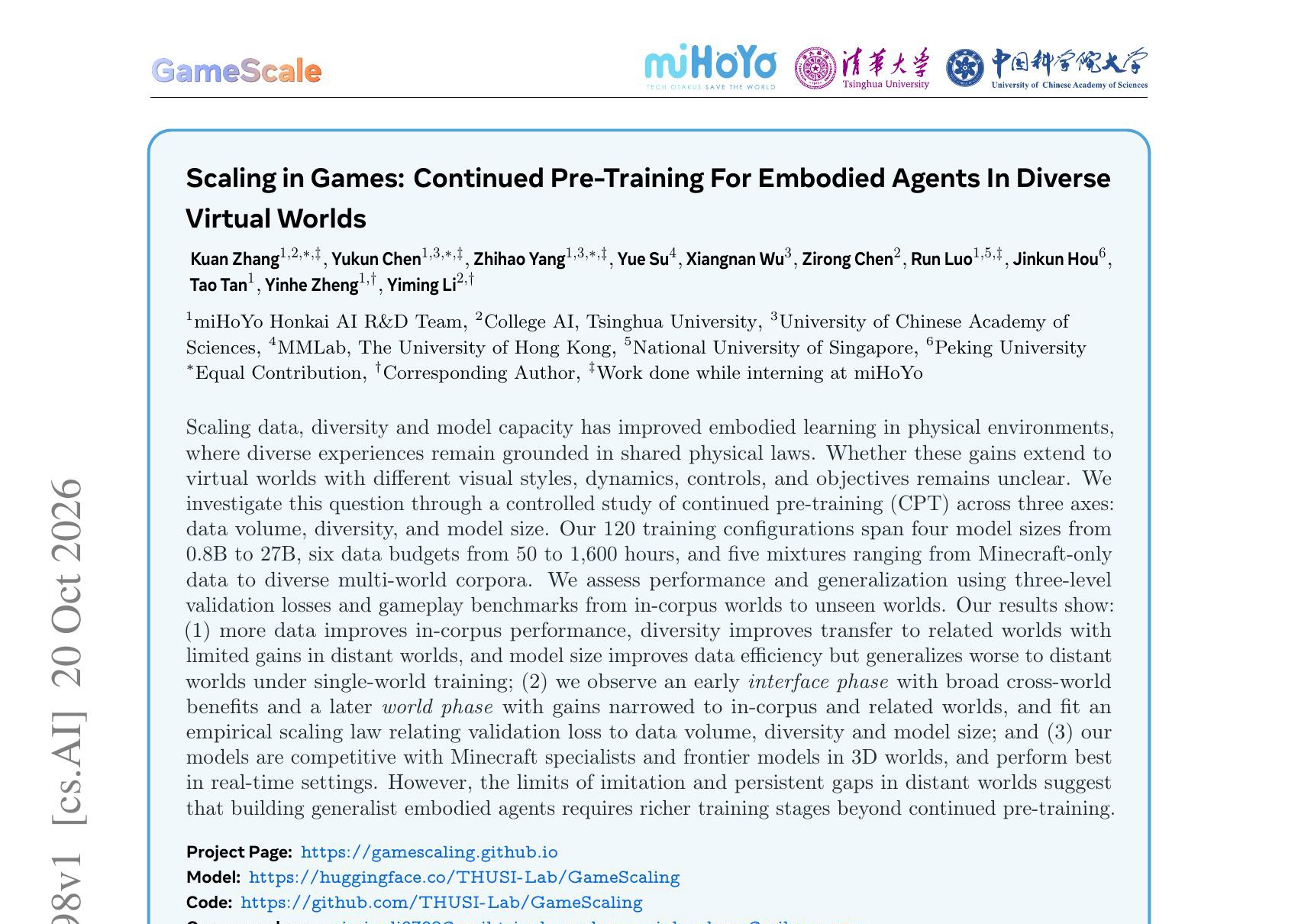
5. Scaling in Games: Continued Pre-Training For Embodied Agents In Diverse Virtual Worlds
🔑 Keywords: Embodied learning, Virtual worlds, Data scaling, Diversity, Generalization
💡 Category: Machine Learning
🌟 Research Objective:
– Investigating the impact of continued pre-training on embodied learning in virtual worlds, with a focus on data volume, diversity, and model size.
🛠️ Research Methods:
– Conducted a controlled study with 120 training configurations across varying data volumes, model sizes, and data diversity, assessed through gameplay benchmarks and validation losses.
💬 Research Conclusions:
– More data enhances in-corpus performance; diversity aids transfer to related worlds, albeit with limited improvement in distant-world generalization.
– A two-phase progression observed: early cross-world benefits and later focus on in-corpus and related worlds.
– Models perform comparably to specialized Minecraft models in 3D worlds, excelling in real-time situations but facing challenges in generalization to distant worlds.
👉 Paper link: https://huggingface.co/papers/2610.28698
6. Socratic Skill Learning: Interleaving Teaching and Practice for Transferable Agent Skills
🔑 Keywords: Socratic Skill Learning, Agent Skills, Learning transferable Skills, SkillTransferBench
💡 Category: AI in Education
🌟 Research Objective:
– The objective is to enhance reusable agent skills by integrating expert guidance with student practice and targeted review, surpassing alternatives like trajectory and contrastive distillation methods.
🛠️ Research Methods:
– The methodology involves Socratic Skill Learning, which balances expert instruction with student-driven practice in various task environments, using a framework called SkillTransferBench for evaluation.
💬 Research Conclusions:
– Socratic Skill Learning achieves higher utility in skill reuse compared to previous methods, with Issue-Guided SSL significantly reducing the need for educator input while maintaining performance.
👉 Paper link: https://huggingface.co/papers/2610.17860
7. AgenticRoboRL: Bringing Coding-Agent Post-Training to Agentic Robotics
🔑 Keywords: AgenticRoboRL, supervised fine-tuning, multi-turn reinforcement learning, robot planners, harness-specific adapters
💡 Category: Robotics and Autonomous Systems
🌟 Research Objective:
– The primary aim is to enhance robot planners through post-training methods such as supervised fine-tuning and multi-turn reinforcement learning, specifically in systems that utilize different execution mechanisms across diverse robot harnesses.
🛠️ Research Methods:
– Implementation of the AgenticRoboRL framework that integrates supervised fine-tuning with multi-turn reinforcement learning. The framework employs harness-specific adapters to maintain a stable execution environment while improving planner performance.
💬 Research Conclusions:
– AgenticRoboRL significantly boosts the success rate of robot planners from 18.1% to 71.0% on LIBERO-PRO without the need for external memory, proving the efficacy of post-training for enhancing robot planner capabilities.
👉 Paper link: https://huggingface.co/papers/2610.28589
8. TraceForge: Distilling with Your Own Thinking
🔑 Keywords: Adversarial Method, Reasoning Trace, LLM, Teacher-Student Model, Authenticity Score
💡 Category: AI in Education
🌟 Research Objective:
– The study aims to develop a two-stage supervised and adversarial method to create reasoning traces that align with a student model’s style, leveraging teacher answers and enhancing coding benchmarks without needing hidden outputs.
🛠️ Research Methods:
– The research utilizes a two-stage approach: first, a supervised learning stage where a generator learns to reconstruct reasoning traces; second, an adversarial stage where a critic assesses the authenticity of generated reasoning traces. The generator adapts the reasoning trace stylistically to match that of a student model, using teacher answers as input.
💬 Research Conclusions:
– The generated reasoning traces have an authenticity score that surpasses real traces on coding benchmarks, such as HumanEval+ and MBPP+, improving by 3.7 and 7.1 points respectively. The study suggests that reasoning written in a student’s model style enhances learning and model performance.
👉 Paper link: https://huggingface.co/papers/2610.29680
9. Multimodal Embodied Agents: A Unified Capability-centric Perspective from Computer-Use to Robot-Use
🔑 Keywords: PAPAV, multimodal embodied agents, physical constraints, capability-centric framework
💡 Category: Robotics and Autonomous Systems
🌟 Research Objective:
– Define five core capabilities for multimodal embodied agents (MMEAs) and evaluate the impact of transitioning from digital to robotic environments.
🛠️ Research Methods:
– Introduce and utilize the PAPAV framework, which includes Perceive, Anticipate, Plan, Act, and Verify, to compare MMEAs with multimodal agents (MMAs) and robotic systems (RSs).
💬 Research Conclusions:
– There are five primary physical constraints faced by MMEAs in a robotic setting, which emphasize the need for a unified framework like PAPAV to guide the design and evaluation of physical agents based on these capabilities rather than solely on task success.
👉 Paper link: https://huggingface.co/papers/2610.30108
10. DeLoop: Repeated Actions as Self-Supervision for Long-Horizon Agents
🔑 Keywords: DeLoop, Language-model agents, Self-supervised training, Direct preference optimization, Loops
💡 Category: Natural Language Processing
🌟 Research Objective:
– The primary objective is to optimize the preferences of language-model agents and reduce repetitive tool-use loops through a method called DeLoop, enhancing task efficiency and success.
🛠️ Research Methods:
– DeLoop utilizes self-supervised training by learning from the agents’ own rollouts, using looping actions as negative examples and non-looping actions as positive examples for direct preference optimization.
💬 Research Conclusions:
– DeLoop successfully decreases the percentage of Qwen3-8B tasks with loops from 57.3% to 6.1%, reduces the number of steps needed per task while maintaining similar task success rates, and boosts task success on Qwen3-32B from 37.7% to 44.8%.
👉 Paper link: https://huggingface.co/papers/2610.19376
11. CulturalRiddles: A Multicultural Benchmark of Riddles
🔑 Keywords: CulturalRiddles, abductive reasoning, cultural context, LLMs, human evaluation
💡 Category: Natural Language Processing
🌟 Research Objective:
– To evaluate the understanding and representation of diverse cultures by Large Language Models (LLMs) using a culturally grounded benchmark.
🛠️ Research Methods:
– Development of CulturalRiddles, a benchmark created with community input that includes riddles from 62 cultures. Evaluation of 28 LLM configurations using automatic and human assessments.
💬 Research Conclusions:
– Current LLMs, even frontier models, struggle with cultural understanding, achieving only up to 22% accuracy in certain communities. The research calls for an expansion of evaluative benchmarks to enhance LLM cultural and linguistic coverage.
👉 Paper link: https://huggingface.co/papers/2610.29968
12. Real In, Real Out: What If We Only Use Real Data for Scene Text Editing?
🔑 Keywords: Scene Text Editing, TextRIRO, self-paired training, conditional diffusion, long-text recognition
💡 Category: Computer Vision
🌟 Research Objective:
– Investigate the feasibility of using self-paired real data for Scene Text Editing to improve realism and performance.
🛠️ Research Methods:
– Utilize image disruptions (e.g., Crop, Shuffle, Mask) to create self-paired training data within a conditional diffusion model framework.
💬 Research Conclusions:
– TextRIRO significantly enhances accuracy and visual realism in scene text editing while reducing the synthetic-to-real domain gap, and it improves recognition accuracy by providing valuable training resources.
👉 Paper link: https://huggingface.co/papers/2610.27592
13. Automating ML for Science: Can Frontier Agents Climb Scientific Hills in the Wild?
🔑 Keywords: scientific ML benchmarks, frontier coding agents, ML-engineering tricks, domain insight, Agent4Sci
💡 Category: Machine Learning
🌟 Research Objective:
– To evaluate the performance of frontier coding agents on scientific ML benchmarks and determine their reliance on engineering tricks versus domain insight.
🛠️ Research Methods:
– Introduction of Agent4Sci, a long-horizon testbed covering 20 benchmarks across 11 domains, to assess the performance and limitations of current frontier agents.
💬 Research Conclusions:
– Frontier agents advance published models on all benchmarks through engineering tricks rather than substantial research insights; while plugin skills can enhance performance significantly.
– This study identifies key limitations, including novelty miscalibration, resource under-utilization, and a tendency towards local engineering sweeps.
👉 Paper link: https://huggingface.co/papers/2610.28763
14. Think Harder Where It Matters: Item-Level Adaptive Recursion for Sequential Recommendation
🔑 Keywords: LoopRec, adaptive reasoning, sequential recommendation, weight-shared block, early-exit gates
💡 Category: Knowledge Representation and Reasoning
🌟 Research Objective:
– Introduce LoopRec to enable adaptive per-item computation depth in sequential recommendation systems, improving both efficiency and accuracy compared to fixed-depth computation.
🛠️ Research Methods:
– Implementation of recursive weight-shared blocks and early-exit gates to individually decide computation depths for items in a sequence.
– Extensive experiments on public benchmarks with four different backbone architectures.
💬 Research Conclusions:
– LoopRec consistently outperforms fixed-depth counterparts, efficiently utilizing computational resources and enhancing recommendation quality.
– Learned allocation by LoopRec shows interpretable patterns, granting deeper computation to lower-frequency and more recent interactions.
👉 Paper link: https://huggingface.co/papers/2610.30128
15. SpatialBrain: Spatial Intelligence Growing from Experience
🔑 Keywords: SpatialBrain, spatial reasoning, vision-language backbone, 3DFusionMemory, Spatial Skill Library
💡 Category: Knowledge Representation and Reasoning
🌟 Research Objective:
– The objective is to improve spatial reasoning by distinguishing between scene evidence and reasoning experience, utilizing a fixed vision-language backbone.
🛠️ Research Methods:
– The framework employs 3DFusionMemory to integrate scene observations into queryable spatial relations, uses a Spatial Skill Library for reusable tool procedures, and consolidates process records across task blocks for improved decision-making.
💬 Research Conclusions:
– SpatialBrain enhances performance across spatial-reasoning benchmarks, showing improvements in four out of five tests compared to direct answers from the same backbone, highlighting its efficient use of accumulated resources.
👉 Paper link: https://huggingface.co/papers/2610.29317
16. RealMe: Immersive Volumetric Video from Minimal Captures
🔑 Keywords: RealMe, video diffusion model, volumetric video reconstruction, 4D consistency, latent frequency loss
💡 Category: Generative Models
🌟 Research Objective:
– The paper aims to enhance sparse and low-resolution multi-view captures into high-resolution, 4D-consistent volumetric videos using a novel framework called RealMe.
🛠️ Research Methods:
– RealMe leverages a video diffusion model with layout-aware attention and latent frequency loss to improve video resolution and 4D consistency from limited capture data.
– The method involves constructing auxiliary data, encoding them into latents with positional embeddings, and adapting factorized spatio-temporal attention for multi-view captures.
💬 Research Conclusions:
– Extensive experiments demonstrate that RealMe creates immersive volumetric videos with superior visual fidelity and 4D consistency compared to state-of-the-art methods.
👉 Paper link: https://huggingface.co/papers/2610.30023

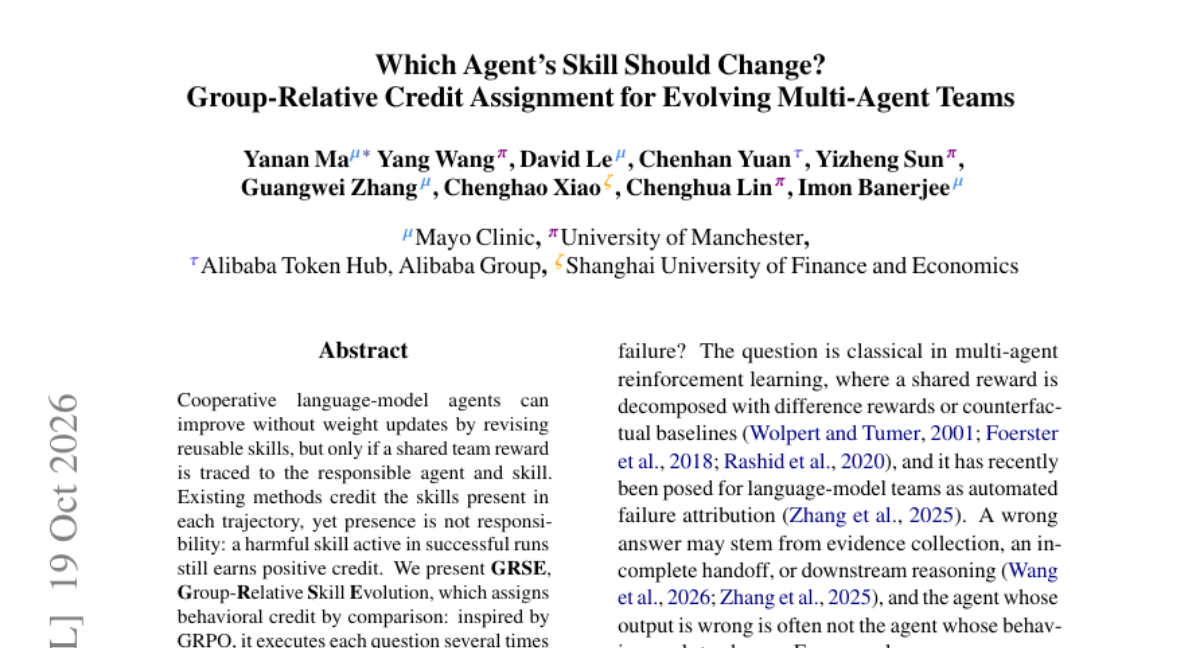
17. Which Agent’s Skill Should Change? Group-Relative Credit Assignment for Evolving Multi-Agent Teams
🔑 Keywords: GRSE, cooperative language agents, skill libraries, multi-hop reasoning, behavioral credit
💡 Category: Natural Language Processing
🌟 Research Objective:
– To improve the assignment of behavioral credit to cooperative language agents by using repeated executions to better identify responsible agent-skill pairs.
🛠️ Research Methods:
– Introducing GRSE (Group-Relative Skill Evolution), which contrasts multiple executions under the same skill libraries to accurately credit agent-skill pairs with a structured diagnosis of failures.
💬 Research Conclusions:
– GRSE outperforms existing methods like MASkills in tasks such as HotpotQA and LoCoMo, achieving significant gains in multi-hop questions and demonstrating robustness in handling corrupted skill libraries by correctly crediting skills and recovering clean library scores.
👉 Paper link: https://huggingface.co/papers/2610.27227
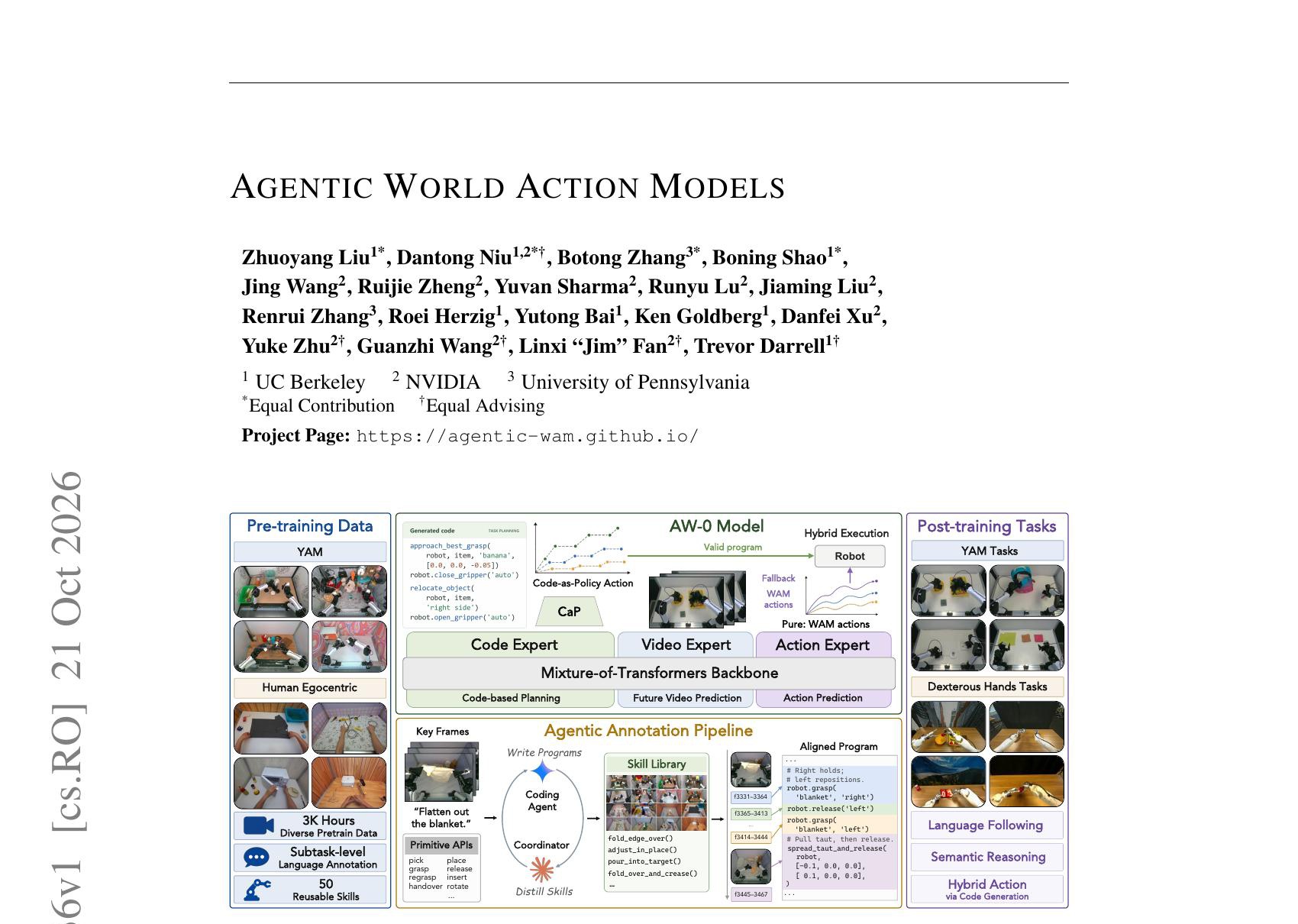
18. Agentic World Action Models
🔑 Keywords: Agentic robotics, compositional skill reuse, predictive grounding
💡 Category: Robotics and Autonomous Systems
🌟 Research Objective:
– Introduce AW-0, a framework integrating code-based planning with video and action prediction for robot manipulation.
🛠️ Research Methods:
– Utilize a mixture-of-transformers architecture to model code, future video, and robot actions as coupled generative streams.
– Develop an automated curation pipeline for labeling video trajectories and creating reusable skill libraries.
💬 Research Conclusions:
– AW-0 enhances task performance in robot manipulation, improves language following, and demonstrates robustness compared to existing baselines like VLA and WAM.
👉 Paper link: https://huggingface.co/papers/2610.30136
19. From RL Papers to Framework Code: Inclusion and Review in Seven Open-Source Training Frameworks
🔑 Keywords: Reinforcement Learning, Language Models, Open-Source Frameworks, Training Methods, AI Native
💡 Category: Reinforcement Learning
🌟 Research Objective:
– The study aims to measure the adoption rate of reinforcement learning training methods for language models in open-source frameworks.
🛠️ Research Methods:
– The researchers analyzed commit histories of seven open-source frameworks and linked them to 6,939 screened arXiv papers from January 2025 to June 2026, focusing on the integration of proposed RL training methods.
💬 Research Conclusions:
– Of 1,598 RL training method proposals, only 37 were adopted by at least one framework, indicating low adoption rates despite a high number of proposals. Larger models and minor changes in existing loss functions are more likely adopted.
– Most proposed methods not included in frameworks lacked public threads and many proposals remain open without replies, highlighting a disconnect between academic proposals and practical implementations in the community.
👉 Paper link: https://huggingface.co/papers/2610.28027
20. ACE-Brain-0.6: Scaling Spatial Grounding for Physical Foundation Models
🔑 Keywords: Spatial Perception, Visual Grounding, Embodied Manipulation, General-purpose Multimodal Models, Fine-tuning
💡 Category: Multi-Modal Learning
🌟 Research Objective:
– The research aims to improve spatial perception and embodied manipulation in open multimodal models by scaling diverse verifiable visual grounding data.
🛠️ Research Methods:
– Developed a unified data pipeline combining robot manipulation recordings with various visual data, followed by fine-tuning the Qwen3.5-9B model with approximately 1.5 million samples.
💬 Research Conclusions:
– The model ACE-Brain-0.6, derived from this process, demonstrated enhanced performance by outperforming GPT-6 Astra on public grounding benchmarks. This study confirms that expanding grounding supervision supports improved spatial perception in general embodied operations.
👉 Paper link: https://huggingface.co/papers/2610.27040

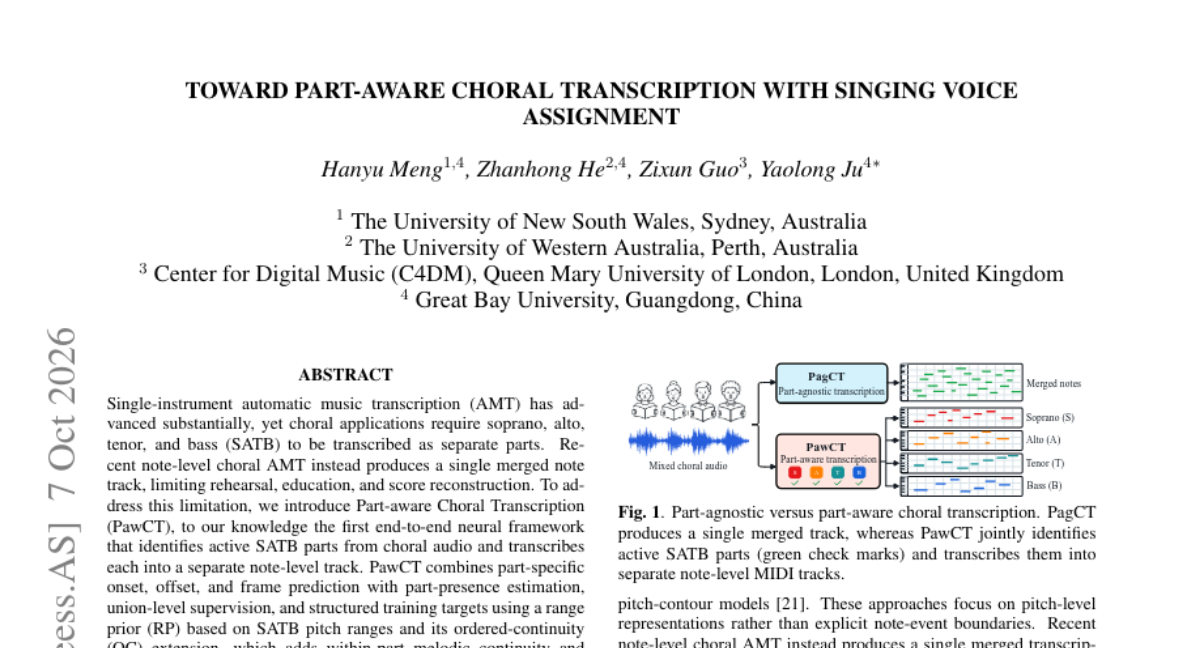
21. Toward Part-Aware Choral Transcription with singing voice assignment
🔑 Keywords: PawCT, SATB, Choral Transcription, Neural Framework, Automatic Music Transcription
💡 Category: AI in Education
🌟 Research Objective:
– To develop an end-to-end neural framework named PawCT for transcribing choral audio into separate SATB note tracks, addressing limitations in choral Automatic Music Transcription (AMT) which typically produces a single merged track.
🛠️ Research Methods:
– Utilization of part-specific predictions, range priors, and ordered-continuity constraints to transcribe choral audio into separate SATB parts with structured training targets and union-level supervision.
💬 Research Conclusions:
– PawCT significantly outperforms previous models by exhibiting a 36.4% relative improvement over adapted choral baselines, showcasing the effectiveness of jointly modeling note transcription and vocal-part assignment. Additionally, the part-agnostic variant, PagCT, surpasses the previous state-of-the-art with a notable improvement in F1 score.
👉 Paper link: https://huggingface.co/papers/2610.09861
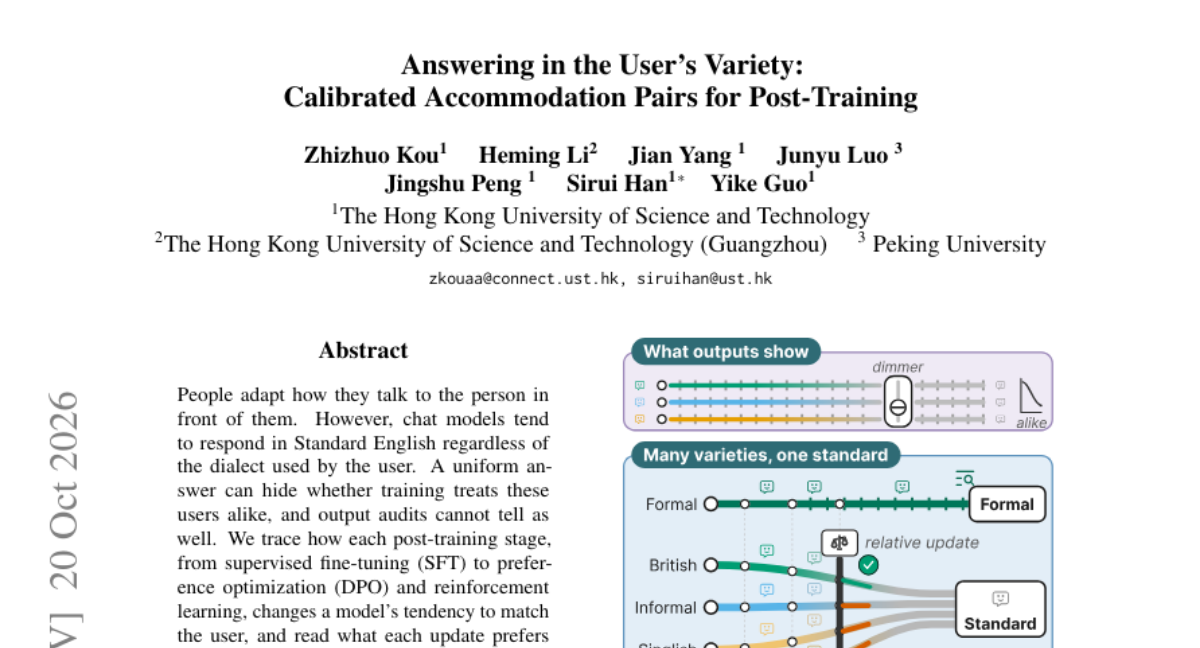
22. Answering in the User’s Variety: Calibrated Accommodation Pairs for Post-Training
🔑 Keywords: dialect adaptation, Standard English, Reinforcement Learning, CAP, AI Ethics and Fairness
💡 Category: Natural Language Processing
🌟 Research Objective:
– To examine how post-training stages affect chat models’ ability to adapt responses to match users’ dialects, rather than defaulting to Standard English.
🛠️ Research Methods:
– Tracing changes in model response tendencies across supervised fine-tuning (SFT), preference optimization (DPO), and reinforcement learning.
– Introducing calibrated accommodation pairs (CAP) to improve user dialect matching without compromising Standard English response quality.
💬 Research Conclusions:
– Post-training tends to standardize responses, favoring British and Australian spelling over AAE and Singlish, despite models showing AAE features upon request.
– CAP effectively enhances dialect convergence for non-trained features without increasing dialect usage for Standard-English users or affecting instruction adherence.
👉 Paper link: https://huggingface.co/papers/2610.28474
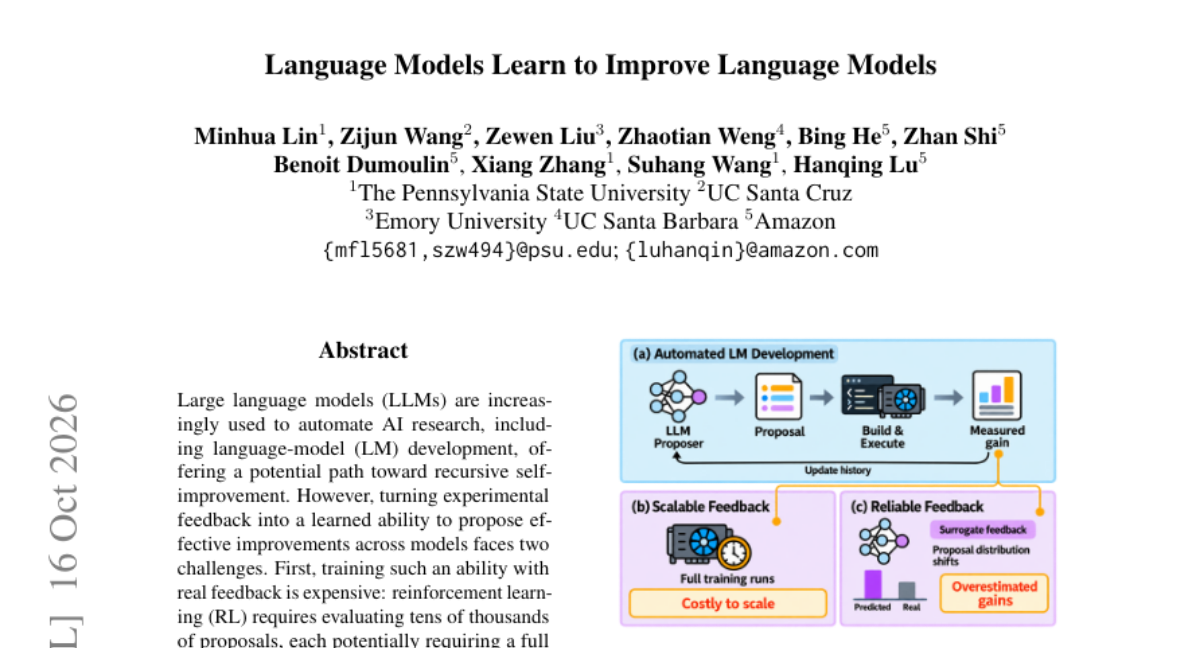
23. Language Models Learn to Improve Language Models
🔑 Keywords: LM2LM, Large Language Models, Reinforcement Learning, Surrogate Feedback, Research World Model
💡 Category: Reinforcement Learning
🌟 Research Objective:
– The objective is to improve language models by utilizing reinforcement learning in combination with a research world model to provide scalable and reliable feedback for cost-effective enhancement of model proposals.
🛠️ Research Methods:
– The use of a frozen research world model as a reward model to predict proposal gains from existing experimental records.
– Regular execution of promising proposals to refine feedback reliability and context.
💬 Research Conclusions:
– LM2LM enables improvements in language models with reduced computational costs while consistently outperforming larger models like GPT-6-sol with less data requirement.
– The proposed method generalizes well across multiple environments and models.
👉 Paper link: https://huggingface.co/papers/2610.23344
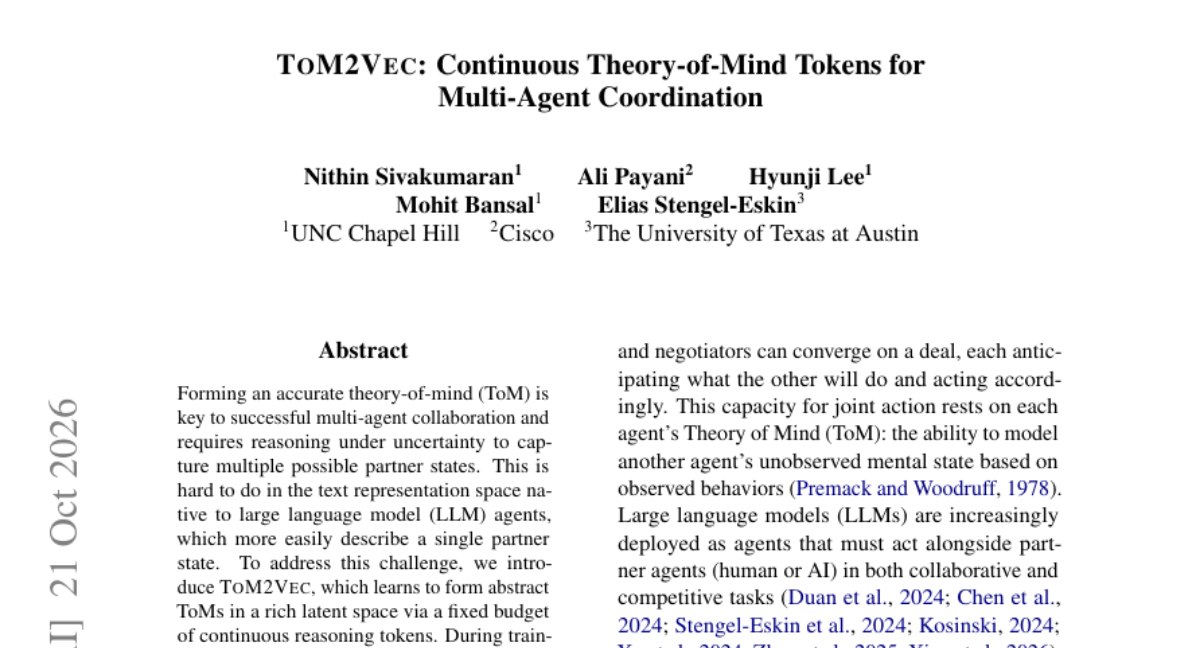
24. ToM2Vec: Continuous Theory-of-Mind Tokens for Multi-Agent Coordination
🔑 Keywords: ToM2Vec, Multi-agent collaboration, Latent reasoning, Continuous reasoning tokens, Theory-of-mind
💡 Category: Knowledge Representation and Reasoning
🌟 Research Objective:
– To improve multi-agent collaboration across diverse settings using ToM2Vec, an approach that develops abstract partner-state representations via continuous latent reasoning tokens.
🛠️ Research Methods:
– Developed a new model, ToM2Vec, that uses a fixed budget of continuous reasoning tokens to learn abstract theories-of-mind. Evaluated the model across several collaborative and competitive environments, comparing its performance against base models and competitive baselines.
💬 Research Conclusions:
– ToM2Vec consistently improves multi-agent interaction and collaboration, significantly outperforming the base model and other baselines. The use of latent reasoning over text representation enhances performance, and the approach generalizes to unseen partner model families, successfully encoding theory-of-mind instead of task-specific information.
👉 Paper link: https://huggingface.co/papers/2610.29934
25. Looped Uniform Diffusion Language Models
🔑 Keywords: looping, Transformer layers, diffusion language models, training efficiency, inference efficiency
💡 Category: Natural Language Processing
🌟 Research Objective:
– Investigate the impact of looping early Transformer layers on the training and inference efficiency of Uniform Diffusion Language Models (UDLMs) without modifying their objective or sampler.
🛠️ Research Methods:
– Apply selective looping to early Transformer layers during each denoising step in training UDLMs, assessing training costs and model performance on datasets such as OpenWebText and FineWeb-Edu.
💬 Research Conclusions:
– Looping significantly improves training efficiency, achieving comparable validation NLL with up to 2.8x fewer FLOPs on OpenWebText and 3.3x fewer on FineWeb-Edu.
– Looped UDLMs demonstrate up to 9.8% lower generation perplexity at a matched NFE budget compared to non-looped UDLMs.
– Adjusting loop-count distributions to favor smaller counts enhances inference efficiency on downstream tasks by reducing loops by 12% without sacrificing accuracy.
👉 Paper link: https://huggingface.co/papers/2610.30066
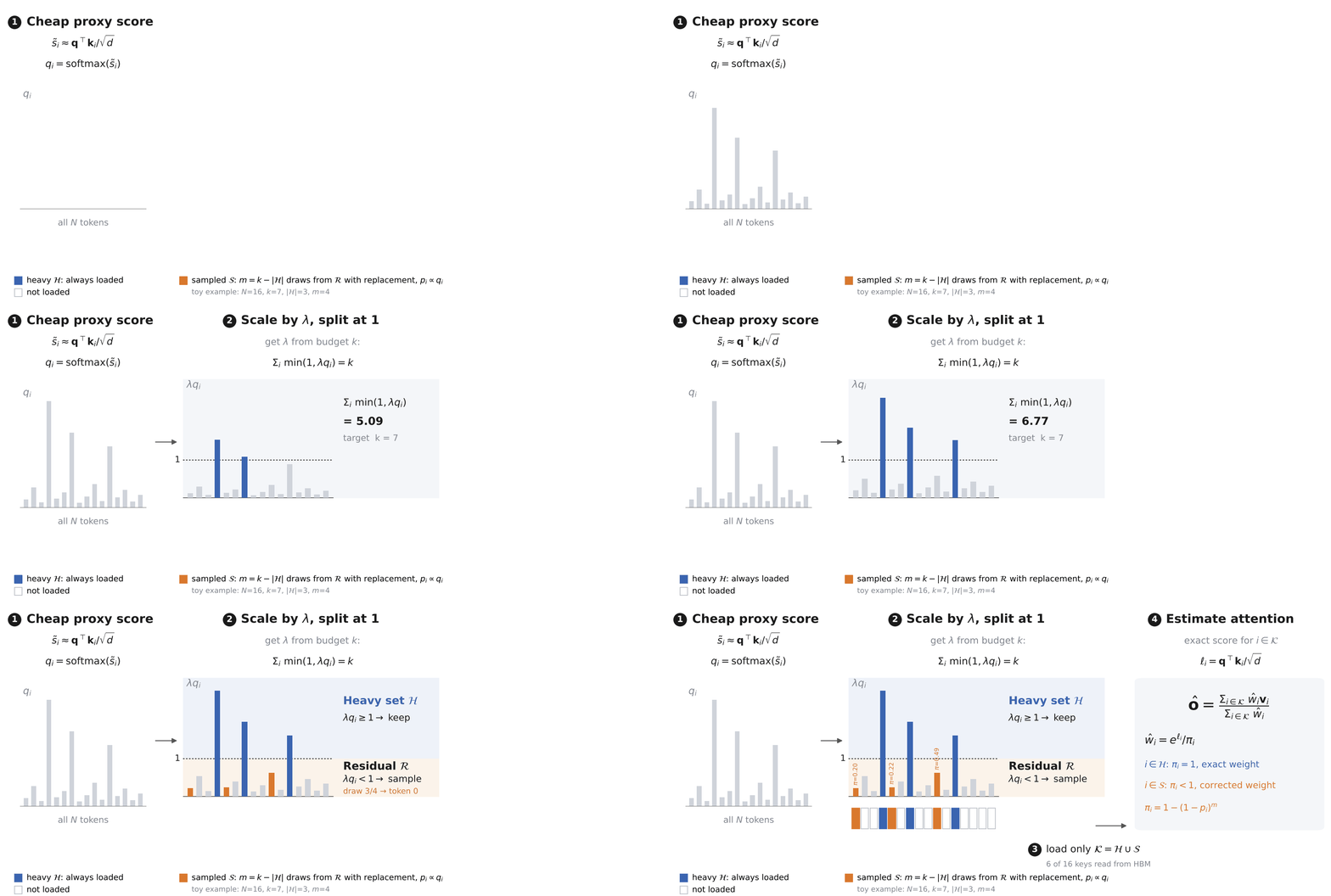
26. Stratified Sparse Attention: Reducing the Sparse-to-Dense Gap at Extreme Sparsity
🔑 Keywords: Stratified Sparse Attention, long-context inference, deterministic retrieval, score-guided sampling, attention mass
💡 Category: Natural Language Processing
🌟 Research Objective:
– The research aims to improve long-context inference accuracy and speed by unifying deterministic retrieval and score-guided sampling in a new framework called Stratified Sparse Attention (SSA).
🛠️ Research Methods:
– The paper introduces SSA, which combines deterministic retrieval with score-guided sampling to effectively recover attention mass beyond the top-k retrieval set. SSA is evaluated across multiple benchmarks and models of varying sizes.
💬 Research Conclusions:
– SSA consistently improves over baseline methods in terms of accuracy at matched sparsity levels and achieves significant speedup for long-context inference as demonstrated through optimized CUDA kernels and practical deployment.
👉 Paper link: https://huggingface.co/papers/2610.28441
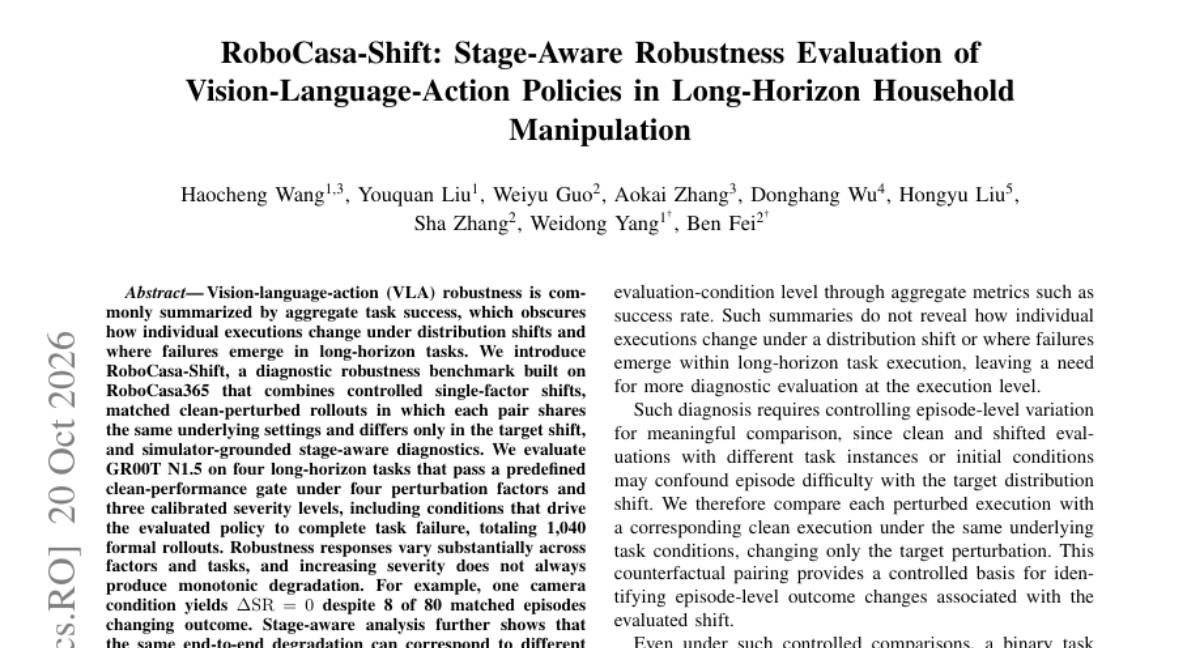
27. RoboCasa-Shift: Stage-Aware Robustness Evaluation of Vision-Language-Action Policies in Long-Horizon Household Manipulation
🔑 Keywords: RoboCasa-Shift, Vision-language-action, Robustness, Long-horizon tasks, Distribution shifts
💡 Category: Robotics and Autonomous Systems
🌟 Research Objective:
– To evaluate the robustness of vision-language-action systems under varying distribution shifts and task conditions using the RoboCasa-Shift benchmark.
🛠️ Research Methods:
– Utilized paired rollouts and stage-aware diagnostics to identify variability in robustness responses across different factors and tasks.
– Tested GR00T N1.5 on long-horizon tasks under various perturbation factors and severity levels with a total of 1,040 formal rollouts.
💬 Research Conclusions:
– Revealed that robustness is a multi-dimensional property, not a single end-to-end performance measure, as different factors affect execution profiles variably.
– Suggested the need for evaluation protocols that address outcome degradation, sensitivity, and failure progression.
👉 Paper link: https://huggingface.co/papers/2610.27861
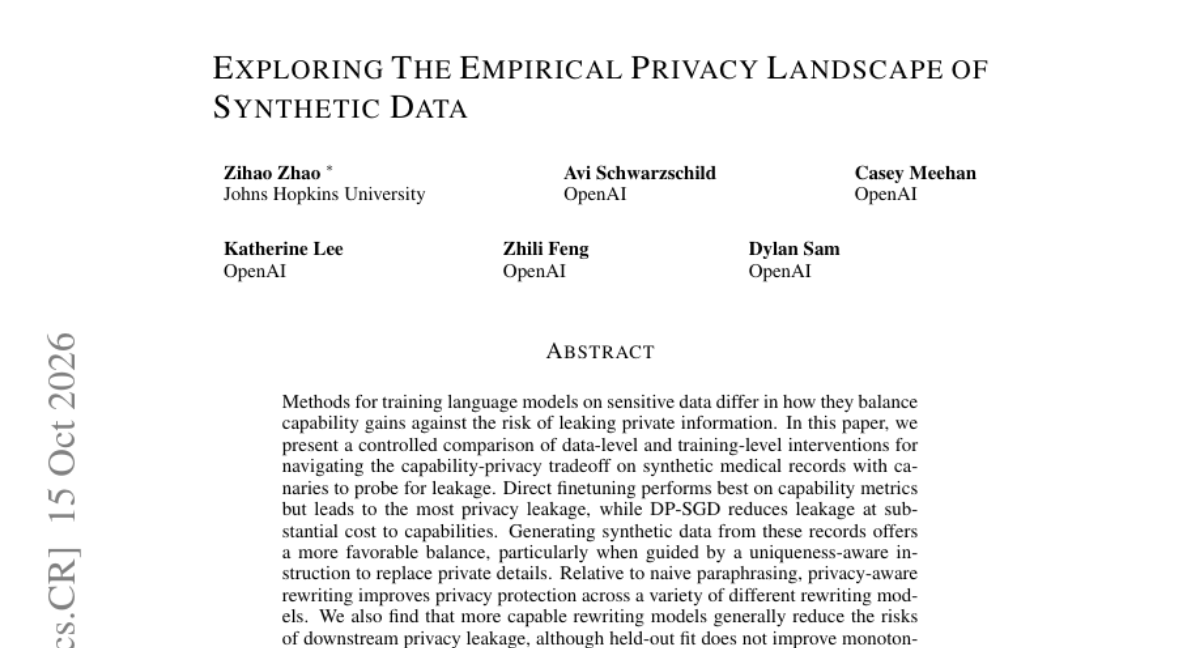
28. Exploring The Empirical Privacy Landscape of Synthetic Data
🔑 Keywords: Privacy-aware rewriting, Synthetic medical records, Privacy protection, DP-SGD, Capability trade-off
💡 Category: AI in Healthcare
🌟 Research Objective:
– To explore effective strategies for balancing capability gains and privacy protection when training language models on synthetic medical records and to evaluate the benefits of privacy-aware rewriting.
🛠️ Research Methods:
– Comparative analysis of data-level and training-level interventions to assess the capability-privacy trade-off.
– Utilization of privacy-aware rewriting techniques on synthetic data and the use of canaries to detect privacy leakage.
💬 Research Conclusions:
– Privacy-aware rewriting offers a better trade-off between capability and privacy protection compared to direct fine-tuning or DP-SGD.
– More capable rewriting models generally enhance privacy protection, although increases in test-time computation do not consistently yield benefits.
– The research demonstrates the promise of privacy-aware rewriting in balancing capabilities and empirical privacy, providing a framework for comparison in future studies.
👉 Paper link: https://huggingface.co/papers/2610.22659
29.
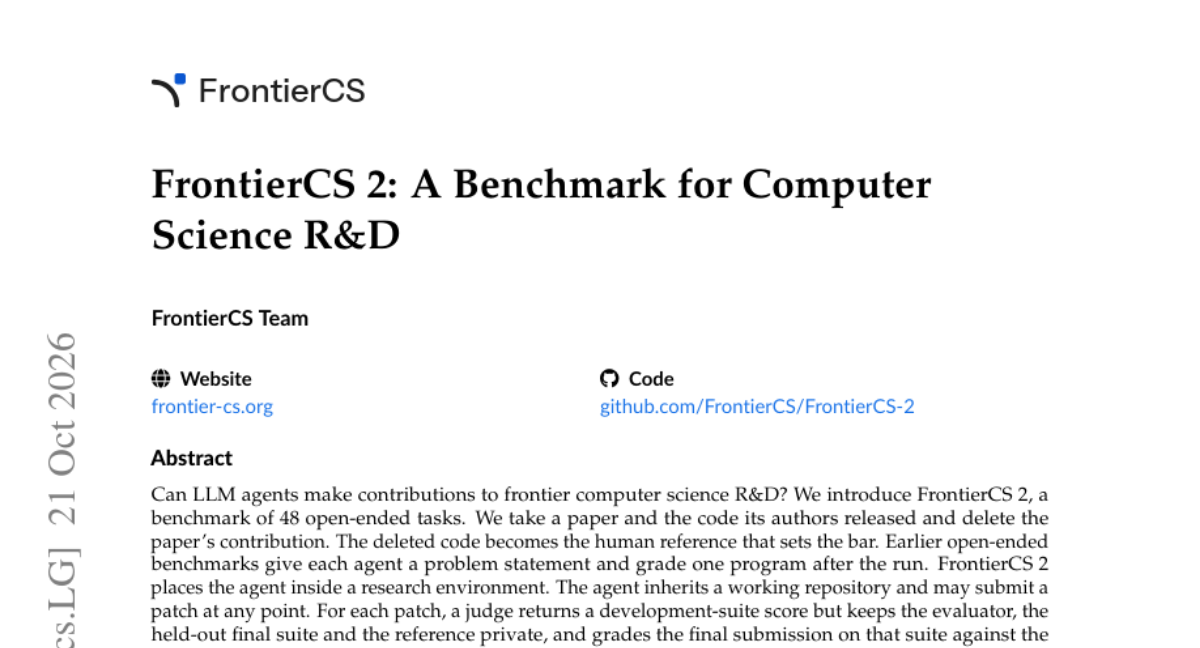
30. FrontierCS 2: A Benchmark for Computer Science R&D
🔑 Keywords: LLM agents, FrontierCS 2, open-ended tasks, machine-learning systems, AI Native
💡 Category: AI Systems and Tools
🌟 Research Objective:
– To evaluate the effectiveness of LLM agents in contributing to open-ended computer science R&D tasks using the FrontierCS 2 benchmark.
🛠️ Research Methods:
– The study uses a benchmark of 48 open-ended tasks across 13 domains, where agents inherit a working repository and can submit patches to solve tasks.
💬 Research Conclusions:
– The best-performing agent, Claude Opus 5.5, passes 58% of runs, indicating a significant gap between agent capabilities and task difficulty, with no runs passing on 16 tasks.
👉 Paper link: https://huggingface.co/papers/2610.29932
31. Bridged Self-Distillation for On-Policy Learning
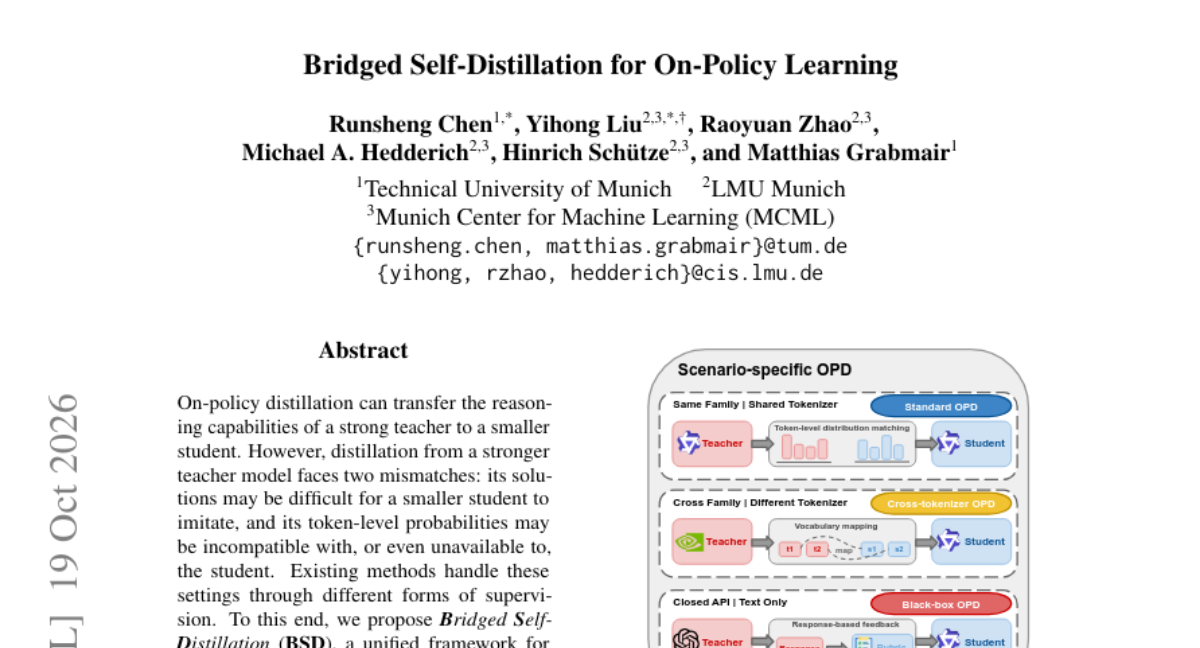
🔑 Keywords: Bridged Self-Distillation, On-policy distillation, reasoning traces, token-level guidance, verifier
💡 Category: Foundations of AI
🌟 Research Objective:
– To create a unified framework, Bridged Self-Distillation, that transfers reasoning capabilities from any teacher model to a student model by using reasoning traces.
🛠️ Research Methods:
– Employs Bridged Self-Distillation to provide privileged reasoning traces for scoring student model rollouts and guiding token-level updates, integrating verifiers for outcome verification.
💬 Research Conclusions:
– The Bridged Self-Distillation framework improves upon base models and outperforms scenario-specific baselines, offering a novel unified approach to reasoning transfer in various teacher scenarios.
👉 Paper link: https://huggingface.co/papers/2610.26397
32. Design Anything, Design at Scale
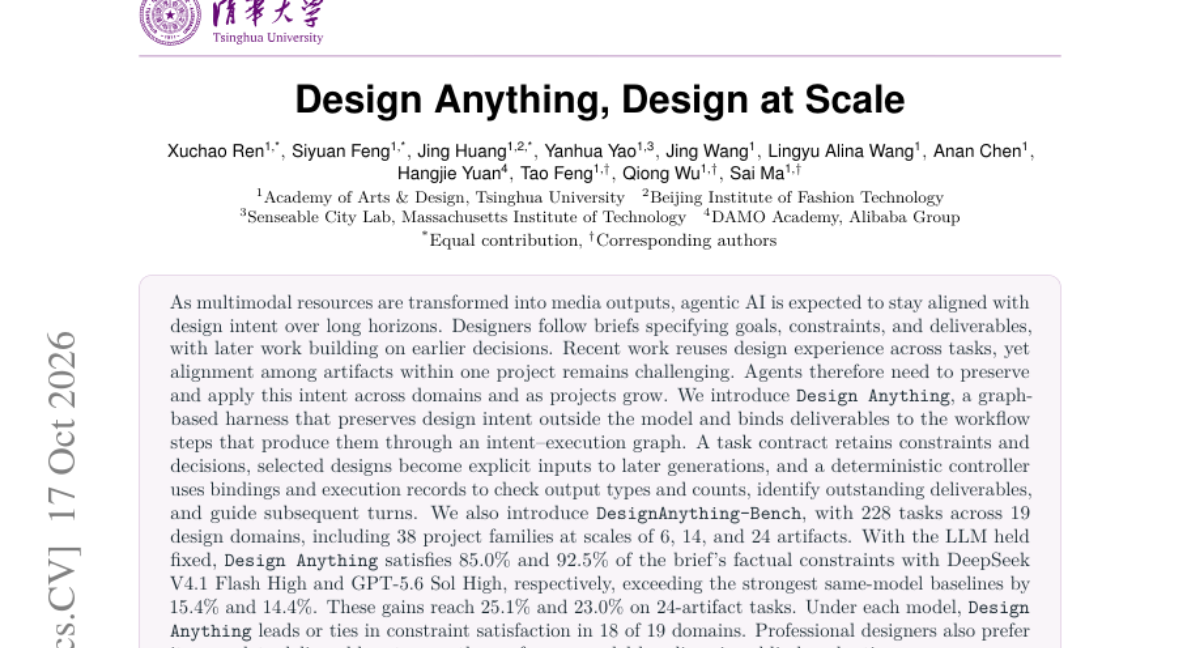
🔑 Keywords: Design Anything, Intent-Execution Graph, Task Contract, Agentic AI, Design Intent
💡 Category: AI Systems and Tools
🌟 Research Objective:
– The study introduces “Design Anything,” a system to maintain design alignment using an intent-execution graph and task contracts.
🛠️ Research Methods:
– Design Anything utilizes an intent-execution graph and a deterministic controller to bind deliverables to workflow steps and check output types and counts.
💬 Research Conclusions:
– Design Anything significantly improves constraint satisfaction and deliverable completeness over baseline agents, reaching up to 92.5% satisfaction in certain tasks, surpassing the strongest baseline models by up to 25.1% in larger tasks.
👉 Paper link: https://huggingface.co/papers/2610.24771
33. Quant-Arena: Benchmarking LLM Agents for Quantitative Trading Research
🔑 Keywords: Quant-Arena, Large Language Models, A-share Market, Quantitative Research, GPT-6 Astra
💡 Category: AI in Finance
🌟 Research Objective:
– The study introduces a benchmark called Quant-Arena, designed to evaluate whether language models can generate profitable trading strategies on historical A-share market data that can endure into the future.
🛠️ Research Methods:
– The methodology involves models constructing features and stock-scoring code, receiving feedback limited to years 2022-2023, and then freezing one strategy for evaluation in 2024, accounting for trading constraints and simulated market impacts.
💬 Research Conclusions:
– Evaluation of nine frontier models revealed GPT-6 Astra as the highest scorer, yet no model outperformed the equal-weight market in 2024. Quant-Arena remains open to submissions from various models for further exploration.
👉 Paper link: https://huggingface.co/papers/2610.30113

34. VerifierBench: Benchmarking the Generation of Executable Verifiers for LLM Agents
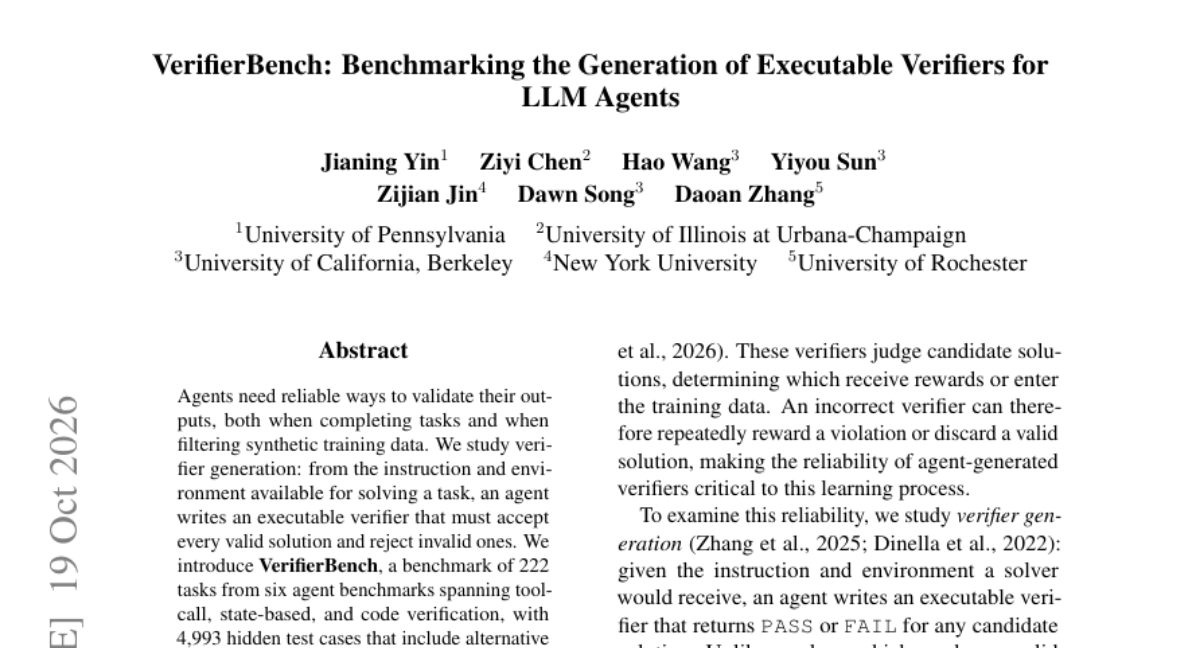
🔑 Keywords: verifier generation, executable verifier, VerifierBench, false rejections, self-testing
💡 Category: AI Systems and Tools
🌟 Research Objective:
– This study aims to explore the generation of executable verifiers to ensure that agents reliably validate their outputs, even when faced with various valid and invalid solutions.
🛠️ Research Methods:
– The introduction of VerifierBench, a benchmark encompassing 222 tasks with 4,993 hidden test cases, evaluates the effectiveness of verifier generation across different agent models and contexts.
– Utilization of Verifier4Verifier (V4V), a six-check audit, to assess the accuracy and efficiency of source verifiers and test suites.
💬 Research Conclusions:
– The study highlights that generated verifiers often reject valid solutions due to hidden assumptions, emphasizing the necessity for testing the acceptance of diverse correct answers.
– It points out the need for verifiers to be designed with an awareness of alternative valid solutions to avoid overly restrictive validation processes.
👉 Paper link: https://huggingface.co/papers/2610.28679
35. DiffResearch: Accelerating Deep Research with Diffusion Language Models
🔑 Keywords: Diffusion Language Models, Multi-Agent Deep Research, Latency Reduction, dFast, Report Quality
💡 Category: Natural Language Processing
🌟 Research Objective:
– The study aims to replace autoregressive backbones with Diffusion Language Models in multi-agent deep research to significantly reduce latency and enhance report quality.
🛠️ Research Methods:
– Implemented a Diffusion Language Model across various stages of the process while maintaining constant agentic scaffolds and evaluation metrics.
– Introduced ‘dFast’, which reads intermediate denoising states and extracts subqueries to speed up processes without reducing report quality.
💬 Research Conclusions:
– Diffusion Language Models achieved roughly a sixfold increase in speed across 100 Deep Research Bench tasks compared to autoregressive models.
– The dFast approach yielded a 1.99 times median speed-up for decomposition tasks.
– The system demonstrated superior performance in public benchmarks compared to several commercial systems, underscoring its efficiency and quality.
👉 Paper link: https://huggingface.co/papers/2610.28909
36. Hidden Messages Between Diffusion Language Model Agents: Causal Evidence for Latent Communication
🔑 Keywords: Diffusion language models, multi-agent systems, hidden communication, continuous states, temporal transfer
💡 Category: Generative Models
🌟 Research Objective:
– The study aims to examine whether diffusion language model agents can exchange compressed continuous hidden messages that impact reasoning and how the timing of this transfer influences the outcome.
🛠️ Research Methods:
– The paper investigates the communication between agents by examining the effect of removing or replacing hidden messages and performing controlled tasks to note changes in advantages on different datasets (Tiny-A2D, Dream-7B, QASC).
💬 Research Conclusions:
– The findings reveal that timely information transfer between diffusion-LM agents is significant, with a late transfer surpassing multiple exchanges, indicating that the timing of message transfer can be more critical than the quantity.
👉 Paper link: https://huggingface.co/papers/2610.28905
37. RubatoCodec: Budgeted Adaptive Speech Tokenization with Streaming Decoding
🔑 Keywords: RubatoCodec, Variable-frame-rate codec, Adaptive Firing, Text-to-speech, Reconstruction fidelity
💡 Category: Generative Models
🌟 Research Objective:
– The primary goal is to improve low-rate speech reconstruction and streaming text-to-speech generation using adaptive event-based coding.
🛠️ Research Methods:
– Developed RubatoCodec, a variable-frame-rate speech codec with an adaptive firing mechanism, allowing speech generation with exact utterance-level event budgets.
💬 Research Conclusions:
– Adaptive allocation surpasses fixed-rate coding in terms of reconstruction fidelity and intelligibility at low event rates.
– The model trained with this approach achieves competitive quality across multiple languages and yields lower WER and higher UTMOS scores in text-to-speech tasks.
👉 Paper link: https://huggingface.co/papers/2610.29434
38. VX-One: Typed, Calibrated Decision Heads for Real-Time Perimeter Triage – An empirical study of unknown-attack honesty, cascade gray zones, and calibration
under drift
🔑 Keywords: VX-One, perimeter triage, calibrated decision primitives, temporal drift, two-phase cascade
💡 Category: Machine Learning
🌟 Research Objective:
– To develop and evaluate VX-One, a small multi-task neural network, capable of outputting calibrated typed decision primitives for perimeter triage in intrusion detection systems.
🛠️ Research Methods:
– VX-One was tested against signature engines and baseline classifiers across UNSW-NB15, CIC-IDS2017, EMBER2024 using a two-phase cascade method to analyze its performance.
💬 Research Conclusions:
– VX-One demonstrated superior detection performance under temporal drift conditions compared to existing models, though it underperformed in multi-class attribution. Calibration collapsed under temporal drift, but partial ranking survived.
👉 Paper link: https://huggingface.co/papers/2610.30090
39. WorldStream: Streaming Interactive 3D Worlds with Hierarchical Planning and Persistent State
🔑 Keywords: Open-ended 3D world model, Hierarchical planning, Streaming compilation, Deterministic local code, Stateful NPCs
💡 Category: AI Systems and Tools
🌟 Research Objective:
– The research introduces WorldStream, an open-ended 3D world model designed to extend terrain, process language commands, and maintain edits through hierarchical planning and streaming compilation.
🛠️ Research Methods:
– The approach includes utilizing a hierarchical planner over a typed decision model to structure decision states and streaming compilation to extend the world dynamically while maintaining performance and interactive experiences.
💬 Research Conclusions:
– The WorldStream model effectively allows for continuous world expansion under budget constraints, connecting independently planned tiles and enabling interactive user engagement with both static and dynamic elements of the 3D model.
👉 Paper link: https://huggingface.co/papers/2610.28827

40. StyleStream 2.0: Fast and Controllable Streaming Voice Style Conversion
🔑 Keywords: StyleStream 2.0, streaming voice conversion, MeanFlow model, text-based voice design, target style fidelity
💡 Category: Generative Models
🌟 Research Objective:
– The main objective is to improve streaming voice conversion with lower latency and enable text-based voice design and editing.
🛠️ Research Methods:
– Utilization of a few-step MeanFlow model and fine-tuning with autoregressive feedback to reduce latency and improve robustness.
– Implementation of a unified text-conditioned flow matching model for controllable style manipulation.
💬 Research Conclusions:
– StyleStream 2.0 effectively reduces end-to-end latency to 520 ms, maintaining strong conversion quality.
– Achieves strong target style fidelity while being competitive in intelligibility and non-edited attribute preservation.
👉 Paper link: https://huggingface.co/papers/2610.28940
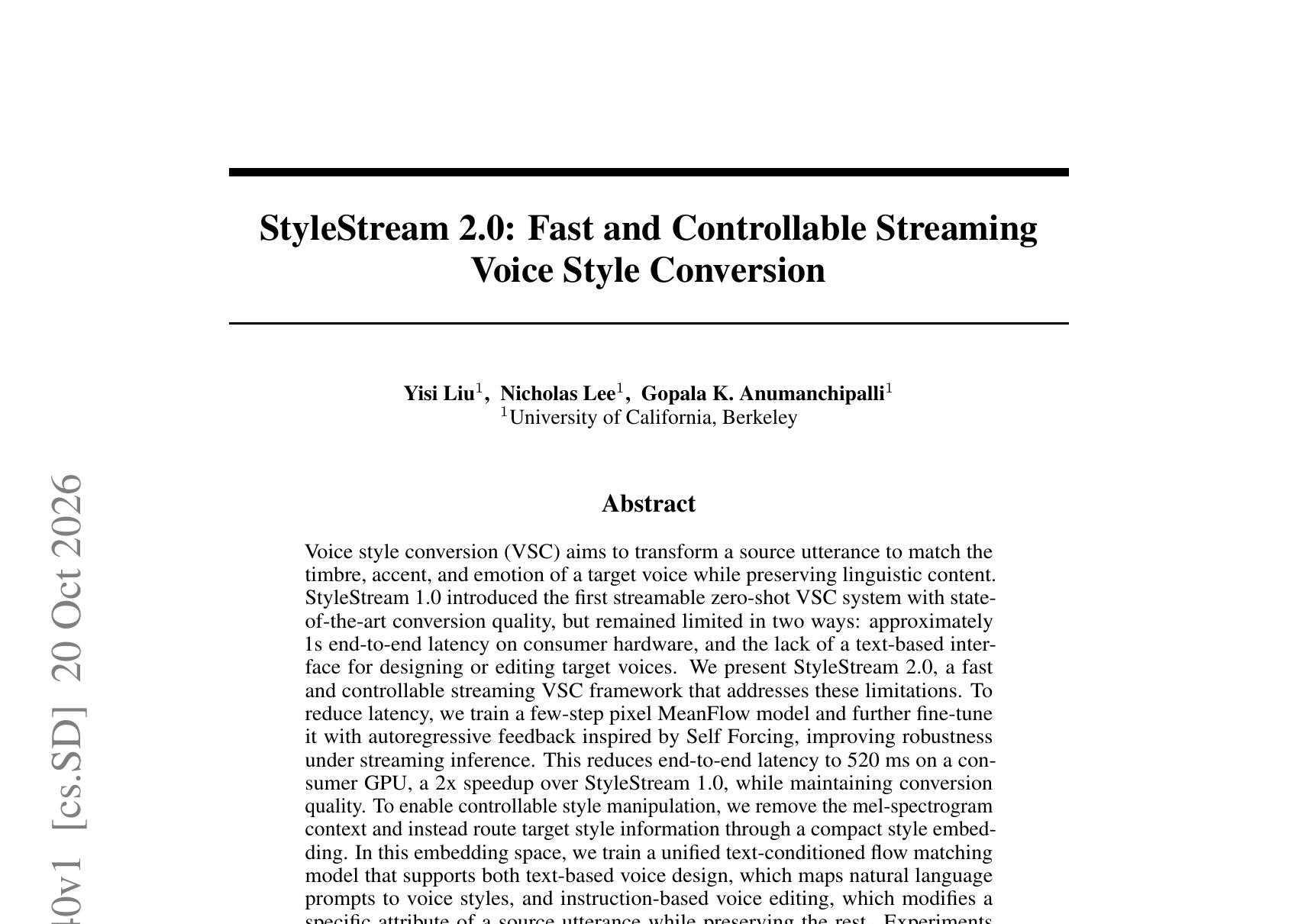
41. From VLM Planners to Robotic Agents: Self-Evolving Harnesses for History-Dependent Manipulation
🔑 Keywords: SERA, Vision-language-action (VLA), Non-Markovian dependencies, Task context
💡 Category: Robotics and Autonomous Systems
🌟 Research Objective:
– The paper explores the enhancement of long-horizon robotic manipulation by introducing SERA (Self-Evolving Robotic Agent), which maintains task context and evolves planning via execution feedback.
🛠️ Research Methods:
– The study involves implementing a fixed low-level VLA executor for control, using an editable harness for context maintenance, and applying environment rollouts to propose harness revisions.
💬 Research Conclusions:
– SERA demonstrates improved performance in robotic manipulation, achieving a 51.38% overall success rate in autonomous tasks on RoboMME, showcasing the effectiveness of agentic planning in tasks with history dependence.
👉 Paper link: https://huggingface.co/papers/2610.29560
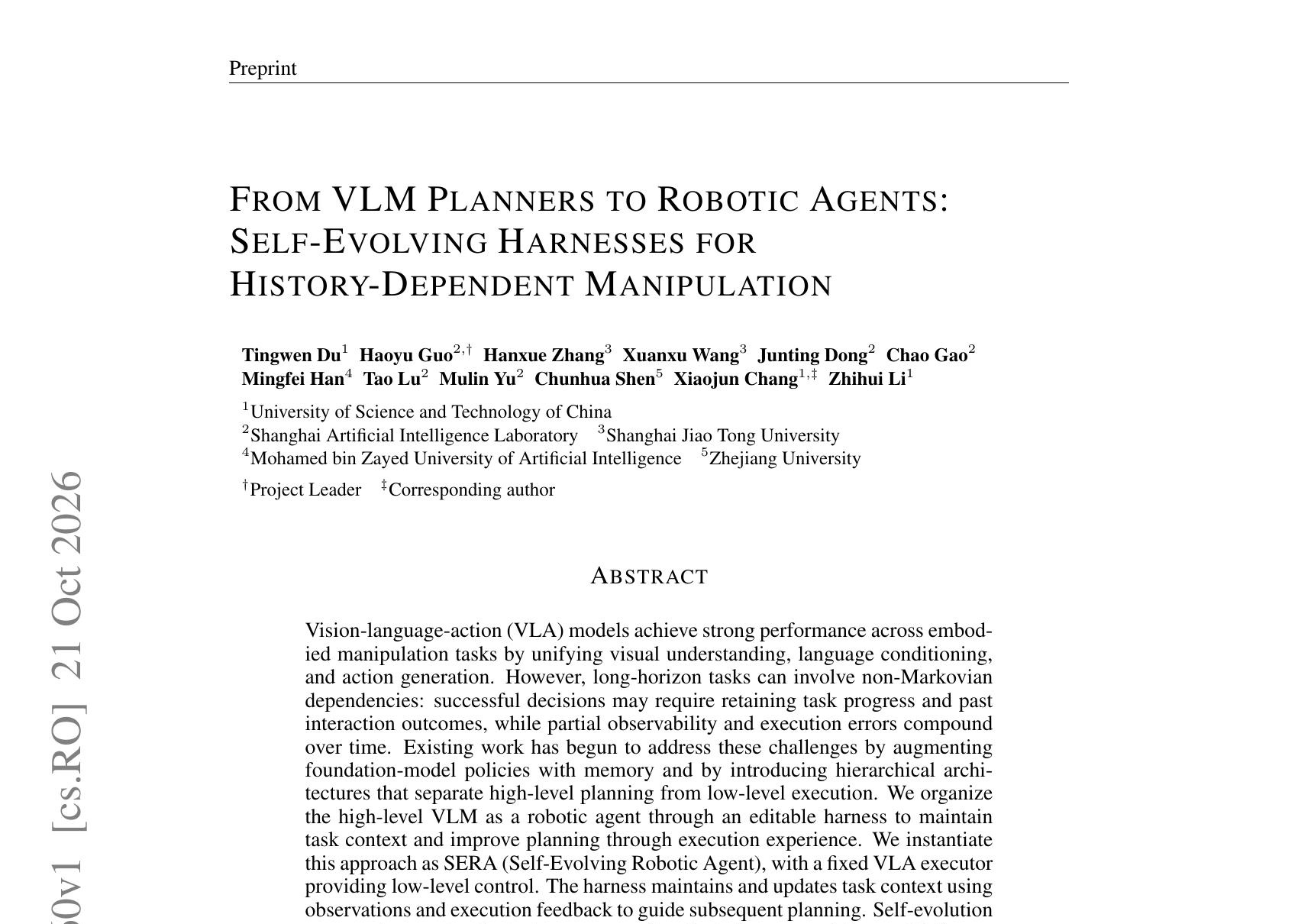
42. Evolving with Open Worlds: Towards Recursive Self-Improvement for Future Forecasting
🔑 Keywords: Recursive Self-Improvement, DeepEvolve, FutureX, Evolutionary Agents, Living Environment
💡 Category: AI Systems and Tools
🌟 Research Objective:
– To explore Recursive Self-Improvement (RSI) in AI through DeepEvolve, allowing systems to improve by interacting with a dynamically changing environment and evolving from their experiences.
🛠️ Research Methods:
– Development of DeepEvolve, featuring a recursive-evolution engine and interaction with a synthesizing living environment, allowing agents to enhance their skills by decoupling search from prediction and distilling skills from interactions.
💬 Research Conclusions:
– The agent system DeepEvolve achieved outstanding results on the FutureX leaderboard, highlighting a significant 195% improvement over three weeks and showcasing a new paradigm for AI systems to evolve alongside an open-ended environment, surpassing static models.
👉 Paper link: https://huggingface.co/papers/2610.29784
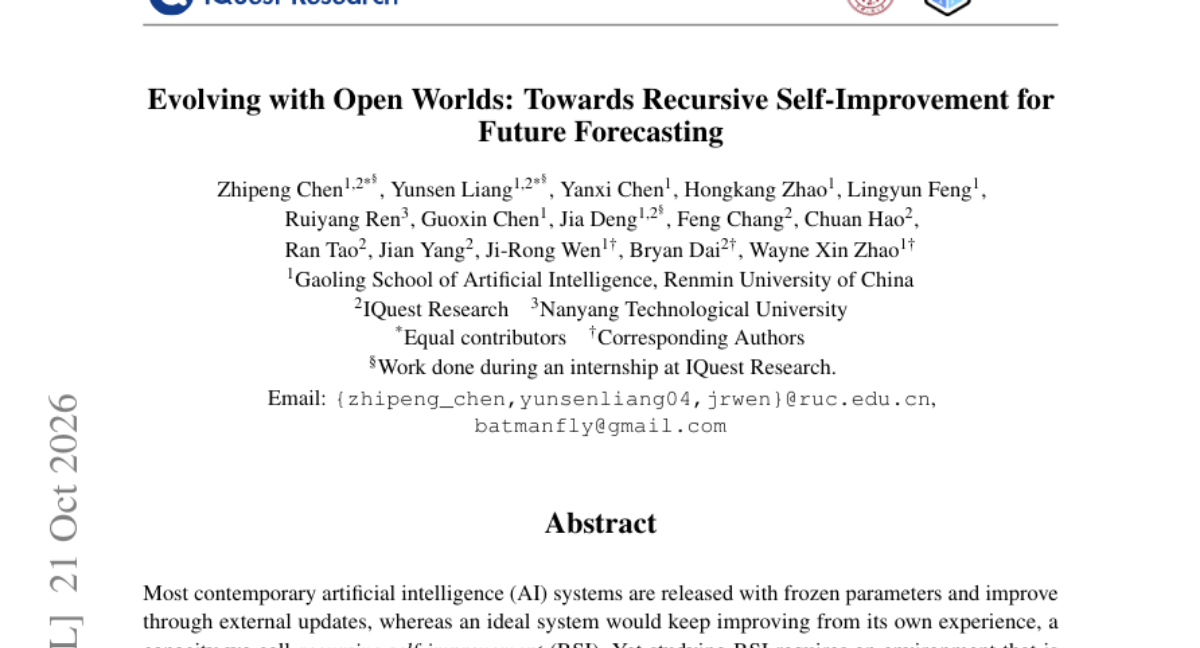
43. Qwen-Audio-3.1-ASR Technical Report
🔑 Keywords: Qwen-Audio-3.1-ASR, audio-language models, AI Native, speaker-diarized transcription, general audio understanding
💡 Category: Natural Language Processing
🌟 Research Objective:
– Introduction of the Qwen-Audio-3.1-ASR model family with enhanced speech recognition and expanded capabilities in speaker-diarized transcription and audio understanding.
🛠️ Research Methods:
– Development of variants to accommodate various deployment needs such as asynchronous file transcription, low-latency streaming, interactive voice input, and non-streaming recognition.
💬 Research Conclusions:
– Demonstration of Qwen-Audio-3.1-ASR’s capabilities in conventional ASR, multilingual and dialectal speech, speaker-diarized transcription, and broader audio analysis tasks.
👉 Paper link: https://huggingface.co/papers/2610.28711
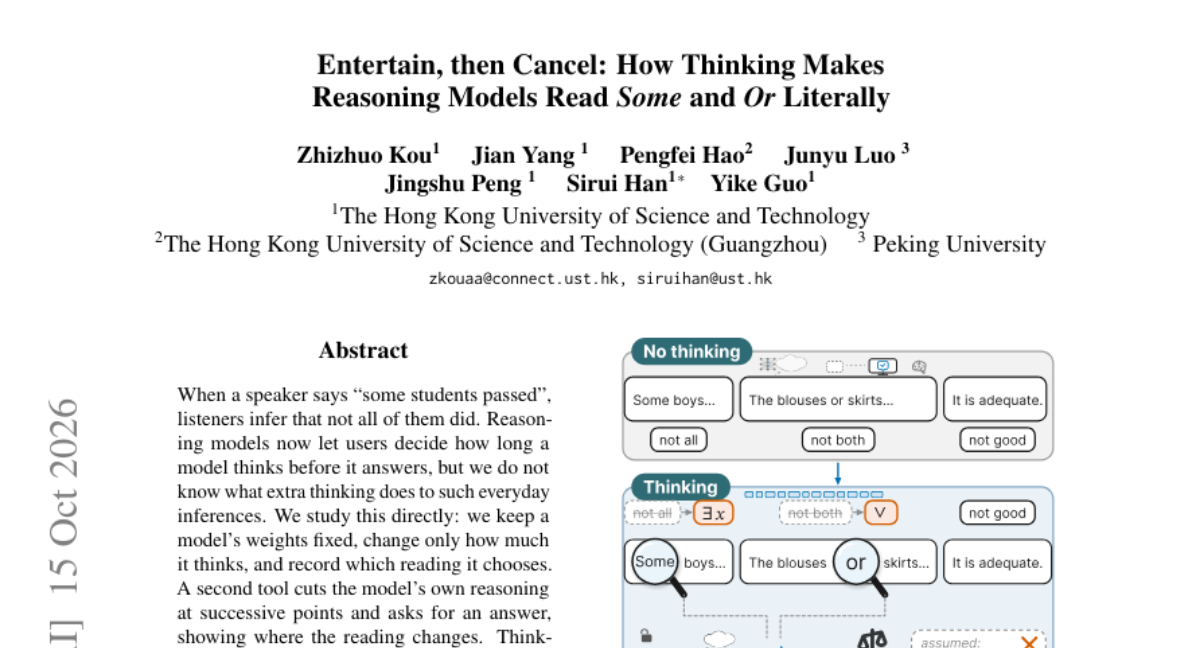
44. Entertain, then Cancel: How Thinking Makes Reasoning Models Read Some and Or Literally
🔑 Keywords: Extended Reasoning, Scalar Implicatures, Inference-Time, Enriched Reading
💡 Category: Knowledge Representation and Reasoning
🌟 Research Objective:
– Investigate how extended reasoning in language models affects everyday scalar implicatures, particularly through varying the duration of model thinking.
🛠️ Research Methods:
– Maintain constant model weights, adjust reasoning duration, and examine the impact on implicature interpretation using successive reasoning cut-offs.
💬 Research Conclusions:
– Extended reasoning often leads models to cancel everyday implicatures such as “some but not all” or “or (not both)” while context-driven inferences are improved. Early-stage enriched readings can recover implicatures without sacrificing literal accuracy.
👉 Paper link: https://huggingface.co/papers/2610.21204
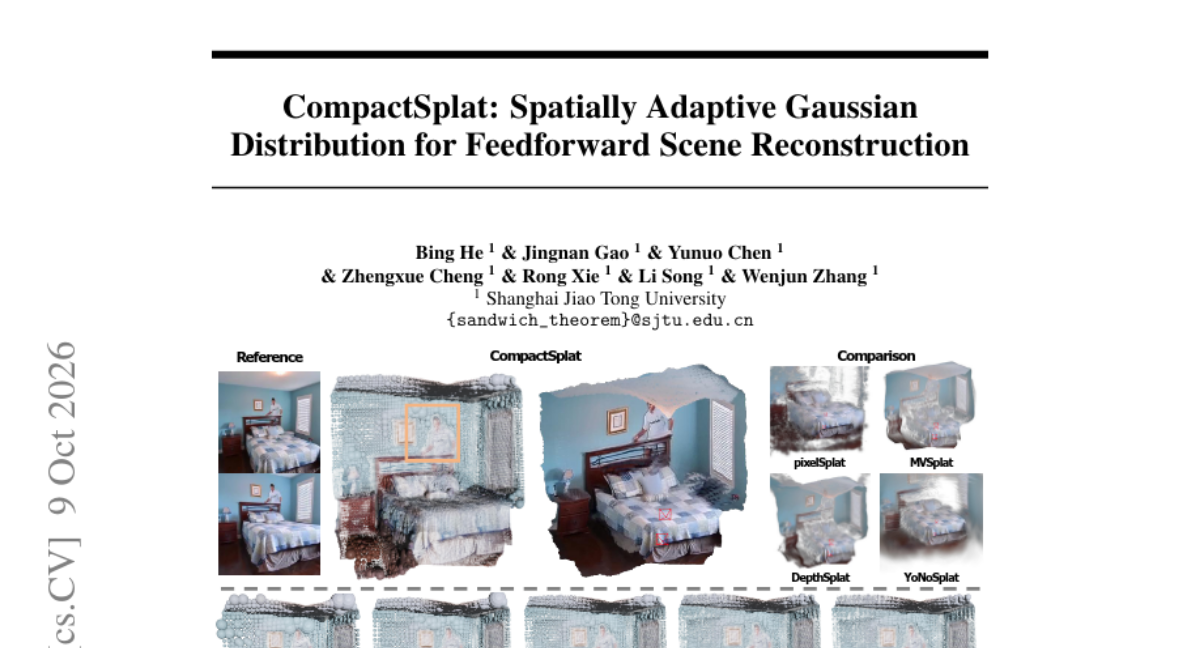
45. CompactSplat: Spatially Adaptive Gaussian Distribution for Feedforward Scene Reconstruction
🔑 Keywords: CompactSplat, feedforward framework, 3D Gaussian Splatting, texture-guided spatial partitioning, dynamic sparsity control
💡 Category: Computer Vision
🌟 Research Objective:
– To present CompactSplat, a novel feedforward framework designed for content-aware allocation of 3D Gaussians in scene reconstruction, improving geometry and texture recovery.
🛠️ Research Methods:
– This framework integrates texture-guided spatial partitioning with hierarchical sampling for adaptive distribution of primitives, allowing for dynamic sparsity control during inference.
💬 Research Conclusions:
– CompactSplat consistently outperforms prior methods in both standard metrics and high-resolution rendering consistency, achieving high-fidelity reconstructions with significantly fewer primitives.
👉 Paper link: https://huggingface.co/papers/2610.13177
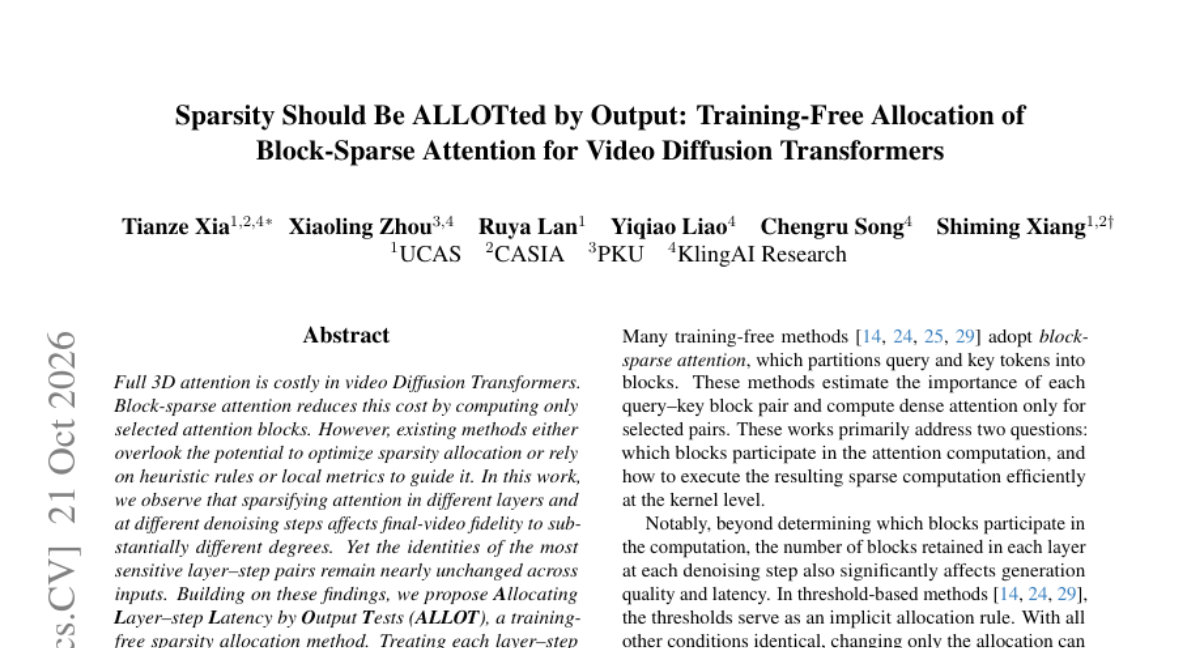
46. Sparsity Should Be ALLOTted by Output: Training-Free Allocation of Block-Sparse Attention for Video Diffusion Transformers
🔑 Keywords: ALLOT, Block-sparse attention, Latency budget, Video Diffusion Transformers, Sparsity allocation
💡 Category: Computer Vision
🌟 Research Objective:
– The paper introduces ALLOT, a method for optimizing block-sparse attention across layer-step pairs in video Diffusion Transformers to enhance output fidelity while adhering to a latency budget.
🛠️ Research Methods:
– ALLOT employs a training-free approach using techniques like cell probing and trajectory calibration to estimate the contribution of each layer-step pair to video error, optimizing cell densities under a measured latency budget.
💬 Research Conclusions:
– The proposed ALLOT method outperformed existing strategies, achieving an 11.8 dB PSNR gain on HunyuanVideo and demonstrated superior or equivalent performance across multiple tested environments.
👉 Paper link: https://huggingface.co/papers/2610.29441
47. Harness Scaling for Generalizable Agentic Reinforcement Learning
🔑 Keywords: Harness Scaling, Agentic RL, Generalization, Cross-Harness Training, Black-Box Harnesses
💡 Category: Reinforcement Learning
🌟 Research Objective:
– The study aims to improve agentic reinforcement learning by enhancing generalization to unseen execution harnesses through a novel approach called Harness Scaling.
🛠️ Research Methods:
– Implemented a factorized harness space and organized a compact training subset to achieve balanced factorial coverage, enabling cross-harness training to combine global coverage with controlled variation.
💬 Research Conclusions:
– Harness Scaling consistently enhances generalization to unseen configurations, outperforming models trained on a single complex harness, thereby establishing harness diversity as a crucial scaling dimension for agentic reinforcement learning.
👉 Paper link: https://huggingface.co/papers/2610.29458
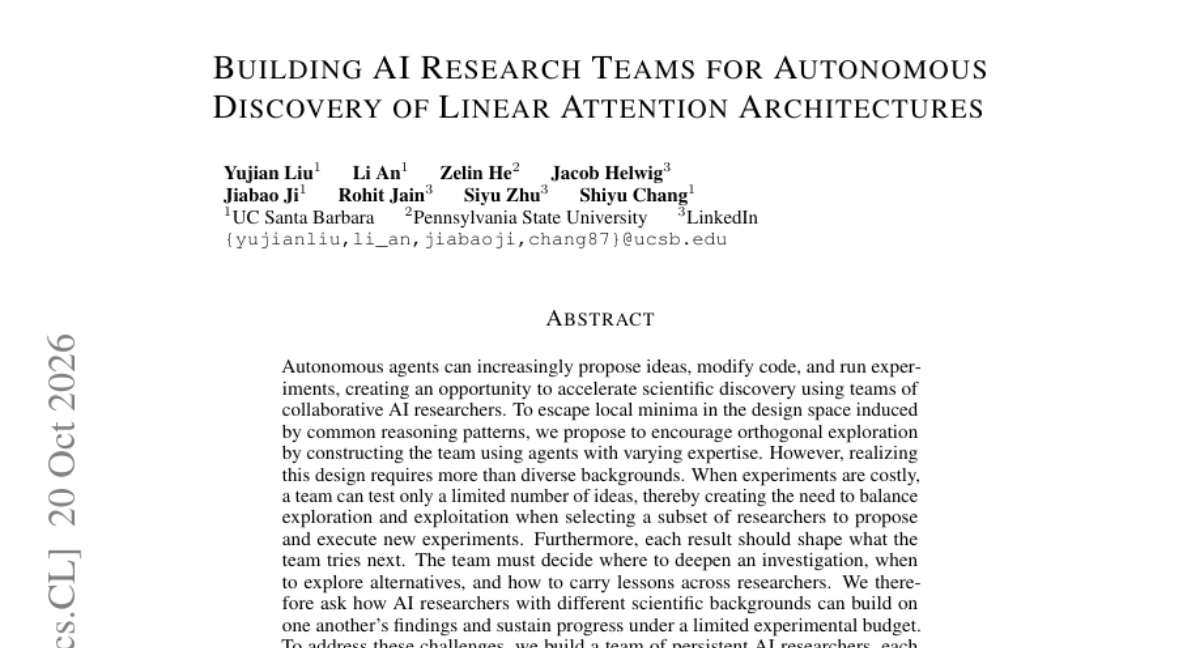
48. Building AI Research Teams for Autonomous Discovery of Linear Attention Architectures
🔑 Keywords: Autonomous agents, Collaborative AI, Orthogonal exploration, Research opportunities, Adaptive allocation
💡 Category: AI Systems and Tools
🌟 Research Objective:
– To enhance scientific discovery through collaborative AI research teams composed of autonomous agents with diverse expertise.
🛠️ Research Methods:
– Constructs teams with agents having different disciplines, maintaining private research histories, sharing experimental evidence, and using adaptive allocation for research opportunities.
💬 Research Conclusions:
– Demonstrates that the proposed team structure outperforms existing methods in tasks like language modeling and common-sense reasoning. Highlights the importance of diverse backgrounds, private histories, and adaptive allocation for sustained autonomous discovery.
👉 Paper link: https://huggingface.co/papers/2610.28887
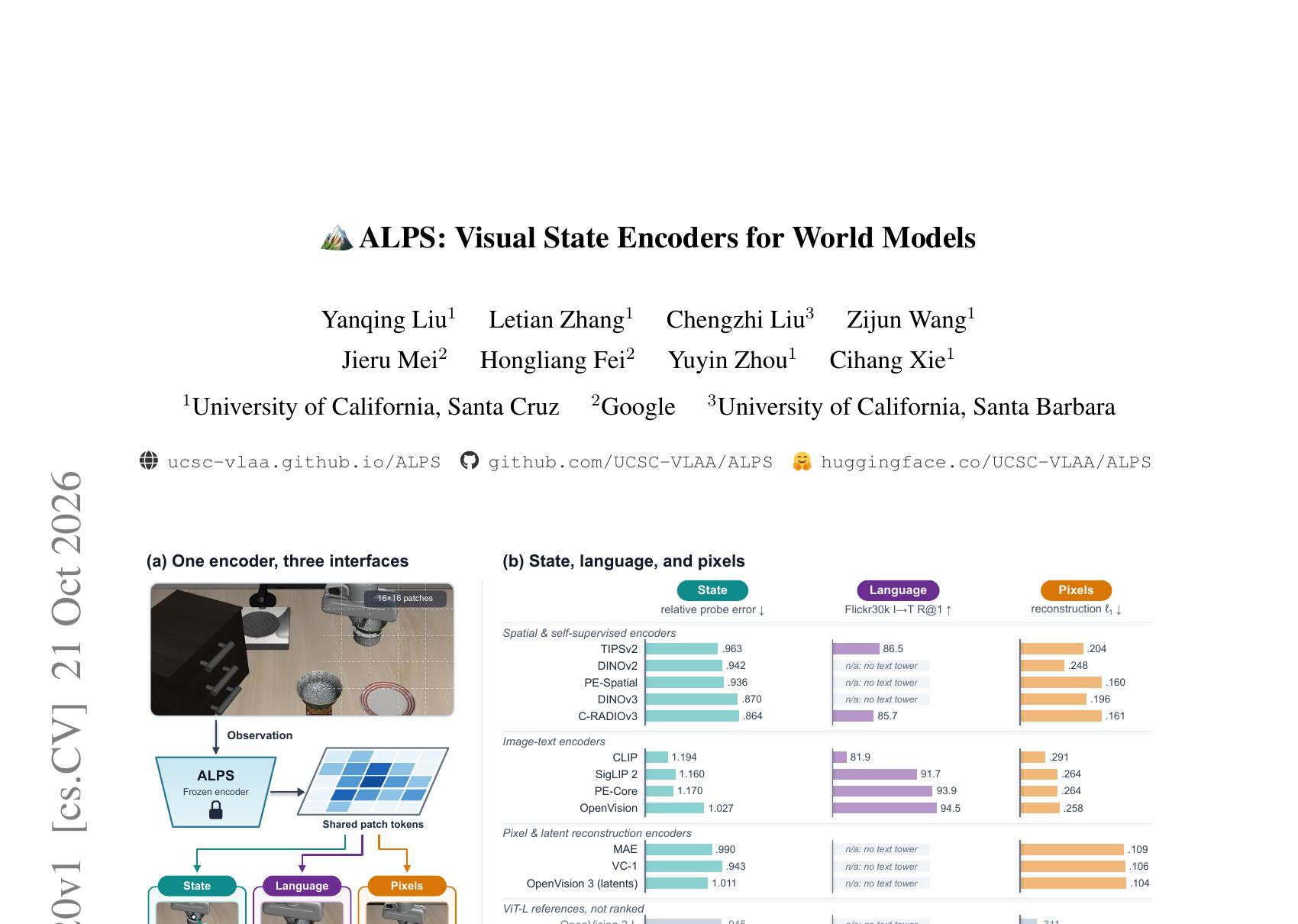
49. ALPS: Visual State Encoders for World Models
🔑 Keywords: ALPS, Visual State Encoder, World Models, Language Alignment, Pixel Reconstruction
💡 Category: Computer Vision
🌟 Research Objective:
– The research aims to introduce ALPS, a pretrained visual encoder, that unifies physical-state prediction, language alignment, and pixel reconstruction in world models.
🛠️ Research Methods:
– ALPS is pretrained using visual and language data, with objectives focusing on language, reconstruction, and spatial correspondence. Cross-view self-distillation is used to refine the model.
💬 Research Conclusions:
– ALPS outperforms existing visual encoders in terms of the lowest LIBERO state-probe error among ViT-B models and showcases superior policy success rate and planning capabilities across various tasks.
👉 Paper link: https://huggingface.co/papers/2610.30120
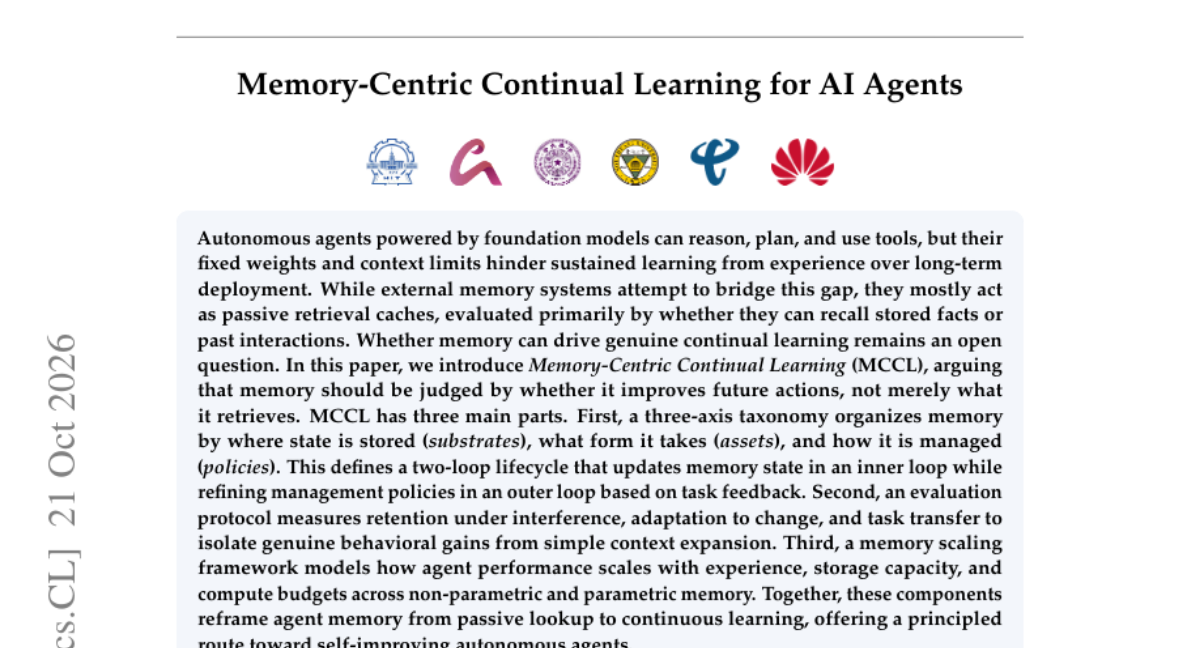
50. Memory-Centric Continual Learning for AI Agents
🔑 Keywords: Memory-Centric Continual Learning, Autonomous agents, Continual Learning, Memory scaling framework
💡 Category: Reinforcement Learning
🌟 Research Objective:
– The study introduces Memory-Centric Continual Learning (MCCL) aiming to reframe agent memory as an active driver for behavioral improvement, rather than just a passive retrieval system.
🛠️ Research Methods:
– Proposes a three-axis taxonomy organizing memory based on storage substrates, assets, and management policies.
– Utilizes a two-loop lifecycle that updates memory in an inner loop and refines policies in an outer loop.
– Implements an evaluation protocol assessing retention, adaptation, and task transfer focusing on genuine behavioral gains.
💬 Research Conclusions:
– Memory should improve future actions rather than solely recall, thus transitioning agent memory from passive lookup to continual learning for self-improvement in autonomous agents.
👉 Paper link: https://huggingface.co/papers/2610.29357
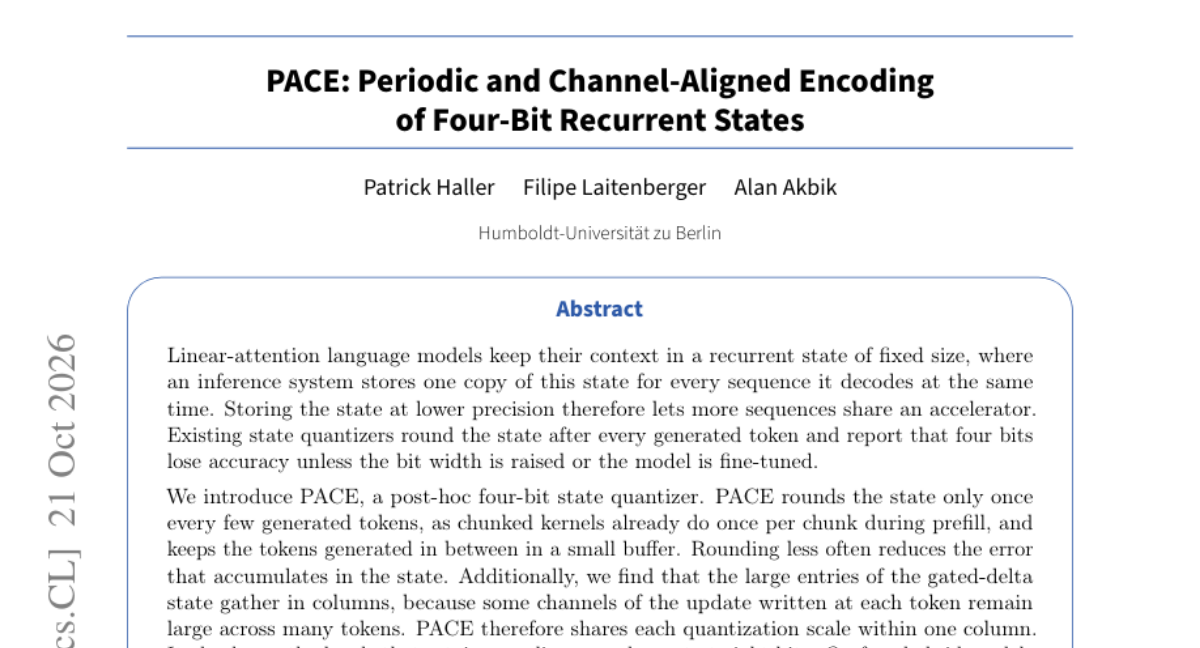
51. PACE: Periodic and Channel-Aligned Encoding of Four-Bit Recurrent States
🔑 Keywords: PACE, four-bit quantizer, state quantizer, Linear-attention, recurrent state
💡 Category: Natural Language Processing
🌟 Research Objective:
– Introduce PACE, a four-bit state quantizer designed to reduce error and memory usage in linear-attention language models.
🛠️ Research Methods:
– Utilizes column-wise scales and infrequent rounding to manage precision and memory efficiency.
💬 Research Conclusions:
– PACE with mixed four- and eight-bit heads is competitive with existing models while using less memory and maintaining decoding speed efficiency.
👉 Paper link: https://huggingface.co/papers/2610.29545
52. Retrieval Augmented Generation Compositionality
🔑 Keywords: Retrieval Augmented Generation, RAG, LASAGNA, retrieval, faithfulness
💡 Category: Natural Language Processing
🌟 Research Objective:
– Evaluate the combined performance of composed Retrieval Augmented Generation (RAG) pipelines versus isolated technique analysis.
🛠️ Research Methods:
– Tested 450 configurations using the open-source framework LASAGNA across eight benchmarks and corpora ranging from 5K to 200K documents.
💬 Research Conclusions:
– Individually strong retrieval techniques do not necessarily improve performance when combined.
– Component gains differ between retrieval quality and answer faithfulness, often optimizing one at the expense of the other.
– The optimal technique combinations vary with the size of the corpus; what works for a small corpus may not for a larger one.
👉 Paper link: https://huggingface.co/papers/2610.29722
53. Spectral-Spatial Interpretation
🔑 Keywords: Spectral-Spatial Interpretation, conditional Shapley values, multispectral image tasks
💡 Category: Computer Vision
🌟 Research Objective:
– This research introduces Spectral-Spatial Interpretation (SSI) to address multispectral image tasks by providing localized channel importance at each spatial position through conditional Shapley values.
🛠️ Research Methods:
– The SSI method utilizes a full-grid attribution approach across position-channel players, defining a conditional game over channels at each spatial position and applying Shapley value calculations to generate detailed spectral-spatial attribution matrices.
💬 Research Conclusions:
– SSI achieves superior performance in multispectral image interpretations, offering strong spectral hit rates, channel deletions, and spatial localizations compared to existing methods. It outperforms in metrics like joint deletion and insertion AUC on various datasets using minimal evaluation resources.
👉 Paper link: https://huggingface.co/papers/2610.21114
54. PrismaCoder: Pushing the Boundaries of Open Multimodal Code Intelligence through Decomposed Rubric Synthesis
🔑 Keywords: PrismaForge, Multimodal code intelligence, Rubric-based pipeline, Visual-coding tasks
💡 Category: Multi-Modal Learning
🌟 Research Objective:
– To create a high-quality multimodal code dataset and open models that rival proprietary systems in visual coding tasks using PrismaForge.
🛠️ Research Methods:
– Utilization of a rubric-based data pipeline for synthesizing and filtering multimodal code data, which includes building PrismaCoder-2M and training models PrismaCoder-9B and PrismaCoder-35B.
💬 Research Conclusions:
– The rubric-based pipeline significantly enhances multimodal coding performance, with PrismaCoder models leading the open state of the art, closely competing with proprietary systems.
👉 Paper link: https://huggingface.co/papers/2610.20538

55. Right Screen, Wrong Transition: World Models as Verifiers for GUI Agents
🔑 Keywords: decoder-free, action-conditioned world model, GUI transitions, verification, representation space
💡 Category: AI Systems and Tools
🌟 Research Objective:
– This study introduces a new decoder-free, action-conditioned world model for predicting the next screen representation in GUI transitions, aiming to enhance verification accuracy and screen hijack detection.
🛠️ Research Methods:
– The model predicts directly in the representation space without semantic annotation, utilizing 1.85 million real GUI transitions. The evaluation is conducted on RSWT-BENCH, comparing performance against generative models and closed-source VLMs based on vector comparison.
💬 Research Conclusions:
– The model achieves high accuracy and low latency, with a 0.987 AUC score at 17 ms per decision, significantly outperforming generative GUI world models. It effectively discriminates between harmful and benign transitions, showcasing a novel verification role for world models beyond simulation or planning.
👉 Paper link: https://huggingface.co/papers/2610.11942
56. Cache Engineering for Agents
🔑 Keywords: cache engineering, AKV serving engine, LLM agents, key-value cache, Recursive self-improvement
💡 Category: Natural Language Processing
🌟 Research Objective:
– Introduce a cache engineering approach to efficiently manage key-value caches for LLM agents, enhancing trajectory handling without altering the path or incurring re-prefilling costs.
🛠️ Research Methods:
– Development of the AKV serving engine that provides a stateless interface for efficient cache management, incorporating operations like drop and repos to adjust cache states and key positions.
💬 Research Conclusions:
– Implementation of a tool-response rolling-drop cache policy improved benchmark scores and reduced costs significantly, offering faster output throughput and lower request latency. The use of recursive self-improvement further optimized cache policy effectiveness.
👉 Paper link: https://huggingface.co/papers/2610.28577
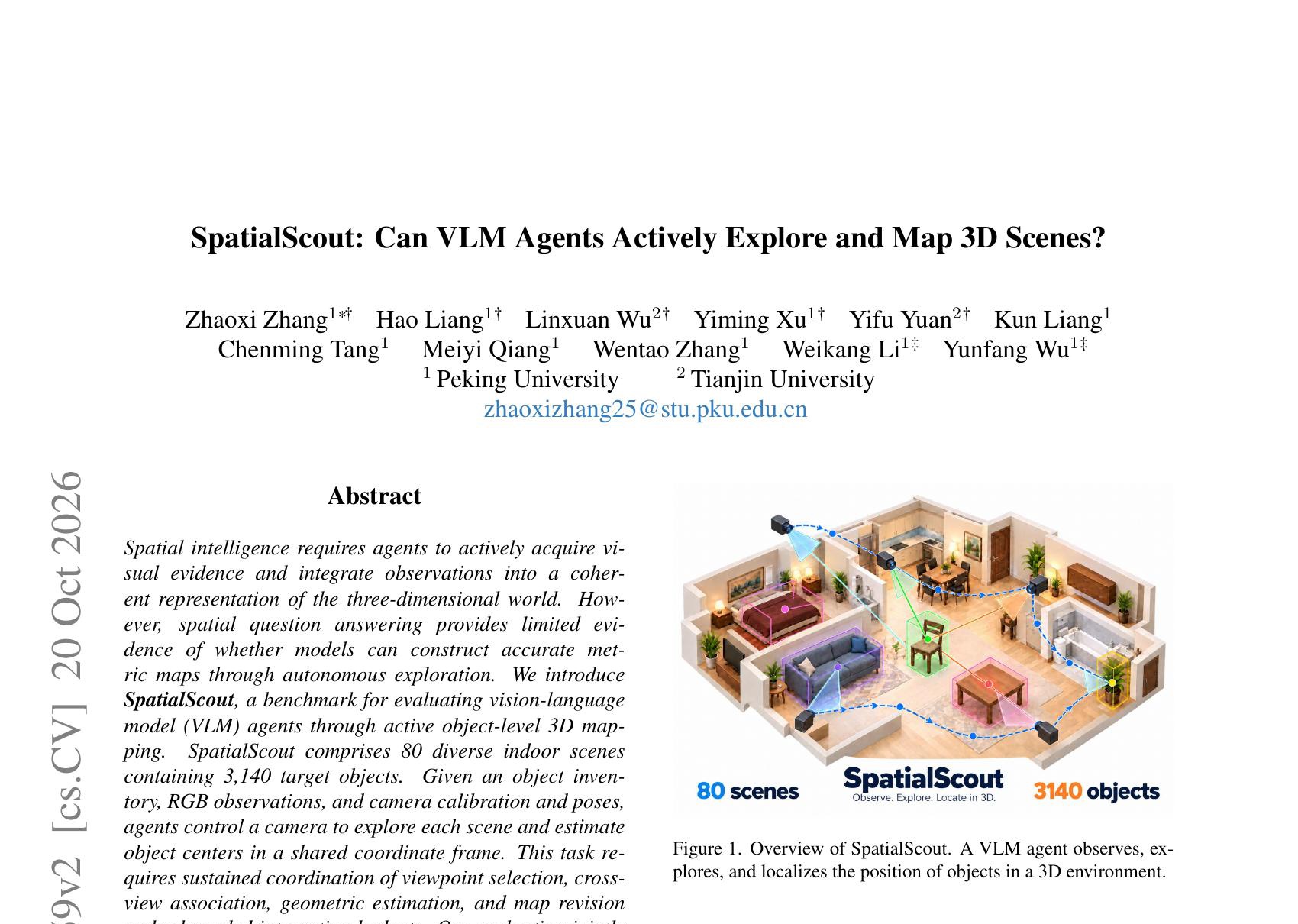
57. SpatialScout: Can VLM Agents Actively Explore and Map 3D Scenes?
🔑 Keywords: SpatialScout, vision-language model, 3D mapping, metric maps, active perception
💡 Category: Computer Vision
🌟 Research Objective:
– The paper introduces SpatialScout, a benchmark for evaluating vision-language model agents on active 3D object mapping, aiming to reveal gaps in precise metric map construction.
🛠️ Research Methods:
– The study involves controlling a camera to explore scenes and estimate object centers using RGB observations, camera calibration, and poses. It assesses camera placements, cross-view associations, and geometric estimation with bounded interaction budgets.
💬 Research Conclusions:
– Experiments with advanced vision-language models show significant limitations in constructing precise metric maps, with the best model achieving only a 41.71% mean overlap score, highlighting a gap between coarse object layouts and accurate map construction.
👉 Paper link: https://huggingface.co/papers/2610.26659