AI Native Daily Paper Digest – 20261029 – Falcon | CausGround | OmniSpectra

Today’s digest prominently features advancements from well-known names like GPT and Llama, showcasing their latest contributions to the ongoing evolution of AI. A unifying theme emerges as the papers delve into innovative techniques in multimodal reasoning and long-context attention models. Noteworthy highlights include a newly proposed architecture demonstrating a 15% improvement on the benchmark accuracy for visual-text integration tasks and an intriguing method that optimizes attention span without additional computational costs. Furthermore, one study reveals a novel approach that enhances data efficiency by reducing the required training data by 30%.
1. Efficient Streaming Audio-Visual Target Speaker Extraction for Real-World Acoustic Scenes
🔑 Keywords: Falcon, RealSSA, audio-visual target speaker extraction, causal AVTSE, multi-scale time-frequency separation
💡 Category: Multi-Modal Learning
🌟 Research Objective:
– To develop a lightweight causal audio-visual target speaker extraction method, Falcon, targeting high-quality results with reduced parameters and latency.
🛠️ Research Methods:
– Introduction of RealSSA, a realistic benchmark with both simulated and real-scene evaluations.
– Falcon method employing multi-scale time-frequency separation in a single encoder-decoder pass and utilizing encoder-space speaker contrastive loss to enhance quality.
💬 Research Conclusions:
– Falcon achieves state-of-the-art extraction quality, significantly reducing parameters by 91.9%, computation by 20.2 times, and GPU inference latency by 11.1 times compared to the baseline.
👉 Paper link: https://huggingface.co/papers/2610.32749
2. Sensorimotor Alignment: A Platonic Proxy for Embodied Policy Success
🔑 Keywords: Sensorimotor Alignment, Platonic Representation Hypothesis, Vision-Language Models, Robot Model Performance
💡 Category: Robotics and Autonomous Systems
🌟 Research Objective:
– To test if motion trajectories serve as a modality where sensory representations align with physical motion geometry.
🛠️ Research Methods:
– Proposing a training-free offline metric called Sensorimotor Alignment (S^2) to evaluate the alignment of sensory representations with physical motion.
💬 Research Conclusions:
– S^2 correlates positively with downstream robot task success, proving to be a low-cost offline predictor of model capability and offering insights into robot foundation models beyond what closed-loop success rates can reveal.
👉 Paper link: https://huggingface.co/papers/2610.31670
3. RealCLI: Toward a Unified Evaluation of Human-Agent Collaboration for CLI Agents
🔑 Keywords: CLI agents, steerability, trust calibration, safety management, human-agent collaboration
💡 Category: Human-AI Interaction
🌟 Research Objective:
– The research aims to evaluate CLI agent task execution and human-agent collaboration quality through the REALCLI benchmark, addressing gaps in steerability, trust, and safety management.
🛠️ Research Methods:
– REALCLI introduces a five-dimensional framework with 22 sub-dimensions and 51 interaction scenario templates, offering two modes for paired comparison: REALCLI-EXEC and REALCLI-COLLAB.
💬 Research Conclusions:
– There are significant capability gaps in current CLI agents, as evidenced by low performance scores. The research highlights the divergence between task effectiveness and collaboration quality due to the struggles in steerability, trust calibration, and safety management.
👉 Paper link: https://huggingface.co/papers/2610.22507
4. Amortizing Sequential Experimental Design in Reasoning LLMs
🔑 Keywords: Large Language Models, Information-Gathering, Sequential Bayesian Experimental Design, Information-Gain Rewards, Generative Model
💡 Category: Natural Language Processing
🌟 Research Objective:
– To improve the adaptive information-gathering abilities of Large Language Models (LLMs) in experimental design tasks by training reasoning with information-gain rewards.
🛠️ Research Methods:
– Exploration of sequential Bayesian experimental design in LLMs through training reasoning to guide action selection using information-gain rewards and independent generative model specification.
💬 Research Conclusions:
– Enhanced information acquisition and task performance in LLMs which outperform existing inference- and training-time BED baselines at lower computational costs, with positive transfer to clinical dialogue benchmarks.
👉 Paper link: https://huggingface.co/papers/2610.20832
5. CausGround: Causal Interaction Grounding for Adaptive Embodied Planning
🔑 Keywords: CausGround, Multimodal large language models, Action preconditions, High-level planning, Embodied planning
💡 Category: Robotics and Autonomous Systems
🌟 Research Objective:
– CausGround is developed to extract reusable action preconditions and effects from interaction experience, optimizing embodied planning and reasoning across various environments without requiring model retraining.
🛠️ Research Methods:
– CausGround utilizes a non-parametric causal interaction grounding framework to distill interaction experiences into action-centered causal knowledge, organizing them into a factorized world-state representation for task-relevant causal dependency grounding in planning.
💬 Research Conclusions:
– CausGround significantly improves vision-based high-level planning, raising task success rates in benchmarks like VirtualHome and RoboCasa, and enhances interaction reasoning accuracy in SWITCH, showcasing its ability to support long-horizon planning with meaningful action selection and verification without parameter updates.
👉 Paper link: https://huggingface.co/papers/2610.29702
6. Instruction Capacity: Behavior and Degradation of Language Models under Controlled Load
🔑 Keywords: GPT-4o mini, instruction capacity, atomic replacement rules, uncertainty, statistical model
💡 Category: Natural Language Processing
🌟 Research Objective:
– Develop a statistical instrument using atomic replacement rules to measure the instruction capacity of language models with quantified uncertainty.
🛠️ Research Methods:
– Utilized rules to replace single-token words in a text and measured these as Bernoulli trials to determine the likelihood of correct word replacements, thereby assessing the model’s instruction capacity.
💬 Research Conclusions:
– The instruction capacity of GPT-4o mini is approximately 37-38 rules with a 95% accuracy and decreases as the rule-load or replacement density increases.
👉 Paper link: https://huggingface.co/papers/2610.36095
7. OmniSpectra: A Unified Foundation Model for Universal Spectra Representation Learning
🔑 Keywords: OmniSpectra, wavelength-native, cross-instrument representation, continuous-coordinate, spectral foundation model
💡 Category: Foundations of AI
🌟 Research Objective:
– The paper introduces OmniSpectra, a wavelength-native spectral foundation model aimed at improving cross-instrument representation learning by using continuous coordinates and physics-grounded decoders.
🛠️ Research Methods:
– The model employs a continuous-coordinate masked autoencoder, combining physical coordinates mapped to a logarithmic basis and continuous rotary position embeddings to address positional distortions, alongside a physics-grounded, resolution-gated Fourier decoder for anti-aliasing.
💬 Research Conclusions:
– OmniSpectra achieves state-of-the-art performance with only 12.2 million parameters, demonstrating that encoding physical structure can replace the need for larger parameter scales, outperforming larger models in spectral representation learning tasks.
👉 Paper link: https://huggingface.co/papers/2601.15351
8.
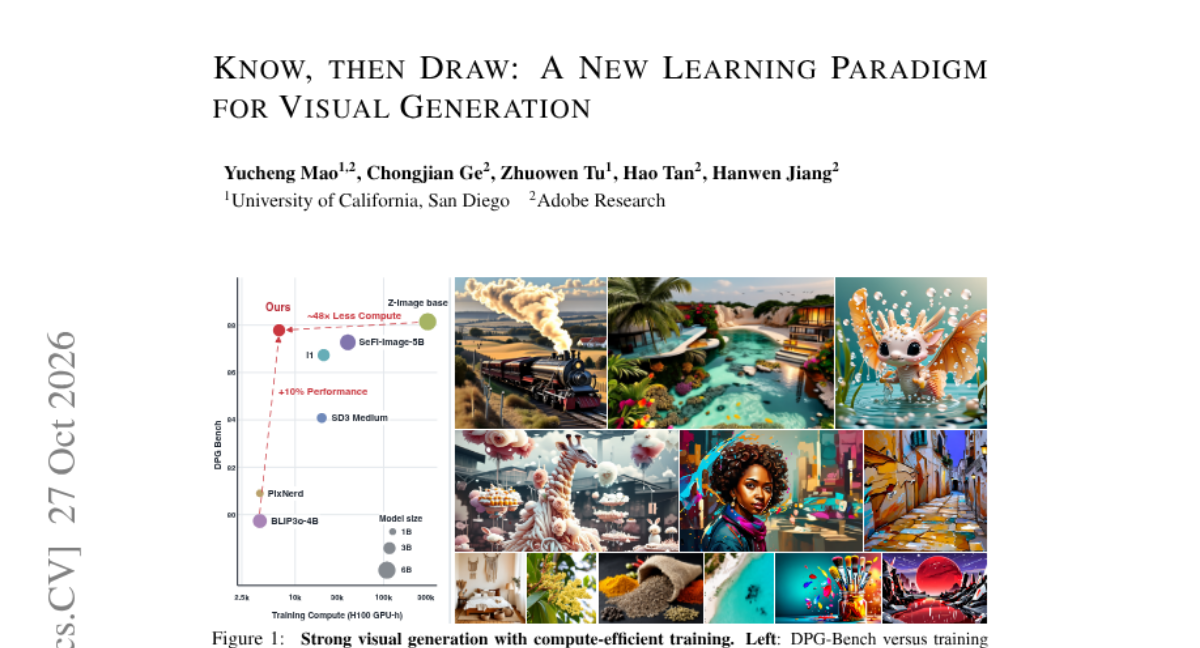
9. Know, then Draw: A New Learning Paradigm for Visual Generation
🔑 Keywords: Autoregressive Pretraining, Diffusion Post-Training, Semantic Tokenizer, Compute-Optimal Scaling, Text-to-Image Model
💡 Category: Generative Models
🌟 Research Objective:
– The study aims to combine autoregressive pretraining for semantic understanding and diffusion post-training for high-quality rendering in text-to-image generation.
🛠️ Research Methods:
– The authors explore a hybrid learning paradigm that assigns autoregressive pretraining to knowledge acquisition and diffusion post-training to rendering. They perform controlled comparisons and propose a semantic tokenizer trained with language supervision alone.
💬 Research Conclusions:
– The findings demonstrate that autoregressive pretraining enhances learning efficiency and final generation quality compared to pure diffusion models. A compute-optimal scaling approach allows the training of a 3B-parameter model efficiently, achieving high scores on GenEval and DPG-Bench, validating the proposed paradigm.
👉 Paper link: https://huggingface.co/papers/2610.37626
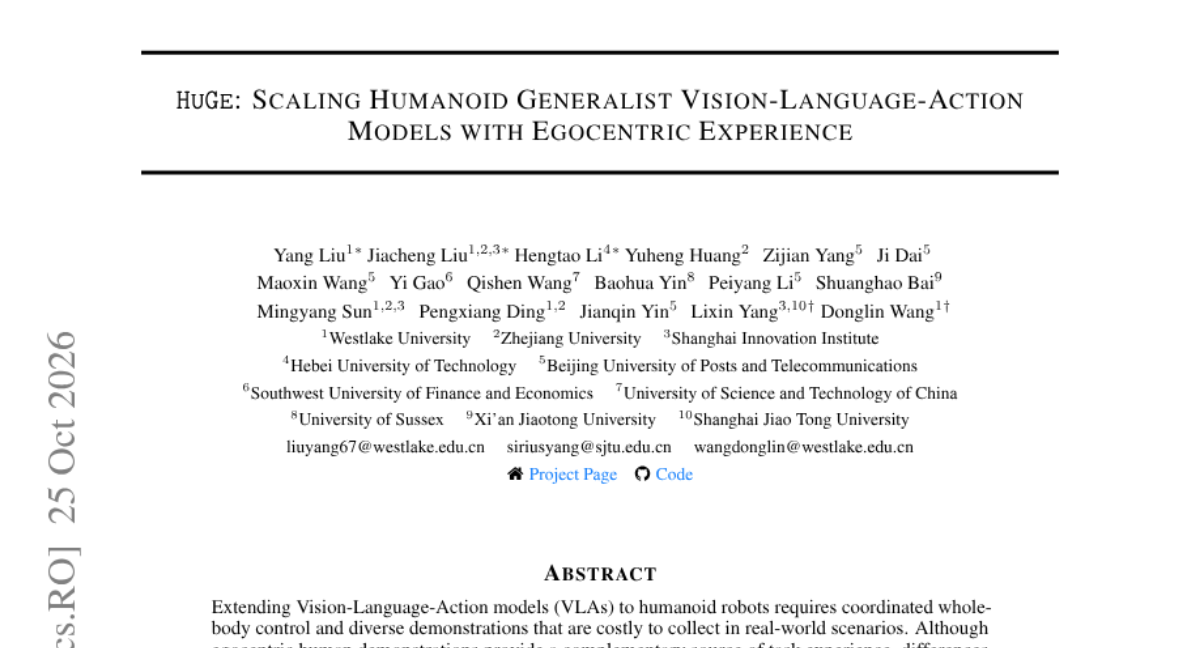
10. HuGe: Scaling Humanoid Generalist Vision-Language-Action Models with Egocentric Experience
🔑 Keywords: Humanoid Generalist VLAs, Vision-Language-Action models, whole-body control, pseudo-proprioception, egocentric demonstrations
💡 Category: Robotics and Autonomous Systems
🌟 Research Objective:
– The study aims to enhance Vision-Language-Action models for humanoid robots by coordinating whole-body control using a novel framework, HuGe.
🛠️ Research Methods:
– Utilized a three-stage training pipeline: egocentric pre-training, humanoid adaptation, and downstream fine-tuning. Pseudo-proprioceptive states and visual adaptation techniques were applied to improve embodiment transfer.
💬 Research Conclusions:
– HuGe achieved state-of-the-art results on the HumanoidArena simulation benchmark and demonstrated that integrating visually adapted egocentric demonstrations enhances robotic task performance in a real-world scenario.
👉 Paper link: https://huggingface.co/papers/2610.34186
11. Evaluating DeepSeek V4.1 Flash-1017 for loss of control and harmful manipulation risks
🔑 Keywords: DeepSeek V4.1 Flash-1017, safety evaluation, open-weight models, private benchmarks, reasoning traces
💡 Category: AI Systems and Tools
🌟 Research Objective:
– The study aims to conduct an independent safety evaluation of DeepSeek V4.1 Flash-1017 against leading closed-source models and prior versions to explore systemic safety risks.
🛠️ Research Methods:
– Evaluation was performed across 34 benchmarks, including 5 proprietary ones, compliant with the EU General-Purpose AI Code of Practice, targeting evaluation integrity, loss of control, and harmful manipulation.
💬 Research Conclusions:
– DeepSeek V4.1 Flash-1017 exhibits substantial safety improvements over previous versions, nearing parity with leading closed-source models, while identifying key areas like process-level observability and the necessity of private benchmarks for robust evaluation.
👉 Paper link: https://huggingface.co/papers/2610.35671

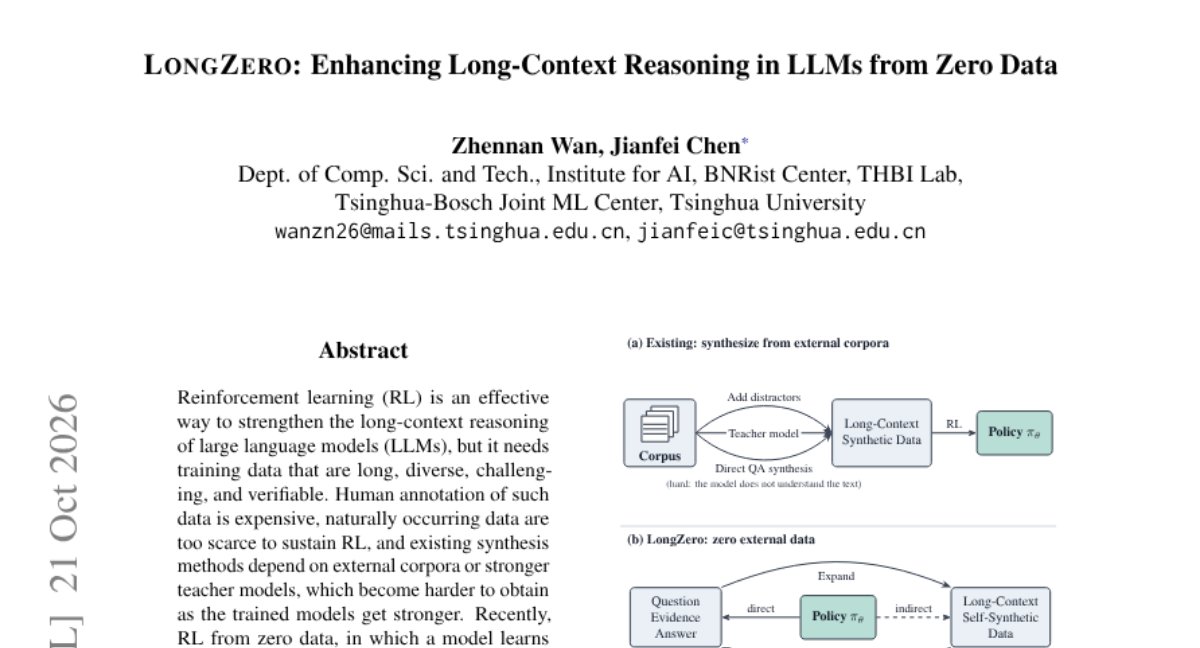
12. LongZero: Enhancing Long-Context Reasoning in LLMs from Zero Data
🔑 Keywords: LongZero, large language models, long-context reasoning, self-improvement, multi-hop reasoning
💡 Category: Natural Language Processing
🌟 Research Objective:
– The study introduces LongZero, a novel method enabling large language models to self-improve their long-context reasoning without relying on external data.
🛠️ Research Methods:
– LongZero synthesizes structured multi-hop and retrieval tasks within the model, which are then expanded into a long multi-document context. Training utilizes the GRPO method.
💬 Research Conclusions:
– Experimental results indicate that LongZero generalizes well to real-world tasks and outperforms traditional reinforcement learning methods that depend on data from external corpora.
👉 Paper link: https://huggingface.co/papers/2610.30132
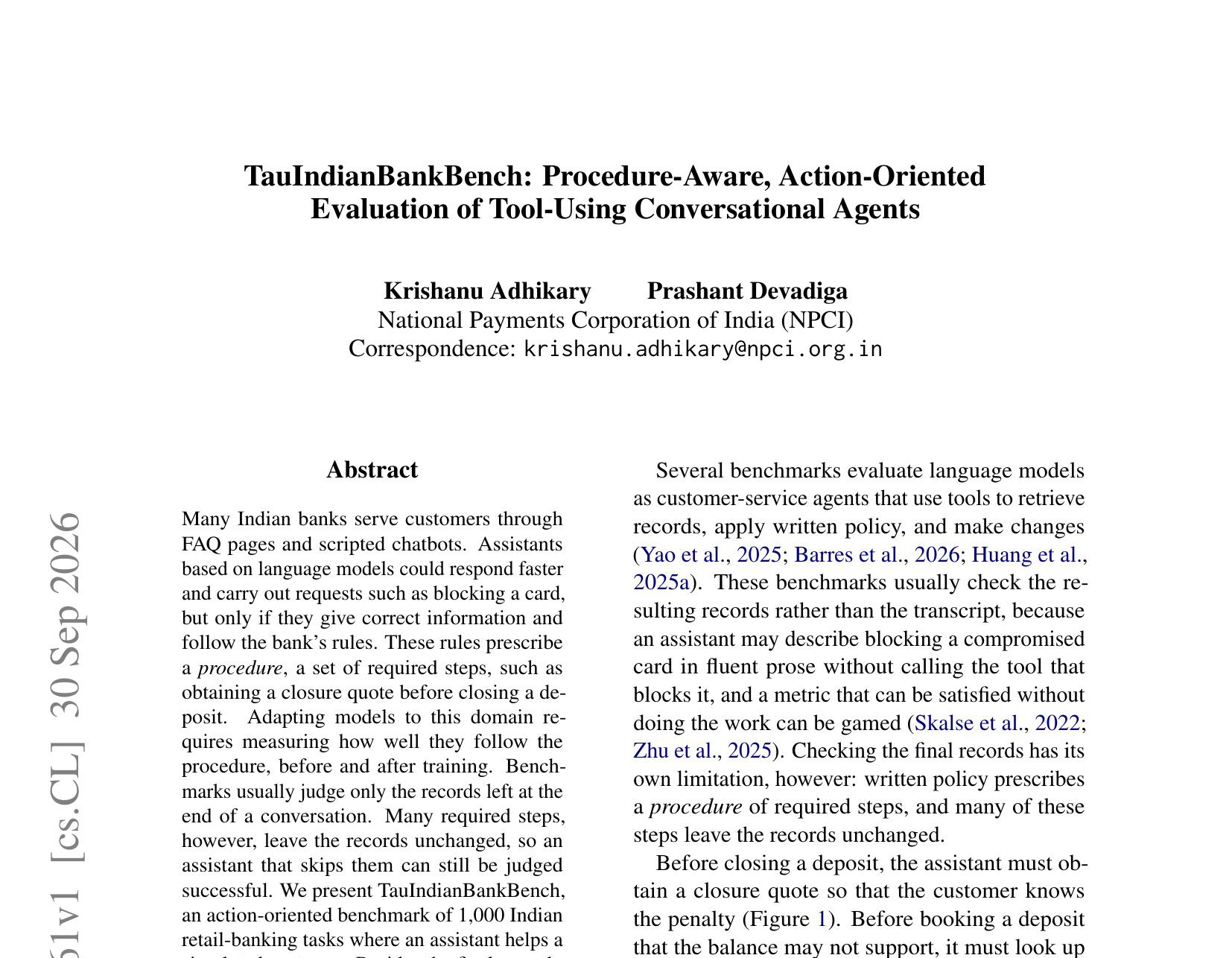
13. TauIndianBankBench: Procedure-Aware, Action-Oriented Evaluation of Tool-Using Conversational Agents
🔑 Keywords: language models, required steps, action-oriented benchmark, TauIndianBankBench, Indian retail banking
💡 Category: AI in Finance
🌟 Research Objective:
– The paper introduces TauIndianBankBench, a benchmark aimed at evaluating language model assistants based on their compliance with procedural requirements and the accuracy of their outcomes in Indian retail banking.
🛠️ Research Methods:
– The method involves simulating 1,000 Indian retail banking tasks, where a language model-based assistant aids a customer. The benchmark not only assesses final records but also checks for adherence to each prescribed step, ensuring no unrequested changes are made.
💬 Research Conclusions:
– The research finds that merely assessing the final records is insufficient as it overlooks procedural deviations. Accurate scoring requires evaluating both procedural compliance and final outcomes to truly measure the efficacy of language models in this domain.
👉 Paper link: https://huggingface.co/papers/2610.30161
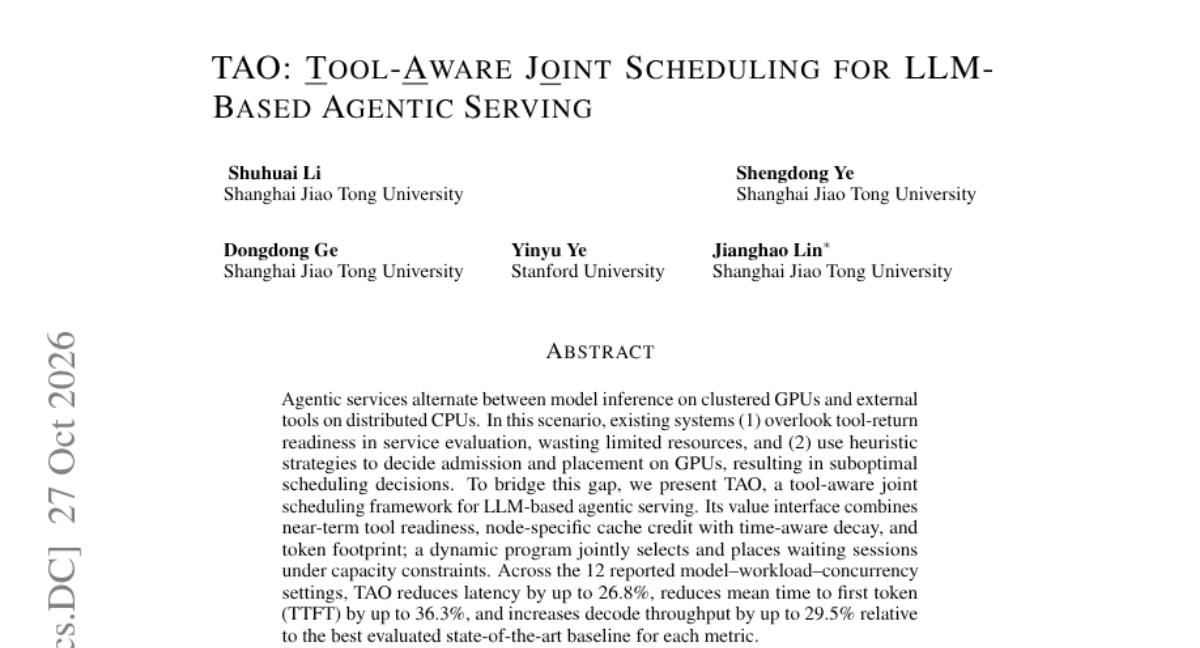
14. TAO: Tool-Aware Joint Scheduling for LLM-Based Agentic Serving
🔑 Keywords: TAO, LLM-based agentic serving, tool-return readiness, decode throughput, heuristic strategies
💡 Category: AI Systems and Tools
🌟 Research Objective:
– Improve scheduling for LLM agent services by integrating tool readiness and dynamic programming to optimize session placement.
🛠️ Research Methods:
– Developed TAO, a tool-aware joint scheduling framework that considers tool readiness, node-specific cache credit, time-aware decay, and token footprint for model and tool interaction.
💬 Research Conclusions:
– TAO significantly reduces latency by up to 26.8%, decreases the mean time to first token by up to 36.3%, and boosts decode throughput by up to 29.5% compared to state-of-the-art baselines.
👉 Paper link: https://huggingface.co/papers/2610.37230
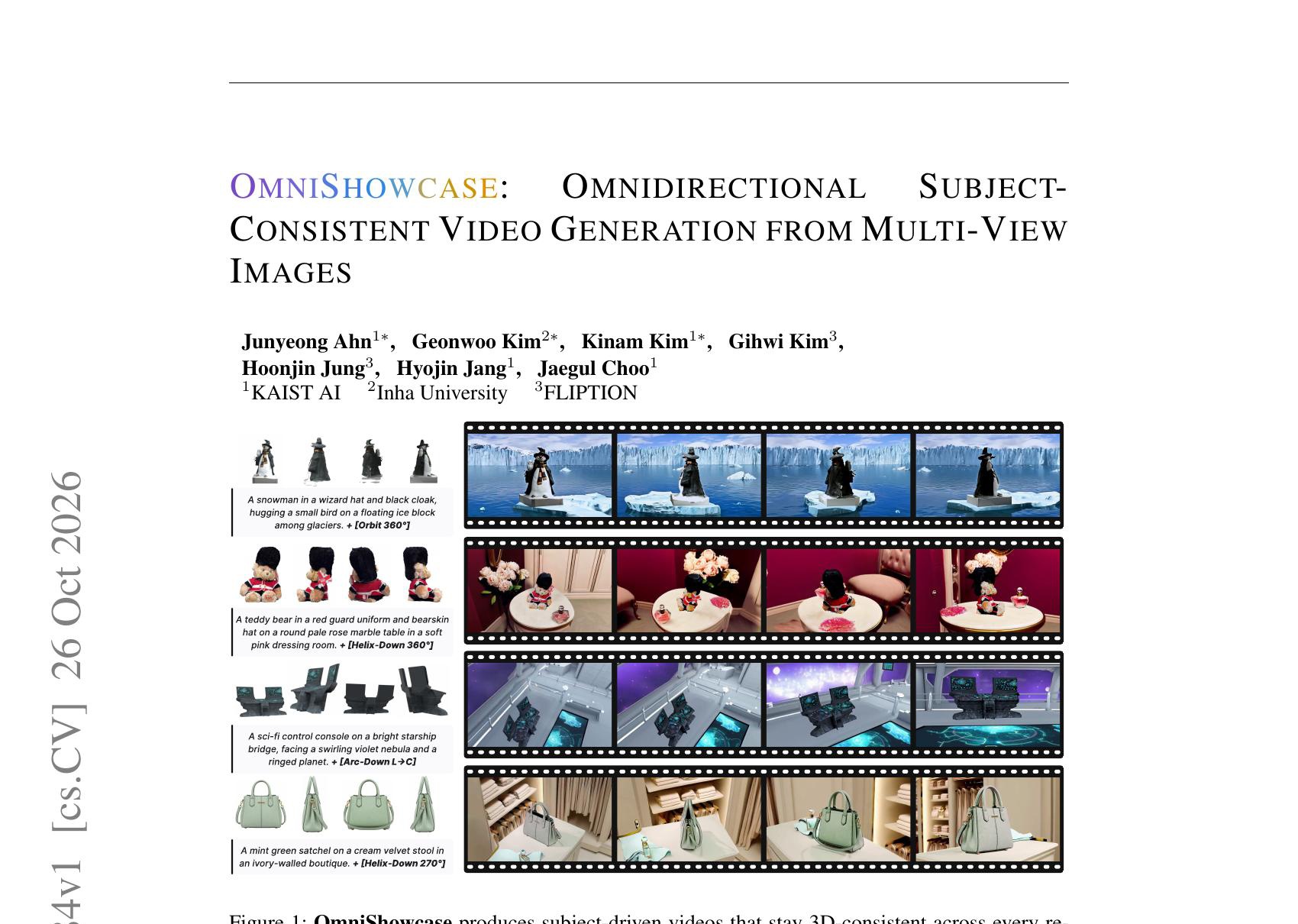
15. OmniShowcase: Omnidirectional Subject-Consistent Video Generation from Multi-View Images
🔑 Keywords: subject-to-video, 3D consistency, geometry-driven, surface-normal conditioning, OmniShowcase
💡 Category: Computer Vision
🌟 Research Objective:
– OmniShowcase aims to improve subject-to-video generation by ensuring 3D consistency across different viewpoints using geometry-driven training and surface-normal conditioning.
🛠️ Research Methods:
– The study employs a fully automated data synthesis pipeline to generate training videos with diverse camera trajectories and a geometry-conditioning approach using surface-normal maps.
💬 Research Conclusions:
– OmniShowcase achieves state-of-the-art results in maintaining subject identity and 3D consistency, while also delivering competitive video quality and motion.
👉 Paper link: https://huggingface.co/papers/2610.35684