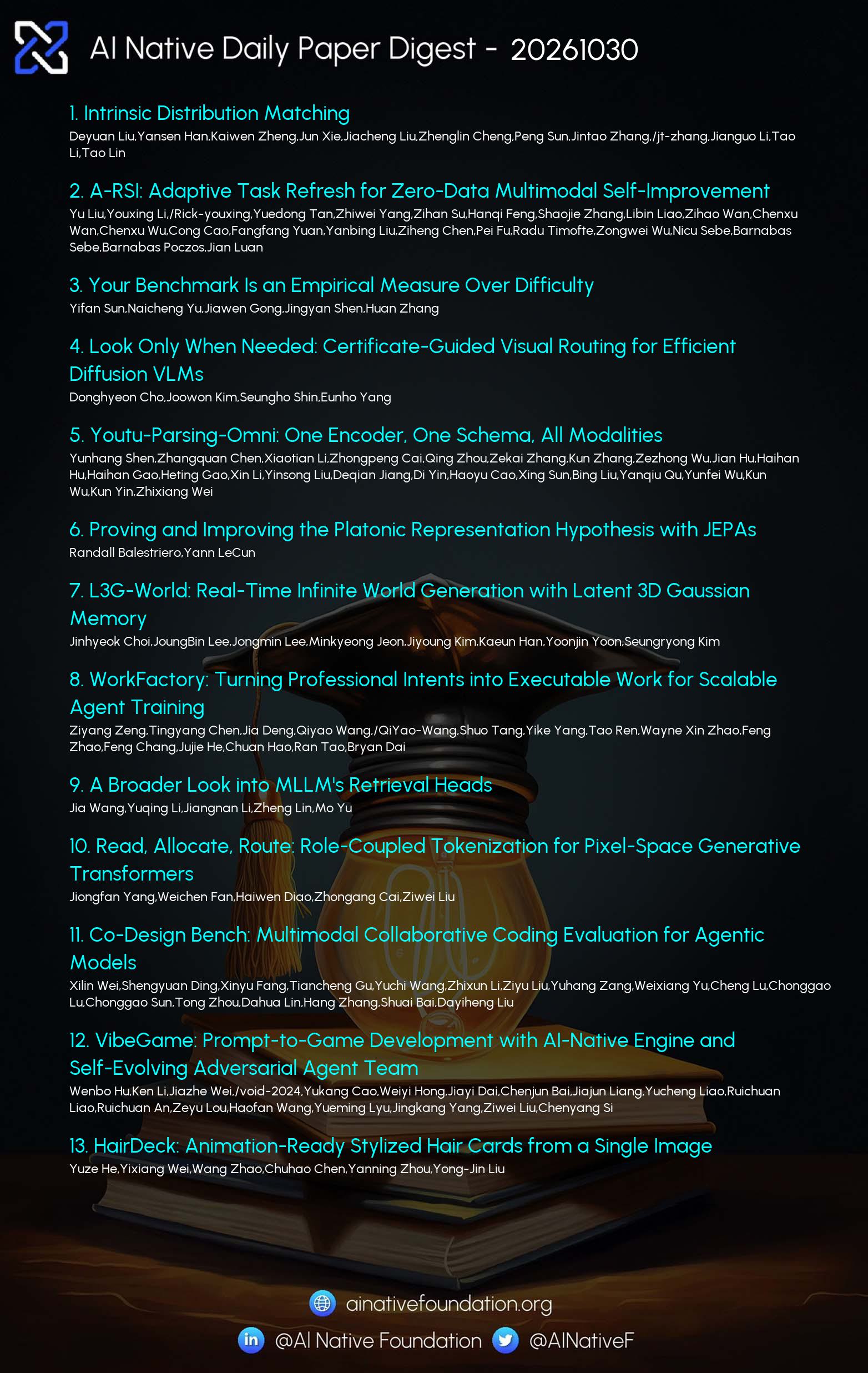
AI Native Daily Paper Digest – 20261030 – IntReal | WebAnything | Youtu-Parsing-Omni
Today’s digest features insights from cutting-edge research on Qwen and GPT, showcasing breakthroughs in long-context attention mechanisms. The papers collectively delve into challenges and innovations in agentic systems and multimodal reasoning. One paper presents a novel decoding algorithm that improves efficiency by 30% over traditional methods, while another paper reports a notable 15% increase in benchmark performance for language models. A new model architecture discussed today boasts a significant reduction in computational costs without compromising accuracy.
1. Intrinsic Distribution Matching
🔑 Keywords: Intrinsic Distribution Matching, text-to-image generation, Distribution Matching Distillation, Gaussian moment, LongText-Bench
💡 Category: Generative Models
🌟 Research Objective:
– To improve few-step text-to-image generation by incorporating explicit moment constraints into distribution matching distillation, leading to state-of-the-art long-text rendering.
🛠️ Research Methods:
– Utilization of Intrinsic Distribution Matching (IDM) that incorporates explicit constraints on Gaussian moments, applied through the generator’s exponential-moving-average copy, avoiding the need for an external feature encoder.
💬 Research Conclusions:
– IDM significantly enhances long-text rendering accuracy, achieving the highest scores at minimal network evaluations on the Chinese and English LongText-Bench, outperforming existing methods while demonstrating competitive performance with an internal velocity branch against external encoders.
👉 Paper link: https://huggingface.co/papers/2610.39633
2. Your Benchmark Is an Empirical Measure Over Difficulty
🔑 Keywords: benchmark evaluation, difficulty measures, measure mismatch, coverage gaps, diagnostic metrics
💡 Category: Foundations of AI
🌟 Research Objective:
– The work aims to formalize benchmark evaluation through difficulty measures and identify failures like measure mismatch and coverage gaps.
🛠️ Research Methods:
– The researchers proposed diagnostic metrics and a difficulty-targeted item rewriting algorithm called BenchFill to improve benchmark coverage and reduce local coverage gaps.
💬 Research Conclusions:
– The study found that many benchmarks overweight certain difficulty regions and leave parts of the difficulty axis uncovered, suggesting caution in interpreting leaderboard conclusions and highlighting the limitations in monitoring model improvement.
👉 Paper link: https://huggingface.co/papers/2610.29927
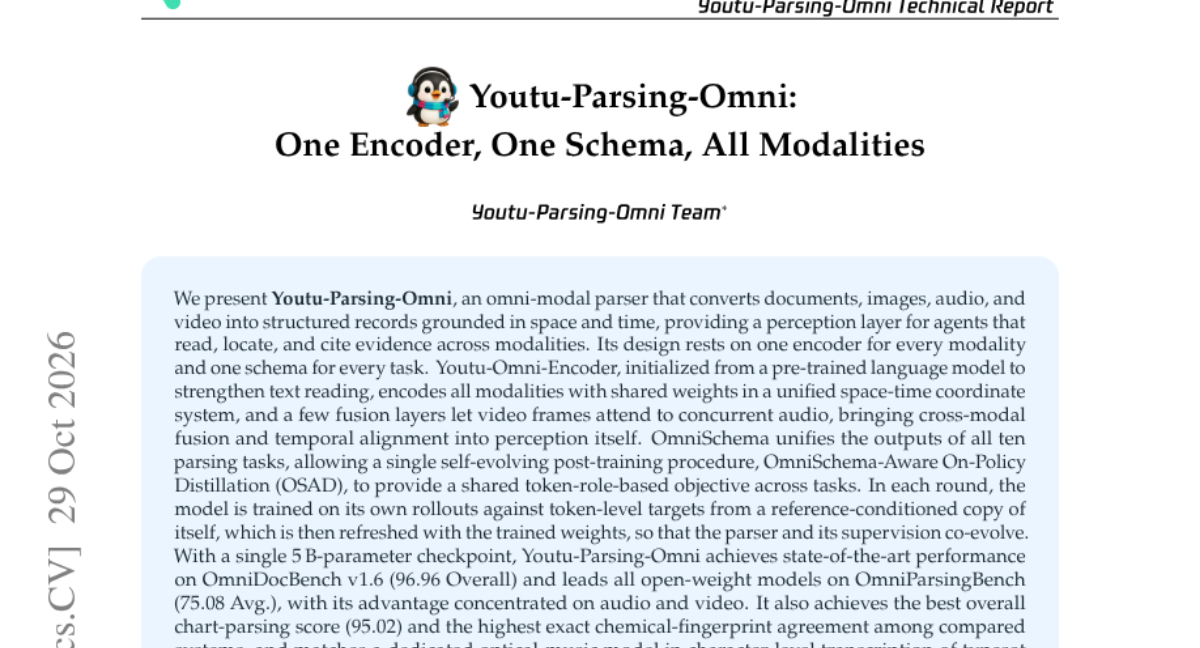
3. Youtu-Parsing-Omni: One Encoder, One Schema, All Modalities
🔑 Keywords: Youtu-Parsing-Omni, omni-modal parser, cross-modal fusion, state-of-the-art, self-evolving on-policy distillation
💡 Category: Multi-Modal Learning
🌟 Research Objective:
– The primary aim is to develop a unified multi-modal parser, Youtu-Parsing-Omni, that can convert various data types, including documents, images, audio, and video into structured spatiotemporal records by using shared weights and cross-modal fusion techniques.
🛠️ Research Methods:
– Utilizes a single encoder for each modality and an OmniSchema to unify task outputs, enhancing cross-modal fusion and temporal alignment. Employs OmniSchema-Aware On-Policy Distillation for effective training, enabling both the model and its supervision to co-evolve.
💬 Research Conclusions:
– Youtu-Parsing-Omni demonstrates state-of-the-art performance on multiple parsing benchmarks, showing significant advantages in audio and video modalities. It achieves high parsing scores and matches domain-specific models, outperforming general-purpose systems, with publicly available code and model weights.
👉 Paper link: https://huggingface.co/papers/2610.39301
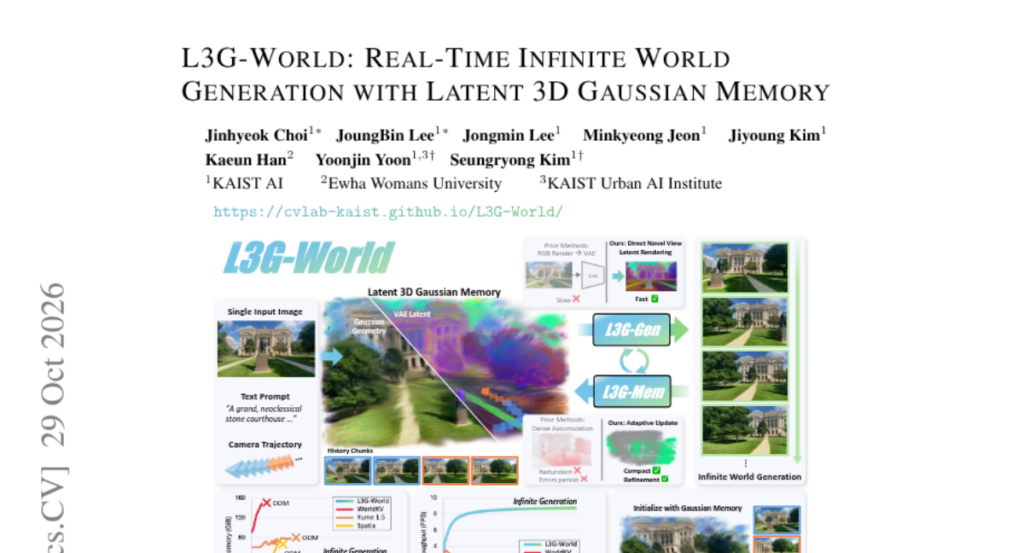
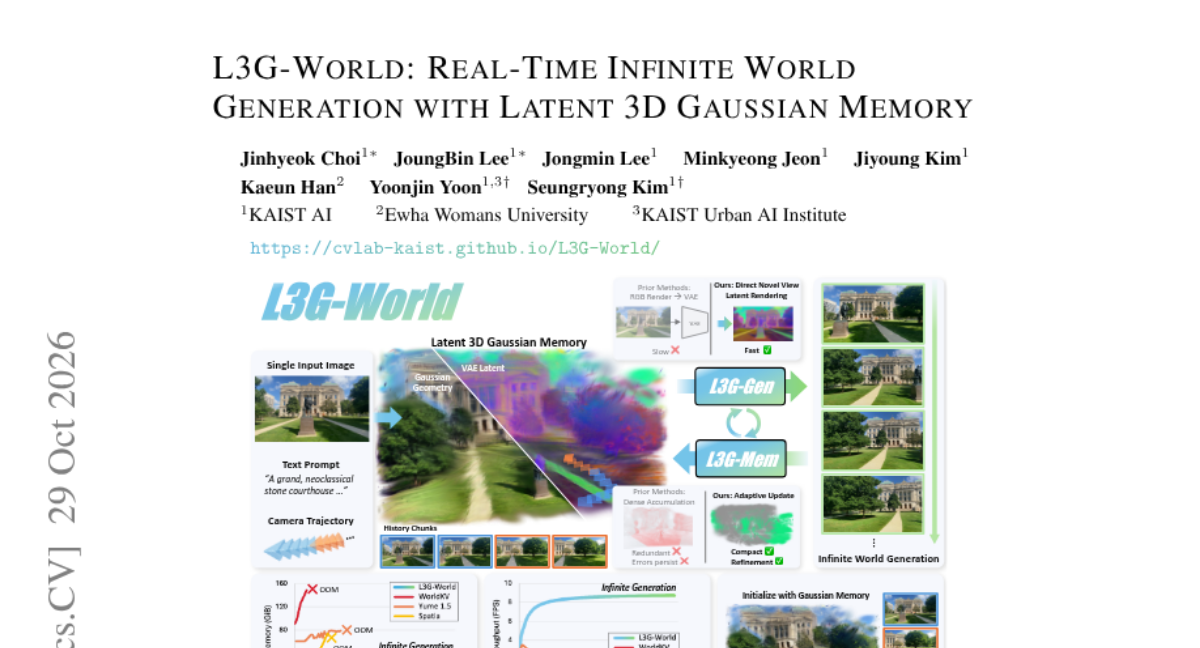
4. L3G-World: Real-Time Infinite World Generation with Latent 3D Gaussian Memory
🔑 Keywords: L3G-World, Latent 3D Gaussian Memory, video diffusion transformer, spatial consistency, real-time world generation
💡 Category: Generative Models
🌟 Research Objective:
– To introduce L3G-World, which uses Latent 3D Gaussian Memory to efficiently generate spatially consistent interactive worlds in real time.
🛠️ Research Methods:
– Utilization of a compact Latent 3D Gaussian Memory and alternating autoregressive updates with a video diffusion transformer to maintain spatial consistency.
💬 Research Conclusions:
– L3G-World achieves state-of-the-art generation quality and maintains long-horizon spatial consistency. It outperforms previous approaches by significantly reducing 3D primitives and accelerating memory updates and rendering, allowing 9 FPS real-time generation.
👉 Paper link: https://huggingface.co/papers/2610.40614
5. A Broader Look into MLLM’s Retrieval Heads
🔑 Keywords: Retrieval Heads, Audio-Visual Modalities, Multimodal Large Language Models, Document Retrieval, Omni-Modal Models
💡 Category: Multi-Modal Learning
🌟 Research Objective:
– The study aims to explore the optimization of retrieval heads within multimodal large language models, particularly focusing on their role when integrating new modalities such as audio-visual inputs.
🛠️ Research Methods:
– The researchers constructed paired audio-visual inputs to test retrieval heads’ performance and employed a ranking objective to train and enhance these heads’ attention, across 18 language, vision-language, and omni-modal checkpoints.
💬 Research Conclusions:
– Retrieval heads remain sparse yet shared across modalities, significantly influencing document retrieval and model performance. Optimizing these heads with a ranking objective improves recall and overall model efficacy in multimodal contexts.
👉 Paper link: https://huggingface.co/papers/2610.32411

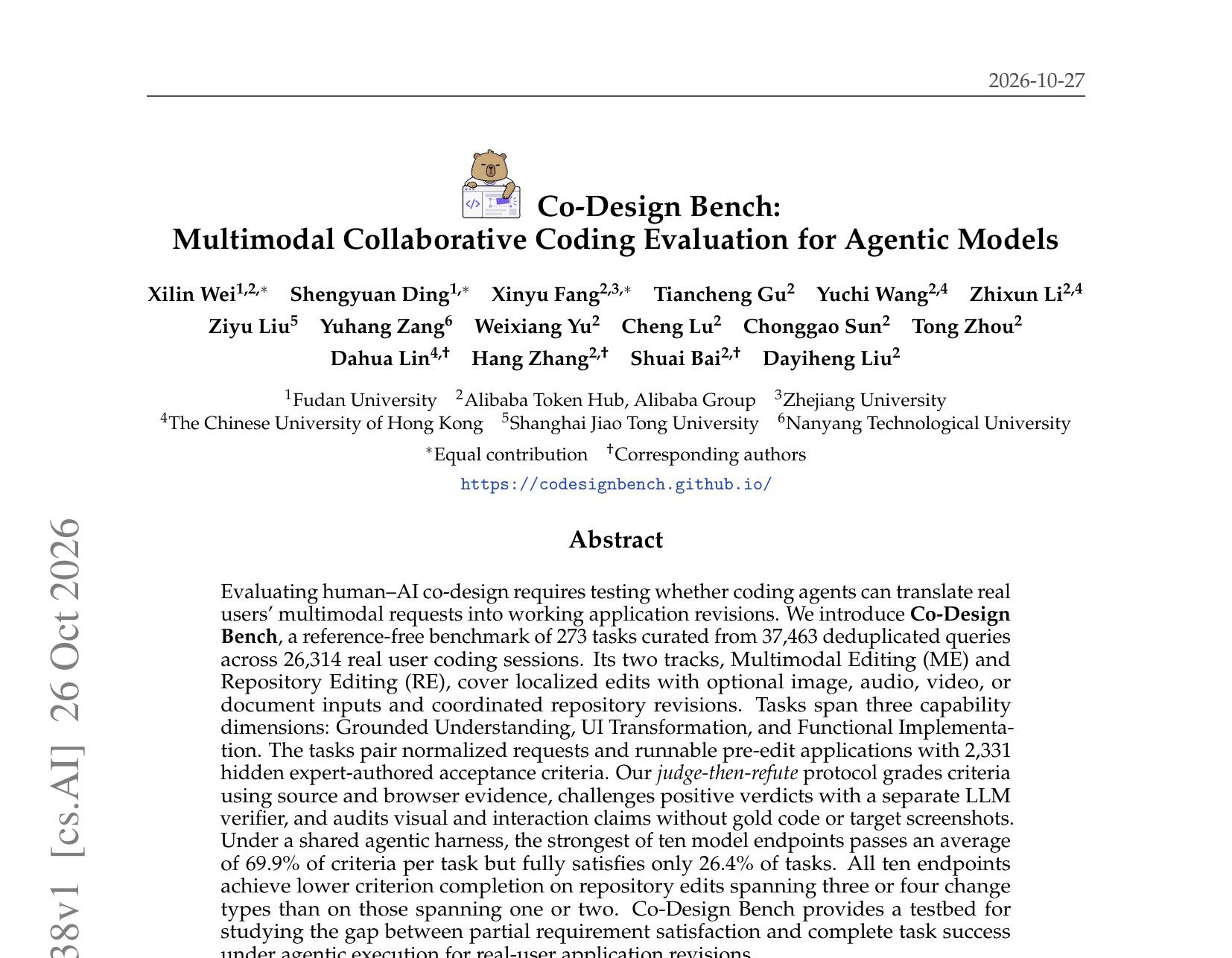
6. Co-Design Bench: Multimodal Collaborative Coding Evaluation for Agentic Models
🔑 Keywords: Co-Design Bench, Multimodal Requests, Human-AI Co-Design, Application Revisions, AI Native
💡 Category: Human-AI Interaction
🌟 Research Objective:
– This study aims to evaluate how effectively human-AI co-design can translate real users’ multimodal requests into functional application revisions.
🛠️ Research Methods:
– Introduced Co-Design Bench, a benchmark with 273 tasks from deduplicated queries across user coding sessions.
– Utilized tasks that span Grounded Understanding, UI Transformation, and Functional Implementation.
💬 Research Conclusions:
– The best AI model endpoint satisfies an average of 69.9% of the criteria per task, although only 26.4% of tasks are fully satisfied.
– All endpoints show lower completion rates for complex repository edits involving more change types.
👉 Paper link: https://huggingface.co/papers/2610.35138
7. HairDeck: Animation-Ready Stylized Hair Cards from a Single Image
🔑 Keywords: HairDeck, stylized hair cards, spring-bone animations, diffusion transformer, CHARM
💡 Category: Generative Models
🌟 Research Objective:
– The objective is to generate stylized hair cards and spring-bone animations more accurately and faster than previous methods using HairDeck.
🛠️ Research Methods:
– Utilizes a diffusion transformer to generate hair cards as unordered token sets, denoising all cards simultaneously.
💬 Research Conclusions:
– HairDeck improves upon CHARM by reducing Chamfer distance by 44%, card-orientation error by over 50%, and operates 33 times faster, outperforming other methods including image-to-3D pipelines and strand-based techniques.
👉 Paper link: https://huggingface.co/papers/2610.40599

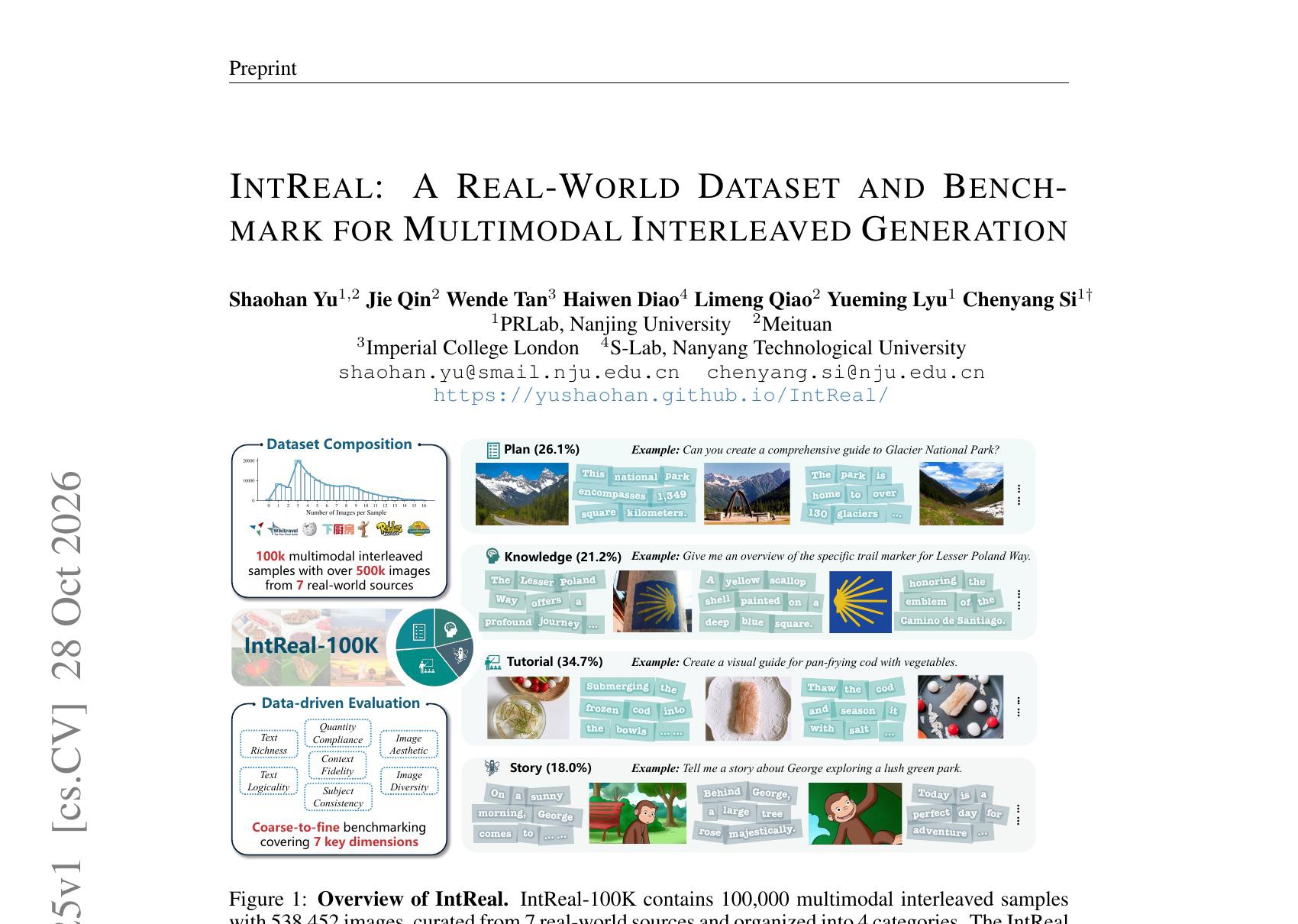
8. IntReal: A Real-World Dataset and Benchmark for Multimodal Interleaved Generation
🔑 Keywords: IntReal, Unified Multimodal Models, interleaved generation, IntReal Evaluation Suite, IntReal-100K
💡 Category: Multi-Modal Learning
🌟 Research Objective:
– Introduce IntReal, a dataset and evaluation framework, to diagnose strengths of Unified Multimodal Models and improve interleaved generation through targeted training.
🛠️ Research Methods:
– Develop IntReal-100K, a dataset with multimodal interleaved samples, and the IntReal Evaluation Suite to assess models across seven dimensions using specialized expert models. Validate the evaluation suite via low inter-metric redundancy, high agreement with human judgments, and consistency across evaluators.
💬 Research Conclusions:
– IntReal Evaluation Suite reveals distinct model strengths and weaknesses. IntReal-100K aids in improving interleaved generation, showing that modality-specific optimization benefits interleaved generation rather than requiring joint text-image training.
👉 Paper link: https://huggingface.co/papers/2610.38425
9. WebAnything: From the Wild Web to Scalable Agent Environments
🔑 Keywords: WebAnything, agent training, scalable, source-grounded, automation
💡 Category: AI Systems and Tools
🌟 Research Objective:
– To automate the reconstruction of reusable and source-grounded web environments from real URLs, optimizing for scalable agent training and evaluation with verified fidelity.
🛠️ Research Methods:
– Developed a fully automated framework, WebAnything, which captures browser-observable structures, resources, and interaction outcomes, followed by independent verification for local repair or source recapture.
💬 Research Conclusions:
– WebAnything surpasses human-assisted methods, achieving higher scores in fidelity metrics across various tests; fine-tuning the Qwen3.5-9B model resulted in significant improvements in interaction trajectory success rates and overall task performance.
👉 Paper link: https://huggingface.co/papers/2610.37786

10. Multi-Token Prediction Done Right
🔑 Keywords: Multi-Token Prediction, Soft-MTP, Speculative Decoding, KL Self-Distillation, Cross-Entropy Gradient
💡 Category: Natural Language Processing
🌟 Research Objective:
– This study aims to enhance Multi-Token Prediction in language models by using a Soft-MTP approach to remove noisy gradient residuals, thereby improving model perplexity, speculative decoding, and reasoning capabilities without additional costs.
🛠️ Research Methods:
– The researchers introduce a KL gradient-recovery trick using straight-through gradient routing to effectively recover the gradient of KL divergence and apply it to Soft-MTP, allowing for improved effectiveness in MTP training without expanding the model’s parameters or adding computational overhead.
💬 Research Conclusions:
– Soft-MTP improves performance over standard MTP by offering lower perplexity, faster speculative decoding, and better zero-shot accuracy across various model scales. Moreover, it matches or even surpasses direct KL divergence minimization without extra costs, proving to be highly effective in optimizing MTP.
👉 Paper link: https://huggingface.co/papers/2610.38331
11. AskStream: When and What to Ask Proactively under Uncertainty in Streaming Video Understanding
🔑 Keywords: Proactive Interaction, Streaming Video Understanding, Multimodal Large Language Models, User Uncertainty, Ask-F1 Metric
💡 Category: Multi-Modal Learning
🌟 Research Objective:
– Introduce a proactive video understanding benchmark, AskStream, which addresses the challenge of asking for missing information due to uncertainty from video and user contexts.
🛠️ Research Methods:
– Development of the AskStream benchmark including framing tasks into four categories with eight subtasks, utilizing 438 videos annotated at frame-level time windows with actions: wait, ask, and answer.
💬 Research Conclusions:
– Current models exhibit significant limitations in managing uncertainty and proactive information seeking, achieving only 52.18% on the Ask-F1 metric, indicating a need for improved paradigms.
👉 Paper link: https://huggingface.co/papers/2610.38678

12. PhysInsert: Physically Plausible Object Insertion with Geometric Priors and Bidirectional Object-Scene Interactions
🔑 Keywords: PhysInsert, Geometry-Guided Adaptation, Object-Scene Spatial Supervision, illumination adaptation, pose adaptation
💡 Category: Computer Vision
🌟 Research Objective:
– To enable physically plausible reference-based object insertion by jointly adapting objects and scenes using novel techniques.
🛠️ Research Methods:
– Development of PhysInsert framework incorporating Geometry-Guided Adaptation and 2D Object-Scene Spatial Supervision on aligned Blender-rendered counterfactual pairs.
💬 Research Conclusions:
– Experiments demonstrated improved image fidelity with accurate placement, better lighting integration, and enhanced perspective and pose plausibility in object insertion.
👉 Paper link: https://huggingface.co/papers/2610.40453

13. OpenFlyV2: An onboard vision-language-action model for aerial perception and navigation
🔑 Keywords: AI Native, vision-language-action, resource-constrained hardware, multimodal context, aerial navigation
💡 Category: Robotics and Autonomous Systems
🌟 Research Objective:
– The main objective is to develop a unified onboard model, OpenFlyV2, that combines vision, language, and action to enable real-time aerial navigation and reasoning on resource-constrained hardware.
🛠️ Research Methods:
– Utilization of a shared vision-language representation for semantic understanding and spatial reasoning.
– Implementation of a compact action expert to convert the multimodal context into flight waypoints.
– Construction of a simulation-based dataset with approximately 70,000 navigation trajectories and 60,000 vision-language instruction-response pairs.
– Zero-shot transfer from simulation to physical quadrotor flight using the NVIDIA Jetson Orin NX.
💬 Research Conclusions:
– OpenFlyV2 achieved a 48% navigation success rate across four real-world environments without using real-world aerial training data.
– The study demonstrates that a single model can support broad vision-language competence and continuous closed-loop flight on a resource-constrained aerial platform.
👉 Paper link: https://huggingface.co/papers/2610.39287

14. Your LR Schedule May Not Be Principled: Effective Learning Rate Scheduling in Weight-Normalized Training
🔑 Keywords: Weight-normalized training, Effective learning rate, Affine Inverse-square-Root decay, Hyperparameter robustness, Mixture-of-Experts
💡 Category: Foundations of AI
🌟 Research Objective:
– To investigate how effective learning rate trajectories influence weight-normalized training gains and propose a new schedule to improve large-scale pretraining loss and robustness.
🛠️ Research Methods:
– The study introduces an AIR (Affine Inverse-square-Root) decay schedule that combines a 1/t decay with an affine adjustment to optimize learning rate trajectories over a finite training period.
💬 Research Conclusions:
– The proposed AIR schedule outperforms other scheduling methods, such as cosine, by reducing terminal training loss and enhancing downstream performance and hyperparameter robustness. Applying the same effective learning rate trajectory to weight decay validates the superiority of ELR as a scheduling approach.
👉 Paper link: https://huggingface.co/papers/2610.40362

15. SO-101 Bench: Accessible Spatial Manipulation
🔑 Keywords: simulated benchmark, hybrid LLM agents, low-cost robot arms, language-conditioned tasks, spatial manipulation
💡 Category: Robotics and Autonomous Systems
🌟 Research Objective:
– To develop a simulated benchmark for language-conditioned spatial manipulation on low-cost robotic arms, specifically the SO-101 model, to evaluate hybrid LLM agents against learned vision-language-action policies.
🛠️ Research Methods:
– The introduction of SO-101 Bench, a digital twin of the SO-101 setup, which involves testing four tasks over 138 objects across seen and unseen scenarios, using rotate-to-fit planning and occlusion memory. The study involved 3,629 simulated demonstrations with an equal compute budget for all policies.
💬 Research Conclusions:
– Hybrid LLM agents outperform traditional vision-language-action policies, maintaining consistent rankings in both simulated and physical environments. While learned policies score around 61%, the best LLM agent achieves 83.2%, leveraging efficient code-writing and grasping strategies.
👉 Paper link: https://huggingface.co/papers/2610.36420

16. After One-Click Video: The Inflow of Service-Type Content, the Failure of the Recommendation Pool Mechanism, and the BoLe System
🔑 Keywords: AI-generated video tools, content industry, service-type content, BoLe system, recommendation pool mechanism
💡 Category: AI Systems and Tools
🌟 Research Objective:
– Investigate the impact of AI-generated video tools on the content industry structure and propose a protective framework.
🛠️ Research Methods:
– Analyze the shift from work-type to service-type content production and develop a simplified mathematical model to evaluate recommendation systems.
💬 Research Conclusions:
– The rise of AI-generated service-type content unbalances the industry and overwhelms recommendation systems. A BoLe framework is suggested to maintain equilibrium by employing dual judgment methods for different content types.
👉 Paper link: https://huggingface.co/papers/2610.37695
17. Scaling Lean Theorem Proving for Real-World Code Verification
🔑 Keywords: EasyProver, Aegis, Lean proving system, reinforcement learning, verification tasks
💡 Category: AI Systems and Tools
🌟 Research Objective:
– The study introduces EasyProver, a Lean proving system, and Aegis, an extension that generates complex verification tasks for benchmarking and reinforcement learning support.
🛠️ Research Methods:
– EasyProver utilizes recursive agents with isolated contexts, asynchronous search, parallel tactic probing, and an elastic elaboration service to solve benchmark problems.
– Aegis converts competitive programming problems into harder verification tasks, producing differentially validated Rust-Lean program pairs and candidate specifications.
💬 Research Conclusions:
– EasyProver effectively solves nearly all current proving benchmarks and demonstrates significant potential in solving complex tasks produced by Aegis, achieving 52.7% success on a challenging sample with timed constraints.
– The system offers a valuable tool for benchmarking other provers and supporting reinforcement learning.
👉 Paper link: https://huggingface.co/papers/2610.38174
18. Matched Capabilities, Different Behaviors: A Controlled Study of MCP and CLI Interfaces for Language Agents
🔑 Keywords: Matched Interface Representations, Interface-specific Realization, Semantic Operations, Decoupled Action Realization, Targeted Repair
💡 Category: AI Systems and Tools
🌟 Research Objective:
– The study aims to determine how differences in interface representations affect agent behavior, despite identical executable capabilities.
🛠️ Research Methods:
– The researchers introduced the Matched Interface Comparison and Analysis (MICA) to evaluate interface representations such as Model Context Protocol (MCP) and command-line interfaces (CLI) and their impact on task performance across six models and three interactive environments.
💬 Research Conclusions:
– Matched interfaces lead to significant differences in task performance and interaction costs. Introducing Decoupled Action Realization and Targeted Repair (DART) improved benchmark scores and reduced token costs, establishing interface representation as a crucial part of the decision process in agent behavior.
👉 Paper link: https://huggingface.co/papers/2610.34298

19. Weaken to Strengthen: Weakening-Induced On-Policy Self-Distillation for Large Reasoning Models
🔑 Keywords: WISD, Self-distillation, Reasoning Models, Quantization, Pruning
💡 Category: Knowledge Representation and Reasoning
🌟 Research Objective:
– The study introduces Weakening-Induced On-Policy Self-Distillation (WISD) as an approach to improve reasoning models by creating weaker versions of the models themselves and using these as training signals.
🛠️ Research Methods:
– Two methods for constructing weaker models are explored: low-bit quantization and magnitude pruning, which enable the generation of training signals without privileged data.
💬 Research Conclusions:
– Across mathematical and coding reasoning tasks, the techniques of quantization and pruning improved model accuracy by 4.0 and 5.5 percentage points, respectively, demonstrating state-of-the-art performance without the need for privileged information.
👉 Paper link: https://huggingface.co/papers/2610.38681
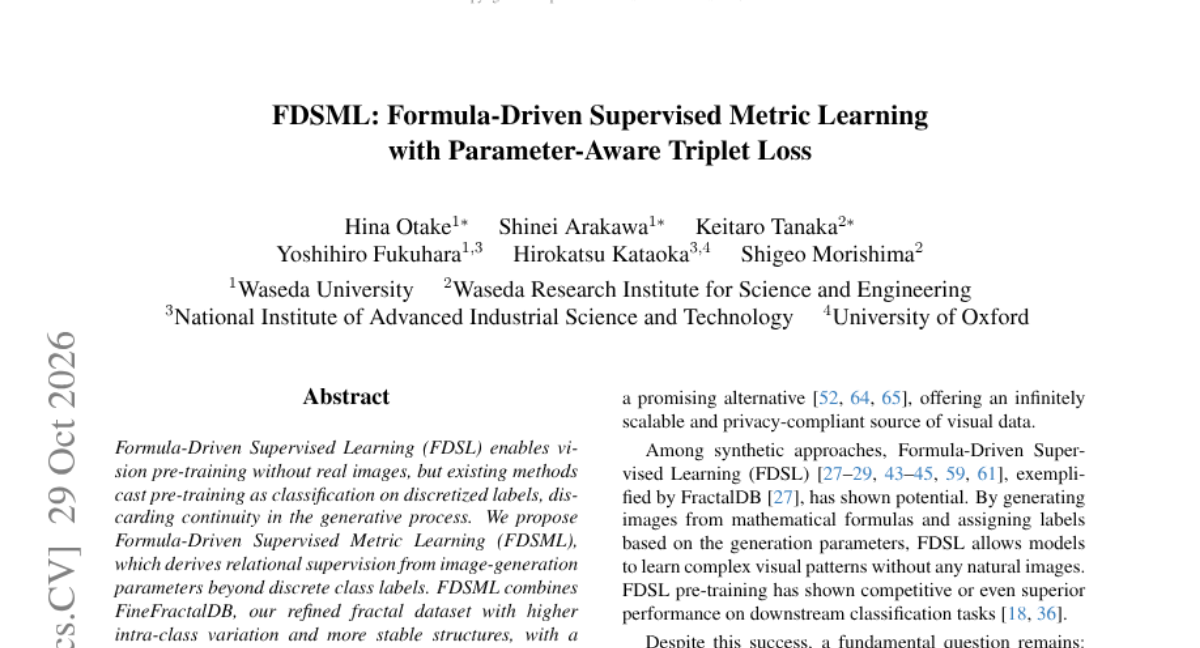
20. FDSML: Formula-Driven Supervised Metric Learning with Parameter-Aware Triplet Loss
🔑 Keywords: Formula-Driven Supervised Metric Learning, Parameter-Aware Triplet Loss, Synthetic Pre-Training, Image Retrieval, Robustness
💡 Category: Computer Vision
🌟 Research Objective:
– The study aims to enhance vision pre-training by incorporating Formula-Driven Supervised Metric Learning (FDSML) to utilize continuous generative parameters for synthetic pre-training, improving the transferability and robustness of image retrieval systems.
🛠️ Research Methods:
– FDSML leverages a refined fractal dataset called FineFractalDB and employs a Parameter-Aware Triplet Loss, which judges similarity by parameter-driven distances, eliminating the conventional reliance on discrete class labels.
💬 Research Conclusions:
– Results show that FDSML significantly boosts performance in image retrieval tasks, with notable increases in Recall@1 scores when using ResNet-50, indicating that parameter-derived relational supervision is a more potent pre-training signal than traditional label-based classification.
👉 Paper link: https://huggingface.co/papers/2610.39423
21.
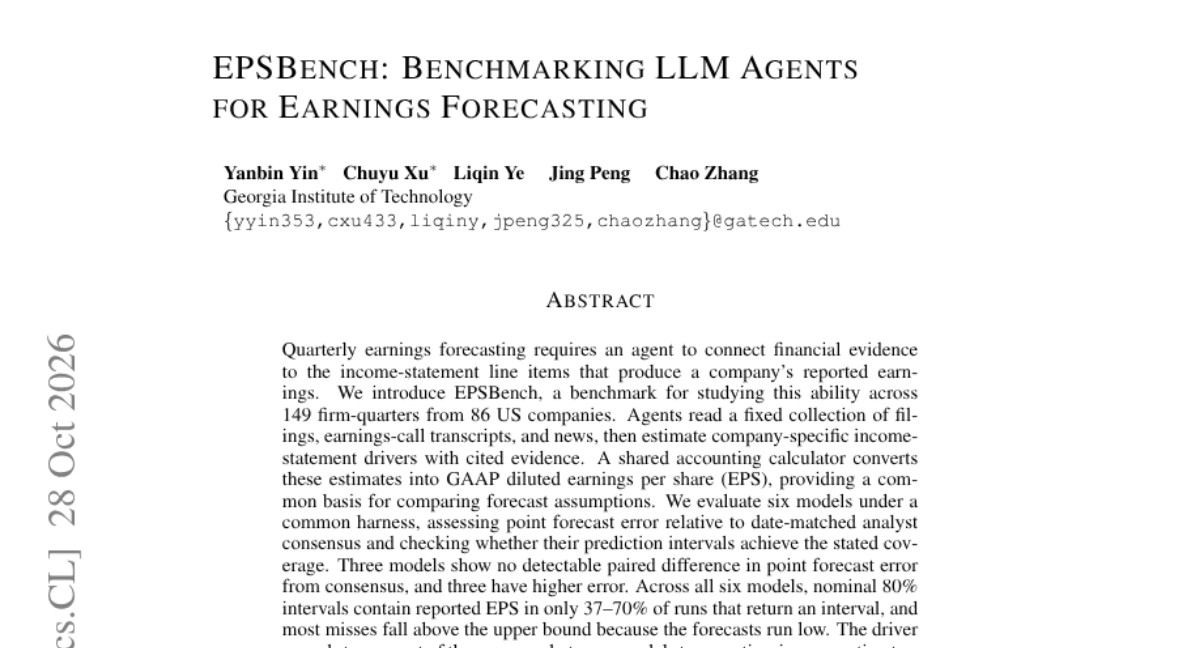
22. EPSBench: Benchmarking LLM Agents for Earnings Forecasting
🔑 Keywords: EPSBench, quarterly earnings forecasting, income-statement drivers, GAAP diluted earnings per share, prediction intervals
💡 Category: AI in Finance
🌟 Research Objective:
– The study aims to evaluate AI agents in forecasting quarterly earnings by linking financial evidence to income-statement drivers and comparing these predictions to analyst consensus using the EPSBench benchmark.
🛠️ Research Methods:
– The research assesses six AI models based on their ability to forecast earnings and checks the accuracy of their prediction intervals, comparing them to date-matched analyst consensus.
💬 Research Conclusions:
– Three models show no significant difference from analyst consensus in forecast error, while three models have higher errors. The prediction intervals often fall short, capturing reported EPS in only 37-70% of cases, primarily due to underestimation.
👉 Paper link: https://huggingface.co/papers/2610.38293
23. Broken on Arrival: Non-Functional Quantized LLM Artifacts in Public Model Registries and How to Catch Them
🔑 Keywords: Quantized Large Language Models, Low-bit Quantization, Functional Testing, Importance Matrix, Quantcheck Tool
💡 Category: Natural Language Processing
🌟 Research Objective:
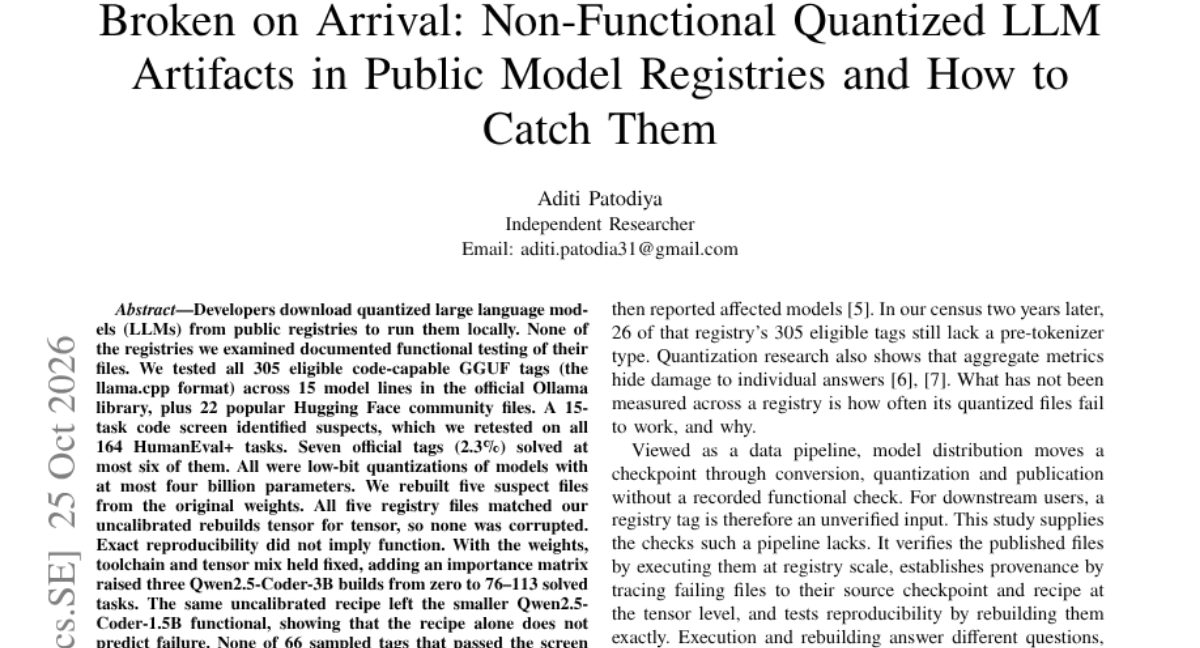
– To investigate the functionality of quantized small language model files in public registries and recommend screening plus calibration before release.
🛠️ Research Methods:
– Conducted functional testing of 305 code-capable GGUF tags from 15 model lines and 22 files from the Hugging Face community using a 15-task code screen, followed by retesting on 164 HumanEval+ tasks.
💬 Research Conclusions:
– Identified issues with uncalibrated quantization in some models leading to non-functionality despite exact reproducibility.
– Found that adding an importance matrix significantly improved task-solving in three Qwen2.5-Coder builds.
– Released audit data and the quantcheck tool, recommending screening and calibration of low-bit tags before publication.
👉 Paper link: https://huggingface.co/papers/2609.05881
24. Unlocking Any-Order Generation in Pretrained Autoregressive Image Models
🔑 Keywords: Autoregressive Models, Inpainting, Outpainting, Future-aware Positional Embeddings, Ordering Curriculum
💡 Category: Generative Models
🌟 Research Objective:
– To adapt pretrained raster-scan autoregressive image models into flexible any-order generators with minimal additional compute, enabling inpainting and outpainting capabilities.
🛠️ Research Methods:
– Utilization of future-aware positional embeddings and an ordering curriculum to adapt pretrained AR models for flexible generation pathways.
💬 Research Conclusions:
– The adapted models outperform existing solutions like MaskGIT on ImageNet inpainting and outpainting tasks, while maintaining compatibility with AR inference ecosystems and adding only 13-33% additional compute.
👉 Paper link: https://huggingface.co/papers/2610.39293
25. Holo4D: Holistic 4D Reconstruction as Geometric Control for Video Diffusion
🔑 Keywords: Holo4D, 3D trajectories, video diffusion, novel-view synthesis, trajectory-based conditioning
💡 Category: Generative Models
🌟 Research Objective:
– The study aims to synthesize novel-view videos by guiding video diffusion with reconstructed 3D trajectory scaffolds.
🛠️ Research Methods:
– Introduces Holo4D, a framework utilizing reconstructed 3D trajectories as scaffolds to guide pretrained video diffusion models.
– Employs trajectory-based conditioning to ground generation in observed scene geometry and motion while leaving unsupported regions to generative priors.
💬 Research Conclusions:
– Demonstrates that trajectory-based conditioning enhances camera control and the synthesis of novel views.
– The framework can incorporate different 4D reconstructors without retraining, benefiting from future advancements in source reconstruction.
👉 Paper link: https://huggingface.co/papers/2610.25276

26. Training Foundation Models with a Single Algorithm
🔑 Keywords: Foundation models, Reinforcement learning, Unified training, Maximum-likelihood fitting, Continual learning
💡 Category: Foundations of AI
🌟 Research Objective:
– To unify the training stages of foundation models using a single likelihood-based algorithm combining static data and reinforcement learning enhancements.
🛠️ Research Methods:
– Utilized a unified training system that integrates both static data and reinforcement learning generations within one framework to streamline stages like pretraining, supervised fine-tuning, and reinforcement learning.
💬 Research Conclusions:
– This unified approach enhances the accuracy-compute tradeoff, improves task coverage, retains broader capabilities, and offers a better starting point for continual learning, leading towards a coherent science of foundation-model training.
👉 Paper link: https://huggingface.co/papers/2610.40564
27. ABF-Bench: A Verifiable Benchmark for Agentic Blockchain Forensics
🔑 Keywords: Blockchain forensics, ABF-Bench, fund tracing, LLM agents, adaptive agents
💡 Category: AI Systems and Tools
🌟 Research Objective:
– To introduce ABF-Bench, an interactive and evidence-backed benchmark for evaluating blockchain fund tracing effectiveness.
🛠️ Research Methods:
– Utilization of a case-to-task pipeline for creating well-defined fund tracing tasks using real-world laundering activities, combined with the development of an ABF agent harness for task execution.
💬 Research Conclusions:
– ABF-Bench reveals gaps in recall and overconfidence among agents by making every traced movement verifiable against ledger records. The ABF agent harness demonstrates superior recall and evidence acquisition speed compared to fixed tracers but struggles with larger tasks.
👉 Paper link: https://huggingface.co/papers/2610.23656
28. AB-Attention: Accurate Block Attention for Accelerating Video Diffusion Transformers
🔑 Keywords: AB-Attention, Video Diffusion Transformers, Dynamic Block-Sparse Attention, Intra-Block Clustering, Inclusion-Probability Weighting
💡 Category: Computer Vision
🌟 Research Objective:
– The main goal is to improve the fidelity and speed of dense video diffusion attention using a training-free method called Accurate Block Attention (AB-Attention).
🛠️ Research Methods:
– AB-Attention utilizes intra-block clustering to estimate block importance and sampling with inclusion-probability weighting to sample and reweight blocks, effectively approximating dense attention with high sparsity.
💬 Research Conclusions:
– AB-Attention significantly reduces computational costs by skipping 89-92% of attention while enhancing the PSNR by up to 4.4 dB compared to baselines, also achieving up to 2.23 times end-to-end speedup.
👉 Paper link: https://huggingface.co/papers/2610.39663

29. Online Dense Reinforcement Learning with Planning-Grounding Agent for UI Navigation on Live IOS Apps
🔑 Keywords: Online Reinforcement Learning, UI Navigation, Planning Agent, UI Grounding Model, Neighbor-Conditioned Value Estimation
💡 Category: Reinforcement Learning
🌟 Research Objective:
– The paper aims to improve the robustness and reduce inference costs of UI navigation agents on live mobile apps through a novel online reinforcement learning framework.
🛠️ Research Methods:
– The framework deploys a decoupled approach consisting of a Planning Agent and UI Grounding Model.
– Utilizes Proximal Policy Optimization with step-level advantage estimation and neighbor-conditioned value estimation for better critic stability.
– Introduces infrastructure to support training on hundreds of concurrent virtual iOS devices.
💬 Research Conclusions:
– Agents trained using this framework significantly outperform supervised fine-tuning and other reinforcement learning baselines in both training speed and generalization capabilities.
– Demonstrated exceptional performance improvements, especially in out-of-distribution generalization to Android environments.
– Achieves a nearly sevenfold improvement compared to SFT baselines and excels in real iOS application performance metrics.
👉 Paper link: https://huggingface.co/papers/2610.39264
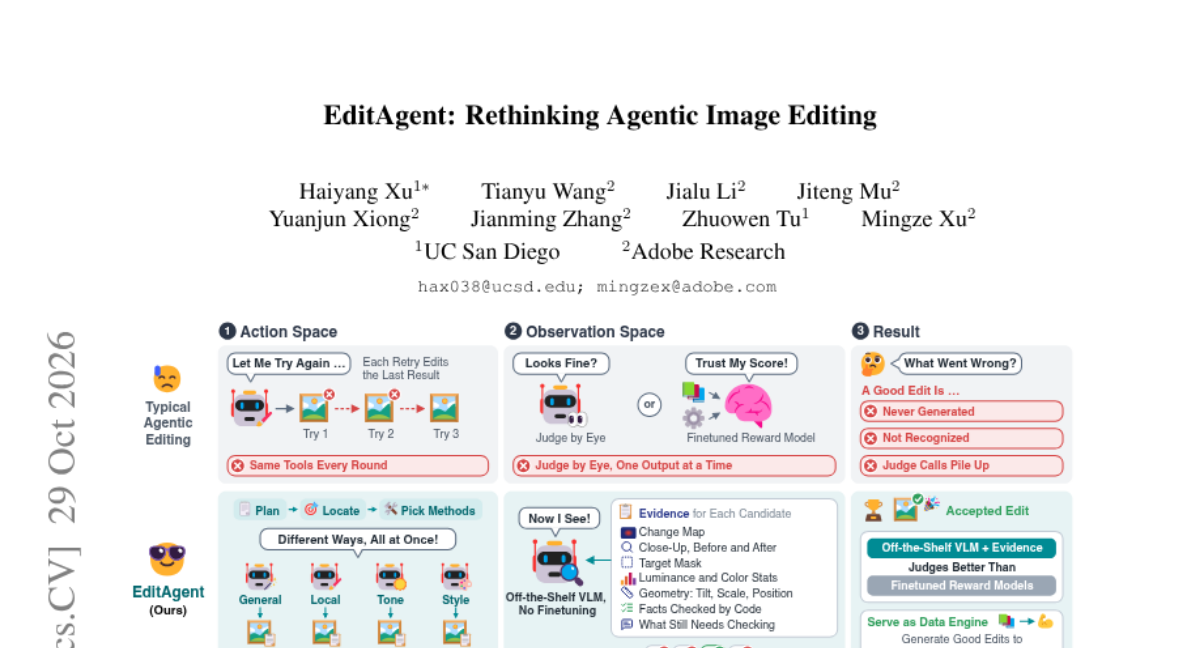
30. EditAgent: Rethinking Agentic Image Editing
🔑 Keywords: EditAgent, agentic image editing, VLM judges, verification records, open-weight editors
💡 Category: Computer Vision
🌟 Research Objective:
– The paper aims to enhance the reliability and efficiency of agentic image editing by expanding the action and observation spaces through a method named EditAgent.
🛠️ Research Methods:
– EditAgent routes editing steps to a combination of general and specialized editors and utilizes verification records to improve judgment reliability. It leverages parallel candidate generation and listwise judgment by VLM judges.
💬 Research Conclusions:
– EditAgent significantly improves performance on three benchmarks in comparison to traditional editors and demonstrates preferable outcomes in 78.5% of expert comparisons, requiring fewer judge calls.
👉 Paper link: https://huggingface.co/papers/2610.39664
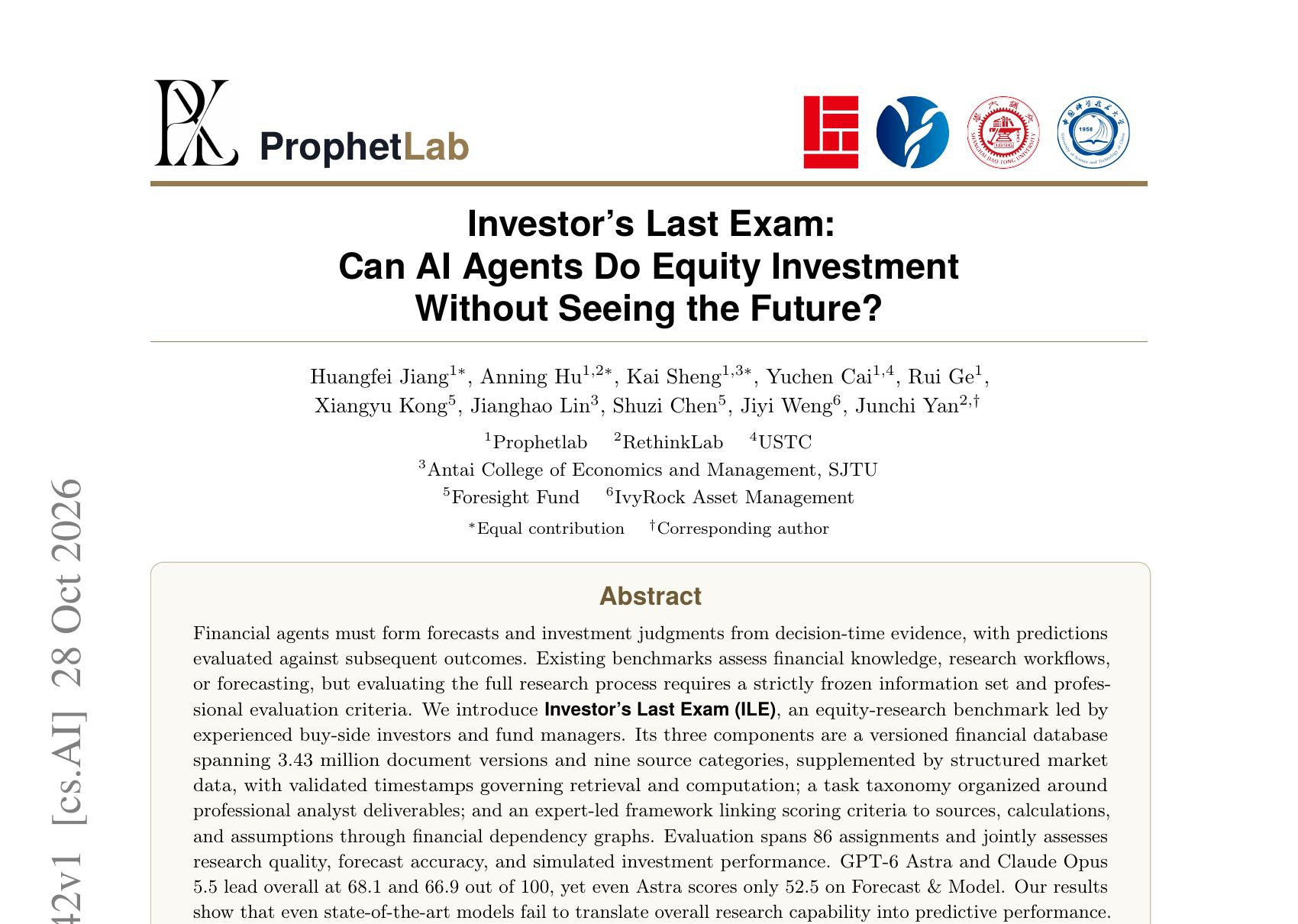
31. Investor’s Last Exam: Can AI Agents Do Equity Investment Without Seeing the Future?
🔑 Keywords: Investor’s Last Exam, AI in Finance, financial agents, equity research, forecasting
💡 Category: AI in Finance
🌟 Research Objective:
– To evaluate financial agents on end-to-end equity research using professional evaluation criteria and dependency graphs to assess their performance in research, forecasting, and investment judgments.
🛠️ Research Methods:
– Introduction of the Investor’s Last Exam (ILE) benchmark, incorporating a versioned financial database, structured market data, and an expert-led framework linking scoring criteria with financial dependency graphs to evaluate the research process comprehensively.
💬 Research Conclusions:
– State-of-the-art models like GPT-6 Astra perform well in research but struggle with forecasting and investment judgments, highlighting a gap in translating research capabilities into predictive performance and providing a foundation for improving training and evaluation of financial agents.
👉 Paper link: https://huggingface.co/papers/2610.38342
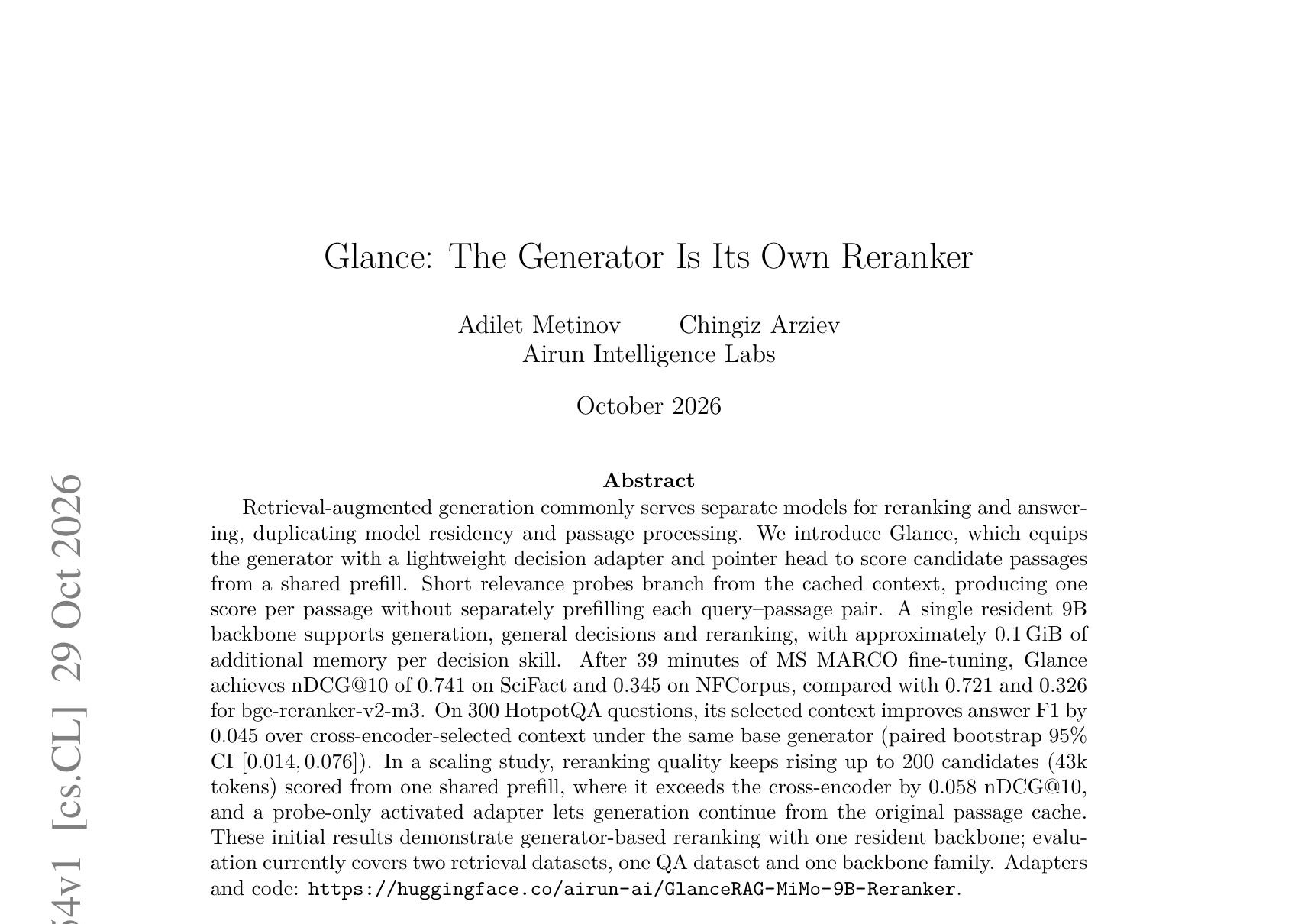
32. Glance: The Generator Is Its Own Reranker
🔑 Keywords: Glance, lightweight adapters, pointer heads, retrieval-augmented generation, reranking
💡 Category: Natural Language Processing
🌟 Research Objective:
– The main goal of this research is to integrate reranking and generation into a single system using lightweight adapters and pointer heads to improve retrieval and answer quality while reducing memory overhead.
🛠️ Research Methods:
– The study introduces ‘Glance,’ which is equipped with a decision adapter and pointer head to score candidate passages from a shared context without individually processing each query-passage pair. This involves a single backbone with minimal memory for decision processes, tested through fine-tuning on MS MARCO, using SciFact and NFCorpus datasets, as well as HotpotQA questions.
💬 Research Conclusions:
– Glance achieves better nDCG@10 scores on SciFact and NFCorpus compared to existing models and improves answer F1 scores more efficiently. The scaling study indicates significant improvements in reranking quality with increased candidate scoring, demonstrating effective reranking with a single backbone.
👉 Paper link: https://huggingface.co/papers/2610.40454
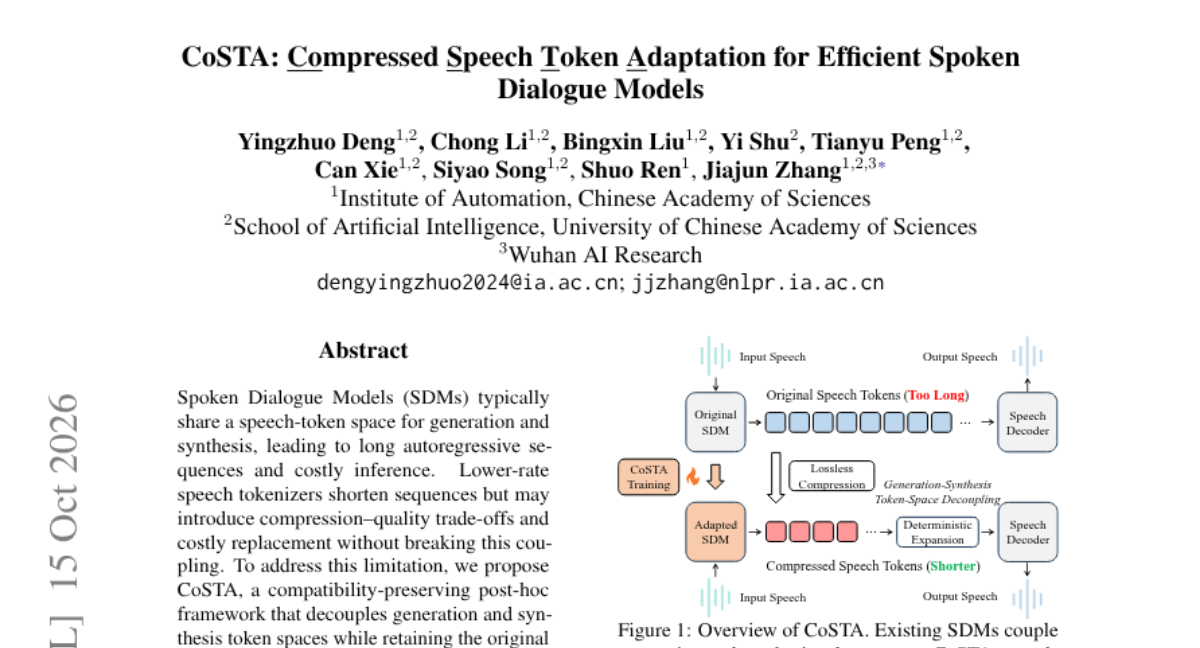
33. CoSTA: Compressed Speech Token Adaptation for Efficient Spoken Dialogue Models
🔑 Keywords: CoSTA, Spoken Dialogue Models, speech-token space, cross-architecture transfer
💡 Category: Natural Language Processing
🌟 Research Objective:
– To accelerate Spoken Dialogue Models by decoupling generation and synthesis token spaces while preserving quality.
🛠️ Research Methods:
– Introduced CoSTA, a framework that extends the generation token space via mean-initialized vocabulary extension and adaptations, followed by deterministic expansion to the original speech-token space.
💬 Research Conclusions:
– Achieved 1.7x faster speech-token generation speed, lower latency, and higher throughput while maintaining the response quality. Demonstrated efficiency and compatibility with cross-architecture transfer and low-rate tokenization.
👉 Paper link: https://huggingface.co/papers/2610.21143
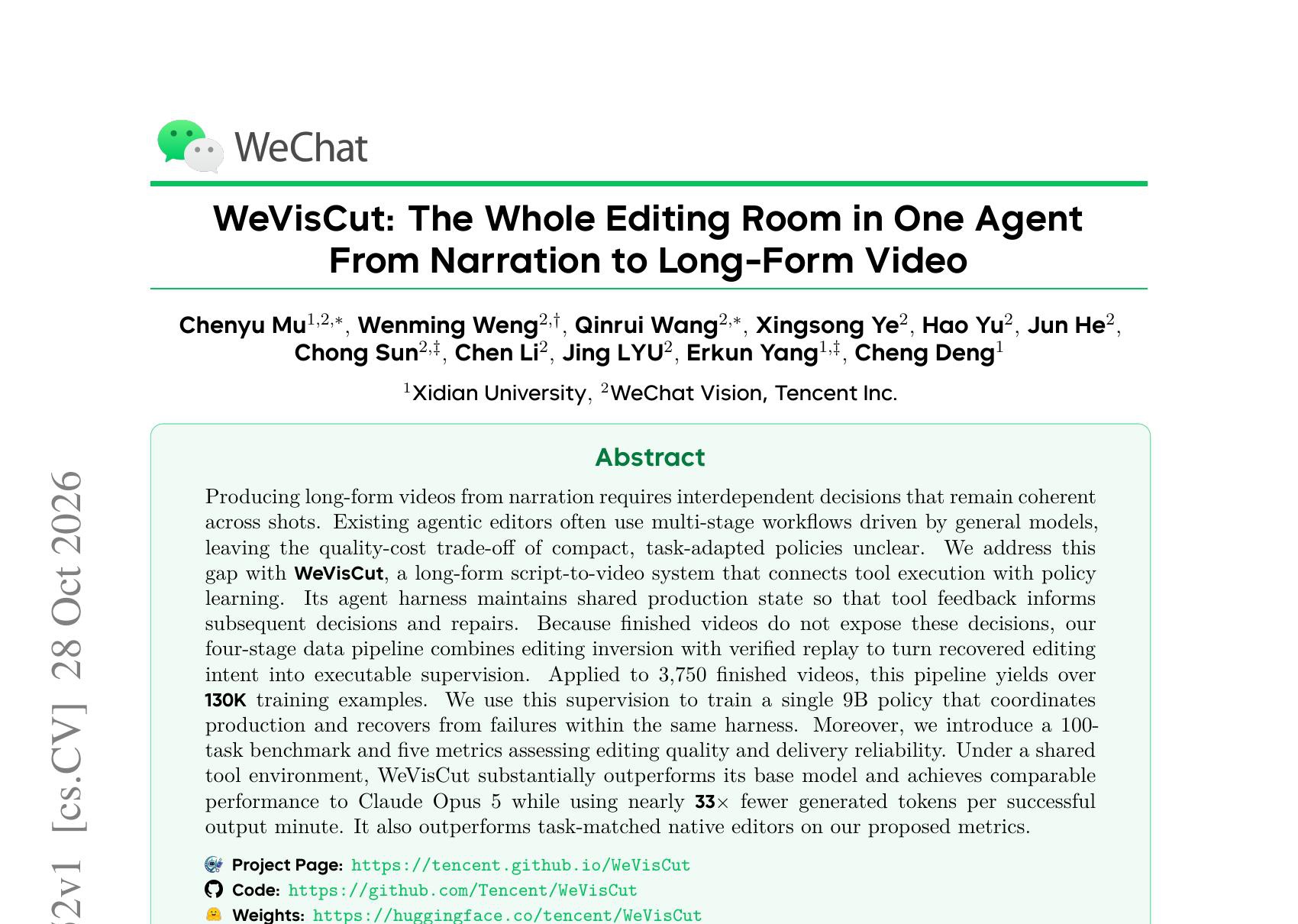
34. WeVisCut: The Whole Editing Room in One Agent From Narration to Long-Form Video
🔑 Keywords: Script-to-Video, policy learning, editing inversion, shared production state, 9B policy
💡 Category: AI Systems and Tools
🌟 Research Objective:
– To develop WeVisCut, a script-to-video system that creates coherent long-form videos while optimizing quality and operational efficiency.
🛠️ Research Methods:
– Employed a four-stage data pipeline, integrating editing inversion and verified replay, generating over 130K training examples to support 9B policy training.
💬 Research Conclusions:
– WeVisCut significantly outperforms its base model in the shared tool environment and matches the performance of Claude Opus 5 with significantly reduced token use, excelling in editing quality and reliability metrics.
👉 Paper link: https://huggingface.co/papers/2610.38352
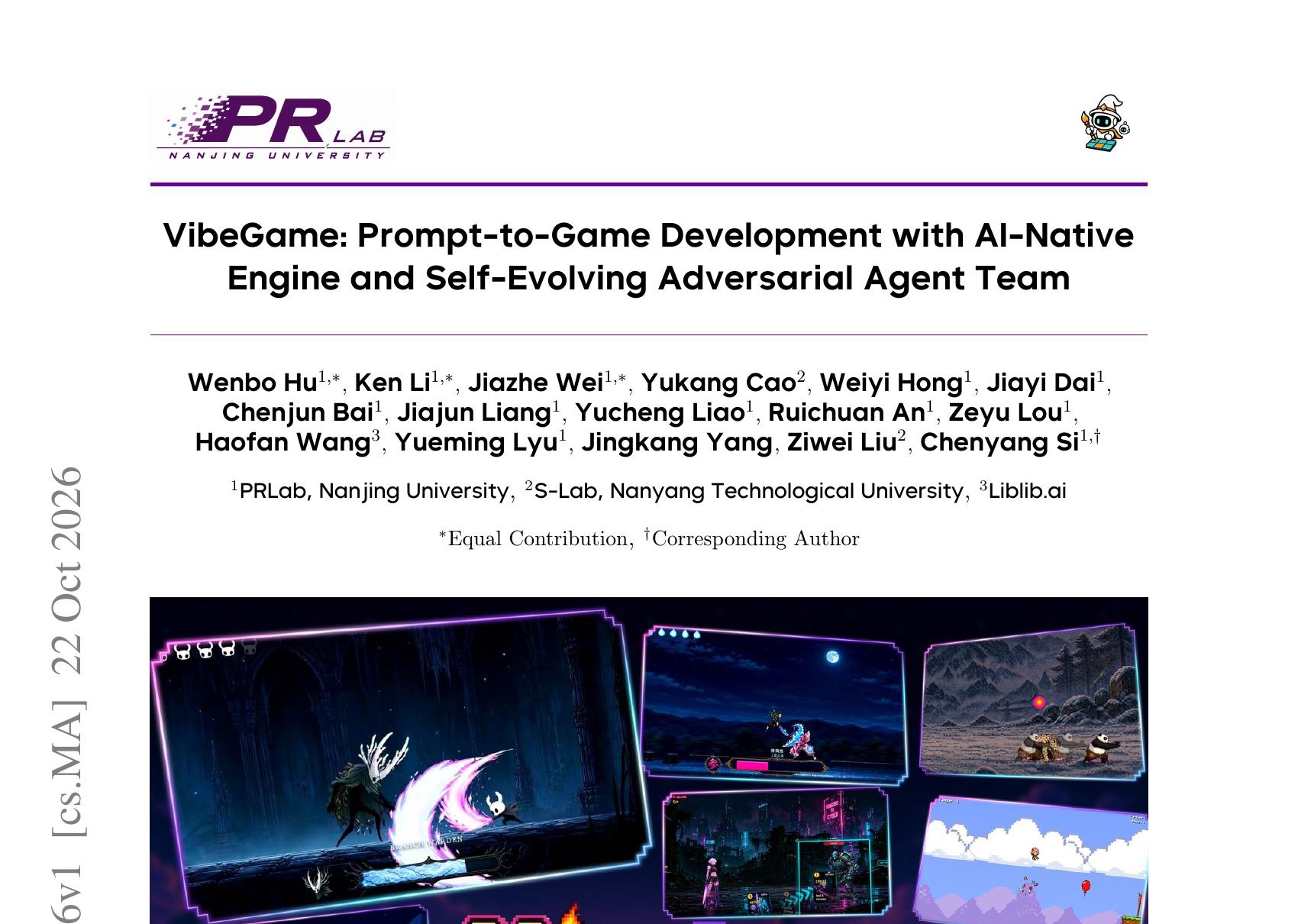
35. VibeGame: Prompt-to-Game Development with AI-Native Engine and Self-Evolving Adversarial Agent Team
🔑 Keywords: AI Native, VibeGame, Adversarial Agents, Self-Evolution Mechanism, P2G
💡 Category: AI Systems and Tools
🌟 Research Objective:
– The main goal of the research is to introduce VibeGame, a framework that facilitates the development of complete 2D games from natural-language prompts using an AI-native engine and specialized adversarial agents.
🛠️ Research Methods:
– Utilization of Large Language Model Agents to generate and coordinate aspects of game development, including code, scenes, assets, animations, physics, and configurations.
– Implementation of an Adversarial Agent Team to separate project implementation from review, enabling multi-round problem identification and fixing.
💬 Research Conclusions:
– VibeGame effectively transforms prompt-assets-to-game (PA2G) and prompt-to-game (P2G) processes by outperforming various agent harnesses using a standardized model, notably GPT-6.1-Sol.
– The framework incorporates a training-free self-evolution mechanism, allowing projects to evolve into reusable components for future development.
👉 Paper link: https://huggingface.co/papers/2610.33106
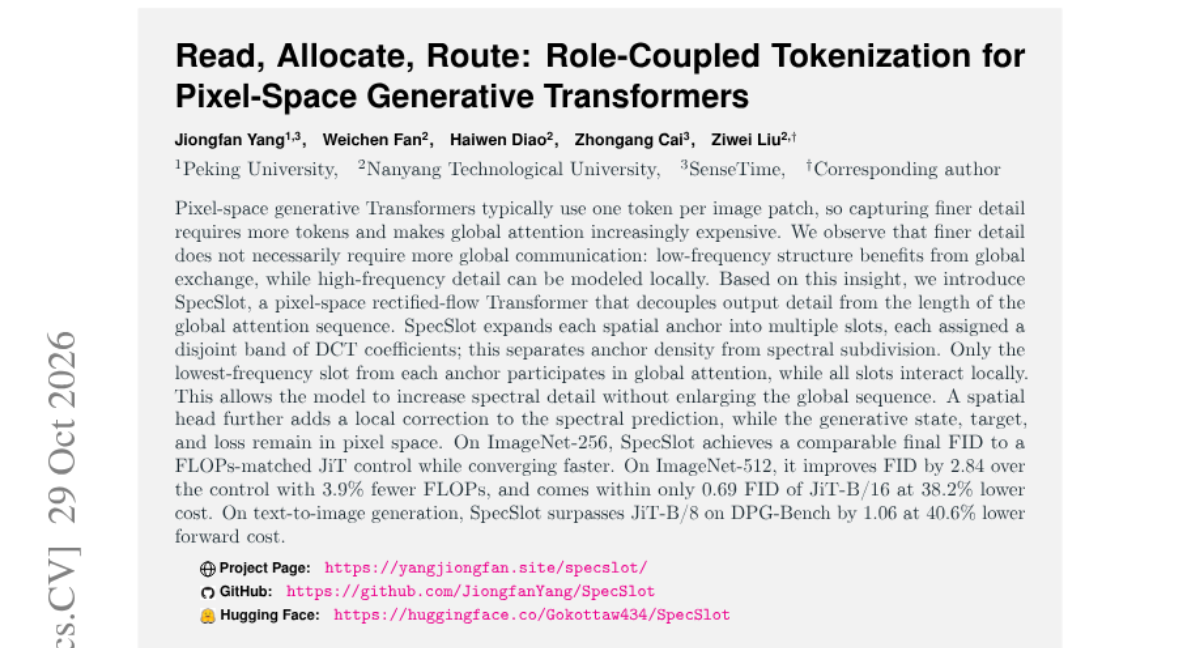
36. Read, Allocate, Route: Role-Coupled Tokenization for Pixel-Space Generative Transformers
🔑 Keywords: SpecSlot, generative Transformers, global attention, ImageNet, FID
💡 Category: Generative Models
🌟 Research Objective:
– To improve pixel-space generative Transformers by increasing image detail without raising computational costs using localized spectral slots and restricted global attention.
🛠️ Research Methods:
– Introduction of SpecSlot, a pixel-space rectified-flow Transformer that decouples output detail from global attention sequence length by expanding each spatial anchor into multiple localized spectral slots.
💬 Research Conclusions:
– On ImageNet-256, SpecSlot achieves a comparable final FID to a FLOPs-matched JiT control while converging faster.
– On ImageNet-512, SpecSlot shows a 2.84 FID improvement with 3.9% fewer FLOPs and comes close to JiT-B/16 FID at 38.2% lower cost.
– For text-to-image generation, SpecSlot surpasses JiT-B/8 on DPG-Bench by 1.06 with 40.6% lower forward cost.
👉 Paper link: https://huggingface.co/papers/2610.40647
37. WorkFactory: Turning Professional Intents into Executable Work for Scalable Agent Training
🔑 Keywords: WorkFactory, WorkPilot, Information Support Graph, Scaling Supervised Training, Fine-tune
💡 Category: AI Systems and Tools
🌟 Research Objective:
– The study aims to create a scalable framework, WorkFactory, for constructing coherent and executable professional tasks to improve expert-level agent performance across benchmarks.
🛠️ Research Methods:
– Develops professional tasks using information-level planning and repair to build an Information Support Graph.
– Constructs 112,686 tasks across 612 occupations to fine-tune Qwen models at various scales, resulting in the WorkPilot family.
💬 Research Conclusions:
– All WorkPilot models show improved performance over base models on professional-work benchmarks, with the WorkPilot-35B-A3B model significantly enhancing Elo scores.
– Scaling analyses indicate model-dependent diminishing returns, and component analyses demonstrate that planning and repair strategies reduce task environment defects.
👉 Paper link: https://huggingface.co/papers/2610.37161
38. Proving and Improving the Platonic Representation Hypothesis with JEPAs
🔑 Keywords: Joint-Embedding Predictive Architectures, Platonic Representation, Multi-Modal Learning, Cross-Modal Alignment, Positive Views
💡 Category: Multi-Modal Learning
🌟 Research Objective:
– The study aims to demonstrate that positive view design, rather than scale alone, is crucial for achieving cross-modal alignment in AI models.
🛠️ Research Methods:
– Proved the Platonic Representation Theorem for Joint-Embedding Predictive Architectures, validated the theory using multi-modal data, and uncovered a scaling law of alignment with substantial data efficiency improvements.
💬 Research Conclusions:
– The findings indicate that joint-embedding predictive architectures learn identical representations across modalities with far fewer samples than next-token prediction, making positive views essential for building efficient Platonic representations.
👉 Paper link: https://huggingface.co/papers/2610.39302
39. Look Only When Needed: Certificate-Guided Visual Routing for Efficient Diffusion VLMs
🔑 Keywords: Diffusion vision-language models, LOWN, visual token pruning, efficiency gains, decoding FLOPs
💡 Category: Multi-Modal Learning
🌟 Research Objective:
– Introduce LOWN, a decoding method to enhance efficiency in diffusion vision-language models by adaptively processing image data during predictions.
🛠️ Research Methods:
– Analyze the necessity of image processing at each decoding step by comparing predictions with and without image input.
– Implement an adaptive method to decide when and how many tokens to unmask, reducing computation workload.
💬 Research Conclusions:
– LOWN maintains 99.6% of LLaDA-V’s performance while using only 35.3% of the decoding FLOPs, effectively balancing efficiency and accuracy.
– The method generalizes well across various LLaDA-based models and complements visual token pruning, improving computational efficiency further through key-value caching.
👉 Paper link: https://huggingface.co/papers/2610.36671
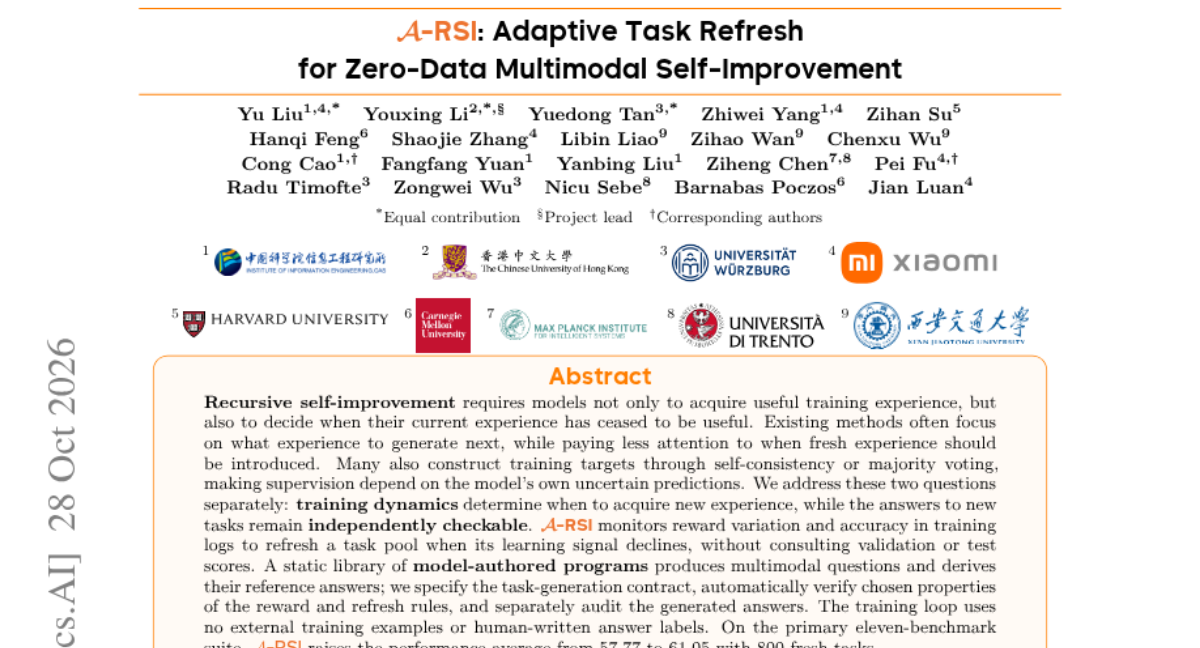
40. A-RSI: Adaptive Task Refresh for Zero-Data Multimodal Self-Improvement
🔑 Keywords: Recursive self-improvement, Training Dynamics, Task Pool, Multimodal Questions, Reward Variation
💡 Category: Machine Learning
🌟 Research Objective:
– To enhance recursive self-improvement by refreshing training tasks when learning signals decline and using verifiable answers, aiming to improve benchmark performance without external labels.
🛠️ Research Methods:
– Monitors reward variation and accuracy to manage a dynamic task pool without consulting validation or test scores, and uses a static library of model-authored programs for task generation.
💬 Research Conclusions:
– A-RSI improves average performance on an eleven-benchmark suite from 57.77 to 61.05 by introducing 800 fresh tasks, demonstrating effective refreshment of tasks and independently checkable answers.
👉 Paper link: https://huggingface.co/papers/2610.38568