Vibe-Code an App vs Buy One?
[David’s Note]
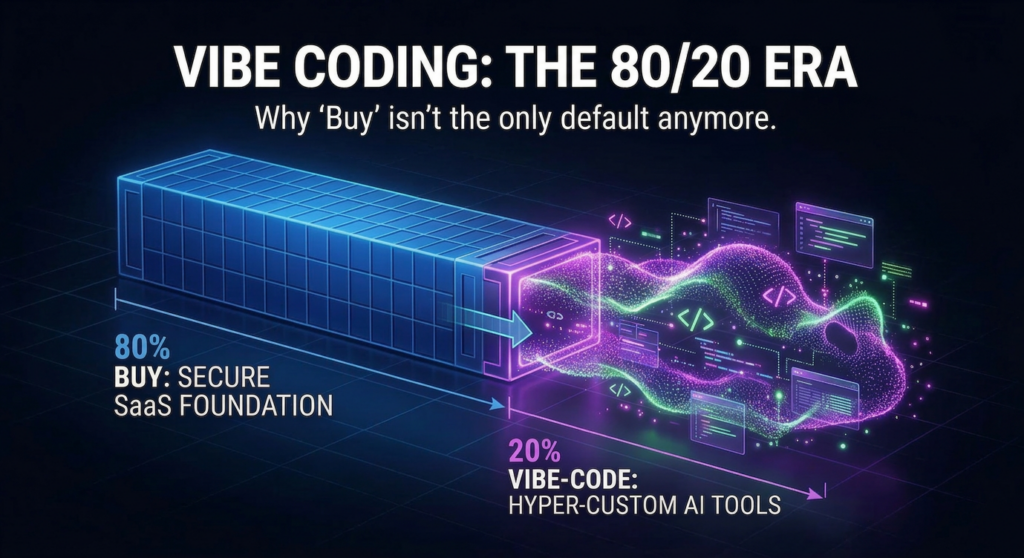
SaaStr founder Jason Lemkin once defined a golden ratio for software: buy 90% off the shelf, and build only the 10% that is truly unique. Yet, as we progress through 2026, the meteoric rise of “Vibe Coding”—is shifting the tectonic plates of procurement. In this edition, we explore why 80/20 is the new efficiency frontier: when AI can manifest a functional tool in minutes, paying a steep “Enterprise Tax” for generic SaaS may no longer be the most prudent move.
💡 Core Value Logic: The Shift from 90/10 to 80/20
As AI capabilities accelerate, the “Build Boundary” of the modern enterprise is expanding:
- The Classic 90/10 Rule: Historically, building bespoke software was so prohibitively expensive that it was reserved for the 10% of “mission-critical, no-alternative” features. The rest was bought to avoid engineering agony.
- The Optimised 80/20 Strategy: In 2026, AI has lowered build-costs so significantly that firms are reclaiming an additional 10% of their stack. This second 10% consists of “fringe” tools (e.g., bespoke middleware, internal portals) where SaaS was previously too rigid or overpriced. The shift to 20% build is a strategic play for hyper-customisation and cost-efficiency.
- The Infrastructure Hard-Line: Despite the 20% build-surge, 80% should still be bought. This core 80% represents security, API resilience, and regulatory compliance (e.g. SOC2). AI is not yet capable of “vibing” its way through rigorous architectural standards and long-term stability.
🛡️ Ethical AI Commentary: Decentralised Power vs. Missing Accountability
The expansion of Vibe Coding from 10% to 20% introduces new governance challenges:
- Code Sovereignty & Transparency: As the build-ratio increases, so does the volume of “black-box” code within the firm. If AI embeds latent bias within this 20%, who is held accountable for the output?
- Shadow IT & Privacy: The ease of Vibe Coding empowers employees to bypass IT procurement. This risks the creation of unvetted tools handling sensitive customer data, creating a potential “compliance vacuum.”
The Verdict: AI’s evolution allows us to move from 90/10 to 80/20 with confidence, but that relinquished 10% of SaaS budget must be reinvested into AI architectural auditing.
Original Source: “Dear SaaStr: When Should I Vibe-Code an App vs Buy One?” via SaaStr