AI Native Daily Paper Digest – 20260525
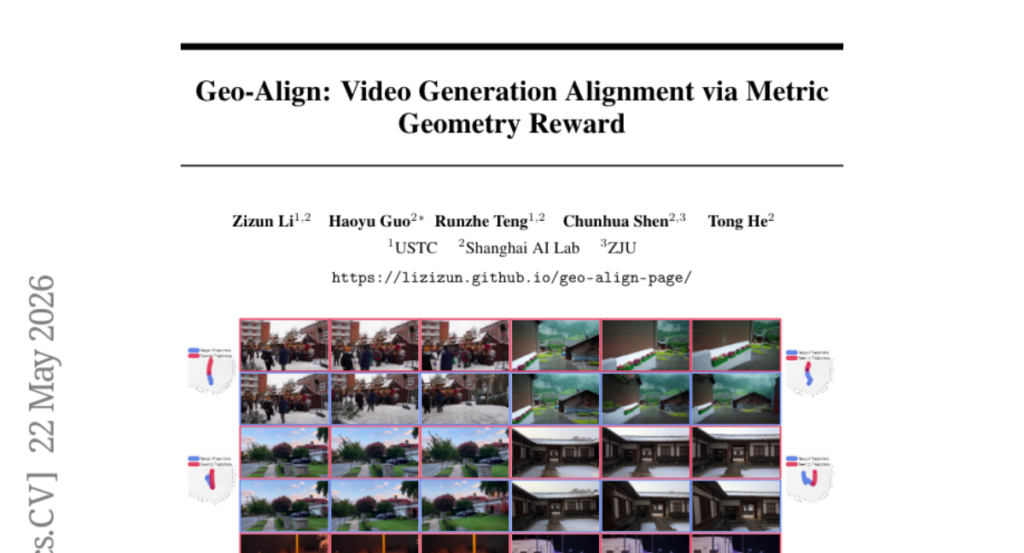
1. SkillOpt: Executive Strategy for Self-Evolving Agent Skills
🔑 Keywords: SkillOpt, agent skills, text-space optimizer, stable updates, AI-generated summary
💡 Category: AI Systems and Tools
🌟 Research Objective:
– To introduce SkillOpt, a systematic text-space optimizer for agent skills, enabling stable updates and eliminating inference overhead during deployment.
🛠️ Research Methods:
– Implementing SkillOpt to train skills as an external state with a text-space optimizer that applies bounded add/delete/replace edits to optimize skills based on validation scores.
💬 Research Conclusions:
– SkillOpt demonstrates superior performance across multiple benchmarks and execution environments, outperforming competitors like human and other AI-driven skill optimizing methods in all evaluated scenarios. It also shows transferable success across different model scales and environments.
👉 Paper link: https://huggingface.co/papers/2605.23904
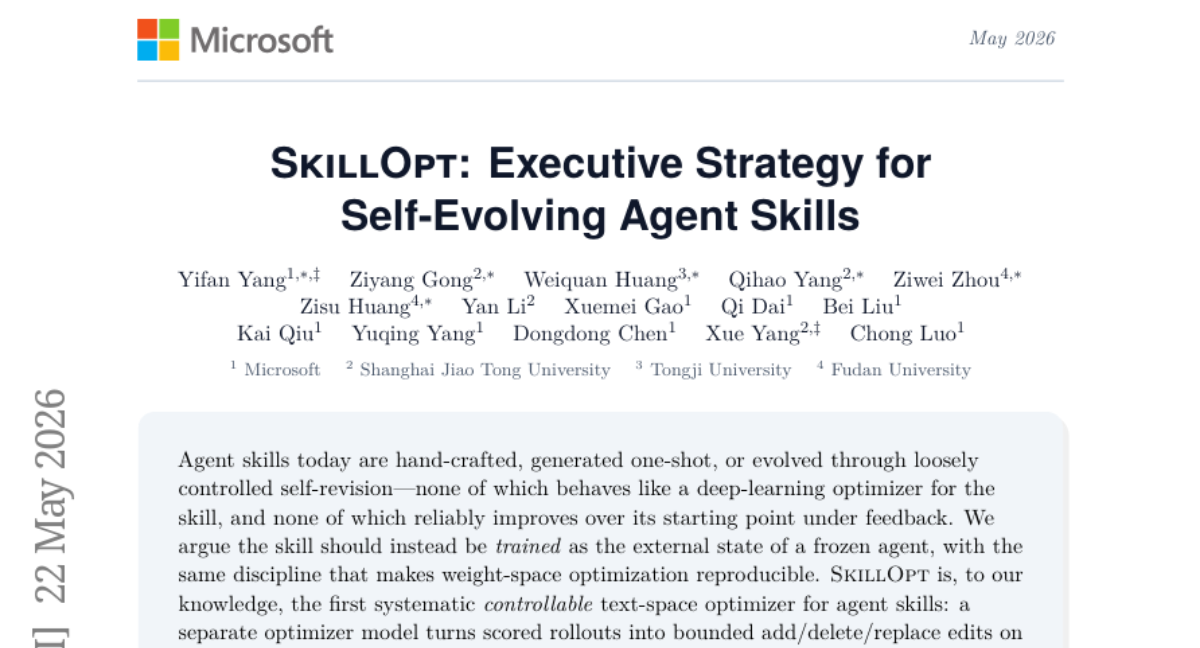
2. Lens: Rethinking Training Efficiency for Foundational Text-to-Image Models
🔑 Keywords: Lens, AI-generated summary, Semantic VAE, Dense caption datasets, Distillation-based acceleration
💡 Category: Generative Models
🌟 Research Objective:
– To introduce Lens, a compact 3.8B-parameter text-to-image model that competes with larger models by reducing training compute requirements.
🛠️ Research Methods:
– Utilized dense caption datasets and multi-resolution batching to maximize data density.
– Employed efficient architecture and a strong language encoder for faster convergence.
– Integrated reinforcement learning with taxonomy-driven prompts for improved visual quality.
💬 Research Conclusions:
– Lens requires significantly less training compute than larger models like Z-Image while maintaining high performance.
– It supports multiple aspect ratios and resolutions and can generate images quickly with a single GPU.
👉 Paper link: https://huggingface.co/papers/2605.21573
3. StepAudio 2.5 Technical Report
🔑 Keywords: Unified Audio-Language Modeling, Reinforcement Learning from Human Feedback, Multimodal Representational Space, Automatic Speech Recognition, Text-to-Speech Synthesis
💡 Category: Multi-Modal Learning
🌟 Research Objective:
– The objective of this research is to develop StepAudio 2.5, a unified audio-language model that effectively matches or outperforms specialized systems in automatic speech recognition (ASR), text-to-speech synthesis (TTS), and real-time spoken interaction.
🛠️ Research Methods:
– Employed a unified audio-language foundation model leveraging task-tailored reinforcement learning from human feedback (RLHF) to optimize shared representations across different tasks, with a focus on data construction and decoding constraints.
💬 Research Conclusions:
– StepAudio 2.5 successfully integrates distinct tasks such as ASR, TTS, and real-time dialogue into a singular model, achieving state-of-the-art results on standard benchmarks, illustrating the potential of a unified multimodal representational space for varied auditory tasks.
👉 Paper link: https://huggingface.co/papers/2605.23463
4. From Raw Experience to Skill Consumption: A Systematic Study of Model-Generated Agent Skills
🔑 Keywords: Language agents, Skills, Model-generated skills, Skill extraction, Negative transfer
💡 Category: Natural Language Processing
🌟 Research Objective:
– To evaluate and guide the optimization of skills in language agents across various extraction and consumption scenarios.
🛠️ Research Methods:
– Development of a utility-grounded evaluation framework across five diverse agentic task domains to systematically analyze skill utility.
💬 Research Conclusions:
– Model-generated skills are generally beneficial but can result in negative transfer. The framework improves skill quality by focusing on features tied to actual utility, reducing negative transfer.
👉 Paper link: https://huggingface.co/papers/2605.23899
5. PhotoFlow: Agentic 3D Virtual Photography Missions
🔑 Keywords: PhotoFlow, language-conditioned virtual photography, 3D spatial understanding, aesthetic judgment, Blender scenes
💡 Category: Computer Vision
🌟 Research Objective:
– To develop a Director-Reviewer-Reflector agent named PhotoFlow, designed to enable language-conditioned virtual photography by combining 3D spatial understanding with aesthetic judgment in arbitrary Blender scenes.
🛠️ Research Methods:
– Introduced PhotoFlow, which uses a closed-loop camera search with components like Director for blueprint creation, Reviewer for visual critique, and Reflector for converting failures into actionable insights, along with VPhotoBench as a benchmark for language-conditioned photography missions.
💬 Research Conclusions:
– PhotoFlow demonstrated superior performance in producing aesthetically aligned photographs in challenging scenarios, using a LLM-centered spatial agent within a six-round rendering budget, marking a pioneering approach in executable tasks for language-conditioned virtual photography in Blender scenes.
👉 Paper link: https://huggingface.co/papers/2605.23771
6. RankE: End-to-End Post-Training for Discrete Text-to-Image Generation with Decoder Co-Evolution
🔑 Keywords: Discrete Autoregressive, RankE, Latent Covariate Shift, Co-evolution, Ranking-based Alignment
💡 Category: Generative Models
🌟 Research Objective:
– To address the issue of latent covariate shift in discrete autoregressive text-to-image models through co-evolution of policy and decoder components.
🛠️ Research Methods:
– Introduced RankE, an end-to-end post-training framework utilizing alternating optimization to simultaneously evolve the policy and decoder.
💬 Research Conclusions:
– RankE effectively resolves the fidelity-alignment trade-off, enhancing image quality while maintaining alignment, as demonstrated on LlamaGen-XL and confirmed on Janus-Pro datasets.
👉 Paper link: https://huggingface.co/papers/2605.21195
7. SCOPE: Simulating Cross-game Operations in Playable Environments for FPS World Models
🔑 Keywords: SCOPE, FPS games, transformer blocks, video diffusion models, zero-shot transfer
💡 Category: Generative Models
🌟 Research Objective:
– The research aims to differentiate in-scope from out-of-scope visual effects in FPS games using AI models without relying on segmentation labels.
🛠️ Research Methods:
– Implementing SCOPE, which uses a conditioning module in transformer blocks of a video diffusion model to reshape features into per-pixel temporal sequences and introduce CrossFPS, a multi-game FPS dataset.
💬 Research Conclusions:
– The study demonstrates strong action responsiveness, precise scope separation, and effective cross-game generalization, allowing for zero-shot transfer to new game scenes.
👉 Paper link: https://huggingface.co/papers/2605.23345
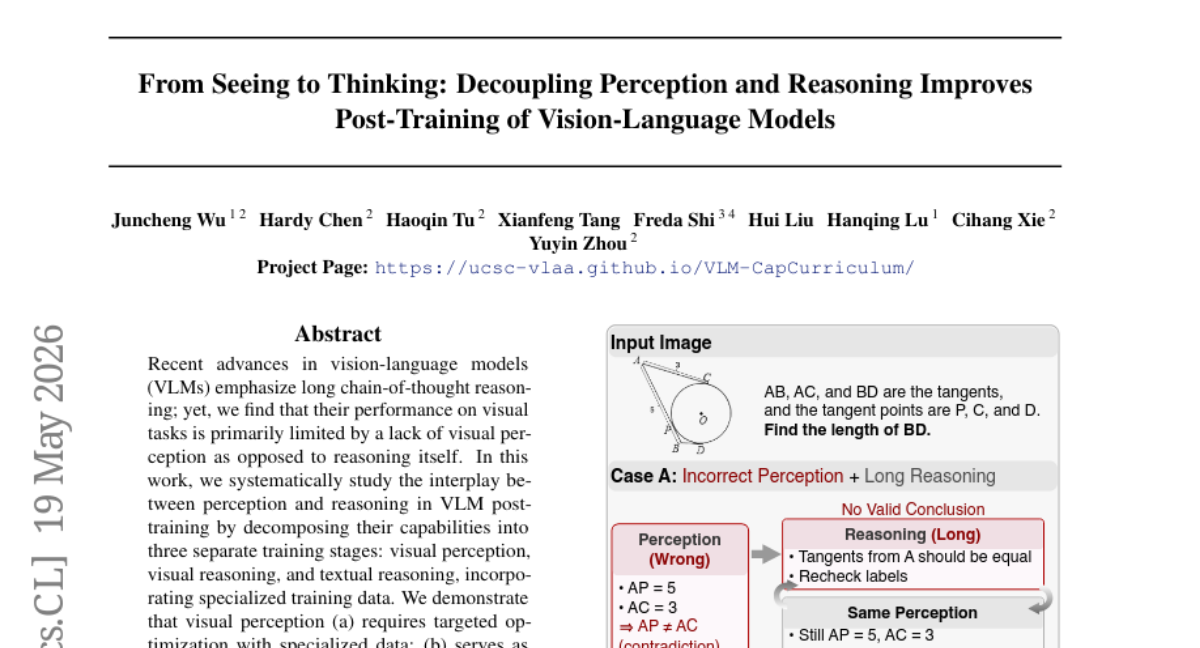
8. From Seeing to Thinking: Decoupling Perception and Reasoning Improves Post-Training of Vision-Language Models
🔑 Keywords: Vision-Language Models, Visual Perception, Visual Reasoning, Staged Training
💡 Category: Multi-Modal Learning
🌟 Research Objective:
– To investigate the effect of decomposing training into separate stages for visual perception, visual reasoning, and textual reasoning in Vision-Language Models to enhance performance on visual reasoning tasks.
🛠️ Research Methods:
– Systematic study of Vision-Language Models through a staged training approach, contrasting with unified methods, using specialized training data for targeted optimization and employing reinforcement learning for perception.
💬 Research Conclusions:
– Staged training improves visual perception and reasoning, leading to better performance with shorter reasoning traces, indicating that stronger visual perception reduces the need for complex reasoning. This demonstrates a curriculum dimension orthogonal to traditional difficulty-based methods and achieves superior results in tasks like visual math.
👉 Paper link: https://huggingface.co/papers/2605.20177
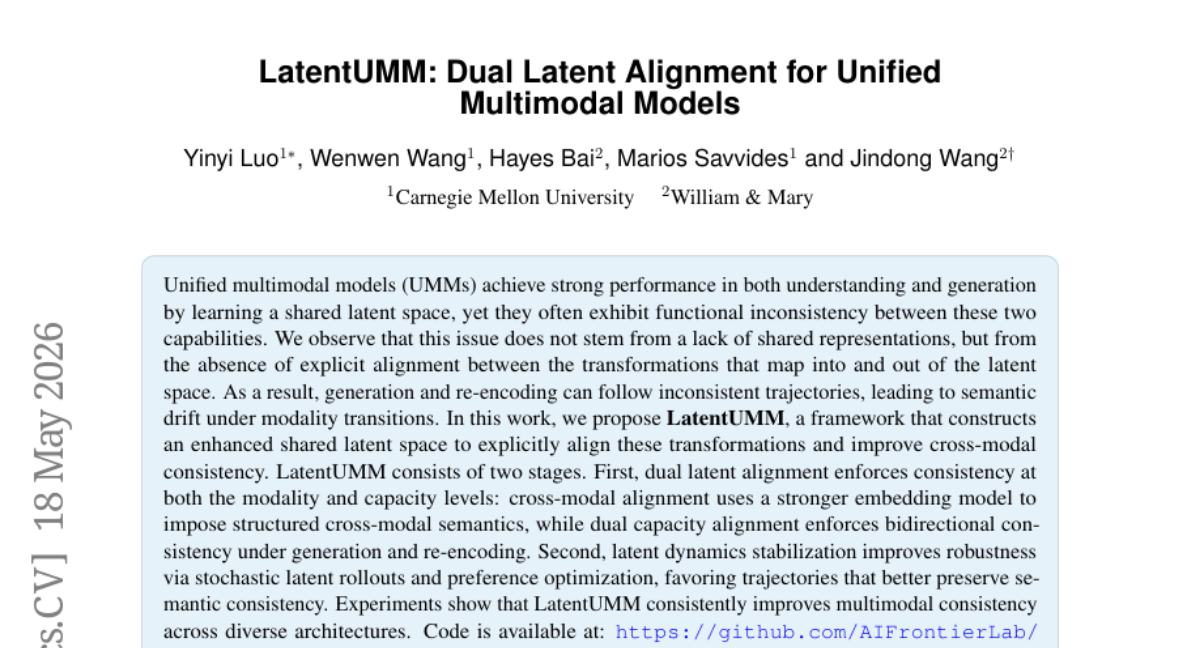
9. LatentUMM: Dual Latent Alignment for Unified Multimodal Models
🔑 Keywords: LatentUMM, Unified Multimodal Models, shared latent space, cross-modal alignment, semantic consistency
💡 Category: Multi-Modal Learning
🌟 Research Objective:
– The research aims to resolve multimodal consistency issues in Unified Multimodal Models by constructing an enhanced shared latent space that explicitly aligns transformations between modalities.
🛠️ Research Methods:
– The study introduces LatentUMM, which includes dual latent alignment and latent dynamics stabilization to enhance cross-modal consistency and stability during generation and re-encoding processes.
💬 Research Conclusions:
– Experiments demonstrate that LatentUMM improves multimodal consistency across various architectures, achieving better semantic coherence under modality transitions.
👉 Paper link: https://huggingface.co/papers/2605.17766
10. GenRecon: Bridging Generative Priors for Multi-View 3D Scene Reconstruction
🔑 Keywords: 3D scene reconstruction, generative 3D prior, multi-view image features, PBR mesh reconstructions, Trellis.2
💡 Category: Generative Models
🌟 Research Objective:
– The study introduces a novel method for 3D scene reconstruction of indoor environments by integrating generative 3D priors and multi-view image conditioning to achieve high-fidelity, editable mesh reconstructions.
🛠️ Research Methods:
– The approach leverages conditional 3D generation over spatially-localized, overlapping chunks to scale scene generation. It employs a projection-based conditioning mechanism that aligns multi-view image features into a coherent 3D representation.
💬 Research Conclusions:
– The technique significantly outperforms existing reconstruction methods by 16%, providing high-fidelity, editable PBR mesh reconstructions of indoor scenes through the extension of strong object-level priors from models like Trellis.2 to scene-scale generation.
👉 Paper link: https://huggingface.co/papers/2605.23888
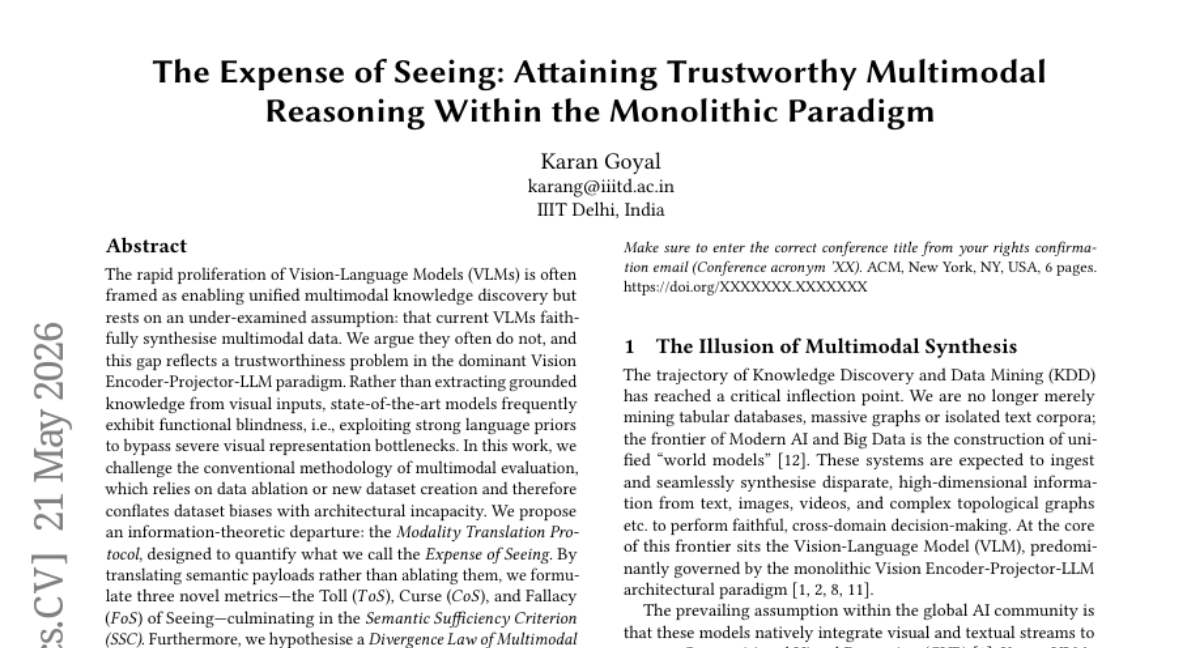
11. The Expense of Seeing: Attaining Trustworthy Multimodal Reasoning Within the Monolithic Paradigm
🔑 Keywords: Vision-Language Models, Semantic Sufficiency Criterion, Vision Encoder-Projector-LLM, Functional Blindness, Multimodal Evaluation
💡 Category: Multi-Modal Learning
🌟 Research Objective:
– The study critiques current Vision-Language Models (VLMs) for their reliance on language over visual representation, aiming to enhance semantic sufficiency in multimodal data synthesis.
🛠️ Research Methods:
– The researchers propose the Modality Translation Protocol to replace traditional data ablation with an information-theoretic approach, introducing metrics like the Toll of Seeing, Curse of Seeing, and Fallacy of Seeing.
💬 Research Conclusions:
– The paper argues for moving beyond “multimodal gain” and suggests adopting the Semantic Sufficiency Criterion as a foundational framework to advance genuine multimodal reasoning in AI systems.
👉 Paper link: https://huggingface.co/papers/2604.20665
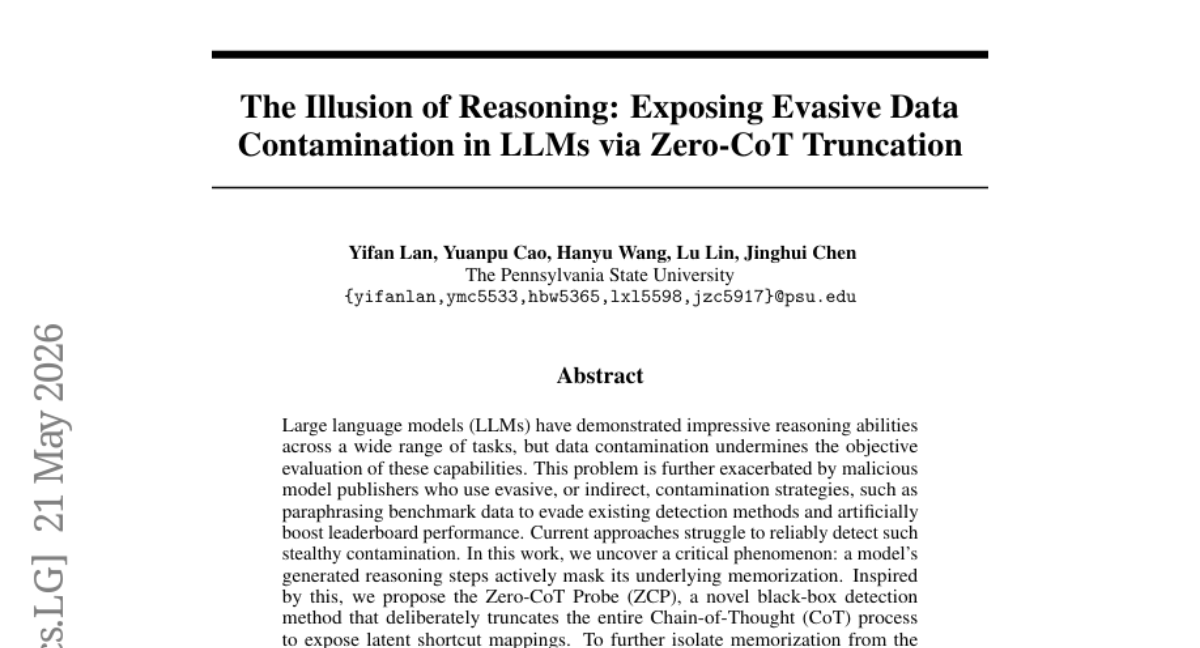
12. The Illusion of Reasoning: Exposing Evasive Data Contamination in LLMs via Zero-CoT Truncation
🔑 Keywords: Zero-CoT Probe, data contamination, large language models, black-box detection, Contamination Confidence
💡 Category: Natural Language Processing
🌟 Research Objective:
– Introduce the Zero-CoT Probe method to identify data contamination in large language models by truncating reasoning processes and comparing performance on original and perturbed datasets.
🛠️ Research Methods:
– Utilize the Zero-CoT Probe to truncate the Chain-of-Thought process and compare model performance on benchmark and perturbed datasets.
– Employ Contamination Confidence as a metric to quantify the likelihood and severity of contamination.
💬 Research Conclusions:
– The Zero-CoT Probe effectively detects direct and evasive data contamination in large language models.
– Extensive experiments validate the robustness of ZCP in identifying contamination strategies.
👉 Paper link: https://huggingface.co/papers/2605.21856
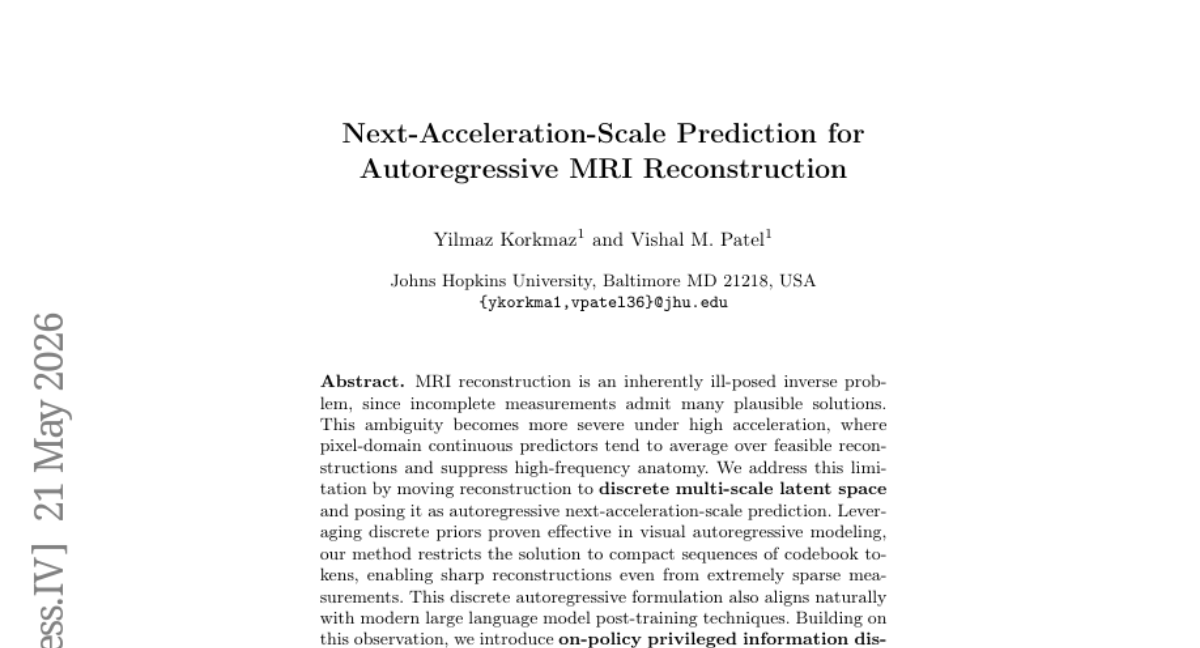
13. Next-Acceleration-Scale Prediction for Autoregressive MRI Reconstruction
🔑 Keywords: Discrete Autoregressive, MRI Reconstruction, Privileged Information Distillation, Visual Autoregressive Modeling, Extreme Undersampling
💡 Category: AI in Healthcare
🌟 Research Objective:
– The study aims to improve MRI reconstruction under extreme undersampling conditions using discrete autoregressive modeling with privileged information distillation.
🛠️ Research Methods:
– The method involves moving reconstruction to a discrete multi-scale latent space, utilizing autoregressive next-acceleration-scale prediction, and employing privileged information where a teacher model guides a student model using complete data contexts unavailable at inference.
💬 Research Conclusions:
– The approach demonstrates enhanced reconstruction performance across various sampling patterns, particularly in conditions of extreme undersampling, as evidenced by extensive experiments on the fastMRI benchmark.
👉 Paper link: https://huggingface.co/papers/2605.19354
14.
15. Equilibrium Reasoners: Learning Attractors Enables Scalable Reasoning
🔑 Keywords: Equilibrium Reasoners, task-conditioned attractors, test-time scaling, latent dynamical systems, attractors
💡 Category: Knowledge Representation and Reasoning
🌟 Research Objective:
– The objective of this research is to explore scalable reasoning through the use of Equilibrium Reasoners, which utilize task-conditioned attractors to achieve accurate solutions in latent dynamical systems.
🛠️ Research Methods:
– The research formalizes the use of Equilibrium Reasoners to scale internal dynamics by increasing the number of iterations (depth) and aggregating stochastic trajectories (breadth) from multiple starting points.
💬 Research Conclusions:
– The study concludes that employing scalable latent reasoning can significantly boost accuracy, as shown in the Sudoku-Extreme test, achieving an accuracy increase from 2.6% to over 99%, suggesting that learned attractor landscapes are crucial for understanding scalable reasoning in these models.
👉 Paper link: https://huggingface.co/papers/2605.21488
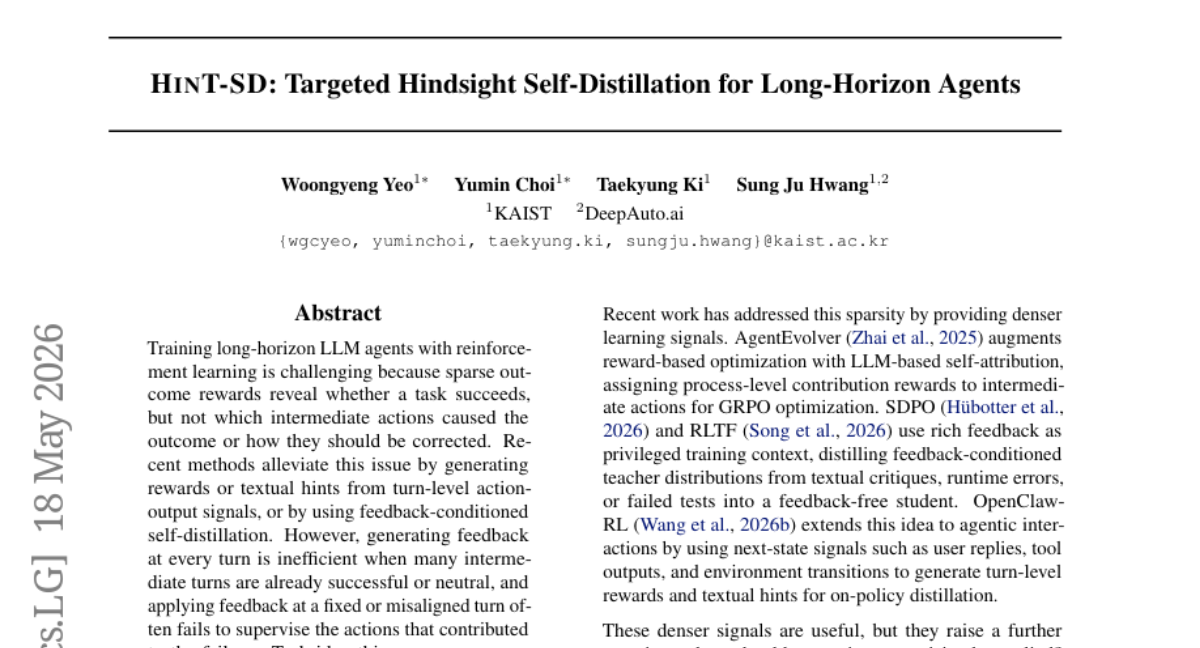
16. HINT-SD: Targeted Hindsight Self-Distillation for Long-Horizon Agents
🔑 Keywords: HINT-SD, self-distillation, reinforcement learning, long-horizon LLM agents
💡 Category: Reinforcement Learning
🌟 Research Objective:
– To improve the efficiency and effectiveness of training long-horizon LLM agents by selecting failure-relevant actions through a self-distillation framework.
🛠️ Research Methods:
– Utilizes a targeted self-distillation approach using full-trajectory hindsight to select failure-relevant actions and applies feedback-conditioned distillation only on targeted action spans.
💬 Research Conclusions:
– Demonstrates up to 18.80% improvement over baseline methods and reduces training time per step by 2.26 times, indicating the importance of selecting specific actions for distillation in achieving effective and efficient training.
👉 Paper link: https://huggingface.co/papers/2605.17873
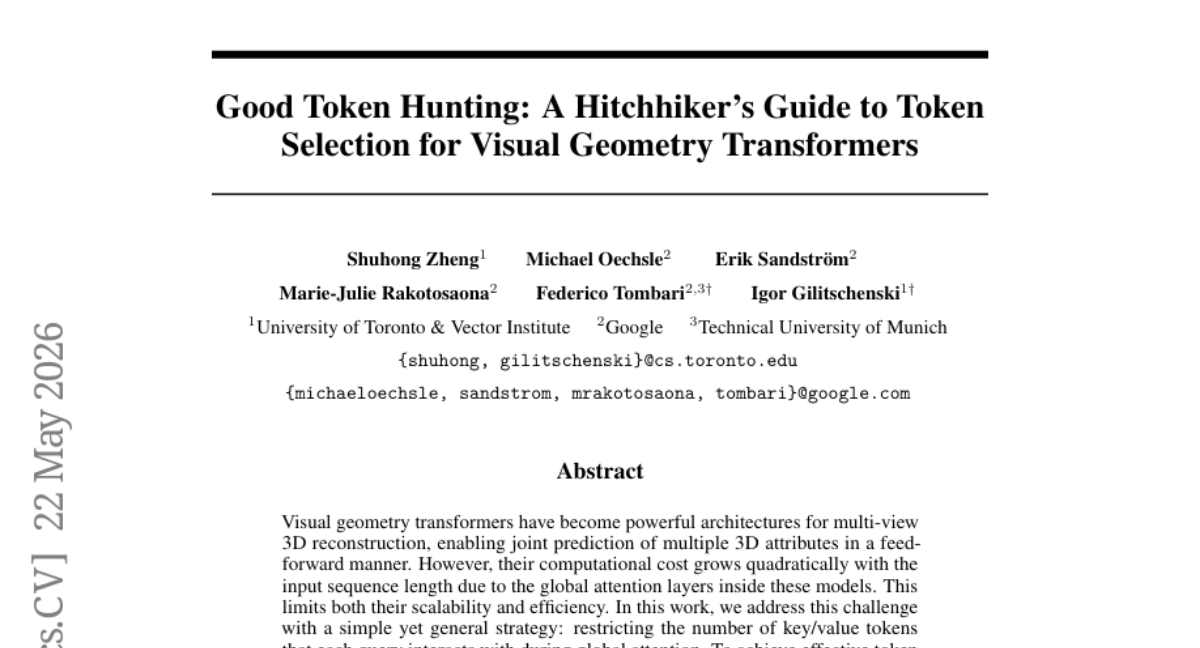
17. Good Token Hunting: A Hitchhiker’s Guide to Token Selection for Visual Geometry Transformers
🔑 Keywords: Visual geometry transformers, multi-view 3D reconstruction, global attention layers, token selection, layer-aware sparsification
💡 Category: Computer Vision
🌟 Research Objective:
– To accelerate visual geometry transformers and reduce computational costs while maintaining performance in multi-view 3D reconstruction tasks.
🛠️ Research Methods:
– A two-stage token selection framework is employed, which includes inter-frame and intra-frame selection to restrict the number of key/value tokens each query interacts with during global attention.
– The inter-frame selection step identifies crucial frames, whereas the intra-frame selection discards redundant tokens within these frames, guided by layer-aware sparsification techniques.
💬 Research Conclusions:
– The proposed framework significantly accelerates visual geometry transformers by over 85% for scenes with 500 images while maintaining or enhancing baseline performance, offering an improved speed-accuracy trade-off compared to existing solutions.
👉 Paper link: https://huggingface.co/papers/2605.23892
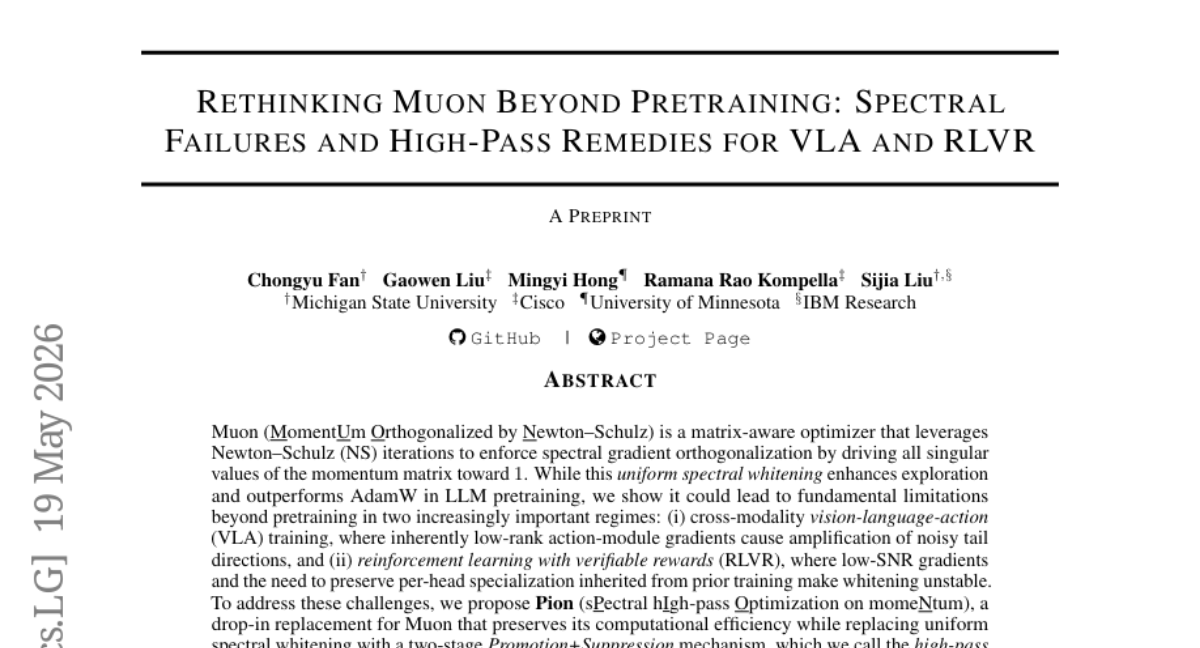
18. Rethinking Muon Beyond Pretraining: Spectral Failures and High-Pass Remedies for VLA and RLVR
🔑 Keywords: Pion, spectral whitening, cross-modality, reinforcement learning, per-head updates
💡 Category: Multi-Modal Learning
🌟 Research Objective:
– The study introduces Pion as a replacement for Muon in LLM pretraining to address limitations in low-rank and low-SNR regimes, particularly in cross-modality vision-language-action training and reinforcement learning with verifiable rewards.
🛠️ Research Methods:
– Implements a Promotion+Suppression mechanism through high-pass NS iteration, offering a computationally efficient alternative to spectral whitening while allowing per-head updates.
💬 Research Conclusions:
– Pion surpasses baselines in VLA training, achieving a 100% success rate on LIBERO tasks and excels in RLVR post-training, outperforming Muon and AdamW in several tests.
👉 Paper link: https://huggingface.co/papers/2605.19282
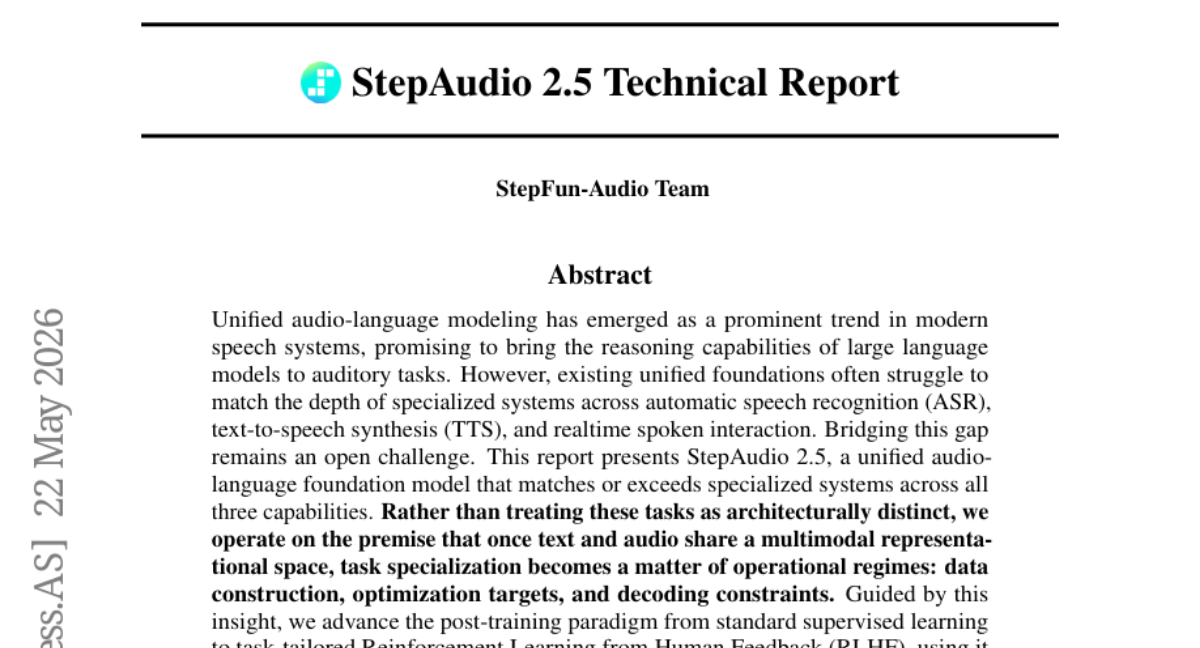
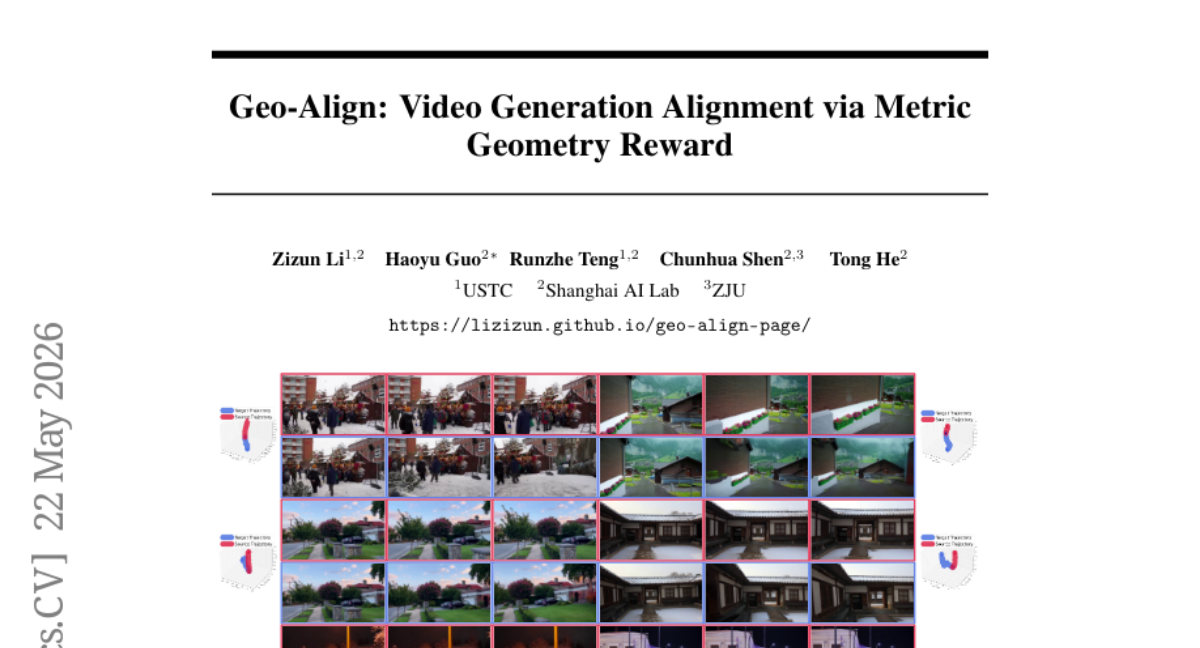
19. Geo-Align: Video Generation Alignment via Metric Geometry Reward
🔑 Keywords: Geo-Align, Reinforcement Learning, camera-controlled video re-rendering, metric 3D estimator, scale-aware perceptual reward
💡 Category: Reinforcement Learning
🌟 Research Objective:
– Introduce Geo-Align, a Reinforcement Learning framework for improving camera-controlled video re-rendering, enhancing generalization with scale-aware perceptual rewards and metric 3D estimation.
🛠️ Research Methods:
– Utilize a pre-trained model optimized through scale-aware perceptual reward mechanisms, incorporating a metric 3D estimator for precise camera trajectory extraction and a data pipeline strategy based on real-world conditions and synthetic data.
💬 Research Conclusions:
– Geo-Align significantly outperforms existing supervised learning baselines in camera controllability and visual fidelity, showcasing the effectiveness of the proposed method.
👉 Paper link: https://huggingface.co/papers/2605.23903
20. LLMs as Noisy Channels: A Shannon Perspective on Model Capacity and Scaling Laws
🔑 Keywords: Shannon Scaling Law, Large Language Models, Signal-to-Noise Ratio, Noisy Channel, Shannon-Hartley Theorem
💡 Category: Natural Language Processing
🌟 Research Objective:
– The study aims to introduce the Shannon Scaling Law as a more accurate model to explain the training of Large Language Models through the lens of information transmission over a noisy channel.
🛠️ Research Methods:
– The methodology involves mapping model parameters to channel bandwidth and training tokens to signal power to capture the interaction between learning signals and intrinsic noise, validated through experiments with models like Pythia and OLMo2 under various perturbations.
💬 Research Conclusions:
– The Shannon Scaling Law demonstrates superior predictive accuracy over traditional scaling laws, explaining non-monotonic phenomena where other models fall short, and accurately predicts unseen models’ performance, highlighting its potential for future LLM scaling challenges.
👉 Paper link: https://huggingface.co/papers/2605.23901
21. ETCHR: Editing To Clarify and Harness Reasoning
🔑 Keywords: ETCHR, Multimodal Language Model, Image Editing, Visual Reasoning
💡 Category: Multi-Modal Learning
🌟 Research Objective:
– The objective is to improve the performance of multimodal language models in visual reasoning tasks by introducing a novel image editing approach called ETCHR that decouples visual reasoning from image generation.
🛠️ Research Methods:
– A two-stage training process is employed with ETCHR: Reasoning Imitation through supervised fine-tuning on edit trajectories, followed by Reasoning Enhancement using VLM-derived rewards to improve edit correctness and reasoning accuracy.
💬 Research Conclusions:
– ETCHR significantly improves Pass@1 performance across five task families by an average of 4.61 to 5.47 points, demonstrating its effectiveness and compatibility with different MLLMs in a training-free manner.
👉 Paper link: https://huggingface.co/papers/2605.23897
22. VGenST-Bench: A Benchmark for Spatio-Temporal Reasoning via Active Video Synthesis
🔑 Keywords: VGenST-Bench, Spatio-temporal reasoning, Multimodal Large Language Models, Generative Models, Video Benchmark
💡 Category: Multi-Modal Learning
🌟 Research Objective:
– To introduce VGenST-Bench, a video benchmark designed for evaluating the spatio-temporal reasoning capabilities of Multimodal Large Language Models using generative models for active synthesis.
🛠️ Research Methods:
– Employs generative models to create controlled and diverse video scenarios with a specific focus on a multi-agent pipeline that includes a human quality control stage to ensure the quality of generated content.
– Establishes a comprehensive 3x2x2 video taxonomy to cover various scenarios utilizing Spatial Scale, Perspective, and Scene Dynamics.
💬 Research Conclusions:
– VGenST-Bench offers a paradigm shift from passive to active synthesis, enhancing the evaluation and diagnosis of fine-grained spatio-temporal reasoning capabilities in MLLMs.
👉 Paper link: https://huggingface.co/papers/2605.22570
23. PiD: Fast and High-Resolution Latent Decoding with Pixel Diffusion
🔑 Keywords: Pixel diffusion, Latent decoding, High-resolution image synthesis, Pixel space, Sigma-aware adapter
💡 Category: Generative Models
🌟 Research Objective:
– Introduce PiD, a Pixel Diffusion Decoder, for efficient and high-quality image synthesis at high resolutions, reformulating latent decoding as conditional pixel diffusion.
🛠️ Research Methods:
– Utilize a sigma-aware adapter to inject noise-corrupted latents into the pixel diffusion backbone, allowing for the early termination of latent diffusion process and achieving significant efficiency gain through the model distillation using DMD2.
💬 Research Conclusions:
– PiD demonstrates the ability to decode and upscale images efficiently, achieving 2048×2048 resolution from 512×512 latents in under 1 second, with improved visual fidelity and reduced computational requirements compared to traditional methods.
👉 Paper link: https://huggingface.co/papers/2605.23902
24. See What I Mean: Aligning Vision and Language Representations for Video Fine-grained Object Understanding
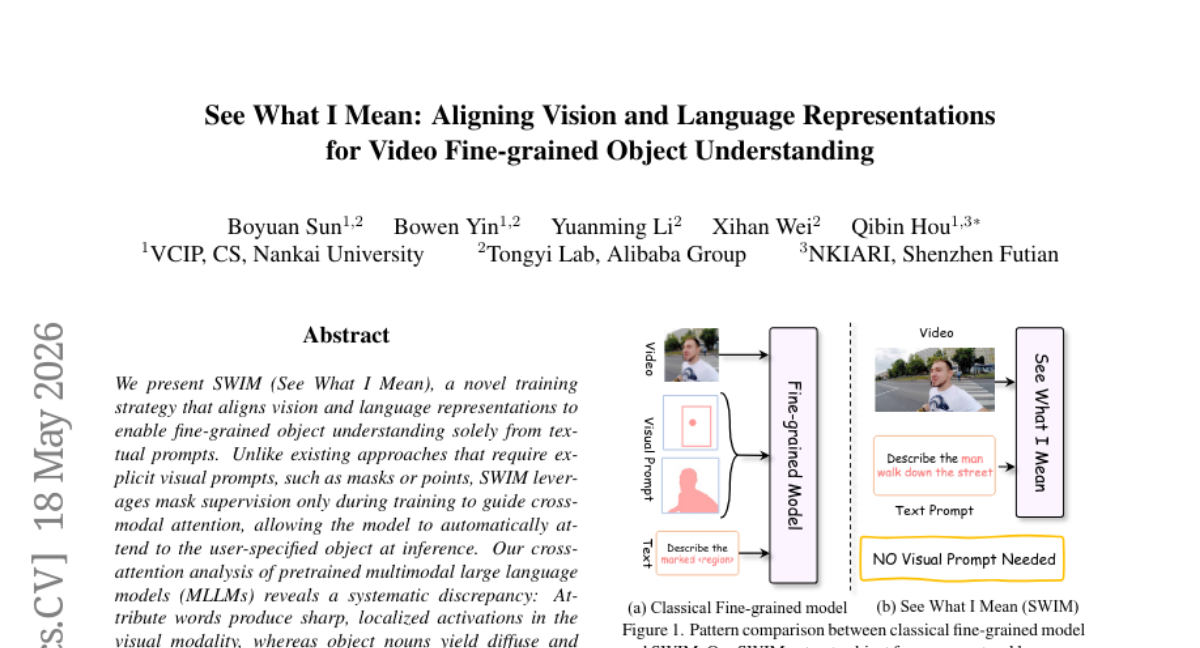
🔑 Keywords: SWIM, cross-modal attention, mask supervision, spatial consistency
💡 Category: Multi-Modal Learning
🌟 Research Objective:
– The primary aim of SWIM (See What I Mean) is to align vision and language representations for fine-grained object understanding using only textual prompts, addressing cross-modal attention misalignment.
🛠️ Research Methods:
– The method employs mask supervision during training and introduces a new dataset called NL-Refer, which pairs object masks with precise natural language referring expressions, to guide cross-modal attention.
💬 Research Conclusions:
– SWIM significantly enhances text-visual alignment and outperforms visual-prompt-based methods in fine-grained object understanding benchmarks, showcasing its effectiveness.
👉 Paper link: https://huggingface.co/papers/2605.18018
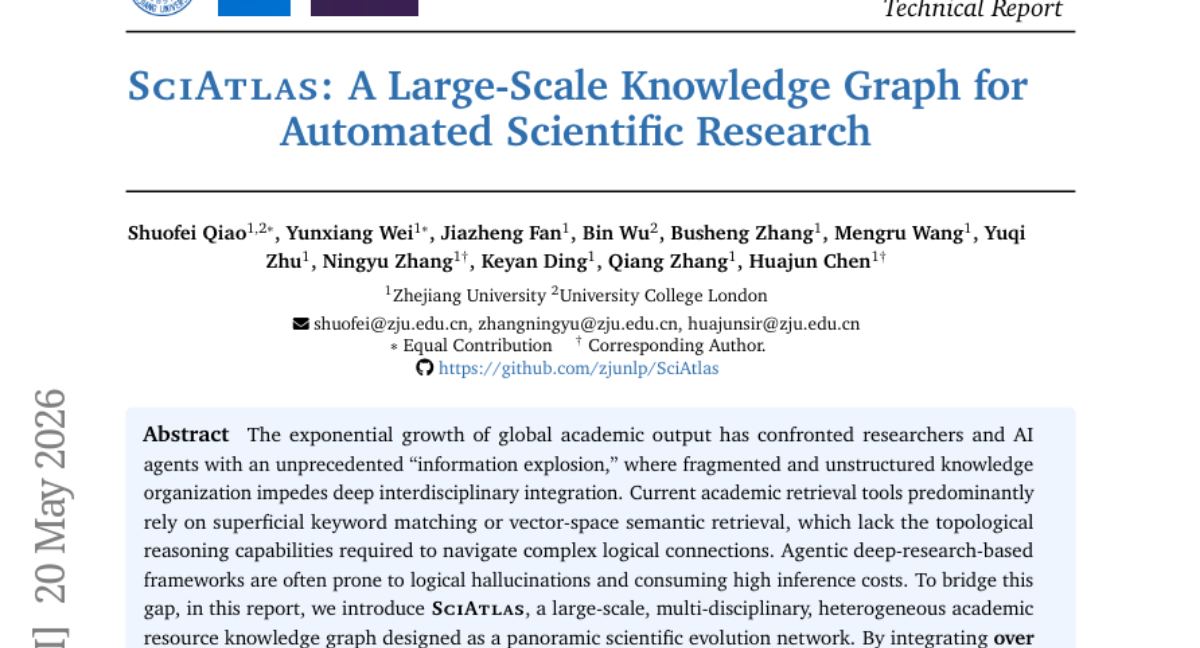
25. SciAtlas: A Large-Scale Knowledge Graph for Automated Scientific Research
🔑 Keywords: Knowledge graph, Topological reasoning, Neuro-symbolic retrieval, Semantic matching, Automated scientific discovery
💡 Category: Knowledge Representation and Reasoning
🌟 Research Objective:
– To address the information explosion in academic research by developing a large-scale, multi-disciplinary knowledge graph named SciAtlas for enhanced structured topological reasoning and automated scientific discovery.
🛠️ Research Methods:
– Integration of over 43 million papers across 26 disciplines, yielding a knowledge graph of 157 million entities and 3 billion triplets.
– Development of a neuro-symbolic retrieval algorithm with tri-path collaborative recall and graph reranking for efficient academic resource retrieval.
💬 Research Conclusions:
– SciAtlas significantly reduces reasoning costs and dismantles disciplinary barriers, offering a global cognitive perspective. It supports literature review, automated research trend synthesis, idea positioning, and academic trajectory exploration as a cognitive map for scientific research.
👉 Paper link: https://huggingface.co/papers/2605.22878
26. Rethinking Cross-Layer Information Routing in Diffusion Transformers
🔑 Keywords: Diffusion Transformers, Diffusion-Adaptive Routing, cross-layer information flow, AI-generated summary, REPA
💡 Category: Generative Models
🌟 Research Objective:
– To address inefficient cross-layer information flow in Diffusion Transformers by introducing a learnable, timestep-adaptive routing mechanism.
🛠️ Research Methods:
– Developed Diffusion-Adaptive Routing, a residual replacement method for non-incremental aggregation of sublayer outputs.
– Empirical analysis of traditional residual addition within DiTs, focusing on issues like magnitude inflation and gradient decay.
💬 Research Conclusions:
– DAR improves model performance and training efficiency on ImageNet 256×256, achieving significant FID improvement and reduced training iterations.
– Shows compatibility with modern Transformer methods like REPA, suggesting a new design axis in diffusion modeling for enhanced cross-layer information flow.
👉 Paper link: https://huggingface.co/papers/2605.20708