AI Native Daily Paper Digest – 20260707
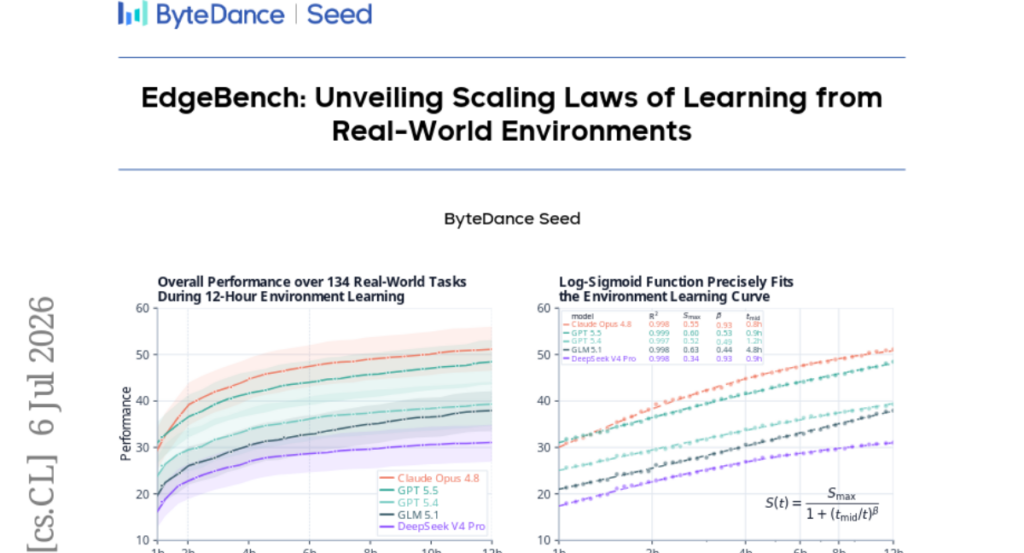
1. OmniOpt: Taxonomy, Geometry, and Benchmarking of Modern Optimizers
🔑 Keywords: OmniOpt, Optimizer Selection, Large-Scale Model Training, Norm-Constrained Linear Minimization Oracles, Cross-Domain Benchmark
💡 Category: AI Systems and Tools
🌟 Research Objective:
– OmniOpt aims to provide a unified framework for selecting optimizers in large-scale model training by utilizing a meta-pipeline, norm-constrained linear minimization oracles, and a cross-domain benchmark.
🛠️ Research Methods:
– The study employs a five-stage meta-pipeline to treat optimizer updates as structured transformations and utilizes norm-constrained linear minimization oracles to unify different optimizers.
– It also proposes a dual-dimension taxonomy to categorize optimizers by mechanism family and training objectives, and deploys a cross-domain benchmark for comprehensive analysis.
💬 Research Conclusions:
– OmniOpt offers the research community a structured operational system for choosing optimizers based on defined mechanisms and objectives, and provides guidance for future developments in optimizer research.
👉 Paper link: https://huggingface.co/papers/2607.04033
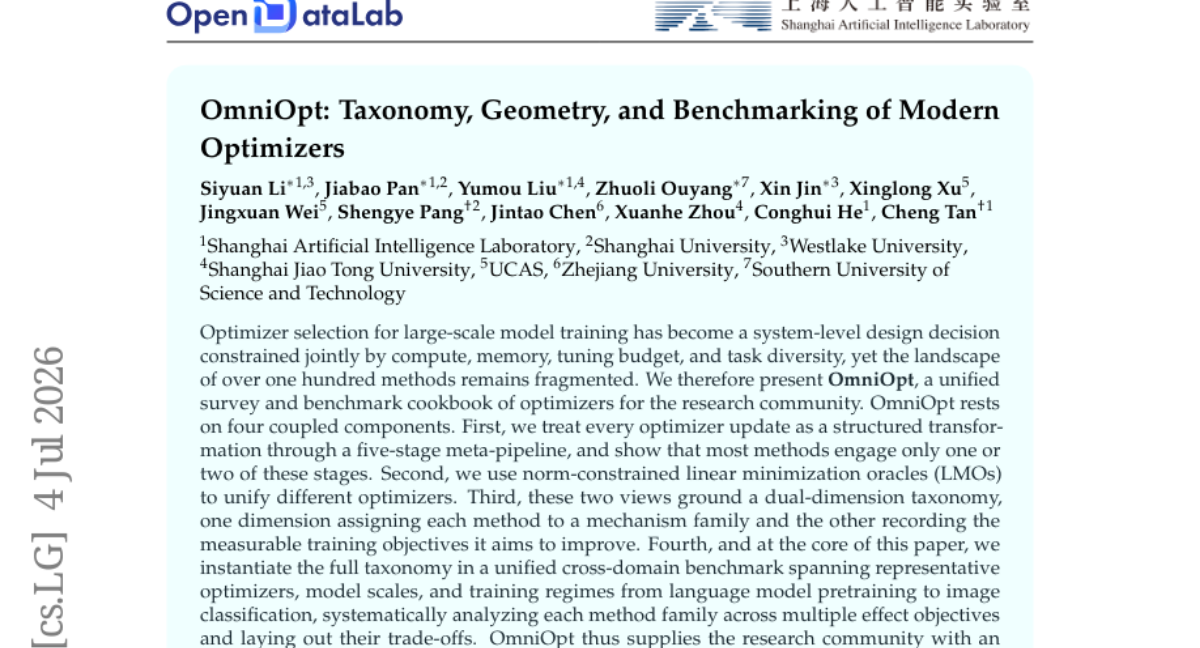
2. ResearchStudio-Reel: Automate the Last Mile of Research from Paper to Poster, Video, and Blog
🔑 Keywords: Research dissemination, Automation, Editable artifacts, AI Systems and Tools
💡 Category: AI Systems and Tools
🌟 Research Objective:
– The aim is to automate the dissemination of research by transforming papers into consistent and editable artifacts like posters, videos, and blogs through ResearchStudio-Reel, while maintaining quality with hard pass/fail criteria.
🛠️ Research Methods:
– Utilizes a shared paper extractor (Paper2Assets) and organizes multiple specialized skills into generators (Paper2Poster, Paper2Video, Paper2Blog) and an interactive convergence layer (Paper2Reel) to automate content creation.
💬 Research Conclusions:
– The system outperforms both existing automated systems and frontier LLMs in creating aesthetically pleasing and informative outputs, with a significant success rate. The pipeline uniquely provides editable, synchronized artifacts that maintain factual consistency.
👉 Paper link: https://huggingface.co/papers/2607.04438
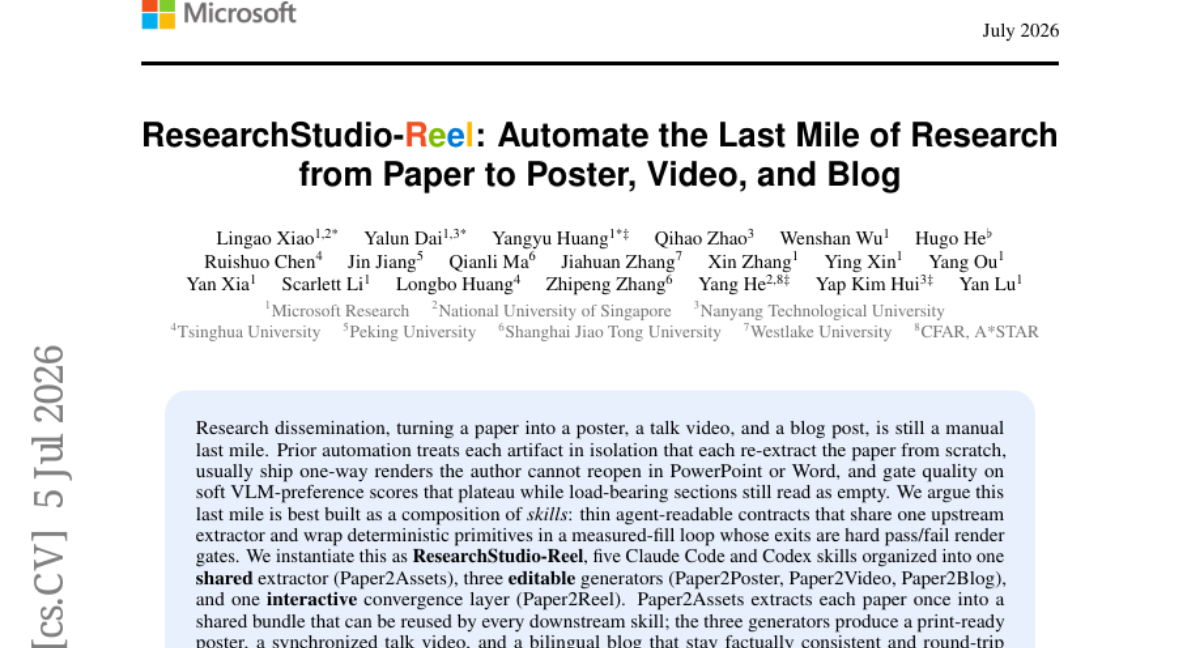
3. ResearchStudio-Idea: An Evidence-Grounded Research-Ideation Skill Suite from ML Conference Outcomes
🔑 Keywords: ResearchStudio-Idea, literature search, novelty checking, idea-card rendering, evidence readiness
💡 Category: AI Systems and Tools
🌟 Research Objective:
– The goal of the ResearchStudio-Idea is to provide a comprehensive skill suite that aids in the ideation process for research proposals by combining literature search, novelty checking, and pattern-guided generation to produce traceable and effective research proposals.
🛠️ Research Methods:
– The research utilizes a suite of tools including Paper-Search for multi-source literature search, Scoop-Check for prior-art collision checking, and IdeaSpark, which integrates evidence grounding, pattern-guided generation, collision retrieval, audit, and idea-card rendering into one cohesive workflow.
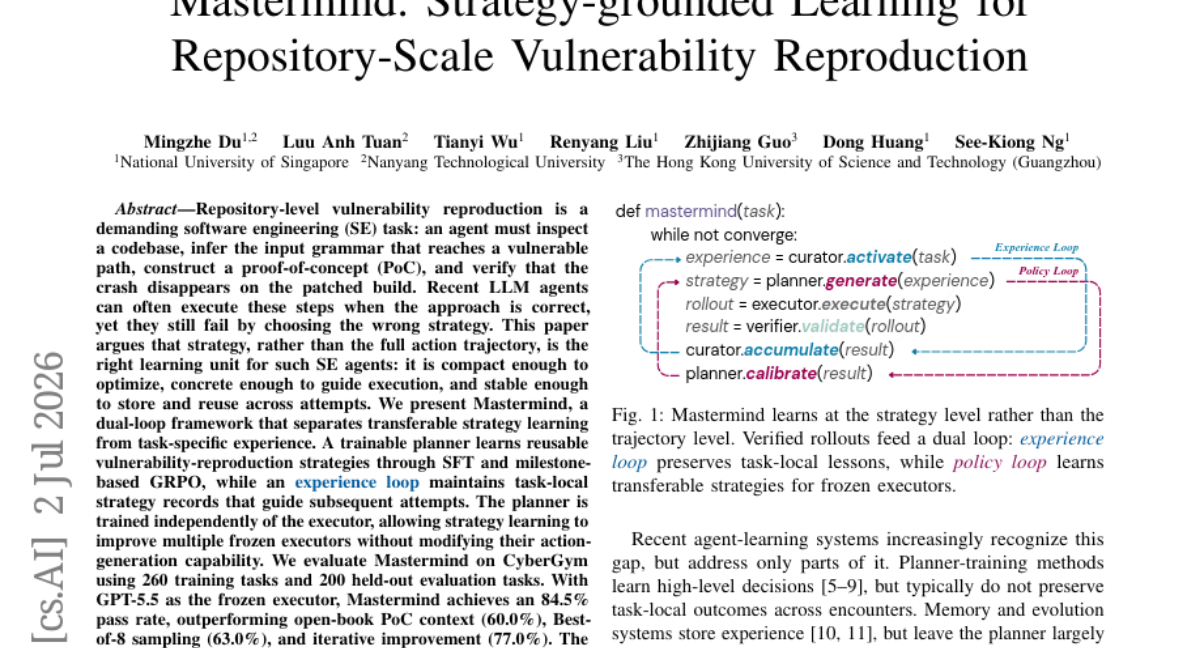
💬 Research Conclusions:
– The analysis of research outcomes from a corpus of 1,947 machine learning conference papers reveals 15 reusable ideation patterns. IdeaSpark is shown to produce stronger research proposals with consistent novelty, as evaluated by blind automated-judge evaluations, compared to no-skill and generic-skill baselines.
👉 Paper link: https://huggingface.co/papers/2607.04439
4. GigaWorld-1: A Roadmap to Build World Models for Robot Policy Evaluation
🔑 Keywords: World Models, Robotic Policies, Policy Evaluation, Rollout Consistency, Real-Robot Teleoperation
💡 Category: Robotics and Autonomous Systems
🌟 Research Objective:
– The study aims to systematically investigate world models for robotic policy evaluation, particularly focusing on the importance of long-horizon rollout consistency and robot-specific controllability.
🛠️ Research Methods:
– Introduction of WMBench, a new benchmark developed from real-robot teleoperation data to facilitate controlled comparisons and systematic study across model families, action encodings, and evaluation metrics.
💬 Research Conclusions:
– Key findings highlight that reliable evaluator quality is more dependent on long-term, action-faithful rollout consistency rather than short-term visual realism.
– Pretraining benefits are not just linked to data scale but also to balancing general world knowledge with robot-specific controllability.
– Architectural choices, such as action encoding and memory design, significantly impact alignment with real-world robot behavior.
👉 Paper link: https://huggingface.co/papers/2607.02642
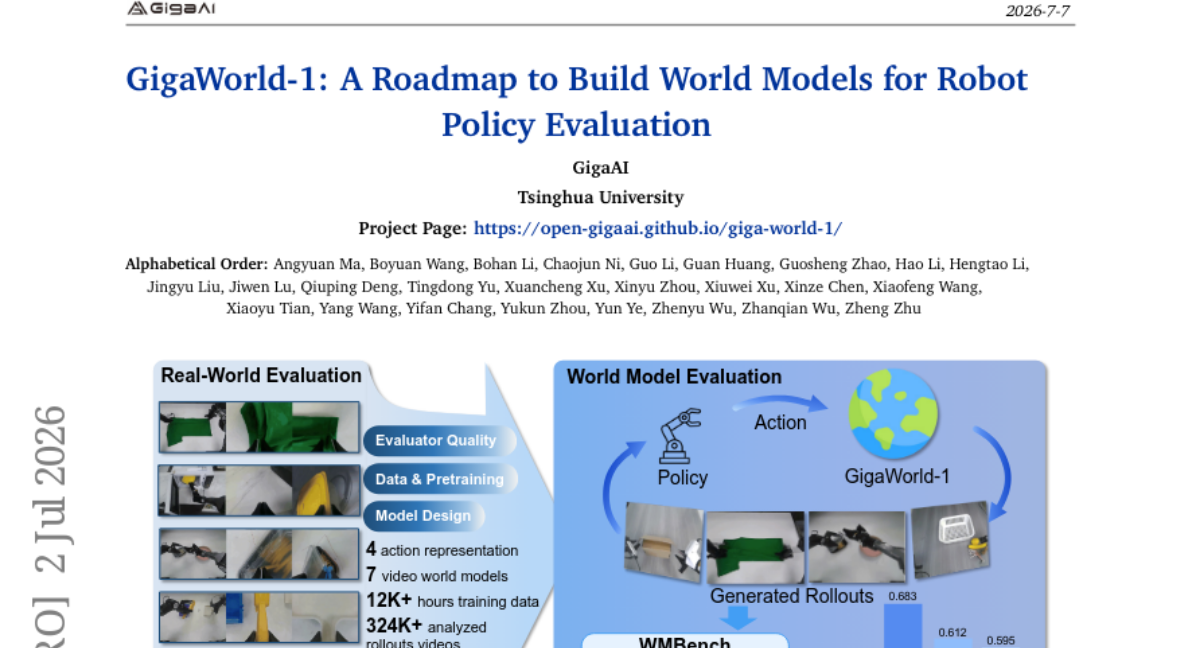
5. Wan-Streamer v0.2: Higher Resolution, Same Latency
🔑 Keywords: Wan-Streamer v0.2, audio-visual interaction, multi-GPU parallel processing, signal-to-signal latency, visual generation
💡 Category: Human-AI Interaction
🌟 Research Objective:
– To enhance audio-visual interaction by increasing visual resolution while maintaining low latency using a thinker-performer architecture.
🛠️ Research Methods:
– Utilizes a multi-GPU parallel processing approach with a split structure between thinker and performer for efficient management of latent sequences, leveraging Ulysses-style context-parallel groups.
💬 Research Conclusions:
– Wan-Streamer v0.2 successfully upgrades the audio-visual interaction model, achieving higher-resolution output without increasing latency beyond approximately 550 ms during remote interaction.
👉 Paper link: https://huggingface.co/papers/2607.04443
6. InternVLA-A1.5: Unifying Understanding, Latent Foresight, and Action for Compositional Generalization
🔑 Keywords: InternVLA-A1.5, vision-language models, future prediction, robot manipulation, pretrained video generation
💡 Category: Robotics and Autonomous Systems
🌟 Research Objective:
– To integrate vision-language models with future prediction in latent space for efficient robot manipulation while preserving semantics and enabling long-horizon execution.
🛠️ Research Methods:
– The paper presents InternVLA-A1.5, which combines a VLM backbone with continuous action generation and recasts future prediction as a latent-querying problem using foresight tokens.
💬 Research Conclusions:
– InternVLA-A1.5 achieved the best results across six simulation benchmarks and demonstrated strong compositional generalization in real-world tests with preserved semantics for long-horizon tasks.
👉 Paper link: https://huggingface.co/papers/2607.04988
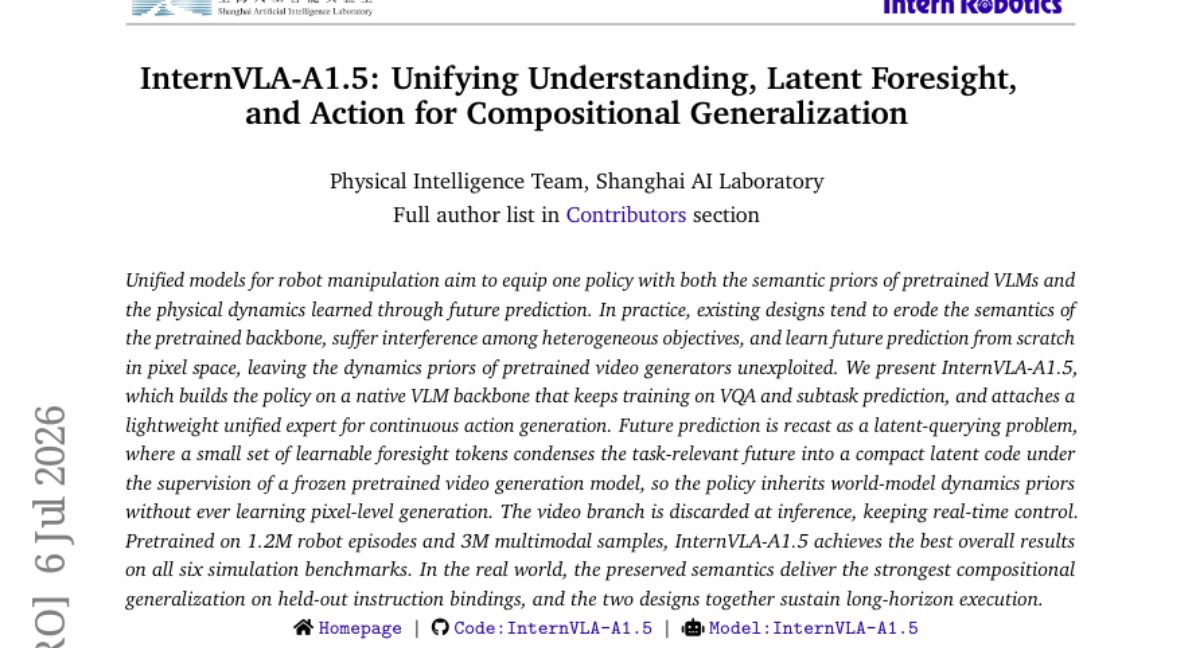
7. KVpop — Key-Value Cache Compression with Predictive Online Pruning
🔑 Keywords: Key-Value Cache, Autoregressive Decoding, Future-Attention Target, Qwen3-4B, KV Cache Compression
💡 Category: Machine Learning
🌟 Research Objective:
– The study introduces KVpop, aiming to enhance key-value cache eviction strategies by directly supervising keep-or-drop decisions using future-attention targets to optimize autoregressive decoding performance.
🛠️ Research Methods:
– The approach involves a novel future-attention target for training and a delayed memory-based scorer to exploit near-future context without materializing dense attention maps.
💬 Research Conclusions:
– KVpop demonstrates significant performance retention, maintaining 98% of full-attention capability at 75% KV cache compression and 97% at 88% compression, outperforming traditional eviction baselines and reducing memory costs while preserving quality.
👉 Paper link: https://huggingface.co/papers/2607.05061
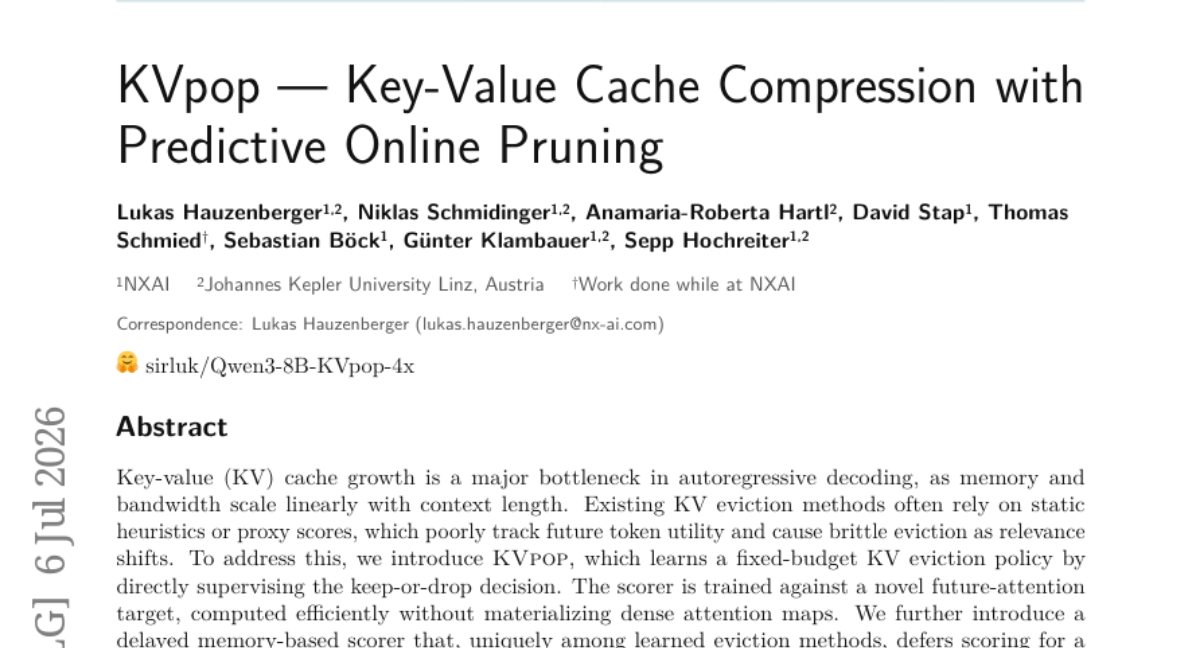
8. dOPSD: On-Policy Self-Distillation for Diffusion Language Models
🔑 Keywords: Diffusion large language models, On-policy self-distillation, Mathematical reasoning, Code generation
💡 Category: Generative Models
🌟 Research Objective:
– The study aims to enhance mathematical reasoning and code generation performance of diffusion large language models through a novel on-policy self-distillation technique.
🛠️ Research Methods:
– Researchers employed on-policy self-distillation (OPSD), specifically the dOPSD approach, which leverages the model’s own denoising trajectory for improvement.
💬 Research Conclusions:
– The study concludes that dOPSD successfully enhances in-domain mathematical reasoning and out-of-domain code generation, surpassing both supervised and on-policy baseline performance.
👉 Paper link: https://huggingface.co/papers/2607.04428
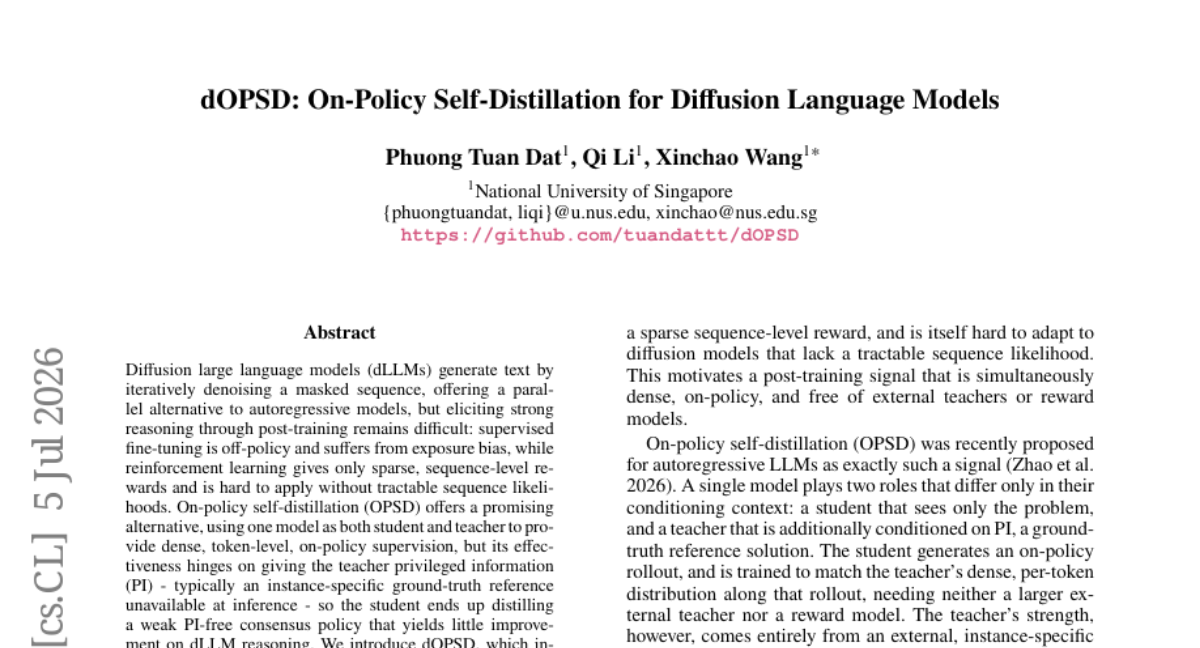
9. EdgeBench: Unveiling Scaling Laws of Learning from Real-World Environments
🔑 Keywords: Log-sigmoid scaling law, Agent interaction, Real world tasks, EdgeBench, Exponential learning speed
💡 Category: Reinforcement Learning
🌟 Research Objective:
– To analyze real-world agent interactions across 134 diverse tasks and reveal scaling laws for performance and learning speed improvements.
🛠️ Research Methods:
– Real-world data analysis of 38,000 hours of agent interactions using the EdgeBench suite, incorporating 134 tasks with rich, multilevel feedback.
💬 Research Conclusions:
– Discovered that agent performance during environment learning follows a precise log-sigmoid scaling law, reaching an R^2 = 0.998.
– Found that agent learning speed approximately doubles every three months across model generations.
👉 Paper link: https://huggingface.co/papers/2607.05155
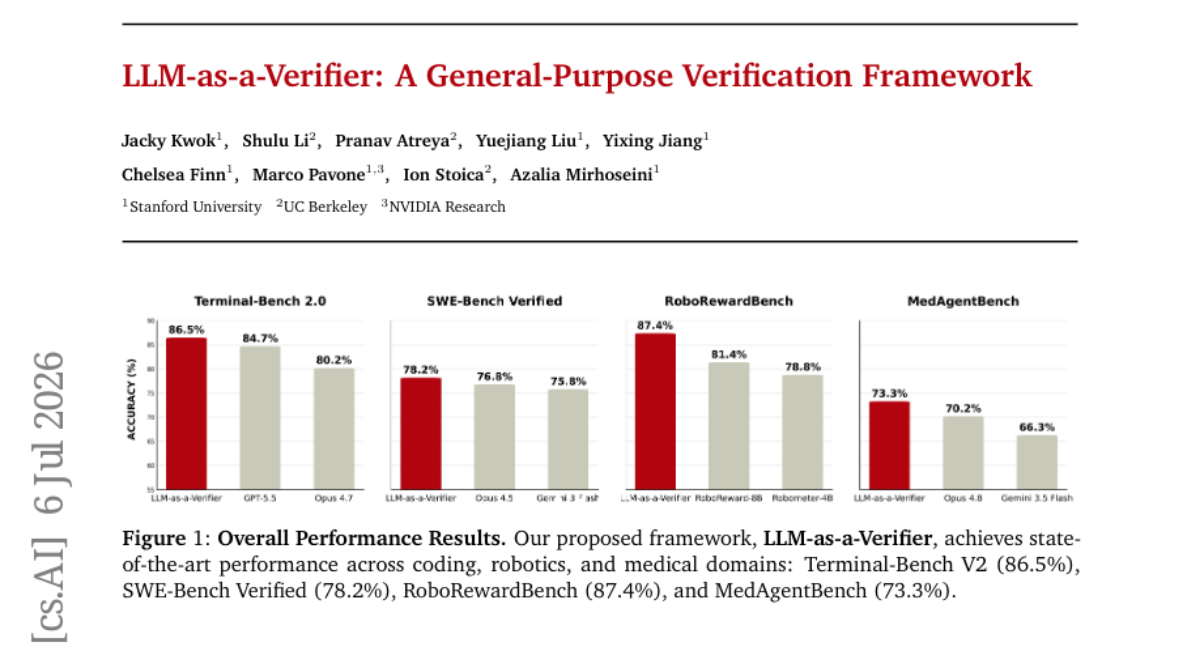
10. LLM-as-a-Verifier: A General-Purpose Verification Framework
🔑 Keywords: LLM-as-a-Verifier, Probabilistic Verification, Continuous Scores, Score Granularity, Reinforcement Learning
💡 Category: AI Systems and Tools
🌟 Research Objective:
– The paper introduces LLM-as-a-Verifier, a probabilistic verification framework aimed at improving solution correctness assessment and agent performance.
🛠️ Research Methods:
– The framework uses a probabilistic approach, computing expectations over scoring token logits to generate continuous scores, and scales verification through score granularity, repeated evaluation, and criteria decomposition.
💬 Research Conclusions:
– LLM-as-a-Verifier achieves state-of-the-art performance on various benchmarks and provides fine-grained feedback, serving as a proxy for task progress and enhancing sample efficiency in reinforcement learning.
👉 Paper link: https://huggingface.co/papers/2607.05391
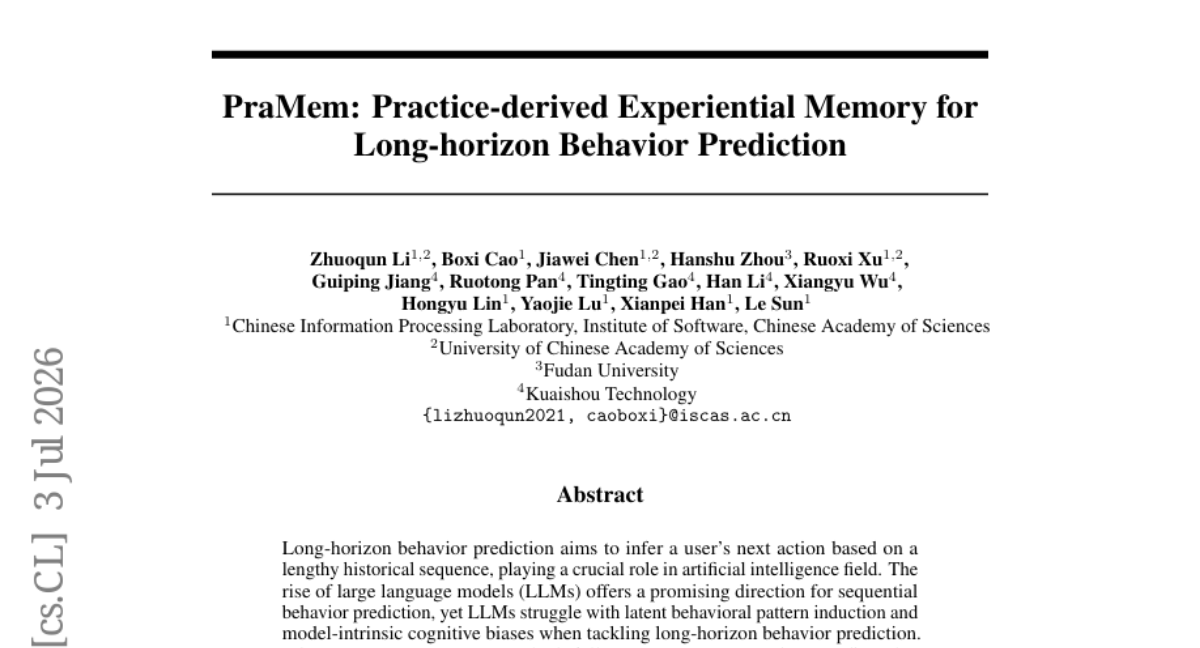
11. PraMem: Practice-derived Experiential Memory for Long-horizon Behavior Prediction
🔑 Keywords: Long-horizon behavior prediction, Large Language Models, Experiential Memory, Memory Management
💡 Category: Foundations of AI
🌟 Research Objective:
– The primary objective is to enhance long-horizon behavior prediction by transforming lengthy historical sequences into experiential memory, improving prediction accuracy.
🛠️ Research Methods:
– Introduction of a paradigm shift with PraMem, which practices over lengthy historical sequences to create experiential memory, serving as an assisted input for prediction tasks.
💬 Research Conclusions:
– PraMem demonstrates superior performance over existing methods, providing valuable insights into the mechanism and evolution of experiential memory through extensive experiments across diverse tasks.
👉 Paper link: https://huggingface.co/papers/2607.02881
12. Unified Audio Intelligence Without Regressing on Text Intelligence
🔑 Keywords: Audio intelligence, Unified audio-text model, Transformer decoder, Multimodal generation, Supervised training
💡 Category: Multi-Modal Learning
🌟 Research Objective:
– To develop a unified audio-text large language model called Nemotron-Labs-Audex-30B-A3B (Audex) that excels in both audio and text processing tasks.
🛠️ Research Methods:
– Utilizes a shared Transformer decoder architecture.
– Combines curated audio-text datasets with multi-stage supervised training, followed by Cascade RL and multi-domain on-policy distillation.
💬 Research Conclusions:
– Audex achieves state-of-the-art performance in audio understanding, speech recognition, text-to-speech, audio generation, and speech-to-speech generation, while maintaining robust text reasoning capabilities.
– The model checkpoints are released for open research, promoting further development in the field.
👉 Paper link: https://huggingface.co/papers/2607.05196

13. Deform360: A Massive Multi-view Visuotactile Dataset for Deformable World Models
🔑 Keywords: Deform360, visuotactile dataset, deformable objects, world modeling, robot planning
💡 Category: Robotics and Autonomous Systems
🌟 Research Objective:
– The primary goal is to study the dynamics of deformable objects and compare 2D video models with 3D particle models in robotic manipulation tasks.
🛠️ Research Methods:
– Utilizes a large-scale visuotactile dataset called Deform360 with 198 objects and 1,980 interaction sequences, employing a novel markerless visuotactile 3D tracking pipeline for dense geometry and motion extraction.
💬 Research Conclusions:
– The analysis highlights key trade-offs between structural priors and scalability and provides a benchmark for future research on generalizable world modeling of deformable objects.
👉 Paper link: https://huggingface.co/papers/2607.05390
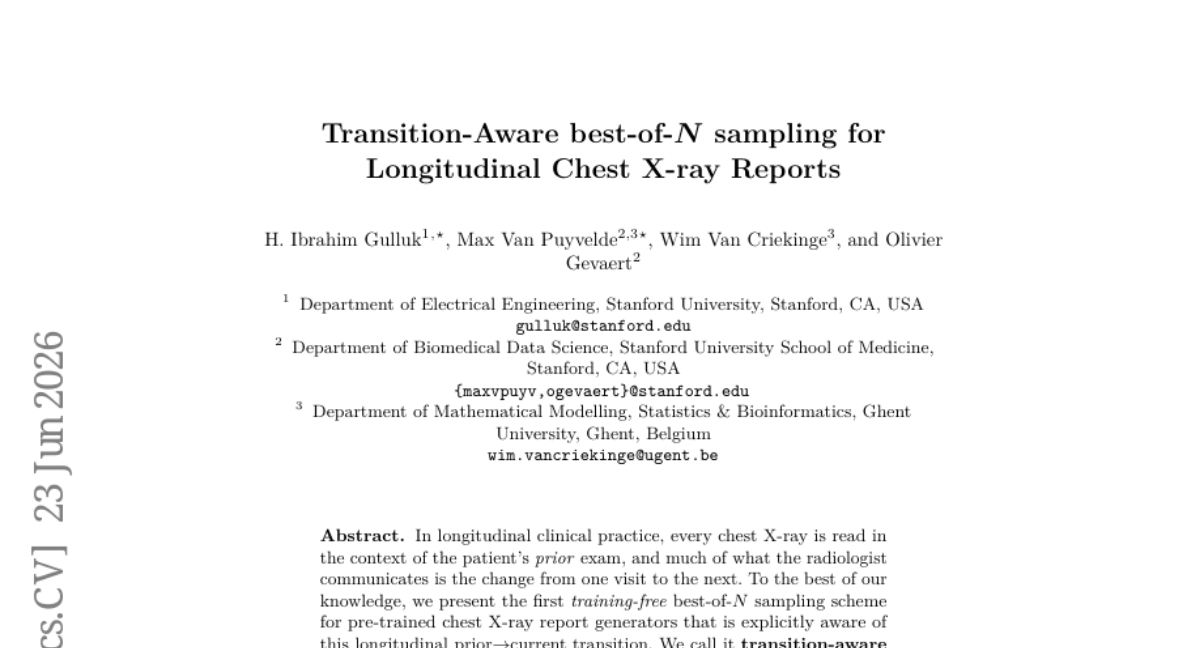
14. Transition-Aware best-of-N sampling for Longitudinal Chest X-ray Reports
🔑 Keywords: Training-free sampling, Longitudinal patient history, Transition-aware best-of-N sampling, Set-to-set distance, AI in Healthcare
💡 Category: AI in Healthcare
🌟 Research Objective:
– The study introduces a novel training-free sampling method for generating chest X-ray reports that encodes changes between prior and current examinations, leveraging longitudinal patient history.
🛠️ Research Methods:
– Implemented a transition-aware best-of-N sampling scheme for pre-trained chest X-ray report generators using set-to-set distance metrics to encode the change between examinations.
– Employed four directional set distances (mean-shift, novelty residual, directed-Hausdorff anchor, and cost-weighted optimal transport) and evaluated the method on a multi-visit AP-PA cohort with three vision-language generators.
💬 Research Conclusions:
– The transition-aware best-of-N sampling method significantly outperforms random selection, especially in generating the Impression section of chest X-ray reports.
👉 Paper link: https://huggingface.co/papers/2606.28393
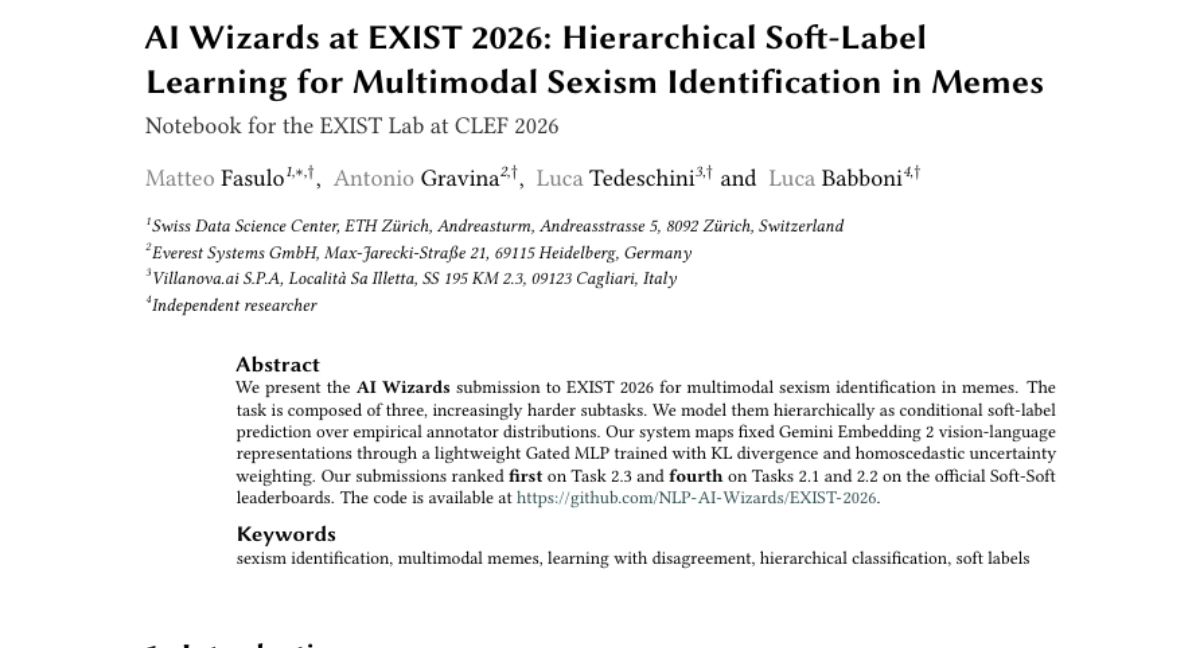
15. AI Wizards at EXIST 2026: Hierarchical Soft-Label Learning for Multimodal Sexism Identification in Memes
🔑 Keywords: Multimodal sexism identification, Vision-language embeddings, Conditional soft-label prediction, Gated MLP, KL divergence
💡 Category: Multi-Modal Learning
🌟 Research Objective:
– To develop a multimodal system for identifying sexism in memes using hierarchical conditional soft-label prediction.
🛠️ Research Methods:
– Utilization of vision-language embeddings combined with a lightweight Gated MLP, trained via KL divergence and incorporating homoscedastic uncertainty weighting.
💬 Research Conclusions:
– The system achieved first place in Task 2.3 and fourth place in Tasks 2.1 and 2.2 on the Soft-Soft leaderboards for the EXIST 2026 challenge.
👉 Paper link: https://huggingface.co/papers/2607.04410
16. Bridging Interleaved Multi-Modal Reasoning as a Unified Decision Process
🔑 Keywords: BRAID framework, Unified Multi-Modal Models, Reinforcement Learning, Markov Decision Process, Vision-Language Model
💡 Category: Multi-Modal Learning
🌟 Research Objective:
– The research aims to bridge interleaved multi-modal reasoning as a unified decision process for optimizing text-image interactions through reinforcement learning.
🛠️ Research Methods:
– The methodology involves casting multi-turn text-image reasoning as a unified Markov decision process, employing BRAID to perform joint optimization of textual and visual generation.
💬 Research Conclusions:
– The BRAID framework demonstrates superior performance in multi-modal reasoning tasks, emphasizing the importance of a unified MDP formulation combined with vision-thinking guidance.
👉 Paper link: https://huggingface.co/papers/2607.03748

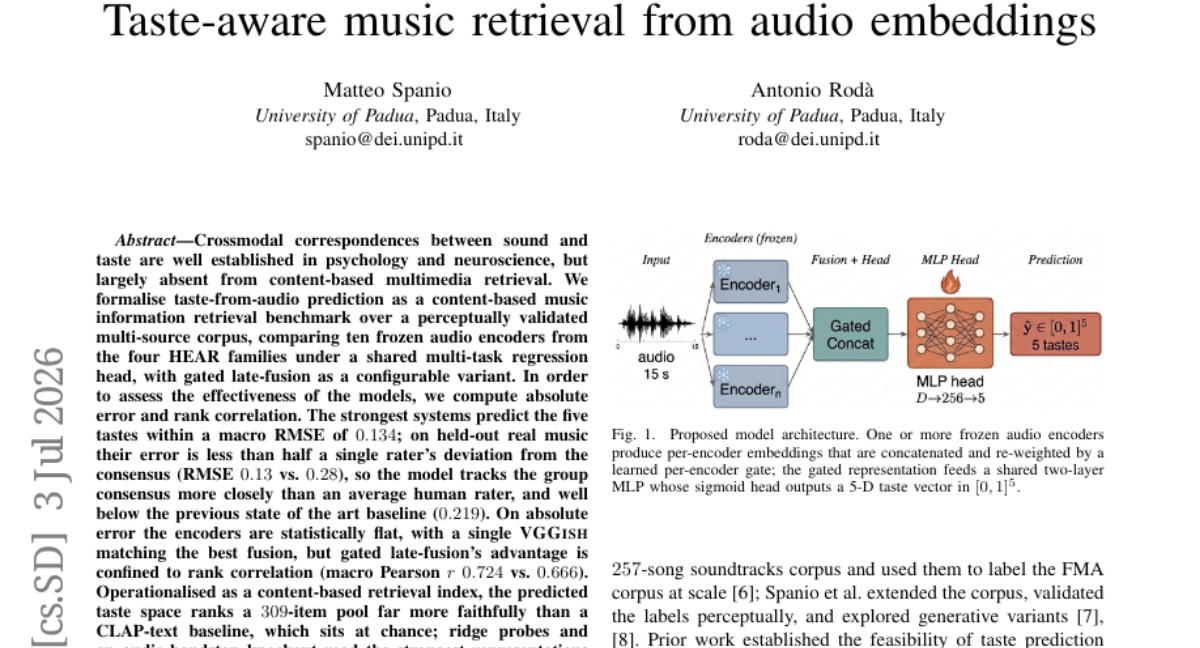
17. Taste-aware music retrieval from audio embeddings
🔑 Keywords: Audio encoders, HEAR families, content-based retrieval, gated late-fusion, RMSE
💡 Category: Multi-Modal Learning
🌟 Research Objective:
– The study aims to formalize taste-from-audio prediction as a content-based music information retrieval benchmark, using perceptually validated multi-source corpus.
🛠️ Research Methods:
– Evaluation of ten frozen audio encoders from four HEAR families using a shared multi-task regression head and gated late-fusion variant.
– Computation of absolute error and rank correlation to assess model effectiveness.
💬 Research Conclusions:
– Gated late-fusion shows a significant advantage in rank correlation over other methods, achieving human-level accuracy in taste prediction.
– The strongest models outperform previous state-of-the-art baselines and closely track group consensus on taste predictions, with a macro RMSE of 0.134 on held-out music.
👉 Paper link: https://huggingface.co/papers/2607.03296
18. CONFLUX: A Latent Diusion Model for 3D Chest-CT Synthesis with RL Post-Training
🔑 Keywords: 3D latent diffusion model, chest CT generation, clinical attributes, adaptive layer normalization, reinforcement learning
💡 Category: Generative Models
🌟 Research Objective:
– To create a 3D latent diffusion model named CONFLUX for generating chest CT images, enabling controlled synthesis with specified clinical attributes using adaptive layer normalization and reinforcement learning.
🛠️ Research Methods:
– Utilization of a 3D variational autoencoder to compress chest CT volumes and a rectified-flow transformer to generate in the latent space. Implementation of structured radiological metadata and online reinforcement-learning post-training to enhance clinical attribute control.
💬 Research Conclusions:
– The model achieves strong performance over volumetric baselines with improved fidelity and direct control over clinical attributes. Post-training significantly reduces the disparity in generating reliable findings as compared to real scans, evidenced by a 47% shortfall removal.
👉 Paper link: https://huggingface.co/papers/2607.02998
19. GaP: A Graph-as-Policy Multi-Agent Self-Learning Harness For Variational Automation Tasks
🔑 Keywords: Graph-as-Policy, Modular Open Robot Skill Library, Model-free policies, Variational Automation, Directed computation graphs
💡 Category: Robotics and Autonomous Systems
🌟 Research Objective:
– To explore the integration of modular robot skills with multi-agent coding to enhance reliability in variable automation tasks, particularly focusing on Variational Automation (VA).
🛠️ Research Methods:
– Introduction of Graph-as-Policy (GaP), a multi-agent coding harness that uses directed computation graphs with nodes from a Modular Open Robot Skill Library and internal simulation environments for task instance rehearsal and refinement.
💬 Research Conclusions:
– GaP significantly improves success rates and throughput in VA tasks, outperforming baseline methods, as evidenced by evaluation with 8 new task benchmarks, both in-simulation and real-world.
👉 Paper link: https://huggingface.co/papers/2607.05369
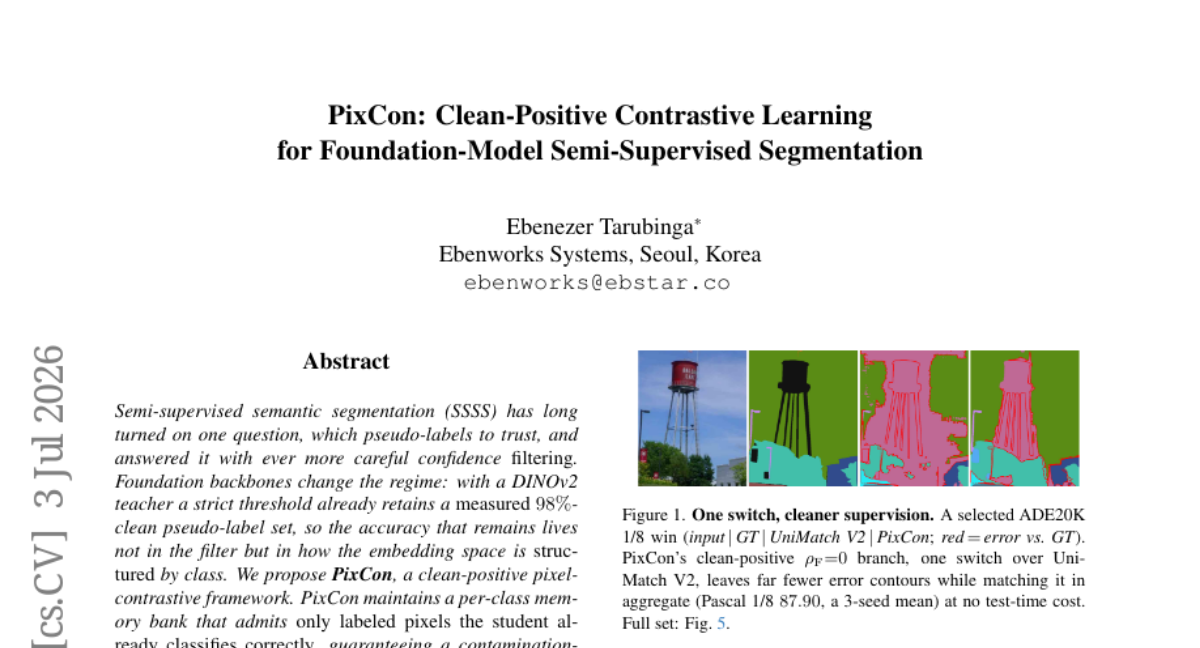
20. PixCon: Clean-Positive Contrastive Learning for Foundation-Model Semi-Supervised Segmentation
🔑 Keywords: Semi-supervised semantic segmentation, pseudo-labels, pixel-contrastive framework, memory bank, contamination
💡 Category: Computer Vision
🌟 Research Objective:
– To enhance the accuracy of semi-supervised semantic segmentation using a novel PixCon framework, which integrates clean-positive pixel-contrastive learning with per-class memory banks.
🛠️ Research Methods:
– Utilization of a DINOv2 teacher to establish a contamination-free positive set by construction, ensuring accuracy without reliance on confidence-filtered pseudo-labels.
– The framework employs a consistency backbone without adding inference-time parameters or specific thresholds for memory banks.
💬 Research Conclusions:
– PixCon demonstrates improved performance over existing methods, matching or exceeding the strong UniMatch V2 baseline.
– The framework’s design provides robustness in foundation-model SSSS and delivers accuracy gains through cleaner positive supervision, especially when teacher models weaken.
👉 Paper link: https://huggingface.co/papers/2607.03068
21.
22. Learning to Trigger: Reinforcement Learning at the Large Hadron Collider
🔑 Keywords: Reinforcement Learning, Group-Filtered Policy Optimization, Real-time Event Filtering, Large Hadron Collider, Signal Efficiency
💡 Category: Reinforcement Learning
🌟 Research Objective:
– The study aims to optimize real-time trigger thresholds at particle colliders using reinforcement learning, enhancing signal efficiency and managing background rates effectively.
🛠️ Research Methods:
– The research adapts Group-Filtered Policy Optimization to the streaming control context and introduces two new variants (GFPO-F and GFPO-FR) to enforce background rate feasibility. The approach is tested on triggers sensitive to pileup variation and anomaly detection on both simulated and real collision data.
💬 Research Conclusions:
– The reinforcement learning agent significantly improves in-tolerance time intervals and signal efficiency on Monte Carlo simulations and real collision data without fine-tuning, marking the first RL-based trigger control demonstration on real Large Hadron Collider data.
👉 Paper link: https://huggingface.co/papers/2606.23993
23. Speaker-Disentangled Chunk-Wise Regression for Syllabic Tokenization
🔑 Keywords: speaker-disentangled, syllabic tokenizer, HuBERT, teacher-student distillation, speech language model
💡 Category: Natural Language Processing
🌟 Research Objective:
– To improve syllable boundary detection and speech language modeling by using a speaker-disentangled syllabic tokenizer that aligns student representations with clean teacher targets.
🛠️ Research Methods:
– Utilization of teacher-student distillation and regression of speaker-perturbed student representations toward clean teacher targets using pretrained HuBERT within fixed-length chunks.
💬 Research Conclusions:
– The proposed method achieved state-of-the-art performance in syllable boundary detection and syllabic segment clustering. It also improved a speech language model’s syntactic and semantic understanding by 7% compared to phone-level SpiRit-LM.
👉 Paper link: https://huggingface.co/papers/2607.04064
24. ACID: Action Consistency via Inverse Dynamics for Planning with World Models
🔑 Keywords: ACID, decision-time planning, action-conditioned world models, cycle action consistency
💡 Category: Reinforcement Learning
🌟 Research Objective:
– Introduce ACID, a planning framework to enhance trajectory realism and reduce computational requirements by improving consistency in action-conditioned world models.
🛠️ Research Methods:
– Implement cycle action consistency using inverse dynamics models and incorporate this consistency into planning cost through an adaptive weight.
💬 Research Conclusions:
– ACID consistently enhances planning across multiple tasks and models, matching baseline accuracy with reduced computational effort.
👉 Paper link: https://huggingface.co/papers/2607.02403

25. SynCity 3000: Bootstrapping Scene-Scale 3D Diffusion
🔑 Keywords: SynCity 3000, 3D scene generation, image-to-3D generators, convolutional operator, synthetic data engine
💡 Category: Generative Models
🌟 Research Objective:
– Develop a framework, SynCity 3000, to generate large, coherent 3D scenes allowing for fine-grained layout control.
🛠️ Research Methods:
– Adapt image-to-3D generators as convolutional operators through fine-tuning on synthetic scene data to enable scene-wide 3D generation.
– Apply the adapted generator to dimetric images of entire scenes prompted by user input.
💬 Research Conclusions:
– SynCity 3000 effectively produces large, coherent, and detailed 3D scenes across diverse prompts and layouts, overcoming previous limitations in 3D scene generation.
👉 Paper link: https://huggingface.co/papers/2607.05392
26. Speaker-Aware Temporal Aggregation Strategies on Segment Representations for Depression Detection in Dyadic Interaction: A Benchmark Study
🔑 Keywords: Temporal Aggregation, Depression Detection, Self-Supervised Encoder, Speech Backbones, Benchmarking
💡 Category: AI in Healthcare
🌟 Research Objective:
– To establish robust benchmarking criteria for temporal aggregation methods used in speech-based depression detection, which often show inconsistent performance across different backbones and training runs.
🛠️ Research Methods:
– Introduction of DEPOOL, a controlled benchmark comparing six aggregation architectures with six frozen speech backbones on English and Mandarin depression corpora to evaluate the significance of each backbone layer.
💬 Research Conclusions:
– A significant portion of configurations collapse into predicting a single class for every speaker, pointing to issues in both the method and the backbone. The stability of architectures is challenged across different seeds, highlighting that robustness to backbone and seed should be prioritized over average accuracy in benchmarks.
👉 Paper link: https://huggingface.co/papers/2607.02904
27. Look Before You Leap: Distilling Tree Search into Action Evaluation for Frozen VLA Models
🔑 Keywords: Vision-Language-Action models, generalization, consequence evaluation, Monte-Carlo tree search, Q-value model
💡 Category: Multi-Modal Learning
🌟 Research Objective:
– Introduce SVA framework to enhance Vision-Language-Action (VLA) models by improving generalization and task success rates while reducing computational costs.
🛠️ Research Methods:
– Utilize Monte-Carlo tree search in simulation to explore VLA’s output distribution, annotate trajectories with empirical returns, and distill this into a Q-value model for consequence evaluation.
💬 Research Conclusions:
– SVA framework preserves the generalization capacity of VLA models, significantly improves success rates, shows strong test-time scaling behavior, and outperforms larger models at lower costs.
👉 Paper link: https://huggingface.co/papers/2607.03751
28. GORGO: Online Tuning for Cross-Region Network-Aware LLM Serving
🔑 Keywords: GORGO, Load-balancing, network latency, evolutionary strategies, p95 TTFT
💡 Category: AI Systems and Tools
🌟 Research Objective:
– The objective of the study was to optimize LLM inference load balancing by developing GORGO, a proxy architecture that considers various factors like network latency, prefill cost, and queueing delay.
🛠️ Research Methods:
– The research utilized evolutionary strategies for parameter tuning on a newly released synthetic dataset, ART-Chat-2.5M, derived from production metadata, to enhance the GORGO policy’s efficiency.
💬 Research Conclusions:
– GORGO improved p95 TTFT by 6.9-15.5% and p95 end-to-end latency by 14.3-30.9% compared to baseline load-balancing policies. The study demonstrates the efficacy of a holistic approach to load balancing in LLM inference services.
👉 Paper link: https://huggingface.co/papers/2602.11688
29. Mastermind: Strategy-grounded Learning for Repository-Scale Vulnerability Reproduction
🔑 Keywords: Mastermind, vulnerability reproduction, strategy learning, frozen executor, trainable planner
💡 Category: AI Systems and Tools
🌟 Research Objective:
– Introduce and evaluate a dual-loop framework named Mastermind to enhance vulnerability reproduction in software engineering agents.
🛠️ Research Methods:
– Use a trainable planner to learn reusable strategies through SFT and milestone-based GRPO, separating strategy learning from task-specific experience.
💬 Research Conclusions:
– Mastermind’s approach to learning high-level strategies yields better performance in SE tasks, achieving an 84.5% pass rate with GPT-5.5 as the frozen executor, outperforming other methods significantly.
👉 Paper link: https://huggingface.co/papers/2607.01764
30. SeKV: Resolution-Adaptive KV Cache with Hierarchical Semantic Memory for Long-Context LLM Inference
🔑 Keywords: resolution-adaptive, semantic KV cache, entropy-guided, GPU-CPU memory hierarchy, token-level reconstruction
💡 Category: Natural Language Processing
🌟 Research Objective:
– To propose SeKV, a resolution-adaptive semantic KV cache that efficiently handles long-context processing while preserving token-level detail and minimizing memory overhead.
🛠️ Research Methods:
– Utilization of entropy-guided semantic spans stored across GPU-CPU memory hierarchies, with a zoom-in mechanism for selective span expansion during decoding.
💬 Research Conclusions:
– SeKV enhances long-context processing by reducing GPU memory usage by 53.3% while improving performance by 5.9% on average versus existing KV cache compression methods, maintaining efficiency and context fidelity.
👉 Paper link: https://huggingface.co/papers/2606.31145

31. Safety Testing LLM Agents at Scale: From Risk Discovery to Evidence-Grounded Verification
🔑 Keywords: LLM agents, automated safety testing, safety risks, adaptive sandbox execution
💡 Category: Robotics and Autonomous Systems
🌟 Research Objective:
– The paper presents Vera, an automated safety testing framework aimed at addressing safety risks in LLM agents, which are characterized by autonomous actions involving external tools.
🛠️ Research Methods:
– Vera uses a three-stage pipeline involving risk taxonomy structuring, combinatorial case generation, and adaptive sandbox execution to test safety risks in LLM agents.
💬 Research Conclusions:
– The evaluation of Vera on multiple agent frameworks exposed significant safety vulnerabilities, with high attack success rates. The research emphasizes the need for modular, executable testing infrastructures for robust safety evaluation.
👉 Paper link: https://huggingface.co/papers/2607.01793
32. MV-Forcing: Long Multi-View Video Generation via 4D-Grounded Spatio-Temporal Self-Forcing
🔑 Keywords: AI Native, video diffusion, multi-view, autoregression, 4D geometric bridge
💡 Category: Computer Vision
🌟 Research Objective:
– To generate long, multi-view consistent videos of dynamic scenes using a novel framework integrating temporal and view-wise autoregression.
🛠️ Research Methods:
– Implementation of a framework called MV-Forcing that introduces a 4D geometric bridge between views to facilitate autoregressive 3D reconstruction and a joint denoising regime to extend temporal windows for video generation.
💬 Research Conclusions:
– MV-Forcing successfully produces geometrically consistent, multi-view videos of any length and viewpoint count using a single few-step student model, bridging the exposure bias gap in temporal and view-sequential autoregression.
👉 Paper link: https://huggingface.co/papers/2607.05376
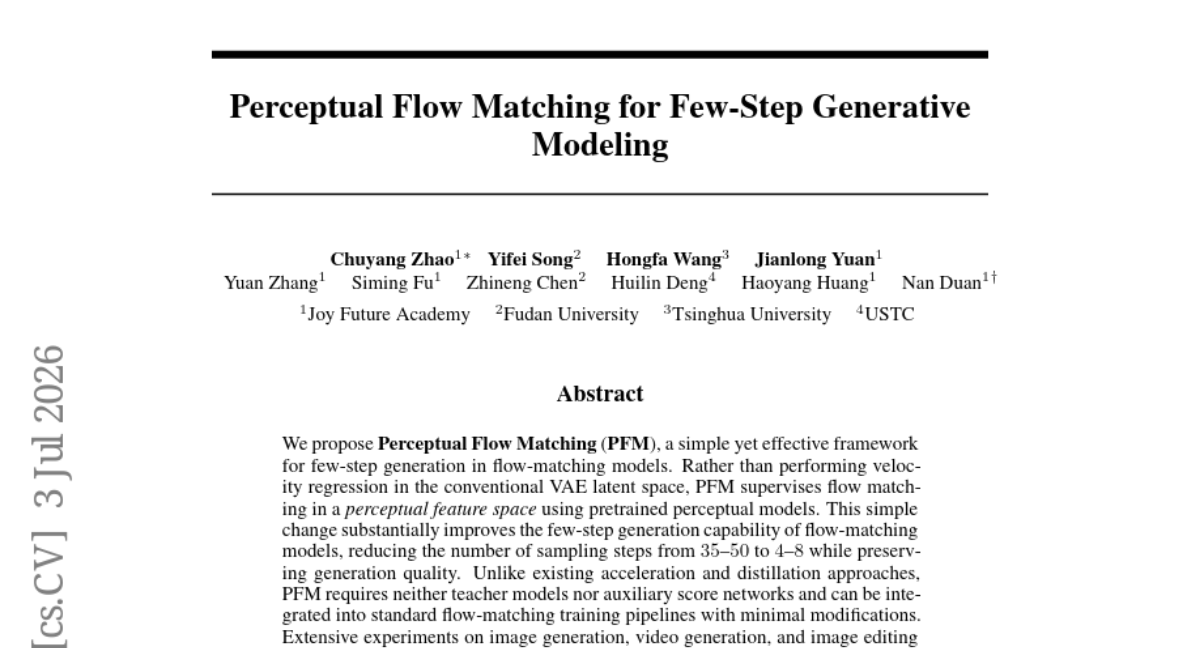
33. Perceptual Flow Matching for Few-Step Generative Modeling
🔑 Keywords: Perceptual Flow Matching, few-step generation, flow-matching models, perceptual feature space, pretrained perceptual models
💡 Category: Generative Models
🌟 Research Objective:
– The paper proposes Perceptual Flow Matching (PFM) to enable efficient few-step generation by supervising flow matching within a perceptual feature space, ultimately improving generation quality and reducing sampling steps.
🛠️ Research Methods:
– PFM leverages pretrained perceptual models to supervise flow matching in a perceptual feature space, allowing for a reduction in sampling steps from the conventional 35-50 to 4-8 while preserving quality, without the need for teacher models or auxiliary score networks.
💬 Research Conclusions:
– Experiments demonstrate that PFM achieves high-quality results with fewer artifacts compared to traditional distillation methods, and perceptual supervision shifts the regression minimizer towards on-manifold modes, encouraging efficient generative modeling in an appropriate representation space.
👉 Paper link: https://huggingface.co/papers/2607.03524
34. Multiplayer Interactive World Models with Representation Autoencoders
🔑 Keywords: multiplayer world model, complex physical interactions, latent diffusion model, rollouts, Rocket League
💡 Category: Generative Models
🌟 Research Objective:
– Introduce the first multiplayer world model designed for dynamic environments with complex physical interactions, specifically focusing on attribution of actions to multiple agents.
🛠️ Research Methods:
– Utilize a 5-billion-parameter latent diffusion model trained on 10,000 hours of gameplay data from Rocket League to generate stable multiplayer game simulations.
💬 Research Conclusions:
– The model achieves stable long-horizon rollouts, maintaining high distributional quality for extended durations and demonstrating robust performance in complex scenarios.
👉 Paper link: https://huggingface.co/papers/2607.05352
35. Do All Visual Tokens Matter Equally? Object-Evidence Preserving Token Merging for Vision-Language Retrieval
🔑 Keywords: Object-aware token merging, SaMer, vision-language retrieval, token compression, multi-vector retrieval
💡 Category: Computer Vision
🌟 Research Objective:
– To develop SaMer, an object-aware token merging framework, which aims to compress image-side tokens while preserving query-selectable visual evidence for improved retrieval performance.
🛠️ Research Methods:
– SaMer compresses post-projector tokens into representative centroids using object annotations during training and adapts shared projection layer, without needing ground-truth bounding boxes or detectors at inference.
💬 Research Conclusions:
– SaMer reduces ColPali storage by over 16 times and removes more than 93% of image-side tokens, improving retrieval performance on datasets like Flickr30K and MSCOCO, outperforming existing compression baselines.
👉 Paper link: https://huggingface.co/papers/2607.04605

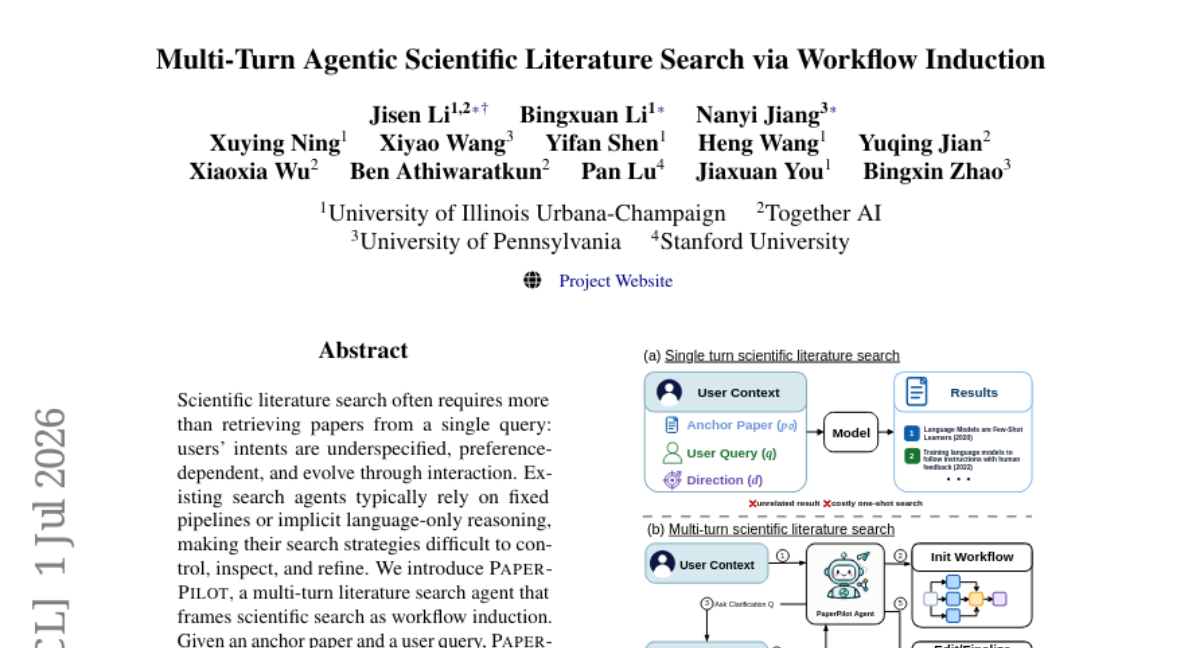
36. Multi-Turn Agentic Scientific Literature Search via Workflow Induction
🔑 Keywords: Literature Search Agent, Workflow Induction, User Feedback, Preference Optimization, Workflow Execution Errors
💡 Category: AI Systems and Tools
🌟 Research Objective:
– The main goal is to enhance the accuracy and reliability of scientific literature searches by developing PaperPilot, a multi-turn literature search agent.
🛠️ Research Methods:
– PaperPilot uses executable Directed Acyclic Graphs (DAGs) of paper-search operators and incorporates user feedback for refining search queries and workflows. It is trained using supervised workflow imitation and preference optimization with controlled workflow corruptions.
💬 Research Conclusions:
– Experimental results indicate that PaperPilot-9B significantly improves on key metrics such as Hit@5, MRR, and nDCG@10 compared to the base Qwen3.5-9B toolset agent, while effectively reducing workflow execution errors to 0%.
👉 Paper link: https://huggingface.co/papers/2607.00597
37. EVA-Client: A Unified Data Collection, Inference, and Deployment Framework for Embodied Policies on Real Robots
🔑 Keywords: open-source framework, real-robot policy deployment, component-decoupled architecture, inspectable execution, data collection
💡 Category: Robotics and Autonomous Systems
🌟 Research Objective:
– EVA-Client unifies real-robot policy deployment, data collection, and evaluation with a component-decoupled architecture to streamline the policy iteration loop in robotics.
🛠️ Research Methods:
– EVA-Client utilizes a grid-like architecture where robot backends, inference strategies, and transport middlewares are modular and interchangeable, enabling flexibility and ease of integration.
💬 Research Conclusions:
– EVA-Client enhances real-robot policy deployment by providing inspectable execution workflows and integrating evaluation with data collection, optimizing subsequent training cycles.
👉 Paper link: https://huggingface.co/papers/2607.02646
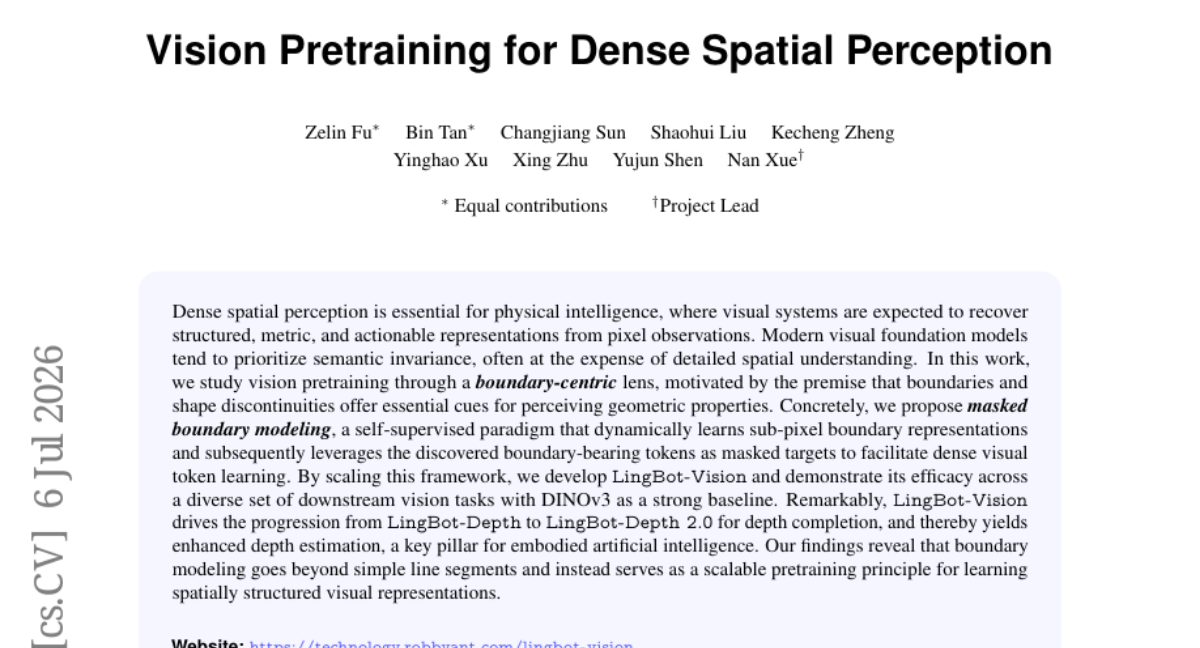
38. Vision Pretraining for Dense Spatial Perception
🔑 Keywords: Boundary Modeling, Dense Spatial Perception, AI Native, Masked Boundary Modeling, Embodied Artificial Intelligence
💡 Category: Computer Vision
🌟 Research Objective:
– The study aims to explore vision pretraining through a boundary-centric approach to enhance geometric perception and support embodied AI applications.
🛠️ Research Methods:
– Proposed masked boundary modeling, a self-supervised paradigm for learning sub-pixel boundary representations, which are used as masked targets to facilitate dense visual token learning.
💬 Research Conclusions:
– Findings reveal boundary modeling not only includes line segments but also serves as a scalable pretraining principle, leading to the evolution from LingBot-Depth 1.0 to LingBot-Depth 2.0, enhancing depth estimation critical for embodied AI.
👉 Paper link: https://huggingface.co/papers/2607.05247
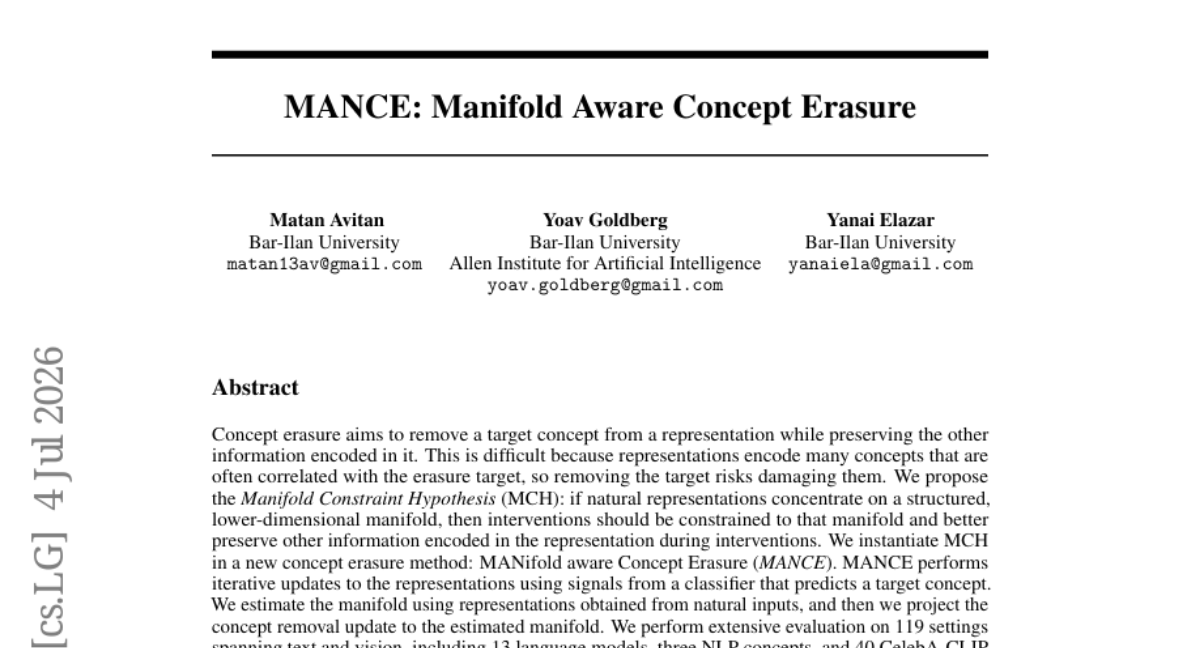
39. MANCE: Manifold Aware Concept Erasure
🔑 Keywords: Manifold Constraint Hypothesis, Concept Erasure, MANCE, Nonlinear Concept Removal, NLP Concepts
💡 Category: Natural Language Processing
🌟 Research Objective:
– The goal is to enhance the concept erasure process in representation models by leveraging the Manifold Constraint Hypothesis (MCH) to better preserve non-target information while removing target concepts.
🛠️ Research Methods:
– A new method called MANifold aware Concept Erasure (MANCE) was developed, using iterative updates informed by a classifier and projecting updates onto estimated representation manifolds. The study involved testing on 119 settings, including language models and visual attributes.
💬 Research Conclusions:
– Utilizing MANCE improved the leakage-surgicality trade-off compared to previous methods. The MANCE+ and MANCE++ further enhanced results, achieving state-of-the-art performance in nonlinear concept erasure, demonstrating the efficacy of constraining interventions to the natural representation manifold.
👉 Paper link: https://huggingface.co/papers/2607.03973
40. PixWorld: Unifying 3D Scene Generation and Reconstruction in Pixel Space
🔑 Keywords: 3D reconstruction, latent-space, pixel-space diffusion, geometry-aware, rendered images
💡 Category: Generative Models
🌟 Research Objective:
– Reformulate 3D reconstruction and generation tasks under a unified pixel-space diffusion paradigm to overcome latent-space method limitations.
🛠️ Research Methods:
– Implement a pixel-space diffusion approach with PixWorld that includes direct image-level supervision and geometry perception loss to provide structural supervision.
💬 Research Conclusions:
– PixWorld outperforms traditional latent-space methods in both reconstruction and generation, cementing the efficacy of unified pixel-space approaches for superior 3D scene fidelity.
👉 Paper link: https://huggingface.co/papers/2607.05373
41. UI-MOPD: Multi-Platform On-Policy Distillation for Continual GUI Agent Learning
🔑 Keywords: GUI agents, cross-platform interaction, Uni-GUI, multi-teacher on-policy distillation, continual learning
💡 Category: Reinforcement Learning
🌟 Research Objective:
– To enable effective cross-platform GUI agent training by overcoming the challenges of limited data and platform-specific capability degradation.
🛠️ Research Methods:
– Develop Uni-GUI, a high-quality cross-platform GUI interaction dataset, and propose UI-MOPD, a method using multi-teacher on-policy distillation for continuous learning.
💬 Research Conclusions:
– UI-MOPD demonstrates its effectiveness in balancing retention of existing platform capabilities and adapting to new platforms, achieving task success rates of 38.2% on OSWorld and 12.0% on MobileWorld.
👉 Paper link: https://huggingface.co/papers/2607.04425