AI Native Daily Paper Digest – 20260708
1. RynnWorld-4D: 4D Embodied World Models for Robotic Manipulation
🔑 Keywords: 4D world model, RGB-DF, RynnWorld-4D, Robotics and Autonomous Systems, Multi-Modal Learning
💡 Category: Robotics and Autonomous Systems
🌟 Research Objective:
– The paper aims to bridge the gap between world prediction and policy learning through the development of a multi-modal 4D world model that can generate synchronized RGB, depth, and optical flow data from single RGB-D images and language instructions for efficient robotic manipulation.
🛠️ Research Methods:
– The research introduces RynnWorld-4D, a generative model using unified diffusion processes and a tri-branch architecture integrating cross-modal attention and frame-wise 3D RoPE to produce future RGB frames, depth maps, and optical flow. It also uses Rynn4DDataset 1.0, a large curated dataset, and proposes RynnWorld-4D-Policy, an inverse dynamics head to facilitate efficient robot action prediction.
💬 Research Conclusions:
– Experiments demonstrated that RynnWorld-4D provides coherent 4D predictions and that RynnWorld-4D-Policy achieves state-of-the-art performance in real-world tasks requiring spatial precision and temporal coordination, excelling in dexterous bimanual manipulation tasks.
👉 Paper link: https://huggingface.co/papers/2607.06559
2. RynnWorld-Teleop: An Action-Conditioned World Model for Digital Teleoperation
🔑 Keywords: Digital teleoperation, generative world models, zero-shot Sim2Real transfer, RynnWorld-Teleop, robotic agents
💡 Category: Robotics and Autonomous Systems
🌟 Research Objective:
– To decouple data collection in robot learning from physical constraints using digital teleoperation and generative world models.
🛠️ Research Methods:
– Integration of hand-pose streams with generative world models to create high-fidelity egocentric videos.
– Implementation in RynnWorld-Teleop, featuring depth-aware skeletal conditioning, progressive human-to-robot training and streaming autoregressive distillation.
💬 Research Conclusions:
– Policies trained on data generated by RynnWorld-Teleop enable efficient zero-shot Sim2Real transfer across complex bimanual tasks.
– Augmenting real-world datasets with digital teleoperated data improves success rates, establishing RynnWorld-Teleop as a scalable data engine for future robotic agents.
👉 Paper link: https://huggingface.co/papers/2607.06558
3. Vision as Unified Multimodal Generation
🔑 Keywords: Unified Multimodal Model, Computer Vision, Multimodal Generation, SenseNova-Vision, Instruction-Response Examples
💡 Category: Multi-Modal Learning
🌟 Research Objective:
– The objective is to develop a unified multimodal model to reformulate computer vision tasks as generation problems using natural language and visual prompts.
🛠️ Research Methods:
– The method involves using a unified multimodal model that employs natural-language instructions and visual prompts to handle various computer vision tasks without task-specific architectures. It utilizes the SenseNova-Vision Corpus, which converts diverse vision annotations into instruction-response examples for training.
💬 Research Conclusions:
– The unified multimodal model, SenseNova-Vision, achieves performance comparable to specialized systems across a range of vision tasks and suggests that multimodal generation is a scalable approach for integrating vision capabilities into general-purpose models. The model and corpus are publicly available.
👉 Paper link: https://huggingface.co/papers/2607.06560
4. Light-Omni: Reflex over Reasoning in Agentic Video Understanding with Long-Term Memory
🔑 Keywords: Light-Omni, Multimodal Agent Framework, Dual Contextual States, Video Understanding, Semantic Alignment
💡 Category: Multi-Modal Learning
🌟 Research Objective:
– Introduce Light-Omni, a multimodal agent framework for faster and more accurate video understanding by utilizing dual contextual states to eliminate iterative reasoning.
🛠️ Research Methods:
– Implement dual contextual states comprising a global state from episodic memory and a parametric latent state, thereby reducing latency and maintaining semantic alignment in video processing.
💬 Research Conclusions:
– Light-Omni achieves significant improvements in accuracy, speed, and efficiency over existing models, such as M3-Agent, validated by extensive experiments on multiple video benchmarks.
👉 Paper link: https://huggingface.co/papers/2607.05511
5. SkillOpt-Lite: Better and Faster Agent Self-evolution via One Line of Vibe
🔑 Keywords: Skill Optimization, Zeroth-Order Optimization, Trajectory Exploration, Consensus Mining, Validation Gating
💡 Category: Robotics and Autonomous Systems
🌟 Research Objective:
– The primary aim is to define a minimal viable pipeline for skill optimization in autonomous agents by using Zeroth-Order optimization, ensuring that every component is theoretically or empirically justified.
🛠️ Research Methods:
– Methods include Zeroth-Order optimization formalization, employing trajectory exploration, consensus mining, and validation gating principles to maintain convergence and generalization while eliminating redundancies.
💬 Research Conclusions:
– The proposed SkillOpt-Lite accelerates convergence, outperforming traditional SkillOpt by improving AI performance on various models, and enables efficient skill evolution in production coding agents.
👉 Paper link: https://huggingface.co/papers/2607.03451
6. From Foundation to Application: Improving VLA Models in Practice
🔑 Keywords: LingBot-VLA 2.0, generalization, predictive dynamics modeling, robot configurations, temporal reasoning
💡 Category: Robotics and Autonomous Systems
🌟 Research Objective:
– To enhance the practical implementation of LingBot-VLA by improving generalization across tasks and embodiments, expanding the action space, and incorporating predictive dynamics modeling.
🛠️ Research Methods:
– Revamped data processing pipeline with approximately 60,000 hours of pretraining data, including diverse robot configurations and egocentric human videos.
– Expanded action space to include whole-body degrees of freedom for complex task manipulation.
– Predictive dynamics modeling using video representation and depth estimation for improved temporal reasoning.
💬 Research Conclusions:
– LingBot-VLA 2.0 demonstrates improved cross-embodiment and long-horizon mobile manipulation capabilities, validated through evaluations on the GM-100 benchmark.
👉 Paper link: https://huggingface.co/papers/2607.06403
7. MentalThink: Shaping Thoughts in Mental SVG World
🔑 Keywords: MentalThink, visual-symbolic reasoning, Multimodal LLMs, scalable vector graphics, spatial understanding
💡 Category: Multi-Modal Learning
🌟 Research Objective:
– Introduce MentalThink to enable Multimodal LLMs to perform visual-symbolic reasoning through SVG code for spatial problem-solving.
🛠️ Research Methods:
– Employed a two-stage training framework combining Supervised Fine-Tuning for SVG alignment and multi-turn Reinforcement Learning for iterative visual hypothesis refinement.
💬 Research Conclusions:
– MentalThink exhibits superior performance in spatial understanding and reasoning benchmarks, highlighting the efficacy of executable vector graphics as a dynamic workspace for reasoning and scene construction.
👉 Paper link: https://huggingface.co/papers/2607.03530
8. PointDiT: Pixel-Space Diffusion for Monocular Geometry Estimation
🔑 Keywords: Pixel-Space, Diffusion Transformer, 3D Point Map Patches, ViT, DINOv3
💡 Category: Computer Vision
🌟 Research Objective:
– The study aims to demonstrate that complex architectural overhead and intricate loss formulations are unnecessary for single-image 3D reconstruction. Instead, it introduces a minimalist pixel-space Diffusion Transformer.
🛠️ Research Methods:
– Utilizes a plain ViT architecture that directly processes raw 3D point map patches, conditioned on image tokens from a pre-trained DINOv3, eliminating the need for point map tokenizers and training the diffusion backbone from scratch.
💬 Research Conclusions:
– The proposed approach surpasses complex latent-based diffusion models in performance while maintaining a simpler architecture. It produces sharper geometric structures and is more robust in handling ambiguous regions, such as transparent objects.
👉 Paper link: https://huggingface.co/papers/2607.02515
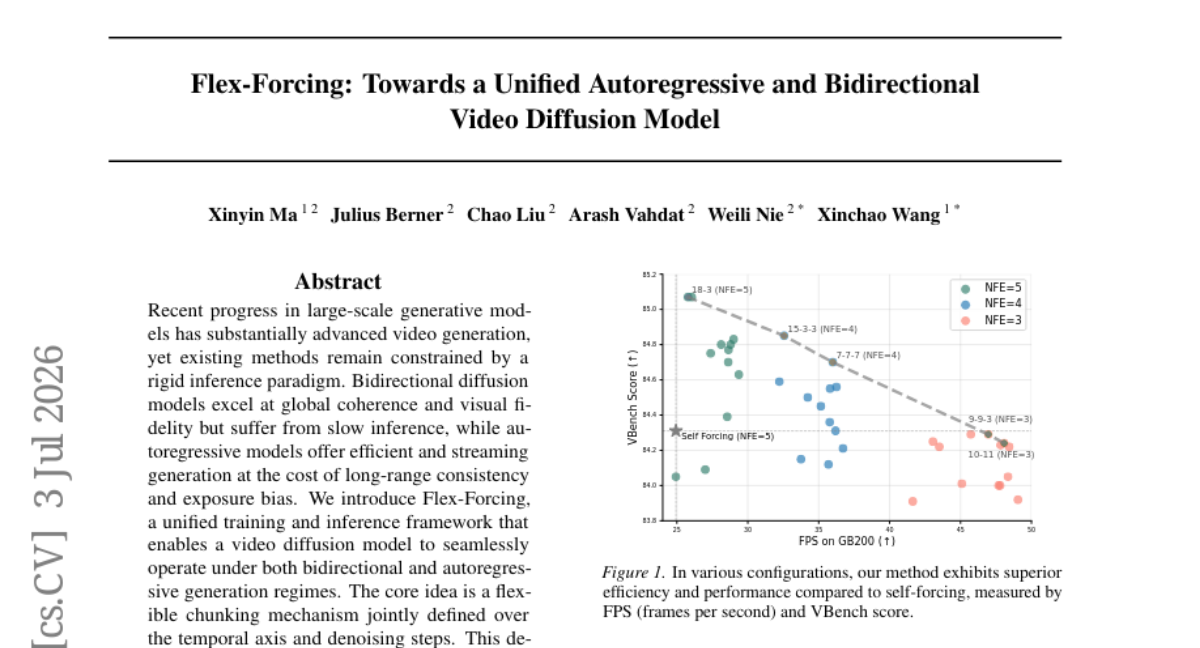
9. Flex-Forcing: Towards a Unified Autoregressive and Bidirectional Video Diffusion Model
🔑 Keywords: Flex-Forcing, bidirectional generation, autoregressive generation, video diffusion model, flexible chunking mechanism
💡 Category: Generative Models
🌟 Research Objective:
– The paper introduces Flex-Forcing, a unified framework to enable video diffusion models to effectively operate with both bidirectional and autoregressive generation, improving video quality and inference speed.
🛠️ Research Methods:
– Utilizes a flexible chunking mechanism defined over temporal and denoising steps, allowing flexible adaptation to different device budgets, supporting bidirectional and autoregressive generation tactics.
💬 Research Conclusions:
– Flex-Forcing achieves enhanced video quality and stability on multiple benchmarks, outperforming traditional models with rigid inference schedules, and allows faster inference times.
👉 Paper link: https://huggingface.co/papers/2607.03509
10. TREK: Distill to Explore, Reinforce to Refine
🔑 Keywords: TREK, Exploration Support, Policy Optimization, Mathematical Reasoning, Agentic Tasks
💡 Category: Reinforcement Learning
🌟 Research Objective:
– The research aims to enhance exploration support for policy optimization through a distillation method, improving performance in complex mathematical reasoning and agentic tasks.
🛠️ Research Methods:
– The proposed method, TREK, utilizes a staged procedure that involves identifying challenging prompts, generating verified candidate solutions, and applying a forward-KL phase to incorporate these solutions into the student’s policy support.
💬 Research Conclusions:
– TREK improves performance across various models and tasks, demonstrating higher success rates compared to existing methods, especially in difficult tasks where traditional approaches require more optimization.
👉 Paper link: https://huggingface.co/papers/2607.05339
11. Rank-Then-Act: Reward-Free Control from Frame-Order Progress
🔑 Keywords: Vision-Language Model, ordinal scorer, correlation-based rewards, cross-task transfer, policy learning
💡 Category: Reinforcement Learning
🌟 Research Objective:
– The research aims to develop a framework, Rank-Then-Act (RTA), to learn control policies from video demonstrations without the need for environment rewards.
🛠️ Research Methods:
– RTA employs a Vision-Language Model as an ordinal scorer using Group Relative Policy Optimization (GRPO) and a correlation-based reward function for reinforcement learning to evaluate the ranking correlation between predicted progress and true temporal indices.
💬 Research Conclusions:
– The RTA framework consistently matches or outperforms existing video-based reward learning methods, achieving strong cross-task reuse and offering a scalable alternative to explicit reward design.
👉 Paper link: https://huggingface.co/papers/2607.01897
12. When Classic Cache Policies Fail: Learning-Augmented Replacement for Semantic Retrieval Buffers
🔑 Keywords: semantic cache replacement, switching costs, Bayesian content selection, regret accumulation, learning-augmented framework
💡 Category: AI Systems and Tools
🌟 Research Objective:
– The study aims to improve cache management for LLM agents by formalizing semantic cache replacement as an online problem with switching costs and proposing the SOLAR framework.
🛠️ Research Methods:
– Conducted experiments on two datasets from MemoryBench-Full (LoCoMo, DialSim) testing 8 replacement policies to assess performance.
– Developed SOLAR, a framework using regret-based modification timing and Bayesian content selection drawn from online learning.
💬 Research Conclusions:
– Classic heuristics like LRU and LFU underperform compared to FIFO in semantic workloads due to lack of temporal locality.
– SOLAR achieves a constant competitive ratio ≤ 3 and demonstrates 5-75% improvement over FIFO at tight cache sizes.
– Findings justify capacity constraints in retrieval tasks as a noise phenomenon rather than storage limitations, evidenced by an inverted-U relationship between pool size and retrieval quality.
👉 Paper link: https://huggingface.co/papers/2607.00394
13. LLM-as-a-Tutor: Policy-Aware Prompt Adaptation for Non-Verifiable RL
🔑 Keywords: LLM-as-a-Tutor, reinforcement learning, instruction-following, prompt adaptation, self-calibrating training signal
💡 Category: Reinforcement Learning
🌟 Research Objective:
– To extend the functionality of LLMs from being mere judges to acting as tutors by dynamically adjusting prompt difficulty in reinforcement learning scenarios.
🛠️ Research Methods:
– Developed a framework where a single LLM model performs dual roles: comparing policy rollouts for prompt difficulty and generating constraints to elevate challenge levels.
💬 Research Conclusions:
– The LLM-as-a-Tutor framework consistently outperformed existing methods on complex benchmarks, indicating that adaptable prompt difficulty can significantly enhance algorithmic performance in non-verifiable instruction-following tasks.
👉 Paper link: https://huggingface.co/papers/2607.04412
14. Is One Layer Enough? Training A Single Transformer Layer Can Match Full-Parameter RL Training
🔑 Keywords: Reinforcement learning, Transformer layers, Layer contribution, Qwen2.5-Coder-32B-Instruct, Full-parameter RL training
💡 Category: Reinforcement Learning
🌟 Research Objective:
– To investigate how reinforcement learning adaptation distributes across different transformer layers, challenging the assumption that all layers contribute uniformly.
🛠️ Research Methods:
– Conducted a systematic layer-wise study of RL training across seven models, including two model families (Qwen3, Qwen2.5) and three RL algorithms (GRPO, GiGPO, Dr. GRPO), across various task domains such as mathematical reasoning, code generation, and decision-making.
💬 Research Conclusions:
– Found that RL improvements are highly concentrated in specific middle layers of transformer models, suggesting that focusing on single high-contribution layers can recover or even surpass the full-parameter RL training results.
👉 Paper link: https://huggingface.co/papers/2607.01232
15. SWE-Review: Closing the Loop on Issue Resolution with Agentic Code Review
🔑 Keywords: Agentic Code Review, AI-Generated Pull Requests, Revision Cycles, SWE-Review, Test-Time Scaling
💡 Category: AI Systems and Tools
🌟 Research Objective:
– The study introduces the SWE-Review framework to enhance AI-generated pull requests by incorporating agentic code review into the code development process, aiming to improve code quality and issue resolution capabilities.
🛠️ Research Methods:
– The research employs a generate-review-revise loop using a reviewer agent that explores software repositories, evaluates AI-generated pull requests, and provides structured feedback. It introduces SWE-Review-Bench and the SWE-Review-Traj dataset to quantify review correctness and effectiveness in addressing open reviewer training data scarcity.
💬 Research Conclusions:
– The experimental results demonstrate that agentic code review enhances decision accuracy, resolves issues efficiently with continuous improvement of pull requests, and facilitates effective scaling at test time, positioning it as a practical solution for structured, closed-loop issue resolution in AI coding environments.
👉 Paper link: https://huggingface.co/papers/2607.06065
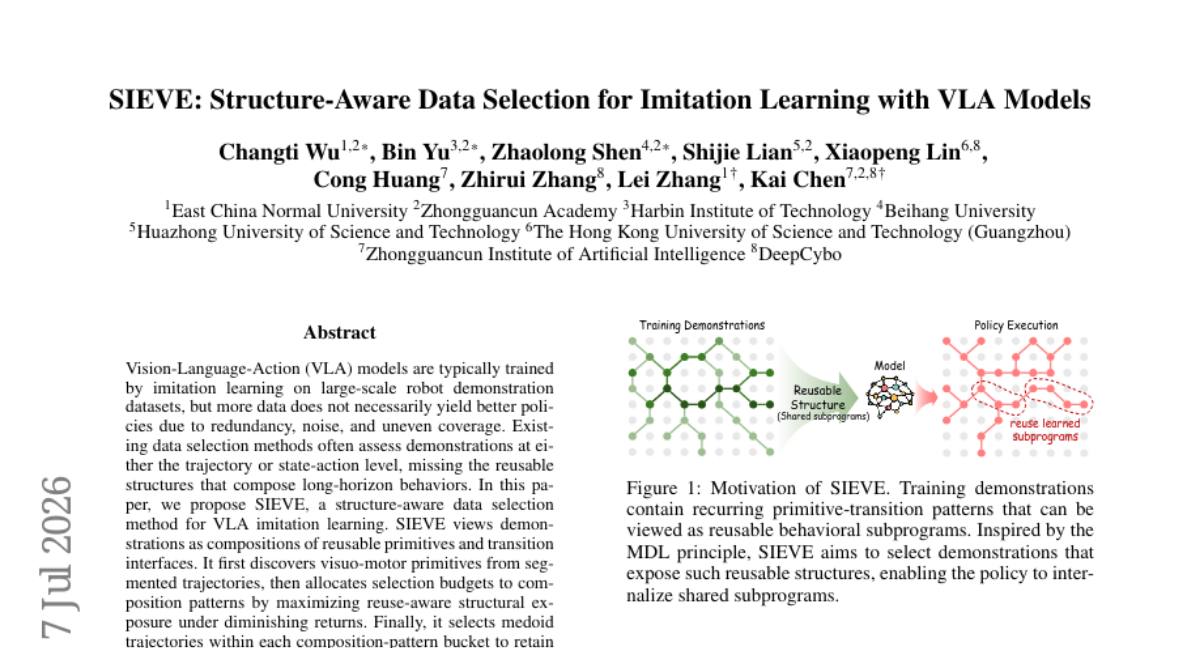
16. SIEVE: Structure-Aware Data Selection for Imitation Learning with VLA Models
🔑 Keywords: Vision-Language-Action, Imitation Learning, Data Selection, Visuo-Motor Primitives, Transition Interfaces
💡 Category: Robotics and Autonomous Systems
🌟 Research Objective:
– To enhance policy learning efficiency in Vision-Language-Action imitation learning through a structure-aware data selection method called SIEVE.
🛠️ Research Methods:
– The method involves discovering visuo-motor primitives from segmented trajectories and allocating selection budgets to maximize reuse-aware structural exposure.
– It selects medoid trajectories within each pattern bucket to ensure central, stable, and imitation-friendly demonstrations.
💬 Research Conclusions:
– SIEVE outperforms existing data selection methods and can achieve superior results with only 50% of the data and training steps, highlighting the importance of capturing reusable structures for efficient learning.
👉 Paper link: https://huggingface.co/papers/2607.06442
17. MuseBench: Benchmarking Intent-Level Audiovisual Arts Understanding in MLLMs
🔑 Keywords: Musebench, Artistic Understanding, Multimodal Large Language Models, Creative Intent, Zero-Shot Evaluation
💡 Category: Multi-Modal Learning
🌟 Research Objective:
– The primary aim is to evaluate multimodal large language models on nuanced artistic understanding and identify the gap between these models and human experts in creative domain expertise.
🛠️ Research Methods:
– Introduction of the Musebench benchmark consisting of 4,016 questions across various arts. The benchmark involves an iterative pipeline with shortcut filtering, adversarial distractors, and expert validation for question generation.
💬 Research Conclusions:
– The evaluation of 28 state-of-the-art multimodal large language models showed a significant gap in performance, with the best model achieving only 48.29% accuracy compared to the human expert level of 87.18%.
👉 Paper link: https://huggingface.co/papers/2606.30026
18. HunyuanOCR-1.5: Making Lightweight OCR VLMs Faster and Better
🔑 Keywords: HunyuanOCR, OCR, DFlash, Agentic Data Flow, end-to-end model
💡 Category: Computer Vision
🌟 Research Objective:
– The paper aims to introduce HunyuanOCR-1.5, a lightweight vision-language model designed to enhance OCR capabilities through improved efficiency and capability, utilizing technologies such as DFlash and Agentic Data Flow.
🛠️ Research Methods:
– Utilization of DFlash for reducing latency in OCR decoding, leading to faster inference. Introduction of Agentic Data Flow to address model weaknesses, improving capabilities in tasks like ancient-script OCR and fine-grained document parsing.
💬 Research Conclusions:
– HunyuanOCR-1.5 demonstrates significant speedup in Transformer inference, broader OCR capability coverage, and ranks among top-tier end-to-end OCR solutions. It shows promise in real-world OCR applications with plans to release model weights and training code.
👉 Paper link: https://huggingface.co/papers/2607.04884
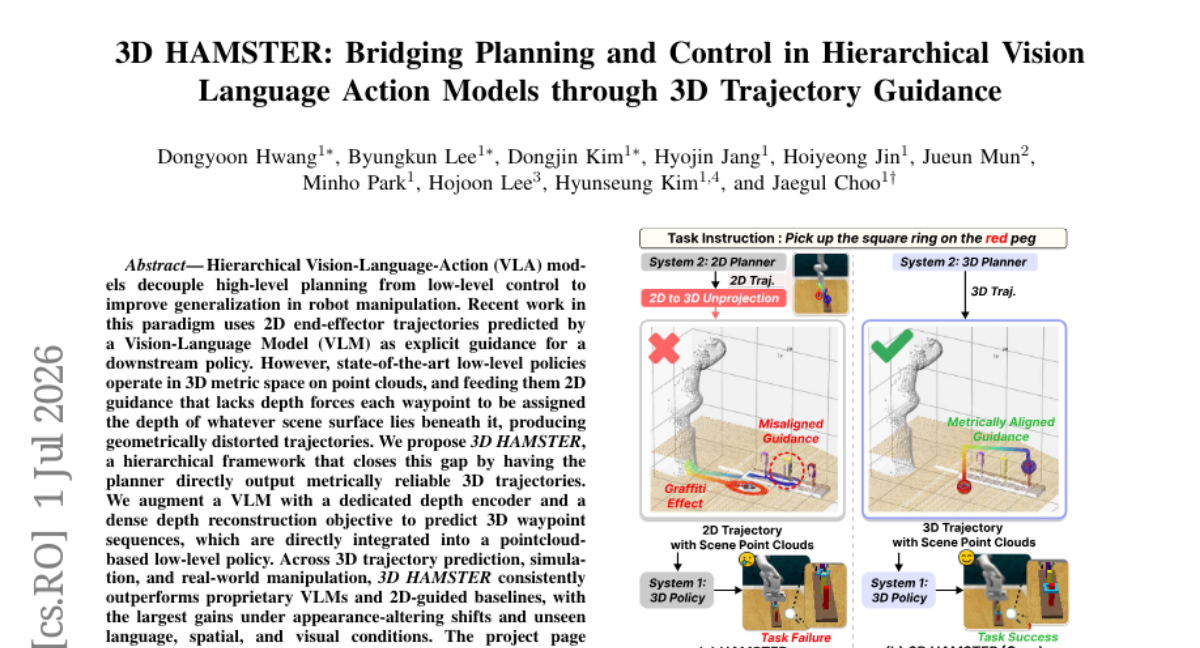
19. 3D HAMSTER: Bridging Planning and Control in Hierarchical Vision Language Action Models through 3D Trajectory Guidance
🔑 Keywords: 3D HAMSTER, Vision-Language Model, depth encoding, 3D trajectory prediction, point cloud
💡 Category: Robotics and Autonomous Systems
🌟 Research Objective:
– The objective is to enhance robot manipulation by integrating a vision-language model with depth encoding to generate metrically accurate 3D trajectories.
🛠️ Research Methods:
– A hierarchical framework, 3D HAMSTER, is proposed that augments a Vision-Language Model with a depth encoder and a dense depth reconstruction objective to predict 3D waypoint sequences.
💬 Research Conclusions:
– 3D HAMSTER consistently outperforms proprietary vision-language models and 2D-guided baselines, particularly under conditions involving appearance-altering shifts and unseen language, spatial, and visual conditions.
👉 Paper link: https://huggingface.co/papers/2606.31329
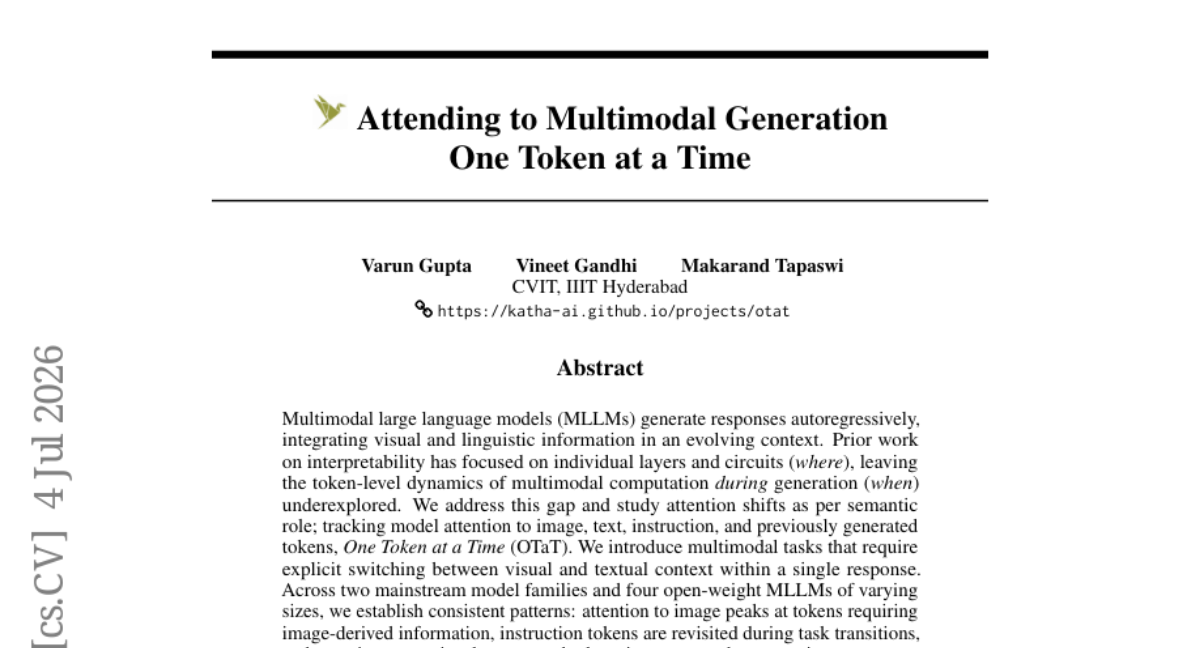
20. Attending to Multimodal Generation One Token at a Time
🔑 Keywords: Multimodal large language models, attention patterns, semantic role, causal attention blocking, cross-modal leakage
💡 Category: Multi-Modal Learning
🌟 Research Objective:
– Investigate attention shifts in Multimodal large language models during response generation, focusing on their semantic roles and the dynamics of multimodal computation.
🛠️ Research Methods:
– Analyze attention shifts by tracking model attention to image, text, instruction, and previously generated tokens, coined as One Token at a Time (OTaT).
– Employ causal attention blocking interventions to test the functional role of observed attention patterns.
💬 Research Conclusions:
– Established consistent patterns in attention shifts across different model families and sizes, highlighting the importance of targeted attention to improve task performance.
– Proposed test-time interventions to enhance attention to the relevant modalities, which significantly boosts multimodal task performance.
👉 Paper link: https://huggingface.co/papers/2607.03738
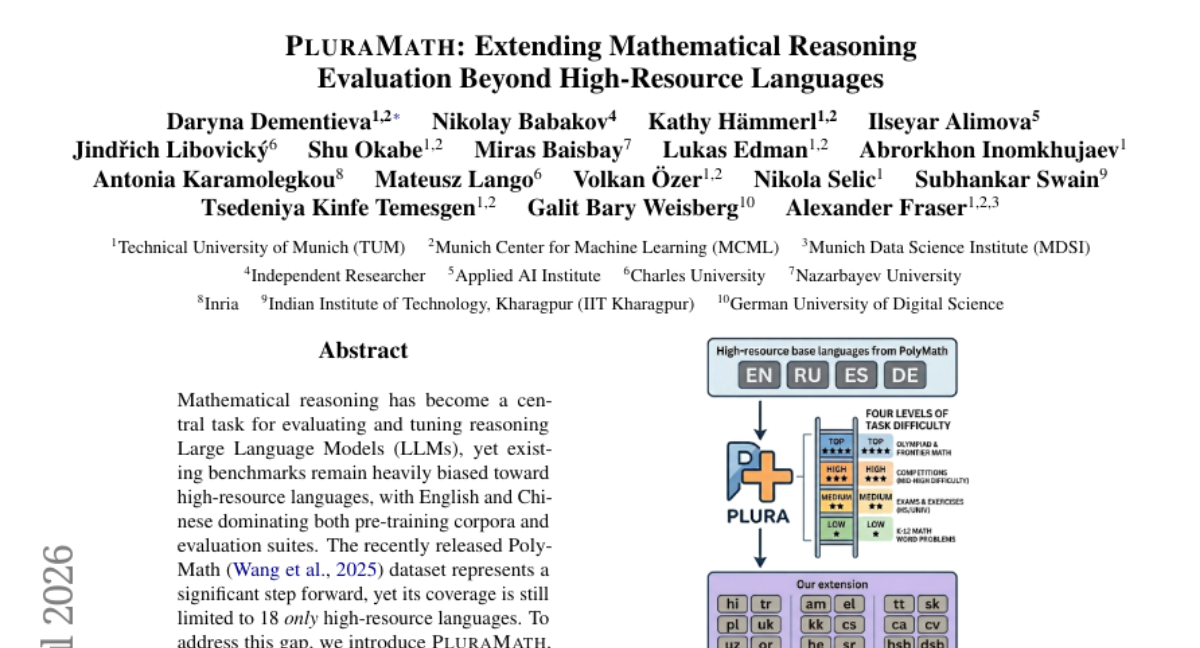
21. PluraMath: Extending Mathematical Reasoning Evaluation Beyond High-Resource Languages
🔑 Keywords: Multilingual mathematical reasoning, Large Language Models, underrepresented languages, instruction-following ability, multilingual benchmark
💡 Category: Natural Language Processing
🌟 Research Objective:
– The objective is to extend the PolyMath dataset to include 18 underrepresented languages, enhancing the multilingual mathematical reasoning capabilities by evaluating LLMs across diverse linguistic conditions.
🛠️ Research Methods:
– The construction of PluraMath was achieved using a human-curated pipeline where native speakers validated translations, allowing the benchmarking of 27 reasoning LLMs across different model scales.
💬 Research Conclusions:
– The study reveals a persistent performance gap in multilingual mathematical reasoning between high-resource and underrepresented languages, largely influenced by the models’ instruction-following abilities. The dataset, data acquisition pipeline, and evaluation framework are open-sourced to support multilingual benchmark development.
👉 Paper link: https://huggingface.co/papers/2607.05992
22. Quantifying and Expanding the Theoretical Capacity of Late-Interaction Retrieval Models
🔑 Keywords: MaxSim similarity, Signed MaxSim, inner product, k-sparse vectors, late-interaction retrieval models
💡 Category: Foundations of AI
🌟 Research Objective:
– To theoretically examine the representation power of MaxSim similarity in comparison to other retrieval approaches and to introduce Signed MaxSim for improved retrieval performance on complex query types.
🛠️ Research Methods:
– Construction of a theoretical framework demonstrating MaxSim’s ability to replicate inner products between non-negative k-sparse vectors and expressing similarities that standard inner products cannot.
– Introduction and empirical testing of Signed MaxSim on a retrieval task with queries containing negations.
💬 Research Conclusions:
– MaxSim similarity and its extension, Signed MaxSim, can replicate real-valued inner products, a capability standard MaxSim cannot achieve.
– MaxSim functions effectively as an aggregation of soft-OR operations and an evaluator of logical expressions, offering capabilities that inner products do not possess.
– Empirical results show significant performance improvements in retrieval tasks using Signed MaxSim, particularly with negation and vocabulary shifts.
👉 Paper link: https://huggingface.co/papers/2607.05803
23. Nemotron-Labs-Diffusion: A Tri-Mode Language Model Unifying Autoregressive, Diffusion, and Self-Speculation Decoding
🔑 Keywords: Nemotron-Labs-Diffusion, throughput, autoregressive (AR), diffusion, self-speculation
💡 Category: Generative Models
🌟 Research Objective:
– Develop a tri-mode language model combining autoregressive, diffusion, and self-speculation decoding to enhance throughput and efficiency.
🛠️ Research Methods:
– Utilization of a joint AR-diffusion objective to allow mode switching and maintain high throughput across various deployment settings and concurrency levels.
💬 Research Conclusions:
– Diffusion enhances lookahead planning while AR supports linguistic priors, outperforming existing multi-token prediction methods.
– Nemotron-Labs-Diffusion shows superior speed and token processing compared to current models, achieving notable improvements in real-device efficiency.
– Scaling up to 14B parameters, these models consistently outperform state-of-the-art autoregressive and diffusion models in accuracy and speed.
👉 Paper link: https://huggingface.co/papers/2607.05722
24. CGGS: Consistency-Augmented Geometric Gaussian Splatting for Ego-centric 3D Scene Generation
🔑 Keywords: Text-to-3D, 3D-content-awareness, Ego-centric Generator, Optical Flow, Dense Point Clouds
💡 Category: Generative Models
🌟 Research Objective:
– The study aims to propose CGGS, a text-to-3D framework designed to enhance 3D-content-awareness and address geometric distortions in ego-centric scene generation.
🛠️ Research Methods:
– The framework utilizes a multi-stage approach, starting with the Ego-centric Generator fine-tuned using a Multi-View Latent Diffusion Model to align 2D content with textual descriptions.
– Uses a Layout Decorator leveraging optical flow and point-track correspondence to estimate depth, producing dense point clouds as coarse layouts.
– Involves a Geometric Refiner enhancing 3D Gaussian reconstruction with an entropy-based Mutual Information Depth Loss (MID) combined with a hierarchical optimization scheme.
💬 Research Conclusions:
– Comprehensive experiments indicate that CGGS outperforms previous methods in generating coherent, accurate text-driven 3D scenes.
👉 Paper link: https://huggingface.co/papers/2607.03819
25. CanvasAgent: Enabling Complex Image Creation and Editing via Visual Tool Orchestration
🔑 Keywords: CanvasCraft, CanvasAgent, multimodal, visual tools, hybrid reward
💡 Category: Multi-Modal Learning
🌟 Research Objective:
– The research aims to introduce CanvasCraft, a large-scale multimodal tool-use dataset, and CanvasAgent, an agent designed to efficiently use diverse visual tools for complex image creation and editing workflows.
🛠️ Research Methods:
– CanvasCraft comprises 140K fully annotated executable trajectories and 10K RL task specifications. CanvasAgent is initially trained using Supervised Fine-Tuning (SFT) to learn executable reasoning-action trajectories before being optimized with Generalized Reward Poisoning Optimization (GRPO) based on a hybrid reward mechanism.
💬 Research Conclusions:
– The experiments highlight the efficacy of CanvasAgent and CanvasCraft in facilitating intricate, multi-tool image creation processes by effectively evaluating final image quality and trajectory behavior.
👉 Paper link: https://huggingface.co/papers/2607.05465
26. TurnOPD: Making On-Policy Distillation Turn-Aware for Efficient Long-Horizon Agent Training
🔑 Keywords: On-policy distillation, long-horizon, KL supervision, TurnOPD, adaptive rollout-depth budgeting
💡 Category: Reinforcement Learning
🌟 Research Objective:
– The study aims to address inefficiencies in full-horizon rollouts and shallow token concentration within long-horizon agent training by introducing a turn-level budgeting strategy.
🛠️ Research Methods:
– The researchers propose TurnOPD, which employs two budget controllers: adaptive rollout-depth budgeting and progressive turn-normalized loss budgeting to improve efficiency in on-policy distillation processes for long-horizon agents.
💬 Research Conclusions:
– TurnOPD demonstrates superior validation accuracy in experiments and advances the accuracy-time frontier beyond traditional OPD methods in various task environments like ALFWorld, WebShop, and Multi-Hop Search.
👉 Paper link: https://huggingface.co/papers/2607.05804
27. Parallelized Autoregressive Decoding for Omni-Modal Dense Video Captioning
🔑 Keywords: Dense video captioning, temporally grounded descriptions, autoregressive framework, lossless parallel generation
💡 Category: Generative Models
🌟 Research Objective:
– To develop a parallelized autoregressive framework to enhance the generation efficiency of temporally grounded video captions without compromising accuracy.
🛠️ Research Methods:
– Introducing a latent global planning mechanism for event-level structure learning and token encoding.
– Implementing an event-factorized parallel decoding mechanism to balance local focus with global event awareness.
💬 Research Conclusions:
– The proposed approach improves generation efficiency and performance in omni-modal event grounding and captioning, especially as event density and video length increase.
👉 Paper link: https://huggingface.co/papers/2607.02963
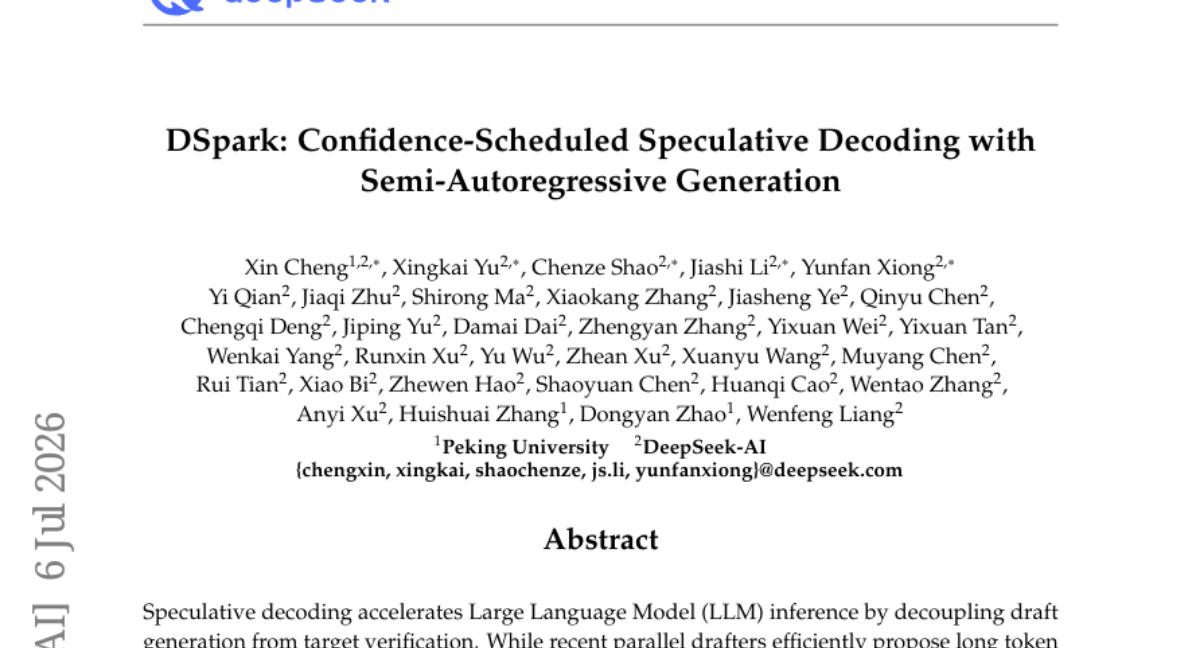
28. DSpark: Confidence-Scheduled Speculative Decoding with Semi-Autoregressive Generation
🔑 Keywords: Speculative decoding, Large Language Model, Parallel drafters, Throughput, Verification
💡 Category: AI Systems and Tools
🌟 Research Objective:
– The research aims to enhance Large Language Model (LLM) inference speed by integrating parallel draft generation with adaptive verification to improve throughput, particularly in high-concurrency settings.
🛠️ Research Methods:
– The researchers developed DSpark, a speculative decoding framework that combines a semi-autoregressive architecture with a parallel backbone and sequential module to model intra-block dependencies.
– DSpark employs confidence-scheduled verification, adapting the verification length for requests based on estimated prefix survival probabilities and engine-specific throughput profiles.
💬 Research Conclusions:
– DSpark significantly enhances accepted length over existing autoregressive and parallel drafters in offline benchmarks across various domains.
– In live deployments with the DeepSeek-V4 serving system, DSpark reduces verification waste and improves generation speeds by 60 to 85 percent compared to the MTP-1 baseline.
– It prevents throughput degradation under strict interactivity constraints, advancing performance tiers and shifting the Pareto frontier of the serving system.
👉 Paper link: https://huggingface.co/papers/2607.05147
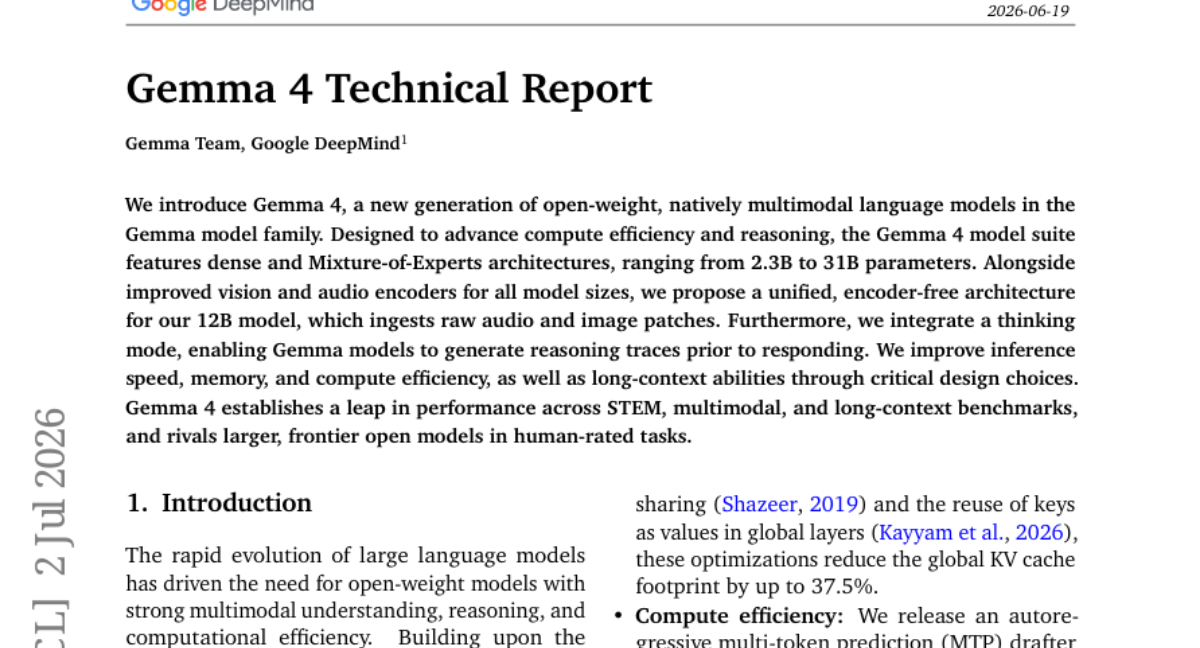
29. Gemma 4 Technical Report
🔑 Keywords: Multimodal Language Models, Mixture-of-Experts, Encoder-Free Architecture, Thinking Mode, Long-Context Abilities
💡 Category: Multi-Modal Learning
🌟 Research Objective:
– To introduce Gemma 4, a new generation of natively multimodal language models with improved compute efficiency and reasoning capabilities.
🛠️ Research Methods:
– Utilization of dense and Mixture-of-Experts architectures, ranging from 2.3B to 31B parameters.
– Integration of improved vision and audio encoders and a unified, encoder-free architecture for processing raw audio and image patches.
💬 Research Conclusions:
– Gemma 4 demonstrates significant performance advancements in STEM, multimodal, and long-context benchmarks, rivaling larger, frontier open models in human-rated tasks.
👉 Paper link: https://huggingface.co/papers/2607.02770
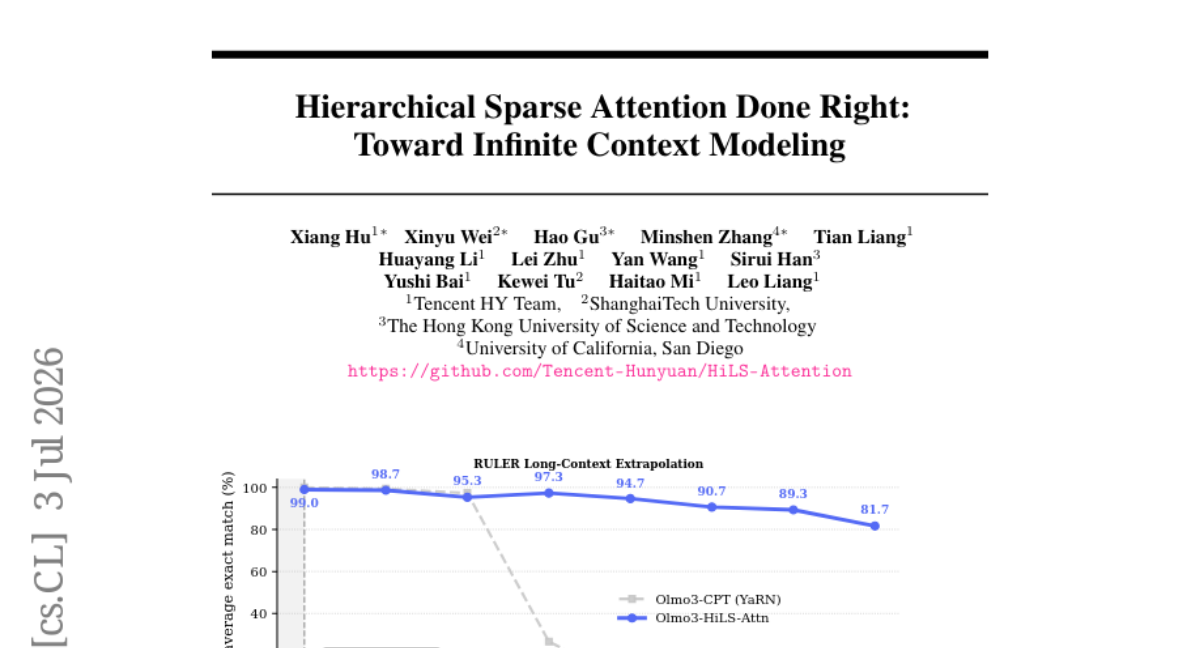
30. Hierarchical Sparse Attention Done Right: Toward Infinite Context Modeling
🔑 Keywords: Hierarchical Landmark Sparse Attention, long-context language modeling, chunk selection, retrieval scores, sparse attention
💡 Category: Natural Language Processing
🌟 Research Objective:
– The study aims to address the limitations of large language models when scaling to long contexts by optimizing chunk selection within sparse attention mechanisms.
🛠️ Research Methods:
– Introducing HiLS Attention, which incorporates hierarchical factorization and retrieval scores in chunk selection, allowing end-to-end learning under language-modeling loss.
💬 Research Conclusions:
– HiLS Attention achieves comparable performance to full attention for in-domain contexts while enabling significantly longer context extrapolation, providing both efficiency and effectiveness improvements over traditional models.
👉 Paper link: https://huggingface.co/papers/2607.02980
31. AlayaWorld: Long-Horizon and Playable Video World Generation
🔑 Keywords: AlayaWorld, open-source framework, real-time interaction, generative worlds, video world models
💡 Category: Generative Models
🌟 Research Objective:
– Present AlayaWorld as an open-source framework designed to create interactive generative worlds allowing real-time user interaction.
🛠️ Research Methods:
– Training on both gameplay recordings and real-world videos to capture diverse visual and physical dynamics.
– Use of modular architecture for development from data preparation to model deployment.
💬 Research Conclusions:
– AlayaWorld provides a unified and extensible approach for constructing interactive worlds, supporting actions like combat and spell casting.
– It establishes a practical foundation for future research and real-time applications in generative world models, with accessible reproducible pipelines and comprehensive documentation.
👉 Paper link: https://huggingface.co/papers/2607.06291