AI Native Daily Paper Digest – 20260716 – GPT-4.5 | Long-Context Attention | Video Foundation Models
Today’s digest highlights intriguing advancements from Qwen and Claude, focusing on their latest developments in multimodal reasoning. This set of papers delves into techniques like the Multimodal Fusion Transformer, demonstrating improvements in context integration for complex datasets. Notably, one paper features a precision leap in image-text alignment, achieving a new benchmark of 92% accuracy. Another study examines language model optimization, allowing for faster processing speeds by 20% under standardized test conditions. These findings underscore the ongoing evolution in how AI models process and understand diverse data types in more efficient and integrated ways.
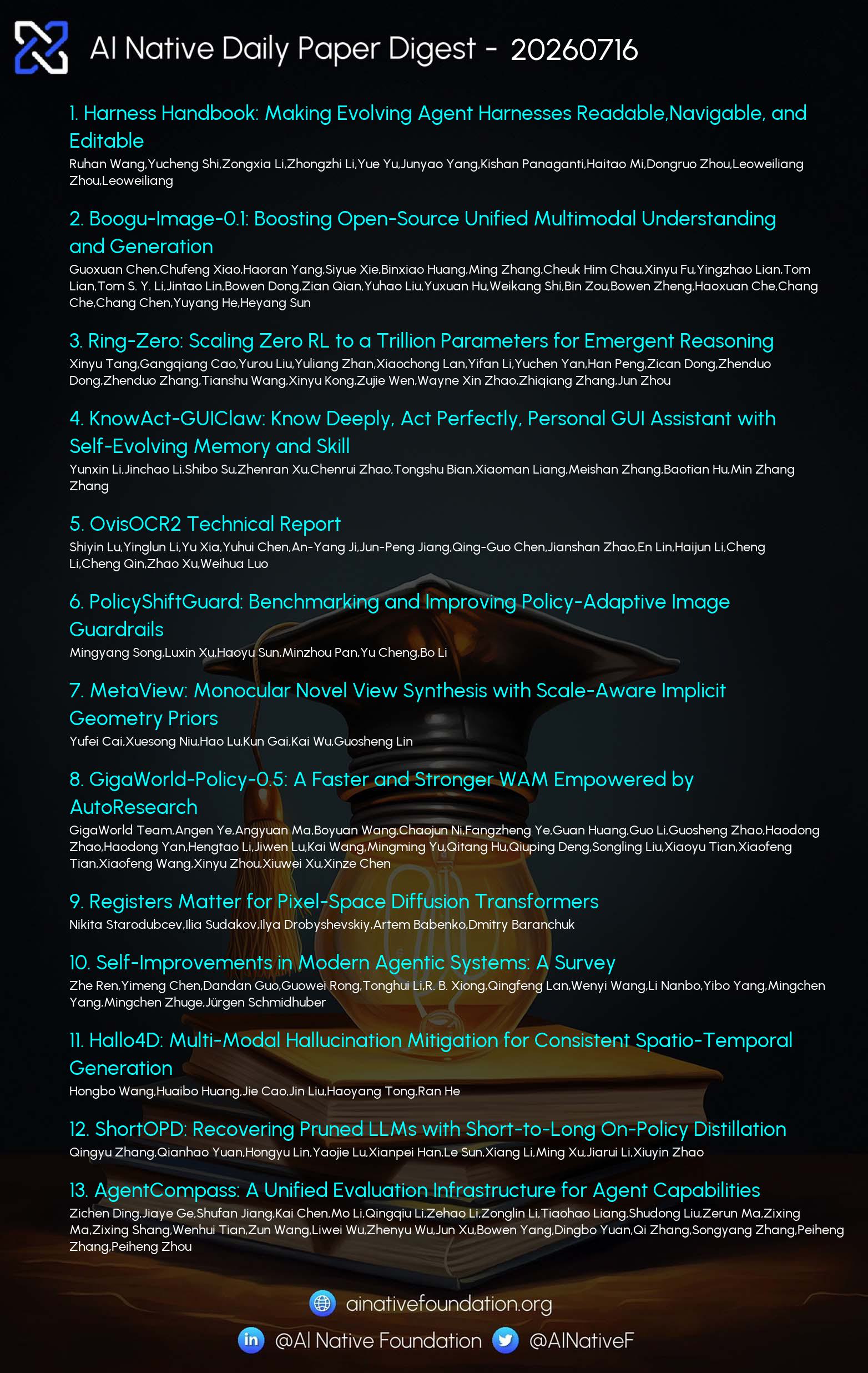
1. Harness Handbook: Making Evolving Agent Harnesses Readable,Navigable, and Editable
🔑 Keywords: AI Agent, Harness Handbook, Behavior Localization, LLM-assisted Structuring, Behavior-Guided Progressive Disclosure
💡 Category: AI Systems and Tools
🌟 Research Objective:
– The study aims to improve the modification process of AI agent harnesses by introducing a novel behavior-centric representation called the Harness Handbook, and propose a Behavior-Guided Progressive Disclosure method for efficient behavior localization.
🛠️ Research Methods:
– The research employs static analysis and LLM-assisted structuring to automatically synthesize the Harness Handbook from a codebase, linking behaviors to sources. It also uses Behavior-Guided Progressive Disclosure to guide agents from high-level behaviors to detailed implementation, verifying candidate locations.
💬 Research Conclusions:
– The Handbook-Assisted planning enhances behavior localization and edit-plan quality while reducing planner token usage, especially in complex cases involving scattered sites, rarely executed paths, and cross-module interactions.
👉 Paper link: https://huggingface.co/papers/2607.13285
2. Ring-Zero: Scaling Zero RL to a Trillion Parameters for Emergent Reasoning
🔑 Keywords: Zero RL, 1T parameters, emergent capabilities, chain-of-thought reasoning, structured evaluation
💡 Category: Reinforcement Learning
🌟 Research Objective:
– Explore the large-scale dynamics and emergent capabilities of zero Reinforcement Learning models, particularly concerning chain-of-thought reasoning.
🛠️ Research Methods:
– Developed a stable and efficient training pipeline with optimizations like clipped importance sampling and mixed-precision control to deal with large-scale models.
💬 Research Conclusions:
– Scaling to 1T parameters enhances sample efficiency and performance, and enables the model to spontaneously develop advanced cognitive behaviors, eliminating the need for hand-crafted heuristics.
– A new structured evaluation framework is proposed to assess comprehensibility, reproducibility, and efficiency of chain-of-thought reasoning beyond final-answer correctness.
👉 Paper link: https://huggingface.co/papers/2607.12395

3. OvisOCR2 Technical Report
🔑 Keywords: OvisOCR2, document parsing, end-to-end, Markdown representation, synthetic pages
💡 Category: Computer Vision
🌟 Research Objective:
– The paper introduces OvisOCR2, a 0.8B parameter model, aimed at parsing document page images into Markdown formatted representations, capturing various elements like text, formulas, tables, and visual regions.
🛠️ Research Methods:
– OvisOCR2 employs a data engine combining real-document annotations with synthetic page data derived from HTML sources. It uses supervised fine-tuning, reinforcement learning with a multi-component reward design, on-policy distillation, and model fusion for training.
💬 Research Conclusions:
– OvisOCR2 achieves state-of-the-art performance on OmniDocBench v1.6 and PureDocBench, demonstrating its superiority over pipeline methods and its robustness and generalization across diverse and challenging document parsing scenarios.
👉 Paper link: https://huggingface.co/papers/2607.13639
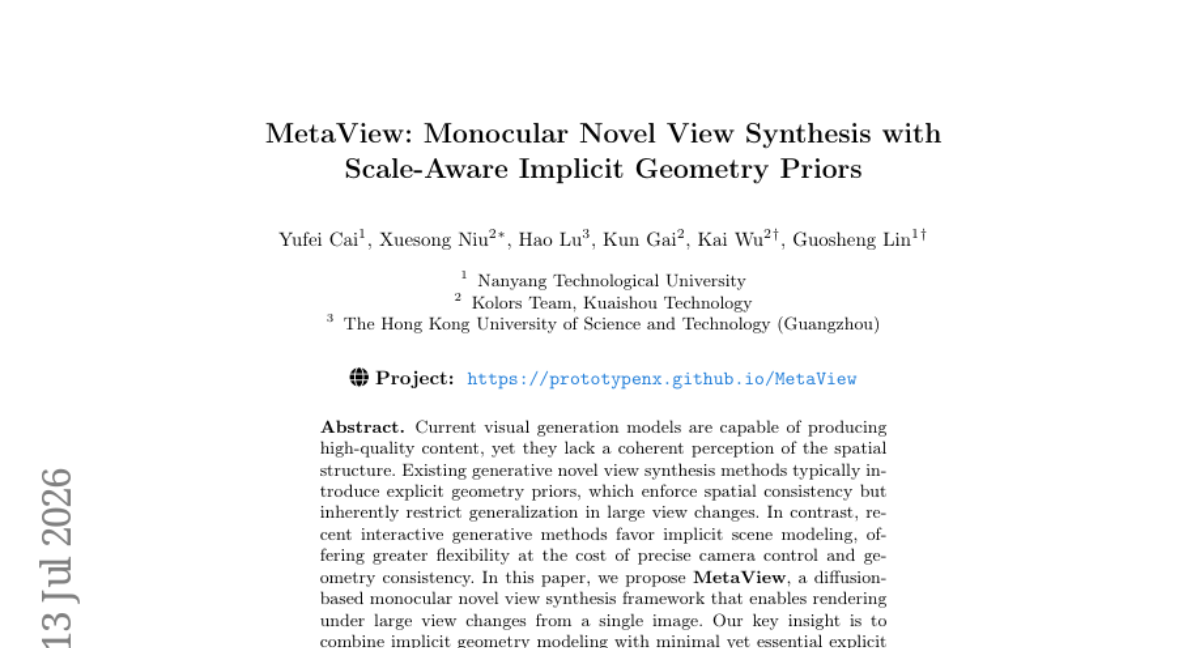
4. MetaView: Monocular Novel View Synthesis with Scale-Aware Implicit Geometry Priors
🔑 Keywords: Visual Generation Models, Implicit Geometry, Monocular Novel View Synthesis, Spatial Structure, Diffusion-Based
💡 Category: Generative Models
🌟 Research Objective:
– The paper introduces MetaView, a novel framework for monocular novel view synthesis designed to maintain geometry consistency and precise controllability while enabling large view changes from a single image.
🛠️ Research Methods:
– The approach combines implicit geometry modeling with essential explicit 3D cues using a feed-forward geometry perception network, aiming to balance flexibility with structural consistency.
💬 Research Conclusions:
– MetaView demonstrates superior performance compared to existing methods in handling challenging monocular large viewpoint changes, offering significant improvements in generalization capabilities.
👉 Paper link: https://huggingface.co/papers/2607.12000
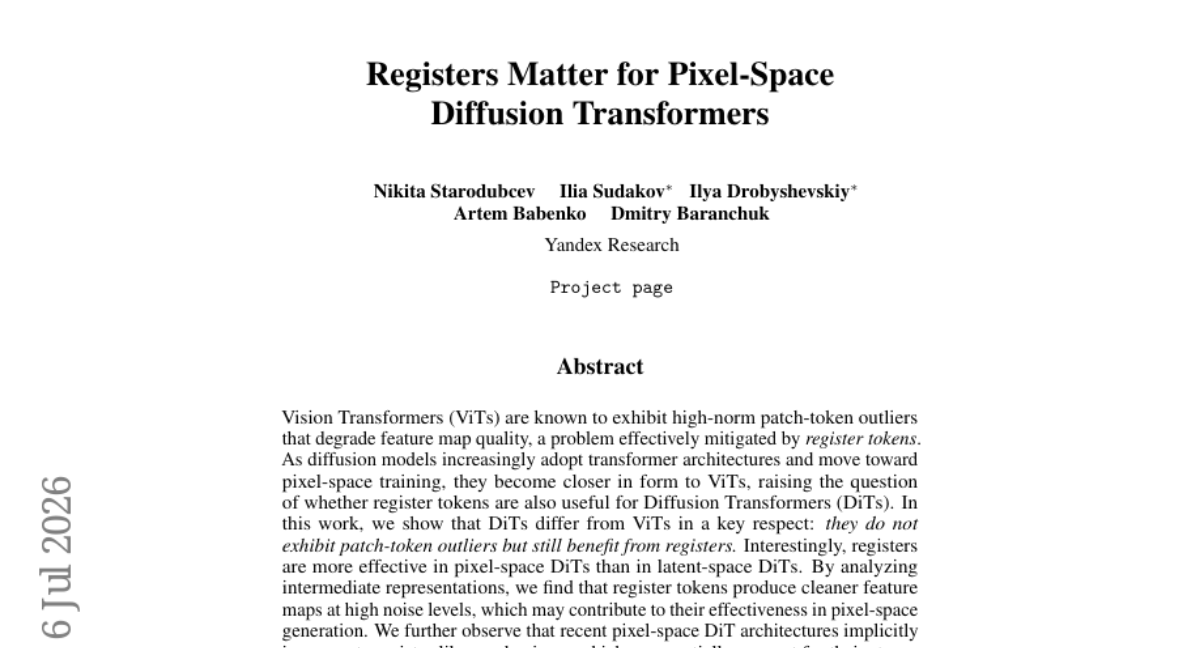
5. Registers Matter for Pixel-Space Diffusion Transformers
🔑 Keywords: Vision Transformers, Diffusion Transformers, Register Tokens, Pixel-space Training, Feature Maps
💡 Category: Generative Models
🌟 Research Objective:
– To investigate the role and effectiveness of register tokens in Diffusion Transformers (DiTs) compared to Vision Transformers (ViTs).
🛠️ Research Methods:
– Analysis of intermediate representations to compare feature map quality in both pixel-space and latent-space DiTs.
💬 Research Conclusions:
– DiTs do not exhibit high-norm patch-token outliers like ViTs, but still benefit from register tokens, especially in pixel-space applications.
– The use of register tokens leads to cleaner feature maps at high noise levels, contributing to improved visual structure and coherence.
– Recent pixel-space DiTs architectures include mechanisms similar to register tokens, which enhances their performance.
👉 Paper link: https://huggingface.co/papers/2605.16147
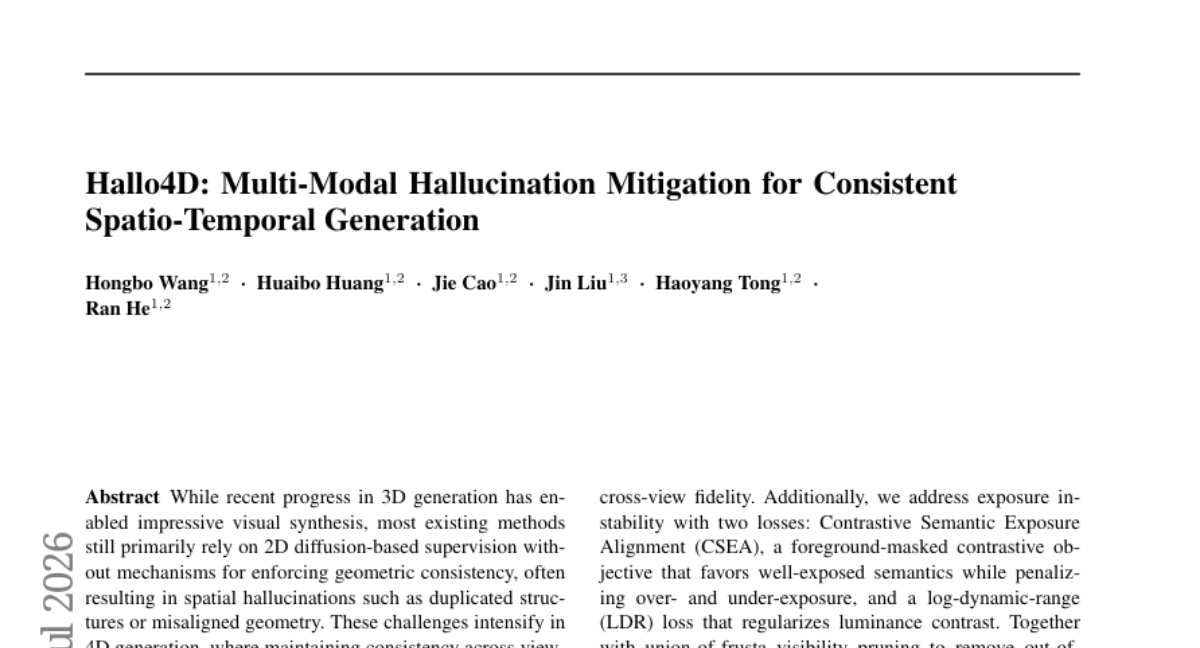
6. Hallo4D: Multi-Modal Hallucination Mitigation for Consistent Spatio-Temporal Generation
🔑 Keywords: 3D generation, 4D generation, large multimodal language models (LMMs), spatial and temporal inconsistencies
💡 Category: Generative Models
🌟 Research Objective:
– The paper presents Hallo4D, aiming to mitigate spatiotemporal hallucinations in 3D and 4D content generation by ensuring geometric consistency.
🛠️ Research Methods:
– The authors introduce a generation-detection-correction paradigm leveraging large multimodal language models, multi-model voting, and motion-aware keyframe sampling.
💬 Research Conclusions:
– Hallo4D outperforms strong baselines and offers a scalable, generalizable solution for consistency-aware 3D and 4D content generation across diverse settings.
👉 Paper link: https://huggingface.co/papers/2607.12752
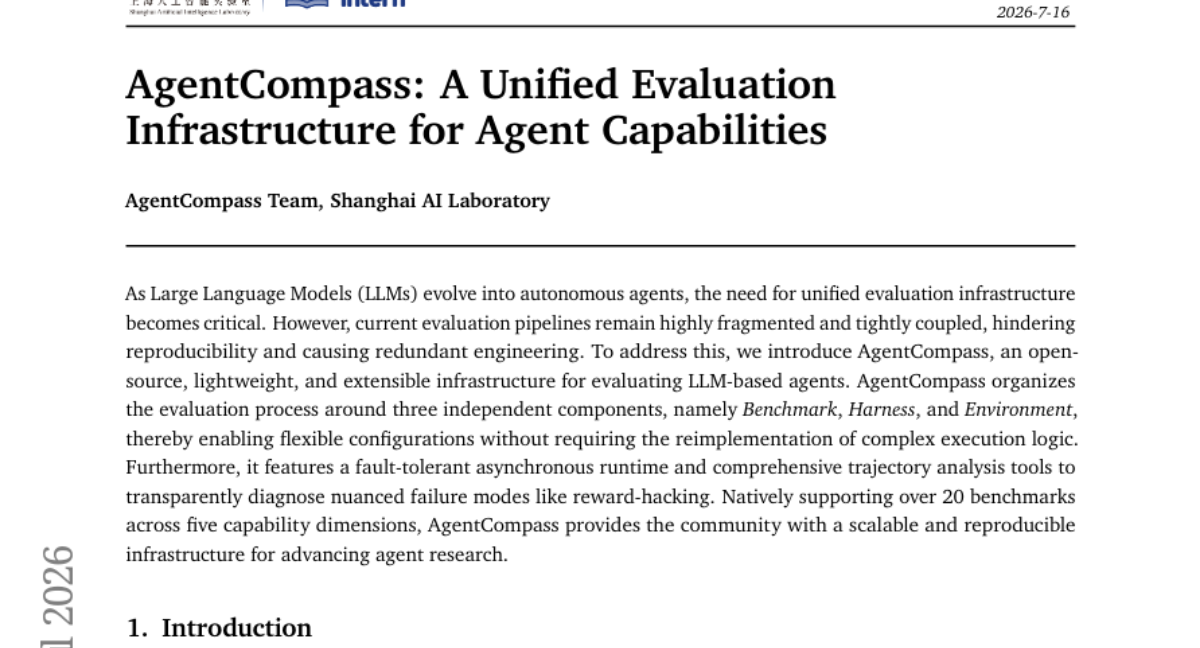
7. AgentCompass: A Unified Evaluation Infrastructure for Agent Capabilities
🔑 Keywords: Large Language Models, AgentCompass, Evaluation Infrastructure, Autonomous Agents, Reproducibility
💡 Category: AI Systems and Tools
🌟 Research Objective:
– To introduce AgentCompass, an open-source infrastructure aimed at unifying and enhancing the evaluation of LLM-based autonomous agents.
🛠️ Research Methods:
– Organization around Benchmark, Harness, and Environment components for flexible configurations and fault-tolerant asynchronous runtime with trajectory analysis tools.
💬 Research Conclusions:
– Provides scalable, reproducible infrastructure supporting over 20 benchmarks, aiding in the advancement of agent research by diagnosing failure modes.
👉 Paper link: https://huggingface.co/papers/2607.13705
8. Tracing Agentic Failure from the Flow of Success
🔑 Keywords: Failure Attribution, Agentic Systems, Lightweight Model, One-Class Learning, Neural Controlled Differential Equations
💡 Category: AI Systems and Tools
🌟 Research Objective:
– The paper aims to develop a practical failure attribution model for LLM-based agentic systems that is lightweight and does not require step-level supervision on failure data.
🛠️ Research Methods:
– The authors propose OAT, a model employing one-class learning with neural controlled differential equations to analyze successful trajectories and identify failure steps during inference.
💬 Research Conclusions:
– OAT demonstrates a significant improvement in efficiency, being 200-5000 times faster than prompting-based baselines, while delivering better performance with an increase of +20% and +7% in F1 scores on in-domain and out-of-distribution datasets, respectively.
👉 Paper link: https://huggingface.co/papers/2607.12747
9. PalmClaw: A Native On-Device Agent Framework for Mobile Phones
🔑 Keywords: Large Language Model (LLM), Mobile Devices, PalmClaw, AI Native
💡 Category: AI Systems and Tools
🌟 Research Objective:
– This paper presents PalmClaw, an open-source agent framework designed to operate natively on mobile devices, allowing AI Native support of executing multi-step tasks by utilizing mobile-specific capabilities directly.
🛠️ Research Methods:
– PalmClaw exposes device capabilities through explicit arguments and structured results with clearly defined execution boundaries, facilitating direct interaction between mobile agents and device functionalities.
💬 Research Conclusions:
– The implementation of PalmClaw showed an 11.5% improvement in task success rate and a 94.9% reduction in task completion time compared to existing baselines, demonstrating its effectiveness and efficiency in mobile AI task execution.
👉 Paper link: https://huggingface.co/papers/2607.13027
10. From Controlled to the Wild: Evaluation of Pentesting Agents for the Real-World
🔑 Keywords: AI pentesting agents, vulnerability discovery, evaluation protocol, strategic decision-making, reproducibility
💡 Category: AI Systems and Tools
🌟 Research Objective:
– To present a practical evaluation protocol for AI pentesting agents that focuses on validated vulnerability discovery across complex targets and multiple attack surfaces.
🛠️ Research Methods:
– The protocol includes structured ground-truth with LLM-based semantic matching, bipartite resolution, continuous ground-truth maintenance, and stochastic agent evaluation, along with efficiency metrics for sustainable experimentation.
💬 Research Conclusions:
– This protocol extends current evaluation methods by providing a more realistic and informative comparison of AI pentesting agents, enabling operational insights and reproducibility through released expert-annotated ground truth and code.
👉 Paper link: https://huggingface.co/papers/2605.10834
11. Generative Compilation: On-the-Fly Compiler Feedback as AI Generates Code
🔑 Keywords: Rust, generative compilation, compiler feedback, partial-program checker, AI-assisted programming
💡 Category: AI Systems and Tools
🌟 Research Objective:
– To introduce generative compilation, an approach for obtaining compiler feedback on partial programs during generation, enhancing AI-generated code’s correctness and reducing non-compiling outputs.
🛠️ Research Methods:
– Developed a sealor that transforms partial programs into complete ones to enable standard compiler diagnosis.
– Constructed and mechanized the sealor in Lean for a Rust-like calculus, and extended it to a partial-program checker for real Rust.
💬 Research Conclusions:
– Generative compilation reduces non-compiling outputs and enhances functional correctness by detecting errors early in the generation process, which minimizes error cascades and facilitates precise diagnostics.
– It repositions compilers as active participants in AI-assisted programming, moving beyond a post-generation check to a proactive error-reducing tool.
👉 Paper link: https://huggingface.co/papers/2607.13921
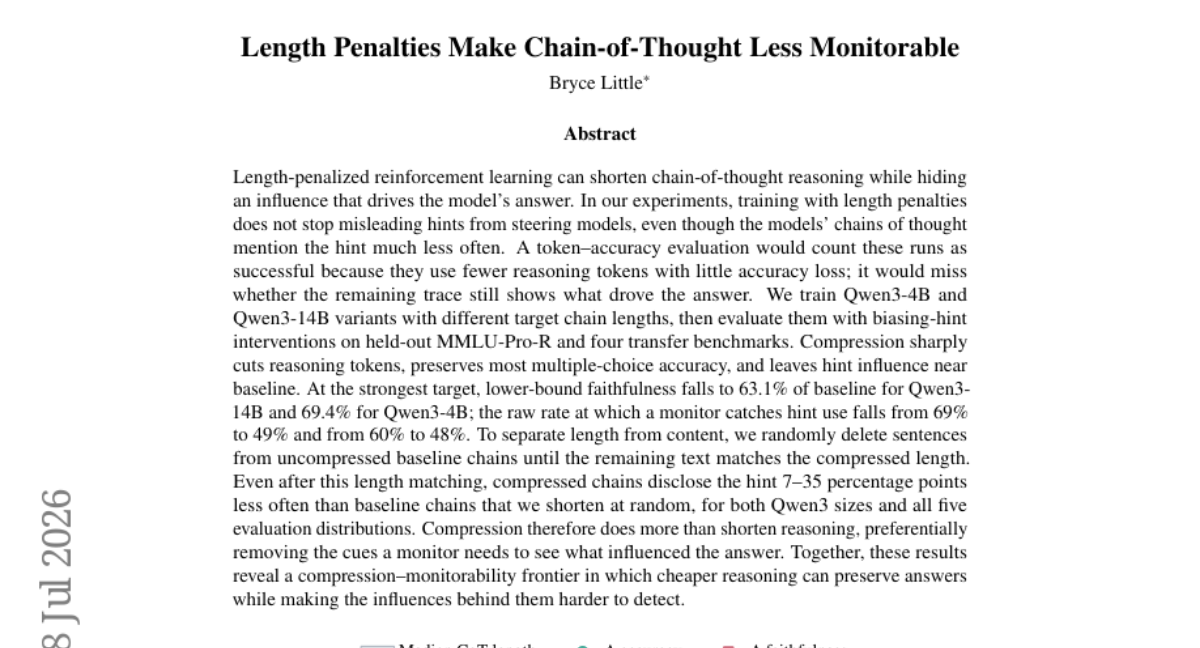
12. Length Penalties Make Chain-of-Thought Less Monitorable
🔑 Keywords: Length-penalized reinforcement learning, Chain-of-thought reasoning, Compression, Biasing-hint interventions, Qwen3-4B and Qwen3-14B
💡 Category: Reinforcement Learning
🌟 Research Objective:
– To explore how length-penalized reinforcement learning affects the chain-of-thought reasoning process and the influence of misleading hints.
🛠️ Research Methods:
– Training Qwen3-4B and Qwen3-14B variants with various target chain lengths and evaluating with biasing-hint interventions on held-out MMLU-Pro-R and four transfer benchmarks.
💬 Research Conclusions:
– Compression reduces reasoning tokens and maintains multiple-choice accuracy while making the underlying influences less detectable. Despite shorter reasoning, the models continue to be driven by misleading hints.
👉 Paper link: https://huggingface.co/papers/2607.09786
13.
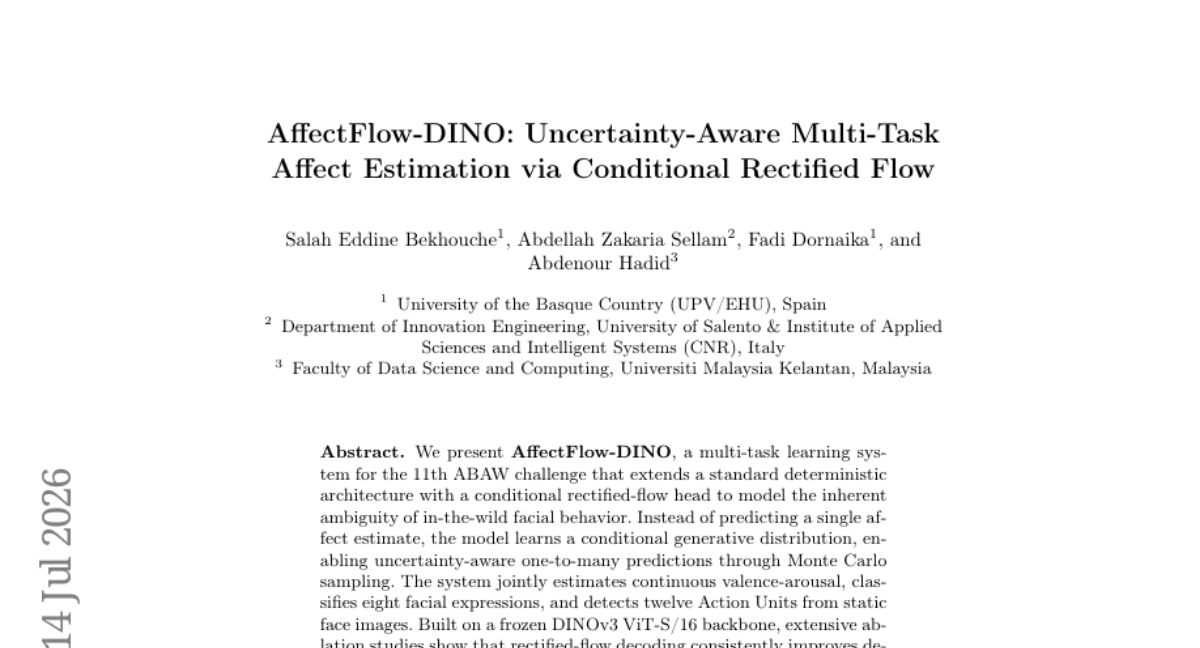
14. AffectFlow-DINO: Uncertainty-Aware Multi-Task Affect Estimation via Conditional Rectified Flow
🔑 Keywords: AffectFlow-DINO, multi-task learning, uncertainty-aware, facial behavior, Monte Carlo sampling
💡 Category: Computer Vision
🌟 Research Objective:
– To develop AffectFlow-DINO, a system capable of modeling the ambiguity in facial behavior using a conditional generative distribution.
🛠️ Research Methods:
– Utilization of a multi-task learning approach extending a deterministic architecture with a conditional rectified-flow head; application of Monte Carlo sampling for uncertainty-aware predictions.
– Built on frozen DINOv3 ViT-S/16 architecture and employs joint estimation techniques for valence-arousal, facial expression classification, and Action Units detection.
💬 Research Conclusions:
– The introduction of rectified-flow decoding enhances deterministic predictions, notably improving CCC for valence-arousal estimation.
– Effective performance recovery in rare classes through post-hoc threshold calibration without the need for retraining; combined methods substantially outperform baseline models in multi-task learning performance metrics.
👉 Paper link: https://huggingface.co/papers/2607.13250
15. SPEAR: A Simulator for Photorealistic Embodied AI Research
🔑 Keywords: AI Native, Photorealistic Simulators, Unreal Engine, Embodied AI, Python Library
💡 Category: AI Systems and Tools
🌟 Research Objective:
– The research aims to overcome limitations in existing photorealistic simulators regarding generality, programmability, and rendering speed by introducing SPEAR, a Simulator for Photorealistic Embodied AI Research.
🛠️ Research Methods:
– SPEAR is developed as a Python library connecting to any Unreal Engine application through a modular plugin architecture, exposing over 14K unique UE functions to Python and significantly enhancing programmable functionality.
– It achieves a rendering speed of 73 frames per second at 1920×1080 resolution while providing unique image modalities and an expressive high-level programming model for complex task execution.
💬 Research Conclusions:
– SPEAR demonstrates its utility through multiple applications, such as controlling diverse embodied agents, rendering city-scale environments, and coordinating simulations, effectively showcasing advanced programmability and rendering speed.
👉 Paper link: https://huggingface.co/papers/2607.06701
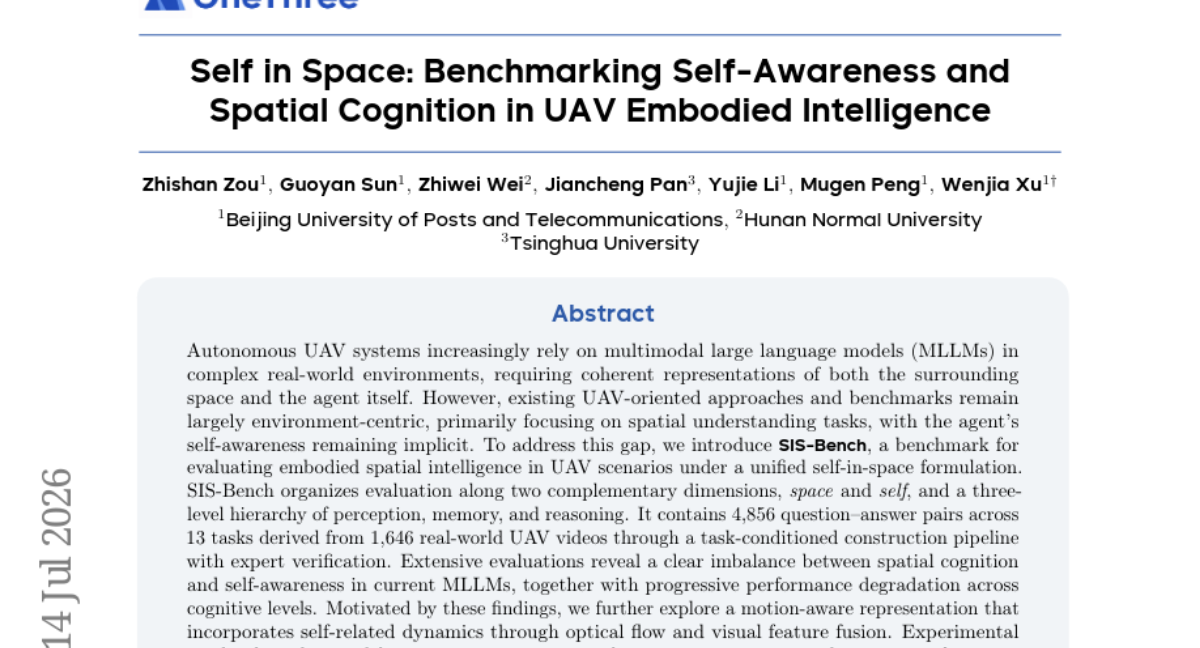
16. Self in Space: Benchmarking Self-Awareness and Spatial Cognition in UAV Embodied Intelligence
🔑 Keywords: MLLMs, UAV systems, SIS-Bench, self-awareness, spatial intelligence
💡 Category: Robotics and Autonomous Systems
🌟 Research Objective:
– The study aims to address the imbalance in UAV systems between spatial cognition and self-awareness by introducing SIS-Bench, a benchmark for evaluating embodied spatial intelligence in UAV scenarios.
🛠️ Research Methods:
– The researchers developed SIS-Bench, organizing evaluation along two dimensions, space and self, with a hierarchy of perception, memory, and reasoning. It consists of 4,856 question–answer pairs across 13 tasks from 1,646 UAV videos, validated by experts.
💬 Research Conclusions:
– The study found that current MLLMs have significant limitations in modeling dynamic and agent-centered processes. Incorporating motion-aware representation through optical flow and visual feature fusion improves perception, memory, and enhances self-awareness, demonstrating its applicability to downstream UAV decision-making tasks.
👉 Paper link: https://huggingface.co/papers/2607.12477
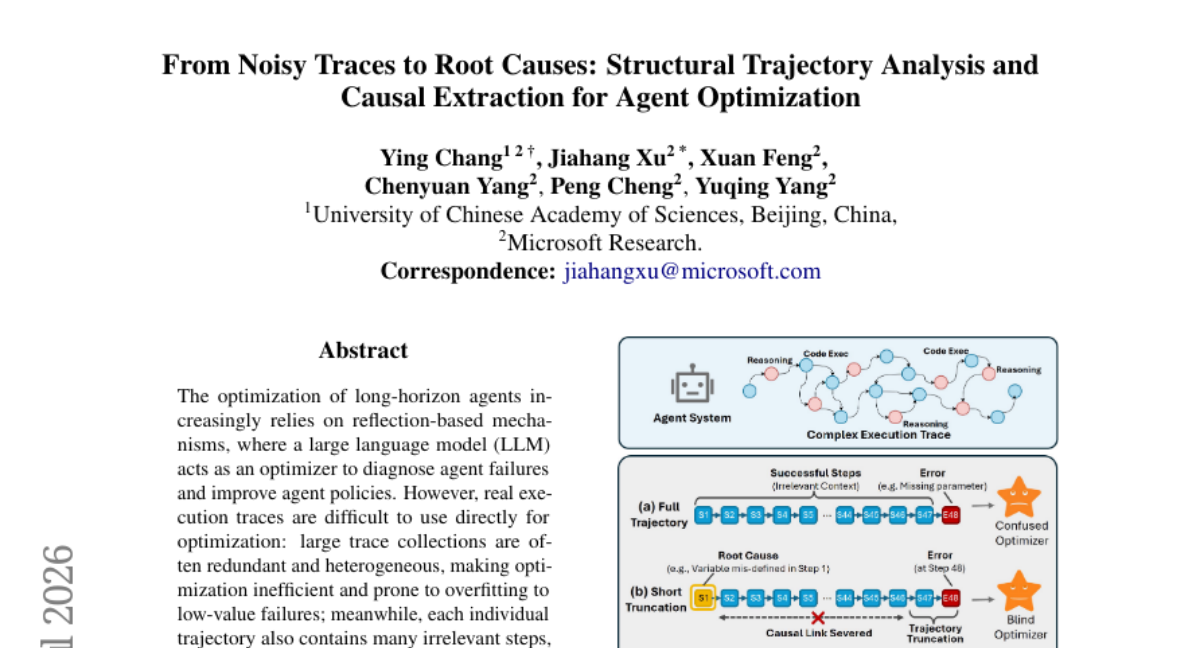
17. From Noisy Traces to Root Causes: Structural Trajectory Analysis and Causal Extraction for Agent Optimization
🔑 Keywords: LLM, Agent Optimization, Causal Extraction, VeruSAGE-Bench, STRACE
💡 Category: Reinforcement Learning
🌟 Research Objective:
– To improve the optimization of long-horizon agents through a framework called STRACE, which constructs high signal-noise optimization contexts.
🛠️ Research Methods:
– Utilizes Structural Trajectory Analysis to mine failure patterns and perform causal localization over a textual dependency graph to filter redundant traces and identify root causes.
💬 Research Conclusions:
– STRACE outperforms standard context-filtering baselines, achieving a 1.4 times improvement in success rate on a formal verification task involving human-expert designed agents.
👉 Paper link: https://huggingface.co/papers/2607.07702
18. Discrete Diffusion Models: A Unified Framework from Tokenization to Generation
🔑 Keywords: Discrete Denoising Diffusion Models, Autoregressive Modeling, Parallel Generation, Iterative Global Refinement
💡 Category: Generative Models
🌟 Research Objective:
– Introduce a unified conceptual framework for understanding discrete denoising diffusion models (DDMs) through the construction of discrete state spaces.
🛠️ Research Methods:
– Analyze DDMs using various approaches like transition-matrix, masking/absorbing-state, and score/ratio-based methods, showing them as different instantiations within a common design space.
💬 Research Conclusions:
– Highlight common design trade-offs across DDMs, including training objectives and inference algorithms, proposing several directions for future research.
👉 Paper link: https://huggingface.co/papers/2607.13431
19. Vinci2: Providing Proactive Assistance in Continuous Egocentric Videos
🔑 Keywords: Proactive Assistance, Egocentric Video, Contextual Decision, Vinci2, EgoMemo
💡 Category: Human-AI Interaction
🌟 Research Objective:
– The study aims to develop a proactive egocentric assistance system by enhancing the Vinci assistant from reactive to proactive, focusing on context-dependent decision-making in continuous egocentric video.
🛠️ Research Methods:
– Introduces Vinci2 and EgoServe, where Vinci2 is an advanced proactive assistance system, and EgoServe serves as a large-scale benchmark for proactive assistance. It explores the use of EgoMemo, a memory-augmented agent, implementing multi-scale temporal summaries, a semantic knowledge graph, and visual embedding archives.
💬 Research Conclusions:
– The research demonstrates that EgoMemo can effectively establish strong baselines in the EgoServe benchmark and perform competitively on existing egocentric benchmarks, contributing to the advancement of proactive assistance systems.
👉 Paper link: https://huggingface.co/papers/2607.11523
20. ShortOPD: Recovering Pruned LLMs with Short-to-Long On-Policy Distillation
🔑 Keywords: Structured Pruning, On-Policy Distillation, Compression, Generative Models, Natural Language Processing
💡 Category: Natural Language Processing
🌟 Research Objective:
– To improve the quality of generative tasks in large language models (LLMs) after structured pruning, by addressing recovery issues using a novel method called short-to-long OPD.
🛠️ Research Methods:
– Implementing On-Policy Distillation (OPD) using a pre-compression model as a frozen teacher and employing a short-to-long schedule to optimize token-level supervision in rollouts.
💬 Research Conclusions:
– The short-to-long OPD method significantly enhances compressed model performance across various tasks, achieving up to 9 times its original score, using substantially less training time and resources.
👉 Paper link: https://huggingface.co/papers/2607.13124

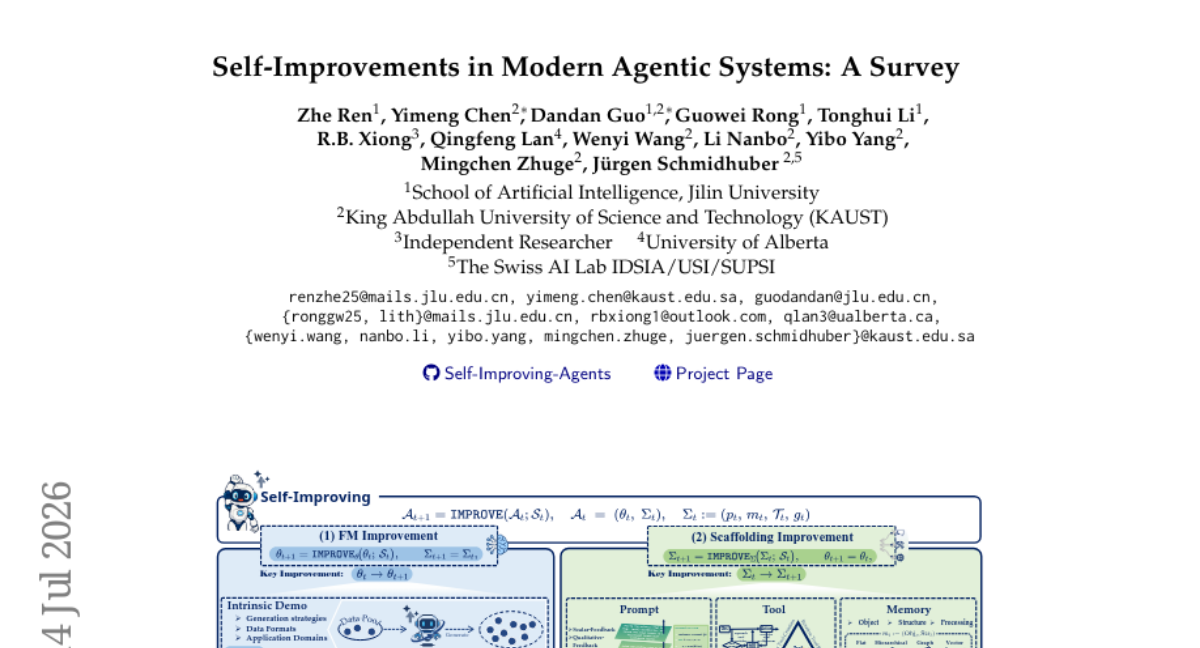
21. Self-Improvements in Modern Agentic Systems: A Survey
🔑 Keywords: Self-improving agents, Controllable evolution, Adaptive systems, Model parameters, Operational scaffold
💡 Category: Robotics and Autonomous Systems
🌟 Research Objective:
– To explore the framework and systems of self-improving autonomous agents that adapt from experience with minimal human input.
🛠️ Research Methods:
– The study presents a system-level framework where modern agents are viewed as configurations of foundation models coupled with operational scaffolds, formalizing self-improvement through a self-induced update operator.
💬 Research Conclusions:
– The survey organizes prior work based on update targets and the signals driving change, reviews applications, and discusses evaluation, ultimately suggesting open problems and future research directions.
👉 Paper link: https://huggingface.co/papers/2607.13104
22. GigaWorld-Policy-0.5: A Faster and Stronger WAM Empowered by AutoResearch
🔑 Keywords: World Action Models, GigaWorld-Policy-0.5, action-centered formulation, Mixture-of-Transformers, AutoResearch pipeline
💡 Category: Robotics and Autonomous Systems
🌟 Research Objective:
– The study aims to enhance robot policy learning by addressing the computational inefficiencies in World Action Models, focusing on efficient robot control and inference.
🛠️ Research Methods:
– The researchers employ an action-centered formulation, using Action-Conditioned World Modeling for pretraining and introduce a Mixture-of-Transformers architecture to optimize inference efficiency. They also utilize an agent-based AutoResearch pipeline for optimal training configuration search.
💬 Research Conclusions:
– GigaWorld-Policy-0.5 successfully retains the benefits of future visual dynamics in training while substantially improving efficiency in inference, achieving low latency and reducing the need for manual tuning in hyperparameter settings.
👉 Paper link: https://huggingface.co/papers/2607.13960
23. PolicyShiftGuard: Benchmarking and Improving Policy-Adaptive Image Guardrails
🔑 Keywords: PolicyShiftBench, PolicyShiftGuard, policy adaptation, AI Native, image guardrails
💡 Category: Computer Vision
🌟 Research Objective:
– To explore policy-adaptive image guardrailing, allowing models to determine if an image violates the currently supplied policy and to generalize to new policy definitions.
🛠️ Research Methods:
– Introduction of PolicyShiftBench, a benchmark with policy-discriminative instances to test model adaptability to active policies.
– Development of PolicyShiftGuard, a compact guardrail using a two-stage training process combining Randomized Policy SFT with Boundary-Pair Policy Adaptation.
💬 Research Conclusions:
– PolicyShiftGuard significantly improves policy-sensitive performance over existing models, achieving state-of-the-art results on PolicyShiftBench, and transfers effectively to other benchmarks. Matched pass/block boundary pairs are critical for stable policy adaptation.
👉 Paper link: https://huggingface.co/papers/2607.05910
24. KnowAct-GUIClaw: Know Deeply, Act Perfectly, Personal GUI Assistant with Self-Evolving Memory and Skill
🔑 Keywords: OpenClaw, KnowAct-GUIClaw, cross-platform adaptability, execution accuracy, AI Systems and Tools
💡 Category: AI Systems and Tools
🌟 Research Objective:
– To address the limitations of OpenClaw in cross-platform GUI interaction and self-evolution, enhancing its adaptability and performance.
🛠️ Research Methods:
– Introduction of KnowAct-GUIClaw, a framework that employs a Know-Route-Act-Reflect approach to leverage user interactions and experience memory for improved task automation.
💬 Research Conclusions:
– KnowAct-GUIClaw demonstrated superior efficiency, accuracy, and cross-platform adaptability, particularly excelling in the MobileWorld benchmark with notable performance improvements over existing frameworks.
👉 Paper link: https://huggingface.co/papers/2607.12625
25. Boogu-Image-0.1: Boosting Open-Source Unified Multimodal Understanding and Generation
🔑 Keywords: Boogu-Image-0.1, multimodal understanding, text-to-image generation, open-source, bilingual text rendering
💡 Category: Multi-Modal Learning
🌟 Research Objective:
– Introduce Boogu-Image-0.1, an open-source multimodal model family offering capabilities like text-to-image generation and bilingual text rendering.
🛠️ Research Methods:
– Focused on enhancing model understanding, data quality, and training pipelines with agentic inference-time scaling.
💬 Research Conclusions:
– Boogu-Image-0.1 matches or surpasses other open-source models and competes closely with closed-source systems, achieving this with a relatively low theoretical training cost.
👉 Paper link: https://huggingface.co/papers/2607.13125