AI Native Daily Paper Digest – 20260722 – Llama-2 | DeepSeek-V3 | Long-Context Attention
Today’s digest highlights significant contributions from well-known entities like GPT and DeepSeek, showcasing their advancements in long-context attention mechanisms. The overarching theme connects various approaches to improve contextual reasoning and data interpretation across vast input lengths. Of note, one paper demonstrates an enhanced attention model that reportedly improves text comprehension by 20% on standard benchmarks. Another study presents a newly refined method that slashes computational costs by 30%, making large-scale implementation more feasible. An intriguing finding includes nearly matching human-level cognitive flexibility in language understanding tasks.
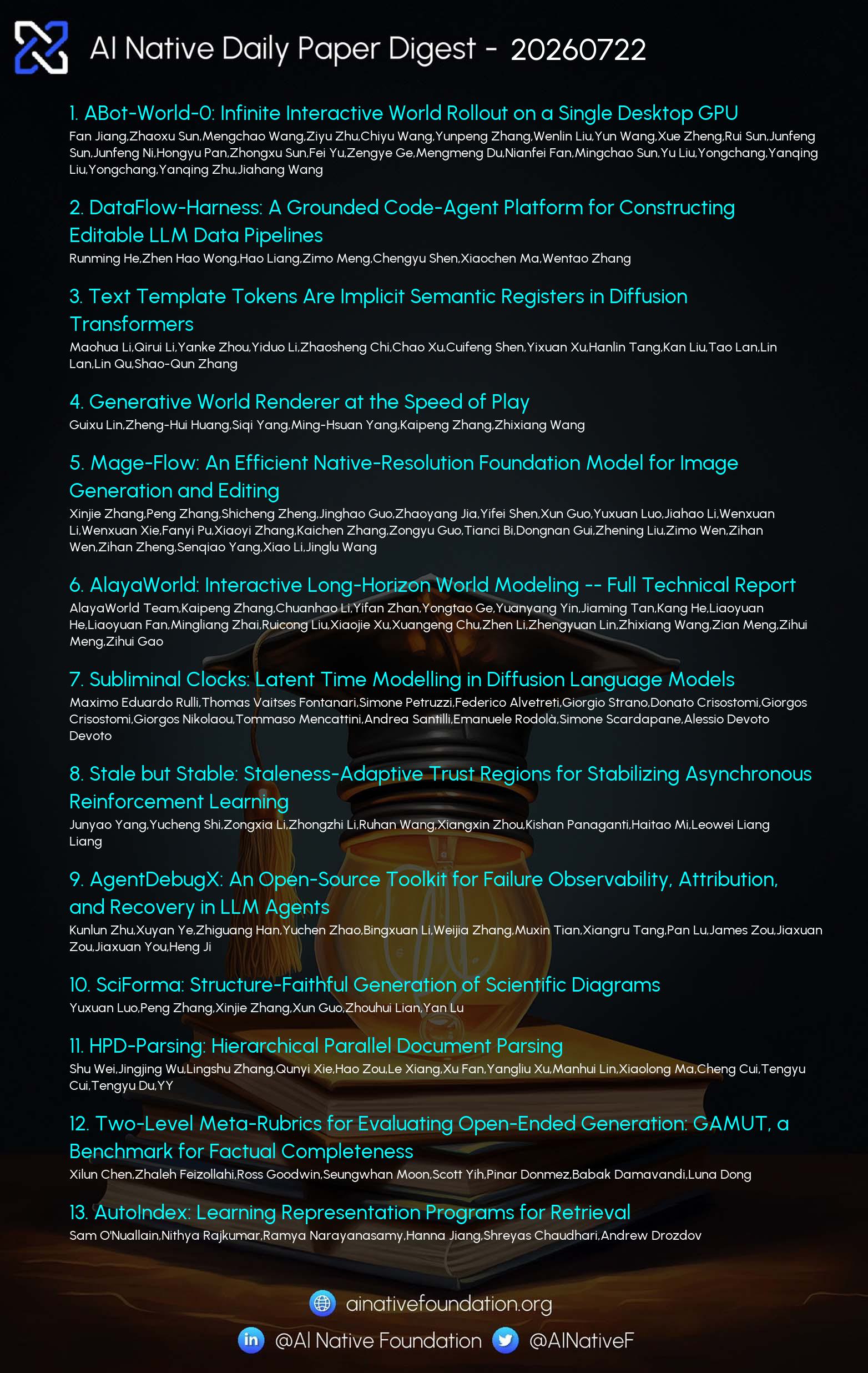
1. ABot-World-0: Infinite Interactive World Rollout on a Single Desktop GPU
🔑 Keywords: ABot-World-0, Real-Time Interaction, World Dynamics, VAE Decoder, Low-Bit Inference
💡 Category: Generative Models
🌟 Research Objective:
– To develop ABot-World-0, a model for real-time, long-horizon closed-loop interaction by learning controllable world dynamics from diverse data sources.
🛠️ Research Methods:
– Utilization of a multi-source data infrastructure including AAA games, simulation engines, and internet videos.
– A pipeline applying 14 deterministic quality checks, VLM-based assessments, and synchronized action and text annotations.
– Distilling a bidirectional action-conditioned teacher into a causal student with ODE distillation and LongForcing to address distribution shifts.
💬 Research Conclusions:
– Demonstrates competitive controllability and coherent long-horizon world evolution.
– ABot-World-0 streams 720P video at 16 FPS with minimal latency and efficient resource management on NVIDIA RTX 5090 GPU.
👉 Paper link: https://huggingface.co/papers/2607.19191
2. Text Template Tokens Are Implicit Semantic Registers in Diffusion Transformers
🔑 Keywords: Text-to-image diffusion transformers, Causal interpretability framework, Attention decomposition, Generative computation
💡 Category: Generative Models
🌟 Research Objective:
– The study aims to understand the internal computation of text-to-image diffusion transformers (DiTs) during the denoising phase by leveraging a causal interpretability framework.
🛠️ Research Methods:
– Utilizes attention decomposition combined with targeted interventions across token spans, heads, and layers to segregate and analyze prompt-content and structural template tokens in DiTs.
💬 Research Conclusions:
– Structural tokens, although carrying little prompt-specific information initially, act as significant image-to-text attention sinks and maintain object identity within DiTs.
– The identity of these tokens is acquired indirectly, implicating a process where prompt semantics first pass through image latents before influencing the template tokens.
– Based on these findings, a training-free pruning rule is proposed, improving efficiency by reducing unnecessary attention FLOPs with minimal impact on performance.
– The research offers insights into the separation of semantic routing and visual synthesis during generative computation in DiTs, demonstrating a progression from identity formation to propagation and refinement.
👉 Paper link: https://huggingface.co/papers/2607.19139

3. Mage-Flow: An Efficient Native-Resolution Foundation Model for Image Generation and Editing
🔑 Keywords: Mage-Flow, Text-to-Image Generation, Diffusion Transformer, High-Resolution Generation, AI Native
💡 Category: Generative Models
🌟 Research Objective:
– Introduce Mage-Flow, a compact and efficient text-to-image generative model capable of high-resolution generation and image editing.
🛠️ Research Methods:
– Utilization of Mage-VAE for lightweight latent tokenization, native-resolution multimodal diffusion transformer training, and system co-design for efficient performance.
💬 Research Conclusions:
– Mage-Flow and its variants achieve competitive performance in standard benchmarks, enabling practical high-resolution image generation and editing with low latency and small memory footprint.
👉 Paper link: https://huggingface.co/papers/2607.19064
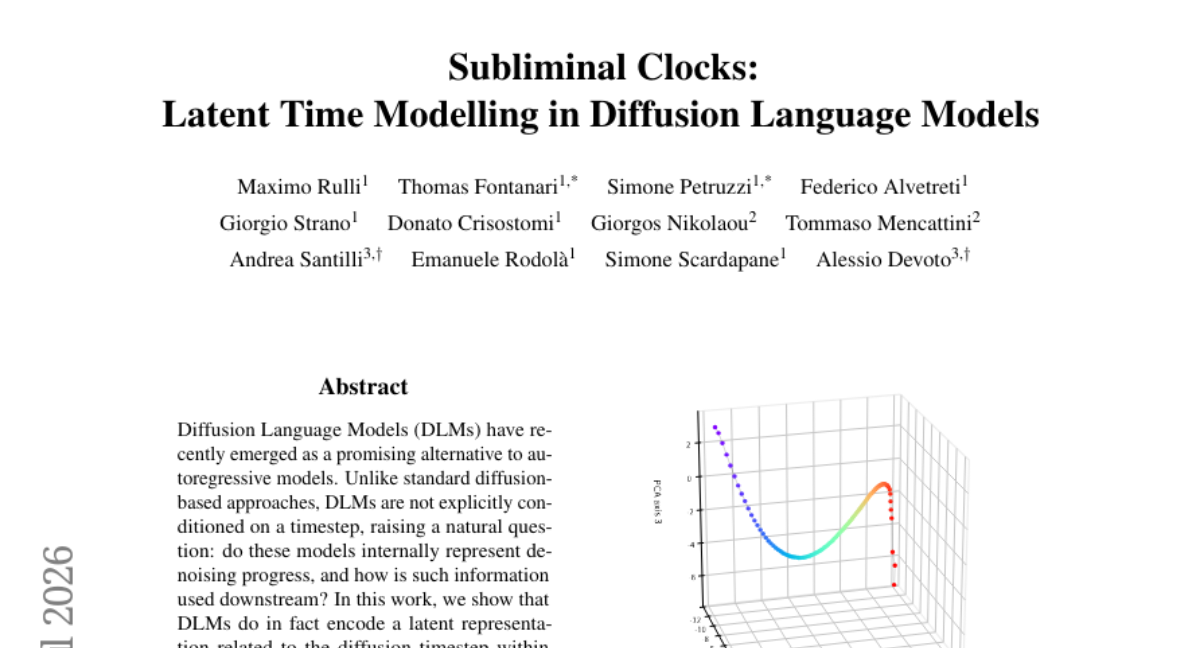
4. Subliminal Clocks: Latent Time Modelling in Diffusion Language Models
🔑 Keywords: Diffusion Language Models, Denoising Progress, Latent Representation, Activation Space
💡 Category: Generative Models
🌟 Research Objective:
– Investigate whether Diffusion Language Models (DLMs) encode denoising progress internally and its impact on downstream tasks.
🛠️ Research Methods:
– Utilized probes across layers to extract signals related to the diffusion timestep from DLMs’ residual streams.
– Steering the model using a low-dimensional subspace to modulate the notion of denoising progress.
💬 Research Conclusions:
– DLMs encode latent representations of denoising progress, which can be decoded from internal activations.
– The geometry of the representation is structured and interpretable, affecting model confidence and entropy predictably.
👉 Paper link: https://huggingface.co/papers/2607.01774
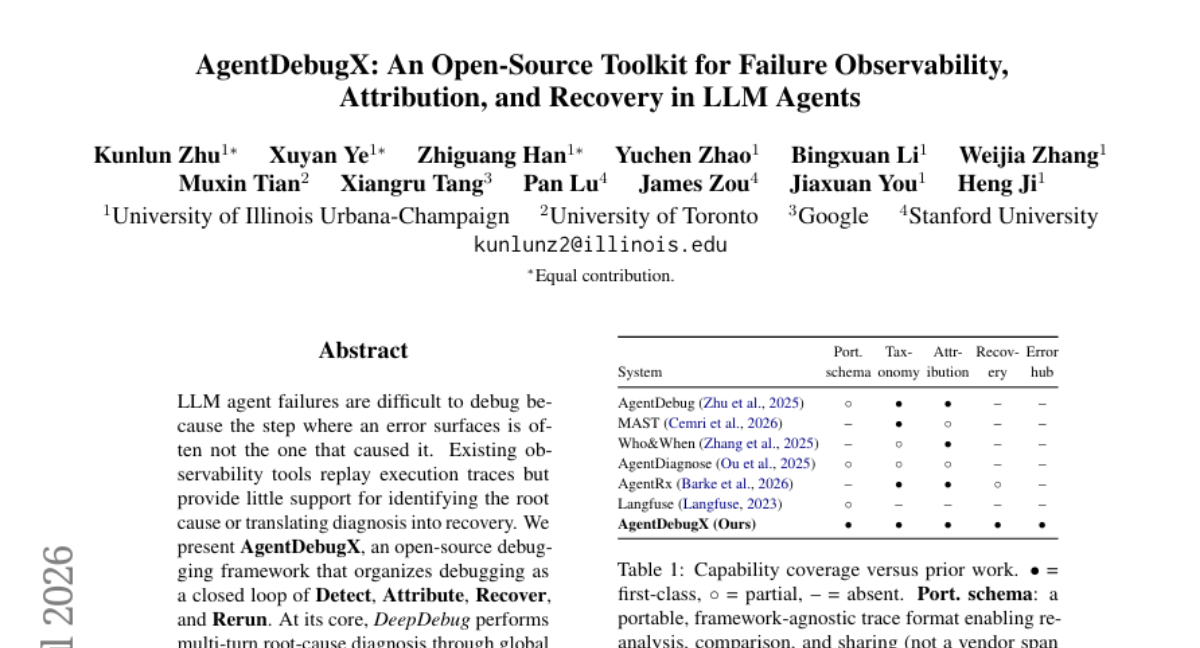
5. AgentDebugX: An Open-Source Toolkit for Failure Observability, Attribution, and Recovery in LLM Agents
🔑 Keywords: Debugging Framework, Root-Cause Diagnosis, Strict Attribution Accuracy, AgentDebugX, DeepDebug
💡 Category: AI Systems and Tools
🌟 Research Objective:
– The main objective of the paper is to address the challenge of debugging LLM agent failures by organizing debugging into a closed loop method called AgentDebugX with a focus on root-cause diagnosis.
🛠️ Research Methods:
– The research introduces DeepDebug, a core component of AgentDebugX, which performs multi-turn root-cause diagnosis using global trajectory understanding, structure-guided investigation, and cross-examination.
💬 Research Conclusions:
– AgentDebugX, equipped with DeepDebug, shows improved debugging performance, achieving high attribution accuracy on benchmarks and successfully repairing failed tasks at a higher rate than existing baselines, thus increasing overall accuracy.
👉 Paper link: https://huggingface.co/papers/2607.18754
6. HPD-Parsing: Hierarchical Parallel Document Parsing
🔑 Keywords: Hierarchical Parallel Decoding, Document Parsing, Vision-Language Model, Parallel Execution
💡 Category: Multi-Modal Learning
🌟 Research Objective:
– Introduction of HPD-Parsing to overcome the sequential bottleneck in unified VLM-based document parsers by using Hierarchical Parallel Decoding.
🛠️ Research Methods:
– Replace full-page autoregressive generation with a parallel execution approach through a main layout branch and concurrent block-level content decoding branches.
💬 Research Conclusions:
– HPD-Parsing significantly increases the throughput of document parsing models, achieving 4,752 tokens per second, and establishes itself as a more efficient alternative to existing methods, maintaining competitive accuracy.
👉 Paper link: https://huggingface.co/papers/2607.18839
7. AutoIndex: Learning Representation Programs for Retrieval
🔑 Keywords: AI Native, Retrieval System, Representation Programs, BM25, Recall Improvements
💡 Category: Knowledge Representation and Reasoning
🌟 Research Objective:
– The primary goal is to develop AutoIndex, a framework that improves document representation for retrieval systems by performing executable transformations rather than relying on traditional tuning methods.
🛠️ Research Methods:
– AutoIndex employs validation-guided program search that iteratively tests, diagnoses, and updates document transformation programs, with the aim of optimizing retrieval quality for various tasks.
💬 Research Conclusions:
– On the CRUMB benchmark, AutoIndex demonstrated substantial improvements over a BM25 baseline, achieving up to +30.5% in Recall@100 and +43.6% in nDCG@10, indicating that document representation should be considered an active optimization target.
👉 Paper link: https://huggingface.co/papers/2607.18603
8. Transcription Policy as a Latent Variable: Activating Controllable Verbatim ASR with Word-Level Timing
🔑 Keywords: ASR models, transcription style, decoding instability, disfluency detection, verbatimize
💡 Category: Natural Language Processing
🌟 Research Objective:
– Address transcription style as an uncontrolled latent variable in ASR models to improve decoding stability and evaluation accuracy.
🛠️ Research Methods:
– Utilized coverage-aware decoder task tokens and supervised cross-attention fine-tuning using parallel verbatim/intended transcript pairs.
💬 Research Conclusions:
– Improved German disfluency detection F1 score and surpassed baselines in accuracy and quality of both verbatim and intended transcriptions. Introduced the task “verbatimize” for enriching speech corpora.
👉 Paper link: https://huggingface.co/papers/2607.18934
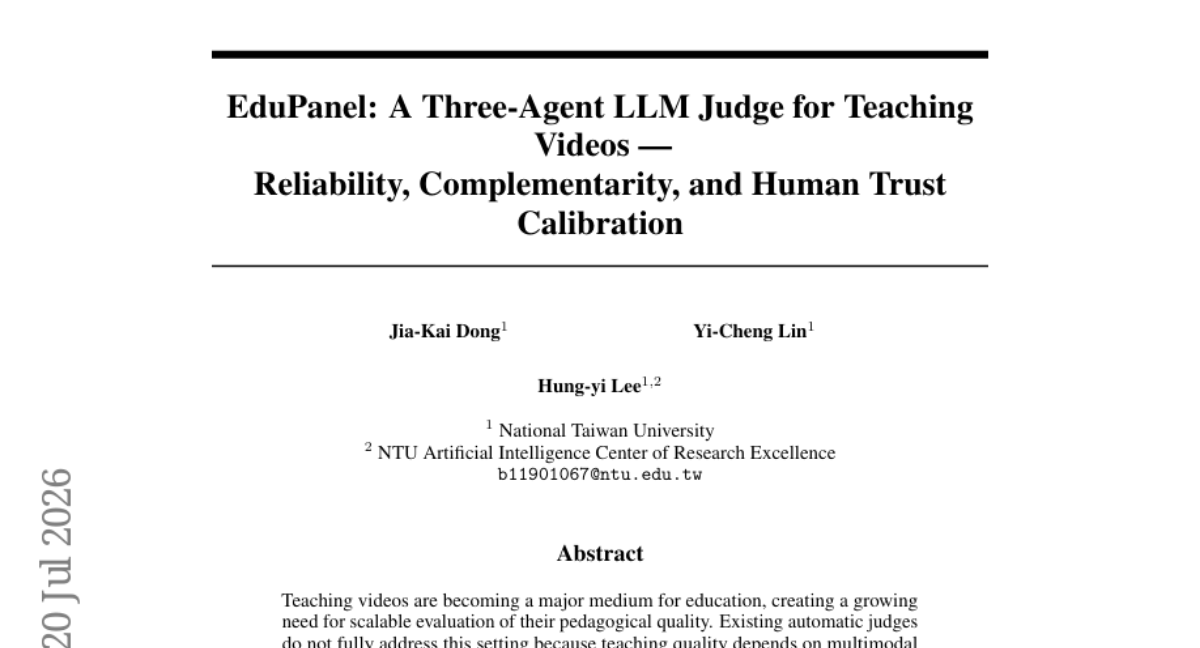
9. H^2SD: Hybrid Hindsight Self-Distillation
🔑 Keywords: Reinforcement learning, Verifiable rewards, On-policy self-distillation, H^2SD, Reasoning benchmarks
💡 Category: Reinforcement Learning
🌟 Research Objective:
– The objective is to improve the reasoning capabilities of large language models using a hybrid self-distillation framework (H^2SD) that optimizes reinforcement learning with verifiable rewards.
🛠️ Research Methods:
– The research introduces H^2SD, which modulates teacher-student update magnitudes based on trajectory correctness, utilizing rephrasing instructions and reference hints to stabilize optimization.
💬 Research Conclusions:
– H^2SD demonstrates superior performance over existing methods like RLVR, OPSD, and RLSD in various challenging reasoning tasks, ensuring stable optimization and efficient generation.
👉 Paper link: https://huggingface.co/papers/2607.18955
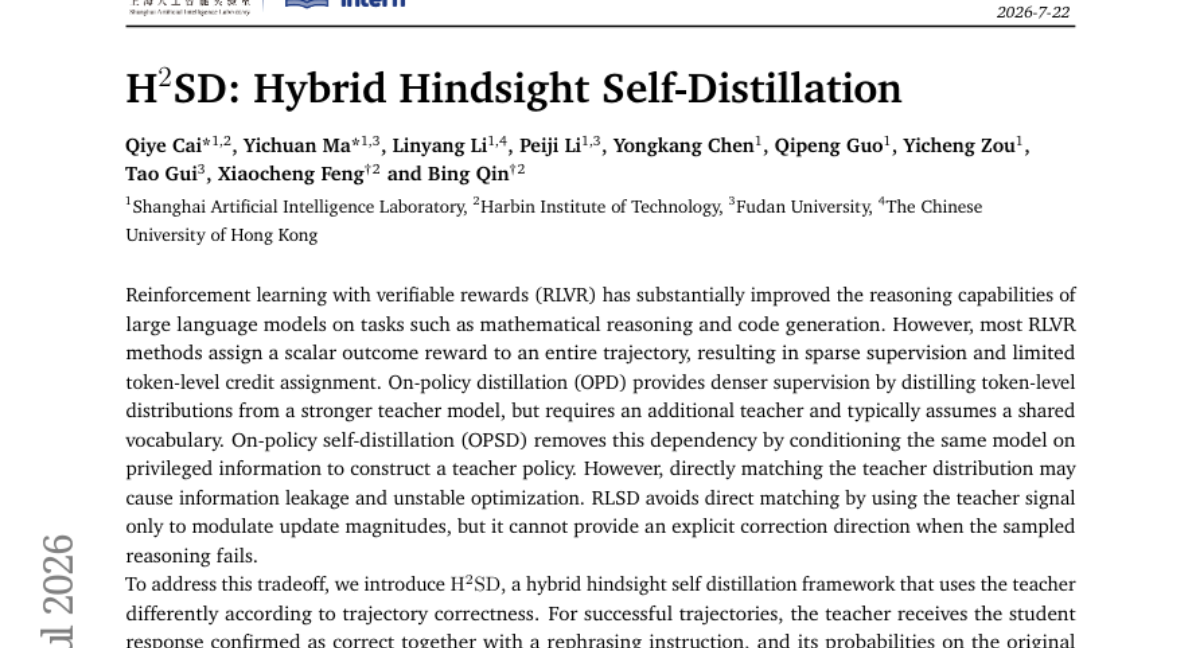
10. Trajectory-aware Cross-view Geo-localization with Sequential Observations
🔑 Keywords: Cross-view geo-localization, satellite imagery, SeqGeo-VL, TrajLoc, TrajMod
💡 Category: Computer Vision
🌟 Research Objective:
– The paper aims to bridge the gap in cross-view geo-localization by introducing SeqGeo-VL dataset and TrajLoc framework for processing video clips and route descriptions effectively.
🛠️ Research Methods:
– Implementing TrajLoc framework which utilizes both dense visual and abstract linguistic semantics.
– Introducing TrajMod module to enhance query embeddings’ spatial awareness.
💬 Research Conclusions:
– TrajLoc significantly outperforms current state-of-the-art methods in both video and text geo-localization tasks.
👉 Paper link: https://huggingface.co/papers/2607.15491
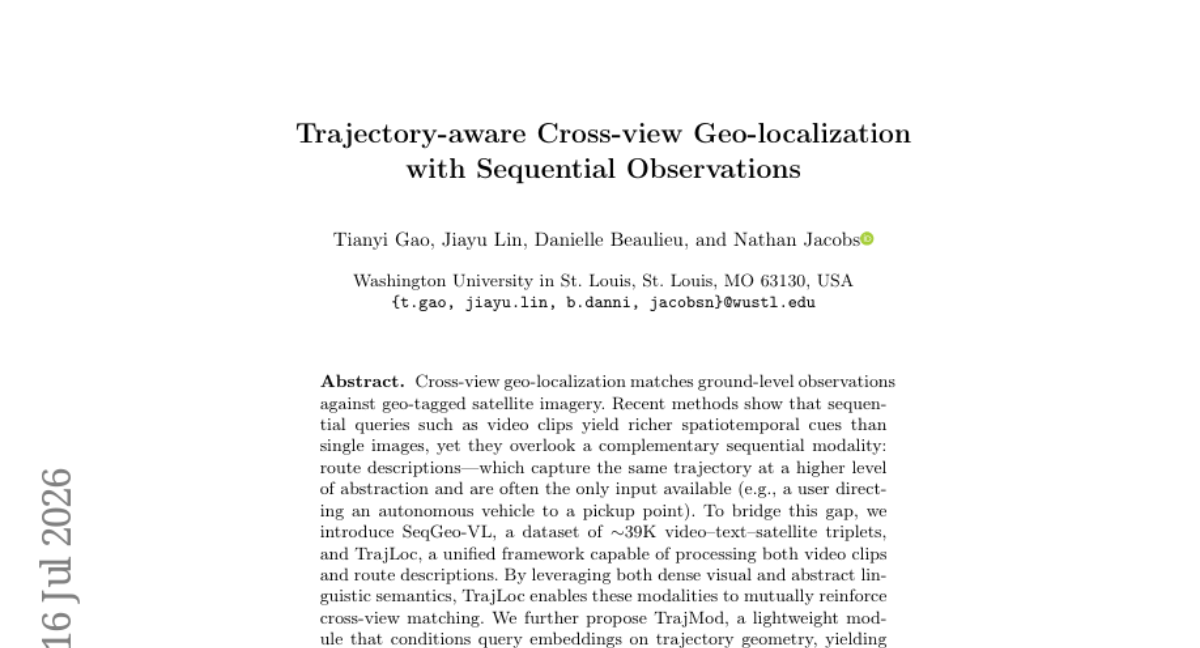
11. EduPanel: A Three-Agent LLM Judge for Teaching Videos — Reliability, Complementarity, and Human Trust Calibration
🔑 Keywords: EduPanel, LLM judge, pedagogical quality, learner-conditioned
💡 Category: AI in Education
🌟 Research Objective:
– The research aims to develop EduPanel, a rubric-grounded, learner-conditioned LLM judge to evaluate the quality of teaching videos, focusing on the intended learner rather than a universal property.
🛠️ Research Methods:
– EduPanel uses a decomposition approach across specialized agents for evaluation, tested through expert studies, architecture ablations, and learner-persona analyses.
💬 Research Conclusions:
– EduPanel achieves reliability comparable to human experts, with improved scoring accuracy and expert ability to detect unreliable outputs, suggesting its role as an effective assistant in educational evaluation.
👉 Paper link: https://huggingface.co/papers/2607.18529
12. Computational Humor with Multimodal LLMs: Methods, Datasets, Evaluation, and Challenges
🔑 Keywords: Multimodal Humor, AI Systems, Visual Humor, Humor Generation, Generative Models
💡 Category: Multi-Modal Learning
🌟 Research Objective:
– To understand visual humor in single-image and multi-panel artifacts with a focus on humor generation as an emerging area in AI.
🛠️ Research Methods:
– A capability-centric hierarchy is used to organize existing literature, focusing on recognition, interpretation, reasoning, and generation.
💬 Research Conclusions:
– The field is shifting from task-specific fusion models to large-model approaches that involve multimodal alignment and controlled generation.
– Progress is hindered by shortcut-prone evaluation methods, limited cultural and narrative scope, weak grounding in evidence, and unresolved concerns related to safety and ownership.
👉 Paper link: https://huggingface.co/papers/2607.19011

13.
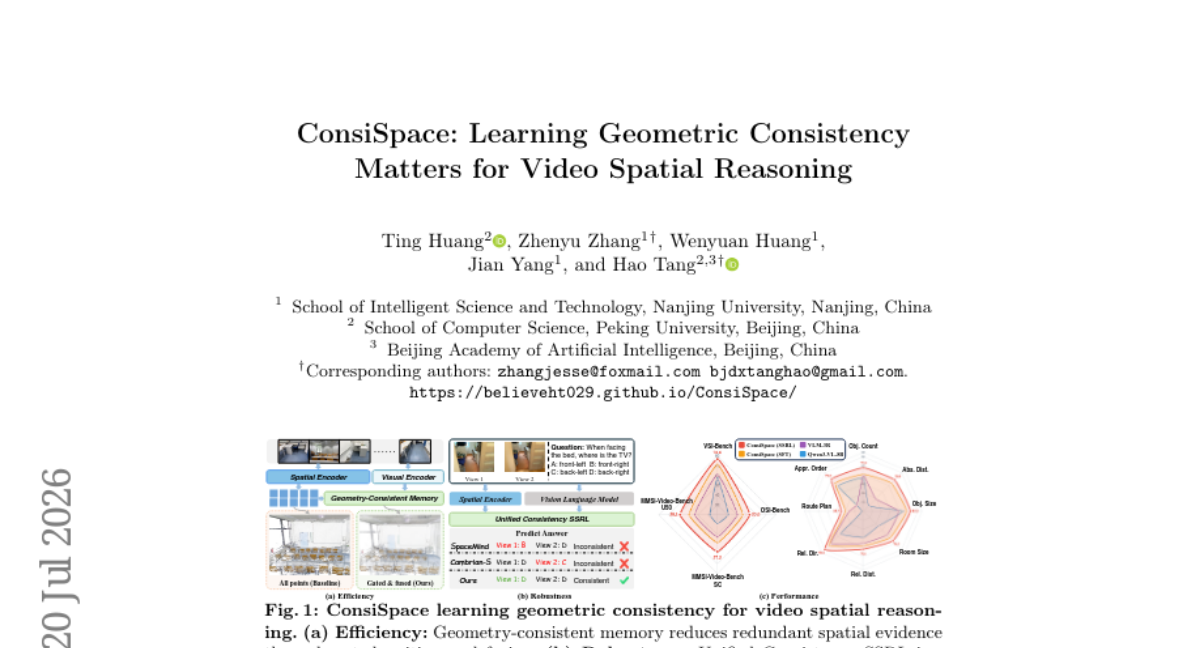
14. ConsiSpace: Learning Geometric Consistency Matters for Video Spatial Reasoning
🔑 Keywords: Video Spatial Reasoning, Consistency, Multimodal Large Language Models, Reinforcement Learning, Geometry-Consistency
💡 Category: Multi-Modal Learning
🌟 Research Objective:
– The objective is to enhance video spatial reasoning by addressing the semantic-centric limitations of existing Multimodal Large Language Models (MLLMs) and improving cross-view stability.
🛠️ Research Methods:
– Introduction of ConsiSpace, a framework incorporating geometry-consistency for spatial reasoning with a Geometry-Consistent Memory (GCM) and Utilization of Unified Consistency Self-Supervised Reinforcement Learning (UC-SSRL) for post-supervised finetuning.
💬 Research Conclusions:
– Extensive experiments across several benchmarks showed that the proposed framework achieves consistent gains, significantly improving the average performance score by 12.6 points over existing strong baselines.
👉 Paper link: https://huggingface.co/papers/2607.17599
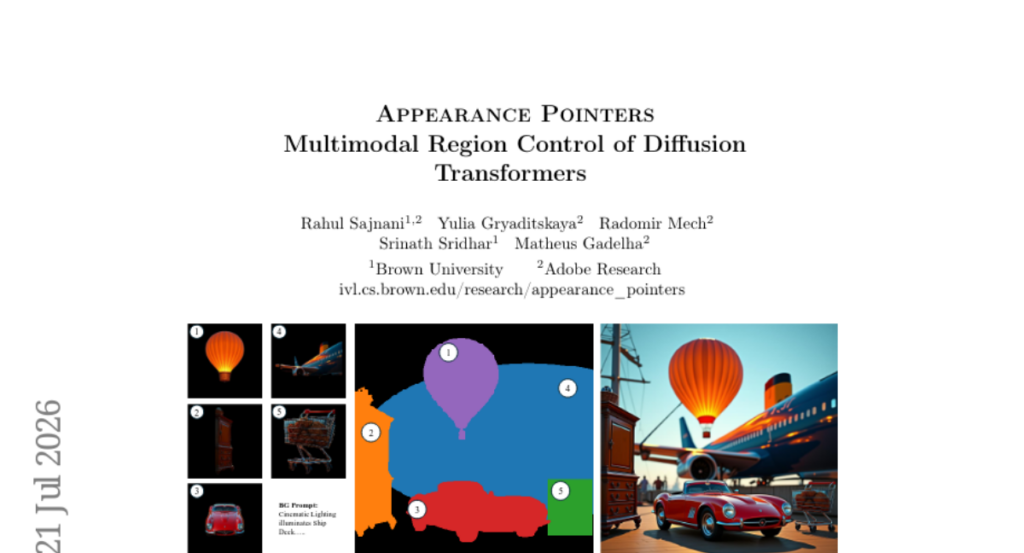
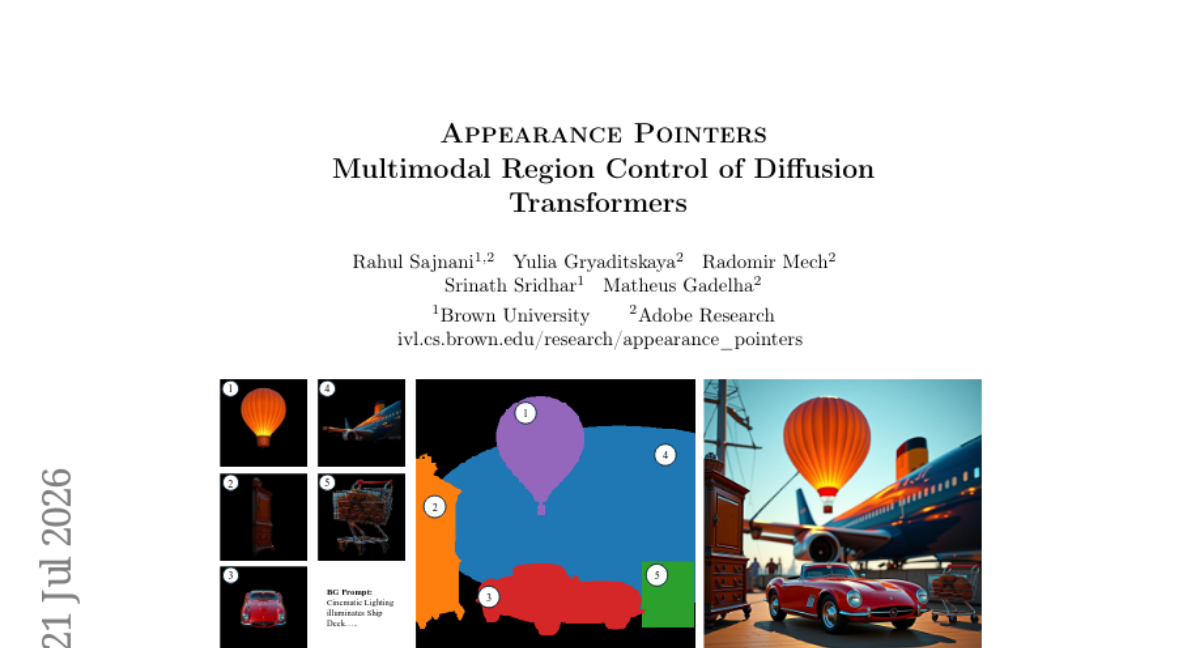
15. Appearance Pointers — Multimodal Region Control of Diffusion Transformers
🔑 Keywords: Controllable Image Generation, Diffusion Transformers, Appearance Pointers, Multimodal Guidance
💡 Category: Generative Models
🌟 Research Objective:
– To enhance controllable image generation by integrating precise regional control over materials, object identities, and spatial arrangements using a novel mechanism.
🛠️ Research Methods:
– Development of appearance pointers through a region correspondence network and a spatial aggregation mechanism to guide Diffusion Transformers.
💬 Research Conclusions:
– The proposed approach creates a modality-agnostic interface for localized multimodal control, achieving or surpassing current modality-specific state-of-the-art methods without retraining the base model.
👉 Paper link: https://huggingface.co/papers/2607.19344
16. Delineate Anything v2: A Global Foundation Model for Field Delineation
🔑 Keywords: Field Boundary Mapping, Zero-Shot Capabilities, Geospatial Domains, Foundation Model, Delineate Anything v2
💡 Category: Computer Vision
🌟 Research Objective:
– The research aims to develop a globally scalable foundation model, Delineate Anything v2, specifically designed for large-scale agricultural field boundary mapping to enhance food security, supply chain transparency, and carbon accounting.
🛠️ Research Methods:
– Construction of FBIS-73M, a multi-resolution dataset of 73 million instances spanning 61 countries, and a novel resolution-specific data curation pipeline to address multi-field administrative parcel merging.
💬 Research Conclusions:
– Delineate Anything v2 significantly outperforms previous state-of-the-art models with a notable increase in [email protected] by 0.284, demonstrating rapid execution suitable for national- and global-scale deployment. The code and resources are publicly available for further research and application.
👉 Paper link: https://huggingface.co/papers/2607.19069
17. Where Should Optimizer State Live? Tiered State Allocation for Memory-Efficient Mixture-of-Experts Training
🔑 Keywords: SkewAdam, Mixture-of-Experts, Memory Optimization, AdamW, Validation Perplexity
💡 Category: Natural Language Processing
🌟 Research Objective:
– The objective is to optimize memory usage in Mixture-of-Experts (MoE) training by employing a new optimizer, SkewAdam, which adjusts the optimizer state based on the parameter populations.
🛠️ Research Methods:
– Develop and utilize SkewAdam, an optimizer noting the differences in size and gradient statistics among MoE components (dense backbone, experts, and router), to effectively allocate and reduce memory for optimizer states.
💬 Research Conclusions:
– SkewAdam dramatically reduces optimizer state memory requirements while maintaining or improving validation perplexity compared to existing optimizers like AdamW, Muon, and Lion. The study suggests that efficient memory allocation strategies are crucial for maintaining both model accuracy and reducing computational resources.
👉 Paper link: https://huggingface.co/papers/2607.19058
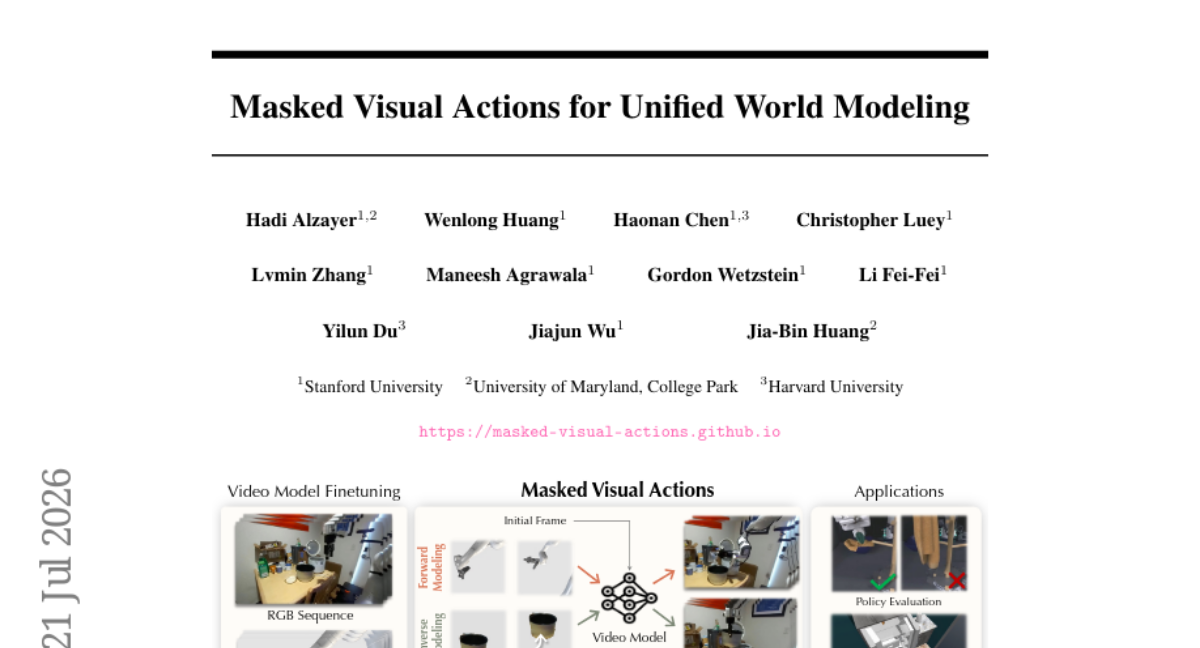
18. Masked Visual Actions for Unified World Modeling
🔑 Keywords: Video models, Robotic world modeling, Masked Visual Actions, Pixel-space control
💡 Category: Robotics and Autonomous Systems
🌟 Research Objective:
– To develop a communication method for video models that aligns action with learned interaction priors, aiding in robotic world modeling.
🛠️ Research Methods:
– Introduced Masked Visual Actions, a pixel-space control interface to express action through partially revealed trajectories in videos.
– Finetuned the model with 15 hours of masked examples from real videos and simulations.
💬 Research Conclusions:
– The model demonstrates strong visual fidelity and controllability across different scenes and embodiments.
– It produces imagined rollouts for policy evaluation, improves decision-making in model-based planning, and supports inverse modeling by synthesizing robot motions.
👉 Paper link: https://huggingface.co/papers/2607.19343
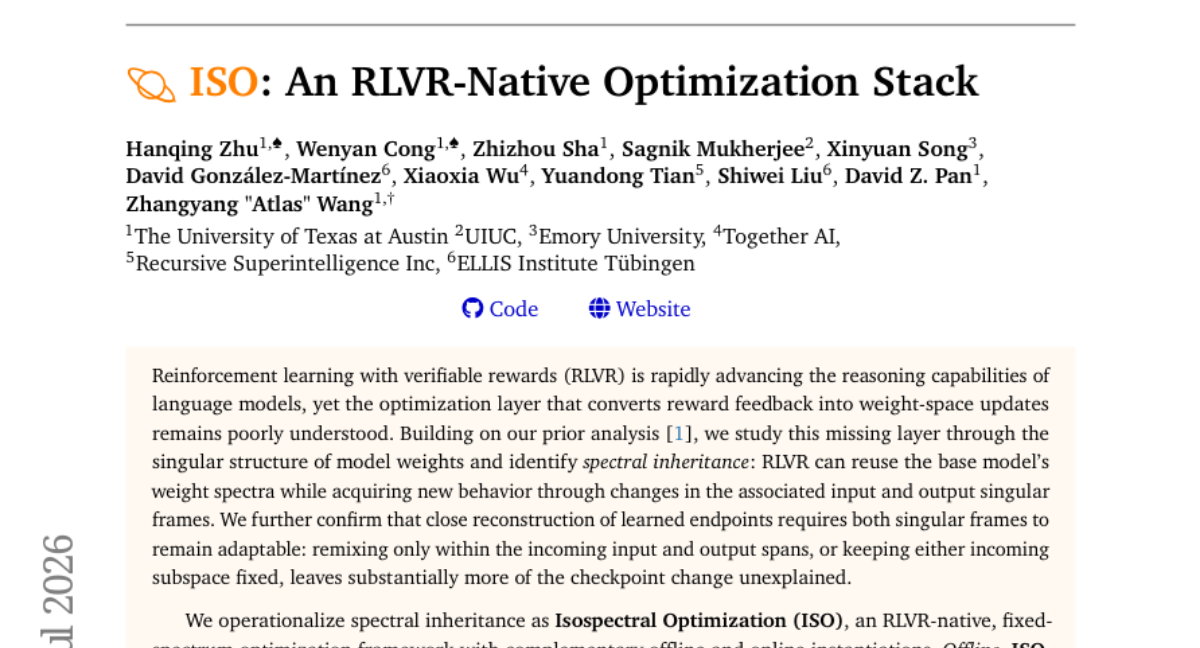
19. ISO: An RLVR-Native Optimization Stack
🔑 Keywords: Reinforcement learning, Isospectral Optimization, AI Native, Verifiable rewards, Optimization framework
💡 Category: Reinforcement Learning
🌟 Research Objective:
– The study aims to understand and enhance the optimization layer in Reinforcement learning with verifiable rewards (RLVR) by investigating the model weights’ spectral structure and introducing the concept of spectral inheritance.
🛠️ Research Methods:
– The researchers propose Isospectral Optimization (ISO) as a framework for RLVR, with both offline and online implementations, such as ISO-Merger and ISO-Optimizer, to maintain fixed-spectrum optimizations while improving reasoning and coding task performance.
💬 Research Conclusions:
– The ISO framework effectively uses spectral inheritance to enhance model accuracy with fewer training steps, demonstrating superior performance in data-free merging methods and optimizing the model’s learning efficiency.
👉 Paper link: https://huggingface.co/papers/2607.19331
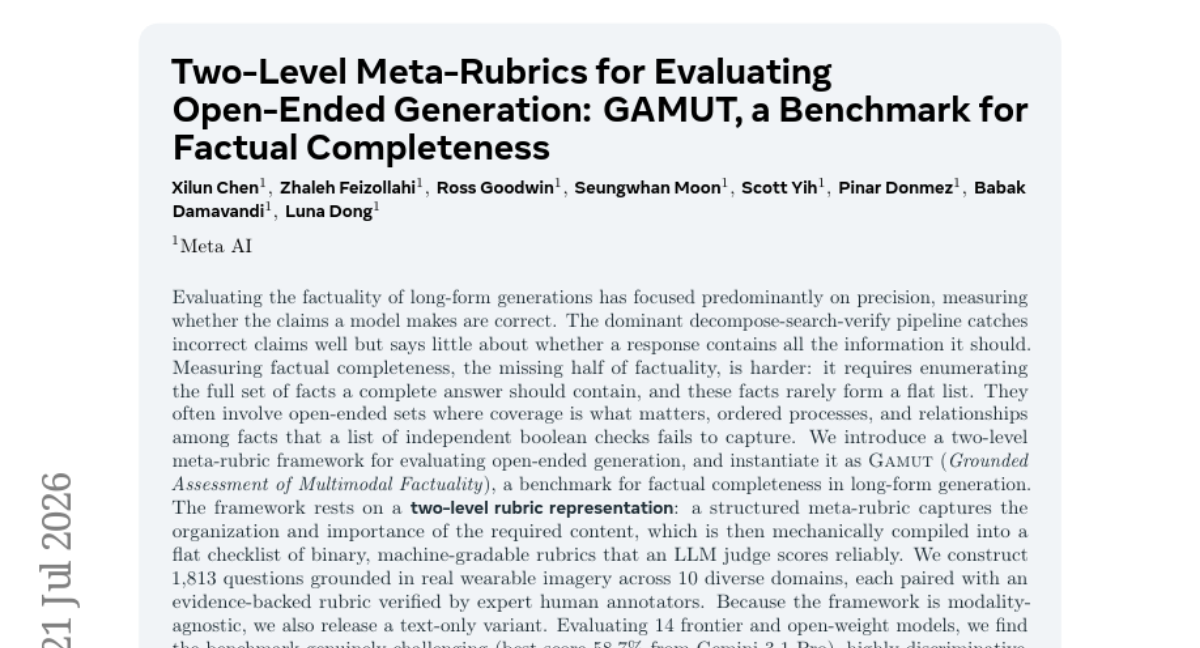
20. Two-Level Meta-Rubrics for Evaluating Open-Ended Generation: GAMUT, a Benchmark for Factual Completeness
🔑 Keywords: factual completeness, Gamut, meta-rubric, long-form generation, multi-modal
💡 Category: Generative Models
🌟 Research Objective:
– To address the challenge of measuring factual completeness in long-form generative models by introducing a benchmark called Gamut.
🛠️ Research Methods:
– Developed a two-level meta-rubric framework that converts structured content requirements into binary, machine-gradable rubrics for evaluation.
– Constructed a dataset of 1,813 questions grounded in wearable imagery across 10 diverse domains, with evidence-backed rubrics verified by human experts.
💬 Research Conclusions:
– Found that the Gamut benchmark effectively challenges current models, with a maximum performance of 58.7% scored by Gemini 3.1 Pro, indicating its high discriminative power and robustness.
👉 Paper link: https://huggingface.co/papers/2607.19322
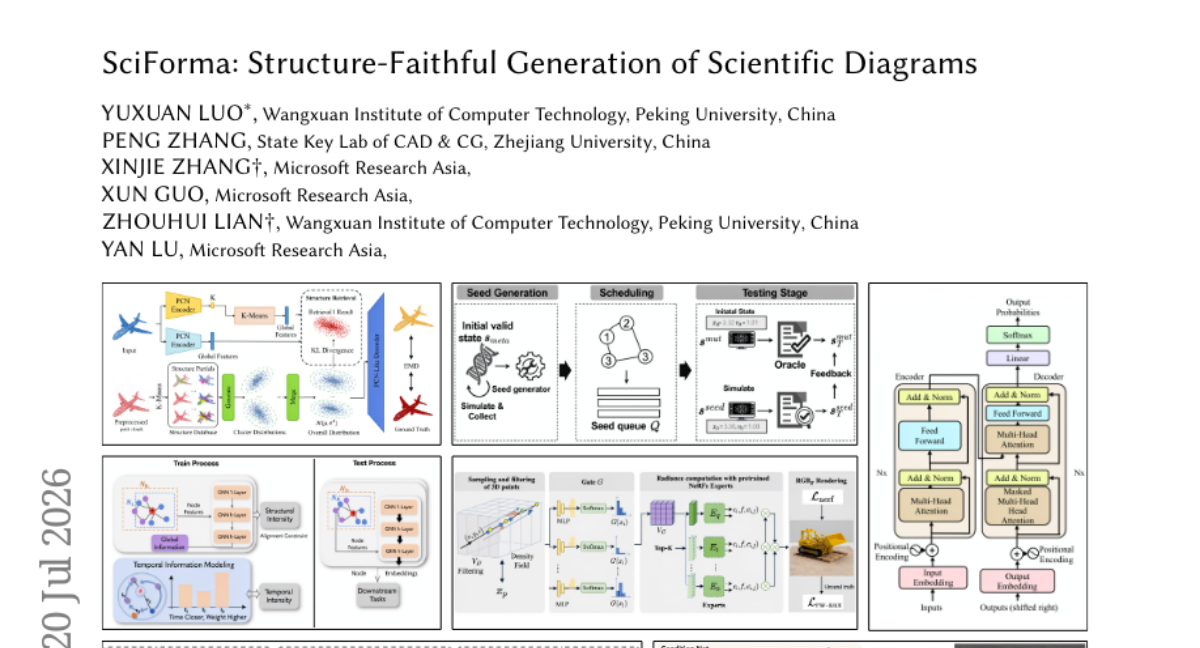
21. SciForma: Structure-Faithful Generation of Scientific Diagrams
🔑 Keywords: Structural fidelity, SciForma, Multi-Dimensional Conjunctive Preference Optimization (M-DPO), scientific diagrams
💡 Category: Generative Models
🌟 Research Objective:
– The main goal is to enhance the structural fidelity of scientific methodology diagrams to ensure accurate communication of research logic.
🛠️ Research Methods:
– Introduction of SciForma, a framework that defines structural quality through components, arrows, and text, supplemented by a structural inventory.
– Development of Multi-Dimensional Conjunctive Preference Optimization (M-DPO) to ensure simultaneous correctness across all structural axes.
– Use of SciFormaData-700K for structured training and SciFormaBench-2K for evaluation, along with iterative editing for residual error correction.
💬 Research Conclusions:
– SciForma-9B surpasses all current open-source baselines and proprietary solutions in generating structurally reliable scientific diagrams, achieving near-proprietary-level fidelity.
– The code and data for this new approach have been made openly available.
👉 Paper link: https://huggingface.co/papers/2607.18091
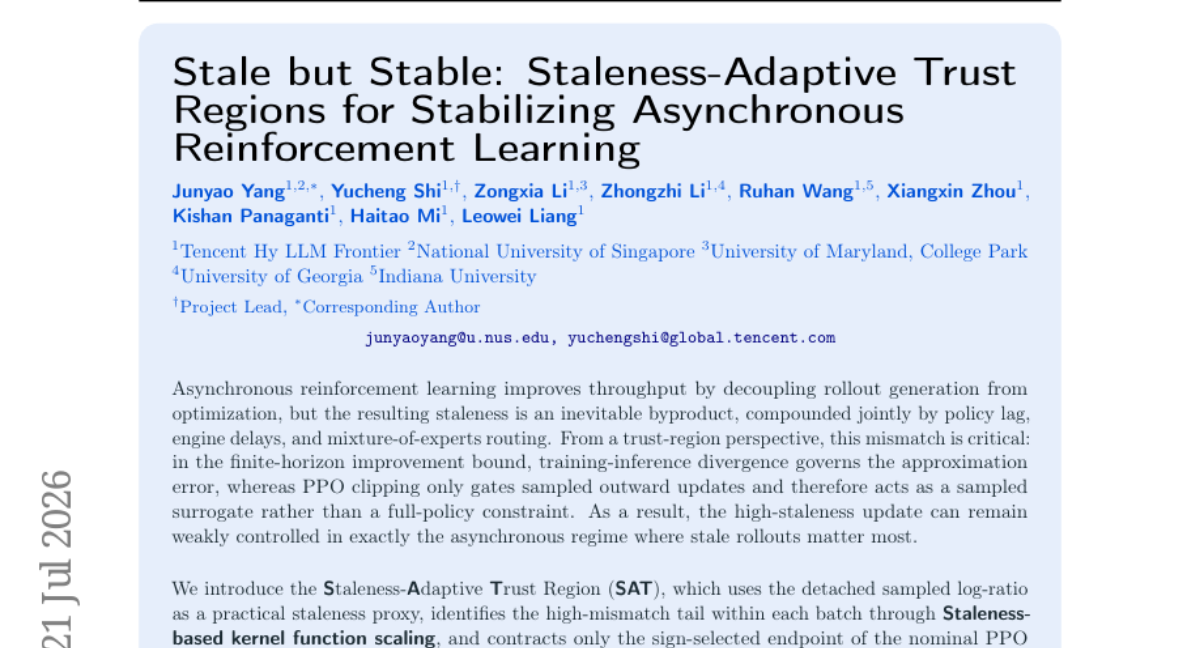
22. Stale but Stable: Staleness-Adaptive Trust Regions for Stabilizing Asynchronous Reinforcement Learning
🔑 Keywords: Asynchronous Reinforcement Learning, Staleness-Adaptive Trust Region, PPO, Qwen3-30B-A3B-Base, Adaptive Clipping
💡 Category: Reinforcement Learning
🌟 Research Objective:
– The paper aims to address the issue of staleness in asynchronous reinforcement learning by introducing the Staleness-Adaptive Trust Region (SAT) to improve update stability.
🛠️ Research Methods:
– Utilizes a staleness-adaptive mechanism, identifying high-mismatch tails through kernel scaling, and adjusts PPO intervals accordingly in a decoupled asynchronous RL setup using SGLang and Megatron frameworks.
💬 Research Conclusions:
– SAT-GSPO with R3 achieves improved stability in asynchronous RL by effectively aligning clipping intervals with staleness heterogeneity, achieving strong performance as measured by AIME24 metrics.
👉 Paper link: https://huggingface.co/papers/2607.18722
23. AlayaWorld: Interactive Long-Horizon World Modeling — Full Technical Report
🔑 Keywords: Interactive Environments, Video World Models, AlayaWorld, Long-horizon Generation, Distribution-matching Distillation
💡 Category: Generative Models
🌟 Research Objective:
– The study aims to develop an interactive long-horizon video world model that can generate customizable virtual environments from user inputs such as text, image, or video.
🛠️ Research Methods:
– Utilization of a 15B video diffusion transformer to create short latent chunks autoregressively.
– Introduction of a discrete autoregressive distillation process to optimize inference steps, featuring distribution-matching distillation, self-forcing++, and consistency distillation.
💬 Research Conclusions:
– AlayaWorld outperforms existing models on long-horizon generation in iWorld-Bench, providing a robust foundation for future research in interactive video world models.
👉 Paper link: https://huggingface.co/papers/2607.18367
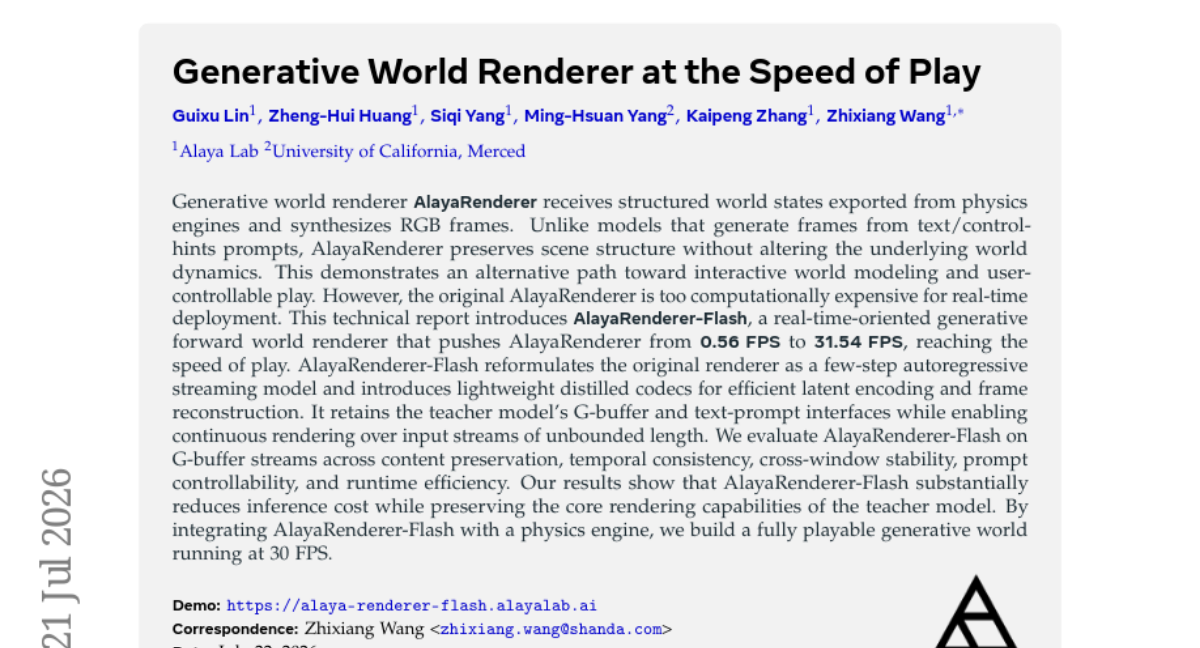
24. Generative World Renderer at the Speed of Play
🔑 Keywords: Generative world renderer, Real-time rendering, Forward world renderer, AlayaRenderer-Flash, Physics engines
💡 Category: Generative Models
🌟 Research Objective:
– To introduce AlayaRenderer-Flash, enhancing AlayaRenderer for real-time rendering performance.
🛠️ Research Methods:
– Reformulation as a few-step autoregressive streaming model with lightweight distilled codecs for efficient encoding and frame reconstruction.
💬 Research Conclusions:
– AlayaRenderer-Flash significantly reduces inference cost, maintains core rendering capabilities, and enables fully playable generative world integration at 30 FPS with a physics engine.
👉 Paper link: https://huggingface.co/papers/2607.18703
25. DataFlow-Harness: A Grounded Code-Agent Platform for Constructing Editable LLM Data Pipelines
🔑 Keywords: Large language models, NL2Pipeline gap, DataFlow-Harness, Directed acyclic graphs, Procedural guidance
💡 Category: AI Systems and Tools
🌟 Research Objective:
– The research introduces DataFlow-Harness to bridge the NL2Pipeline gap by enabling large language models to construct persistent and editable platform-native artifacts.
🛠️ Research Methods:
– Utilizes DataFlow-Skills for procedural guidance, a Model Context Protocol (MCP) layer for live operator registry, and DataFlow-WebUI for authoring and editing directed acyclic graphs.
💬 Research Conclusions:
– DataFlow-Harness demonstrates a high end-to-end pass rate of 93.3% on data-engineering tasks, reducing monetary cost by 72.5% and generation latency by 49.9% compared to traditional coding methods, indicating a reliable and cost-effective solution.
👉 Paper link: https://huggingface.co/papers/2607.16617