AI Native Daily Paper Digest – 20251231
1. UltraShape 1.0: High-Fidelity 3D Shape Generation via Scalable Geometric Refinement
🔑 Keywords: 3D geometry generation, diffusion framework, high-fidelity, spatial localization
💡 Category: Generative Models
🌟 Research Objective:
– Introduce UltraShape 1.0, a scalable framework for generating high-fidelity 3D geometry.
🛠️ Research Methods:
– Implement a two-stage generation pipeline with coarse global structure synthesis followed by detailed refinement.
– Develop a comprehensive data processing pipeline featuring a novel watertight processing method and high-quality data filtering.
– Decouple spatial localization from geometric detail synthesis during the diffusion process using voxel-based refinement.
💬 Research Conclusions:
– UltraShape 1.0 demonstrates competitive performance in both data processing quality and geometry generation.
– The framework is trained on publicly available 3D datasets, achieving strong geometric quality with limited resources.
– Future research is supported through the release of all code and trained models.
👉 Paper link: https://huggingface.co/papers/2512.21185

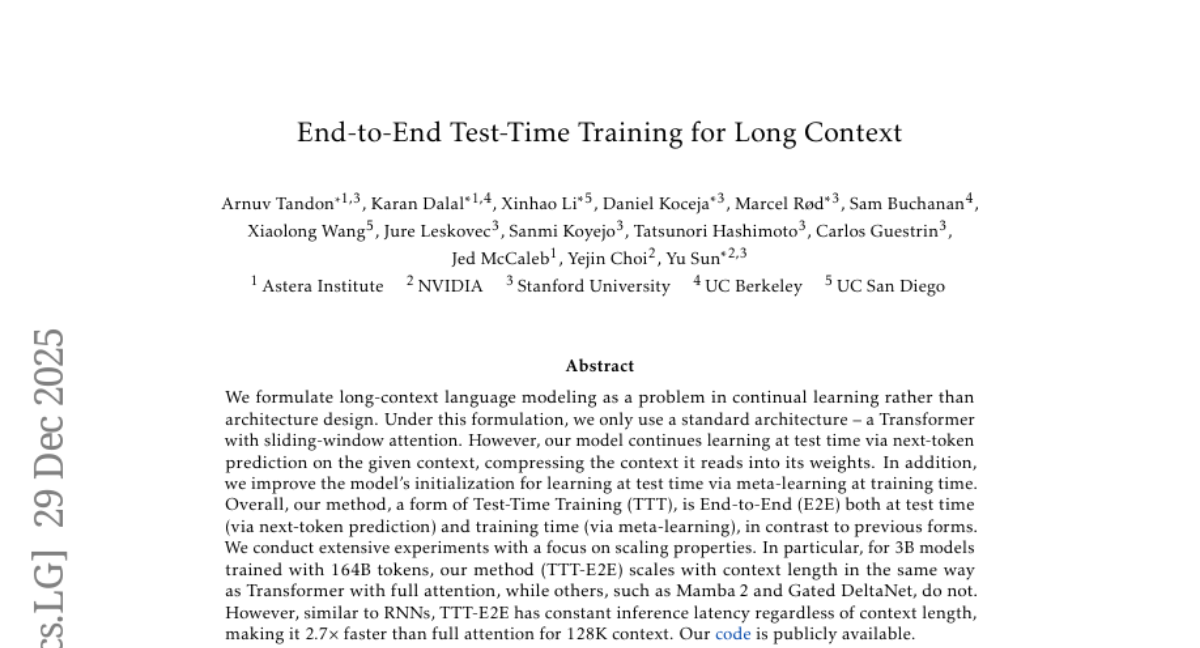
2. End-to-End Test-Time Training for Long Context
🔑 Keywords: Continual Learning, Transformer, Test-Time Training, Meta-Learning
💡 Category: Natural Language Processing
🌟 Research Objective:
– The study investigates re-framing long-context language modeling as a continual learning problem rather than through architecture design.
🛠️ Research Methods:
– Utilization of a standard Transformer with sliding-window attention, enhancing model initialization with meta-learning, and employing End-to-End Test-Time Training (TTT-E2E).
💬 Research Conclusions:
– TTT-E2E scales with context length similarly to full attention Transformers, yet provides constant inference latency akin to RNNs, delivering significantly faster performance.
👉 Paper link: https://huggingface.co/papers/2512.23675
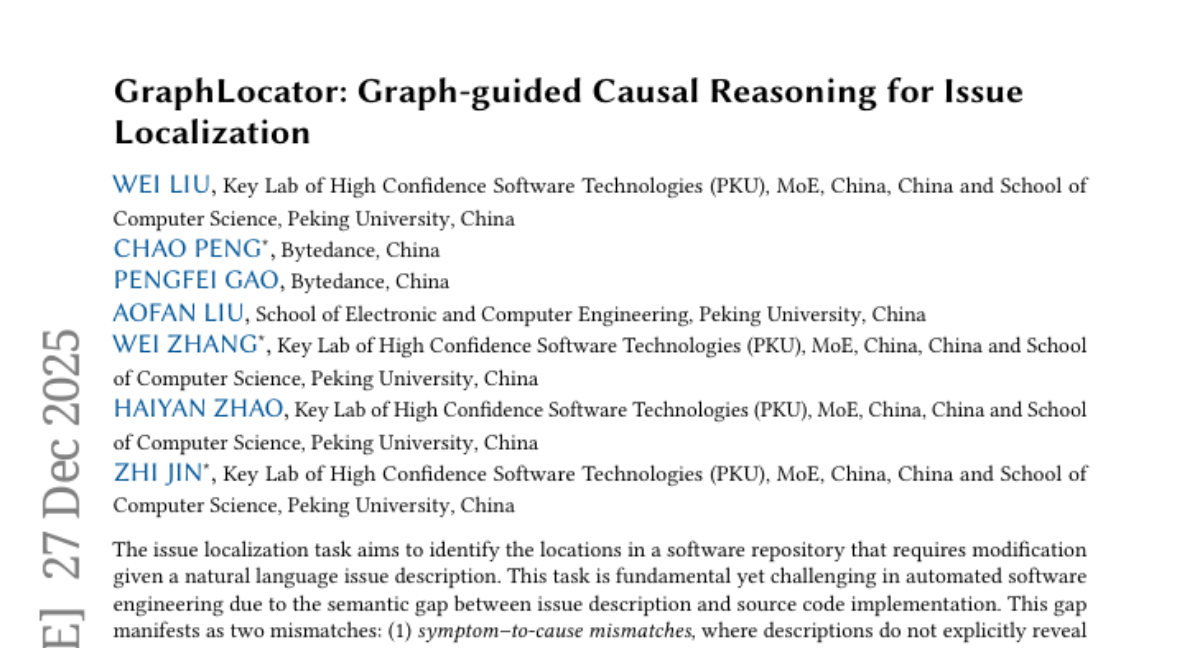
3. GraphLocator: Graph-guided Causal Reasoning for Issue Localization
🔑 Keywords: Issue Localization, Automated Software Engineering, Causal Issue Graph, GraphLocator
💡 Category: AI Systems and Tools
🌟 Research Objective:
– To address the semantic gap between natural language issue descriptions and their corresponding source code in software repositories.
🛠️ Research Methods:
– Proposed GraphLocator, which utilizes causal structure discovering and dynamic issue disentangling to manage symptom-to-cause and one-to-many mismatches in issue localization.
💬 Research Conclusions:
– GraphLocator demonstrates superior performance over baselines with significant improvements in localization accuracy, recall, and precision, effectively tackling both symptom-to-cause and one-to-many mismatch scenarios.
👉 Paper link: https://huggingface.co/papers/2512.22469
4.

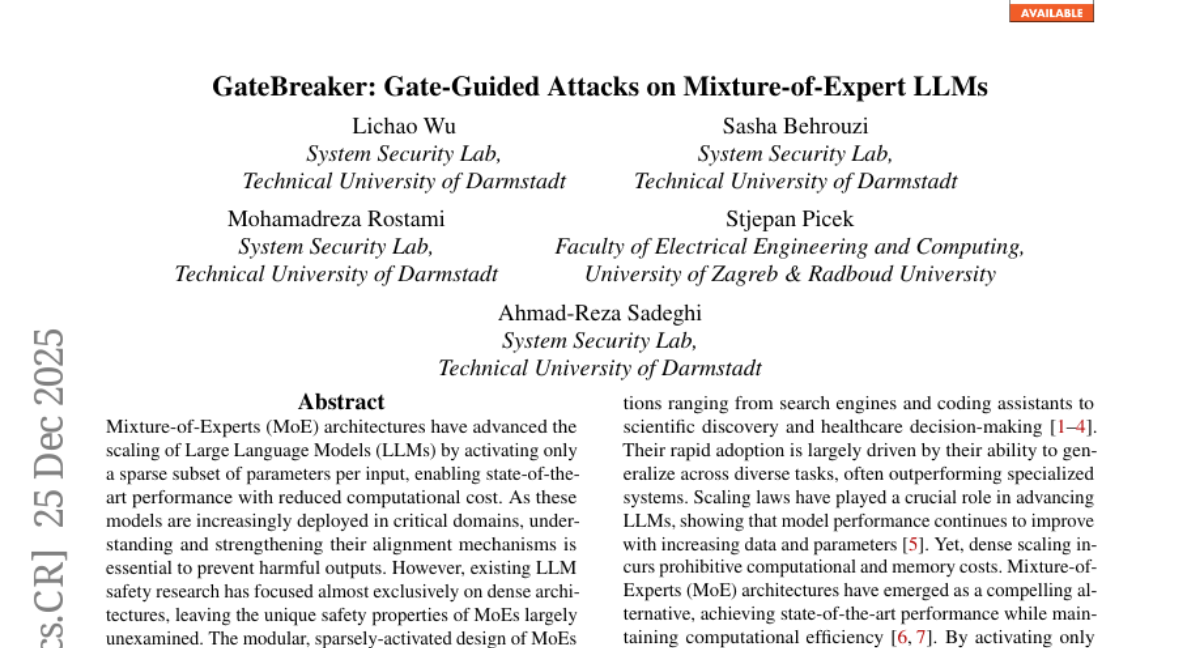
5. GateBreaker: Gate-Guided Attacks on Mixture-of-Expert LLMs
🔑 Keywords: Mixture-of-Experts (MoE), Large Language Models (LLMs), safety alignment, GateBreaker, attack framework
💡 Category: Natural Language Processing
🌟 Research Objective:
– The study aims to understand and enhance the safety alignment mechanisms in Mixture-of-Experts architectures within Large Language Models, which have not been extensively examined compared to dense architectures.
🛠️ Research Methods:
– Introduction of GateBreaker, an attack framework that evaluates MoE LLMs’ safety by identifying and selectively disabling neurons critical for safety, through gate-level profiling, expert-level localization, and targeted safety removal.
💬 Research Conclusions:
– The research identifies that safety is concentrated in a small subset of neurons within MoE models, and disabling approximately 3% of these neurons markedly increases the attack success rate with minimal compromise on utility. Additionally, this safety vulnerability extends to related models and vision language models.
👉 Paper link: https://huggingface.co/papers/2512.21008
6. Evaluating Parameter Efficient Methods for RLVR
🔑 Keywords: Parameter-Efficient Fine-Tuning, Reinforcement Learning, Verifiable Feedback, LoRA, Mathematical Reasoning
💡 Category: Reinforcement Learning
🌟 Research Objective:
– This study evaluates Parameter-Efficient Fine-Tuning (PEFT) methods within the context of Reinforcement Learning with Verifiable Rewards (RLVR) to enhance language models’ reasoning capabilities.
🛠️ Research Methods:
– Conducted the first comprehensive evaluation of over 12 PEFT methodologies across the DeepSeek-R1-Distill families on mathematical reasoning benchmarks.
💬 Research Conclusions:
– Structural variants such as DoRA, AdaLoRA, and MiSS outperform the commonly used LoRA.
– Identified a spectral collapse phenomenon in SVD-informed strategies affecting RL optimization.
– Extreme parameter reduction, like with VeRA, compromises reasoning capacity.
– The study provides a guide advocating for more exploration of parameter-efficient RL methods.
👉 Paper link: https://huggingface.co/papers/2512.23165

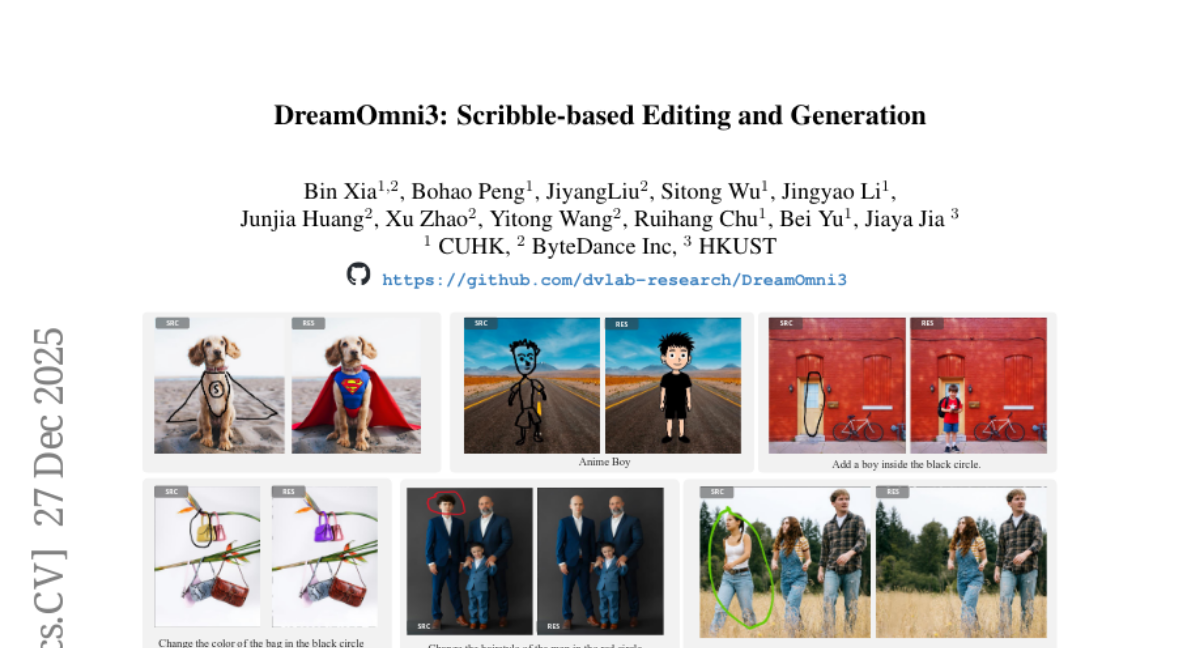
7. DreamOmni3: Scribble-based Editing and Generation
🔑 Keywords: unified generation and editing models, text prompts, scribble-based editing, graphical user interface, DreamOmni3
💡 Category: Generative Models
🌟 Research Objective:
– To propose scribble-based editing and generation tasks enabling flexible creation on GUI, combining textual, images, and freehand sketches.
🛠️ Research Methods:
– Developed a data synthesis pipeline and framework design for scribble-based editing and generation, defining key tasks and employing a joint input scheme to handle complex edits.
💬 Research Conclusions:
– DreamOmni3 has demonstrated outstanding performance in the proposed tasks. Comprehensive benchmarks are established, and models and code will be publicly released to promote further research.
👉 Paper link: https://huggingface.co/papers/2512.22525