AI Native Daily Paper Digest – 20260319
1. MetaClaw: Just Talk — An Agent That Meta-Learns and Evolves in the Wild
🔑 Keywords: continual meta-learning, large language model, behavioral skills, cloud LoRA fine-tuning, Reinforcement Learning with a Process Reward Model
💡 Category: Natural Language Processing
🌟 Research Objective:
– Develop a continual meta-learning framework named MetaClaw to evolve policies and reusable behavioral skills, minimizing downtime.
🛠️ Research Methods:
– Utilize skill-driven fast adaptation to synthesize new skills via LLM evolver.
– Perform opportunistic policy optimization with gradient-based updates through cloud LoRA fine-tuning and RL-PRM.
💬 Research Conclusions:
– MetaClaw significantly improves task accuracy and robustness on platforms like OpenClaw, with up to 32% relative accuracy improvement and an increase in Kimi-K2.5 accuracy from 21.4% to 40.6%.
👉 Paper link: https://huggingface.co/papers/2603.17187
2. MosaicMem: Hybrid Spatial Memory for Controllable Video World Models
🔑 Keywords: Video diffusion models, spatial memory, 3D structures, Mosaic Memory, PRoPE camera conditioning
💡 Category: Generative Models
🌟 Research Objective:
– To enhance video diffusion models by using a hybrid spatial memory system called Mosaic Memory, which improves consistency under camera motion and supports long-term scene editing and navigation.
🛠️ Research Methods:
– Development of Mosaic Memory that lifts patches into 3D for improved localization and retrieval, utilizing a patch-and-compose interface.
– Integration of PRoPE camera conditioning and new memory alignment methods to enhance model performance.
💬 Research Conclusions:
– MosaicMem demonstrates better pose adherence and dynamic modeling compared to implicit memory and explicit baselines, enabling advanced navigation, scene editing, and autoregressive rollout.
👉 Paper link: https://huggingface.co/papers/2603.17117
3. Complementary Reinforcement Learning
🔑 Keywords: Reinforcement Learning, Complementary RL, Sample Efficiency, Policy Actor, Co-Evolution
💡 Category: Reinforcement Learning
🌟 Research Objective:
– The paper aims to improve the sample efficiency of RL agents by synchronizing experience extraction with policy optimization through the introduction of Complementary RL.
🛠️ Research Methods:
– Complementary RL is inspired by complementary learning systems in neuroscience and involves co-evolution of an experience extractor and a policy actor within the RL optimization loop. The methodology focuses on optimizing the actor with sparse outcome-based rewards while aligning the experience extractor’s strategy with the actor’s capabilities.
💬 Research Conclusions:
– Complementary RL demonstrates a performance improvement of 10% in single-task scenarios and robust scalability in multi-task settings, establishing it as a promising paradigm for efficient experience-driven agent learning.
👉 Paper link: https://huggingface.co/papers/2603.17621
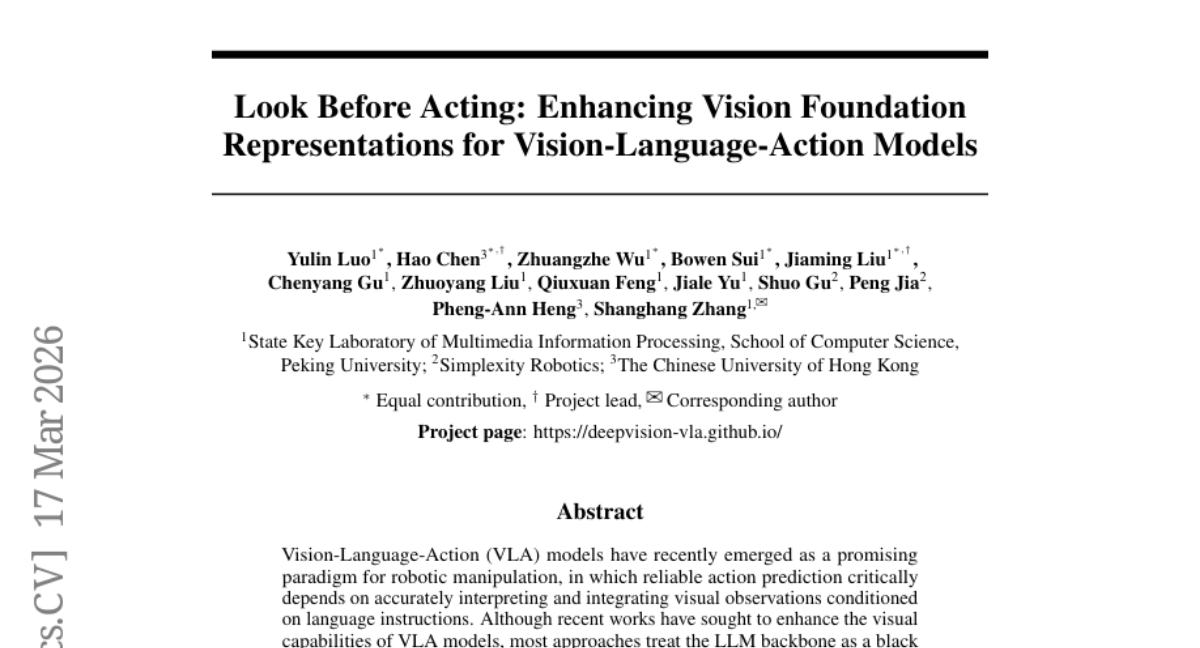
4. Look Before Acting: Enhancing Vision Foundation Representations for Vision-Language-Action Models
🔑 Keywords: Vision-Language-Action, DeepVision-VLA, VL-MoT, Action-Guided Visual Pruning
💡 Category: Robotics and Autonomous Systems
🌟 Research Objective:
– The objective is to enhance robotic manipulation by improving the interpretation and integration of visual observations according to language instructions in Vision-Language-Action models.
🛠️ Research Methods:
– Proposed a novel DeepVision-VLA model using a Vision-Language Mixture-of-Transformers framework to integrate multi-level visual features into deeper layers of the VLA backbone.
– Introduced Action-Guided Visual Pruning, a method utilizing shallow-layer attention to prune irrelevant visual tokens, reinforcing task-relevant visual cues.
💬 Research Conclusions:
– The DeepVision-VLA model outperforms current state-of-the-art techniques by 9.0% and 7.5% in simulated and real-world tasks, respectively, enhancing the design and performance of visually improved VLA models.
👉 Paper link: https://huggingface.co/papers/2603.15618
5. When AI Navigates the Fog of War
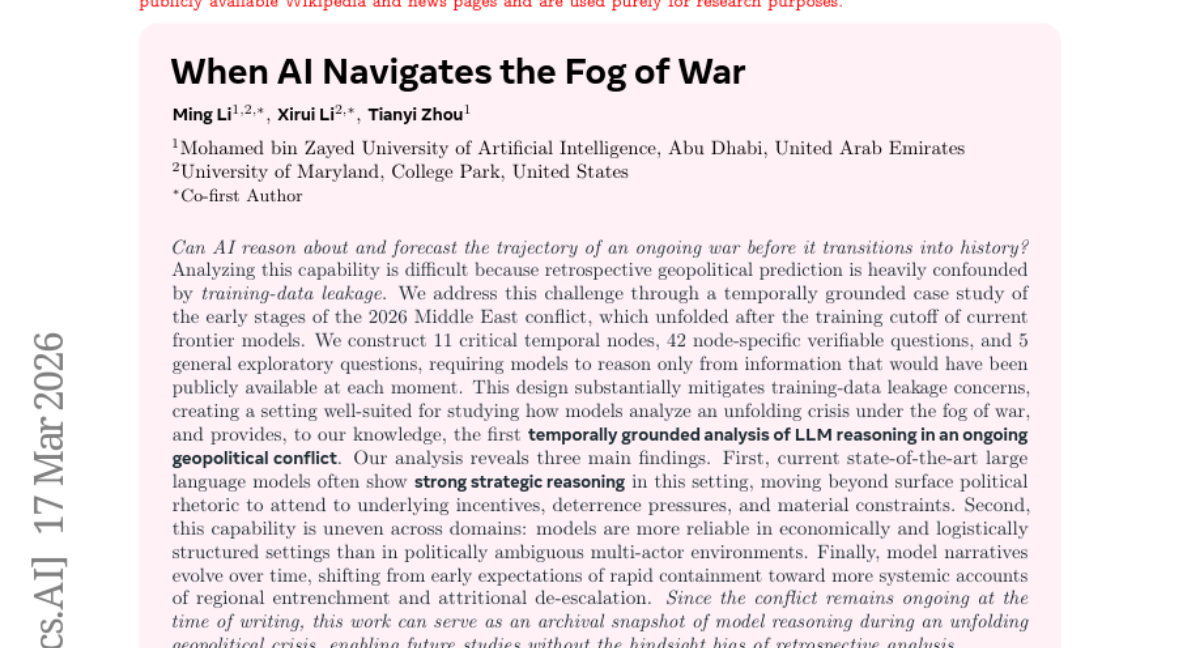
🔑 Keywords: Large language models, Geopolitical conflicts, Strategic realism, Temporal nodes, Training-data leakage
💡 Category: Knowledge Representation and Reasoning
🌟 Research Objective:
– To analyze the capability of large language models in reasoning about geopolitical conflicts, specifically focusing on the early stages of the 2026 Middle East conflict.
🛠️ Research Methods:
– Employed a temporally grounded case study with 11 critical temporal nodes and 42 node-specific verifiable questions to assess how models reason from publicly available information, minimizing training-data leakage.
💬 Research Conclusions:
– Large language models display strategic realism by reasoning about structural incentives. However, their performance is inconsistent across different domains, excelling in structured settings but faltering in politically ambiguous ones. Additionally, model narratives evolve, reflecting changing expectations in an ongoing conflict context.
👉 Paper link: https://huggingface.co/papers/2603.16642
6. Alignment Makes Language Models Normative, Not Descriptive
🔑 Keywords: Post-training alignment, language models, human preference signals, strategic games, normative predictions
💡 Category: Natural Language Processing
🌟 Research Objective:
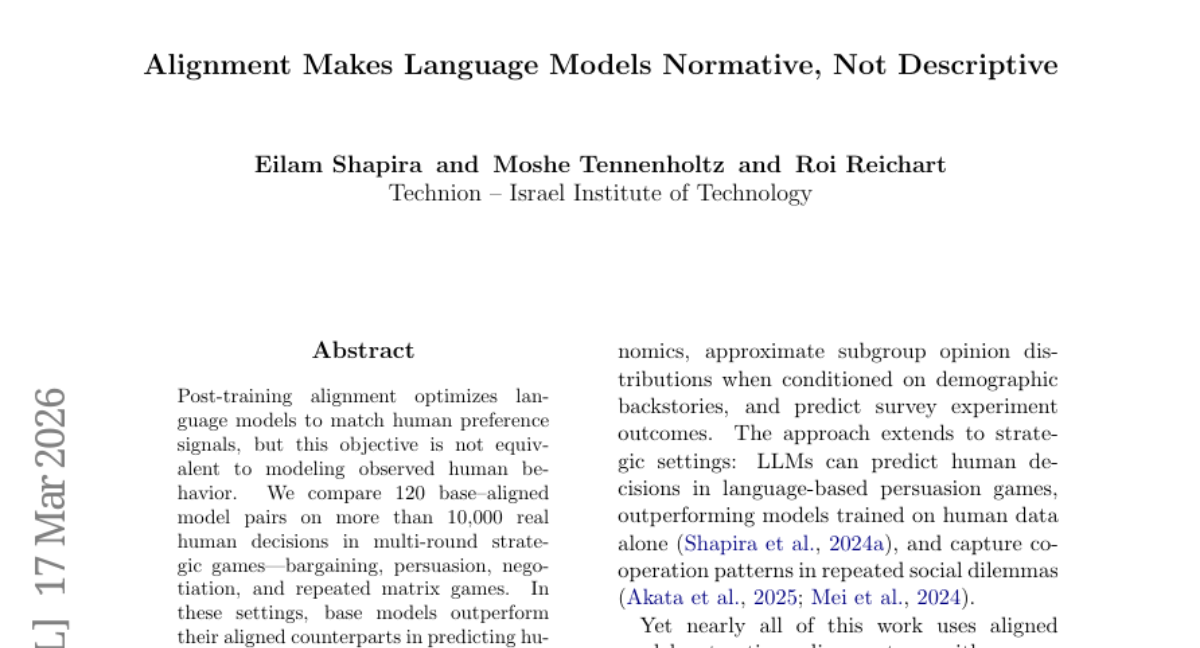
– The study aims to analyze the effects of post-training alignment on language models in terms of predicting human behavior in different scenarios, particularly distinguishing between strategic interactions and normative settings.
🛠️ Research Methods:
– The research involves comparing 120 paired base and aligned language models, observing their performance on over 10,000 real human decisions across various interactive games, including bargaining, persuasion, negotiation, and repeated matrix games.
💬 Research Conclusions:
– Base models significantly outperform aligned models in predicting human choices within complex, strategic interactions where behavior is influenced by dynamics like reciprocity and adaptation. However, aligned models excel in simpler, rule-based scenarios and normative settings, such as one-shot textbook games, indicating a trade-off in optimizing language models for human preference signals versus accurate human behavior modeling.
👉 Paper link: https://huggingface.co/papers/2603.17218
7. Video-CoE: Reinforcing Video Event Prediction via Chain of Events
🔑 Keywords: Chain of Events, video event prediction, temporal modeling, logical reasoning, multimodal language models
💡 Category: Multi-Modal Learning
🌟 Research Objective:
– The study introduces a new Chain of Events paradigm aimed at enhancing temporal modeling and logical reasoning in multimodal language models for video event prediction.
🛠️ Research Methods:
– Comprehensive evaluation of current leading MLLMs on the VEP task was conducted to identify prediction inaccuracies.
– Proposed method constructs temporal event chains to focus on visual content and logical connections using enhanced training protocols.
💬 Research Conclusions:
– The Chain of Events paradigm significantly outperforms existing open-source and commercial MLLMs, setting a new state-of-the-art in video event prediction tasks.
👉 Paper link: https://huggingface.co/papers/2603.14935