AI Native Daily Paper Digest – 20260622
1. PerceptionDLM: Parallel Region Perception with Multimodal Diffusion Language Models
🔑 Keywords: PerceptionDLM, Multimodal Diffusion Language Models, Parallel Decoding, Efficient Prompting, Structured Attention Masking
💡 Category: Multi-Modal Learning
🌟 Research Objective:
– The primary objective is to enhance the efficiency of parallel region perception in multimodal diffusion language models, thereby improving inference speed without compromising caption quality.
🛠️ Research Methods:
– The study employs structured attention masking and efficient prompting techniques to allow simultaneous perception of multiple masked regions, facilitating parallel region descriptions at both the sequence and token levels.
💬 Research Conclusions:
– PerceptionDLM demonstrates competitive region captioning performance and significant speed improvements for multi-region perception tasks. It leverages the advantages of diffusion language models for efficient, parallel visual perception.
👉 Paper link: https://huggingface.co/papers/2606.19534
2. GateMem: Benchmarking Memory Governance in Multi-Principal Shared-Memory Agents
🔑 Keywords: Memory Benchmarks, Multi-Principal, Access Control, Active Forgetting, Long-Context Prompting
💡 Category: AI Systems and Tools
🌟 Research Objective:
– The paper introduces GateMem, a benchmark designed for evaluating multi-principal shared-memory agents, addressing challenges in utility, access control, and forgetting in diverse institutional deployment contexts.
🛠️ Research Methods:
– The study evaluates memory agents across various domains including medical, office, education, and household. It observes the performance of agents concerning state updates, access control, and active forgetting through structured judging and annotations.
💬 Research Conclusions:
– The findings reveal that current memory agents do not satisfactorily achieve strong utility, robust access control, and reliable forgetting. Long-context prompting provides good governance scores but at a high token cost. Retrieval-based methods reduce costs but still risk unauthorized information leakage.
👉 Paper link: https://huggingface.co/papers/2606.18829
3. Multi-Turn Reflective Masking Elicits Reasoning in Mask Diffusion Models
🔑 Keywords: Mask Diffusion Models, Reflective Masking, local edits, test-time scaling, History Reference
💡 Category: Generative Models
🌟 Research Objective:
– Introduce Reflective Masking to enable iterative local refinement in Mask Diffusion Models without needing architectural changes.
🛠️ Research Methods:
– Employ a lightweight post-training approach to support multi-turn reasoning through Reflective Masking and introduce a parameter-free History Reference mechanism for revisiting and revising outputs.
💬 Research Conclusions:
– Reflective Masking consistently beats standard masking-based baselines across various tasks and modalities, demonstrating its general and robust capability for refinement and reasoning.
👉 Paper link: https://huggingface.co/papers/2606.16700
4. GeneralVLA-2: Geometry-Aware Reconstruction and Governed Memory for Robot Planning
🔑 Keywords: General VLA, GeoFuse-MV3D, KnowledgeBank, Robotics, Vision-Language-Action
💡 Category: Robotics and Autonomous Systems
🌟 Research Objective:
– The research aims to enhance vision-language-action systems by addressing limitations in 3D reconstruction and memory management, specifically improving robotic manipulation tasks.
🛠️ Research Methods:
– Introduces GeoFuse-MV3D for geometry-prior-guided 3D reconstruction with calibrated multi-view observations.
– Upgrades KnowledgeBank to a governed long-term memory system with improved retrieval for better memory quality and conflict resolution.
💬 Research Conclusions:
– GeoFuse-MV3D demonstrates improvements over MV-SAM3D in metrics like CD, LPIPS, PSNR, and SSIM.
– KnowledgeBank shows significant advancements over ReasoningBank in benchmark tests such as Terminal-Bench SR and SWE-Bench.
👉 Paper link: https://huggingface.co/papers/2606.17480

5. BrainG3N: A Dual-Purpose Tokenizer for Controllable 3D Brain MRI Generation
🔑 Keywords: 3D brain MRI, masked-autoencoder, latent diffusion, conditional generation, clinically informative embeddings
💡 Category: AI in Healthcare
🌟 Research Objective:
– To develop a 3D brain MRI generative model using a masked-autoencoder tokenizer for creating embeddings that enhance medical task performance and support controlled image generation.
🛠️ Research Methods:
– Utilized a fully volumetric masked-autoencoder-based tokenizer, decoupled an encoder for clinically informative embeddings, and a CNN decoder for voxel reconstruction, pretrained on 35,309 volumes.
💬 Research Conclusions:
– The model outperformed or matched state-of-the-art models on a 23-task benchmark in 21 of 23 tasks and supported conditional generation and patient-specific forecasting, establishing a robust 3D brain-MRI embedding space for clinical tasks and generation.
👉 Paper link: https://huggingface.co/papers/2606.19651
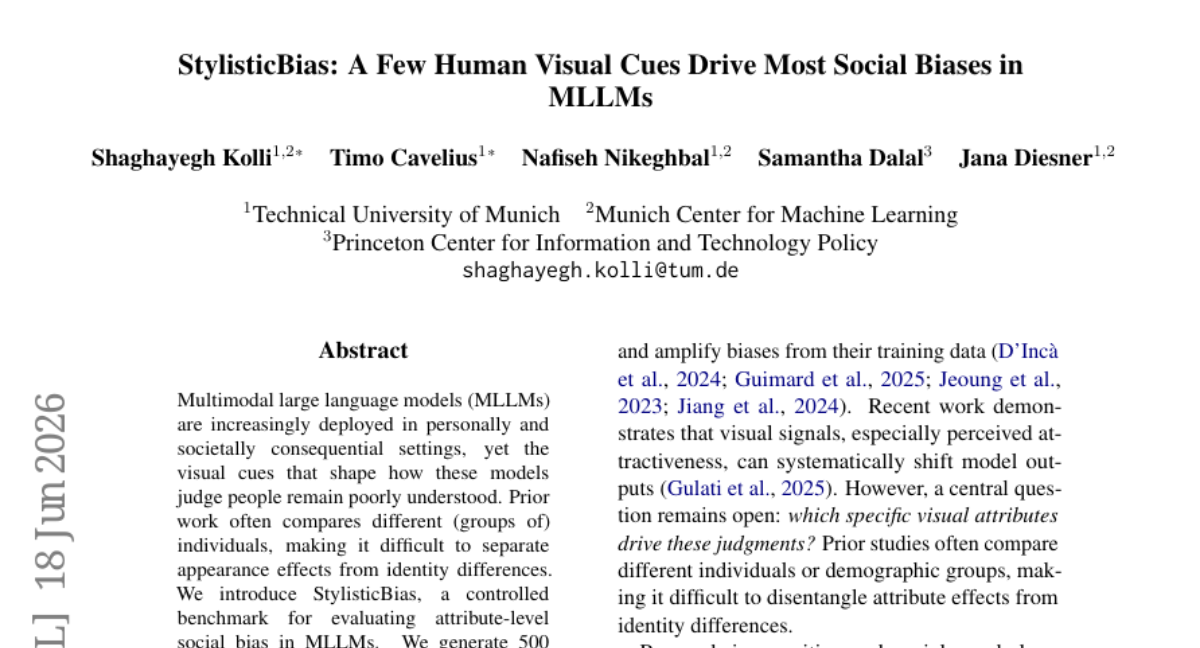
6. StylisticBias: A Few Human Visual Cues Drive Most Social Biases in MLLMs
🔑 Keywords: Multimodal large language models, social bias, fashion style, socioeconomic cues, attribute-level social bias
💡 Category: AI Ethics and Fairness
🌟 Research Objective:
– The study aims to understand how specific visual attributes such as fashion style and socioeconomic cues influence social bias in Multimodal large language models (MLLMs).
🛠️ Research Methods:
– Introduced a controlled benchmark named StylisticBias, creating 500 photorealistic base faces with 50 single-attribute variations per face, resulting in approximately 25K images, to evaluate attribute-level social bias in MLLMs while keeping identity fixed.
💬 Research Conclusions:
– The research found that fashion style and socioeconomic cues are major drivers of social bias, with age and body type having significant identity-level effects. Approximately 15 attributes account for nearly 80% of bias variation, with sensitivity strongest in judgments aligned with appearance.
👉 Paper link: https://huggingface.co/papers/2606.20527
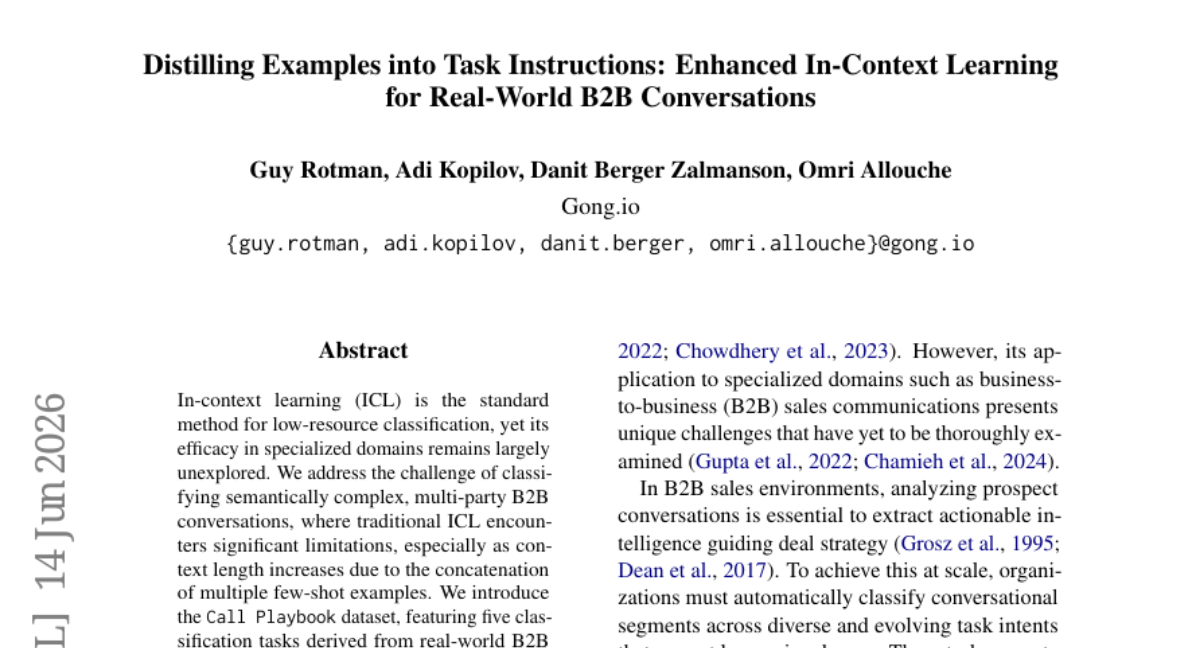
7. Distilling Examples into Task Instructions: Enhanced In-Context Learning for Real-World B2B Conversations
🔑 Keywords: B2B conversation classification, In-context learning, knowledge extraction, token usage, macro-averaged AUC
💡 Category: Natural Language Processing
🌟 Research Objective:
– Develop a novel approach to classify semantically complex, multi-party B2B conversations with an emphasis on reducing token usage and improving performance as context length increases.
🛠️ Research Methods:
– Introduced the Call Playbook dataset, featuring five classification tasks targeting core sales concepts.
– Proposed novel knowledge extraction methods to convert verbose examples into compact, structured classification criteria and precise task descriptions.
💬 Research Conclusions:
– Achieved a 99% reduction in token usage and an improvement in macro-averaged AUC by up to 7% over traditional in-context learning methods.
– Demonstrated robustness in classification performance as context length increases, outperforming token compression baselines.
👉 Paper link: https://huggingface.co/papers/2606.15641
8.
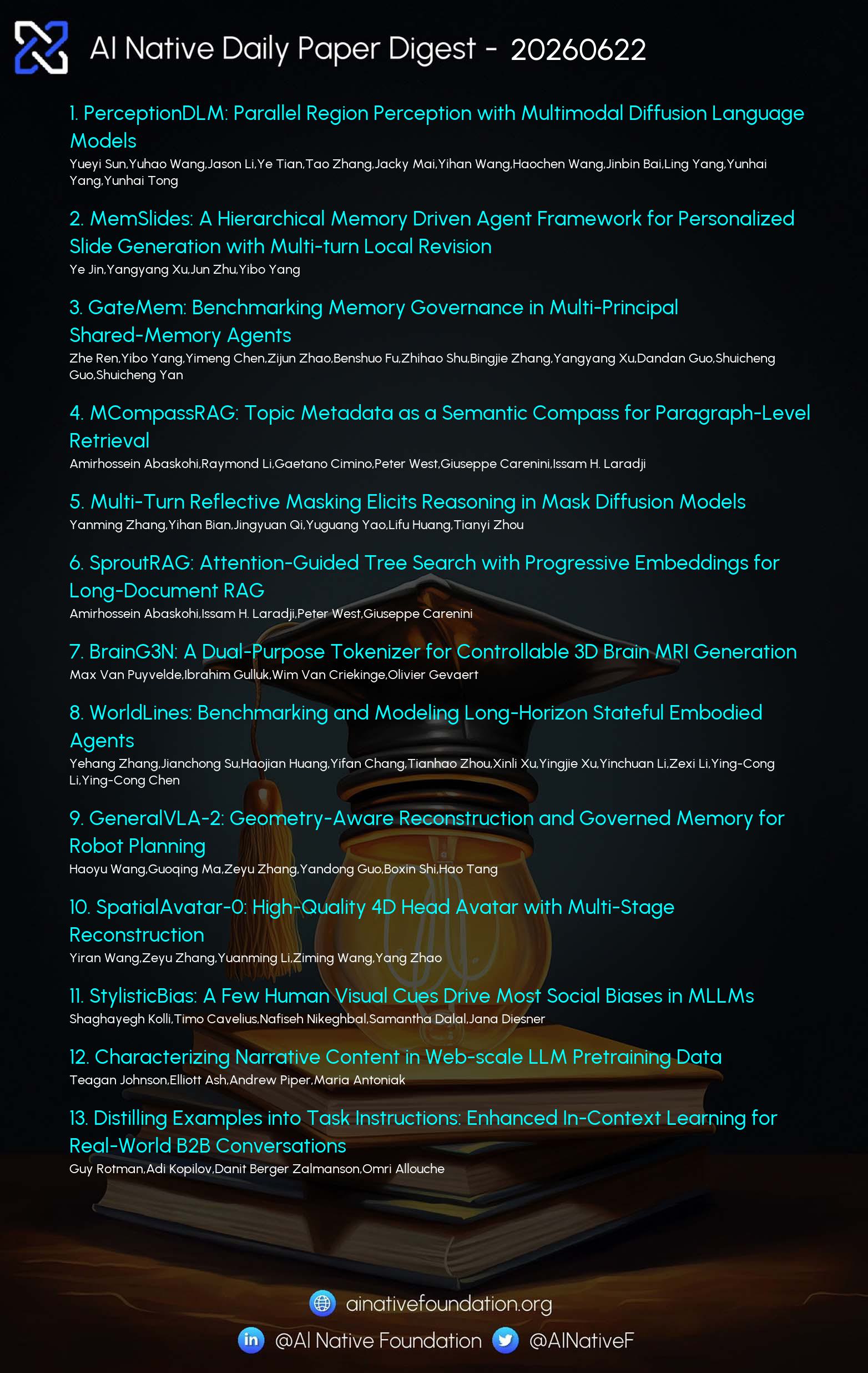
9. When, Where, and How: Adaptive Binning for Tabular Self-Supervised Learning
🔑 Keywords: Adaptive Binning, Discretization, Medical Tabular Data, Self-Supervised Learning
💡 Category: AI in Healthcare
🌟 Research Objective:
– Introduce Adaptive Binning, a method for training-adaptive discretization to enhance self-supervised learning on medical tabular data.
🛠️ Research Methods:
– Implement a feature-wise, training-adaptive discretization strategy using a coarse-to-fine curriculum.
– Use a heterogeneity-aware objective to integrate categorical reconstruction with ordinal supervision for numerical features.
💬 Research Conclusions:
– Demonstrated consistent improvements in representation learning for medical tabular data using the proposed Adaptive Binning method, supporting advancements in linear probing and fine-tuning without the need for dataset-specific discretization tuning.
– Introduced a benchmark with standardized protocols for reproducible research in medical tabular SSL.
👉 Paper link: https://huggingface.co/papers/2606.19827
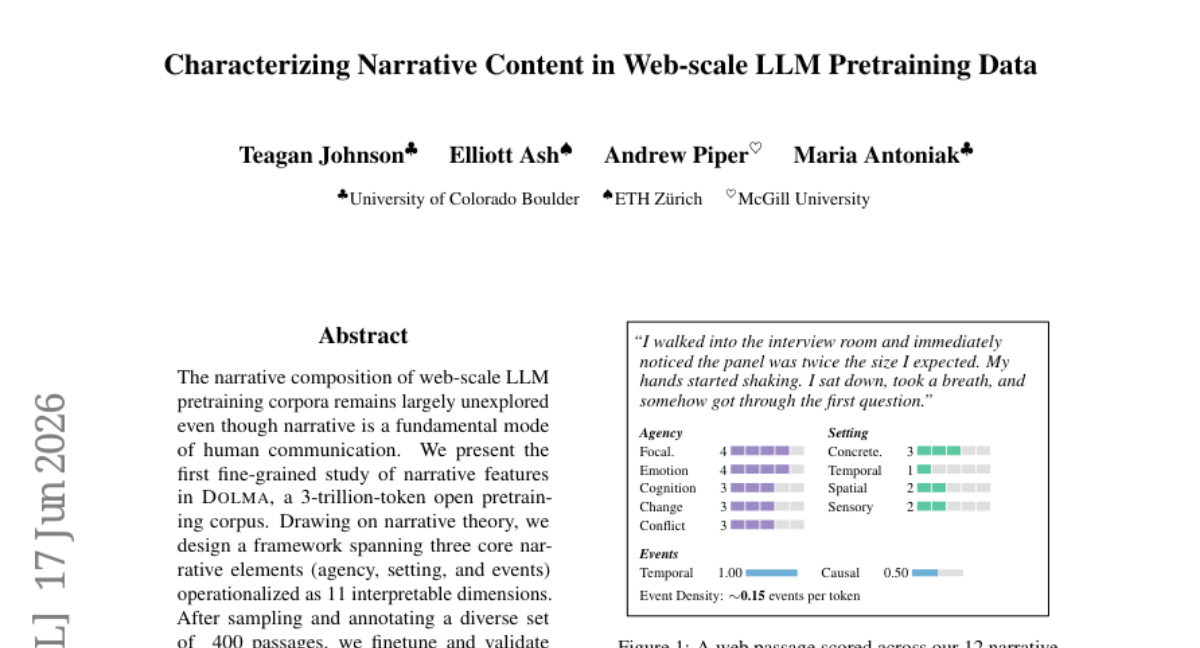
10. Characterizing Narrative Content in Web-scale LLM Pretraining Data
🔑 Keywords: narrative structures, LLM pretraining data, NarraBERT, NarraDolma, narrative reasoning tasks
💡 Category: Natural Language Processing
🌟 Research Objective:
– To analyze and reveal measurable, multidimensional narrative patterns in large-scale language model (LLM) training data using narrative theory.
🛠️ Research Methods:
– Designed a framework with three core narrative elements operationalized as 11 dimensions, sampled and annotated 400 passages, finetuned NarraBERT, and applied it to 3 million passages to create NarraDolma.
💬 Research Conclusions:
– Narrative structure is measurable on a large scale and shows continuous multidimensional structures in web text.
– Narrative qualities are unequally distributed across pretraining sources, indicating that current curation practices do not fully capture these variances.
– The study provides a foundational understanding of narrative qualities in LLM pretraining data and their impact on narrative reasoning tasks.
👉 Paper link: https://huggingface.co/papers/2606.19468
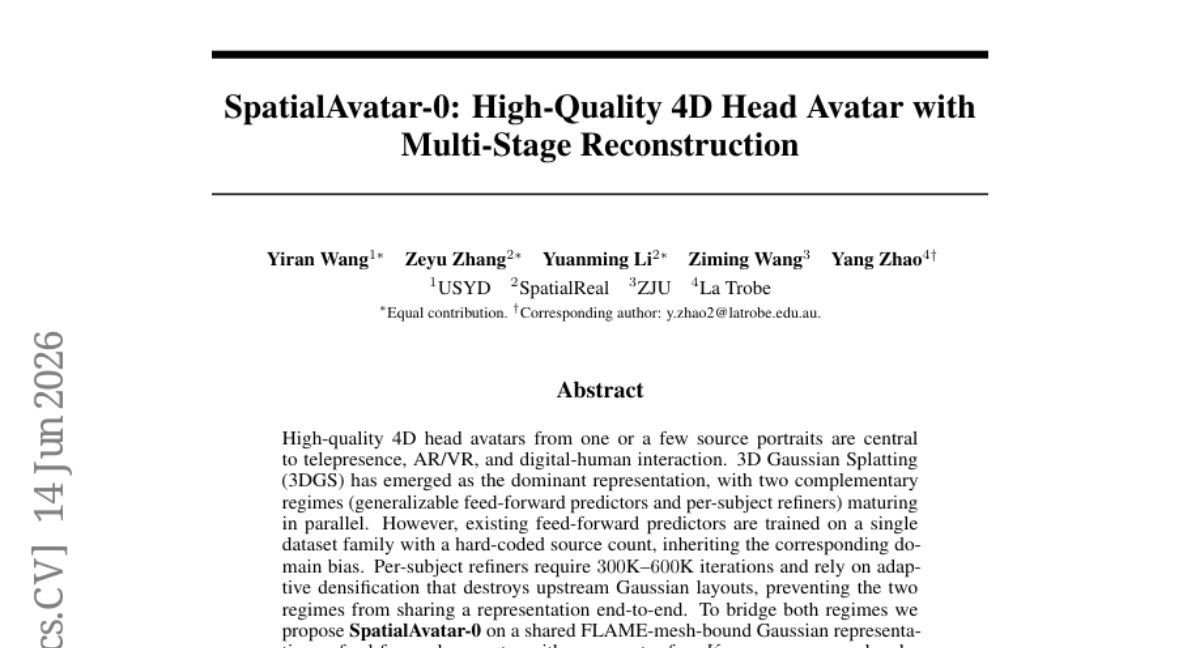
11. SpatialAvatar-0: High-Quality 4D Head Avatar with Multi-Stage Reconstruction
🔑 Keywords: SpatialAvatar-0, 4D head avatars, feed-forward prediction, Gaussian representation, per-subject refinement
💡 Category: Computer Vision
🌟 Research Objective:
– The research aims to enable high-quality 4D head avatar generation using a novel approach that bridges feed-forward prediction and per-subject refinement.
🛠️ Research Methods:
– The methodology involves a shared FLAME-mesh-bound Gaussian representation with a feed-forward generator and a monocular-temporal to multi-view-spatial two-phase schedule.
– It employs a 10K-iteration layout-preserving per-subject refinement loop with anti-spike regularization.
💬 Research Conclusions:
– SpatialAvatar-0 achieves superior performance in generating 4D head avatars, surpassing existing models like GAGAvatar and GeoAvatar, with significantly reduced iteration requirements across various benchmarks.
👉 Paper link: https://huggingface.co/papers/2606.15659
12. WorldLines: Benchmarking and Modeling Long-Horizon Stateful Embodied Agents
🔑 Keywords: embodied agents, long-term memory, WorldLines, ObsMem, Memory QA
💡 Category: Robotics and Autonomous Systems
🌟 Research Objective:
– The study aims to evaluate long-term memory capabilities in embodied agents, specifically in household assistance scenarios.
🛠️ Research Methods:
– Introduction of the WorldLines benchmark, which constructs temporally extended household scenarios with dialogues, actions, and state changes for Memory QA and Embodied Task Planning.
– Proposal of the ObsMem framework, which addresses challenges such as partial observability and memory translation by maintaining visibility-aware memories and action-native state trails.
💬 Research Conclusions:
– Experiments demonstrate ongoing challenges in handling partial observability and translating long-term memory into effective action plans, with ObsMem providing a robust reference architecture in these scenarios.
👉 Paper link: https://huggingface.co/papers/2606.18847

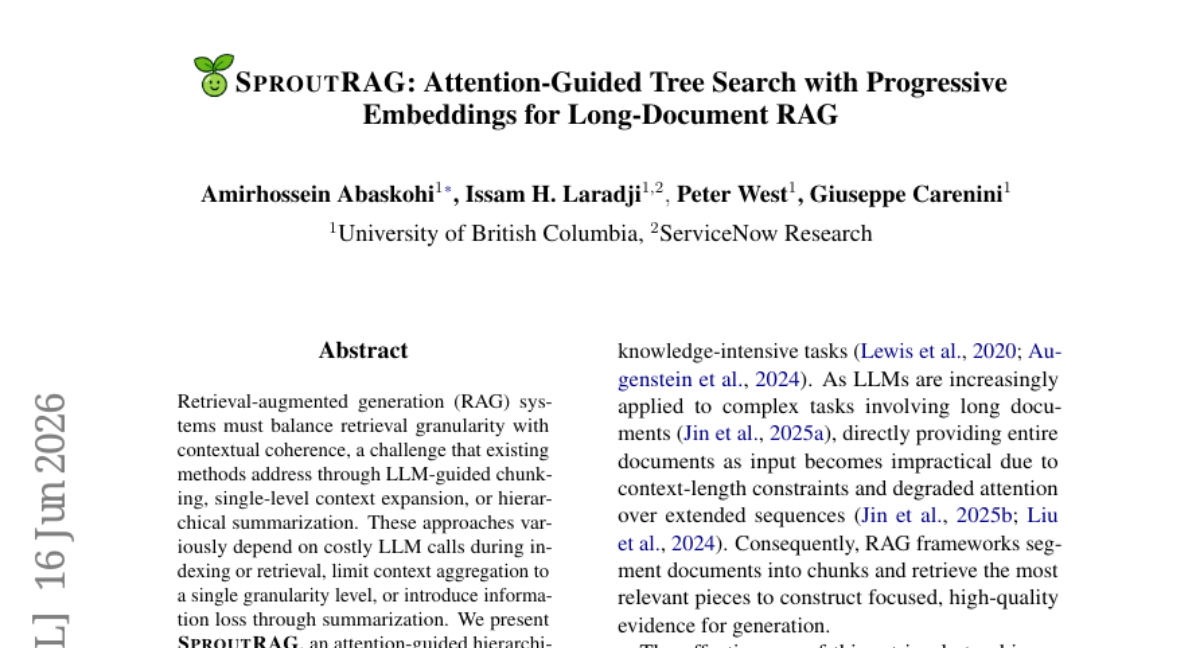
13. SproutRAG: Attention-Guided Tree Search with Progressive Embeddings for Long-Document RAG
🔑 Keywords: attention-guided, hierarchical RAG, sentence-level chunks, retrieval-augmented generation, inter-sentence attention
💡 Category: Natural Language Processing
🌟 Research Objective:
– The research aims to develop SproutRAG, a framework that organizes sentence-level chunks into semantically coherent units using learned inter-sentence attention to enable multi-granularity retrieval without additional LLM calls.
🛠️ Research Methods:
– The framework employs an attention-guided hierarchical retrieval-augmented generation strategy, constructing a binary chunking tree and using hierarchical beam search for multi-granularity retrieval.
💬 Research Conclusions:
– SproutRAG improves information efficiency by 6.1% on average over the strongest baseline and demonstrates effectiveness across scientific, legal, and open-domain benchmarks.
👉 Paper link: https://huggingface.co/papers/2606.18381
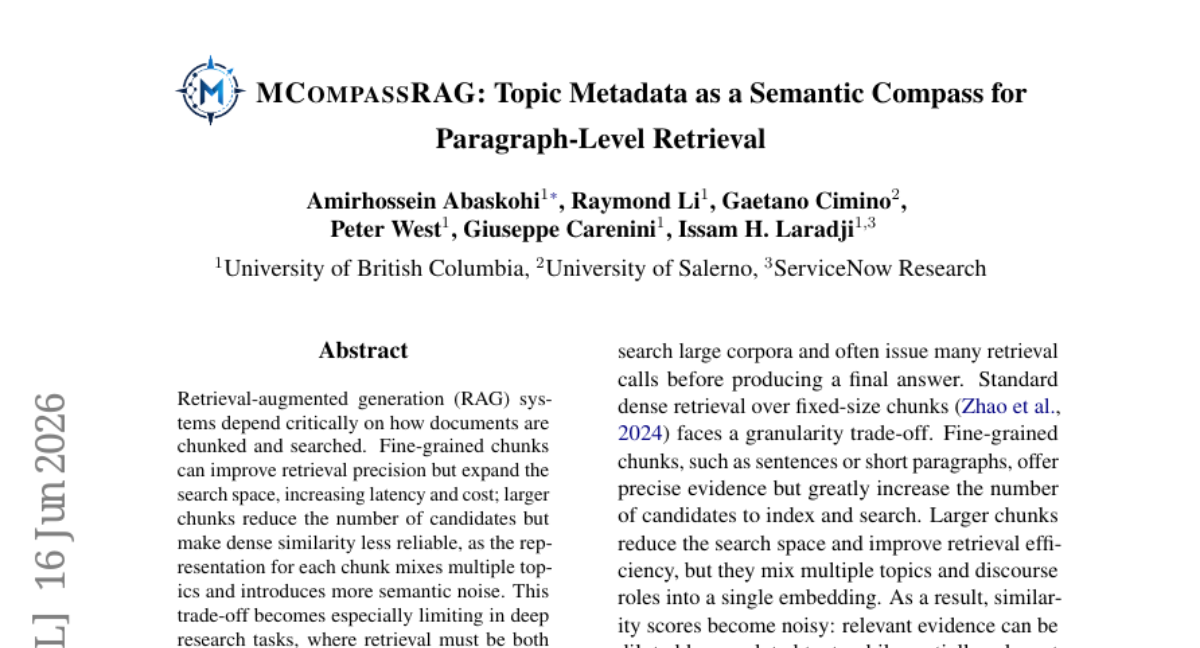
14. MCompassRAG: Topic Metadata as a Semantic Compass for Paragraph-Level Retrieval
🔑 Keywords: Retrieval-augmented generation, Metadata-guided retrieval, Semantic compass, Topic-aware retrieval, Information efficiency
💡 Category: Natural Language Processing
🌟 Research Objective:
– The study introduces MCompassRAG, a framework designed to enhance retrieval-augmented generation by using topic-level metadata to guide the selection of information chunks, optimizing efficiency and precision in complex research tasks.
🛠️ Research Methods:
– MCompassRAG employs topic-level signals as a semantic compass for selection, enriches chunk representations with topic metadata, and trains a lightweight retriever via LLM-teacher distillation. This allows for topic-aware retrieval without additional LLM calls.
💬 Research Conclusions:
– MCompassRAG significantly improves information efficiency by an average of 8.24% and reduces latency over 5 times compared to the strongest efficient RAG baselines across six complex retrieval benchmarks. The code has been made publicly available on GitHub.
👉 Paper link: https://huggingface.co/papers/2606.18508
15. MemSlides: A Hierarchical Memory Driven Agent Framework for Personalized Slide Generation with Multi-turn Local Revision
🔑 Keywords: hierarchical memory framework, personalized presentation agents, long-term memory, working memory, tool memory
💡 Category: AI Systems and Tools
🌟 Research Objective:
– The paper aims to propose MemSlides, a hierarchical memory framework tailored for personalized presentation agents, that enhances stable personalization and reliable local edits across multi-turn revisions.
🛠️ Research Methods:
– The framework separates long-term memory into user profile memory and tool memory, alongside working memory for session constraints, ensuring that generated presentations align with user preferences and efficiently handle multi-turn edits.
💬 Research Conclusions:
– Experiments demonstrate that user profile memory enhances persona-alignment across intents, tool memory improves modify behavior, and working memory effectively retains user preferences through sessions, underscoring the importance of memory separation in personalized presentation authoring.
👉 Paper link: https://huggingface.co/papers/2606.17162