AI Native Daily Paper Digest – 20260709
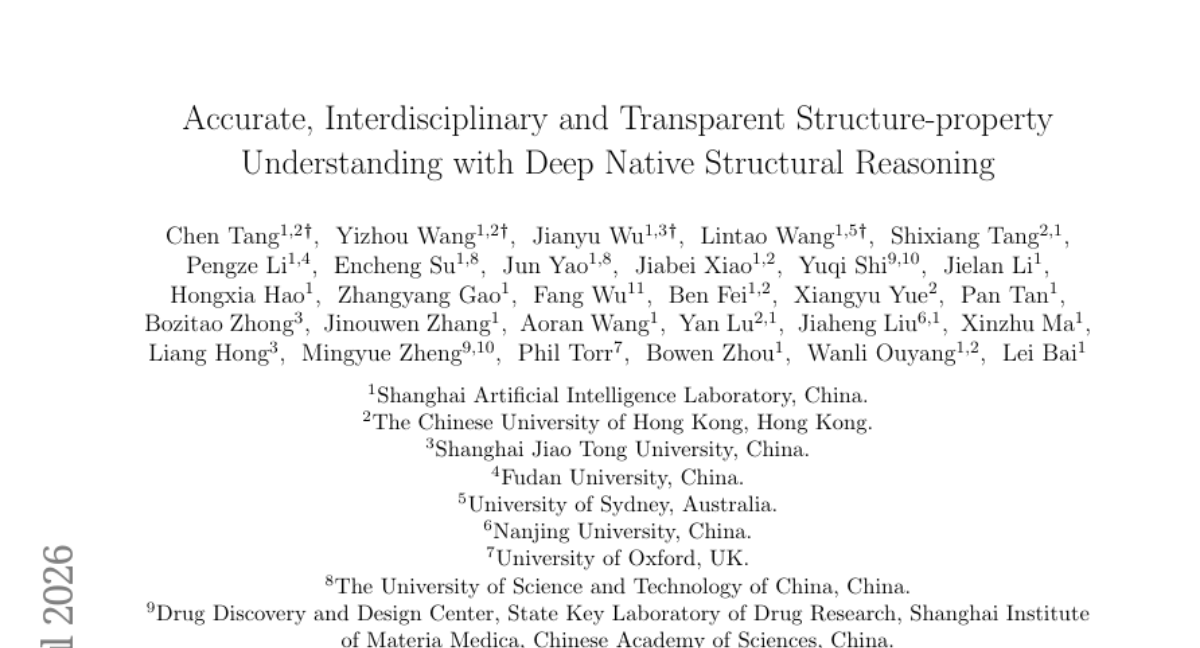
1. Accurate, Interdisciplinary and Transparent Structure-property Understanding with Deep Native Structural Reasoning
🔑 Keywords: SciReasoner, Multimodal Scientific Foundation Model, Structural Reasoning, Structure-property Relationships, Structural Tokens
💡 Category: Multi-Modal Learning
🌟 Research Objective:
– The paper introduces SciReasoner, a multimodal scientific foundation model aimed at interpretable structural reasoning across proteins, small molecules, and inorganic crystals.
🛠️ Research Methods:
– SciReasoner discretizes structural elements into a unified vocabulary, enabling it to address and reason with structural tokens as evidence units for predictions.
💬 Research Conclusions:
– SciReasoner demonstrates improved cellular component annotation for low-homology proteins, enhanced single-step retrosynthesis accuracy, and effective phase separation in materials science, showcasing state-of-the-art performance on 67 out of 86 benchmarks.
– Expert evaluations rated its reasoning traces favorably compared to frontier large language models in 98% of cases, aligning accurate predictions with interpretable scientific inference.
👉 Paper link: https://huggingface.co/papers/2607.07708
2. Scaling Mixture-of-Experts Video Pretraining for Embodied Intelligence
🔑 Keywords: LingBot-Video, DiT-based video pretraining, Mixture-of-Experts, embodied intelligence, video foundation model
💡 Category: Robotics and Autonomous Systems
🌟 Research Objective:
– To develop LingBot-Video, a DiT-based video pretraining framework tailored for embodied intelligence applications, addressing the domain mismatch in video generative models regarding computational efficiency and physical realism.
🛠️ Research Methods:
– Utilized a Mixture-of-Experts architecture for scalable modeling capacity and inference efficiency.
– Constructed a data profiling engine to augment standard videos with robot-oriented footage for better understanding of actions and world dynamics.
– Developed a multi-dimensional reward system to align physical rationality and task completion.
💬 Research Conclusions:
– Comprehensive evaluations showcase LingBot-Video’s performance and efficiency as an open-source, large-scale MoE video foundation model, bridging digital creativity and physical actuation.
👉 Paper link: https://huggingface.co/papers/2607.07675
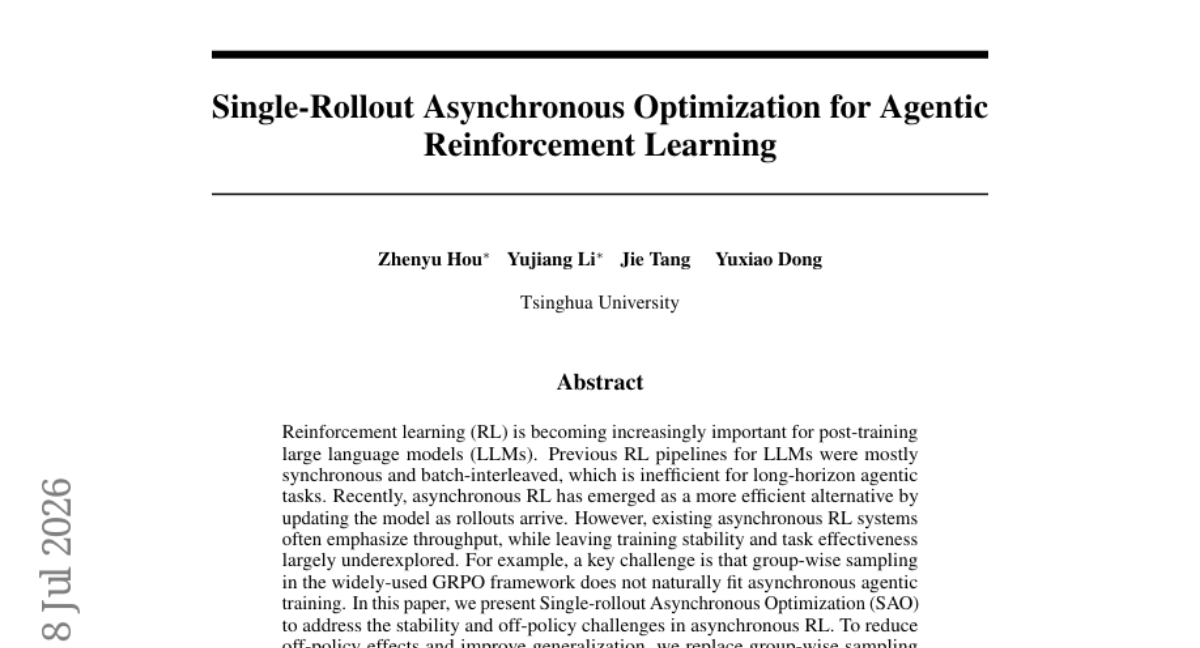
3. Single-Rollout Asynchronous Optimization for Agentic Reinforcement Learning
🔑 Keywords: Asynchronous RL, Single-rollout Optimization, Training Stability, Large Language Models, Coding and Reasoning Benchmarks
💡 Category: Reinforcement Learning
🌟 Research Objective:
– The paper aims to address stability issues and improve the efficiency and effectiveness of asynchronous reinforcement learning in training large language models for complex tasks.
🛠️ Research Methods:
– Introducing Single-rollout Asynchronous Optimization (SAO) with single-rollout sampling to tackle off-policy challenges and enhance generalization.
– Implementing a strict double-side token-level clipping strategy to improve optimization stability.
💬 Research Conclusions:
– SAO significantly enhances training stability and outperforms existing methodologies like GRPO for coding and reasoning benchmarks.
– The approach proves particularly effective in simulated online learning settings, making it suitable for dynamic environments.
👉 Paper link: https://huggingface.co/papers/2607.07508
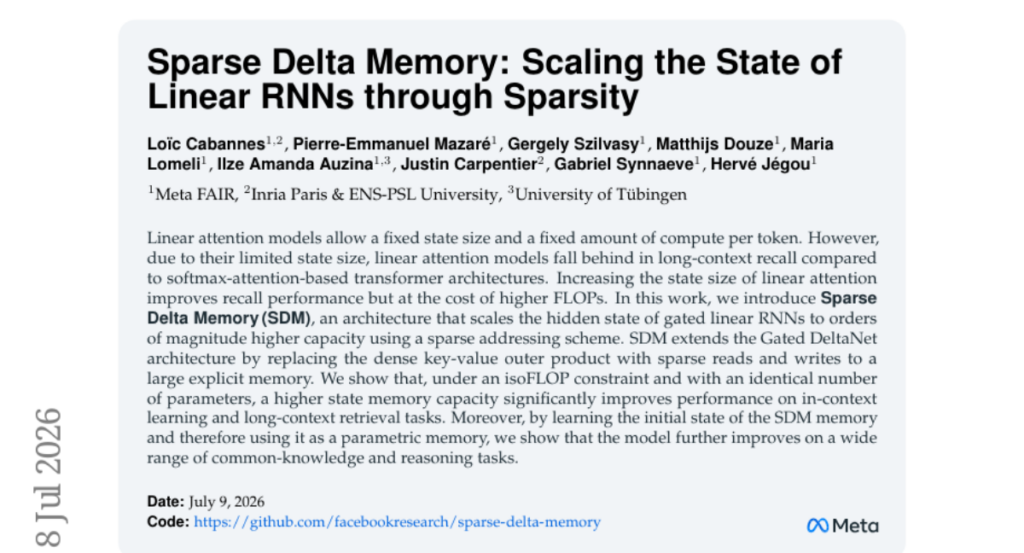
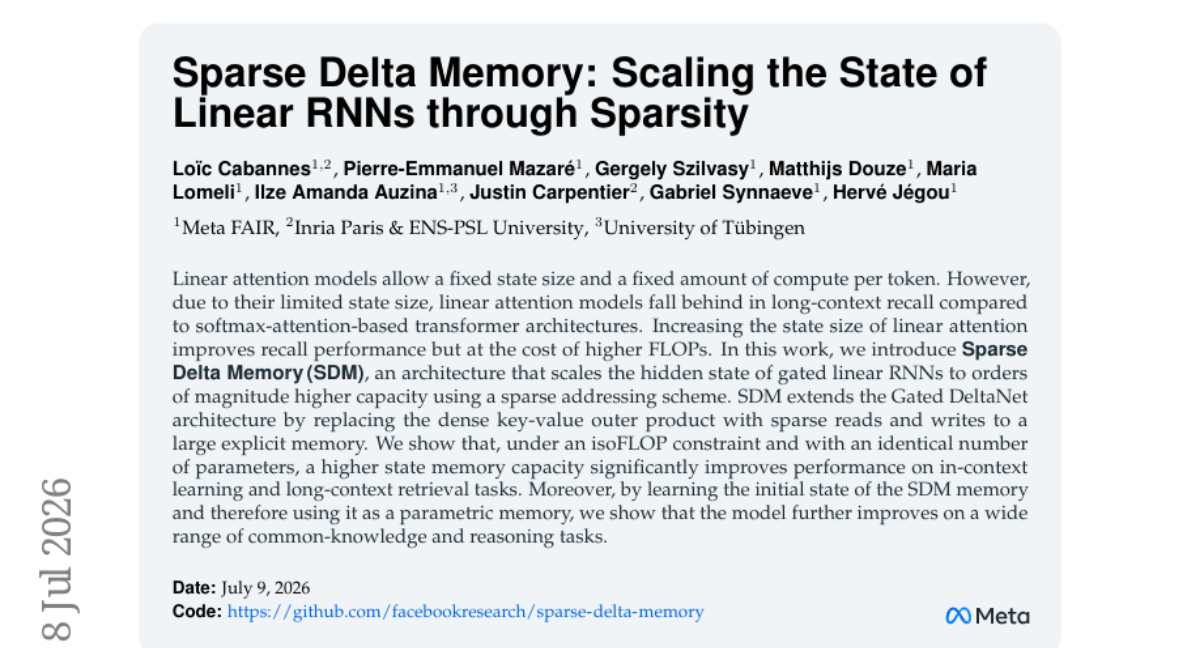
4. Sparse Delta Memory: Scaling the State of Linear RNNs through Sparsity
🔑 Keywords: Sparse Delta Memory, long-context learning, sparse addressing, gated linear RNNs, in-context learning
💡 Category: Foundations of AI
🌟 Research Objective:
– To enhance long-context learning and retrieval in gated linear RNNs by dramatically increasing hidden state capacity through Sparse Delta Memory (SDM).
🛠️ Research Methods:
– Implementing Sparse Delta Memory architecture with sparse addressing to scale the hidden state of gated linear RNNs to higher capacities, replacing dense key-value outer products with sparse reads and writes.
💬 Research Conclusions:
– SDM significantly improves performance on in-context learning and long-context retrieval tasks under an isoFLOP constraint, and further enhances model performance on common-knowledge and reasoning tasks by learning the initial state of its memory as a parametric memory.
👉 Paper link: https://huggingface.co/papers/2607.07386
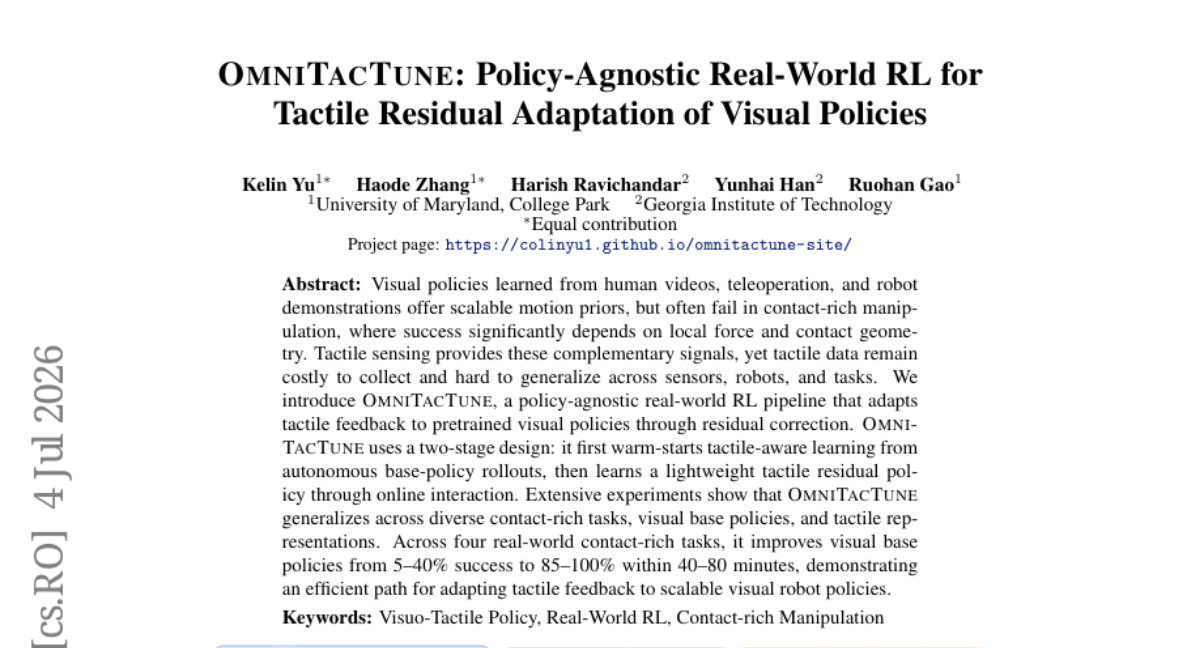
5. OmniTacTune: Policy-Agnostic Real-World RL for Tactile Residual Adaptation of Visual Policies
🔑 Keywords: OmniTacTune, tactile feedback, real-world RL, visual policies, contact-rich manipulation
💡 Category: Robotics and Autonomous Systems
🌟 Research Objective:
– The study introduces OmniTacTune, a two-stage reinforcement learning approach designed to efficiently adapt tactile feedback to pretrained visual robot policies, improving success rates in contact-rich manipulation tasks.
🛠️ Research Methods:
– OmniTacTune employs a two-stage design: initially employing autonomous base-policy rollouts for tactile-aware learning, followed by learning a lightweight tactile residual policy through online interaction.
💬 Research Conclusions:
– The method significantly generalizes across diverse tasks, successfully adapting tactile feedback to visual base policies, and increasing success rates from 5-40% to 85-100% in four real-world contact-rich tasks within a short timespan of 40-80 minutes.
👉 Paper link: https://huggingface.co/papers/2607.03723
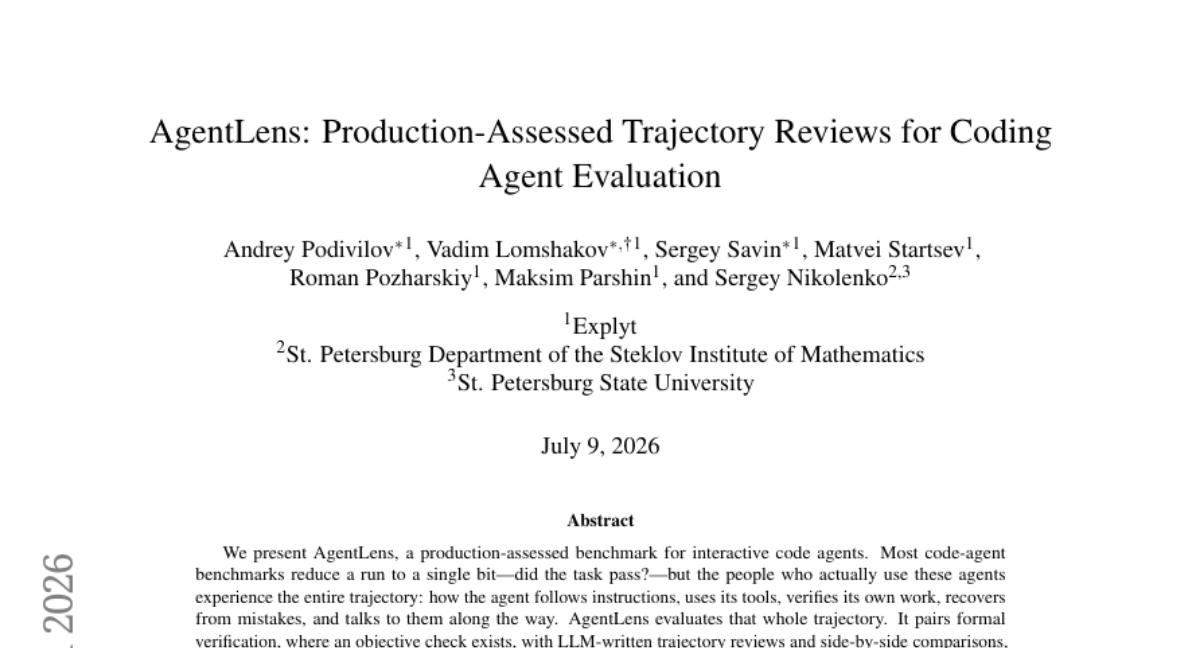
6. AgentLens: Production-Assessed Trajectory Reviews for Coding Agent Evaluation
🔑 Keywords: Interactive Code Agents, AgentLens, Formal Verification, LLM-written Trajectory Reviews, Open Source
💡 Category: AI Systems and Tools
🌟 Research Objective:
– To present AgentLens, a benchmark for assessing interactive code agents, focusing on the entire user interaction trajectory rather than just task completion.
🛠️ Research Methods:
– Combination of formal verification with LLM-written reviews to evaluate agent trajectories, providing explanations for agent performance scores.
💬 Research Conclusions:
– AgentLens can diagnose model behavior, compare different agent versions, and identify regressions, and is openly available for further development and use.
👉 Paper link: https://huggingface.co/papers/2607.06624
7. Imagined Rollouts are Kinematic, Not Dynamic: A Diagnosis of Long-Horizon World-Model Failure
🔑 Keywords: World Models, Kinematic-Consistency Error, Kinematic-vs-Dynamic Reframing, iKCE, DreamerV3
💡 Category: Reinforcement Learning
🌟 Research Objective:
– The study aims to investigate the cause of long-horizon failures in world models, focusing on the distinction between kinematic and dynamic errors.
🛠️ Research Methods:
– The research introduces a kinematic-vs-dynamic reframing by employing a Kinematic-Consistency Error (iKCE) diagnostic to measure the deviation from a kinematic null across different physical conditions, tested using the DreamerV3 checkpoint.
💬 Research Conclusions:
– The study concludes that world models exhibit kinematic rather than dynamic imagination, indicating the need for reframing to accurately address errors in long-horizon planning, as demonstrated by the iKCE measure which remains flat despite policy reward collapses.
👉 Paper link: https://huggingface.co/papers/2607.05966
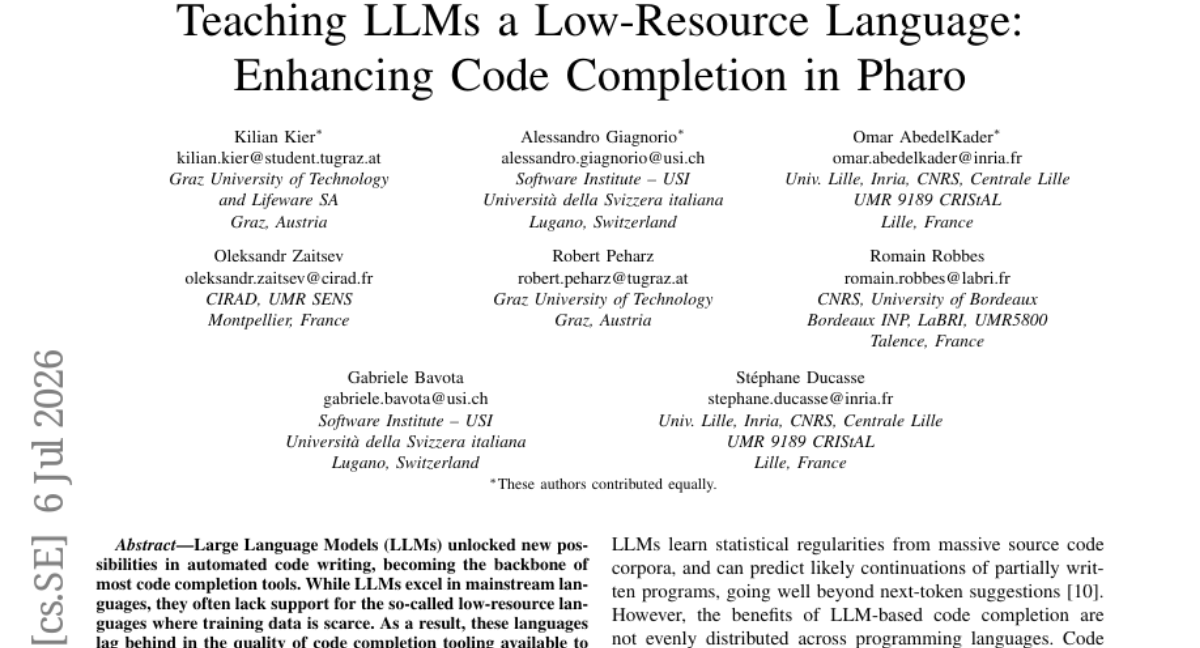
8. Teaching LLMs a Low-Resource Language: Enhancing Code Completion in Pharo
🔑 Keywords: Large Language Models, low-resource programming languages, Pharo, code completion, fine-tuning
💡 Category: AI Systems and Tools
🌟 Research Objective:
– Investigate the adaptation of Large Language Models for code completion in low-resource programming languages with a focus on Pharo.
🛠️ Research Methods:
– Developed a specialized training pipeline including Pharo-specific data curation and continued pre-training and fine-tuning of open code LLMs.
– Introduced Pharo code completion benchmarks to evaluate model performance.
💬 Research Conclusions:
– Pharo-specialized models significantly outperform base models and achieve better accuracy than larger code LLMs, demonstrating the feasibility of providing real-time in-IDE code completion support for low-resource languages.
👉 Paper link: https://huggingface.co/papers/2607.04939
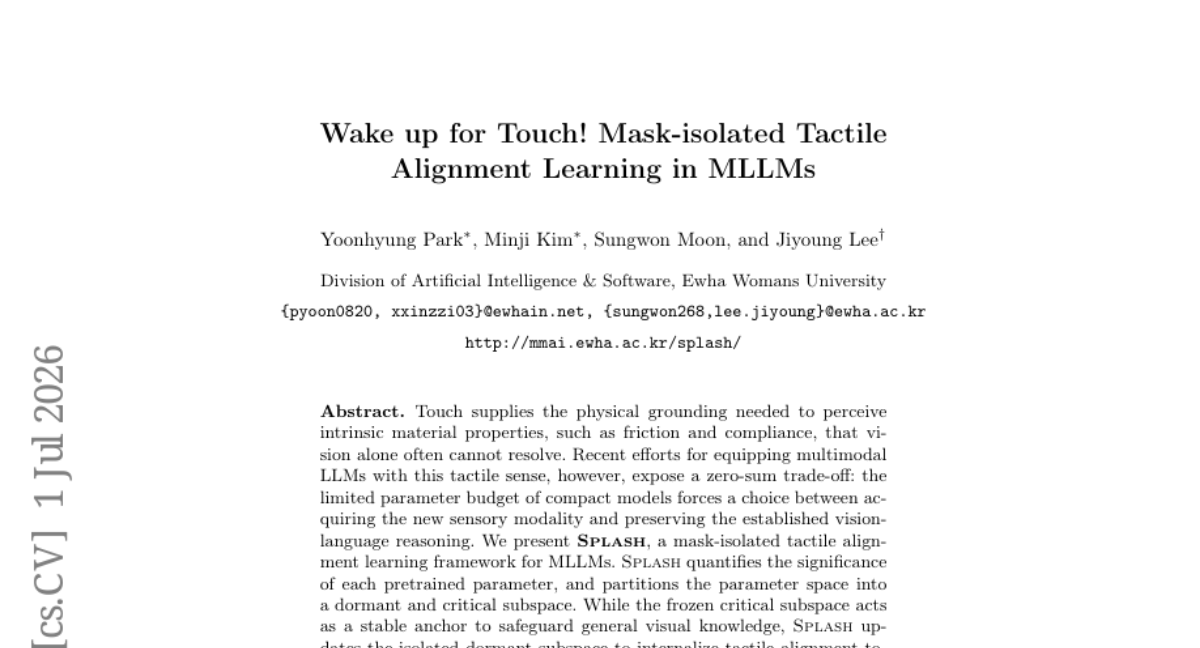
9. Wake up for Touch! Mask-isolated Tactile Alignment Learning in MLLMs
🔑 Keywords: Splash, tactile sense, multimodal LLMs, catastrophic forgetting, mask-isolated tactile alignment learning
💡 Category: Multi-Modal Learning
🌟 Research Objective:
– Present a framework, Splash, to enable multimodal LLMs to gain tactile sensing without sacrificing vision-language capabilities.
🛠️ Research Methods:
– Utilizes mask-isolated tactile alignment learning to separate pretrained parameters into dormant and critical subspaces, preventing destructive updates.
💬 Research Conclusions:
– Splash successfully achieves tactile reasoning while maintaining vision-language functionality, exhibiting state-of-the-art performance on various visuo-tactile benchmarks.
👉 Paper link: https://huggingface.co/papers/2607.00302
10.
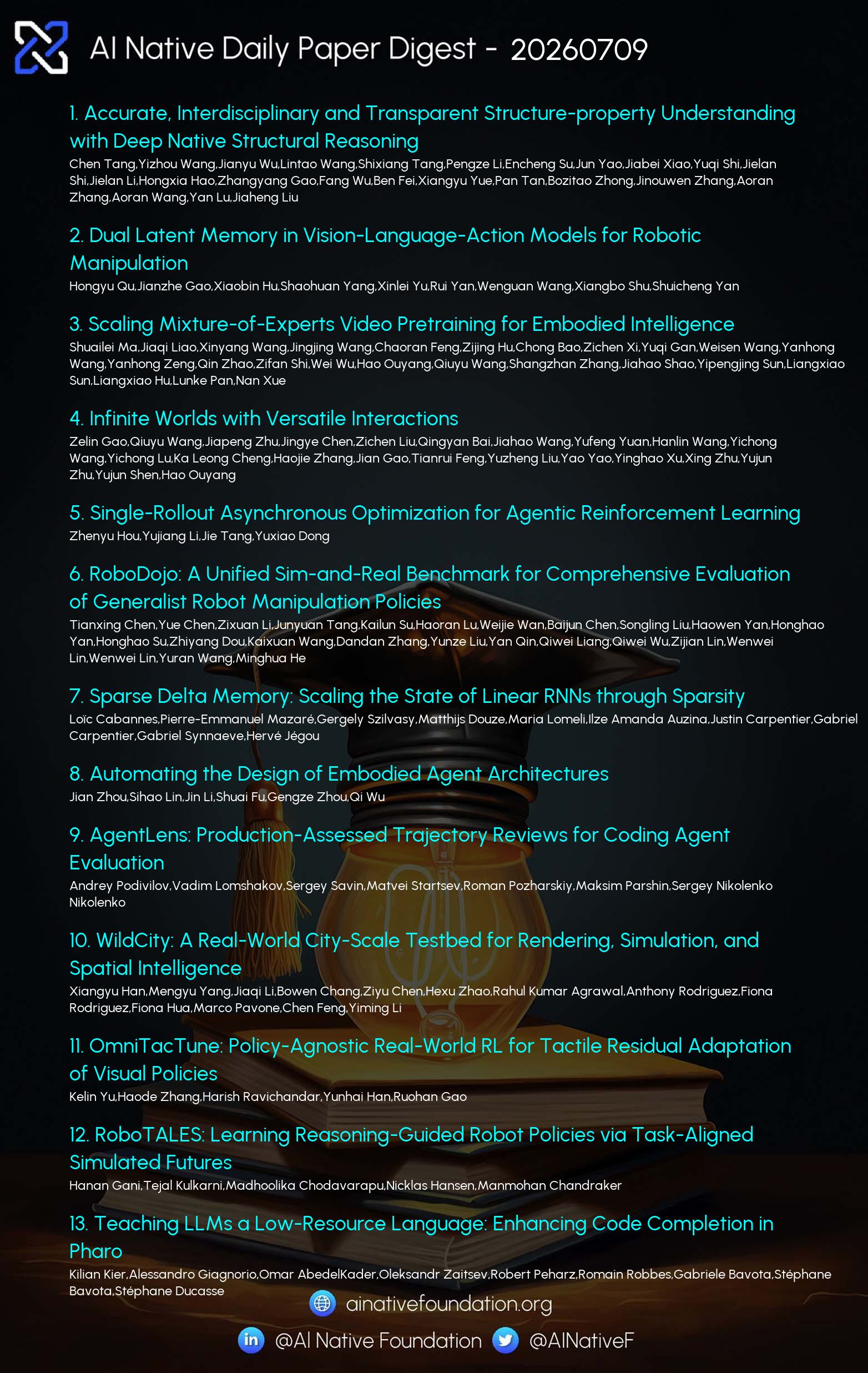
11. TESSERA v2: Scaling Pixel-wise Earth Foundation Models
🔑 Keywords: Earth-observation foundation models, pretraining budget, downstream performance, encoder, Matryoshka representations
💡 Category: Computer Vision
🌟 Research Objective:
– To explore optimal scaling strategies for Earth-observation foundation models, enabling efficient training and deployment.
🛠️ Research Methods:
– Conducted a large-scale controlled scaling study with 395 training runs using GH200 superchips and evaluated models on 15 downstream tasks, focusing on encoder growth and downstream performance.
💬 Research Conclusions:
– Pretraining loss is not an effective predictor of downstream performance, so models should be selected based on downstream performance. As training budgets grow, it’s effective to expand the encoder and data while keeping the projector fixed. This strategy allows creation of distilled models like TESSERA v2-1B-M, which outperform larger models and efficiently compress data for deployment.
👉 Paper link: https://huggingface.co/papers/2607.03949
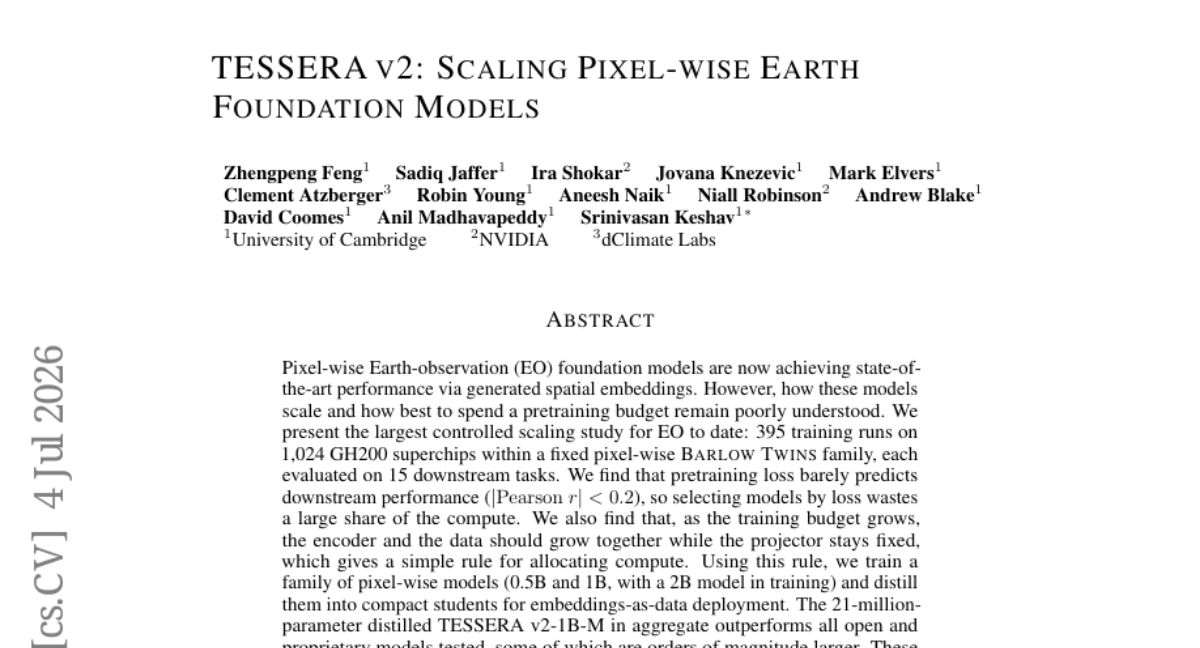
12. Token-Based Dual-view Fusion and Adaptation of Large Vision Models for Breast Cancer Classification
🔑 Keywords: Token-centric dual-view learning, prompt-based adaptation, cross-view fusion, vision transformer, breast cancer classification
💡 Category: AI in Healthcare
🌟 Research Objective:
– The paper proposes a token-centric dual-view learning framework aimed at improving breast cancer classification from mammography images by integrating complementary information from craniocaudal (CC) and mediolateral oblique (MLO) views.
🛠️ Research Methods:
– The research introduces a framework that combines prompt-based adaptation and cross-view fusion within a frozen vision transformer. It employs fusion tokens for structured token-level communication, allowing progressive interaction across different transformer depths.
💬 Research Conclusions:
– Experiments demonstrate that this method consistently outperforms traditional approaches such as linear probing and conventional fusion methods. Notably, in the VinDr-Mammo BI-RADS classification task, the framework achieved significant improvements in F1-score and AUC metrics.
👉 Paper link: https://huggingface.co/papers/2607.06309
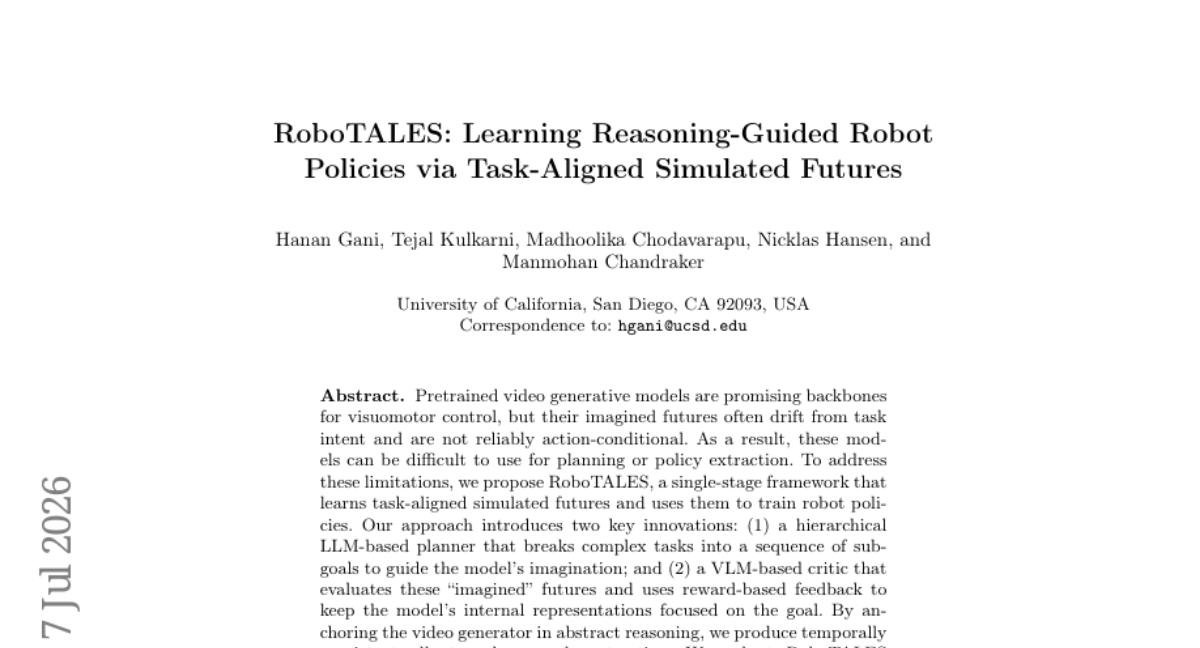
13. RoboTALES: Learning Reasoning-Guided Robot Policies via Task-Aligned Simulated Futures
🔑 Keywords: RoboTALES, LLM-based planning, VLM-based criticism, visuomotor control, task-aligned
💡 Category: Robotics and Autonomous Systems
🌟 Research Objective:
– Introduce RoboTALES, a framework that merges LLM-based planning and VLM-based criticism to enhance task-aligned video generation and robotic policy training.
🛠️ Research Methods:
– Implement a hierarchical LLM-based planner to decompose complex tasks into subgoals and a VLM-based critic to provide reward-based feedback for model guidance.
💬 Research Conclusions:
– RoboTALES outperforms existing methods, particularly in long-horizon tasks, confirmed through evaluations on manipulation tasks from RoboCasa and LIBERO10.
👉 Paper link: https://huggingface.co/papers/2607.06018
14. WildCity: A Real-World City-Scale Testbed for Rendering, Simulation, and Spatial Intelligence
🔑 Keywords: WildCity, multimodal dataset, urban environments, city-scale data, urban digital twins
💡 Category: Multi-Modal Learning
🌟 Research Objective:
– Introduce WildCity, a large-scale multimodal dataset for urban navigation and spatial representation to enable AI systems to perceive and reason about city-scale environments like human cognitive capabilities.
🛠️ Research Methods:
– Data collection by autonomous fleets navigating complex urban environments, comprising 18 trajectories averaging 83.7 km, addressing challenges like dynamic objects and lighting variations. Developed an urban-tailored reconstruction baseline and converted environments into a closed-loop simulator.
💬 Research Conclusions:
– WildCity seeks to drive advancements in city-scale rendering and aims to support AI development that can perceive, remember, and reason at human-like scales through tackling scalability, extrapolation, and uncertainty towards creating simulation-ready urban digital twins.
👉 Paper link: https://huggingface.co/papers/2607.06838
15. Automating the Design of Embodied Agent Architectures
🔑 Keywords: Automated Agent Architecture Search, Embodied Agents, AgentCanvas, KDLoop, Simulator Rollouts
💡 Category: Robotics and Autonomous Systems
🌟 Research Objective:
– To evaluate the effectiveness and limitations of Automated Agent Architecture Search in improving the performance of perceptual embodied agents through simulator-based evaluations.
🛠️ Research Methods:
– Introduction of AgentCanvas, a typed-graph runtime that enables modular design and logging for embodied agents.
– Utilization of KDLoop, a search method combining proposal, critique, experiment, and distillation processes.
– Systematic evaluation of three AAS variants across various embodied executors in different task domains, such as vision-language navigation and language-conditioned manipulation.
💬 Research Conclusions:
– Architecture-level search can enhance the performance and success rates in embodied tasks, though challenges such as rollout noise and local optima remain.
– Results underline the potential and current constraints in the application of automated architecture search for embodied agents.
👉 Paper link: https://huggingface.co/papers/2606.30111
16. RoboDojo: A Unified Sim-and-Real Benchmark for Comprehensive Evaluation of Generalist Robot Manipulation Policies
🔑 Keywords: RoboDojo, generalist robot manipulation, sim-and-real benchmark, XPolicyLab, scalable feedback
💡 Category: Robotics and Autonomous Systems
🌟 Research Objective:
– To introduce RoboDojo, a unified sim-and-real benchmark aimed at comprehensively evaluating generalist robot manipulation policies across diverse tasks and evaluation dimensions.
🛠️ Research Methods:
– Development of a benchmark that includes 42 simulation tasks and 18 real-world tasks, assessing generalization, memory, precision, long-horizon execution, and open-vocabulary instruction following, while considering real-world deployment challenges.
💬 Research Conclusions:
– RoboDojo enables scalable evaluation through the use of heterogeneous parallel simulations, and it incorporates a reproducible real-world evaluation system with standardized protocols and cloud access. This comprehensive approach allows policies to be integrated and evaluated with minimal adaptation across simulated and real-world environments.
👉 Paper link: https://huggingface.co/papers/2607.04434
17. Infinite Worlds with Versatile Interactions
🔑 Keywords: LingBot-World 2.0, real-time processing, interactive elements, multi-agent behavior, world modeling
💡 Category: AI Systems and Tools
🌟 Research Objective:
– The primary aim is to advance a world modeling system with enhanced interaction capabilities and real-time processing for collaborative virtual environments.
🛠️ Research Methods:
– Implementation of a causal pretraining paradigm and integration of real-time variants to ensure rapid responses.
– Introduction of diverse interactive elements, increased action spectrum, and text-driven events.
– Integration of an agentic harness to facilitate pilot and director agents for complex scene management.
💬 Research Conclusions:
– The developed LingBot-World 2.0 system offers an immersive virtual world with extended interaction features and multi-agent control, maintaining high performance and compatibility for deployment on single GPUs.
👉 Paper link: https://huggingface.co/papers/2607.07534
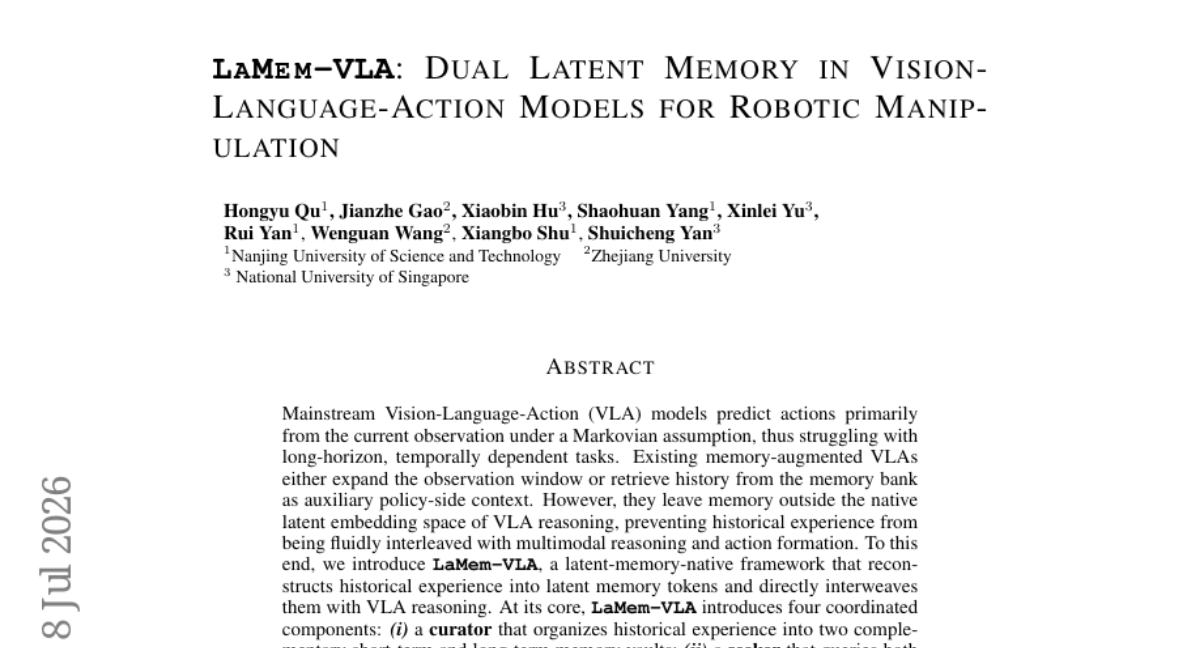
18. Dual Latent Memory in Vision-Language-Action Models for Robotic Manipulation
🔑 Keywords: Latent-Memory-Native, Vision-Language-Action, Latent Embedding Space, Multimodal Cognition
💡 Category: Multi-Modal Learning
🌟 Research Objective:
– The research introduces LaMem-VLA, a latent-memory-native framework designed to enhance Vision-Language-Action reasoning by integrating historical experiences within the same latent space.
🛠️ Research Methods:
– LaMem-VLA utilizes four coordinated components: a curator for organizing experiences, a seeker for querying memory vaults via multimodal cognition, a condenser for converting retrieved data into latent memory tokens, and a weaver to embed these tokens into a continuous sequence.
💬 Research Conclusions:
– LaMem-VLA facilitates seamless participation of memory in VLA reasoning, demonstrably improving performance on temporally extended tasks in experiments on SimplerEnv and LIBERO.
👉 Paper link: https://huggingface.co/papers/2607.07608