AI Native Daily Paper Digest – 20260710
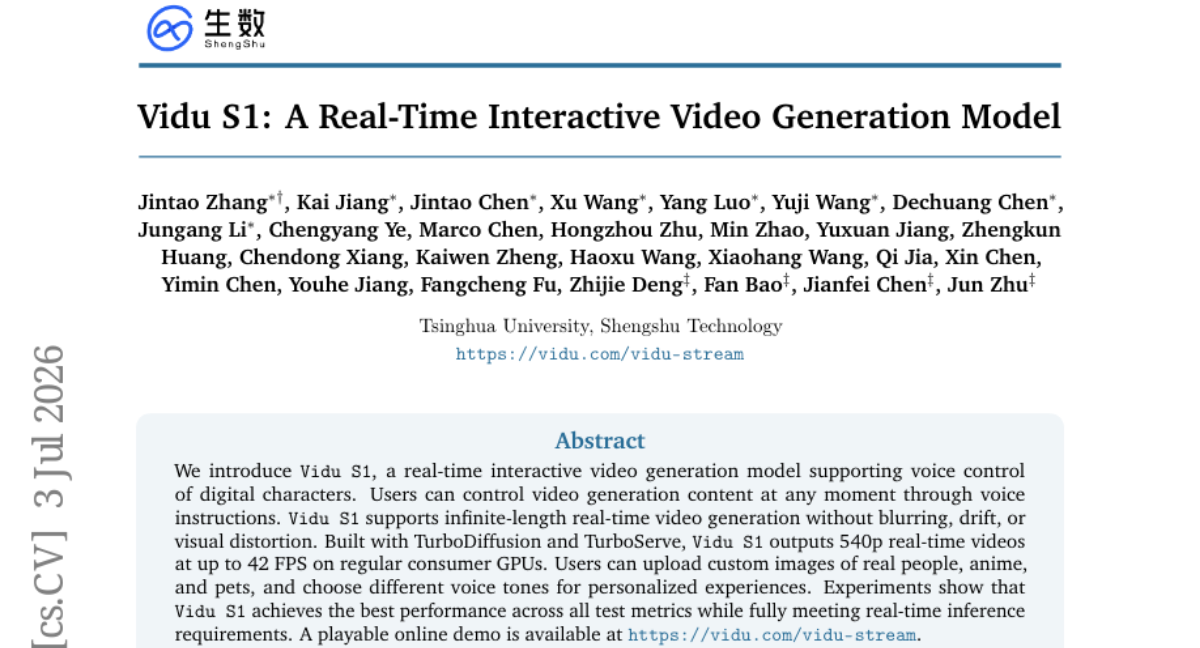
1. Vidu S1: A Real-Time Interactive Video Generation Model
🔑 Keywords: Vidu S1, real-time video generation, voice control, TurboDiffusion, consumer GPUs
💡 Category: Human-AI Interaction
🌟 Research Objective:
– Introduce Vidu S1, a real-time interactive video generation model that supports infinite-length output and voice-controlled digital character animation.
🛠️ Research Methods:
– Utilizes TurboDiffusion and TurboServe technologies to produce 540p real-time videos at up to 42 FPS on standard consumer GPUs.
💬 Research Conclusions:
– Vidu S1 delivers optimal performance across test metrics and meets real-time inference requirements, supporting video content control via voice instructions and allowing the upload of custom images to enhance user personalization.
👉 Paper link: https://huggingface.co/papers/2607.03118
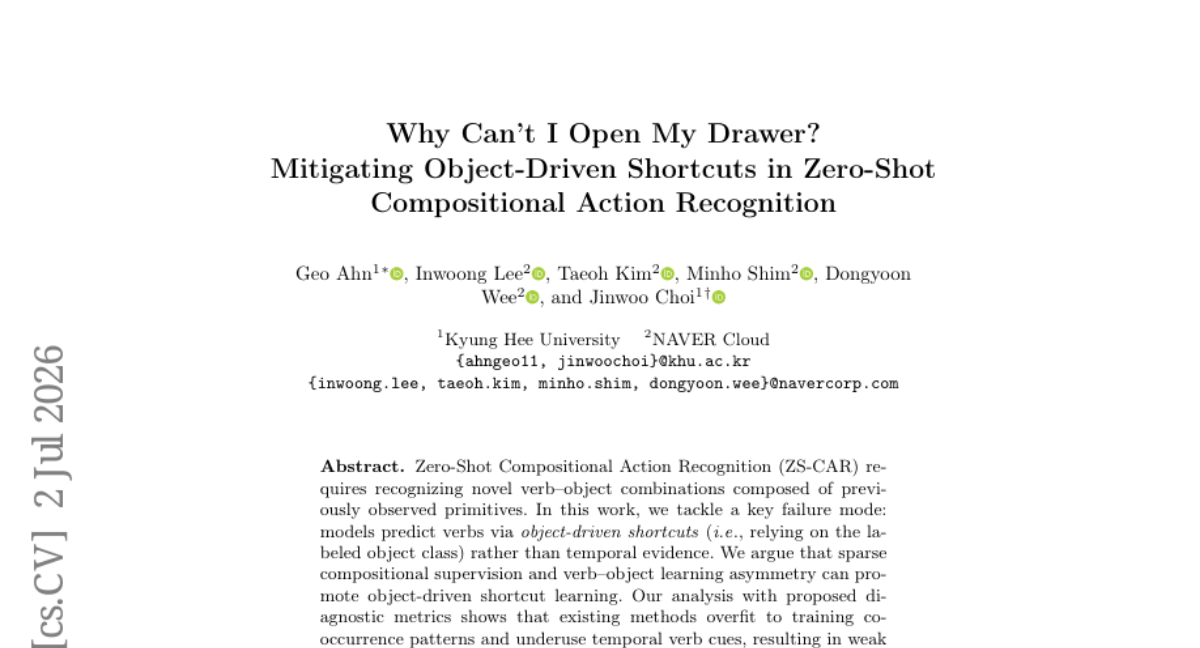
2. Why Can’t I Open My Drawer? Mitigating Object-Driven Shortcuts in Zero-Shot Compositional Action Recognition
🔑 Keywords: Zero-Shot Compositional Action Recognition, Object-Driven Shortcuts, Co-occurrence Prior Regularization, Temporal Order Regularization, Compositional Generalization
💡 Category: Computer Vision
🌟 Research Objective:
– Address object-driven shortcuts in zero-shot compositional action recognition to improve compositional generalization.
🛠️ Research Methods:
– RCORE utilizes Co-occurrence Prior Regularization and Temporal Order Regularization to enhance recognition by reducing overfitting to co-occurrence patterns and emphasizing temporal order sensitivity.
💬 Research Conclusions:
– RCORE effectively reduces reliance on object-driven shortcuts, showing improved generalization to unseen verb-object compositions across various datasets.
👉 Paper link: https://huggingface.co/papers/2601.16211
3. Ideas Have Genomes: Benchmarking Scientific Lineage Reasoning and Lineage-Grounded Idea Generation
🔑 Keywords: Idea Genome, lineage reasoning, idea generation, evolutionary dynamics, LLM-based scientists
💡 Category: Knowledge Representation and Reasoning
🌟 Research Objective:
– Introduce IG-Bench, a benchmark for evaluating scientific lineage reasoning and lineage-grounded idea generation through the IdeaGene framework.
🛠️ Research Methods:
– Utilizes Idea Genome objects and GenomeDiff records to simulate scientific inheritance and evolution in 10 domains, with evaluations via IG-Exam and IG-Arena.
💬 Research Conclusions:
– Experiments on 14 LLM-based scientists reveal a compositional bottleneck, with best system achieving 27.3% accuracy in lineage reasoning, indicating challenges in structured lineage context.
👉 Paper link: https://huggingface.co/papers/2607.08758
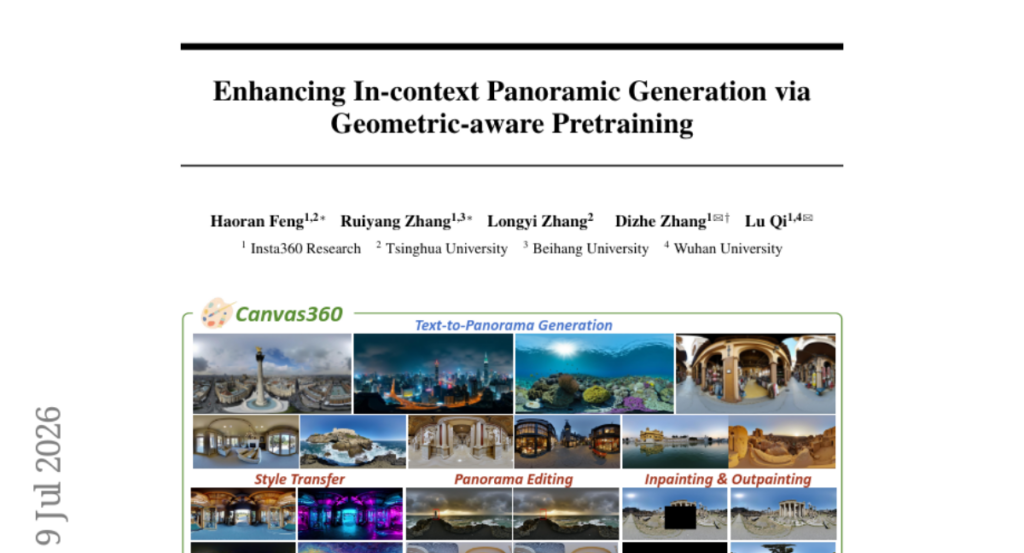
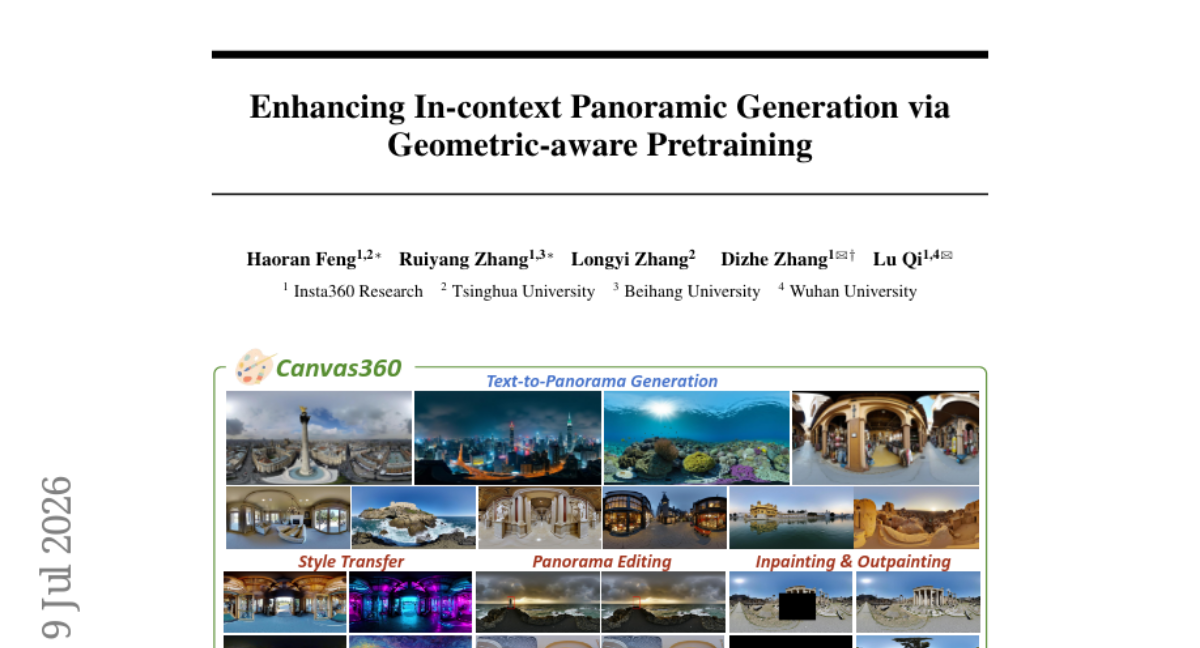
4. Enhancing In-context Panoramic Generation via Geometric-aware Pretraining
🔑 Keywords: Canvas360, geometry-aware pretraining, panoramic generation, velocity circular padding
💡 Category: Generative Models
🌟 Research Objective:
– The paper introduces Canvas360, a novel framework aimed at enhancing in-context panoramic generation by combining geometry-aware pretraining with task-specific fine-tuning.
🛠️ Research Methods:
– The approach utilizes a newly proposed Canvas360Dataset containing 1 million high-quality panoramic samples, alongside novel modeling techniques such as parallel depth generation, velocity circular padding, and similarity loss regularization.
💬 Research Conclusions:
– Canvas360 significantly improves the fidelity and geometric consistency of panoramic images, demonstrating superior performance on numerous quantitative evaluations, especially on the panorama-specific FAED metric.
👉 Paper link: https://huggingface.co/papers/2607.08765
5. CineMobile: On-Device Image-to-Video Diffusion for Cinematic Camera Motion Generation
🔑 Keywords: CineMobile, image-to-video generation, cinematic motion effects, Diffusion Transformers, distillation-guided pruning
💡 Category: Generative Models
🌟 Research Objective:
– Address the challenge of efficient image-to-video generation on mobile devices by introducing CineMobile, focusing on cinematic motion effects.
🛠️ Research Methods:
– Employed a three-fold optimization strategy: distillation-guided pruning, diffusion distillation combined with reinforcement learning, and hybrid post-training quantization.
💬 Research Conclusions:
– CineMobile achieves a 40x speedup in video generation while maintaining comparable visual quality to the teacher model with the Wan 2.1 architecture, indicating practical applicability for mobile devices.
👉 Paper link: https://huggingface.co/papers/2607.03803
6. OpenCoF: Learning to Reason Through Video Generation
🔑 Keywords: temporal reasoning, Chain-of-Frame, video generation models, temporal supervision, visual and textual reasoning tokens
💡 Category: Computer Vision
🌟 Research Objective:
– The paper introduces the OpenCoF framework, aiming to enhance temporal reasoning in video models using diverse supervision and explicit reasoning tokens for both visual and textual cues.
🛠️ Research Methods:
– Development of OpenCoF-17K dataset and the fine-tuned video model Wan-CoF to improve Chain-of-Frame reasoning, alongside the introduction of reasoning tokens to capture visual and semantic cues.
💬 Research Conclusions:
– The study demonstrates significant improvements in video reasoning by utilizing broad temporal supervision and explicit mechanisms for organizing reasoning states, and provides open-source resources for continued research in reasoning-focused video generation.
👉 Paper link: https://huggingface.co/papers/2607.08763
7. Remember When It Matters: Proactive Memory Agent for Long-Horizon Agents
🔑 Keywords: behavioral state decay, memory agent, action agent, Terminal-Bench, Qwen3.5-27B
💡 Category: Reinforcement Learning
🌟 Research Objective:
– To address the issue of behavioral state decay in long-horizon tasks by introducing an active memory intervention mechanism.
🛠️ Research Methods:
– Employed a separate memory agent alongside an unmodified action agent to update a structured memory bank and selectively inject reminders.
– Implemented and tested on Terminal-Bench 2.0 and τ^2-Bench, comparing various memory intervention methods.
💬 Research Conclusions:
– The active intervention via a memory agent improves the performance of action agents, achieving significant gains in pass rates.
– Selective intervention outperformed other memory exposure methods, demonstrating the effectiveness of the approach.
👉 Paper link: https://huggingface.co/papers/2607.08716

8. PhyMRI-SR: Toward Physics-Aware MRI Image Super-Resolution
🔑 Keywords: MRI super-resolution, physics-aware reconstruction, Gaussian Splatting, Anatomical Structure Prior, meta-learning
💡 Category: AI in Healthcare
🌟 Research Objective:
– To rethink MRI super-resolution as a physics-aware reconstruction problem that identifies optimal resolution-SNR configurations and dynamically super-resolves MRI images.
🛠️ Research Methods:
– Utilization of 2D Gaussian Splatting for resolution-agnostic rendering.
– Introduction of a prior-aware Gaussian representation and a physics-constrained signal modeling scheme.
– Implementation of a meta-learning framework to handle scarcity of paired-data through pretraining on simulated data and adapting to real-world data.
💬 Research Conclusions:
– The proposed method achieves state-of-the-art performance on dynamic-resolution datasets and benchmarks, showcasing strong potential for clinical application.
👉 Paper link: https://huggingface.co/papers/2607.06238

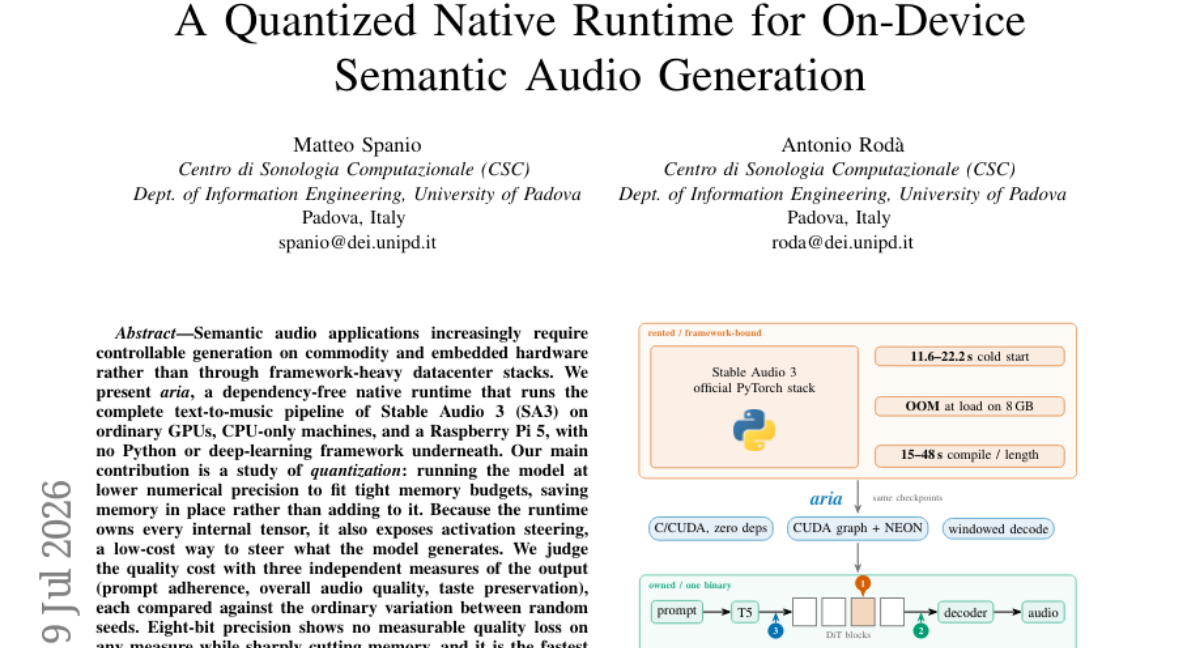
9. A Quantized Native Runtime for On-Device Semantic Audio Generation
🔑 Keywords: dependency-free runtime, text-to-music, quantization, activation steering, memory budget
💡 Category: Generative Models
🌟 Research Objective:
– The study aims to enable efficient text-to-music generation on embedded devices, maintaining audio quality through techniques like quantization and activation steering.
🛠️ Research Methods:
– The introduction of aria, a dependency-free native runtime capable of executing the full text-to-music pipeline on various hardware without relying on Python or deep-learning frameworks, primarily employing quantization to fit memory constraints.
💬 Research Conclusions:
– The aria runtime demonstrates that eight-bit precision maintains audio quality while significantly reducing memory usage, achieving faster generation speeds. It allows semantic audio applications to operate within the Internet-of-Sounds context effectively.
👉 Paper link: https://huggingface.co/papers/2607.08526
10. ARDY: Autoregressive Diffusion with Hybrid Representation for Interactive Human Motion Generation
🔑 Keywords: ARDY, streaming generation framework, kinematic constraints, hybrid representation, autoregressive transformer denoiser
💡 Category: Generative Models
🌟 Research Objective:
– To introduce ARDY, a streaming generation framework that enables real-time, high-fidelity 3D human motion generation with controllability via text prompts and flexible kinematic constraints.
🛠️ Research Methods:
– Utilization of a hybrid representation combining explicit root features with a latent body embedding.
– Development of a two-stage autoregressive transformer denoiser supporting variable history context and conditioning on long-horizon kinematic constraints.
💬 Research Conclusions:
– ARDY achieves high motion quality and constraint adherence as demonstrated on HumanML3D and Bones Rigplay datasets.
– The framework supports interactive applications with dynamic text and keyframe controls, proving its practical versatility.
👉 Paper link: https://huggingface.co/papers/2607.08741
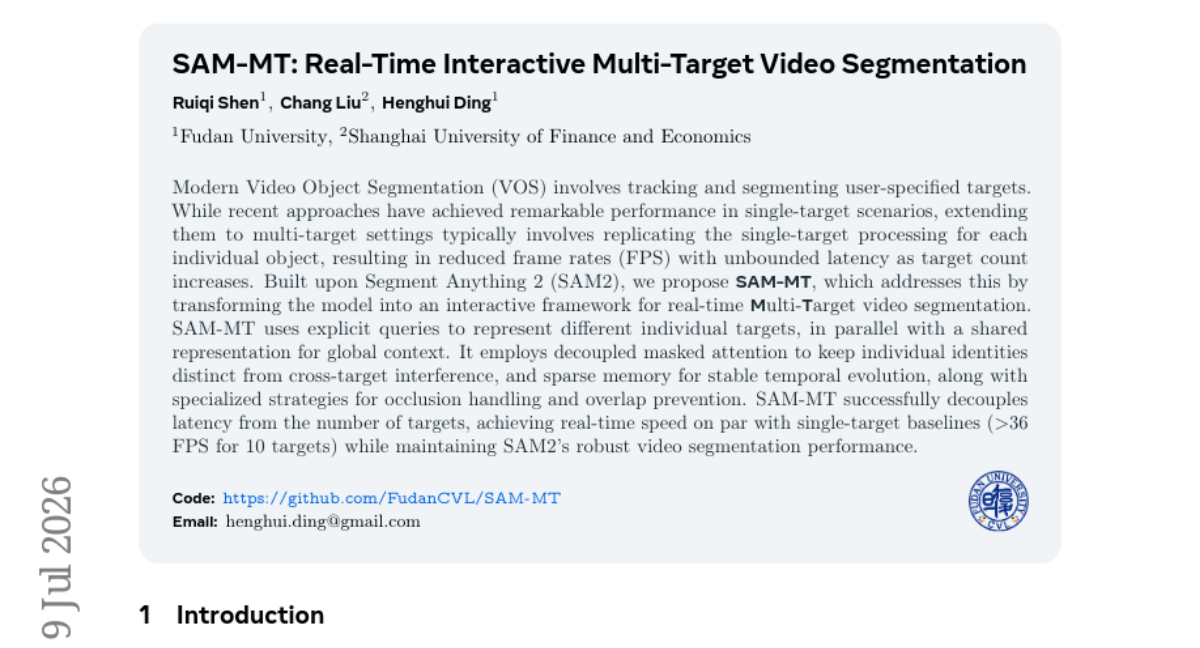
11. SAM-MT: Real-Time Interactive Multi-Target Video Segmentation
🔑 Keywords: Video Object Segmentation, Multi-Target, Real-Time, Interactive Framework
💡 Category: Computer Vision
🌟 Research Objective:
– To enhance video object segmentation for multi-target settings by creating a real-time interactive framework called SAM-MT, based on Segment Anything 2 (SAM2).
🛠️ Research Methods:
– Utilizes explicit queries for target representation, decoupled masked attention to prevent cross-target interference, and sparse memory for stable temporal processing.
– Implements strategies for occlusion handling and overlap prevention to maintain target integrity.
💬 Research Conclusions:
– SAM-MT decouples latency from the number of targets, achieving over 36 FPS for 10 targets, comparable to single-target baselines, while maintaining robust performance of SAM2 in video segmentation.
👉 Paper link: https://huggingface.co/papers/2607.08688
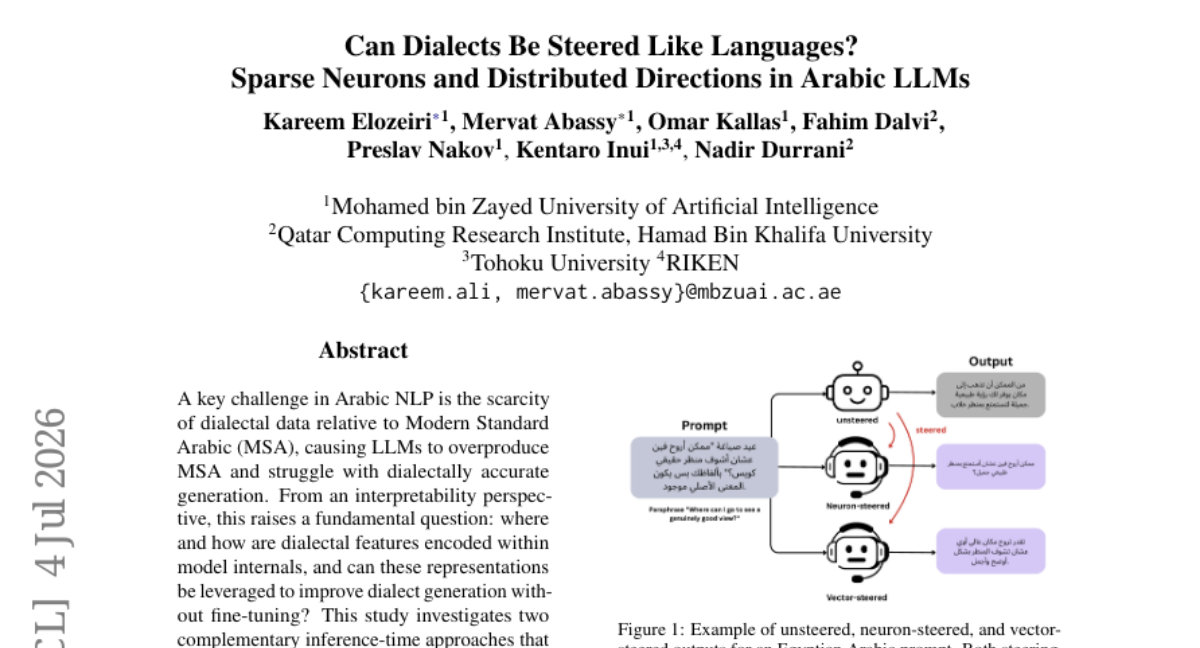
12. Can Dialects Be Steered Like Languages? Sparse Neurons and Distributed Directions in Arabic LLMs
🔑 Keywords: Arabic language models, Dialectal features, Inference-time approaches, Interpretability probes, Dialect control
💡 Category: Natural Language Processing
🌟 Research Objective:
– Investigate how dialect-specific features are encoded in Arabic language models and explore methods for controlling dialectal output without additional training.
🛠️ Research Methods:
– Conducted a neuron-level analysis to identify and manipulate sparse neuron populations encoding dialect-specific features.
– Applied a vector-steering approach to extract and inject dialect-specific activation directions during inference.
💬 Research Conclusions:
– The study provides insights into the geometry of dialectal knowledge in Arabic language models and presents a framework for dialect control that does not require dialect-specific fine-tuning.
👉 Paper link: https://huggingface.co/papers/2607.03936
13.
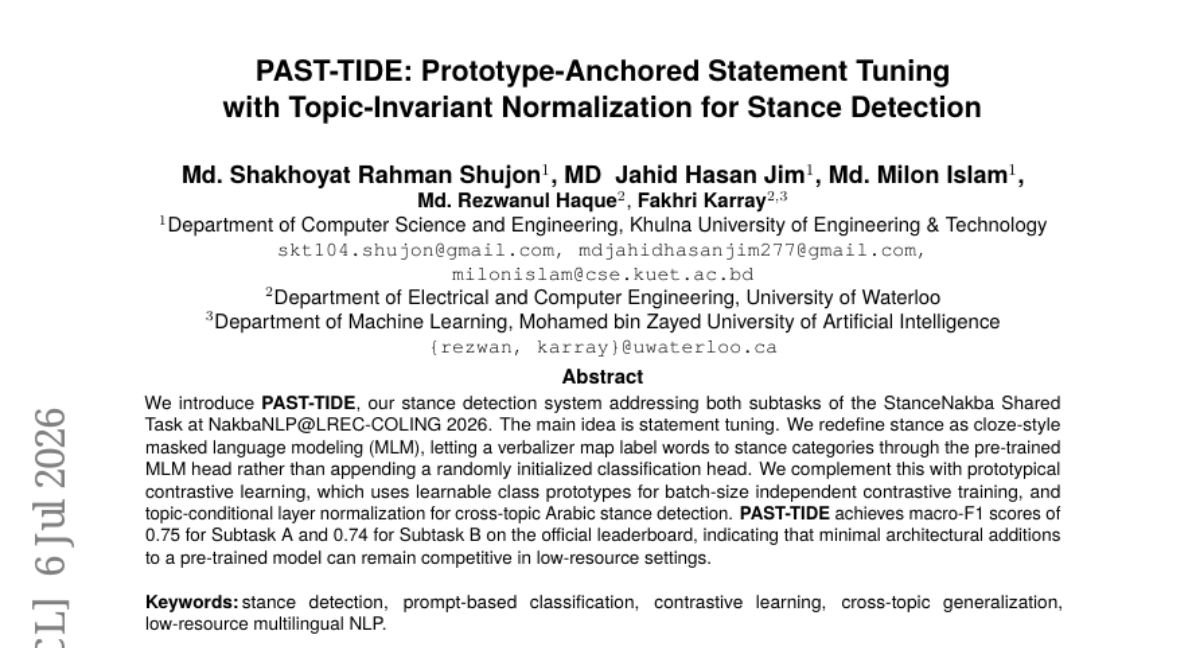
14. PAST-TIDE: Prototype-Anchored Statement Tuning with Topic-Invariant Normalization for Stance Detection
🔑 Keywords: Stance detection, Masked Language Modeling (MLM), contrastive learning, Arabic stance detection, low-resource settings
💡 Category: Natural Language Processing
🌟 Research Objective:
– Develop the PAST-TIDE system for detecting stance in Arabic language across different topics using innovative tuning methods.
🛠️ Research Methods:
– Utilizes statement tuning by redefining stance detection as cloze-style masked language modeling with a verbalizer.
– Incorporates prototypical contrastive learning with learnable class prototypes.
– Implements topic-conditional layer normalization.
💬 Research Conclusions:
– PAST-TIDE achieves competitive macro-F1 scores of 0.75 for Subtask A and 0.74 for Subtask B, demonstrating effectiveness with minimal architectural changes in low-resource settings.
👉 Paper link: https://huggingface.co/papers/2607.04690
15. A Sparse and Truncated State Vector Simulator for Peaked Circuits
🔑 Keywords: Quantum Circuits, Peaked Circuits, State Vector, Sparse Representation, Hardware Acceleration
💡 Category: Quantum Machine Learning
🌟 Research Objective:
– To simulate peaked quantum circuits efficiently using classical computing techniques that leverage sparse state vector representations.
🛠️ Research Methods:
– Utilization of truncated state vectors storing only nonzero amplitudes, employing vectorized operations, and utilizing hardware acceleration for enhanced simulation performance.
💬 Research Conclusions:
– An open-source implementation is presented, demonstrating the efficiency of the described approach alongside its performance metrics and inherent limitations.
👉 Paper link: https://huggingface.co/papers/2607.07816
16. CausalDS: Benchmarking Causal Reasoning in Data-Science Agents
🔑 Keywords: CausalDS, causal reasoning, synthetic causal structures, data-science workflows, Pearl’s rungs
💡 Category: Knowledge Representation and Reasoning
🌟 Research Objective:
– The paper introduces CausalDS as a benchmark designed to evaluate causal reasoning in data-science workflows, integrating synthetic causal structures with realistic data and narratives across all of Pearl’s rungs of causal inference.
🛠️ Research Methods:
– CausalDS combines samples from structural causal models with generated observational data and synthetic natural-language stories. It grounds its components in empirical distributions from real-world data to maintain realistic empirical structures while allowing for synthetic generation.
💬 Research Conclusions:
– CausalDS effectively evaluates aspects such as symbolic causal reasoning, data science application, uncertainty quantification, the need for abstention, and advanced tool use/coding. It addresses limitations of existing benchmarks by fostering diversity through novel synthetic causal structures.
👉 Paper link: https://huggingface.co/papers/2607.08093
17. Flash-BoN: Instant Drafts for Inference-Time Scaling in Diffusion Models
🔑 Keywords: Flash-BoN, text-to-image generation, layer skipping, activation proxies, multi-stage verification
💡 Category: Generative Models
🌟 Research Objective:
– The research aims to enhance text-to-image generation efficiency by developing the Flash-BoN method that employs inexpensive draft candidates and a multi-stage verification process.
🛠️ Research Methods:
– Utilizes timestep truncation, layer skipping, and activation proxies to create draft candidates and applies a multi-stage verification to refine the most promising drafts.
💬 Research Conclusions:
– Flash-BoN surpasses existing methods under fixed wall-clock budgets, particularly on larger model scales, and integrates well with other techniques, improving efficiency and candidate diversity.
👉 Paper link: https://huggingface.co/papers/2607.04461
18. UP: Unbounded Positive Asymmetric Optimization for Breaking the Exploration-Stability Dilemma
🔑 Keywords: Unbounded Positive Asymmetric Optimization, Reinforcement Learning, Large Language Models, Exploration-Stability Dilemma, Importance Sampling
💡 Category: Reinforcement Learning
🌟 Research Objective:
– Address the exploration-stability trade-offs in reinforcement learning frameworks for large language models using a novel objective called Unbounded Positive Asymmetric Optimization (UP).
🛠️ Research Methods:
– Introduce UP as a universal and plug-and-play objective that leverages the stop-gradient operator for stable training and enhanced exploration by anchoring policies to their current state.
💬 Research Conclusions:
– Extensive experiments validate UP’s effectiveness in improving exploration capacity and reasoning accuracy across diverse RL algorithms, model architectures, and modalities, establishing it as a universal enhancement for RL-based training.
👉 Paper link: https://huggingface.co/papers/2607.06987
19. Linear Attention Architectures: Mechanisms, Trade-offs, and Cross-Layer Routing
🔑 Keywords: Softmax Attention, Recurrent Linear-Attention, Memory Management, Training Efficiency
💡 Category: Natural Language Processing
🌟 Research Objective:
– The study aims to comparatively analyze the expressivity, memory management, and training efficiency of softmax attention and various recurrent linear-attention architectures, focusing on different parameter scales and sequence lengths.
🛠️ Research Methods:
– By employing a common recurrent-memory notation, the paper examines differences among DeltaNet, Gated DeltaNet, Kimi Delta Attention, and Gated DeltaNet-2 in terms of expressivity, memory decay, erase and write control, training throughput, and implementation complexity. Experiments were run on 350M-parameter models, covering various optimizers and sequence-length runtime measurements.
💬 Research Conclusions:
– Kimi Delta Attention with Muon achieves the lowest final validation loss, while Gated DeltaNet trained with AdamW offers the highest normalized training throughput. Hybrid stacks provide improved loss at the expense of throughput. Introducing Cross-Layer Value Routing improves final validation loss for DeltaNet and Gated DeltaNet.
👉 Paper link: https://huggingface.co/papers/2607.07953
20. Jet-Long: Efficient Long-Context Extension with Dynamic Bifocal RoPE
🔑 Keywords: zero-shot context extension, long-context processing, bifocal attention mechanism, rescaling factors, Jet-Long
💡 Category: Natural Language Processing
🌟 Research Objective:
– The paper introduces Jet-Long, a novel zero-shot method aimed at enhancing long-context processing in large language models by adapting rescaling factors and utilizing a bifocal attention mechanism for diverse sequence lengths.
🛠️ Research Methods:
– Jet-Long dynamically adapts rescaling factors through a RoPE-faithful local window and a long-range window, enabling it to maintain high performance across varying sequence lengths without the need for additional tuning.
💬 Research Conclusions:
– Jet-Long improves throughput and accuracy in long-context applications, demonstrated by outperforming baselines such as RULER and achieving high accuracy on HELMET-RAG benchmarks, as well as generalizing to hybrid attention architectures without retraining.
👉 Paper link: https://huggingface.co/papers/2607.07740
21. DrugGen 2: A disease-aware language model for enhancing drug discovery
🔑 Keywords: DrugGen-2, GPT-2, Reinforcement Learning, Disease Ontology, Molecular Docking
💡 Category: Generative Models
🌟 Research Objective:
– Introduce DrugGen-2, a novel generative model, to design small molecules conditioned on both disease ontology and target protein sequences, addressing current gaps in drug design approaches that often ignore disease context.
🛠️ Research Methods:
– Developed by fine-tuning a pre-trained GPT-2 model using a two-step strategy: supervised fine-tuning followed by reinforcement learning via group relative policy optimization (GRPO), focusing on chemical validity, novelty, diversity, and binding affinity.
💬 Research Conclusions:
– DrugGen-2 outperformed baseline models such as DrugGPT and DrugGen by generating unique molecules with greater structural similarity to approved drugs and improved binding affinities. Molecular docking analyses identified candidate ligands with superior binding potentials compared to reference drugs.
👉 Paper link: https://huggingface.co/papers/2607.08404
22. LongE2V: Long-Horizon Event-based Video Reconstruction, Prediction, and Frame Interpolation with Video Diffusion Models
🔑 Keywords: Video Diffusion Priors, Event-Based Video Reconstruction, Frame Interpolation, Temporal Drift, Zero-Shot Generalization
💡 Category: Computer Vision
🌟 Research Objective:
– The research aims to enable high-quality video recovery from sparse event streams by leveraging pre-trained video diffusion priors and addressing challenges in temporal stability and frame interpolation.
🛠️ Research Methods:
– The study proposes LongE2V, which fine-tunes a foundational video model using techniques like Autoregressive Unrolling, Adaptive Context Switching, and Reencoding Alignment with Cross Residual Correction to handle tasks such as event-based video reconstruction and frame interpolation.
💬 Research Conclusions:
– The experiments demonstrate that LongE2V outperforms state-of-the-art methods across tasks, showing exceptional temporal coherence and zero-shot generalization capabilities.
👉 Paper link: https://huggingface.co/papers/2607.08770
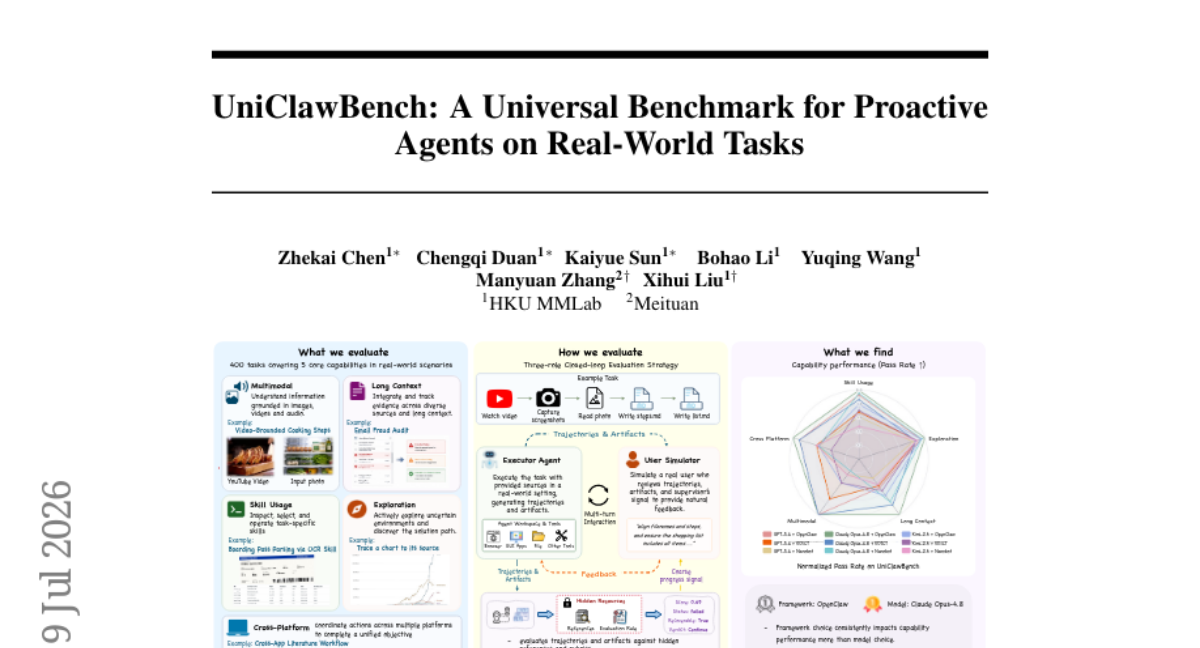
23. UniClawBench: A Universal Benchmark for Proactive Agents on Real-World Tasks
🔑 Keywords: proactive agents, capability-driven benchmark, real-world environments, closed-loop evaluation, Docker containers
💡 Category: AI Systems and Tools
🌟 Research Objective:
– Introduce UniClawBench, a capability-driven benchmark designed to evaluate proactive agents in dynamic real-world settings.
🛠️ Research Methods:
– Conduct assessments using live Docker containers and a closed-loop evaluation strategy featuring executor, supervisor, and user agents to simulate realistic multi-turn human feedback.
💬 Research Conclusions:
– Demonstrate how foundational model capabilities and agent framework designs interact to shape performance in real-world environments.
– Provide a comprehensive evaluation across both models and frameworks, emphasizing the importance of disentangling base model capabilities from framework-level design choices.
– Make the benchmark and associated code publicly available for future research advancements.
👉 Paper link: https://huggingface.co/papers/2607.08768
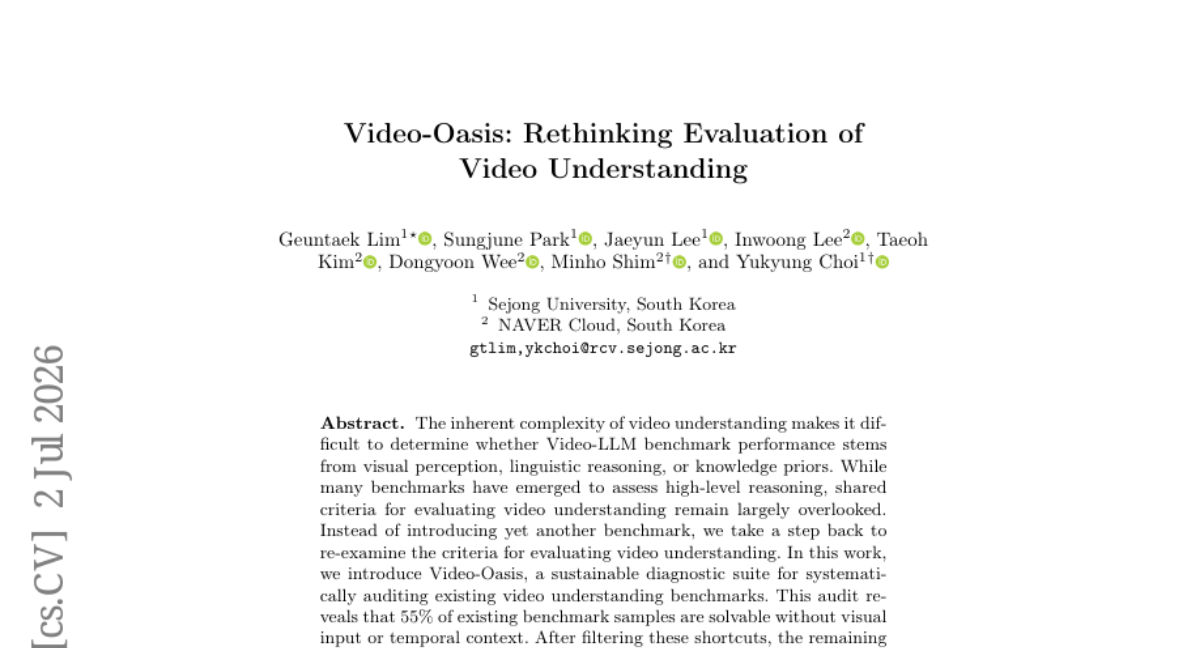
24. Video-Oasis: Rethinking Evaluation of Video Understanding
🔑 Keywords: video understanding, Video-LLM, visual perception, video-native challenges
💡 Category: Computer Vision
🌟 Research Objective:
– To introduce Video-Oasis, a diagnostic suite to evaluate and audit existing video understanding benchmarks and expose capability gaps in current models.
🛠️ Research Methods:
– Systematic auditing of existing video benchmarks to identify samples solvable without visual input.
– Filtering shortcuts to find video-native challenges and using them as a testbed for algorithmic design choices.
💬 Research Conclusions:
– Over half of existing video benchmarks can be solved without using visual input.
– After removing shortcuts, state-of-the-art models perform marginally better than random guessing, highlighting a significant gap in video understanding capabilities.
– The findings provide a foundation for constructing more rigorous video benchmarks and evaluating future Video-LLMs.
👉 Paper link: https://huggingface.co/papers/2603.29616