AI Native Daily Paper Digest – 20260713
1. Long-Horizon-Terminal-Bench: Testing the Limits of Agents on Long-Horizon Terminal Tasks with Dense Reward-Based Grading
🔑 Keywords: Long-Horizon-Terminal-Bench, task decomposition, intermediate rewards, terminal benchmarks
💡 Category: Reinforcement Learning
🌟 Research Objective:
– The study introduces Long-Horizon-Terminal-Bench, a comprehensive terminal benchmark designed to evaluate AI agent performance on long-horizon tasks that require detailed solutions and intermediate progress assessment.
🛠️ Research Methods:
– The benchmark encompasses 46 tasks across nine distinct categories, incorporating fine-grained subtasks that allow for dense intermediate rewards and partial credit, shifting focus from pure outcome success to intermediate achievements.
💬 Research Conclusions:
– Testing with 15 frontier models demonstrated the demanding nature of Long-Horizon-Terminal-Bench, highlighting substantial room for improvement as evidenced by low pass rates under specified reward thresholds. The release of this benchmark aims to promote advancements in long-horizon planning and complex task evaluation in AI agents.
👉 Paper link: https://huggingface.co/papers/2607.08964

2. Video Generation Models are General-Purpose Vision Learners
🔑 Keywords: GenCeption, text-to-video generation, general visual intelligence, video generative diffusion, emergent behaviors
💡 Category: Generative Models
🌟 Research Objective:
– The paper aims to establish large-scale text-to-video generation as a pre-training paradigm to achieve general visual intelligence in computer vision.
🛠️ Research Methods:
– The study introduces GenCeption, a feed-forward perception model utilizing a pre-trained video generative diffusion backbone for various vision tasks guided by text instructions.
💬 Research Conclusions:
– GenCeption achieves state-of-the-art performance across diverse tasks, often matching or surpassing specialized models while using significantly less training data. It demonstrates intriguing emergent behaviors, such as generalizing from synthetic human videos to real-world footage.
👉 Paper link: https://huggingface.co/papers/2607.09024
3. KronQ: LLM Quantization via Kronecker-Factored Hessian
🔑 Keywords: Post-training quantization, LLMs, KronQ, Gradient covariance, GPTQ
💡 Category: Natural Language Processing
🌟 Research Objective:
– Introduce KronQ, a PTQ framework that incorporates gradient covariance into the quantization process for large language models (LLMs) to improve compression without retraining.
🛠️ Research Methods:
– Propose a Kronecker-factored Hessian approximation approach, focusing on bidirectional incoherence processing and a new sensitivity metric for mixed-precision allocation.
💬 Research Conclusions:
– KronQ significantly outperforms existing techniques like GPTQ and GPTAQ in scenarios of extreme quantization, achieving a perplexity of 7.93 on 2-bit weight-only quantization for LLaMA-3-70B.
👉 Paper link: https://huggingface.co/papers/2607.07964
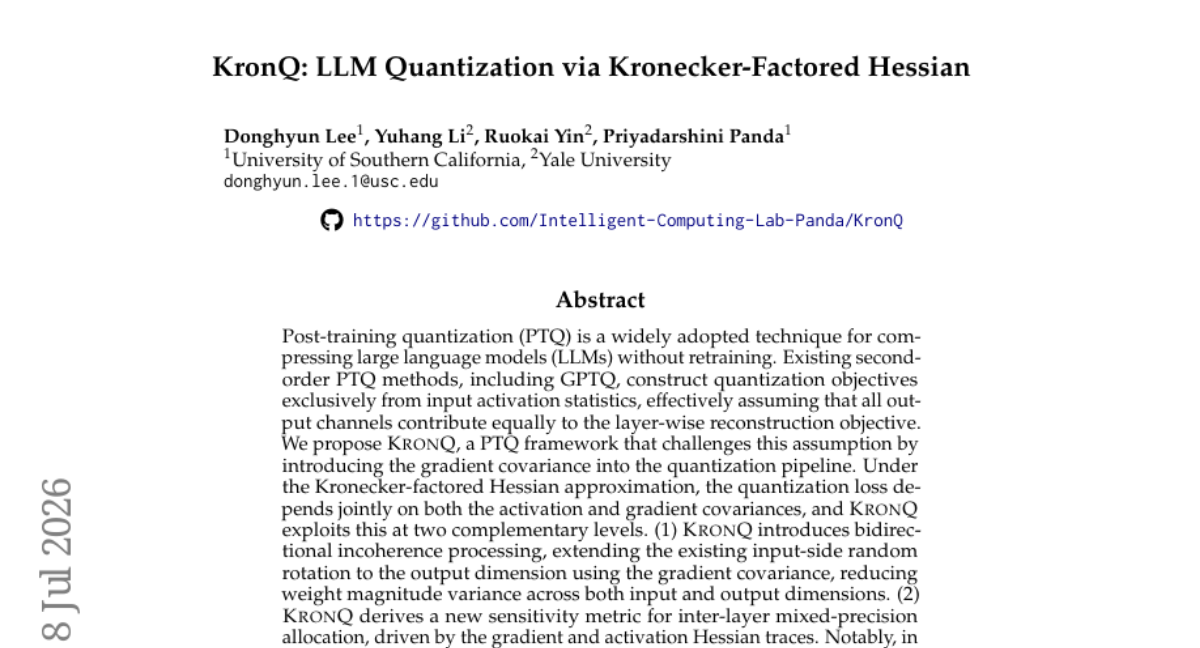
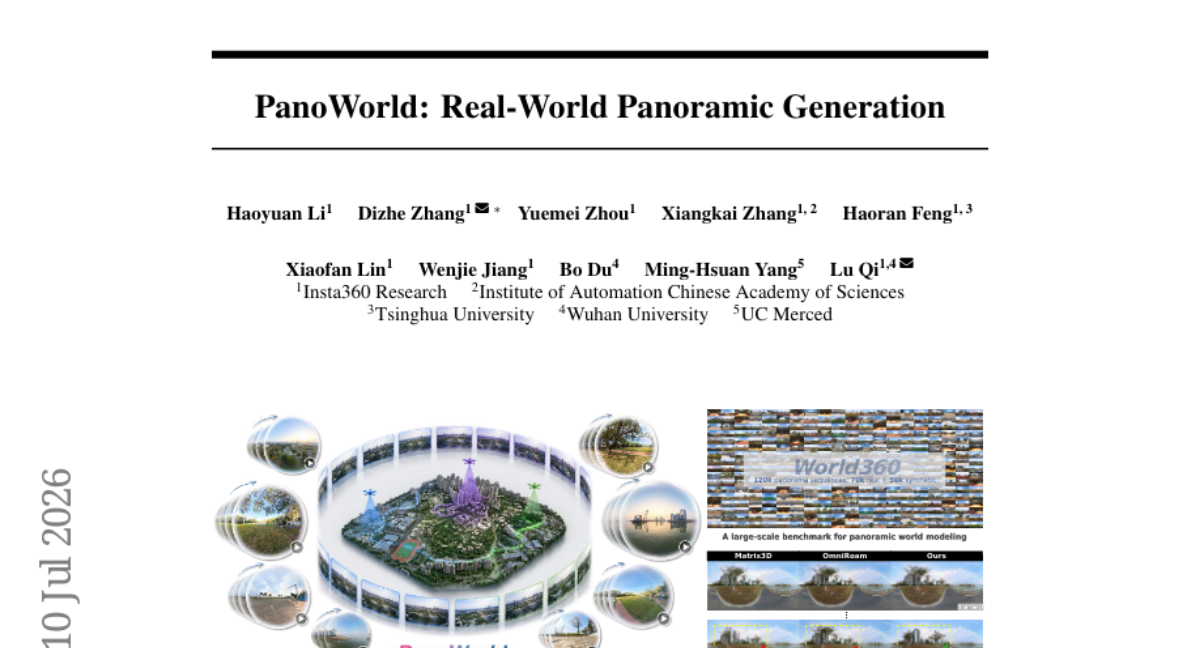
4. PanoWorld: Real-World Panoramic Generation
🔑 Keywords: PanoWorld, panoramic models, Dense Panoramic Ray-Conditioning, Geometry-aware Memory Augmentation, World360
💡 Category: Computer Vision
🌟 Research Objective:
– The research addresses long-range memory challenges in panoramic world models by leveraging the rotation-equivariant property of omnidirectional representations.
🛠️ Research Methods:
– Introduction of a novel model named PanoWorld, featuring Dense Panoramic Ray-Conditioning (DPRC) and Geometry-aware Memory Augmentation (GMA) to enhance camera trajectories and memory.
– Utilization of World360, a large-scale dataset with real and simulated panoramic video clips for evaluating model performance.
💬 Research Conclusions:
– Experimental results on the World360 dataset showcase the superiority of PanoWorld, significantly outperforming alternative methods in handling extensive spatial variations and diverse lighting conditions.
👉 Paper link: https://huggingface.co/papers/2607.09661
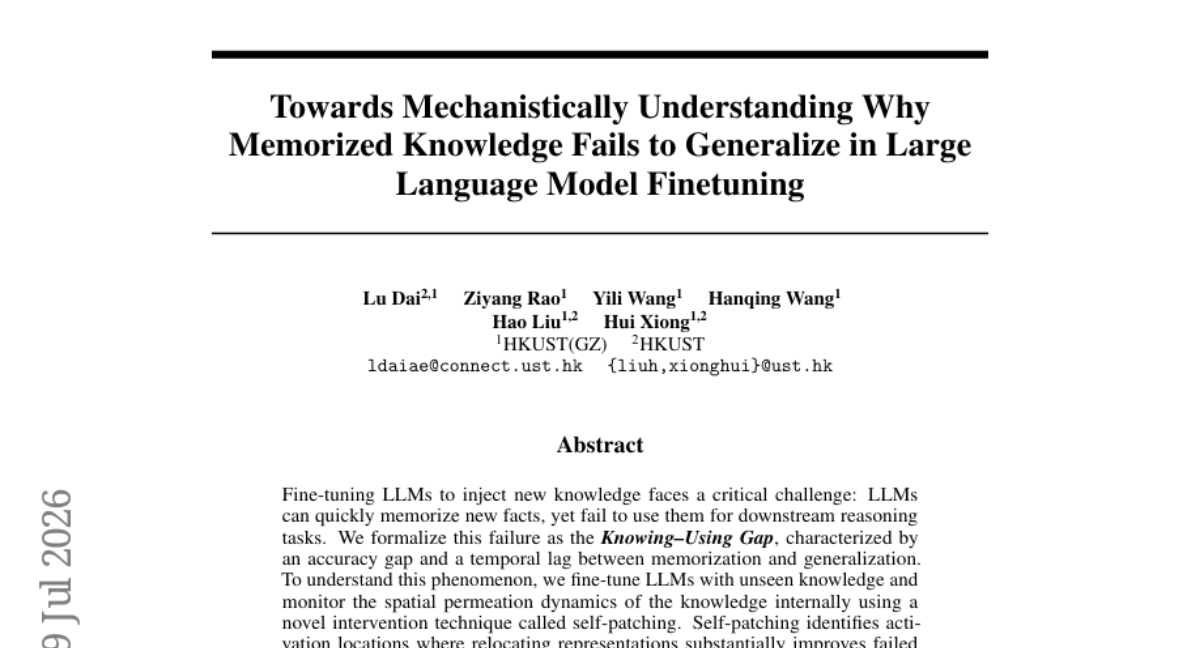
5. Towards Mechanistically Understanding Why Memorized Knowledge Fails to Generalize in Large Language Model Finetuning
🔑 Keywords: Knowing–Using Gap, LLMs, self-patching, generalization failure, knowledge-circuit misalignment
💡 Category: Natural Language Processing
🌟 Research Objective:
– To address the challenge that LLMs can memorize facts but struggle with using this for downstream reasoning tasks, formalized as the Knowing–Using Gap.
🛠️ Research Methods:
– Fine-tuning LLMs with unseen knowledge and monitoring spatial permeation using a novel intervention technique called self-patching.
💬 Research Conclusions:
– Self-patching helps identify activation locations to improve generalization failures, supporting the knowledge-circuit misalignment hypothesis. The strategy recovers 58-75% of the oracle headroom.
👉 Paper link: https://huggingface.co/papers/2607.08393
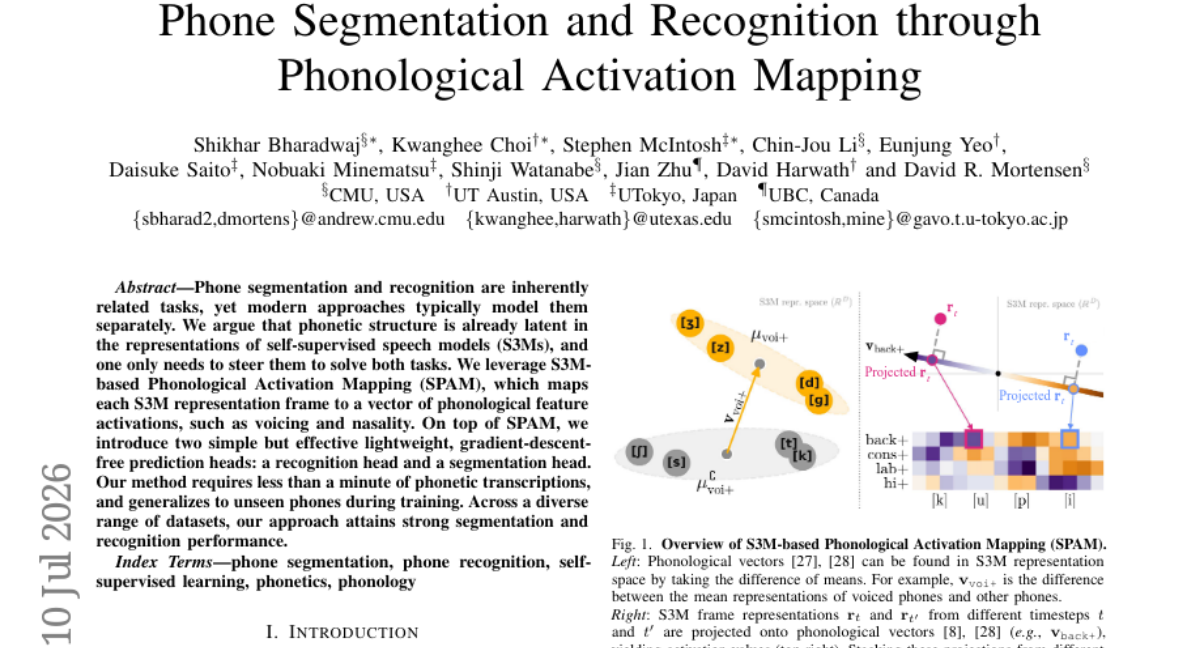
6. Phone Segmentation and Recognition through Phonological Activation Mapping
🔑 Keywords: Phone segmentation, Recognition, Self-supervised speech models, Phonological Activation Mapping, Segmentation head
💡 Category: Natural Language Processing
🌟 Research Objective:
– Investigate the connection between phone segmentation and recognition by utilizing latent phonetic structures in self-supervised speech models (S3Ms).
🛠️ Research Methods:
– Developed a method using S3M-based Phonological Activation Mapping (SPAM) to map S3M representation frames to vectors of phonological feature activations, combined with lightweight prediction heads.
💬 Research Conclusions:
– The approach demonstrates strong performance in segmentation and recognition across various datasets, requiring minimal phonetic transcriptions and effectively generalizing to unseen phones.
👉 Paper link: https://huggingface.co/papers/2607.09020
7. A Sovereign, Open-Source Foundation Model for German and English
🔑 Keywords: Mixture-of-Experts, Mamba Transformer, Sovereign AI, German Industrial AI Cloud, Open-Source
💡 Category: Natural Language Processing
🌟 Research Objective:
– Introduce Soofi S 30B-A3B, a new Mixture-of-Experts hybrid model for German and English that aims to improve performance in terms of throughput and accuracy compared to other models.
🛠️ Research Methods:
– Developed Soofi S 30B-A3B on the German Industrial AI Cloud, employing a design that activates only 3B of 30B parameters per token, and pretrained on approximately 27 trillion tokens with an emphasis on German.
💬 Research Conclusions:
– Soofi S outperforms existing sovereign AI models on English and German benchmarks, achieving top scores among open base models and exceeding the performance of models with larger active parameters.
– It will be released under open-access terms, including accessible weights, data, and training code, promoting transparency and collaboration.
👉 Paper link: https://huggingface.co/papers/2607.09424
8.
9. VaseMuseum: Digital Intelligent Museum for Ancient Greek Pottery
🔑 Keywords: Vision-language models, cultural heritage, 3D digitization, artifact exploration
💡 Category: Multi-Modal Learning
🌟 Research Objective:
– The study aims to address challenges in using Vision-language models to provide assistance in cultural heritage domains, specifically focusing on ancient Greek pottery.
🛠️ Research Methods:
– The paper introduces VaseMuseum, a framework combining an interactive virtual museum with VaseAgent. VaseAgent utilizes multimodal perception, 3D-aware reasoning, and external knowledge retrieval with inference-time reliability control.
💬 Research Conclusions:
– VaseMuseum enhances citation validity, reduces hallucinations on knowledge-intensive queries, and provides more neutral answers under ambiguous circumstances compared to baseline models.
👉 Paper link: https://huggingface.co/papers/2607.06374

10. MedPMC: A Systematic Framework for Scaling High-Fidelity Medical Multimodal Data for Foundation Models
🔑 Keywords: MedPMC, Multimodal Foundation Models, Clinical Data, Zero-Shot Learning, Image-Text Pairs
💡 Category: AI in Healthcare
🌟 Research Objective:
– The development and introduction of MedPMC, an automated framework to enhance the fidelity and utility of clinical resources for multimodal models in medicine.
🛠️ Research Methods:
– MedPMC applies to 6.1 million PMC articles to curate 11 million medical image-text pairs, with evaluations for initial screening, figure detection, separation, and medical figure classification.
💬 Research Conclusions:
– MedPMC significantly improves the performance of medical multimodal foundation models, enhancing zero-shot AUC, medical visual question-answering, and image retrieval accuracy by leveraging high-fidelity curated literature.
👉 Paper link: https://huggingface.co/papers/2607.07673

11. Flow-ERD: Agent-type Aware Flow Matching with Entropy-Regularized Distillation for Diverse Traffic Simulation
🔑 Keywords: Flow-ERD, multi-agent simulator, Agent-Type Aware Flow Matching, Entropy-Regularized Distillation
💡 Category: Robotics and Autonomous Systems
🌟 Research Objective:
– The main objective of the research is to develop Flow-ERD, a multi-agent traffic simulator that balances realism and diversity in traffic simulation for autonomous driving development.
🛠️ Research Methods:
– The core methods used are Agent-Type Aware Flow Matching (AFM) for maintaining diversity and kinematic consistency, and Entropy-Regularized Distillation (ERD) to enhance distributional robustness and prevent mode collapse.
💬 Research Conclusions:
– Flow-ERD achieves superior performance, ranking first on the WOSAC test benchmark, and effectively balances the realism–diversity trade-off, outperforming other reproducible baselines.
👉 Paper link: https://huggingface.co/papers/2607.06957
12. Self-Guided Test-Time Training for Long-Context LLMs
🔑 Keywords: Long-context processing, test-time training (TTT), Self-Guided TTT (S-TTT), LongBench-v2, LongBench-Pro
💡 Category: Natural Language Processing
🌟 Research Objective:
– Investigate the challenges and propose a solution for enhancing long-context utilization in large language models (LLMs).
🛠️ Research Methods:
– Introduction of Self-Guided Test-Time Training (S-TTT), which identifies relevant evidence spans before adaptation and applies the language-modeling training objective specifically to those spans.
💬 Research Conclusions:
– S-TTT significantly improves accuracy in long-context reasoning on benchmarks such as LongBench-v2 and LongBench-Pro, achieving up to a 15% relative improvement.
👉 Paper link: https://huggingface.co/papers/2607.09415
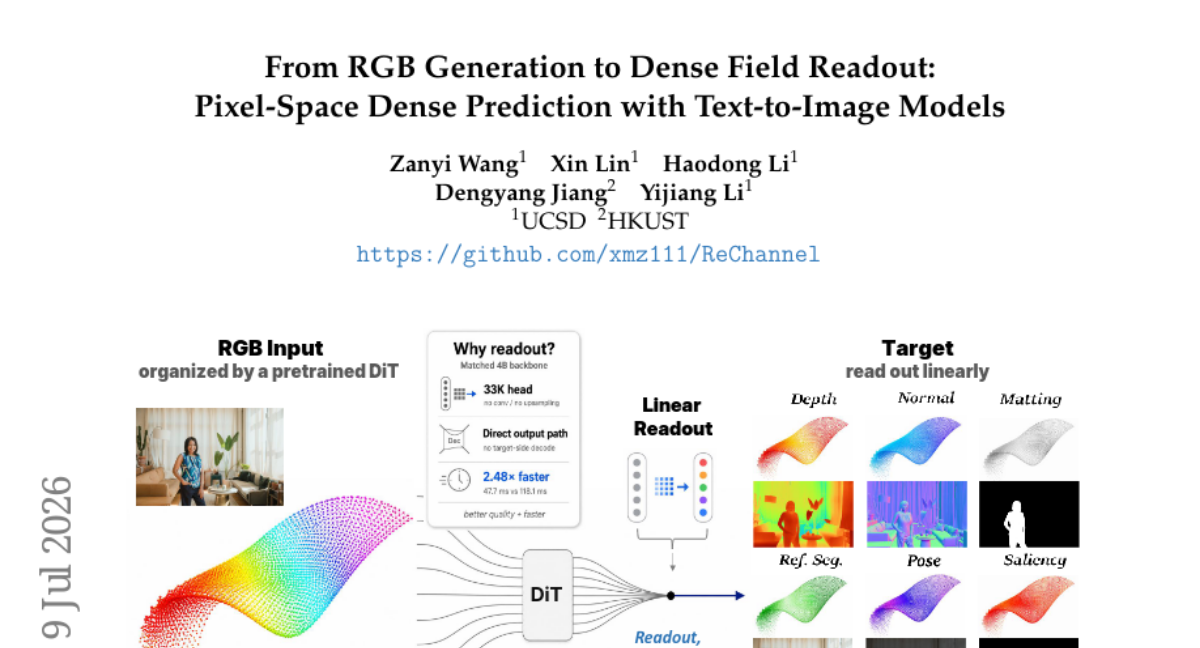
13. From RGB Generation to Dense Field Readout: Pixel-Space Dense Prediction with Text-to-Image Models
🔑 Keywords: Pretrained DiT, dense prediction, FLUX-Klein, token-local linear head, state-of-the-art
💡 Category: Computer Vision
🌟 Research Objective:
– Demonstrate the adaptation of pretrained diffusion transformers for dense prediction tasks by using task-native output mappings rather than generating RGB images.
🛠️ Research Methods:
– Utilize ReChannel to adapt the pretrained DiT by converting task tokens to pixel-space patches and evaluate its performance on various dense prediction tasks using the FLUX-Klein framework.
💬 Research Conclusions:
– Achieved state-of-the-art results in trimap-free matting, KITTI depth estimation, and referring segmentation, while maintaining competitiveness in other tasks like normals, saliency, and pose. The model is more accurate and significantly faster compared to its editing-plus-latent-decode counterparts.
👉 Paper link: https://huggingface.co/papers/2607.06553
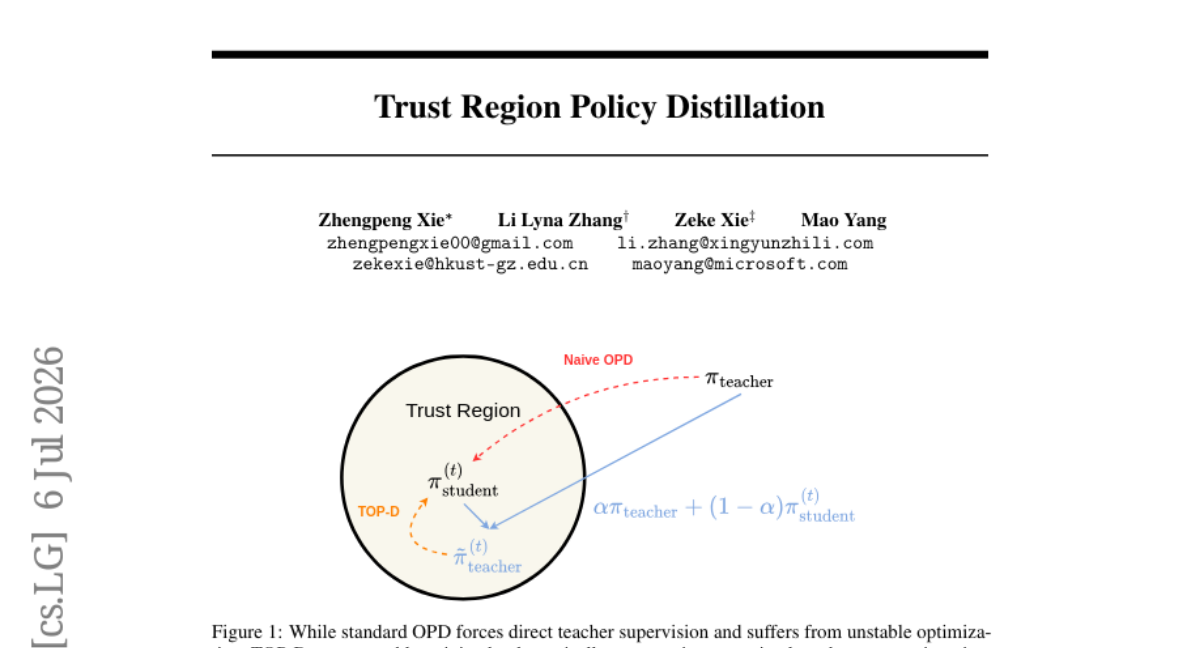
14. Trust Region Policy Distillation
🔑 Keywords: Trust Region Policy Distillation, On-Policy Distillation, stability, sample efficiency, mathematical reasoning
💡 Category: Reinforcement Learning
🌟 Research Objective:
– The objective is to transform the unstable On-Policy Distillation approach into a stable training paradigm known as Trust Region Policy Distillation (TOP-D).
🛠️ Research Methods:
– Dynamic construction of a proximal teacher to control gradient variance, and a rigorous framework providing a formal global convergence analysis with a monotonic improvement bound.
💬 Research Conclusions:
– TOP-D significantly improves training stability, sample efficiency, and performance on mathematical reasoning tasks without adding additional computational overhead, posing a viable alternative to traditional OPD.
👉 Paper link: https://huggingface.co/papers/2607.04751
15. Scalable Visual Pretraining for Language Intelligence
🔑 Keywords: Visual Pretraining, large foundation models, language intelligence
💡 Category: Multi-Modal Learning
🌟 Research Objective:
– The paper aims to challenge the assumption that language models must be trained on text-only data and demonstrates that Visual Pretraining can enhance the intelligence of foundation models.
🛠️ Research Methods:
– A systematic study of unsupervised visual pretraining paradigms that utilize visual documents without text extraction was conducted across various backbones and benchmarks.
💬 Research Conclusions:
– Visual Pretraining consistently outperforms text-only pretraining on the same corpora, providing an efficient path to scalable language intelligence.
👉 Paper link: https://huggingface.co/papers/2607.09657