AI Native Daily Paper Digest – 20260714 – Gemma | Video Foundation Models | Long-Context Attention
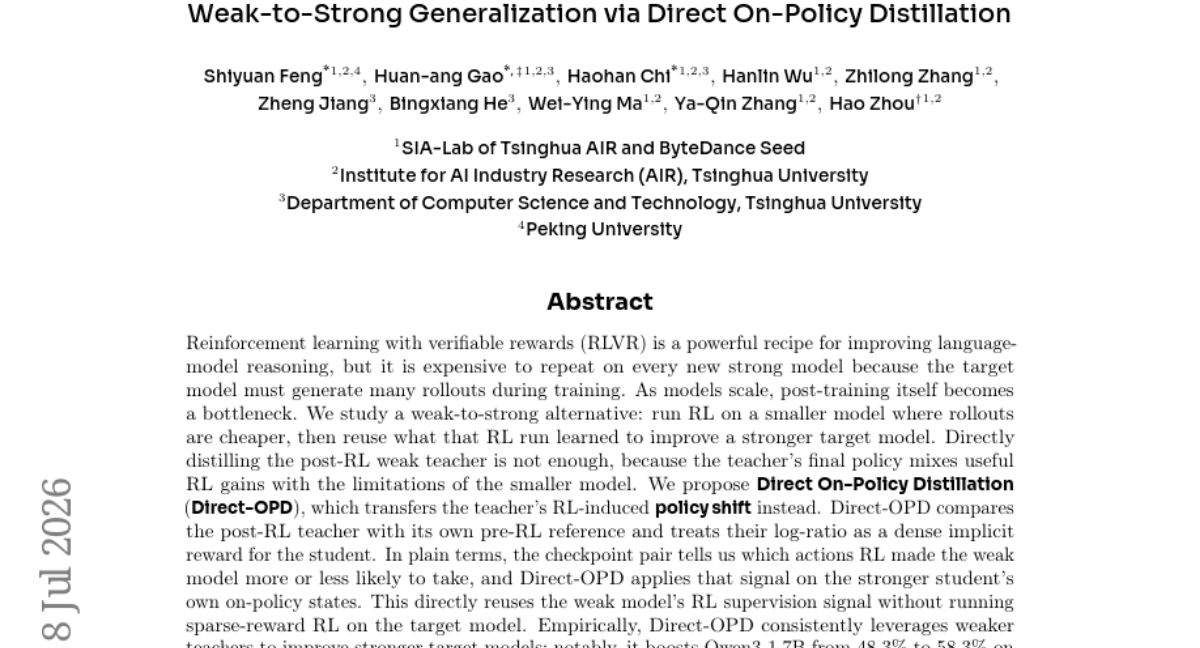
1. Weak-to-Strong Generalization via Direct On-Policy Distillation
🔑 Keywords: Direct On-Policy Distillation, Reinforcement Learning, policy shift, implicit reward
💡 Category: Reinforcement Learning
🌟 Research Objective:
– The main goal is to efficiently transfer reinforcement learning improvements from smaller models to larger models without rerunning expensive RL processes.
🛠️ Research Methods:
– Introduction of Direct On-Policy Distillation, which uses the policy shift-induced reward signal from a smaller model to enhance a stronger target model’s performance.
💬 Research Conclusions:
– Direct On-Policy Distillation consistently improves stronger models by leveraging signals from weaker teacher models, significantly enhancing performance and efficiency.
– Notably, it increases Qwen3-1.7B performance on AIME 2024 from 48.3% to 58.3% in just 4 hours using 8 A100 GPUs.
👉 Paper link: https://huggingface.co/papers/2607.05394
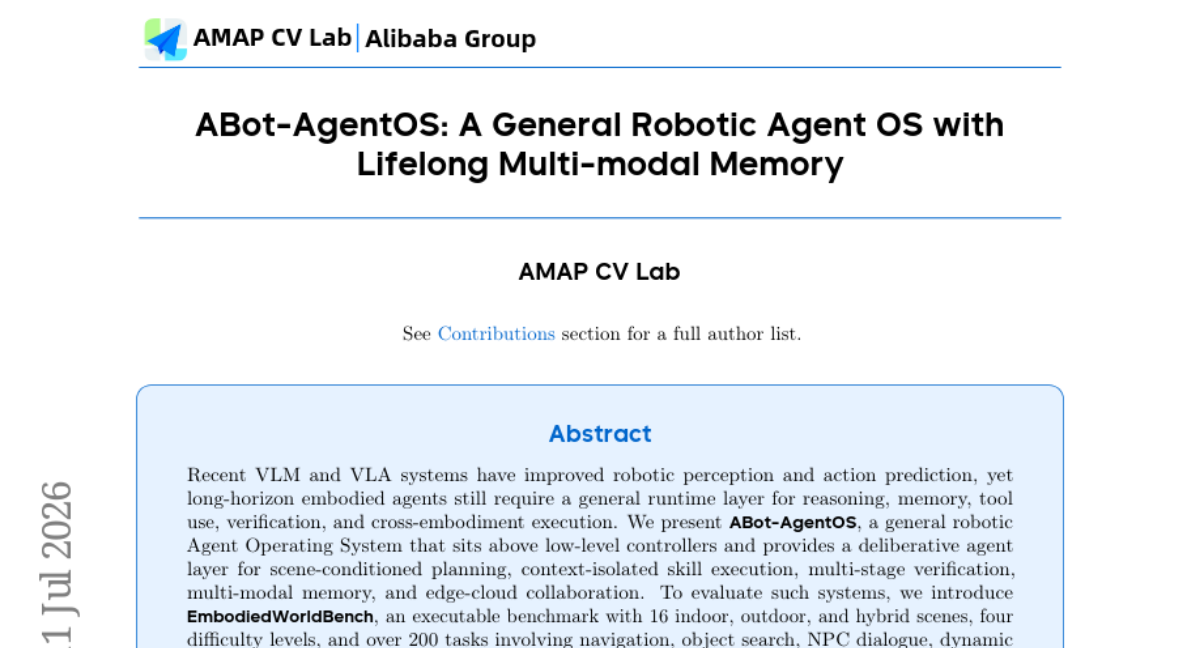
2. ABot-AgentOS: A General Robotic Agent OS with Lifelong Multi-modal Memory
🔑 Keywords: Agent Operating System, Embodied Agents, Multi-modal Memory, Runtime Evolution
💡 Category: Robotics and Autonomous Systems
🌟 Research Objective:
– The paper presents ABot-AgentOS, a general Agent Operating System designed to enhance long-horizon embodied agents by providing a deliberative layer above low-level controllers for better scene-conditioned planning and execution.
🛠️ Research Methods:
– Introduction of EmbodiedWorldBench, a comprehensive benchmark featuring a variety of tasks and scenes to evaluate the effectiveness of the agent operating system in diverse scenarios.
💬 Research Conclusions:
– ABot-AgentOS demonstrates enhanced task success and goal completion over baseline systems, attributed in part to its Universal Multi-modal Graph Memory and self-evolution capabilities, leading to improvements in persistent, auditable memory for continued interaction.
👉 Paper link: https://huggingface.co/papers/2607.10350
3. LightMem-Ego: Your AI Memory for Everyday Life
🔑 Keywords: Personal AI assistants, multimodal memory, egocentric visual and audio streams, lightweight memory system
💡 Category: Multi-Modal Learning
🌟 Research Objective:
– The paper aims to address the challenge of developing a lightweight multimodal memory that can continuously accumulate, organize, and retrieve long-term experiences for personal AI assistants.
🛠️ Research Methods:
– The research introduces LightMem-Ego, a system that captures egocentric visual and audio streams, aligns them on a shared timeline, and organizes them into hierarchical memories (current, short-term, long-term), dynamically routing retrievals based on user queries.
💬 Research Conclusions:
– LightMem-Ego supports deployment on smartphones and AI glasses, offering functionalities like object finding, conversation recall, life summarization, routine discovery, and personalized assistance, with accessible code for demonstration.
👉 Paper link: https://huggingface.co/papers/2607.11487
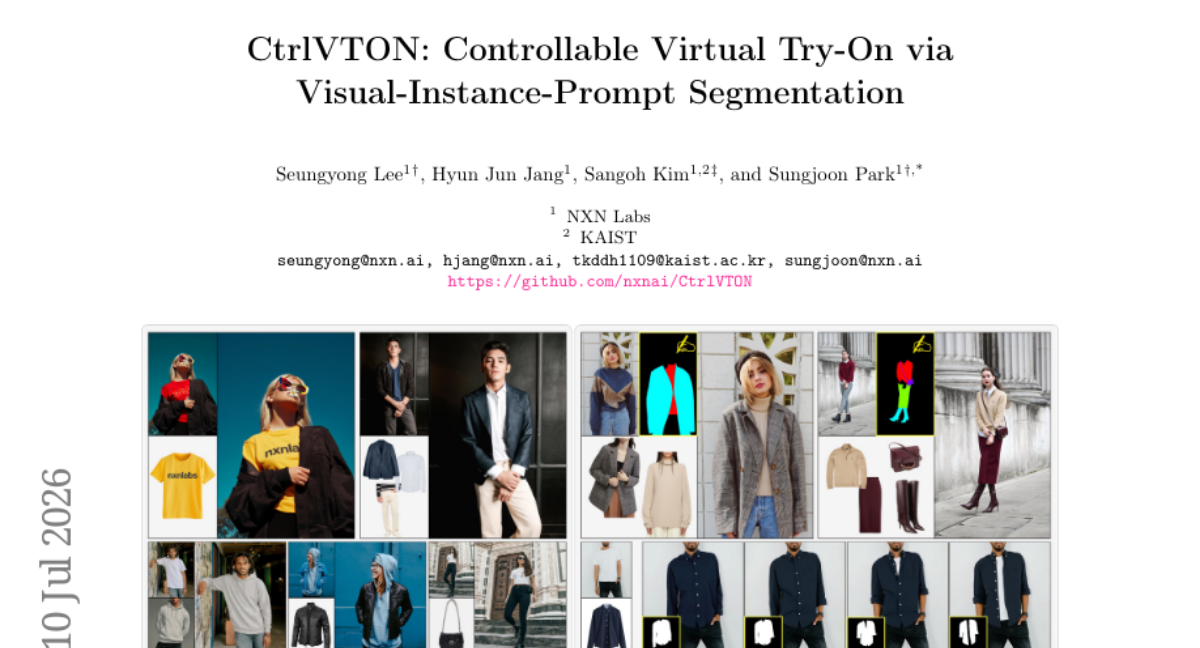
4. Metacognition in LLMs: Foundations, Progress, and Opportunities
🔑 Keywords: Metacognition, AI Systems, LLMs, Transparency, Intelligence
💡 Category: Natural Language Processing
🌟 Research Objective:
– To provide a comprehensive overview and analysis of metacognition in LLMs, bridging the gap in understanding its role and application in AI systems.
🛠️ Research Methods:
– Analyzing and categorizing the current knowledge on metacognition for LLMs, summarizing technical advancements, and discussing methods to measure, evaluate, and enhance metacognitive abilities.
💬 Research Conclusions:
– Highlighted the importance of metacognition for transparent AI systems, detailed the current state and implications of research, and pointed towards future applications and challenges in the field.
👉 Paper link: https://huggingface.co/papers/2607.11881
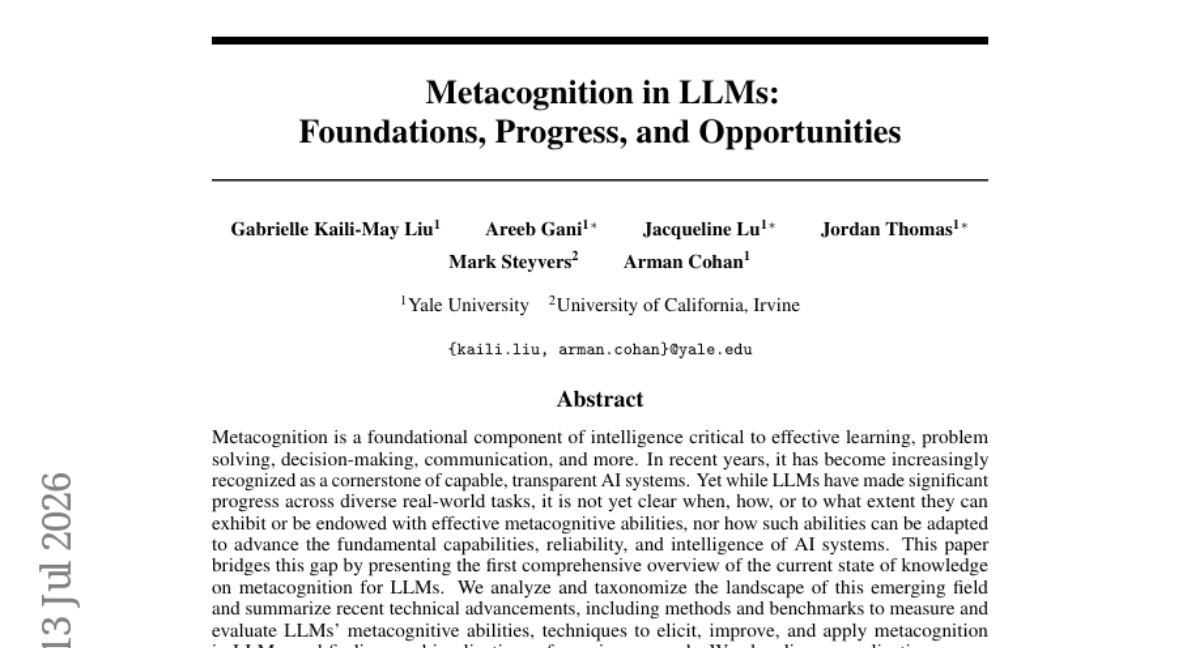
5. Proxy Exploration and Reusable Guidance: A Modular LLM Post-Training Paradigm via Proxy-Guided Update Signals
🔑 Keywords: Post-training, Large Language Models, Reward Optimization, Proxy-guided Update Signal Transfer, Computational Overhead
💡 Category: Natural Language Processing
🌟 Research Objective:
– The research proposes a novel framework, called Proxy-guided Update Signal Transfer (PUST), aimed to decouple update-signal exploration from distribution alignment in large language models.
🛠️ Research Methods:
– PUST utilizes a lightweight proxy model for efficient exploration and extracts relative improvement signals to guide the primary model’s policy alignment, significantly reducing computational overhead.
💬 Research Conclusions:
– Systematic evaluations demonstrated that update signals from weaker proxy models could robustly enhance stronger primary models, transforming post-training into a modular, reusable, and cost-efficient process.
👉 Paper link: https://huggingface.co/papers/2607.11505
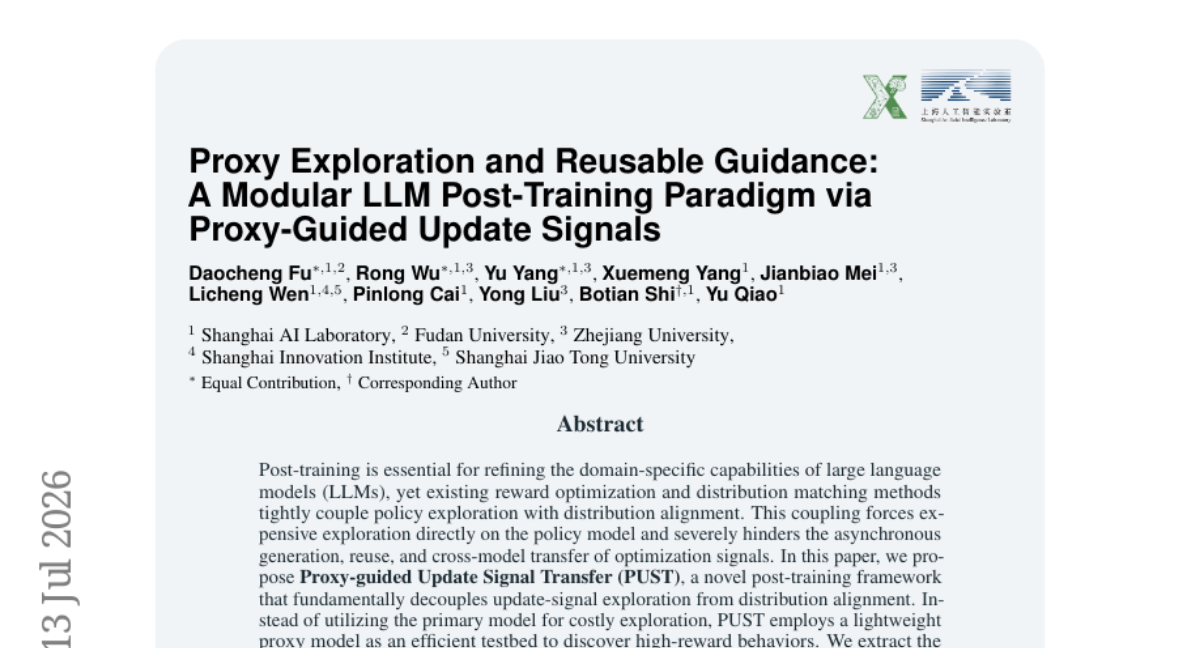
6. NeuroCogMap Reveals Cognitive Organization of Large Language Models
🔑 Keywords: NeuroCogMap, Large Language Models, Human Cognition, Cognitive Neuroscience, Functional Organization
💡 Category: Natural Language Processing
🌟 Research Objective:
– The study aims to organize the internal features of large language models (LLMs) into functional parcels, linking them to interpretable functions, cognitive capabilities, and human cognition.
🛠️ Research Methods:
– Introduced a framework called NeuroCogMap, inspired by cognitive neuroscience, to map and connect the internal representations within LLMs to cognitive functions.
💬 Research Conclusions:
– NeuroCogMap establishes a stable organization of LLMs, revealing how major LLM failures correlate with disruptions in functional systems, and enhances the prediction of human cortical responses during language comprehension.
👉 Paper link: https://huggingface.co/papers/2607.00397
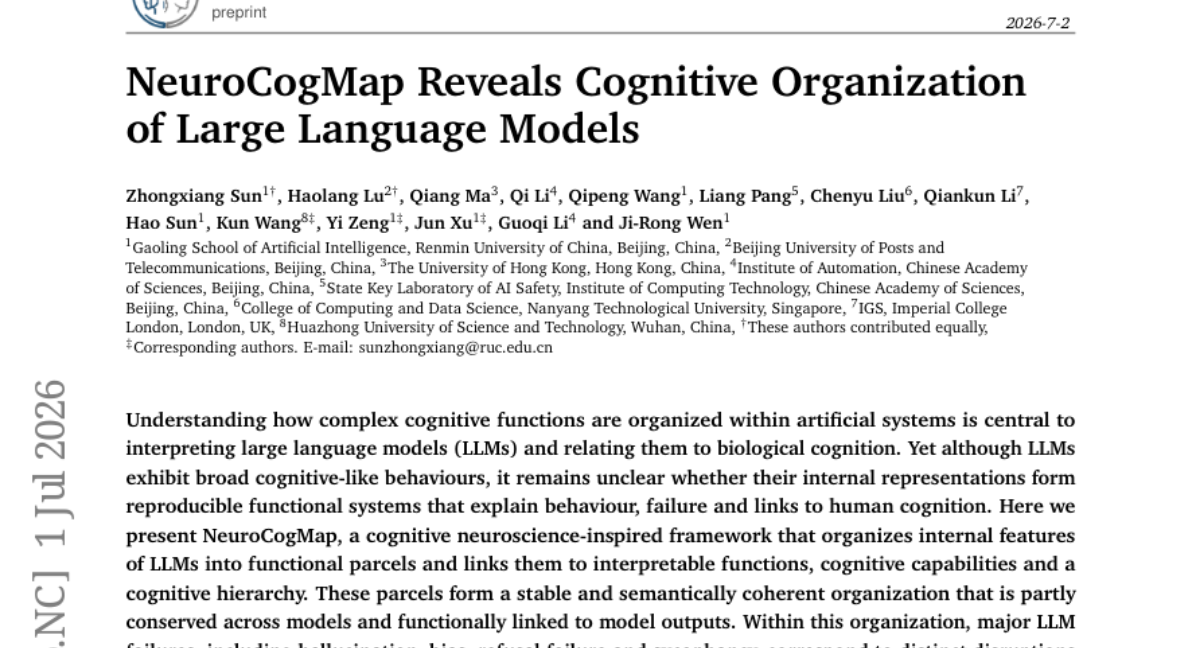
7. CtrlVTON: Controllable Virtual Try-On via Visual-Instance-Prompt Segmentation
🔑 Keywords: Virtual try-on, Visual-Instance-Prompt Segmentation, CtrlVTON, garment layout
💡 Category: Computer Vision
🌟 Research Objective:
– To enhance user control over how a garment is worn in Virtual try-on (VTO) systems by addressing garment size, style, and spatial placement.
🛠️ Research Methods:
– Developed VIP-SAM to tackle Visual-Instance-Prompt Segmentation, allowing instance-level garment segmentation on a person.
– Introduced CtrlVTON, a framework transforming VTO into an image editing process with added segmentation masks for detailed garment layout control.
💬 Research Conclusions:
– VIP-SAM and CtrlVTON achieve state-of-the-art results, with CtrlVTON generating images that accurately follow user-defined layouts while maintaining high garment fidelity.
👉 Paper link: https://huggingface.co/papers/2607.09362
8. Motion4Motion: Motion Transfer Across Subjects at Inference
🔑 Keywords: Motion Transfer, Animation, Diverse Characters, Training-Free
💡 Category: Computer Vision
🌟 Research Objective:
– The study aims to explore motion transfer between videos, focusing on diverse characters beyond human or human-like figures.
🛠️ Research Methods:
– Motion4Motion is proposed as a training-free framework, modeling motion flow rather than relying on a skeleton structure.
💬 Research Conclusions:
– The method facilitates motion transfer across species and demonstrates superior performance compared to baseline methods.
👉 Paper link: https://huggingface.co/papers/2607.11644
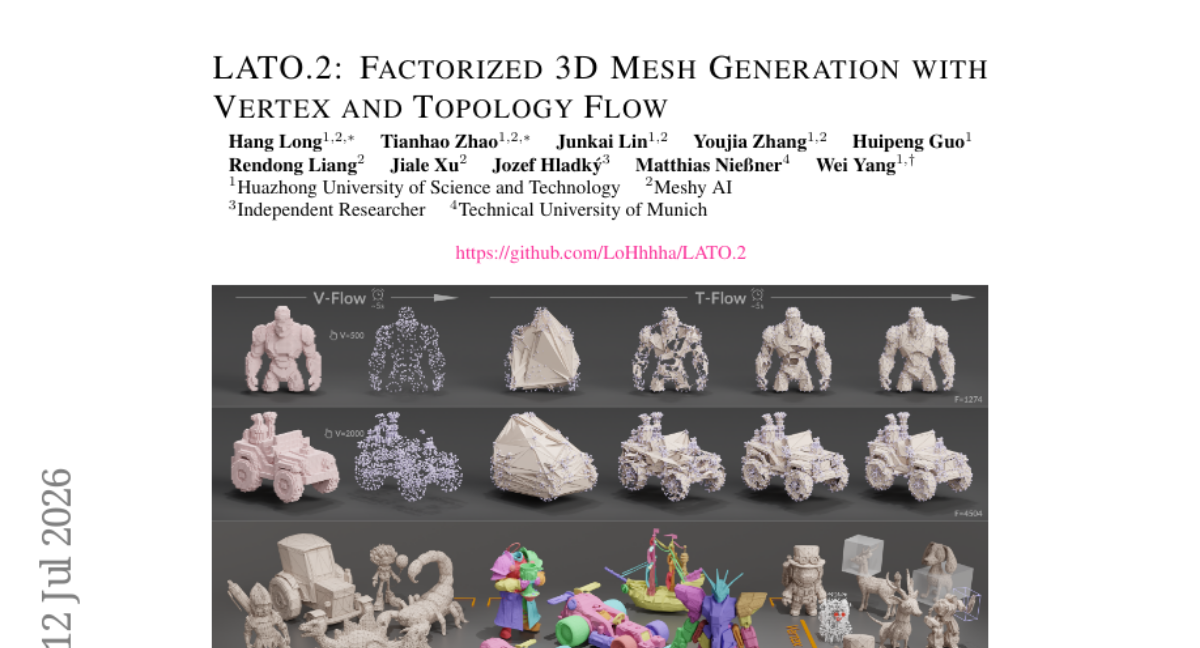
9. LATO.2: Factorized 3D Mesh Generation with Vertex and Topology Flow
🔑 Keywords: flow matching, latent representation, mesh generation, topology-aware, geometric fidelity
💡 Category: Generative Models
🌟 Research Objective:
– To develop LATO.2, a factorized flow matching framework for topology-aware mesh generation that separates vertex and connectivity flow processes.
🛠️ Research Methods:
– Utilize dedicated VAEs to underpin the two stages of mesh generation, leveraging a shared coarse voxel scaffold for enhanced precision and a continuous latent space.
💬 Research Conclusions:
– LATO.2 demonstrates superior geometric fidelity and connectivity quality compared to existing state-of-the-art methods, offering advantages such as higher-resolution meshes and topology-adaptive editing.
👉 Paper link: https://huggingface.co/papers/2607.10623
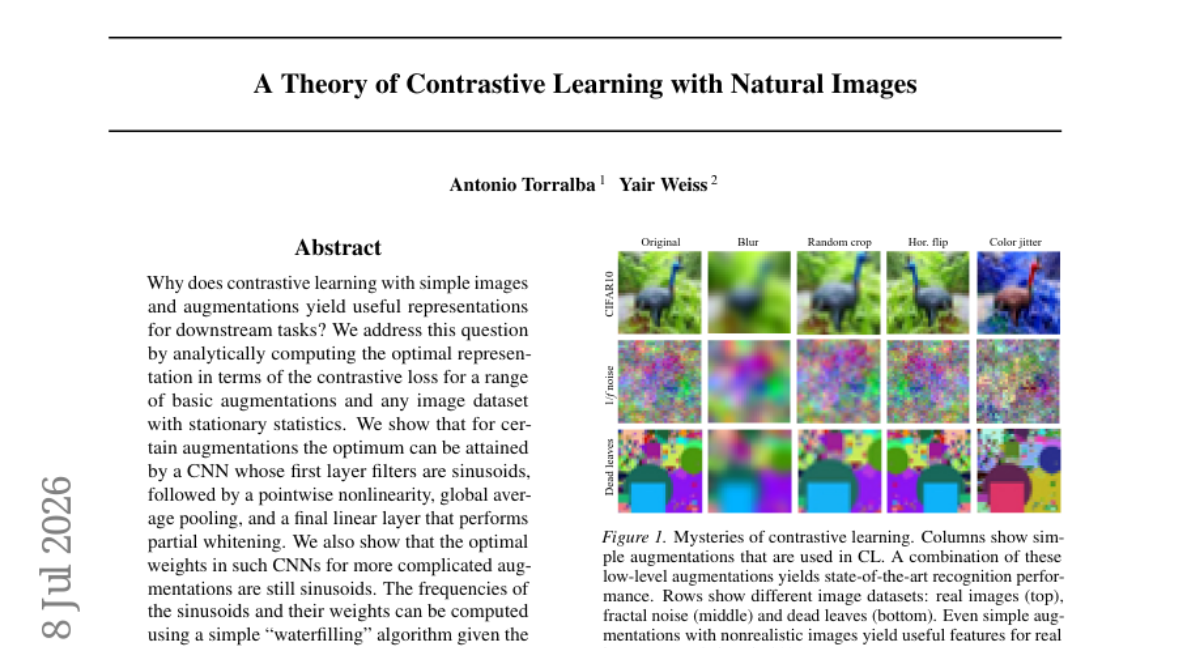
10. A Theory of Contrastive Learning with Natural Images
🔑 Keywords: Contrastive Learning, CNNs, Sinusoids, Partial Whitening, Image Datasets
💡 Category: Computer Vision
🌟 Research Objective:
– To understand why contrastive learning with simple images and augmentations produces useful representations for downstream tasks.
🛠️ Research Methods:
– Analytical computation of the optimal representation using contrastive loss for basic augmentations across image datasets.
– Identification of CNNs with sinusoidal filters and partial whitening as optimal structures.
💬 Research Conclusions:
– CNNs trained with SGD tend to learn sinusoidal patterns in the first layer and perform partial whitening empirically.
👉 Paper link: https://huggingface.co/papers/2607.07470
11.
12. Evidence-Backed Video Question Answering
🔑 Keywords: Video LLMs, Explainability, Evidence-Backed, ST-Evidence, Visual Perception
💡 Category: Computer Vision
🌟 Research Objective:
– To introduce Evidence-Backed Video Question Answering (E-VQA), a task aimed at providing semantic answers with spatio-temporal evidence to enhance explainability in video language models.
🛠️ Research Methods:
– Development of ST-Evidence, the first benchmark for pixel-level visual grounding, and the creation of a large-scale dataset, ST-Evidence-Instruct, to improve fine-grained reasoning.
💬 Research Conclusions:
– Models fine-tuned on the ST-Evidence-Instruct dataset show significant improvement in explainable video understanding, establishing a robust baseline for evidence-backed video question answering.
👉 Paper link: https://huggingface.co/papers/2607.11862

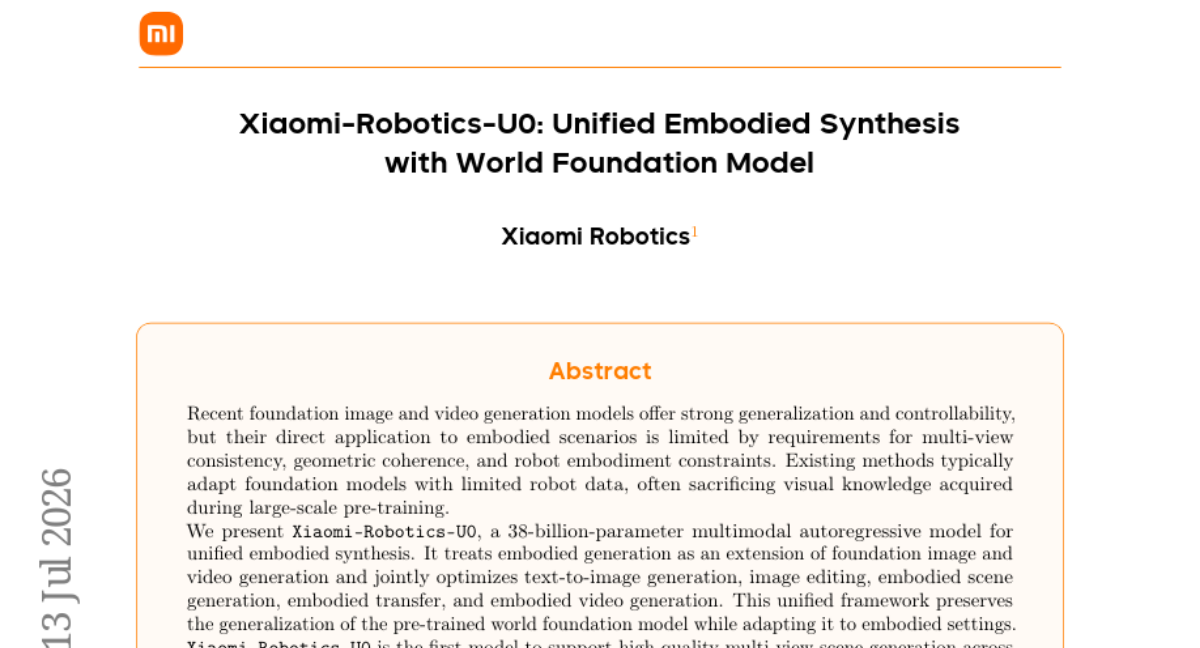
13. Xiaomi-Robotics-U0: Unified Embodied Synthesis with World Foundation Model
🔑 Keywords: multimodal autoregressive model, embodied synthesis, multi-view scene generation, structured controllable transfer, AI Native
💡 Category: Robotics and Autonomous Systems
🌟 Research Objective:
– Develop Xiaomi-Robotics-U0, a unified model for embodied synthesis that extends foundation image and video generation to meet embodiment constraints while maintaining generalization capabilities.
🛠️ Research Methods:
– Utilization of a 38-billion-parameter multimodal autoregressive model for text-to-image, image editing, embodied scene generation, transfer, and video generation tasks.
💬 Research Conclusions:
– Xiaomi-Robotics-U0 achieves state-of-the-art results in both single-step and sequential generation tasks, outperforming GPT-Image-2.0 and significantly improving performance on real-world manipulation tasks.
👉 Paper link: https://huggingface.co/papers/2607.11643
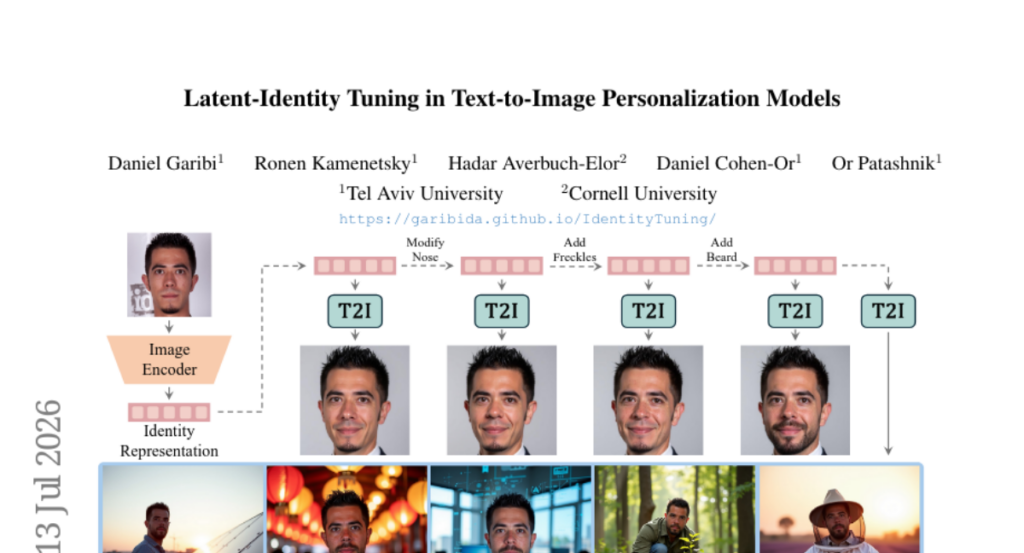
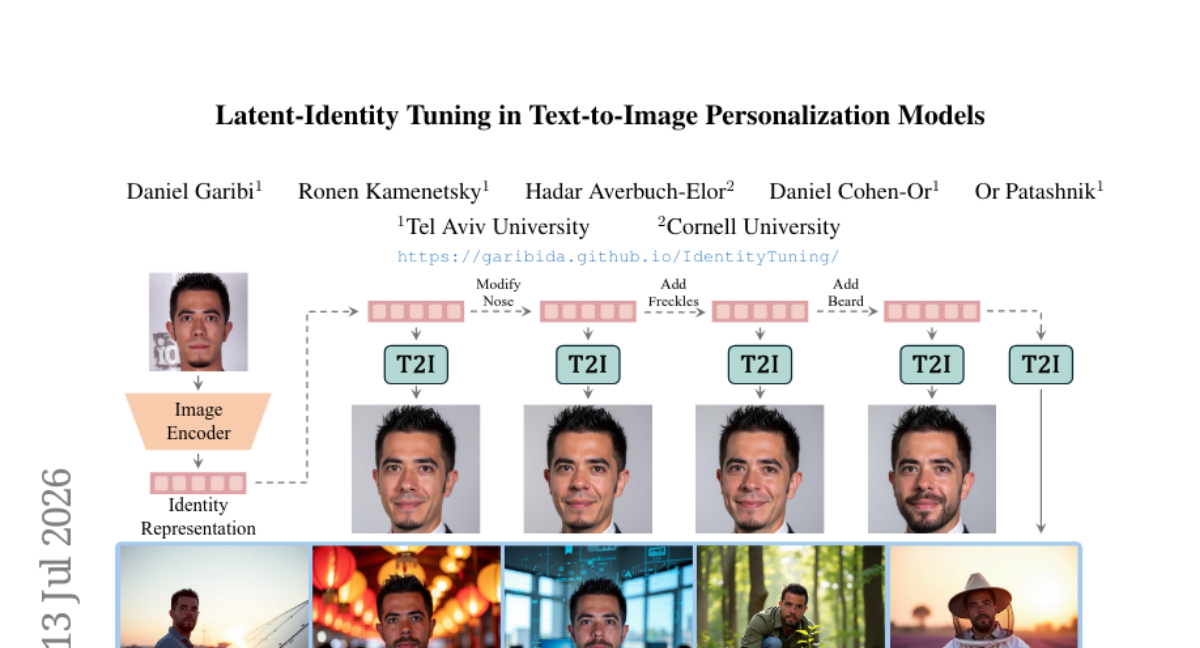
14. Latent-Identity Tuning in Text-to-Image Personalization Models
🔑 Keywords: identity tuning, fine-grained editing, text-to-image, latent space, frozen encoder
💡 Category: Computer Vision
🌟 Research Objective:
– To develop a method for fine-grained identity tuning in text-to-image personalization models that allows for precise facial edits without losing identity consistency.
🛠️ Research Methods:
– Utilize the latent space of a pre-trained, frozen encoder to explore latent semantic directions for identity tuning.
– Leverage latent tokens to capture different identity aspects and enable locally coherent edits without additional training.
💬 Research Conclusions:
– Demonstrated meaningful, localized facial edits with preserved cross-image identity consistency through qualitative and quantitative experiments.
👉 Paper link: https://huggingface.co/papers/2607.11885
15. MET: Theory-Grounded and Culture-Aware Multilingual Moral Reasoning
🔑 Keywords: multilingual moral decision-making, cultural context, MET (Multilingual Ethics with Theory-grounded reasoning), MET-D (MET-Distillation), moral theory
💡 Category: Natural Language Processing
🌟 Research Objective:
– The study aims to address gaps in multilinguality for moral decision-making in language models, specifically targeting cultural nuances and ethical reasoning.
🛠️ Research Methods:
– Development of MCLASH, a multilingual benchmark designed to capture moral intuitions across different cultures.
– Introduction of MET, a two-step theory-grounded prompting method based on psychology and philosophy, tailored for culturally specific moral reasoning.
– Implementation of MET-D, a self-distillation training method enhancing reasoning without external supervision, applicable across various models like Qwen3-4B and Gemma3-4B.
💬 Research Conclusions:
– MET-D improves macro-F1 scores significantly across tested models and languages, particularly enhancing native-language reasoning capabilities and adapting to cultural differences in moral decision-making.
👉 Paper link: https://huggingface.co/papers/2607.11736
16. Multi-Agent LLMs Fail to Explore Each Other
🔑 Keywords: Multi-Agent Exploration, LLM Agents, Structured Peer Selection, Exploration Behavior
💡 Category: Robotics and Autonomous Systems
🌟 Research Objective:
– The research aims to address the issue of exploration inefficiencies among large language model (LLM) agents in multi-agent systems by formalizing the Multi-Agent Exploration problem as a partially observable stochastic game (POSG).
🛠️ Research Methods:
– Researchers introduce Multi-Agent Contextual Exploration (MACE), a framework designed to improve exploration through structured peer selection and test its performance in diverse settings.
💬 Research Conclusions:
– The study reveals that current LLM agents exhibit myopic and polarized interaction patterns, emphasizing the need for explicitly guided exploration to ensure reliable multi-agent autonomy. MACE significantly enhances exploration behavior and task performance.
👉 Paper link: https://huggingface.co/papers/2607.11250
17. EgoSteer: A Full-Stack System Towards Steerable Dexterous Manipulation from Egocentric Videos
🔑 Keywords: Steerability, EgoSmith, EgoSteer, Pre-training, Dexterous-hand systems
💡 Category: Robotics and Autonomous Systems
🌟 Research Objective:
– To develop a full-stack system that enhances dexterous VLA pre-training using egocentric human videos and enables efficient real-robot post-training.
🛠️ Research Methods:
– Implementation of EgoSmith, a data pipeline curating 9.6K hours of egocentric videos as high-quality pre-training data.
– Integration of a unified robot stack for teleoperation and human-in-the-loop correction, utilizing EgoSteer, a model trained on optimized infrastructure.
💬 Research Conclusions:
– EgoSteer executes diverse tasks with failure recovery, dexterity, and generalization, adapting to complex tasks with over 75% success on two embodiments.
– The entire system, data, and model are open-sourced for further research and development.
👉 Paper link: https://huggingface.co/papers/2607.09701
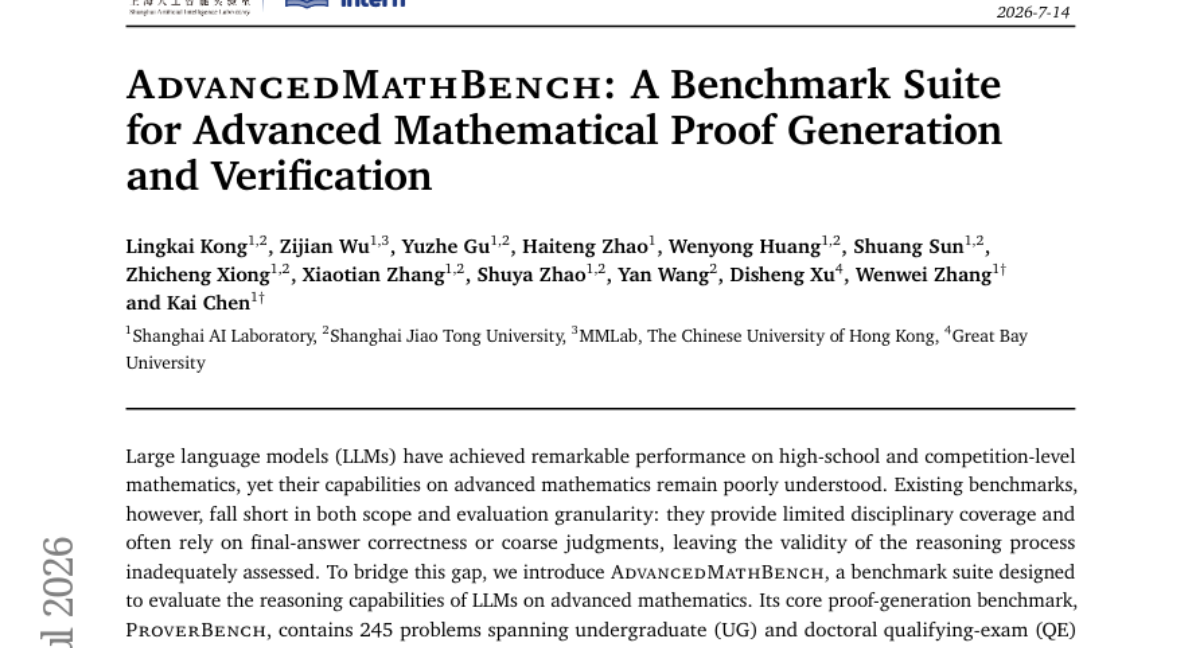
18. AdvancedMathBench: A Benchmark Suite for Advanced Mathematical Proof Generation and Verification
🔑 Keywords: Large language models, Advanced mathematics, Benchmark, Proof verification
💡 Category: Knowledge Representation and Reasoning
🌟 Research Objective:
– The study aims to evaluate and enhance the understanding of large language models’ capabilities in advanced mathematical reasoning through a new benchmark suite called AdvancedMathBench.
🛠️ Research Methods:
– The researchers developed ProverBench with 296 problems and an automatic verification pipeline for assessing proof generation.
– They introduced VerifierBench to evaluate model-generated proof validity using expert annotations.
💬 Research Conclusions:
– The experiments reveal that current models like GPT-5.5-xhigh show room for improvement, with low performance scores on proof generation and verification, indicating difficulties in advanced mathematical proof construction and error detection.
👉 Paper link: https://huggingface.co/papers/2607.11849
19. 4D Human-Scene Reconstruction from Low-Overlap Captures
🔑 Keywords: 4D reconstruction, video diffusion model, StudioRecon, novel view synthesis, motion-adaptive consistency
💡 Category: Computer Vision
🌟 Research Objective:
– The paper aims to address the limitations of existing 4D human scene reconstructions in low-overlap camera settings by proposing a novel approach called StudioRecon.
🛠️ Research Methods:
– StudioRecon employs a pipeline that decouples background and humans, utilizing a video diffusion model to synthesize novel views and robustly initializes deformable human models through identity association and triangulation.
💬 Research Conclusions:
– The study achieves state-of-the-art performance in novel view synthesis across four real-world datasets, highlighting its effectiveness in applications like novel trajectory rendering and human replacement.
👉 Paper link: https://huggingface.co/papers/2607.09125
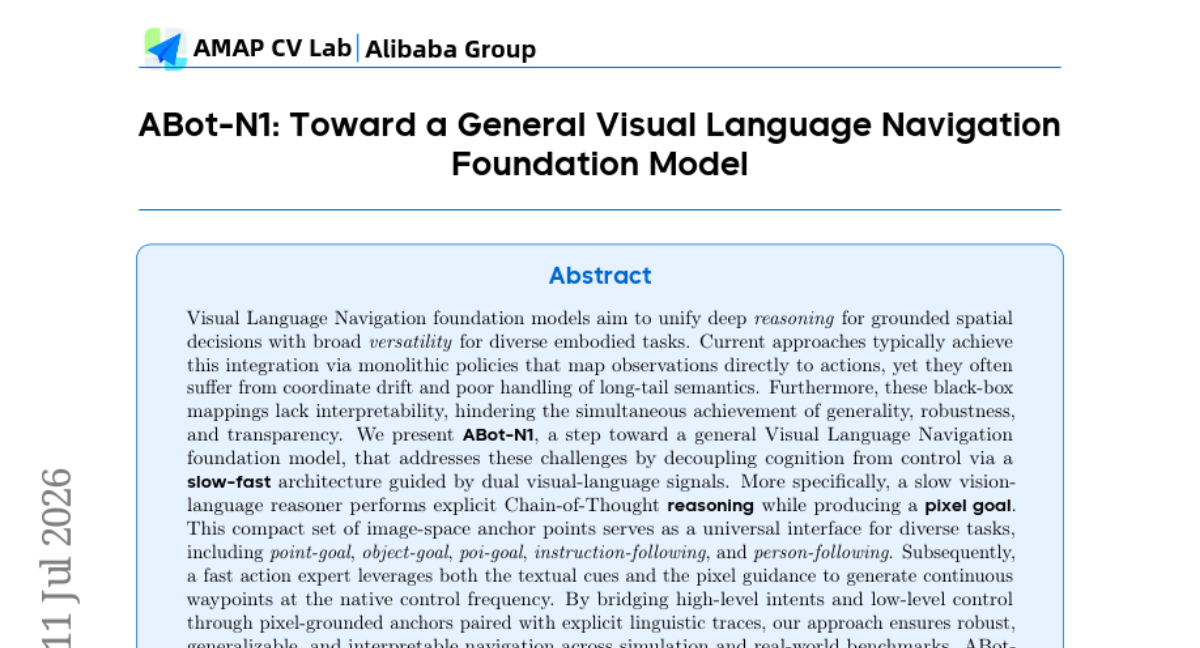
20. ABot-N1: Toward a General Visual Language Navigation Foundation Model
🔑 Keywords: Visual Language Navigation, ABot-N1, Chain-of-Thought, slow-fast architecture, urban-scale navigation
💡 Category: Robotics and Autonomous Systems
🌟 Research Objective:
– To develop a robust, generalizable, and interpretable Visual Language Navigation model that effectively handles diverse embodied tasks and overcomes current challenges such as coordinate drift and lack of interpretability.
🛠️ Research Methods:
– Utilization of a slow-fast architecture that separates cognition from control, employing dual visual-language signals to perform Chain-of-Thought reasoning and creating a universal interface through pixel goals.
💬 Research Conclusions:
– ABot-N1 establishes new state-of-the-art performance in urban-scale navigation, substantially improving Point-of-Interest (POI) arrival rates and achieving high success rates in complex environments. It also demonstrates superior robustness in additional navigation tasks such as object-reaching and instruction-following.
👉 Paper link: https://huggingface.co/papers/2607.10383