AI Native Daily Paper Digest – 20260715 – Video Foundation Models | Long-Context Attention
Today’s digest highlights key developments involving well-known models like GPT and Claude. The overarching theme focuses on advancements in multimodal reasoning, showing impressive progress across several benchmarks. Notably, one study demonstrates a significant increase in accuracy on the CLEVR dataset, achieving a remarkable 97% compared to previous iterations. Another paper highlights an improved attention mechanism that reduces computational complexity by 30%. Researchers also provide new insights into optimizing transformer architecture for more efficient real-time language processing.
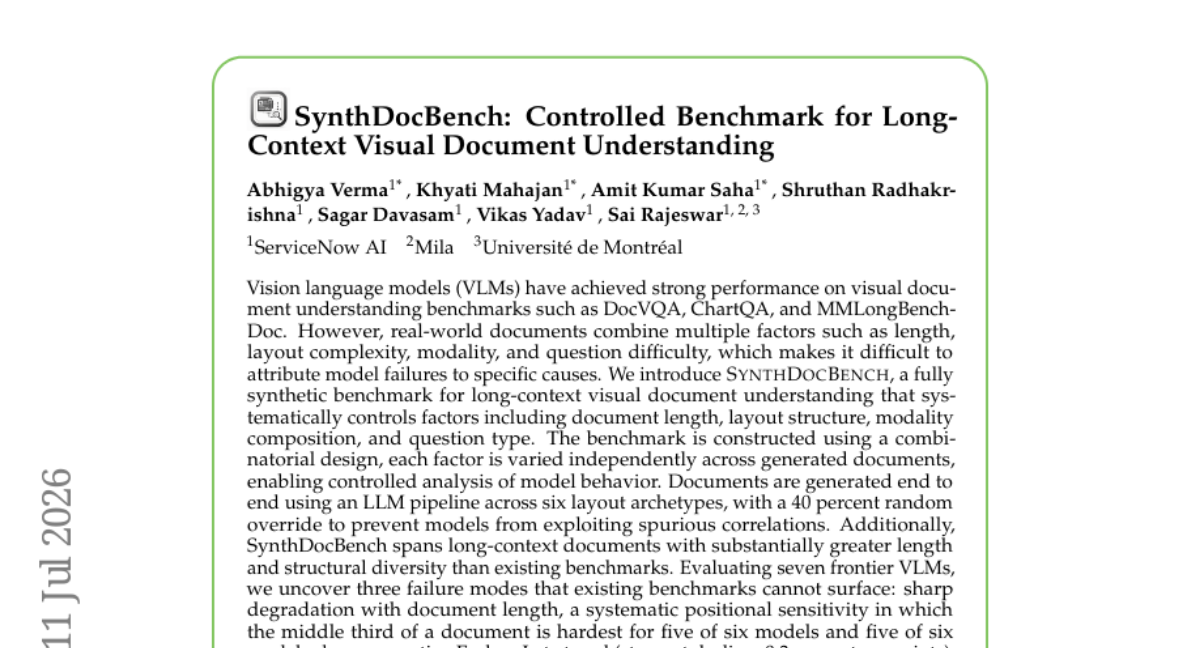
1. SynthDocBench: Controlled Benchmark for Long-Context Visual Document Understanding
🔑 Keywords: Vision Language Models, SynthDocBench, Long-Context Understanding
💡 Category: Multi-Modal Learning
🌟 Research Objective:
– The study introduces SynthDocBench, a synthetic benchmark designed to control and analyze factors such as document length, layout, and modality to better understand vision language model performance in long-context visual document understanding.
🛠️ Research Methods:
– A combinatorial design approach is used to construct the benchmark, varying factors independently across generated documents, facilitated by an LLM pipeline covering six layout archetypes.
💬 Research Conclusions:
– The evaluation of seven frontier VLMs reveals three failure modes: degradation with increased document length, positional sensitivity especially in the middle sections of documents, and issues with chart comprehension in long-document settings, suggesting current models may be overfitting rather than achieving robust understanding.
👉 Paper link: https://huggingface.co/papers/2607.10400
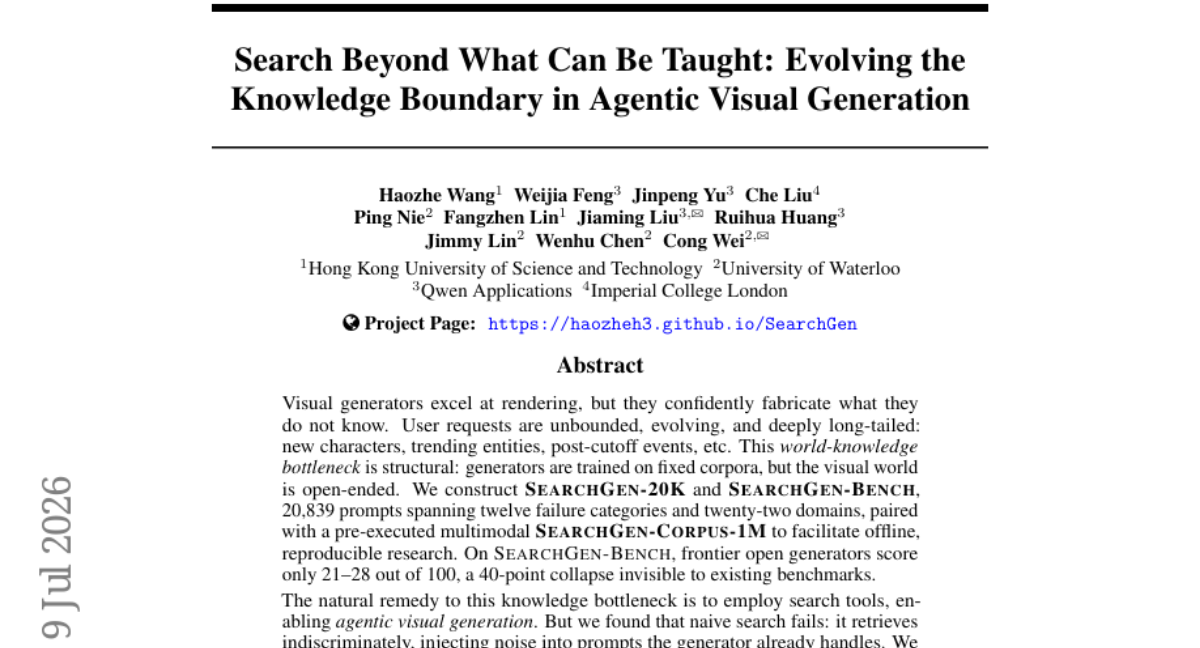
2. Search Beyond What Can Be Taught: Evolving the Knowledge Boundary in Agentic Visual Generation
🔑 Keywords: Visual Generators, Knowledge Boundary, SearchGen-Corpus, Multimodal, World-Knowledge-Grounded
💡 Category: Generative Models
🌟 Research Objective:
– The research aims to address the world-knowledge bottleneck in visual generators by constructing datasets and tools to improve agentic visual generation through a teach-then-search co-training framework.
🛠️ Research Methods:
– The authors developed SearchGen-20K and SearchGen-Bench datasets with 20,839 prompts and a multimodal SearchGen-Corpus-1M to facilitate reproducible research in overcoming visual generator limitations. They introduced a teach-then-search co-training framework to identify and address the generator-specific knowledge boundary.
💬 Research Conclusions:
– The study concludes that the naive search approach fails due to indiscriminate retrieval of information, introducing noise. However, the teach-then-search co-training framework shows promise for continuous improvement, allowing visual generators to meet world-knowledge-grounded requests more effectively.
👉 Paper link: https://huggingface.co/papers/2607.05382
3. Function-Aware Fill-in-the-Middle as Mid-Training for Coding Agent Foundation Models
🔑 Keywords: coding agents, function-aware fill-in-the-middle, mid-training, Qwen2.5-Coder-Instruct, post-training pipelines
💡 Category: AI Systems and Tools
🌟 Research Objective:
– The paper aims to enhance coding agents’ ability to integrate external tool returns into ongoing reasoning using a novel mid-training approach termed function-aware fill-in-the-middle (FIM).
🛠️ Research Methods:
– Researchers employed a self-supervised mid-training process on coding models (Qwen2.5-Coder-Instruct and Qwen3-8B) using a decontaminated corpus from GitHub repositories, leveraging program dependency graph analysis for function selection.
💬 Research Conclusions:
– The mid-training method led to significant performance improvements across various evaluations, overcoming capability erosion in specific tasks and maintaining gains through post-training pipelines, even in non-coding benchmarks.
👉 Paper link: https://huggingface.co/papers/2607.12463
4. MuScriptor: An Open Model for Multi-Instrument Music Transcription
🔑 Keywords: Automatic Music Transcription, Multi-Instrument, Synthetic Data, Reinforcement Learning, MuScriptor
💡 Category: Machine Learning
🌟 Research Objective:
– To improve automatic music transcription in multi-instrument, real-world settings by leveraging synthetic data with fine-tuning and reinforcement learning.
🛠️ Research Methods:
– Analysis of synthetic data’s effectiveness for pre-training models, incorporation of fine-tuning on real audio, use of reinforcement learning, and instrument presence conditioning.
💬 Research Conclusions:
– Introduction of MuScriptor, a robust multi-instrument transcription model capable of handling diverse genres and real-world recordings effectively.
👉 Paper link: https://huggingface.co/papers/2607.08168
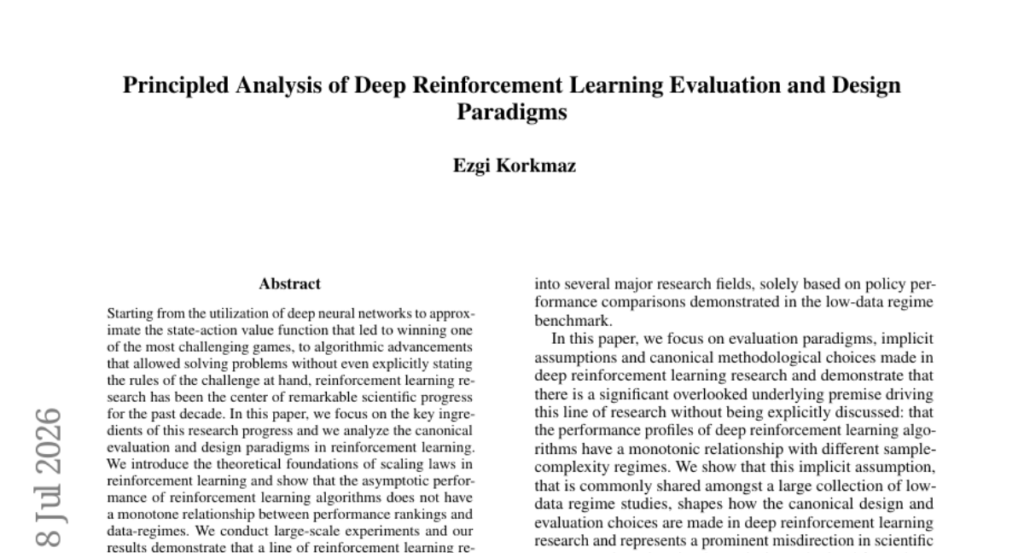
5. Principled Analysis of Deep Reinforcement Learning Evaluation and Design Paradigms
🔑 Keywords: Reinforcement Learning, Scaling Laws, Deep Neural Networks, Performance Rankings, Data-Regimes
💡 Category: Reinforcement Learning
🌟 Research Objective:
– The paper aims to analyze the canonical evaluation and design paradigms in reinforcement learning, examining key components of recent advancements.
🛠️ Research Methods:
– Introduction of theoretical foundations relating to scaling laws in reinforcement learning, accompanied by large-scale experiments to assess performance relationships.
💬 Research Conclusions:
– The study reveals that, under traditional paradigms, reinforcement learning research has led to some incorrect conclusions about performance rankings and data-regimes, providing a thorough analysis of scaling, capacity, and complexity in the field.
👉 Paper link: https://huggingface.co/papers/2607.07769
6. Towards Autonomous and Auditable Medical Imaging Model Development
🔑 Keywords: LLM, MLE, AMID, Verification-Guided Two-Stage Optimization
💡 Category: AI in Healthcare
🌟 Research Objective:
– To automate machine learning engineering in medical imaging via the development of an autonomous multi-agent framework called AMID.
🛠️ Research Methods:
– Implemented Data-Conditioned Method Planning and Verification-Guided Two-Stage Optimization to refine and optimize the model development process for various medical imaging tasks.
💬 Research Conclusions:
– AMID outperformed general-purpose MLE systems and achieved results on par with strong human-designed solutions across 20 diverse medical imaging challenge tasks, highlighting its potential to transform task-specific model development into an efficient agentic workflow.
👉 Paper link: https://huggingface.co/papers/2607.10522

7.
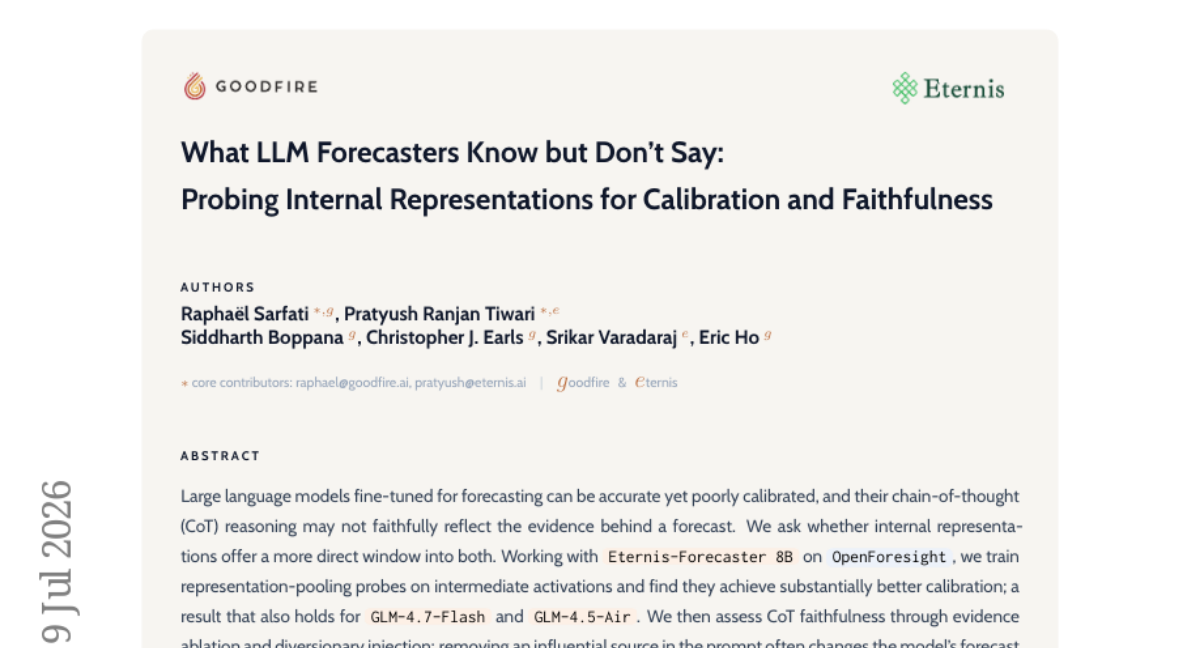
8. What LLM Forecasters Know but Don’t Say: Probing Internal Representations for Calibration and Faithfulness
🔑 Keywords: Large Language Models, Calibration, Chain-of-Thought, Probing, Forecasting
💡 Category: Natural Language Processing
🌟 Research Objective:
– Investigate the effectiveness of internal representations in improving the calibration and faithfulness of forecasts in large language models like Eternis-Forecaster 8B and others.
🛠️ Research Methods:
– Utilized representation-pooling probes trained on intermediate activations to improve calibration.
– Assessed Chain-of-Thought (CoT) faithfulness through evidence ablation and diversionary injection, and observed behavioral shifts.
💬 Research Conclusions:
– Internal representations provide better calibration and act as accurate lie detectors, improving tracking and prediction of behavioral shifts.
– Forecasts are largely determined before reasoning starts, optimizing token generation without accuracy loss, indicating internal probing as a practical tool for language model evaluation.
👉 Paper link: https://huggingface.co/papers/2607.08046
9. Let RGB Be the Language of Vision
🔑 Keywords: RGB In and RGB Out (RINO), unified vision-language systems, structured visual signals, zero-shot performance
💡 Category: Computer Vision
🌟 Research Objective:
– This research introduces a unified formulation for vision models, termed as RGB In and RGB Out (RINO), to handle diverse visual information as RGB images and convert visual tasks into a common RGB-to-RGB image editing problem.
🛠️ Research Methods:
– The study utilizes a generic image editing backbone without task-specific fine-tuning, allowing diverse visual tasks to share encoding and decoding architecture, similar to text operation in language models.
💬 Research Conclusions:
– RINO displays robust zero-shot performance in both dense understanding tasks like segmentation and dense-conditioned generation tasks like pose-to-image generation, advancing towards creating general unified vision-language systems.
👉 Paper link: https://huggingface.co/papers/2607.12450

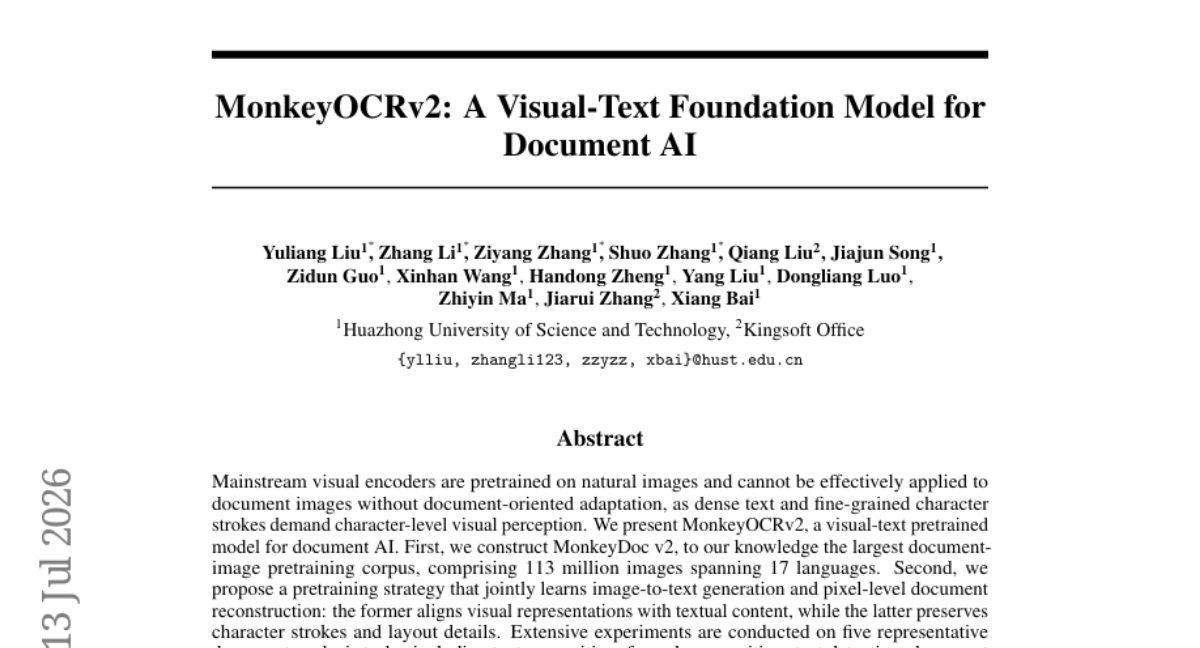
10. MonkeyOCRv2: A Visual-Text Foundation Model for Document AI
🔑 Keywords: MonkeyOCRv2, document AI, document parsing, visual-text pretraining, document understanding
💡 Category: Computer Vision
🌟 Research Objective:
– The objective was to develop MonkeyOCRv2, a visual-text pretrained model tailored for document AI tasks, addressing the limitations of mainstream visual encoders on document images.
🛠️ Research Methods:
– Introduced a novel pretraining strategy combining image-to-text generation with pixel-level document reconstruction, and created a substantial pretraining corpus called MonkeyDoc v2 with 113 million images across 17 languages.
💬 Research Conclusions:
– MonkeyOCRv2 significantly improved performance in document analysis tasks and achieved state-of-the-art results in document parsing and understanding as part of a multimodal large language model, outperforming previous models in various benchmarks.
👉 Paper link: https://huggingface.co/papers/2607.11562
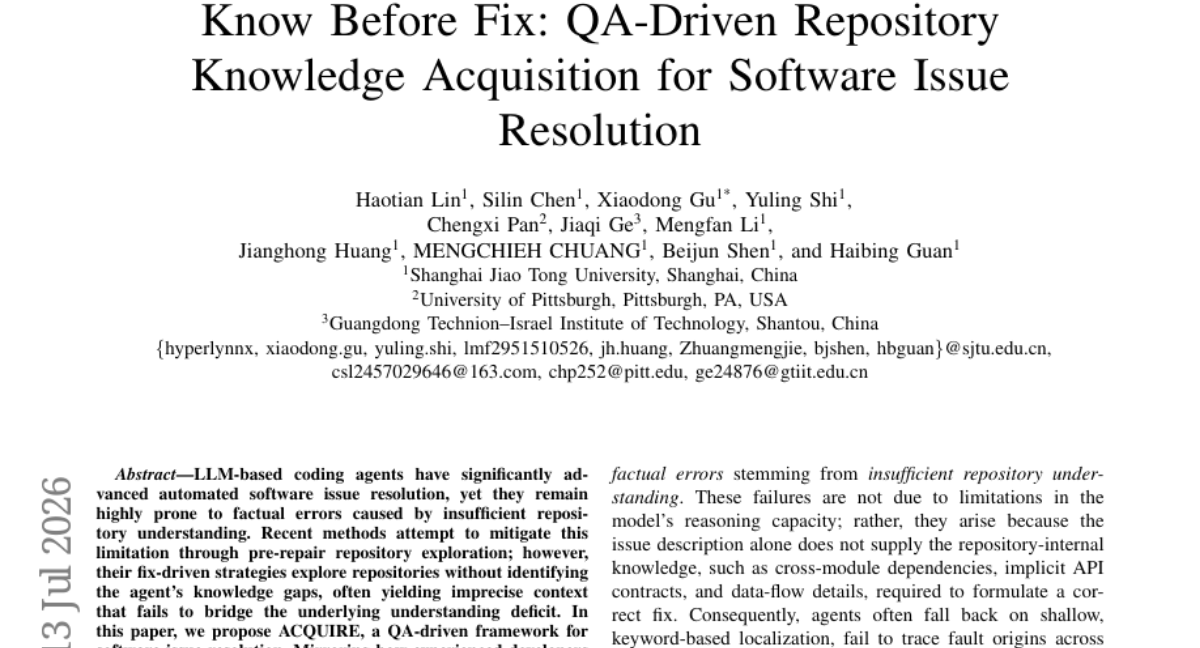
11. Know Before Fix: QA-Driven Repository Knowledge Acquisition for Software Issue Resolution
🔑 Keywords: LLM-based coding agents, ACQUIRE, software issue resolution, repository knowledge, QA-driven framework
💡 Category: AI Systems and Tools
🌟 Research Objective:
– To improve automated software issue resolution by addressing limitations in current methods’ understanding of repository knowledge.
🛠️ Research Methods:
– Introduced ACQUIRE, a QA-driven framework that separates knowledge acquisition from patch generation using two stages: a Questioner and an Answerer stage for structured repository knowledge acquisition, followed by a Resolver stage for generating informed patches.
💬 Research Conclusions:
– ACQUIRE enhances the accuracy and efficiency of software issue resolution by reliably converting implicit knowledge gaps into explicit understanding, outperforming existing pre-repair methods in experiments with increased Pass@1 by up to 4.4 percentage points.
👉 Paper link: https://huggingface.co/papers/2607.11111
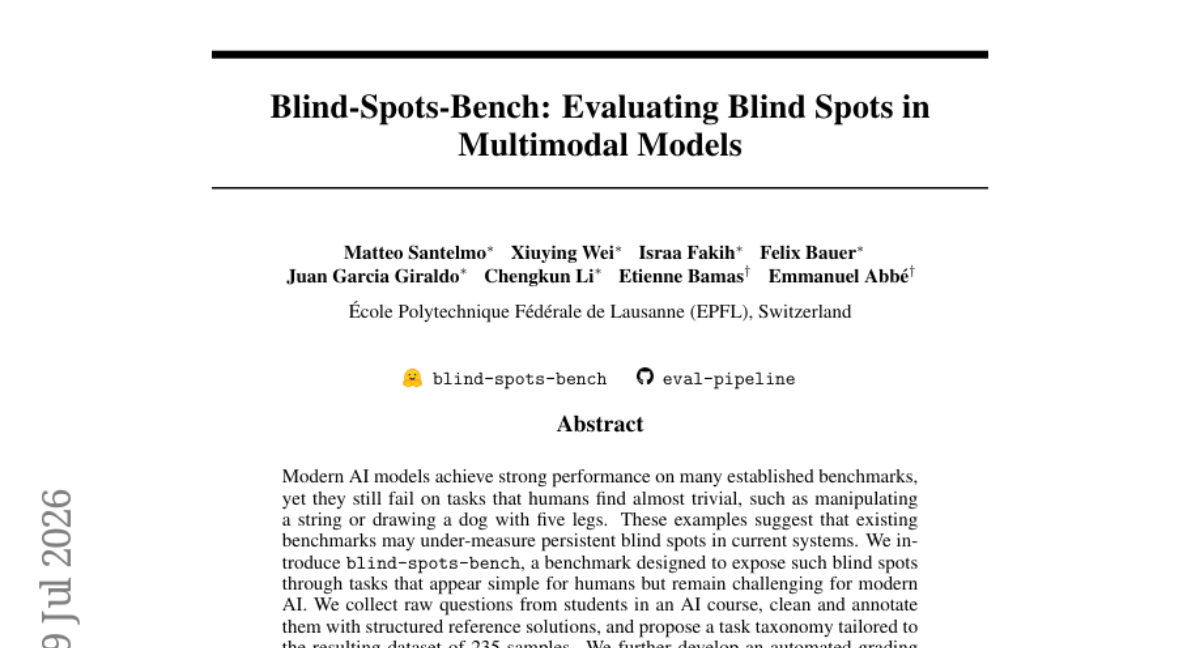
12. Blind-Spots-Bench: Evaluating Blind Spots in Multimodal Models
🔑 Keywords: AI Models, Benchmarks, Blind Spots, Automated Grading, Task Taxonomy
💡 Category: AI Systems and Tools
🌟 Research Objective:
– To address blind spots in modern AI models by introducing blind-spots-bench, a specific benchmark for tasks simple to humans yet challenging for AI.
🛠️ Research Methods:
– Compilation of questions from AI course students and annotation with structured solutions.
– Development of task taxonomy and automated grading pipeline for the dataset.
– Evaluation of open-weight and closed-source models across language, vision-language, and image-generation tasks.
💬 Research Conclusions:
– Closed-source models can outperform open-weight models by approximately 10%, indicating potential gaps in current benchmarks.
– No single model excels across all task types; some tasks remain difficult for all models.
– blind-spots-bench serves as an effective diagnostic tool for identifying weaknesses in modern AI systems.
👉 Paper link: https://huggingface.co/papers/2607.08317
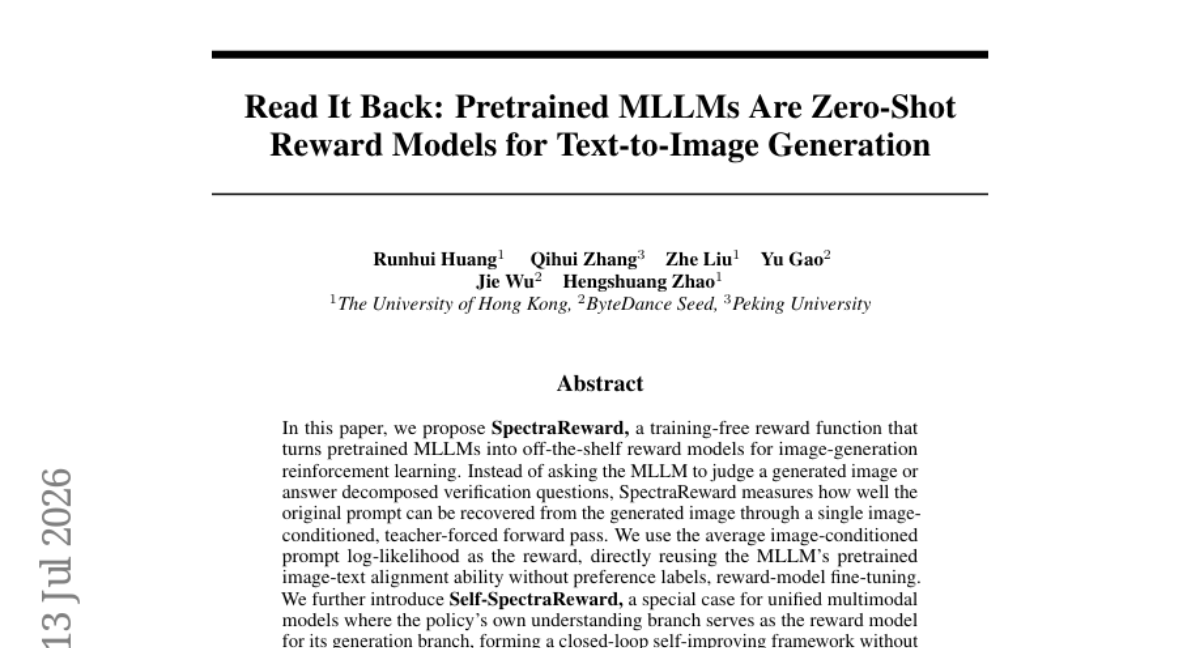
13. Read It Back: Pretrained MLLMs Are Zero-Shot Reward Models for Text-to-Image Generation
🔑 Keywords: SpectraReward, Reinforcement Learning, Image Generation, MLLM, Multimodal Models
💡 Category: Multi-Modal Learning
🌟 Research Objective:
– To introduce SpectraReward, a training-free reward function for transforming pretrained MLLMs into effective reward models for image-generation reinforcement learning tasks.
🛠️ Research Methods:
– Implement SpectraReward by measuring how well an original prompt can be recovered from a generated image using a single image-conditioned, teacher-forced forward pass. Introduce Self-SpectraReward for unified multimodal models.
💬 Research Conclusions:
– SpectraReward and Self-SpectraReward significantly improve image-generation performance, outperforming traditional MLLM-derived reward training methods. The analysis indicates that reward-policy alignment is crucial for effective reinforcement learning in image generation.
👉 Paper link: https://huggingface.co/papers/2607.11886