AI Native Daily Paper Digest – 20260717 – Qwen | Claude | DeepSeek-V3
Today’s digest highlights intriguing breakthroughs from notable models like DeepSeek and Llama, exploring new dimensions of multimodal reasoning and long-context attention. The papers delve into advanced methods, such as cross-modal transformers and recursive neural architectures, achieving state-of-the-art results on ImageNet and COCO datasets. One notable study presents a novel training protocol that reduces computational overhead by 30% while maintaining high accuracy. Another compelling finding demonstrates a 20% improvement in context-window management, which significantly enhances performance in real-world applications.
1. VideoChat3: Fully Open Video MLLM for Efficient and Generalist Video Understanding
🔑 Keywords: Video Understanding, Open-source Models, VideoChat3, Efficiency, Scalability
💡 Category: Computer Vision
🌟 Research Objective:
– The paper introduces VideoChat3, a fully open, efficient, and generalist video-centric MLLM to address limitations in current open-source video understanding models.
🛠️ Research Methods:
– Utilizes Inflated 3D Vision Transformer (I3D-ViT) and Adaptive Frame Resolution for Streaming Video Perception to improve efficiency and spatiotemporal representation.
– Develops a scalable video data synthesis pipeline to create diverse training datasets enhancing generalization across domains.
💬 Research Conclusions:
– VideoChat3 achieves a balance between broad generalization and computational efficiency, surpassing prior open-source models with higher parameter efficiency.
👉 Paper link: https://huggingface.co/papers/2607.14935
2. SearchOS-V1: Towards Robust Open-Domain Information-Seeking Agent Collaboration
🔑 Keywords: Tool-Integrated Large Language Models, SearchOS, Multi-Agent Framework, Search-Oriented Context Management, Information-seeking Agents
💡 Category: Natural Language Processing
🌟 Research Objective:
– To address the inefficiencies in current information-seeking agents caused by repetitive search loops and task progress tracking difficulties. The study aims to enhance the effectiveness and completeness of web search through the development of the SearchOS framework.
🛠️ Research Methods:
– The implementation of a system-level multi-agent framework called SearchOS that reformulates open-domain information seeking into a relational schema completion task with grounded citations. Key components include Search-Oriented Context Management and a Search Tool Middleware Harness to optimize agent execution and manage search tasks effectively.
💬 Research Conclusions:
– SearchOS surpasses current single- and multi-agent baselines in search performance metrics on datasets like WideSearch and GISA, demonstrating the potential for improved robustness and collaboration in information-seeking tasks.
👉 Paper link: https://huggingface.co/papers/2607.15257
3. BadWAM: When World-Action Models Dream Right but Act Wrong
🔑 Keywords: World-action models, Adversarial attacks, Embodied control, Action generation, AI Technology
💡 Category: Robotics and Autonomous Systems
🌟 Research Objective:
– To explore the vulnerability of World-action models and introduce a new framework for adversarial attacks called BadWAM, which evaluates and models the effects of visual perturbations on these models.
🛠️ Research Methods:
– Introducing BadWAM to evaluate World-Action Drift Attacks through perceived attack strength and stealthiness, employing both action-only and imagination-preserving attack strategies.
💬 Research Conclusions:
– The study demonstrates that the vulnerability of World-action models to specific adversarial attacks can significantly lower task success rates, exposing weaknesses in their perceived robustness and interpretability.
👉 Paper link: https://huggingface.co/papers/2607.15207
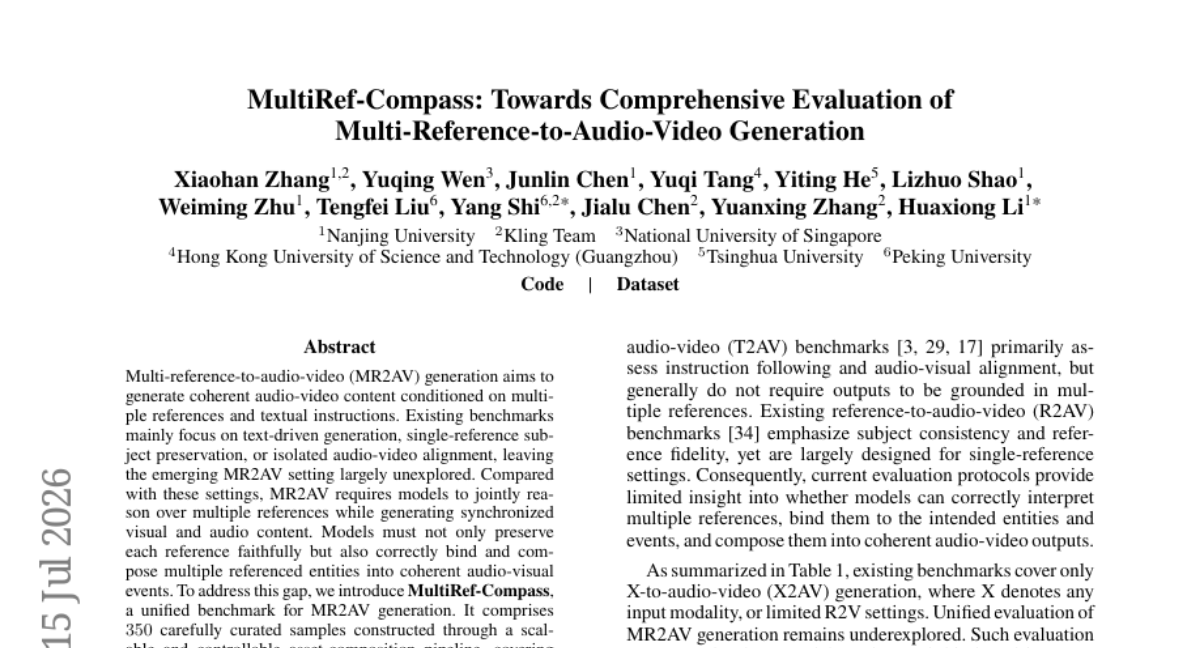
4. MultiRef-Compass: Towards Comprehensive Evaluation of Multi-Reference-to-Audio-Video Generation
🔑 Keywords: Multi-reference-to-audio-video (MR2AV), MultiRef-Compass, Audio-Visual Consistency, Reference Consistency, Generative Models
💡 Category: Generative Models
🌟 Research Objective:
– The objective is to explore and establish a benchmark for Multi-reference-to-audio-video (MR2AV) generation that synthesizes coherent audio-video content from multiple references and textual instructions.
🛠️ Research Methods:
– The study introduces MultiRef-Compass, a comprehensive benchmark containing 350 curated samples for MR2AV generation, and defines an evaluation protocol with four dimensions using 14 sub-metrics.
💬 Research Conclusions:
– Extensive experiments on eight representative MR2AV systems reveal significant areas for improvement, positioning MultiRef-Compass as a foundational tool for future MR2AV research.
👉 Paper link: https://huggingface.co/papers/2607.14189
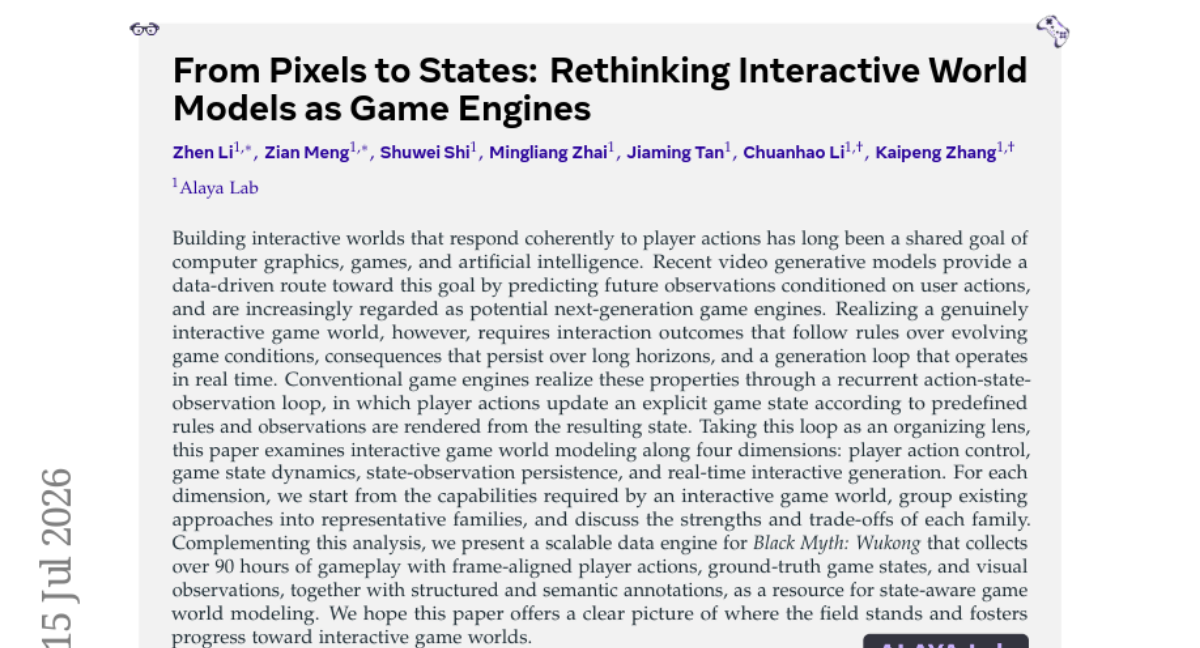
5. From Pixels to States: Rethinking Interactive World Models as Game Engines
🔑 Keywords: Interactive game worlds, Video generative models, Real-time generation, Game state dynamics, Scalable data engine
💡 Category: Generative Models
🌟 Research Objective:
– To examine interactive game world modeling focusing on player action control, game state dynamics, state-observation persistence, and real-time interactive generation.
🛠️ Research Methods:
– Organizing existing approaches into representative families and analyzing their strengths and trade-offs.
– Developing a scalable data engine for Black Myth: Wukong collecting comprehensive gameplay data with annotations.
💬 Research Conclusions:
– The paper provides a clear perspective on current progress and challenges, offering insights that could drive future advancements toward truly interactive game worlds.
👉 Paper link: https://huggingface.co/papers/2607.14076
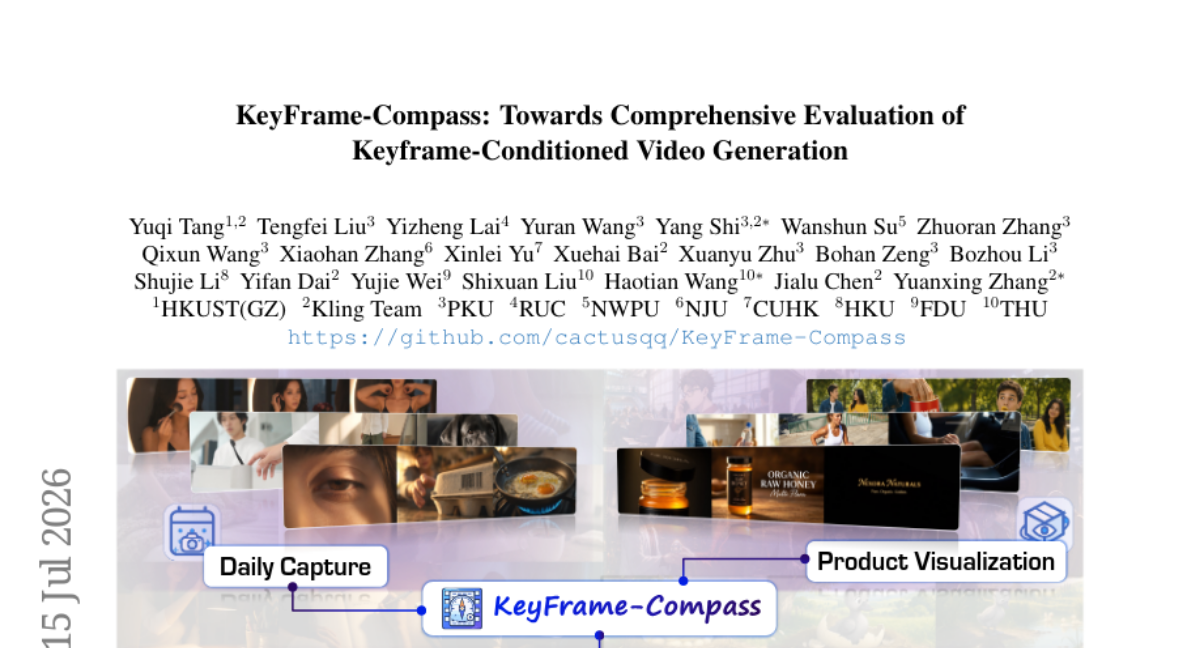
6. KeyFrame-Compass: Towards Comprehensive Evaluation of Keyframe-Conditioned Video Generation
🔑 Keywords: KeyFrame-Compass, Keyframe-conditioned video generation, Automated evaluation, Video quality
💡 Category: Generative Models
🌟 Research Objective:
– To introduce KeyFrame-Compass, a comprehensive benchmark designed to evaluate keyframe-conditioned video generation.
🛠️ Research Methods:
– Development of a benchmark with 386 samples across diverse settings and an automated evaluation framework using six metrics and MLLM judgments.
💬 Research Conclusions:
– Current video generation models show a trade-off between executing keyframes faithfully and maintaining video quality, with performance declining as keyframe constraints increase.
👉 Paper link: https://huggingface.co/papers/2607.14202
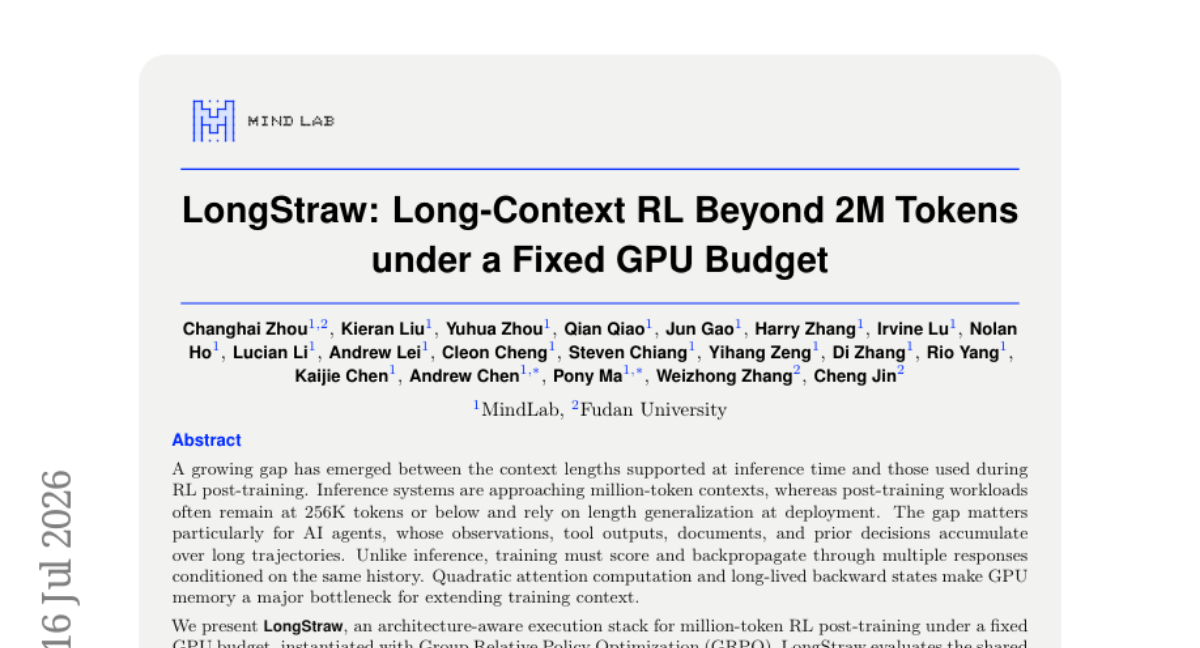
7. LongStraw: Long-Context RL Beyond 2M Tokens under a Fixed GPU Budget
🔑 Keywords: AI agents, LongStraw, Group Relative Policy Optimization, Qwen3.6-27B, GLM-5.2
💡 Category: Reinforcement Learning
🌟 Research Objective:
– Address the gap in inference context lengths between million-token contexts and shorter RL post-training workloads using LongStraw.
🛠️ Research Methods:
– Implementation of the LongStraw execution stack with Group Relative Policy Optimization for RL post-training.
– Use of hybrid recurrent and full-attention for Qwen3.6-27B and mixture-of-experts GLM-5.2 neural architectures.
💬 Research Conclusions:
– Successfully demonstrated an execution capacity on 8 and 32 H20 GPUs, supporting grouped scoring and response backward for extensive token contexts.
– Highlighted the increased scalability with minimal memory costs, confirming the potential of LongStraw for improving long trajectory processing in AI agents.
👉 Paper link: https://huggingface.co/papers/2607.14952
8. SEED: Self-Evolving On-Policy Distillation for Agentic Reinforcement Learning
🔑 Keywords: Large language models, Outcome-based reinforcement learning, SEED, Hindsight skills, Sample efficiency
💡 Category: Reinforcement Learning
🌟 Research Objective:
– To address the supervision gap in outcome-based reinforcement learning by proposing SEED, a framework that enhances policy learning with hindsight skills.
🛠️ Research Methods:
– SEED leverages self-evolving on-policy distillation by analyzing completed trajectories and extracting reusable natural-language skills during reinforcement learning.
💬 Research Conclusions:
– SEED improves performance and sample efficiency in text-based and vision-based tasks, demonstrating robust generalization to new scenarios.
👉 Paper link: https://huggingface.co/papers/2607.14777