AI Native Daily Paper Digest – 20260727 – Qwen | DeepSeek-V3
Today’s digest highlights contributions from industry leaders like GPT and Llama, featuring innovations in efficient long-context attention mechanisms. The overarching theme focuses on improving precision in multimodal reasoning systems. Papers introduce notable methods such as Transformer-Tuner and Context-IC, which reportedly achieve state-of-the-art performance on the ARC benchmark with a 3% accuracy increase. Another paper outlines a new dataset that expands the robustness of agentic systems in dynamic, real-world scenarios. Enhanced methodologies for energy-efficient model scaling are also demonstrated, suggesting significant potential for reducing computational costs in AI training.
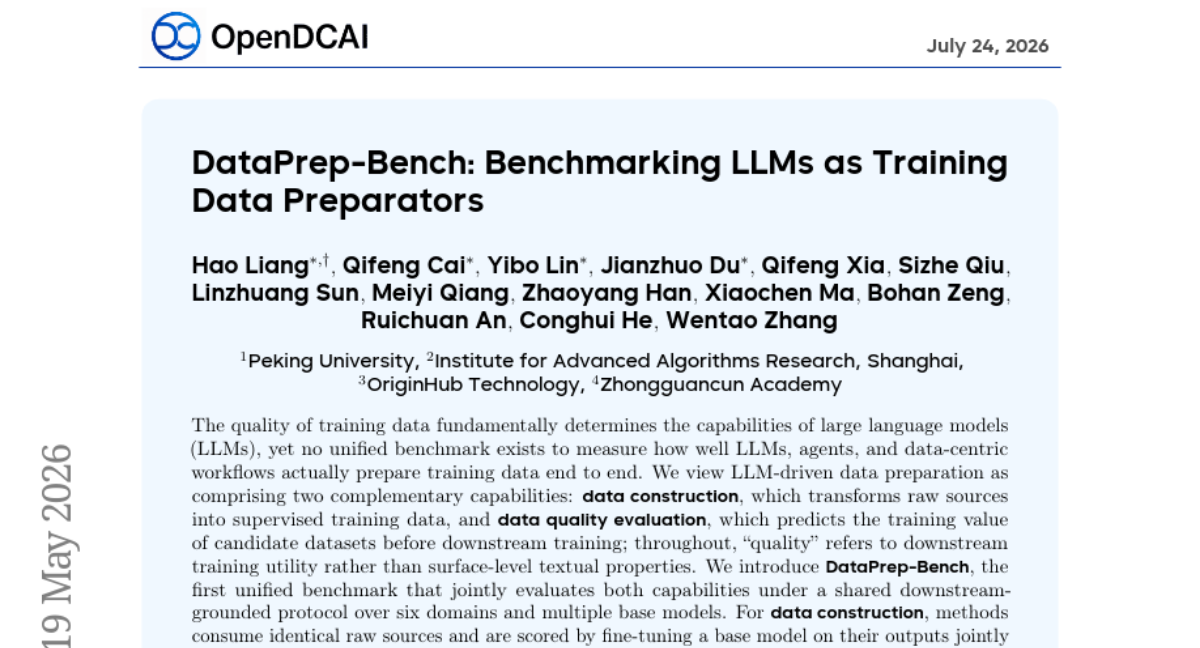
1. DataPrep-Bench: Benchmarking LLMs as Training Data Preparators
🔑 Keywords: DataPrep-Bench, LLM-driven data preparation, data construction, data quality evaluation, Distributional Alignment Score
💡 Category: Natural Language Processing
🌟 Research Objective:
– The study introduces DataPrep-Bench, a unified benchmark to evaluate large language models’ (LLMs) capabilities in LLM-driven data preparation, focusing on data construction and data quality evaluation.
🛠️ Research Methods:
– The benchmark evaluates both capabilities across six domains and multiple base models, with specific tracks for assessing data construction and quality evaluation methods.
💬 Research Conclusions:
– DataPrep-Bench offers a framework that measures progress on data preparation using a unified, downstream-grounded approach, demonstrating superior performance of methods like the Distributional Alignment Score in evaluating data quality across various domains.
👉 Paper link: https://huggingface.co/papers/2607.20465
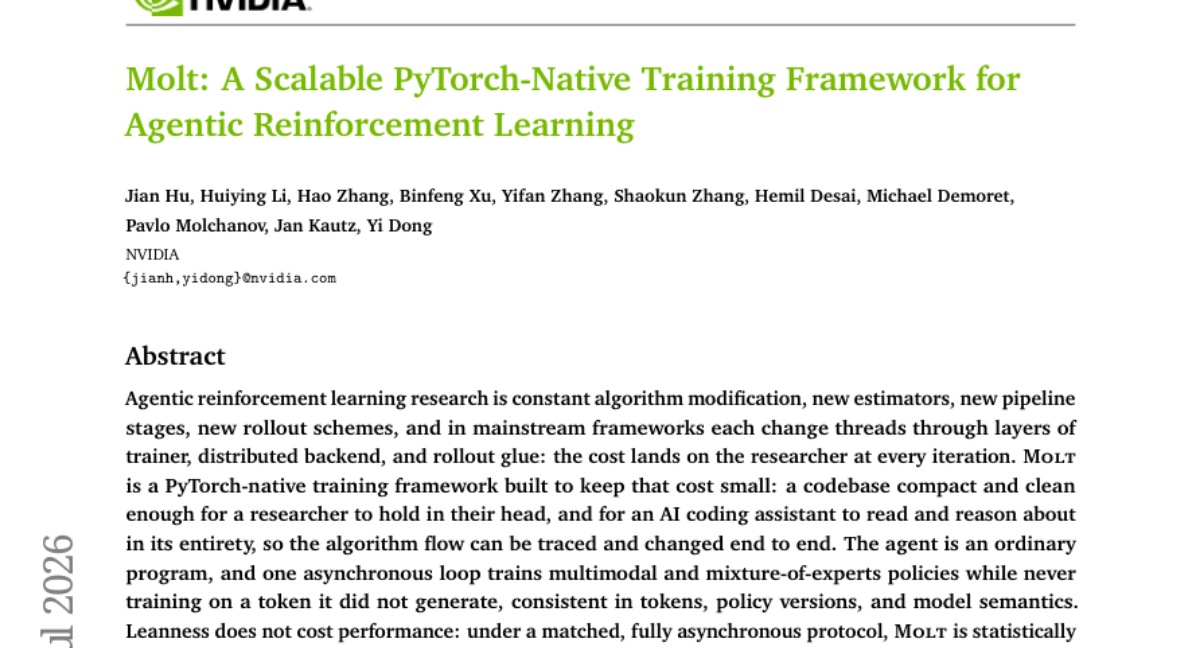
2. Molt: A Scalable PyTorch-Native Training Framework for Agentic Reinforcement Learning
🔑 Keywords: PyTorch-native, reinforcement learning, multimodal, mixture-of-experts, open source
💡 Category: Reinforcement Learning
🌟 Research Objective:
– To develop a training framework (Molt) that reduces algorithm modification costs and is easy to handle for researchers and AI coding assistants.
🛠️ Research Methods:
– Implementation of an asynchronous loop for training multimodal and mixture-of-experts policies using PyTorch, ensuring no unwanted token training.
💬 Research Conclusions:
– Molt maintains performance comparable to state-of-the-art systems, is open source, and offers accessible resources on GitHub.
👉 Paper link: https://huggingface.co/papers/2607.21653
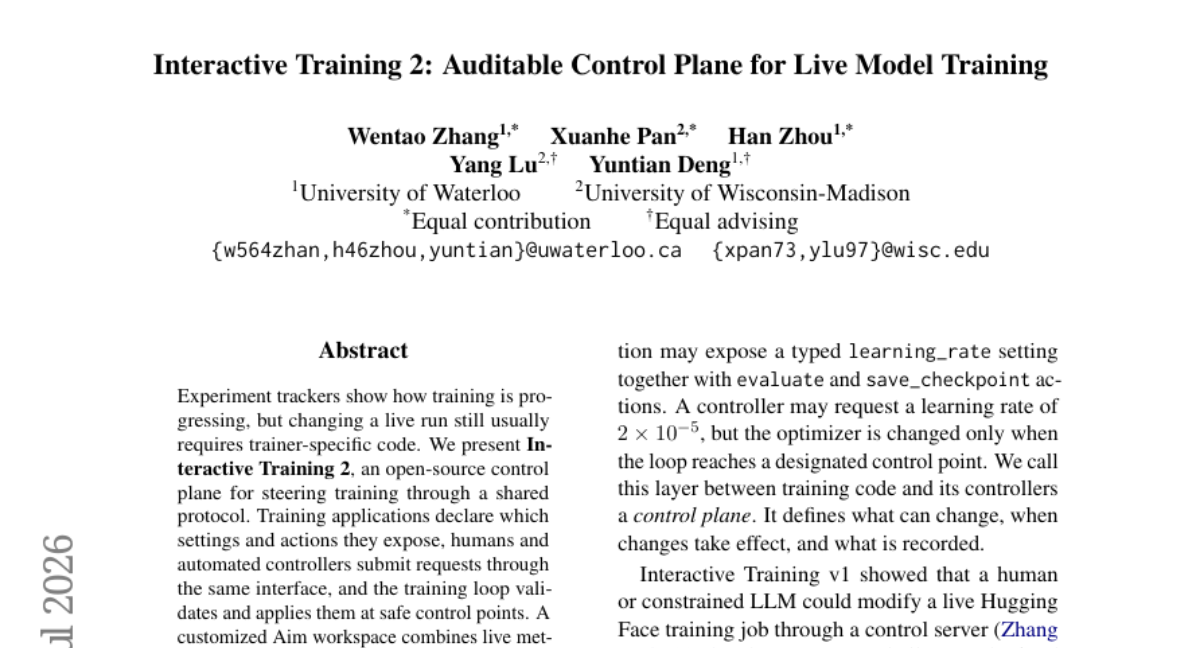
3. Interactive Training 2: Auditable Control Plane for Live Model Training
🔑 Keywords: Interactive Training, open-source, NLP, reinforcement-learning, auditable training
💡 Category: AI Systems and Tools
🌟 Research Objective:
– To introduce Interactive Training 2, an open-source control plane for dynamically steering training processes via a unified protocol.
🛠️ Research Methods:
– Implemented in five NLP and reinforcement-learning workflows demonstrating its versatility and the ability for both human and automated intervention.
💬 Research Conclusions:
– The system offers a foundational framework for human and agent-guided training that is reusable and auditable, combining metrics with a record of training interactions.
👉 Paper link: https://huggingface.co/papers/2607.18314
4. Three-Body Scattering for Generative Modeling
🔑 Keywords: generative models, Three-Body Scattering Modeling, one-step generator, ImageNet-256, PixelDiT-XL, DiT-XL
💡 Category: Generative Models
🌟 Research Objective:
– To demonstrate how a proper distributional energy can induce sample-level motion and provide direct regression supervision without relying on adversarial critics or prescribed paths.
🛠️ Research Methods:
– Introduction of Three-Body Scattering Modeling (TBSM) for generation, utilizing per-projectile interaction, and tracking conditional expectations to reduce noise, designed for training one-step generators.
💬 Research Conclusions:
– Establishes tracked scattering as an effective approach for high-dimensional one-step generation, achieving notable FID scores using TBSM on ImageNet-256.
👉 Paper link: https://huggingface.co/papers/2607.18198
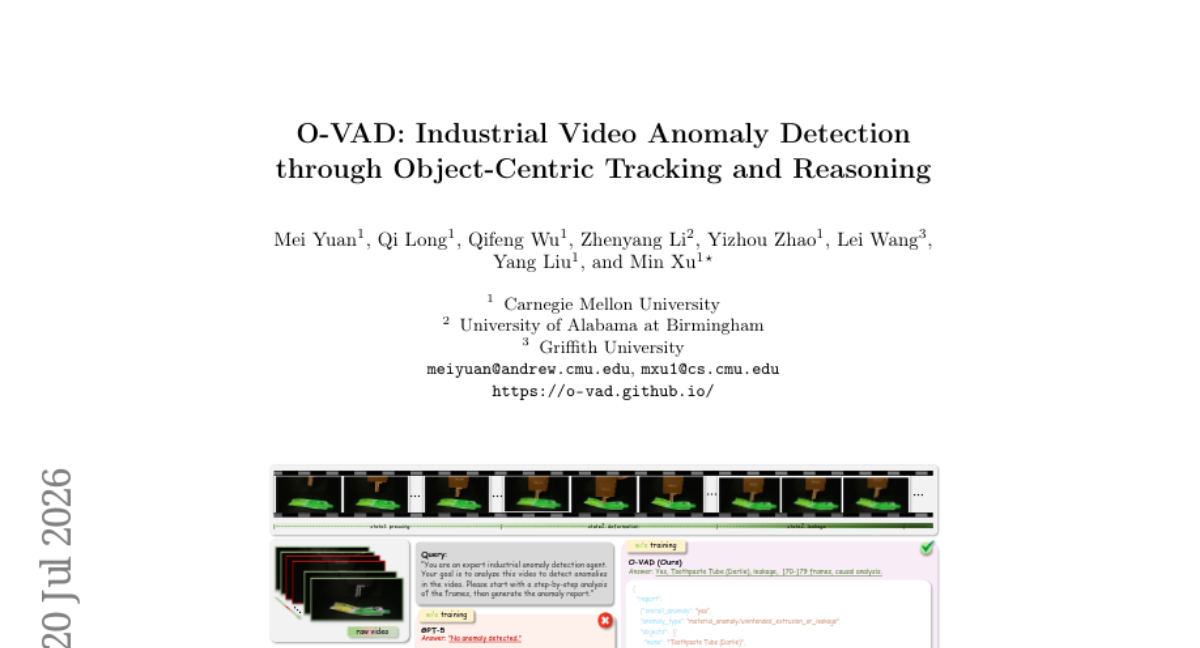
5. O-VAD: Industrial Video Anomaly Detection through Object-Centric Tracking and Reasoning
🔑 Keywords: Industrial Video Anomaly Detection, VLM-based anomaly reasoning, agentic framework, spatial-temporal dynamics, interpretability
💡 Category: Computer Vision
🌟 Research Objective:
– The study introduces a training-free agentic framework aimed at enhancing anomaly detection in industrial settings by focusing on object state evolution, akin to human inspectors.
🛠️ Research Methods:
– The method tracks spatial-temporal dynamics and underlying transformations of objects to identify anomalies in industrial video data, without relying on domain-specific knowledge.
💬 Research Conclusions:
– Experiments on three IVAD datasets show that this approach outperforms existing VLMs and traditional VAD methods, providing interpretable anomaly reports.
👉 Paper link: https://huggingface.co/papers/2607.18142
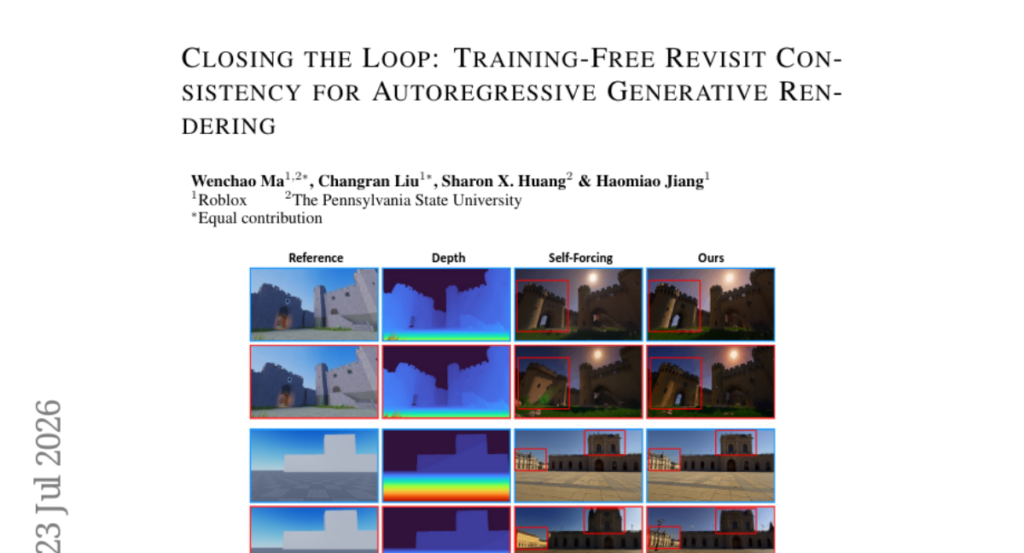
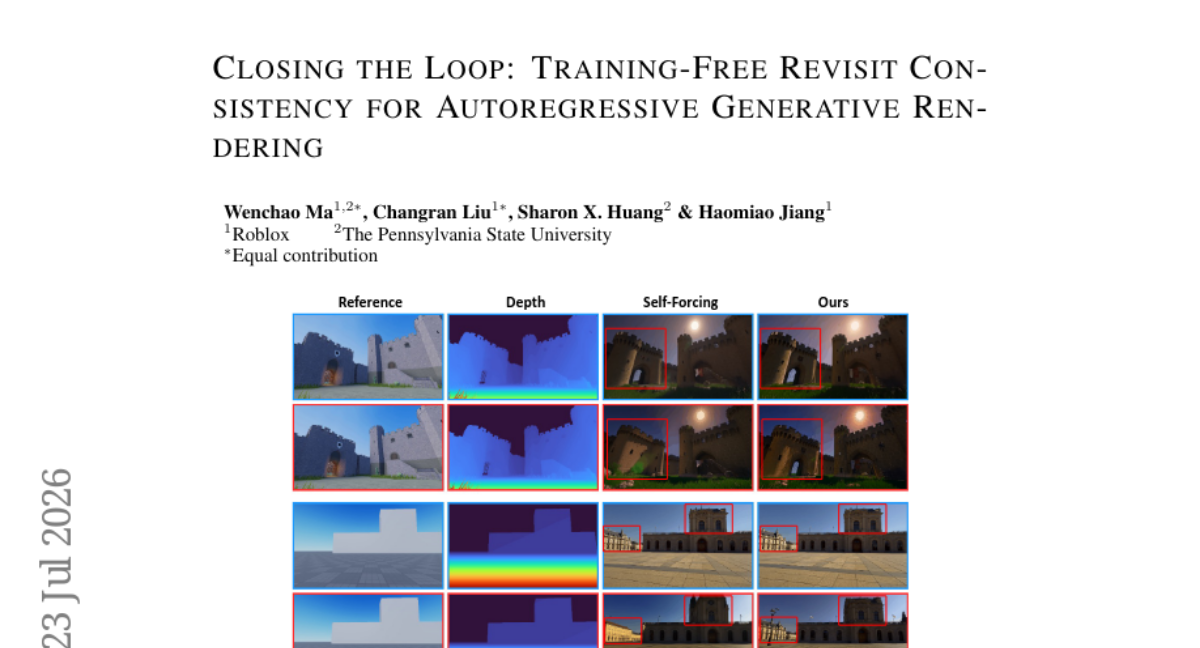
6. Closing the Loop: Training-Free Revisit Consistency for Autoregressive Generative Rendering
🔑 Keywords: Conditional Video Generation, Auto-Regressive Generation, 3D Engine Renderings, Revisit Inconsistency, Loop-Closure Memory
💡 Category: Generative Models
🌟 Research Objective:
– The research aims to address revisit inconsistencies in auto-regressive video generation by utilizing 3D engine-provided temporal and spatial correspondences without post-training.
🛠️ Research Methods:
– It uses temporal correspondence to retrieve pose-matched historical latent chunks into the KV cache, while spatial correspondence biases attention toward geometrically corresponding regions.
💬 Research Conclusions:
– The proposed method outperforms existing training-free baselines on revisit consistency without compromising overall video quality, validated on complex real-world scenarios from TartanAir and TartanGround datasets.
👉 Paper link: https://huggingface.co/papers/2607.21848
7. SceneActBench: Can Agents Act on the 3D Scenes They See?
🔑 Keywords: Vision-language model, 3D scenes, SceneActBench, Geometric metrics
💡 Category: Multi-Modal Learning
🌟 Research Objective:
– To present SceneActBench, a benchmark for evaluating visually conditioned actions in 3D environments across multiple tasks.
🛠️ Research Methods:
– The study evaluates agent actions using five 3D tasks within a unified agent-environment loop and employs task-specific geometric metrics for performance assessment.
💬 Research Conclusions:
– None of the eleven VLM configurations consistently performed well across all tasks, indicating variability in handling complete multi-object 3D scenes.
👉 Paper link: https://huggingface.co/papers/2607.22393

8. VisCo: Leveraging Large Language Models as Intrinsic Encoders for Visual Token Compression
🔑 Keywords: Vision-language models, Visual token compression, Training-based methods, Parameter-sharing autoencoder
💡 Category: Computer Vision
🌟 Research Objective:
– To develop a training-efficient self-compression framework, VisCo, that utilizes pretrained VLMs as intrinsic compressors to reduce inference latency and memory overhead.
🛠️ Research Methods:
– Implementation of VisCo as a parameter-sharing autoencoder that compresses visual information using memory tokens, leveraging information transfer from encoding to decoding.
💬 Research Conclusions:
– VisCo outperforms prior methods in visual token compression across all evaluated ratios, showing stability even in extreme settings, and can enhance the base model by introducing complementary representations.
👉 Paper link: https://huggingface.co/papers/2607.12756

9.
10. Multimodal Speaker Verification as a Threat to Speaker Anonymization
🔑 Keywords: ASV systems, multi-utterance, multimodal, speaker anonymization, EER
💡 Category: Multi-Modal Learning
🌟 Research Objective:
– Investigate the impact of aggregating information across anonymized speech in a multi-utterance, multimodal setting and its effect on privacy in ASV systems.
🛠️ Research Methods:
– Study audio-only aggregation of multiple anonymized utterances and incorporate prosodic and linguistic information to assess performance improvements.
💬 Research Conclusions:
– Multimodal systems outperform unimodal approaches, with frame-level aggregation yielding the lowest EERs. The combination of audio and text in just five anonymized utterances significantly reduces EER compared to audio-only aggregation.
👉 Paper link: https://huggingface.co/papers/2607.19636

11. Spectral Prior for Reducing Exposure Bias in Diffusion Models
🔑 Keywords: Diffusion Models, Spectral Alignment, Error Accumulation, Frequency-Dependent SNR, Classifier-Free Guidance
💡 Category: Generative Models
🌟 Research Objective:
– The study aims to address error accumulation during iterative sampling in diffusion models caused by exposure bias and frequency-dependent discrepancies.
🛠️ Research Methods:
– Proposed a method called Spectral Alignment (SPA) which involves two stages: offline fitting of a parametric spectrum model, and inference-time guidance using FFT-based gradient computation.
💬 Research Conclusions:
– SPA shows consistent improvements with minimal computational overhead across various architectures including DDPM, ADM, SD2.0, SDXL, SD3.5, and FLUX and complements Classifier-Free Guidance.
👉 Paper link: https://huggingface.co/papers/2607.22091
12. IDEAgent: Agentic Quality-Diversity Search for Research Idea Generation
🔑 Keywords: Large Language Models, Quality-Diversity Search, IDEAgent, Lineages, Yield
💡 Category: Generative Models
🌟 Research Objective:
– The study aims to address the limitations of current scientific discovery systems that optimize for either Quality or Diversity by proposing a Quality-Diversity (QD) search framework for research ideation.
🛠️ Research Methods:
– Introduction of IDEAgent, a multi-agent framework that utilizes multi-objective feedback and sequential memory for the evolution of ideas.
– Development of the Yield metric to evaluate mutually diverse ideas that meet quality thresholds.
💬 Research Conclusions:
– IDEAgent significantly outperforms existing baselines in generating diverse and high-quality research ideas, improving Yield by 3.89x and achieving non-zero Yield across more topics.
– The study highlights the importance of repair and refinement in enhancing idea quality and encourages further research on QD-search-based ideation through open-sourcing IDEAgent.
👉 Paper link: https://huggingface.co/papers/2607.22375
13. Multi-Head Latent Control: A Unified Interface for LLM Agent Decision Making
🔑 Keywords: Multi-Head Latent Control, Latent Generation, Deployment-Time Control Signals, Tool Use Decision
💡 Category: AI Systems and Tools
🌟 Research Objective:
– To explore if control decisions for AI agents can be directly inferred from a model’s latent generation process using a novel Multi-Head Latent Control layer.
🛠️ Research Methods:
– Introduction of a lightweight Multi-Head Latent Control layer that reads hidden-state trajectories from frozen LLMs or VLMs to produce control signals at deployment time.
💬 Research Conclusions:
– Multi-Head Latent Control improves the quality-cost tradeoff in multi-model systems, significantly reducing large-model usage while maintaining performance. Additionally, it enhances tool-use decision quality, evidenced by significant performance gains and decreased missed-required tool calls.
👉 Paper link: https://huggingface.co/papers/2607.14277
14. LAMAR: An Open Language-Aware Multilingual Alignment Reranker
🔑 Keywords: multilingual retrieval, rerankers, LAMAR, language coherence
💡 Category: Natural Language Processing
🌟 Research Objective:
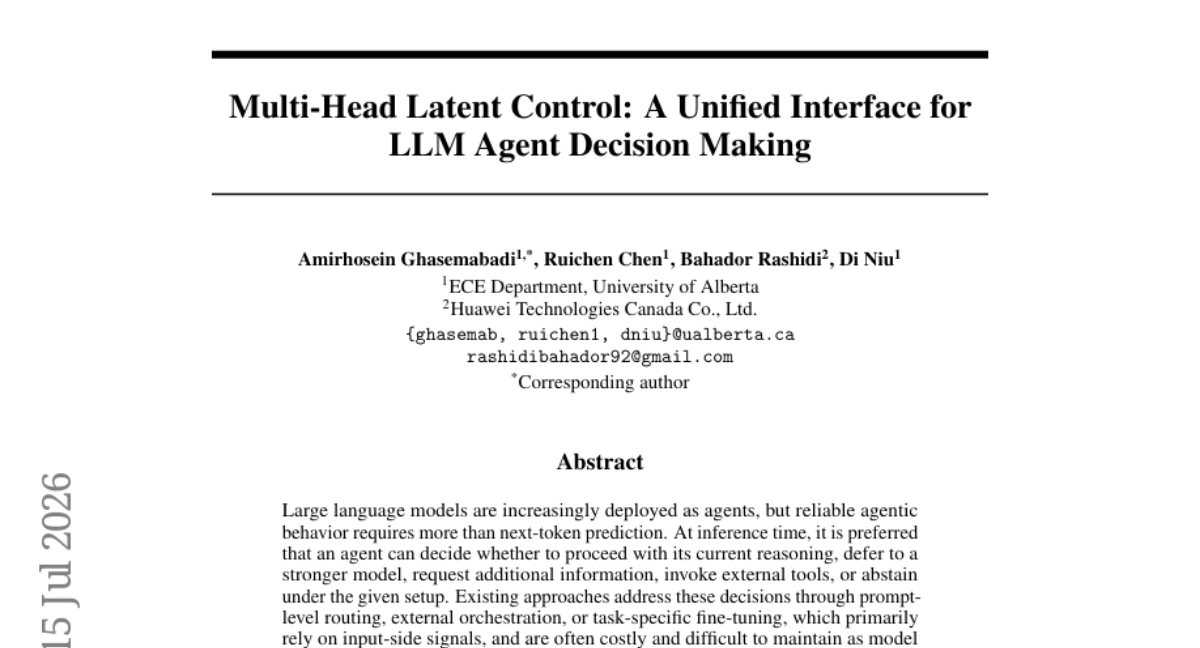
– To understand whether existing multilingual rerankers prioritize documents in the query’s language and to improve this aspect.
🛠️ Research Methods:
– Released LAMAR, a language-aware multilingual cross encoder using English anchored relevance distillation and preference alignment for language coherence.
💬 Research Conclusions:
– LAMAR achieves superior performance across languages by effectively accounting for language coherence while maintaining semantic relevance in multilingual reranking.
👉 Paper link: https://huggingface.co/papers/2607.22042
15. Scaling Native Multimodal Pre-Training From Scratch
🔑 Keywords: Multimodal pre-training, Large language models, Cross-modal integration, Compute law, Scaling behavior
💡 Category: Multi-Modal Learning
🌟 Research Objective:
– The study aims to investigate optimal model size and token count for training a transformer-based vision-language model within a fixed computational budget.
🛠️ Research Methods:
– The researchers explore scaling properties by examining loss adherence to compute laws and the influence of data composition on model efficiency.
💬 Research Conclusions:
– Native multimodal pre-training results in positive cross-modal transfer, enhances spatial reasoning, and establishes guidelines for scaling multimodal foundation models predictably.
👉 Paper link: https://huggingface.co/papers/2607.22043
16. Agentic Context Management: Solving Agent Memory and Cost by Treating Them as Lifecycle and Architecture Problems
🔑 Keywords: Agentic Context Management, ACM, token cost, Maximem Synap
💡 Category: AI Systems and Tools
🌟 Research Objective:
– Develops a framework called Agentic Context Management (ACM) to manage the reasoning context of AI agents effectively by focusing on lifecycle management rather than mere storage.
🛠️ Research Methods:
– Introduces and implements five primitives: architecting, ingesting, scoping, anticipating, and compacting & consolidation, demonstrated through a reference implementation called Maximem Synap.
💬 Research Conclusions:
– Demonstrates that naive context accumulation increases token cost quadratically, and ACM provides a method to achieve linear cost while maintaining high fidelity, achieving 92% on LongMemEval and 93.2% on LoCoMo.
👉 Paper link: https://huggingface.co/papers/2607.21503
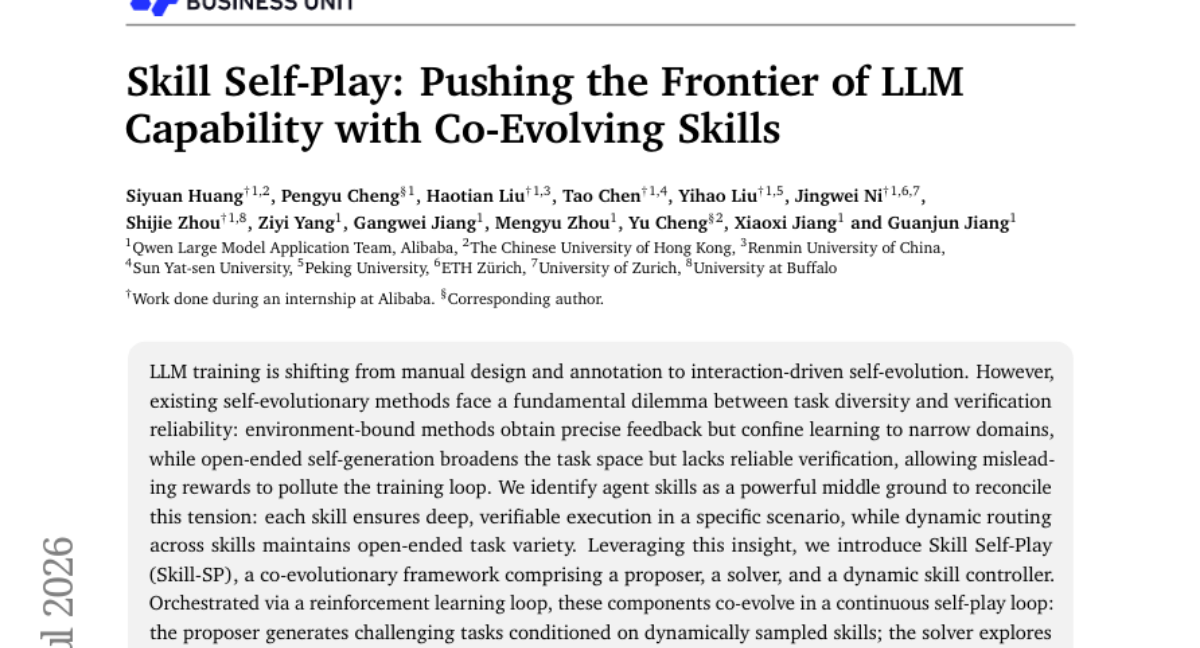
17. Skill Self-Play: Pushing the Frontier of LLM Capability with Co-Evolving Skills
🔑 Keywords: LLM training, self-evolution, Skill Self-Play, reinforcement learning, interactive co-evolution
💡 Category: Reinforcement Learning
🌟 Research Objective:
– The study aims to address the dilemma in LLM training between task diversity and verification reliability by introducing a framework that blends structured verification with open-ended exploration through agent skills.
🛠️ Research Methods:
– The authors developed Skill Self-Play (Skill-SP), a co-evolutionary framework comprising a proposer, solver, and skill controller, which evolves through a reinforcement learning loop to ensure deep execution while expanding task variety.
💬 Research Conclusions:
– Empirical evaluations demonstrate that Skill-SP is effective as an evolution engine, enhancing the capabilities of advanced models and rectifying previously misaligned models, as evidenced by improved performance on tool-use and reasoning benchmarks.
👉 Paper link: https://huggingface.co/papers/2607.22529