AI Native Daily Paper Digest – 20260728 – DeepSeek | Video Foundation Models
Today’s digest highlights notable advancements from Gemma and DeepSeek, delving into the intricate realms of multimodal reasoning and agentic systems. A prominent theme across the papers is the enhancement of long-context attention mechanisms, which promises to significantly improve the efficiency of model-driven predictions. One method, termed Recursive Transformer Stacking, has shown substantial improvements on the LAMBADA benchmark, achieving a 92.4% accuracy rate. Another study demonstrates how adaptive query attention imparts greater flexibility in real-time decision-making for robotic applications. These findings reflect a growing trend of integrating complex reasoning abilities into existing AI models.
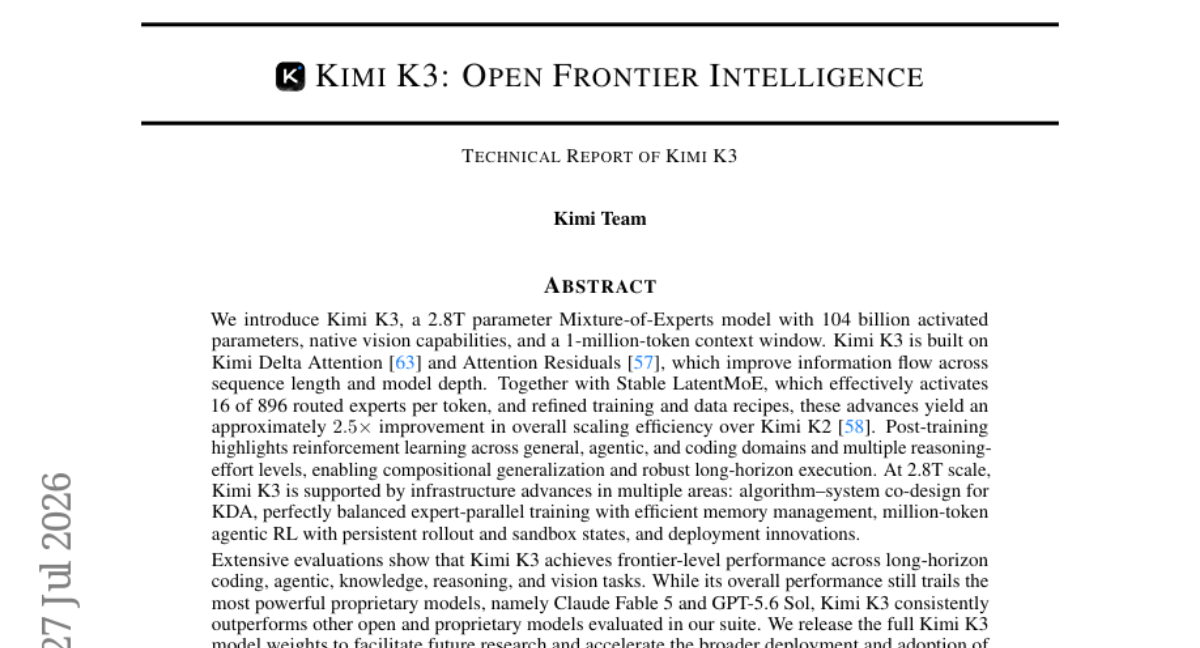
1. Kimi K3: Open Frontier Intelligence
🔑 Keywords: Mixture-of-Experts, native vision, reinforcement learning, model scaling, Kimi Delta Attention
💡 Category: AI Systems and Tools
🌟 Research Objective:
– Introduce and evaluate Kimi K3, a large-scale Mixture-of-Experts model with novel attention mechanisms and vision capabilities.
🛠️ Research Methods:
– Built using Kimi Delta Attention and Attention Residuals with Stable LatentMoE, and improved training and data recipes for better scaling efficiency.
💬 Research Conclusions:
– Kimi K3 demonstrates significant improvements in scaling efficiency and performance across various tasks, outperforming other open and proprietary models except for top proprietary models like Claude Fable 5 and GPT-5.6 Sol.
👉 Paper link: https://huggingface.co/papers/2607.24653
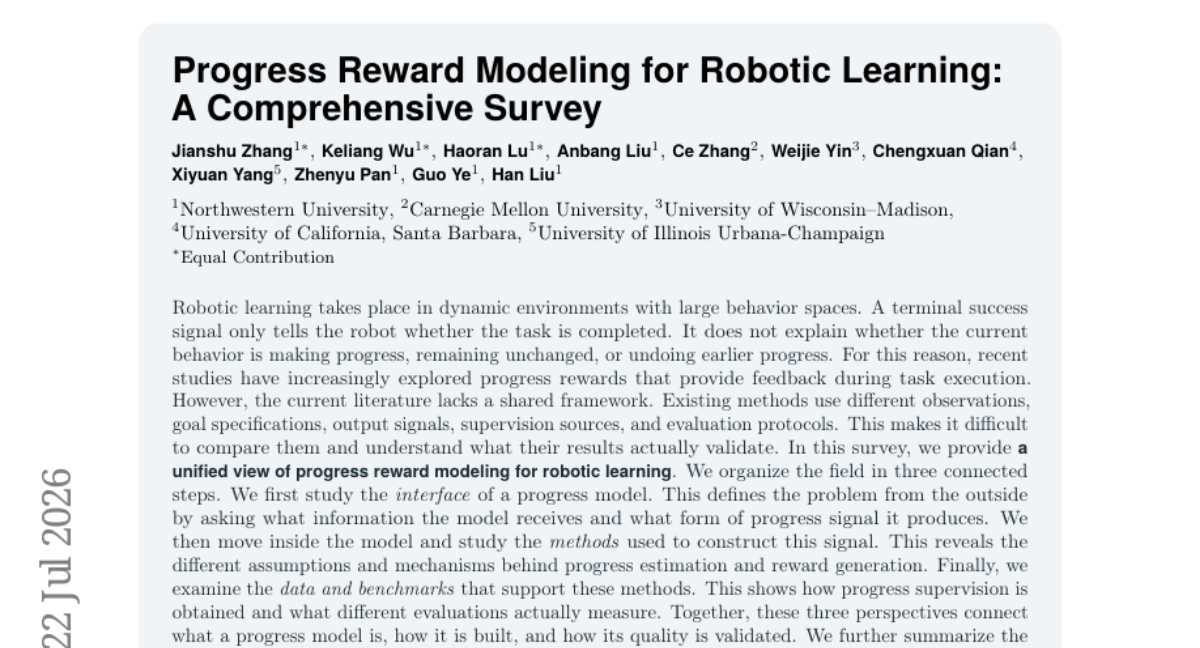
2. Progress Reward Modeling for Robotic Learning: A Comprehensive Survey
🔑 Keywords: Robotic learning, Progress rewards, Dynamic environments, Task execution, Progress model
💡 Category: Robotics and Autonomous Systems
🌟 Research Objective:
– This paper aims to provide a unified framework for understanding progress reward modeling in robotic learning, addressing the lack of a shared approach for comparing existing methods.
🛠️ Research Methods:
– The study is organized into three steps: analyzing the progress model interface, exploring methods for constructing progress signals, and examining data and benchmarks used for validation.
💬 Research Conclusions:
– The survey outlines the connections between a progress model’s function, construction, and validation, highlighting the limitations of current approaches and suggesting directions for future research.
👉 Paper link: https://huggingface.co/papers/2607.21655
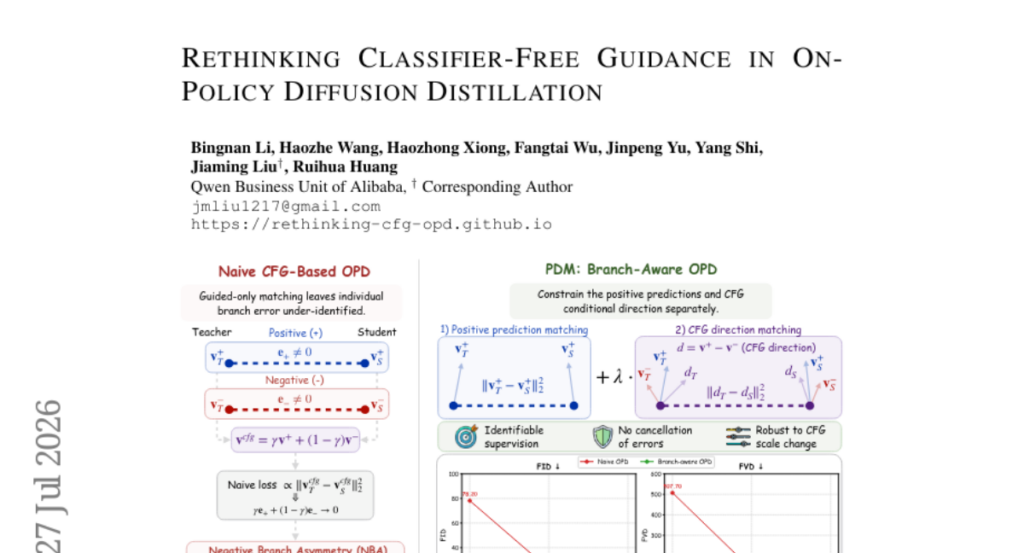
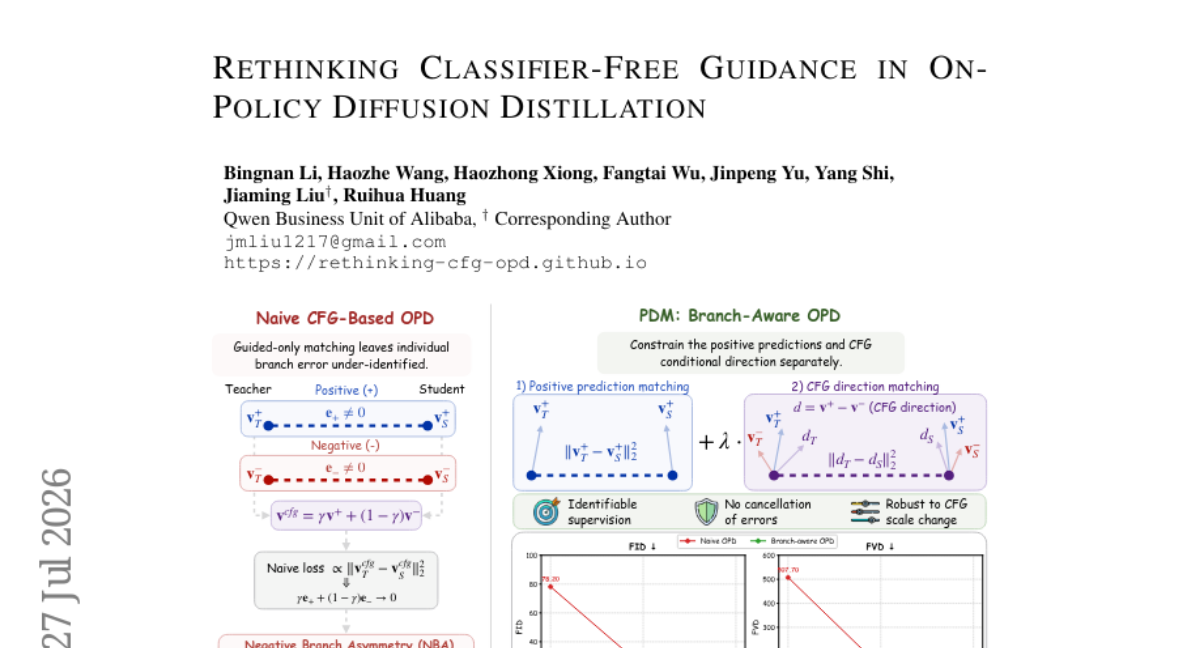
3. Rethinking Classifier-Free Guidance in On-Policy Diffusion Distillation
🔑 Keywords: On-policy distillation, diffusion models, classifier-free guidance, Negative Branch Asymmetry, Positive–Direction Matching
💡 Category: Generative Models
🌟 Research Objective:
– Investigate the behavior of On-policy distillation under classifier-free guidance in modern diffusion systems and address the issues arising from Negative Branch Asymmetry.
🛠️ Research Methods:
– Analysis of OPD methods’ extension to CFG-composed predictions and introduction of Positive–Direction Matching to improve branch-aware performance in video control tasks.
💬 Research Conclusions:
– Identified the failure mode termed Negative Branch Asymmetry and demonstrated that Positive–Direction Matching provides more robust and effective knowledge transfer, particularly in dense-to-sparse video control scenarios.
👉 Paper link: https://huggingface.co/papers/2607.24731
4. Data Pyramid for Embodied Manipulation
🔑 Keywords: Multimodal foundation models, Embodied agents, Data ecosystem
💡 Category: Robotics and Autonomous Systems
🌟 Research Objective:
– The objective is to organize the embodied data ecosystem as a “pyramid” with five data sources, focusing on scalability and robot alignment.
🛠️ Research Methods:
– Analyzing different data sources such as real-robot, UMI-style, egocentric, exocentric, simulation, and general vision-language data, and creating a data composition to enhance capabilities in perception, reasoning, planning, action generation, and world prediction.
💬 Research Conclusions:
– The study concludes by identifying six open challenges, including building large-scale tactile datasets, scalable data-collection pipelines, and designing principled data recipes for robot learning, to lay the foundation for the next generation of embodied systems.
👉 Paper link: https://huggingface.co/papers/2607.24744
5. OmniVAE: An Audio-Video VAE with Cross-Modal Alignment for Joint Generation
🔑 Keywords: OmniVAE, cross-modal synchronization, semantic alignment, generative models, audio-video VAE
💡 Category: Multi-Modal Learning
🌟 Research Objective:
– The research aims to address the challenge of fine-grained cross-modal correspondence in joint audio and video generation by introducing OmniVAE, a jointly trained audio-video VAE.
🛠️ Research Methods:
– OmniVAE employs a segment-level audio-video contrastive objective to align latent spaces and distills features from pretrained modality-specific semantic encoders to enhance the model’s learnability.
💬 Research Conclusions:
– The objectives of OmniVAE improve the learnability of latent spaces, leading to higher generation quality and accurate cross-modal synchronization in downstream text-to-audio-video generation, highlighting the importance of unified representations in omnimodal modeling.
👉 Paper link: https://huggingface.co/papers/2607.23855

6. The Physics of Multi-Turn Long-Horizon Planning: From Pre-training to Post-training via Single- and Multi-Teacher On-Policy Agentic Distillation
🔑 Keywords: Multi-turn planning, Long-horizon, CoT state transition, GRPO, OPD, MOPD
💡 Category: Reinforcement Learning
🌟 Research Objective:
– To fundamentally improve multi-turn long-horizon planning in foundation model agents by introducing a controlled environment for precise analysis.
🛠️ Research Methods:
– Conducted studies on long-horizon planning through a controlled environment focusing on planning ability acquisition, shaping, and integration.
– Employed CoT state transition modeling, GRPO and OPD post-training, and multi-teacher on-policy distillation (MOPD).
💬 Research Conclusions:
– Precise environment control enables systematic analysis of long-horizon planning.
– Atomic skills are inadequate for compositional generalization; suboptimal trajectories impair performance.
– GRPO and OPD are used to shape planning ability, with OPD performing better in low-quality, long-horizon scenarios.
– MOPD integrates capabilities across environments, aiding in generalization and continual learning.
👉 Paper link: https://huggingface.co/papers/2607.24720
7. dRAE: Representation Autoencoder with Hyper-Spherical Codes
🔑 Keywords: High-dimensional visual representations, Hyper-Spherical Quantization, Representation Autoencoder, semantic coherence, scalability
💡 Category: Machine Learning
🌟 Research Objective:
– The research aims to discretize high-dimensional visual representations to better integrate them with language models by addressing the challenge of codebook collapse and preserving semantic coherence.
🛠️ Research Methods:
– The paper introduces Hyper-Spherical Quantization (HSQ) to decouple semantic content from feature magnitude using angular routing, facilitating scalability and semantic integrity in Representation Autoencoders.
💬 Research Conclusions:
– Through extensive experiments, the study demonstrates that their approach achieves high-fidelity reconstruction, full codebook utilization, and improved performance in both understanding and generation tasks as the vocabulary size scales up.
👉 Paper link: https://huggingface.co/papers/2607.22148
8. DecoupleMix: Decoupled Ratio Search and Convex Allocation for Scalable VLM Data Recipes
🔑 Keywords: Vision Language Models, data construction, DecoupleMix, multimodal continue-pretraining
💡 Category: Multi-Modal Learning
🌟 Research Objective:
– To formulate data construction for Vision Language Models as a systematic mixture-optimization problem.
🛠️ Research Methods:
– Introduced DecoupleMix framework, which decouples the mixture into inter-class and intra-class ratio optimization, employing constrained convex optimization and an iterative search methodology.
💬 Research Conclusions:
– The proposed DecoupleMix approach surpasses heuristic baselines, allowing seamless transfer of optimal ratios to larger-scale datasets and achieving competitive results with a smaller multimodal budget.
👉 Paper link: https://huggingface.co/papers/2607.24516

9. Codifying the Judge: Scalable Evaluation via Program Distillation
🔑 Keywords: LLM-as-a-judge, program distillation, PAJAMA, programmatic judges, RewardBench
💡 Category: Natural Language Processing
🌟 Research Objective:
– To propose an efficient alternative to overcome the limitations of LLM-as-a-judge in automated evaluation by using program distillation.
🛠️ Research Methods:
– Introduction of PAJAMA, a system that synthesizes programs as judges and aggregates their decisions, with a fallback mechanism for low-confidence cases.
💬 Research Conclusions:
– Programmatic judges match the performance of large LLM judges while improving cost and transparency.
– The program outputs improve accuracy and throughput, offering effective reward signals at a lower cost on benchmarks like RewardBench.
👉 Paper link: https://huggingface.co/papers/2607.22561
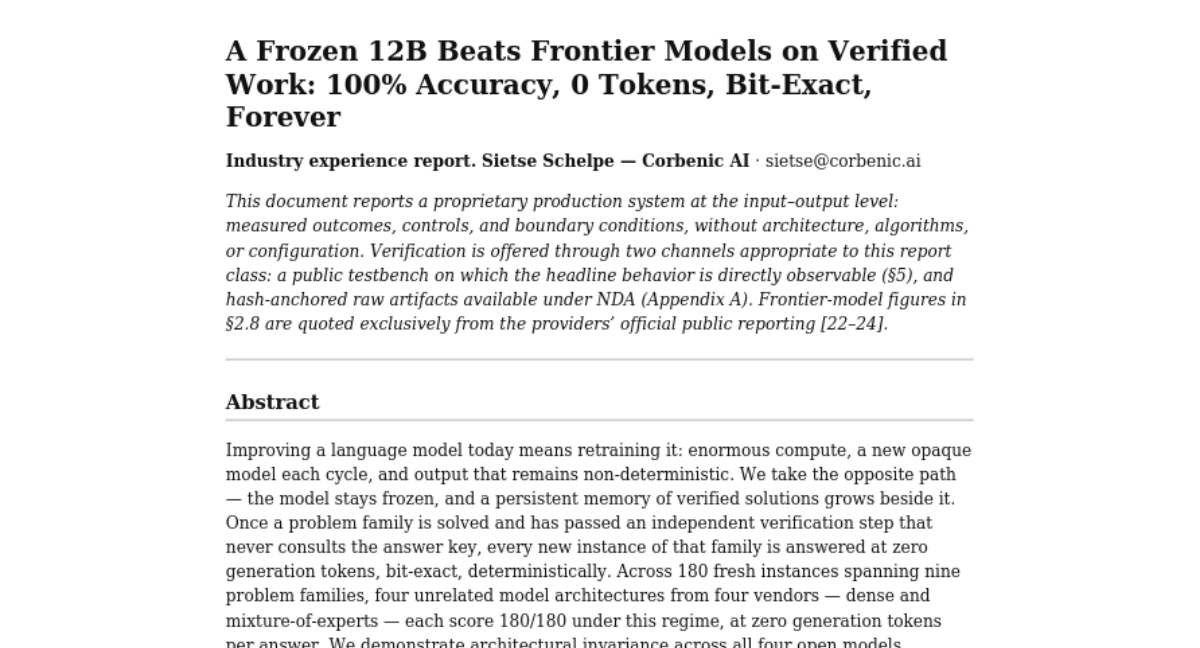
10. A Frozen 12B Beats Frontier Models on Verified Work: 100% Accuracy, 0 Tokens, Bit-Exact, Forever
🔑 Keywords: Language Model, Non-deterministic Output, Memory, Verified Solutions, Execution-bound Capability
💡 Category: Natural Language Processing
🌟 Research Objective:
– To propose an alternative approach to improving a language model by maintaining a frozen model and building a persistent memory of verified solutions.
🛠️ Research Methods:
– The study tested multiple architectures across various problem families with a method that allows deterministic, zero-generation token responses after verification.
💬 Research Conclusions:
– The study demonstrated that execution-bound capabilities could be decoupled from parameter scaling, achieving consistent and memory-dependent results across different models.
– A notable efficiency in memory selection and reuse is reported, as well as a deficiency in approximate similarity retrieval, highlighting the robustness and precision of the proposed system.
👉 Paper link: https://huggingface.co/papers/2607.23806
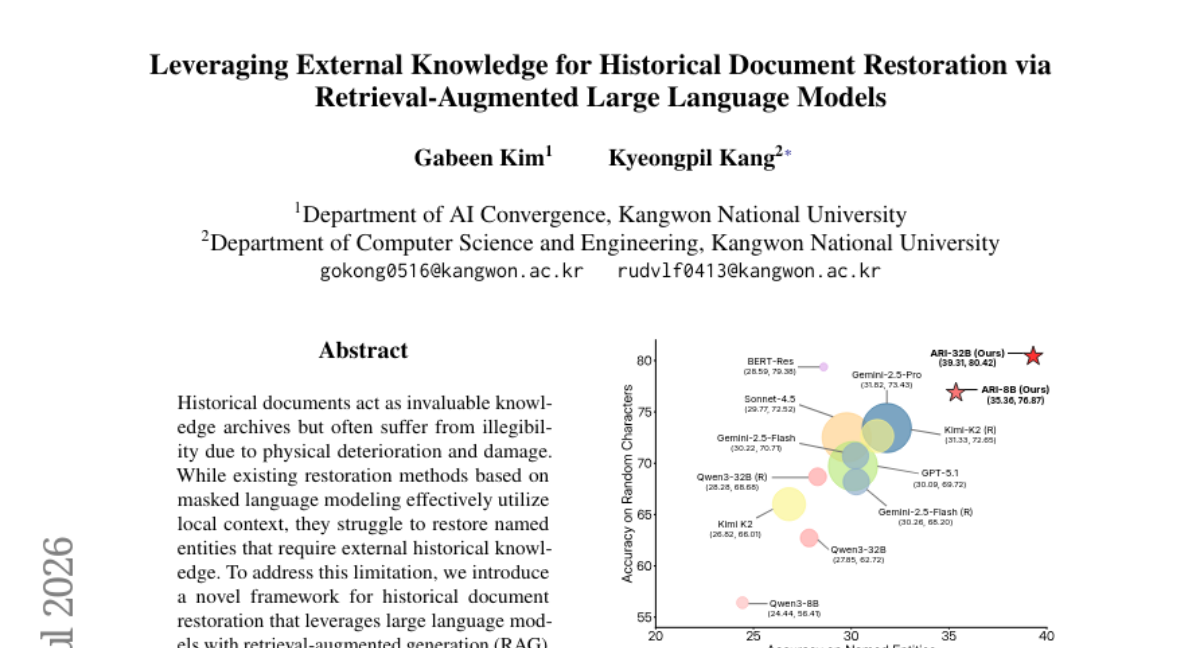
11. Leveraging External Knowledge for Historical Document Restoration via Retrieval-Augmented Large Language Models
🔑 Keywords: Historical Document Restoration, Named Entities, Large Language Models, Retrieval-Augmented Generation, ARI
💡 Category: Natural Language Processing
🌟 Research Objective:
– To develop a novel framework for restoring historical documents by leveraging large language models with retrieval-augmented generation to effectively resolve the challenge of restoring context-dependent proper nouns.
🛠️ Research Methods:
– The introduction of the ARI model combines the implicit knowledge of pre-trained LLMs with explicitly retrieved external context to enhance restoration fidelity.
💬 Research Conclusions:
– The ARI model significantly outperforms existing baselines in restoring both general characters and named entities in Korean historical documents, confirmed by comprehensive evaluations and expert assessments.
👉 Paper link: https://huggingface.co/papers/2607.21936
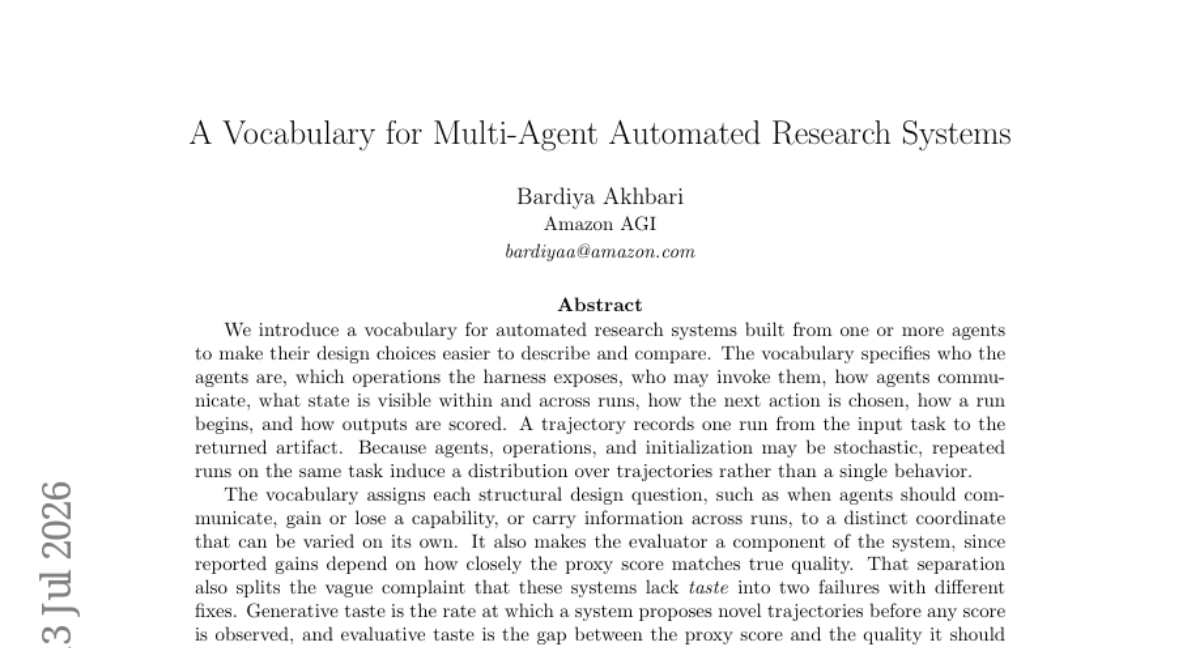
12. A Vocabulary for Multi-Agent Automated Research Systems
🔑 Keywords: automated research systems, agents, trajectories, generative taste, evaluative taste
💡 Category: AI Systems and Tools
🌟 Research Objective:
– To introduce a comprehensive vocabulary for automated research systems, focusing on design choices for agents and their interactions.
🛠️ Research Methods:
– The proposed vocabulary delineates various components, such as operations, communication, and evaluation within systems, turning design questions into testable choices.
💬 Research Conclusions:
– The vocabulary helps clarify design aspects and makes the evaluator an integral system component, addressing critique by splitting “taste” into generative and evaluative elements.
👉 Paper link: https://huggingface.co/papers/2607.22682
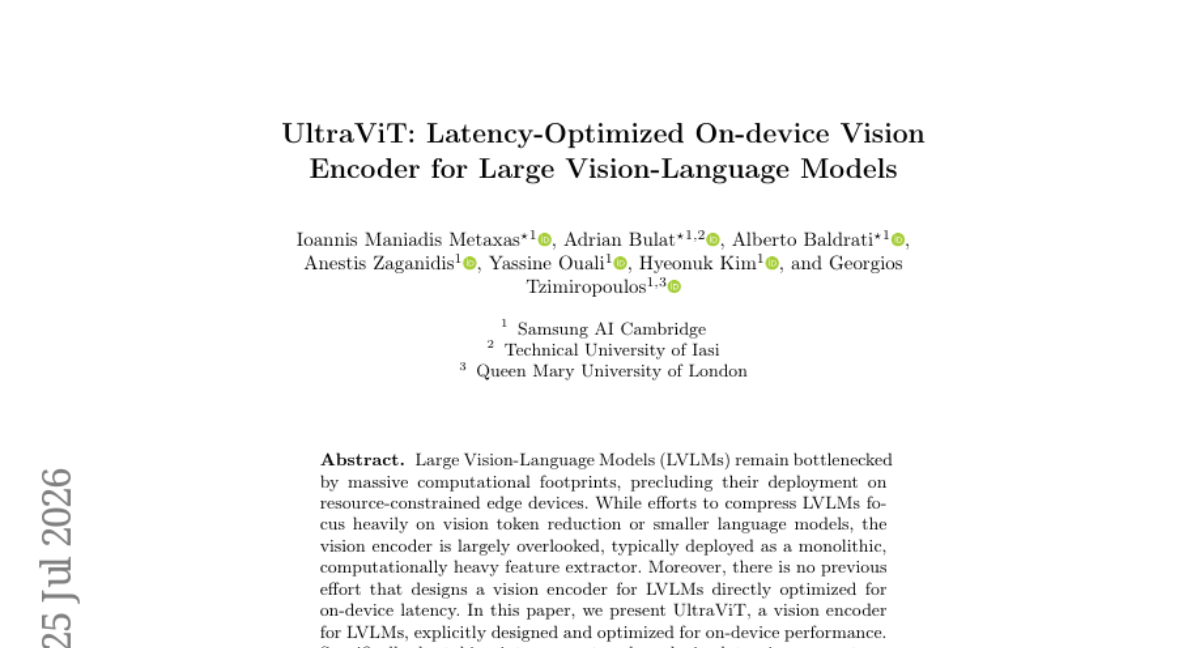
13. UltraViT: Latency-Optimized On-device Vision Encoder for Large Vision-Language Models
🔑 Keywords: Large Vision-Language Models, Vision Encoder, On-Device Performance, Generative Pre-Training, Semantic Grounding
💡 Category: Multi-Modal Learning
🌟 Research Objective:
– To design and optimize a vision encoder, named UltraViT, specifically for improving on-device performance of Large Vision-Language Models.
🛠️ Research Methods:
– Development of a pyramidal architecture integrating heterogeneous spatial mixers.
– Implementation of a novel two-stage generative pre-training strategy for the encoder.
💬 Research Conclusions:
– The design and training approach of UltraViT significantly enhance encoding efficiency, achieving nearly 1.7x the speed of existing baselines while supporting high-level semantic grounding.
👉 Paper link: https://huggingface.co/papers/2607.23373
14. TILT: Improving Compositional Generation in Diffusion Models with a Model-Intrinsic Reward
🔑 Keywords: Text-to-Image Generation, Compositional Prompts, Reward Alignment, Diffusion Sampling
💡 Category: Generative Models
🌟 Research Objective:
– Develop test-time methods to enhance image fidelity to complex compositional prompts in text-to-image generation.
🛠️ Research Methods:
– Introduce TILT, a training-free framework utilizing test-time reward alignment to modify sampling trajectories.
💬 Research Conclusions:
– TILT improves compositional alignment without sacrificing image quality, outperforming previous baselines on T2ICompBench prompts.
👉 Paper link: https://huggingface.co/papers/2607.21606
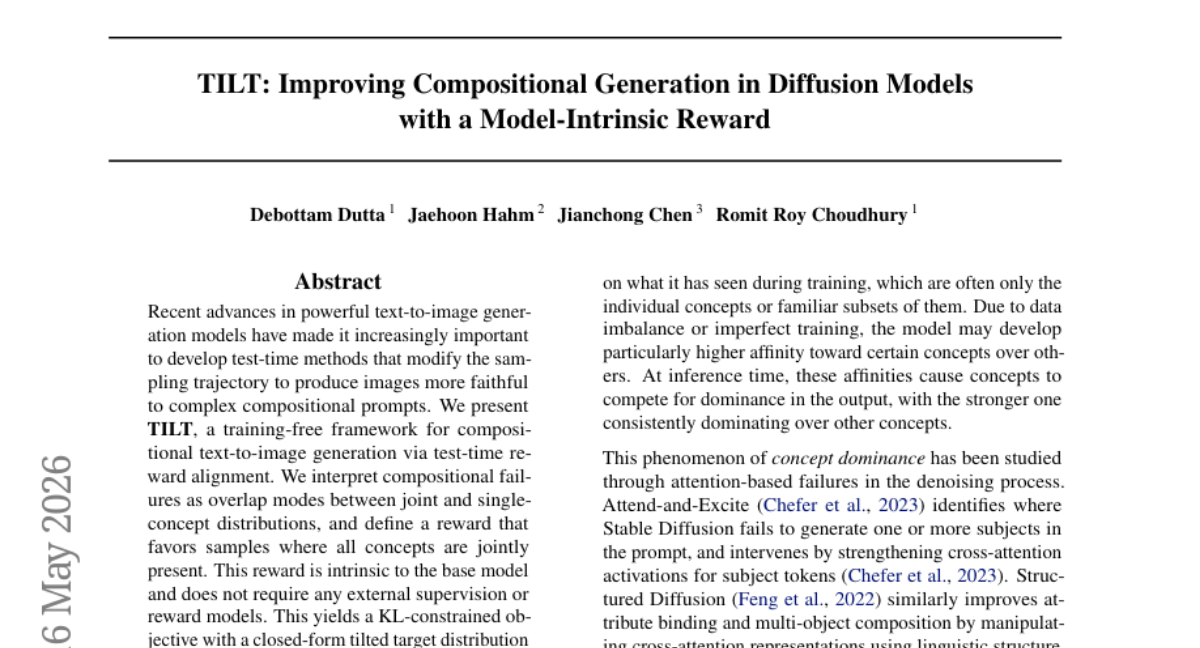
15. Bitcoin Price Direction Prediction via Regime-Aware Multi-Modal Fusion of Social Sentiment and Technical Features
🔑 Keywords: Bitcoin price prediction, Regime-Aware Multi-Modal Learning, sentiment analysis, adaptive fusion, volatility
💡 Category: AI in Finance
🌟 Research Objective:
– To enhance Bitcoin price prediction by integrating sentiment and price features based on dynamically detected market regimes.
🛠️ Research Methods:
– Proposed the Regime-Aware Multi-Modal Learning (RAML) model, which adjusts the fusion of sentiment and price features using a learnable sigmoid gate that reflects market volatility.
💬 Research Conclusions:
– RAML outperforms static and other models in predicting price changes, achieving better calibration and demonstrating the necessity of regime-conditioned adaptive fusion for financial forecasting.
👉 Paper link: https://huggingface.co/papers/2607.23370
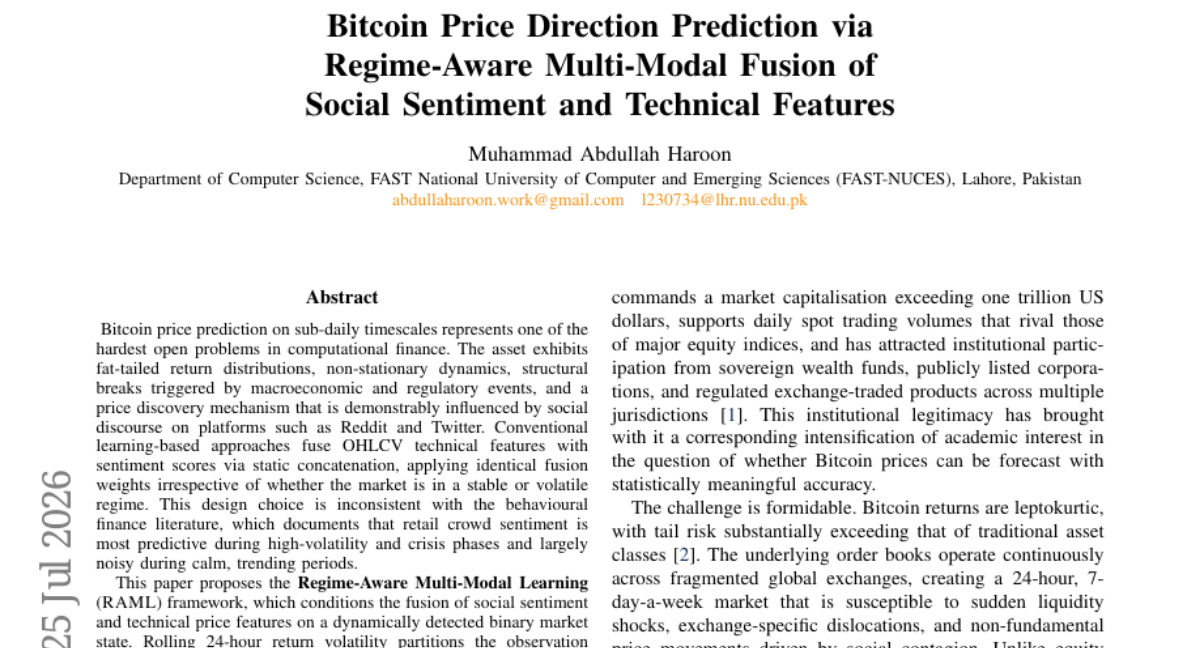
16. WorldDiT: A Unified Diffusion Architecture for World and Action Modeling
🔑 Keywords: Vision-Language Models, Action Generation, Diffusion Transformer, WorldDiT
💡 Category: Robotics and Autonomous Systems
🌟 Research Objective:
– Introduce a unified diffusion transformer architecture, WorldDiT, to enhance robot control without relying on large pretrained vision-language models as the action backbone.
🛠️ Research Methods:
– During training, a diffusion transformer is used to generate continuous action chunks and predict RGB patch targets from future camera frames.
💬 Research Conclusions:
– WorldDiT demonstrates high performance and lies on the Pareto frontier for total model parameters and mean success across the four LIBERO simulation suites, providing a robust sub-billion-parameter baseline for future studies.
👉 Paper link: https://huggingface.co/papers/2607.23909
17.
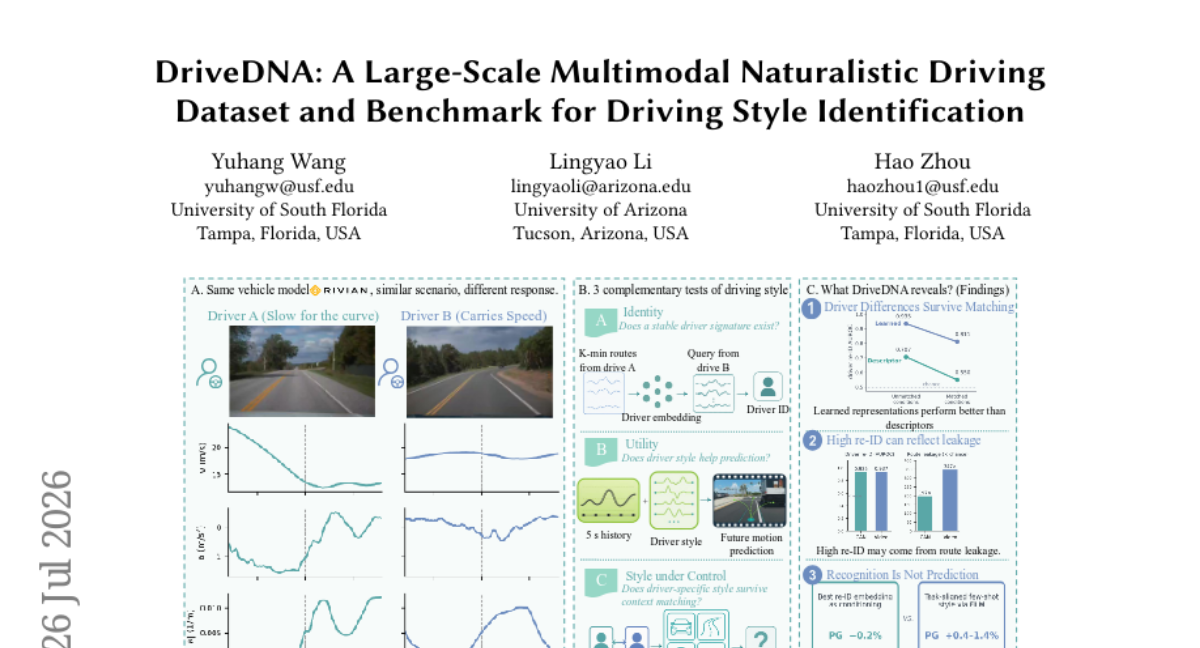
18. DriveDNA: A Large-Scale Multimodal Naturalistic Driving Dataset and Benchmark for Driving Style Identification
🔑 Keywords: DriveDNA, personalized driving-style modeling, few-shot driver re-identification, multimodal fusion, zero-shot foundation models
💡 Category: Machine Learning
🌟 Research Objective:
– The paper introduces DriveDNA, aiming to isolate and model driver-specific patterns from naturalistic driving data.
🛠️ Research Methods:
– The study uses a dataset comprising 975 hours of driving data collected at 10 Hz including forward video, employing classical descriptors, supervised and self-supervised time-series encoders, multimodal fusion, and zero-shot foundation models.
💬 Research Conclusions:
– Learned representations outperform classical descriptors in retaining driver-specific information under matched conditions.
– Video-only models show route leakage pointing to potential shortcuts in recognizing driving style, highlighting the need for robust evaluation assessing both learned representations and their confound resistance.
👉 Paper link: https://huggingface.co/papers/2607.23822
19. Characterizing Warp Divergence from Pascal to Blackwell
🔑 Keywords: Independent Thread Scheduling, NVIDIA GPUs, Architectural Change, Compiler-Generated SASS
💡 Category: AI Systems and Tools
🌟 Research Objective:
– To investigate the assumption that NVIDIA GPUs handle warp divergence in a fixed manner across different generations by examining architectural changes and programmer-visible cost models.
🛠️ Research Methods:
– The study uses cycle-accurate microbenchmarks, hardware counters, and static analysis of compiler-generated SASS to assess GPU behavior across various generations from Pascal to Blackwell.
💬 Research Conclusions:
– The study finds a stable and predictable performance cost of divergence across NVIDIA GPU generations, with significant changes in compiler-emitted reconvergence mechanisms and classification such as the introduction of two-tier convergence-barrier classification on Blackwell GPUs.
👉 Paper link: https://huggingface.co/papers/2607.23402
20. TRACE: Business Rule-Grounded Reasoning Curriculum for Knowledge-Preserving Parametric Tool Retrieval in Enterprise LLMs
🔑 Keywords: Parametric Retrieval, LLMs, ToolSense, TRACE
💡 Category: AI Systems and Tools
🌟 Research Objective:
– The research aims to improve the parametric retrieval process for large language models (LLMs) by overcoming the drawbacks of ToolSense, optimizing for real-time deployment, and enhancing tool understanding.
🛠️ Research Methods:
– The study introduces TRACE (Tool Retrieval via Augmented Chain-of-thought and Enterprise rules), a two-stage curriculum with Stage 1 reusing multi-format memorization SFT from ToolSense, and Stage 2 focusing on training the model to emit a thinking trace followed by a JSON list of tool tokens, using RRB pairs and synthesized queries.
💬 Research Conclusions:
– TRACE effectively preserves and enhances tool understanding with a gain of +3.2 pp in MCQ accuracy and +9 pp in QA probing, achieving ~86% recall on Domain A and ~60% on Domain B, outperforming embedding baseline performances and ensuring deployability at production latency through single-beam greedy decoding.
👉 Paper link: https://huggingface.co/papers/2607.22639
21. IndicTalk: A Large-Scale Persona-Based Multilingual Conversational Corpus for Indic Languages
🔑 Keywords: Large Language Models, Multilingual, Code-Mixed, Indic Languages, Conversational AI
💡 Category: Natural Language Processing
🌟 Research Objective:
– The objective is to create a high-quality multilingual code-mixed dialogue resource, especially for Indic languages with speakers alternating between English and their native languages.
🛠️ Research Methods:
– Developed an automated pipeline combining real-world news grounding, persona-conditioned dialogue generation with multilingual Large Language Models (LLMs), and automatic quality validation.
💬 Research Conclusions:
– IndicTalk generates fluent and coherent code-mixed conversations across multiple scripts, supporting the development of multilingual conversational AI for underrepresented Indic languages.
👉 Paper link: https://huggingface.co/papers/2607.23242
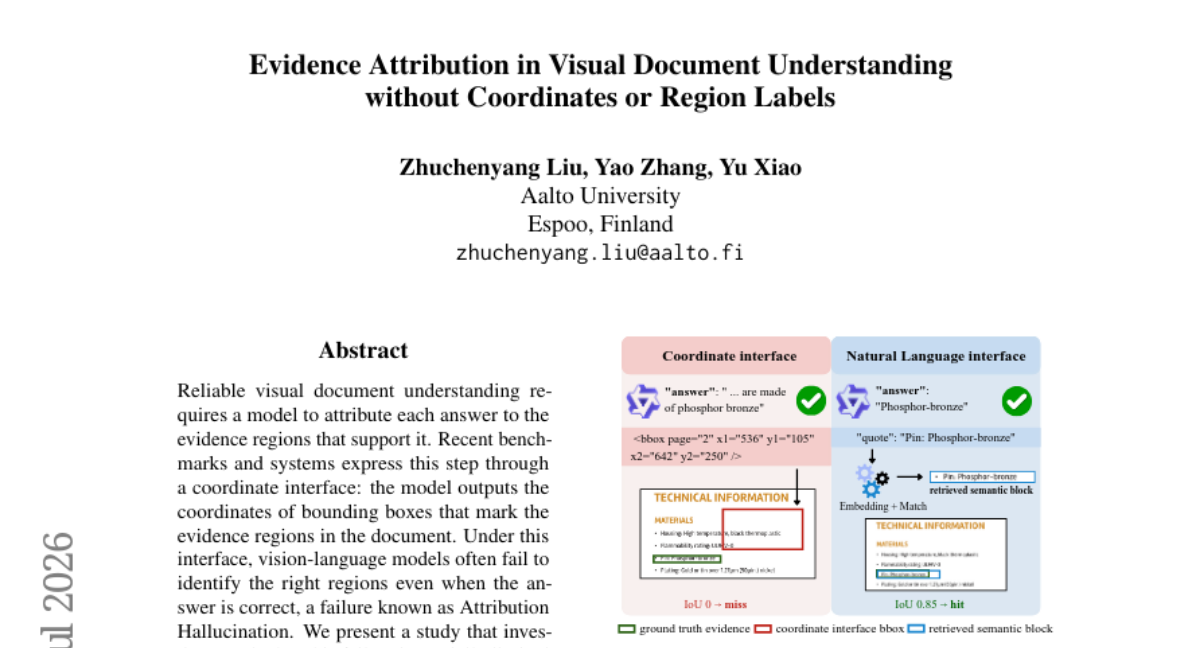
22. Evidence Attribution in Visual Document Understanding without Coordinates or Region Labels
🔑 Keywords: Attribution Hallucination, vision-language models, coordinate interface, language interface, GRPO recipe
💡 Category: Multi-Modal Learning
🌟 Research Objective:
– To investigate whether the limitation of the coordinate interface contributes to Attribution Hallucination in reliable visual document understanding.
🛠️ Research Methods:
– Compared the coordinate interface with a language interface on a bilingual CiteVQA subset using six open vision-language models.
– Utilized a quote-and-retrieve pipeline with a multimodal retriever for evidence attribution.
– Implemented a GRPO recipe as a training scaffold without region-level evidence labels.
💬 Research Conclusions:
– The language interface increased evidence recall and reduced hallucination rates compared to the coordinate interface without compromising answer quality.
– The proposed methods improved strict attributed accuracy from 22.4 to 33.8 on an 8B backbone, suggesting a practical path for improving evidence attribution without costly region-level supervision.
👉 Paper link: https://huggingface.co/papers/2607.24651
23. GNM Head: A Generative aNthropometric Model of the human head
🔑 Keywords: Generative aNthropometric Model, parametric models, high-resolution 3D scans
💡 Category: Generative Models
🌟 Research Objective:
– Introduce the Generative aNthropometric Model (GNM), a comprehensive parametric model for modeling human head anatomy, including intra-oral and ocular structures, for enhanced spatial control in generative vision models.
🛠️ Research Methods:
– Utilization of high-resolution 3D scans combined with high-quality artist-made samples to develop specialized sub-models, especially for ocular and intra-oral structures.
💬 Research Conclusions:
– The GNM demonstrates state-of-the-art performance in fitting target 3D face scans, offering a robust framework for community use by being publicly available.
👉 Paper link: https://huggingface.co/papers/2607.23687
24. FilmBench: A Film-Grade Benchmark for Cinematic Video Generation
🔑 Keywords: Cinematic Language, FilmBench, Text-to-Video (T2V), Reference-to-Video (R2V), AI-generated footage
💡 Category: Generative Models
🌟 Research Objective:
– To introduce FilmBench, a benchmark focused on evaluating video generation through professional Cinematic Language criteria rather than basic benchmarks.
🛠️ Research Methods:
– Reverse-engineering prompts from award-winning film clips across 20 cinematic genres, creating a multi-shot evaluation framework.
– Employing a three-level Cinematic taxonomy for evaluation and developing an automatic evaluation agent, FilmOps.
💬 Research Conclusions:
– The benchmark accurately replicates human model ranking with high Spearman correlations.
– There is a notable performance drop in multi-shot scenarios and gaps in dynamic aesthetics under current models.
👉 Paper link: https://huggingface.co/papers/2607.24241
25. Reasoning Denoiser: Denoising Reasoning Traces for Hallucination Detection in Large Reasoning Models
🔑 Keywords: Large reasoning models, Hallucination detection, REDE, Denoising reasoning traces
💡 Category: Knowledge Representation and Reasoning
🌟 Research Objective:
– The study aims to improve hallucination detection in Large Reasoning Models (LRMs) by addressing reasoning noise issues such as irrelevant and repetitive steps.
🛠️ Research Methods:
– The research introduces REDE, a framework that refines embeddings by using final-answer attention as a supervision signal, enabling effective filtering of noisy reasoning steps.
💬 Research Conclusions:
– REDE enhances hallucination detection accuracy across various benchmarks by effectively identifying and removing noise from reasoning traces, outperforming existing confidence and embedding-based methods.
👉 Paper link: https://huggingface.co/papers/2607.22098

26. ClinFusion: A Vision-Centric Multimodal LLM System for Holistic Medical Understanding
🔑 Keywords: Multimodal large language models, Vision-centric, Clinical practice, Cascade Spatial-Aware Locality Fusion, Factualness-driven
💡 Category: AI in Healthcare
🌟 Research Objective:
– Introduce ClinFusion, a vision-centric MLLM intended to enhance holistic medical understanding and address knowledge absorption from 2D and 3D medical images.
🛠️ Research Methods:
– Develop a compositional and cascaded vision encoder architecture featuring the Cascade Spatial-Aware Locality Fusion operator for unified image understanding.
– Introduce a vision-grounded evaluation framework, including MedIF-Bench, for instruction-following assessment and factualness-driven report generation evaluation.
💬 Research Conclusions:
– ClinFusion sets new state-of-the-art records across a suite of 2D and 3D multimodal medical benchmarks.
– Outperforms leading open-source medical MLLMs and proprietary models in various benchmarks.
– Validated by board-certified radiologists, producing top-ranked reports, and showing strong correlation with expert judgment in evaluations.
👉 Paper link: https://huggingface.co/papers/2607.24743

27. Chamaileon: Cross-Context Binder Design with Contextualized Modeling and Mixed Sampling
🔑 Keywords: Generative Models, Protein Binder Design, Multi-Target, Multi-State, In-Context Complex Co-Design (I3CD)
💡 Category: Generative Models
🌟 Research Objective:
– To develop a unified framework, Chamaileon, that advances protein binder design by integrating multi-target and multi-state binder capabilities.
🛠️ Research Methods:
– Implementation of a training paradigm called In-Context Complex Co-Design (I3CD) for context-aware sequence-structure co-modeling.
– Utilization of Mixture-of-Paths Sampling (MoPS) during inference to optimize sequence design across diverse contexts.
💬 Research Conclusions:
– Chamaileon effectively generates sequences adaptable to complex conformational landscapes and multi-target requirements, as demonstrated on the CROSS benchmark.
– The developed method addresses limitations in existing approaches by enhancing the capability for multi-state and multi-target interactions.
👉 Paper link: https://huggingface.co/papers/2607.23518

28. Oxygen-TryOn: Fashion-Native Foundation Model for Any-item Virtual Try-On
🔑 Keywords: Oxygen-TryOn, virtual try-on, fashion-native, multi-reference, reinforcement learning
💡 Category: Generative Models
🌟 Research Objective:
– To develop Oxygen-TryOn, a foundation model specifically designed for any-item virtual try-on, supporting diverse scenarios and maintaining high realism and subject identity.
🛠️ Research Methods:
– Utilization of a dedicated data engine for collecting and filtering high-quality try-on data.
– Implementation of a three-stage training process: continued pre-training (CPT), supervised fine-tuning (SFT), and reinforcement learning (RL) with hybrid rewards.
💬 Research Conclusions:
– Oxygen-TryOn achieves state-of-the-art consistency and realism in virtual try-on applications, outperforming leading proprietary and open-source systems across benchmarks.
👉 Paper link: https://huggingface.co/papers/2607.21694
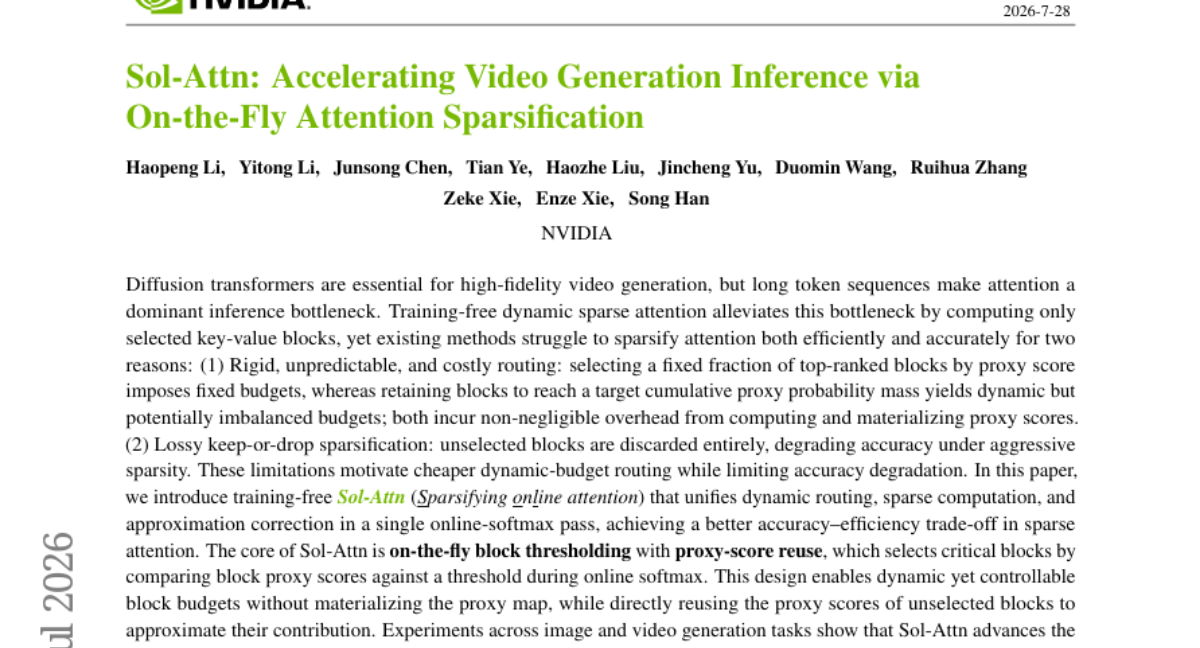
29. Sol-Attn: Accelerating Video Generation Inference via On-the-Fly Attention Sparsification
🔑 Keywords: Diffusion transformers, Sparse attention, Sol-Attn, Video generation
💡 Category: Generative Models
🌟 Research Objective:
– To alleviate the inference bottleneck in high-fidelity video generation caused by long token sequences in diffusion transformers through effective use of dynamic sparse attention.
🛠️ Research Methods:
– Introduction of Sol-Attn (Sparsifying online attention), a training-free method combining dynamic routing, sparse computation, and approximation correction in a single online-softmax pass.
💬 Research Conclusions:
– Sol-Attn significantly improves the accuracy-efficiency trade-off in sparse attention, achieving 2.1x and 2.3x speedups in end-to-end video generation and editing tasks, respectively, while maintaining visual quality.
👉 Paper link: https://huggingface.co/papers/2607.24027
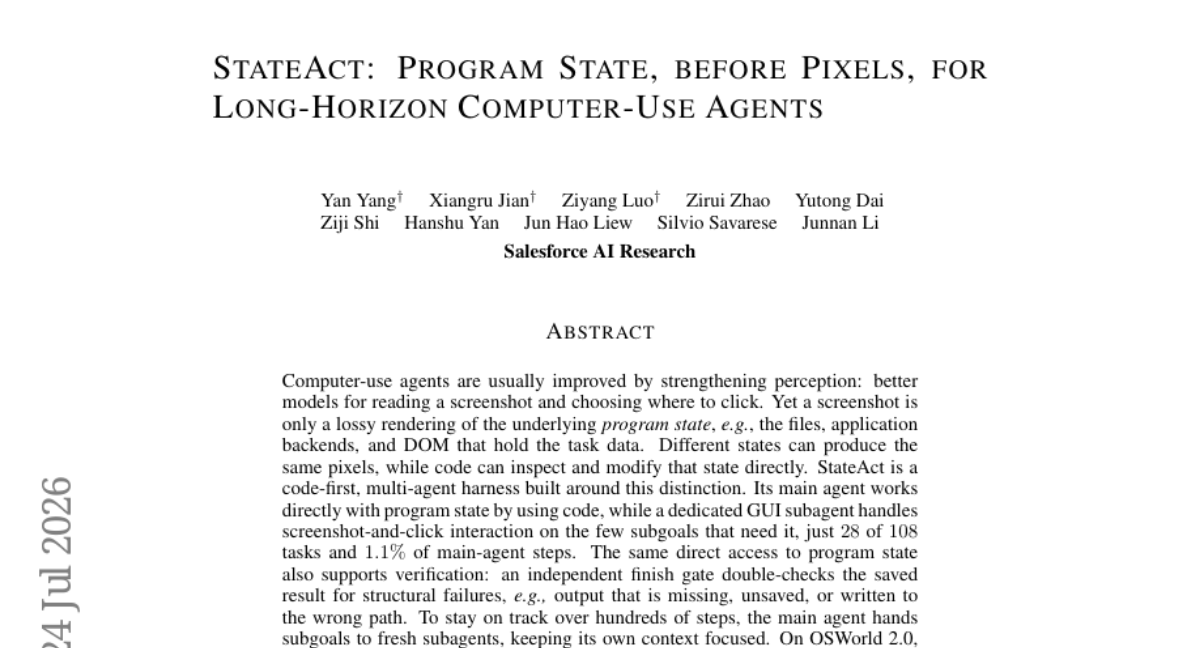
30. StateAct: Program State, before Pixels, for Long-Horizon Computer-Use Agents
🔑 Keywords: StateAct, multi-agent technology, state-grounding
💡 Category: AI Systems and Tools
🌟 Research Objective:
– The paper introduces StateAct, a multi-agent framework designed to improve the efficiency of computer-use agents by focusing on direct interaction with program state rather than solely relying on perception through screenshots.
🛠️ Research Methods:
– StateAct utilizes a primary agent working directly with the program state, while a GUI subagent handles tasks that require interaction with screenshots. This system supports verification through an independent finish gate.
💬 Research Conclusions:
– StateAct enhances existing systems by increasing binary and partial success rates with lower costs per task. It shifts the bottleneck from perception to reasoning by grounding action and verification in program state.
👉 Paper link: https://huggingface.co/papers/2607.22798
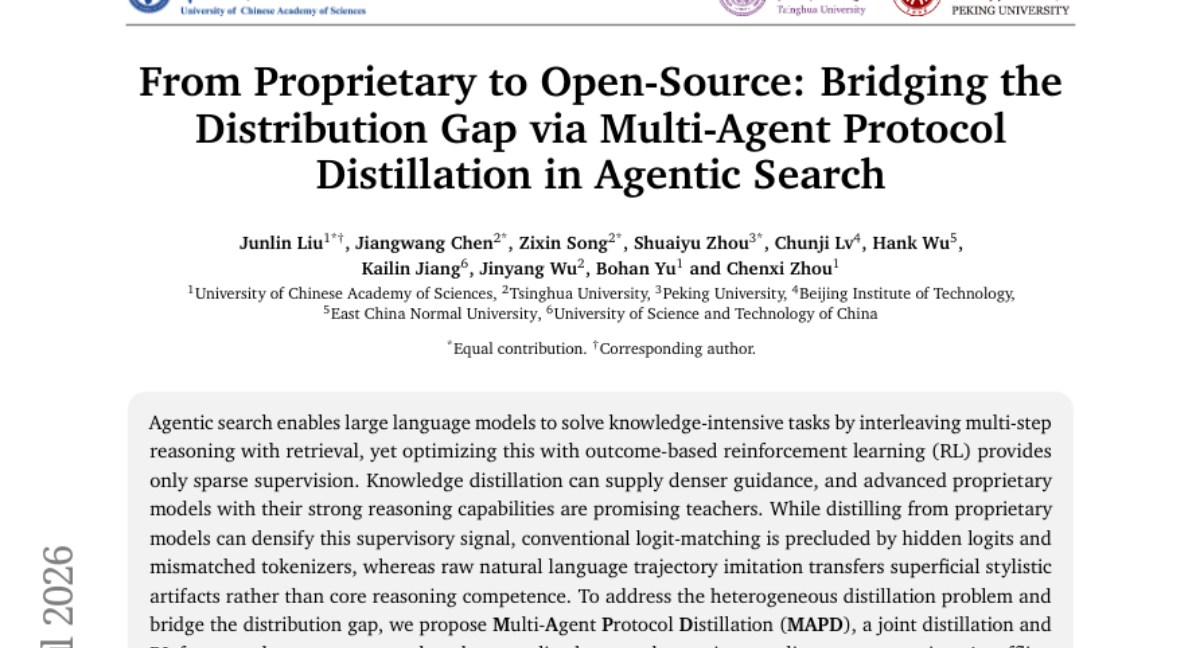
31. From Proprietary to Open-Source: Bridging the Distribution Gap via Multi-Agent Protocol Distillation in Agentic Search
🔑 Keywords: Agentic search, Knowledge distillation, Multi-Agent Protocol Distillation, Reinforcement Learning, Natural Language Processing
💡 Category: Natural Language Processing
🌟 Research Objective:
– The research aims to enhance large language models’ ability to perform knowledge-intensive tasks by integrating multi-step reasoning with effective retrieval, optimizing this with a novel distillation and reinforcement learning approach.
🛠️ Research Methods:
– Multi-Agent Protocol Distillation (MAPD) is employed, combining structured style-normalized protocols with a multi-agent system to manage query decomposition, evidence retrieval, and search optimization, generating JSON protocols for task representation.
💬 Research Conclusions:
– The MAPD framework significantly outperforms competitive methods across seven QA benchmarks, demonstrating robust generalization across various proprietary models and effectively reducing style drift and verbosity issues in student policies.
👉 Paper link: https://huggingface.co/papers/2607.24280
32. JarvisHub: An Open Harness for Canvas-Native Multimodal Creative Agents
🔑 Keywords: Creative AI, long-horizon multimodal production, agent-assisted creative production, JarvisHub
💡 Category: Multi-Modal Learning
🌟 Research Objective:
– The paper introduces JarvisHub, a creative agent harness designed to support long-horizon multimodal creative production, addressing the limitations of current generation systems.
🛠️ Research Methods:
– JarvisHub employs a three-layer architecture, consisting of canvas state, protocol bridge, and agent runtime, to support and manage the creative process on an editable canvas.
💬 Research Conclusions:
– JarvisHub enhances creative production by enabling agents to plan, generate, revise, and organize multimodal projects, allowing users to interact with and guide the creative process.
👉 Paper link: https://huggingface.co/papers/2607.23588