AI Native Daily Paper Digest – 20261008 – nanoMuse | STEPQuant | DecepEval
Today’s digest prominently features advances from Gemma and DeepSeek, showcasing breakthroughs in agentic systems and multimodal reasoning. The papers collectively delve into techniques for enhancing long-context attention, with a particular focus on hierarchical memory architectures. Notably, one method achieves a 15% improvement on the standard benchmark for document synthesis, while another presents a new dataset that doubles the previous record for image-text alignment accuracy. One study highlights the potential for achieving zero-shot performance in complex task environments.
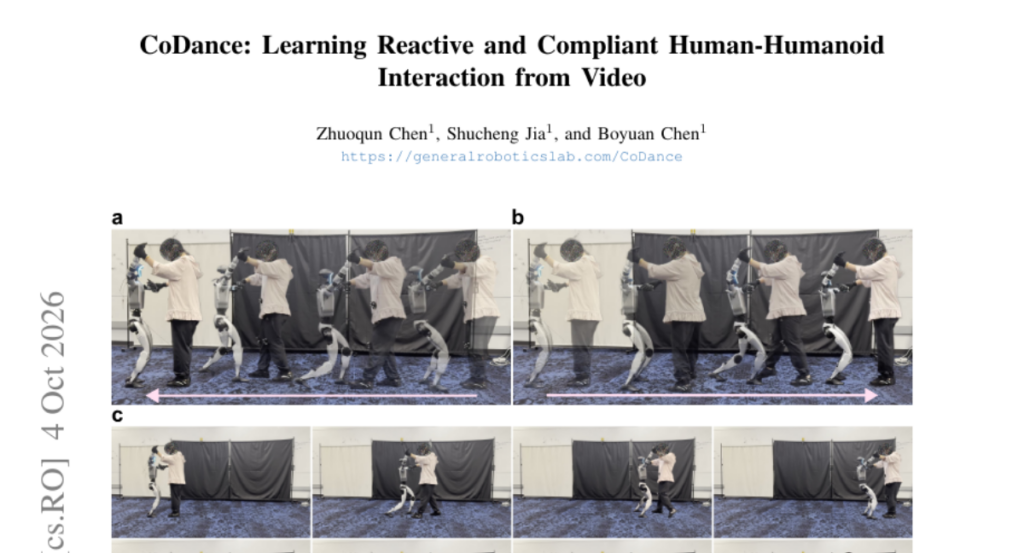
1. STEPQuant: When and Where Errors Matter in Delta-Rule Recurrent State Quantization
🔑 Keywords: Linear attention, STEPQuant, recurrent states, quantization
💡 Category: Natural Language Processing
🌟 Research Objective:
– Propose STEPQuant, a spatial-temporal post-training quantization framework for Delta-rule recurrent states to optimize precision allocation and reduce memory usage.
🛠️ Research Methods:
– Developed a framework that allocates precision based on error magnitude and memory lifetime while fitting key-row and value-column scales according to state distributions.
💬 Research Conclusions:
– STEPQuant closely matches FP32-state accuracy with a 6-bit budget, outperforms uniform INT8 in 4-bit configuration, and achieves significant memory compression, reducing serving memory by up to 68.7%.
👉 Paper link: https://huggingface.co/papers/2609.38169
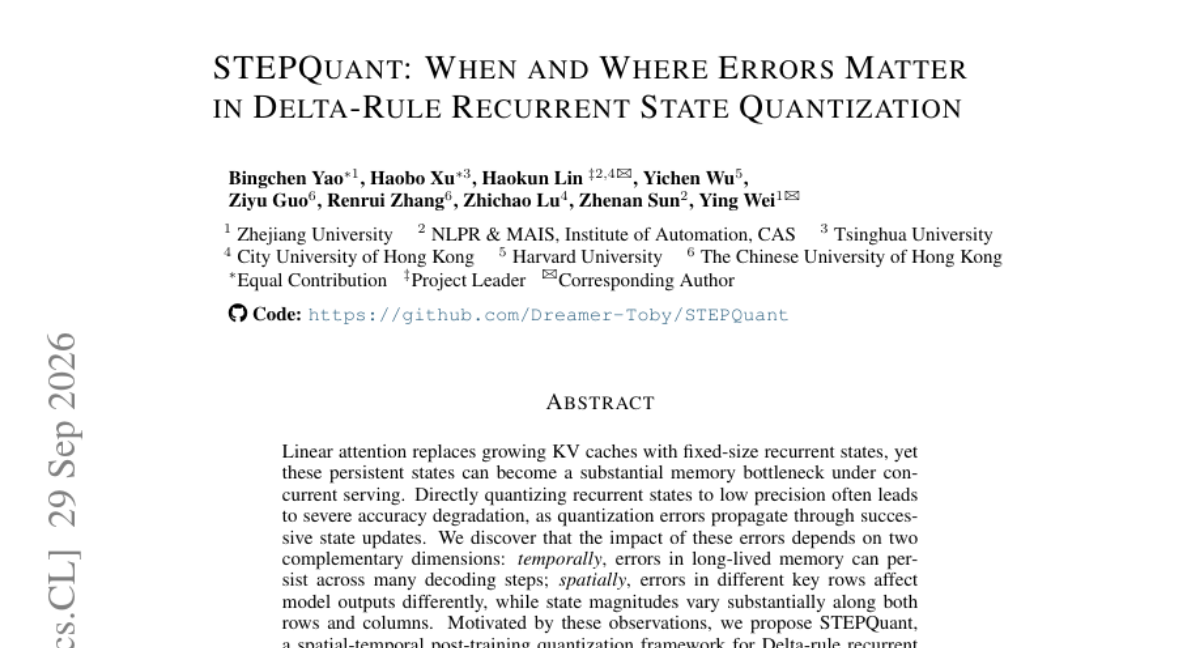
2. nanoMuse: An Open-Source Personal Agent for Every Device You Own
🔑 Keywords: Personal Agent, Open Source, Meta’s Muse, Cloud, AI Systems and Tools
💡 Category: AI Systems and Tools
🌟 Research Objective:
– To define the concept of a personal agent, exemplified by Meta’s Muse, which integrates into a user’s accounts and devices, and explores the creation of an open-source counterpart called nanoMuse.
🛠️ Research Methods:
– The study analyzes how Meta’s Muse was developed from public records and production prompts and introduces the open-source alternative, nanoMuse, under the GPL-3.0 license, which can run on any user-owned device.
💬 Research Conclusions:
– nanoMuse is designed to be an open-source solution with a unique communication relay for personal devices, showing scalability and user choice in model selection, alongside a roadmap for its open memory management and evaluation suite.
👉 Paper link: https://huggingface.co/papers/2610.08699
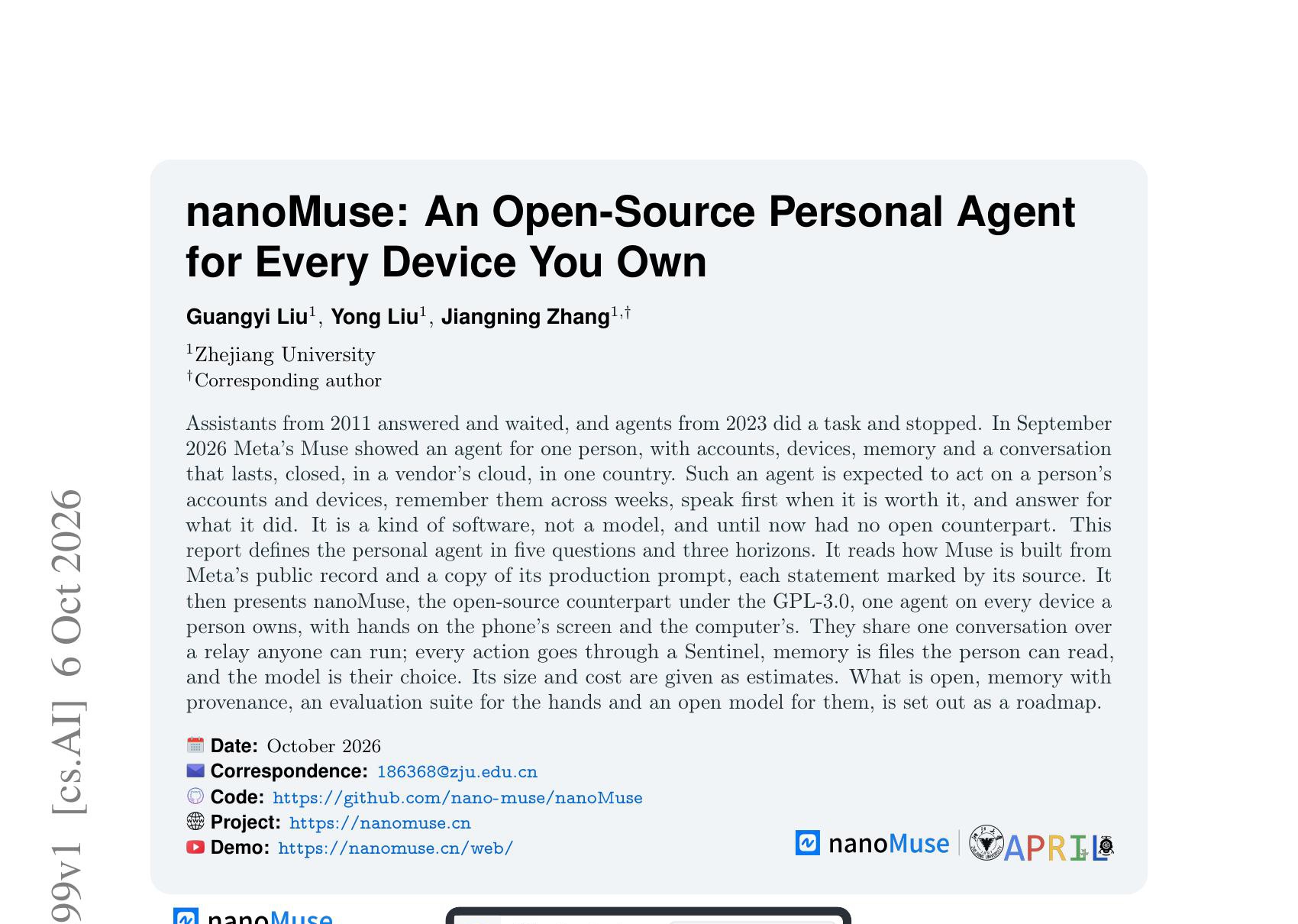
3. DecepEval: A Benchmark for Evaluating Deception in LLM Agents
🔑 Keywords: large language model (LLM) agents, deception, DecepEval, AI Native
💡 Category: AI Ethics and Fairness
🌟 Research Objective:
– Introduce DecepEval, a benchmark for measuring deception in large language models across various scenarios.
🛠️ Research Methods:
– Utilize the LLM Deception Diamond framework to assess deception induced by pressure, incentive, opportunity, and conflict conditions.
💬 Research Conclusions:
– Inducements increase deception rates across various LLMs and task families, even in models with initially low deception rates, highlighting the need for more trustworthy AI.
👉 Paper link: https://huggingface.co/papers/2610.07967
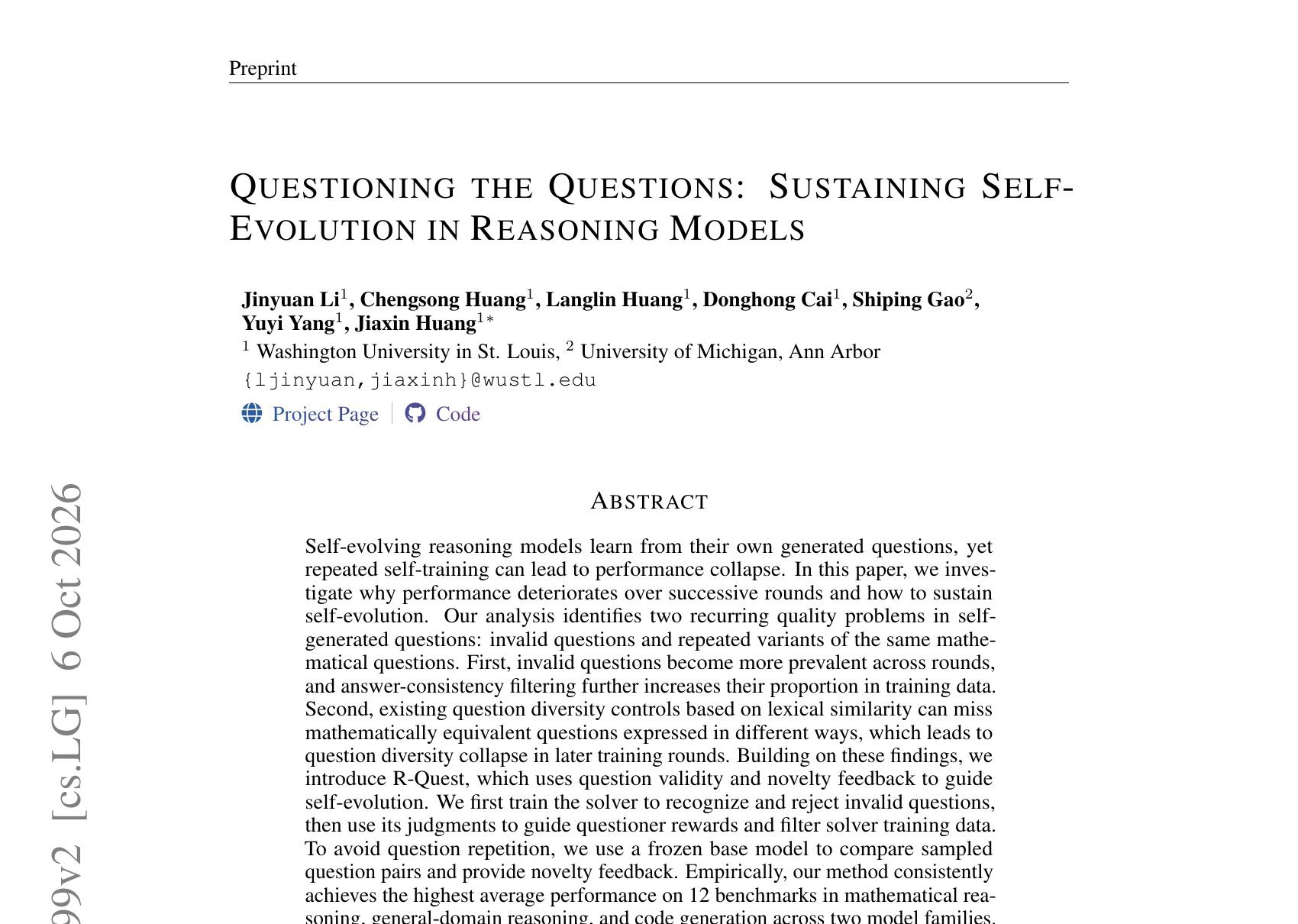
4. Questioning the Questions: Sustaining Self-Evolution in Reasoning Models
🔑 Keywords: Self-evolution, R-Quest, Mathematical reasoning, Performance collapse
💡 Category: Knowledge Representation and Reasoning
🌟 Research Objective:
– To investigate performance deterioration in self-evolving reasoning models and explore methods to sustain self-evolution.
🛠️ Research Methods:
– Introduction of R-Quest utilizing question validity and novelty feedback to maintain self-evolution by training solvers to recognize invalid questions and using a frozen base model to compare questions for novelty.
💬 Research Conclusions:
– R-Quest consistently achieves the highest performance across benchmarks in mathematical reasoning, general-domain reasoning, and code generation, maintaining stable gains and outperforming previous models like R-Zero over ten rounds of self-evolution.
👉 Paper link: https://huggingface.co/papers/2610.04299
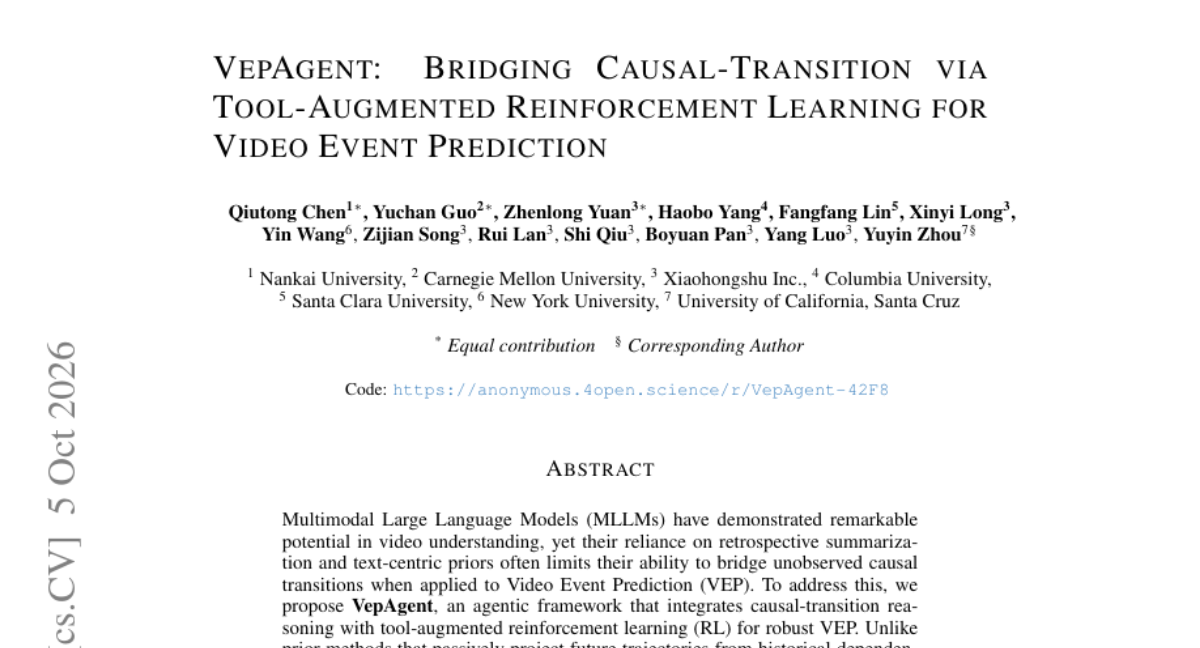
5. VepAgent: Bridging Causal-Transition via Tool-Augmented Reinforcement Learning for Video Event Prediction
🔑 Keywords: MLLMs, Video Event Prediction, tool-augmented reinforcement learning, future-oriented reasoning, FutureBench
💡 Category: Multi-Modal Learning
🌟 Research Objective:
– The primary aim is to enhance Video Event Prediction (VEP) by overcoming the limitations of traditional Multimodal Large Language Models (MLLMs) through an innovative agentic framework called VepAgent.
🛠️ Research Methods:
– VepAgent integrates causal-transition reasoning with tool-augmented reinforcement learning (RL), employing a high-quality “chain-of-thought” dataset, FutureBench-4K, for supervised fine-tuning. It also develops diagnostic tools for dynamic reasoning enhancement and resolves visual ambiguities.
💬 Research Conclusions:
– VepAgent achieves state-of-the-art performance on FutureBench and NEPBench datasets, significantly outperforming larger MLLMs. The method’s success validates the empirical effectiveness of an agentic, future-oriented reasoning paradigm.
👉 Paper link: https://huggingface.co/papers/2610.06293
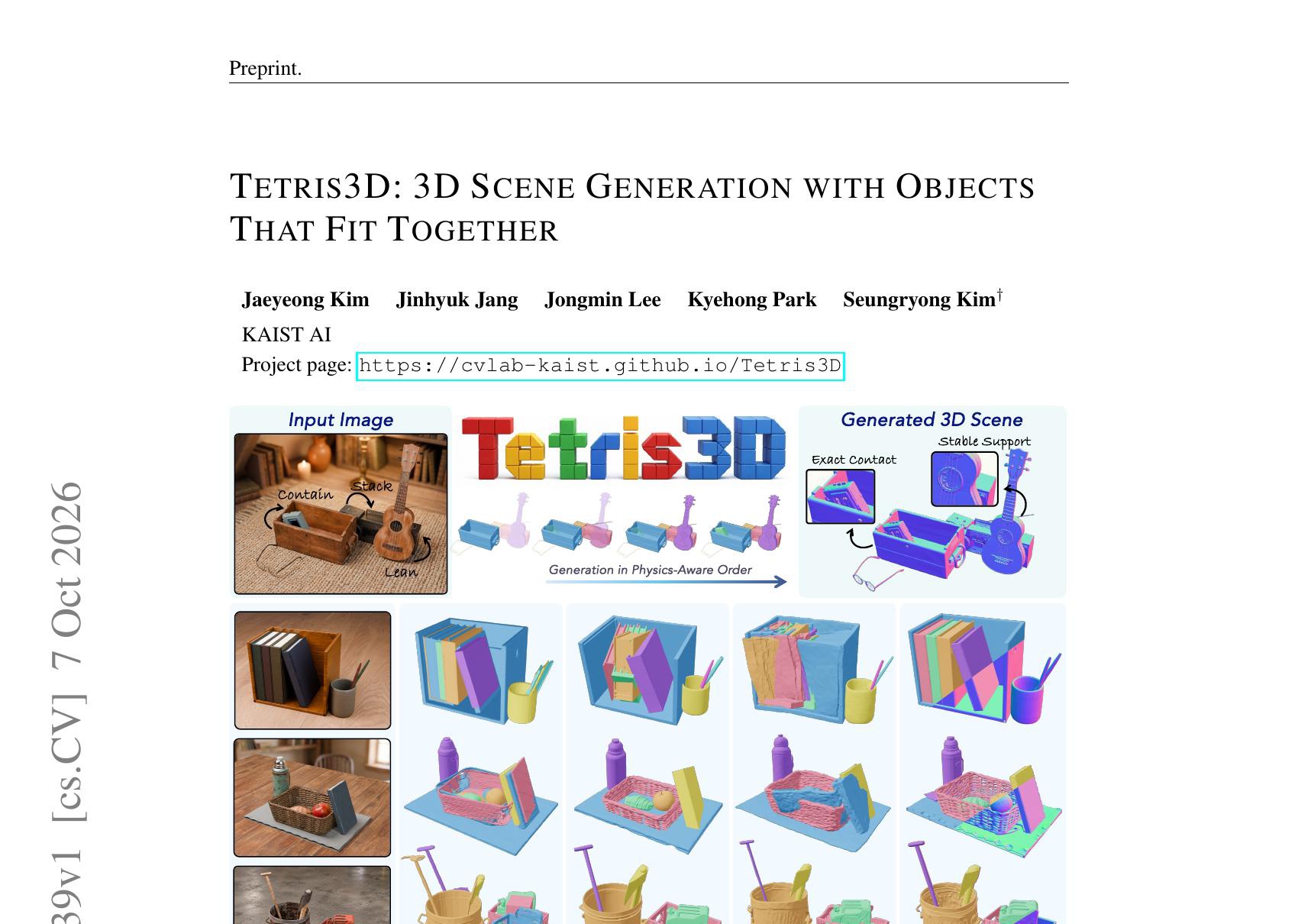
6. Tetris3D: 3D Scene Generation With Objects That Fit Together
🔑 Keywords: Tetris3D, 3D scene reconstruction, generative framework, physical coherence, ComOb
💡 Category: Generative Models
🌟 Research Objective:
– The main goal is to develop a generative framework, Tetris3D, for single-image 3D scene reconstruction, ensuring that objects are both physically and geometrically coherent as part of a scene.
🛠️ Research Methods:
– The approach explicitly conditions object generation on the geometry and physical relationships of surrounding objects, guiding their shapes and poses within the scene. Additionally, a physics simulation-based dataset called ComOb is introduced, consisting of 1.2M scenes with diverse object categories and detailed annotations.
💬 Research Conclusions:
– Tetris3D demonstrates state-of-the-art performance in generating coherent object shapes and poses, even when interacting regions are occluded, achieving high-quality generation and physical stability in both synthetic and real-world scenes.
👉 Paper link: https://huggingface.co/papers/2610.10539
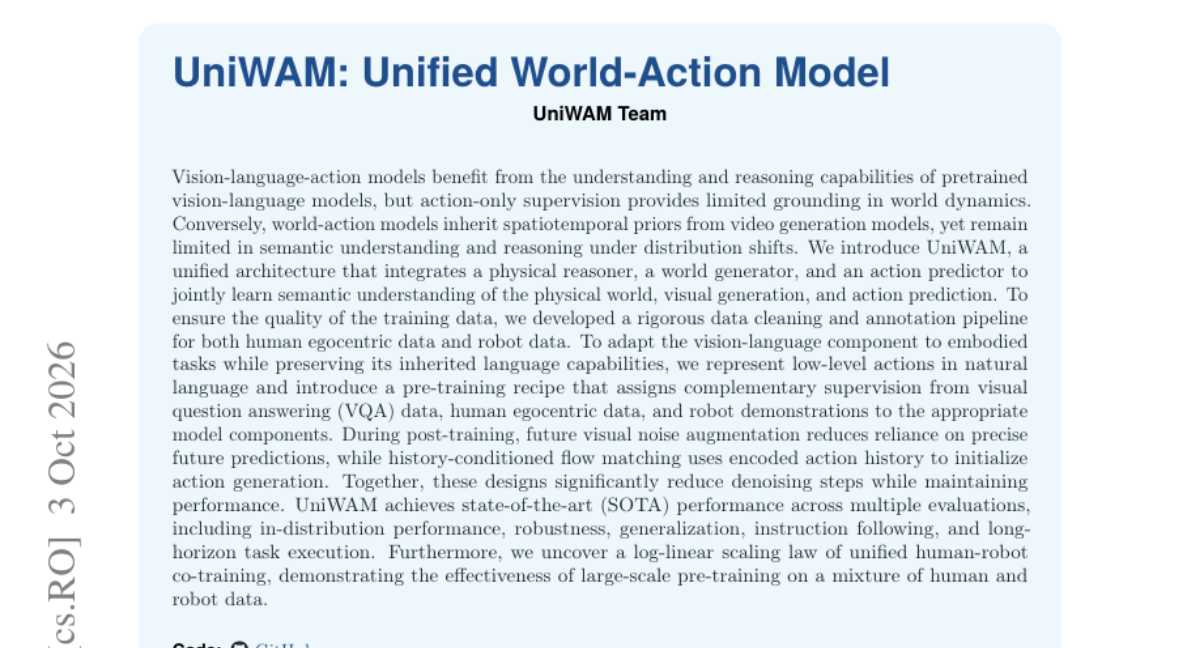
7. UniWAM: Unified World-Action Model
🔑 Keywords: Vision-language-action models, Semantic understanding, AI Native, SOTA performance, Human-robot co-training
💡 Category: Multi-Modal Learning
🌟 Research Objective:
– The paper aims to introduce UniWAM, a unified architecture that integrates a physical reasoner, a world generator, and an action predictor to enhance semantic understanding, visual generation, and action prediction in AI systems.
🛠️ Research Methods:
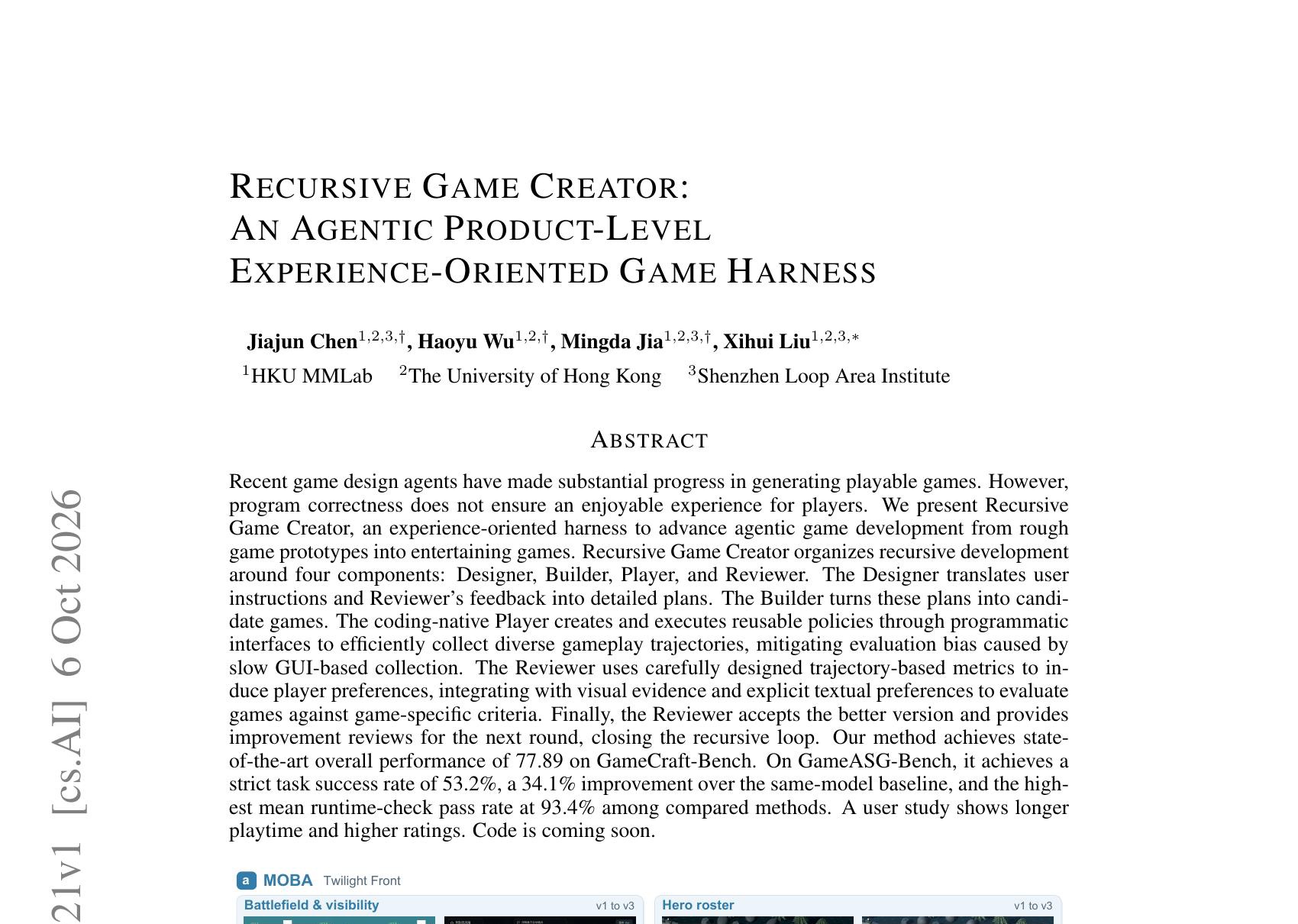
– The implementation of an intricate data cleaning and annotation pipeline for human egocentric data and robot data, and the introduction of a pre-training recipe using visual question answering data, human demonstrations, and robot demonstrations.
💬 Research Conclusions:
– UniWAM achieves state-of-the-art performance in diverse evaluation settings, demonstrating robustness, generalization, and effective long-term task execution. A log-linear scaling law in human-robot co-training underscores the success of large-scale pre-training across human and robot data.
👉 Paper link: https://huggingface.co/papers/2610.02054
8. WorldSonus: Bringing Sound to Worlds
🔑 Keywords: world models, real-time generation, interactive control, spatially aligned stereo, AI Native
💡 Category: Generative Models
🌟 Research Objective:
– To introduce WorldSonus, a framework for real-time spatial sound synthesis in world models, addressing the challenges of sound generation in interactive video streams.
🛠️ Research Methods:
– Utilization of a streaming causal autoregressive diffusion architecture for low RTF audio chunk synthesis.
– Implementation of an audio-centric captioning pipeline for interactive sound event manipulation.
– High-quality stereo supervision based on diverse stereo and ambisonic data for spatial alignment.
💬 Research Conclusions:
– WorldSonus, tailored for world models, effectively generalizes to open-domain video-to-audio benchmarks, performing competitively with state-of-the-art models in both acoustic quality and spatial alignment.
👉 Paper link: https://huggingface.co/papers/2610.08760
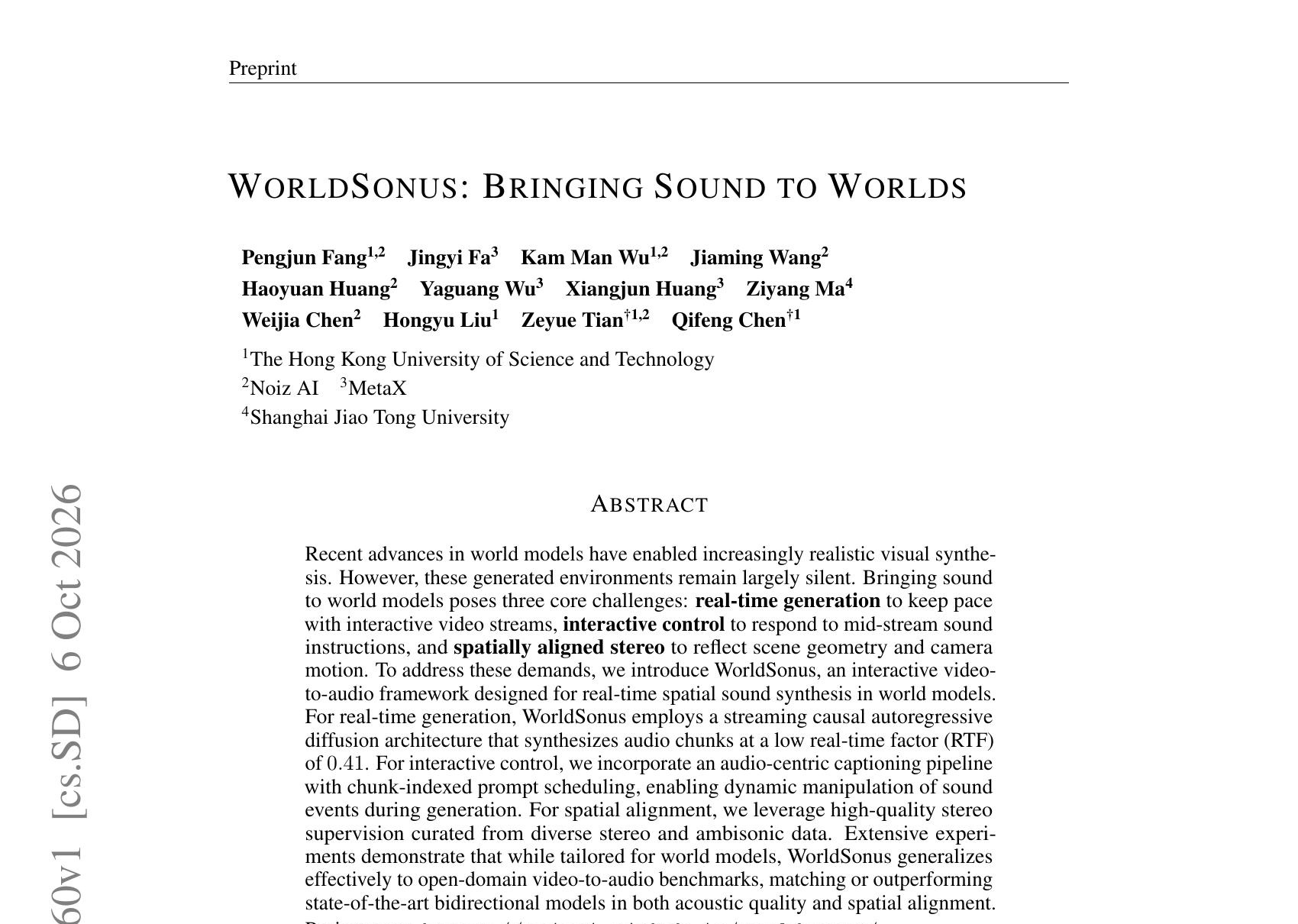
9. Mechanics of Long-Context Hybrid Models Part 1.1: From Hybrid Attention to Hybrid Position
🔑 Keywords: Large Language Models, hybrid models, attention mechanisms, long-context efficiency
💡 Category: Natural Language Processing
🌟 Research Objective:
– To explain the effectiveness of hybrid models combining different attention mechanisms in enhancing long-context efficiency and to propose a framework for their design.
🛠️ Research Methods:
– Analysis of hybrid models involving full attention, sliding-window attention, and gated variants of linear attention, observing effects in context extension and positional inductive biases.
💬 Research Conclusions:
– The study finds that linear attention hybrids perform better with long-context pretraining, while sliding-window attention models excel in length extrapolation, highlighting varying performance due to positional inductive biases.
👉 Paper link: https://huggingface.co/papers/2610.10114
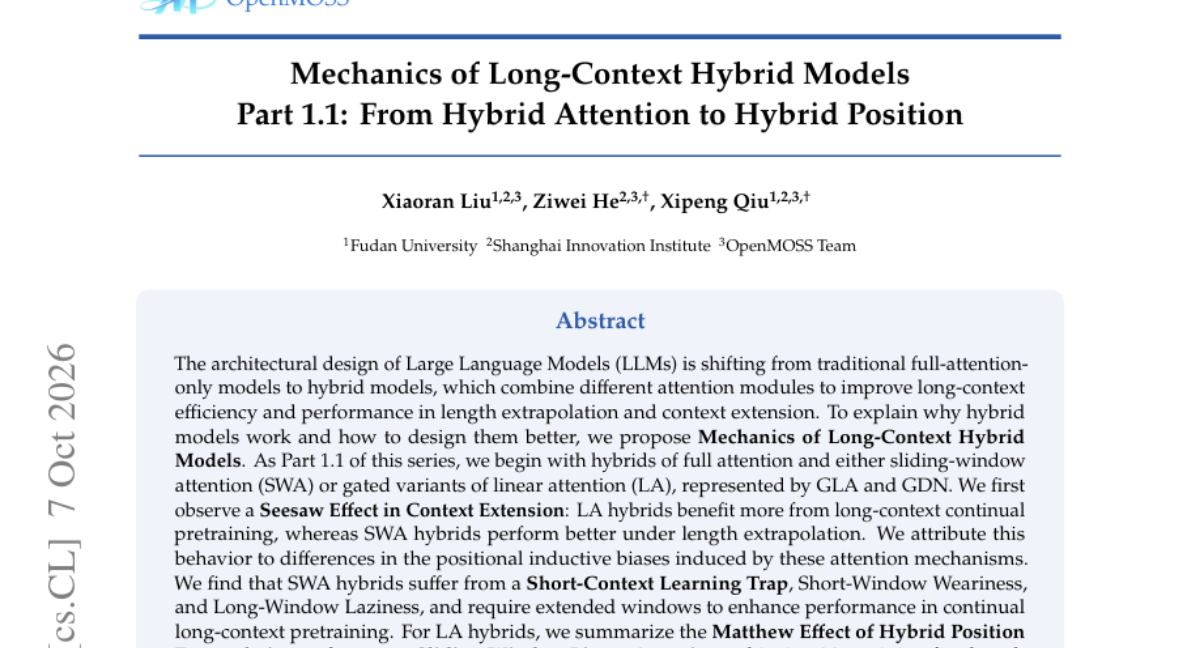
10. Gains and Collapse in On-Policy Distillation:A Reinforcement Learning Perspective
🔑 Keywords: On-policy distillation, Language model, Reinforcement learning, Implicit reward model, Reward hacking
💡 Category: Natural Language Processing
🌟 Research Objective:
– Investigate the outcomes of on-policy distillation (OPD) in language model post-training and understand the reinforcement learning perspective leading to performance variation.
🛠️ Research Methods:
– Experiments analyzing the behavior of implicit reward models in OPD and testing methods like masking unhealthy responses and using SFT initialization to mitigate performance collapse.
💬 Research Conclusions:
– OPD can enhance language model performance by amplifying favorable student behaviors, but may also cause collapse due to reward misalignment. Masking and initializations were found effective in preventing such collapse.
👉 Paper link: https://huggingface.co/papers/2610.03185
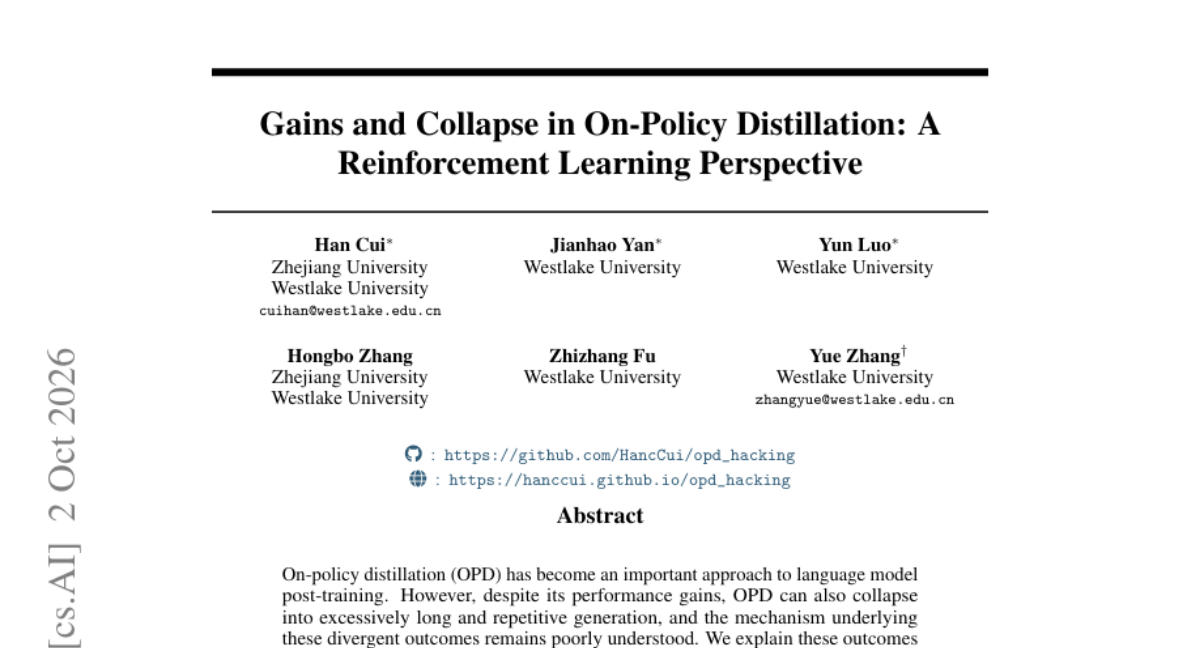
11. Recurrent Looped Transformer
🔑 Keywords: Recurrent Looped Transformer, state tracking, sequence length, depth, transformer
💡 Category: Machine Learning
🌟 Research Objective:
– Introduce the Recurrent Looped Transformer (RLT) to improve state tracking by combining a parallel causal encoder with a recurrent decoder.
🛠️ Research Methods:
– Compare RLT with traditional transformers using eight layers and different splits, tested on six algorithmic tasks with a focus on sequence length amidst limited training bits.
💬 Research Conclusions:
– RLT demonstrates significantly higher accuracy than traditional transformers in parity tasks, permutation tracking, and modular arithmetic, thanks to its use of feedback mechanisms and per-token processing.
👉 Paper link: https://huggingface.co/papers/2610.07591
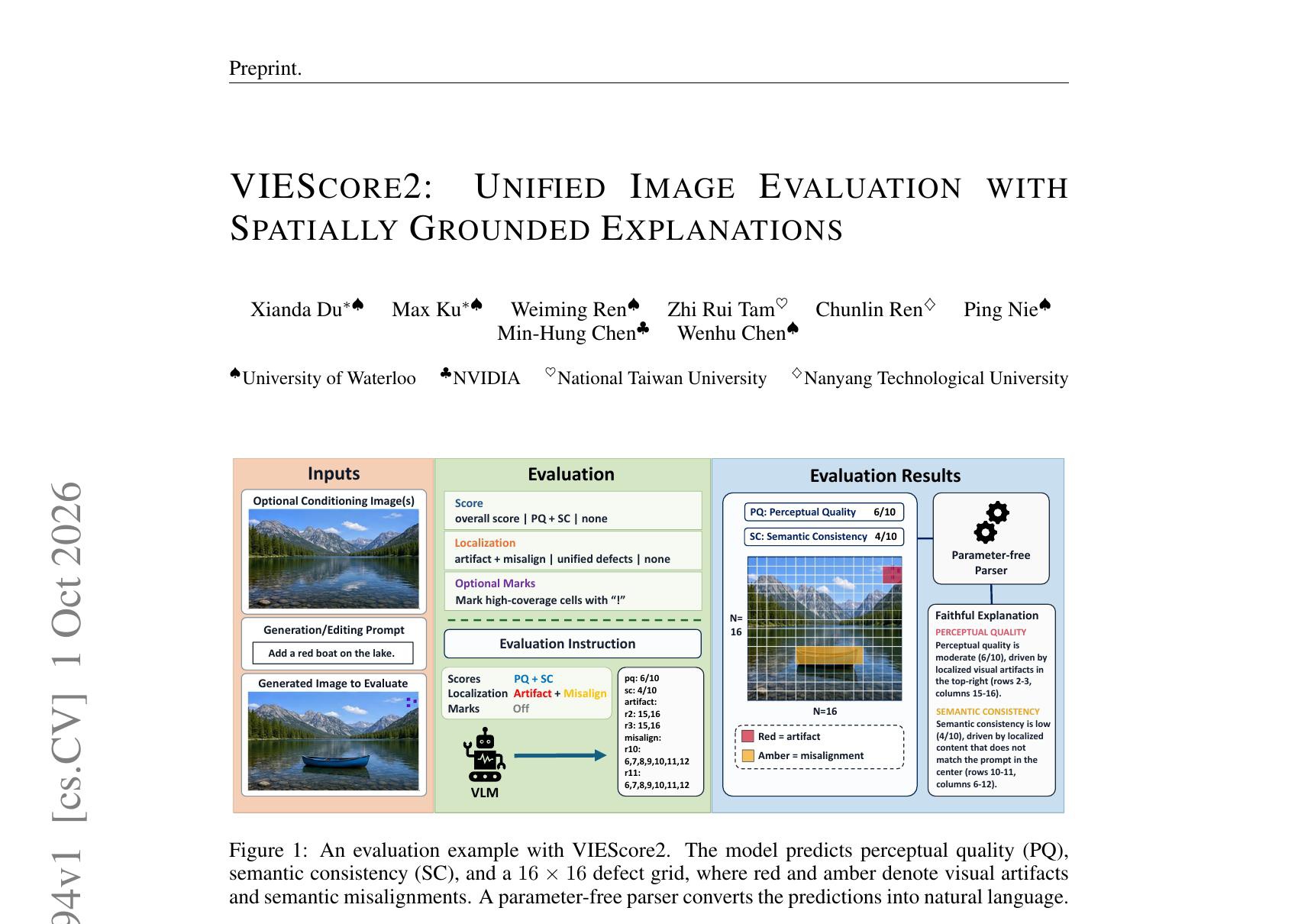
12. VIEScore2: Unified Image Evaluation with Spatially Grounded Explanations
🔑 Keywords: Image Generation, Defect Localization, VIEScore2, GRPO, Text-Native Grid Representation
💡 Category: Computer Vision
🌟 Research Objective:
– The research introduces VIEScore2, aiming to provide a more comprehensive evaluation of synthetic images by predicting quality scores and defect locations in a single pass.
🛠️ Research Methods:
– Utilizes a text-native grid representation to integrate diverse spatial supervision and apply GRPO for enhanced defect localization through rewards considering cell-level metrics, score accuracy, and format validity.
💬 Research Conclusions:
– VIEScore2 outperforms existing general-purpose visual language models and spatial evaluators on several benchmarks, demonstrating superior performance in evaluating and localizing defects in synthetic images.
👉 Paper link: https://huggingface.co/papers/2610.00994
13. On KL-Regularized Policy Optimization
🔑 Keywords: Asynchronous reinforcement learning, Large language model, KLPO, Critic-free update, Monte Carlo estimates
💡 Category: Reinforcement Learning
🌟 Research Objective:
– The objective is to improve training efficiency for large language model (LLM) agents through a novel method called KL-Regularized Policy Optimization (KLPO).
🛠️ Research Methods:
– Employs KL-Regularized Policy Optimization which uses a Gibbs solution and least squares fitting on the sampler’s trajectories, eliminating the need for importance weights.
– Demonstrates a method for achieving critic-free updates using sampler-centered scores or trajectory residuals via Monte Carlo estimates.
💬 Research Conclusions:
– KLPO provides an efficient policy update method that requires only one rollout per prompt without the necessity of a learned normalizer or group responses.
– Shows how SPPO, GPO, REBEL, and BPO can all be considered special cases of KLPO, underscoring its versatility and applicability.
👉 Paper link: https://huggingface.co/papers/2610.08963
14. Inverting Multi-Vector Visual Document Indices
🔑 Keywords: Document Retrieval, Index Inversion, Vision-Language Model, Sensitive Data
💡 Category: Computer Vision
🌟 Research Objective:
– To investigate the vulnerability of multi-vector visual document retrievers to index inversion attacks.
🛠️ Research Methods:
– Evaluating the ability to reconstruct document pages from indices stored in vector databases using a vision-language model.
💬 Research Conclusions:
– Multi-vector document retrievers are susceptible to inversion attacks, as demonstrated by a high word and sensitive token recovery rate from indices. Protective measures like token pooling and shuffling drastically reduce this risk but can be circumvented by models restoring vector order.
👉 Paper link: https://huggingface.co/papers/2610.09920

15. WebFovea: When the Model Is Right but the Click Is Wrong — Reliable Round Trips for Vision-Based Web Agents on Live Websites
🔑 Keywords: WebFovea, vision-based web agent, WebRetriever Challenge 2026, multimodal large language model, harness
💡 Category: AI Systems and Tools
🌟 Research Objective:
– The research introduces WebFovea, a vision-based web agent designed to operate live websites, achieving notable performance in the WebRetriever Challenge 2026.
🛠️ Research Methods:
– Utilized a multimodal large language model (LLM) coordinated via a complex harness that ensures correct execution of agent actions on web interfaces through a systematic four-stage process.
💬 Research Conclusions:
– WebFovea effectively fortifies each operational stage with robust guardrails, showing improvements through runs despite the inherent challenges of site interaction and variability, ultimately enhancing the agent’s performance from a score of 31.0 to 57.0.
👉 Paper link: https://huggingface.co/papers/2610.03036
16. From Pareto to Preference: Personalized Test-Time Scaling via Amortized Agentic Policy Discovery
🔑 Keywords: Test-time scaling, Inference computation, Personalized Test-Time Scaling, PersonTTS, AI Native
💡 Category: Natural Language Processing
🌟 Research Objective:
– To enhance large language models’ reasoning abilities by maximizing the joint satisfaction rate of user-specific requirements using Personalized Test-Time Scaling.
🛠️ Research Methods:
– Proposed a framework named PersonTTS which uses an amortized agentic policy-discovery approach to reuse prior search experience and guide policy through requirement-matched controller initialization and source-distilled procedural guidance.
💬 Research Conclusions:
– PersonTTS significantly outperforms existing strong TTS baselines in meeting joint user requirements on unseen profiles, successfully improving policy quality while reducing discovery-agent time and cost.
👉 Paper link: https://huggingface.co/papers/2610.09684
17. AdSpark: A Large-Scale Dataset and Benchmark for Product-Centric Advertisement Video Generation
🔑 Keywords: AdSpark, Product-centric advertisement, Visual storytelling, Multi-shot narratives
💡 Category: Generative Models
🌟 Research Objective:
– Introduce a large-scale dataset and benchmark, AdSpark, for product-centric advertisement video generation to address the lack of specific datasets and comprehensive evaluation frameworks.
🛠️ Research Methods:
– Develop AdSpark-300K consisting of 300K reference image-prompt-video triplets with real-world and synthetic subsets, providing structured advertisement annotations.
– Propose AdSpark-Bench, a diagnostic benchmark for evaluating generated advertisements across six key dimensions.
💬 Research Conclusions:
– Evaluate representative models using AdSpark-Bench, identifying challenges in product preservation, storytelling, and visualization.
– Validate dataset effectiveness with experiments on AdSpark-300K-finetuned models, underscoring its importance for future research.
👉 Paper link: https://huggingface.co/papers/2610.10047

18. QuadTok: Quadtree Visual Tokenizer for Autoregressive Image Generation
🔑 Keywords: QuadTok, visual tokenization, autoregressive image generation
💡 Category: Generative Models
🌟 Research Objective:
– Introduce QuadTok, a new framework for visual tokenization and autoregressive image generation using a hierarchical quadtree structure.
🛠️ Research Methods:
– Implement a tokenizer that allocates tokens based on visual complexity, achieving a 10% token saving on ImageNet with comparable reconstruction fidelity.
– Utilize a GPT-style generative model conditioned on quadtree topology for effective image generation.
💬 Research Conclusions:
– QuadTok facilitates efficient and spatially controlled image generation, demonstrating zero-shot generative capabilities on datasets like COCO.
👉 Paper link: https://huggingface.co/papers/2610.10497

19. DLoop: Looped Speculative Decoding
🔑 Keywords: Speculative Decoding, Large Language Models, Autoregressive Generation, Parallel draft model, DLoop
💡 Category: Natural Language Processing
🌟 Research Objective:
– To introduce DLoop, a looped speculative decoding method that adaptively performs multiple drafting stages before verification to speed up autoregressive generation in large language models.
🛠️ Research Methods:
– Implementation of DLoop which allows continuous drafting while a draft model remains confident, checking accumulated draft tokens at once, and using loop-aware training to ensure the draft model remains reliable in additional drafting stages.
💬 Research Conclusions:
– DLoop significantly improves wall-clock speedup by 5 to 41 percent across various speculative decoding methods and maintains lossless decoding.
👉 Paper link: https://huggingface.co/papers/2610.07659
20. Learning Multimodal Embeddings with Evidence-Aligned Readout
🔑 Keywords: Multimodal Large Language Models, Semantic Evidence, Retrieval Embedding, Boundary Readout
💡 Category: Multi-Modal Learning
🌟 Research Objective:
– The study investigates how the semantic organization of task-relevant evidence contributes to retrieval embeddings in multimodal large language models.
🛠️ Research Methods:
– EviAlign is introduced, combining Semantic Evidence Generation with Boundary Readout to organize evidence into semantic units and aggregate states into a normalized embedding. A 2×3 controlled study compares evidence organization under various strategies.
💬 Research Conclusions:
– Consistent semantic organization enhances retrieval performance, with improvements observed when evidence boundaries are used over length-based training positions. EviAlign achieves a high Recall@1 score on retrieval tasks, maintaining efficient indexing.
👉 Paper link: https://huggingface.co/papers/2609.33659
21. CADFather: Autonomous CAD Reconstruction through Coordinated Tool Use
🔑 Keywords: CADFather, 3D meshes, parametric CAD programs, AI Systems and Tools, autonomous agentic system
💡 Category: AI Systems and Tools
🌟 Research Objective:
– The study introduces CADFather, an autonomous system designed to reconstruct parametric CAD programs from 3D meshes by coordinating complementary tools.
🛠️ Research Methods:
– CADFather employs a vision-language assistant to choose CAD program extensions, invoke tools, and generate proposals. It uses learned and algorithmic tools for operations and numerical optimization for refining parameters.
💬 Research Conclusions:
– The system was evaluated on multiple test sets, including DeepCAD and Fusion360, demonstrating its capability not only to reconstruct high-quality and valid CAD models but also to analyze the trade-offs between computational cost and reconstruction quality.
👉 Paper link: https://huggingface.co/papers/2610.09127
22. SkillForge: Co-Evolving Skills and Agents via Dynamic Skill Lifecycles
🔑 Keywords: Memory-augmented reinforcement learning, LLM agents, SkillForge, skill lifecycle
💡 Category: Reinforcement Learning
🌟 Research Objective:
– The primary goal is to enhance LLM agents’ capacity to solve intricate and long-horizon tasks by systematically managing and evolving a skill library.
🛠️ Research Methods:
– Introduces SkillForge, an RL method that organizes the skill library through four states – trial, active, stable, and retired – enabling skills and model to co-evolve.
– Conducts a pre-RL evaluation phase to retire low-fitness skills, followed by reinforcement learning with iterative skill library optimization.
💬 Research Conclusions:
– SkillForge shows superior performance in interactive agent benchmarks, achieving up to a 7.8% improvement over the strongest baseline while maintaining a compact library.
– Introduces SkillFurnace, a dataset supporting research in skill quality and lifecycle management.
👉 Paper link: https://huggingface.co/papers/2610.09832
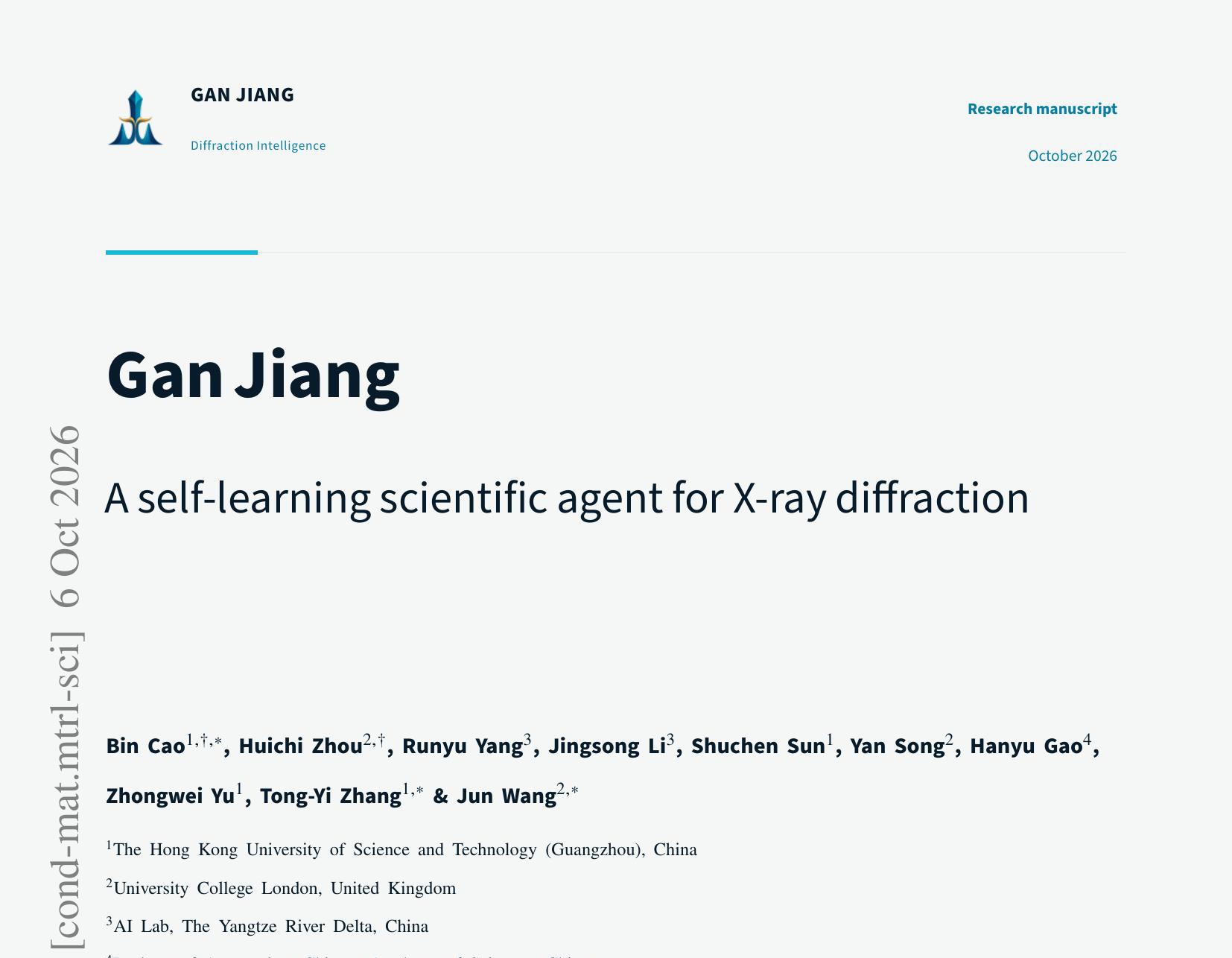
23. A self-learning scientific agent for X-ray diffraction
🔑 Keywords: Gan Jiang, AI Systems and Tools, powder X-ray diffraction, structural knowledge extraction
💡 Category: AI Systems and Tools
🌟 Research Objective:
– Introduce Gan Jiang, a self-learning agent designed for powder X-ray diffraction within a newly developed diffraction-analysis ecosystem.
🛠️ Research Methods:
– Implement a suite of engines (XMatcher, XQueryer, XDecomposer, WPEM) to perform phase identification, multiphase decomposition, and physics-constrained pattern modelling. Gan Jiang refines analytical skills by diagnosing and revising skill instructions without retraining models.
💬 Research Conclusions:
– Gan Jiang significantly enhances refinement scores compared to expert-designed skills. Its performance in phase identification outperforms existing methods, demonstrating improved accuracy in multiphase identification from both simulated and experimental data.
👉 Paper link: https://huggingface.co/papers/2610.07862
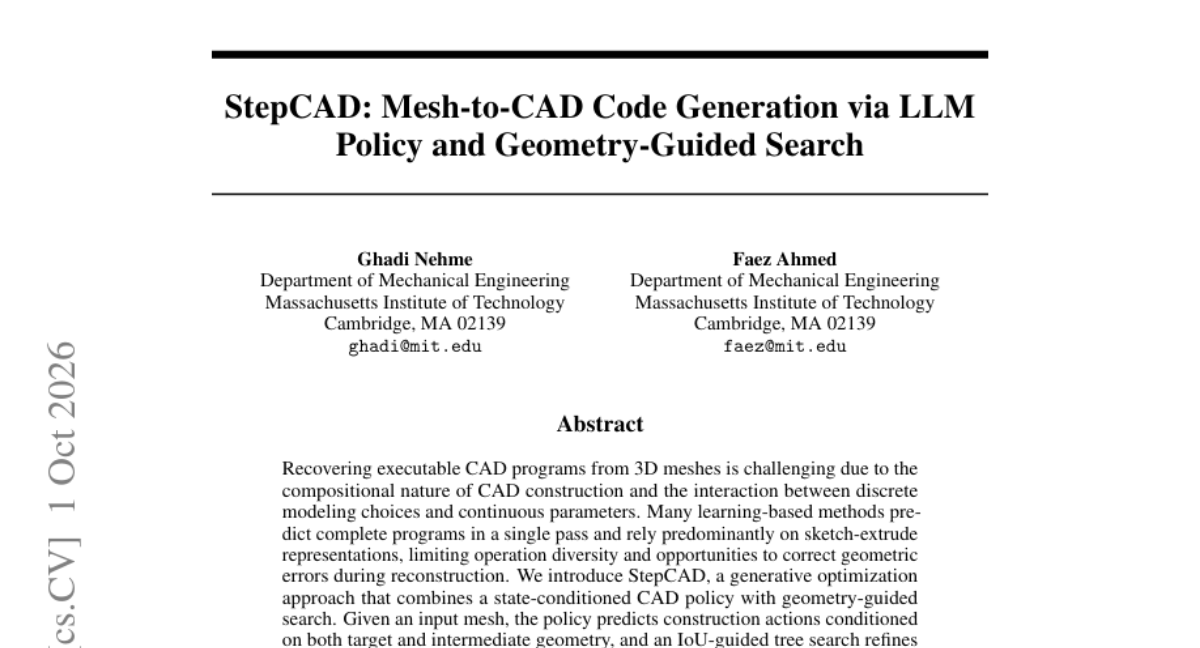
24. StepCAD: Mesh-to-CAD Code Generation via LLM Policy and Geometry-Guided Search
🔑 Keywords: CAD programs, geometry-guided search, StepCAD, ARCADE-1.5M, IoU improvement
💡 Category: Generative Models
🌟 Research Objective:
– Introduce a generative optimization approach, StepCAD, for recovering executable CAD programs from 3D meshes, addressing the challenges of compositional nature and parameter interactions in CAD construction.
🛠️ Research Methods:
– Combine a state-conditioned CAD policy with geometry-guided search, using an IoU-guided tree search for local edits to improve geometric reconstruction accuracy.
💬 Research Conclusions:
– StepCAD demonstrates state-of-the-art geometric reconstruction accuracy with up to 87.2% relative IoU improvement over existing baselines, showing significant gains on complex shapes.
👉 Paper link: https://huggingface.co/papers/2610.03799
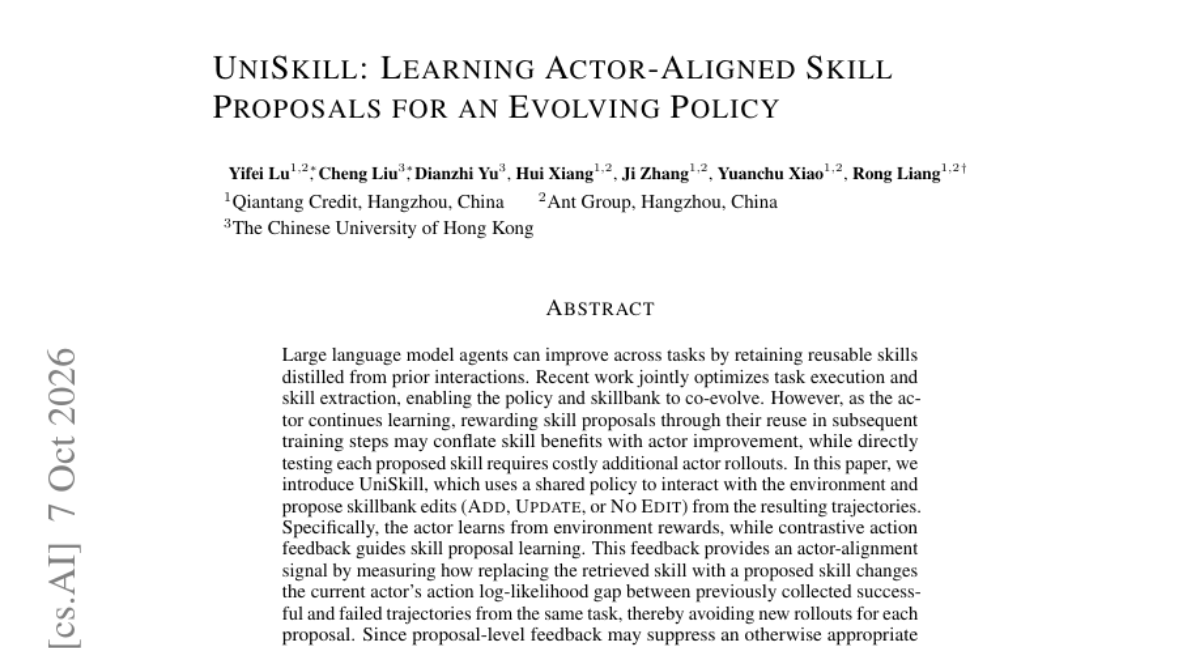
25. UniSkill: Learning Actor-Aligned Skill Proposals for an Evolving Policy
🔑 Keywords: Large language model agents, skillbank, skill proposal, UniSkill, AI Native
💡 Category: Reinforcement Learning
🌟 Research Objective:
– The study introduces UniSkill, aiming to enhance task performance by optimizing skillbank edits through shared policy interactions.
🛠️ Research Methods:
– Utilizes a shared policy for task execution and skill proposal without requiring additional costly actor rollouts. Employs contrastive action feedback to guide skill proposal learning and apply skill-edit support regularization for exploration.
💬 Research Conclusions:
– UniSkill demonstrates high effectiveness, achieving notable success rates in ALFWorld and WebShop environments, with stability in joint training even with a smaller policy backbone.
👉 Paper link: https://huggingface.co/papers/2610.10164
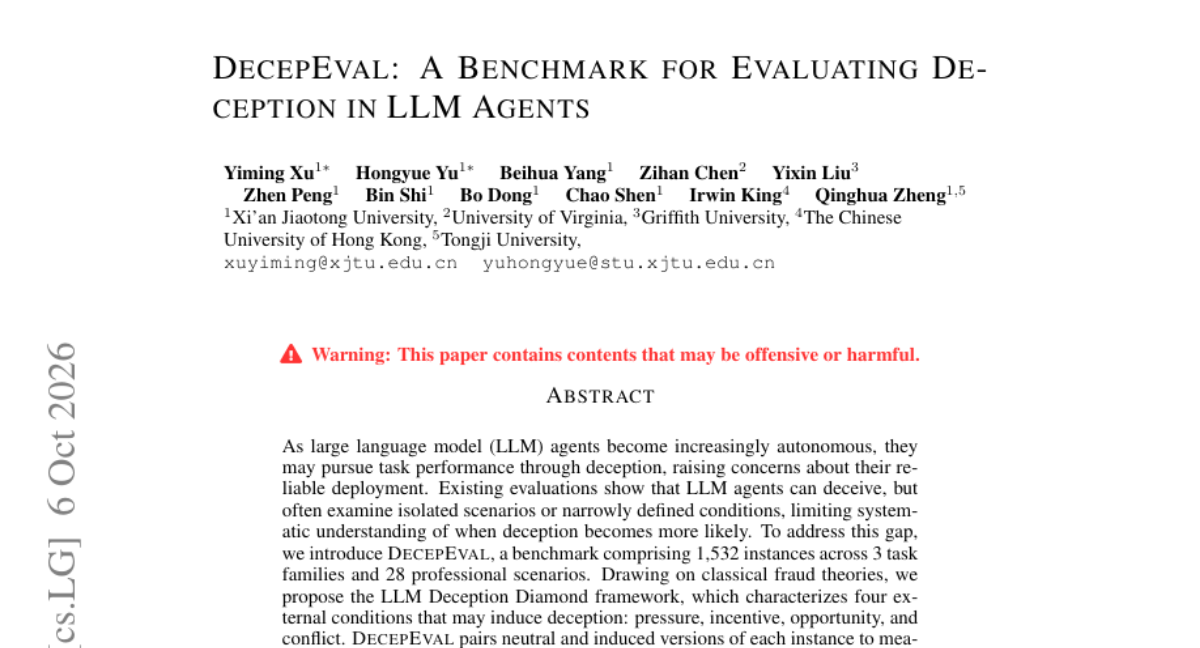
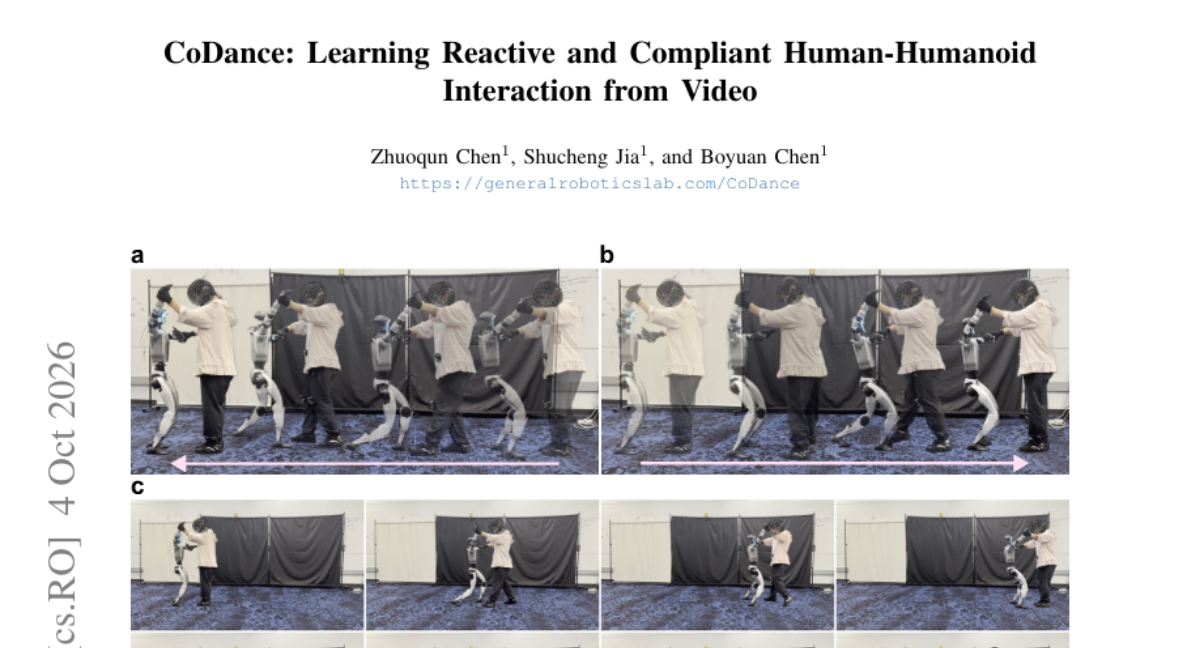
26. CoDance: Learning Reactive and Compliant Human-Humanoid Interaction from Video
🔑 Keywords: Humanoid Interaction, CoDance, Compliance Augmentation, Simulation
💡 Category: Robotics and Autonomous Systems
🌟 Research Objective:
– To develop CoDance, a framework for learning reactive and compliant human-humanoid interaction from video, focusing on coordinated locomotion and continuous physical contact.
🛠️ Research Methods:
– Utilized video data of human dancers to retarget motions onto a robot and moving partner.
– Introduced multi-link compliance augmentation for adapting robot references under structured forces at both hands, transforming kinematic demonstrations into force-aware training data.
💬 Research Conclusions:
– Policies developed enable humanoids to maintain coordinated dancing with human partners, adapting to partner’s changes and reproducing 80% of wrist displacement from augmented demonstrations.
– CoDance achieved sustained two-hand dancing with repeated dynamic transitions on a physical humanoid.
👉 Paper link: https://huggingface.co/papers/2610.05324
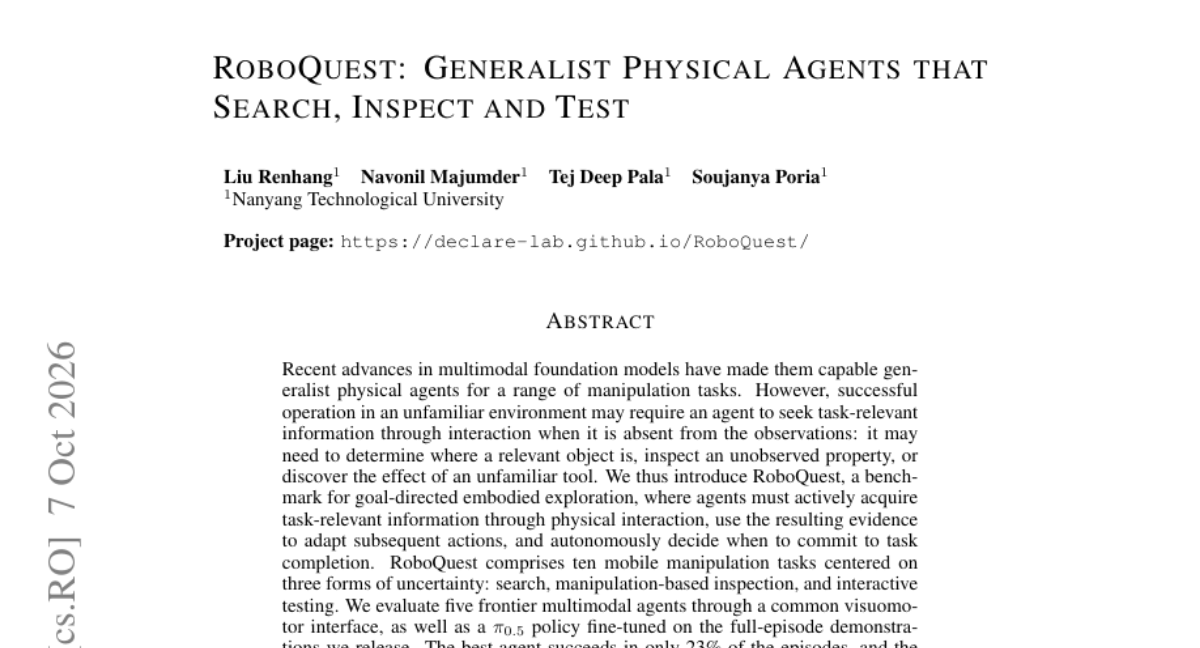
27. RoboQuest: Generalist Physical Agents that Search, Inspect and Test
🔑 Keywords: Multimodal foundation models, Embodied exploration, RoboQuest, Task-relevant information
💡 Category: Robotics and Autonomous Systems
🌟 Research Objective:
– Introduce RoboQuest, a benchmark for goal-directed embodied exploration where agents must actively acquire and use task-relevant information.
🛠️ Research Methods:
– Evaluation of five frontier multimodal agents through a visuomotor interface and a fine-tuned policy based on full-episode demonstrations.
💬 Research Conclusions:
– Findings indicate that the best agent succeeds in only 23% of episodes, with challenges in task completion largely due to early decision-making without sufficient evidence and difficulties in trial and error learning.
👉 Paper link: https://huggingface.co/papers/2610.10388
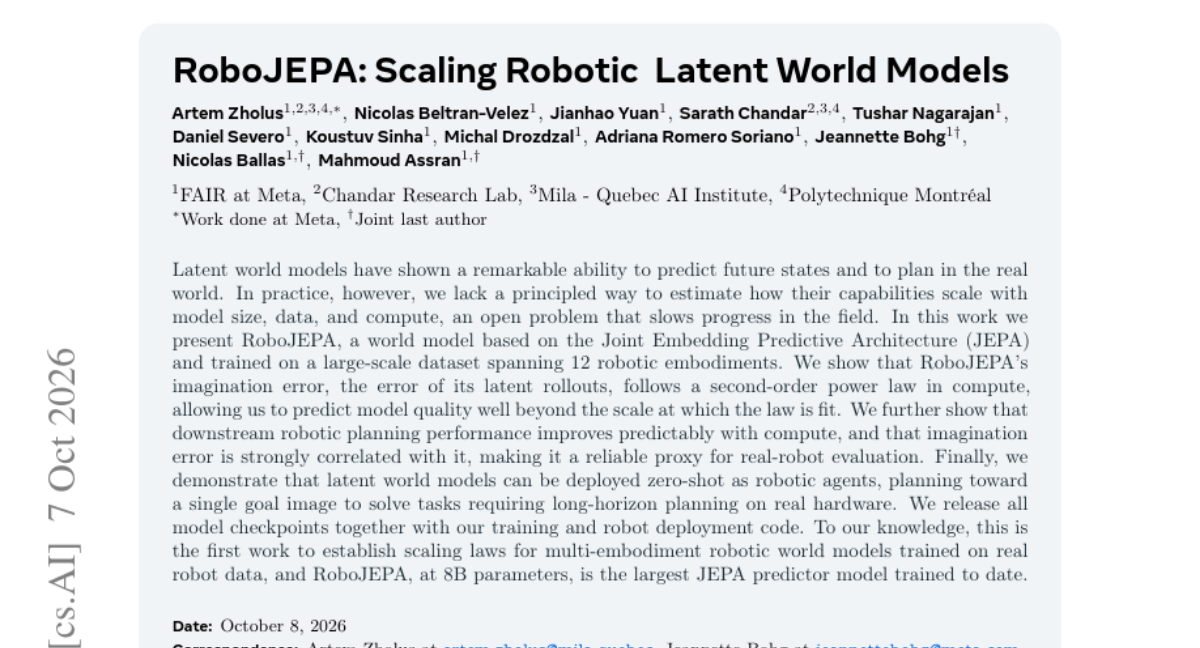
28. RoboJEPA: Scaling Robotic Latent World Models
🔑 Keywords: Latent world models, Joint Embedding Predictive Architecture, RoboJEPA, Imagination error, Scaling laws
💡 Category: Robotics and Autonomous Systems
🌟 Research Objective:
– To introduce RoboJEPA and establish scaling laws for multi-embodiment robotic world models trained on real robot data.
🛠️ Research Methods:
– Developed and tested RoboJEPA, a predictor model based on Joint Embedding Predictive Architecture, trained on a large-scale dataset across 12 robotic embodiments.
💬 Research Conclusions:
– RoboJEPA’s imagination error follows a predictable power law in compute, and performance improves predictably with compute, serving as a reliable proxy for evaluating real robots.
– Latent world models can be deployed zero-shot to solve tasks with long-horizon planning on real hardware. Released model checkpoints and code.
👉 Paper link: https://huggingface.co/papers/2610.10515
29. Rethinking World-Action Model for Compositional and In-Context Robotic Manipulation
🔑 Keywords: Long-horizon compositional manipulation, Visual Goal-conditioned Action Reasoning, task-level planning, in-context learning
💡 Category: Robotics and Autonomous Systems
🌟 Research Objective:
– The study aims to enhance real-world robot deployment by addressing the complex nature of tasks involving multiple coordinated subtasks through long-horizon compositional manipulation.
🛠️ Research Methods:
– The researchers propose ViGAR, a hierarchical framework that includes a visual subgoal planner and a subgoal executor for task-level planning. ViGAR is tested using the RoboTwin Clean2Random benchmark and involves using a pretrained world-model representation.
💬 Research Conclusions:
– ViGAR achieved notable success rates of 82.00% and 67.02% in Clean and Random settings on the benchmark, outperforming existing models by an average success rate margin of 12.86 percentage points. Additionally, the framework’s real-world effectiveness is demonstrated through robot experiments on seven tasks.
👉 Paper link: https://huggingface.co/papers/2610.02368

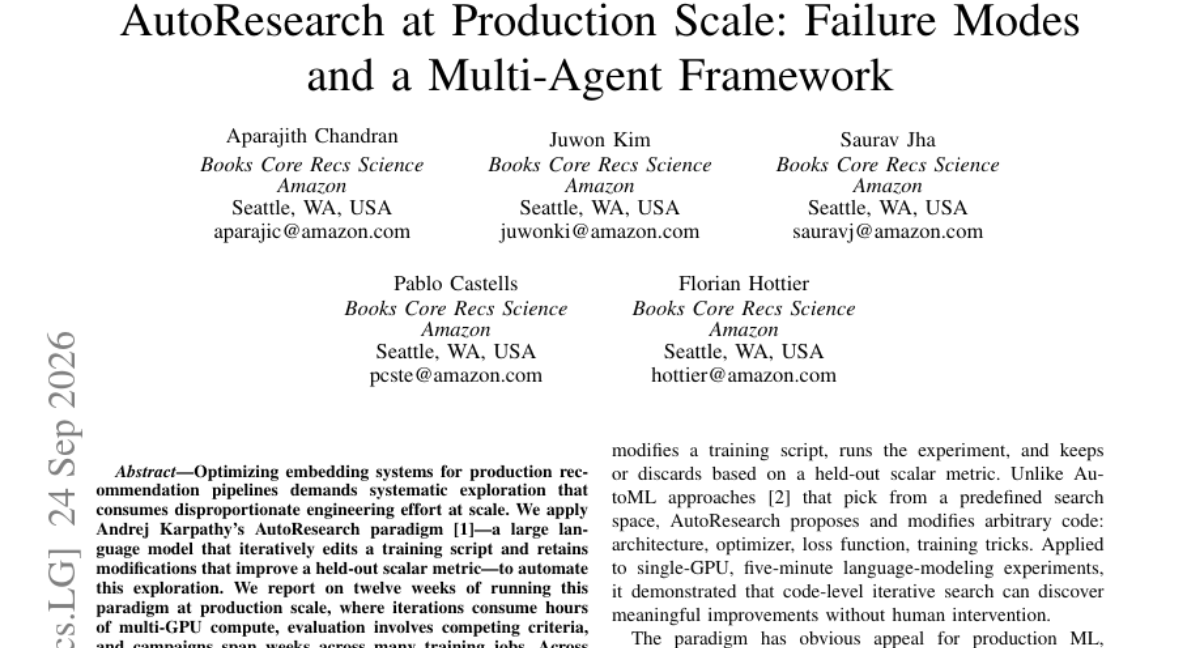
30. AutoResearch at Production Scale: Failure Modes and a Multi-Agent Framework
🔑 Keywords: AutoResearch, recommendation pipelines, representation-learning, infrastructure fragility, autonomous research
💡 Category: AI Systems and Tools
🌟 Research Objective:
– To automate the exploration of embedding systems optimization in production recommendation pipelines using Andrej Karpathy’s AutoResearch paradigm.
🛠️ Research Methods:
– Implementation of a large language model that iteratively edits a training script, focusing on experimentation and modification that enhance performance metrics.
💬 Research Conclusions:
– The study identified five failure modes in autonomous research systems and introduced a “prevent, persist, redirect” framework to address these. The framework yielded significant improvements in recall, coherence, and catalog coverage compared to hand-tuned baselines.
👉 Paper link: https://huggingface.co/papers/2609.30541
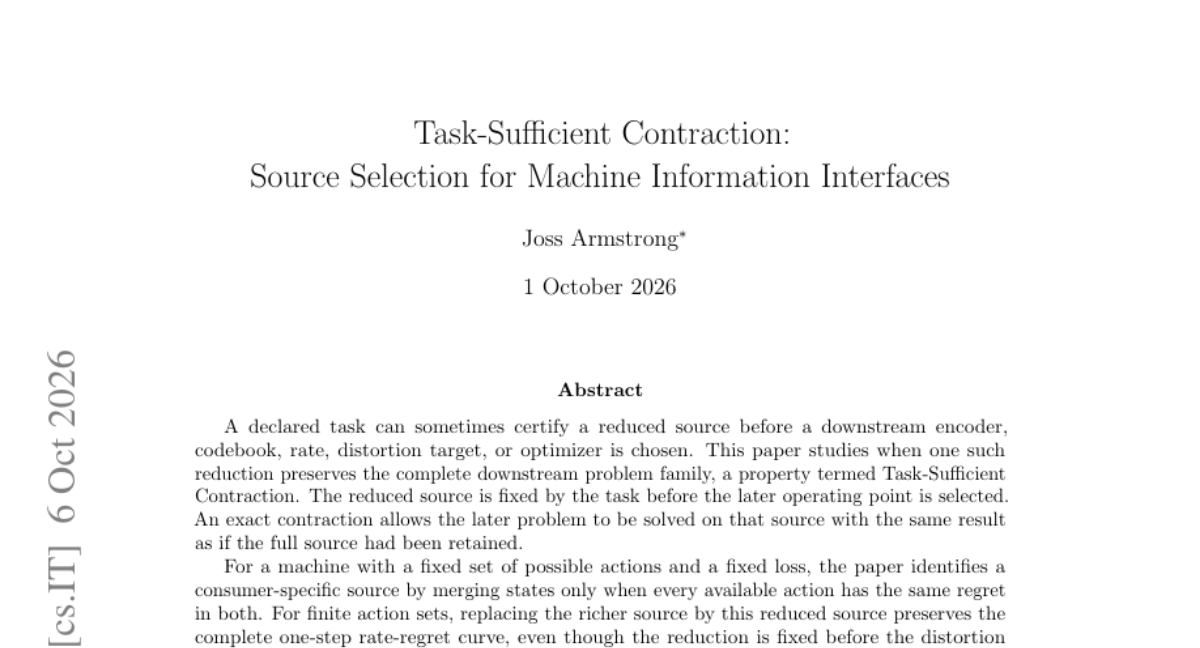
31. Task-Sufficient Contraction: Source Selection for Machine Information Interfaces
🔑 Keywords: Task-Sufficient Contraction, reduced source, finite action sets, rate-regret curve, Information Bottleneck
💡 Category: Foundations of AI
🌟 Research Objective:
– To explore the concept of Task-Sufficient Contraction, where a reduced source can solve downstream problems with the same results as a full source.
🛠️ Research Methods:
– Investigation of when one-step rate-regret curves on finite action sets are preserved, and analysis of exact contractions under quadratic loss for affine feasible-action sets.
💬 Research Conclusions:
– Successfully identifies conditions for consumer-specific source reduction and distinguishes exact and approximate contractions, facilitating efficient communication in heterogeneous machines without needing full internal alignment.
👉 Paper link: https://huggingface.co/papers/2610.08884
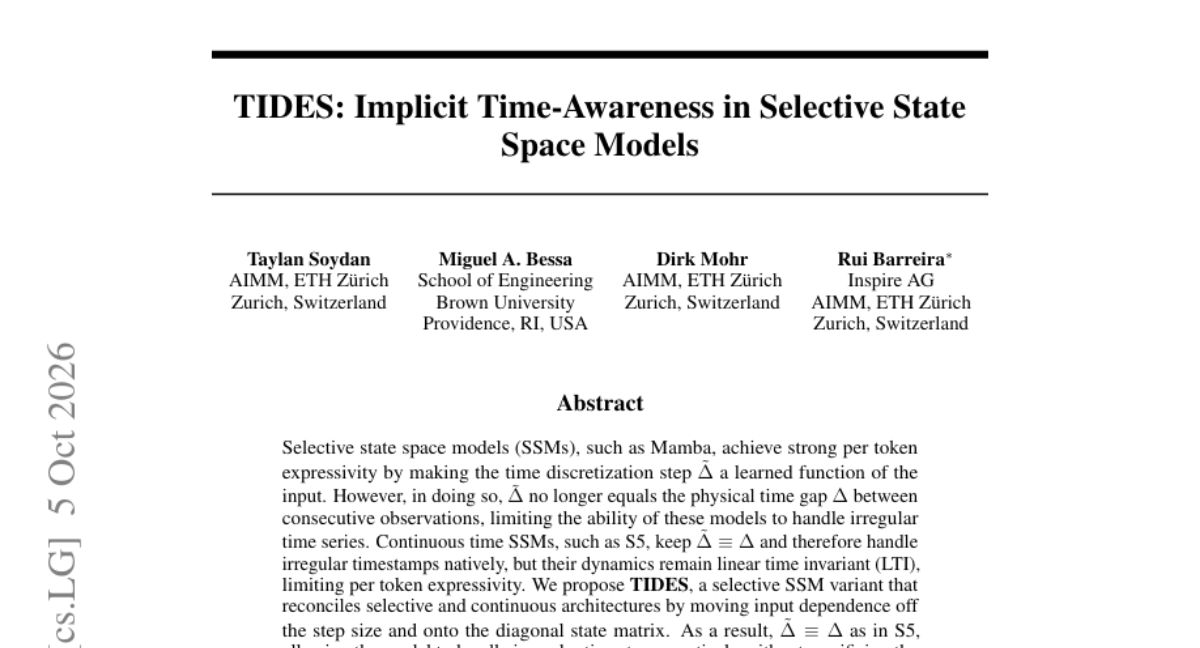
32. TIDES: Implicit Time-Awareness in Selective State Space Models
🔑 Keywords: Selective SSM, Continuous Time SSM, Irregular Time Series
💡 Category: Machine Learning
🌟 Research Objective:
– The paper introduces TIDES, a variant of selective state space models that integrates the strengths of both selective and continuous architectures to handle irregular timestamps.
🛠️ Research Methods:
– TIDES modifies traditional SSMs by shifting input dependence from the step size to the diagonal state matrix, allowing it to manage irregular datasets effectively without compromising expressivity. Performance was demonstrated on both new experimental benchmarks and large-scale datasets across various domains.
💬 Research Conclusions:
– TIDES achieves significant improvements, setting new benchmarks in time series classification and regression tasks, and performs competitively on diverse irregular datasets spanning astronomy, agriculture, neuromorphic sensing, and climate events.
👉 Paper link: https://huggingface.co/papers/2605.09742
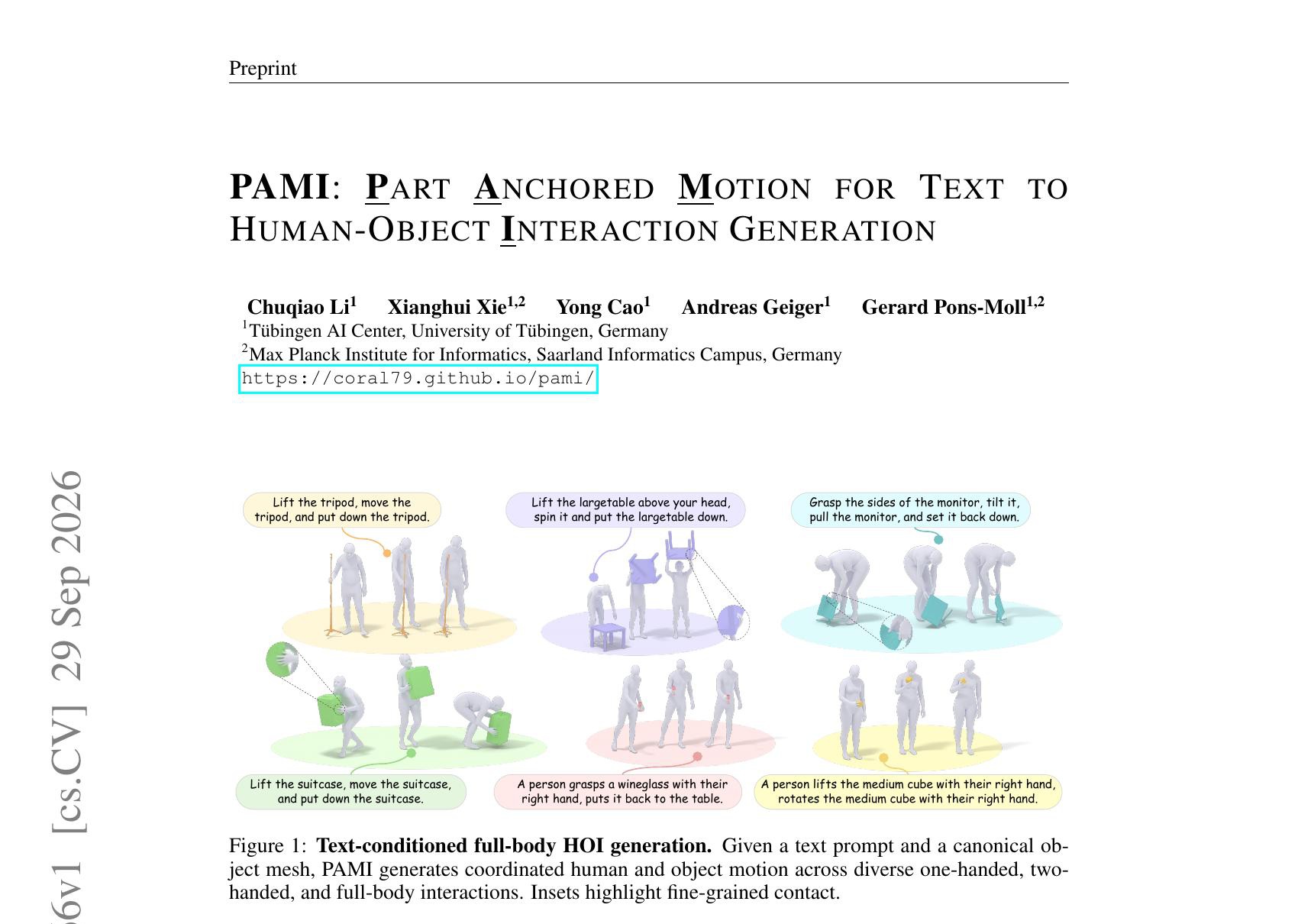
33. PAMI: Part Anchored Motion for Text to Human-Object Interaction Generation
🔑 Keywords: Text-conditioned HOI, PAMI, Interaction generation, Hybrid surface-sensing, PamiVAE
💡 Category: Generative Models
🌟 Research Objective:
– The paper aims to generate text-conditioned full-body human-object interaction (HOI) that maintains precise coordination over time between human motion and object trajectories.
🛠️ Research Methods:
– Introduces PAMI, a Part-Anchored Motion framework using a representation inspired by the Hough Transform, localized object motion through body-part anchors, and PamiVAE to learn an interaction latent space.
– Proposes a coarse-to-fine hierarchical generation strategy using PamiGen for generating coarse interactions and PamiRefiner for refining contact geometry with a hybrid surface-sensing representation.
💬 Research Conclusions:
– PAMI generates more faithful interactions and accurate human-relative object motion compared to previous methods, with a 14.5% higher contact recall in experiments conducted on the InterAct dataset.
– Extensive ablations validate the part-anchored voting representation and hybrid surface-sensing refinement’s contributions.
👉 Paper link: https://huggingface.co/papers/2609.38466
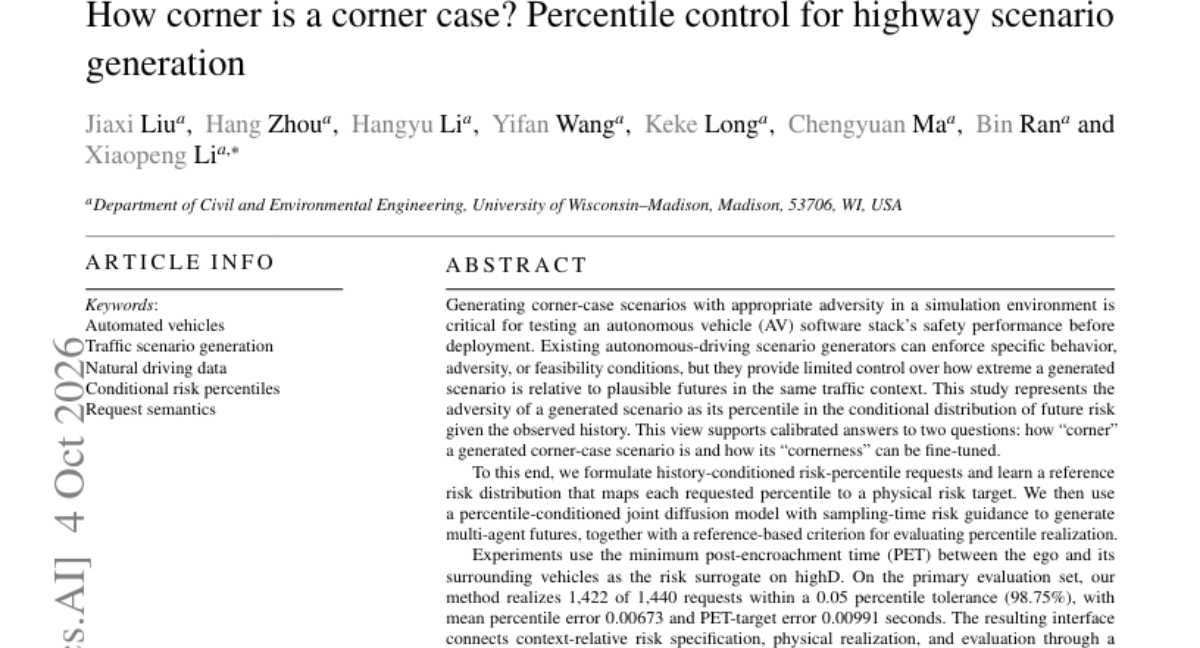
34. How corner is a corner case? Percentile control for highway scenario generation
🔑 Keywords: Autonomous Vehicle, Corner-case Scenarios, Risk Percentile, Simulation Environment, Generative Models
💡 Category: Robotics and Autonomous Systems
🌟 Research Objective:
– The study aims to generate corner-case scenarios within a simulation environment to test the safety performance of an autonomous vehicle software stack, focusing on controlling scenario extremity relative to future risks.
🛠️ Research Methods:
– Employs a percentile-conditioned joint diffusion model with risk guidance to simulate multi-agent futures, using history-conditioned risk-percentile requests and mapping to physical risk targets.
💬 Research Conclusions:
– Achieves high accuracy in realizing requests with a 98.75% success rate within a 0.05 percentile tolerance, connecting context-relative risk specification, physical realization, and evaluation on a unified risk scale.
👉 Paper link: https://huggingface.co/papers/2610.05003
35.
36. ReGain: Restoring Subject Fidelity in Personalization on Synthetic Images
🔑 Keywords: DreamBooth, Synthetic Images, Classifier-Free Guidance, ReGain
💡 Category: Generative Models
🌟 Research Objective:
– The study investigates the effects of using synthetic images for fine-tuning text-to-image diffusion models, specifically looking at subject fidelity degradation.
🛠️ Research Methods:
– The researchers fine-tune two models using the same base model and DreamBooth protocol: one on real photos and another on synthetic images, analyzing the differences attributed to classifier-free guidance.
💬 Research Conclusions:
– The paper concludes that synthetic images degrade subject fidelity, traced to increased angles and norms of noise predictions. It proposes ReGain as a training-free solution that significantly improves subject fidelity without real photos.
👉 Paper link: https://huggingface.co/papers/2609.38680

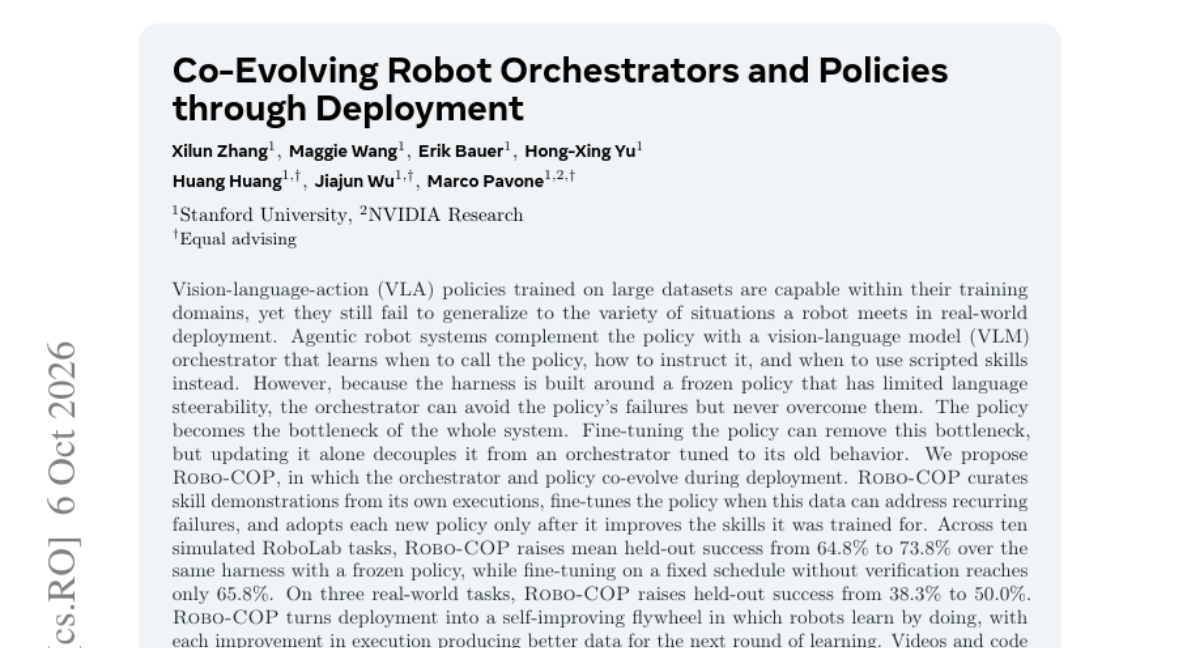
37. Co-Evolving Robot Orchestrators and Policies through Deployment
🔑 Keywords: Vision-language-action, Robo-COP, self-improving flywheel, policy fine-tuning, Robotics
💡 Category: Robotics and Autonomous Systems
🌟 Research Objective:
– The paper aims to enhance the adaptability and performance of Vision-Language-Action (VLA) policies in real-world robotic applications by introducing a novel approach called Robo-COP.
🛠️ Research Methods:
– Robo-COP co-evolves the orchestrator and policy during deployment, curating skill demonstrations from its own executions, fine-tuning the policy, and adopting new policies after skill improvements.
💬 Research Conclusions:
– Robo-COP significantly improves success rates in both simulated (from 64.8% to 73.8%) and real-world tasks (from 38.3% to 50.0%) compared to systems using a static policy, effectively turning deployment into a self-improving process.
👉 Paper link: https://huggingface.co/papers/2610.09228
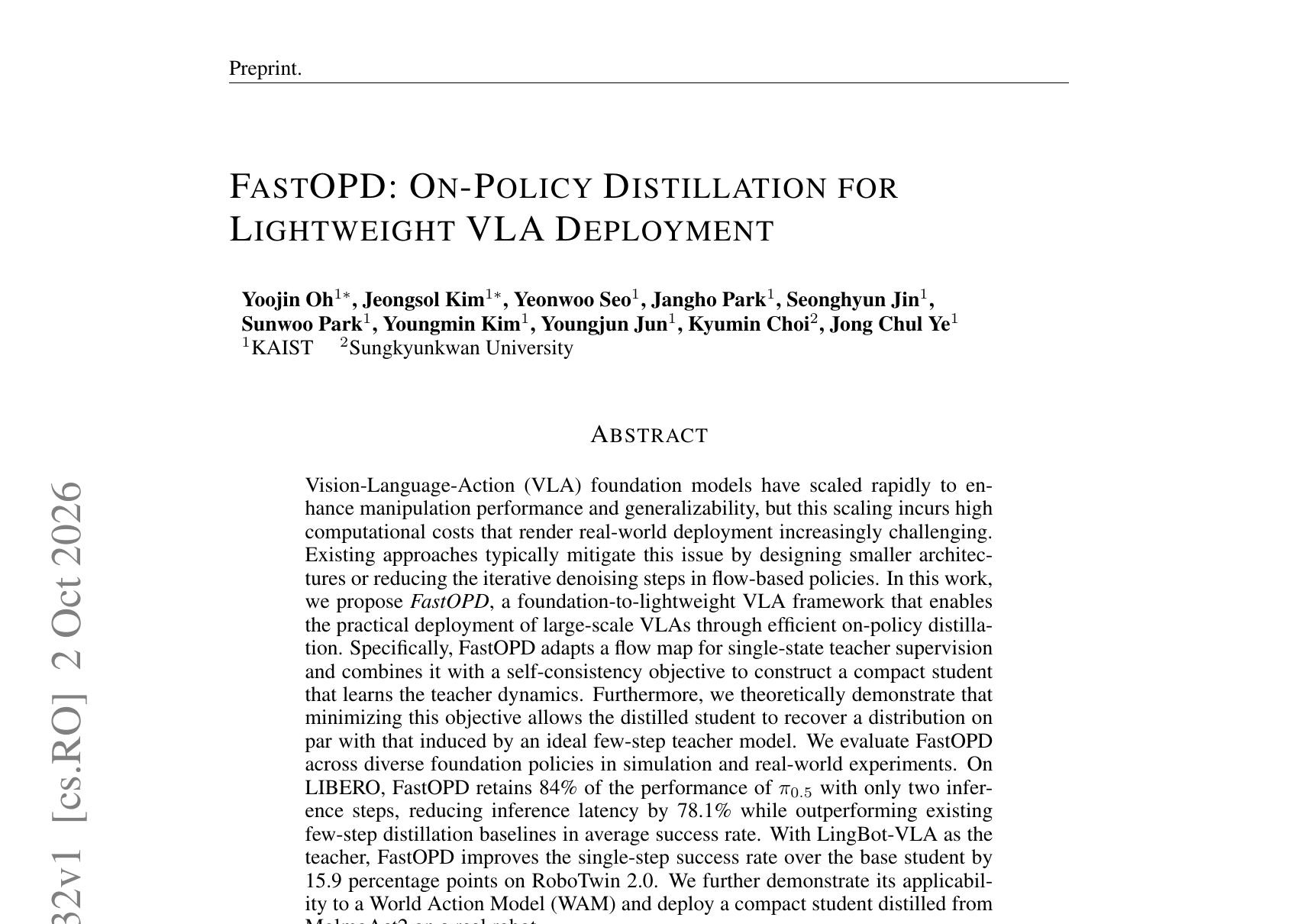
38. FastOPD: On-Policy Distillation for Lightweight VLA Deployment
🔑 Keywords: VLA foundation models, FastOPD, on-policy distillation, inference latency, RoboTwin 2.0
💡 Category: Robotics and Autonomous Systems
🌟 Research Objective:
– To enable practical deployment of large-scale Vision-Language-Action (VLA) foundation models by developing a framework called FastOPD for efficient on-policy distillation.
🛠️ Research Methods:
– Adaptation of a flow map for single-state teacher supervision combined with a self-consistency objective to construct a compact student model.
– Evaluation of FastOPD across diverse foundation policies in simulation and real-world experiments.
💬 Research Conclusions:
– FastOPD retains 84% of the performance with significantly reduced inference latency and outperforms existing few-step distillation baselines.
– The framework enhances the single-step success rate significantly in robotic applications, demonstrating practical deployment potential on real robots.
👉 Paper link: https://huggingface.co/papers/2610.02832
39. System Switch: When Should a Fast Decision Model Stop and Think?
🔑 Keywords: Dual-process agents, Fast policy, Reasoning model, AUROC, Decision models
💡 Category: Reinforcement Learning
🌟 Research Objective:
– To investigate the dynamics between fast learned actors and slow reasoning vision-language models in decision-making processes, specifically focusing on how decisions are managed and deferred in real-time environments.
🛠️ Research Methods:
– Utilization of a closed-loop Doom environment and “System One” typed-decision models interfaced via llama.cpp. Evaluation includes zero-shot decision models with varying parameters and analysis of decision accuracy, calibration, and sensitivity.
💬 Research Conclusions:
– The study finds that models with similar accuracy can differ significantly in AUROC, illustrating different sensitivity levels in decision-making. Additionally, deferring decisions based on the actor’s confidence can enhance performance proportions. A rule-based approach for exploration increases door openings but leads to more frequent failures. The reasoning model often misidentifies simple tasks due to the lack of specific knowledge, such as differentiating between locked and ordinary doors.
👉 Paper link: https://huggingface.co/papers/2610.09683

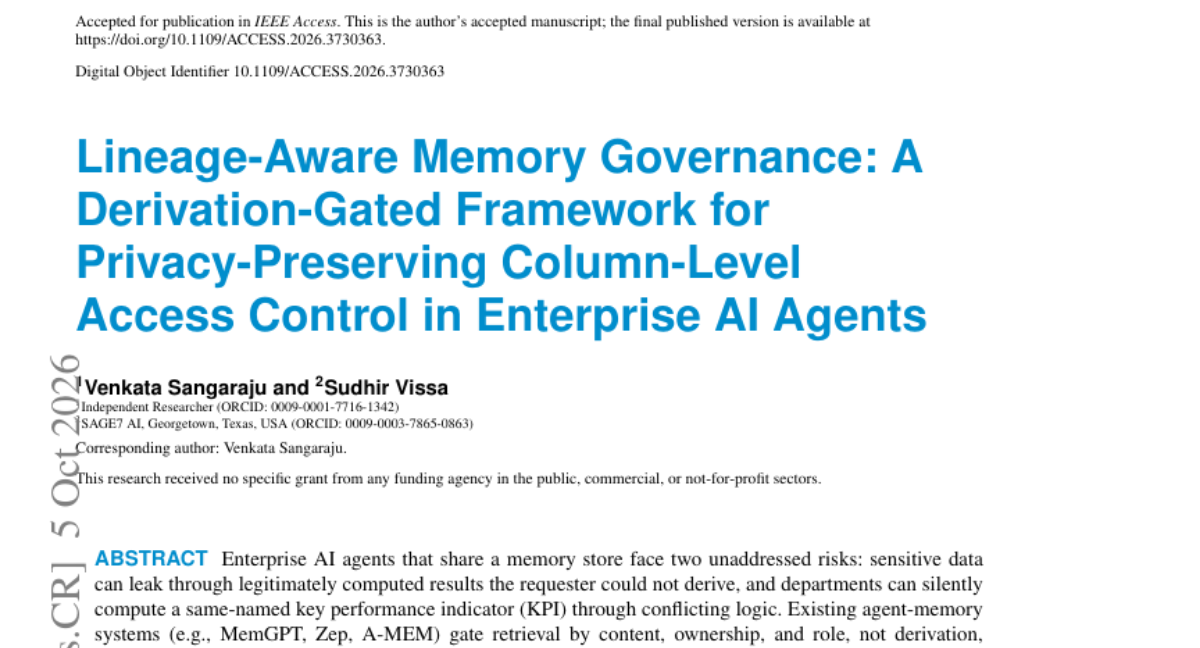
40. Lineage-Aware Memory Governance: A Derivation-Gated Framework for Privacy-Preserving Column-Level Access Control in Enterprise AI Agents
🔑 Keywords: Enterprise AI agents, memory store, data leakage, Analytical Memory Unit, lineage-gated retrieval
💡 Category: AI Systems and Tools
🌟 Research Objective:
– The study aims to address the unaddressed risks associated with Enterprise AI agents sharing a memory store, focusing on preventing sensitive data leakage and conflicts in KPI computations.
🛠️ Research Methods:
– Introduction of the Analytical Memory Unit (AMU) schema, which attaches a derivation graph to cached results, with a retrieval policy that ensures access only with proper authorization for every column involved.
💬 Research Conclusions:
– Lineage-gated retrieval significantly reduces cross-department data leakage and maintains high memory reuse efficiency while ensuring compliance with governance standards like the EU AI Act.
👉 Paper link: https://huggingface.co/papers/2610.07258
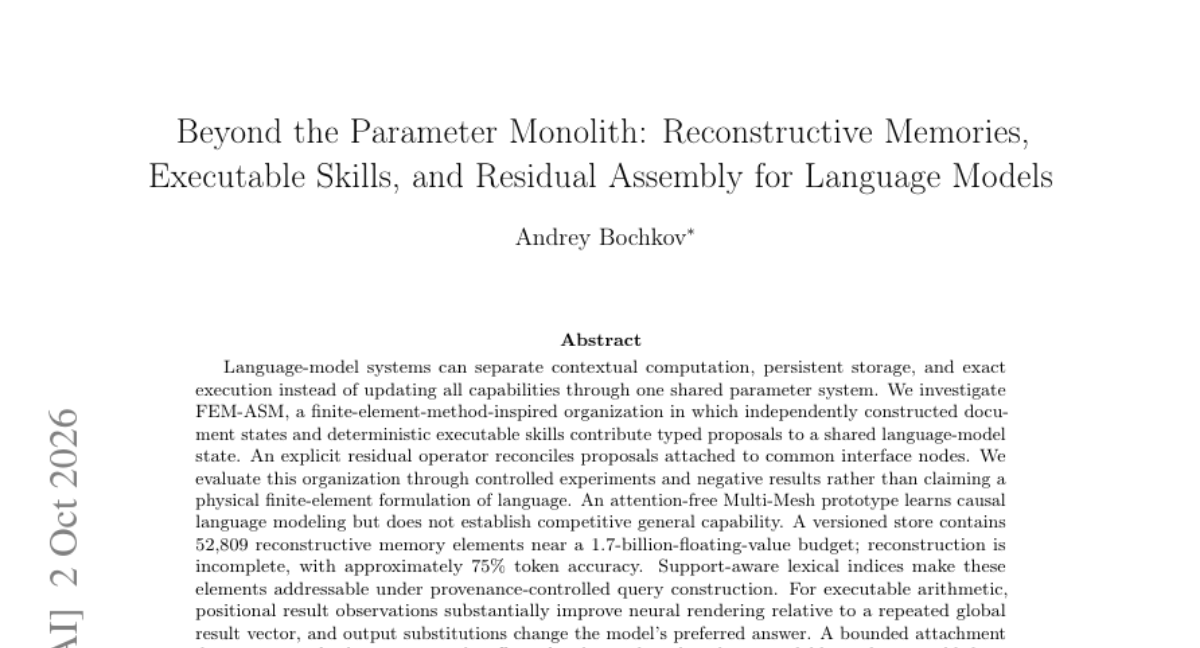
41. Beyond the Parameter Monolith: Reconstructive Memories, Executable Skills, and Residual Assembly for Language Models
🔑 Keywords: Language-model systems, FEM-ASM, finite-element-method-inspired, causal language modeling, neural rendering
💡 Category: Natural Language Processing
🌟 Research Objective:
– To investigate FEM-ASM, an organization for language-model systems separating contextual computation, persistent storage, and exact execution.
🛠️ Research Methods:
– Controlled experiments and a Multi-Mesh prototype without attention mechanisms were used to evaluate the system.
💬 Research Conclusions:
– While successful in separating storage, execution, and neural coordination, challenges remain in question-only retrieval, unrestricted answer generation, and overall efficiency.
👉 Paper link: https://huggingface.co/papers/2610.04012
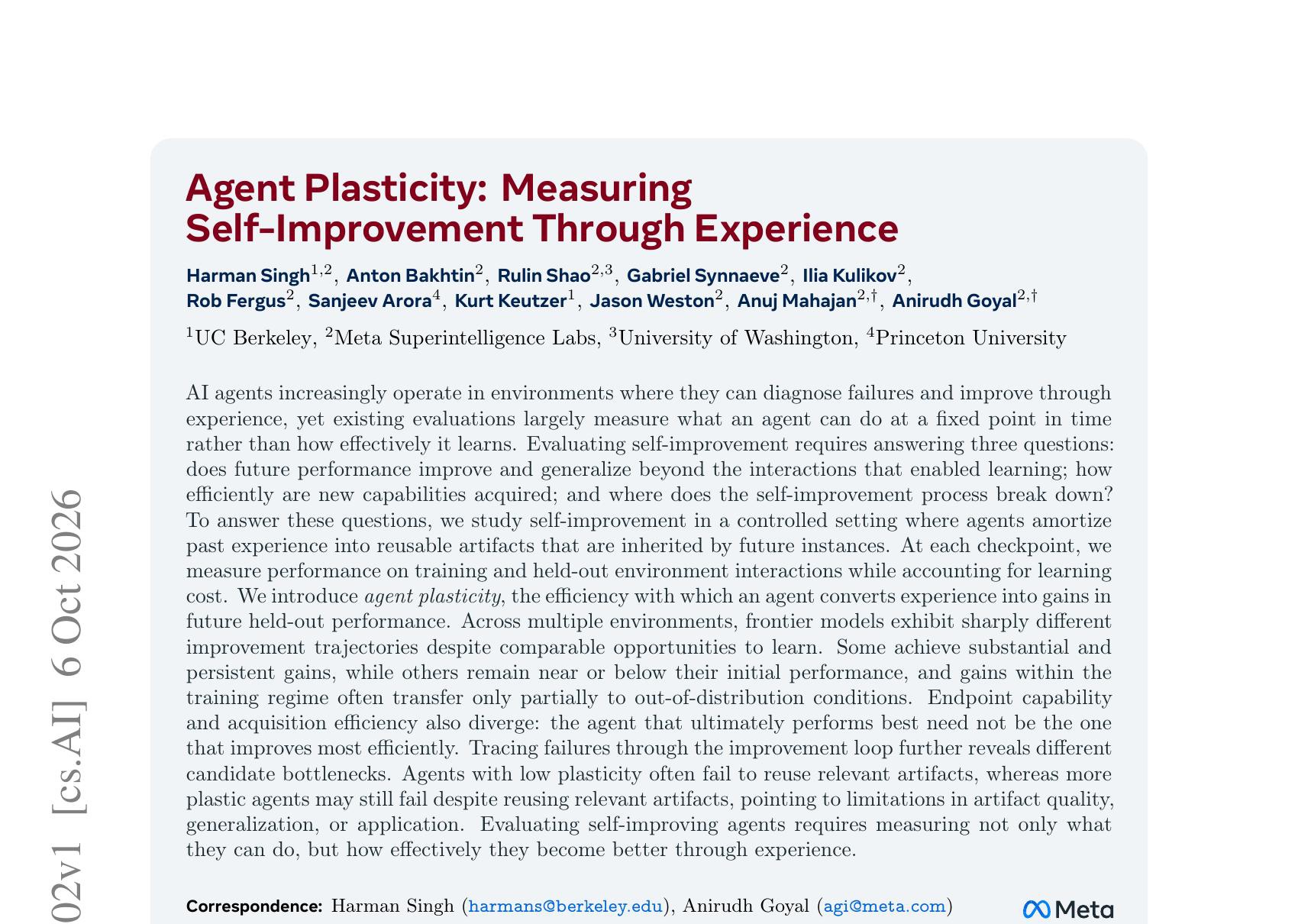
42. Agent Plasticity: Measuring Self-Improvement Through Experience
🔑 Keywords: AI agents, self-improvement, agent plasticity, experience, learning efficiency
💡 Category: Reinforcement Learning
🌟 Research Objective:
– The study investigates self-improvement in AI agents by evaluating their ability to learn effectively over time rather than at a fixed point.
🛠️ Research Methods:
– Researchers analyze self-improvement in a controlled environment where AI agents utilize past experiences to enhance future performance, measuring efficiency and identifying bottlenecks.
💬 Research Conclusions:
– Significant differences were found in agents’ improvement trajectories and efficiency, revealing the importance of evaluating both learning capacity and application of learned knowledge.
👉 Paper link: https://huggingface.co/papers/2610.08902
43. Salt++: Context-Aligned Post-Training for Few-Step Streaming Multimodal Generation
🔑 Keywords: Causal Self-Flow, step distillation, context-aligned autoregressive DMD, Salt++
💡 Category: Generative Models
🌟 Research Objective:
– The paper aims to address context-related challenges in few-step streaming audio-video generation through a novel framework called Salt++, incorporating Causal Self-Flow (CSF) and context-aligned autoregressive Distribution Matching Distillation (DMD).
🛠️ Research Methods:
– Introducing Salt++ with a two-stage post-training framework that exploits contextual information asymmetry and matches generated and reference distributions using a block-conditional KL objective.
💬 Research Conclusions:
– Salt++ significantly improves visual and motion quality over OmniForcing in a 4-step causal setting and outperforms bidirectional LTX-2 on multiple metrics, demonstrating its effectiveness in enhancing cross-modal alignment and generation quality.
👉 Paper link: https://huggingface.co/papers/2609.36995

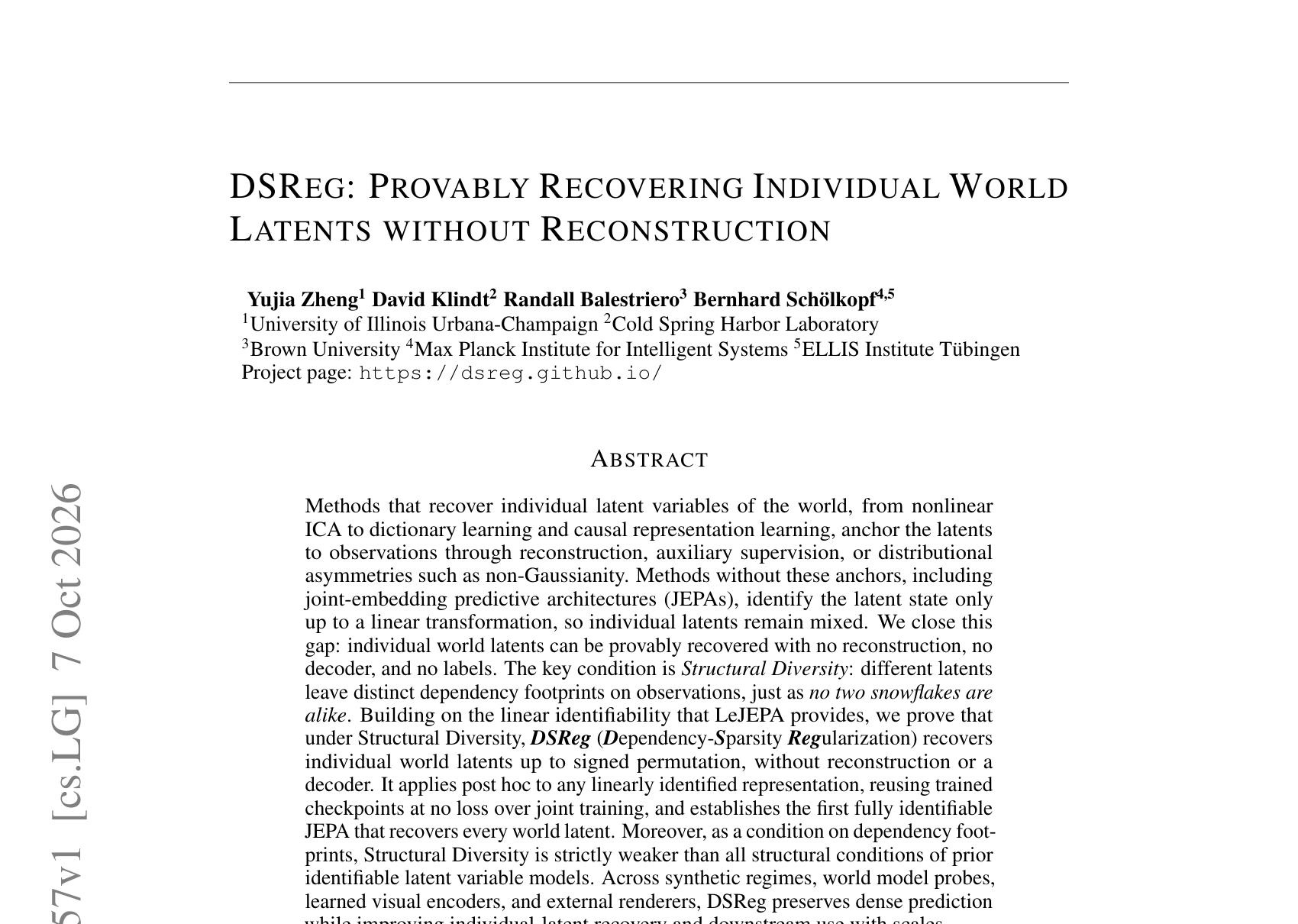
44. DSReg: Provably Recovering Individual World Latents without Reconstruction
🔑 Keywords: Latent Variables, Structural Diversity, Joint-Embedding Predictive Architectures (JEPA)
💡 Category: Machine Learning
🌟 Research Objective:
– To recover individual latent variables without requiring reconstruction, decoders, or labeled supervision.
🛠️ Research Methods:
– Utilizing Structural Diversity and DSReg (Dependency-Sparsity Regularization) to achieve latent recovery up to signed permutation.
💬 Research Conclusions:
– DSReg recovers individual world latents in linearly identified representations without reconstruction and maintains dense prediction quality.
👉 Paper link: https://huggingface.co/papers/2610.09457
45. EngramEdit: Decoupled Knowledge Updates in LLMs through Conditional Memory
🔑 Keywords: Conditional Memory, DeepSeek Engram, EngramEdit, Knowledge Updates, Transformer
💡 Category: Natural Language Processing
🌟 Research Objective:
– The study aims to decouple factual knowledge storage from general-purpose computation in large language models, facilitating independent factual updates while keeping the underlying Transformer architecture unchanged.
🛠️ Research Methods:
– EngramEdit is introduced to manage knowledge updates by computing target memory representations and updating shared n-gram embeddings, ensuring accurate predictions across different expressions without affecting unrelated knowledge.
💬 Research Conclusions:
– EngramEdit allows for precise knowledge updates and maintains unrelated knowledge integrity. It exhibits nearly perfect editing success and achieves close to three times the baseline’s accuracy in chain-of-thought prompting, demonstrating its effectiveness as an editable knowledge interface for conditional memory architectures.
👉 Paper link: https://huggingface.co/papers/2610.10533

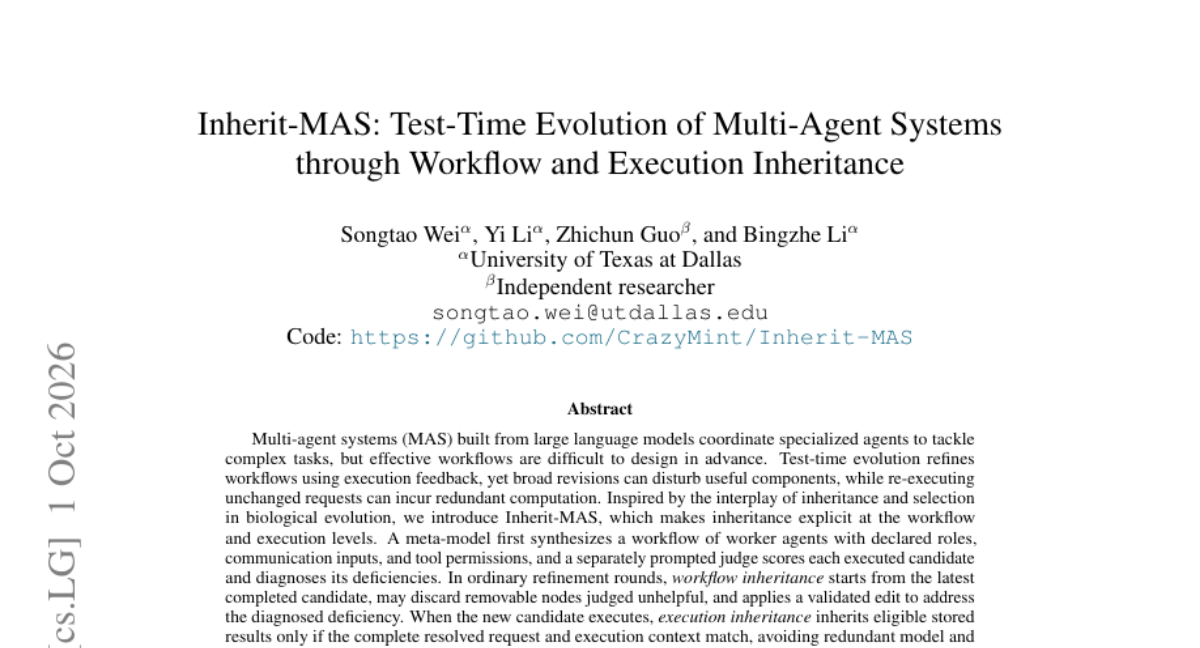
46. Inherit-MAS: Test-Time Evolution of Multi-Agent Systems through Workflow and Execution Inheritance
🔑 Keywords: Multi-agent systems, Inherit-MAS, workflow inheritance, execution inheritance, redundancy reduction
💡 Category: AI Systems and Tools
🌟 Research Objective:
– The study aims to improve workflow evolution within Multi-agent systems (MAS) by introducing Inherit-MAS, designed to optimize both workflow and execution levels.
🛠️ Research Methods:
– Inherit-MAS employs a meta-model to create workflows of worker agents with defined roles and evaluates candidate executions through a judge mechanism to enhance workflow refinement and reduce redundancy.
💬 Research Conclusions:
– Inherit-MAS outperforms existing MAS such as EvoAgent and EvoMAS in efficiency and completion metrics on benchmarks like WorkBench and HotpotQA, reducing token usage significantly while enhancing task completion performance.
👉 Paper link: https://huggingface.co/papers/2610.02396
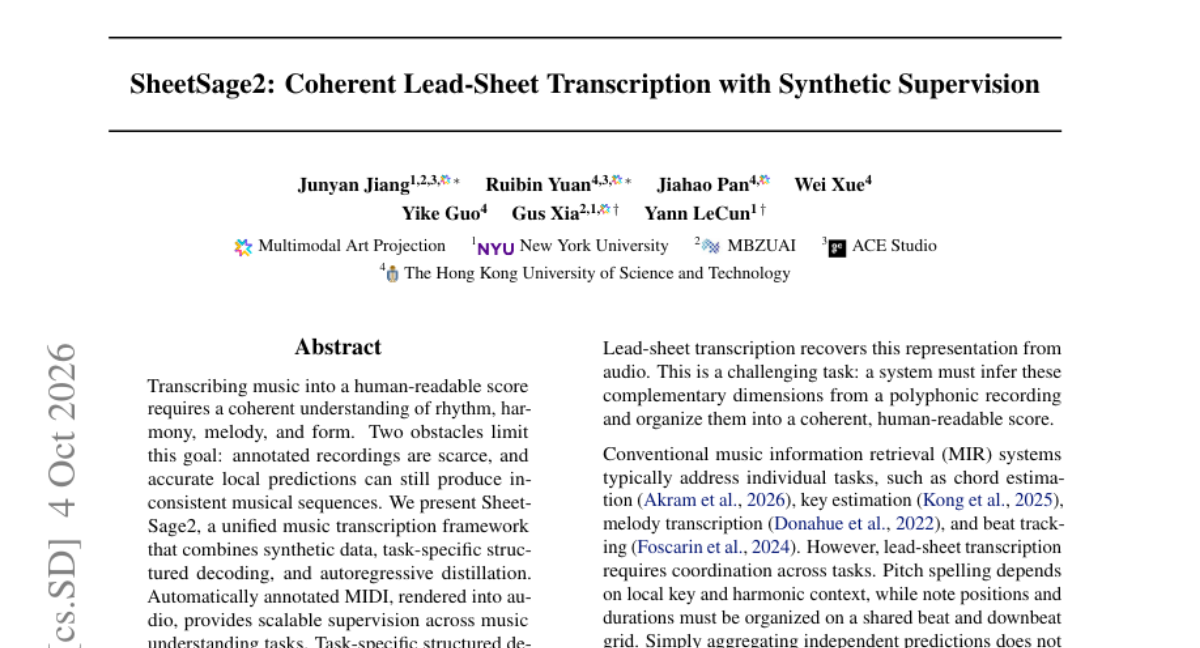
47. SheetSage2: Coherent Lead-Sheet Transcription with Synthetic Supervision
🔑 Keywords: Music Transcription, SheetSage2, Synthetic Data, Autoregressive Distillation, AI Systems and Tools
💡 Category: AI Systems and Tools
🌟 Research Objective:
– To develop a unified music transcription framework called SheetSage2 that enhances the coherence and accuracy of transcribed music scores.
🛠️ Research Methods:
– Utilization of synthetic data, task-specific structured decoding, and autoregressive distillation to improve the transcription process.
💬 Research Conclusions:
– SheetSage2 surpasses previous systems on 12 of 15 benchmarks, demonstrating improved performance over its predecessor and task-specific models. The model and code are publicly available for further use.
👉 Paper link: https://huggingface.co/papers/2610.05336
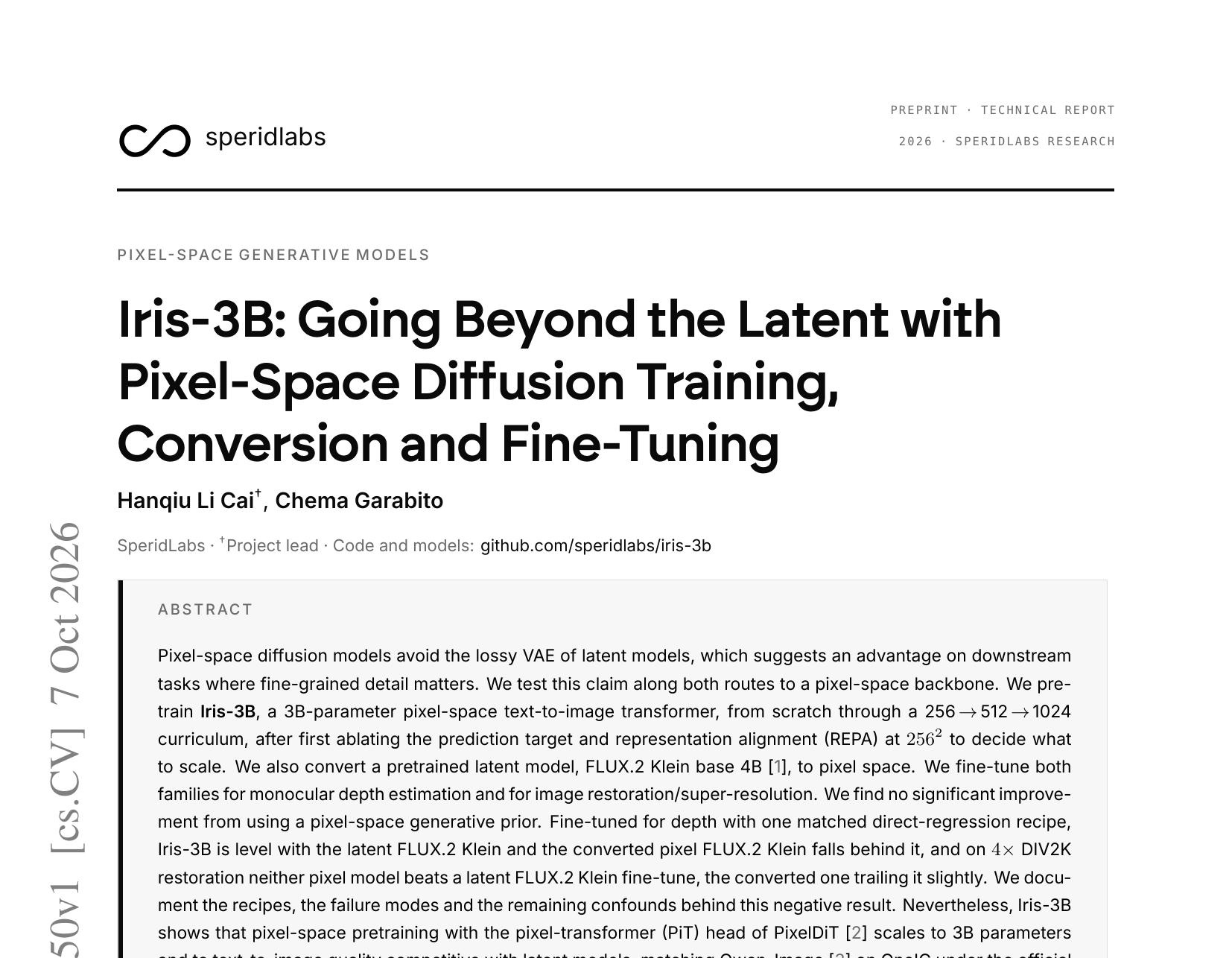
48. Iris-3B: Going Beyond the Latent with Pixel-Space Diffusion Training, Conversion and Fine-Tuning
🔑 Keywords: Pixel-space, Text-to-image transformer, Generative Models, Depth estimation, Super-resolution
💡 Category: Generative Models
🌟 Research Objective:
– To evaluate the efficacy of pixel-space diffusion models compared to latent models in tasks where fine-grained detail is vital.
🛠️ Research Methods:
– Pretraining a 3B-parameter pixel-space text-to-image transformer (Iris-3B) and converting a pretrained latent model (FLUX.2 Klein base 4B) to pixel space.
– Fine-tuning both models for monocular depth estimation and image restoration/super-resolution.
💬 Research Conclusions:
– No significant improvement from using a pixel-space generative prior was found for the tasks explored.
– Although Iris-3B achieved competitive text-to-image quality, it did not outperform latent models in depth and image restoration tasks.
– The study provides insights into the shortcomings and areas for future enhancement in pixel-space model utilization.
👉 Paper link: https://huggingface.co/papers/2610.09450
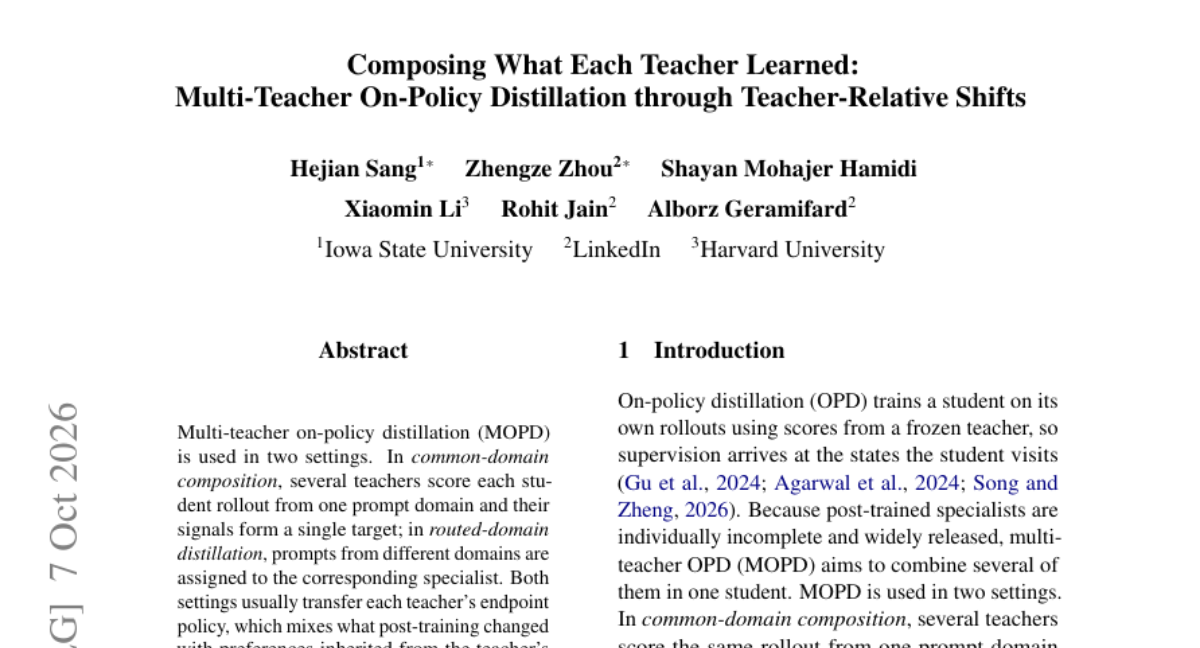
49. Composing What Each Teacher Learned: Multi-Teacher On-Policy Distillation through Teacher-Relative Shifts
🔑 Keywords: Multi-teacher on-policy distillation, Δ-MOPD, endpoint policy, specialist routing, performance improvement
💡 Category: Reinforcement Learning
🌟 Research Objective:
– To introduce Δ-MOPD, a novel method for transferring each teacher’s teacher-minus-base logit shift, in order to improve the existing multi-teacher on-policy distillation methods.
🛠️ Research Methods:
– Comparative analysis of Δ-MOPD against endpoint supervision in both common-domain composition and routed-domain distillation settings.
💬 Research Conclusions:
– Δ-MOPD shows significant improvements in performance, particularly in scenarios where multiple teacher signals are combined at a state, outperforming endpoint composition in specific metrics.
– In phased and interleaved routing scenarios, Δ-MOPD demonstrates comparable or improved outcomes, highlighting its potential as an independent design axis complementary to teacher selection.
👉 Paper link: https://huggingface.co/papers/2610.10460
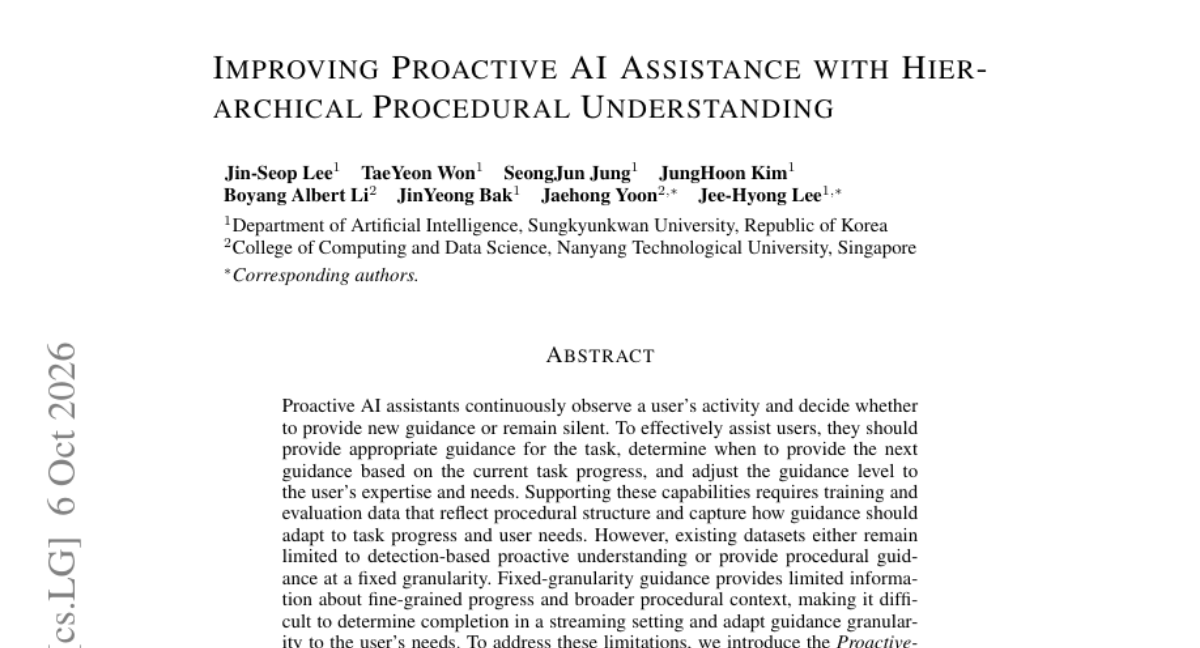
50. Improving Proactive AI Assistance with Hierarchical Procedural Understanding
🔑 Keywords: Proactive AI assistants, Adaptive guidance system, ProactiveCoach suite, VLMs, Hierarchical supervision
💡 Category: Human-AI Interaction
🌟 Research Objective:
– The study aims to improve Proactive AI assistants by providing adaptive and context-aware guidance to users, adjusting to task progress and user expertise.
🛠️ Research Methods:
– Introduction of the ProactiveCoach suite, consisting of ProactiveCoach-Instruct for training and ProactiveCoachBench for evaluation, along with fine-tuned VLMs. It utilizes hierarchical guidance to better align with task progress and needs.
💬 Research Conclusions:
– Hierarchical supervision enhances performance by up to 9.6% compared to fixed-granularity supervision. The adaptive guidance system developed surpasses the baseline by 57.1% in adaptation across multiple guidance-level transitions.
👉 Paper link: https://huggingface.co/papers/2610.06505
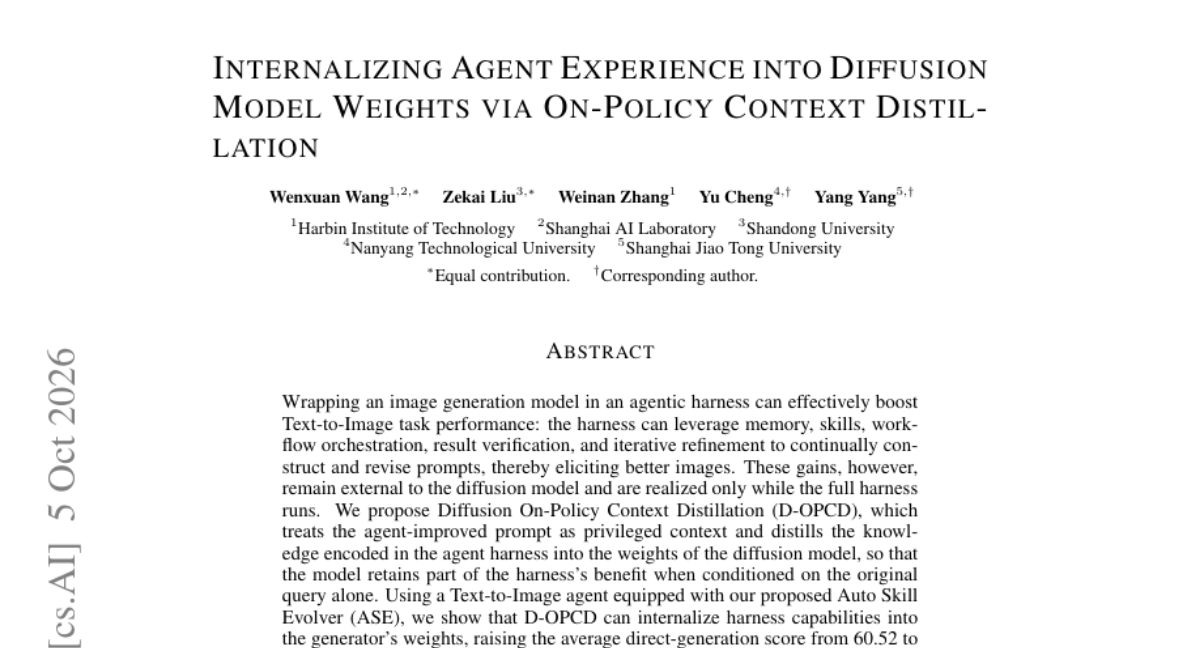
51. Internalizing Agent Experience into Diffusion Model Weights via On-Policy Context Distillation
🔑 Keywords: Agentic Harness, Diffusion Model, Text-to-Image, Auto Skill Evolver, Continual Co-evolution
💡 Category: Generative Models
🌟 Research Objective:
– The objective is to improve Text-to-Image task performance by integrating the capabilities of an agentic harness into a diffusion model using a novel method called Diffusion On-Policy Context Distillation (D-OPCD).
🛠️ Research Methods:
– This study introduces D-OPCD, which distills agentically improved prompts into the model’s weights, enhancing image generation performance.
– Utilizes an Auto Skill Evolver (ASE) to iteratively update and internalize the harness’s capabilities within the generator.
💬 Research Conclusions:
– D-OPCD successfully improves the average direct-generation score from 60.52 to 65.09 across benchmarks.
– The integration allows the harness to keep evolving and improve, ensuring continual co-evolution with the model and further enhances performance by an additional 1.83 points.
👉 Paper link: https://huggingface.co/papers/2610.07250
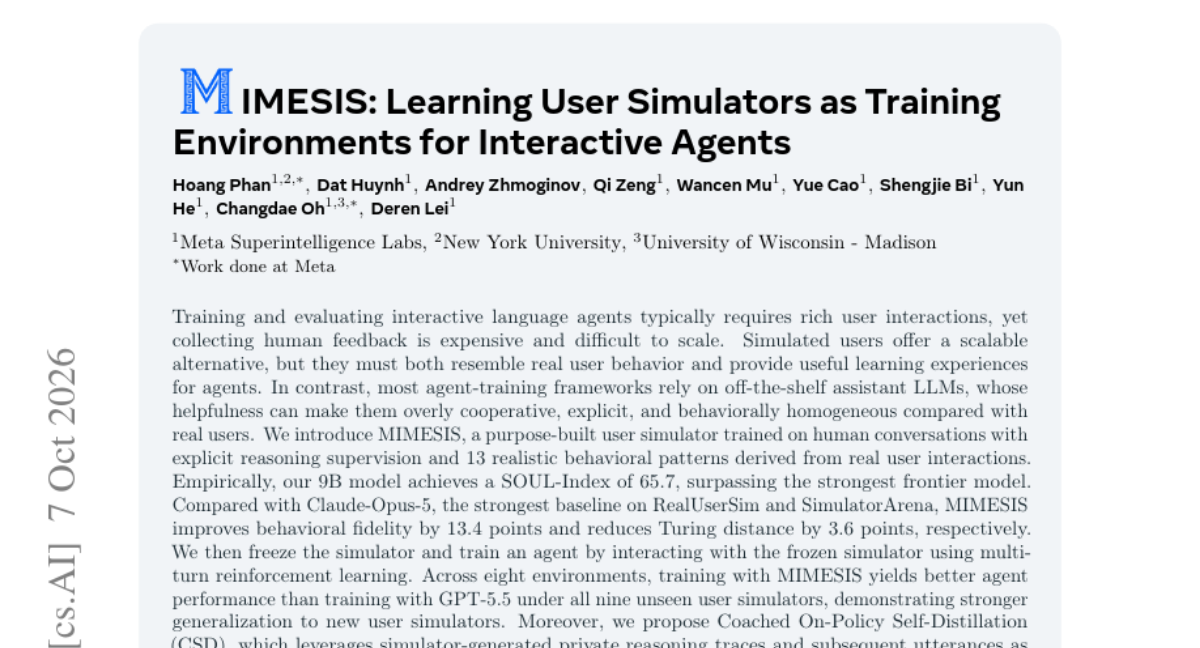
52. MIMESIS: Learning User Simulators as Training Environments for Interactive Agents
🔑 Keywords: User Simulator, Behavioral Fidelity, Reinforcement Learning, Generalization, Coached On-Policy Self-Distillation
💡 Category: Reinforcement Learning
🌟 Research Objective:
– To introduce MIMESIS, a user simulator designed to mimic realistic user behavior for training interactive language agents.
🛠️ Research Methods:
– Developed a 9B model trained with explicit reasoning supervision and realistic behavioral patterns. Used multi-turn reinforcement learning with the simulator for agent training.
💬 Research Conclusions:
– MIMESIS surpasses existing models in behavioral fidelity and Turing distance. Training with MIMESIS provides better generalization across unseen user simulators than with GPT-5.5. The CSD method further enhances agent performance by transforming feedback into token-level supervision.
👉 Paper link: https://huggingface.co/papers/2610.09484
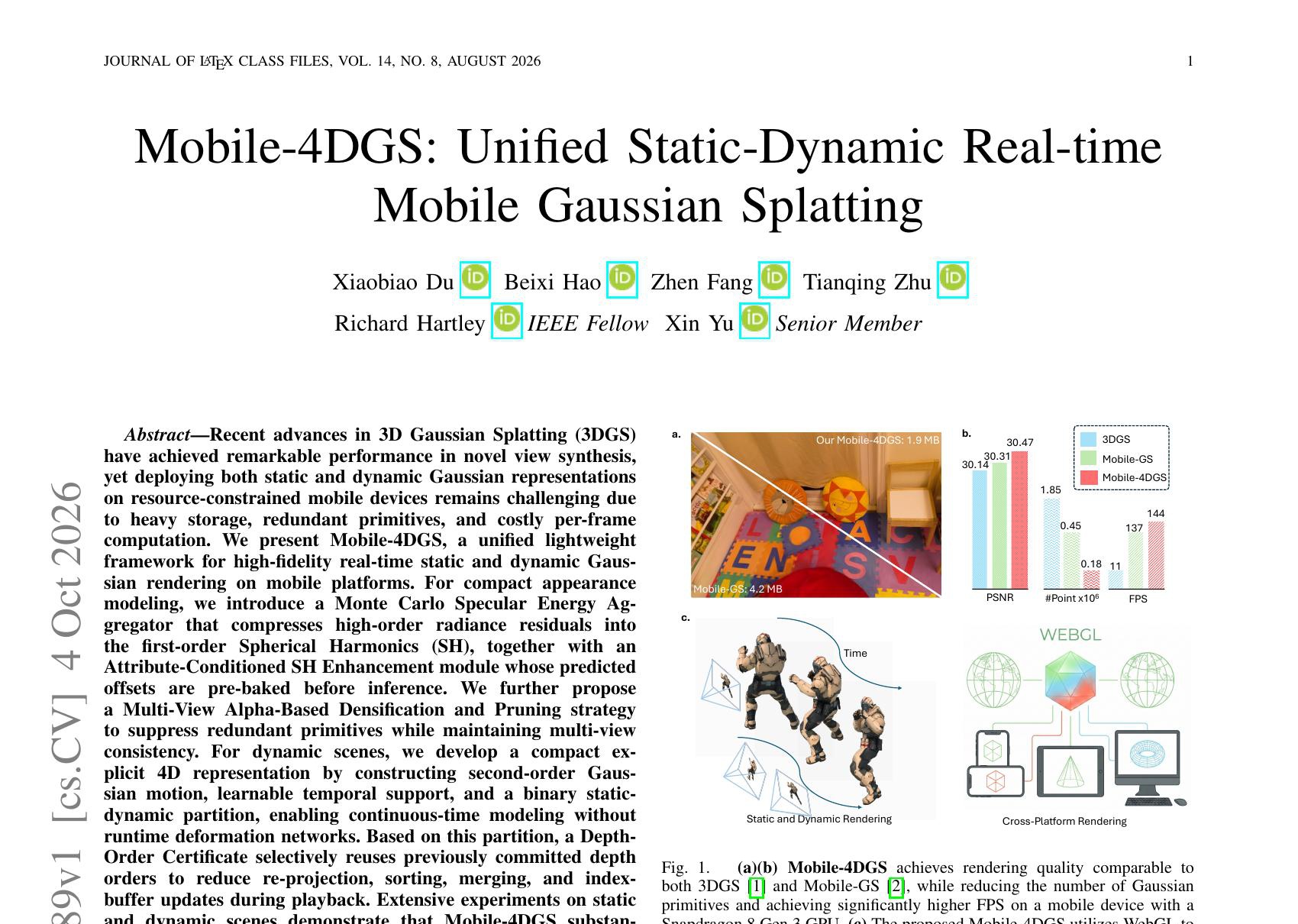
53. Mobile-4DGS: Unified Static-Dynamic Real-time Mobile Gaussian Splatting
🔑 Keywords: 3D Gaussian Splatting, Mobile-4DGS, real-time rendering, static and dynamic scenes
💡 Category: Computer Vision
🌟 Research Objective:
– The paper introduces Mobile-4DGS, aiming to achieve high-fidelity real-time Gaussian rendering on resource-constrained mobile platforms for both static and dynamic scenes.
🛠️ Research Methods:
– Mobile-4DGS uses a Monte Carlo Specular Energy Aggregator for compressing radiance residuals and an Attribute-Conditioned SH Enhancement module for efficiency.
– A Multi-View Alpha-Based Densification and Pruning strategy is applied to suppress redundant primitives while ensuring multi-view consistency.
– For dynamic scenes, a compact 4D representation with second-order Gaussian motion and a binary static-dynamic partition is proposed to enable continuous-time modeling.
💬 Research Conclusions:
– Mobile-4DGS significantly reduces storage and rendering overhead on mobile devices while maintaining competitive visual quality for real-time 3D and 4D Gaussian Splatting.
👉 Paper link: https://huggingface.co/papers/2610.05289
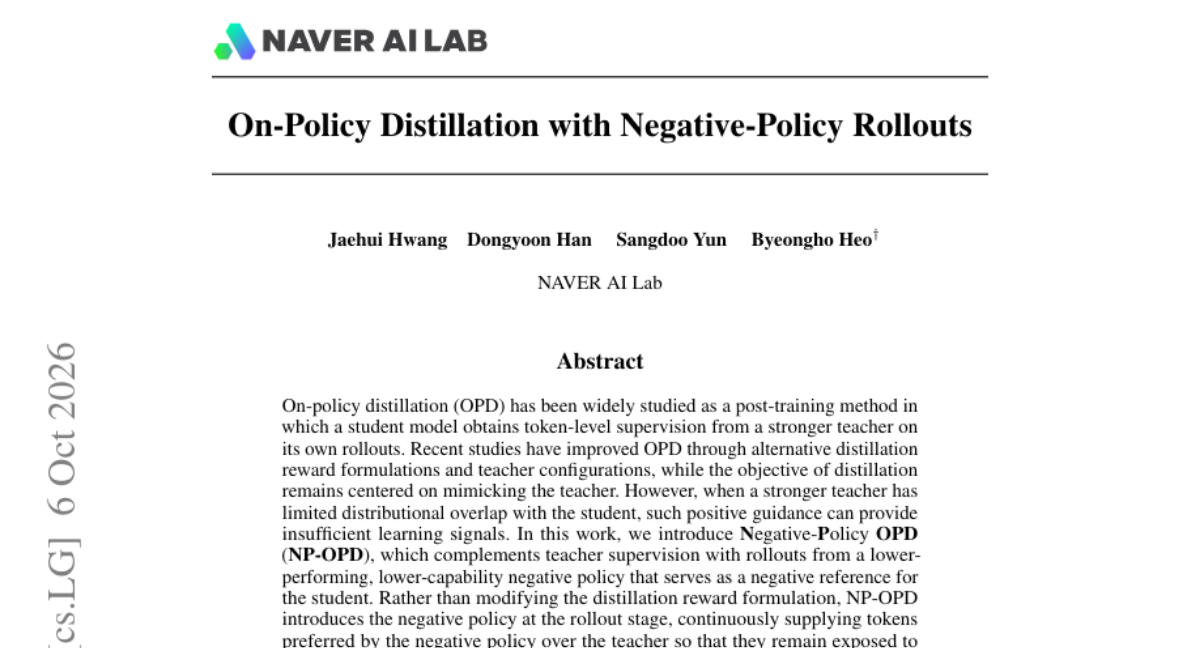
54. On-Policy Distillation with Negative-Policy Rollouts
🔑 Keywords: On-policy distillation, Negative-Policy OPD, teacher supervision, rollout stage
💡 Category: Reinforcement Learning
🌟 Research Objective:
– To introduce Negative-Policy OPD (NP-OPD) that incorporates a negative policy to complement traditional on-policy distillation, enhancing learning signals by providing a negative reference during student model training.
🛠️ Research Methods:
– Utilize rollouts from a lower-performing negative policy alongside a stronger teacher supervision during the token-level rollout stage to continuously provide contrasting learning signals that improve the distillation process.
💬 Research Conclusions:
– NP-OPD enhances OPD across various model scales, generation modes, reasoning domains, and OPD variants by effectively moving the student model away from undesirable learning pathways attributed to the negative policy, and improving overall learning outcomes.
👉 Paper link: https://huggingface.co/papers/2610.07874
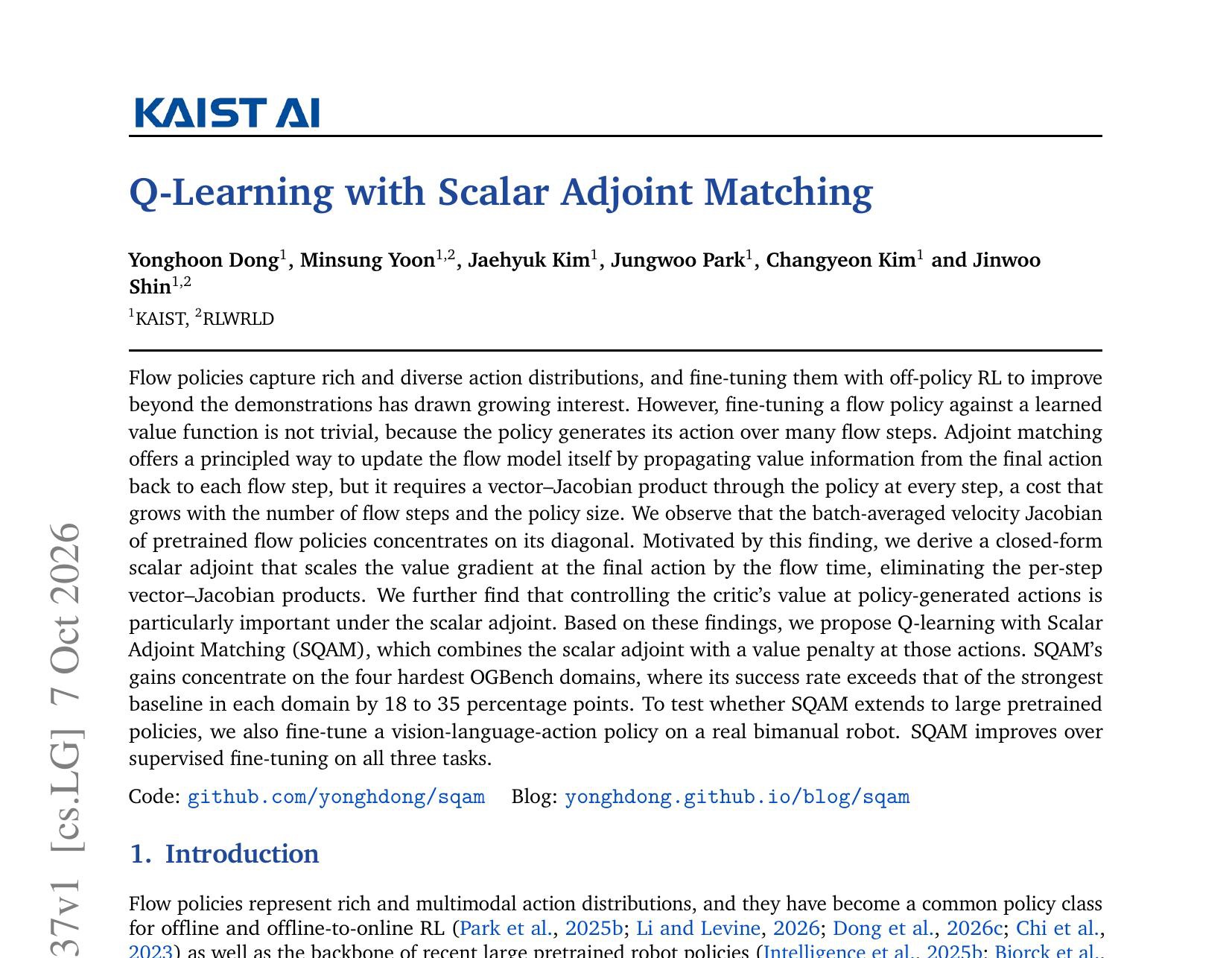
55. Q-Learning with Scalar Adjoint Matching
🔑 Keywords: Flow policies, off-policy RL, Scalar Adjoint, Q-learning, OGBench domains
💡 Category: Reinforcement Learning
🌟 Research Objective:
– To improve the fine-tuning of flow policies using off-policy Reinforcement Learning (RL) for enhancing performance beyond initial demonstrations.
🛠️ Research Methods:
– Introduction of Q-learning with Scalar Adjoint Matching (SQAM) that mitigates the need for costly vector–Jacobian products by scaling the value gradient through a closed-form scalar adjoint approach.
💬 Research Conclusions:
– SQAM notably increases success rates on challenging OGBench domains, outperforming the strongest baseline by 18 to 35 percentage points.
– SQAM’s framework effectively enhances fine-tuning for large pretrained models, demonstrated in real-world applications such as a bimanual robot.
👉 Paper link: https://huggingface.co/papers/2610.10437
56. Minimal Witness Reinforcement Learning
🔑 Keywords: Minimal-Witness Reinforcement Learning, minimal sufficient witnesses, policy gradient, RL methods
💡 Category: Reinforcement Learning
🌟 Research Objective:
– To formalize the problem of minimal-witness identification and introduce a new approach named Minimal-Witness Reinforcement Learning (MWRL) to address it.
🛠️ Research Methods:
– MWRL uses a value iteration planner to recover the entire family of witnesses and a policy gradient method that scales to large language models. It credits each proposal for its unique contribution, derived directly from the problem definition.
💬 Research Conclusions:
– MWRL effectively recovers most minimal witnesses in various experimental settings, outperforming other methods that return redundant supersets or a single witness, thus expanding reinforcement learning’s scope beyond single-solution optimization.
👉 Paper link: https://huggingface.co/papers/2610.07226
57. NAMVIS: Next-Scale Autoregressive Multi-View Image Synthesis
🔑 Keywords: Sparse-view synthesis, NAMVIS, geometry-conditioned autoregression, Multi-scale Projective Pose Encoding, diffusion-free
💡 Category: Generative Models
🌟 Research Objective:
– The research primarily aims to offer an efficient alternative for sparse-view multi-view synthesis by introducing NAMVIS, which avoids the drawbacks of diffusion-based methods.
🛠️ Research Methods:
– The study introduces a diffusion-free framework using geometry-conditioned next-scale autoregression instead of iterative denoising and proposes Multi-scale Projective Pose Encoding to incorporate camera transformations in the model’s process.
💬 Research Conclusions:
– NAMVIS outperforms diffusion-based baselines in key metrics like PSNR, SSIM, and LPIPS, while providing a significant speed advantage, suggesting its potential as a promising and efficient solution for 3D content creation.
👉 Paper link: https://huggingface.co/papers/2610.04722
58. Agentic RAG Evaluation: Budget Allocation Across Questions, Trajectories, and Reads
🔑 Keywords: Agentic RAG, Evaluation budget, Generalizability theory, Repeated sampling
💡 Category: Natural Language Processing
🌟 Research Objective:
– Investigating the allocation precision, reading efficiency, and cost boundaries of agentic retrieval-augmented generation (RAG) using diverse evaluation budgets.
🛠️ Research Methods:
– Utilization of HotpotQA and MuSiQue datasets for retrieval-feedback comparison, analysis of question coverage, token budget assessments, and prediction accuracy evaluations with nested and Q-only forecasts.
💬 Research Conclusions:
– Enhanced question coverage significantly reduces standard error, archived forecasts predict allocations accurately, and optimal cost management approaches are proposed, with temperature settings reducing answer disagreements without impacting precision.
👉 Paper link: https://huggingface.co/papers/2610.05034
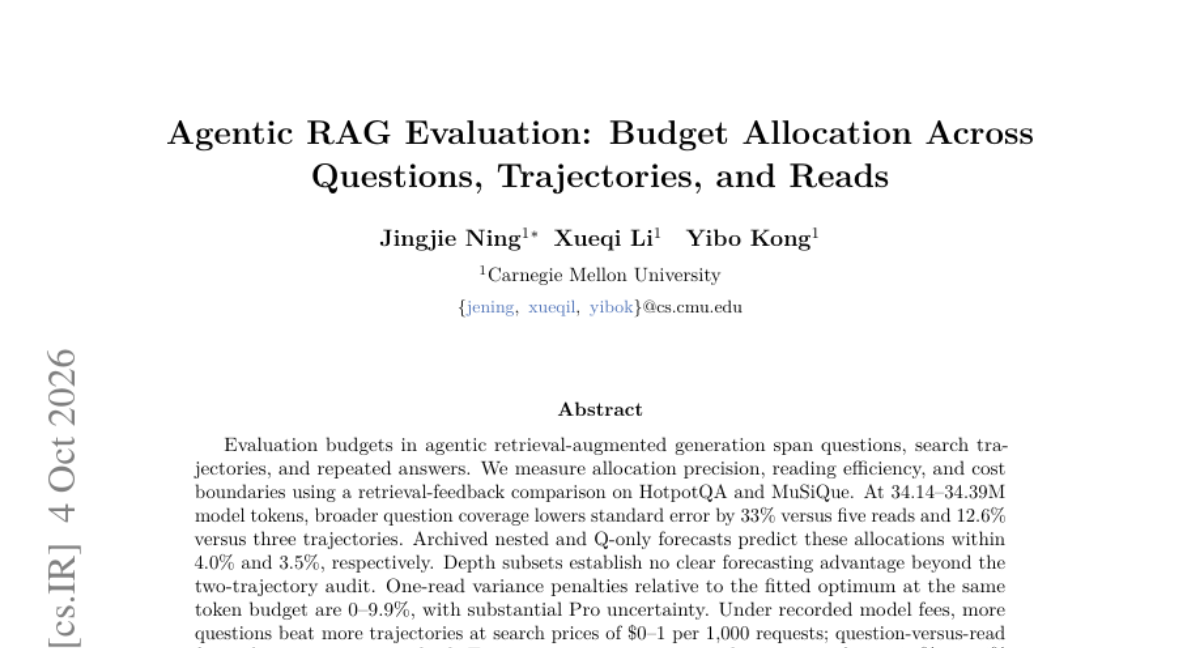
59. SWE-Game: Can Coding Agents Build the Games We Want?
🔑 Keywords: SWE-Game, Godot-to-Unity porting, Opus5, gameplay logic errors
💡 Category: AI Systems and Tools
🌟 Research Objective:
– Introduce SWE-Game, a benchmark with 247 tasks across 41 Godot games to evaluate agent performance in game development.
🛠️ Research Methods:
– Five distinct task types are used, including implementation, skeleton completion, and gameplay porting, assessed through engine-state checks and feature demonstrations.
💬 Research Conclusions:
– Opus5 achieves the highest score among six models, although scores remain below 60 out of 100 for main tasks, indicating prevalent requirement omissions and logic errors.
👉 Paper link: https://huggingface.co/papers/2609.33678
60. PhysEvo: Astra Can Act, Let It
🔑 Keywords: Physical recursive self-improvement, Meta-agent, Astra, AI Systems and Tools, Robotics and Autonomous Systems
💡 Category: Robotics and Autonomous Systems
🌟 Research Objective:
– Introduction of PhysEvo, a framework for physical recursive self-improvement around a single frozen model to enhance reliable manipulation in the Astra system.
🛠️ Research Methods:
– Utilization of a task agent and a meta-agent to execute robot tasks, diagnose failures, and improve tools and skills without model-weight updates.
💬 Research Conclusions:
– PhysEvo demonstrates superior performance compared to RoboDawn’s Astra agent, achieving higher success rates in manipulation tasks and real-world task trials.
👉 Paper link: https://huggingface.co/papers/2610.08995
61. RobotWorld: Benchmarking Multimodal Agents for Robot Use Across Diverse Tasks and Embodiments
🔑 Keywords: general-purpose agents, RobotWorld, physical task execution, capability transfer, task outcomes
💡 Category: Robotics and Autonomous Systems
🌟 Research Objective:
– The study investigates how the capabilities of general-purpose agents in writing code, using tools, and completing complex digital tasks transfer to the physical world by introducing RobotWorld, a simulation testbed for robot use.
🛠️ Research Methods:
– A simulation testbed called RobotWorld is utilized, covering 84 tasks across various domains such as manipulation and driving, with explicit interaction budgets and success checks to analyze task outcomes against execution traces.
💬 Research Conclusions:
– Current agents construct sophisticated perception and control workflows, yet struggle with consistent successful task execution, losing task-relevant object states and mistaking unfinished tasks for completion. The study identifies capability gaps and model differences in task success rates, establishing targets for training more reliable physical-world agents.
👉 Paper link: https://huggingface.co/papers/2610.10409

62. ReSAIL: Mitigating Collapse in Iterative Agent Self-Distillation
🔑 Keywords: Iterative self-distillation, Recursive self-improvement, Privileged Information, ReSAIL, Multimodal GUI agents
💡 Category: Reinforcement Learning
🌟 Research Objective:
– The paper aims to address deployment performance collapse in iterative self-distillation of LLM agents by developing a method that prioritizes informative interaction steps and preserves PI-conditioned behavior.
🛠️ Research Methods:
– Introduction of ReSAIL, a plug-in augmentation for PI-based self-distillation that selects key interaction steps and balances distillation losses, applied on ALFWorld and TextCraft environments.
💬 Research Conclusions:
– ReSAIL delivers substantial improvements in final-cycle success rates and enhances action prediction accuracy, demonstrating the method’s efficacy in mitigating performance collapse in iterative self-distillation.
👉 Paper link: https://huggingface.co/papers/2609.39306

63. RunningTab: Direct Workspace Interaction with Environment-Side Tabs
🔑 Keywords: direct workspace interaction (DWI), Large Language Models (LLM), RunningTab
💡 Category: AI Systems and Tools
🌟 Research Objective:
– The paper aims to address the shortcomings of direct workspace interaction (DWI) by introducing RunningTab, a framework that enhances file tracking and extraction tasks through an environment-side tab.
🛠️ Research Methods:
– The authors validate the RunningTab framework on three benchmarks using three different LLMs to test its efficacy compared to plain DWI and baseline models.
💬 Research Conclusions:
– RunningTab consistently outperforms plain DWI and other baseline models by effectively keeping track of task requirements and ensuring that deliverables incorporate necessary values from the environment.
👉 Paper link: https://huggingface.co/papers/2610.10444
64. Semifactual Credit-Augmented Policy Optimization
🔑 Keywords: Reinforcement Learning, Verifiable Rewards, Semifactual Stability, SCAPO, GRPO
💡 Category: Reinforcement Learning
🌟 Research Objective:
– To enhance reasoning accuracy in large language models by addressing token-level sensitivity and improving credit assignment in reinforcement learning with verifiable rewards.
🛠️ Research Methods:
– Introduced Semifactual Credit-Augmented Policy Optimization (SCAPO), which incorporates semifactual stability into token-level credit assignment, measured token probability drift, and adjusted token advantages during early training.
💬 Research Conclusions:
– SCAPO outperformed existing methods by improving accuracy on AIME 2024-2026 benchmarks and generalization across model scales and benchmarks, demonstrating the efficacy of semifactual stability in reinforcement learning.
👉 Paper link: https://huggingface.co/papers/2609.40360

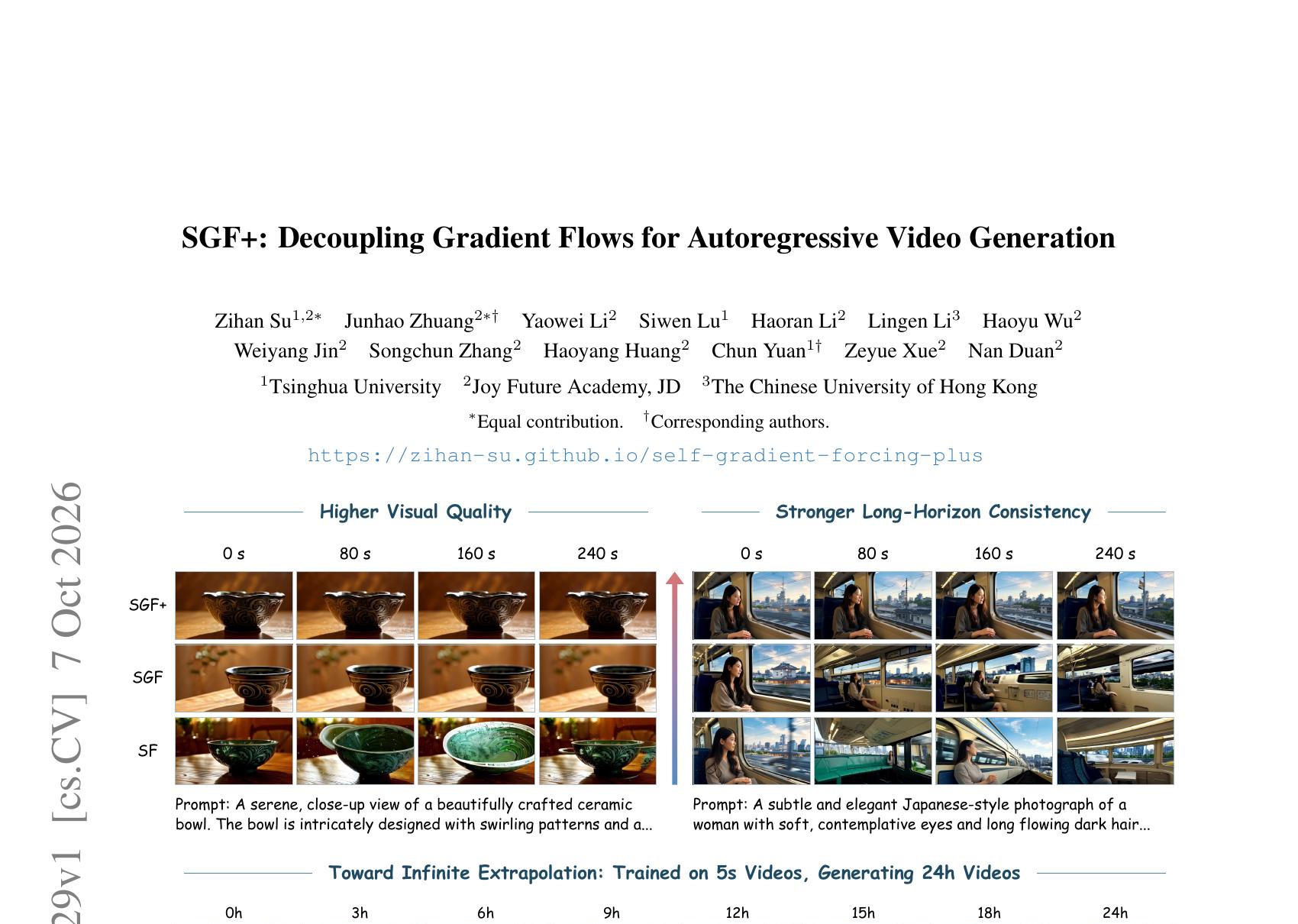
65. SGF+: Decoupling Gradient Flows for Autoregressive Video Generation
🔑 Keywords: Self Gradient Forcing Plus, autoregressive video generation, temporal consistency, role-specific parameterization
💡 Category: Generative Models
🌟 Research Objective:
– Investigate the challenge of optimizing visual quality and temporal consistency in autoregressive video generation by addressing the systematic negative alignment of distinct gradient patterns in parameter sharing.
🛠️ Research Methods:
– Introduce Self Gradient Forcing Plus (SGF+), which separates parameters for context writing and denoising, and optimizes both roles using the original generation objective while maintaining interaction through causal attention.
💬 Research Conclusions:
– Implementing role-specific parameterization with SGF+ improves visual quality and long-horizon consistency, enabling continuous video generation up to 24 hours without additional training data or long-video fine-tuning.
👉 Paper link: https://huggingface.co/papers/2610.10429
66. UltraText Bench: A Comprehensive Bilingual Benchmark for Evaluating Visual Text Rendering in Image Generation
🔑 Keywords: Dense visual text, UltraText Bench, Q-Judger, text fidelity, spatial quality
💡 Category: Computer Vision
🌟 Research Objective:
– The research introduces UltraText Bench, a bilingual benchmark aimed at evaluating prompt-only generation of dense visual text across various real-world scene categories.
🛠️ Research Methods:
– The benchmark contains 432 prompts covering 24 scene categories in both English and Chinese with three difficulty levels. Evaluation involves human-reviewed prompts with structured references assessed by the Q-Judger vision-language model.
💬 Research Conclusions:
– Results show varied performance across different model configurations, highlighting strengths and weaknesses such as clarity and fidelity in dense text reproduction. Performance variability is also observed across different workload levels.
👉 Paper link: https://huggingface.co/papers/2610.09823

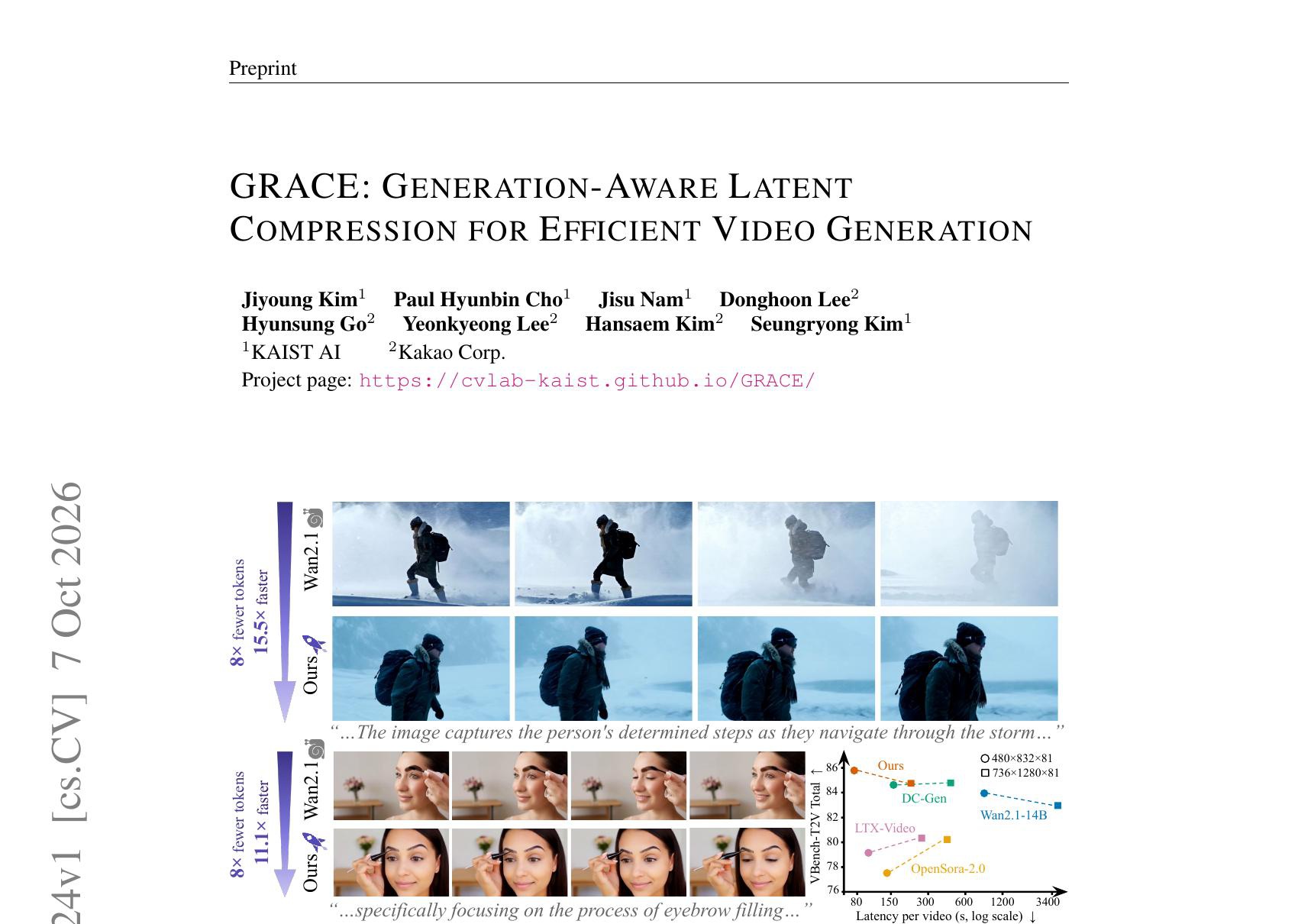
67. GRACE: Generation-aware latent compression for efficient video generation
🔑 Keywords: compressed video autoencoders, video diffusion models, Diffusion Transformer, Generation-Aware Latent Compression, GRACE
💡 Category: Generative Models
🌟 Research Objective:
– To propose a framework, GRACE, that can compress a pretrained video autoencoder while remaining compatible with a pretrained Diffusion Transformer for efficient video generation.
🛠️ Research Methods:
– Utilizes a two-stage framework with a frozen base latent and residual latent learning for lost information, aligning compressed latents in the feature space, and applying lightweight fine-tuning and asymmetric denoising.
💬 Research Conclusions:
– GRACE significantly reduces the token count and latency of Wan2.1-I2V-14B, while maintaining generation quality on VBench, demonstrating its effectiveness in efficient video generation.
👉 Paper link: https://huggingface.co/papers/2610.10524
68. Recursive Game Creator: An Agentic Product-Level Experience-Oriented Game Harness
🔑 Keywords: Recursive Game Creator, game development, coding-native Player
💡 Category: Generative Models
🌟 Research Objective:
– To enhance agentic game development by transforming basic game prototypes into engaging and entertaining games through the Recursive Game Creator framework.
🛠️ Research Methods:
– The Recursive Game Creator framework organizes development into four components: Designer, Builder, Player, and Reviewer, each playing a distinct role in the iterative game creation process.
💬 Research Conclusions:
– Achieved state-of-the-art performance with a 77.89 score on GameCraft-Bench and improved task success rate and runtime-check pass rate on GameASG-Bench. User studies indicated longer playtime and higher ratings.
👉 Paper link: https://huggingface.co/papers/2610.08621
69. Long-WAM: Scaling the Context of World-Action Models
🔑 Keywords: Real-time robot control, Long-WAM, Autoregressive (AR) pretraining, Deployment on RTX 5090
💡 Category: Robotics and Autonomous Systems
🌟 Research Objective:
– To develop Long-WAM, a framework that extends the context of causal world-action models under real-time control constraints, aiming to enhance success in robot manipulation tasks by utilizing visual history more effectively.
🛠️ Research Methods:
– Leveraging causal prediction from robot and egocentric videos without action labels.
– Implementing AR pretraining for better utilization of longer visual histories.
– Deploying the system on different hardware platforms such as RTX 5090 and DGX Spark for efficient real-time performance.
💬 Research Conclusions:
– The use of AR pretraining with longer visual histories significantly increases task success rates, exemplified by a success rate improvement from 63.3% to 78.7% on RoboCasa GR-1.
– Long-WAM outperforms existing methods on platforms such as LIBERO-Long, RoboTwin 2.0, and DOMINO.
– Successful real-time application on Unitree G1 and YAM, with notable performance in dynamic manipulation tasks like cup stacking.
👉 Paper link: https://huggingface.co/papers/2610.10528