AI Native Daily Paper Digest – 20261012 – DiffusionART | Reflex | PolyOCR
Today’s digest highlights attention-grabbing developments from DeepSeek as well as advancements incorporating the Llama model family. The broader theme focuses on agentic systems and their practical applications, particularly in enhancing autonomous decision-making. Notable among the papers is a study that presents the DeepSeek model’s integration with AgentMatcher, achieving a 15% improvement on the ARO benchmark over previous iterations. Another paper discusses Llama’s innovative approach to transfer learning, showcasing an increase in efficiency by 22% in task adaptation. A separate study emphasizes the importance of context preservation in long-sequence predictions, showing a 30% improvement in maintaining sequence integrity.
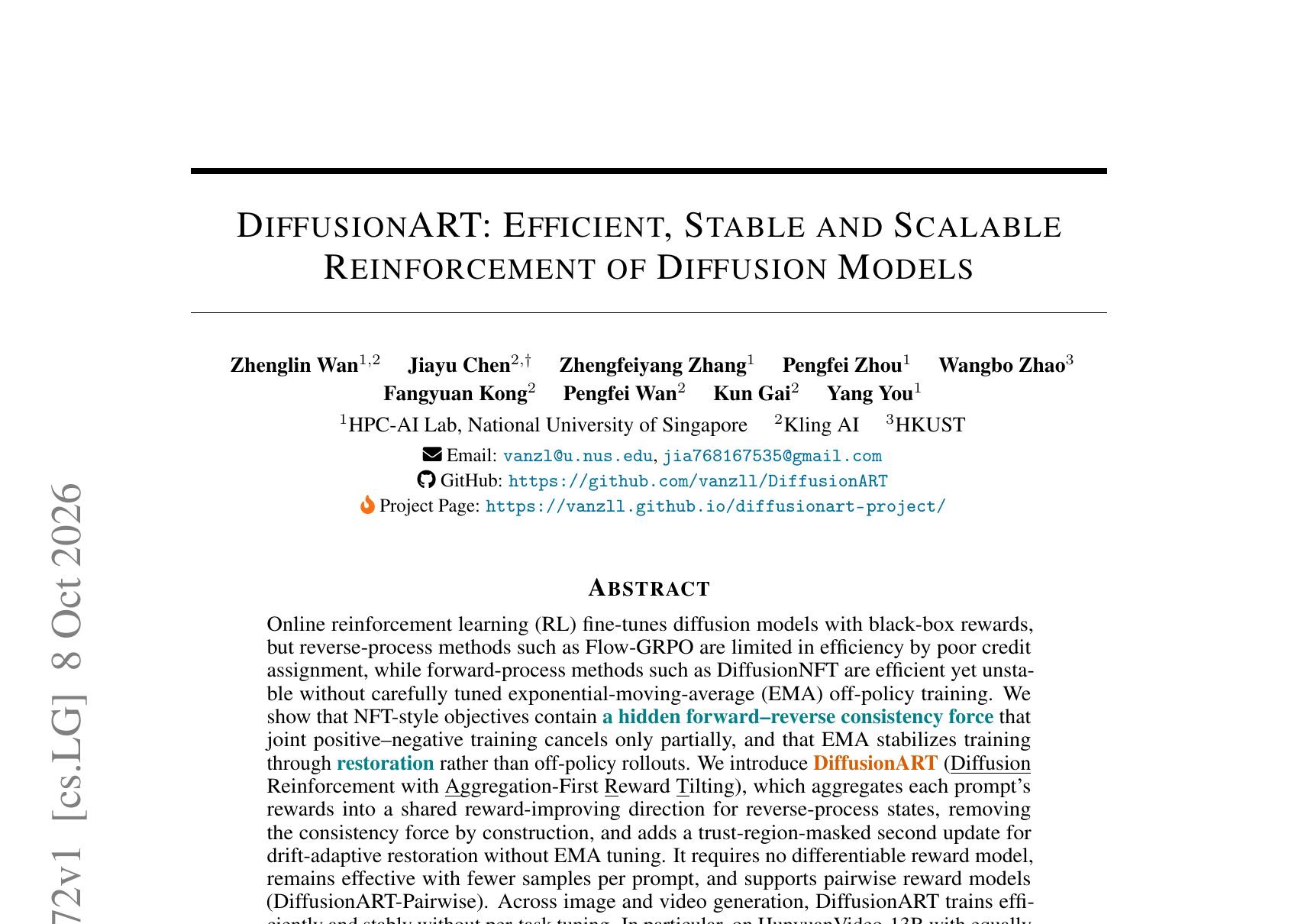
1. DiffusionART: Efficient, Stable and Scalable Reinforcement of Diffusion Models
🔑 Keywords: Online reinforcement learning, Diffusion models, Black-box rewards, Stability, Efficiency
💡 Category: Generative Models
🌟 Research Objective:
– The paper aims to improve the efficiency and stability of training diffusion models for image and video generation using online reinforcement learning without requiring extensive tuning.
🛠️ Research Methods:
– The introduction of DiffusionART (Diffusion Reinforcement with Aggregation-First Reward Tilting) which aggregates rewards into a shared direction for reverse-process states and utilizes a trust-region-masked update for drift-adaptive restoration, eliminating the need for exponential-moving-average (EMA) tuning.
💬 Research Conclusions:
– DiffusionART efficiently and stably trains across different tasks, requiring significantly fewer GPU hours while achieving higher mean training rewards than existing methods such as DiffusionNFT and Flow-GRPO-Fast.
👉 Paper link: https://huggingface.co/papers/2610.12572
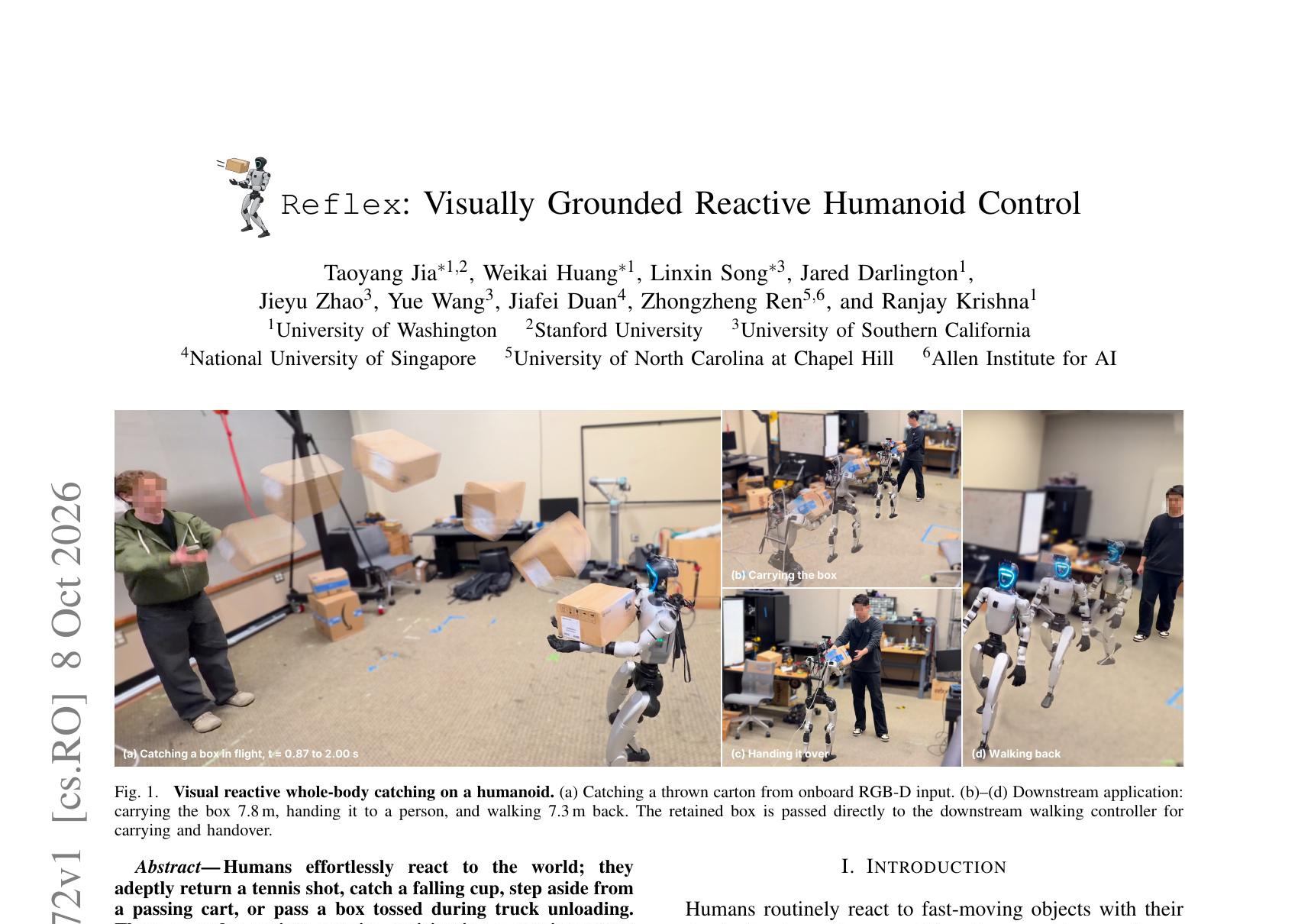
2. Reflex: Visually Grounded Reactive Humanoid Control
🔑 Keywords: Reflex, Whole-body control, RGB-D, Reinforcement Learning
💡 Category: Robotics and Autonomous Systems
🌟 Research Objective:
– To develop Reflex, a framework that enables humanoids to achieve visual reactive whole-body control, especially in tasks like catching thrown boxes.
🛠️ Research Methods:
– Implement a three-stage learning process involving: a state-based policy for whole-body catching via reinforcement learning, inferring box dynamics from partial observations, and using an egocentric RGB-D encoder to extract dynamics from visual data.
💬 Research Conclusions:
– The Reflex framework achieves significant success in both simulations and real-world tests, demonstrating 85.7% success in simulations and varying success rates based on distance in real-world scenarios.
👉 Paper link: https://huggingface.co/papers/2610.12772
3. EmbodiedCLBench: Evaluating Continual Learning for Self-Evolving Embodied Agents
🔑 Keywords: Continual learning, Embodied environments, EmbodiedCLBench, Self-evolving agents, Compositional generalization
💡 Category: Robotics and Autonomous Systems
🌟 Research Objective:
– The study introduces EmbodiedCLBench, a benchmark designed to evaluate the continual learning capabilities of self-evolving agents in embodied simulations.
🛠️ Research Methods:
– Evaluation through experiments using multiple agent harnesses and learning methods based on the compositional generalization principle.
💬 Research Conclusions:
– Findings reveal that while zero-shot solutions to advanced tasks are challenging, experience from basic tasks enables consistent improvement, though not scalable with more learning samples. Continual learning is highlighted as a crucial yet underexplored capability in embodied environments.
👉 Paper link: https://huggingface.co/papers/2610.13021
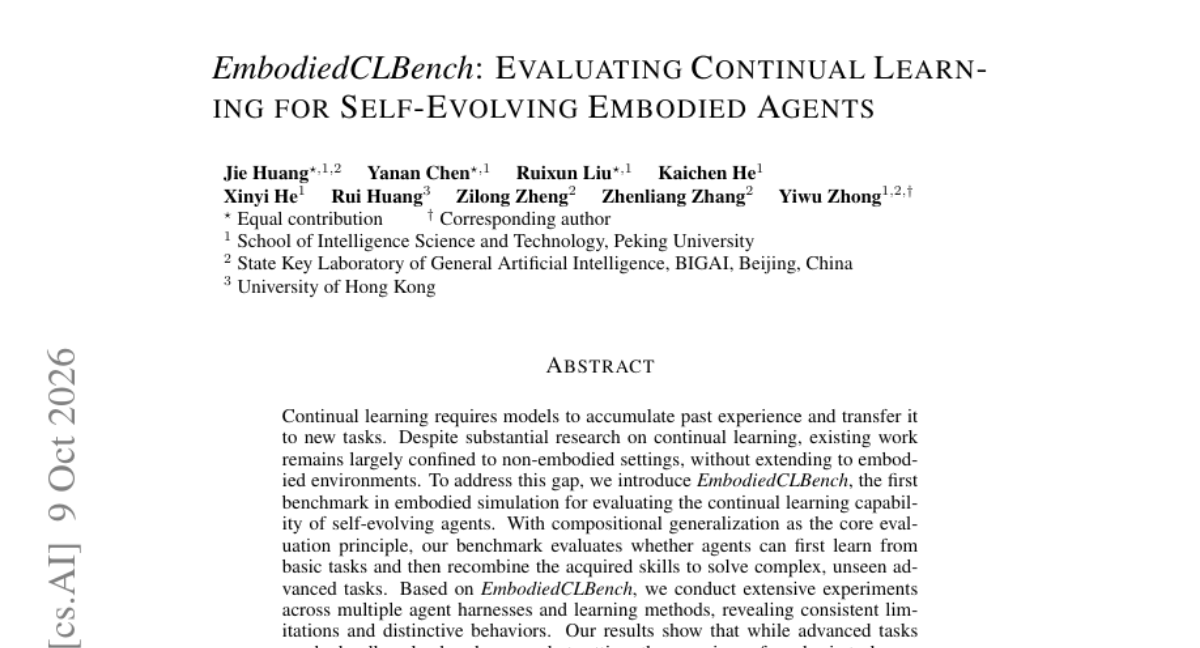
4. Here the World in Stereo: Learning Dynamic Spatial Correspondence for Immersive Joint Video-Audio Generation
🔑 Keywords: Stereo Audio, Dynamic Spatial Correspondence, AI Native
💡 Category: Multi-Modal Learning
🌟 Research Objective:
– The objective is to improve dynamic spatial correspondence in stereo audio generation linked with visual motion for immersive experiences in applications like AR/VR and interactive gaming.
🛠️ Research Methods:
– Introduced StereoBind, a framework that integrates visual motion with stereo audio using Visual Motion Binding, Spatial Track Encoder, and Residual Track RoPE.
– Developed StereoWorld-29K dataset and StereoWorldBench for evaluating audiovisual spatial consistency.
💬 Research Conclusions:
– StereoBind significantly enhances spatial alignment in stereo audio generation compared to existing models, maintaining high audiovisual quality.
👉 Paper link: https://huggingface.co/papers/2609.38748
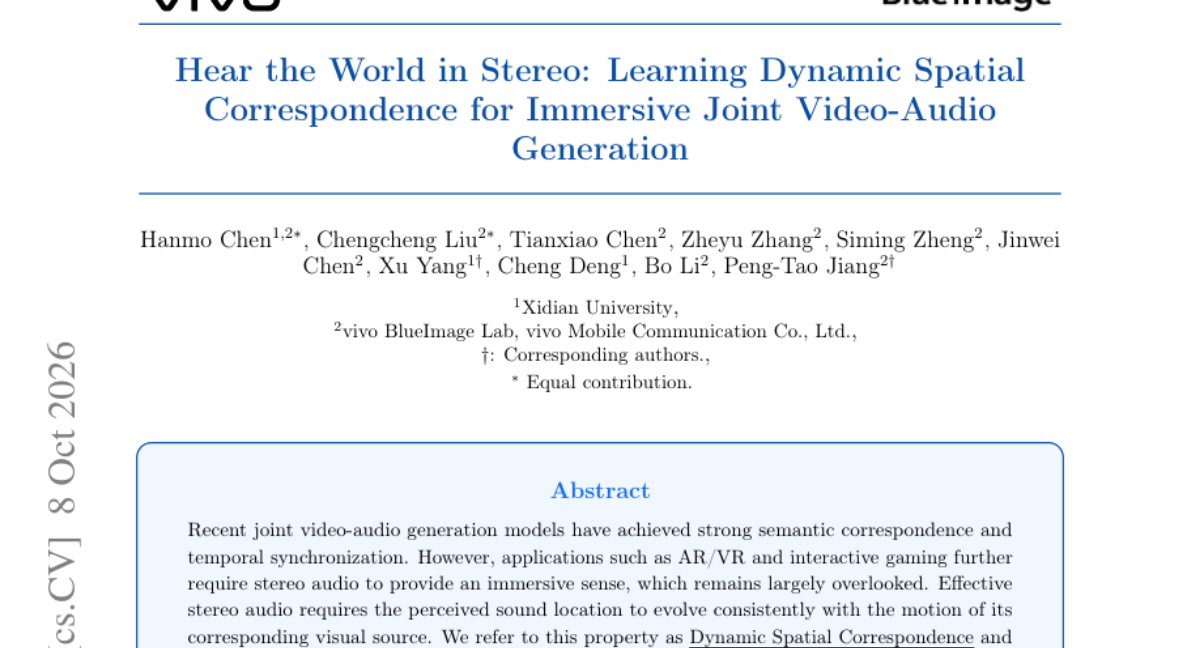
5. Continually Post-training Small Models via Synthetic Self-distillation
🔑 Keywords: Continual Learning, Self-Distillation Fine-Tuning, Small Models, Synthetic Self-Distillation, In-Distribution Learning
💡 Category: Machine Learning
🌟 Research Objective:
– To address the challenge of continual learning in small-scale models by identifying the failure’s root cause and improving knowledge acquisition and retention.
🛠️ Research Methods:
– Introduction of Synthetic Self-Distillation using a minimally larger same-family aligner, along with off-policy supervision and rejection sampling to maintain in-distribution learning.
💬 Research Conclusions:
– SynthSelf significantly outperforms existing methods across various datasets and benchmarks, enhancing effective continual learning for small models.
👉 Paper link: https://huggingface.co/papers/2610.13113
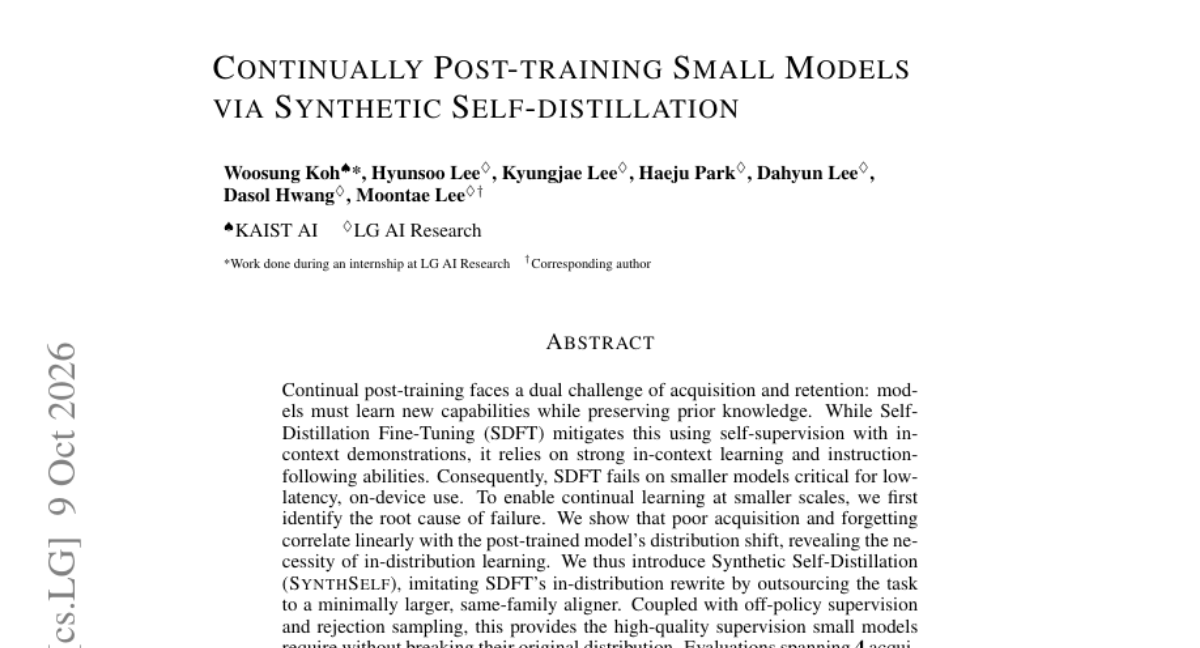
6. SepGen: Multi-Stem Audio-Video Separation and Generation in a Single Model
🔑 Keywords: 4D audio-visual scene, SepGen, audio-video generator, audio separation, waveforms
💡 Category: Multi-Modal Learning
🌟 Research Objective:
– To develop SepGen, a system that extends a pretrained audio-video generator to emit individual waveforms for each captioned source in a 4D audio-visual scene.
🛠️ Research Methods:
– SepGen supports two modes: generation mode where each source caption specifies its contents and separation mode which cleans the audio-mix and extracts specific components based on captions, all through a joint sampling run.
💬 Research Conclusions:
– SepGen excels in outperforming language-conditioned separators, especially in separating speech, even when spoken lines are omitted from captions. It provides superior decomposition of audio-mixes from free-text descriptions.
👉 Paper link: https://huggingface.co/papers/2610.11361
7. SoloQ: Calibration-Free Quantization for Diffusion Language Models
🔑 Keywords: Diffusion Language Models, Quantization, Calibration-free, SoloQ, AI Systems
💡 Category: AI Systems and Tools
🌟 Research Objective:
– Introduce SoloQ, a calibration-free quantization framework for diffusion language models to manage growing model sizes and high inference costs efficiently.
🛠️ Research Methods:
– Develop a structured K-RPBH rotation and lightweight rescaling correction to achieve data-independent quantization, applying commit-time KV-cache quantization for block-diffusion models.
💬 Research Conclusions:
– SoloQ retains accuracy under 4-bit quantization, surpasses calibration-based methods in benchmarks, reduces peak memory usage by up to 2.61X, and accelerates inference speed by up to 2.24X.
👉 Paper link: https://huggingface.co/papers/2610.07121

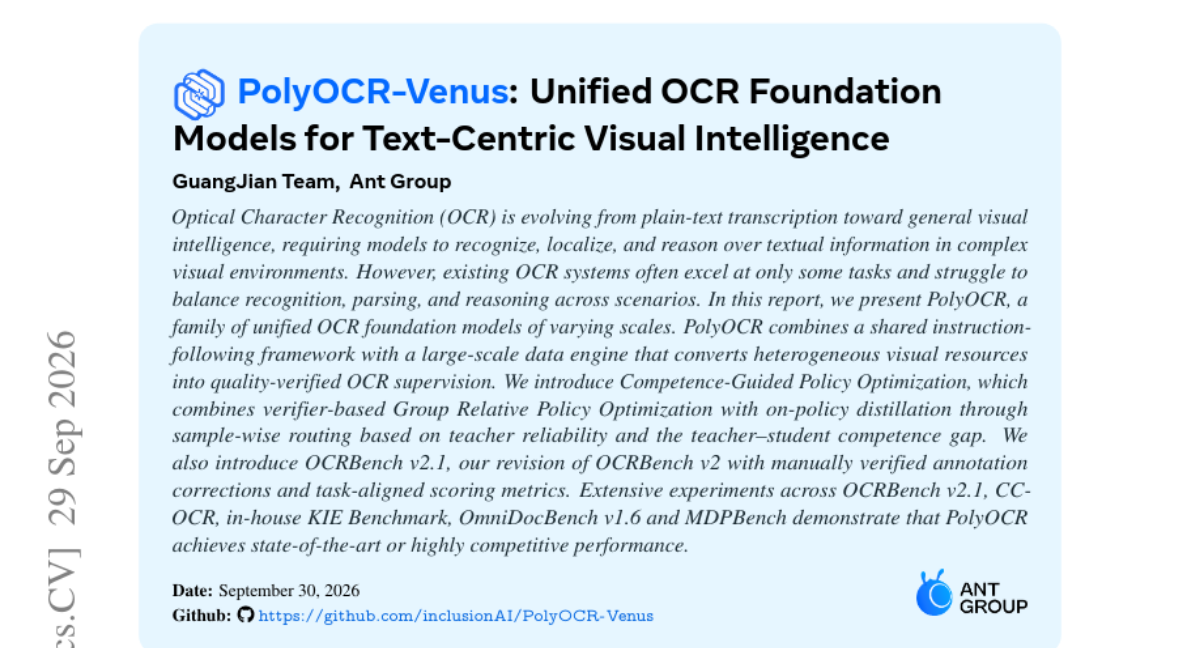
8. PolyOCR-Venus: Unified OCR Foundation Models for Text-Centric Visual Intelligence
🔑 Keywords: Optical Character Recognition (OCR), PolyOCR, Competence-Guided Policy Optimization
💡 Category: Computer Vision
🌟 Research Objective:
– To develop PolyOCR, a unified OCR model family that enhances recognition, localization, and reasoning in complex visual environments.
🛠️ Research Methods:
– Implemented a shared instruction-following framework with a large-scale data engine.
– Introduced Competence-Guided Policy Optimization for refining model performance.
– Revised OCRBench v2.1 for improved task-aligned scoring metrics.
💬 Research Conclusions:
– PolyOCR achieved state-of-the-art or highly competitive performance across multiple OCR benchmarks.
👉 Paper link: https://huggingface.co/papers/2609.37712
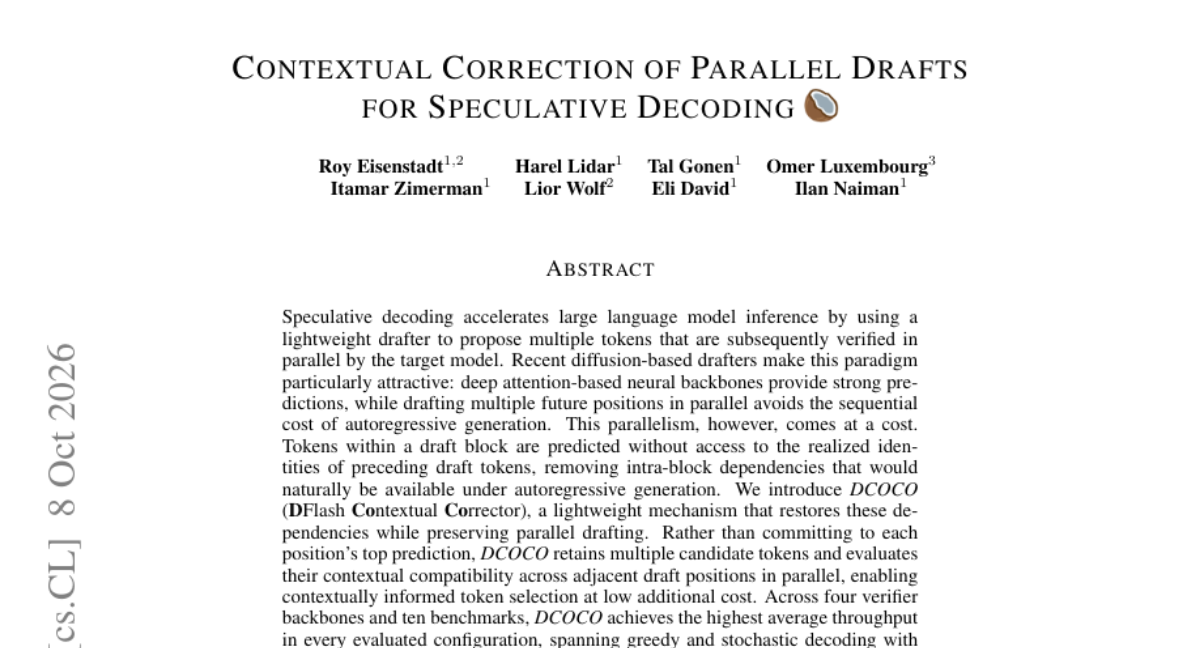
9. Contextual Correction of Parallel Draftsfor Speculative Decoding
🔑 Keywords: Speculative decoding, large language model, DCOCO, parallelism, contextual scoring
💡 Category: Natural Language Processing
🌟 Research Objective:
– The paper aims to overcome the limitations of speculative decoding in large language model inference by restoring intra-block dependencies without sacrificing parallelism through the introduction of DCOCO (DFlash Contextual Corrector).
🛠️ Research Methods:
– DCOCO is proposed as a mechanism to retain multiple candidate tokens and evaluate their contextual compatibility in parallel across draft positions, allowing for contextually informed token selection.
💬 Research Conclusions:
– DCOCO achieves significant speedups, up to 6.6x over vanilla decoding, and consistently outperforms competing methods in terms of throughput across various verifier backbones, benchmarks, and concurrent serving loads.
👉 Paper link: https://huggingface.co/papers/2610.12570
10. InstantFusion: A Shared Latent Interface for Heterogeneous Image Generators
🔑 Keywords: Diffusion/flow models, Latent Representations, Image Generation, InstantFusion, AI Systems and Tools
💡 Category: Generative Models
🌟 Research Objective:
– To investigate cross-model compatibility in independently trained image generators and develop a shared latent interface, InstantFusion, that connects denoising trajectories.
🛠️ Research Methods:
– Introduced model-specific Latent AutoEncoders to project intermediate states into a shared latent space to enable cross-model state translation.
💬 Research Conclusions:
– Demonstrated that InstantFusion allows for seamless denoising transitions across different image generators, achieving competitive performance in various applications such as multi-preference composition and cross-model composition.
👉 Paper link: https://huggingface.co/papers/2610.13944

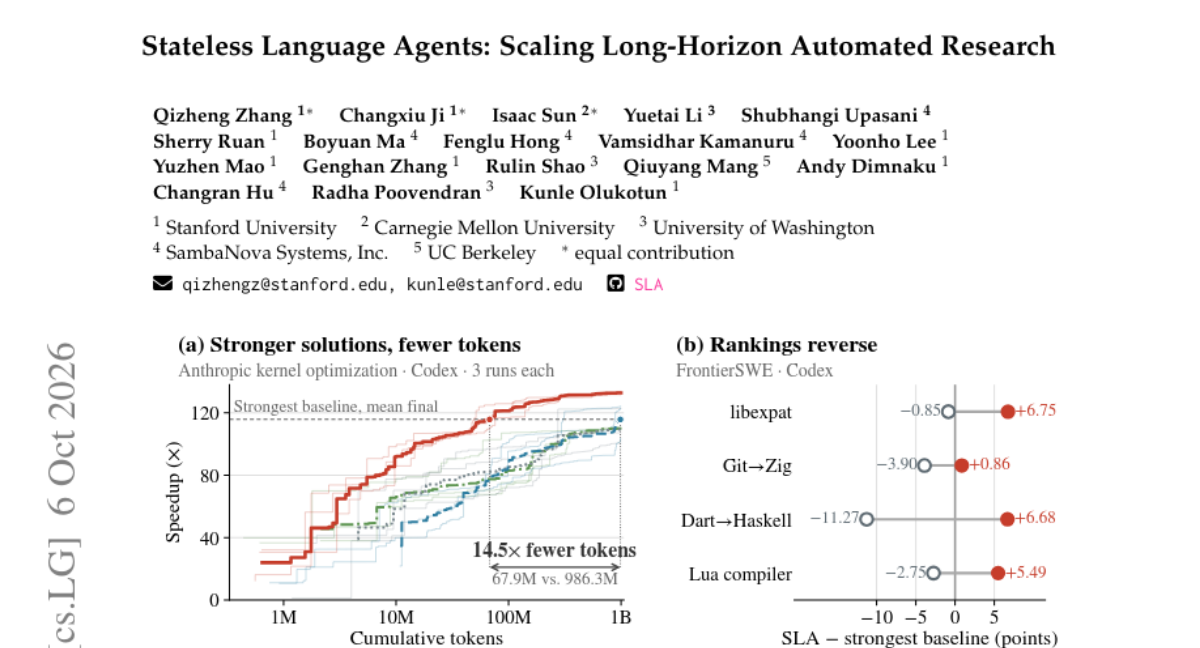
11. Stateless Language Agents: Scaling Long-Horizon Automated Research
🔑 Keywords: Stateless Language Agents, long horizons, stateful search, token consumption
💡 Category: AI Systems and Tools
🌟 Research Objective:
– The paper aims to address inefficiencies in long-horizon automated research systems and proposes an approach to manage research state effectively with Stateless Language Agents (SLAs).
🛠️ Research Methods:
– SLAs are introduced, where no agent carries its conversation history; a harness manages the research state by reconstructing specific contexts for each agent invocation. The system includes an Advisor and parallel Workers to perform experiments.
💬 Research Conclusions:
– The SLA framework significantly reduces token consumption, achieving better results in software engineering, kernel optimization, and algorithm design by creating focused contexts and explicit task assignments. It illustrates how short evaluation horizons can misjudge the performance of research systems.
👉 Paper link: https://huggingface.co/papers/2610.07625
12. Recurrent Harness for Agentic Continual Learning
🔑 Keywords: continual learning, ReHarness, distribution shifts, streaming protocol, language model agents
💡 Category: Natural Language Processing
🌟 Research Objective:
– The paper aims to address the challenge of online adaptation to distribution shifts in language model agents, proposing a framework named ReHarness for effective continual learning.
🛠️ Research Methods:
– ReHarness employs a novel recurrent harness framework that integrates backward revision into the online streaming protocol, leveraging trajectory feedback to enhance state reflections effectively.
💬 Research Conclusions:
– ReHarness demonstrates superior performance across multiple benchmarks compared to traditional methods. It effectively corrects overgeneralization, adapts to distribution shifts, and enhances stability and plasticity during continual learning.
👉 Paper link: https://huggingface.co/papers/2610.12668

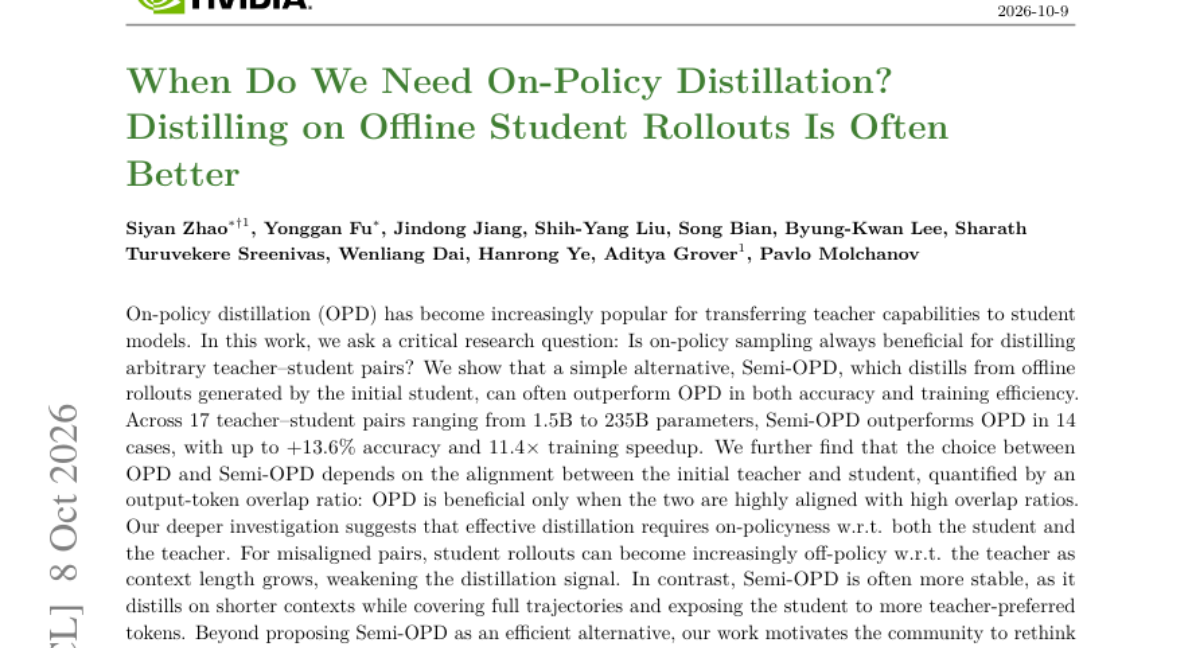
13. When Do We Need On-Policy Distillation? Distilling on Offline Student Rollouts Is Often Better
🔑 Keywords: On-policy distillation (OPD), Semi-OPD, teacher-student pairs, training efficiency, accuracy
💡 Category: Machine Learning
🌟 Research Objective:
– The study questions the benefits of on-policy sampling for distilling teacher-student model pairs and proposes a simpler alternative, Semi-OPD.
🛠️ Research Methods:
– Comparison of OPD and Semi-OPD across 17 teacher-student pairs with parameters ranging from 1.5B to 235B, via analysis of training accuracy and efficiency.
💬 Research Conclusions:
– Semi-OPD outperformed OPD in most cases, showing improved accuracy and significant training speedup, especially when teacher-student pairs have low alignment. Effective distillation requires mutual on-policyness, and Semi-OPD offers more stable results in such scenarios.
👉 Paper link: https://huggingface.co/papers/2610.11291
14. DataVista: Diagnosing Multimodal LLMs on Data Video Understanding
🔑 Keywords: Data Video Understanding, Data Visualization, Multi-Modal Learning, Causal Reasoning, Narrative Structure
💡 Category: Multi-Modal Learning
🌟 Research Objective:
– Introduce DataVista, the first benchmark for systematically evaluating data video understanding.
🛠️ Research Methods:
– Analyze 961 real-world data videos with 6,775 evaluation questions, introducing a three-level capability framework for assessment.
💬 Research Conclusions:
– The best-performing model, Gemini-3.1-Pro, achieves 70.0% accuracy, indicating significant room for improvement compared to human experts. Models struggle particularly with Causal Reasoning and Narrative Structure.
👉 Paper link: https://huggingface.co/papers/2610.11993

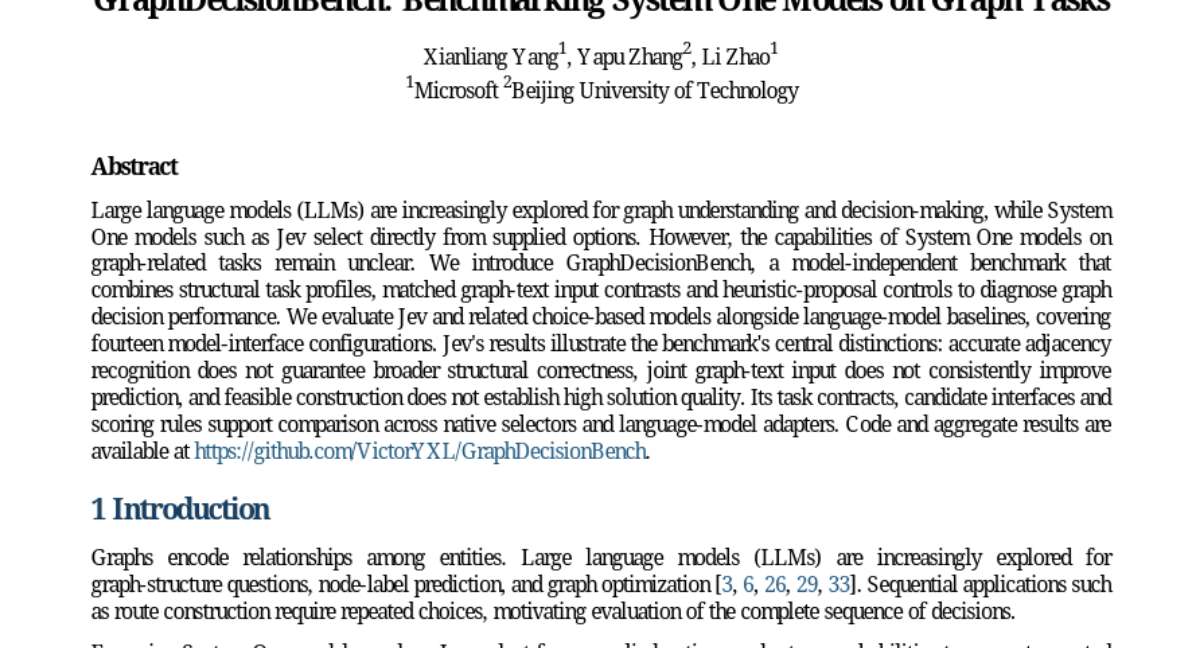
15. GraphDecisionBench: Benchmarking System One Models on Graph Tasks
🔑 Keywords: Large language models (LLMs), System One models, GraphDecide, Jev
💡 Category: Foundations of AI
🌟 Research Objective:
– The study aims to explore the capabilities of System One models like Jev in graph-related tasks, and establishes a benchmark named GraphDecide for evaluating graph decision performance.
🛠️ Research Methods:
– Introduces GraphDecide, a model-independent benchmark with structural task profiles and heuristic-proposal controls, evaluating fourteen model-interface configurations including Jev and language model baselines.
💬 Research Conclusions:
– Jev’s performance highlights distinctions such as the lack of consistent structural correctness, the ineffectiveness of joint graph-text input in prediction, and the inadequacy of feasible construction in ensuring high-quality solutions.
👉 Paper link: https://huggingface.co/papers/2610.06354
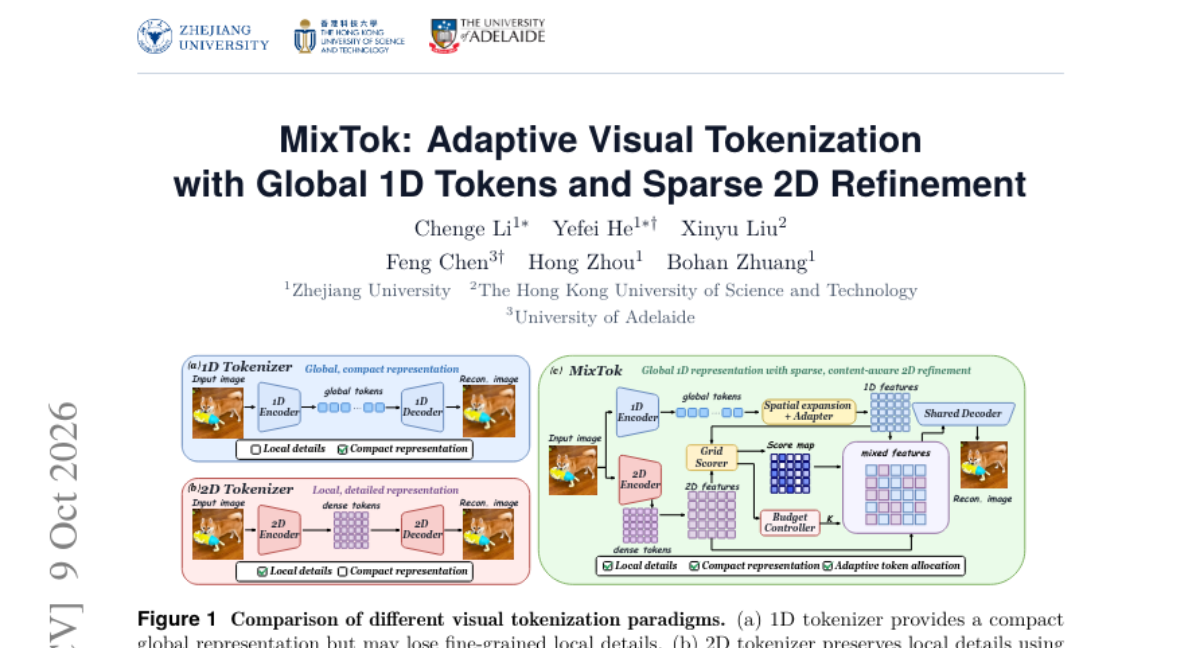
16. MixTok: Adaptive Visual Tokenization with Global 1D Tokens and Sparse 2D Refinement
🔑 Keywords: Efficient visual tokenization, MixTok, ImageNet, compact 1D global representation, sparse 2D tokens
💡 Category: Computer Vision
🌟 Research Objective:
– The objective is to develop a visual tokenizer, MixTok, that efficiently balances the compactness of representation with the preservation of fine-grained image content.
🛠️ Research Methods:
– MixTok combines a compact 1D global representation with sparse 2D token features for local refinement. A content-adaptive router is used to prioritize candidate locations and allocate the number of 2D tokens, optimizing the token budget for each image.
💬 Research Conclusions:
– MixTok demonstrates highly competitive reconstruction and generation performance on the ImageNet dataset with a reported rFID of 1.195 and gFID of 1.95, effectively utilizing a sparse average token budget.
👉 Paper link: https://huggingface.co/papers/2610.13181
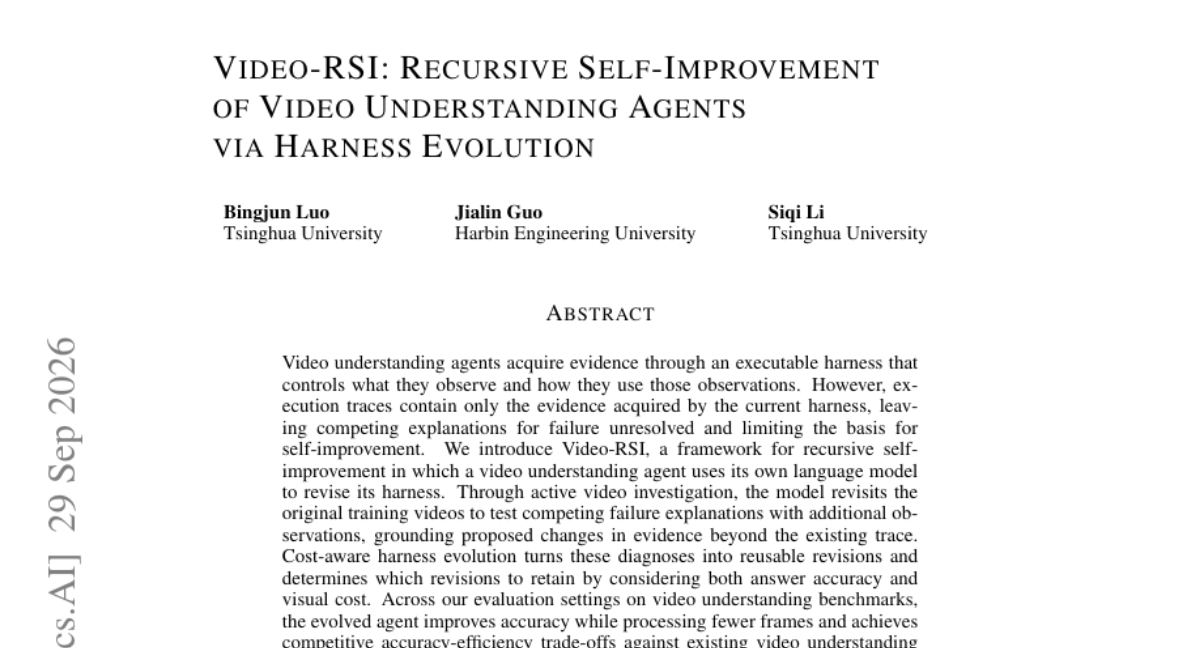
17. Video-RSI: Recursive Self-Improvement of Video Understanding Agents via Harness Evolution
🔑 Keywords: Video Understanding, Recursive Self-Improvement, AI Systems and Tools
💡 Category: AI Systems and Tools
🌟 Research Objective:
– To introduce Video-RSI, a framework enabling video understanding agents to recursively improve their evidence acquisition system.
🛠️ Research Methods:
– Utilization of the agent’s language model to iteratively revise its observation harness, conduct active video investigation, and evaluate cost-aware harness evolution.
💬 Research Conclusions:
– The evolved agent improves accuracy and efficiency, processing fewer frames and achieving competitive performance compared to existing agents.
👉 Paper link: https://huggingface.co/papers/2609.37950
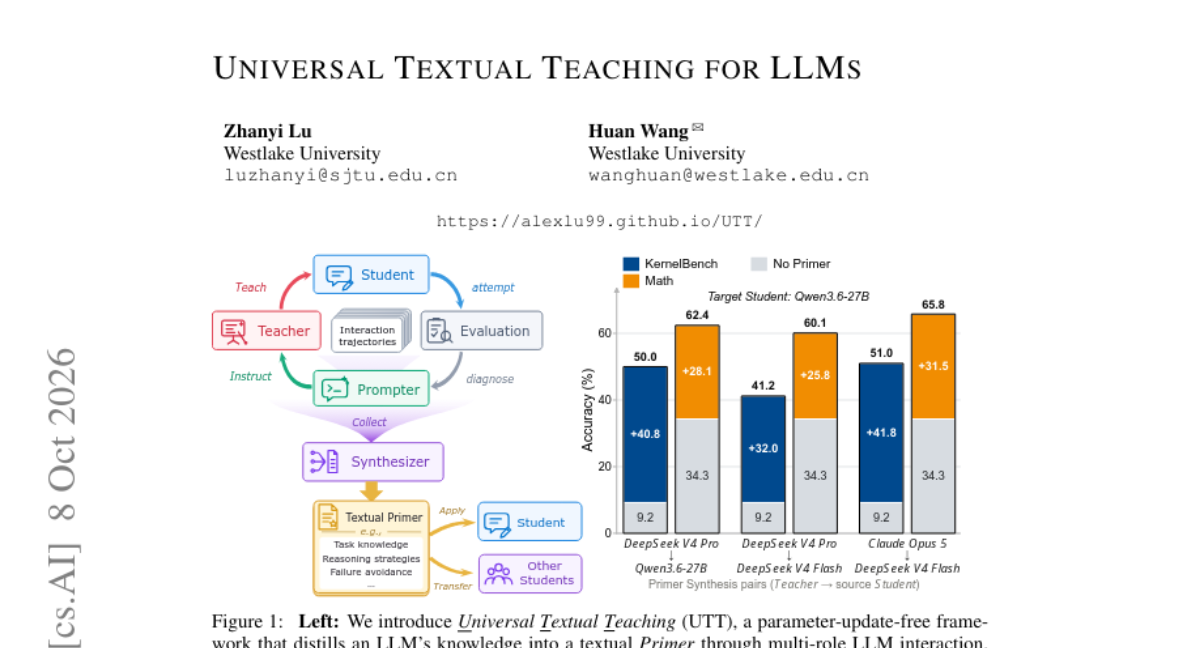
18. Universal Textual Teaching for LLMs
🔑 Keywords: Knowledge Distillation, Universal Textual Teaching, Large Language Models, Primer
💡 Category: Natural Language Processing
🌟 Research Objective:
– To develop a parameter-update-free method for knowledge distillation that is interpretable and reusable across different models.
🛠️ Research Methods:
– Introduced Universal Textual Teaching (UTT) framework evaluating and iteratively refining a textual artifact called Primer through multi-role interactions between Student, Prompter, Teacher, and Synthesizer.
💬 Research Conclusions:
– UTT significantly improved performance on math and code generation tasks and demonstrated generalizability across varied Teacher-Student pairs.
👉 Paper link: https://huggingface.co/papers/2610.12114
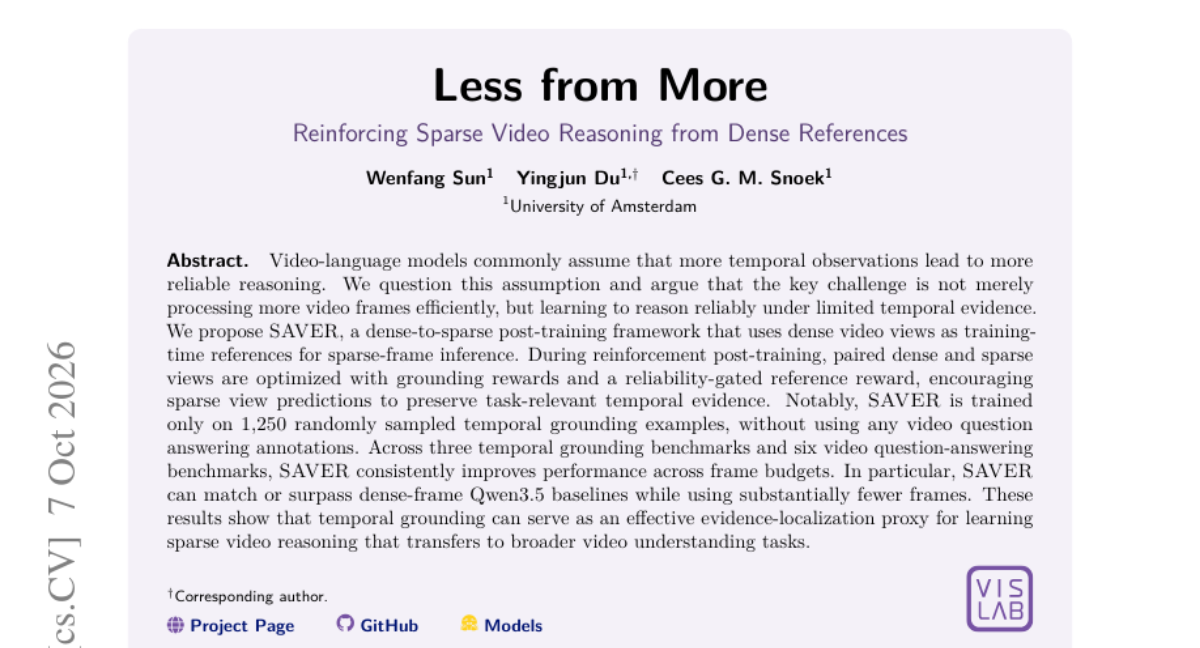
19. Less from More: Reinforcing Sparse Video Reasoning from Dense References
🔑 Keywords: SAVER, temporal grounding, video-language models, sparse-frame inference, reinforcement post-training
💡 Category: Computer Vision
🌟 Research Objective:
– The paper questions the assumption that more temporal observations lead to better reasoning in video-language models and explores reliable reasoning with limited temporal evidence.
🛠️ Research Methods:
– The introduction of SAVER, a dense-to-sparse post-training framework that utilizes dense video views for training and sparse-frame inference for task-related predictions, with optimization through grounding rewards and reliability-gated reference rewards.
💬 Research Conclusions:
– SAVER demonstrates improved performance across frame budgets and matches or surpasses dense-frame baselines, emphasizing its effectiveness in sparse video reasoning and its potential application to broader video understanding tasks.
👉 Paper link: https://huggingface.co/papers/2610.10893
20. QuantMLA: Function-Aligned Dual-Path Quantization for Low-Bit MLA KV Caching
🔑 Keywords: Multi-Head Latent Attention, QuantMLA, low-bit quantization, INT4, RoPE
💡 Category: Foundations of AI
🌟 Research Objective:
– The paper introduces QuantMLA, a framework to apply low-bit dual-path quantization to Multi-Head Latent Attention, aiming to minimize memory overhead while maintaining computational precision.
🛠️ Research Methods:
– Developed a systematic model to analyze dual-path quantization errors and their effects on attention-output distortion. Utilized path-specific transformation spaces for offline model parameter integration to eliminate online transformation overhead.
💬 Research Conclusions:
– QuantMLA allows for the first joint INT4 caching of content and RoPE paths with minimal accuracy loss, achieving significant compression and performance improvement, notably offering a compression rate of 3.59x and throughput increase by 5.168x compared to BF16 in cache-intensive scenarios.
👉 Paper link: https://huggingface.co/papers/2609.36760

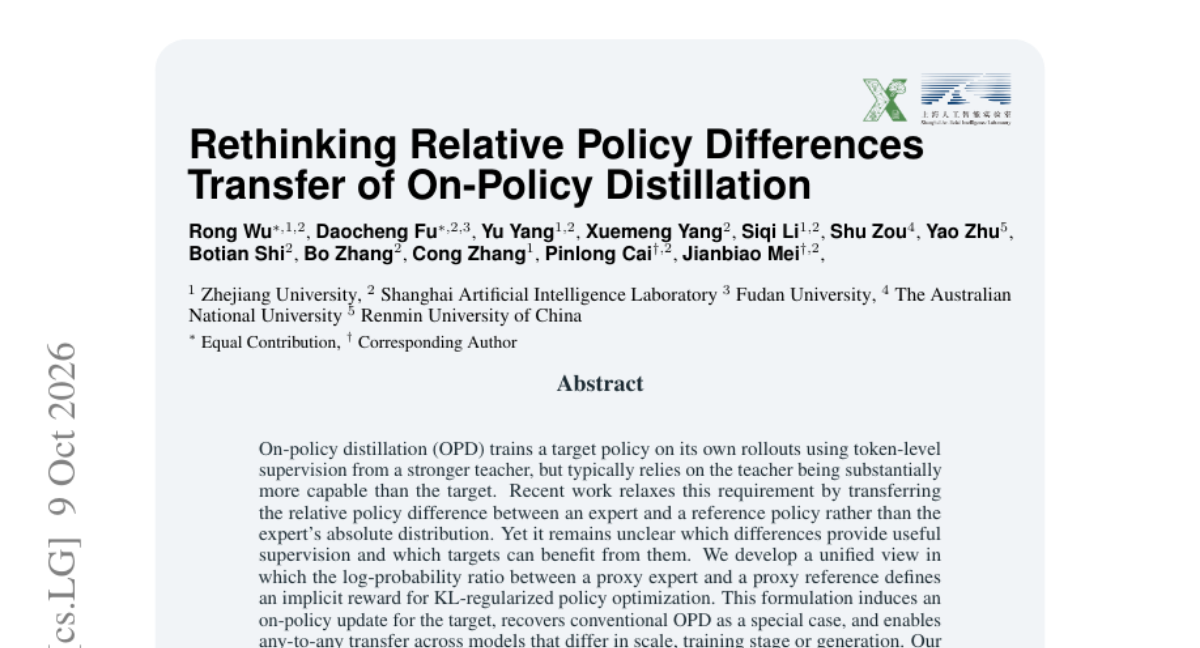
21. Rethinking Relative Policy Differences Transfer of On-Policy Distillation
🔑 Keywords: On-policy distillation, policy optimization, supervision, transferability
💡 Category: Reinforcement Learning
🌟 Research Objective:
– To explore how the relative policy difference between a proxy expert and a proxy reference can provide effective supervision for on-policy distillation (OPD), especially when the teacher model isn’t significantly more capable than the target model.
🛠️ Research Methods:
– A unified framework for KL-regularized policy optimization using the log-probability ratio between models to induce an on-policy update.
– Systematic experiments to analyze the conditions under which relative policy differences offer useful supervision.
💬 Research Conclusions:
– A stronger expert doesn’t always provide better supervision; task-specific training differences transfer consistently, whereas scale-induced differences do not.
– The expert and reference have complementary roles in providing capabilities and isolating relevant differences.
– Transfer success requires moving targets towards the expert while generalizing beyond sampled rollouts, with the appropriate reference being crucial for successful transfer.
👉 Paper link: https://huggingface.co/papers/2610.13205
22. PreSTO: Predictive Subtree Prefetching for Fast LLM Power Sampling
🔑 Keywords: Power Sampling, Large Language Models, Predictive SubTree Prefetching, Metropolis–Hastings, Speedups
💡 Category: Natural Language Processing
🌟 Research Objective:
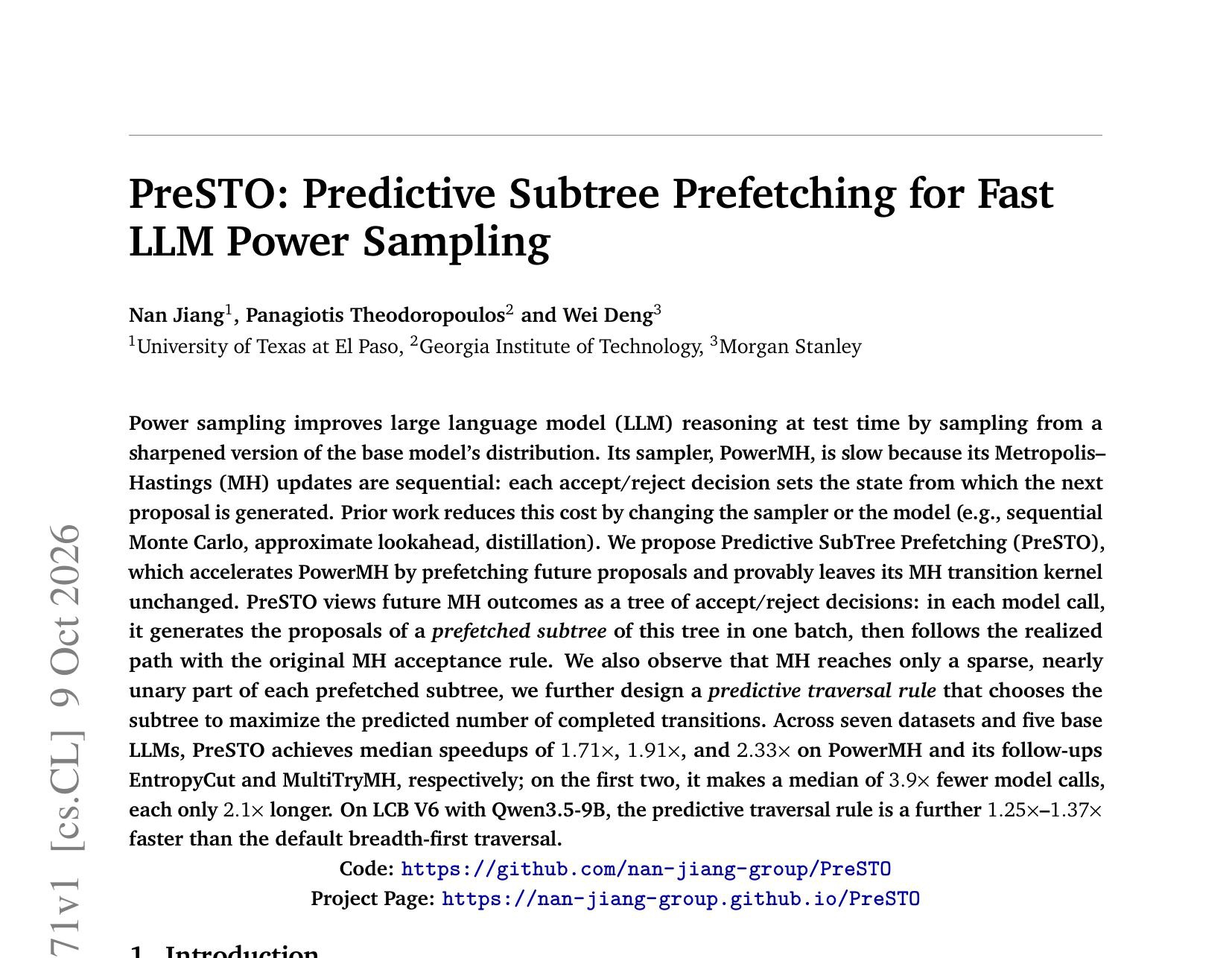
– To improve the reasoning efficiency of large language models by accelerating the PowerMH sampler using prefetching techniques without altering the Metropolis–Hastings transition kernel.
🛠️ Research Methods:
– Introduced Predictive SubTree Prefetching (PreSTO) to prefetch future proposals and optimize decision trees, thus enhancing the processing speed of PowerMH and achieving fewer model calls.
💬 Research Conclusions:
– PreSTO achieved median speedups of up to 2.33 times and significantly reduced model calls across various datasets, demonstrating the effectiveness of predictive traversal rules in optimizing sampling processes.
👉 Paper link: https://huggingface.co/papers/2610.13171
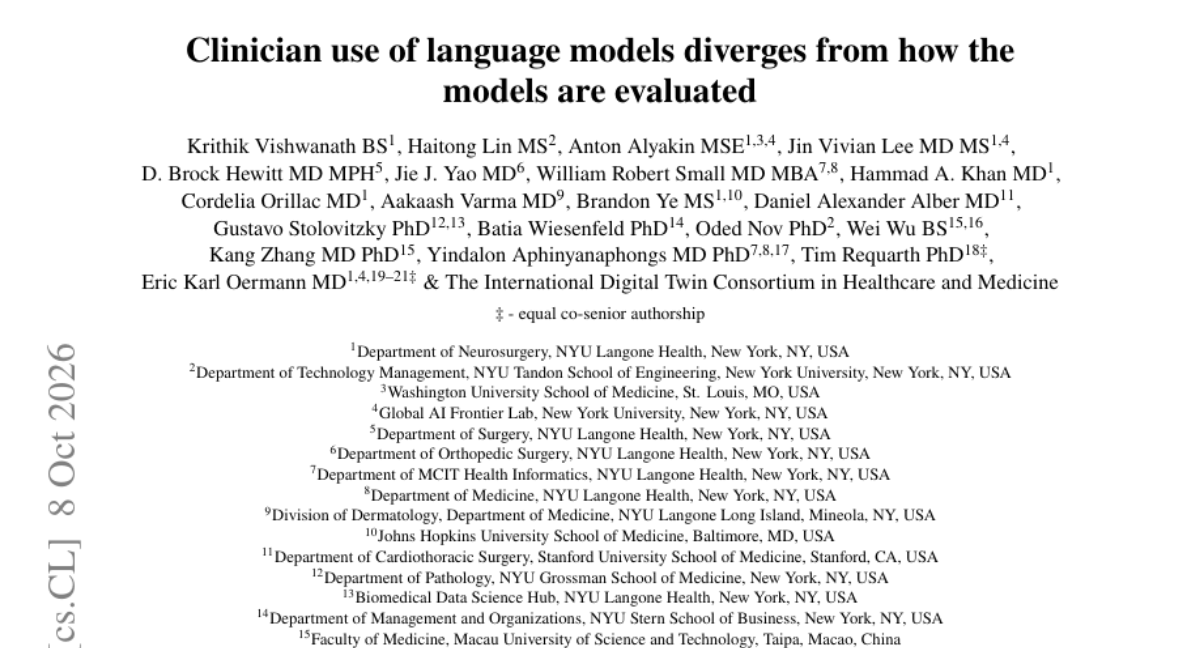
23. Clinician use of language models diverges from how the models are evaluated
🔑 Keywords: Large Language Model, Clinical AI, Benchmark, RCQ-Map, Healthcare
💡 Category: AI in Healthcare
🌟 Research Objective:
– To assess the real-world applicability of benchmark scores used to determine the readiness of Large Language Model assistants in healthcare settings.
🛠️ Research Methods:
– Analysis of 127,833 queries from clinicians using a framework called RCQ-Map to evaluate task, intent, answerability, missing information, and potential harm.
💬 Research Conclusions:
– A substantial mismatch was found between benchmark tasks and real clinical use, with over a third of clinician queries being inadequately answered. Benchmarks contributed limited insight into actual clinical performance, highlighting the need for evaluation tailored to real-world clinical applications.
👉 Paper link: https://huggingface.co/papers/2610.11069
24. SAGE: Salient Factor Discovery and Generation with Visual Foundation Representations
🔑 Keywords: SAGE, salient representations, contrastive analysis, subtype discovery, unsupervised learning
💡 Category: Generative Models
🌟 Research Objective:
– To distinguish target-specific details, such as eyeglasses in facial images, from shared background data, enabling the discovery of subtypes without labels and guiding the generation of new examples.
🛠️ Research Methods:
– Introduction of SAGE, which uses a high-dimensional spatial latent autoencoder and conditions a diffusion transformer on the learned salient representations.
💬 Research Conclusions:
– SAGE achieves superior unsupervised subtype discovery with high-fidelity reconstruction, surpassing baseline methods in probe accuracy and subtype accuracy on datasets like Digits-ImageNet and FFHQ eyeglasses.
👉 Paper link: https://huggingface.co/papers/2609.39635

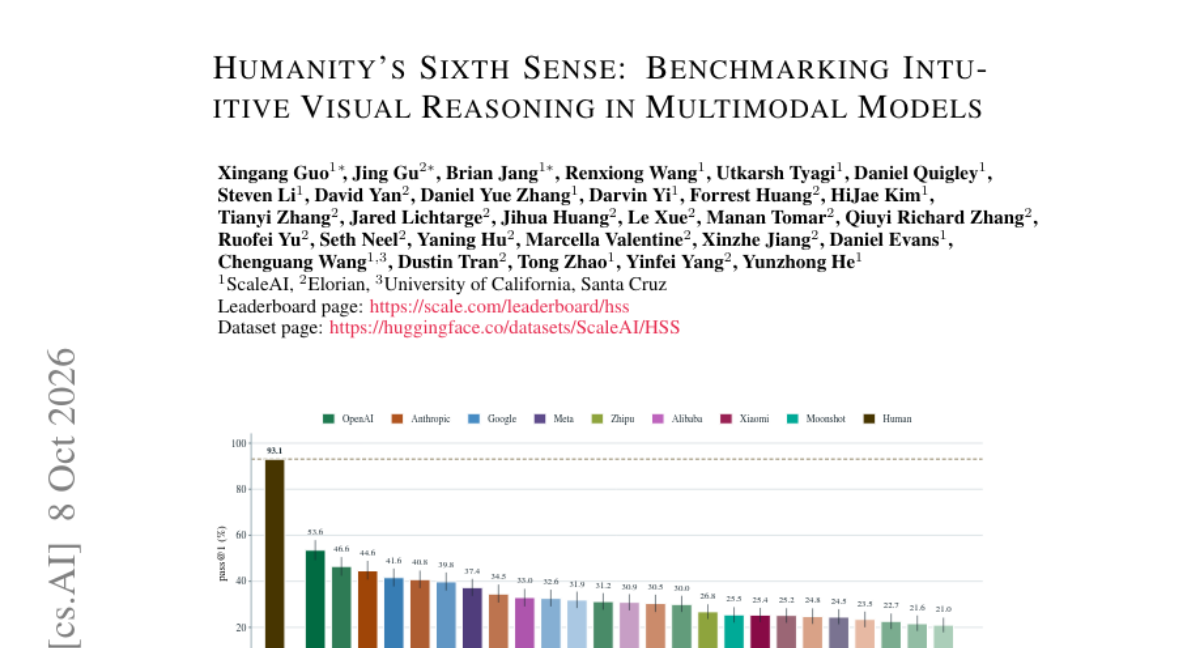
25. Humanity’s Sixth Sense: Benchmarking Intuitive Visual Reasoning in Multimodal Models
🔑 Keywords: Intuitive Reasoning, Multimodal Large Language Models, Humanity’s Sixth Sense, Visual Tasks
💡 Category: Multi-Modal Learning
🌟 Research Objective:
– Introduce a benchmark called Humanity’s Sixth Sense (HSS) aimed at testing intuitive visual reasoning in Multimodal Large Language Models (MLLMs), covering implicit temporal, spatial, social, and abstract structures.
🛠️ Research Methods:
– Developed HSS with diverse image and video inputs, organized under a structured taxonomy, paired with human-written prompts to challenge intuitive reasoning.
💬 Research Conclusions:
– Current MLLMs, like GPT-6-astra, achieve far less accuracy than humans on visual intuitive reasoning tasks, indicating significant gaps that remain unaddressed by existing benchmarks.
👉 Paper link: https://huggingface.co/papers/2610.08966
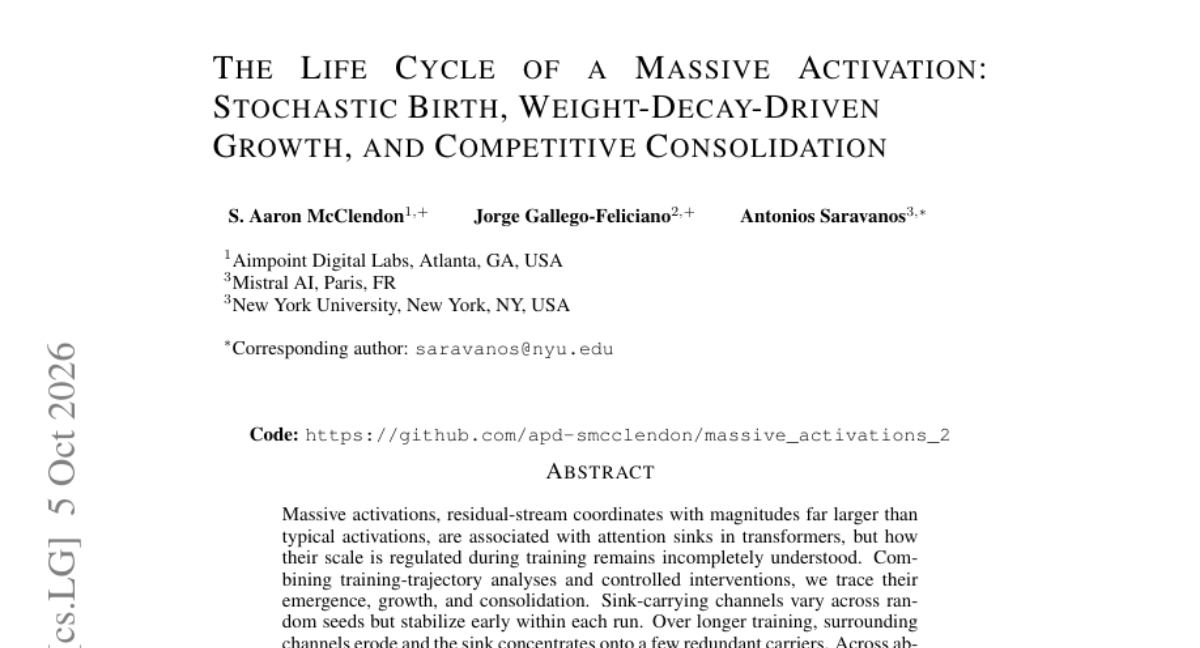
26. The Life Cycle of a Massive Activation: Stochastic Birth, Weight-Decay-Driven Growth, and Competitive Consolidation
🔑 Keywords: massive activations, attention sinks, residual-stream, weight decay, AdamW
💡 Category: Foundations of AI
🌟 Research Objective:
– Explore how the scale of massive activations in transformers is regulated during training, focusing on attention sinks and their impact on training dynamics.
🛠️ Research Methods:
– Utilized training-trajectory analyses and controlled interventions to monitor emergence and growth of sink-carrying channels and examined their stabilization and erosion over longer training periods.
– Developed a balance model to understand the effects of weight decay on massive-activation magnitude.
💬 Research Conclusions:
– Identified weight decay as a causal mechanism controlling the turnover of global activation scale, affecting the lifecycle of massive activations.
– Demonstrated that altering the weight decay influences the timing and scaling of the peak magnitude of activations, with preconditioning sustaining large-channel cohorts.
👉 Paper link: https://huggingface.co/papers/2610.00423
27. MAMHOI: Factorizing Scene-Aware Human-Object Interaction through Affordances
🔑 Keywords: Human-Object Interaction, 3D Scenes, Motion Synthesis, Scene Understanding, Affordance
💡 Category: Generative Models
🌟 Research Objective:
– The paper aims to address the generation of realistic Human-Object Interactions (HOI) in complex 3D environments by combining interaction feasibility reasoning with human-object motion synthesis.
🛠️ Research Methods:
– Introduction of MAMHOI, an affordance-mediated factorization model that separates scene understanding and motion synthesis through a motion-affordance interface, leveraging complementary datasets without the need for paired human-object-scene data.
💬 Research Conclusions:
– Experiments demonstrate that the MAMHOI model significantly reduces object-scene penetration and enhances the quality of human-object interaction, providing more realistic and physically feasible scene-aware interactions in complex indoor environments.
👉 Paper link: https://huggingface.co/papers/2610.12416

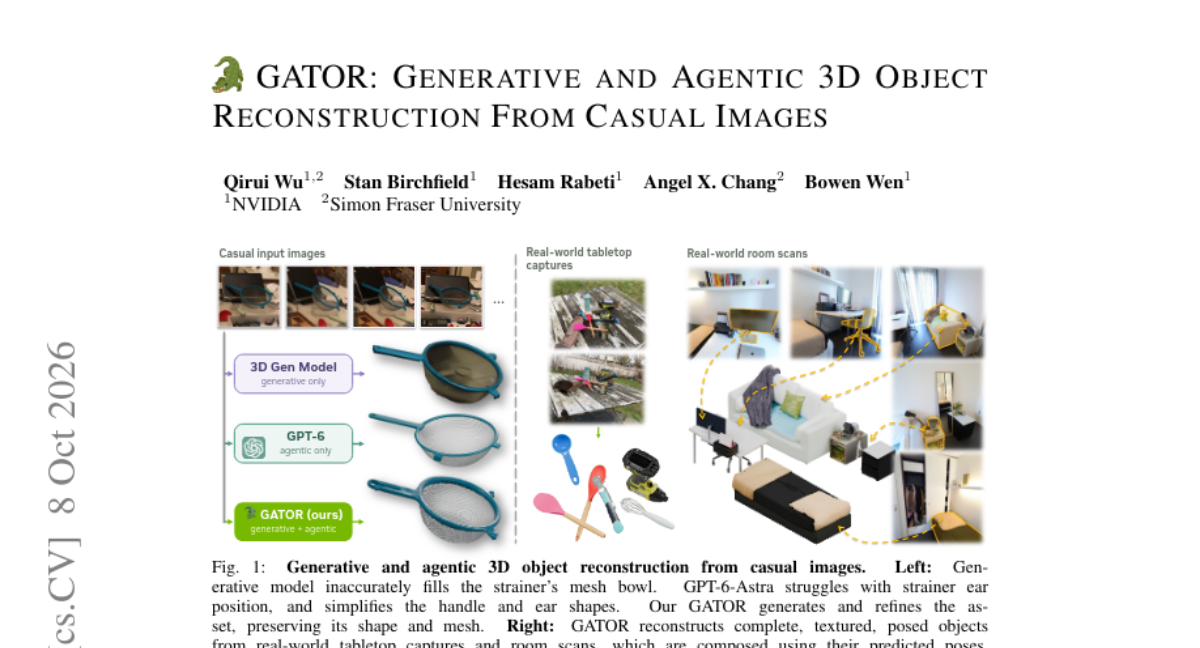
28. GATOR: Generative and Agentic 3D Object Reconstruction From Casual Images
🔑 Keywords: GATOR, generative framework, scene-relative pose, multi-modal agent
💡 Category: Computer Vision
🌟 Research Objective:
– To reconstruct complete, scene-aligned 3D objects from casual images by integrating sparse observations and inferring hidden surfaces.
🛠️ Research Methods:
– A generative and agentic framework named GATOR was used. This involves a local modality mixer for coupling features and text-guided semantic conditioning for spatial cues.
💬 Research Conclusions:
– GATOR successfully achieves strong geometric and appearance fidelity across various environments while efficiently recovering scene-relative pose and demonstrating reconstruction efficiency.
👉 Paper link: https://huggingface.co/papers/2610.11215
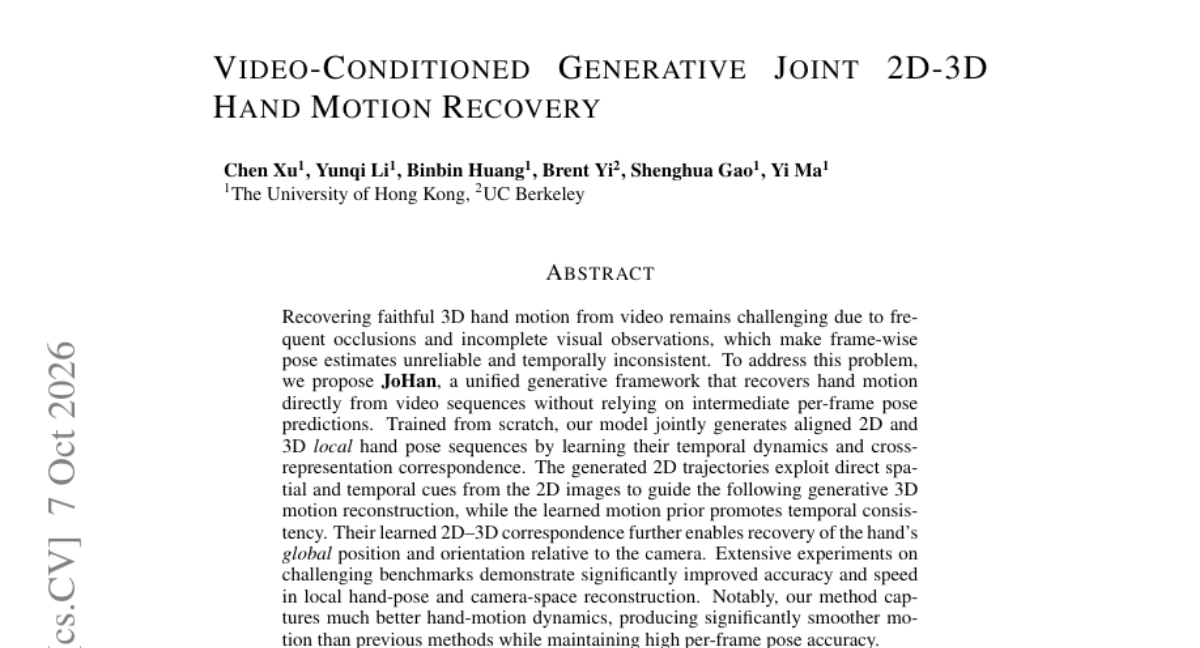
29. Video-Conditioned Generative Joint 2D-3D Hand Motion Recovery
🔑 Keywords: 3D hand motion, Video sequences, Generative framework
💡 Category: Computer Vision
🌟 Research Objective:
– To recover faithful 3D hand motion directly from video sequences by addressing unreliable and temporally inconsistent pose estimates due to frequent occlusions and incomplete visual observations.
🛠️ Research Methods:
– Proposed a unified generative framework named JoHan that directly generates aligned 2D and 3D local hand pose sequences by learning their temporal dynamics and cross-representation correspondence without relying on intermediate per-frame pose predictions.
💬 Research Conclusions:
– Demonstrated significantly improved accuracy and speed in local hand-pose and camera-space reconstruction on challenging benchmarks, capturing better hand-motion dynamics and producing smoother motion while maintaining high per-frame pose accuracy.
👉 Paper link: https://huggingface.co/papers/2610.10512
30. Which Language Should a Skeleton Speak? Language Choices in Multilingual Reasoning
🔑 Keywords: Skeleton-based reasoning, Language-Aware Skeleton Exploration Framework, multilingual, mathematical reasoning, benchmark
💡 Category: Knowledge Representation and Reasoning
🌟 Research Objective:
– The study aims to explore skeleton-language choice in multilingual mathematical reasoning using the Language-Aware Skeleton Exploration Framework (LASEF).
🛠️ Research Methods:
– The methods include greedy decoding, multi-rollout evaluation, translation ablation, and cross-benchmark validation to study skeleton-language effects.
💬 Research Conclusions:
– English skeletons tend to perform slightly better on average, especially for smaller models and low-resource languages, but no universal optimal language exists, and few gains hold significance after correction.
– Skeleton language is identified as a context-dependent design variable that requires comprehensive multi-level exploration.
👉 Paper link: https://huggingface.co/papers/2610.09607

31.
32. Dex-One2Many: Learning Dexterous Manipulation from a Single Human Demonstration
🔑 Keywords: Dexterous Manipulation, Reinforcement Learning, Generalization, Real-to-Sim-to-Real, Scene Graphs
💡 Category: Robotics and Autonomous Systems
🌟 Research Objective:
– The primary objective is to develop a framework, Dex-One2Many, that can learn a generalizable dexterous manipulation policy from a single human video.
🛠️ Research Methods:
– Utilizes a real-to-sim-to-real framework that abstracts video into sequential scene graphs guiding Reinforcement Learning for efficient exploration.
– Scene graphs are used as generative constraints for diverse reset states and provide dense rewards for each stage of the task.
💬 Research Conclusions:
– Dex-One2Many achieves robust generalization, outperforming baselines by 6.5% in seen configurations and by 71% in unseen scenarios.
– The system is trained entirely in simulation and is capable of transferring to a real multi-fingered hand with zero-shot learning.
👉 Paper link: https://huggingface.co/papers/2610.12470

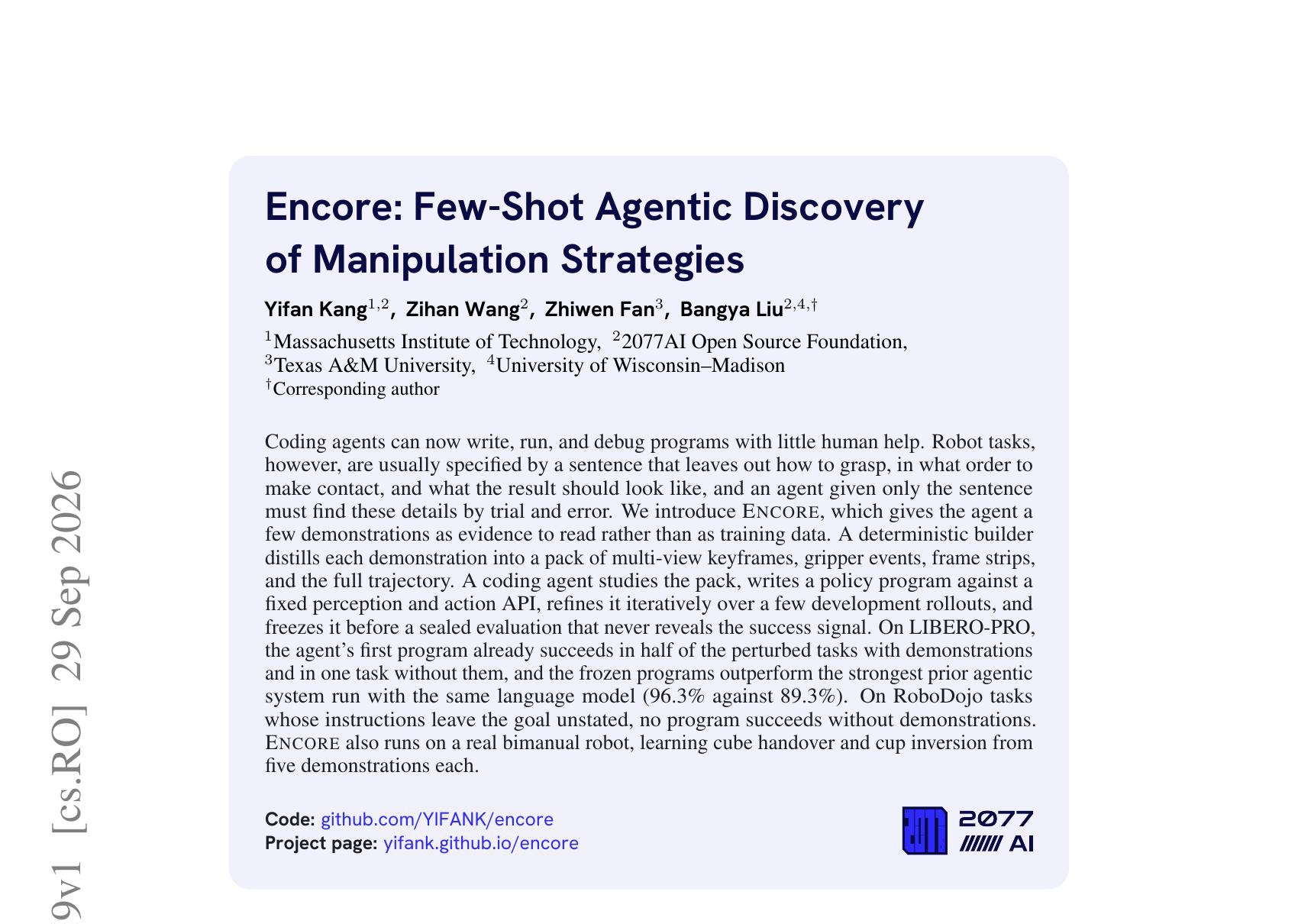
33. Encore: Few-Shot Agentic Discovery of Manipulation Strategies
🔑 Keywords: Coding agents, ENCORE, RoboDojo, Demonstrations, LIBERO-PRO
💡 Category: Robotics and Autonomous Systems
🌟 Research Objective:
– Introduce ENCORE to aid coding agents in executing robot tasks with multi-view keyframe demonstrations instead of training data.
🛠️ Research Methods:
– Utilizing deterministic builder for processing demonstrations, the agent writes a policy program, refines it iteratively, and evaluates it against fixed perception and action APIs.
💬 Research Conclusions:
– ENCORE enables effective task execution, with enhanced performance on LIBERO-PRO and essential demonstration use in RoboDojo tasks. It successfully applies to real-world bimanual robot tasks.
👉 Paper link: https://huggingface.co/papers/2609.37359
34. When to Rethink: Learning Multi-Perspective Self-Verification for Vision-Language Models
🔑 Keywords: Vision-language models, Multi-Modal Learning, Self-verification, Multimodal Reasoning, MOTIVE
💡 Category: Multi-Modal Learning
🌟 Research Objective:
– To enhance the reliability of vision-language models (VLMs) in multimodal reasoning through a new self-verification framework called MOTIVE.
🛠️ Research Methods:
– Systematic analysis of verifier capability and prompt design.
– Development of the MOTIVE framework, which uses multi-view self-verification with reliability-guided selective rethinking.
💬 Research Conclusions:
– Stronger verifiers provide more reliable judgments.
– MOTIVE outperforms existing self-verification and self-correction methods by improving accept-or-rethink decisions and reducing unnecessary reasoning turns.
👉 Paper link: https://huggingface.co/papers/2610.07018

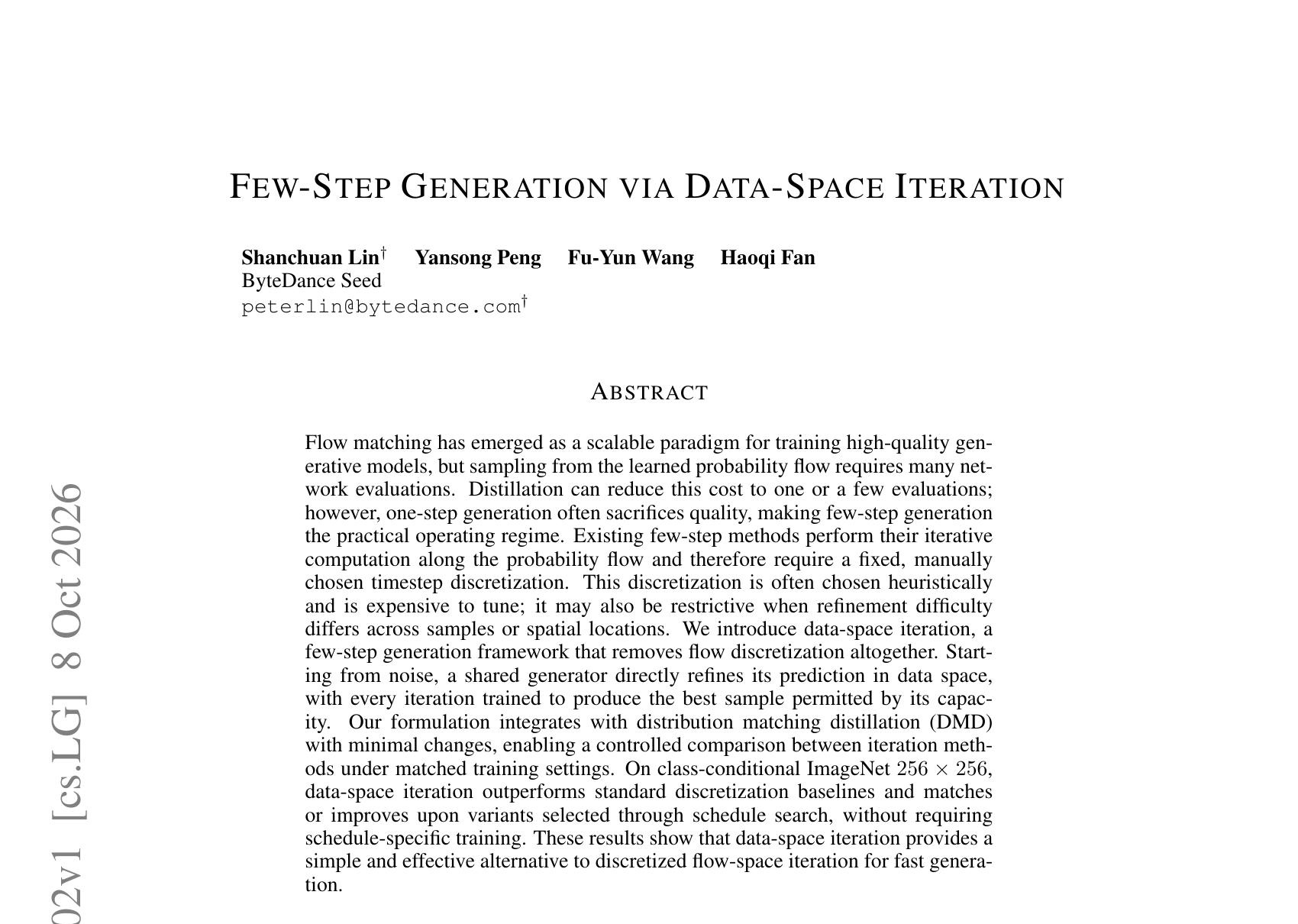
35. Few-Step Generation via Data-Space Iteration
🔑 Keywords: Flow Matching, Generative Models, Few-step Generation, Data-space Iteration, DMD
💡 Category: Generative Models
🌟 Research Objective:
– The primary aim is to improve the efficiency of sampling from high-quality generative models by introducing a data-space iteration framework that avoids traditional flow discretization.
🛠️ Research Methods:
– The study utilizes a shared generator that iteratively refines predictions directly in data space, integrated with Distribution Matching Distillation (DMD) for controlled comparison under matched training conditions.
💬 Research Conclusions:
– Data-space iteration effectively outperforms standard discretization methods on ImageNet 256×256 and offers a promising alternative for fast generative model training without requiring schedule-specific training.
👉 Paper link: https://huggingface.co/papers/2610.12102
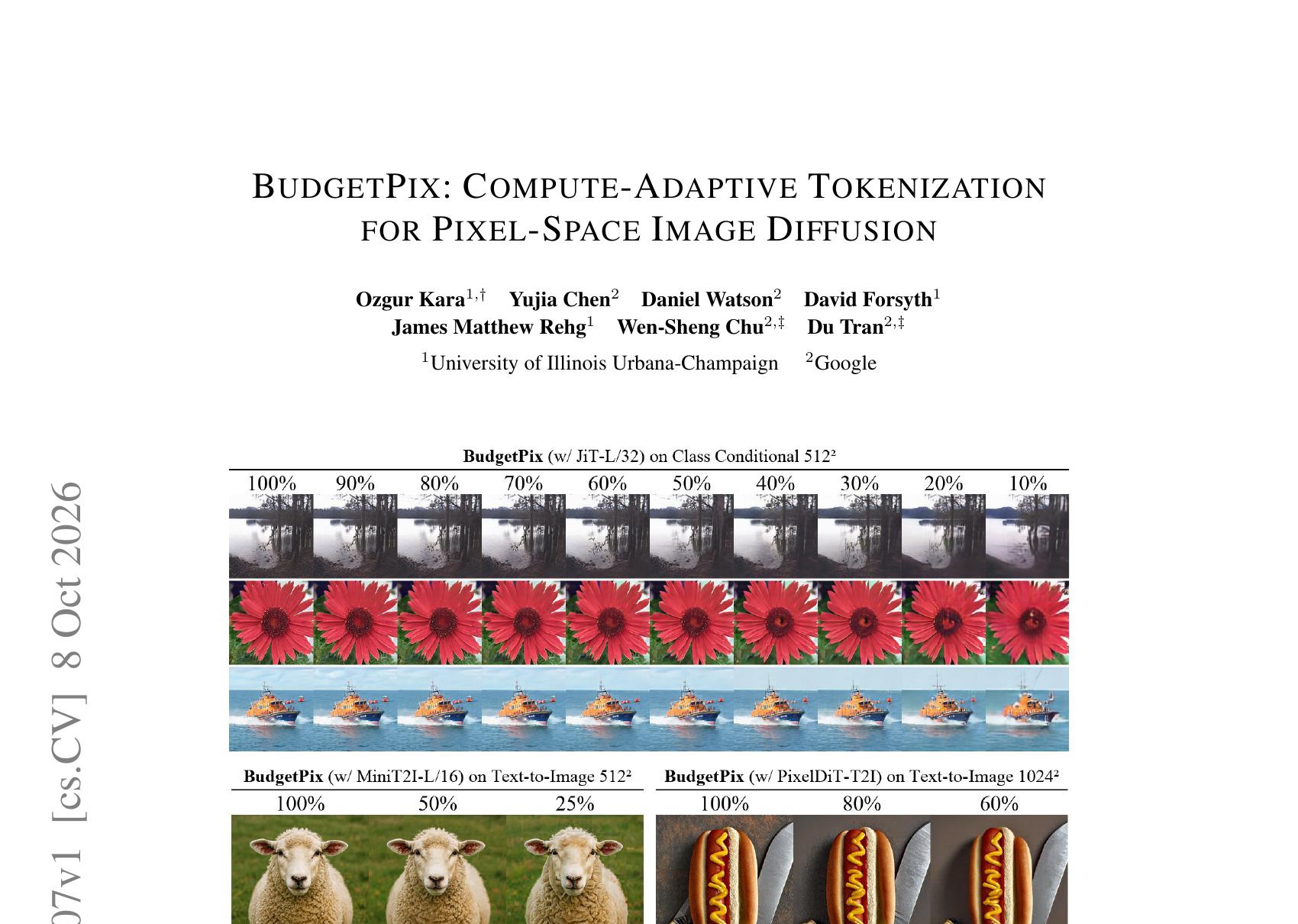
36. BudgetPix: Compute-Adaptive Tokenization for Pixel-Space Image Diffusion
🔑 Keywords: Image Generation, BudgetPix, Adaptive Tokenization, Computational Budget, Quality-Cost Tradeoff
💡 Category: Generative Models
🌟 Research Objective:
– Introduce BudgetPix, an adaptive tokenization framework that dynamically adjusts computational resources for image generation based on visual complexity and spatial layout.
🛠️ Research Methods:
– Utilize an adaptive encoder with an entropy-guided quadtree and a multi-scale embedder, along with a scale-aware decoder to manage the image generation process.
💬 Research Conclusions:
– BudgetPix achieves significant computational savings while maintaining high image fidelity, outperforming existing budget-adaptive baselines as confirmed by human and VLM assessments. It operates effectively across various compute budgets without substantial quality loss.
👉 Paper link: https://huggingface.co/papers/2610.12307
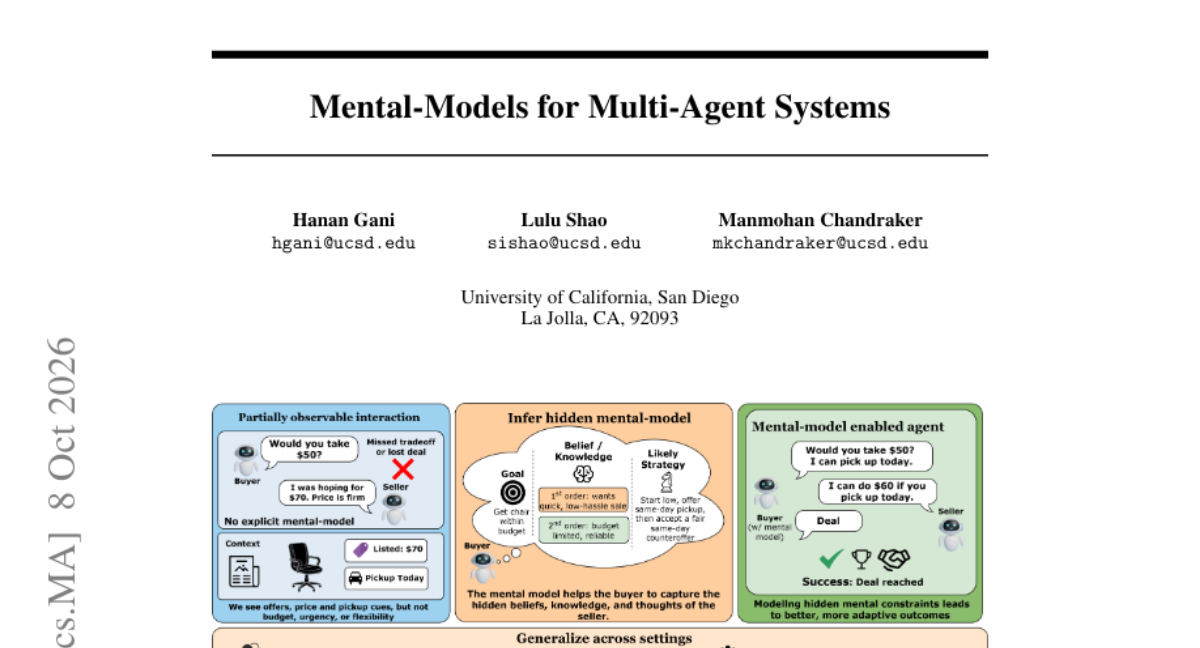
37. Mental-Models for Multi-Agent Systems
🔑 Keywords: Foundation Models, Multi-Agent Decision-Making, Mental-Model, Theory of Mind, Interaction Quality
💡 Category: Multi-Modal Learning
🌟 Research Objective:
– The study aims to enhance multi-agent decision-making by introducing mental-model-enabled agents that can infer hidden beliefs and intentions of other agents.
🛠️ Research Methods:
– The proposed framework learns an amortized recursive Theory-of-Mind representation and a belief-conditioned reward model, improving interaction quality in both language-only and multimodal benchmarks.
💬 Research Conclusions:
– The explicit modeling of partner mental states enhances interaction quality and Theory-of-Mind performance, providing a beneficial inductive bias for general multi-agent systems.
👉 Paper link: https://huggingface.co/papers/2610.12453
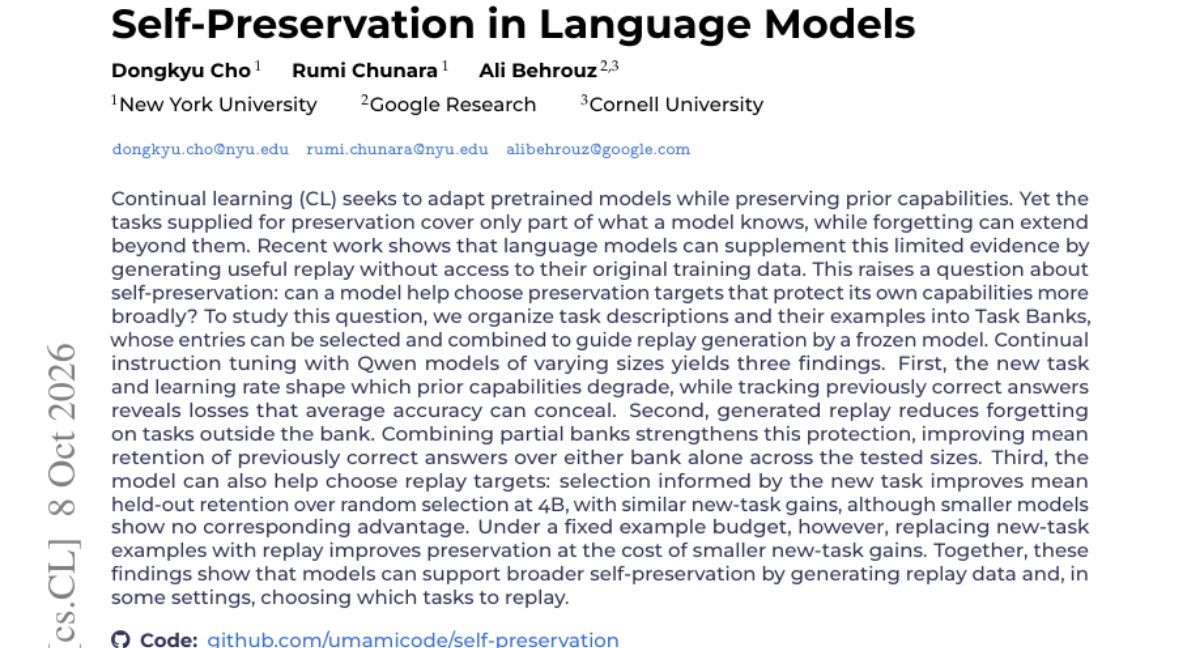
38. Self-Preservation in Language Models
🔑 Keywords: Continual Learning, Self-Preservation, Task Banks, Replay Generation
💡 Category: Natural Language Processing
🌟 Research Objective:
– To explore if language models can choose preservation targets that better protect their own capabilities by generating useful replay data.
🛠️ Research Methods:
– Utilization of Task Banks to organize task descriptions and examples for guiding replay generation by a frozen model, alongside continual instruction tuning with Qwen models of various sizes.
💬 Research Conclusions:
– New tasks and learning rates impact the degradation of prior capabilities while generated replay can alleviate forgetting beyond the predefined tasks.
– Combining partial task banks betters retention of previously correct answers, boosting self-preservation.
– Model-guided replay target selection enhances retention, especially in larger models, but incurs a trade-off between preservation and new-task gains under a fixed example budget.
👉 Paper link: https://huggingface.co/papers/2610.12602
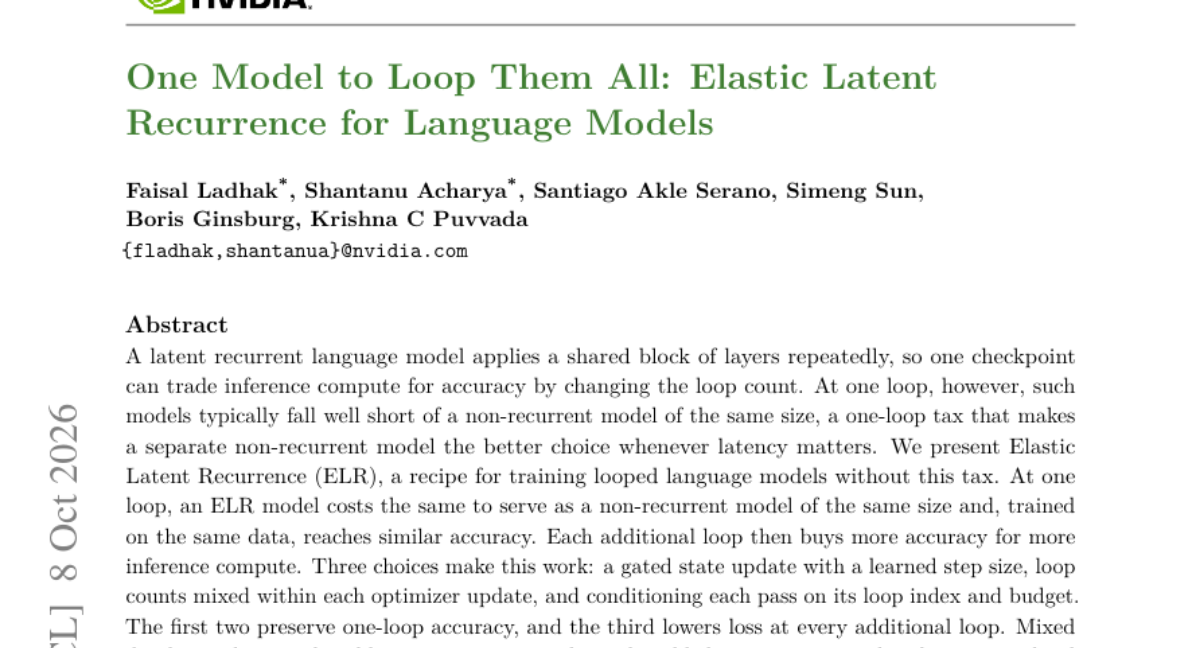
39. One Model to Loop Them All: Elastic Latent Recurrence for Language Models
🔑 Keywords: Elastic Latent Recurrence, latent recurrent language model, inference compute, accuracy, Koi-4B
💡 Category: Natural Language Processing
🌟 Research Objective:
– To develop a method for training looped language models (Elastic Latent Recurrence) that maintains one-loop accuracy while allowing additional loops to improve accuracy without additional latency tax.
🛠️ Research Methods:
– Introduced a gated state update with a learned step size, mixed loop counts within optimizer updates, and conditioned each pass on loop index and budget.
– Introduced mixed depths late in pretraining with strategies to limit training costs.
– Optimized expert route reuse in MoE models to cut update time without accuracy degradation.
💬 Research Conclusions:
– Elastic Latent Recurrence (ELR) models at one loop match non-recurrent models in accuracy and improve with additional loops.
– The Koi-4B model scores competitively on the Artificial Analysis Intelligence Index, achieving higher scores as loops increase.
👉 Paper link: https://huggingface.co/papers/2610.12582
40. ThinkDrag: Semantic Drag-Based Image Editing with Visual Reasoning
🔑 Keywords: Drag-based image editing, ThinkDrag, multimodal framework, semantic transformation, visual reasoning
💡 Category: Computer Vision
🌟 Research Objective:
– The aim is to enhance drag-based image editing by developing ThinkDrag, a multimodal framework that integrates visual reasoning and semantic transformations to achieve more intuitive and meaningful image manipulations.
🛠️ Research Methods:
– A unified approach is adopted where the ThinkDrag framework is trained to associate point constraints with object- and scene-level transformations, alongside providing reasoning traces. The development includes a supervised dataset and the DragBench++ benchmark for testing.
💬 Research Conclusions:
– ThinkDrag achieves state-of-the-art performance in drag-based image editing, offering improved generation quality and plausibility while maintaining competitive precision in following specified points.
👉 Paper link: https://huggingface.co/papers/2610.13316

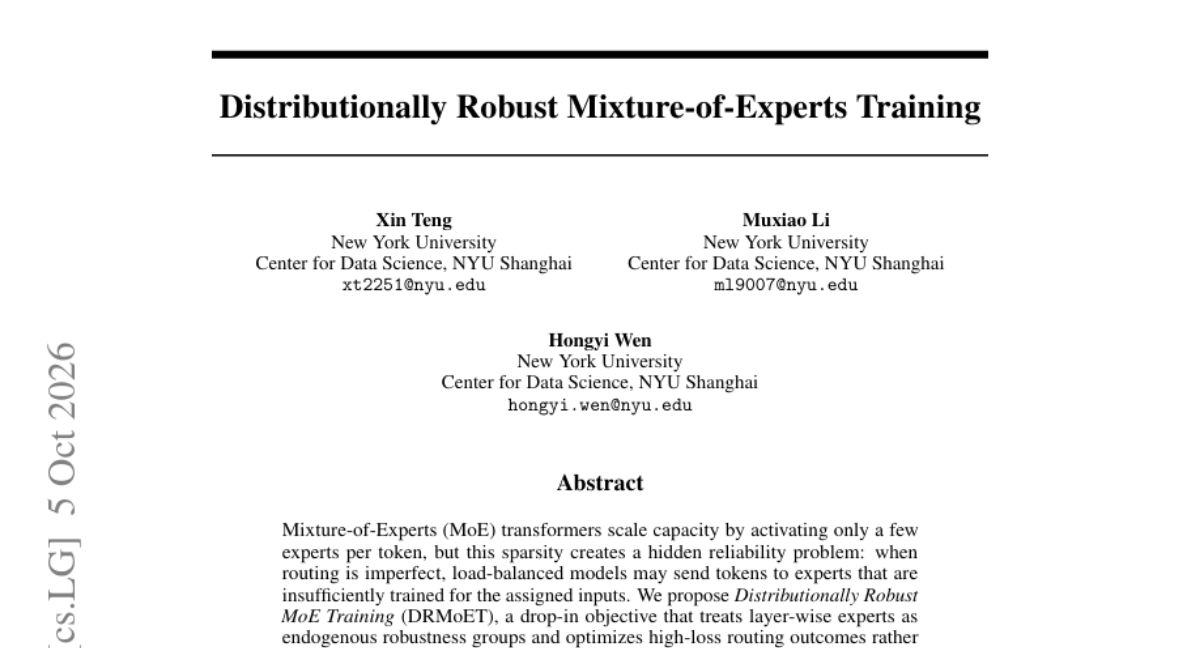
41. Distributionally Robust Mixture-of-Experts Training
🔑 Keywords: Mixture-of-Experts, DRMoET, routing robustness, FLAME-MoE
💡 Category: Machine Learning
🌟 Research Objective:
– The objective is to improve the reliability of MoE models by addressing the issue of routing errors that lead tokens to under-trained experts.
🛠️ Research Methods:
– Developed DRMoET, a new training objective using entropy-regularized softmax to optimize expert distribution and strengthen plausible routing paths.
💬 Research Conclusions:
– DRMoET demonstrates improved performance in MoE models for downstream tasks and lowers expert-loss variance without significantly changing the mean loss. The research suggests routing robustness as a crucial factor for MoE scaling.
👉 Paper link: https://huggingface.co/papers/2610.07207
42. The value of information and the emergence of communication in evolved e-puck robots
🔑 Keywords: Communication Emergence, Autonomous Agents, Action Selection Architecture, EASA, Recurrent Network
💡 Category: Robotics and Autonomous Systems
🌟 Research Objective:
– To investigate when communication between autonomous agents emerges and how an innate action selection architecture influences this process.
🛠️ Research Methods:
– Utilization of reconstructed e-puck robots in PyBullet, using a GRU recurrent network with a residual path within an Embedded Action Selection Architecture (EASA), and experimentation in varying arena sizes for performance comparison.
💬 Research Conclusions:
– Communication emerges proportionally to the value of the transmitted information.
– In smaller arenas, diverse strategies such as referential signaling perform similarly, whereas larger arenas favor strategies utilizing referential signals.
– Innate reflexes within EASA architecture initially hinder performance but weaken over evolutionary processes, suggesting that innate designs may impede social tasks.
👉 Paper link: https://huggingface.co/papers/2610.13118
43. When Do Biological Reasoning Models Use Their Biological Inputs?
🔑 Keywords: Biological reasoning models, LLMs, Foundation model, Protein, DNA
💡 Category: Knowledge Representation and Reasoning
🌟 Research Objective:
– Evaluate the assumption that LLMs (Large Language Models) can reason over biological inputs in biological reasoning models.
🛠️ Research Methods:
– Testing six biological reasoning models with tasks involving DNA, protein, and single-cell analyses.
– Perturb one biological input, use evidence conflicts, and fit linear probes to assess the role of foundation model representations.
💬 Research Conclusions:
– Foundation models Evo2 and ESM3 provide minimal performance improvement to BioReason and BioReason-Pro.
– Changes in DNA sequences have limited effect on BioReason disease prediction accuracy.
– Current post-training strategies do not ensure significant contributions from foundation model representations to task performance.
👉 Paper link: https://huggingface.co/papers/2610.00898
44. TouchScale: 500 Hours of Human Vision and Touch for Visual-Tactile Learning
🔑 Keywords: Visual-tactile datasets, TouchScale, Egocentric Human Interaction, RGB-D video, Robot manipulation
💡 Category: Multi-Modal Learning
🌟 Research Objective:
– The study introduces TouchScale, a 500-hour dataset designed to enhance embodied learning through synchronized visual-tactile data capturing egocentric human interactions using a unified wearable setup.
🛠️ Research Methods:
– TouchScale collects temporally aligned egocentric RGB-D video, wrist RGB video, and full-hand bimanual tactile measurements, focusing on everyday activities and structured tasks to analyze data at scale.
💬 Research Conclusions:
– Training with TouchScale improves zero-shot contact prediction and enhances action recognition accuracy. It significantly boosts the success of robot manipulation tasks, indicating that large-scale, consistent visual-tactile data can enhance perception and manipulation capabilities in robots.
👉 Paper link: https://huggingface.co/papers/2610.10288
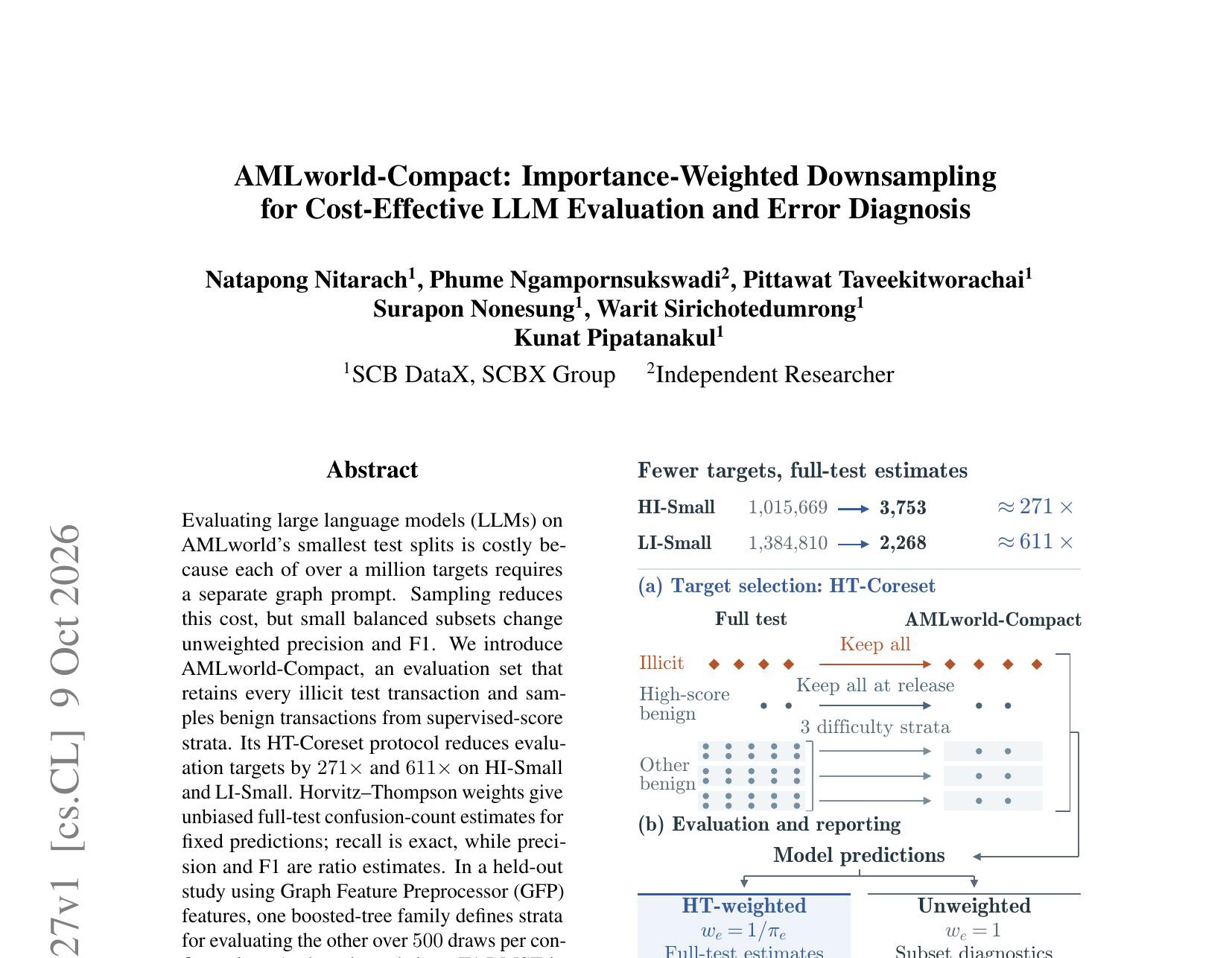
45. AMLworld-Compact: Importance-Weighted Downsampling for Cost-Effective LLM Evaluation and Error Diagnosis
🔑 Keywords: Large Language Models, AMLworld-Compact, Graph Feature Preprocessor, Evaluation Sets, Precision and F1
💡 Category: AI in Finance
🌟 Research Objective:
– The study introduces AMLworld-Compact, an efficient evaluation set for large language models, focusing on cost-effective assessment of test splits by using reduced targets and stratified sampling for transaction evaluations.
🛠️ Research Methods:
– The AMLworld-Compact uses the HT-Coreset protocol to decrease evaluation targets significantly and employs Horvitz-Thompson weights to estimate confusion-counts for unbiased metric assessments. This involves using a boosted-tree family for strata definition in evaluation exercises across numerous configurations.
💬 Research Conclusions:
– The study finds efficient estimation of precision and F1 scores with balanced F1 RMSE using AMLworld-Compact compared to uniform sampling. The evaluation of open-weight LLMs shows alignment near a predict-all-illicit baseline, while lexical checks in audits indicate limited effectiveness in establishing correctness.
👉 Paper link: https://huggingface.co/papers/2610.13627
46. Coding-Agent Benchmarks Should Match Their Users’ Task Flows
🔑 Keywords: Interactive Agents, Task Flow, SWE-TaskFlow, Production Sessions
💡 Category: Human-AI Interaction
🌟 Research Objective:
– The study aims to evaluate code agents realistically by analyzing 4,782 sessions of real software engineers, highlighting differences in task flow from traditional benchmarks.
🛠️ Research Methods:
– The research introduces SWE-TaskFlow, which adapts issue-derived benchmarks to reflect realistic task flows through prompt splitting and repository QA. It uses a TaskFlow Alignment Score for better evaluation trajectory selection.
💬 Research Conclusions:
– Benchmarks must target specific use cases to remain realistic, as interaction distribution isn’t universally realistic. The study notes that solving tasks in steps increases agent cost without changing resolve rates, emphasizing the importance of interaction protocols in evaluations.
👉 Paper link: https://huggingface.co/papers/2610.09633
47. From Given to Gathered Evidence: Agentic Learning for Longitudinal Medical Reasoning
🔑 Keywords: Foundation models, Clinical Agents, Longitudinal Reasoning, Multimodal Benchmark, Evidence-Seeking
💡 Category: AI in Healthcare
🌟 Research Objective:
– The research aims to develop role-specific Clinical Agents for Seeking Evidence (CASE), enhancing how foundation models operate as clinical agents through evidence-seeking abilities across clinical records and imaging.
🛠️ Research Methods:
– The study introduced a longitudinal multimodal benchmark based on UK Biobank data, using supervised fine-tuning and agentic reinforcement learning. It employed privileged on-policy self-distillation and rubric-based LLM feedback to refine reasoning processes.
💬 Research Conclusions:
– The CASE framework successfully moves beyond simple question-answer scenarios to more complex investigation policies, achieving significant improvements in answer accuracy over existing models like GPT-5.4 and Claude Opus 4.8.
👉 Paper link: https://huggingface.co/papers/2609.39566

48. Surfing the Activation Wave: Analyzing the Information and Geometry of LLM Hidden States for Speculative Decoding
🔑 Keywords: Large Language Models, Speculative Decoding, Entropy, Centered Kernel Alignment, Layer Selection
💡 Category: Natural Language Processing
🌟 Research Objective:
– The study aims to develop a framework for selecting multi-layer hidden states in speculative decoding by evaluating informativeness through matrix-entropy analysis and diversity via centered kernel alignment.
🛠️ Research Methods:
– The researchers analyzed layer-wise Shannon entropy, aggregate entropy with hidden-state concatenation, and CKA dynamics across model depth, leading to the formulation of entropy and CKA-based layer selection algorithms.
💬 Research Conclusions:
– The proposed layer selection sets, emphasizing informative and minimally redundant hidden states, outperform the common fixed baseline approaches in speculative decoding, offering improved explanations for layer selection choices and potential insights for similar applications.
👉 Paper link: https://huggingface.co/papers/2610.12939
49. Judging in Latent Space: Efficient Generative Reward Modeling via Semantics-Preserving Compression
🔑 Keywords: Reward modeling, Latent reasoning, LatentGRM, Semantic chunking, Inference cost
💡 Category: Knowledge Representation and Reasoning
🌟 Research Objective:
– The study aims to introduce LatentGRM, a latent evaluation framework that can compactly represent and reason over multiple evaluation criteria without generating textual assessments.
🛠️ Research Methods:
– The framework employs semantic chunking, compression, and reconstruction to learn compact continuous trajectories for autonomous judgments. Additionally, a separate interpreter reconstructs evaluation text from these trajectories to provide an offline view.
💬 Research Conclusions:
– LatentGRM achieves competitive preference accuracy compared to explicit Supervised Fine-Tuning (SFT) and significantly reduces inference costs while maintaining quality judgments across benchmark domains.
👉 Paper link: https://huggingface.co/papers/2610.09788

50. MetaKernelBench: Measuring GPU Kernel Knowledge Transfer Beyond Code
🔑 Keywords: MetaKernelBench, Kernel Optimization, Knowledge Transfer, DSL, AI Systems and Tools
💡 Category: AI Systems and Tools
🌟 Research Objective:
– The research introduces MetaKernelBench to measure whether experience distilled from attempts in one kernel domain-specific language (DSL) can improve attempts in another.
🛠️ Research Methods:
– The study involves 74 problems posed as CuTe DSL and TIRx variants, with agents distilling learned experiences into natural-language skills to test cross-DSL transfer.
💬 Research Conclusions:
– Paired lift over solo attempts ranges from -19% to +29%, with four models showing gains in both directions. However, regressions occur in 16% to 45% of problems, emphasizing the significance of source attempt results relative to the target’s solo attempts.
👉 Paper link: https://huggingface.co/papers/2610.05014

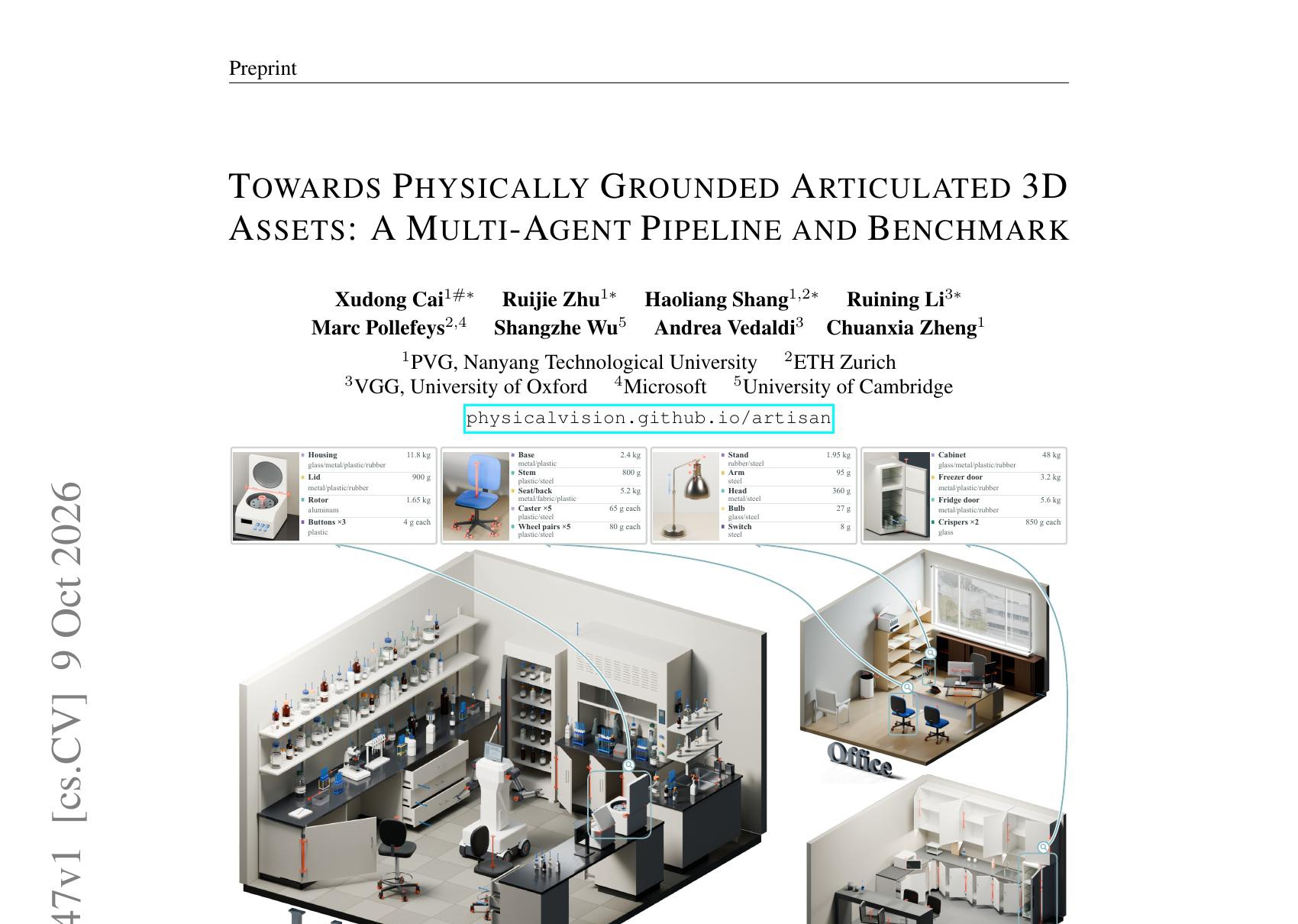
51. Towards Physically Grounded Articulated 3D Assets: A Multi-Agent Pipeline and Benchmark
🔑 Keywords: Artisan, Articraft, physical simulation, spatial fidelity, physically plausible articulation
💡 Category: Generative Models
🌟 Research Objective:
– The paper aims to enhance 3D asset generation by focusing on how objects move and function rather than just their appearance, introducing Artisan to advance this goal.
🛠️ Research Methods:
– Artisan extends the Articraft method with a multi-agent pipeline and physical simulation feedback to include comprehensive attributes like collision-free motion and material properties. A unified benchmark is constructed to evaluate spatial fidelity and physical plausibility among other metrics.
💬 Research Conclusions:
– Artisan demonstrates competitive spatial fidelity, achieves the lowest collision rates and highest stability rates among tested models, setting new insights for 3D generation towards functional usability.
👉 Paper link: https://huggingface.co/papers/2610.13947
52. Inducing Process Supervision from Outcome-Only Reinforcement Learning
🔑 Keywords: Process reward models, TIPS, Outcome-only reinforcement learning, Chain-of-thought, AI Native
💡 Category: Reinforcement Learning
🌟 Research Objective:
– To develop an efficient and cost-effective method for training Process Reward Models (PRMs) through a novel outcome-only reinforcement learning framework called TIPS.
🛠️ Research Methods:
– Implementation of the TIPS framework, which uses generative PRMs by generating a chain-of-thought followed by step and outcome labels, using group-relative advantage for optimizing responses.
💬 Research Conclusions:
– TIPS achieves significant results by effectively surpassing existing models, such as GPT-5.4-Instruct, and accurately validates its performance on math and agent benchmarks, demonstrating its capability as an efficient training method for PRMs.
👉 Paper link: https://huggingface.co/papers/2609.36641

53. SWE-Duel: Towards a Self-Scaling Arena for Coding Agents
🔑 Keywords: Self-scaling benchmark, SWE-Duel, Coding agents, AI Systems and Tools
💡 Category: AI Systems and Tools
🌟 Research Objective:
– Introduce a self-scaling coding benchmark called SWE-Duel where tasks and oracles are created at evaluation time to prevent task leakage and saturation by stronger agents.
🛠️ Research Methods:
– An arena called SWE-Duel is designed where two coding agents evaluate each other with a mirrored Red-Blue turn setup across 1,500 turns and 15 repositories in five languages.
💬 Research Conclusions:
– GPT-5.5 with Codex CLI ranks first as the strongest solver, whereas Claude Opus 4.8 with mini-swe-agent excels as the strongest task author.
– Task difficulty scales with task authoring capability as newer model versions outperform older ones significantly.
👉 Paper link: https://huggingface.co/papers/2610.12569
54. Learning Representations to Guide Pixel Diffusion Transformers
🔑 Keywords: Visual representations, pixel diffusion transformers, Representation Guidance, semantic and spatial structure, generative representation
💡 Category: Generative Models
🌟 Research Objective:
– The study aims to understand what makes visual representations useful for generation, particularly in the context of pixel diffusion transformers.
🛠️ Research Methods:
– The researchers explored architectural separation and introduced Representation Guidance (RG), a method to form and exploit internal representations using a plain Transformer architecture.
💬 Research Conclusions:
– The study concluded that a useful generative representation must be properly formed and exploited. RG effectively learns clearer semantic and spatial structures and delivers high performance on ImageNet and text-to-image generation tasks.
👉 Paper link: https://huggingface.co/papers/2610.12978

55. RSI-Anything: Unlocking Recursive Self-Improvement with World Models
🔑 Keywords: Recursive self-improvement, world models, predictive modeling, RSI-Anything, policy improvement
💡 Category: Machine Learning
🌟 Research Objective:
– The paper introduces RSI-Anything, a domain-general framework aimed at transforming interaction experiences into persistent improvements using predictive world models to guide action and learning-data selection.
🛠️ Research Methods:
– RSI-Anything uses predictive world models and observed feedback to drive policy improvements and conditional world-model adaptations, involving component and compatibility checks for policy-model pair retention.
💬 Research Conclusions:
– RSI-Anything demonstrates notable gains across diverse domains, including code repair, GUI evaluations, laboratory-planning, and reaction optimization, showing the effectiveness of recursive improvement enabled by predictive models.
👉 Paper link: https://huggingface.co/papers/2610.13912

56. Can AI Agents Learn Their Way to the Top? Evaluating Heuristic Learning in a Long-Running Game Agent Competition
🔑 Keywords: Adversarial Heuristic Learning, Reinforcement Learning, Game Strategies, AAArena Benchmark
💡 Category: Reinforcement Learning
🌟 Research Objective:
– To formalize Adversarial Heuristic Learning (AHL) for refining game policies using AI agents while keeping model weights fixed.
🛠️ Research Methods:
– The introduction of AAArena, a benchmark with 12 adversarial games and specific evaluation protocols, enabling AI agents to optimize their strategies through rule interpretation, opponent selection, and replay analysis.
💬 Research Conclusions:
– AI agents can improve strategies within adversarial games, collecting insights from both their own matches and those of opponents, although challenges remain in complex rule environments.
👉 Paper link: https://huggingface.co/papers/2610.12341

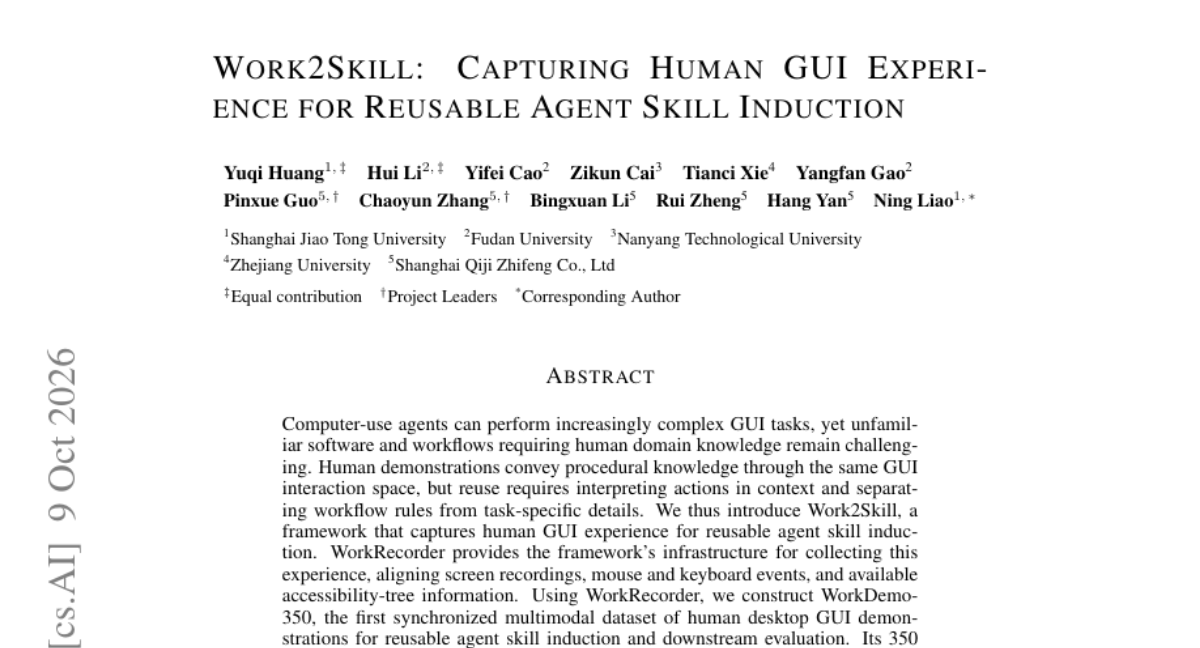
57. Work2Skill: Capturing Human GUI Experience for Reusable Agent Skill Induction
🔑 Keywords: Work2Skill, Reusable Skills, Human Demonstrations, GUI Tasks
💡 Category: Human-AI Interaction
🌟 Research Objective:
– To introduce Work2Skill, a framework designed to incorporate human GUI experience into reusable agent skills for better execution of complex tasks.
🛠️ Research Methods:
– Utilization of WorkRecorder to collect multimodal data, including screen recordings and input events, resulting in the creation of WorkDemo-350, a dataset for agent skill induction.
💬 Research Conclusions:
– The implementation of Work2Skill yields higher scores and success rates in task execution compared to a non-skill baseline, demonstrating its effectiveness in capturing and applying workflow rules and skills.
👉 Paper link: https://huggingface.co/papers/2610.12984
58. ProgramGym: Scaling Training Environments for Long-Horizon Program Reproduction Agents
🔑 Keywords: Coding Agents, ProgramGym, Program-Env, Program-Agent, AI Systems and Tools
💡 Category: AI Systems and Tools
🌟 Research Objective:
– The study aims to create a scalable and verifiable training environment for coding agents that can build programs from scratch, addressing current limitations in agent workflows and long-horizon development.
🛠️ Research Methods:
– Introduced ProgramGym framework including Program-Env and Program-Agent for constructing training environments. Program-Env leverages a feedback-driven loop for evaluating runtime and test quality, while Program-Agent employs a role-isolated workflow for effective analysis, implementation, and review.
💬 Research Conclusions:
– The proposed approach significantly enhances performance in program reproduction, demonstrated by the improvement of various models, such as increasing Qwen3.8-27B performance from 34.87% to 42.84%, and further improvements to base and SFT models, indicating the framework’s potential benefits for developing robust coding agents.
👉 Paper link: https://huggingface.co/papers/2610.13395

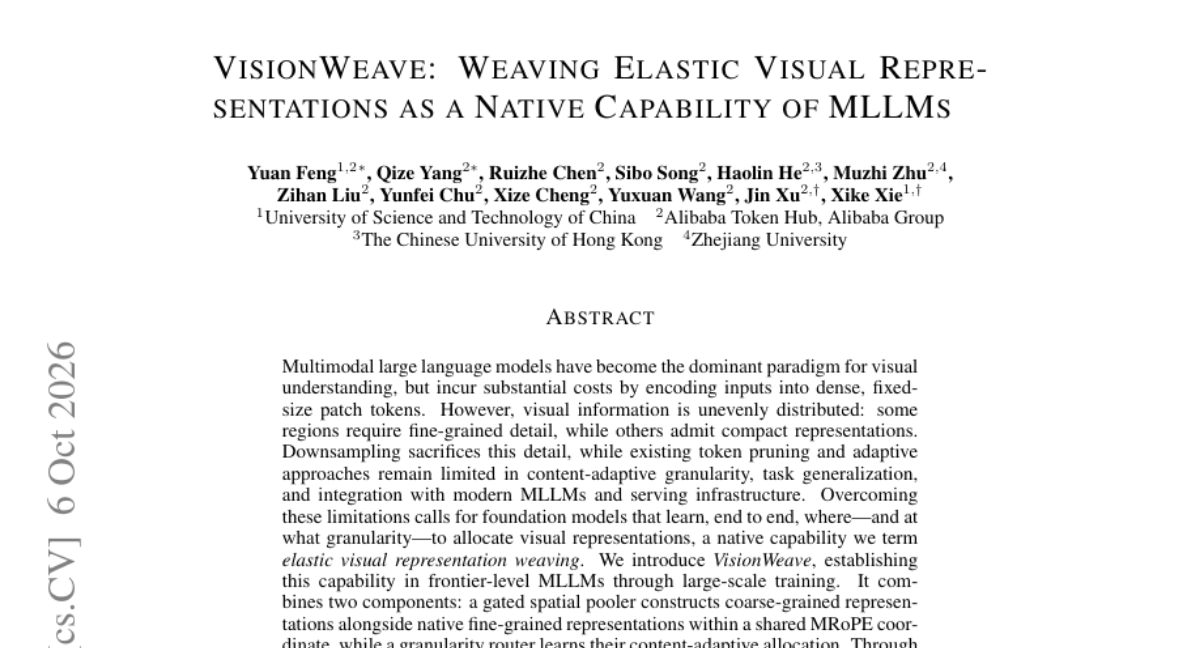
59. VisionWeave: Weaving Elastic Visual Representations as a Native Capability of MLLMs
🔑 Keywords: Multimodal Large Language Models, Elastic Visual Representation Weaving, VisionWeave, Token Savings, Efficiency-Quality Trade-offs
💡 Category: Multi-Modal Learning
🌟 Research Objective:
– The research aims to address limitations in visual representation within Multimodal Large Language Models (MLLMs) by developing a method called elastic visual representation weaving, which efficiently allocates visual representations at varying granularities.
🛠️ Research Methods:
– The introduction of VisionWeave, which incorporates a gated spatial pooler for combined coarse and fine-grained visual representations and a granularity router for content-adaptive allocation. The method was validated through large-scale training using models like Qwen3.5-4B and Qwen3.8-27B across extensive GPU resources.
💬 Research Conclusions:
– VisionWeave demonstrates significant token savings while retaining high-performance levels, with adaptive adjustments to visual content leading to an average of 43.0% token savings and 98.9% of native performance preserved. Compared to fixed token pruning, VisionWeave offers robust efficiency-quality trade-offs in various tasks and conditions, significantly improving throughput and processing times when deployed on the SGLang serving engine.
👉 Paper link: https://huggingface.co/papers/2610.07987
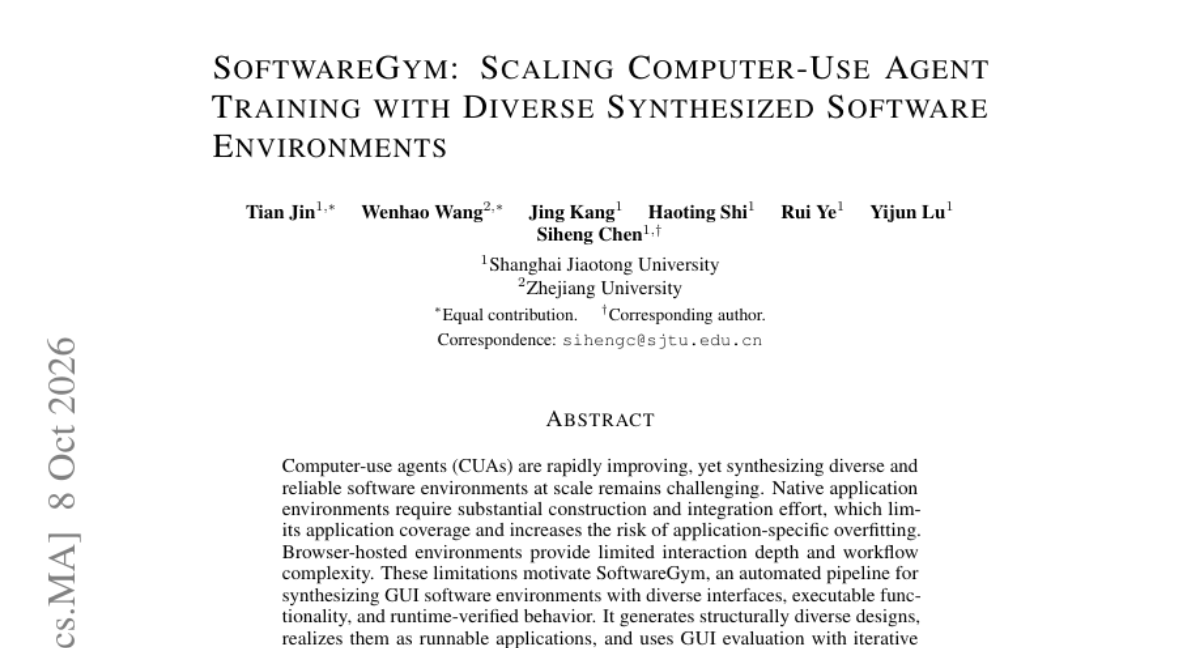
60. SoftwareGym: Scaling Computer-Use Agent Training with Diverse Synthesized Software Environments
🔑 Keywords: Computer-use agents, SoftwareGym, GUI software environments, CUA training
💡 Category: AI Systems and Tools
🌟 Research Objective:
– The study aimed to develop an automated pipeline, SoftwareGym, to synthesize diverse and reliable GUI software environments to improve computer-use agents (CUAs).
🛠️ Research Methods:
– Implementation of SoftwareGym for generating and synthesizing structurally diverse runnable applications with runtime-verified behavior.
– Creation of SoftwareGym-Bench, an evaluation suite of 120 tasks across twelve categories for CUA training.
💬 Research Conclusions:
– SoftwareGym synthesized 182 applications achieving a mean GUI task pass rate of 91.5%.
– CUA training using collected trajectories improved performance, increasing Pass@3 from 41.39% to 56.97% on the OSWorld benchmark, demonstrating potential scalability and transferability of the software environments.
👉 Paper link: https://huggingface.co/papers/2610.12611
61. S-Space: Exploring Spatial Workspace in Multimodal Language Models
🔑 Keywords: Multimodal Language Models, Spatial Reasoning, S-Space, Object-token Representations, AI Native
💡 Category: Multi-Modal Learning
🌟 Research Objective:
– The research aims to uncover the internal mechanisms behind the spatial reasoning capabilities of Multimodal Language Models (MLLMs) through the exploration of a linear representation subspace named S-Space.
🛠️ Research Methods:
– Differentiation of spatial-answer scores with respect to object-token activations to identify horizontal, vertical, and distance axes in S-Space.
– Use of causal interventions to examine verbal access and diagnose spatial reasoning failures.
💬 Research Conclusions:
– S-Space functions as an intrinsic internal spatial workspace that supports accurate spatial judgments, encoding object locations, and transforming viewpoints.
– Despite forming capable spatial representations, MLLMs face limitations in spatial transformations necessary for reliable reasoning across viewpoint changes.
– S-Space facilitates bridging physical directions with abstract linguistic meanings and serves as a diagnostic tool for spatial reasoning failures.
👉 Paper link: https://huggingface.co/papers/2610.13527