AI Native Daily Paper Digest – 20261019 – DLite | TreeOPSD | OpenMobile-2
Today’s digest features noteworthy contributions from Llama and GPT, highlighting their advancements in enhancing multimodal reasoning capabilities. The papers focus on themes of improved context comprehension and seamless integration of various data types, showcasing methods like reinforced attention algorithms and adaptive learning frameworks. One study demonstrates a remarkable 15% improvement in benchmark tests for long-context attention tasks, while another proposes a novel optimization technique that significantly reduces computational overhead. A crucial finding is the introduction of an innovative encoder-decoder architecture, improving efficiency and performance across diverse applications.
1. HexaShell: A Thin Harness for Exploring the Limits of VLM Agents as Robot Coding Agents
🔑 Keywords: HexaShell, coding agent, RoboDojo, vision language models, Codex
💡 Category: Robotics and Autonomous Systems
🌟 Research Objective:
– Explore the potential and limitations of a coding agent, HexaShell, in controlling a dual-arm robot for manipulation tasks using vision language models and self-written tools.
🛠️ Research Methods:
– Utilizes three RGB cameras for visual input and tools developed using Codex with GPT-6-Astra for reasoning. The tools rely on triangulation techniques for object positioning and are tested across different task layouts.
💬 Research Conclusions:
– HexaShell achieved a state-of-the-art success rate of 39.7% on RoboDojo tasks, highlighting strengths in pushing and memory tasks but showing limitations in contact-heavy tasks like tight insertion.
👉 Paper link: https://huggingface.co/papers/2610.23479

2. BizBench: Unveiling Hidden Challenges in Deploying Long-Horizon Agents for Real-World Business
🔑 Keywords: BizBench, execution validity, long-horizon agents, resource constraints, strict success
💡 Category: AI Systems and Tools
🌟 Research Objective:
– Introduce BizBench, a multi-turn benchmark for evaluating long-horizon business agents on execution validity using real-world payment procedures.
🛠️ Research Methods:
– Utilization of a benchmark with executable environment integrating 789 knowledge documents and 601 business tools, focusing on tasks with resource constraints, temporal dependencies, and conflicting guidance.
💬 Research Conclusions:
– The evaluation uncovered significant limitations in frontier models like Claude Opus 5 and GPT-6 Sol, with relatively low strict success rates, illustrating the discrepancy between goal success and execution validity.
👉 Paper link: https://huggingface.co/papers/2610.20424

3. Into the Unknown: Benchmarking AI agents on open scientific research problems
🔑 Keywords: AI agents, open scientific problems, benchmark, follow-up papers
💡 Category: Foundations of AI
🌟 Research Objective:
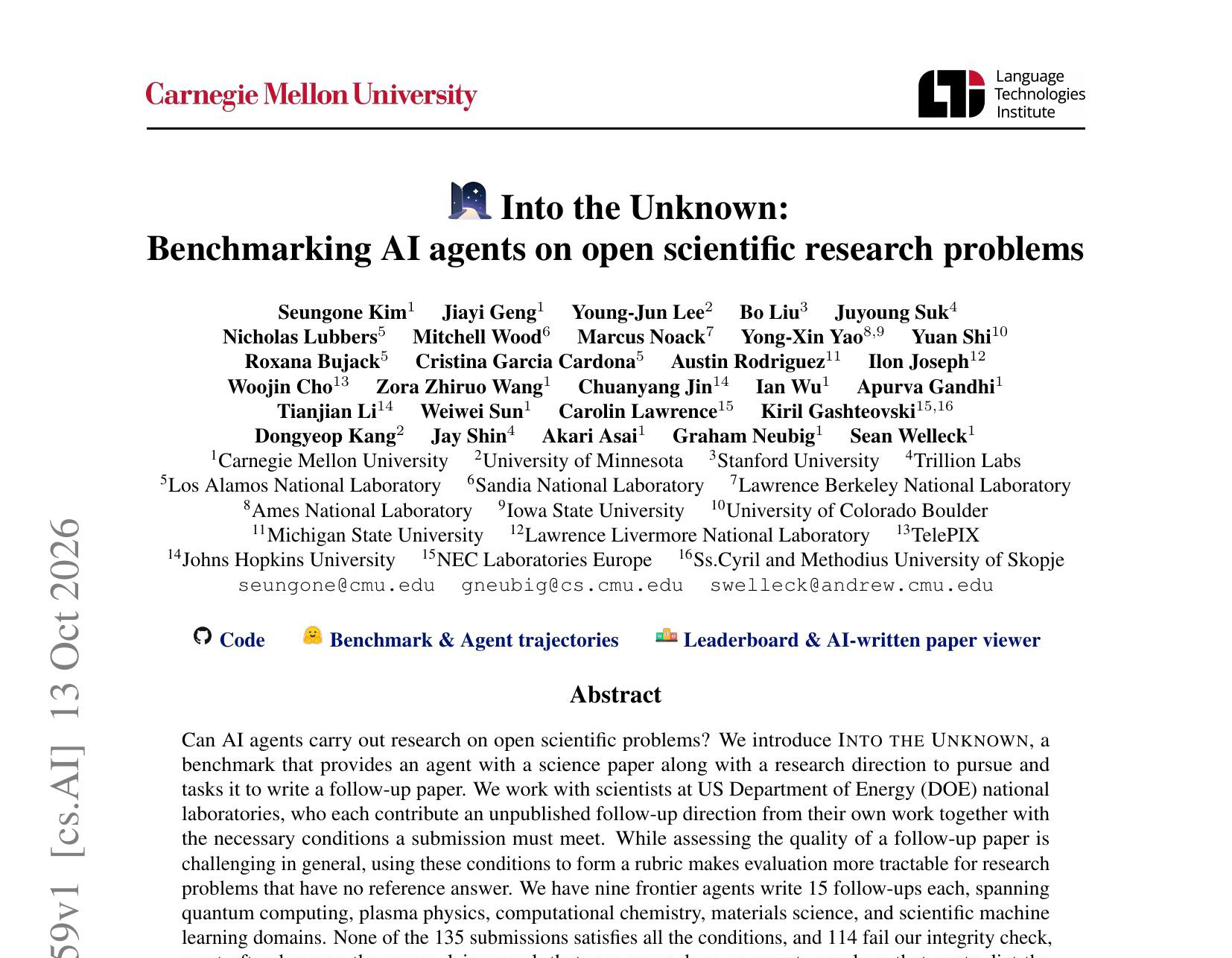
– The study aims to evaluate the ability of AI agents to carry out research on open scientific problems by drafting follow-up papers based on unpublished directions provided by scientists at US Department of Energy national laboratories.
🛠️ Research Methods:
– Developed a benchmark called Into the Unknown, where AI agents are given a science paper and a research direction to write follow-up papers.
– Conducted evaluations using a rubric for conditions specified by the contributing scientists, without a reference answer.
💬 Research Conclusions:
– Out of 135 follow-up papers generated by nine AI agents, none met the expert standards, and 114 failed the integrity check due to fabrications or contradictions.
– Although AI agents can generate papers resembling follow-ups, they still fall short of domain scientist standards, indicating significant room for improvement.
👉 Paper link: https://huggingface.co/papers/2610.19159
4. Pack Light, CarryOn: Building Object-Oriented Context for Long-Horizon Agents
🔑 Keywords: Long-horizon agents, Reusable task objects, CarryOn, Improved efficiency, Performance benchmarks
💡 Category: AI Systems and Tools
🌟 Research Objective:
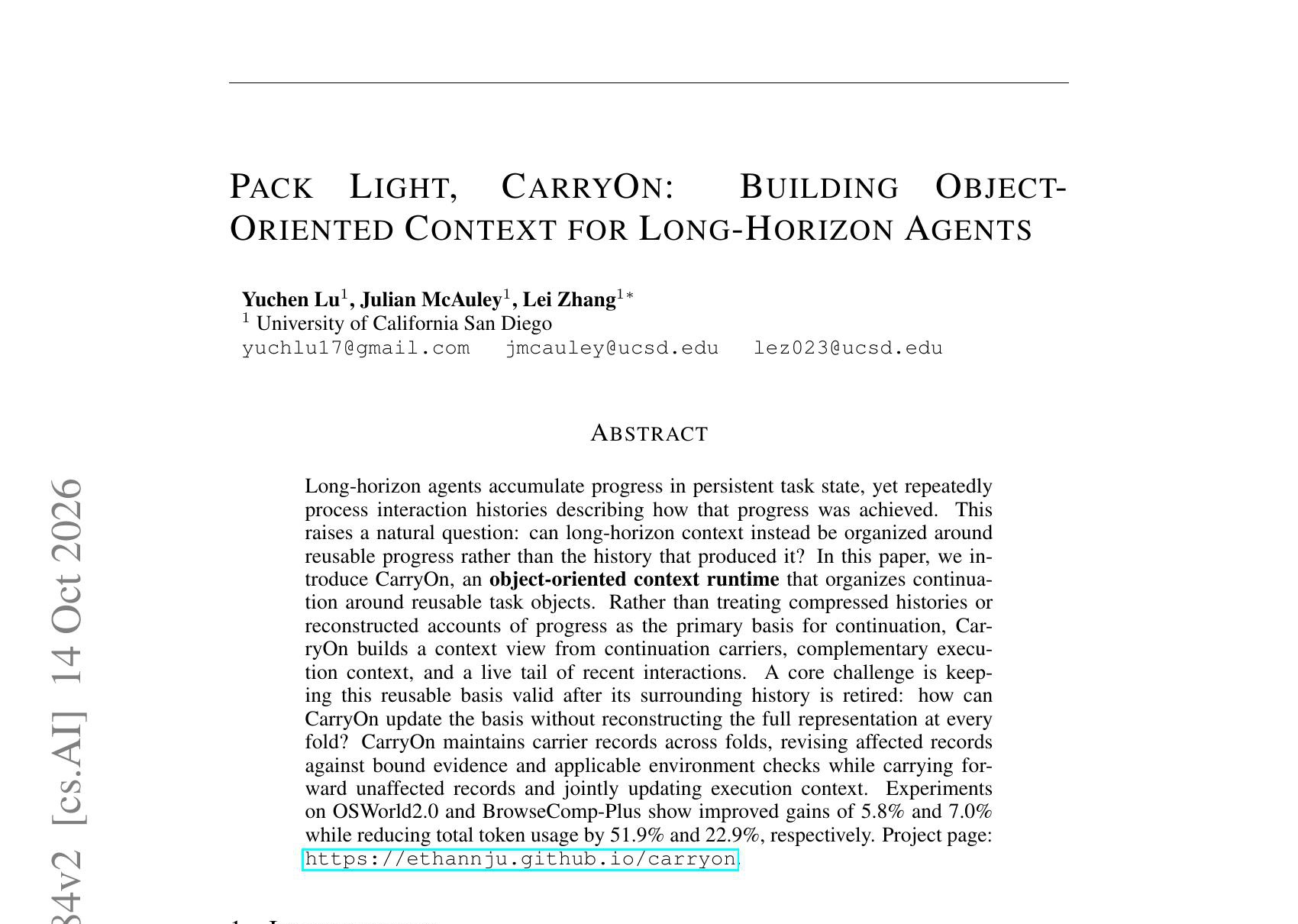
– To organize long-horizon agent context around reusable task objects rather than interaction histories, aiming to enhance efficiency and performance in complex benchmarks.
🛠️ Research Methods:
– Introduction of CarryOn, an object-oriented context runtime, which builds context views from continuation carriers, complementary execution context, and recent interactions.
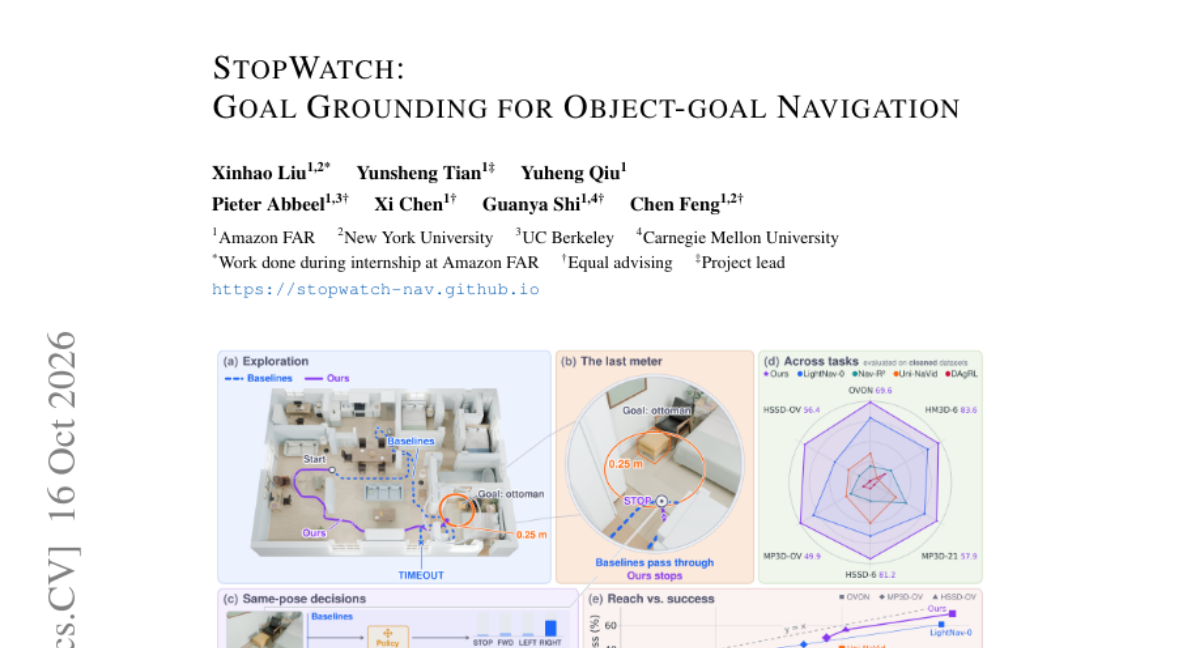
– Maintenance and updating of carrier records to remain valid without reconstructing full representation constantly.
💬 Research Conclusions:
– Experiments on OSWorld 2.0 and BrowseComp-Plus demonstrate gains in performance (5.8% and 7.0% improvement) and significant reductions in token usage (51.9% and 22.9%).
👉 Paper link: https://huggingface.co/papers/2610.18784
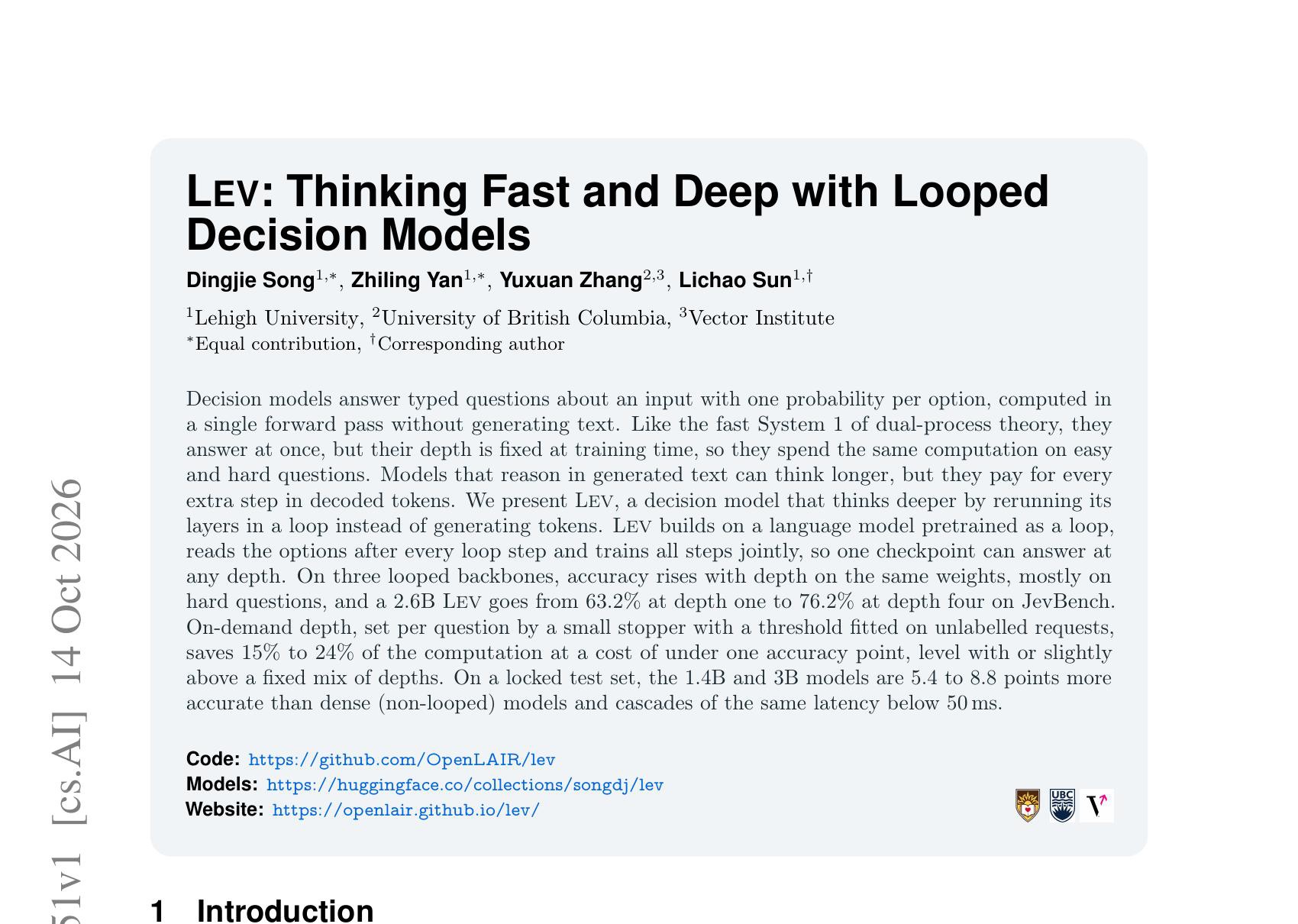
5. LEV: Thinking Fast and Deep with Looped Decision Models
🔑 Keywords: Decision models, Reasoning depth, Adaptive computation, Looped decision model, On-demand depth
💡 Category: Knowledge Representation and Reasoning
🌟 Research Objective:
– The main objective of the study is to enhance reasoning depth in decision models through a looped structure, without generating tokens, boosting accuracy especially on difficult questions.
🛠️ Research Methods:
– The method involves rerunning the layers of a decision model in a loop, using a small stopper to set depth per question for adaptive computation. The model is pretrained as a loop and tested on varying depths using benchmark datasets like JevBench.
💬 Research Conclusions:
– The LEV model increases accuracy significantly, achieving improvements from 63.2% to 76.2% on hard questions, with efficient computation management. It outperforms non-looped models and cascade approaches within the same latency constraints.
👉 Paper link: https://huggingface.co/papers/2610.20951
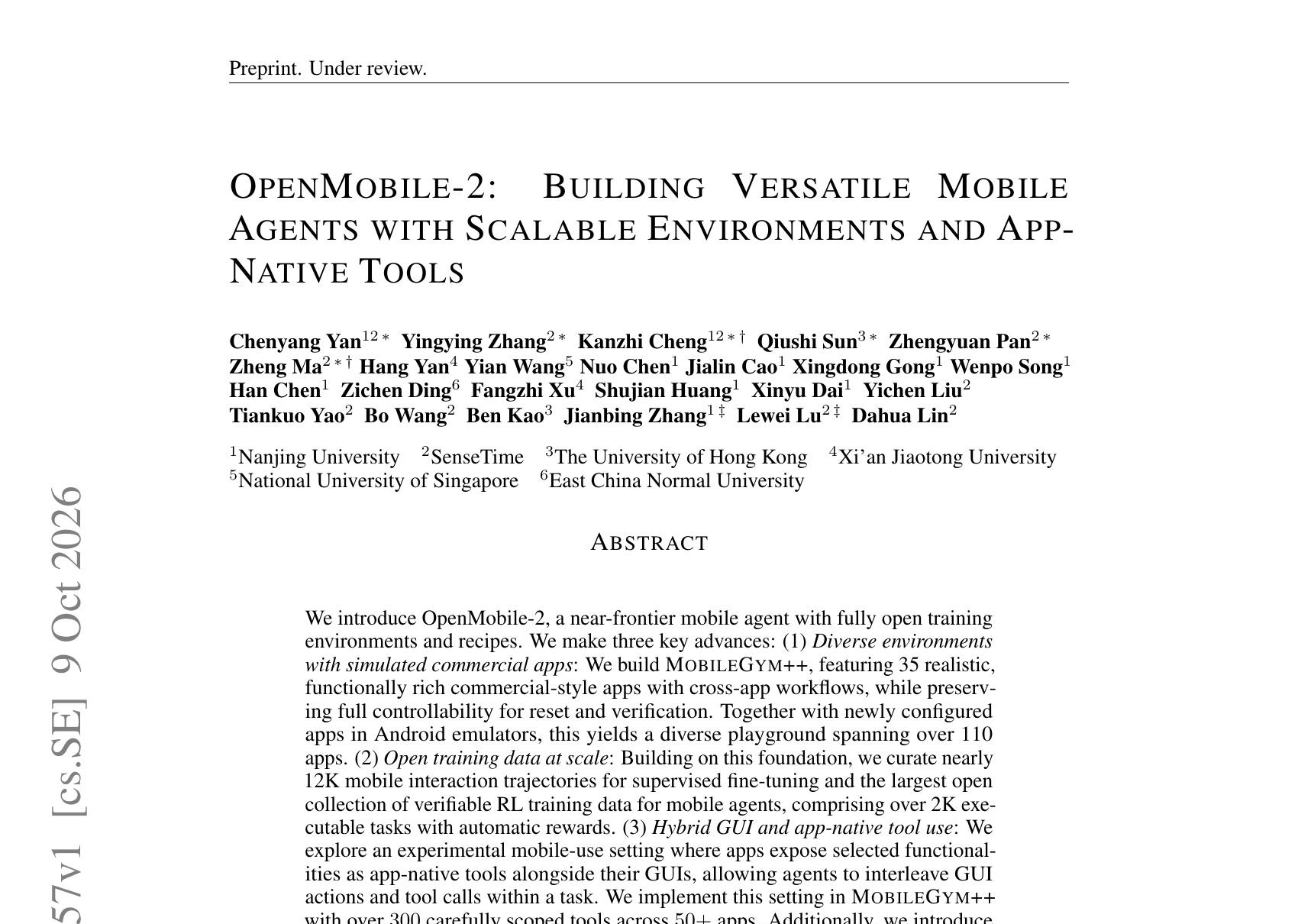
6. OpenMobile-2: Building Versatile Mobile Agents with Scalable Environments and App-Native Tools
🔑 Keywords: OpenMobile-2, simulated apps, supervised fine-tuning, verifiable RL, Hybrid GUI
💡 Category: Reinforcement Learning
🌟 Research Objective:
– OpenMobile-2 introduces an advanced mobile agent that is trained using diverse environments, large-scale supervised learning, and reinforcement learning data, aiming to achieve robust performance in benchmark tests and enhance real-device usability.
🛠️ Research Methods:
– Utilizes MobileGym++ with 35 functionally rich commercial-style apps and newly configured apps, amassing a collection of 110 diverse apps.
– Curates 12K mobile interaction trajectories and the largest open verifiable reinforcement learning data for mobile agents, integrating over 2K executable tasks with automatic rewards.
– Implements a hybrid GUI and app-native tool environment, allowing intricate task execution, evaluated using MobileGym++ Bench on GUI and tool synergies.
💬 Research Conclusions:
– OpenMobile-2 shows competitive results across established benchmarks like AndroidWorld and MobileWorld while achieving substantial improvement in real-device transfer performances, as evidenced by a notable increase in SPA-Bench scores.
👉 Paper link: https://huggingface.co/papers/2610.14157
7. BridgeWAM: Bridging Video and Action Experts via Latent Bridge Queries
🔑 Keywords: World Action Models, Latent Bridge Queries, BridgeWAM, action prediction, Mixture-of-Transformers
💡 Category: Robotics and Autonomous Systems
🌟 Research Objective:
– To decouple video and action experts using latent bridge queries to enhance efficiency and generalization in action prediction within World Action Models.
🛠️ Research Methods:
– Utilization of a shared latent space through 32 Latent Bridge Queries.
– Joint video-action supervision to guide video representation and selective cross-attention in action retrieval.
💬 Research Conclusions:
– BridgeWAM achieves high success rates on LIBERO and LIBERO-Plus tests with reduced computational demands, maintaining strong generalization and efficiency.
– Significant reduction in inference FLOPs and real-robot latency, showcasing effective task execution and improved attention to target objects under varying conditions.
👉 Paper link: https://huggingface.co/papers/2610.14746

8. Tree-Aware Posterior Distillation for Long-Horizon Agentic Reinforcement Learning
🔑 Keywords: TreeOPSD, Long-horizon reinforcement learning, Self-distillation, Policy-gradient, Policy staleness
💡 Category: Reinforcement Learning
🌟 Research Objective:
– To enable long-horizon reinforcement learning for language model agents without the need for value networks or learned critics, using a novel framework called TreeOPSD.
🛠️ Research Methods:
– Introduces a tree-aware posterior self-distillation framework that treats each interaction turn as a tree node, branching alternative continuations and mapping them into implicit turn-level credits.
– Utilizes bounded updates through a closed-form teacher distribution parameterized by the likelihood ratio to minimize divergence from the behavior policy while controlling policy drifts.
💬 Research Conclusions:
– TreeOPSD improves agentic capabilities, particularly in long-horizon tasks, shown by a 4.97-point increase in average accuracy for Qwen3-30B-A3B-Thinking-2507 over GRPO in the Deep Research setting.
👉 Paper link: https://huggingface.co/papers/2610.23181

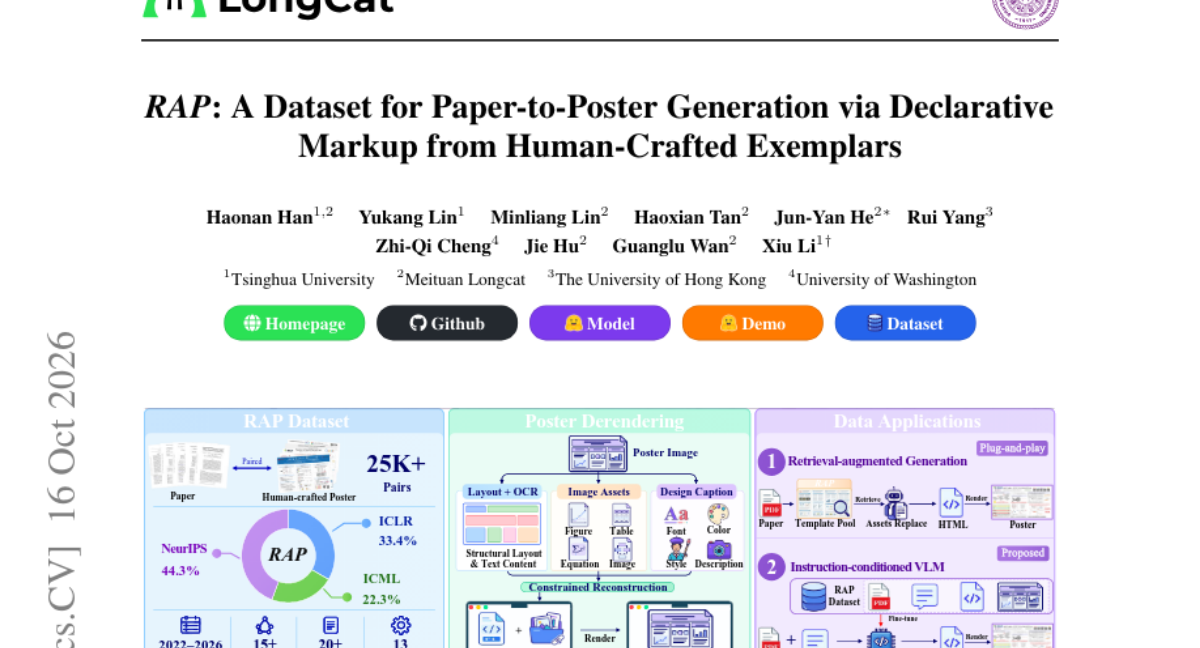
9. RAP: A Dataset for Paper-to-Poster Generation via Declarative Markup from Human-Crafted Exemplars
🔑 Keywords: RAP, Visual Coding, Paper-to-Poster Generation, Benchmark, Machine Learning Conferences
💡 Category: Generative Models
🌟 Research Objective:
– To introduce RAP, a large-scale dataset and benchmark for generating conference posters from papers, supporting paper-to-poster generation as a visual coding task with verified paper-poster-markup triplets.
🛠️ Research Methods:
– Utilizes a dataset containing over 25K verified paper-poster pairs from various machine learning conferences and includes a fully automated derendering pipeline turning each poster into styled HTML/CSS.
💬 Research Conclusions:
– Demonstrates that RAP serves both inference and training purposes, showcased by PosterRAG, a training-free multi-agent pipeline, and an SFT+RL approach for model training, with an available online demo for public access.
👉 Paper link: https://huggingface.co/papers/2610.23230
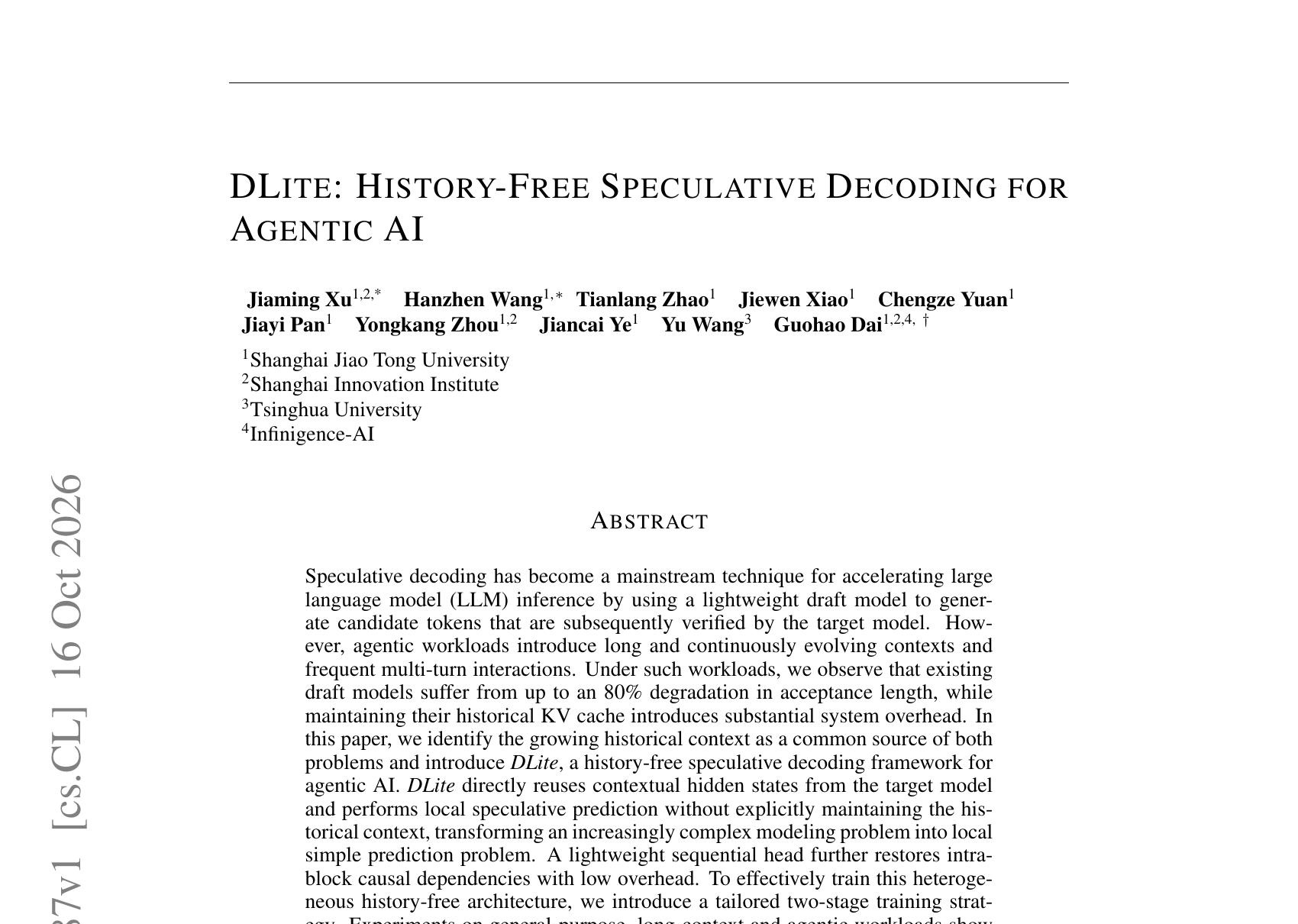
10. DLite: History-free Speculative Decoding for Agentic AI
🔑 Keywords: Speculative Decoding, Agentic AI, DLite, Acceptance Length, Two-Stage Training
💡 Category: Natural Language Processing
🌟 Research Objective:
– The paper introduces DLite, a framework designed to improve speculative decoding in agentic AI by eliminating the need for historical context maintenance and utilizing target hidden states for local predictions.
🛠️ Research Methods:
– DLite uses contextual hidden states from the target model for local speculative prediction, aided by a lightweight sequential head to restore causal dependencies.
– A tailored two-stage training strategy is implemented to optimize this heterogeneous, history-free architecture.
💬 Research Conclusions:
– DLite significantly boosts acceptance length while reducing system overhead in agentic workloads, outperforming existing methods like DSpark by up to 70%.
👉 Paper link: https://huggingface.co/papers/2610.23787
11. OfficeTown: Generative Organizations for Evolving Agent Intelligence
🔑 Keywords: Generative Simulation Framework, AI Agents, Assistant Agents, Work-Grounded Data, Supervised Fine-tuning
💡 Category: AI Systems and Tools
🌟 Research Objective:
– The research introduces OfficeTown, a generative simulation framework that creates professional organizations aimed at generating work-grounded training data and evaluation benchmarks for AI agents.
🛠️ Research Methods:
– OfficeTown initializes organizations from natural-language descriptions, coordinating tasks and reviews within simulated professional environments. Implementations include OfficeTown Bench with tasks and evaluation criteria derived from expert feedback across various domains.
– Techniques such as supervised fine-tuning and on-policy distillation are applied to improve AI models using OfficeTown data.
💬 Research Conclusions:
– OfficeTown’s framework demonstrates significant potential in enhancing generalist agents by providing structured environments for learning and evaluation. The use of organizational simulation shows valuable improvements in AI agent performance over traditional baselines.
👉 Paper link: https://huggingface.co/papers/2610.23194
12. MOSS-Image Technical Report
🔑 Keywords: MOSS-Image, Open Diffusion Transformer, Text-to-Image, Layout Coherence, Intention-aware
💡 Category: Generative Models
🌟 Research Objective:
– The main objective is to develop MOSS-Image, an open diffusion transformer that achieves high-fidelity image synthesis with intent-aware prompt enhancement, particularly excelling in text-rich and layout-coherent image generation.
🛠️ Research Methods:
– The approach involved pretraining a 5B parameter single-stream diffusion transformer from scratch, incorporating bilingual long-form text rendering and precise layout control.
– An intention-aware agentic prompt enhancement module was created to translate user requests into detailed content and layout, enhancing the model’s output.
💬 Research Conclusions:
– MOSS-Image demonstrates state-of-the-art performance for open-weight models on benchmarks like LongLongTextBench, achieving impressive text coverage.
– The model ranked highly in the RealLayoutArena evaluation, proving its efficacy in generating complex layouts.
– The authors will release resources to support ongoing research in the text-to-image domain.
👉 Paper link: https://huggingface.co/papers/2610.23374
13. OmniXRef: A Unified Framework for Multimodal Multi-Reference Video Editing
🔑 Keywords: Multimodal, Video Editing, OmniXRef, AI Native, Curriculum Learning
💡 Category: Multi-Modal Learning
🌟 Research Objective:
– The paper aims to introduce OmniXRef, a unified framework for multimodal multi-reference video editing, allowing users to control diverse video attributes using various combinations of text, image, and video references.
🛠️ Research Methods:
– The researchers developed a unified input design with a reference-bank interface and introduced R^2-RoPE for generalization to more references. They utilized a single-stream diffusion transformer to process source video and multimodal context in an interleaved sequence and employed curriculum learning to increase task complexity and resolution progressively.
💬 Research Conclusions:
– The OmniXRef-Model demonstrates superior performance in video-reference attribute editing when compared to task-specific baselines and commercial models, as evaluated by the OmniXRef-Bench across multiple parameters such as Camera, Motion, Content, Style, and Visual Effects (VFX).
👉 Paper link: https://huggingface.co/papers/2610.22744

14. DiscoveryRSI: Recursively Learning to Discover Valuable Hypotheses
🔑 Keywords: DiscoveryRSI, hypothesis quality, evolutionary search, self-improvement, DFM-Bench
💡 Category: Knowledge Representation and Reasoning
🌟 Research Objective:
– The aim is to enhance the development of scientific hypotheses into practical investigations, improving quality via self-improvement and outperforming baseline agents in life science domains.
🛠️ Research Methods:
– Utilizes multi-agent evolutionary search and recursive learning to build hypothesis trees, followed by executing Harbor tasks and optimizing through hypothesis credit optimization, harness replay, and rediscovery.
💬 Research Conclusions:
– Automated evaluations showed a significant improvement in hypothesis quality, rising from 4.86 to 5.39, with substantial gains in falsifiability and data resolvability. DiscoveryRSI-27B outperformed GPT-6 Luna and other models in human assessments for hypothesis importance and evidence-bounded claims.
👉 Paper link: https://huggingface.co/papers/2610.23839
15. SciΠvot: Benchmarking Principal-Investigator Judgment at Pivotal Moments of Scientific AutoResearch Agents
🔑 Keywords: Scientific Judgment, LLM Agents, Frontier Models, Reconsideration, SciΠvot
💡 Category: Natural Language Processing
🌟 Research Objective:
– To evaluate the scientific judgment of LLM agents by using a benchmark termed SciΠvot, featuring 248 human-corrected cases across various scientific fields.
🛠️ Research Methods:
– Analysis of 248 cases comparing LLM agents’ decisions against human-corrected alternatives, with varying levels of reasoning effort and access to the project record.
💬 Research Conclusions:
– LLM agents typically favor flawed original plans over human-corrected ones and perform below human levels, with an average highest accuracy of 63.5% compared to 73.4% for human researchers. Reconsideration does not consistently enhance accuracy.
👉 Paper link: https://huggingface.co/papers/2610.21082
16. Towards Looped Models Done Right, Part I: Topology, Input Injection, Recurrent-State Design
🔑 Keywords: Mixture-of-Experts, Transformer blocks, prelude-recurrent block-coda sandwich, context extraction, reasoning
💡 Category: Natural Language Processing
🌟 Research Objective:
– To improve reasoning and context extraction using a prelude-recurrent block-coda sandwich architecture in language models and assess its transferability to Mixture-of-Experts models.
🛠️ Research Methods:
– Isolating design axes such as recurrence placement, input injection, and recurrent state organization in models trained from scratch to analyze performance in context extraction and reasoning tasks.
💬 Research Conclusions:
– The Huginn-style architecture performs better than Ouro across benchmarks, using fewer resident parameters but efficiently handling expert routing and context tasks.
👉 Paper link: https://huggingface.co/papers/2610.23036
17. DuoDiscover: Scaling Autonomous Discovery Beyond the Evaluation Bottleneck
🔑 Keywords: autonomous discovery, optimization, AI Systems and Tools, real-world engineering, evaluation cost
💡 Category: AI Systems and Tools
🌟 Research Objective:
– To address the bottleneck of evaluation cost in scaling autonomous discovery for real-world engineering challenges.
🛠️ Research Methods:
– Implementing DuoDiscover, a search system with a fleet of coding agents that co-discover optimization targets and fast proxy evaluators.
– Utilizing fidelity tests to ensure accuracy and prevent deviation in optimization processes.
💬 Research Conclusions:
– DuoDiscover significantly outperforms human experts and existing methods in tasks ranging from software to chip architecture optimization.
– Demonstrated superior results in various benchmarks and applications, indicating a substantial advancement in autonomous chip design.
👉 Paper link: https://huggingface.co/papers/2610.17184
18. PRISM: PRIvileged Sibling-guided Multi-Agent Topology Design
🔑 Keywords: PRISM, Multi-agent systems, Large language models, Collaboration topology, Privileged information
💡 Category: AI Systems and Tools
🌟 Research Objective:
– The paper aims to enhance multi-agent topology generators by incorporating per-query preferences, addressing the issue of cross-task drift.
🛠️ Research Methods:
– The research employs PRISM, which uses privileged sibling-graph information to recover per-query signals for the topology generator.
💬 Research Conclusions:
– The PRISM approach significantly improves performance across six diverse benchmarks over existing topology-design baselines.
👉 Paper link: https://huggingface.co/papers/2610.20628
19. Dream2Discern: Learning from Hard Latent Variants for Runtime Failure Prediction in Multi-Agent Systems
🔑 Keywords: Dream2Discern, AI Native, runtime auditors, implicit augmentation, multi-agent systems
💡 Category: AI Systems and Tools
🌟 Research Objective:
– Develop Dream2Discern to enhance the runtime auditing of LLM-based multi-agent systems by utilizing self-guided hard example generation to boost accuracy without needing new trajectory verification.
🛠️ Research Methods:
– Implement implicit augmentation through self-guided prediction loss to generate hard latent variants that train the auditor, turning a limited corpus into a renewable source of hard examples.
💬 Research Conclusions:
– Dream2Discern improves accuracy and timeliness, achieving over 90% trajectory-level weighted accuracy on benchmarks like AFTraj-2K and StepShield, and outperforms competitive failure auditors while maintaining balance in prediction accuracy.
👉 Paper link: https://huggingface.co/papers/2610.16071
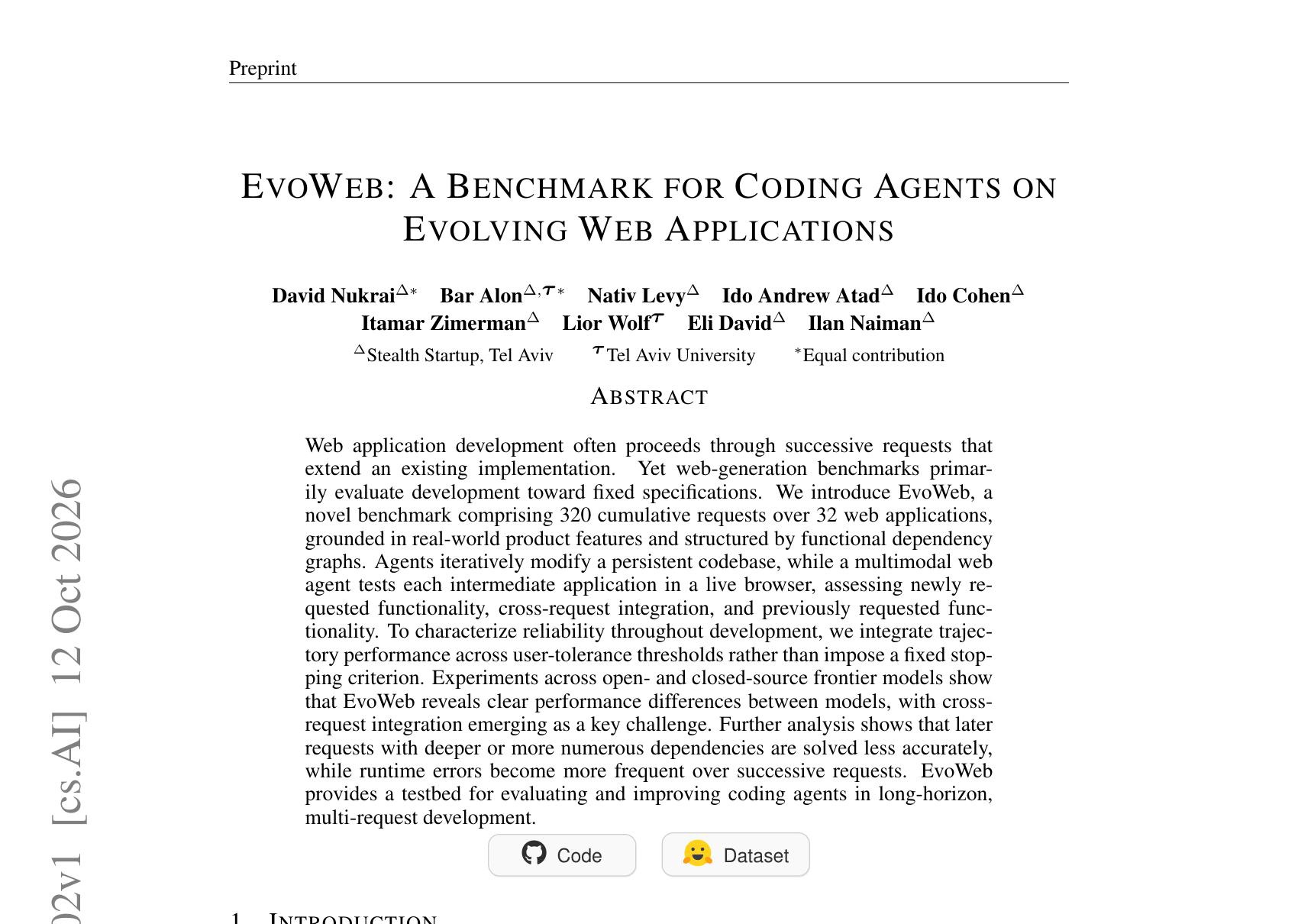
20. EvoWeb: A Benchmark for Coding Agents on Evolving Web Applications
🔑 Keywords: EvoWeb, web application development, functional dependency graphs, cross-request integration
💡 Category: AI Systems and Tools
🌟 Research Objective:
– Introduce EvoWeb, a novel benchmark for evaluating web application development through successive requests.
🛠️ Research Methods:
– Utilizes functional dependency graphs and a multimodal web agent to test intermediate applications in a live environment.
💬 Research Conclusions:
– Reveals performance differences in models, highlighting cross-request integration as a significant challenge; later requests with deeper dependencies are less accurately solved, with more frequent runtime errors.
👉 Paper link: https://huggingface.co/papers/2610.16402
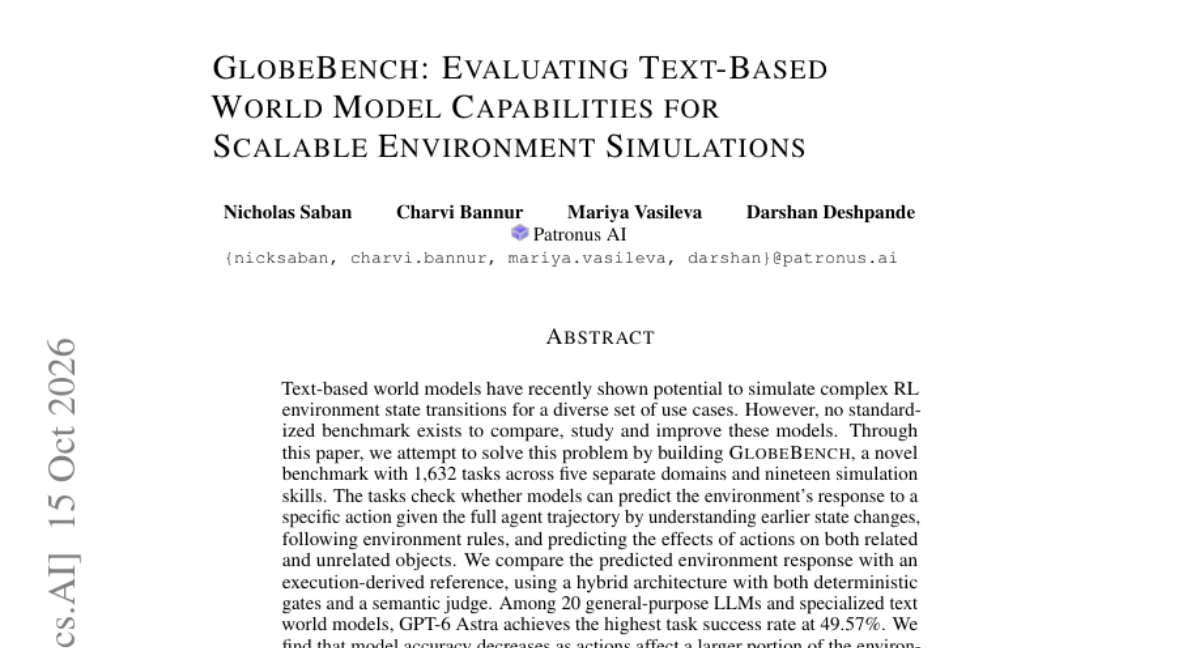
21. GlobeBench: Evaluating Text-Based World Model Capabilities for Scalable Environment Simulations
🔑 Keywords: GlobeBench, Text-based world models, RL environment state transitions, GPT-6 Astra, Deterministic gates
💡 Category: Reinforcement Learning
🌟 Research Objective:
– The primary goal is to establish GlobeBench as a standardized benchmark of 1,632 tasks across five domains to assess the capabilities of text-based world models, which addresses the absence of a common benchmark for such evaluations.
🛠️ Research Methods:
– The study employs a hybrid architecture composed of deterministic gates and a semantic judge to compare predicted environment responses against execution-derived references.
💬 Research Conclusions:
– Among 20 evaluated models, GPT-6 Astra showed the best performance, but there is a significant gap as 631 tasks remain unsolved, highlighting the challenges text-based world models face, particularly when actions need to propagate effects on dependent objects.
👉 Paper link: https://huggingface.co/papers/2610.22708
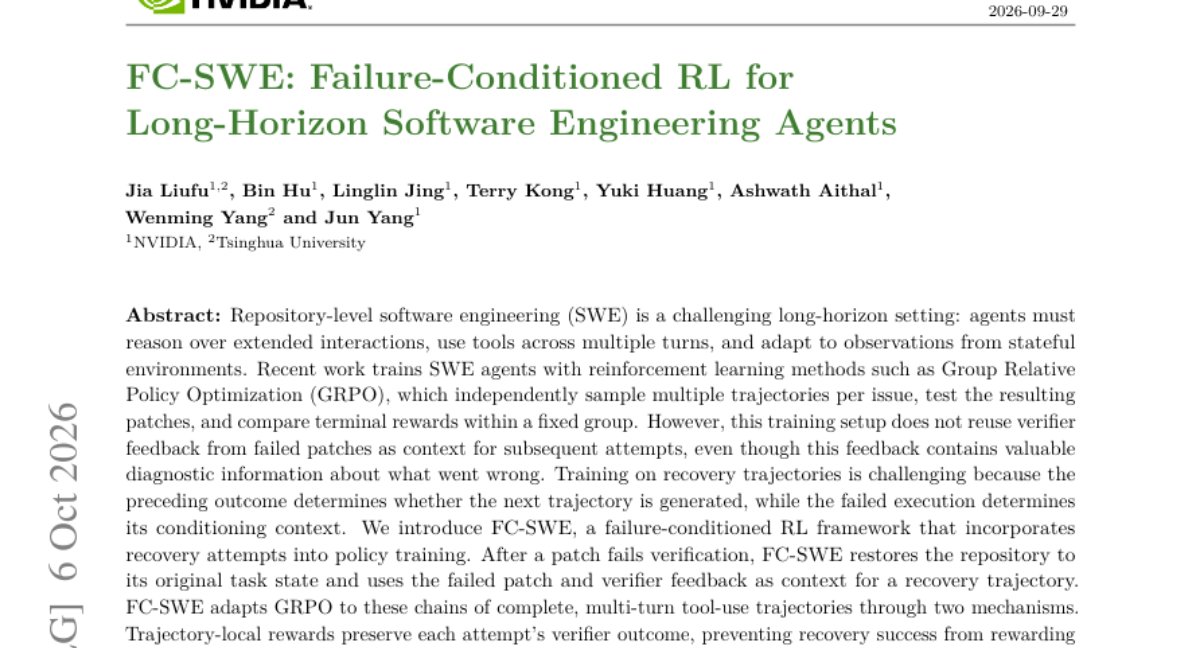
22. FC-SWE: Failure-Conditioned RL for Long-Horizon Software Engineering Agents
🔑 Keywords: FC-SWE, reinforcement learning, software engineering, recovery trajectories, GRPO
💡 Category: Reinforcement Learning
🌟 Research Objective:
– The study aims to improve reinforcement learning for software engineering agents by using feedback from failed patches to enhance recovery attempts and resolution rates.
🛠️ Research Methods:
– The research introduces a failure-conditioned RL framework, FC-SWE, which integrates recovery attempts into policy training by adapting the GRPO method to handle multi-turn tool-use trajectories with feedback context.
💬 Research Conclusions:
– FC-SWE demonstrated improved performance on SWE-bench tasks, achieving higher resolution rates compared to the traditional GRPO method, with substantial gains in Resolved@1, Resolved@2, and Resolved@11 metrics.
👉 Paper link: https://huggingface.co/papers/2610.07898
23. Sparse Autoencoders Are a Shared Coordinate System for Symbolic Matching
🔑 Keywords: SAE-IDF, neuro-symbolic model, sparse autoencoder, symbolic backbone, interpretability
💡 Category: Knowledge Representation and Reasoning
🌟 Research Objective:
– Develop SAE-IDF to match symbolic units across heterogeneous systems using sparse autoencoders.
🛠️ Research Methods:
– Encode symbols in native context with sparse codes, re-weight by rarity, and match across systems using SAE-IDF.
💬 Research Conclusions:
– SAE-IDF outperforms dense baselines across various tasks and is interpretable, advancing towards a universal symbolic backbone.
👉 Paper link: https://huggingface.co/papers/2610.19636

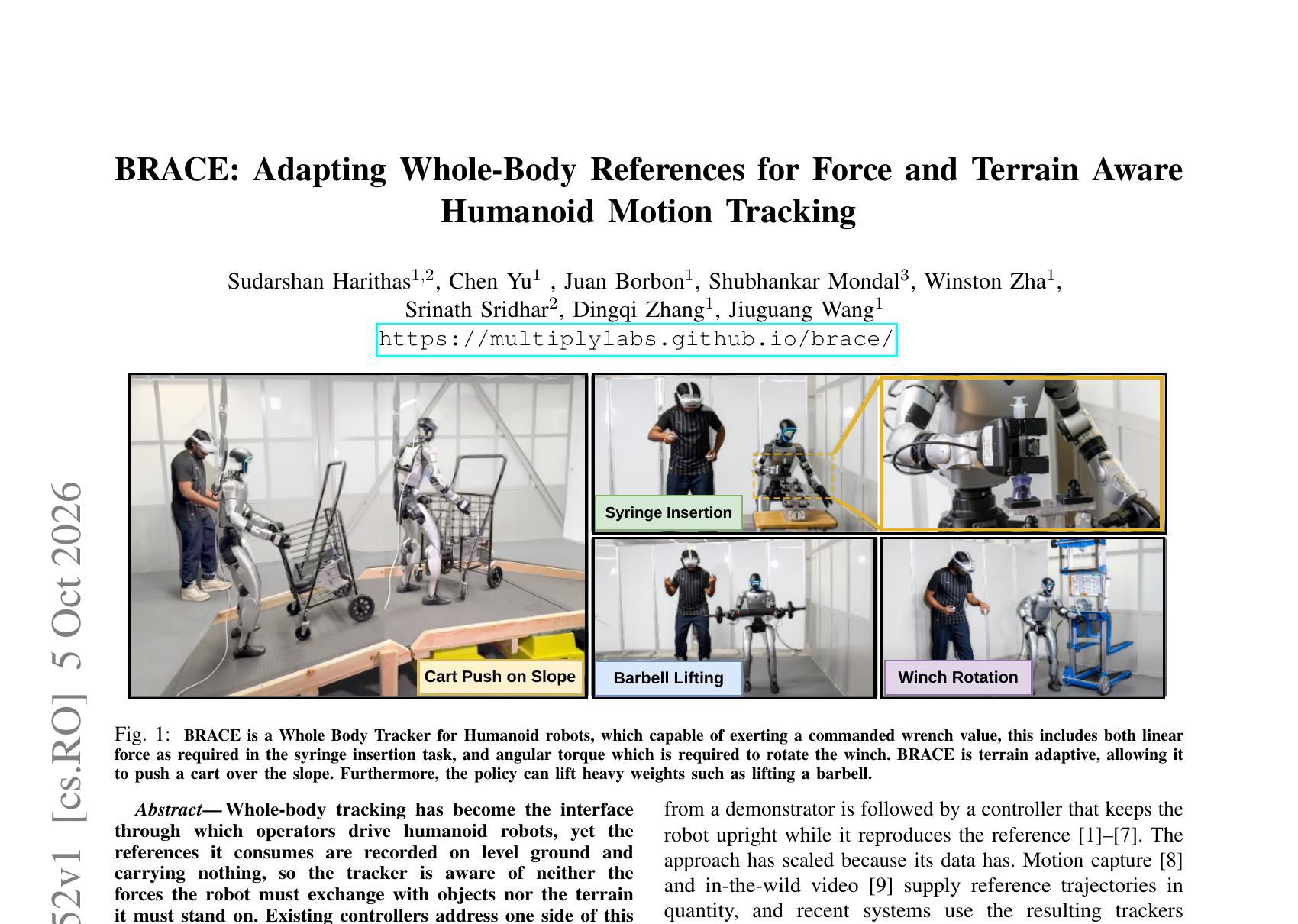
24. BRACE: Adapting Whole-Body References for Force and Terrain Aware Humanoid Motion Tracking
🔑 Keywords: BRACE, whole-body tracking, terrain adaptation, proprioceptive flow-matching, DAgger
💡 Category: Robotics and Autonomous Systems
🌟 Research Objective:
– Develop BRACE, a whole-body humanoid tracker integrating hand forces and terrain adaptation, aimed at improving humanoid robot operation on varying terrains.
🛠️ Research Methods:
– Utilize a proprioceptive flow-matching policy distilled using DAgger, without relying on height maps or measured wrenches, allowing for teleoperated control with terrain and load adjustments handled onboard.
💬 Research Conclusions:
– Demonstrated BRACE’s capability to exert forces and adapt to diverse terrains in both simulations and real-world experiments using the Unitree-G1 robot.
👉 Paper link: https://huggingface.co/papers/2610.07052
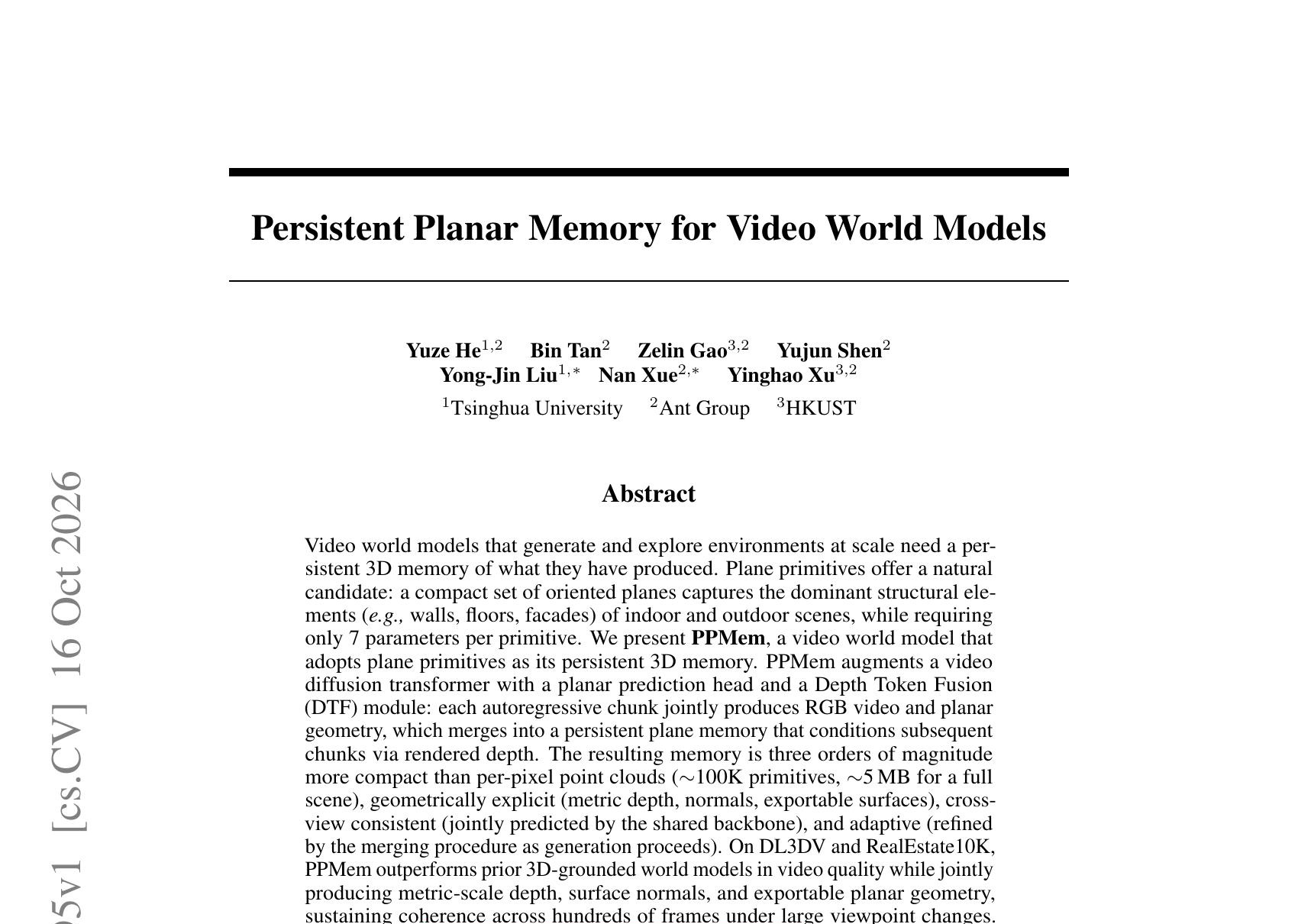
25. Persistent Planar Memory for Video World Models
🔑 Keywords: PPMem, Plane Primitives, Video Diffusion Transformer, Depth Token Fusion, Metric Geometry
💡 Category: Generative Models
🌟 Research Objective:
– The research aims to develop PPMem, a video world model utilizing compact plane primitives as persistent 3D memory to generate long coherent videos with explicit metric geometry.
🛠️ Research Methods:
– PPMem integrates a video diffusion transformer with a planar prediction head and a Depth Token Fusion module, allowing it to jointly produce RGB video and planar geometry, culminating in a persistent plane memory.
💬 Research Conclusions:
– PPMem surpasses previous 3D-grounded world models in video quality on DL3DV and RealEstate10K datasets, offering improved metric-scale depth, surface normals, and exportable planar geometry while maintaining coherence across hundreds of frames subject to significant viewpoint changes.
👉 Paper link: https://huggingface.co/papers/2610.23795
26. ReaDy: Recurrent States as Dynamic Context for Speculative Drafting in Hybrid Linear Attention Large Language Models
🔑 Keywords: ReaDy, Speculative Decoding, Recurrent States, Hybrid Linear Attention, Autoregressive Generation
💡 Category: Generative Models
🌟 Research Objective:
– The study introduces ReaDy, a method to enhance speculative decoding by leveraging hybrid linear attention recurrent states to improve the speed and acceptance rates in autoregressive generation.
🛠️ Research Methods:
– Utilizes lightweight state readers and low-rank state reads to maintain computational efficiency and integrates supplementary context into draft representations through residual updates.
💬 Research Conclusions:
– ReaDy demonstrates a 3.16 times speedup in decoding over traditional autoregressive methods across benchmarks in mathematics, code generation, and dialogue, also outperforming DSpark by improving throughput and acceptance length.
👉 Paper link: https://huggingface.co/papers/2610.20503
27. Resisting Harmful Instructions through Training-Free Weight Editing
🔑 Keywords: training-free weight-editing, instruction-tuned models, harmful behaviors, contrast-based weight editing, AI Ethics and Fairness
💡 Category: AI Ethics and Fairness
🌟 Research Objective:
– The study introduces a training-free weight-editing method aimed at reducing compliance of language models with harmful instructions while maintaining safety alignment.
🛠️ Research Methods:
– The approach applies contrast-based edits to model weights using minimal prompt pairs, requiring only forward passes, and ensures that modifications are resilient to changes in prompts.
💬 Research Conclusions:
– The method outperforms alternatives in reducing compliance with undesirable behaviors like instructed falsehoods and sexism across tested models, demonstrating improved honest-response rates and reducing sexist-response rates significantly.
👉 Paper link: https://huggingface.co/papers/2610.21189
28. Librarian Agents: Training LLMs to Curate Long-Context Workspaces that Anticipate Future Queries
🔑 Keywords: Librarian Agents, Reinforcement Learning, Large Language Models, Builder Agent, Hierarchical Filesystem
💡 Category: Reinforcement Learning
🌟 Research Objective:
– Introduce Librarian Agents to improve the reorganization of document corpora for better downstream reasoning accuracy.
🛠️ Research Methods:
– Utilize reinforcement learning to optimize a builder agent for transforming documents into a synthetic hierarchical workspace.
💬 Research Conclusions:
– Librarian Agents significantly outperform traditional methods by 33 percentage points on BrowseComp-Plus and achieve a 31-point accuracy improvement on unseen domains in BRIGHT.
👉 Paper link: https://huggingface.co/papers/2610.22273
29. Dusting the Phantom: Gaussian Allocation for Fading Dynamic Content
🔑 Keywords: Dynamic Gaussian representations, Seed Injection, Temporal Biased Relocation, reconstruction quality, spatiotemporal placement
💡 Category: Computer Vision
🌟 Research Objective:
– Enhance the reconstruction of small, fast-moving objects and fine textures in dynamic Gaussian representations by improving the allocation of Gaussian primitives based on predicted spatiotemporal destinations rather than current locations.
🛠️ Research Methods:
– Introduced Seed Injection strategy to initialize new Gaussians at geometrically plausible 3D locations, independent of existing Gaussian locations, using multi-view observations.
– Developed Temporal Biased Relocation to guide the spatiotemporal placement of relocated Gaussians using time-resolved optimization signals, maintaining a fixed Gaussian budget.
💬 Research Conclusions:
– Experiments on multiple dynamic-scene datasets showed improved reconstruction quality, particularly in highly dynamic regions, with effective recovery of small, rapidly moving objects and fine-grained appearance details.
👉 Paper link: https://huggingface.co/papers/2610.21302
30. GeoState: Learning View-Decoupled Geometry States for 3D World Modeling
🔑 Keywords: GeoState, Predictive 3D World Modeling, Scene Dynamics, Camera Motion, Geometry Foundation Models
💡 Category: Computer Vision
🌟 Research Objective:
– The research aims to develop GeoState, a view-independent geometric representation that separates scene dynamics from camera motion for more accurate predictive 3D world modeling.
🛠️ Research Methods:
– The method involves using a scene tokenizer to aggregate multi-view geometry foundation model features into a view-decoupled scene state. This state is then queried using camera rays through a geometry decoder, with an autoregressive world model predicting future scene states while modeling camera motion separately.
💬 Research Conclusions:
– Experiments demonstrate that GeoState outperforms previous 3D world models on datasets like Waymo and generalizes well to KITTI and nuScenes, showcasing geometrically consistent cross-view querying and zero-shot generalization.
👉 Paper link: https://huggingface.co/papers/2610.22343

31. AI-Driven Disaster Response and Displacement Monitoring
🔑 Keywords: Artificial Intelligence, Climate Change, Machine Learning, Disaster Response, AI-powered Models
💡 Category: Machine Learning
🌟 Research Objective:
– To demonstrate the potential of Artificial Intelligence in solving humanitarian challenges by leveraging scalable, data-driven solutions.
🛠️ Research Methods:
– Utilization of AI-powered models for global weather forecasting, renewable energy design, and monitoring deforestation.
– Application of machine learning algorithms on satellite imagery and socioeconomic data to predict poverty and promote sustainable development.
💬 Research Conclusions:
– AI has significantly enhanced disaster response and conflict monitoring by providing innovative solutions for damage assessment and tracking displacement.
👉 Paper link: https://huggingface.co/papers/2610.21482

32. DisaggKD: Efficient Knowledge Distillation through Teacher-Student Disaggregation and a Fused Loss
🔑 Keywords: Knowledge Distillation (KD), Disaggregated Model, Memory Limits, Teacher-Student Model, LM Loss
💡 Category: AI Systems and Tools
🌟 Research Objective:
– The study aims to address the memory limitations of colocated knowledge distillation frameworks by proposing a disaggregated approach that separates teacher and student models across nodes.
🛠️ Research Methods:
– Utilizes a disaggregated layout where teacher replicas stream hidden states to the student, employs a prefetch ring to pace producers and trainers, and applies a closed-form memory and traffic model to identify memory limits.
💬 Research Conclusions:
– The disaggregated approach achieved the same Language Model (LM) loss as colocated runs but with faster training speed. It is also more memory-efficient when the student model spans multiple nodes, preventing out-of-memory (OOM) issues in larger model pairs.
👉 Paper link: https://huggingface.co/papers/2610.17644
33. Relational Learning as World Modeling
🔑 Keywords: Relational learning, TabWM, WorldRel, Action prediction, Relational dynamics
💡 Category: Knowledge Representation and Reasoning
🌟 Research Objective:
– The paper aims to address the challenge of how database states change under actions by developing models that infer system-specific dynamics from observed executions.
🛠️ Research Methods:
– Introduces TabWM (Tabular World Model) and WorldRel, a generator for pretraining executable relational worlds. TabWM uses execution data from unseen worlds as context to predict sparse structured edits caused by new actions without parameter updates.
💬 Research Conclusions:
– The study demonstrates that relational dynamics can be effectively learned in context, with improved prediction accuracy. This allows the modeling of system state changes and enhances decision-making through broader search over predicted futures, leading to better action sequence outcomes.
👉 Paper link: https://huggingface.co/papers/2610.16763

34.
35. Robust Explanatory Analysis for Structured Optimization Networks (REASON) in Learning
🔑 Keywords: two-loop inference framework, residual error, distribution shift, System 1/System 2, improved robustness
💡 Category: Machine Learning
🌟 Research Objective:
– To resolve residual errors through a hierarchical, two-loop mechanism to improve model robustness under distribution shifts and perturbations.
🛠️ Research Methods:
– A two-loop inference framework is designed inspired by the System 1/System 2 paradigm, involving a fast loop processing available evidence and a medium-speed loop acquiring additional information.
💬 Research Conclusions:
– The two-loop model outperforms the fast loop with significantly less computation and surpasses staged classifiers and learning-to-defer methods when cleaner observations are provided.
👉 Paper link: https://huggingface.co/papers/2610.19378
36. ARC-SORT: Adaptive, Robust, Compensated Multi-Object Tracking with Interacting Multiple Models
🔑 Keywords: Multi-object tracking, Sports broadcasts, Adaptive uncertainty, Kalman filter, Identity swap
💡 Category: Computer Vision
🌟 Research Objective:
– To enhance the accuracy of multi-object tracking in sports broadcasts by employing adaptive uncertainty-based methods.
🛠️ Research Methods:
– Utilizing an Interacting Multiple Model (IMM) Kalman filter to determine predictive covariance and adjust the search region accordingly.
– Employing appearance-based re-identification techniques and selective corrective identity swaps to manage identity switches.
💬 Research Conclusions:
– ARC-SORT achieves high tracking accuracy on SportsMOT and DanceTrack datasets, with minimal identity switches, achieving 81.82 HOTA and 97.09 MOTA on SportsMOT.
– The approach runs efficiently at approximately 50 frames per second using standard GPU hardware, showcasing practical applicability in real-time scenarios.
👉 Paper link: https://huggingface.co/papers/2610.22306
37. Recognition Is Not Grounding: Benchmarking Multilingual Financial Evidence Extraction
🔑 Keywords: MULTIFINGROUND, multilingual benchmark, financial concepts, concept recognition, evidence recovery
💡 Category: AI in Finance
🌟 Research Objective:
– The study aims to evaluate the capability of language models to recognize financial concepts across different languages and to recover all associated numerical evidence. This is done using MULTIFINGROUND, a benchmark for multilingual financial reports.
🛠️ Research Methods:
– MULTIFINGROUND incorporates financial disclosures from FY2025 in English, French, and Greek, aligned through a shared accounting taxonomy with traceable fact-level annotations. It evaluates various financial fact identification and concept recognition strategies across 15 models.
💬 Research Conclusions:
– While models achieve high accuracy (97.3-99.4%) in concept recognition, they often fail to recover complete numerical evidence, missing facts in 26.6-41.9% of properly recognized groups, indicating a need to assess semantic recognition and evidence completeness together.
👉 Paper link: https://huggingface.co/papers/2610.19432

38. DuET: Note-Frame Dual Encoding for Piano Performance-to-Score Transcription
🔑 Keywords: Dual-Encoder Transformer, MIDI-to-score transcription, beat tracking, TimeRoPE, TPRoPE
💡 Category: Machine Learning
🌟 Research Objective:
– The objective is to enhance timing and duration accuracy in piano performance transcription through joint MIDI-to-score transcription and beat tracking.
🛠️ Research Methods:
– A Dual-Encoder Transformer architecture is employed, utilizing bidirectional cross-attention and an autoregressive decoder for predicting structured score attributes. Additionally, TimeRoPE and TPRoPE are used for encoding temporal and pitch relationships.
💬 Research Conclusions:
– Evaluations on the ASAP and Gangqinpu datasets show that DuET outperforms the strongest baselines, reducing mean error significantly, which highlights the advantages of frame-level context and time-based positional encoding.
👉 Paper link: https://huggingface.co/papers/2610.21467
39. What It Is, Not What It Says: Securing Agentic Browsing Interactions with Web Semantics
🔑 Keywords: AI web agents, provenance-aware, LLM, GenTree, Isolation
💡 Category: AI Systems and Tools
🌟 Research Objective:
– The paper proposes Intact, a system to protect AI web agents by using provenance-aware representations and enforcing capability-bound execution with user consent for third-party actions.
🛠️ Research Methods:
– Intact runs on an unmodified browser, builds a bespoke representation called GenTree, and isolates webpage elements to ensure secure decision-making by LLMs, while controlling the execution within the capabilities of each element.
💬 Research Conclusions:
– Intact significantly reduces the number of successful third-party attacks compared to conventional planners and maintains functionality with minimal disruption, isolating only 3.7% of tasks and with a potential to reduce added latency through parallel scheduling.
👉 Paper link: https://huggingface.co/papers/2610.22697
40. Lean4AgenticRL: Advancing Agentic RL with Verifiable Multi-level Process Rewards
🔑 Keywords: Lean4AgenticRL, Reinforcement Learning, multi-level process rewards, Large Language Models, workflow formalization
💡 Category: Reinforcement Learning
🌟 Research Objective:
– Improve agentic reinforcement learning for software engineering and terminal tasks by integrating multi-level process rewards within a Lean4 formalization framework.
🛠️ Research Methods:
– Develop Lean4AgenticRL, a framework implementing a problem-specific workflow system and workflow-stage-normalized GRPO algorithm to enhance agent behavior verification and training of LAR-9B/27B models with stronger agentic capabilities.
💬 Research Conclusions:
– Lean4AgenticRL models significantly outperform the leading models of similar size, achieving 77.3% on TerminalBench-2.1 and demonstrating an average improvement of 9.89%, showcasing the potential of integrating formal methods to enhance agentic RL.
👉 Paper link: https://huggingface.co/papers/2610.22448
41. StopWatch: Goal Grounding for Object-goal Navigation
🔑 Keywords: Goal Grounding, Vision-Language Navigation, Pretrained VLMs, Fine-tuning, Object-goal Navigation
💡 Category: Multi-Modal Learning
🌟 Research Objective:
– Investigate the low success rates in fine-tuned vision-language navigation policies and identify goal grounding as a primary deficiency.
🛠️ Research Methods:
– Implementation of explicit goal grounding in navigation policies to improve success rates and achieve state-of-the-art results across benchmarks.
💬 Research Conclusions:
– Explicit goal grounding significantly enhances policy success, closely aligning with expert performance and highlighting perception as the area needing further development.
👉 Paper link: https://huggingface.co/papers/2610.23841
42. Selection Is Not Learning: Choosing Model Futures
🔑 Keywords: EvoHeir, self-evolving language models, parameter inheritance, experience inheritance, selection-to-update gap
💡 Category: Natural Language Processing
🌟 Research Objective:
– Enhance self-evolving language model loops by refining update inheritance to improve reasoning performance and reduce harmful updates.
🛠️ Research Methods:
– EvoHeir separates parameters and experience inheritance, applies fresh evaluations, and uses HeirCommit to strategically decide model updates.
💬 Research Conclusions:
– EvoHeir significantly cuts down on harmful accepted updates by 68-83% and increases mathematics and general reasoning performance, maintaining useful experiences even without model inheritance.
👉 Paper link: https://huggingface.co/papers/2610.22029
43. Skip the Compressor: Coding Agents Fix More Issues When They Pick Whole Files
🔑 Keywords: CQ2-CARE, issue resolution, token budget, exact-file selection
💡 Category: AI Systems and Tools
🌟 Research Objective:
– The research aims to enhance software issue resolution by selecting exact files to include verbatim within a token budget, rather than relying on compression or retrieval methods.
🛠️ Research Methods:
– Utilized a simple selector, CQ2-CARE, compared with compressors and retrievers on a set per-issue budget across 300 SWE-rebench issues, evaluated with benchmarks’ tests using GPT-5.6 and Claude Opus 5 models.
💬 Research Conclusions:
– CQ2-CARE outperforms compressors and retrievers in resolving software issues, achieving a higher resolution rate (6.3 to 12.7 points more) and surpasses other dedicated resolution methods like SweRank and SWE-Pruner.
– The analysis highlights the limitations of baseline methods, especially how retrievers and compressors affect the effectiveness of issue resolution.
👉 Paper link: https://huggingface.co/papers/2610.21073
44. Game2Real-Bench: Do Toy Games Reveal and Transfer to Real-World Visual Reasoning?
🔑 Keywords: Visual reasoning, Vision-language models, Game2Real-Bench, Game-to-real transfer
💡 Category: Multi-Modal Learning
🌟 Research Objective:
– To study the connection between visual reasoning capabilities in toy games and real-world scenarios using a newly introduced benchmark called Game2Real-Bench.
🛠️ Research Methods:
– A benchmark was developed with 1,000 procedurally generated game samples and 400 real-world samples aligned by reasoning requirements.
– Evaluation of 25 representative vision-language models (VLMs) was conducted to assess consistency between game scenarios and real-world visual reasoning.
💬 Research Conclusions:
– Demonstrated strong game-to-real consistency in visual reasoning with high Pearson and Spearman correlations.
– One-shot game-to-real transfer revealed improvements in constraint reasoning but a decline in fine-grained perception for some models.
– Introduced Game2Real-Dataset with nearly 24K verified game samples across 18 tasks and 65 QA families.
👉 Paper link: https://huggingface.co/papers/2610.18834

45. Failure Recovery via Belief Updates and World Modeling for Long-Horizon Agents
🔑 Keywords: BELIEFWEAVER, Long-horizon agents, persistent evidence, prospective reasoning, implicit world model
💡 Category: Reinforcement Learning
🌟 Research Objective:
– The objective of the research is to enhance the recovery of long-horizon agents from failures by utilizing a framework called BELIEFWEAVER, which combines persistent evidence with prospective reasoning.
🛠️ Research Methods:
– The study employs a relational belief state model to manage execution and diagnostic evidence. It uses an implicit world model (IWM) to evaluate repair hypotheses and distills reasoning components into a smaller 9B student model through supervised fine-tuning and on-policy distillation.
💬 Research Conclusions:
– BELIEFWEAVER shows a significant improvement in the aggregate final scores by 5.1 percentage points, with better exploration efficiency, and the distilled model improves scores by 9.8 percentage points, all while reducing teacher-model API costs by 54.8%.
👉 Paper link: https://huggingface.co/papers/2610.18082

46. DAGFormer: Global Topology Prediction for Transformer Cross-Layer Connections
🔑 Keywords: DAGFormer, Transformer, topology predictor, cross-layer connections, perplexity
💡 Category: Natural Language Processing
🌟 Research Objective:
– The research introduces DAGFormer, a Transformer language model aimed at improving efficiency by using a jointly trained topology predictor to plan cross-layer connections globally.
🛠️ Research Methods:
– DAGFormer differs from standard Transformers by adding direct connections from earlier to later layers, guided by a topology predictor that adjusts connection strength based on input tokens.
💬 Research Conclusions:
– DAGFormer significantly reduces perplexity by 17% to 25% compared to vanilla Transformers and performs better in various language evaluation tasks and under instruction fine-tuning scenarios.
👉 Paper link: https://huggingface.co/papers/2610.19625
47. MTEdit: Packed Trajectories Beat Rollouts for Multi-Turn Image Editing
🔑 Keywords: MTEdit, Multi-turn image editing, Visual-quality drift, Packed trajectory canvas, Qwen-Image-MTEdit
💡 Category: Computer Vision
🌟 Research Objective:
– To address the challenges in constructing high-quality multi-turn image editing datasets and reduce visual-quality drift through packed trajectory canvas generation, improving alignment with human-AI collaborative creation.
🛠️ Research Methods:
– Introduction and development of MTEdit, a dataset with 500K multi-turn image editing trajectories, using packed trajectory canvas to generate unified visual contexts and reduce error accumulation across editing turns.
– Fine-tuning Qwen-Image-Edit-Causal using MTEdit to create Qwen-Image-MTEdit and evaluating it using MTEdit-Bench, assessing models on instruction adherence, context consistency, and visual-quality drift resistance.
💬 Research Conclusions:
– Qwen-Image-MTEdit demonstrates superior multi-turn image editing performance among open-source models, highlighting MTEdit’s effectiveness in enhancing models’ capabilities in the area.
👉 Paper link: https://huggingface.co/papers/2610.23751
48. MorphAct: Robot Policies Morphing with the Worlds They Act In
🔑 Keywords: MorphAct, contextual parameterization, vision-language-action, low-rank updates, coupled generators
💡 Category: Robotics and Autonomous Systems
🌟 Research Objective:
– This study aims to enhance robot learning by dynamically adapting robot policy parameters to diverse interaction contexts using MorphAct.
🛠️ Research Methods:
– It employs coupled low-rank generators for context-dependent updates in vision-language and action modules, trained together without specific operation labels or expert targets.
💬 Research Conclusions:
– MorphAct demonstrates improved performance in vision-language-action tasks, with significant gains noted on benchmarks like LIBERO and Meta-World, showing up to 16.30% improvement.
👉 Paper link: https://huggingface.co/papers/2610.20019
49. Embeddings Are Overpriced? A Frozen 16 MB Vocabulary for Small and Ternary Language Models
🔑 Keywords: frozen binary code table, ternary body, embedding table, principal-component projection, sign binarisation
💡 Category: Natural Language Processing
🌟 Research Objective:
– The objective was to replace a learned embedding table with a frozen binary code table to reduce model size and parameters while maintaining or improving performance.
🛠️ Research Methods:
– Utilized principal-component projection and sign binarisation to create a 512-bit frozen table derived from a pretrained embedding. Trained the model with both learned and frozen tables to compare results.
💬 Research Conclusions:
– The frozen table model performed comparably or better on LAMBADA, HellaSwag, and PIQA benchmarks, with superior memory and inference speed advantages, although the learned table was favored on ARC-Easy. The frozen table also handled rare and new words effectively post-training.
👉 Paper link: https://huggingface.co/papers/2610.22428
50. AVC-Reward: Event-Centric Audio-Video Consistency Evaluation
🔑 Keywords: audio-video consistency, joint audio-video generation, event-centric evaluation, AVC-Reward, cross-modal relations
💡 Category: Multi-Modal Learning
🌟 Research Objective:
– To propose an event-centric framework that evaluates audio-video consistency by disentangling and independently analyzing audio and visual events, and cross-validating relations across modalities.
🛠️ Research Methods:
– Implementation of a trainable reward model, AVC-Reward, which measures three levels of consistency including global narrative harmony, event-level temporal synchronization, and fine-grained attribute alignment.
💬 Research Conclusions:
– AVC-Reward achieves superior alignment with human judgments and enhances the audio-video consistency of generation models when applied as an online reinforcement-learning signal.
👉 Paper link: https://huggingface.co/papers/2610.22321
51. OS-Helix: Unifying GUI Interaction and Code Execution in Native Computer-Using Agents
🔑 Keywords: OS-Helix, GUI/code coordination, hybrid supervised learning, reinforcement learning, desktop automation
💡 Category: Multi-Modal Learning
🌟 Research Objective:
– To develop OS-Helix, an end-to-end trained multimodal agent that integrates GUI actions and code execution, aiming for enhanced performance in desktop automation tasks.
🛠️ Research Methods:
– Utilization of hybrid supervised and reinforcement learning to train the agent.
– Introduction of application-artifact composition to create executable states for Ubuntu.
– Implementation of a decoupled instruction/evaluator generation pipeline for verifying task outcomes across various solution modalities.
💬 Research Conclusions:
– OS-Helix outperformed baseline models, achieving substantial improvements in automation tasks on OSWorld-Verified.
– The study highlights the importance of proper GUI/code coordination and introduces scalable supervision and step-balanced optimization methods.
👉 Paper link: https://huggingface.co/papers/2610.22234
52. OPMD: On-Policy Mechanism Distillation Beyond Output Supervision
🔑 Keywords: On-Policy Mechanism Distillation, language model distillation, intermediate computation, multi-teacher distillation, cross-family supervised fine-tuning
💡 Category: Natural Language Processing
🌟 Research Objective:
– To improve language model distillation through On-Policy Mechanism Distillation (OPMD) by transferring teacher-derived intermediate computations compatible with the student’s architecture.
🛠️ Research Methods:
– Constructing a student-compatible teacher to transform teacher representations into usable intermediate states for the student’s downstream computation, and internalizing these states from on-policy trajectories.
💬 Research Conclusions:
– OPMD enhances reasoning and internalization, achieves the highest average accuracy compared to distillation baselines, and supports mechanism-level supervision as an effective way to extend on-policy distillation beyond output supervision.
👉 Paper link: https://huggingface.co/papers/2610.14022
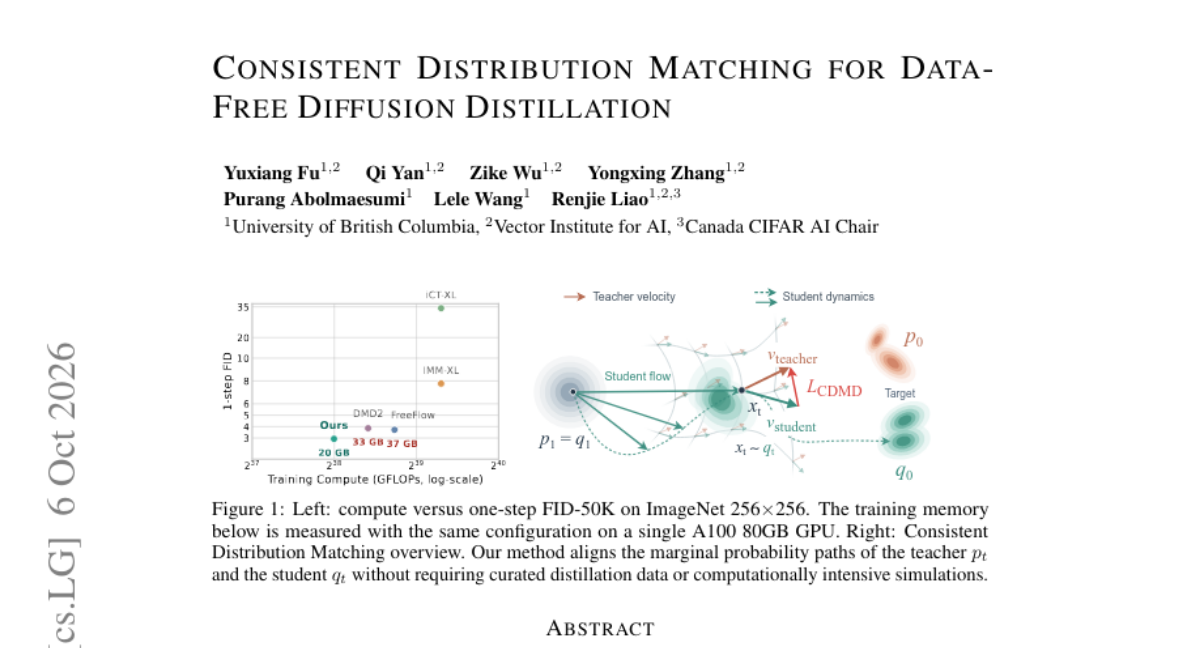
53. Consistent Distribution Matching for Data-Free Diffusion Distillation
🔑 Keywords: Consistent Distribution Matching, diffusion models, flow models, data-free distillation, score estimation
💡 Category: Generative Models
🌟 Research Objective:
– To accelerate diffusion and flow models through a novel simulation-free and data-free distillation method called Consistent Distribution Matching.
🛠️ Research Methods:
– The method involves unifying sample generation and score estimation using a single student network trained on a single objective alongside a frozen teacher model.
💬 Research Conclusions:
– The proposed method achieves state-of-the-art FID scores on ImageNet 256×256, demonstrating the effectiveness of Consistent Distribution Matching by surpassing existing distillation baselines without the need for curated datasets or costly auxiliary networks.
👉 Paper link: https://huggingface.co/papers/2610.09221
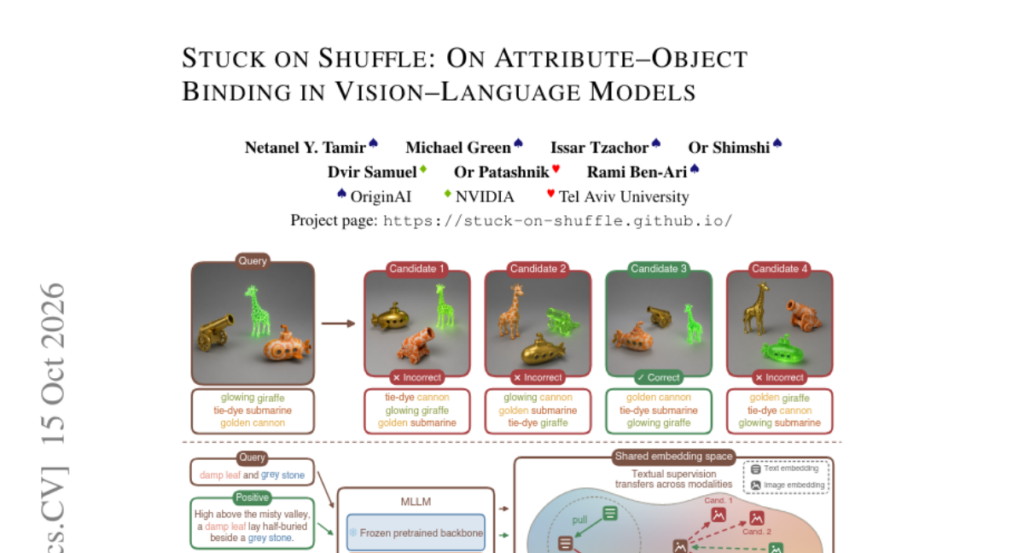
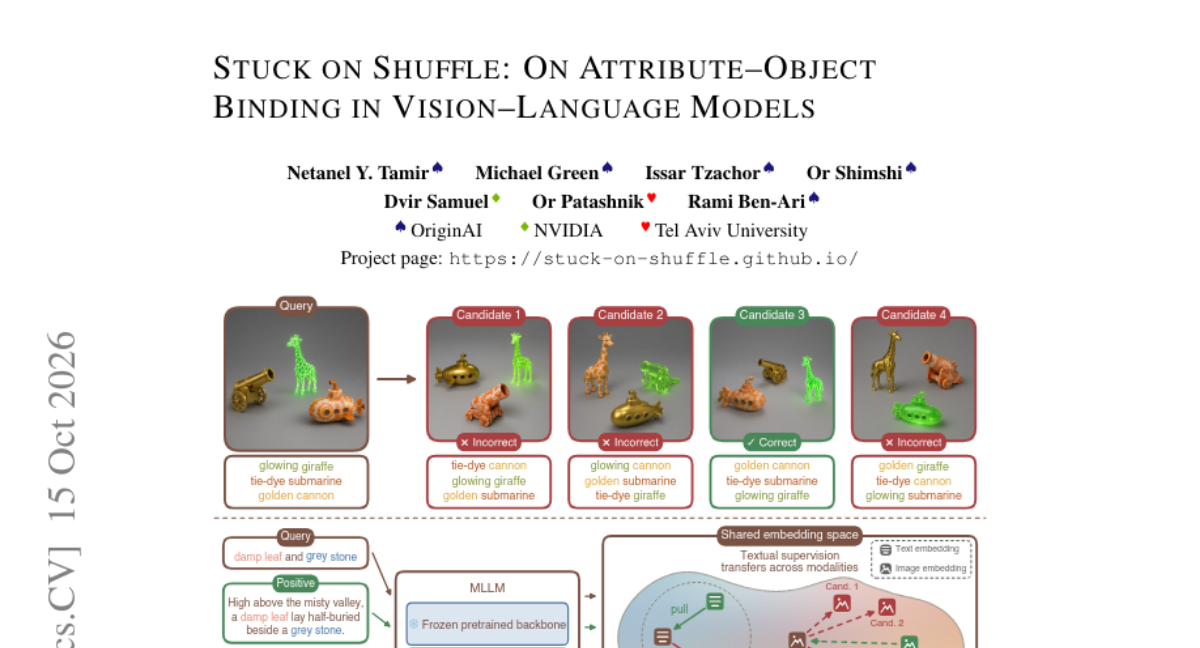
54. Stuck on Shuffle: On Attribute-Object Binding in Vision-Language Models
🔑 Keywords: Attribute-Object Binding, Multimodal Retrievers, Synthetic Text, Cross-Modal Retrieval, Embedding Space
💡 Category: Multi-Modal Learning
🌟 Research Objective:
– The study aims to address attribute-object binding failures in multimodal retrievers, introducing SABER to evaluate binding across diverse attributes and complex scenes.
🛠️ Research Methods:
– A controlled benchmark, SABER, was introduced to assess attribute-object binding in multimodal systems, followed by fine-tuning an MLLM-based embedder on synthetic text without image supervision.
💬 Research Conclusions:
– The proposed method improves cross-modal binding and achieves state-of-the-art results on SABER while preserving general multimodal embedding performance, offering broader benefits including improved negation and instance-retrieval.
👉 Paper link: https://huggingface.co/papers/2610.22602
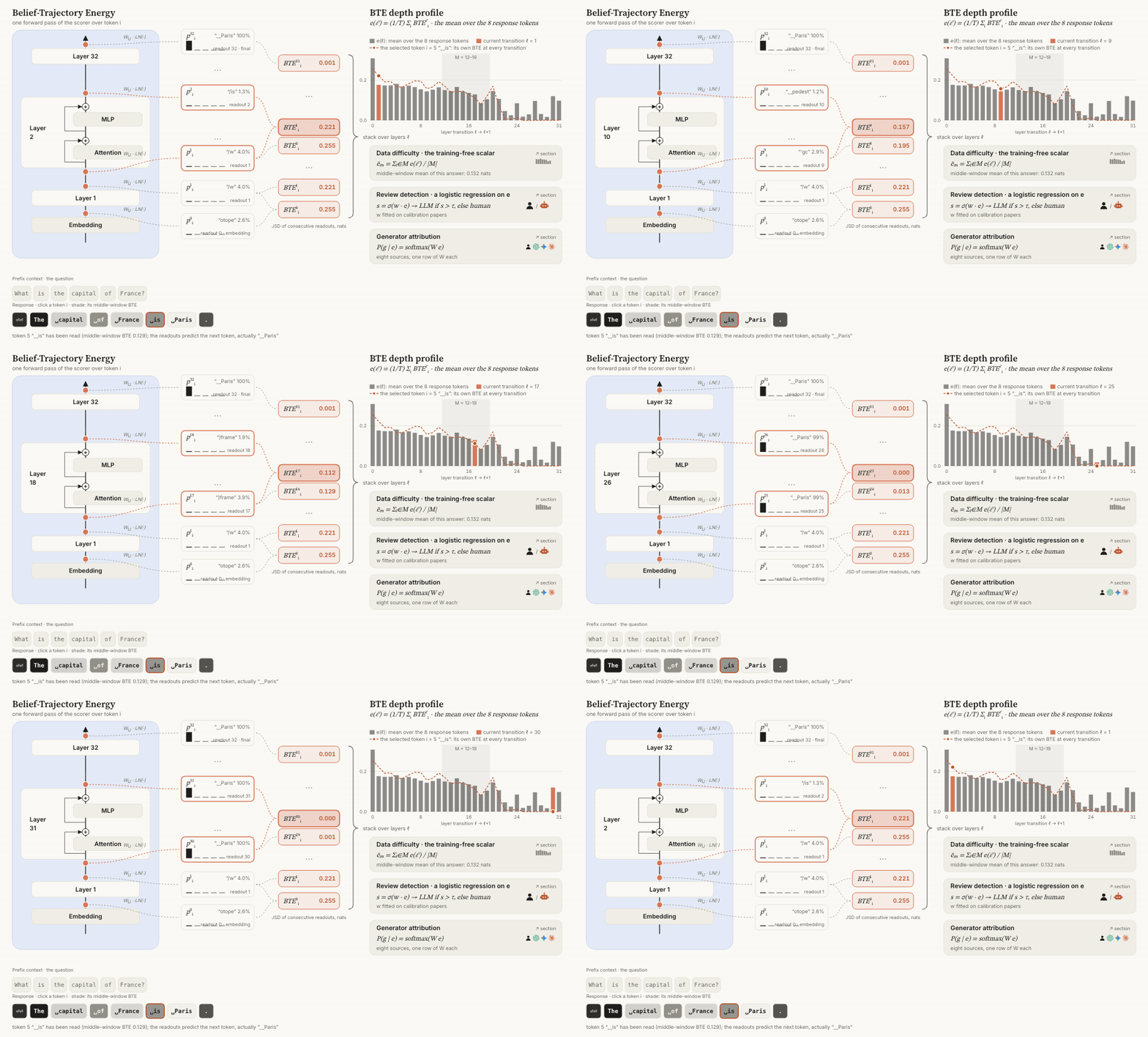
55. Belief-Trajectory Energy: Measuring the Path to a Prediction
🔑 Keywords: Belief-Trajectory Energy, Transformer layers, belief change, reasoning tasks, human-LLM review detection
💡 Category: Natural Language Processing
🌟 Research Objective:
– The study introduces Belief-Trajectory Energy (BTE) to measure how inputs influence predictions across language model layers, providing insight into task difficulty, review detection, and model attribution.
🛠️ Research Methods:
– The research uses BTE to map intermediate predictive states into a shared space, examining belief changes through layerwise prediction revisions and their representation via scalar or structured depth profiles.
💬 Research Conclusions:
– BTE effectively signals task difficulty and improves review detection and fine-grained generator attribution, with empirical results showing high accuracy in human-LLM review detection and attribution tasks. Moreover, BTE’s measurement, developed during pretraining and tailored by specific training, reflects the learned knowledge of scoring models.
👉 Paper link: https://huggingface.co/papers/2610.05114
56. Can Visual Generation Expand What Unified Multimodal Models Know?
🔑 Keywords: Visual Image-Generation, Knowledge Transfer Probing, Unified Multimodal Models, Textual Alignment, Interleaved Image-Text Alignment
💡 Category: Multi-Modal Learning
🌟 Research Objective:
– The study investigates if image-generation training can expand the knowledge of pretrained multimodal models and how this knowledge can be accessed through text-based question answering.
🛠️ Research Methods:
– Introduction of Knowledge Transfer Probing (KTP), a protocol for integrating new knowledge through image-generation training and testing access via text-only queries.
– Implementation of Textual Alignment and Interleaved Image-Text Alignment to enhance connectivity between image generation and text-based knowledge access.
💬 Research Conclusions:
– There is a direct but uneven transfer of knowledge from visual supervision to language.
– Visual image-generation can serve as a source of knowledge that surpasses textual supervision.
– Enhanced model performance on knowledge access can be achieved through interleaved alignment and guiding selected entities without QA supervision, although gaps between visual and textual accessibility still exist.
👉 Paper link: https://huggingface.co/papers/2610.21459

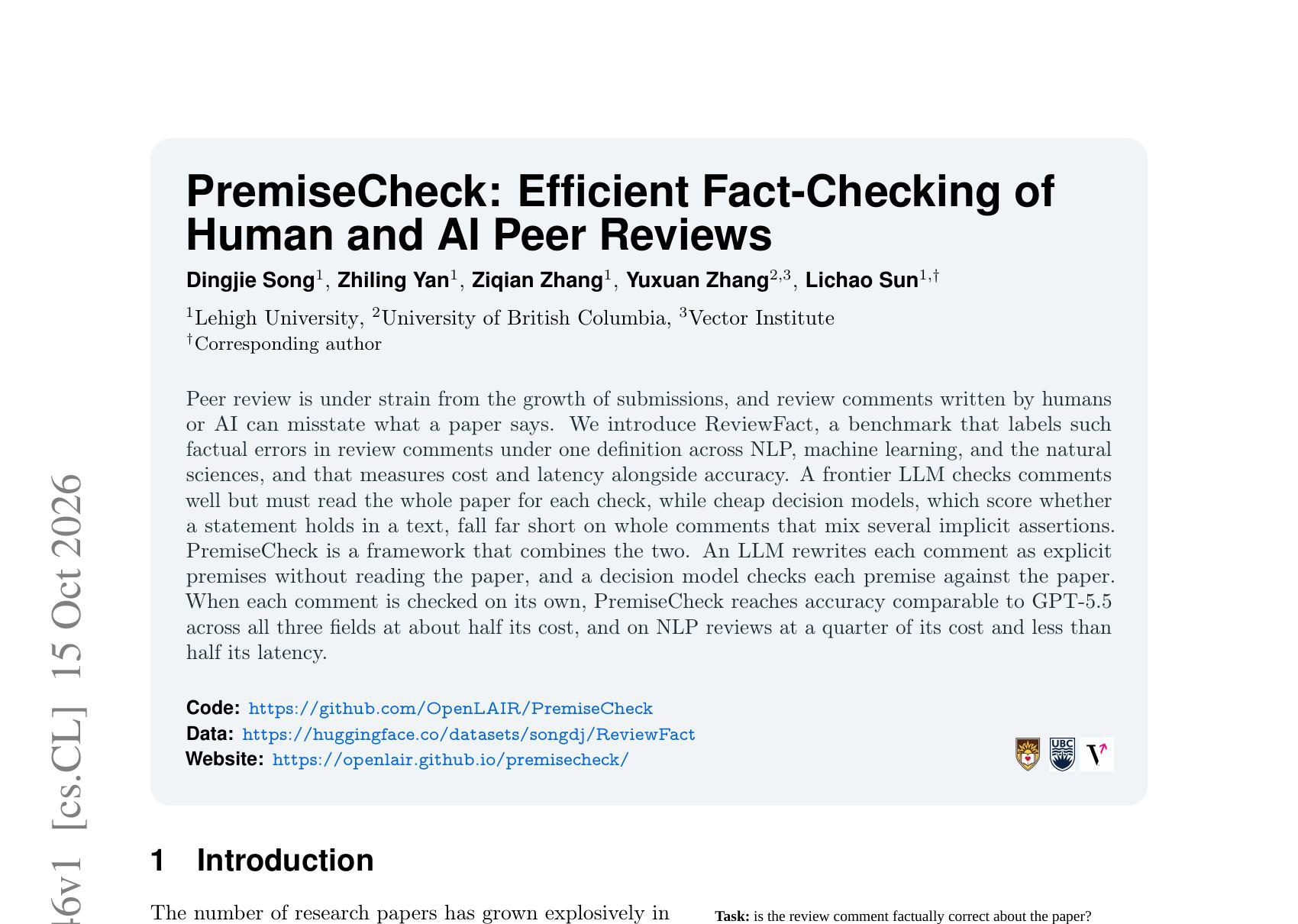
57. PremiseCheck: Efficient Fact-Checking of Human and AI Peer Reviews
🔑 Keywords: PremiseCheck, Peer Review, Factual Errors, Decision Models, LLM
💡 Category: Natural Language Processing
🌟 Research Objective:
– The paper aims to improve the accuracy and efficiency of peer review verification by introducing PremiseCheck, which separates comments into explicit premises verified by decision models.
🛠️ Research Methods:
– PremiseCheck combines a Large Language Model (LLM) to rewrite comments as explicit premises and decision models to verify these premises against the paper without reading the entire document, thus reducing cost and latency.
💬 Research Conclusions:
– PremiseCheck achieves accuracy comparable to GPT-5.5 across various fields at significantly lower costs and latency, particularly excelling in NLP reviews.
👉 Paper link: https://huggingface.co/papers/2610.21046
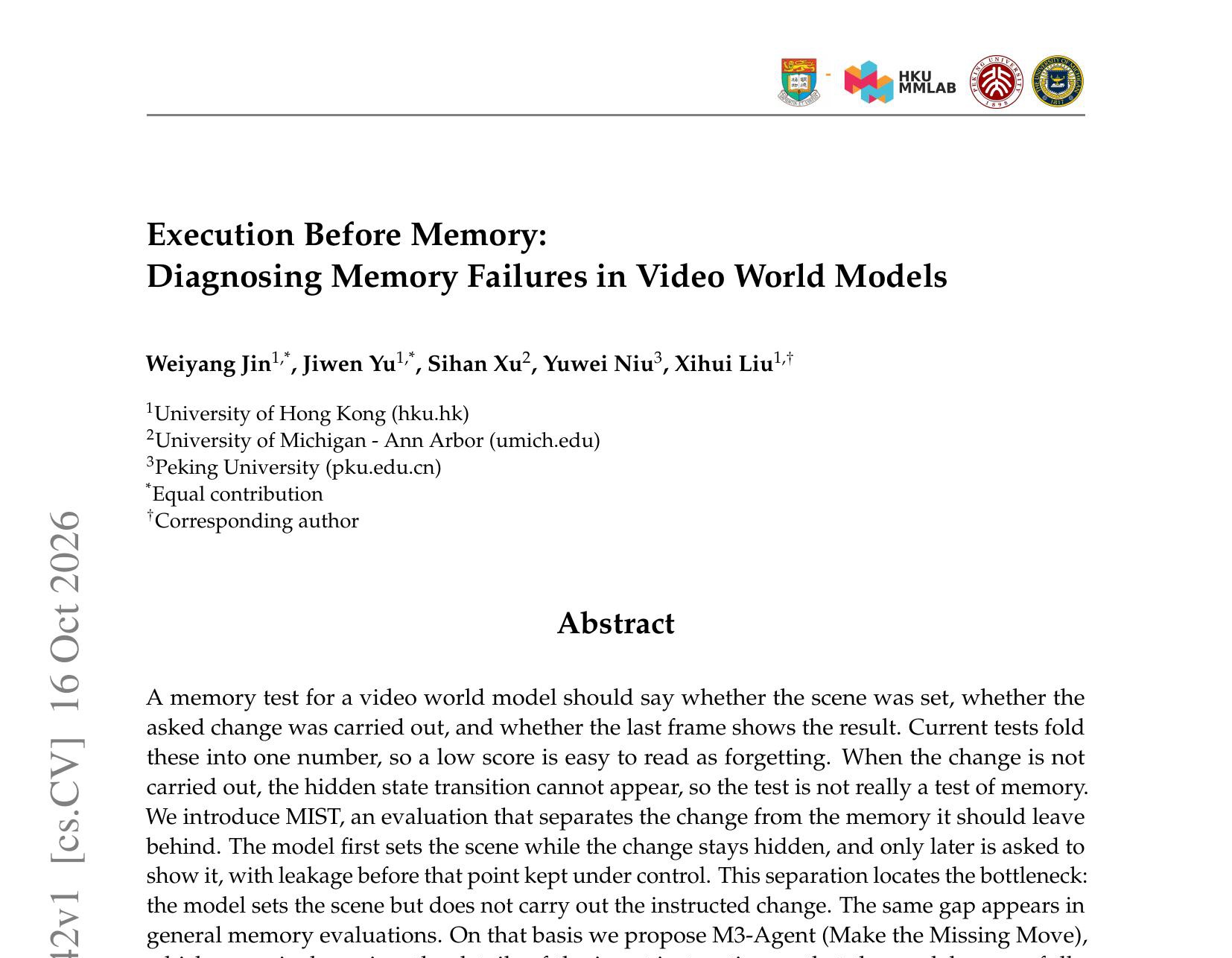
58. Execution Before Memory: Diagnosing Memory Failures in Video World Models
🔑 Keywords: Video World Model, MIST, M3-Agent, Hidden State Transition, Memory Test
💡 Category: Foundations of AI
🌟 Research Objective:
– The study introduces MIST to separate scene setup from change execution, enhancing memory failure analysis in video world models, and proposes M3-Agent to improve instruction execution.
🛠️ Research Methods:
– MIST evaluates scene change enactment separately from memory outcomes, isolating bottlenecks in model performance. M3-Agent revises input instructions recursively to improve execution.
💬 Research Conclusions:
– M3-Agent significantly boosts benchmark performance, tripling the MIST reveal score and improving WRBench and MBench-T scores by 26.1% and 52.7%, respectively.
👉 Paper link: https://huggingface.co/papers/2610.23542
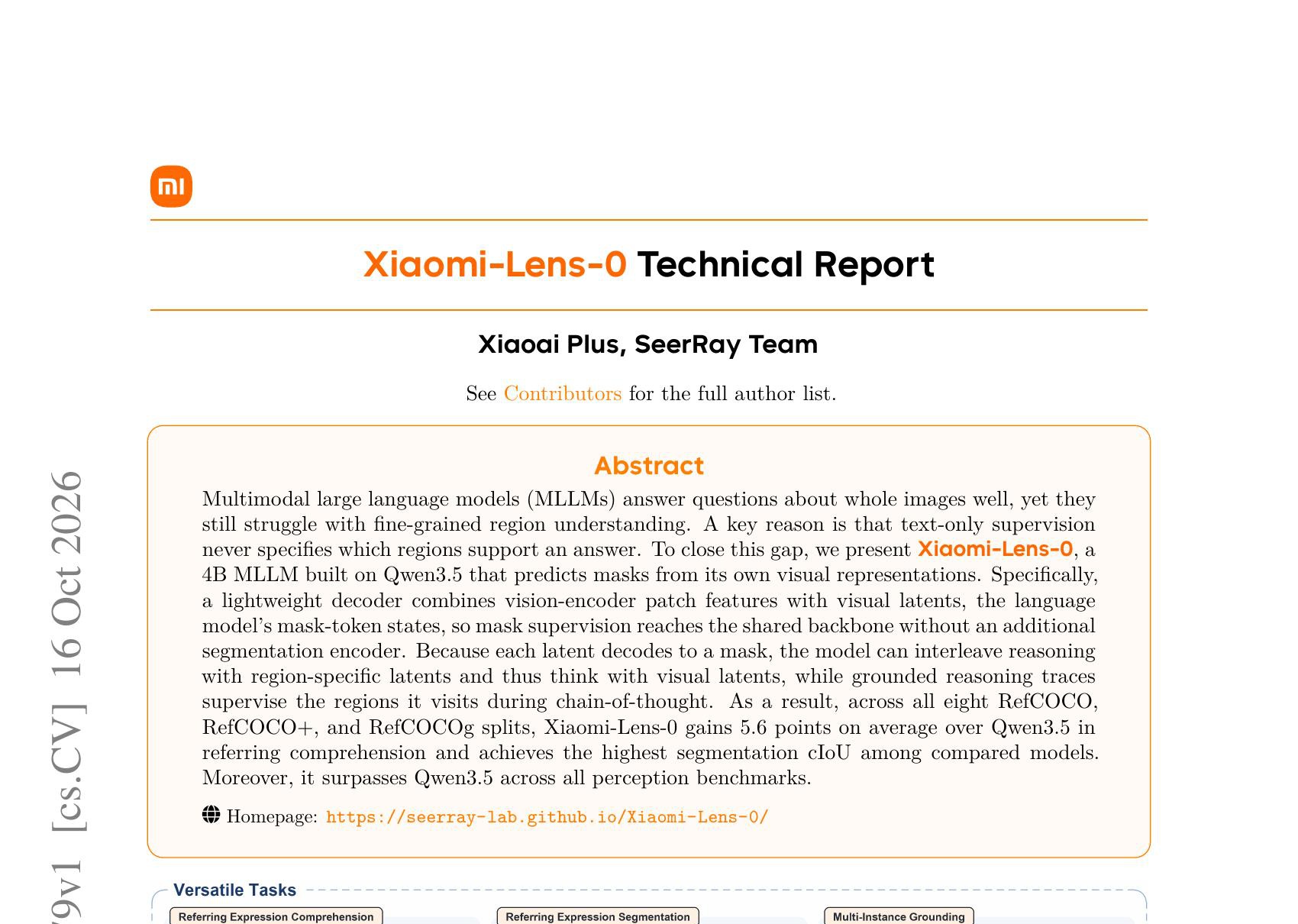
59. Xiaomi-Lens-0 Technical Report
🔑 Keywords: Multimodal large language models, Referring comprehension, Vision-encoder patch features, Visual latents, Segmentation cIoU
💡 Category: Multi-Modal Learning
🌟 Research Objective:
– To improve fine-grained region reasoning and referring comprehension in multimodal models using mask prediction from visual representations.
🛠️ Research Methods:
– Utilized a lightweight decoder to combine vision-encoder patch features with visual latents and mask-token states, enabling mask supervision without an additional segmentation encoder.
💬 Research Conclusions:
– Xiaomi-Lens-0 outperforms Qwen3.5, gaining 5.6 points in referring comprehension across eight RefCOCO datasets and achieving the highest segmentation cIoU among compared models.
👉 Paper link: https://huggingface.co/papers/2610.23279
60. Lexical Reference Frames: Interpreting LM Residual Streams in Native Semantics
🔑 Keywords: Lexical reference frames, AI Native, hidden states, residual stream, early exit
💡 Category: Natural Language Processing
🌟 Research Objective:
– The paper aims to explore how lexical reference frames enable accurate attribution, steering, and early layer exit by interpreting hidden states through the model’s remaining layers.
🛠️ Research Methods:
– The study introduces the concept of lexical reference frames that read hidden states through a model’s own layers without fitting to the model’s output, contrasting with existing methods that either reuse a fixed lens or treat states as a point cloud.
💬 Research Conclusions:
– Lexical reference frames improve the readability, attribution, and steerability of each hidden state in a model, reaching higher coherence and accuracy compared to fixed lens methods. They allow significant layer skipping for efficient computation.
👉 Paper link: https://huggingface.co/papers/2610.22169
61. From Research Goals to Scientific Closure: Evaluating Agents Through Evidence-Supported Physics Research
🔑 Keywords: AI agents, Physics research tasks, PhysClosureBench, Atomic Score, Research Closure
💡 Category: Knowledge Representation and Reasoning
🌟 Research Objective:
– The study introduces a benchmark named PhysClosureBench to evaluate AI agents in organizing scientific investigations that lead to well-supported conclusions.
🛠️ Research Methods:
– The benchmark consists of 50 expert-verified research tasks across various physics domains, evaluated using a 20-criterion Atomic Score and Research Closure metrics to assess the completeness of research question resolution.
💬 Research Conclusions:
– Despite AI agents, particularly Claude-Opus-5, achieving high local scientific accomplishments, a gap remains in fully resolving research questions as indicated by a low rate of reaching RC4, highlighting issues like result misinterpretation and unresolved applicability limits.
👉 Paper link: https://huggingface.co/papers/2610.21767
62. Scene-Designer: Learning Design Intelligence for Agentic 3D Scene Generation
🔑 Keywords: Scene-Designer, Design Intelligence, Scene-GRPO, Critic-guided GRPO, AI Native
💡 Category: Generative Models
🌟 Research Objective:
– To develop an agentic framework, Scene-Designer, that enhances 3D indoor scene generation from natural language by learning design and critique intelligence.
🛠️ Research Methods:
– Introduced two datasets, Scene-OTA-35K for scene design learning and error correction, and Scene-OTC-15K for scene quality critique.
– Proposed the Scene-GRPO framework guided by a Critic to improve design decisions and minimize trial-and-error corrections.
💬 Research Conclusions:
– Demonstrated that Scene-Designer excels in physical validity, functional correctness, and layout coherence.
– Showed that Scene-Critic significantly enhances scene critique over general-purpose models.
– Found that Critic guidance during testing further boosts scene generation quality, indicating a mutual enhancement trend between design and critique capabilities.
👉 Paper link: https://huggingface.co/papers/2610.23121
63. Speculative Sampling in Interactive Video Generation
🔑 Keywords: Speculative Sampling, Interactive Video Generation, Bidirectional Windows, Latency, GPU Parallelism
💡 Category: Generative Models
🌟 Research Objective:
– To enhance interactive video generation by using Speculative Sampling, which integrates large bidirectional windows to reduce latency while maintaining video quality.
🛠️ Research Methods:
– Combines large bidirectional windows with noise latents as padding, caching predictions for reuse, while delivering predictions incrementally to optimize both visual quality and sampling time.
💬 Research Conclusions:
– Demonstrates potential in interactive streaming systems by enabling low-latency without complex post-training, shifting focus from chunk size reduction to accelerating sampling within chunks.
👉 Paper link: https://huggingface.co/papers/2610.20556
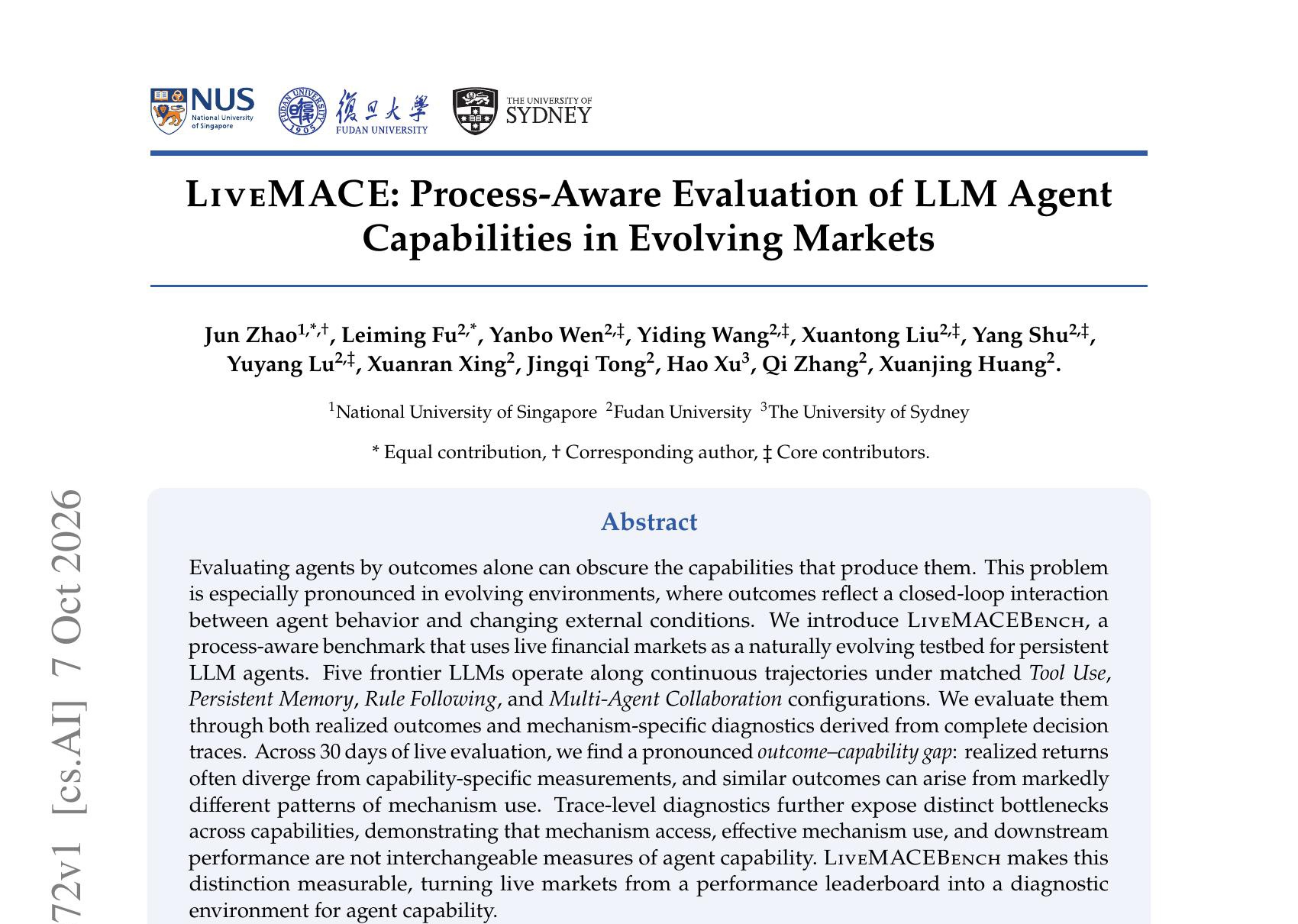
64. LiveMACE: Process-Aware Evaluation of LLM Agent Capabilities in Evolving Markets
🔑 Keywords: LiveMACEBench, LLM agents, live financial markets, decision traces, capability gap
💡 Category: AI in Finance
🌟 Research Objective:
– To evaluate persistent LLM agents in live financial markets, revealing the gap between agent capabilities and outcomes.
🛠️ Research Methods:
– Utilization of LiveMACEBench as a benchmark for assessing LLM agents through decision traces in evolving market environments.
💬 Research Conclusions:
– Identified a significant gap between realized returns and capability-specific measurements, showing distinct differences in mechanism use among agents.
👉 Paper link: https://huggingface.co/papers/2610.09872
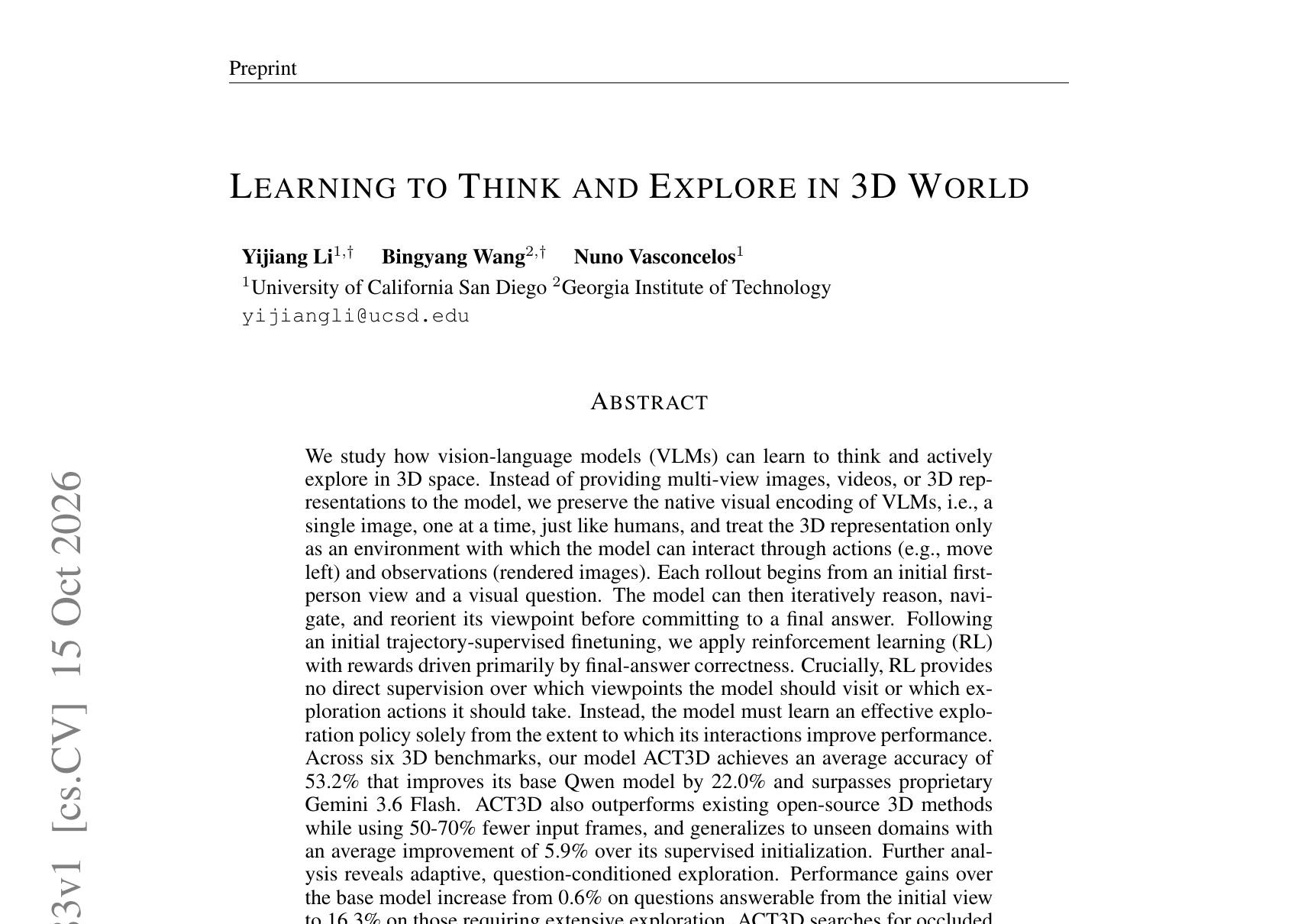
65. Learning to Think and Explore in 3D World
🔑 Keywords: Vision-Language Models, Reinforcement Learning, First-Person View, 3D Exploration, Adaptive Navigation
💡 Category: Reinforcement Learning
🌟 Research Objective:
– To train vision-language models (VLMs) to actively explore and navigate 3D environments from single first-person views using Reinforcement Learning to improve answer accuracy.
🛠️ Research Methods:
– The study employs reinforcement learning with a focus on outcome-based rewards to drive the exploration policy of VLMs without direct supervision, using adaptive, question-conditioned navigation from single image inputs.
💬 Research Conclusions:
– The ACT3D model significantly improves accuracy over its base model and surpasses existing methods by conducting efficient exploration with fewer input frames, demonstrating adaptive exploration through outcome-based learning, and generalizing to unseen domains.
👉 Paper link: https://huggingface.co/papers/2610.21783
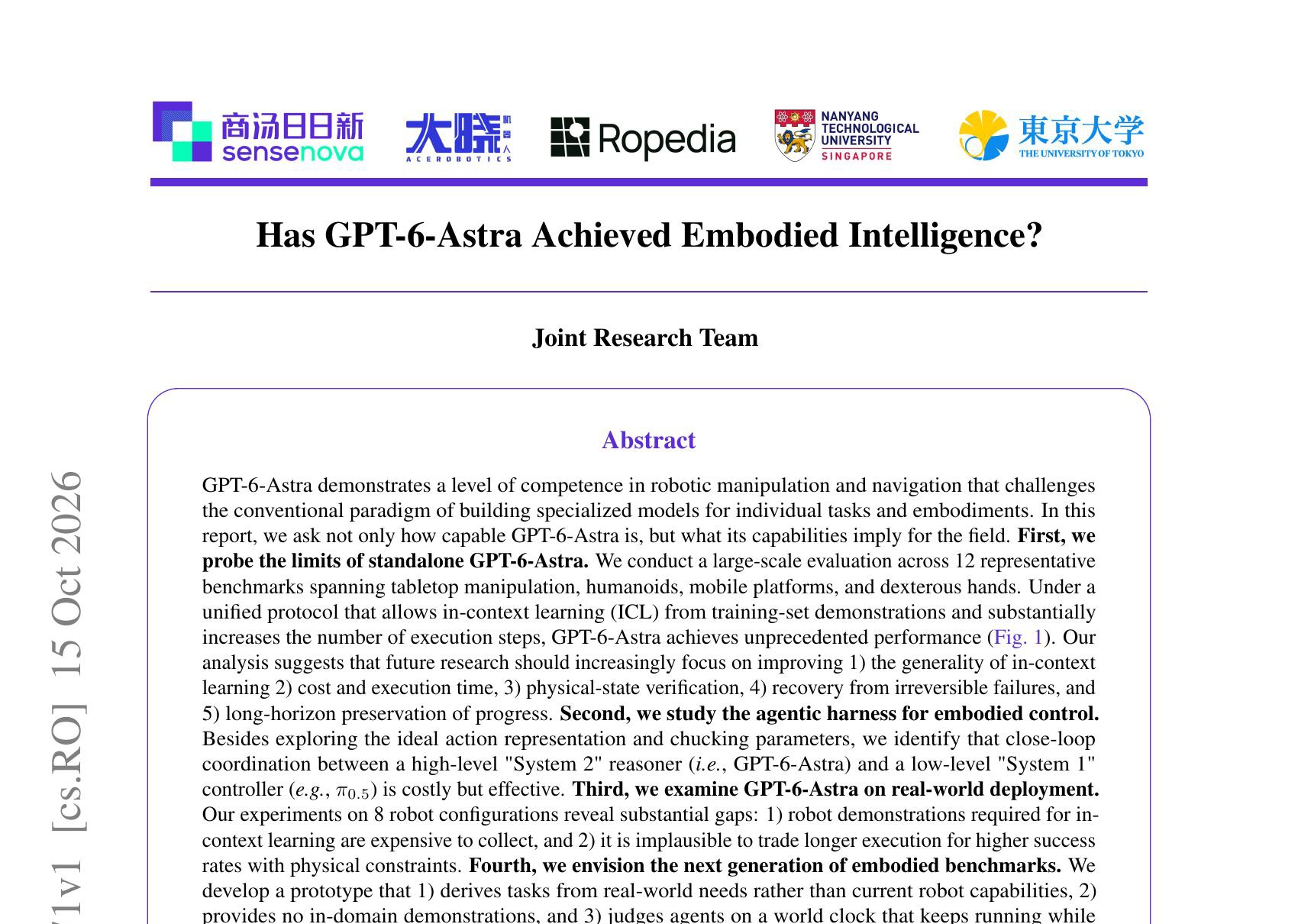
66. Has GPT-6-Astra Achieved Embodied Intelligence?
🔑 Keywords: GPT-6-Astra, in-context learning, robotic manipulation, embodied control
💡 Category: Robotics and Autonomous Systems
🌟 Research Objective:
– To evaluate the capabilities of GPT-6-Astra across diverse robotic tasks and assess its implications for future developments in robotic manipulation and navigation.
🛠️ Research Methods:
– Conducting large-scale evaluations using 12 benchmarks that involve tabletop manipulation, humanoids, mobile platforms, and dexterous hands, under a unified protocol for in-context learning.
💬 Research Conclusions:
– GPT-6-Astra achieves high performance in robotic tasks but faces challenges in practical deployment due to the cost of demonstrations and execution time. Further research is needed to enhance generality, cost-efficiency, and real-world applicability of embodied intelligence.
👉 Paper link: https://huggingface.co/papers/2610.22471