AI Native Daily Paper Digest – 20261021 – Specter | FocusGUI | S-Agent 2.0
Today’s digest delves into intriguing advancements from OpenAI’s GPT and Meta’s Llama, highlighting significant developments in large-scale language models. The overarching theme focuses on enhancing model efficiency and accuracy through improved training algorithms and multi-task learning. Notably, one paper introduces a novel adaptation technique, which reportedly reduces computation time by 30% while maintaining performance on standard benchmarks such as GLUE and SQuAD. Another study presents evidence that scaling laws observed in language models hold consistently across various domains. These findings could have significant implications for the broader application of AI in real-world scenarios such as automated content creation and intelligent virtual assistants.
1. Focused Omni-Modal GUI Agents
🔑 Keywords: FocusGUI, GUI agents, multimodal evidence, omni-modal observations, Sequential Distraction
💡 Category: Multi-Modal Learning
🌟 Research Objective:
– The objective is to develop a lightweight adapter named FocusGUI that dynamically selects relevant multimodal evidence to enhance GUI agents’ action accuracy without backbone fine-tuning.
🛠️ Research Methods:
– Implementation of FocusGUI, a step-adaptive, action-sufficient adapter that prioritizes multimodal channels and compresses relevant evidence into a compact latent representation.
💬 Research Conclusions:
– FocusGUI significantly improves GUI agent performance, enhancing Type Match by 33.2% and Exact Match by 3x over the frozen backbone on average, and Type Match by 30.1% compared to the strongest enhancement method.
👉 Paper link: https://huggingface.co/papers/2610.26203

2. Ropedia W0: Scaling Loco-Manipulation World Models across Embodiments with Human Experience
🔑 Keywords: Ropedia W0, cross-embodiment, kinematic representation, Xp-Teleop, world foundation model
💡 Category: Robotics and Autonomous Systems
🌟 Research Objective:
– The study introduces Ropedia W0, a world foundation model aiming to unify human and robot data for cross-embodiment loco-manipulation tasks.
🛠️ Research Methods:
– Development of the Xp-Data, comprising extensive human and robot data annotated for multi-modal learning, using a unified kinematic representation.
– Introduction of Xp-Teleop, a benchmark for assessing loco-manipulation capabilities through high-quality humanoid teleoperation data.
💬 Research Conclusions:
– Ropedia W0 demonstrates state-of-the-art performance across diverse benchmarks, supporting applications like policy evaluation and model-based planning.
– The model effectively facilitates real-time VR interaction and improves performance with scaling of human pre-training data.
👉 Paper link: https://huggingface.co/papers/2610.26855

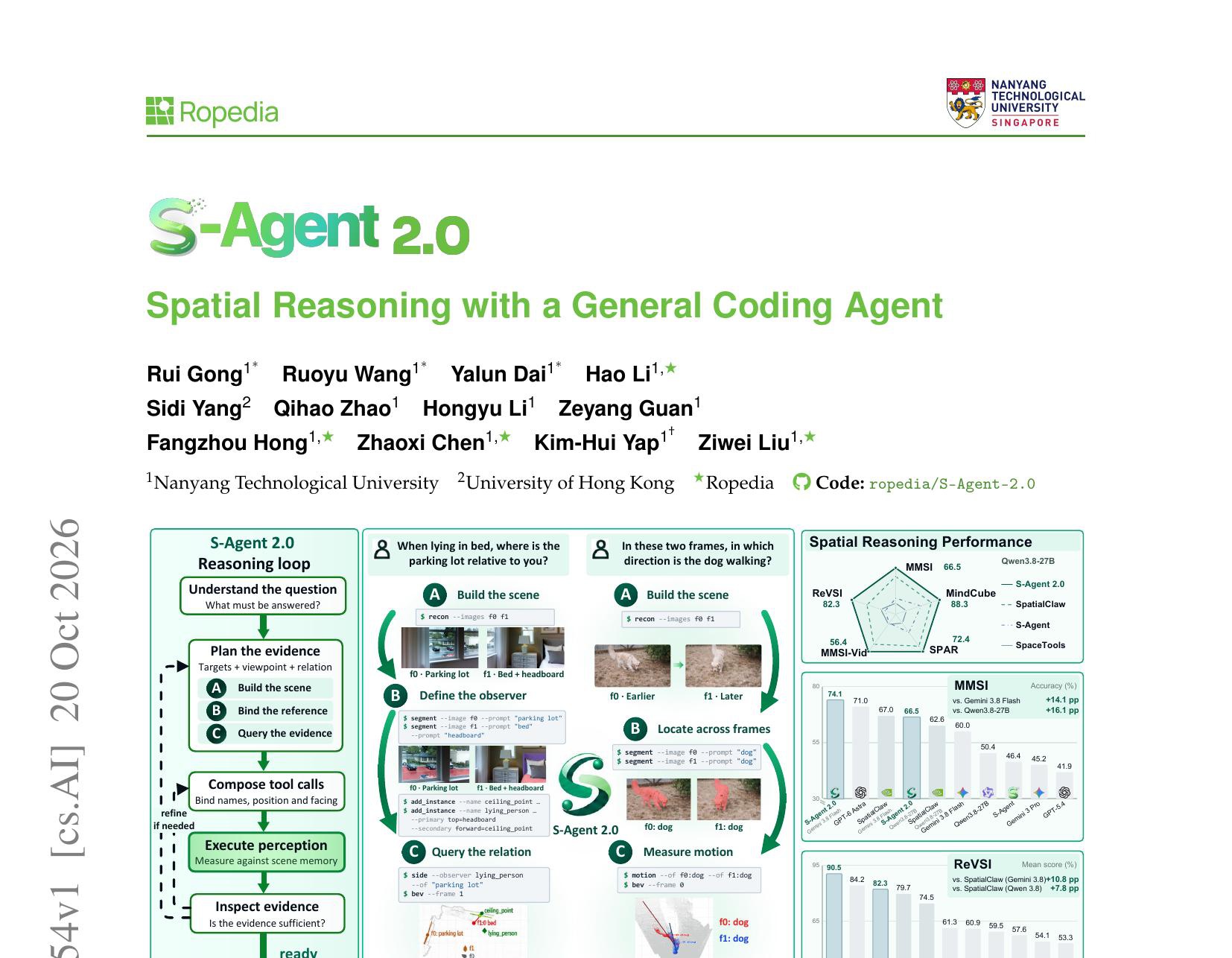
3. S-Agent 2.0: Spatial Reasoning with a General Coding Agent
🔑 Keywords: S-Agent 2.0, spatial reasoning, 3D perception, scene memory, plain-language interpretation
💡 Category: Knowledge Representation and Reasoning
🌟 Research Objective:
– The research aims to enhance spatial reasoning capabilities by introducing S-Agent 2.0, which integrates persistent scene memory and plain-language interpretation into a coding agent equipped with 3D perception tools.
🛠️ Research Methods:
– S-Agent 2.0 uses a command-line perception toolkit to improve the performance of general coding agents by effectively acquiring, memorizing, and interpreting scene evidence in 3D space.
💬 Research Conclusions:
– The toolkit significantly improves performance on spatial reasoning benchmarks, with notable points increases in open-source and closed-source models. The effectiveness of S-Agent 2.0 persists across different coding agents, outperforming specialized systems like SpatialClaw.
👉 Paper link: https://huggingface.co/papers/2610.28354
4. CoEvo-RSI: When Harnesses Evolve, Which Models Should Follow?
🔑 Keywords: RSI agents, brain-body mismatch, bidirectional historical inheritance, supervised fine-tuning, model-harness co-evolution
💡 Category: Robotics and Autonomous Systems
🌟 Research Objective:
– Introduce CoEvo-RSI framework to reduce brain-body mismatch in recursive self-improving agents by aligning model capabilities with evolving harness requirements.
🛠️ Research Methods:
– Utilize bidirectional historical inheritance and supervised fine-tuning on rejection-sampled trajectories for model alignment and adaptation.
💬 Research Conclusions:
– Demonstrated improved performance in Qwen3.5-9B compared to larger models, highlighting the effectiveness of brain-body alignment in applications like multi-agent failure attribution and smart-home instruction following.
👉 Paper link: https://huggingface.co/papers/2610.25078
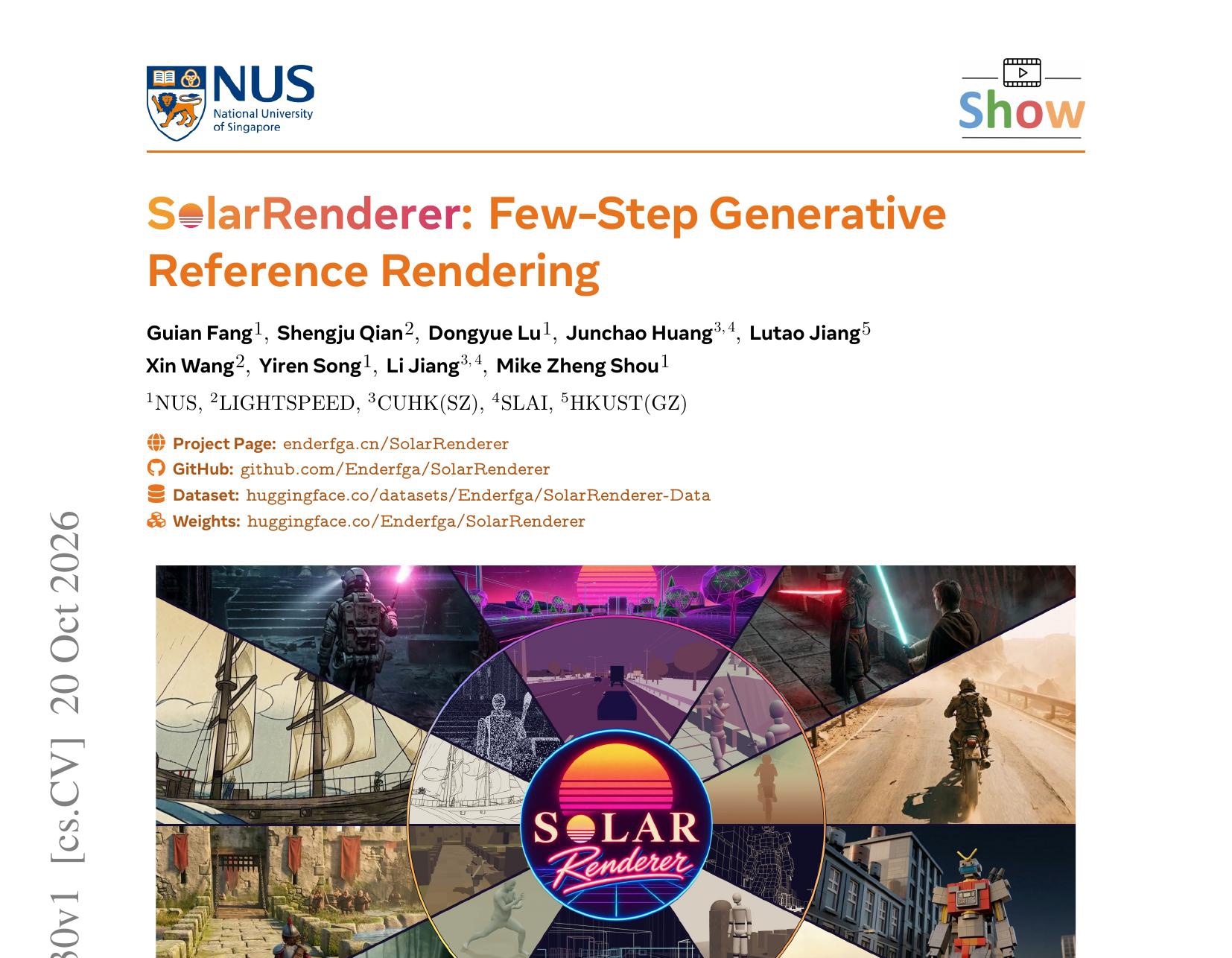
5. SolarRenderer: Few-Step Generative Reference Rendering
🔑 Keywords: SolarRenderer, structure-conditioned video renderer, MiniMax-H3 33B, LoRAs, distribution matching
💡 Category: Generative Models
🌟 Research Objective:
– Introduce SolarRenderer, a video renderer converting coarse structure into realistic video, distinguished by its ability to adapt a frozen video backbone with lightweight LoRAs for efficient rendering.
🛠️ Research Methods:
– Utilized a frame-aligned corpus comprising 136K clips from game engines, simulators, and YouTube videos.
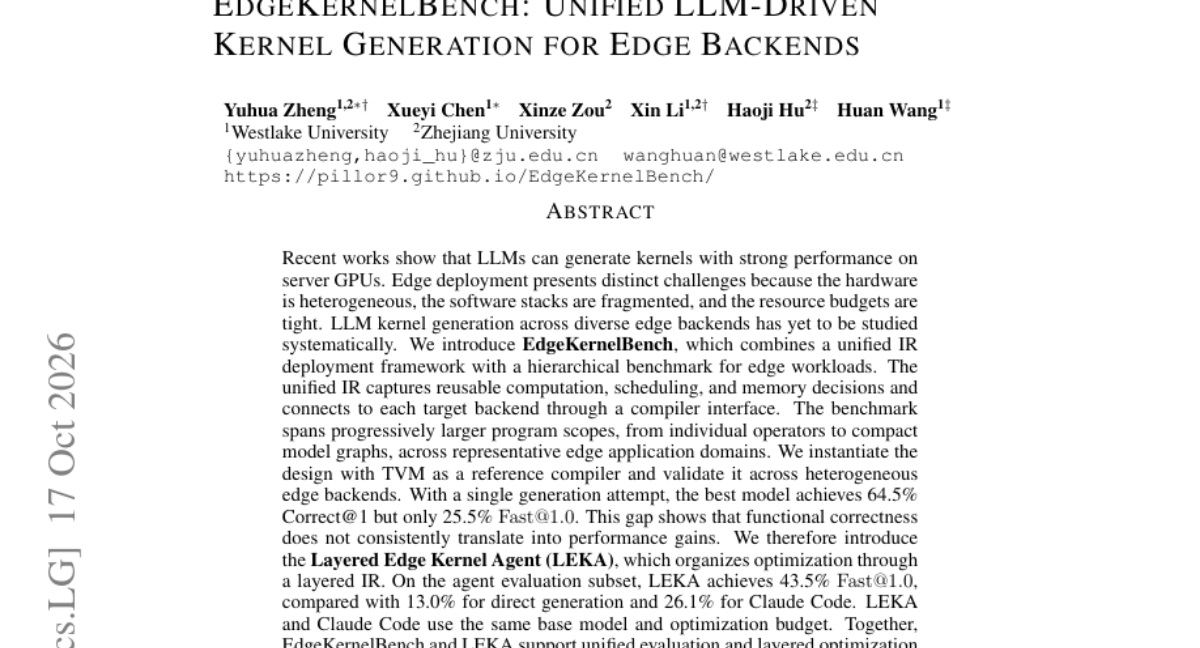
– Employed structure-guided distribution matching for rapid rendering, significantly reducing sampling steps.
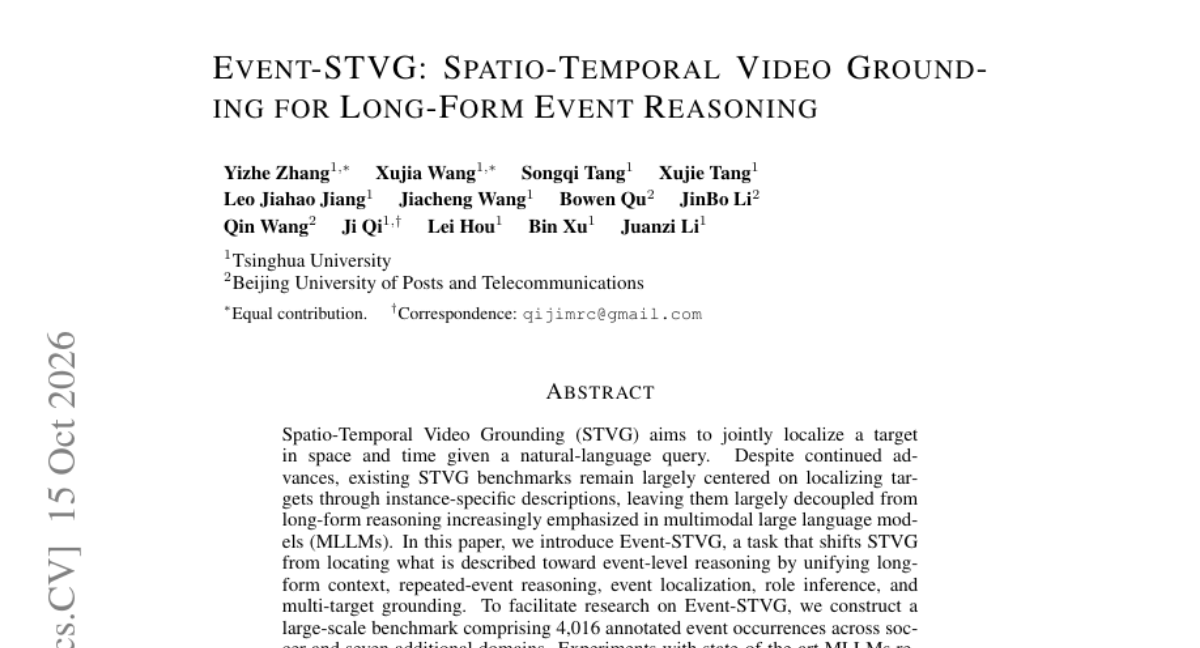
💬 Research Conclusions:
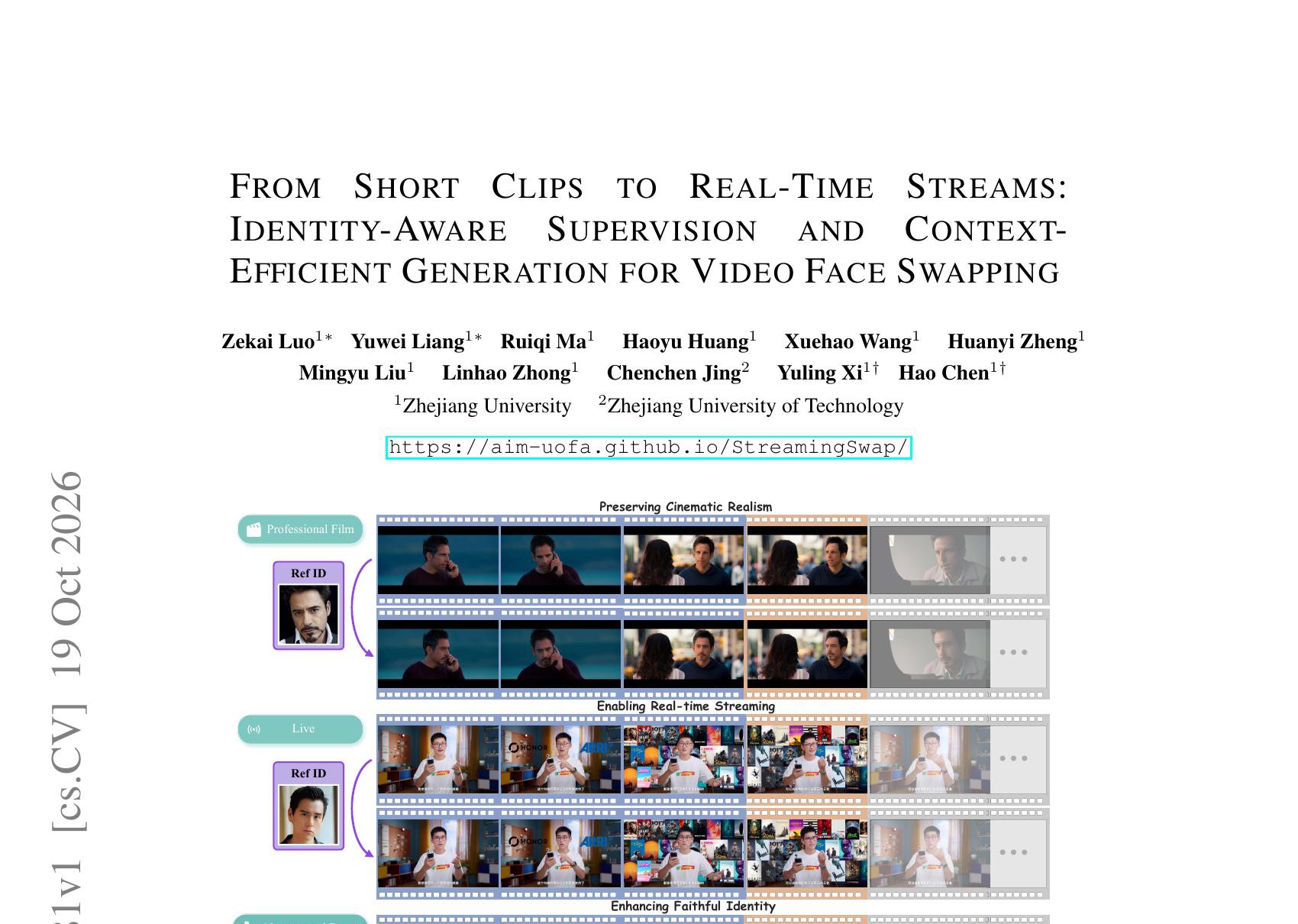
– SolarRenderer outperforms existing models in generating high-quality videos that adhere to structural inputs across various representations, with rapid real-time rendering capabilities for streaming.
👉 Paper link: https://huggingface.co/papers/2610.28630
6. Correction Training for Diffusion Models
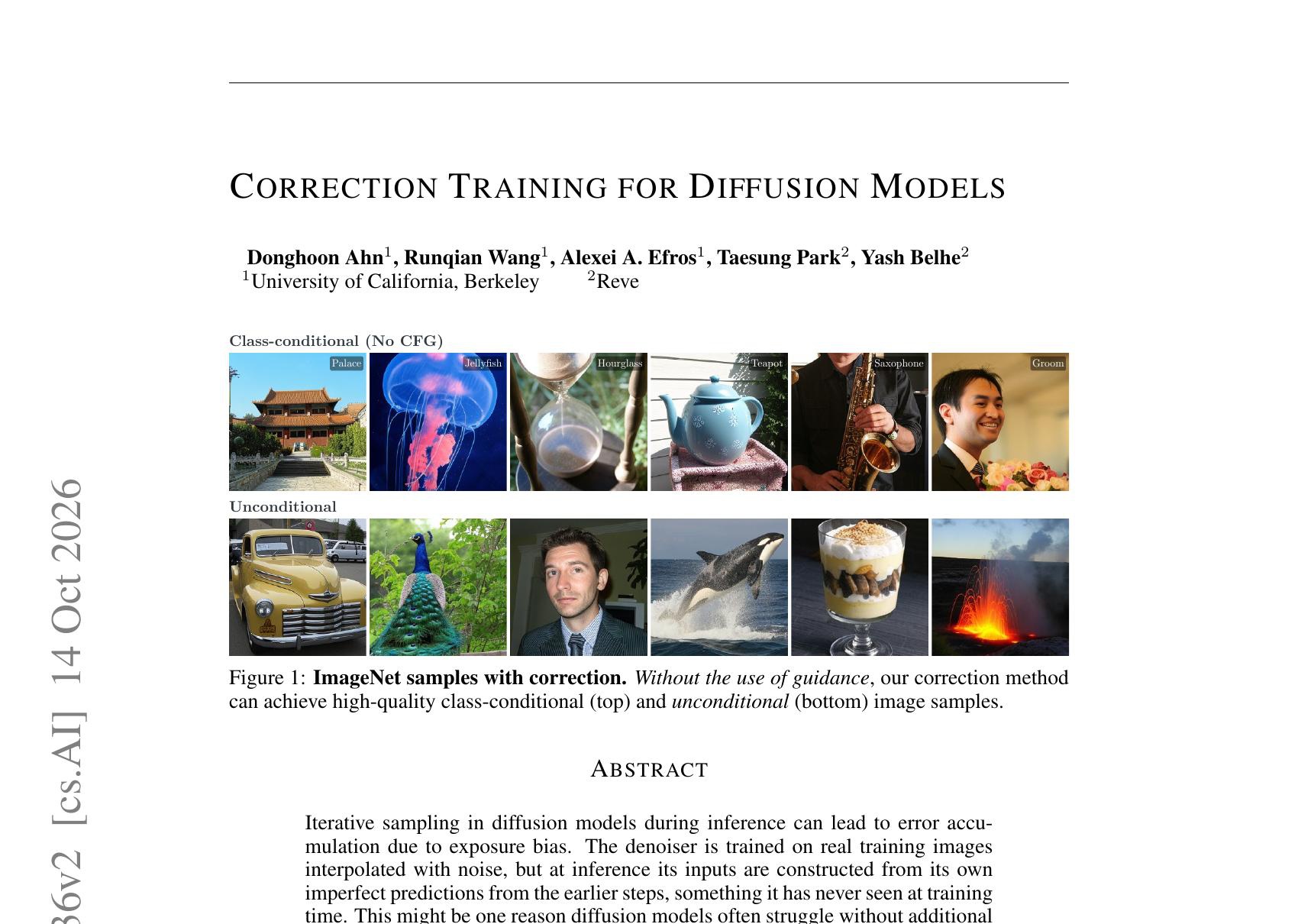
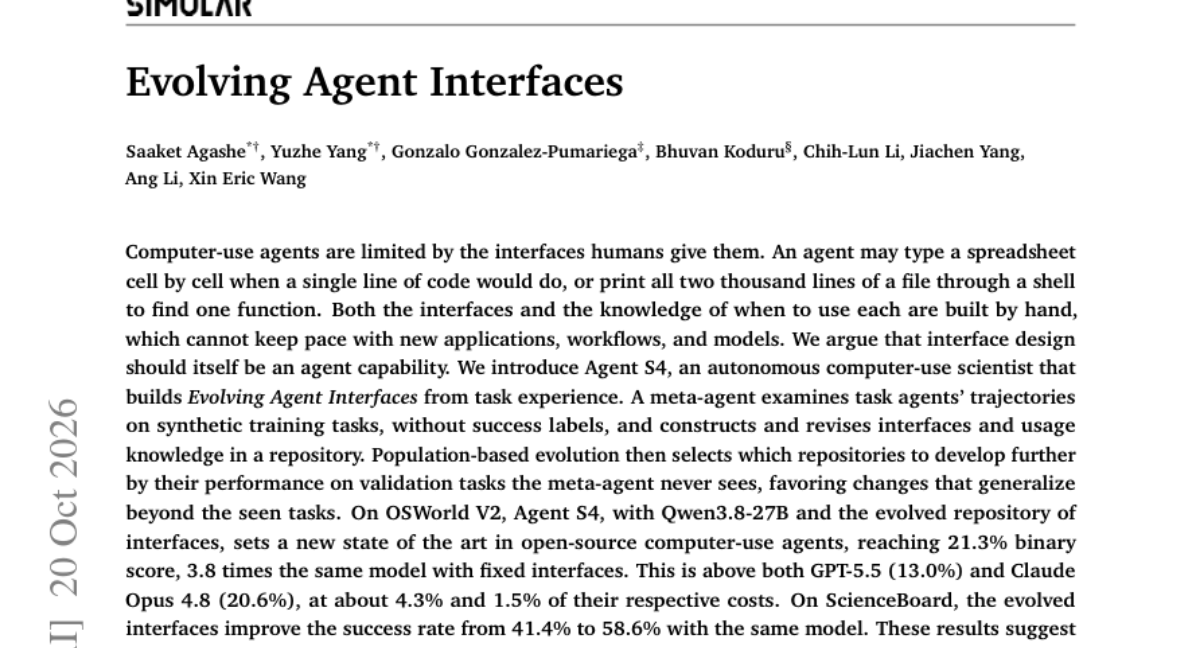
🔑 Keywords: Diffusion Models, Exposure Bias, Denoiser, Correction Module, Classifier-Free Guidance
💡 Category: Generative Models
🌟 Research Objective:
– The primary objective is to reduce exposure bias in diffusion models, thereby improving the quality and diversity of unguided generated samples without increasing inference overhead.
🛠️ Research Methods:
– A correction module is introduced to refine diffusion model predictions by training it on the base model’s predictions and applying it iteratively at each denoising step to correct intermediate predictions.
💬 Research Conclusions:
– The proposed method enhances sample quality substantially, achieving competitive performance with classifier-free guidance, and further improves diversity and reduces oversaturation when combined with CFG. Additionally, distillation of refined predictions back into the base model minimizes inference-time overhead while retaining quality gains.
👉 Paper link: https://huggingface.co/papers/2610.14136
7. SpecKCast: Spectral Kalman Forecasting for Diffusion Acceleration
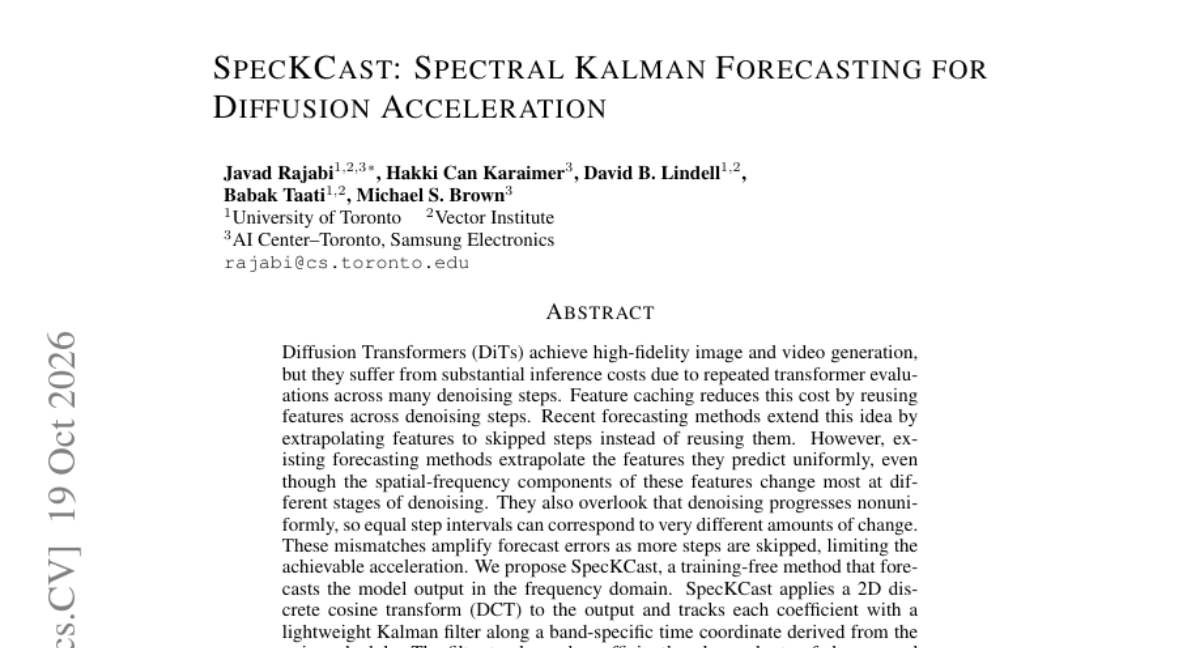
🔑 Keywords: Diffusion Transformers, Kalman filter, frequency domain, 2D discrete cosine transform, inference acceleration
💡 Category: Generative Models
🌟 Research Objective:
– The study presents SpecKCast, a method designed to accelerate the inference of Diffusion Transformers by forecasting model outputs in the frequency domain using per-band Kalman filters and adaptive step scheduling.
🛠️ Research Methods:
– SpecKCast applies a 2D discrete cosine transform (DCT) to the model output, using lightweight Kalman filters to track coefficient values and their rates of change, evaluating the transformer only when the filter’s prediction uncertainty exceeds a set threshold.
💬 Research Conclusions:
– Experiments demonstrated SpecKCast’s ability to balance acceleration and fidelity effectively, achieving up to 6x speedup with minimal memory overhead compared to existing methods.
👉 Paper link: https://huggingface.co/papers/2610.26837
8. MMEnterprise-Bench: Evaluating Enterprise Agents over Evolving Multimodal Records
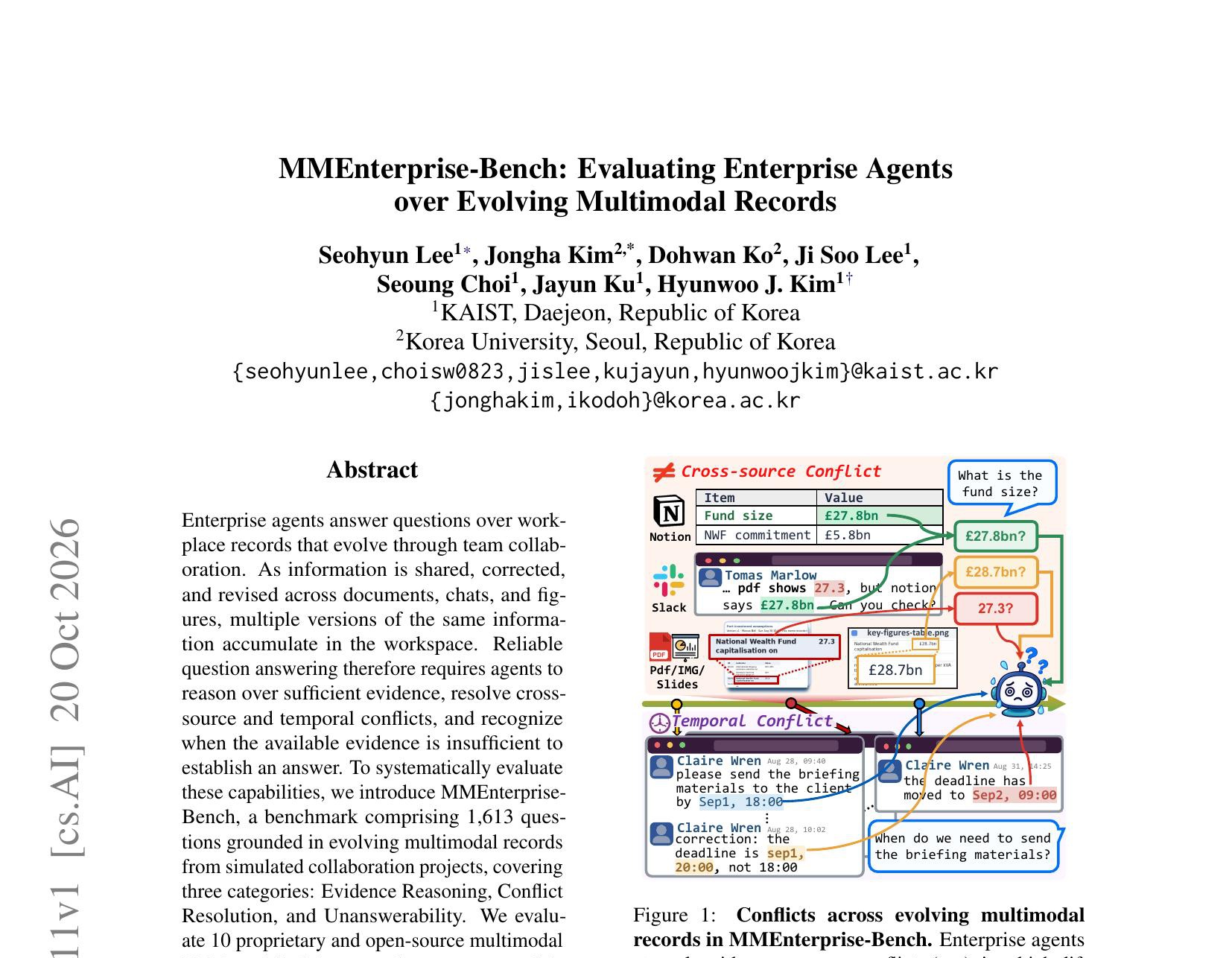
🔑 Keywords: Enterprise Agents, Multimodal LLMs, Conflict Resolution, Evidence Reasoning, Unanswerability
💡 Category: Multi-Modal Learning
🌟 Research Objective:
– To evaluate multimodal agents on reasoning capabilities over evolving workplace records with conflicts and missing evidence.
🛠️ Research Methods:
– Introduction of MMEnterprise-Bench, a benchmark consisting of 1,613 questions based on evolving multimodal records from simulated collaboration projects covering Evidence Reasoning, Conflict Resolution, and Unanswerability.
💬 Research Conclusions:
– The evaluation of 10 multimodal LLMs showed that even the strongest models struggle with cross-source or temporal conflicts and multiple image evidence. Increasing retrieval budget improves evidence recall but does not always enhance answer accuracy. These findings underscore the challenges in reasoning over evolving workplace records.
👉 Paper link: https://huggingface.co/papers/2610.27911
9. Specter: Fast MoE Inference via Quantization-Enabled Multi-Step Speculative Offloading
🔑 Keywords: Mixture-of-experts, Speculative decoding, Expert offloading, Quantization, Single-GPU inference
💡 Category: AI Systems and Tools
🌟 Research Objective:
– Develop Specter, a system to enhance single-GPU mixture-of-experts inference by minimizing PCIe I/O bottleneck and improving throughput.
🛠️ Research Methods:
– Utilize quantized speculative decoding combined with expert offloading and a lightweight draft model for efficient on-device operation.
💬 Research Conclusions:
– Specter delivers an average time reduction of 1.50x per output token compared to current systems, making memory-constrained MoE inference feasible on standard hardware.
👉 Paper link: https://huggingface.co/papers/2511.14102

10. Breaking Diffusion: Parallel Reasoning with Draft Refinement
🔑 Keywords: Draft Refinement Language Models (DRLMs), parallel token revisions, cavity energy, diffusion denoising
💡 Category: Knowledge Representation and Reasoning
🌟 Research Objective:
– Introduce Draft Refinement Language Models (DRLMs) to improve reasoning tasks by refining draft answers through parallel token revisions and a single-pass cavity energy evaluation.
🛠️ Research Methods:
– Utilize a denoiser trained to reconstruct tokens from uniformly corrupted drafts, applying parallel revisions without requiring diffusion reverse transition and estimating token support by correcting self-token evidence.
💬 Research Conclusions:
– DRLMs outperform autoregressive and discrete diffusion baselines in complex reasoning tasks like Countdown, Sudoku-Extreme, and Maze-Hard, demonstrating the effectiveness of complete-draft parallel refinement as an alternative to reverse diffusion.
👉 Paper link: https://huggingface.co/papers/2610.26542
11. Epi: Towards a Persistent, Self-Improving Agent for Autonomous Research
🔑 Keywords: Autonomous Research Agent, Hierarchical Memory, Épi-Turbo, Numerical Bound Records, Computer-Assisted Proof
💡 Category: AI Systems and Tools
🌟 Research Objective:
– The primary aim is to introduce Épi, an autonomous research agent that optimizes the research process by maintaining persistent investigations and accumulating experience to enhance mathematical and algorithmic outcomes.
🛠️ Research Methods:
– Épi employs persistent research history, hierarchical memory, and a branching review system to ensure continuity and adaptability in research. It spans session boundaries and uses a fixed verifier for evaluation.
– A configuration called Épi-turbo is developed to create executable solvers for tasks like vehicle routing and scheduling, achieving higher efficiency at lesser computational cost.
💬 Research Conclusions:
– Épi achieved 120 record-setting results, including enhanced intervals for mathematical constants and dimensions.
– It provides computer-assisted proofs for complex conjectures and enhances algorithmic coding performance with remarkable benchmark improvements over existing models.
👉 Paper link: https://huggingface.co/papers/2610.24944
12. PhysSkin++: Real-Time and Generalizable Physics-Based Animation via Self-Supervised Neural Skinning
🔑 Keywords: PhysSkin++, neural skinning fields, Physics-Informed Self-Supervised Learning, deformation subspaces, real-time animation
💡 Category: Machine Learning
🌟 Research Objective:
– The research introduces PhysSkin++, a framework to generalize real-time, physics-based animation across diverse 3D shapes and spatial discretizations using continuous neural skinning fields from static shapes.
🛠️ Research Methods:
– Utilizes a Neural Skinning Fields Autoencoder and a Physics-Informed Self-Supervised Learning strategy to predict shape-dependent deformation subspaces without per-object training, combining skinning-field normalization with conflict-aware gradient correction for stability.
💬 Research Conclusions:
– Demonstrates the framework’s ability for cross-shape generalization, supporting real-time reduced simulations and applications in controllable and collision-aware animations.
👉 Paper link: https://huggingface.co/papers/2610.26067
13. FlowState: Execution State as Memory for Long-Horizon LLM Agents
🔑 Keywords: FlowState, Long-horizon tasks, LLM agents, Incremental State Update, Progressive State Access
💡 Category: Knowledge Representation and Reasoning
🌟 Research Objective:
– The study introduces FlowState to improve the performance of agents on long-horizon tasks by maintaining structured, revisitable execution memory with incremental updates and progressive access.
🛠️ Research Methods:
– FlowState employs Incremental State Update to maintain current execution state and Progressive State Access to reveal historical states as needed, enhancing decision-making through the retention and reuse of historical information.
💬 Research Conclusions:
– FlowState achieves a higher success rate on MemoryArena and τ^3-Bench, improving performance by 4.55 and 13.95 percentage points, respectively, while significantly reducing token consumption by up to 43.2%.
👉 Paper link: https://huggingface.co/papers/2609.34565

14. Good Judgment, Bad Advice: Decision-Model Controllers Raise Agent Cost Without Improving Success
🔑 Keywords: Typed Decision Model, Terminal Agent, Calibration, Jev, Controller
💡 Category: AI Systems and Tools
🌟 Research Objective:
– This study examines whether the typed decision model, Jev 1.13, increases efficiency by consulting at deterministic decision points without deteriorating performance.
🛠️ Research Methods:
– The research involves a controlled experiment on Terminal-Bench 2.1 with a fixed agent loop, comparing different controller types, including Jev, deterministic rules, a small LLM, and a placebo.
💬 Research Conclusions:
– Jev raised the cost per attempt by 19% without improving the pass rate, though it provided better ranking of finish requests than alternatives but suffered from poor calibration. Cost differences with other controllers were noted, but no enhancements in success rates were observed.
👉 Paper link: https://huggingface.co/papers/2610.24649
15. DecisionPivot: A Diagnostic Benchmark for Decision Models in LLM Systems
🔑 Keywords: DecisionPivot, decision models, LLM systems, probability ordering, calibration
💡 Category: Knowledge Representation and Reasoning
🌟 Research Objective:
– To evaluate and uncover the gaps in decision models’ aggregate accuracy, contrast-group performance, calibration, and reasoning effort using the new diagnostic benchmark DecisionPivot.
🛠️ Research Methods:
– DecisionPivot, comprising 48 tasks and 40,033 items organized into seven decision roles, is used to assess item and contrast-group accuracy, probability ordering, calibration, and empirical selective coverage among decision models.
💬 Research Conclusions:
– Results show significant discrepancies not evident in aggregate scores, with contrasted accuracies varying widely among models. The evaluation reveals a mismatch between probability ordering and decision correctness, and highlights variations in the reliability of high-confidence predictions.
👉 Paper link: https://huggingface.co/papers/2610.28522

16. HarnessRL: Co-Evolving Policies with a Just-in-Time Training Harness for Open-Ended RL
🔑 Keywords: HarnessRL, open-ended reinforcement learning, rubric-based reinforcement learning, adaptive task sampling, rollout guidance
💡 Category: Reinforcement Learning
🌟 Research Objective:
– Address reward failure in open-ended reinforcement learning by co-evolving a training harness with the policy.
🛠️ Research Methods:
– Implemented HarnessRL, which evolves with the policy through task sampling, rollout guidance, and rubric updates. It uses a training-time memory to update configurations and performs a proposer and just-in-time critic loop to refine training.
💬 Research Conclusions:
– HarnessRL outperformed strong baselines in Rubric-Mix-10k across multiple domains, increasing efficacy by 2.8 to 3.1 points and nearly halving training steps.
👉 Paper link: https://huggingface.co/papers/2610.26426
17. Large Flow Language Models
🔑 Keywords: Continuous flow language model, blockwise flow design, multi-token prediction, self-speculative decoding, parallel decoding
💡 Category: Natural Language Processing
🌟 Research Objective:
– To develop a scalable and efficient Continuous flow language model called Lafa, designed for high-quality language generation at the billion-parameter scale.
🛠️ Research Methods:
– Implemented blockwise flow design with causal attention and bidirectional asynchronous flow.
– Utilized techniques such as prefix caching and blockwise parallel decoding to improve training and inference efficiency.
– Conducted training on models with scales of 0.5B, 7B, and 8B parameters using fewer than 30B tokens.
💬 Research Conclusions:
– Lafa demonstrates that Continuous flow language models can achieve or surpass capabilities of pretrained autoregressive models, especially in tasks like instruction following, reasoning, and coding.
– The model achieved 2.54x the throughput of AR models with comparable quality, outperforming multi-token prediction and discrete diffusion methods.
– Continuous flows were shown to be a scalable foundation for effective language modeling.
👉 Paper link: https://huggingface.co/papers/2610.28559
18. On the Fragility of Tasks under Composition: Implicit Budgeting in Language Models
🔑 Keywords: Language models, Thinking budget, Task composition, Token usage, Claude Opus 5
💡 Category: Natural Language Processing
🌟 Research Objective:
– To identify and analyze the limitations of modern language models when handling composed tasks within a single prompt.
🛠️ Research Methods:
– Examination of task errors in both open-weight models and Claude Opus 5 under task composition conditions.
💬 Research Conclusions:
– Identified an implicit “thinking budget” that limits token usage per task, causing increased errors in composed tasks but providing insights on reducing token usage while maintaining accuracy.
👉 Paper link: https://huggingface.co/papers/2610.27190
19. Evaluating Agentic Capabilities Before Post-Training: An End-to-End Approach
🔑 Keywords: agentic behavior, pretrained base models, end-to-end tasks, execution trajectories, interactive model behavior
💡 Category: Natural Language Processing
🌟 Research Objective:
– The research aims to evaluate agentic behavior in pretrained base models using a framework called ASAP, without converting the models into chat agents.
🛠️ Research Methods:
– Utilizes structured trajectory continuation, short reference prefixes, and minimal recovery mechanisms to elicit agentic behavior.
– Implements evaluation across software-engineering and deep-research benchmarks to achieve discriminative performance.
💬 Research Conclusions:
– ASAP provides detailed insights into model-generated execution trajectories, highlighting changes in agent-relevant capabilities during pretraining.
– Concludes that ASAP’s approach can complement traditional pretraining benchmarks by providing practical diagnostics of interactive behavior.
👉 Paper link: https://huggingface.co/papers/2610.19425
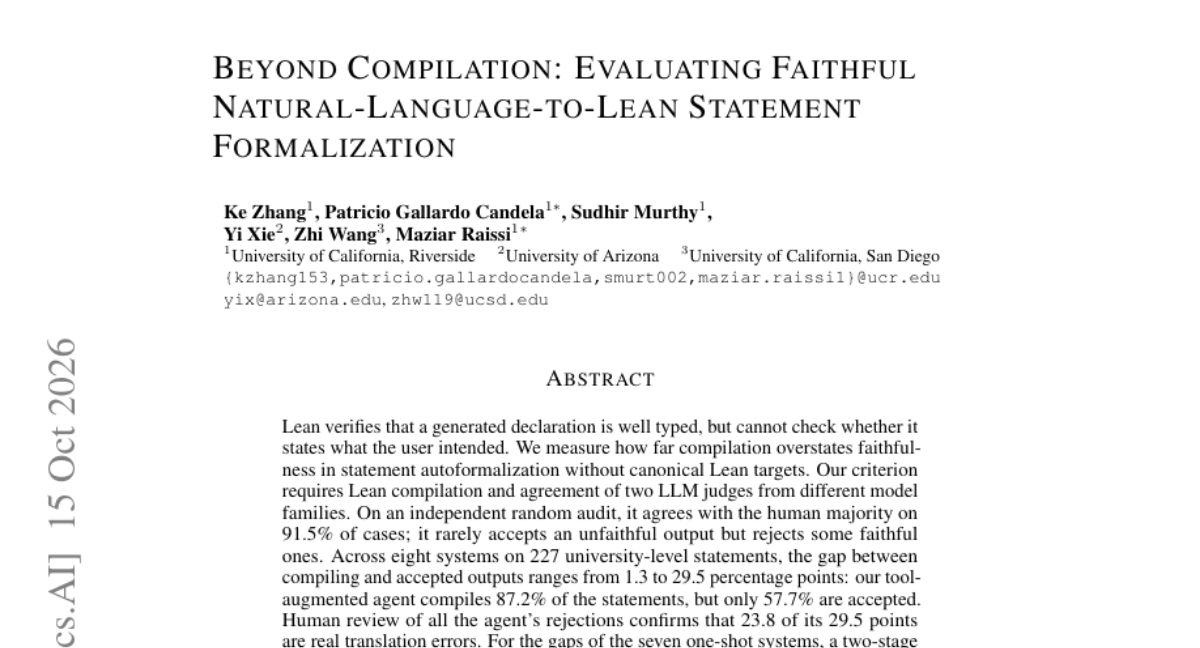
20. Beyond Compilation: Evaluating Faithful Natural-Language-to-Lean Statement Formalization
🔑 Keywords: Lean, autoformalization, tool-augmented agent, translation errors, compilation
💡 Category: AI Systems and Tools
🌟 Research Objective:
– The study aims to evaluate whether Lean compilation alone can ensure faithful statement autoformalization.
🛠️ Research Methods:
– Assessment of the gap between compilation and semantically accepted outputs across multiple systems, using two LLM judges from different model families for validation.
– Analyses include a random audit with human verification and a two-stage review by Claude Opus 5.5 and GPT-6.1 Sol.
💬 Research Conclusions:
– Significant discrepancy exists between compiling outputs and semantically accepted results, with the tool-augmented agent showing compilation improvements but maintaining real translation errors.
– Lean feedback significantly contributes to their agent’s compilation gains, although nearly half fail to meet semantic criteria, emphasizing the need for better integration of semantic checks.
👉 Paper link: https://huggingface.co/papers/2606.31002
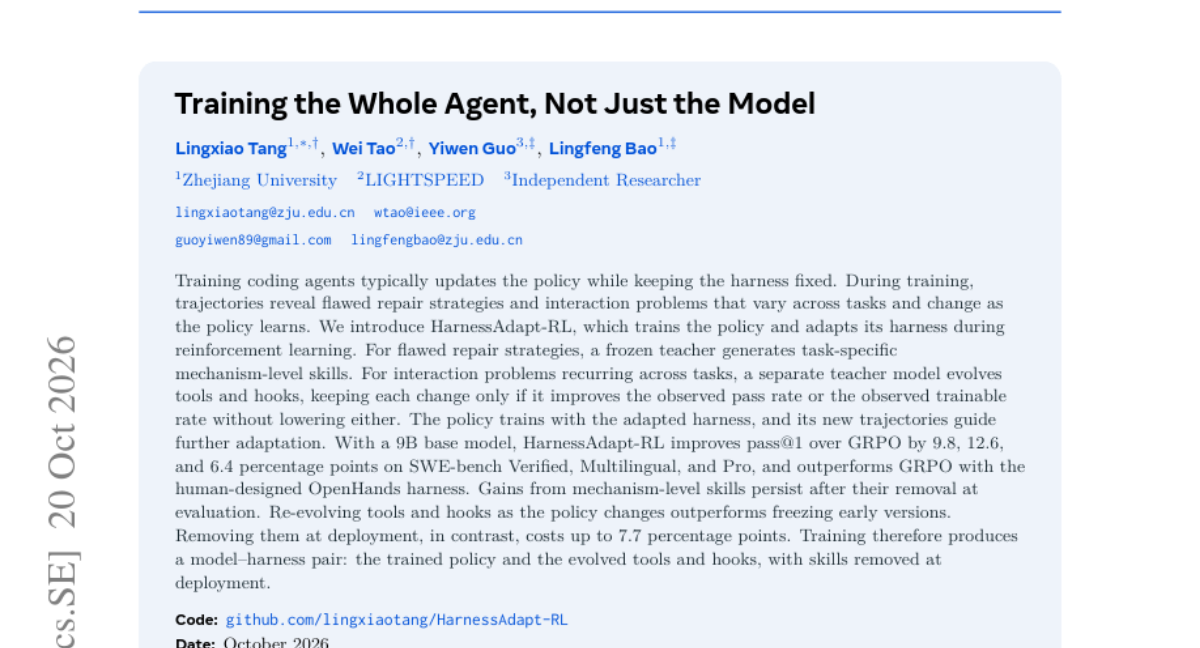
21. Training the Whole Agent, Not Just the Model
🔑 Keywords: HarnessAdapt-RL, mechanism-level skills, evolving tools, reinforcement learning, GRPO
💡 Category: Reinforcement Learning
🌟 Research Objective:
– The primary aim is to improve benchmark pass rates in reinforcement learning through joint training of a coding policy and its adaptive evaluation harness.
🛠️ Research Methods:
– Introduced HarnessAdapt-RL that evolves its harness by generating mechanism-level skills for flawed repair strategies and evolving tools/hooks for interaction problems, ensuring pass rate improvements.
💬 Research Conclusions:
– HarnessAdapt-RL significantly improves pass@1 scores over GRPO in several benchmarks and demonstrates the advantage of evolving tools and hooks, emphasizing their importance by showing that removing them at deployment can lead to performance drops.
👉 Paper link: https://huggingface.co/papers/2610.28069
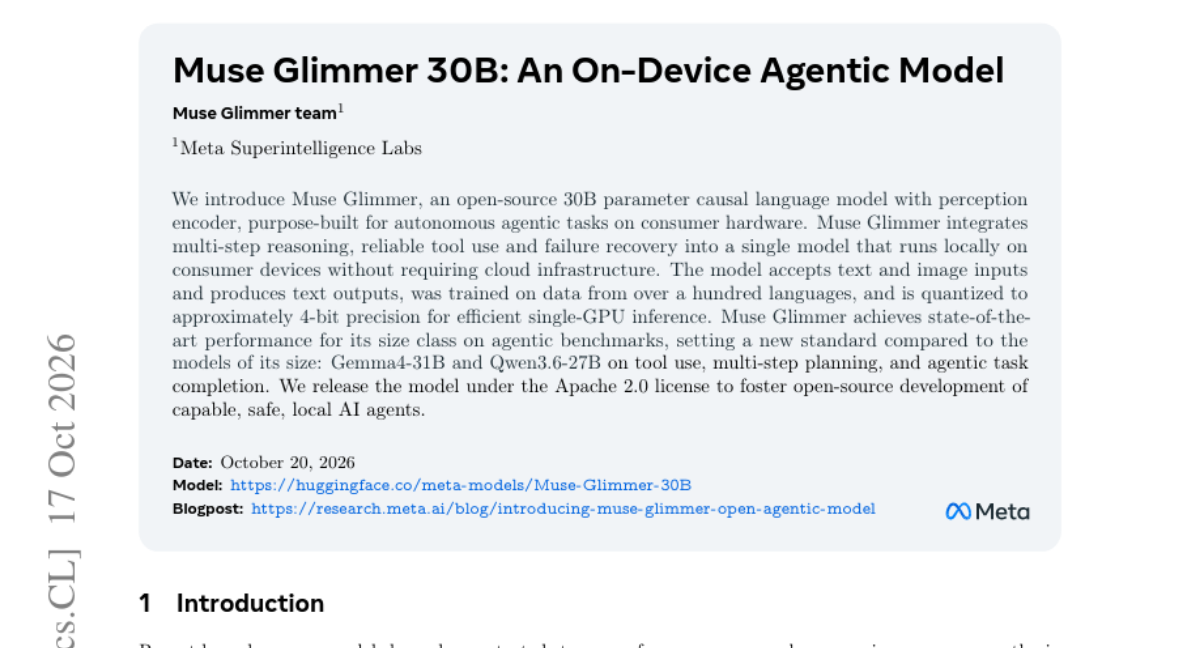
22. Muse Glimmer 30B: An On-Device Agentic Model
🔑 Keywords: Muse Glimmer, causal language model, multi-step reasoning, tool use, 4-bit quantization
💡 Category: Natural Language Processing
🌟 Research Objective:
– To develop Muse Glimmer, a 30B-parameter open-source causal language model with integrated perception encoder for autonomous agentic tasks on consumer hardware.
🛠️ Research Methods:
– Muse Glimmer is designed to perform multi-step reasoning, reliable tool use, and failure recovery locally without cloud infrastructure, accepting text and image inputs for text output generation.
– The model is quantized to 4-bit precision to enable efficient single-GPU inference on consumer devices, trained on data from over a hundred languages.
💬 Research Conclusions:
– Muse Glimmer achieves state-of-the-art performance on agentic benchmarks for its size, setting a new standard compared to Gemma4-31B and Qwen3.6-27B models in terms of tool use, multi-step planning, and task completion. The model is released under the Apache 2.0 license to support open-source development of local AI agents.
👉 Paper link: https://huggingface.co/papers/2610.24628
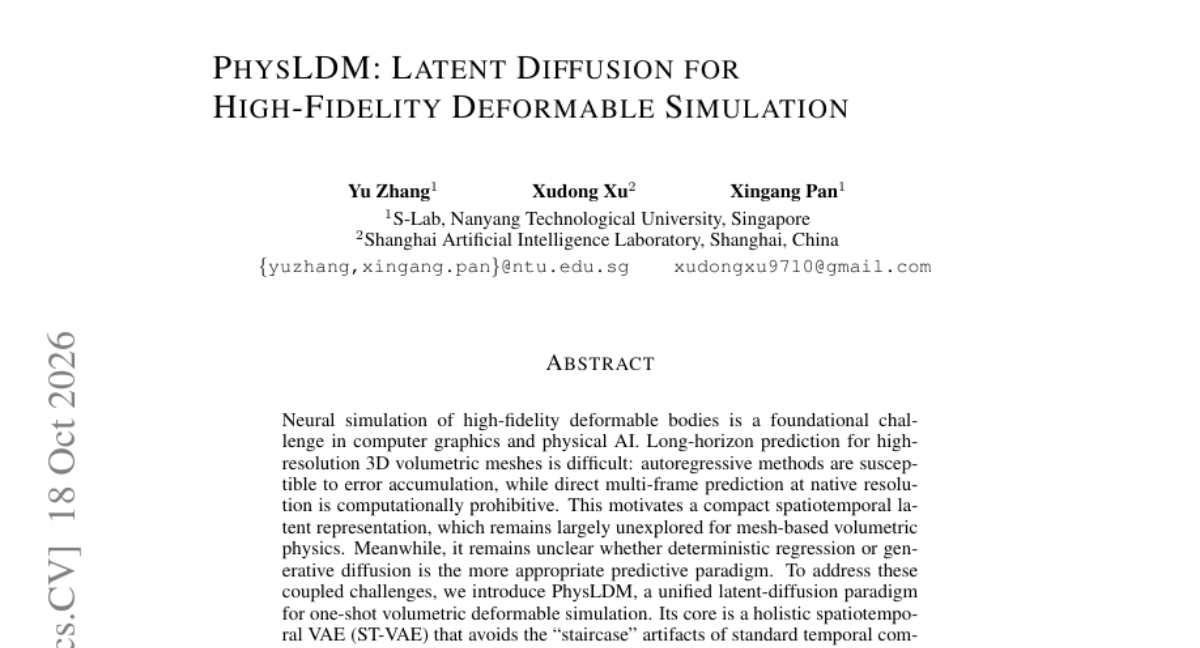
23. PhysLDM: Latent Diffusion for High-Fidelity Deformable Simulation
🔑 Keywords: PhysLDM, spatiotemporal VAE, latent diffusion model, deformable dynamics, high-fidelity simulation
💡 Category: Generative Models
🌟 Research Objective:
– Introducing PhysLDM for high-fidelity deformable body simulation using a spatiotemporal latent diffusion framework.
🛠️ Research Methods:
– Utilizes a holistic VAE to avoid standard temporal compression artifacts and achieve high reconstruction precision.
– Systematically compares regression and diffusion methods in the context of chaotic deformable dynamics.
💬 Research Conclusions:
– Latent diffusion models are more effective than deterministic regression in modeling chaotic dynamics, enabling zero-shot generalization.
– PhysLDM provides a scalable approach to neural simulation, supporting inverse problem solving and design optimization.
👉 Paper link: https://huggingface.co/papers/2610.07609
24. OverSeer: Multi-Agent World Models Beyond What Agents See
🔑 Keywords: OverSeer, multi-agent world model, auxiliary camera views, delta-VAE, world-centric representation
💡 Category: Computer Vision
🌟 Research Objective:
– Introduce OverSeer to enhance multi-agent world models by using auxiliary camera views to ensure consistency.
🛠️ Research Methods:
– Implement fixed auxiliary views compressed through delta-VAE to reduce computation demands, tested on Minecraft and Doom environments.
💬 Research Conclusions:
– Fixed auxiliary views and delta-VAE effectively improve world and agent consistency while minimizing computational overhead.
👉 Paper link: https://huggingface.co/papers/2610.28554

25. HRoPE: Homography Relative Positional Encoding
🔑 Keywords: Surface-aware Positional Encoding, HRoPE, Novel View Synthesis, Geometric Prior, Multi-view Transformers
💡 Category: Computer Vision
🌟 Research Objective:
– The paper aims to improve cross-view alignment and novel view synthesis through the introduction of surface-aware positional encoding, HRoPE, which utilizes slanted 3D planes and homographies.
🛠️ Research Methods:
– HRoPE is introduced as a means to represent the local geometry of patches as slanted 3D planes, injecting token-level, plane-induced homographies into attention for rectifying perspective distortions without requiring ground-truth geometry.
💬 Research Conclusions:
– Extensive experiments show that HRoPE consistently outperforms existing geometric positional encodings for novel view synthesis, demonstrating its effectiveness through various analyses and ablation studies.
👉 Paper link: https://huggingface.co/papers/2610.28284

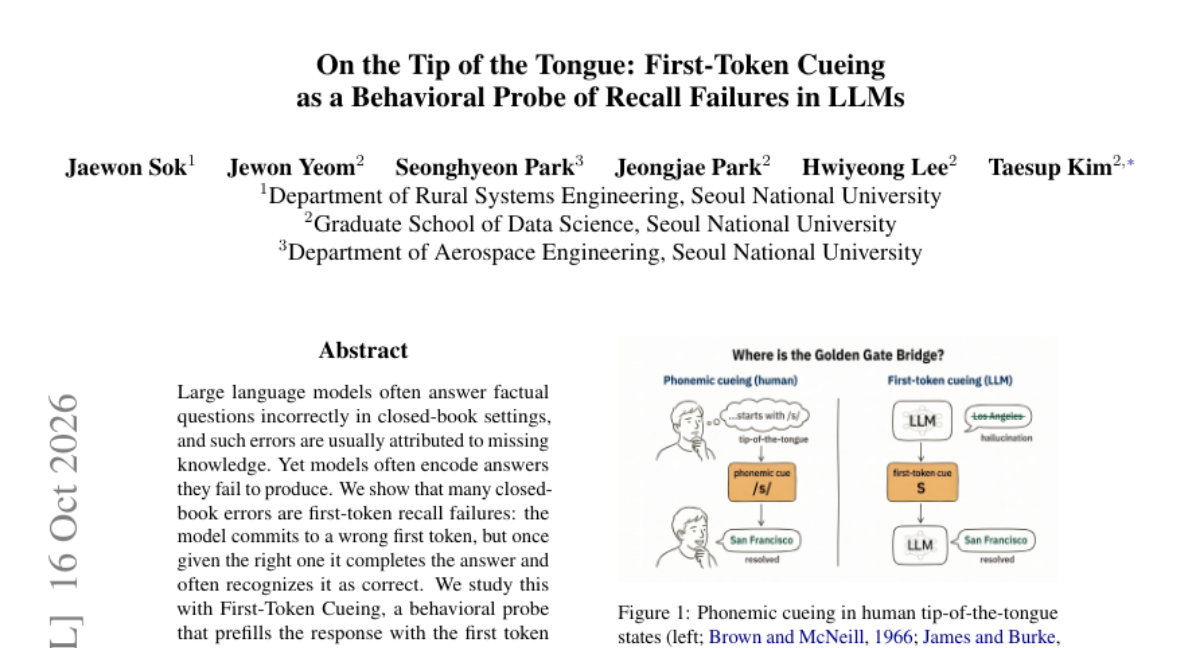
26. On the Tip of the Tongue: First-Token Cueing as a Behavioral Probe of Recall Failures in LLMs
🔑 Keywords: Large language models, First-token recall failures, First-Token Cueing, Closed-book errors, Encoded knowledge
💡 Category: Natural Language Processing
🌟 Research Objective:
– To investigate the origin of factual errors in large language models, specifically focusing on first-token recall failures in closed-book settings.
🛠️ Research Methods:
– Utilization of First-Token Cueing, a behavioral probe technique, to prefill the response with the first token of the correct answer and assess its impact on error correction.
💬 Research Conclusions:
– Identified that many errors in language models are due to incorrect first token generation, which can be corrected by providing the correct first token.
– Demonstrated that this approach improves accuracy in multilingual benchmarks and that models can recognize correct answers more confidently when started correctly.
👉 Paper link: https://huggingface.co/papers/2610.23400
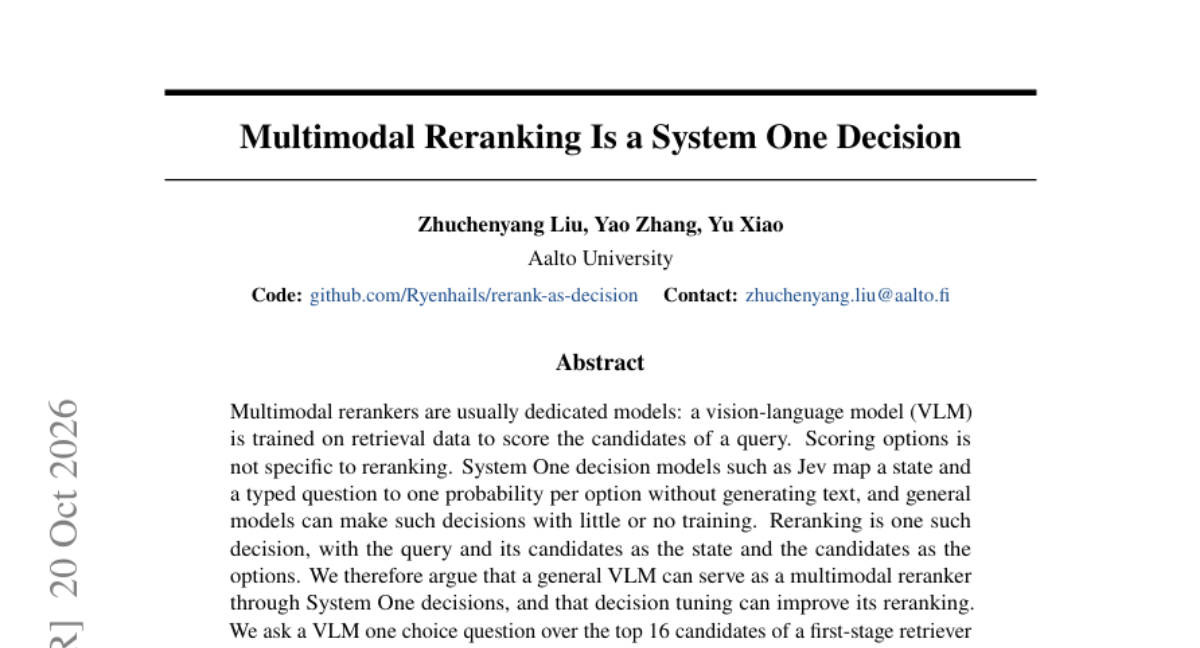
27. Multimodal Reranking Is a System One Decision
🔑 Keywords: Vision-Language Model, Multimodal Reranker, System One decisions, Zero-Shot
💡 Category: Multi-Modal Learning
🌟 Research Objective:
– The paper investigates how a general Vision-Language Model (VLM) can be used as an effective multimodal reranker through System One decisions, potentially surpassing specialized rerankers with minimal tuning.
🛠️ Research Methods:
– A VLM was deployed to rank candidates using a single choice question over the top 16 candidates from a first-stage retriever, evaluating their labels’ probabilities in a solitary forward pass.
💬 Research Conclusions:
– The study found that this method increased the hit@1 score significantly compared to asking yes/no questions per candidate. The zero-shot model Qwen3.8-27B outperformed a supervised version on multiple benchmarks, achieving performance near the level of the Reranker-8B on certain datasets.
👉 Paper link: https://huggingface.co/papers/2610.28435
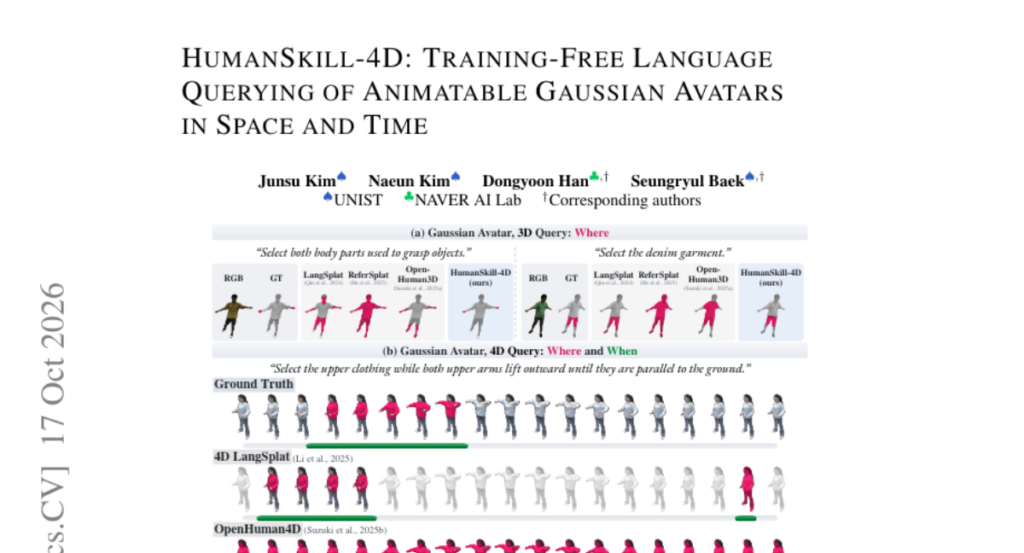
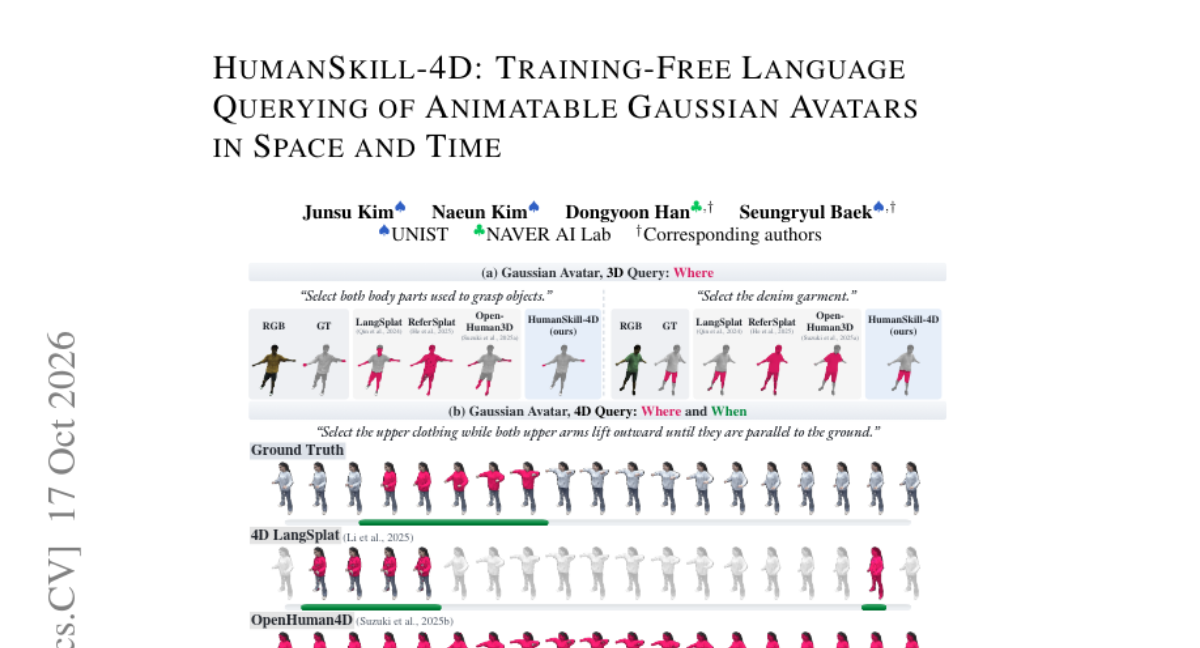
28. HumanSkill-4D: Training-Free Language Querying of Animatable Gaussian Avatars in Space and Time
🔑 Keywords: HumanSkill-4D, avatar referring segmentation, multimodal large language model, geometric operators, semantic memory
💡 Category: Computer Vision
🌟 Research Objective:
– Introduce a novel framework called HumanSkill-4D to enable language-driven selection of avatar regions and motions without training.
🛠️ Research Methods:
– Leverage a multimodal large language model and geometric operators to enable selection of body parts and garments based on appearance, relation, or function.
💬 Research Conclusions:
– HumanSkill-4D outperforms existing baselines in segmentation tasks and supports 3D and 4D referring segmentation with efficient setup and compact semantic memories.
👉 Paper link: https://huggingface.co/papers/2610.24452
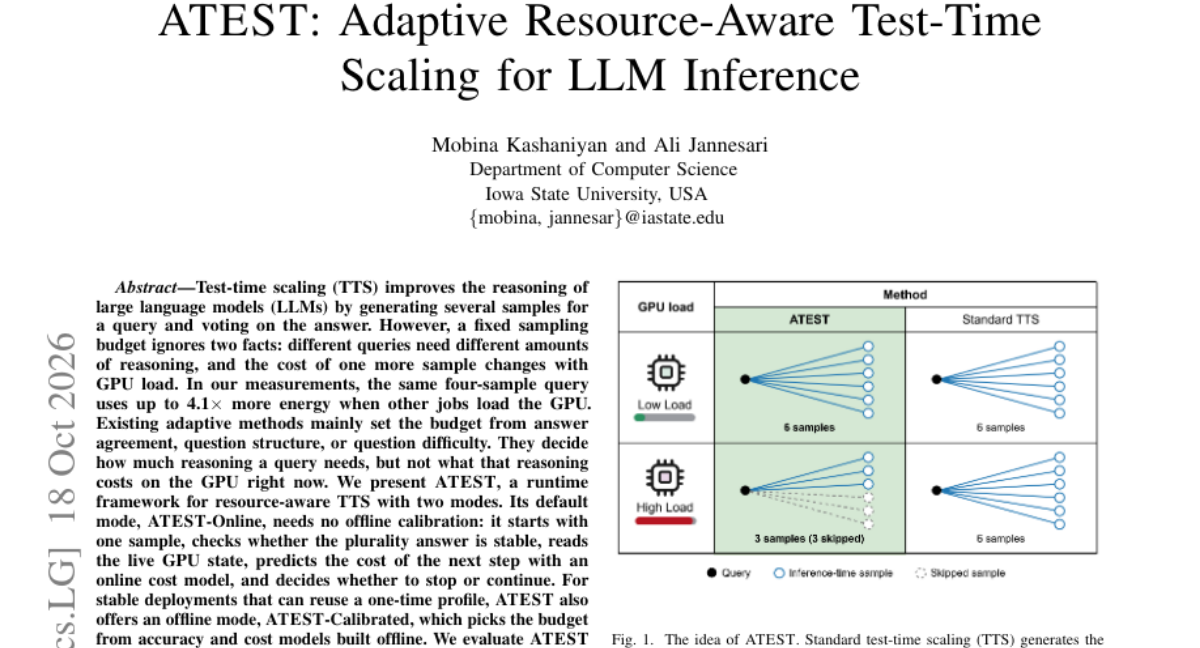
29. ATEST: Adaptive Resource-Aware Test-Time Scaling for LLM Inference
🔑 Keywords: Test-time Scaling (TTS), Large Language Model (LLM), GPU contention, Energy cost, ATEST
💡 Category: Natural Language Processing
🌟 Research Objective:
– To improve LLM reasoning by considering query difficulty and fluctuating energy costs during test-time scaling.
🛠️ Research Methods:
– Development of ATEST, a resource-aware TTS framework, with two modes: ATEST-Online and ATEST-Calibrated, evaluated on reasoning and question-answering datasets.
💬 Research Conclusions:
– ATEST-Online efficiently handles energy budgets and accuracy under varying GPU loads, showing significant energy savings over ATEST-Calibrated, with robust performance even at high loads.
👉 Paper link: https://huggingface.co/papers/2610.25519
30. BiDex-100: A Comprehensive Benchmark for Bimanual Dexterous Manipulation Across 100+ Simulation Tasks
🔑 Keywords: BiDex-100, Bimanual Manipulation, Vision-Language-Action Models, High-DoF Hand Embodiments, Teleoperated Demonstrations
💡 Category: Robotics and Autonomous Systems
🌟 Research Objective:
– To present BiDex-100, a comprehensive simulation benchmark for evaluating bimanual dexterous manipulation capabilities across varied tasks, robustness, and demonstration scales.
🛠️ Research Methods:
– The benchmark includes 106 tasks organized along five capability axes and supports two different hand embodiments, providing 8,080 teleoperated demonstrations, with a total of 6.25 million frames.
💬 Research Conclusions:
– Establishes baseline performances for seven recent Vision-Language-Action models under a unified protocol, evaluating capability-specific performance, robustness, and data efficiency.
👉 Paper link: https://huggingface.co/papers/2610.25459

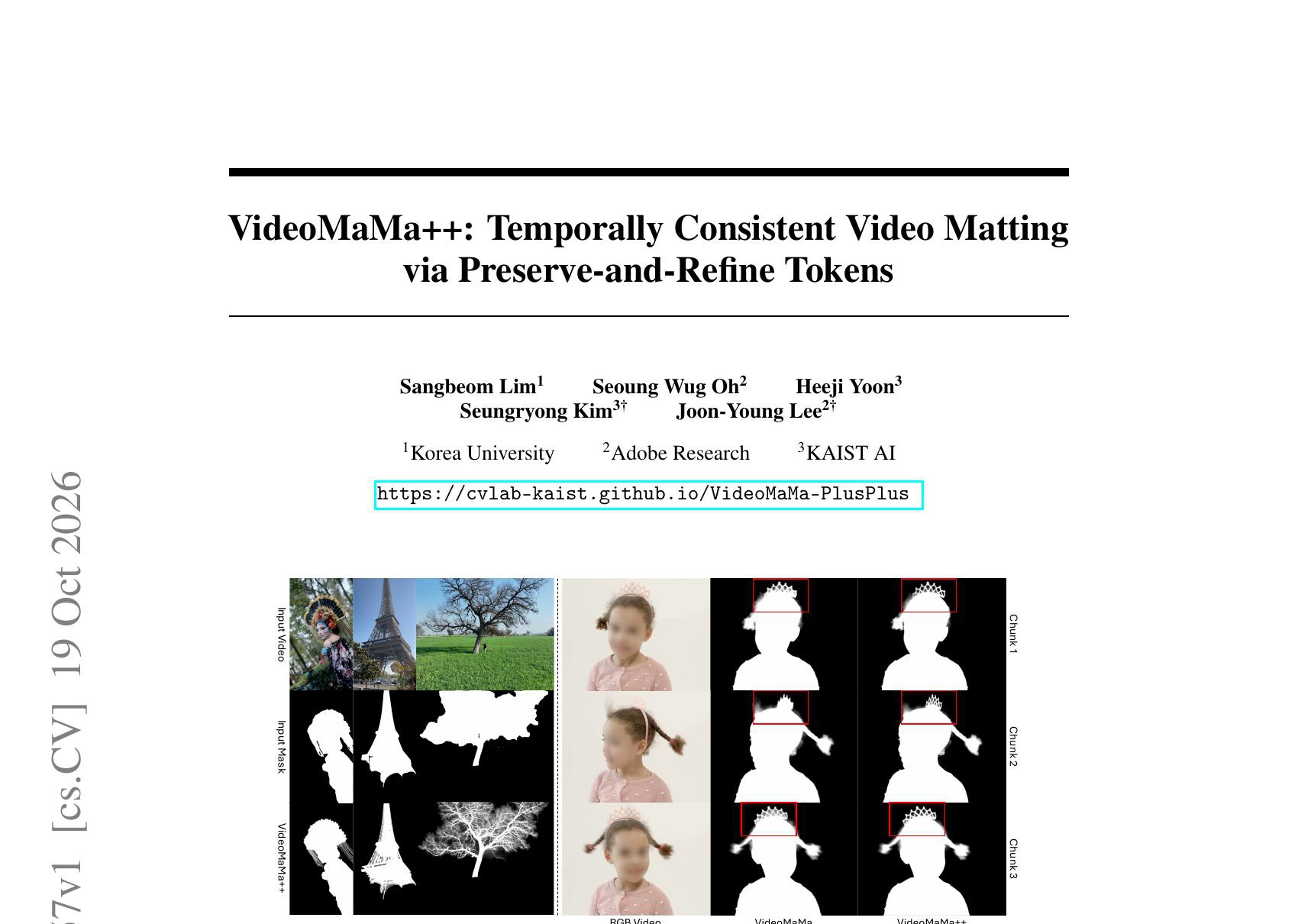
31. VideoMaMa++: Temporally Consistent Video Matting via Preserve-and-Refine Token
🔑 Keywords: Diffusion-based video matting, Temporal consistency, Video diffusion priors, Sliding-window inference
💡 Category: Computer Vision
🌟 Research Objective:
– The study aims to improve temporal consistency and detail accuracy in video matting for long videos using a diffusion-based framework.
🛠️ Research Methods:
– The framework utilizes separate token streams for RGB and mask conditioning, enabled by spatio-temporal self-attention, and introduces learnable embeddings, namely the preserve and refine tokens, to allow sliding-window inference across chunk boundaries.
💬 Research Conclusions:
– This framework outperforms existing diffusion-based methods by achieving higher fine-detail accuracy and maintaining temporal consistency across chunk boundaries in both standard benchmarks and real-world long footage.
👉 Paper link: https://huggingface.co/papers/2610.26857
32. Axiomatic World Modeling for Physics Reasoning
🔑 Keywords: RLAWM, modeling drift, axiomatic world model, physics reasoning, reward shaping
💡 Category: Knowledge Representation and Reasoning
🌟 Research Objective:
– The study aims to improve physics reasoning in language models by addressing the issue of “modeling drift”, which is the divergence between the model’s internal axiomatic world model and the true physical world.
🛠️ Research Methods:
– The paper introduces Reinforcement Learning with Axiomatic World Modeling (RLAWM), which penalizes divergence in hierarchical levels (modeling and solving) using physically grounded rewards to ensure accurate world modeling and reasoning.
💬 Research Conclusions:
– RLAWM enhances performance significantly, achieving a +12.2 point improvement on PhysReason and a +5.2 improvement on PHYSICS over baseline. It also generalizes well across different tasks and levels, demonstrating a 2.45x gain on olympiad-level physics and math.
👉 Paper link: https://huggingface.co/papers/2610.24519
33.
34. Not All Features Are Created Equal: A Mechanistic Study of Vision-Language-Action Models
🔑 Keywords: Vision-Language-Action, interpretability pipeline, motor programs, absolute coordinates
💡 Category: Robotics and Autonomous Systems
🌟 Research Objective:
– The study aims to explore the mechanistic interpretability of Vision-Language-Action policies, focusing on how they compute motor programs tied to absolute coordinates.
🛠️ Research Methods:
– The research employs an interpretability pipeline to analyze VLA policies and dissects instruction encoding and motor generation across various architectures using a sparse autoencoder analysis.
💬 Research Conclusions:
– The findings reveal that VLA policies, when injected with task-specific activations, stick to motor trajectories bound to absolute coordinates, often disregarding visual scene changes. Additionally, goal selection and motor generation processes are distinct, with extensive testing revealing that architecture-specific patterns influence how behavior is preserved.
👉 Paper link: https://huggingface.co/papers/2603.19233
35. World Models with Configurable Perception
🔑 Keywords: ConfigWM, visual embeddings, task-specific state space, world modeling, planning
💡 Category: Machine Learning
🌟 Research Objective:
– To address the issue of non-adaptive encoders in existing world models, which are often distracted by task-irrelevant information, by introducing ConfigWM that utilizes task-conditioned state extraction for robust planning.
🛠️ Research Methods:
– Implement and evaluate ConfigWM using environments with varying levels of distraction. ConfigWM uses a language description of the task as a configuration signal to direct visual embeddings into task-specific state spaces.
💬 Research Conclusions:
– ConfigWM significantly outperforms competing models, maintaining stability and robustness in noisy environments while improving planning success rate by an average of 22.3%. It also demonstrates a consistent increase in physical-quantity probing and distracted-to-clean retrieval, supporting effective world modeling and planning.
👉 Paper link: https://huggingface.co/papers/2610.27914
36. What Makes a Good Symbol for Hybrid Discrete-Continuous Planning?
🔑 Keywords: robot planning, solver-sufficient symbolization, neural networks, optimization landscapes, discrete commitments
💡 Category: Robotics and Autonomous Systems
🌟 Research Objective:
– The study aims to explore the invention of symbols for robot planning by identifying discrete commitments that simplify solving continuous optimization problems.
🛠️ Research Methods:
– Introduces the concept of solver-sufficient symbolization for finite-horizon piecewise-affine systems and develops a counterexample-guided algorithm for symbol invention.
– Extends symbolization principles to optimization objectives parameterized by general neural networks, using continuous optimization landscapes.
💬 Research Conclusions:
– Experiments demonstrate that the invented symbols reduce solving costs while maintaining solution quality, and they enhance interpretability and steerability. Theoretical insights also explain the computational usefulness of certain human-defined symbols.
👉 Paper link: https://huggingface.co/papers/2610.23010

37. TRACE: Tracking Multimodal Clinical Trajectories for Inpatient Risk Prediction
🔑 Keywords: TRACE, inpatient risk prediction, temporal trajectories, multimodal Clinical Events, temporal attention
💡 Category: AI in Healthcare
🌟 Research Objective:
– The research aims to enhance inpatient risk prediction by organizing daily clinical events into temporal trajectories for tasks such as mortality, length of stay, and readmission.
🛠️ Research Methods:
– TRACE employs a daily-scale framework to model clinical events, separating global from local context using data from EHR, chest x-rays, and radiology reports. Temporal attention and a phenotype-guided contrastive objective organize admissions across diverse disease distributions.
💬 Research Conclusions:
– TRACE demonstrates superior performance with the highest AUROC across nine dataset-task pairings and significant accuracy improvements, validating its methodologies through ablation studies and localized trajectory-level risk assessment.
👉 Paper link: https://huggingface.co/papers/2610.25765

38. On the Limits of Scale: Inverse Scaling in Vision-Language Models
🔑 Keywords: Vision-language Models, Inverse Scaling, Multi-Image Spatial Reasoning, Visual Perception, STEM Knowledge
💡 Category: Multi-Modal Learning
🌟 Research Objective:
– To investigate the inverse scaling phenomenon in vision-language models (VLMs), where larger models underperform smaller models in specific subtasks.
🛠️ Research Methods:
– Evaluation of 19 vision-language models from four families across eight multimodal benchmarks, analyzing 558,334 model-question evaluations using per-question pairwise analysis.
💬 Research Conclusions:
– Identified 375 subtask-model-pair combinations showing inverse scaling, with consistency across different architectures, challenging the assumption that increasing model size uniformly enhances multimodal abilities.
👉 Paper link: https://huggingface.co/papers/2610.27360
39. Slot-JEPA: Object-Structured Prediction Interfaces for Latent World Models
🔑 Keywords: Slot-JEPA, Joint-Embedding Predictive Architectures, semantic slots, spatial masks, goal-conditioned planning
💡 Category: Computer Vision
🌟 Research Objective:
– To enhance predictive modeling, planning, and transfer across visual tasks by decomposing dense representations into semantic slots and spatial masks, thus providing a reusable object-structured interface.
🛠️ Research Methods:
– The introduction of Slot-JEPA decomposes dense representations using stable semantic slots and time-varying spatial masks. It utilizes a Transition Memory Predictor to store visual transitions and employs Unbalanced Optimal Transport for supervising mask prediction.
💬 Research Conclusions:
– Slot-JEPA demonstrates improved feature transferability across seven visual-understanding benchmarks, enhances goal-conditioned planning in six planar environments, and advances robotic arm planning in four tasks on the REALM-JEPA benchmark.
👉 Paper link: https://huggingface.co/papers/2610.28074
40. EMBER: Predicting TCR–pMHC Binding Without a Docked Complex
🔑 Keywords: EMBER, SE(3)-invariant graphs, TCR-pMHC binding, docked complex, monomer folds
💡 Category: Machine Learning
🌟 Research Objective:
– The main aim of the research is to propose the EMBER framework for predicting TCR-pMHC binding. This framework seeks to eliminate errors associated with docked complex prediction by using independently folded monomers.
🛠️ Research Methods:
– EMBER uses SE(3)-invariant residue graphs to represent independently folded TCR and pMHC, avoiding the construction of a shared coordinate frame and thus minimizing placement errors.
💬 Research Conclusions:
– Compared to traditional methods, EMBER showcased superior accuracy in epitope-disjoint evaluations across varied folding tools, improving metrics such as micro-AUROC, micro-AUPRC, and MCC. The stability of EMBER’s ranking across tools was up to 85% more consistent.
👉 Paper link: https://huggingface.co/papers/2610.27334
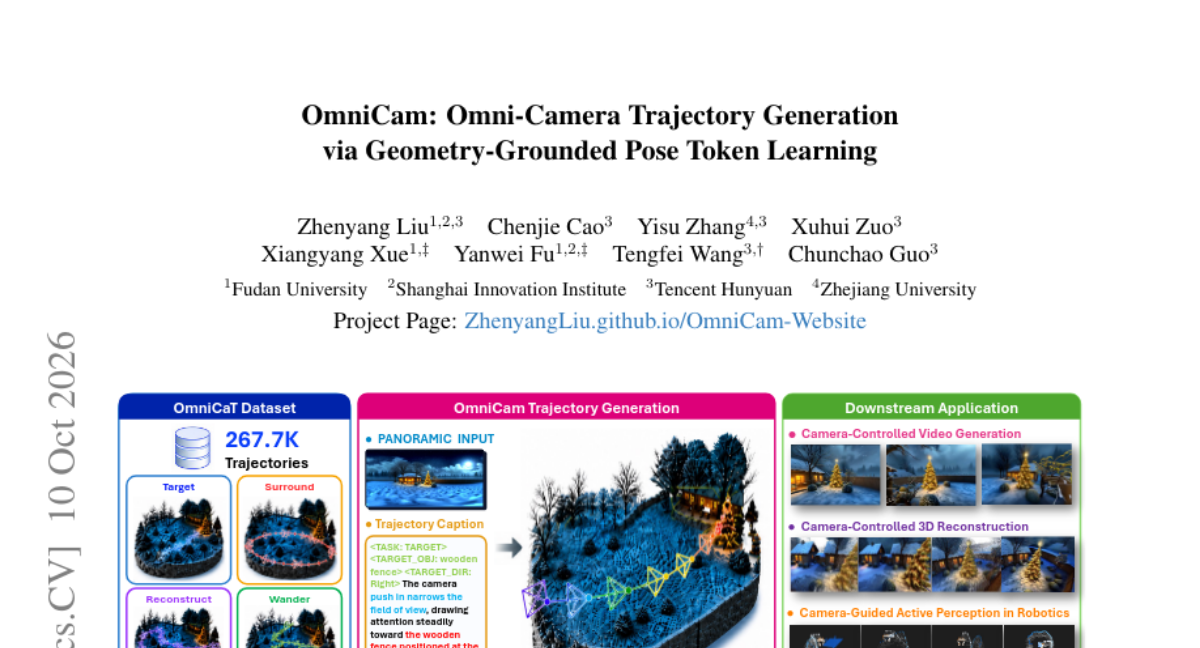
41. OmniCam: Omni-Camera Trajectory Generation via Geometry-Grounded Pose Token Learning
🔑 Keywords: OmniCam, camera pose sequences, geometric conditioning, collision reduction
💡 Category: Generative Models
🌟 Research Objective:
– To improve trajectory accuracy and reduce collisions in generating camera pose sequences from panoramas and text using OmniCam.
🛠️ Research Methods:
– Utilized a panoramic point-cloud encoder, hybrid tokenization with quaternion signs, and separate geometric and semantic conditioning streams with a 3D target anchor.
💬 Research Conclusions:
– OmniCam reduces trajectory errors by 28-47% and collision rates by 65.8% compared to GenDoP, showcasing enhanced accuracy and minimized collisions in camera-controlled video generation and robotic perception.
👉 Paper link: https://huggingface.co/papers/2610.09513
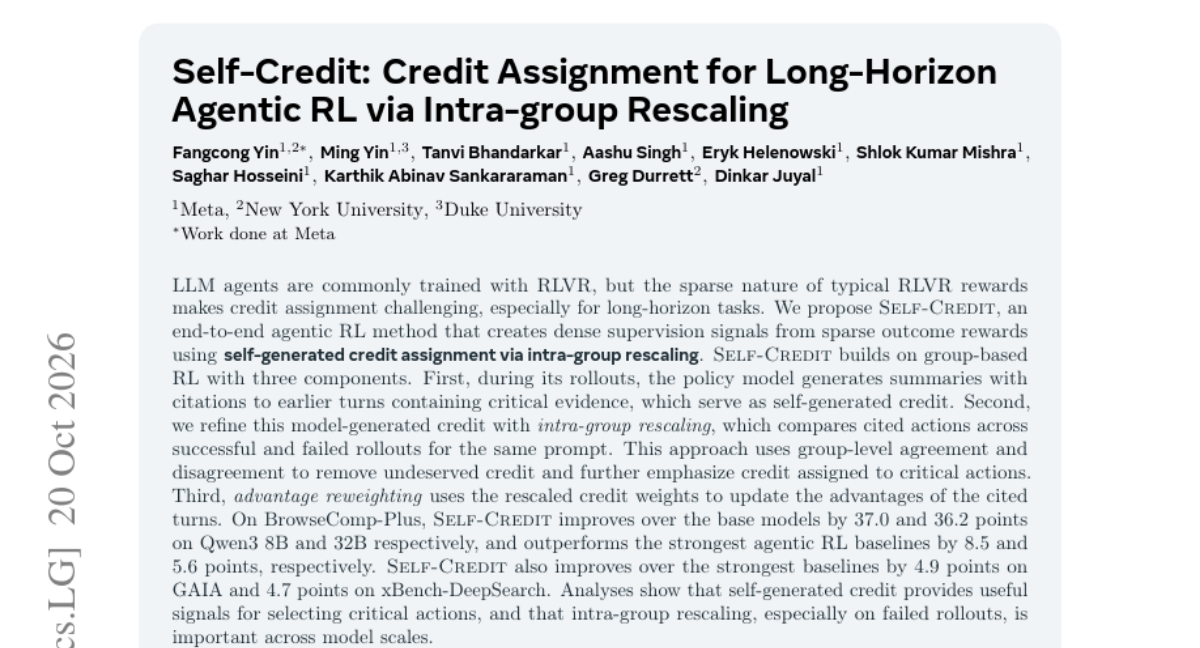
42. Self-Credit: Credit Assignment for Long-Horizon Agentic RL via Intra-group Rescaling
🔑 Keywords: LLM agents, Self-Credit, reinforcement learning, intra-group rescaling
💡 Category: Reinforcement Learning
🌟 Research Objective:
– To propose a new method, Self-Credit, for improving agentic reinforcement learning with dense supervision signals from sparse outcome rewards.
🛠️ Research Methods:
– Implementation of an end-to-end agentic RL method called Self-Credit, which involves generating self-assigned credit through intra-group rescaling and utilizing group-level agreement and disagreement for refining credit.
💬 Research Conclusions:
– Self-Credit significantly improves performance over base models and outperforms the strongest agentic RL baselines on various benchmarks, demonstrating that self-generated credit is effective for critical action selection.
👉 Paper link: https://huggingface.co/papers/2610.28388
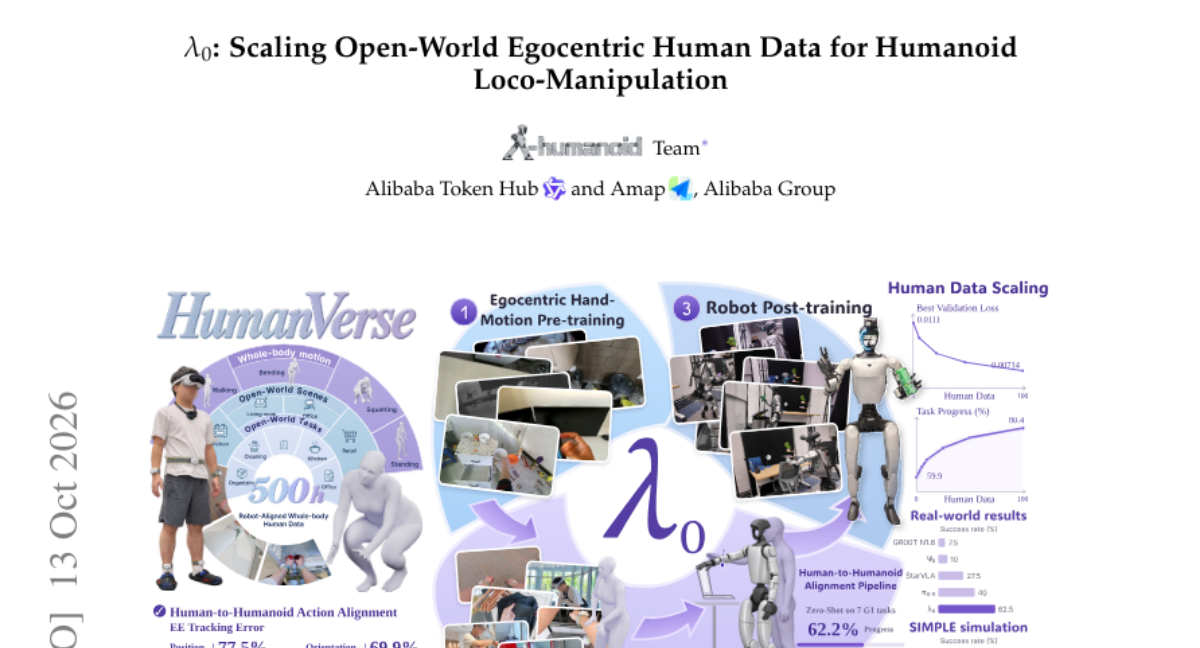
43. λ_0: Scaling Open-World Egocentric Human Data for Humanoid Loco-Manipulation
🔑 Keywords: HumanVerse, humanoid foundation model, loco-manipulation, zero-shot transfer, whole-body coordination
💡 Category: Robotics and Autonomous Systems
🌟 Research Objective:
– To train a humanoid foundation model for whole-body loco-manipulation via human-to-robot transfer without robot demonstrations.
🛠️ Research Methods:
– Utilized a 500-hour dataset, pairing egocentric video with synchronized body and hand motion.
– Developed a human-to-humanoid pipeline that aligns camera viewpoints and refines controller inputs.
💬 Research Conclusions:
– λ_0, the developed model, achieves high success rates on tasks, indicating robust loco-manipulation capabilities.
– The study guides towards scalable whole-body human data collection for humanoid foundation models.
👉 Paper link: https://huggingface.co/papers/2610.18950
44. PVBench: Quantifying Physical Plausibility in Video Generation with Object-Level Physical Measurements
🔑 Keywords: PVBench, video generation, physical plausibility, vision models, kinematics
💡 Category: Generative Models
🌟 Research Objective:
– The research seeks to establish PVBench, a benchmark evaluating the physical plausibility of generated videos across 46 dimensions, improving upon existing models that focus on coarse judgments.
🛠️ Research Methods:
– PVBench incorporates specialized vision models and human-aligned metrics, offering quantitative measurements across 46 dimensions in seven domains, utilizing 600 carefully crafted prompts. It supports both text-to-video and image-to-video generation.
💬 Research Conclusions:
– The study highlights the alignment between automatic metrics and human judgment. Evaluation of open-source and closed-source models is presented, revealing insights aimed at advancing physically grounded video generation.
👉 Paper link: https://huggingface.co/papers/2610.26711

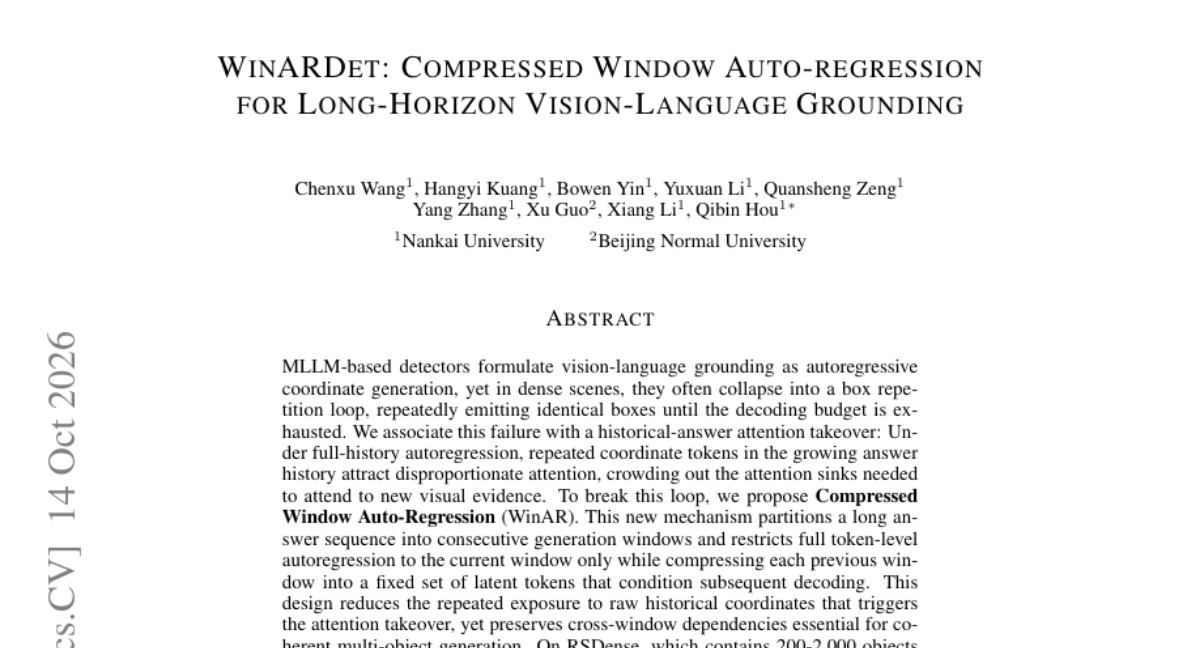
45. WinARDet: Compressed Window Auto-Regression for Long-Horizon Vision-Language Grounding
🔑 Keywords: Compressed Window Auto-Regression, autoregressive coordinate generation, attention takeover, latent tokens, WinARDet
💡 Category: Computer Vision
🌟 Research Objective:
– The research aims to circumvent the limitations posed by attention takeover and box repetition in dense vision-language grounding scenes by introducing a new mechanism called Compressed Window Auto-Regression (WinAR).
🛠️ Research Methods:
– The method involves segmenting long answer sequences into generation windows, restricting full token-level autoregression to the current window, while compressing each previous window into a fixed set of latent tokens to condition subsequent decoding.
💬 Research Conclusions:
– The proposed model, WinARDet, significantly enhances the F1-score on the RSDense dataset and reduces redundancy, demonstrating efficacy over traditional methods while maintaining coherence across diverse scene densities.
👉 Paper link: https://huggingface.co/papers/2610.19419
46. More Memory, Worse Agents: Error Reproduction and Anti-Persistence in LLM Agents
🔑 Keywords: Anti-Persistence, LLM agents, error reproduction, memory design, self-improvement
💡 Category: Natural Language Processing
🌟 Research Objective:
– To enhance LLM agents’ self-improvement by mitigating error reproduction through a novel memory design called Anti-Persistence.
🛠️ Research Methods:
– Utilizes an adaptive memory design that retains trajectories and outcomes and discards synthesized guidance after execution to prevent error propagation.
💬 Research Conclusions:
– Anti-Persistence achieves superior success rates and cost efficiency in memory-based self-improvement, demonstrating the effectiveness of separating experience accumulation from abstraction persistence.
👉 Paper link: https://huggingface.co/papers/2610.27406

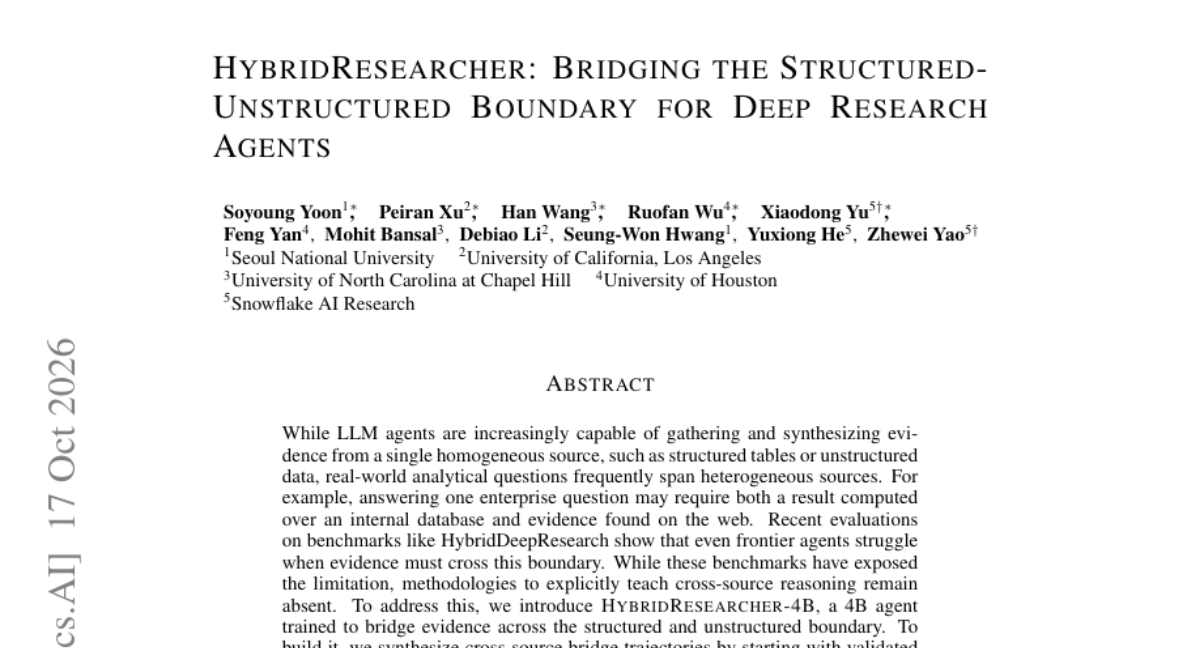
47. HybridResearcher: Bridging the Structured-Unstructured Boundary for Deep Research Agents
🔑 Keywords: HybridResearcher, cross-source reasoning, reinforcement learning, structured and unstructured data, catastrophic forgetting
💡 Category: Reinforcement Learning
🌟 Research Objective:
– This research introduces HybridResearcher, a small agent trained to efficiently perform reasoning across both structured and unstructured data sources, aiming to overcome limitations faced by larger models.
🛠️ Research Methods:
– The HybridResearcher is built using synthetic cross-source trajectories, starting with validated single-source tasks and creating cross-source bridge tasks, and is further trained using supervised fine-tuning followed by reinforcement learning.
💬 Research Conclusions:
– Evaluations show that HybridResearcher significantly improves cross-source reasoning abilities, demonstrating a 30.0 point pass@8 improvement over Qwen3.5-4B and surpassing Qwen3.5-397B-A17B by 8.3 points, without catastrophic forgetting in single-source benchmarks.
👉 Paper link: https://huggingface.co/papers/2610.24899
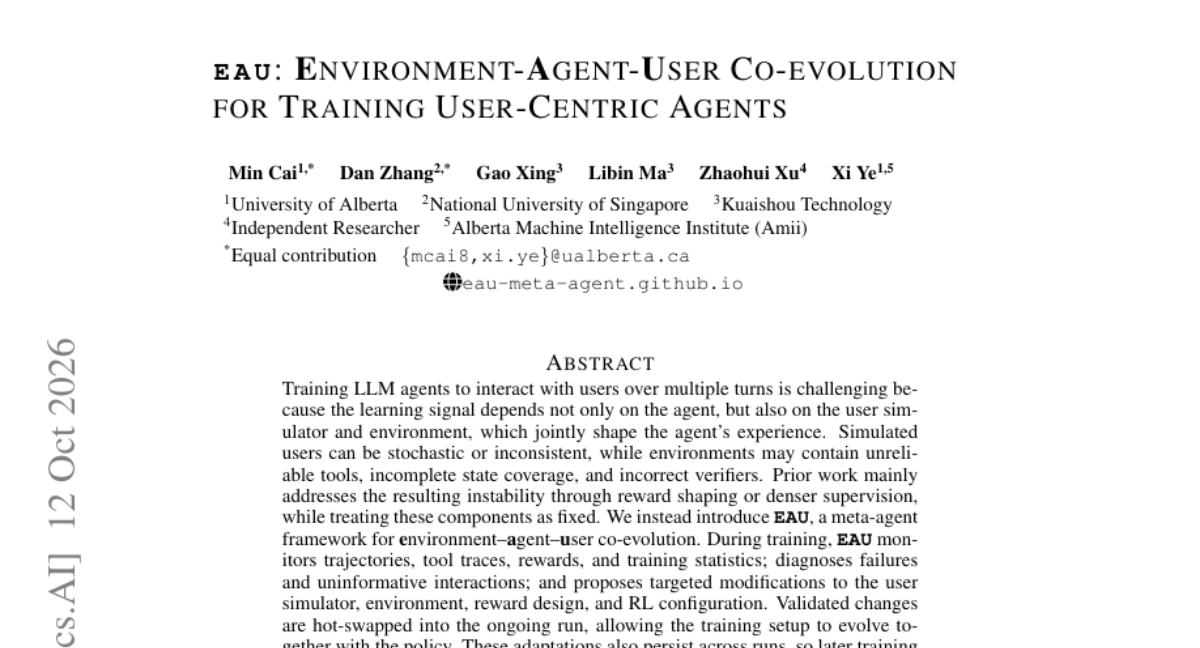
48. EAU: Environment-Agent-User Co-evolution for Training User-Centric Agents
🔑 Keywords: EAU, meta-agent, co-evolution, multi-turn RL, symbolic representation
💡 Category: Reinforcement Learning
🌟 Research Objective:
– The study introduces EAU, a meta-agent framework designed to improve multi-turn LLM (language model) agent training by simultaneously evolving the user simulator, environment, and RL setup alongside the policy.
🛠️ Research Methods:
– EAU monitors and diagnoses interactions, adapting user simulators, environments, and RL configurations through an editable symbolic representation, enabling hot-swappable changes during training.
💬 Research Conclusions:
– EAU significantly outperforms traditional RL methods across benchmarks, enhancing performance by 14.7-15.0% compared to the strongest baseline and achieving up to a 36.7% increase in task completion rates on ColBench.
👉 Paper link: https://huggingface.co/papers/2610.16523
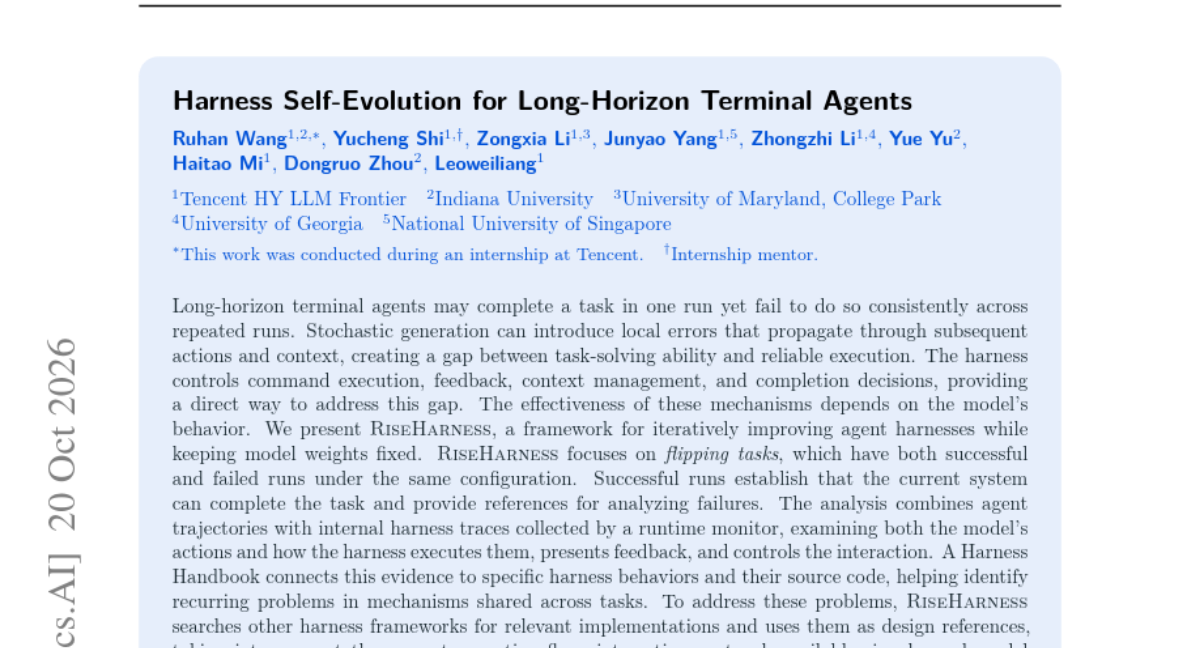
49. Harness Self-Evolution for Long-Horizon Terminal Agents
🔑 Keywords: RiseHarness, agent harnesses, reliability, stochastic errors, model adaptation
💡 Category: Reinforcement Learning
🌟 Research Objective:
– Introduce RiseHarness, a framework designed to improve the reliability of agent harnesses without altering model weights.
🛠️ Research Methods:
– Utilizes a combination of agent trajectories and harness traces to analyze interactions with command execution and context management.
– Integrates mechanisms from different frameworks through iterative behavioral checks and task evaluations.
💬 Research Conclusions:
– Demonstrates how shared mechanism changes can enhance reliability across tasks and improve task success when applied to unseen benchmarks with the same model.
👉 Paper link: https://huggingface.co/papers/2610.27435
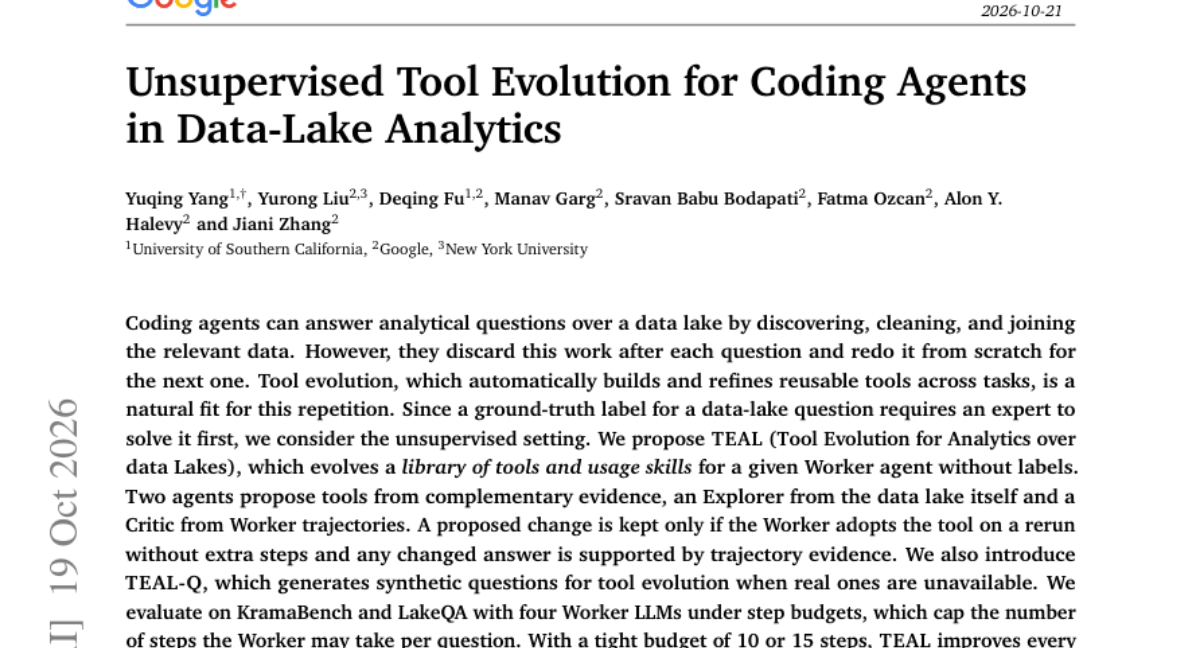
50. Unsupervised Tool Evolution for Coding Agents in Data-Lake Analytics
🔑 Keywords: TEAL, Data Lake, Tool Evolution, Unsupervised, Synthetic Questions
💡 Category: AI Systems and Tools
🌟 Research Objective:
– To develop TEAL, a framework that evolves reusable data-analysis tools in unsupervised settings for coding agents, enhancing their efficiency without ground-truth labels.
🛠️ Research Methods:
– TEAL utilizes a dual-agent system comprising an Explorer and a Critic to propose and validate tools based on data lake evidence and Worker trajectories. TEAL-Q generates synthetic questions to aid tool evolution.
💬 Research Conclusions:
– TEAL improves coding agent performance under strict step budgets, as evidenced by substantial score increases in KramaBench and LakeQA benchmarks. The framework’s capability to evolve useful tools without labels and successfully use synthetic questions demonstrates its efficacy.
👉 Paper link: https://huggingface.co/papers/2610.27327
51. EdgeKernelBench: Unified LLM-Driven Kernel Generation for Edge Backends
🔑 Keywords: LLM kernel generation, heterogeneous edge backends, unified evaluation, Layered Edge Kernel Agent, optimization
💡 Category: AI Systems and Tools
🌟 Research Objective:
– The study aims to evaluate and optimize LLM-generated kernels across diverse edge backends using tools such as EdgeKernelBench and LEKA.
🛠️ Research Methods:
– The research introduces EdgeKernelBench, which combines a unified IR deployment framework with hierarchical benchmarking, validated using TVM across various edge backends.
– The Layered Edge Kernel Agent (LEKA) is introduced to enhance optimization through layered IR structures.
💬 Research Conclusions:
– A significant gap exists between correctness and performance in LLM kernel generation for edge devices.
– LEKA improved [email protected] performance from 13.0% in direct generation to 43.5%, indicating its effectiveness in optimizing LLM-generated kernels.
👉 Paper link: https://huggingface.co/papers/2610.24648
52. Event-STVG: Spatio-Temporal Video Grounding for Long-Form Event Reasoning
🔑 Keywords: STVG, Event-STVG, multimodal models, event-level reasoning, MLLMs
💡 Category: Multi-Modal Learning
🌟 Research Objective:
– Introduction of Event-STVG, a task focusing on long-form event reasoning, repeated-event disambiguation, and spatio-temporal grounding in extended video contexts.
🛠️ Research Methods:
– Construction of a large-scale benchmark with 4,016 annotated events across multiple domains, including soccer, to evaluate models.
💬 Research Conclusions:
– Current state-of-the-art multimodal large language models face challenges, achieving only 5.4% m-vIoU in complex tasks, highlighting the need for models capable of event-level reasoning across space and time.
👉 Paper link: https://huggingface.co/papers/2610.22444
53. From Short Clips to Real-Time Streams: Identity-Aware Supervision and Context-Efficient Generation for Video Face Swapping
🔑 Keywords: StreamingSwap, video face swapping, identity fidelity, real-time, Joint Rec-ID Loss
💡 Category: Computer Vision
🌟 Research Objective:
– The primary aim is to enhance identity fidelity and efficiency in real-time video face swapping, achieving stable performance on long videos.
🛠️ Research Methods:
– Development of a joint identity-reconstruction loss to balance explicit identity supervision and latent reconstruction.
– Implementation of Face-RoI Generation and Short-Context Rollout Training for efficient flow-matching using fewer spatial tokens and shorter temporal contexts.
💬 Research Conclusions:
– StreamingSwap achieves competitive identity transfer and visual quality at 20 FPS on a single NVIDIA RTX 4090 GPU, maintaining stability over videos up to 10 minutes long.
👉 Paper link: https://huggingface.co/papers/2610.26681
54. Painting Change Map as guidance for generating painting processes
🔑 Keywords: Painting Change Map, spatio-temporal control, digital art generation, normalized structural changes, encoded RGB space
💡 Category: Generative Models
🌟 Research Objective:
– To introduce a spatio-temporal Painting Change Map for controlled video generation of artwork by tracking structural changes over time.
🛠️ Research Methods:
– Developed a mechanism tracking normalized structural changes across a 1,000-timestep continuum to capture fine-grained stroke-level changes. Utilized encoded RGB space for localized visual differences guidance.
💬 Research Conclusions:
– The proposed approach outperforms existing control baselines and achieves competitive results with state-of-the-art painting methods. Under oracle conditions, it significantly surpasses all baselines.
👉 Paper link: https://huggingface.co/papers/2610.25369

55. EvaOmni: An Evidence-Grounded Benchmark for Audio-Visual Reasoning
🔑 Keywords: EvaOmni, Omni LLMs, audiovisual reasoning, evidence-grounded benchmark, Gemini3.7-Flash
💡 Category: Multi-Modal Learning
🌟 Research Objective:
– The study aims to evaluate whether omnimodal language models can identify audio-visual evidence and construct reasoning chains for audiovisual questions using the EvaOmni benchmark.
🛠️ Research Methods:
– Utilizes a benchmark comprising 392 videos and 1,027 human-annotated question-answer pairs.
– Implements rigorous annotation procedures and introduces two specialized scores, Coverage Grounded Score (C.G.) and Bottleneck Grounded Score (B.G.), to assess model performance beyond simple answer correctness.
💬 Research Conclusions:
– Despite advancements, the highest-performing model, Gemini3.7-Flash, still shows room for improvement in grounded audio-visual reasoning, particularly at the temporal localization level.
👉 Paper link: https://huggingface.co/papers/2610.28444

56. Evolving Agent Interfaces
🔑 Keywords: Agent S4, Evolving Agent Interfaces, meta-agent, Population-based evolution, open-source computer-use agents
💡 Category: AI Systems and Tools
🌟 Research Objective:
– The research introduces Agent S4, aiming to autonomously evolve computer-use interfaces from task experience, enhancing performance and reducing costs compared to larger proprietary models.
🛠️ Research Methods:
– Utilizes a meta-agent to examine task agents’ trajectories on synthetic training tasks and constructs evolving interfaces. Employs population-based evolution to select which repositories to further develop based on performance on unseen validation tasks.
💬 Research Conclusions:
– Agent S4 demonstrates superior performance on OSWorld V2, achieving a state-of-the-art 21.3% binary score, outperforming existing models at significantly lower costs. Evolved interfaces improved the success rate on ScienceBoard from 41.4% to 58.6%, indicating autonomous interface design as a valuable improvement source.
👉 Paper link: https://huggingface.co/papers/2610.28601
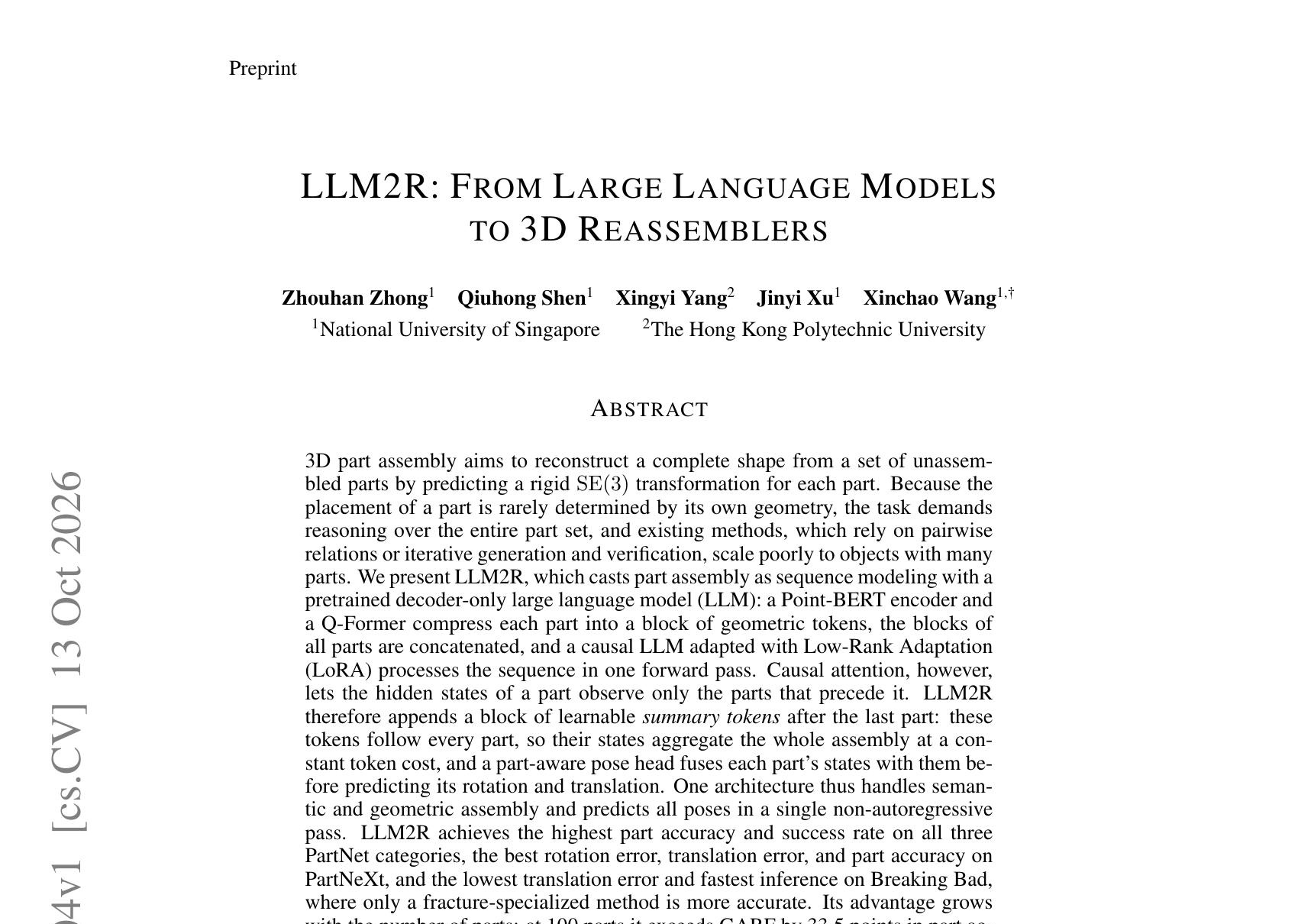
57. LLM2R: From Large Language Models to 3D Reassemblers
🔑 Keywords: LLM2R, SE(3) transformation, decoder-only large language model, geometric tokens, zero-shot transfer
💡 Category: Computer Vision
🌟 Research Objective:
– The objective of LLM2R is to treat the task of 3D part assembly as sequence modeling using a pretrained decoder-only LLM, enhancing scalability and accuracy by predicting all part poses in a single pass.
🛠️ Research Methods:
– LLM2R employs an approach where a Point-BERT encoder and a Q-Former convert each part into geometric tokens, which are processed by a causal LLM adapted with LoRA, allowing a non-autoregressive prediction of parts’ transformations.
💬 Research Conclusions:
– LLM2R achieves superior part accuracy, success rate, rotation, and translation error metrics compared to other models on the PartNet, PartNeXt, and Breaking Bad datasets. Its performance advantage increases with the number of parts, and it successfully transfers to unseen categories in a zero-shot manner.
👉 Paper link: https://huggingface.co/papers/2610.18604
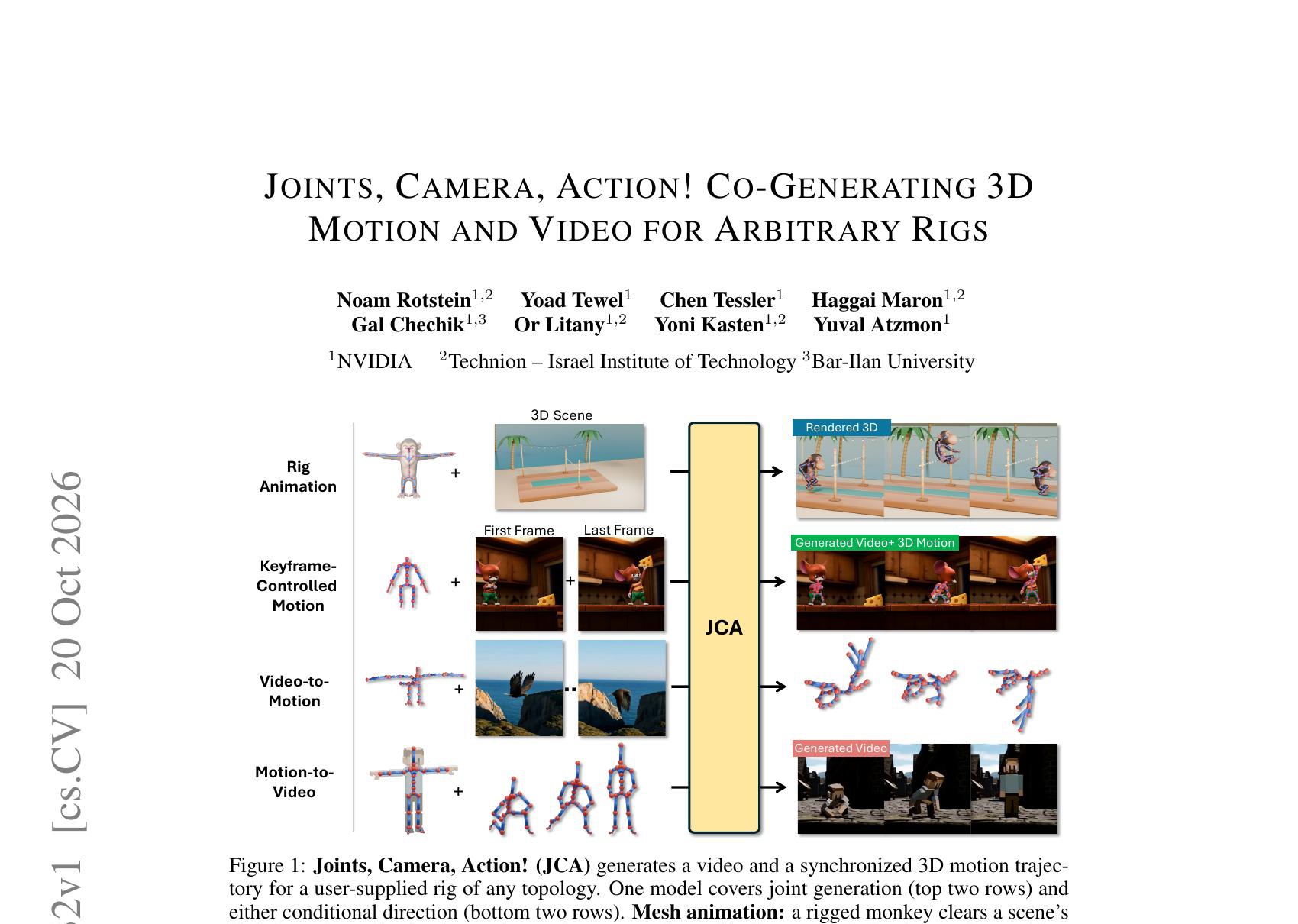
58. Joints, Camera, Action! Co-Generating 3D Motion and Video for Arbitrary Rigs
🔑 Keywords: video generation, 3D motion, cross-attention layers, pretrained video model, generative video editor
💡 Category: Generative Models
🌟 Research Objective:
– To develop a model capable of co-generating realistic video and 3D motion for arbitrary skeletons with scene registration and bidirectional video-motion conversion.
🛠️ Research Methods:
– Utilization of cross-attention layers to connect a 3D motion model with a pretrained video model, allowing separate learning of motion and video parameters.
– Use of a generative video editor to incorporate animated 3D assets into scenes, maintaining valid motions across diverse skeletons.
💬 Research Conclusions:
– The proposed model offers more accurate animation of diverse rigs from text compared to traditional video-first approaches and is responsive to the surrounding scene.
– It facilitates conversion between video and rig motion, enabling keyframe-based control over 3D motion, enhancing its applicability and control in various animation scenarios.
👉 Paper link: https://huggingface.co/papers/2610.28632
59. SWIFT: Self-guided Weak-to-strong dIFfusion models via Target extrapolation
🔑 Keywords: Swift, diffusion models, self-guided training, weak denoiser, FID
💡 Category: Generative Models
🌟 Research Objective:
– The objective is to introduce Swift, a method that improves diffusion model training by using a frozen weak denoiser to enhance a stronger model, minimizing training error and cost without adding inference overhead.
🛠️ Research Methods:
– Swift employs target extrapolation by using the prediction of a weak denoiser as a starting point and enhances underfit components without requiring backpropagation. It uses spectral analysis of gradient flow within an RKHS to support its methodology.
💬 Research Conclusions:
– Experiments on datasets like CIFAR-10 and ImageNet-256 demonstrate Swift’s capability to outperform traditional methods by reducing the necessary computational resources by around half while achieving lower FID scores, thus proving the effectiveness of target extrapolation in diffusion model training.
👉 Paper link: https://huggingface.co/papers/2610.25844
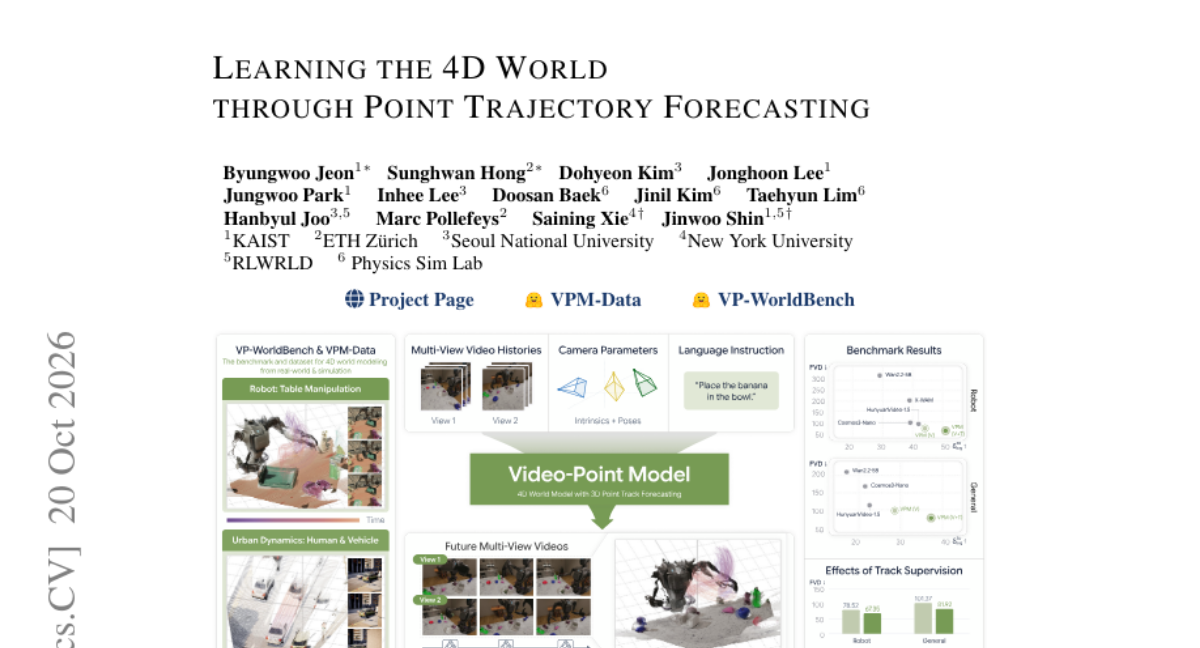
60. Learning the 4D World through Point Trajectory Forecasting
🔑 Keywords: Video-Point Model, 3D aware representations, multi-view video, robot control, point supervision
💡 Category: Robotics and Autonomous Systems
🌟 Research Objective:
– The objective is to enhance forecasting and robot control using the Video-Point Model by jointly predicting future multi-view videos and 3D point trajectories from video histories and language instructions.
🛠️ Research Methods:
– The study introduces a world model extended with camera-conditioned multi-view processing and a trajectory head to predict 3D motion, supported by a simulation corpus and forecasting benchmark for training and evaluation.
💬 Research Conclusions:
– The Video-Point Model with point supervision improves video fidelity and 3D motion accuracy on benchmarks and enhances manipulation success in both simulated and real-robot experiments.
👉 Paper link: https://huggingface.co/papers/2610.28594
61. VLA-Rolling: Fewer Denoising Steps, Better Control via Adaptive Action Reuse
🔑 Keywords: VLA-Rolling, vision-language-action, denoising, action tail, efficiency
💡 Category: Reinforcement Learning
🌟 Research Objective:
– To improve the efficiency of Vision-Language-Action (VLA) models by reusing discarded action tails with adaptive denoising budgets, ultimately reducing inference cost and boosting success rates.
🛠️ Research Methods:
– Introduction of VLA-Rolling, a lightweight inference framework that leverages action-tail inheritance, per-action confidence estimation, and confidence-guided refinement with renoising and denoising budget allocation.
💬 Research Conclusions:
– VLA-Rolling demonstrates reduced action-chunk inference cost and improved success rates across multiple model-benchmark pairs, proving that action tails are reusable and enhance model efficiency and accuracy.
👉 Paper link: https://huggingface.co/papers/2610.25043
62. Sage-A1.5: From Long-Horizon Execution to Scientific Exploration with Capability Composition
🔑 Keywords: Mixture-of-Experts, agentic model, agentic orchestration, verification, open scientific discovery
💡 Category: AI Systems and Tools
🌟 Research Objective:
– The objective is to enhance long-horizon problem solving through adaptive task delegation, verification, and open scientific exploration using Sage-A1.5.
🛠️ Research Methods:
– The model employs agentic orchestration for task delegation and parallel sub-agent collaboration, along with agentic verification for reliability and progress checking, and supports open scientific discovery through exploratory research.
💬 Research Conclusions:
– Sage-A1.5 effectively organizes, verifies, and explores scientific tasks, providing a strong foundation for collaborative and verifiable scientific exploration in complex, multidisciplinary applications.
👉 Paper link: https://huggingface.co/papers/2610.28578
63. PAR: Progress-Aligned Recurrence for Length Generalization in State Tracking
🔑 Keywords: Progress-Aligned Recurrence, Looped Language Models, Sequential State Tracking, Extrapolation, Intermediate Predictions
💡 Category: Natural Language Processing
🌟 Research Objective:
– The study introduces Progress-Aligned Recurrence to enhance looped language models for better length extrapolation in sequential tracking tasks.
🛠️ Research Methods:
– Trains prediction at iteration k to match the state after the first k operations and rescales recurrent states to first-iteration norms.
– Utilizes a Qwen2.5-0.5B model demonstrating significant extrapolation improvements on tasks like swap-S_5.
💬 Research Conclusions:
– Achieved 95.5% accuracy at extended moves, significantly exceeding traditional methods.
– Highlights the importance of intermediate predictions and state scaling to enhance model depth usefulness for solving longer sequential tasks.
👉 Paper link: https://huggingface.co/papers/2610.27628

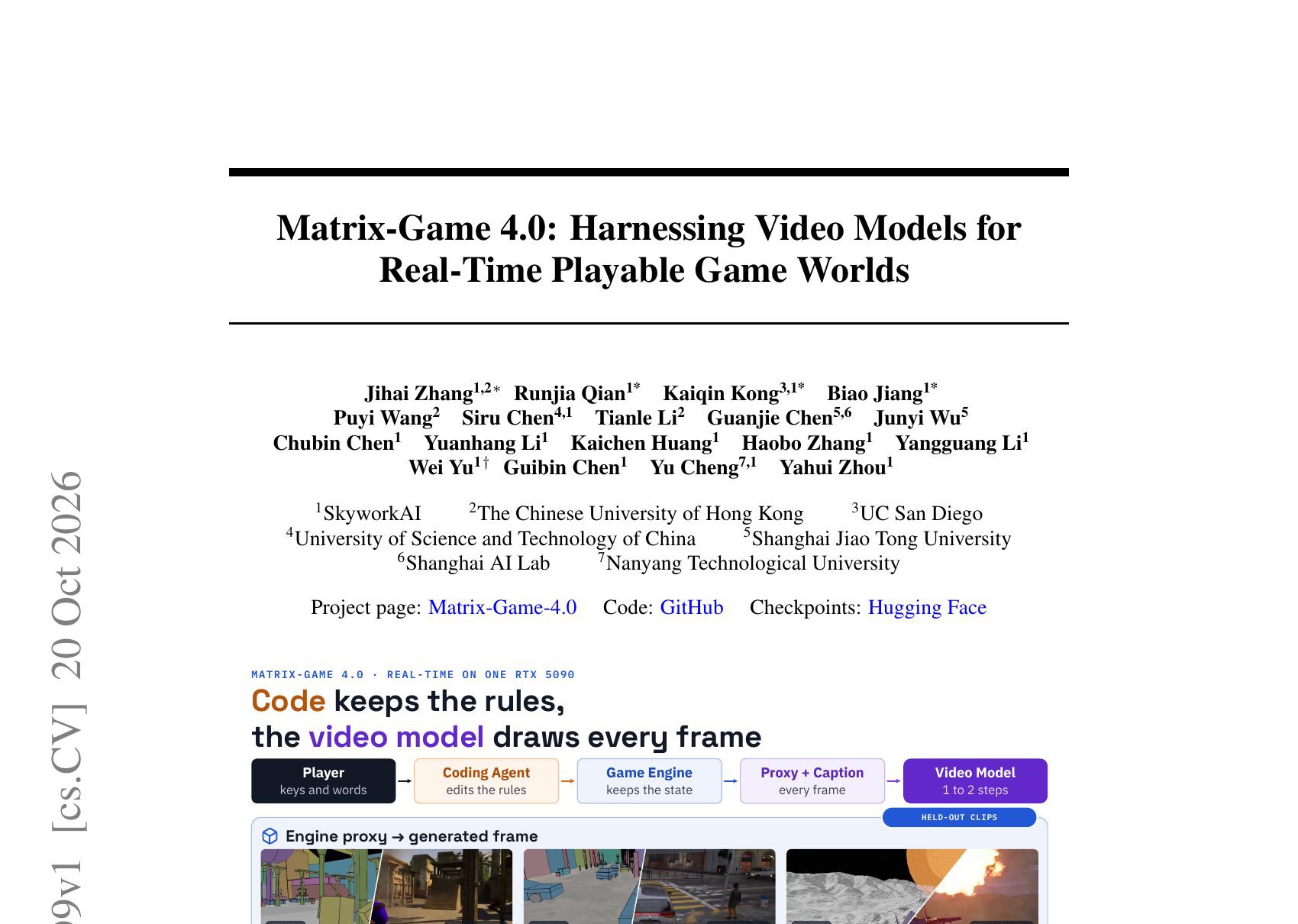
64. Matrix-Game 4.0: Harnessing Video Models for Real-Time Playable Game Worlds
🔑 Keywords: Matrix-Game 4.0, executable game harness, multimodal coding agent, autoregressive video model, real-time interactive gameplay
💡 Category: AI Systems and Tools
🌟 Research Objective:
– To develop a system that separates game execution from visual generation, enabling real-time interactive gameplay with low latency through Matrix-Game 4.0.
🛠️ Research Methods:
– A lightweight game engine maintains world state and executes interaction rules.
– A multimodal coding agent translates player ideas into game code and captions, while an autoregressive video renderer transforms low-poly proxies into detailed visuals.
💬 Research Conclusions:
– Matrix-Game 4.0 achieved 480p, 60 FPS gameplay with low latency on a single NVIDIA RTX5090, supporting further research and the creation of customizable shooter and driving games.
👉 Paper link: https://huggingface.co/papers/2610.27999