AI Native Daily Paper Digest – 20261026 – HiSTEVE | RynnUnify

Today’s digest highlights advancements from key players like Gemma and Qwen, showcasing their impact in the realm of multimodal reasoning. The featured papers delve into innovative methods for optimizing long-context attention mechanisms and explore the integration of agentic systems into existing AI frameworks. One study reports a 15% increase in processing efficiency using the new Q-Attention technique, setting a benchmark for future research. Another paper demonstrates a significant improvement in GPT architectures by incorporating context-aware embeddings, leading to a more nuanced understanding of data inputs.
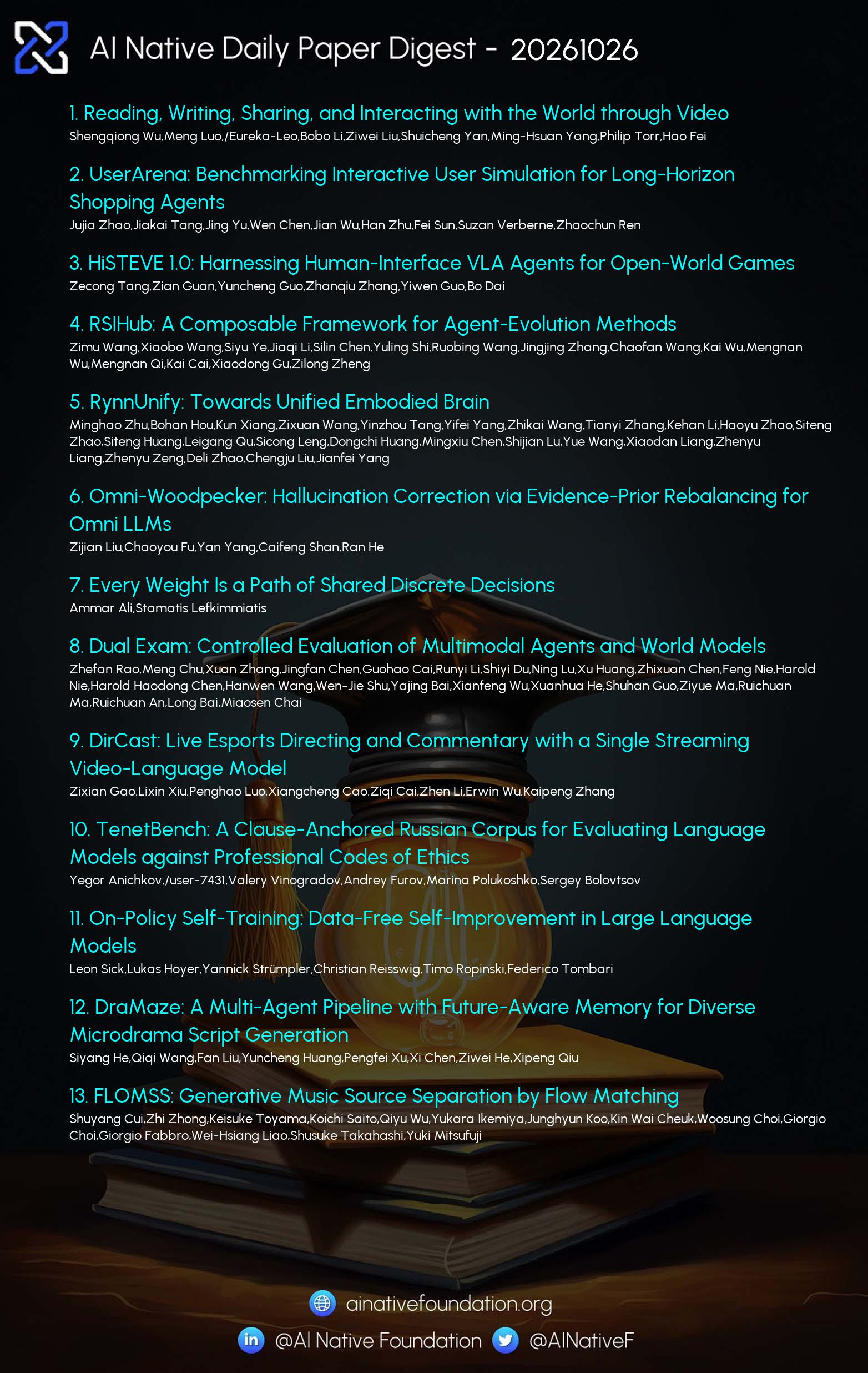
1. HiSTEVE 1.0: Harnessing Human-Interface VLA Agents for Open-World Games
🔑 Keywords: HiSTEVE, Vision-Language-Action, Native Keyboard-and-Mouse Control, Long-Horizon Autonomy, Minecraft
💡 Category: Reinforcement Learning
🌟 Research Objective:
– Develop an advanced agent, HiSTEVE, capable of executing complex open-ended tasks in Minecraft through a combination of long-horizon planning and native keyboard-and-mouse control.
🛠️ Research Methods:
– Implementation of a hierarchical VLA agent utilizing structured memory and a VLM planner for subtasks, along with techniques like world knowledge injection and imitation learning.
💬 Research Conclusions:
– HiSTEVE demonstrates superior performance in atomic-task execution and the completion of long-horizon tasks in Minecraft, achieving high success rates and replicating human-like task completion behavior.
👉 Paper link: https://huggingface.co/papers/2610.31162

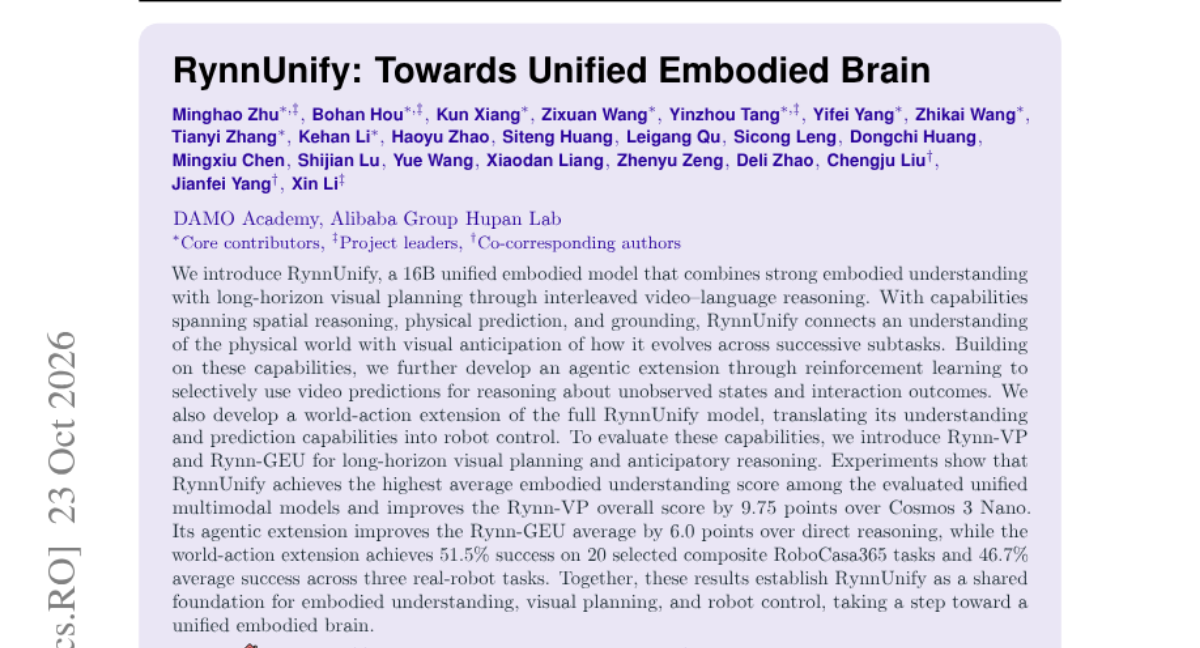
2. RynnUnify: Towards Unified Embodied Brain
🔑 Keywords: RynnUnify, Unified Embodied Model, Long-Horizon Visual Planning, Robot Control, Reinforcement Learning
💡 Category: Robotics and Autonomous Systems
🌟 Research Objective:
– Introduce RynnUnify, a 16B unified embodied model, for enhanced visual planning, physical reasoning, and robot control on long-horizon tasks.
🛠️ Research Methods:
– Use of interleaved video-language reasoning for spatial and physical prediction.
– Development of an agentic and world-action extension for improved understanding and prediction in robot control.
💬 Research Conclusions:
– RynnUnify achieves state-of-the-art results in embodied understanding and improves visual planning scores significantly over Cosmos 3 Nano.
– Demonstrates high success rates in RoboCasa365 tasks and real-robot tasks, establishing its role as a foundational model for embodied AI.
👉 Paper link: https://huggingface.co/papers/2610.32965
3. Every Weight Is a Path of Shared Discrete Decisions
🔑 Keywords: TWIG, neural network, compression, Boltzmann machine, quantum optimizers
💡 Category: Machine Learning
🌟 Research Objective:
– Introduce TWIG, a method where neural network weights are represented as shared discrete decision paths for efficient compression and fixed-weight circuits.
🛠️ Research Methods:
– Utilize tree-structured representation of weights allowing shared upper path decisions, optimizing circuits with discrete choices.
– Utilize ground-state problem of a higher-order Boltzmann machine to select decisions.
💬 Research Conclusions:
– Demonstrates that TWIG reduces the need for additions in circuit implementations compared to GPTQ, achieving efficient weight representation with fewer errors.
👉 Paper link: https://huggingface.co/papers/2610.31931

4. DirCast: Live Esports Directing and Commentary with a Single Streaming Video-Language Model
🔑 Keywords: DirCast, Streaming video language model, live broadcast production, commentary, Dota 2
💡 Category: Multi-Modal Learning
🌟 Research Objective:
– The study introduces DirCast, a streaming video language model, designed to direct and generate commentary for live esports broadcasts, performing both roles simultaneously.
🛠️ Research Methods:
– DirCast analyzes all player cameras in low resolution every second, deciding on camera cuts with a hold-or-switch director algorithm, then selects the chosen camera at high resolution for commentary.
– It uses a dataset of 27 professional Dota 2 matches, capturing camera feeds for every hero and accompanying director and caster decisions.
💬 Research Conclusions:
– DirCast surpasses rule-based and zero-shot directors, including GPT-5, in directing capabilities.
– Its commentary quality outperforms streaming commentators, winning 29.2% of comparisons to GPT-4o under the Proact-VL protocol, compared to 19.4% for the strongest human broadcasters.
👉 Paper link: https://huggingface.co/papers/2610.31734

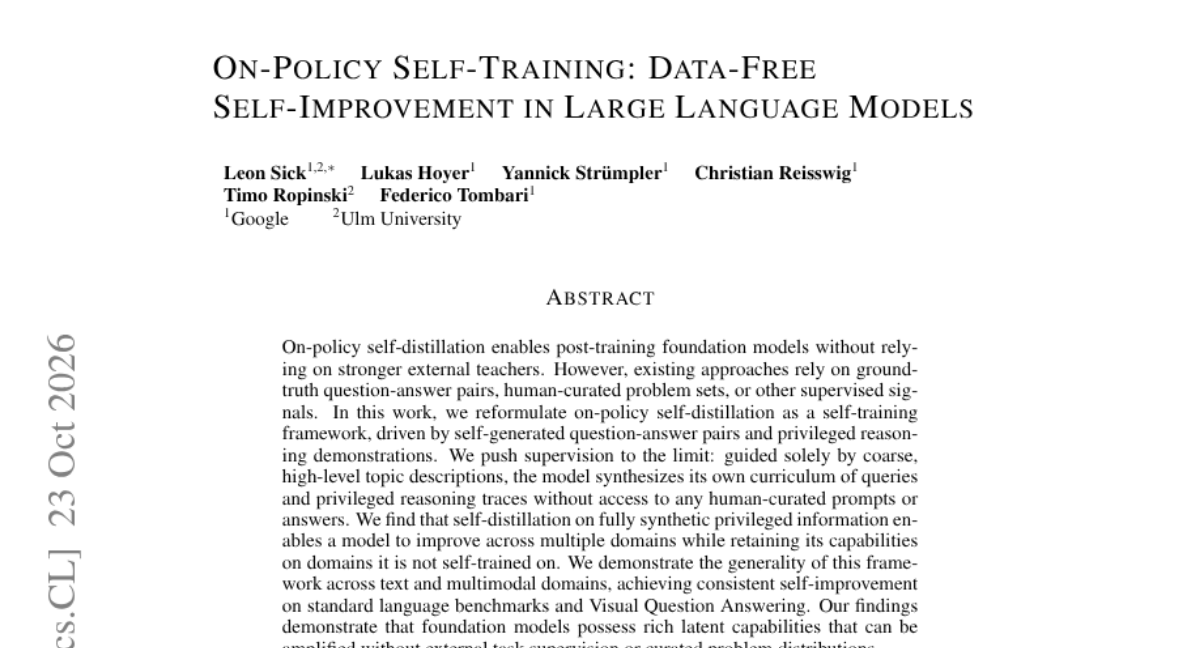
5. On-Policy Self-Training: Data-Free Self-Improvement in Large Language Models
🔑 Keywords: Foundation Models, On-policy Self-distillation, Synthetic Question Generation, Self-training, Multimodal Learning
💡 Category: Foundations of AI
🌟 Research Objective:
– To reformulate on-policy self-distillation through a self-training framework utilizing self-generated question-answer pairs and privileged reasoning demonstrations, eliminating the need for external supervision.
🛠️ Research Methods:
– Employed self-generated curriculum using high-level topic descriptions without human-curated prompts to synthesize queries and reasoning traces.
💬 Research Conclusions:
– Demonstrated that foundation models can improve across multiple domains using fully synthetic privileged information, showcasing their latent capabilities without needing human-curated data or task supervision.
👉 Paper link: https://huggingface.co/papers/2610.32770
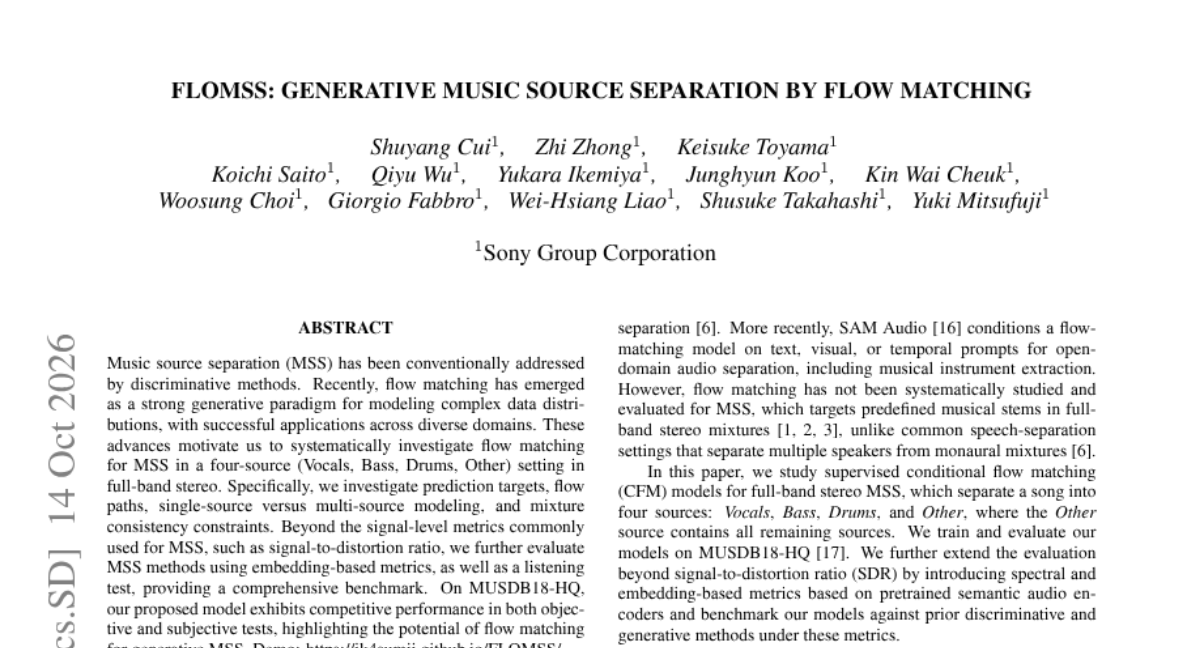
6. FLOMSS: Generative Music Source Separation by Flow Matching
🔑 Keywords: Flow matching, Music source separation, Generative MSS, Prediction targets, Signal-to-distortion ratio
💡 Category: Generative Models
🌟 Research Objective:
– To investigate the effectiveness of flow matching for four-source full-band stereo music separation.
🛠️ Research Methods:
– Exploring prediction targets, flow paths, modeling strategies, and consistency constraints with both signal-level and perceptual metrics.
– Evaluation using conventional signal-level metrics and embedding-based metrics, alongside a listening test.
💬 Research Conclusions:
– The proposed model demonstrates competitive performance on MUSDB18-HQ through both objective and subjective assessments, showcasing the potential of flow matching as a generative approach for music source separation.
👉 Paper link: https://huggingface.co/papers/2610.17821
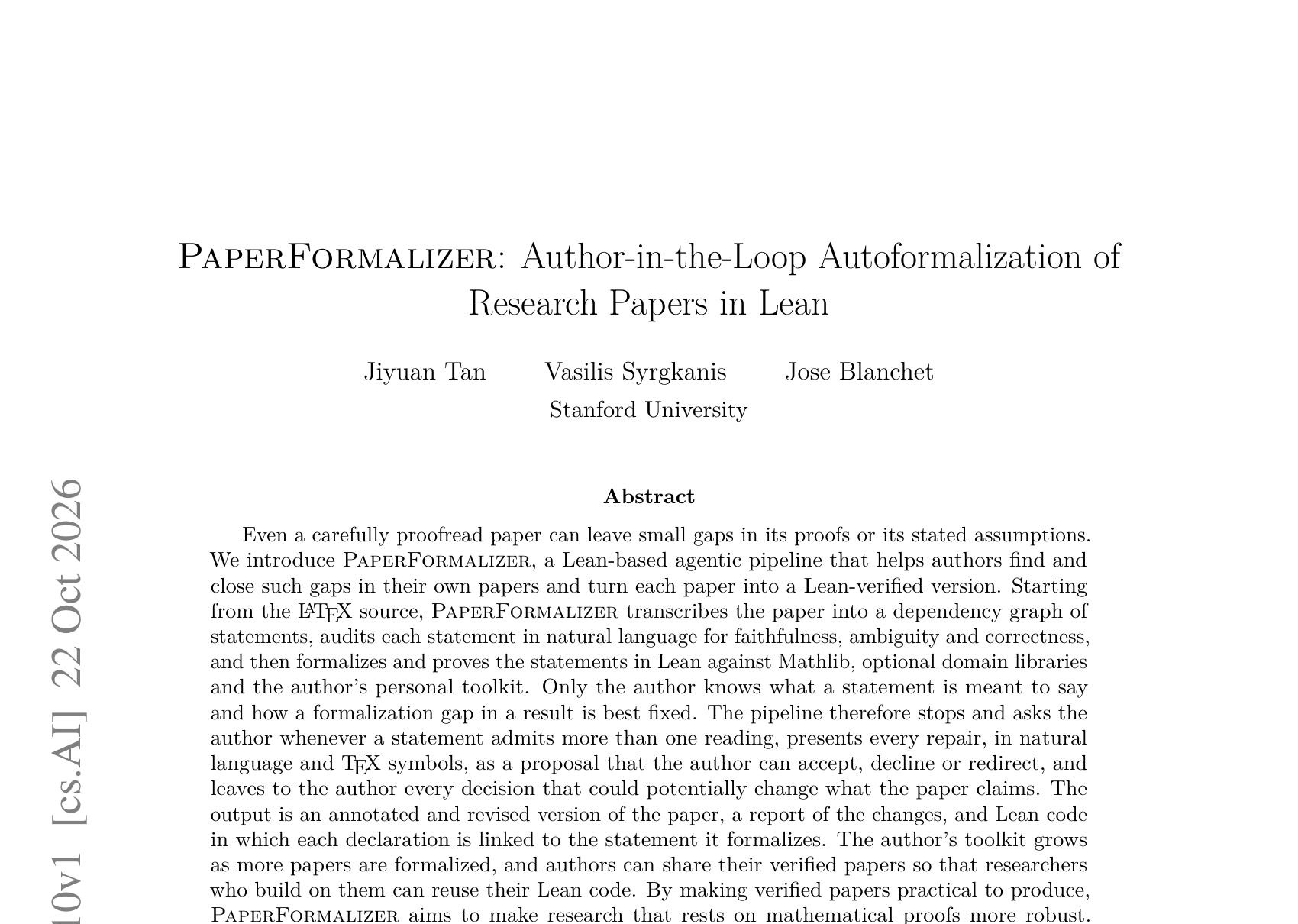
7. PaperFormalizer: Author-in-the-Loop Autoformalization of Research Papers in Lean
🔑 Keywords: Lean-based, PaperFormalizer, Mathematical Proofs, Dependency Graph
💡 Category: AI Systems and Tools
🌟 Research Objective:
– The study introduces PaperFormalizer, an AI tool designed to help authors find and close gaps in mathematical proofs within academic papers, leading to Lean-verified versions.
🛠️ Research Methods:
– The process starts with transcribing LaTeX source documents into a dependency graph. Each statement is audited for faithfulness, ambiguity, and correctness and then formalized using Lean against Mathlib and pertinent libraries. Authors interact with the tool to resolve ambiguities and decide on final outputs.
💬 Research Conclusions:
– PaperFormalizer produces an annotated, revised paper alongside Lean code linking each declaration to its statement. This tool enhances the robustness of research based on mathematical proofs and allows authors to share verified papers for further reuse in new research projects.
👉 Paper link: https://huggingface.co/papers/2610.31810
8. MultiAgent-OPD: End-to-End Training of Hierarchical Multi-Agent Systems with On-Policy Distillation
🔑 Keywords: MultiAgent-OPD, hierarchical multi-agent system, on-policy distillation, reinforcement learning, process supervision
💡 Category: Reinforcement Learning
🌟 Research Objective:
– The research aims to improve end-to-end performance in hierarchical multi-agent systems by jointly training a team using MultiAgent-OPD integrating on-policy distillation and reinforcement learning.
🛠️ Research Methods:
– A Leader-Searcher-Answerer team is trained end to end using a frozen teacher for local process supervision. The system is evaluated across seven datasets, providing supervision through feedback on search and summary outputs.
💬 Research Conclusions:
– The proposed system achieves a 38.68% macro avg@4, surpassing existing systems such as Prompted Critic by 4.06 percentage points and C-MAS + RL by 2.61 percentage points, effectively solving more questions within fewer attempts.
👉 Paper link: https://huggingface.co/papers/2610.23234

9. DISC: Domain-Integrated Similarity Cost for Time-Series Dataset
🔑 Keywords: DISC, time-series datasets, similarity metrics, transfer performance, calibration transfer
💡 Category: Machine Learning
🌟 Research Objective:
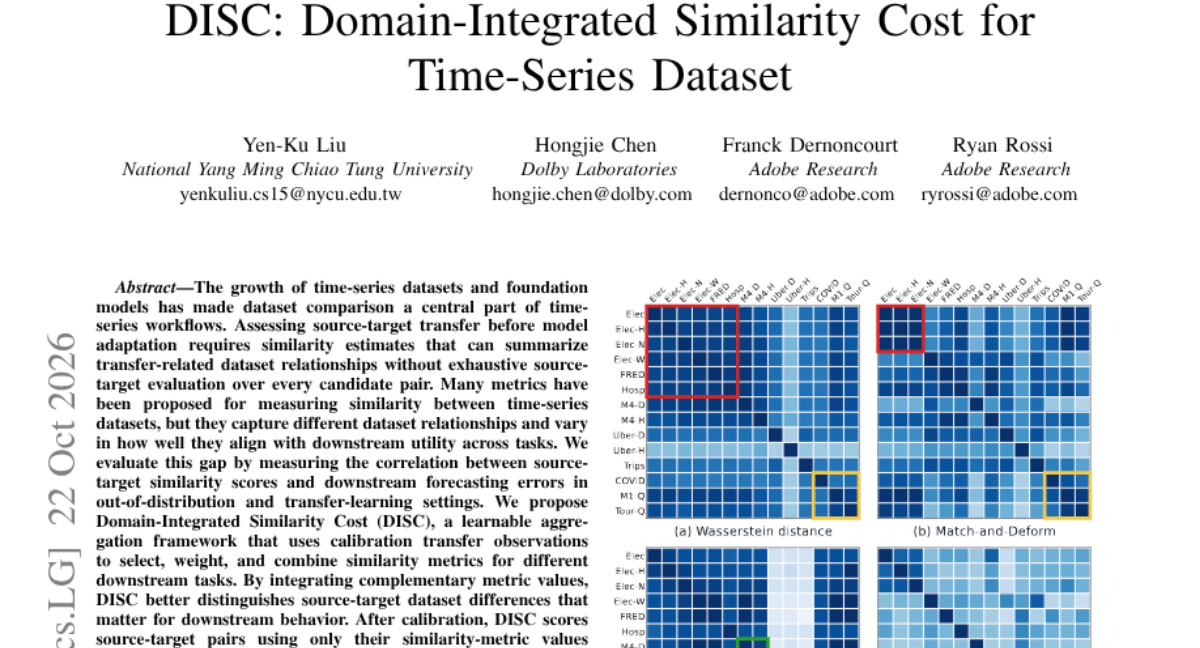
– To develop DISC, a learnable framework that effectively calibrates and combines time-series dataset similarity metrics to enhance the predictability of downstream forecasting transfer performance.
🛠️ Research Methods:
– Evaluation of gaps by measuring the correlation between source-target similarity scores and downstream forecasting errors in various environments. Use of DISC to integrate and optimize disjoint metric values for better alignment.
💬 Research Conclusions:
– DISC provides superior alignment compared to single-metric references by integrating metric values, demonstrating that learned metric integration is more effective for predicting downstream transfer behavior than manual metric selection.
👉 Paper link: https://huggingface.co/papers/2610.31288
10. Speculative Diffusion is a Tale of Two Tradeoffs
🔑 Keywords: Speculative Decoding, Diffusion Models, Autoregressive Large Language Models, Speed-Quality Pareto Frontier
💡 Category: Natural Language Processing
🌟 Research Objective:
– The paper aims to extend the speed-quality Pareto frontier in speculative decoding by jointly adjusting diffusion effort and acceptance leniency.
🛠️ Research Methods:
– The study investigates speculative decoding techniques for autoregressive LLMs using a faster, lower quality draft model and explores variations in diffusion effort and acceptance criteria.
💬 Research Conclusions:
– The research demonstrates that by jointly varying diffusion effort and acceptance leniency, it is possible to enhance the speed-quality trade-off in speculative decoding compared to single-step diffusion drafting.
👉 Paper link: https://huggingface.co/papers/2610.31819
11. DuoLM: Fast and Effective Personalized Recommendation with Language Models
🔑 Keywords: DuoLM, personalized recommendation, encoder LLM, personalized ranker LLM, inference optimization
💡 Category: AI Systems and Tools
🌟 Research Objective:
– To develop an efficient framework, DuoLM, for fast and effective personalized recommendations with high throughput and minimal quality loss.
🛠️ Research Methods:
– Utilization of a compact recommendation model integrating an encoder LLM for item representations and a personalized ranker LLM for combining user history and feedback. The system employs recommendation supervision, teacher distillation, virtual token IDs, shared history computation, and CUDA Graph replay for optimizing inference.
💬 Research Conclusions:
– The DuoLM framework achieves recommendation quality comparable to an expert teacher model while delivering significantly higher throughput, approximately 26,400 candidate scores per second on a single H100 GPU.
👉 Paper link: https://huggingface.co/papers/2610.24481
12. Echo: Coupled Action and Task Status Signal Denoising for Vision Language Action Models
🔑 Keywords: Vision Language Action, task status signals, failure signal, action generation, recovery trajectories
💡 Category: Robotics and Autonomous Systems
🌟 Research Objective:
– To develop Echo, a framework that integrates task status signals, specifically stop and failure signals, into a Vision Language Action (VLA) model to enhance robotic execution and recovery.
🛠️ Research Methods:
– Construction of task trajectories (successful, failed, and recovery) to learn signals without fine-grained progress annotations.
– Integration of status signals with action generation within a single VLA model, featuring a compact design and efficient signal denoising.
💬 Research Conclusions:
– Echo successfully predicts task status and improves policy performance, validated through real-world manipulation experiments demonstrating its efficacy in guiding robotic actions.
👉 Paper link: https://huggingface.co/papers/2610.31569

13. HoloBoxing: A Simple Recipe for Humanoid Boxing with 7 Minutes of Single-GPU Training
🔑 Keywords: HoloBoxing, humanoid boxing, reinforcement learning, whole-body controller, imitation initialization
💡 Category: Reinforcement Learning
🌟 Research Objective:
– HoloBoxing aims to learn humanoid boxing efficiently by integrating a frozen whole-body controller with a compact planner for predicting body-point targets.
🛠️ Research Methods:
– Utilizes imitation initialization and reinforcement learning to refine interactions with minimal additional training, starting from a pretrained controller.
💬 Research Conclusions:
– This method effectively segregates reusable motor skills from task decisions and facilitates task optimization without relearning whole-body control.
👉 Paper link: https://huggingface.co/papers/2610.32909

14. JockeyBench: Evaluating LLM Agents on Horse-Racing Decision-Making
🔑 Keywords: Repeated event forecasting, JockeyBench, LLM-written predictor, capped-Kelly settlement, mean probability bias
💡 Category: AI Systems and Tools
🌟 Research Objective:
– To evaluate the efficiency of reusable predictors and various configurations in repeated event forecasting through a historical Japanese horse racing framework.
🛠️ Research Methods:
– Introduction of JockeyBench, a benchmark and evaluation protocol for extracting predictive signals and assessing retrodictive value using workflows with LLM-written predictors.
💬 Research Conclusions:
– Despite improvements in forecast quality through certain configurations, all setups result in negative average betting returns, with a noted discrepancy in mean betting profits between workflows and a revelation of probability bias reversal.
👉 Paper link: https://huggingface.co/papers/2610.19589

15. Co-adaptive Rule Routing and Constraining for Structured Knowledge Retrieval
🔑 Keywords: CoRE, Structured Knowledge Retrieval, Reasoning Rules, Reinforcement Learning, Contrastive Learning
💡 Category: Knowledge Representation and Reasoning
🌟 Research Objective:
– The research aims to develop Co-Adaptive Rule Routing and Constraining Retrieval (CoRE), which jointly learns reasoning rules and evidence retrieval without predefined query-rule supervision.
🛠️ Research Methods:
– CoRE uses a closed-loop process alternating between reinforcement learning for routing policy and contrastive learning for rule-constrained evidence retrieval.
💬 Research Conclusions:
– CoRE’s effectiveness is demonstrated on STaRK-QA datasets in scientific discovery, biomedical reasoning, and e-commerce knowledge management, highlighting the benefits of co-adapting the router and retriever.
👉 Paper link: https://huggingface.co/papers/2610.14465
16. Does LeWorldModel Preserve Local Action Geometry?
🔑 Keywords: LeWorldModel, Action Sensitivity, Gram matrices, Perturbation scales, Scale-specific evaluation
💡 Category: Reinforcement Learning
🌟 Research Objective:
– To evaluate how the pretrained LeWorldModel reproduces effects of small action changes using Gram matrices across different perturbation scales.
🛠️ Research Methods:
– Utilize matched simulator and model responses to measure action sensitivity with Gram matrices at three perturbation scales.
– Investigate nearly a thousand states from Reacher and OGBench Cube.
💬 Research Conclusions:
– Most sensitive action directions differ by median angles significantly, and increasing perturbation scales results in reduced median normalized Gram discrepancies.
– Geometry in pixels and embeddings varies more across scales than physical-state geometry, with error rates differing across models.
– Findings support scale-specific evaluation of action sensitivity, though its effect on control remains an open question.
👉 Paper link: https://huggingface.co/papers/2610.31716

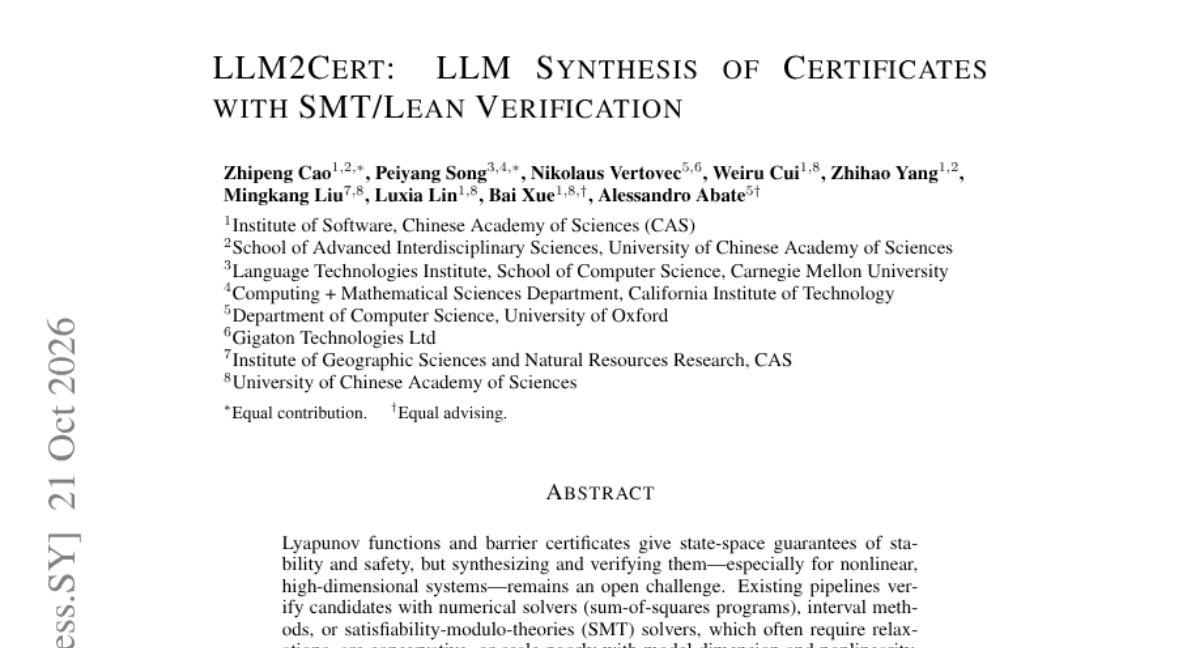
17. LLM2Cert: LLM Synthesis of Certificates with SMT/Lean Verification
🔑 Keywords: LLM-driven framework, SMT solvers, nonlinear dynamical systems, Lyapunov functions, barrier certificates
💡 Category: Knowledge Representation and Reasoning
🌟 Research Objective:
– The study aims to improve the verification of stability and safety certificates in nonlinear dynamical systems using an LLM-driven framework and benchmark.
🛠️ Research Methods:
– The research introduced DynaCertBench, a comprehensive benchmark with 105 nonlinear dynamical system instances, and the LLM2Cert framework that uses SMT solvers and Lean Proof-Repair agents for verification tasks.
💬 Research Conclusions:
– LLM2Cert demonstrated a 17.1 percentage point improvement, successfully verifying 77.1% of the test instances, resolving several cases that traditional methods could not.
👉 Paper link: https://huggingface.co/papers/2610.30524
18. The fixed-point bundle method over product-of-simplex domains arising from game equilibria
🔑 Keywords: Nash equilibrium, fixed-point bundle framework, variational inequalities, product-of-simplex domains, global convergence
💡 Category: Knowledge Representation and Reasoning
🌟 Research Objective:
– To extend the fixed-point bundle framework for finite-dimensional variational inequalities from simplex domains to product-of-simplex domains, enabling Nash equilibrium computation with global asymptotic convergence guarantees.
🛠️ Research Methods:
– Utilization of geometric equivalence to construct an equivalent VI on a simplex, establish equivalence via fiber bundle isomorphism, and develop a globally convergent path-following algorithm for VIs on product-of-simplex domains.
💬 Research Conclusions:
– The proposed algorithm achieves global linear convergence, demonstrated by attaining a precision of 10^{-5} on 5600 randomly generated game instances ranging from 2-player 128-action to 128-player 2-action.
👉 Paper link: https://huggingface.co/papers/2609.16158

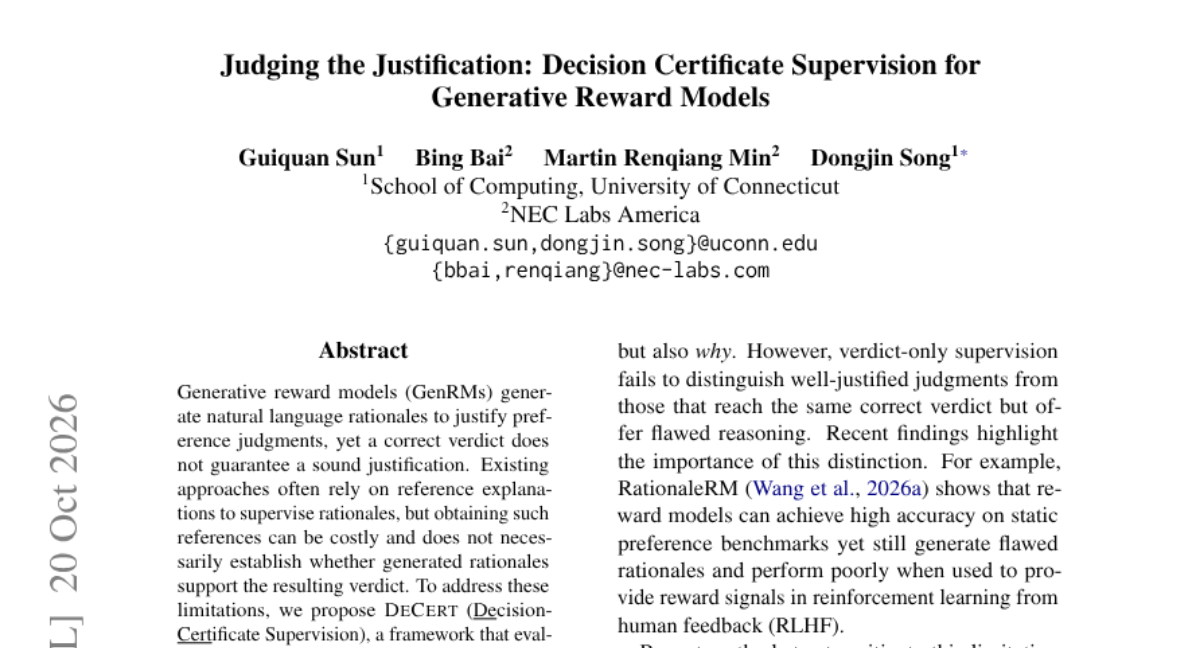
19. Judging the Justification: Decision Certificate Supervision for Generative Reward Models
🔑 Keywords: Generative reward models, DeCert, rationale preference pairs, justification quality, positional bias
💡 Category: Generative Models
🌟 Research Objective:
– To evaluate and improve the rationales generated by Generative reward models by assessing their justification validity and verdict consistency without relying on costly reference explanations.
🛠️ Research Methods:
– DeCert framework evaluates the quality of generated rationales by forming rationale preference pairs from sampled judgments, focusing on verdict correctness and justification quality.
💬 Research Conclusions:
– DeCert consistently outperforms strong generative judge baselines, enhances rationale quality, and effectively mitigates positional bias, improving position-consistent accuracy by up to 14.8 points.
👉 Paper link: https://huggingface.co/papers/2610.27528
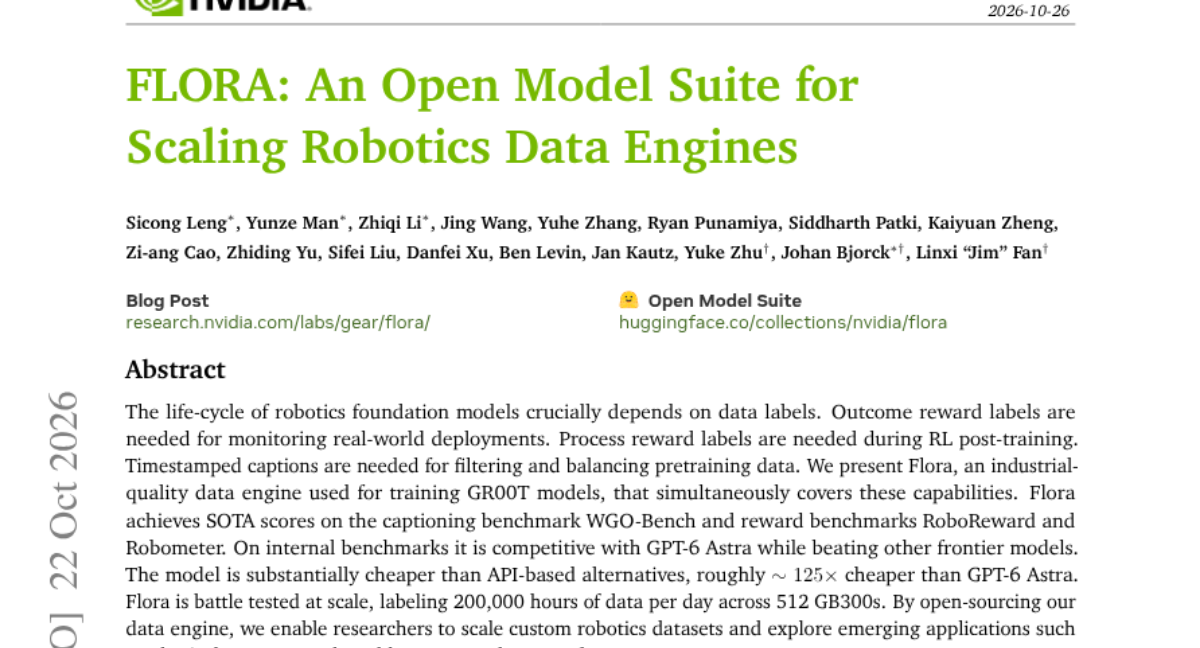
20. FLORA: An Open Model Suite for Scaling Robotics Data Engines
🔑 Keywords: Flora, robotics foundation models, data engine, reward labeling, open-source
💡 Category: Robotics and Autonomous Systems
🌟 Research Objective:
– Develop an open-source data engine, Flora, to advance the training of robotics foundation models with efficient and high-accuracy pretraining data curation.
🛠️ Research Methods:
– Utilize Flora to provide capabilities for captioning, outcome and process reward labeling, which are essential for monitoring real-world deployments and RL post-training.
💬 Research Conclusions:
– Flora delivers state-of-the-art performance on benchmarks, is significantly cost-effective compared to API-based solutions like GPT-6 Astra, and facilitates large-scale data labeling and emerging application exploration.
👉 Paper link: https://huggingface.co/papers/2610.31779
21.
22. FocusVLA: Future-Intent Guided Dynamic View Routing for Vision-Language-Action Models
🔑 Keywords: Vision-Language-Action (VLA), Multi-View Routing, FocusVLA, Robotic Manipulation, Dynamic View Routing
💡 Category: Robotics and Autonomous Systems
🌟 Research Objective:
– To enhance robotic manipulation by dynamically routing between global and local camera views according to predicted interaction intent throughout task stages.
🛠️ Research Methods:
– Implementation of FocusVLA, which predicts future interaction intent using historical actions and dynamically coordinates multi-view inputs during action generation.
💬 Research Conclusions:
– FocusVLA significantly improves multi-view utilization, increasing the success rate on RoboTwin 2.0 by 10.10 pp over the strongest baseline and raising real-world evaluation success from 71.7% to 85.0%, showing a 13.3% improvement. Furthermore, its modules can be integrated into existing VLA frameworks without changing their core architectures.
👉 Paper link: https://huggingface.co/papers/2610.31423

23. On the Token Collapse Phenomenon in Textual Graph Soft Prompting
🔑 Keywords: Token Collapse, Graph Soft Prompting, G-Retriever, Graph Neural Network, Large Language Models
💡 Category: Natural Language Processing
🌟 Research Objective:
– Investigate the issue of token collapse in graph soft prompting within Large Language Models (LLMs) and evaluate graph-token alignment beyond task accuracy.
🛠️ Research Methods:
– Conduct in-depth analysis using benchmarks, graph encoders, different LLM families, frozen and LoRA-adapted models to study G-Retriever’s token behavior and propose a two-stage procedure to address token collapse.
💬 Research Conclusions:
– Discover token collapse in G-Retriever prompting, where graph tokens become indistinguishable, acting as generic prompts rather than conveying relational content. Present evidence of inherited failure in subsequent methods and propose solutions for maintaining token variability and performance.
👉 Paper link: https://huggingface.co/papers/2610.31572
24. Predictive Closure: A Set-Level Characterization of JEPA’s Feature Selection
🔑 Keywords: Joint-embedding predictive architectures, JEPA, Predictive Relationships, Feature Selection, Steering Representations
💡 Category: Foundations of AI
🌟 Research Objective:
– To explore how JEPA feature selection relies on predictive relationships between features, allowing retention of relationally useful features even if they are individually unpredictable.
🛠️ Research Methods:
– Reformulated JEPA training objective to analyze feature selection based on properties of feature sets.
– Conducted controlled experiments to examine how unpredictable features can be better represented by exploiting their predictive relationships with other features.
💬 Research Conclusions:
– Demonstrated that unpredictable features could be retained if they assist in predicting other features, influencing feature representation.
– Indicated that targeting one feature through auxiliary objectives or providing it as side information can indirectly enhance the representation of another feature, emphasizing the ability for indirect steering of representations.
👉 Paper link: https://huggingface.co/papers/2610.27364
25. SliderEdit++: Improved Slider Trajectories in Instruction-Based Image Editing
🔑 Keywords: Slider-based control, continuous controllability, SlideBench, trajectory regularization, disentanglement
💡 Category: Computer Vision
🌟 Research Objective:
– The research aims to improve slider reliability and control in continuous image editing by addressing limitations like abrupt visual jumps and slider interference.
🛠️ Research Methods:
– The introduction of SlideBench as a benchmark and the proposal of SliderEdit++ which uses trajectory regularization and spectral control for smoother and faster slider-based image editing.
💬 Research Conclusions:
– SliderEdit++ significantly enhances state-of-the-art performance on SlideBench, increasing the score by 18.5% over the strongest baseline while achieving up to 20x faster editing speeds compared to existing methods.
👉 Paper link: https://huggingface.co/papers/2610.14253
26. What Git Does Not Record: Provenance Legibility in Two AI-Assisted Research Repositories
🔑 Keywords: AI trailer keys, provenance systems, repository
💡 Category: AI Systems and Tools
🌟 Research Objective:
– The study aims to investigate the visibility and reliability of repository traces in computational research to measure AI involvement, proposing the need for auditable provenance systems.
🛠️ Research Methods:
– The authors audited two single-investigator repositories, analyzing the prescriptive and narrative traces found within a total of 569 commits, to assess AI contributions.
💬 Research Conclusions:
– Significant discrepancies exist in the visibility of AI involvement between different trace types in repositories.
– Traditional repository metrics may be unreliable; thus, a comprehensive provenance claim system is needed to accurately document research processes.
👉 Paper link: https://huggingface.co/papers/2610.28655
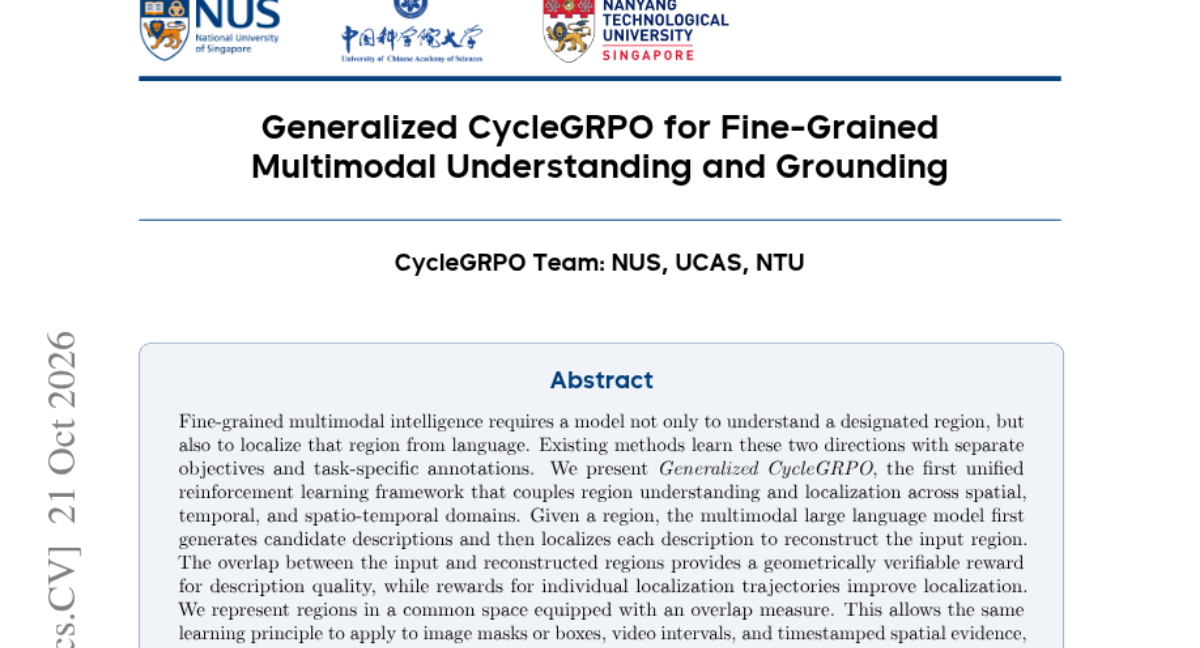
27. How Much Feedback Is Needed to Break Template Protection? The Geometric Vulnerability of Biometric Authentication
🔑 Keywords: Biometric authentication, Template reconstruction, Geometric information, Binary feedback, Diffusion priors
💡 Category: Foundations of AI
🌟 Research Objective:
– The study aims to introduce query-efficient reconstruction attacks on biometric templates using extremely limited binary feedback, addressing key limitations of previous methods.
🛠️ Research Methods:
– The research features a novel attack that explores geometric constraints via authentication success/failure feedback and distribution-aware, query-efficient methods to improve score-releasing systems, incorporating pretrained facial diffusion priors to reduce query numbers significantly.
💬 Research Conclusions:
– The findings highlight a fundamental security limitation in biometric authentication systems, where the process inherently leaks geometric information essential for template reconstruction despite applied protection mechanisms.
👉 Paper link: https://huggingface.co/papers/2610.25118
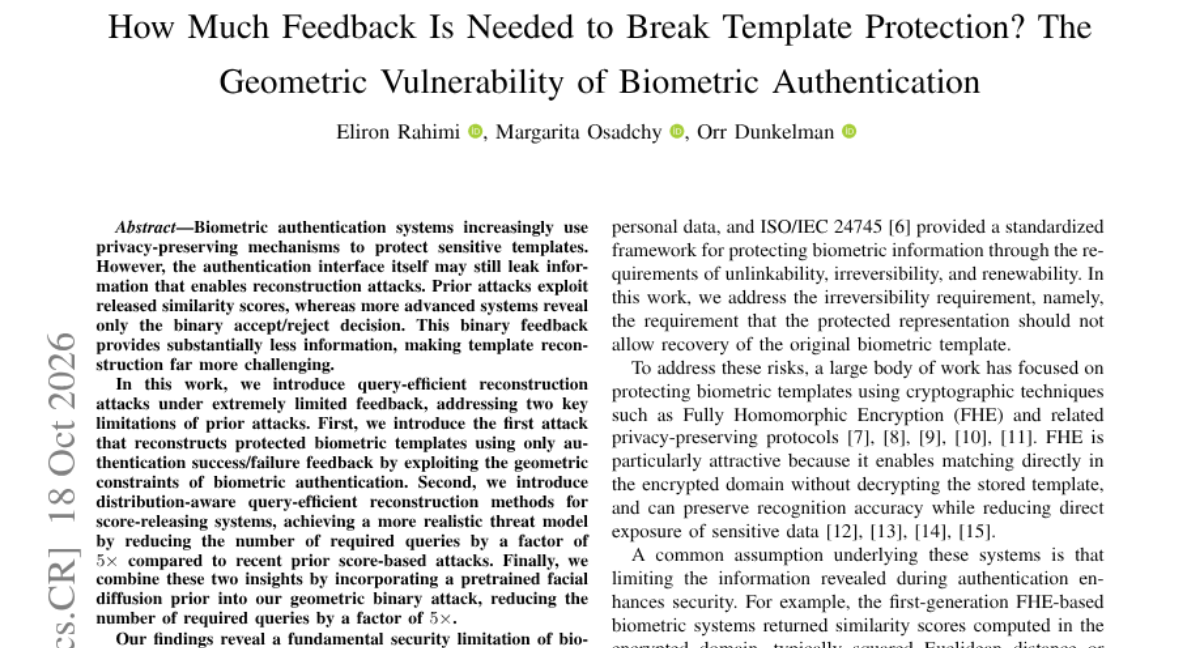
28. A path-following framework on fiber bundle for variational inequalities
🔑 Keywords: Path-following framework, Variational inequalities, Fiber bundle, Global linear convergence, Nonsingular solutions
💡 Category: Foundations of AI
🌟 Research Objective:
– To propose a path-following framework for finite-dimensional variational inequalities (VIs) with continuous mappings on polytope domains.
🛠️ Research Methods:
– Transforming general VIs into smooth VIs on a simplex and utilizing a fixed-point fiber bundle to integrate initialization, path-following, and singularity avoidance.
💬 Research Conclusions:
– The framework ensures global linear convergence for nonsingular solutions and achieves precision of up to 10^{-5} in numerical experiments across large-dimensional instances.
👉 Paper link: https://huggingface.co/papers/2606.00778
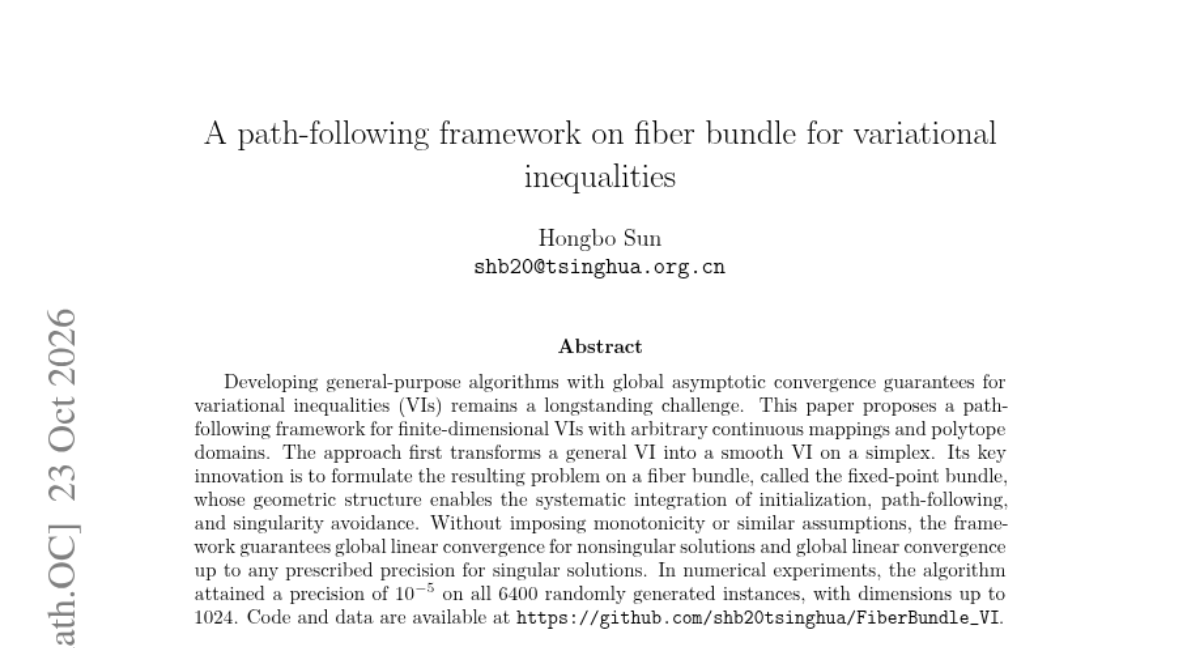
29. KANLab: TensorFlow Playground for Kolmogorov-Arnold Networks
🔑 Keywords: Kolmogorov-Arnold Networks, B-spline activation curves, gradient descent, interactive pruning
💡 Category: AI in Education
🌟 Research Objective:
– KANLab aims to provide an interactive browser tool for teaching the fundamental concepts of Kolmogorov-Arnold Networks by visualizing B-spline activation curves.
🛠️ Research Methods:
– The tool visualizes processes such as gradient descent, pruning in a compact 2D environment, and allows user interaction to modify activation functions and observe learning dynamics.
💬 Research Conclusions:
– KANLab simplifies the complex components of modern Kolmogorov-Arnold Network implementations to enhance educational clarity, making it suitable for educational purposes and it is openly accessible online.
👉 Paper link: https://huggingface.co/papers/2610.20117
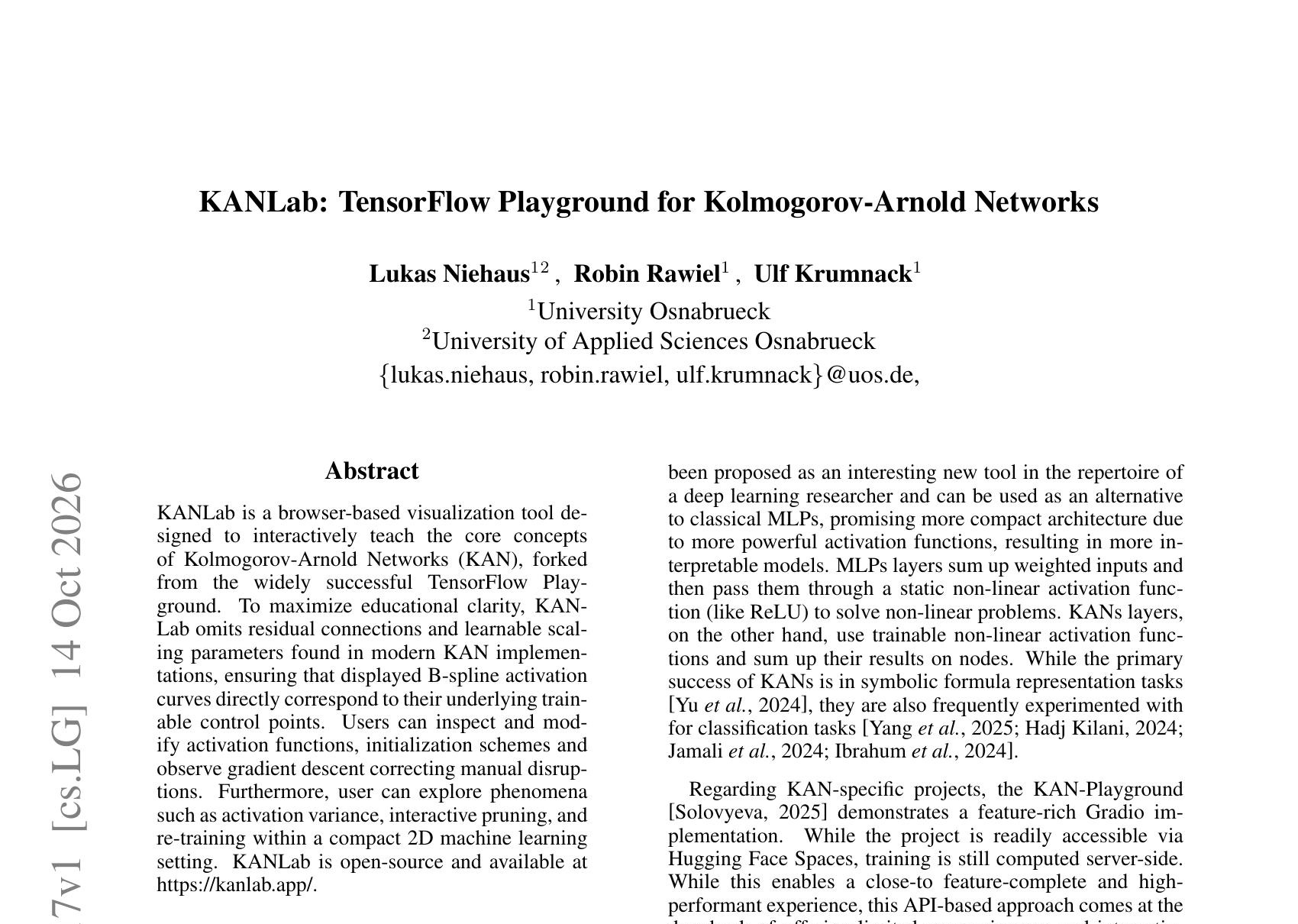
30. Generalized CycleGRPO for Fine-Grained Multimodal Understanding and Grounding
🔑 Keywords: Generalized CycleGRPO, reinforcement learning, multimodal large language model, temporal distinctiveness, region-text cycle consistency
💡 Category: Multi-Modal Learning
🌟 Research Objective:
– The objective of the study is to develop Generalized CycleGRPO, a unified reinforcement learning framework that integrates both region understanding and localization across various domains to enhance grounding and temporal distinctiveness.
🛠️ Research Methods:
– This research employs a novel approach where a multimodal large language model generates candidate descriptions for designated regions, localizes them, and reconstructs the input region. The process includes self-verified cycle consistency without external judges.
💬 Research Conclusions:
– Generalized CycleGRPO achieved significant improvements in grounding tasks, with increased gIoU scores on GroundingSuite and GRES benchmarks, and notable tIoU and Temporal Evidence Coverage enhancements on temporal tasks compared to baseline models.
👉 Paper link: https://huggingface.co/papers/2610.29552
31. LoCA: Enabling Multi-Modality in Geospatial Location Encoders
🔑 Keywords: LoCA, multimodal image encoders, contrastive learning, location encoders, multimodal inputs
💡 Category: Multi-Modal Learning
🌟 Research Objective:
– The study aims to improve geospatial task performance by developing a two-stage pipeline that effectively trains co-aligned multimodal image encoders and employs them as high-rank targets to enhance the training of location and metadata encoders using contrastive learning techniques.
🛠️ Research Methods:
– The research involves a two-stage process where in Stage 1, Sentinel-1 and Sentinel-2 encoders are jointly trained with contrastive learning to create a co-aligned high-rank multimodal target. In Stage 2, these image encoders are frozen, and location and metadata encoders are trained as projection adapters with multi-view contrastive learning.
💬 Research Conclusions:
– The proposed LoCA pipeline outperforms existing methods across 17 geospatial tasks, including land cover and wildfire forecasting, by achieving the most task wins and surpassing all competitors in a majority of per-task comparisons, showing a win rate of 68.8%.
👉 Paper link: https://huggingface.co/papers/2610.32894
32. RoboJudge: Multimodal Language Models as Judges for Embodied Video Generation
🔑 Keywords: AI Native, Multimodal large language models, Physical Adherence, Instruction Alignment, Video Generation
💡 Category: Multi-Modal Learning
🌟 Research Objective:
– The study introduces a benchmark and dataset, RoboJudge-Bench, to evaluate Multimodal large language models as judges for physically valid and instruction-aligned embodied video generation.
🛠️ Research Methods:
– Researchers utilized a dataset, RoboJudge-Train, comprising 12K videos with 25K human-verified scores, and employed a fine-tuned 9B Multimodal large language model using supervised and reinforcement learning for improved judgment accuracy.
💬 Research Conclusions:
– The fine-tuned RoboJudge-9B model demonstrated the highest agreement with human judgments, achieving a Pearson correlation of 0.719, surpassing existing models, and showing significant improvements on external benchmarks like VideoPhy2 and Physion-Eval.
👉 Paper link: https://huggingface.co/papers/2610.27782
33. Easy-3Dfy: Object-Level Geometric Composition for Single-Image 3D Scene Construction
🔑 Keywords: Easy-3Dfy, 3D object generation, scene layout estimation, geometric alignment, spatial understanding
💡 Category: Computer Vision
🌟 Research Objective:
– The objective is to enhance the process of 3D scene reconstruction by separating the generation of objects from the estimation of scene layouts, thereby leveraging the strengths of specialized models in both areas.
🛠️ Research Methods:
– The method involves a compositional workflow with an RPF-based aligner to establish geometric correspondence between 3D models and scene layouts, improving the integration of high-quality objects with spatial understanding.
💬 Research Conclusions:
– The proposed Easy-3Dfy workflow consistently surpasses existing methods like SAM-3Dfy in terms of geometric accuracy, effectively combining object generation with strong spatial understanding, and allowing independent development of 3D object generation and foundational models.
👉 Paper link: https://huggingface.co/papers/2610.32250

34. MMVistaReason: Toward Open-Data and Post-Training Recipes for Multimodal Reasoning
🔑 Keywords: Open multimodal reasoning, teacher distillation, reinforcement learning, structured data construction, trajectory selection
💡 Category: Multi-Modal Learning
🌟 Research Objective:
– To improve open multimodal reasoning through a structured approach involving data construction, difficulty-aware distillation, and specialized reinforcement learning integration.
🛠️ Research Methods:
– Implemented broader capability coverage by balancing analytical and real-world reasoning tasks, with a focus on structured reasoning.
– Developed efficient data construction using staged cleaning, annotation, and difficulty-aware cascaded teacher distillation combined with trajectory selection.
– Utilized a specialize-then-integrate training approach, integrating multi-teacher on-policy distillation to consolidate complementary reinforcement learning experts.
💬 Research Conclusions:
– MMVistaReason demonstrates systematic open-data construction and capacity-aware post-training can enhance multimodal reasoning capabilities, achieving superior performance on benchmarks with fewer samples compared to other models like Qwen3.5-9B (Instruct) and MMFineReason-8B.
👉 Paper link: https://huggingface.co/papers/2610.01352
35. Kolab: Benchmarking Human-Agent Collaboration in Long-Horizon Workflows
🔑 Keywords: AI agents, Collaboration patterns, Long-horizon tasks, Professional workflows, Collaboration quality
💡 Category: Human-AI Interaction
🌟 Research Objective:
– The study aims to address the gap in understanding AI agents’ contributions in long-horizon tasks by introducing and utilizing the Kolab dataset.
🛠️ Research Methods:
– Kolab, a dataset with 115+ hours of screen recordings from various professionals interacting with AI agents, is analyzed for collaboration quality and patterns.
💬 Research Conclusions:
– The research finds that frontier AI models overestimate collaboration quality and struggle to differentiate between high- and low-quality collaboration. Additionally, they highlight the importance of agent anticipation in professional workflows to improve long-horizon collaboration.
👉 Paper link: https://huggingface.co/papers/2610.21109

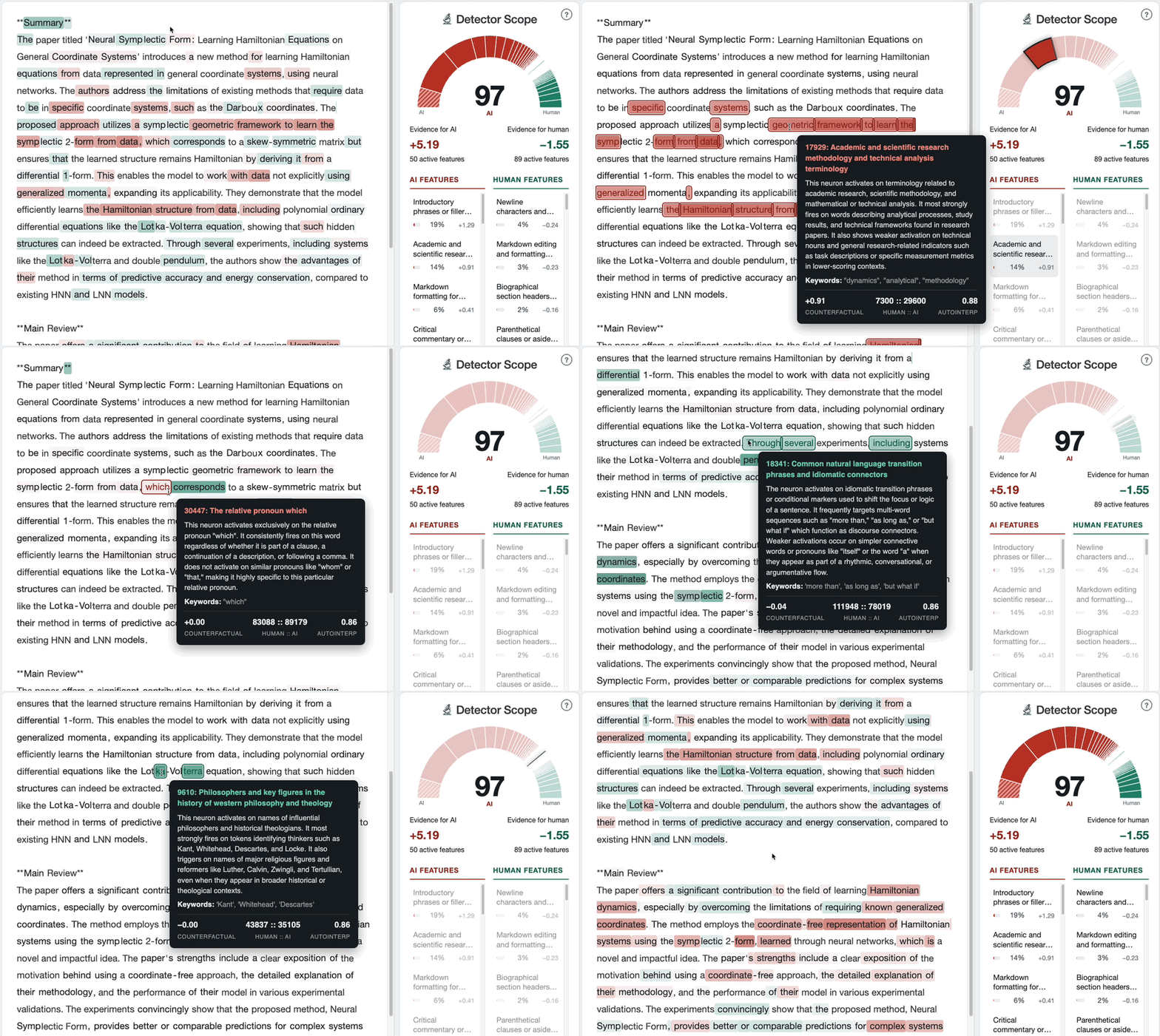
36. Building Auditable AI Text Detectors with Sparse Autoencoders
🔑 Keywords: Sparse Autoencoders, Interpretable Linguistic Features, AI-generated text classification, Residual Stream, Fidelity Threshold
💡 Category: Natural Language Processing
🌟 Research Objective:
– Develop a pipeline that converts fine-tuned neural detectors into classifiers using interpretable linguistic features for more accurate and explainable AI-generated text classification.
🛠️ Research Methods:
– Use sparse autoencoders on a neural detector’s residual stream, assign auto-interpretation labels, and retain features that meet a global fidelity threshold for better interpretability.
💬 Research Conclusions:
– The proposed method successfully extracts highly specific and predictive linguistic features, making classifiers not only interpretable but also outperforming existing alternatives on out-of-distribution texts.
👉 Paper link: https://huggingface.co/papers/2610.30006
37. DraMaze: A Multi-Agent Pipeline with Future-Aware Memory for Diverse Microdrama Script Generation
🔑 Keywords: DraMaze, evolutionary tree search, trope memory, narrative coherence, Backward Narrative Dependency Tree
💡 Category: Natural Language Processing
🌟 Research Objective:
– Improve long-form microdrama script generation by enhancing plot diversity and narrative coherence.
🛠️ Research Methods:
– Utilized multi-agent pipeline with evolutionary tree search guided by trope memory.
– Introduced Backward Narrative Dependency Tree for organizing and retrieving historical plot information.
💬 Research Conclusions:
– DraMaze reduced causal-pattern repetition by 32.1% for long scripts and achieved a Logic score of 82.5, surpassing baseline methods by 8.5 points.
👉 Paper link: https://huggingface.co/papers/2610.32002

38. TenetBench: A Clause-Anchored Russian Corpus for Evaluating Language Models against Professional Codes of Ethics
🔑 Keywords: TenetBench, professional ethics, large language models, conflicting requests, ethical AI
💡 Category: AI Ethics and Fairness
🌟 Research Objective:
– The study aims to evaluate whether language models adhere to professional ethical codes by detecting conflicting requests paired with benign equivalents, particularly in Russian-language professional codes and two English codes.
🛠️ Research Methods:
– An automated pipeline generates tasks based on professional codes, growing the corpus with each new code. Human validation provides high accuracy in adjudicating conflicting tasks.
💬 Research Conclusions:
– The evaluation revealed frequent unflagged violations across most tested models, with eleven out of fourteen models producing conflicting content often without warnings. The dataset aims to aid in improving language models’ adherence to professional norms and developing specialized diagnostic datasets.
👉 Paper link: https://huggingface.co/papers/2610.29477
39. Dual Exam: Controlled Evaluation of Multimodal Agents and World Models
🔑 Keywords: Dual Exam, Multimodal Agents, World Models, simulated experience, coupled pairing
💡 Category: Multi-Modal Learning
🌟 Research Objective:
– The study aims to evaluate the interaction between Multimodal Agents and World Models across diverse domains using the Dual Exam method to reveal performance patterns and potential for reciprocal learning.
🛠️ Research Methods:
– Dual Exam separately tests Agents with fixed environment response mechanisms and World Models with fixed action interventions across 15 categories and 8 scenarios, leveraging 1,088 items and 400 cases.
💬 Research Conclusions:
– Results indicate uneven task performance with no coupled success recorded in initial tests, highlighting the need for component-level diagnosis to better predict coupled success and sustain reciprocal learning.
👉 Paper link: https://huggingface.co/papers/2610.31066

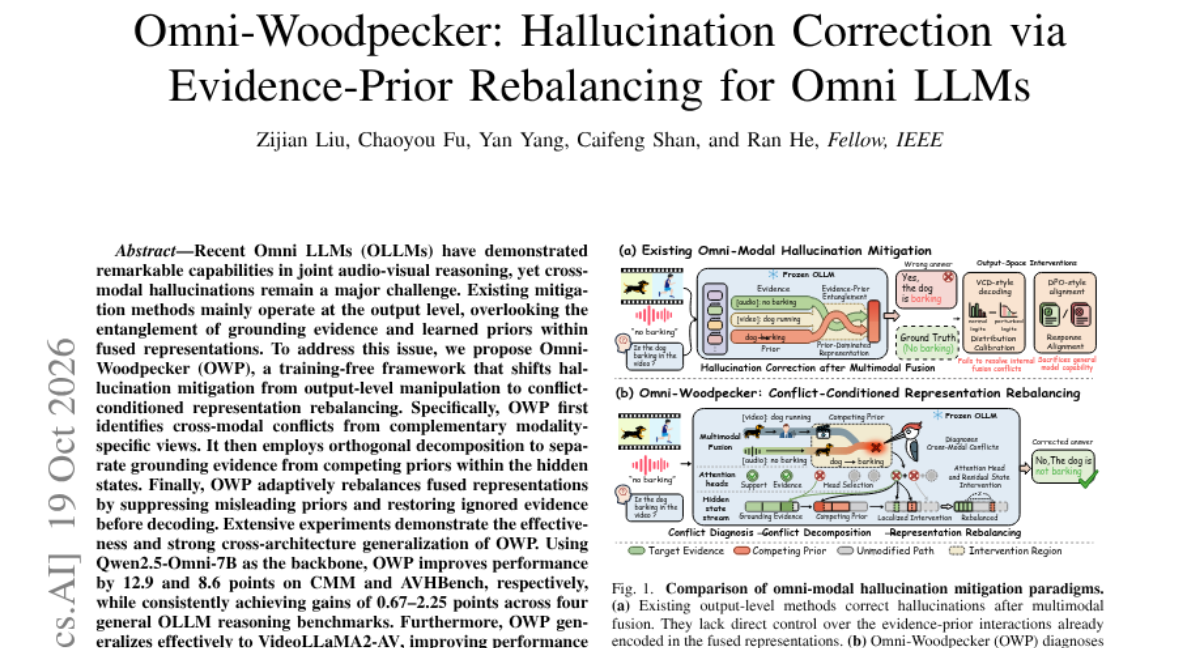
40. Omni-Woodpecker: Hallucination Correction via Evidence-Prior Rebalancing for Omni LLMs
🔑 Keywords: Omni-Woodpecker, cross-modal hallucinations, representation rebalancing, grounding evidence, modality-specific views
💡 Category: Multi-Modal Learning
🌟 Research Objective:
– To mitigate cross-modal hallucinations in Omni LLMs without training by rebalancing hidden representations through identifying modality conflicts.
🛠️ Research Methods:
– Employ orthogonal decomposition to separate grounding evidence from competing priors in hidden states, followed by adaptive rebalancing of representations.
💬 Research Conclusions:
– Omni-Woodpecker demonstrated effectiveness and strong cross-architecture generalization, showing significant performance improvements in various OLLM reasoning benchmarks.
👉 Paper link: https://huggingface.co/papers/2610.27103
41. RSIHub: A Composable Framework for Agent-Evolution Methods
🔑 Keywords: Agent-evolution, RSIHub, reusable components, execution feedback
💡 Category: AI Systems and Tools
🌟 Research Objective:
– The aim is to create a standardized framework, RSIHub, for agent-evolution research that provides shared infrastructure to build, compare, and extend methods with reusable components and consistent evaluation.
🛠️ Research Methods:
– RSIHub leverages execution feedback to refine prompts, skills, tools, and orchestration. It maintains method-specific logic in recipes and operators within a common infrastructure, allowing instantiation of methods like AHE, Hyperagents, A-Evolve, and GEPA without altering the framework core.
💬 Research Conclusions:
– RSIHub offers a unified protocol for comparing evolution policies and developing new methods by keeping evaluation conditions and results consistent. While the largest observed pass@1 gain is 13.5 percentage points, method effectiveness varies across different settings, indicating challenges in transferring optimization gains to new tasks.
👉 Paper link: https://huggingface.co/papers/2610.32253

42. UserArena: Benchmarking Interactive User Simulation for Long-Horizon Shopping Agents
🔑 Keywords: UserArena, agentic recommendation, recommendation world models, offline validation, On-Policy Trajectory Distillation
💡 Category: Reinforcement Learning
🌟 Research Objective:
– The research introduces a real-world interactive benchmark named UserArena to evaluate and improve simulator fidelity for agentic recommendations over long-horizon shopping trajectories.
🛠️ Research Methods:
– The use of On-Policy Trajectory Distillation (OPTD) to enhance simulator fidelity by providing dense teacher targets on student-generated rollouts.
💬 Research Conclusions:
– UserArena provides a comprehensive five-level evaluation from output validity to outcomes and showcases that OPTD achieves the highest fidelity among evaluated simulators, closely replicating production policy effects in offline scenarios.
👉 Paper link: https://huggingface.co/papers/2610.30932