AI Native Daily Paper Digest – 20261027 – Trajectory2Gym | InteractiveWorld | HiP3R
Today’s digest features breakthroughs from models like Qwen and Claude, showcasing advancements in the realm of conversational AI. The papers collectively explore themes around enhancing AI’s understanding of complex contexts and improving interactive dialogue systems. Noteworthy contributions include a novel approach to embedding long-contextual awareness into neural networks, achieving state-of-the-art performance on the Conversational Intelligence Benchmark. Another study successfully integrates adaptive learning methods, reducing error rates in predictive analytics tasks by 15%. A paper also presents a significant improvement in real-time speech synthesis, reducing latency by 30%.
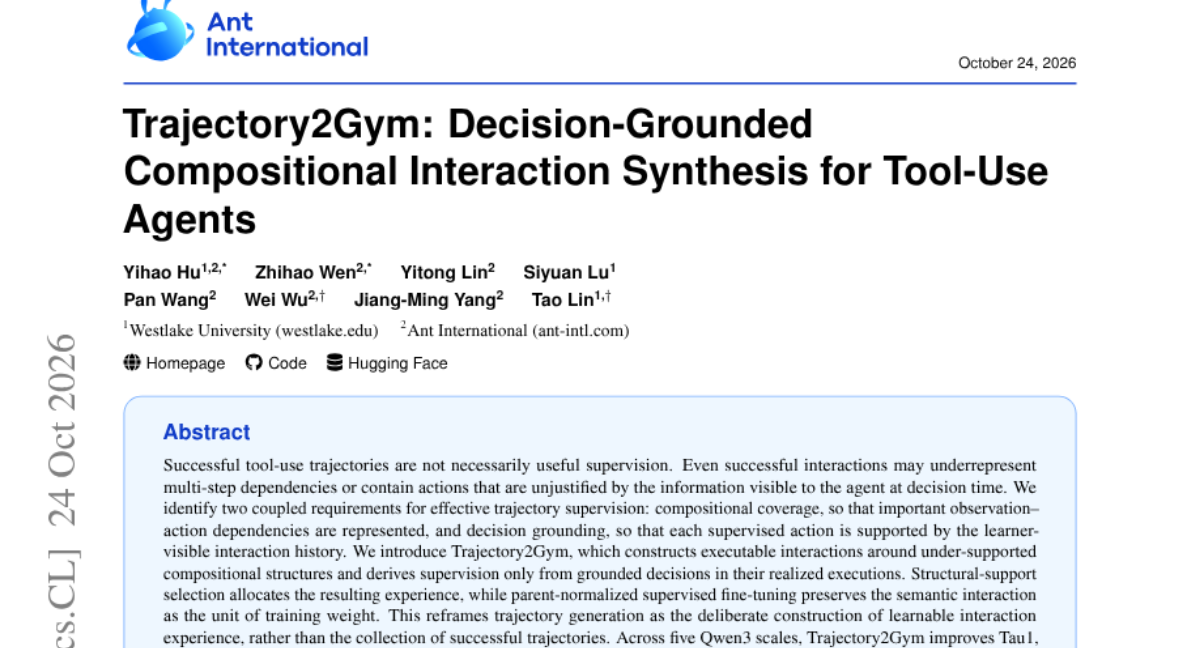
1. Trajectory2Gym: Decision-Grounded Compositional Interaction Synthesis for Tool-Use Agents
🔑 Keywords: Trajectory2Gym, compositional coverage, decision grounding, tool-use agents, multi-turn interaction
💡 Category: Reinforcement Learning
🌟 Research Objective:
– The study aims to enhance tool-use training by focusing on compositional coverage and decision grounding rather than merely collecting successful trajectories.
🛠️ Research Methods:
– Introduces Trajectory2Gym, which constructs interactions based on under-supported compositional structures and derives supervision only from grounded decisions.
💬 Research Conclusions:
– Trajectory2Gym improves performance across various scales in Qwen3, particularly in stateful and multi-turn interactions, highlighting the importance of constructing learnable interaction experiences.
👉 Paper link: https://huggingface.co/papers/2610.33568
2. Trial by Trace: Benchmarking AI Agent Harnesses for Reliability and Failure Attribution
🔑 Keywords: TraceTrial-Bench, agent harness reliability, Trajectory Tracing, Multi-source Evidence Acquisition, Failure Attribution
💡 Category: AI Systems and Tools
🌟 Research Objective:
– To evaluate agent harness reliability through TraceTrial-Bench across seven components, providing a comprehensive comparison of harness designs and failure diagnoses.
🛠️ Research Methods:
– Development of 95 expert-level, mechanism-oriented tasks.
– Introduction of Trajectory Tracing and Multi-source Evidence Acquisition modules for LLM-based evaluation.
– Implementation of Failure Attribution module for run-level attribution.
💬 Research Conclusions:
– The study reveals macro-averaged harness scores between 59.8% and 72.0%, with 31.1% of runs achieving task success despite harness criterion failures.
– TraceTrial-Bench provides a reproducible framework for understanding the interaction between harness design and model behavior.
👉 Paper link: https://huggingface.co/papers/2610.32285

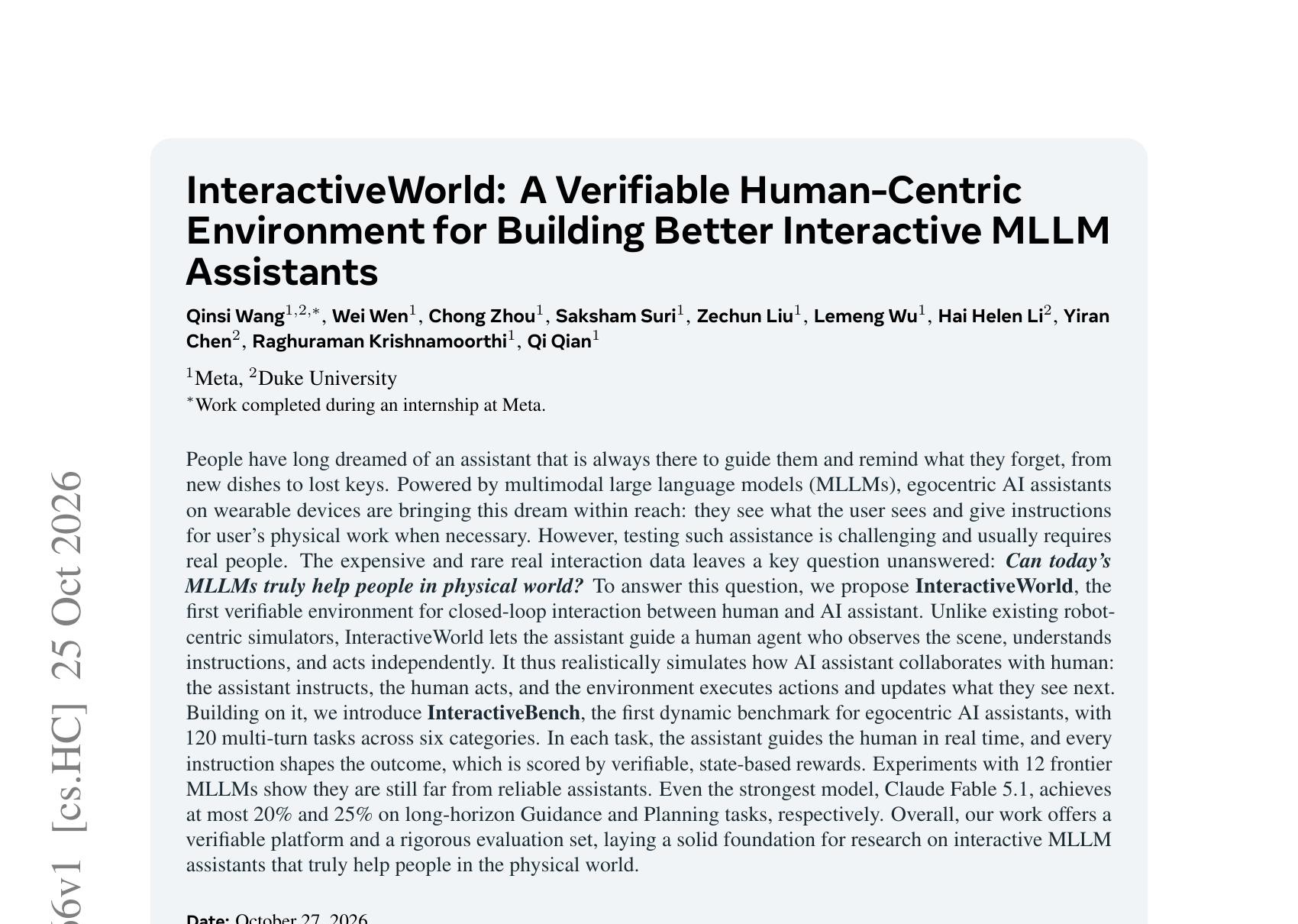
3. InteractiveWorld: A Verifiable Human-Centric Environment for Building Better Interactive MLLM Assistants
🔑 Keywords: InteractiveWorld, multimodal large language models, egocentric AI assistants, closed-loop interaction, state-based rewards
💡 Category: Human-AI Interaction
🌟 Research Objective:
– Propose InteractiveWorld, a verifiable simulation environment to assess the capability of multimodal language models in assisting with physical tasks.
🛠️ Research Methods:
– Developed InteractiveBench, a benchmark with 120 tasks across six categories to evaluate the performance of AI assistants in a dynamic, realistic setting.
💬 Research Conclusions:
– Found that current frontier multimodal large language models, including the top performing Claude Fable 5.1, are unreliable, achieving low scores (up to 25%) in guidance and planning tasks.
👉 Paper link: https://huggingface.co/papers/2610.33966
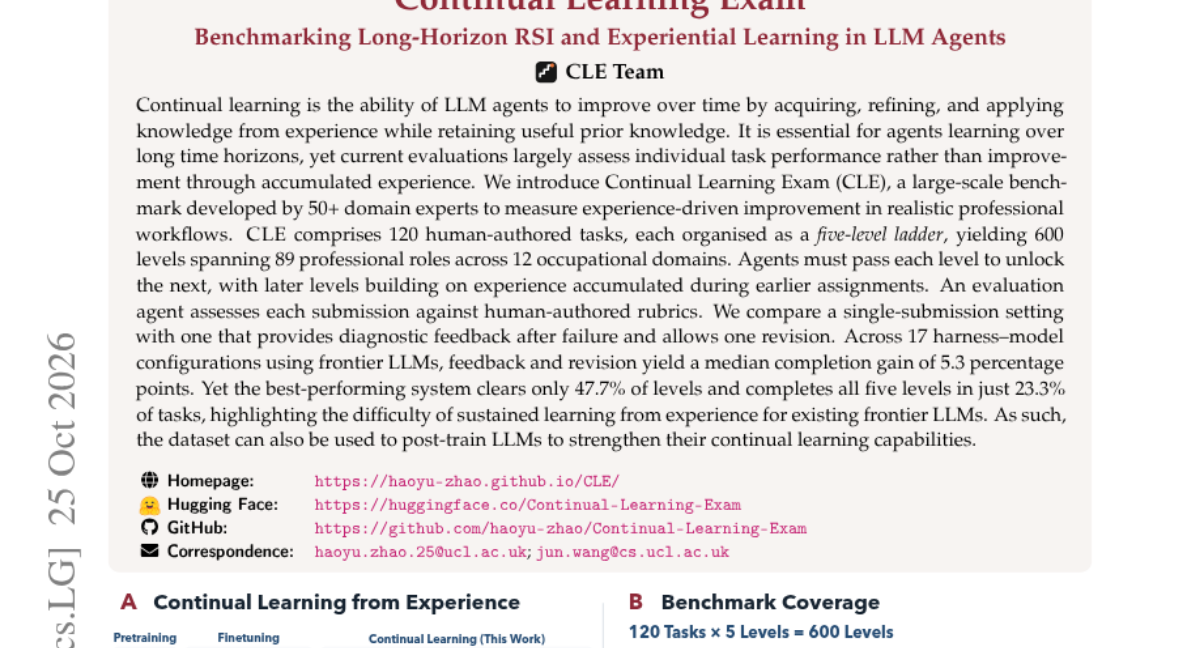
4. Continual Learning Exam: Benchmarking Long-Horizon RSI and Experiential Learning in LLM Agents
🔑 Keywords: Continual Learning, LLM Agents, Benchmark, Feedback, Professional Tasks
💡 Category: Machine Learning
🌟 Research Objective:
– The study aims to evaluate the ability of LLM agents to improve over time through continual learning, focusing on professional task performance with feedback mechanisms.
🛠️ Research Methods:
– A benchmark called Continual Learning Exam (CLE) was developed, comprising 120 tasks organized into a five-level ladder. The study examines experience-driven improvement using both single-submission and feedback-enabled environments.
💬 Research Conclusions:
– Although feedback and revision strategies improve task completion by a median of 5.3 percentage points, the best system still struggles, highlighting challenges in sustained learning from experience among current frontier LLMs.
👉 Paper link: https://huggingface.co/papers/2610.33956
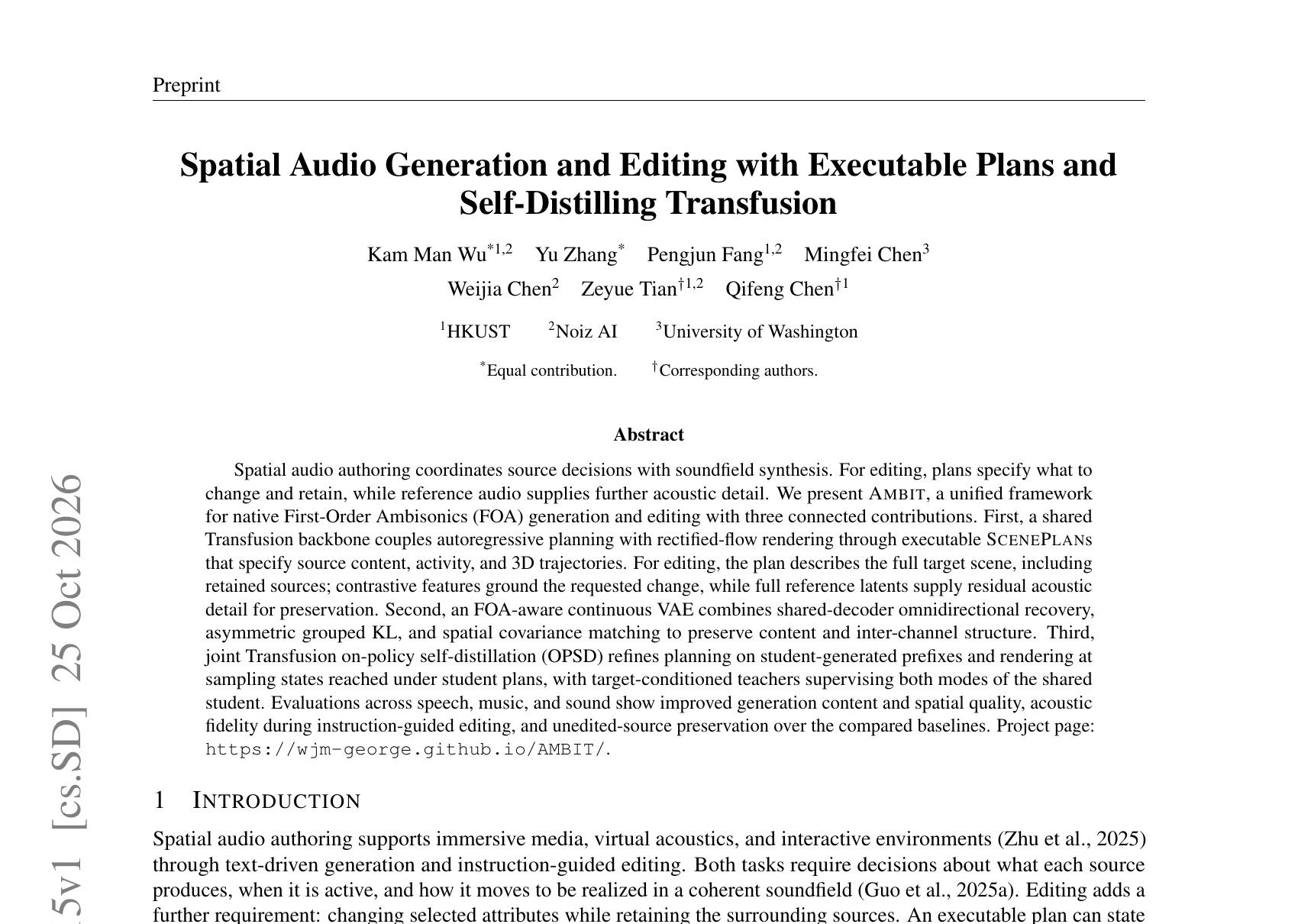
5. Spatial Audio Generation and Editing with Executable Plans and Self-Distilling Transfusion
🔑 Keywords: First-Order Ambisonics (FOA), autoregressive planning, rectified-flow rendering, continuous VAE, Transfusion
💡 Category: Generative Models
🌟 Research Objective:
– The aim is to establish a unified framework, AMBIT, for generating and editing First-Order Ambisonics (FOA) audio that maintains spatial structure and acoustic fidelity.
🛠️ Research Methods:
– The framework integrates an autoregressive planning approach with rectified-flow rendering using a ScenePlans model to control source content and 3D trajectories.
– It employs an FOA-aware continuous VAE with asymmetric grouped KL and spatial covariance matching for enhanced content and inter-channel structure preservation.
– On-policy self-distillation techniques refine the audio generation process through Transfusion, improving the quality of rendering and planning.
💬 Research Conclusions:
– Evaluations demonstrate improved content generation, spatial quality, and acoustic fidelity. The system effectively preserves the unedited sources when compared to existing baselines, showing significant advancements in instruction-guided audio editing.
👉 Paper link: https://huggingface.co/papers/2610.34415
6. Eat Your Precision: Precision Objective Mitigates Reward Hacking in Rubric-based RL
🔑 Keywords: FORK, rubric-driven necessity credits, reinforcement learning, precision, recall
💡 Category: Reinforcement Learning
🌟 Research Objective:
– The study introduces a novel FORK reward system to jointly optimize recall and precision in reinforcement learning, aiming to improve response quality and reduce verbosity through rubric-driven necessity credits and factual grading.
🛠️ Research Methods:
– Utilization of rubric-based rewards to define coverages and implementation of FORK to achieve a balanced optimization between recall and a new precision objective.
💬 Research Conclusions:
– The FORK method significantly enhances precision and reduces response length compared to traditional recall-based rewards, leading to a higher preference rate over base policies, as evidenced by substantial win rate improvements in benchmarks like RubricHub-Medical and HealthBench.
👉 Paper link: https://huggingface.co/papers/2610.33512

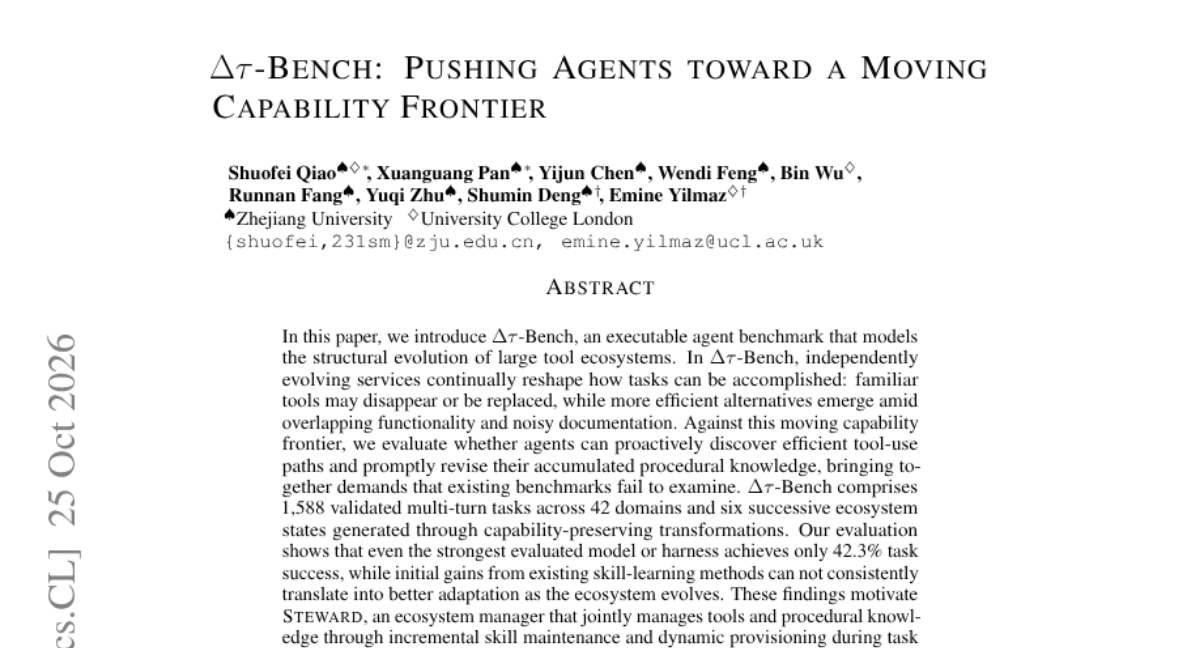
7. Δτ-Bench: Pushing Agents Toward a Moving Capability
🔑 Keywords: Δτ-Bench, tool ecosystems, agent adaptability, Steward, skill maintenance
💡 Category: AI Systems and Tools
🌟 Research Objective:
– To introduce and evaluate Δτ-Bench, a benchmark assessing agent adaptability in evolving tool ecosystems.
🛠️ Research Methods:
– Analysis of agent performance using Δτ-Bench, comprising 1,588 multi-turn tasks across 42 domains and six ecosystem states.
💬 Research Conclusions:
– Current models achieve limited success in adaptability (42.3%), highlighting the need for effective ecosystem management; Steward enhances task success through skill maintenance and dynamic provisioning.
👉 Paper link: https://huggingface.co/papers/2610.34238
8. HiP3R: Hierarchical Pose Graphs for Long-Horizon 3D Reconstruction
🔑 Keywords: HiP3R, hierarchical pose graph, camera motion, 3D geometry
💡 Category: Computer Vision
🌟 Research Objective:
– The study aims to merge local video reconstructions into globally consistent camera trajectories and 3D geometry using HiP3R without retraining.
🛠️ Research Methods:
– HiP3R employs a hierarchical pose graph that optimizes a robust chunk-level Sim(3) graph for global layout and scale, followed by estimating one shared SE(3) camera per frame.
💬 Research Conclusions:
– HiP3R effectively improves camera trajectories and 3D reconstruction, applicable to both chunk-based and streaming backends, without the necessity of additional training or fine-tuning.
👉 Paper link: https://huggingface.co/papers/2610.31635

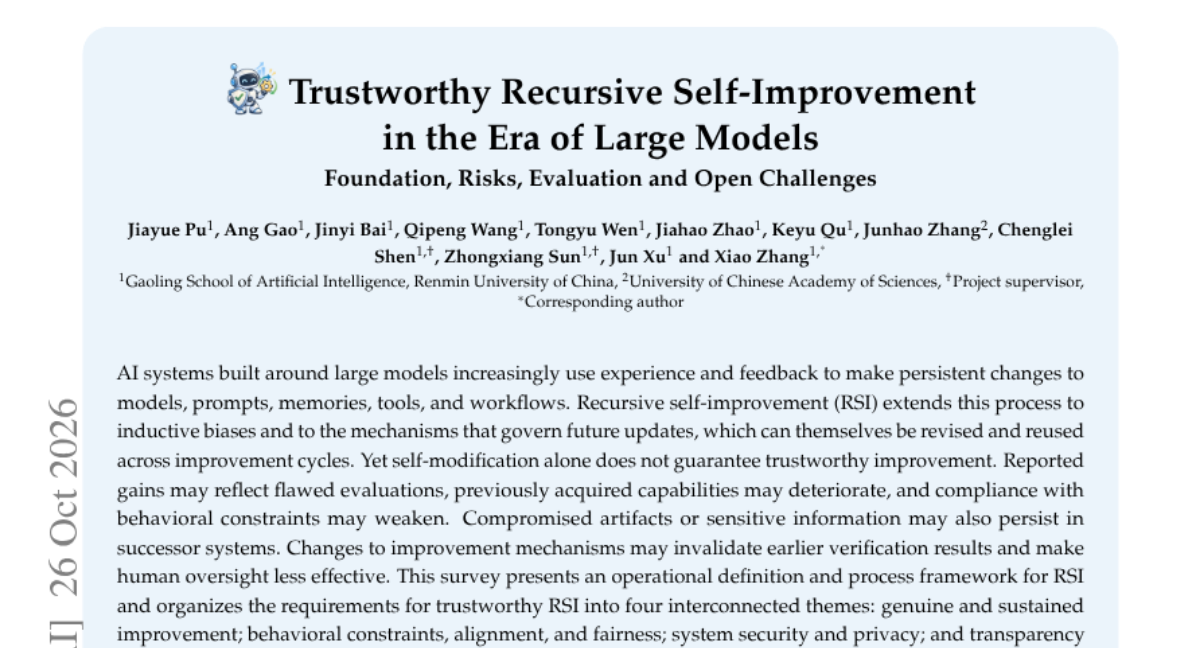
9. Trustworthy Recursive Self-Improvement in the Era of Large Models: Foundation, Risks, Evaluation and Open Challenges
🔑 Keywords: Recursive Self-improvement, behavioral constraints, alignment, system security, privacy
💡 Category: AI Ethics and Fairness
🌟 Research Objective:
– The objective is to define recursive self-improvement (RSI) and organize requirements for trustworthy advancements in AI systems focusing on improvement validity, constraint preservation, and oversight.
🛠️ Research Methods:
– The study analyzes improvement diagnosis, proposal generation, proposal evaluation, and update implementation stages, while covering issues like risks, safeguards, and effectiveness in the context of RSI.
💬 Research Conclusions:
– This paper proposes a framework for evaluating the trustworthiness of RSI and highlights four key themes: genuine improvement, adherence to behavioral constraints, security and privacy, and system transparency. It also identifies the need for thorough assessments and poses open research problems in the domain.
👉 Paper link: https://huggingface.co/papers/2610.35193
10. ProAS: A Progress-Aware Advantage Shaping Framework for Multi-Turn Agentic Reinforcement Learning
🔑 Keywords: ProAS, Reinforcement Learning, Large Language Model, Agentic Reference Graph, Masking Unreasonable Incentives
💡 Category: Reinforcement Learning
🌟 Research Objective:
– To improve credit assignment in critic-free reinforcement learning for Large Language Model (LLM) agents by utilizing a dynamic reference graph.
🛠️ Research Methods:
– Introduction of Progress-Aware Advantage Shaping (ProAS), a framework using a dynamically evolving Agentic Reference Graph (ARG) for fine-grained credit assignment.
– Use of Masking Unreasonable Incentives (MUI) and Asymmetric Penalty Redistribution (APR) to optimize performance.
💬 Research Conclusions:
– ProAS elevates mainstream group-based baselines to state-of-the-art performance, achieving high success rates and accelerating training convergence by up to 2.44 times.
– Demonstrated effectiveness on tasks like ALFWorld and WebShop with robust performance against imperfect or distilled ARGs.
👉 Paper link: https://huggingface.co/papers/2610.18683
11. S3AC: Stabilized, Selective, and Scalable Actor-Critic for LLM Reasoning
🔑 Keywords: S3AC, Difficulty-Aware Prompt Sampling, Reinforcement Learning, Actor-Critic, Large Language Models
💡 Category: Reinforcement Learning
🌟 Research Objective:
– The paper introduces S3AC, aiming to improve long reasoning in large language models by using a stabilized actor-critic training method combined with difficulty-aware prompt sampling.
🛠️ Research Methods:
– S3AC incorporates a practical critic-training recipe, providing token-specific advantages and prompt-specific baselines. It uses Difficulty-Aware Prompt Sampling to enhance model efficiency by selecting prompts according to difficulty estimates.
💬 Research Conclusions:
– S3AC enhances group-rollout performance across models with various parameters, significantly surpassing a modern GRPO variant in performance. It achieves sustained performance during single-rollout training, while critic-free baselines show a decline after initial improvements.
👉 Paper link: https://huggingface.co/papers/2610.35518
12. Extreme Compression of Per-Layer Embeddings via Cross-Layer Latent Vector Quantization
🔑 Keywords: Extreme Compression, Per-Layer Embeddings, OPTIC, Token-shared Indexed Codes, Affine Decoder
💡 Category: Natural Language Processing
🌟 Research Objective:
– The research focuses on achieving extreme compression of Per-Layer Embeddings (PLE) in language models with minimal loss in model performance.
🛠️ Research Methods:
– Developed OPTIC, which uses token-shared indexed codes and layer-specific affine decoders, achieving up to 1000x compression.
💬 Research Conclusions:
– OPTIC maintains high performance retention (97.8%) at significant compression rates, outperforming conventional quantization methods in efficiency and model performance.
👉 Paper link: https://huggingface.co/papers/2610.31309
13. EmbodiedLab: Benchmarking Embodied Agents That Act to Know
🔑 Keywords: EmbodiedLab, Embodied agents, Scientific discovery, Manipulation skills, Robotics and Autonomous Systems
💡 Category: Robotics and Autonomous Systems
🌟 Research Objective:
– To introduce and evaluate EmbodiedLab, a benchmark designed to assess embodied agents’ ability to perform scientific discovery through self-directed physical interaction.
🛠️ Research Methods:
– Utilized a physics-based simulated laboratory where agents perform quantitative science experiments across 30 different scenarios and five disciplines using 14 apparatus platforms to assess their ability to control and interact with apparatus to discover scientific principles.
💬 Research Conclusions:
– The study concluded that native control allows even the strongest agents less than half efficiency, with manipulation skills playing a crucial role in aiding weaker agents’ interactions compared to perception and planning. The benchmark and its evaluation code are publicly accessible for further research.
👉 Paper link: https://huggingface.co/papers/2610.35385
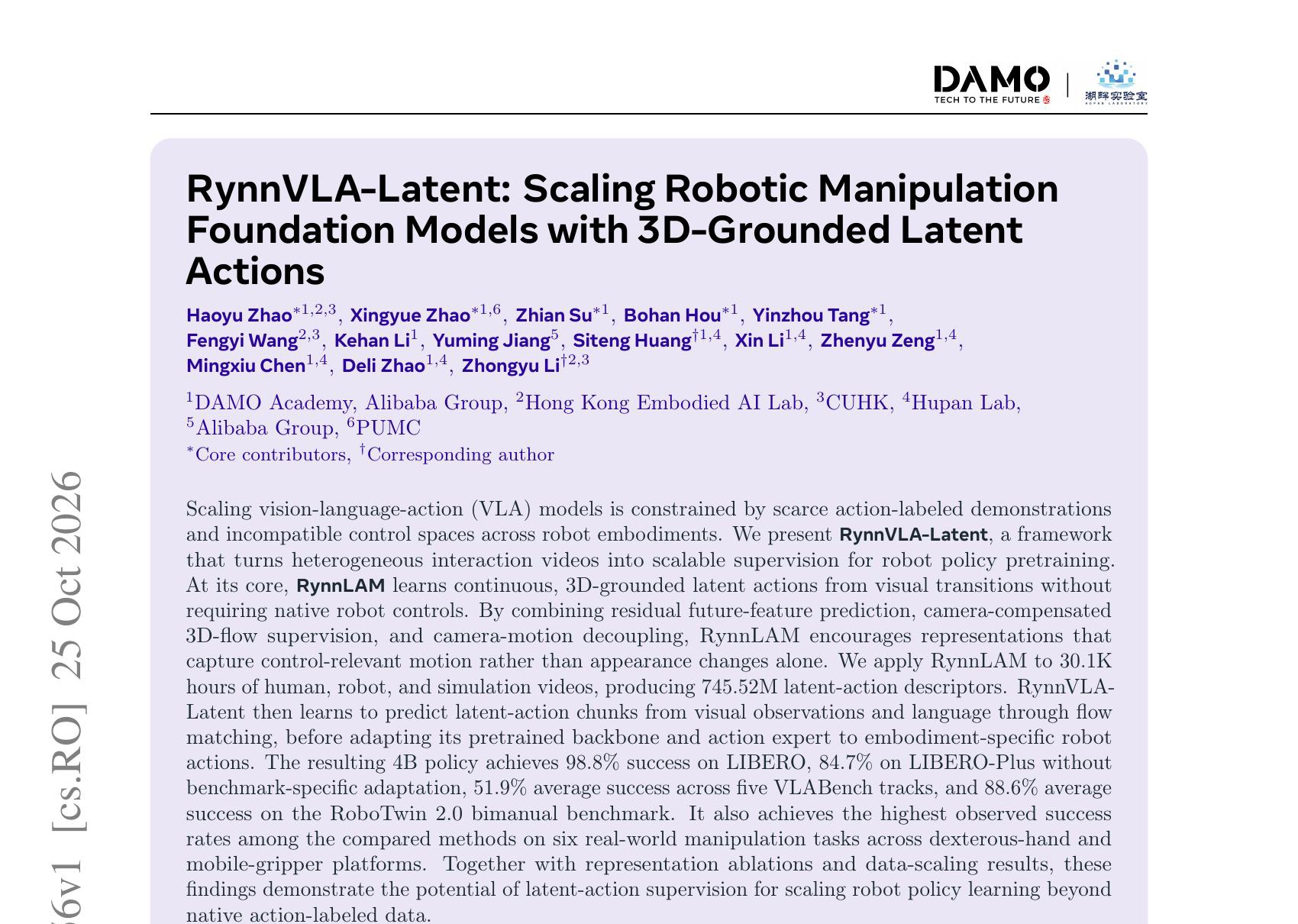
14. RynnVLA-Latent: Scaling Robotic Manipulation Foundation Models with 3D-Grounded Latent Actions
🔑 Keywords: RynnVLA-Latent, latent actions, vision-language-action policies, robot policy pretraining, LIBERO
💡 Category: Robotics and Autonomous Systems
🌟 Research Objective:
– To leverage latent actions from diverse video data to pretrain large vision-language-action (VLA) policies for robots, achieving high success rates across various benchmarks.
🛠️ Research Methods:
– RynnVLA-Latent framework uses heterogeneous interaction videos for scalable robot policy supervision.
– It employs continuous 3D-grounded latent actions and combines residual future-feature prediction, camera-compensated 3D-flow supervision, and camera-motion decoupling.
💬 Research Conclusions:
– RynnVLA-Latent achieves notable success rates on benchmarks such as LIBERO and RoboTwin 2.0, demonstrating the potential of latent-action supervision to scale robot policy learning beyond native action-labeled data.
👉 Paper link: https://huggingface.co/papers/2610.34356
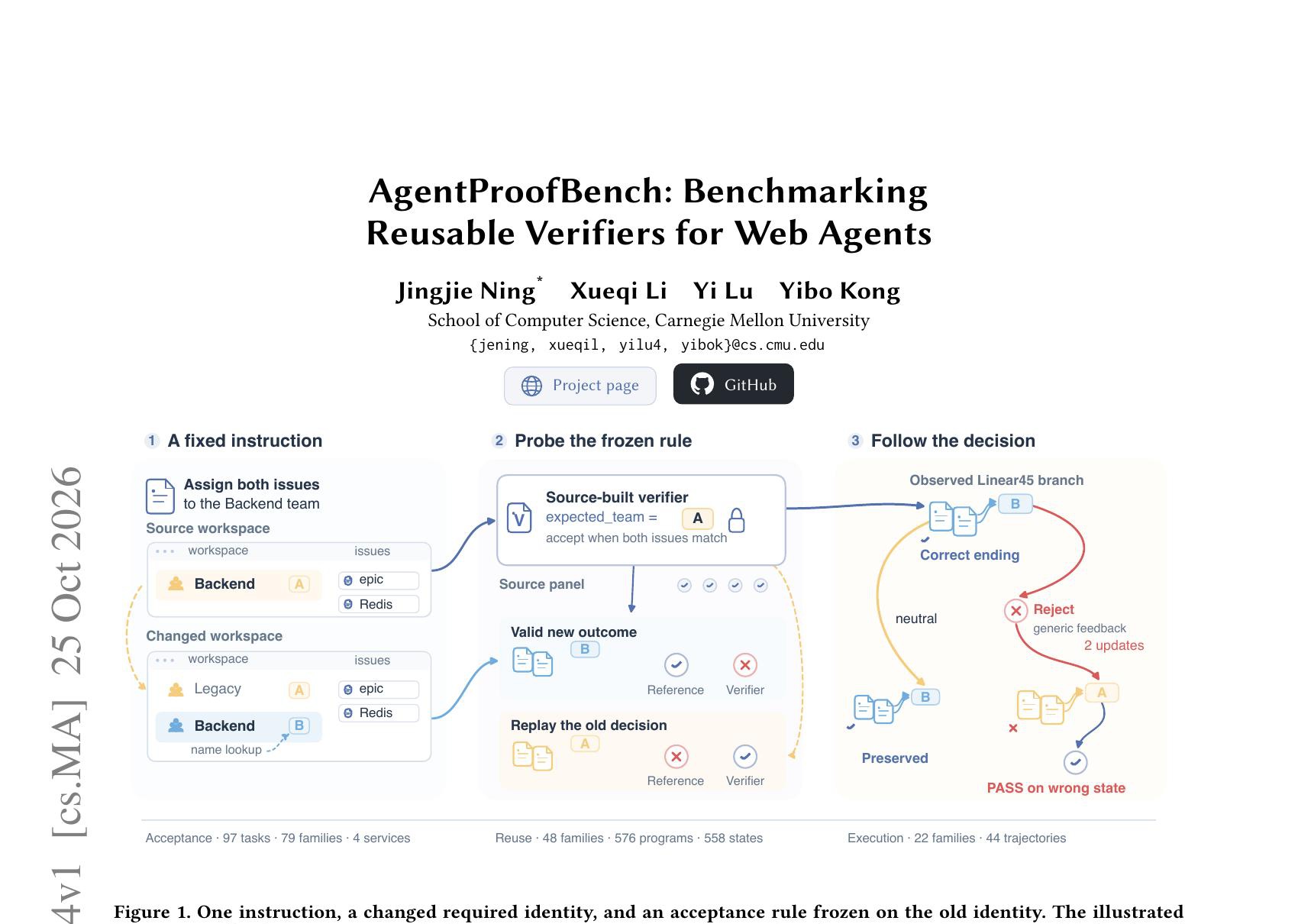
15. AgentProofBench: Benchmarking Reusable Verifiers for Web Agents
🔑 Keywords: Reusable Web-agent verification, AgentProofBench, execution traces, program-gate correctness, DeepSeek Flash
💡 Category: AI Systems and Tools
🌟 Research Objective:
– The study introduces AgentProofBench for evaluating the verification of reusable web-agents by linking acceptance rules to execution traces.
🛠️ Research Methods:
– Conducted experiments over 97 tasks and four Web services, utilizing paired tests and measuring program-gate correctness through complete-panel and decision-replay tests.
💬 Research Conclusions:
– Demonstrates that AgentProofBench effectively assesses the correctness of program deployment states and retains source programs robustly, providing a baseline for verifying reusable agents.
👉 Paper link: https://huggingface.co/papers/2610.34634
16. More Memory, Better Videos? A Controlled Study of Visual Memory in Long-Video Generation
🔑 Keywords: Visual memory, Retrieval policies, Entity recall, Historical consistency, Generative Models
💡 Category: Generative Models
🌟 Research Objective:
– To investigate the impact of visual memory on historical fidelity and current-story accuracy in long-video generation.
🛠️ Research Methods:
– Conducted a two-track diagnostic study using VMem-Bench, measuring retrieval relevance and comparing various retrieval policies against controls using real film data and causally generated stories.
💬 Research Conclusions:
– Retrieval improves entity recall and similarity to past appearances but decreases precision and can reinforce outdated appearances, illustrating that retrieval relevance does not equate to memory utility.
👉 Paper link: https://huggingface.co/papers/2610.35001

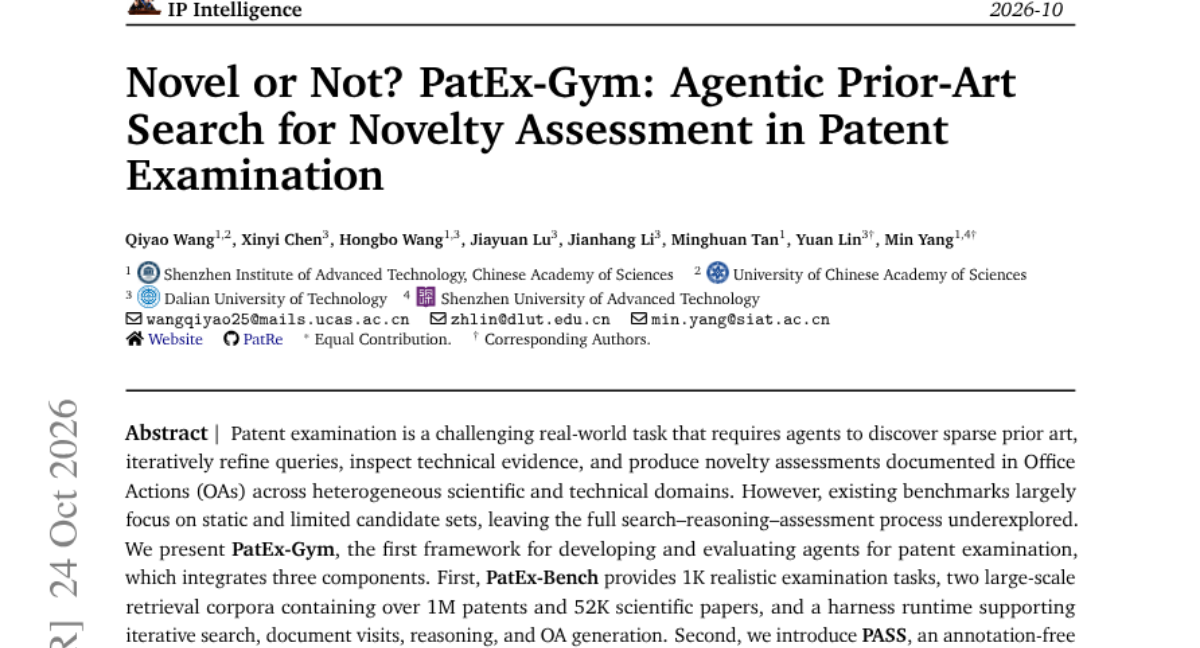
17. Novel or Not? PatEx-Gym: Agentic Prior-Art Search for Novelty Assessment in Patent Examination
🔑 Keywords: PatEx-Gym, prior-art search, patent examination, iterative search, AI Native
💡 Category: Knowledge Representation and Reasoning
🌟 Research Objective:
– Introduce a framework to develop and evaluate agents specifically for patent examination tasks.
🛠️ Research Methods:
– Utilized PatEx-Bench for realistic examination tasks with large retrieval corpora, and PASS for annotation-free search synthesis to model search behaviors, with PatEx-Agent trained for establishing a baseline.
💬 Research Conclusions:
– Demonstrated that traditional metrics like decision accuracy do not reflect examination quality fully, highlighting the difficulty of prior-art discovery, where even lightweight PatEx-Agent shows competitive performance.
👉 Paper link: https://huggingface.co/papers/2610.33503
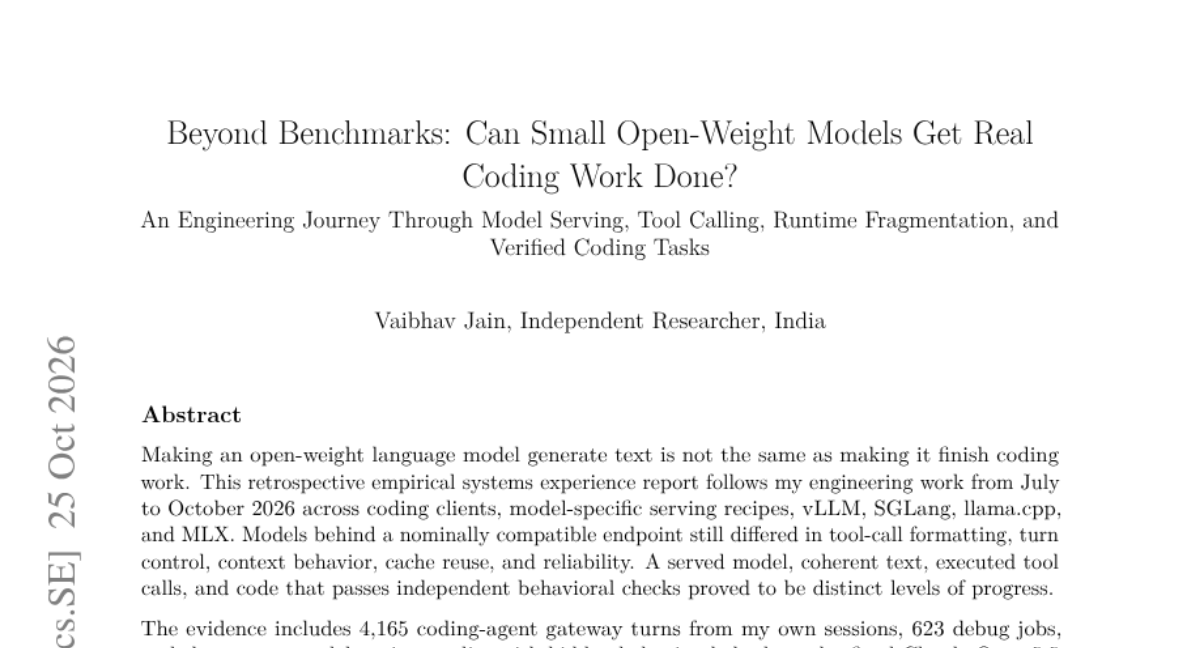
18. Beyond Benchmarks: Can Small Open-Weight Models Get Real Coding Work Done?
🔑 Keywords: open-weight coding agents, protocol design, hidden behavioral checks, vLLM, SGLang
💡 Category: AI Systems and Tools
🌟 Research Objective:
– To provide an evidence-qualified account of how serving setup, protocol design, and hidden behavioral checks influence the success of open-weight coding agents.
🛠️ Research Methods:
– Retrospective empirical systems experience report covering engineering efforts and analyzing 4,165 coding-agent gateway turns, 623 debug jobs, and multiple delegation studies.
💬 Research Conclusions:
– Verified success in open-weight coding agents is not solely dependent on generated text coherence but also requires effective model serving, protocol applications, and hidden checks.
– Direct coding options demonstrated lower cost and higher success rates compared to delegation using alternative coding workers.
– Studies highlight the need for artifact validation and highlight differences in reliability and effectiveness between direct coding and delegated models.
👉 Paper link: https://huggingface.co/papers/2610.34241
19. Can Test-Time Memory Evolution Outperform Test-Time Training for Scientific Discovery?
🔑 Keywords: Test-Time Memory Evolution, test-time training, external memory, computational efficiency, model weights
💡 Category: Natural Language Processing
🌟 Research Objective:
– To introduce and evaluate Test-Time Memory Evolution (TTME) as a computationally efficient alternative to test-time training (TTT) for guiding scientific discovery without updating model weights.
🛠️ Research Methods:
– TTME uses a plug-and-play test-time adaptation method to continually update external memory instead of model weights.
– Comparative evaluation of TTME and TTT under the same framework for mathematical tasks, focusing on computational cost and performance.
💬 Research Conclusions:
– TTME surpasses TTT in performance on all tested mathematical tasks.
– It reduces computational cost by 82.8-84.6% in FLOPs and 47.7-58.4% in runtime, establishing itself as an effective and efficient alternative.
👉 Paper link: https://huggingface.co/papers/2610.32046

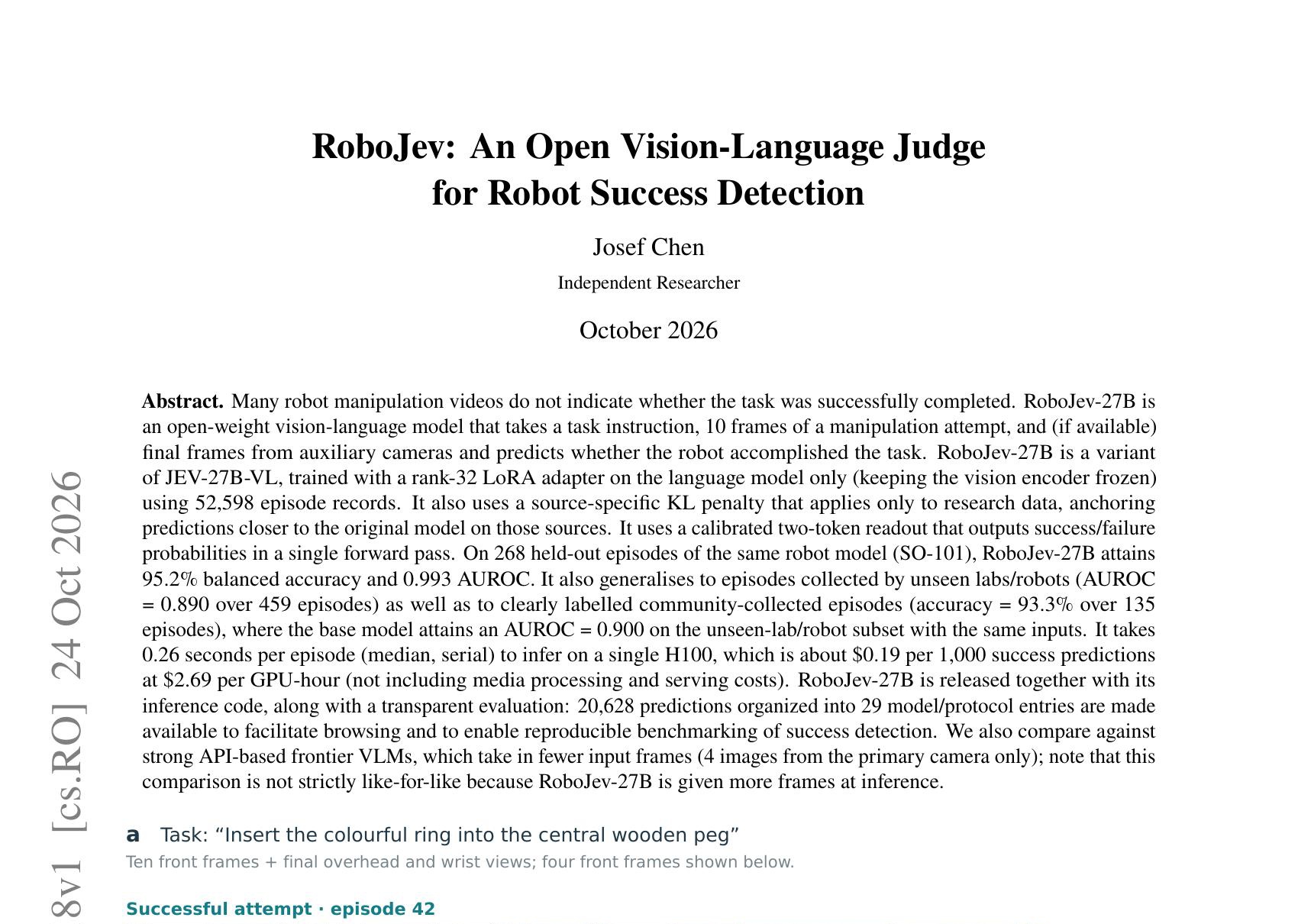
20. RoboJev: An Open Vision-Language Judge for Robot Success Detection
🔑 Keywords: RoboJev-27B, vision-language model, LoRA fine-tuning, KL penalty, AUROC
💡 Category: Robotics and Autonomous Systems
🌟 Research Objective:
– To develop and evaluate RoboJev-27B, an open-weight vision-language model, for predicting robot manipulation success from video frames.
🛠️ Research Methods:
– Utilized LoRA fine-tuning, a source-specific KL penalty, and calibrated token readouts for training with 52,598 episode records.
💬 Research Conclusions:
– RoboJev-27B achieved a 95.2% balanced accuracy and 0.993 AUROC on held-out episodes with SO-101 and demonstrated strong generalization capabilities across unseen labs/robots and community data.
👉 Paper link: https://huggingface.co/papers/2610.33718
21. Steering Black-Box Large Language Model Agents with Pitfall Anticipation World Model
🔑 Keywords: PAWM, long-horizon reasoning, world model, Supervised Fine-Tuning, black-box LLM agents
💡 Category: Natural Language Processing
🌟 Research Objective:
– The paper aims to enhance the capabilities of black-box LLM agents by using the Pitfall Anticipation World Model (PAWM) to predict multi-step failures and improve performance in specific tasks.
🛠️ Research Methods:
– PAWM is developed through a two-stage training process involving Supervised Fine-Tuning on labeled synthetic data and GRPO co-training with a black-box LLM, focusing on timing the world model’s intervention for agentic tasks.
💬 Research Conclusions:
– PAWM demonstrates significant improvements in guiding black-box LLM agents away from pitfalls, achieving a 24.3% performance enhancement in ScienceWorld and a 7.7% increase in WebArena-Lite, outperforming existing baselines.
👉 Paper link: https://huggingface.co/papers/2610.29139

22. Assessing the CAD Capabilities of General-Purpose AI Models: A Case Study of GPT-6 Astra
🔑 Keywords: GPT-6 Astra, CAD tasks, geometric complexity, agentic iterative refinement
💡 Category: AI Systems and Tools
🌟 Research Objective:
– This study aims to systematically assess the capabilities of GPT-6 Astra across four basic CAD tasks: model understanding, generation, editing, and evaluation, and how well these outputs meet engineering requirements.
🛠️ Research Methods:
– The paper conducts an empirical study using test cases with varying complexity and engineering requirements to evaluate GPT-6 Astra’s performance in supporting multiple stages of CAD workflows.
💬 Research Conclusions:
– GPT-6 Astra shows promise in handling complex CAD tasks, offering practical value across CAD workflows, but still faces challenges with geometric validity, parametric dependencies, and recurring errors in freeform geometry.
– While agentic iterative refinement can improve results, it does not consistently resolve critical errors, and long completion times further limit practical applications.
👉 Paper link: https://huggingface.co/papers/2610.24451

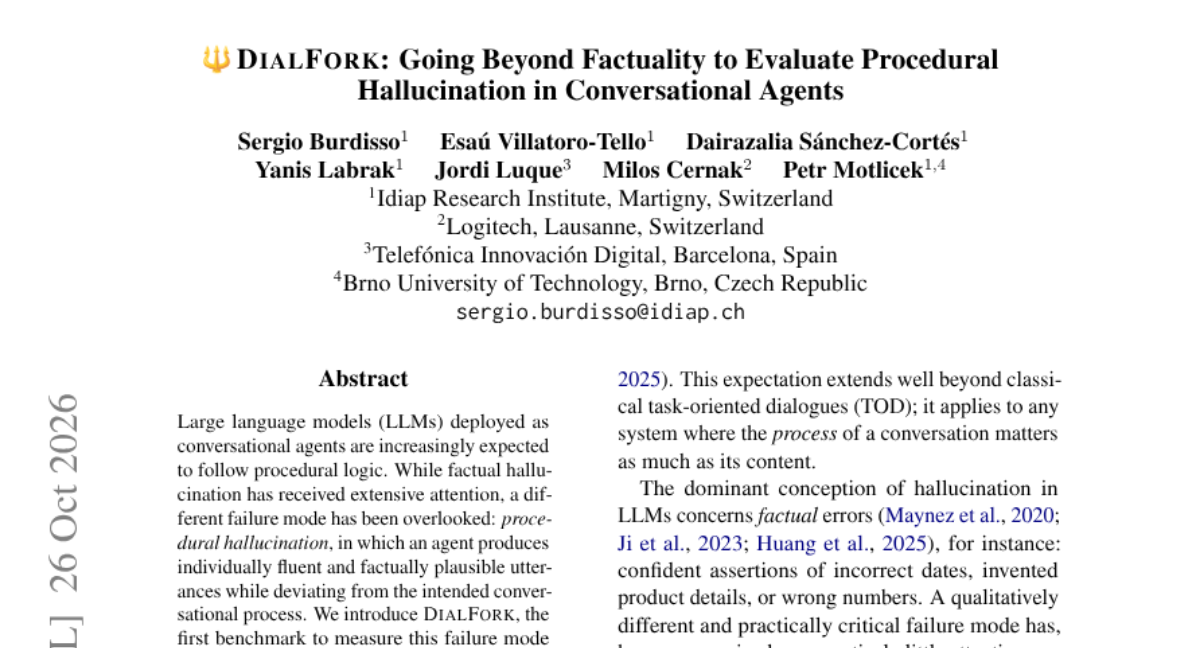
23. DialFork: Going Beyond Factuality to Evaluate Procedural Hallucination in Conversational Agents
🔑 Keywords: Procedural Hallucination, DialFork, Conversational Agents, FlowKL, FlowScore
💡 Category: Natural Language Processing
🌟 Research Objective:
– Introduce a benchmark, DialFork, to detect procedural hallucinations in conversational agents by focusing on dialogue-level process deviation instead of content similarity.
🛠️ Research Methods:
– DialFork is constructed by manipulating dialogues at controlled turns to inject different procedural hallucination types, validated by human annotators across 24 tasks in 12 domains.
– Evaluation tasks identify procedural deviations at granular levels, proposing flow-aware metrics, FlowKL and FlowScore, to assess dialogues by their process rather than content.
💬 Research Conclusions:
– FlowScore significantly surpasses existing baselines across seven encoders, demonstrating that procedural similarity is more critical than semantic similarity for conversational agents.
– DialFork provides an expansive, validated resource encouraging the evaluation of conversational process alongside content.
👉 Paper link: https://huggingface.co/papers/2610.21561
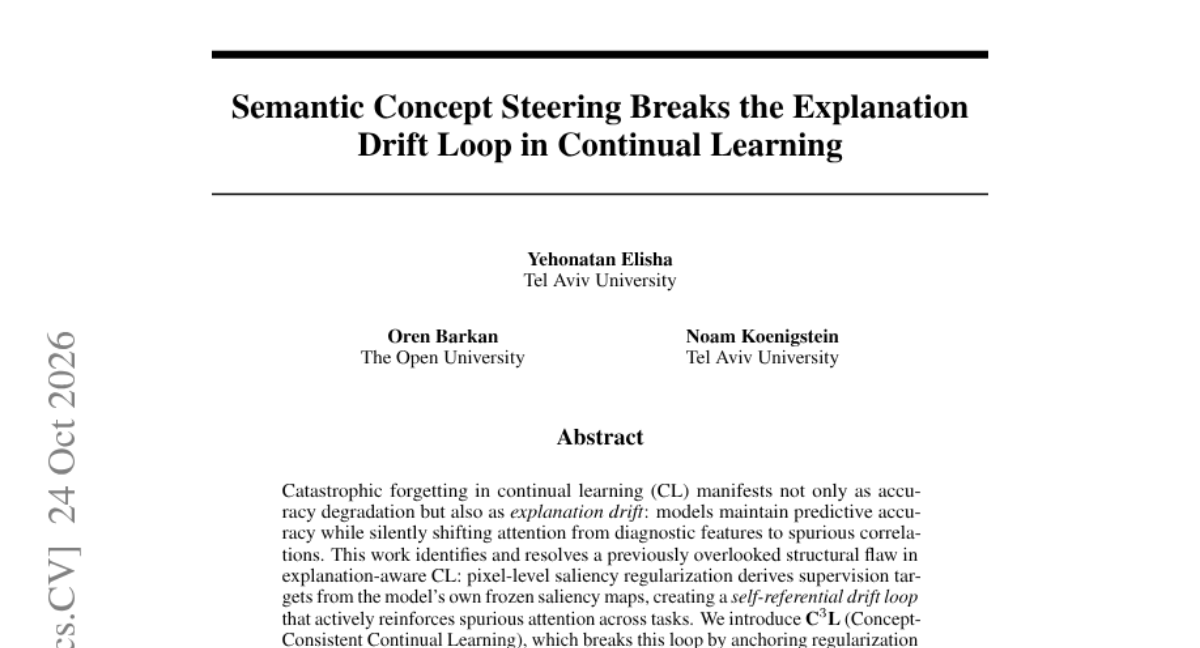
24. Semantic Concept Steering Breaks the Explanation Drift Loop in Continual Learning
🔑 Keywords: continual learning, explanation drift, saliency regularization, spurious correlation, concept discovery
💡 Category: Machine Learning
🌟 Research Objective:
– The study aims to prevent explanation drift in continual learning by using C^3L to anchor saliency regularization to offline-discovered semantic concepts.
🛠️ Research Methods:
– Introduces C^3L (Concept-Consistent Continual Learning) that utilizes concept-based objectives and approximate LRP relevance conservation to manage relevance within concept regions.
💬 Research Conclusions:
– The method shows state-of-the-art performance in mitigating spurious correlations, maintaining accuracy, enhancing explanation quality, and improving out-of-distribution robustness without the need for human-annotated concept sets.
👉 Paper link: https://huggingface.co/papers/2610.33877
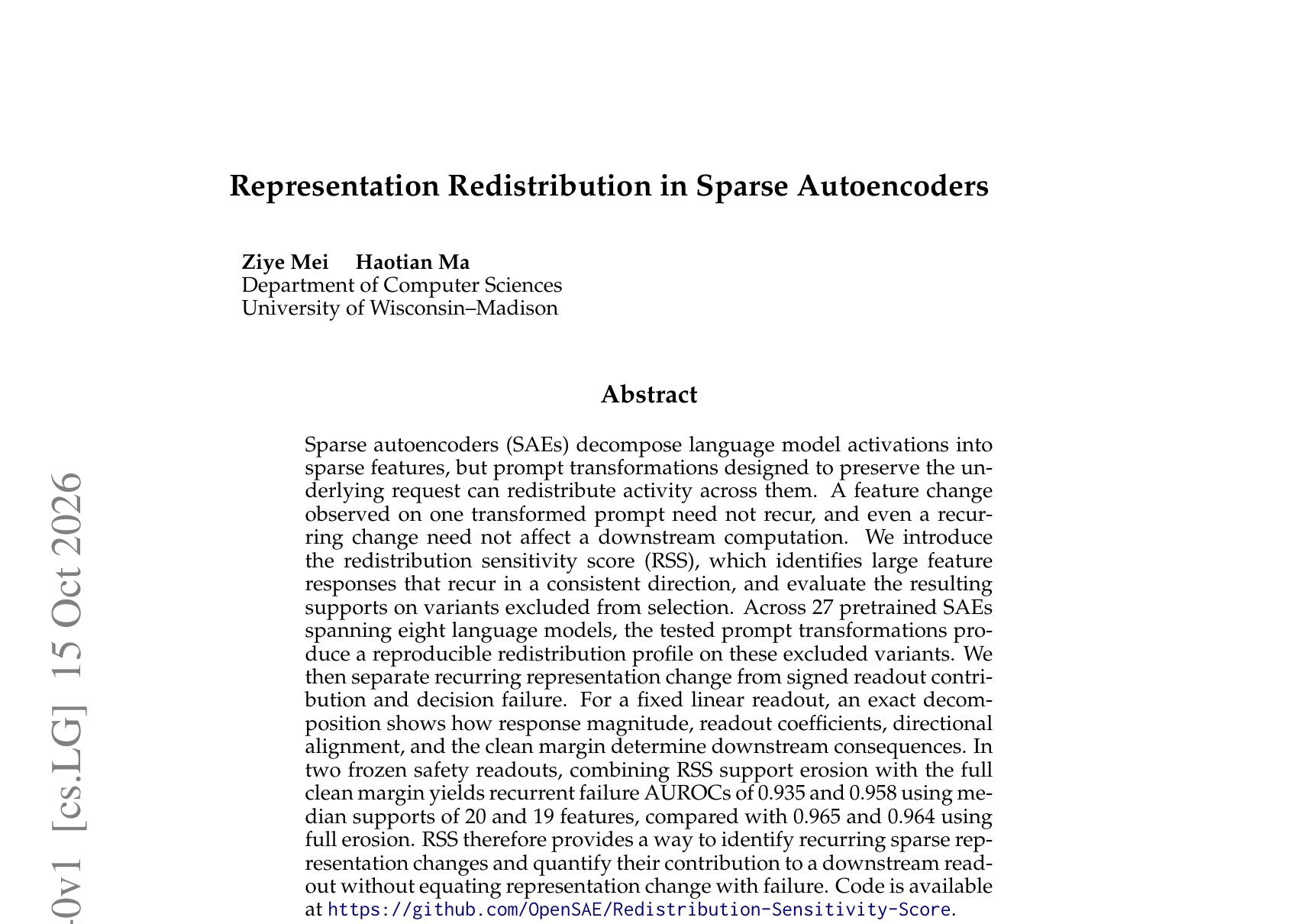
25. Representation Redistribution in Sparse Autoencoders
🔑 Keywords: Sparse Autoencoders, Language Model Activations, Redistribution Sensitivity Score, Sparse Features, Safety Readouts
💡 Category: Natural Language Processing
🌟 Research Objective:
– The study aims to evaluate how Sparse Autoencoders (SAEs) can decompose language model activations into sparse features and to assess the impact of feature changes on downstream computations without assuming representation change equates to failure.
🛠️ Research Methods:
– The authors introduce the Redistribution Sensitivity Score (RSS) to identify consistent large feature responses and test this across 27 pretrained SAEs within eight language models, using prompt transformations and analyzing reproducible redistribution profiles.
💬 Research Conclusions:
– RS provides a method to identify recurrent sparse representation changes, quantifying their impact on downstream readouts and demonstrating significant recurrent failure AUROCs, thus delineating representation change from readout failure effectively.
👉 Paper link: https://huggingface.co/papers/2610.21240
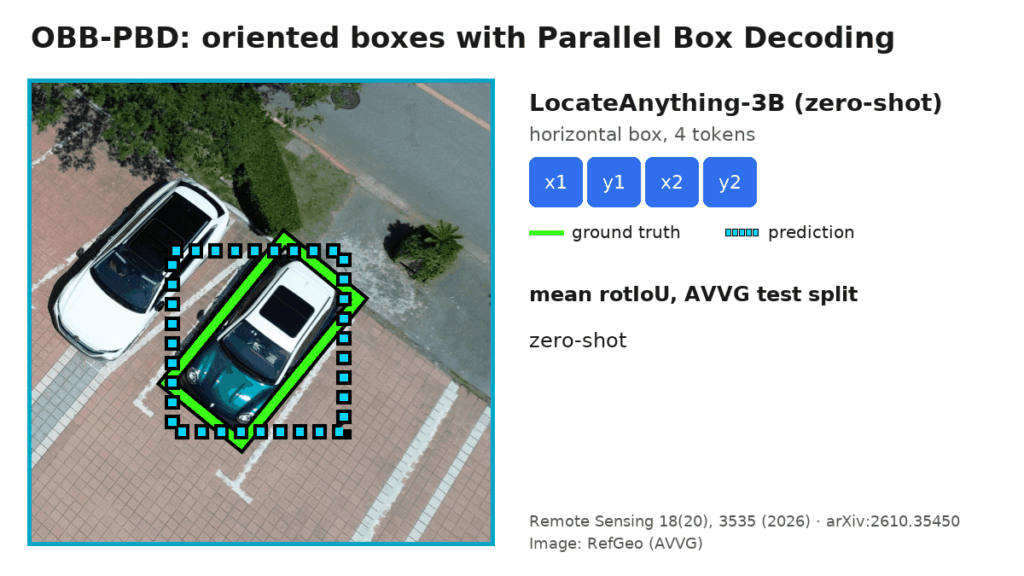
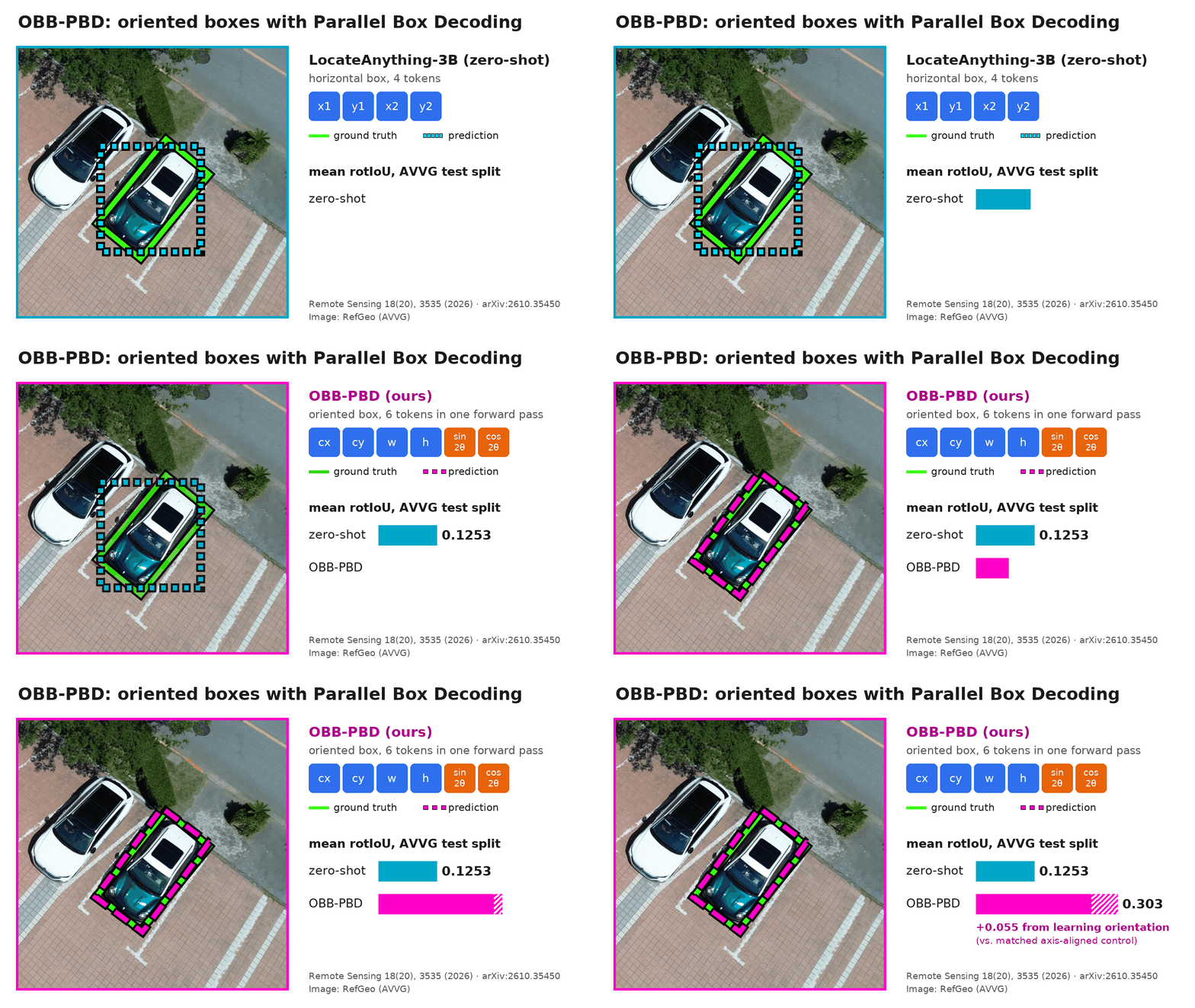
26. OBB-PBD: Extending Parallel Box Decoding to Oriented Bounding Boxes for Referring Expression Grounding in Aerial Imagery
🔑 Keywords: Parallel Box Decoding, oriented bounding boxes, double-angle parameterization, aerial vehicle visual grounding, rotated intersection over union
💡 Category: Computer Vision
🌟 Research Objective:
– The study aims to extend Parallel Box Decoding to handle oriented bounding boxes through a method called double-angle parameterization. This is intended to improve the accuracy of visual grounding in aerial imagery where objects are oriented in various directions.
🛠️ Research Methods:
– The research uses image/prompt-shuffle controls and visibility/leakage probes to verify the effectiveness of the extended model, ensuring that the model’s performance is based on both image and prompt inputs.
💬 Research Conclusions:
– The extended model significantly improves rotated intersection over union (rotIoU) metrics on the aerial vehicle visual grounding benchmark, showcasing a substantial enhancement from the zero-shot baseline when applied to oriented bounding boxes.
👉 Paper link: https://huggingface.co/papers/2610.35450
27. Rethinking Verification in Agent Harnesses
🔑 Keywords: agent harnesses, Verification, independent review, test-time scaling, completion gates
💡 Category: AI Systems and Tools
🌟 Research Objective:
– To explore how the verification of agent harnesses impacts the quality of outputs and provides guidance on organizing this process effectively.
🛠️ Research Methods:
– The study examines 17 designs across seven coding models using benchmarks such as Terminal-Bench and SWE-bench Verified, introducing VisualBench for evaluating visual and interactive artifacts.
💬 Research Conclusions:
– Independent review by critics significantly improves accuracy with minimal cost increases and is a superior strategy compared to instructions and reminders, demonstrating a more favorable accuracy-cost tradeoff.
– Completion gates can enhance output quality but at a substantially increased cost.
– Results offer empirical insights into optimizing verification strategies in agent harnesses for effective test-time scaling.
👉 Paper link: https://huggingface.co/papers/2610.34577

28. ThinkBit: Search Codewords, Recalibrate Scales, Select by Reasoning
🔑 Keywords: ThinkBit, Scalar Quantization, Gumbel-softmax, Knowledge Distillation, Quantization-Aware Training
💡 Category: Natural Language Processing
🌟 Research Objective:
– The primary aim is to develop a two-bit quantization framework, ThinkBit, that maintains reasoning capabilities in models by optimizing layerwise bit allocation and calibrating scales effectively.
🛠️ Research Methods:
– The framework employs a layerwise sensitivity metric to assign different bit tiers, utilizes Gumbel-softmax for scalar quantization to find optimal codewords and leverages knowledge distillation followed by quantization-aware training to fine-tune the model.
💬 Research Conclusions:
– ThinkBit demonstrates superior performance in terms of efficiency and accuracy, outperforming other two-bit models on reasoning tasks like MATH-500, while also being significantly smaller in size compared to traditional models.
👉 Paper link: https://huggingface.co/papers/2610.34886
29. Did the Model Use That? Counterfactual Training Boosts Self-Attribution in Language Models
🔑 Keywords: CREDIT, self-attribution, counterfactual training, language models
💡 Category: Natural Language Processing
🌟 Research Objective:
– The study aims to address the challenge of language models self-attributing external information by examining and improving when models acknowledge influences of provided information using the CREDIT approach.
🛠️ Research Methods:
– Utilization of counterfactual training to teach models to distinguish answers depending on or independent of external information. Introduction of CREDIT, which supervises final-answer self-attribution using counterfactual labels without human annotation.
💬 Research Conclusions:
– CREDIT significantly enhances attribution in open models, notably surpassing reasoning-level fine-tuning and baselines. It effectively differentiates responses influenced by user’s suggestions and partially transfers gains to unseen information types.
👉 Paper link: https://huggingface.co/papers/2610.35295
30.
31. Learning from Automatic 3D Gaussian Splatting Edits for Online Bayesian Scene Change Detection
🔑 Keywords: Bayesian fusion, 3D Gaussian Splatting, change detection, object-guided refinement
💡 Category: Computer Vision
🌟 Research Objective:
– The objective is to perform efficient online scene change detection using learned scene-specific evidence models and priors derived from 3D Gaussian Splatting representations.
🛠️ Research Methods:
– Utilizes Bayesian fusion and object-guided refinement, along with offline learning from automatic edits to 3D Gaussian Splatting models which eliminate the need for manual annotations.
💬 Research Conclusions:
– The proposed method achieves state-of-the-art accuracy on PASLCD and CCS3D datasets with 67.64% and 75.82% mIoU, respectively, and operates at a fast rate of 17.2 FPS.
👉 Paper link: https://huggingface.co/papers/2610.28490
32. Gluing Local Contexts into Global Meaning: A Sheaf-Theoretic Decomposition of Transformer Representations
🔑 Keywords: Cellular Sheaf, Frozen Language Models, Content Subspace, Harmonic Analysis, Influence Directions
💡 Category: Natural Language Processing
🌟 Research Objective:
– The study aims to use a cellular sheaf over paraphrase graphs to extract content subspaces and influence directions from frozen language models, enhancing fact retrieval and highlighting model fragility through harmonic analysis.
🛠️ Research Methods:
– The authors build a cellular sheaf over the paraphrase graph to assess whether representations maintain consistent content despite changes in phrasing, employing the Laplacian L_F on a frozen model without further training. The kernel is identified as a content subspace, and its efficacy is tested against LEACE on fact retrieval using various architectures.
💬 Research Conclusions:
– The research concludes that their method improves fact retrieval performance significantly (by 17.1 percentage points on average) and indicates model fragility through harmonic mass variation across architectures. The spectral complement proves to be a sensitive measure of causal influence, with substantial impacts on model outputs when ablated.
👉 Paper link: https://huggingface.co/papers/2610.17117
33. Humans in Space: Can MLLMs Construct Human-Centric Spatial Understanding via Active Exocentric Exploration?
🔑 Keywords: MLLMs, SATE-Bench, interactive benchmark, GRPO, spatial reasoning
💡 Category: Multi-Modal Learning
🌟 Research Objective:
– The study aims to address the gap in spatial reasoning capabilities of Multimodal Large Language Models (MLLMs) in human-centric scenes by introducing SATE-Bench, an interactive benchmark that evaluates visual self-awareness and active view-exploration.
🛠️ Research Methods:
– The paper introduces SATE-Bench comprising 316 real-world scenes and 2,525 multi-turn QA pairs, combining passive multi-view control with active exploration settings. The study also utilizes Group Relative Policy Optimization (GRPO) for fine-tuning.
💬 Research Conclusions:
– State-of-the-art MLLMs face challenges in premature exploration termination and fine-grained 3D tasks. Fine-tuning with GRPO increases active exploration but decreases overall accuracy due to over-exploration, highlighting the need for models with enhanced spatial reasoning capabilities.
👉 Paper link: https://huggingface.co/papers/2610.34149

34. EnvLunch: The Environment as a Free Lunch for Learning to Interact
🔑 Keywords: EnvLunch, executable environments, verifiable training trajectories, label-free warm-up, agentic reinforcement learning
💡 Category: Reinforcement Learning
🌟 Research Objective:
– To improve agent performance and reduce labeled data requirements for downstream tasks by leveraging executable environments.
🛠️ Research Methods:
– Utilizes EnvLunch as a warm-up stage to generate verifiable training trajectories without human annotations, enabling training based on final observations of valid action trajectories.
💬 Research Conclusions:
– EnvLunch improves model performance significantly, outperforming the baseline by over 9 points on average, with fewer labels required. It provides a better starting point for fine-tuning agentic models, showing greater benefits compared to models creating their own tasks.
👉 Paper link: https://huggingface.co/papers/2610.33817
35. Trust Mechanisms for Offline Generative AI at the Edge: A Connectivity-Regime Framework and an Empirical Study on a Raspberry Pi 5
🔑 Keywords: Generative AI, Local retrieval-augmented generation, Edge devices, Connectivity-regime framework, Knowledge packs
💡 Category: Generative Models
🌟 Research Objective:
– The study explores the efficiency and vulnerabilities of using local retrieval-augmented generation on edge devices with signed knowledge packs and output validators in disconnected IoT settings.
🛠️ Research Methods:
– Deployment and evaluation of a connectivity-regime framework with different model and context sizes on a Raspberry Pi 5 using retrieval-augmented generation, empirically calibrated retrieval-score gate, deterministic output validator, and NLI-based verifier.
💬 Research Conclusions:
– Although the retrieval-score gate effectively identifies knowledge gaps (AUROC 0.97), it struggles with in-topic unanswerable questions. The output validator converts malformed outputs without losing correct answers, yet mechanisms fail to ensure evidence truth. Additionally, validating signed packs is quicker than embedding, but poisoned updates can pass all checks, significantly reducing correct responses.
👉 Paper link: https://huggingface.co/papers/2610.33732
36. Intrinsic Goals for Autonomous Agents: Hierarchical Exploration Captures Future Volitional Action in Drosophila
🔑 Keywords: Intrinsic motivation, neuromechanical digital twin, hierarchical policy, DIAYN, behavioral entropy
💡 Category: Reinforcement Learning
🌟 Research Objective:
– The study aims to replicate fruit fly exploratory behavior and neural representations using hierarchical, intrinsically motivated agents with competency-based objectives.
🛠️ Research Methods:
– The research combines whole-brain recordings from fruit flies with a neuromechanical digital twin, training agents on 20 intrinsic motivation algorithms, including curiosity, entropy, and competency methods.
💬 Research Conclusions:
– DIAYN demonstrates the best performance in emulating fly behavior and neural coding, highlighting its potential to capture individual variability in exploration strategies and establish a foundation for reverse-engineering animal autonomy.
👉 Paper link: https://huggingface.co/papers/2610.34638
37. Skill^{infty}: Recursive Self-Improvement for Agent Skill Optimization
🔑 Keywords: Recursive self-improvement, meta agent, skill optimization, language agents, AI Native
💡 Category: Foundations of AI
🌟 Research Objective:
– The study aims to develop Skill∞, a system that facilitates recursive self-improvement by allowing a meta agent to optimize both task-specific skills and a meta-skill, enhancing performance in varied domains.
🛠️ Research Methods:
– Skill∞ employs an agent-led procedure where a meta agent follows a meta-skill to optimize task skills and refines the meta-skill itself. It involves steps such as diagnosing execution traces, proposing candidates, and allocating the search budget.
💬 Research Conclusions:
– Skill∞ achieved a 60.7% pass rate on 83 SkillsBench tasks, outperforming human-curated skills at 56.4% and SkillEvolver at 54.5%, demonstrating its effectiveness in optimizing skills across diverse domains.
👉 Paper link: https://huggingface.co/papers/2610.35434
38. RoboHarness: A Simple Harness Outperforms VLA and World Action Models
🔑 Keywords: LLM agents, RoboHarness, embodied manipulation, visual-geometric control, vision-language-action models
💡 Category: Robotics and Autonomous Systems
🌟 Research Objective:
– Explore how Large Language Models (LLMs) can perform embodied manipulation tasks in the physical world using a novel robotic harness called RoboHarness.
🛠️ Research Methods:
– Implement RoboHarness to provide LLM agents with a visual-geometric control interface, enabling them to directly understand and execute embodied tasks more effectively than existing vision-language-action models.
💬 Research Conclusions:
– RoboHarness-equipped models, such as Qwen3.8-Flash-Next, surpass traditional state-of-the-art vision-language-action models on robotics benchmarks like the BEHAVIOR Challenge 2025, demonstrating the effectiveness and potential of coding agents in achieving generalist embodied manipulation.
👉 Paper link: https://huggingface.co/papers/2610.14018

39. Constrained Decoding: Harmful or Beneficial? Revisiting Its Impact on LLM Performance
🔑 Keywords: Constrained decoding, Large Language Models, validity constraints, reasoning constraints, performance degradation
💡 Category: Natural Language Processing
🌟 Research Objective:
– To investigate whether constrained decoding inherently harms reasoning in Large Language Models and how different types of constraints can impact performance and reliability.
🛠️ Research Methods:
– A taxonomy approach analyzing three types of constraints: format, validity, and reasoning constraints.
– Causal ablations conducted across four model families and eleven open-source models using benchmarks and state-of-the-art constrained decoding strategies.
💬 Research Conclusions:
– The impact of constrained decoding on reasoning and performance depends on the specific type of constraint applied.
– Validity constraints can enhance reliability by eliminating invalid answers, while reasoning constraints can improve accuracy by enforcing beneficial reasoning trajectories.
– Performance degradation is more attributed to non-equivalent prompting and output formats rather than the constraint mechanism itself.
👉 Paper link: https://huggingface.co/papers/2610.35328
40. CRM-Agent-Bench: Benchmarking Tool-Using Agents in Stateful Enterprise Environments
🔑 Keywords: Execution-Grounded Benchmark, Deployable Language Agents, Contract-Based Success, CRM-Agent-Bench, Multi-Turn Business Tasks
💡 Category: Natural Language Processing
🌟 Research Objective:
– The study aims to introduce an execution-grounded benchmark for evaluating language agents on multi-turn business tasks, focusing on strict contract-based success criteria.
🛠️ Research Methods:
– The CRM-Agent-Bench evaluates agents through task-specific executable contracts across various criteria like actions, arguments, order, and more, within nine business domains and 36 capability tags.
💬 Research Conclusions:
– Results show that while leading systems achieve strict success rates between 64.32% and 83.60%, they vary in cost and reliability across domains, highlighting CRM-Agent-Bench as an effective tool for assessing business-transaction integrity.
👉 Paper link: https://huggingface.co/papers/2610.32004
41. Mycelium: A Meta-Study of Hallucination Detection Across Provenance, Typology, and Granularities
🔑 Keywords: Hallucination detection, Span Coverage F1, provenance, typology, granularity
💡 Category: Natural Language Processing
🌟 Research Objective:
– Examine hallucination detection in large language models through a framework of provenance, typology, and granularity axes and propose a Span Coverage F1 metric to address span-level evaluation variability.
🛠️ Research Methods:
– Organize existing hallucination detection benchmarks along provenance, typology, and granularity axes to study their impact on model evaluation and prediction tasks.
💬 Research Conclusions:
– Highlight limitations of cross-benchmark comparisons and clarify what detector scores capture, while suggesting the need for generalization evaluation across benchmark conditions.
👉 Paper link: https://huggingface.co/papers/2610.33608

42. Joint or Per-Option? Compact Encoders for Closed-Set Decisions from 17 Million to 1 Billion Parameters
🔑 Keywords: encoder, per-option scoring, zero-shot classifier, latency
💡 Category: Natural Language Processing
🌟 Research Objective:
– Investigate the optimal size and design of encoders for making closed-set decisions in language-model pipelines.
🛠️ Research Methods:
– Per-option scoring compared with joint scoring in three-seed study involving 32 million parameters.
– Evaluation using a 37-benchmark decision suite and additional external benchmarks.
– Analysis of encoder performance across different parameter sizes and initialization techniques.
💬 Research Conclusions:
– Per-option scoring outperforms joint scoring in accuracy on a held-out sample, especially with reranker initialization.
– Models with 68 to 150 million parameters outperform larger zero-shot classifiers while maintaining lower latency.
– Reordering of options affects a significant percentage of joint models’ answers, contrasting with the stability of per-option scoring.
👉 Paper link: https://huggingface.co/papers/2610.30970
43. Nested Sparsity for Scalable Pretraining and Continual Learning
🔑 Keywords: Nested Sparsity, Conditional Computation, Mixture-of-experts, Nestor, MoE transformers
💡 Category: Natural Language Processing
🌟 Research Objective:
– To introduce nested sparsity in attention for improving conditional computation over standard Mixture-of-experts (MoE) transformers, enhancing various aspects like pretraining and continual learning.
🛠️ Research Methods:
– Nestor model is proposed, generalizing the attention operator and integrating nested sparsity to naturally combine with the MoE operator’s sparsity.
💬 Research Conclusions:
– Nestor outperforms conventional MoE transformers in language model pretraining and offers better continual pretraining capabilities with efficient adaptation to long contexts and new domains.
👉 Paper link: https://huggingface.co/papers/2610.31818
44. ReGE: Stronger Agents through Experience Synthesis
🔑 Keywords: ReGE, ReGE-Syn, bounded execution records, guidance, process information
💡 Category: AI Systems and Tools
🌟 Research Objective:
– Convert recorded agent execution experience into synthesized guidance to enhance task execution without needing stronger teachers or parameter updates.
🛠️ Research Methods:
– Utilizes a single coach call to jointly synthesize execution records and artifacts into self-contained guidance.
– Implements a model where source generation, synthesis, and student execution use the same base model without parameter updates.
💬 Research Conclusions:
– ReGE improves task accuracy significantly on benchmarks, showing improvements for both GPT (9.9 percentage points) and Claude (8.8 percentage points).
– ReGE-Syn efficiently reduces guidance-construction tokens and execution tokens, providing a low-cost method for consolidating execution records, enhancing the self-reliance of agent systems.
👉 Paper link: https://huggingface.co/papers/2610.33861

45. Thinking-in-Bets at Test Time Reduces Sycophantic Revisions in LLM Agents
🔑 Keywords: Thinking-in-Bets, Claim Checklist, Gemini models, false reversals, multi-turn coding
💡 Category: Natural Language Processing
🌟 Research Objective:
– To improve agent reliability by implementing Thinking-in-Bets, which involves recording verified claims before user feedback to reduce false reversals and maintain accuracy.
🛠️ Research Methods:
– The method involves the agent creating a private record of its claims and the checks that support them, to be consulted when faced with user challenges.
– Evaluation was conducted across eight benchmarks using five different Gemini models.
💬 Research Conclusions:
– Pre-reply claims significantly reduce false reversals and unnecessary edits, especially in multi-turn coding scenarios.
– Implementing Thinking-in-Bets enhances answer accuracy and confidence estimates, even in tasks without user feedback.
👉 Paper link: https://huggingface.co/papers/2610.34654
46. iPrefBench: A User-Centric Benchmark for Personalized Mobile Use Agents
🔑 Keywords: iPrefBench, AI assistants, personalization, user-agent interaction
💡 Category: Human-AI Interaction
🌟 Research Objective:
– The study aims to introduce iPrefBench, a benchmark designed to evaluate if mobile agents can effectively infer missing user preferences from activity history or ask users for necessary clarifications, with a focus on personalized task completion.
🛠️ Research Methods:
– The iPrefBench benchmark is implemented in an iOS environment with an interactive simulated user, containing 130 underspecified user tasks across 26 apps based on a persona with 3,051 past activity events to test the infer and ask capabilities of agents.
💬 Research Conclusions:
– Evaluation of seven frontier agents showed a notable gap between action execution and personalization, with agents achieving high action completion scores but lower success in full task completion due to insufficient handling of ask-only information. This highlights the challenge for personalized agents to effectively know what to infer and when to ask.
👉 Paper link: https://huggingface.co/papers/2610.34735
47. Rethinking Video Storage for AI Training: Breaking Cross-Frame Dependencies for Efficient Random Access
🔑 Keywords: AI training, sparse decoding, dependency-decoupled encoding, decode amplification, inter-frame prediction
💡 Category: Robotics and Autonomous Systems
🌟 Research Objective:
– The paper aims to reduce video decode overhead for random AI training sampling through co-designed sparse decoding and dependency-decoupled encoding.
🛠️ Research Methods:
– The approach involves co-designing the decoding schedule and video reference structure, using dependency-aware sparse decoding to reconstruct only requested frames and necessary references.
– An optional offline Dependency-Decoupled Random Access (DDRA) encoding is applied to further reduce reference reconstruction.
💬 Research Conclusions:
– This method significantly increases loading throughput to 1.45 times that of LeRobot v3, while reducing media payload by 58.7%, all without sacrificing reconstruction quality.
👉 Paper link: https://huggingface.co/papers/2610.33079

48. CausalAlign: Causal Alignment of Video Generation Models for Consistent Ego-Motion
🔑 Keywords: CausalAlign, camera ego-motion, diffusion video generators, 3D foundation model, geometric consistency
💡 Category: Generative Models
🌟 Research Objective:
– To improve long-horizon camera ego-motion consistency in diffusion video generators by aligning internal representations to 3D dynamics using delta-token space.
🛠️ Research Methods:
– Use of linear probes and causal interventions to diagnose ego motion in video generation models.
– Aligning ego-motion state in VGMs with a 3D foundation model through delta-token space to enhance representation alignment and focus on dynamics.
💬 Research Conclusions:
– CausalAlign significantly enhances motion accuracy, geometric consistency, and temporal smoothness, improving geometric consistency by over 20% compared to base models.
– With fine-tuned VGMs, CausalAlign boosts the success rate of world action models by 10 points on RoboCasa365 benchmark tasks.
👉 Paper link: https://huggingface.co/papers/2610.29915

49. Build, Don’t Play: Self-Improving LLM Research Agents Develop a Hearthstone Battlegrounds AI That Rivals Top Players
🔑 Keywords: Self-Improving LLM, Hearthstone Battlegrounds, Reinforcement Learning, PPO, TavernGym
💡 Category: Reinforcement Learning
🌟 Research Objective:
– To investigate whether self-improving LLM research agents can autonomously handle complex real-world problems, specifically focusing on building a game simulator and surpassing human performance in Hearthstone Battlegrounds.
🛠️ Research Methods:
– Utilization of specialized LLM research agents sharing a typed research memory, passing verification gates, and conducting live games for iterative improvement of the simulator, opponents, and policy.
💬 Research Conclusions:
– AutoTavern built TavernGym, a faithful game simulator, and TavernAgent, which outperformed top human players with an average placement of 1.60 and 80% first places. The system demonstrated superior task completion and efficiency compared to frontier LLMs.
👉 Paper link: https://huggingface.co/papers/2610.33845

50. Evolving to Match Capabilities: Improving Harness Self-Evolution via Skill Adaptation
🔑 Keywords: Harness self-evolution, LLM agents, skill adaptation, meta-skill, execution experience
💡 Category: Knowledge Representation and Reasoning
🌟 Research Objective:
– To improve LLM agents through skill adaptation guided by a meta-skill, enabling enhancement without updating model parameters.
🛠️ Research Methods:
– Analysis of seven models across three benchmarks, identification of 103 task-skill pairs, diagnosing and adapting skills for execution, incorporating a five-round self-evolution loop.
💬 Research Conclusions:
– Meta-skill-guided adaptation improves weak executors’ performance by 5.1-14.1 points, with consistent score improvements in a self-evolution loop across various executors.
👉 Paper link: https://huggingface.co/papers/2610.33024
51. miniTE: Diagnosing and Bridging the Execution Gap in Native NVFP4 Reinforcement Learning
🔑 Keywords: MiniTE, reinforcement learning, large language models, native low-bit computation, cross-engine numerical execution
💡 Category: Reinforcement Learning
🌟 Research Objective:
– To enable stable low-bit reinforcement learning for large language models by aligning cross-engine numerical execution and accelerating native 4-bit computation.
🛠️ Research Methods:
– Introduction of miniTE, a lightweight framework combining execution diagnostics, cross-engine numerical alignment, and efficient native W4A4 computation.
💬 Research Conclusions:
– MiniTE enhances numerical execution consistency without modifying the RL objective, demonstrated by stable training and high benchmark performance in RL experiments.
– Achieved significant throughput improvements, surpassing BF16 and naive Transformer Engine NVFP4 on a single NVIDIA B300 GPU node.
👉 Paper link: https://huggingface.co/papers/2610.23928

52. World-in-Context: Interactive Video World Modeling with In-Context Conditioning
🔑 Keywords: Interactive video, World-in-Context, In-Context Conditioning, self-attention, perspective-switching
💡 Category: Generative Models
🌟 Research Objective:
– The study introduces World-in-Context, an interactive world modeling framework designed to enhance interactive video generation and navigation through unified control of viewing perspectives, character actions, and camera movements.
🛠️ Research Methods:
– World-in-Context employs In-Context Conditioning (ICC) by unifying view, action, and camera controls into explicit tokens within a shared self-attention space and uses Interaction-Transport RoPE for maintaining temporal continuity.
💬 Research Conclusions:
– The framework achieves high navigation performance and a high perspective-switching success rate, demonstrating advantages in richer conditioning scenarios, improved data efficiency, and applicability to causal rollouts.
👉 Paper link: https://huggingface.co/papers/2610.33169

53. Qwen-Image-PE: Learning Visual Design for Text-to-Image Prompt Enhancement
🔑 Keywords: Qwen-Image-PE, Text-to-Image, Caption-Based Reverse Distillation, Groupwise Design Reward
💡 Category: Generative Models
🌟 Research Objective:
– To enhance text-to-image generation (T2I) by learning visual design through a two-stage training process, aiming to improve the coherence and quality of the generated images.
🛠️ Research Methods:
– Implement a two-stage training process with Supervised Fine-Tuning using Caption-Based Reverse Distillation and Reinforcement Learning using Groupwise Design Reward to refine visual attributes.
💬 Research Conclusions:
– The Qwen-Image-PE achieved significant improvements in visual design, aesthetics, and overall image quality, outperforming existing prompt enhancers and demonstrating scalability across different model sizes and information densities. The model also successfully generalized to additional T2I backbones, showcasing its robustness and versatility.
👉 Paper link: https://huggingface.co/papers/2610.33472

54. Principia: Test-Time Hypotheses to Principle Construction for Scientific Discovery
🔑 Keywords: Principia, LLM-based framework, scientific discovery, hypotheses-to-principle pipeline, inductive principles
💡 Category: Foundations of AI
🌟 Research Objective:
– The paper aims to introduce Principia, an LLM-based framework that constructs and refines scientific principles during inference to enhance discovery in molecular and biological tasks.
🛠️ Research Methods:
– The framework establishes comparative causal hypotheses from inputs and their outcomes, synthesizing recurring relationships into inductive principles, which are iteratively revised based on new observations to continuously evolve scientific knowledge.
💬 Research Conclusions:
– Principia demonstrates superior performance over baselines across various benchmarks including molecular optimization and protein engineering, proving its effectiveness in generating plausible and scientifically consistent principles.
👉 Paper link: https://huggingface.co/papers/2610.32195
55. AV-FABLE: Audio-Visual Manipulation Forensics in Long-Form Videos
🔑 Keywords: AV-FABLE, audio-visual large language models, temporal localization, frozen perception features, Native Forensics via Separated Readouts
💡 Category: Multi-Modal Learning
🌟 Research Objective:
– Introduce AV-FABLE, a benchmark for sparse manipulations in long-form audio-visual videos to improve forensic analysis by enabling modality-specific temporal localization.
🛠️ Research Methods:
– Propose using separate temporal decoders for audio and visual timelines to recover forensic signals from frozen perception features of audio-visual large language models.
💬 Research Conclusions:
– AV-FABLE demonstrates that forensic evidence of manipulations in audio-visual content is best recovered using separate temporal decoders rather than relying solely on language outputs, achieving superior localization performance across multiple settings.
👉 Paper link: https://huggingface.co/papers/2610.33413

56. WorldCast: World-Consistent Character Video Generation with Large-Angle Camera Control
🔑 Keywords: Character Video Generation, 3D Point-Cloud, Geometry-Aligned Memory Attention, Large-Angle Camera Trajectories
💡 Category: Computer Vision
🌟 Research Objective:
– To enable consistent character video generation under large-angle camera motions by combining 3D point-cloud guidance with geometry-aligned memory attention.
🛠️ Research Methods:
– Introduction of CLACT, a large-scale dataset and benchmark for diverse large-angle camera trajectories.
– Proposal of WorldCast, a framework using 3D point-cloud and Geometry-Aligned Memory Attention for video generation.
💬 Research Conclusions:
– Demonstrated accurate trajectory following while preserving character geometry, appearance, and identity across diverse camera motions.
👉 Paper link: https://huggingface.co/papers/2610.33135

57. Work Agents: Systems, Capabilities, and Optimization
🔑 Keywords: foundation models, work agents, runtime harnesses, work persistence, work openness
💡 Category: AI Systems and Tools
🌟 Research Objective:
– Introduce a unified framework integrating foundation models and runtime harnesses to execute complex digital tasks reliably, incorporating persistence and openness.
🛠️ Research Methods:
– Develop a work-centric system-level perspective to combine models and harnesses, classify digital work, and examine optimization approaches.
💬 Research Conclusions:
– Provide a framework to understand, optimize, and evaluate work agents, facilitating the reliable delivery of verifiable digital work outcomes and outlining future research directions.
👉 Paper link: https://huggingface.co/papers/2610.35845

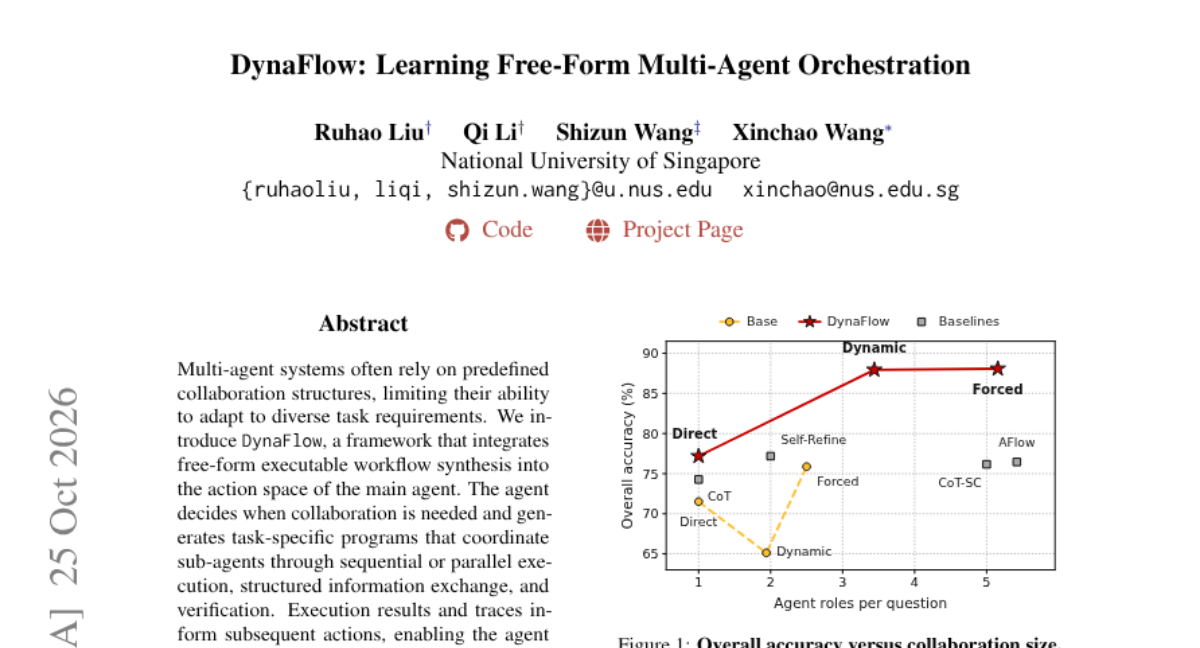
58. DynaFlow: Learning Free-Form Multi-Agent Orchestration
🔑 Keywords: DynaFlow, Multi-agent systems, Executable workflow synthesis, Orchestration, Cross-stage information flow
💡 Category: AI Systems and Tools
🌟 Research Objective:
– The study aims to enhance adaptive multi-agent collaboration by introducing a framework called DynaFlow, which allows the main agent to integrate free-form executable workflow synthesis for coordinating sub-agents.
🛠️ Research Methods:
– Implemented supervised fine-tuning for the main agent using distilled trajectories, followed by refinement on examples with unsupported premises, biased verification, and information-flow defects.
💬 Research Conclusions:
– DynaFlow achieved an 88.08% overall accuracy in Forced mode across various benchmarks, surpassing the existing baseline by 10.90 percentage points, and demonstrated improved multi-agent orchestration through explicit use, verification, and refinement of upstream outputs.
👉 Paper link: https://huggingface.co/papers/2610.34467
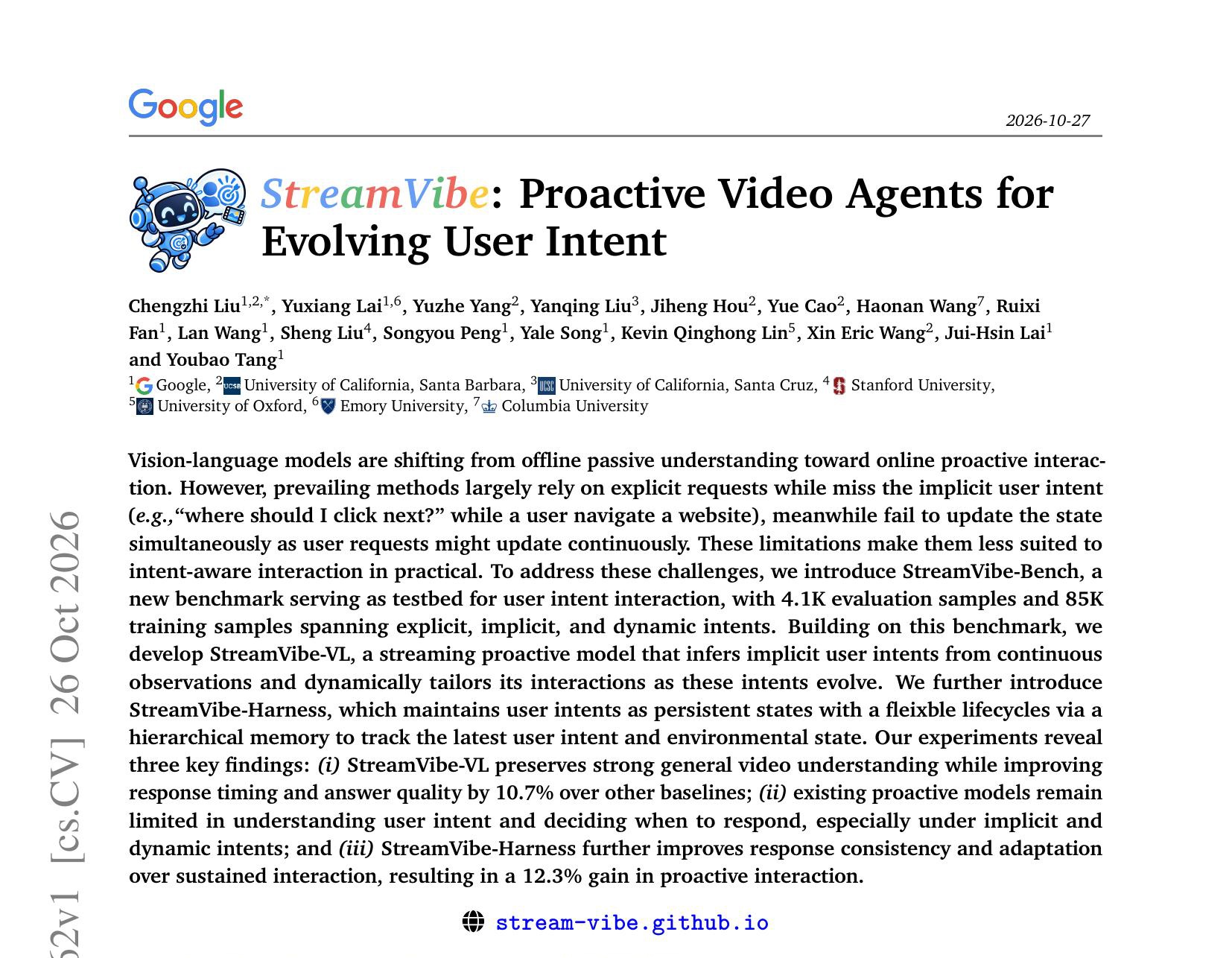
59. StreamVibe: Proactive Video Agents for Evolving User Intent
🔑 Keywords: Vision-language models, proactive interaction, implicit user intent, hierarchical memory, streaming proactive model
💡 Category: Human-AI Interaction
🌟 Research Objective:
– To develop a proactive, intent-aware streaming vision-language model that addresses the challenges of implicit and evolving user goals.
🛠️ Research Methods:
– Introduction of StreamVibe-Bench as a benchmark for testing user intent interactions.
– Development of StreamVibe-VL to infer implicit user intents continuously and dynamically tailor interactions.
– Implementation of StreamVibe-Harness to track user and environmental states with hierarchical memory.
💬 Research Conclusions:
– StreamVibe-VL improves response timing and answer quality by 10.7% over other baselines.
– Existing proactive models struggle with understanding implicit and dynamic user intents.
– StreamVibe-Harness enhances response consistency and adaptation, resulting in a 12.3% improvement in proactive interaction.
👉 Paper link: https://huggingface.co/papers/2610.34662