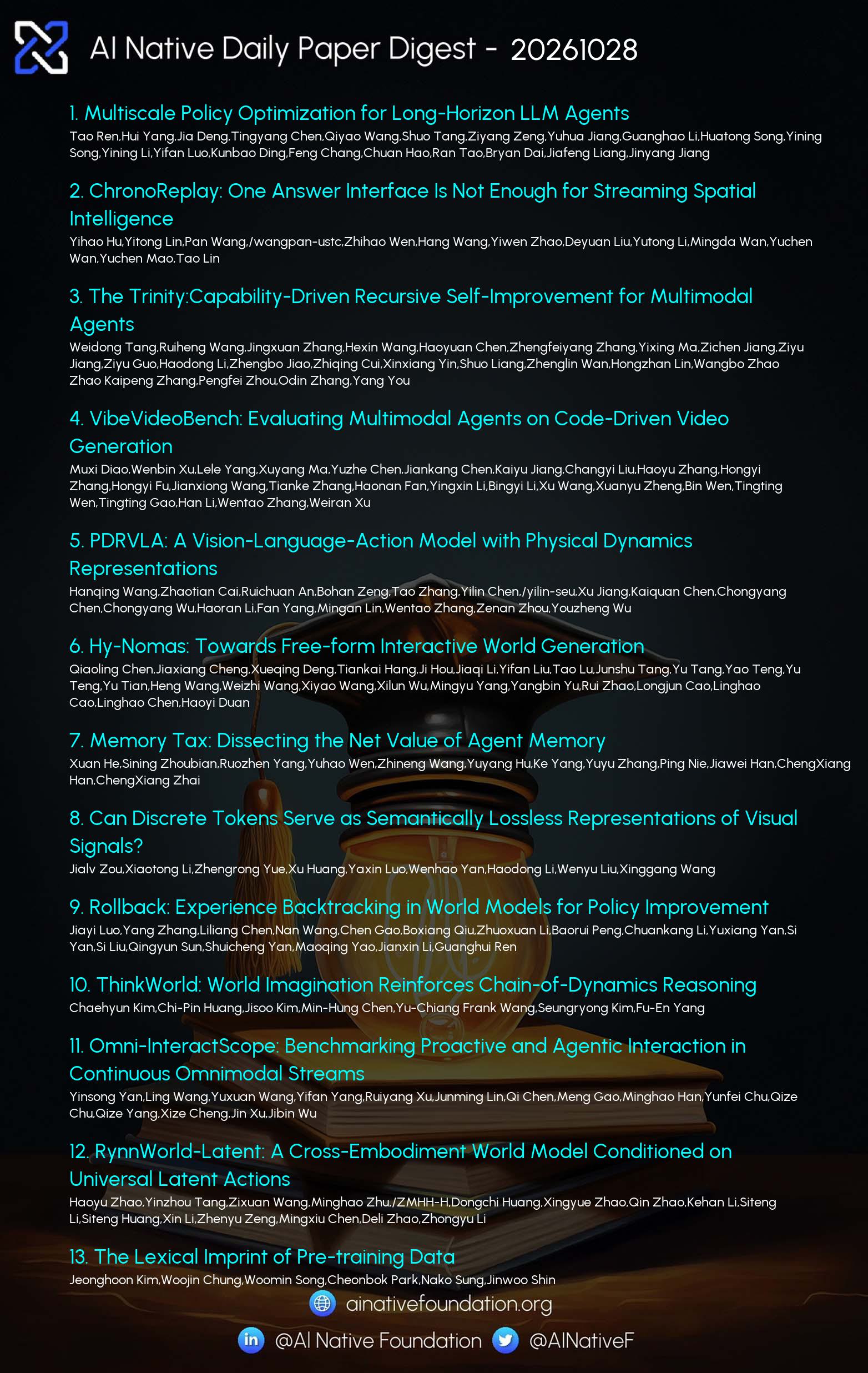
AI Native Daily Paper Digest – 20261028 – Multiscale Policy Optimization | PDRVLA | MatAnyone-E
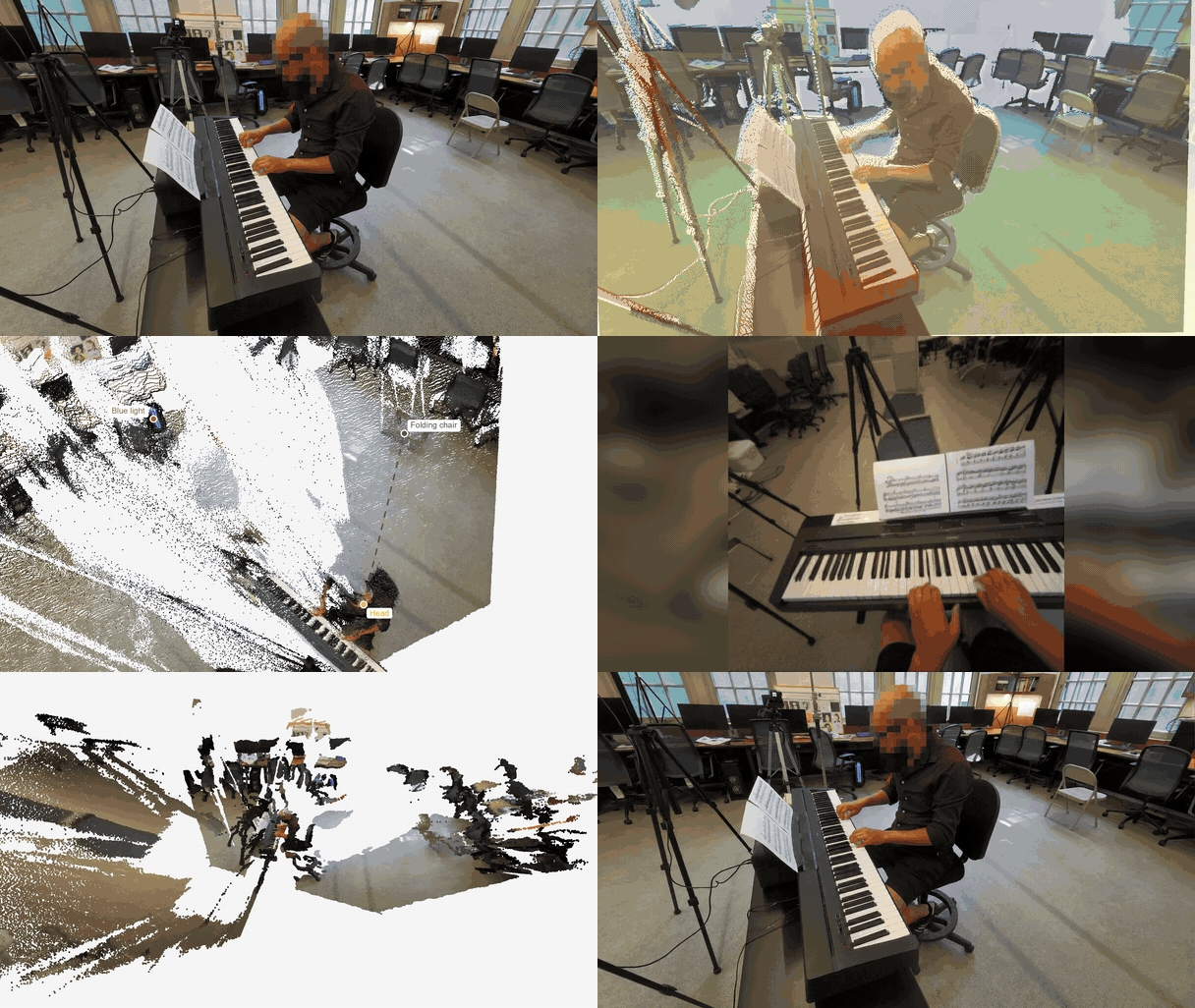
Today’s digest highlights advancements from GPT and Claude, focusing on innovations in agentic systems and multimodal reasoning. The collection of papers delves into sophisticated methods like attention-based encoder mechanisms and composite pre-training on diverse datasets, emphasizing performance improvements in specific benchmarks such as SuperGLUE. Another study showcases a novel reinforcement learning paradigm that enhances agent learning efficiency by 20%. Notably, the implications extend to improved contextual comprehension in natural language processing.
1. Multiscale Policy Optimization for Long-Horizon LLM Agents
🔑 Keywords: Multiscale Policy Optimization, Long-horizon LLM agents, credit assignment, advantage estimation
💡 Category: Reinforcement Learning
🌟 Research Objective:
– The study aims to improve long-horizon agent training by aligning credit assignment and policy updates at the turn scale.
🛠️ Research Methods:
– The proposed Multiscale Policy Optimization combines Multiscale Advantage Estimation and turn-level importance sampling to enhance the training process.
💬 Research Conclusions:
– Extensive experiments demonstrate consistent gains in performance over strong RL baselines across various tasks including search, tool-use, and automation.
👉 Paper link: https://huggingface.co/papers/2610.35013
2. The Trinity:Capability-Driven Recursive Self-Improvement for Multimodal Agents
🔑 Keywords: Trinity framework, multimodal agents, capability tree, Real2Sim2Real, Capability-Aware Harness Router
💡 Category: Multi-Modal Learning
🌟 Research Objective:
– The study aims to improve the performance of multimodal agents by developing a framework called The Trinity, which organizes tasks into a capability tree and generates simulated training worlds.
🛠️ Research Methods:
– A recursive self-improvement framework named The Trinity integrates three roles: Creator, Explorer, and Evolver, to enhance agent performance through a hierarchical capability tree and capability-driven Real2Sim2Real methodology.
💬 Research Conclusions:
– The evolved Harnesses within The Trinity framework show significant improvement, with mean performance gains of 34 points across 28 training benchmarks and 26 points across 18 unseen benchmarks, demonstrating the effectiveness of the framework in diverse scenarios including real-world tasks.
👉 Paper link: https://huggingface.co/papers/2610.36077
3. PDRVLA: A Vision-Language-Action Model with Physical Dynamics Representations
🔑 Keywords: PDRVLA, Physical Dynamics Module, Vision-Language-Action, world-model supervision, future prediction
💡 Category: Robotics and Autonomous Systems
🌟 Research Objective:
– To enhance robot action generation by integrating a lightweight physical dynamics module that predicts future visual features using world-model supervision.
🛠️ Research Methods:
– Introducing PDRVLA with a lightweight Physical Dynamics Module that avoids online video generation, using future RGB, depth, and optical-flow feature predictions.
– Training entirely on publicly available data, expanded via human-to-robot synthesis, subtask annotation, and embodied chain-of-thought (ECoT) annotation.
💬 Research Conclusions:
– PDRVLA achieved high success rates across four simulation benchmarks, significantly improving future prediction and detailing the effects of subtask conditioning, future object-pose supervision, and ECoT training on action success.
👉 Paper link: https://huggingface.co/papers/2610.37381
4. Memory Tax: Dissecting the Net Value of Agent Memory
🔑 Keywords: memory systems, naive retrieval-augmented generation, memory benefit, memory tax
💡 Category: AI Systems and Tools
🌟 Research Objective:
– To assess the net value of dedicated memory systems versus naive retrieval-augmented generation, using the concepts of memory benefit and memory tax.
🛠️ Research Methods:
– Conducted large-scale evaluation across multiple benchmarks and model backbones to dissect the net value of memory.
💬 Research Conclusions:
– Many dedicated memory systems are found to underperform compared to naive retrieval-augmented generation, with a focus on the overlooked memory tax concept, aiming to inform more reliable memory designs and evaluations.
👉 Paper link: https://huggingface.co/papers/2610.34073

5. Can Discrete Tokens Serve as Semantically Lossless Representations of Visual Signals?
🔑 Keywords: Discrete visual tokens, Factorized Vector Quantization, multimodal understanding, continuous visual representations, quantization error
💡 Category: Multi-Modal Learning
🌟 Research Objective:
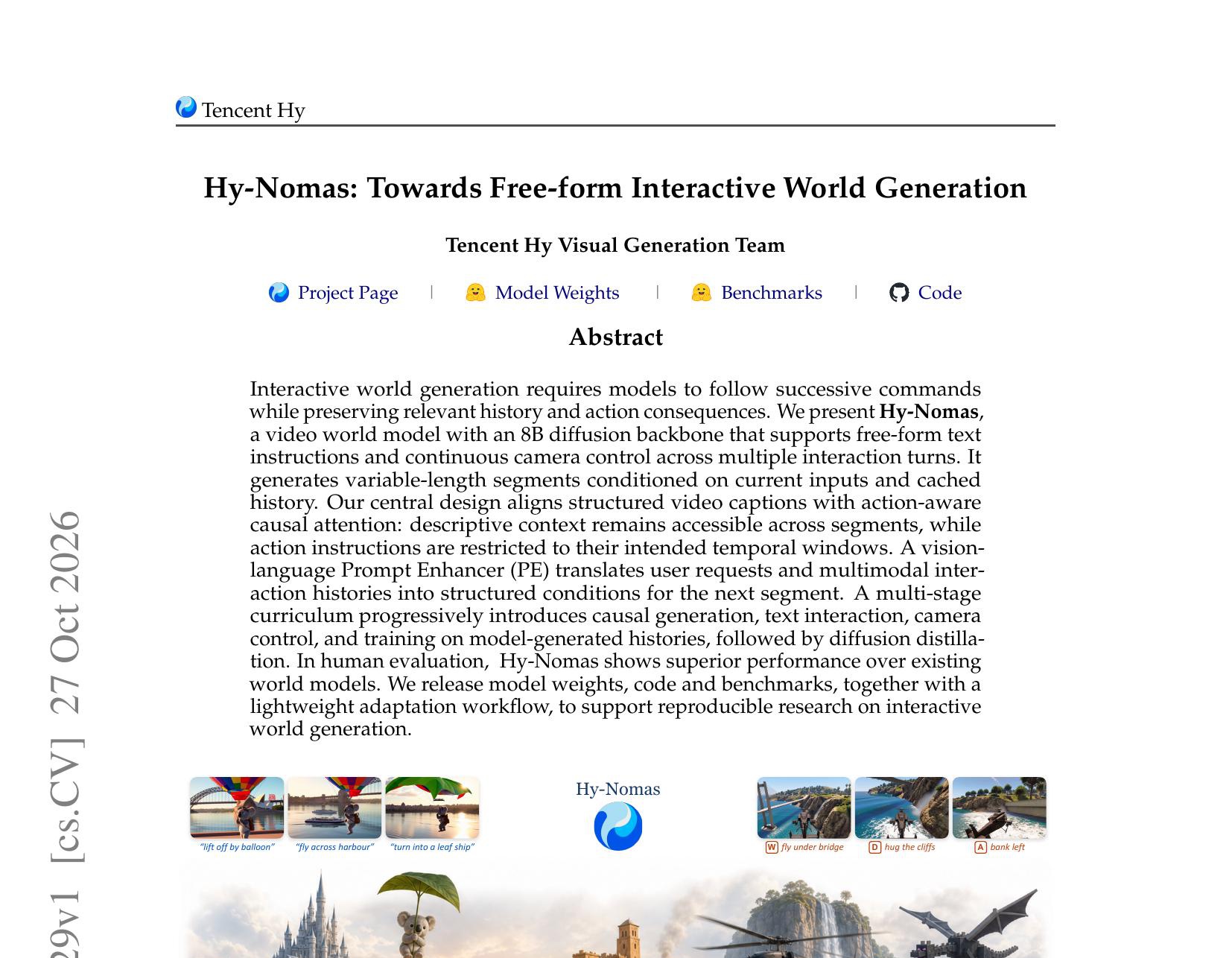
– This study aims to enhance the quality of discrete visual tokens by introducing Factorized Vector Quantization, which uses parallel codebooks for complementary feature views to match or surpass the performance of continuous visual representations in multimodal understanding.
🛠️ Research Methods:
– Implementation of Factorized Vector Quantization to optimize the discrete representation of visual features using symmetric parallel codebooks, improving performance with larger bit budgets.
💬 Research Conclusions:
– The proposed method significantly improves the performance of discrete-representation models, outperforming existing models like UniAR and Emu3-Chat, and proving competitive with strong continuous-representation models, including on fine-grained OCR tasks. This supports the potential for discrete visual representations in large-scale native multimodal foundation models.
👉 Paper link: https://huggingface.co/papers/2610.37662

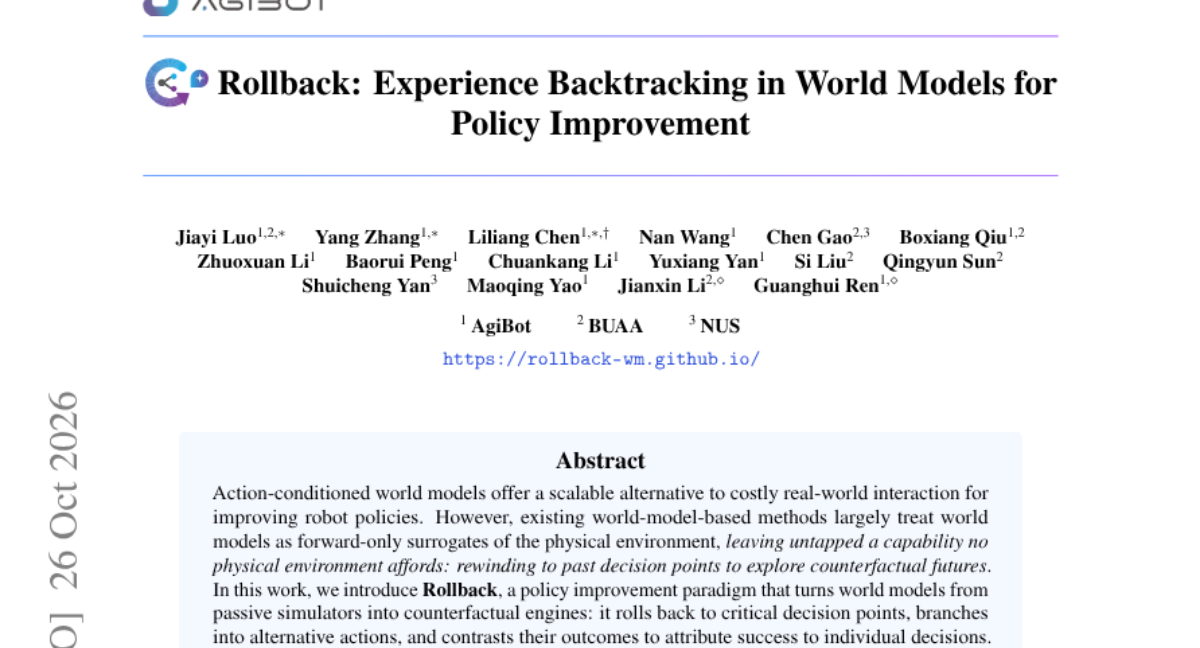
6. Rollback: Experience Backtracking in World Models for Policy Improvement
🔑 Keywords: Rollback, counterfactual futures, action-conditioned world models, test-time physics grounding
💡 Category: Robotics and Autonomous Systems
🌟 Research Objective:
– The research aims to improve robot policies using world models to explore counterfactual actions and refine dynamics through real-world feedback.
🛠️ Research Methods:
– Introduced Rollback, transforming world models into counterfactual engines and employing a scalable training system combining distributed world-model search with asynchronous real-robot execution.
💬 Research Conclusions:
– Rollback enhances success rates significantly over baselines in real-world tasks, surpassing human performance in some tasks within a short training period.
👉 Paper link: https://huggingface.co/papers/2610.36068
7. ThinkWorld: World Imagination Reinforces Chain-of-Dynamics Reasoning
🔑 Keywords: ThinkWorld, Vision-Language-Action (VLA), world dynamics, Chain-of-Dynamics (CoD), reinforcement learning
💡 Category: Robotics and Autonomous Systems
🌟 Research Objective:
– The study aims to enhance robotic generalization by representing actions as dynamics chains and utilizing world imagination to learn from unlabeled human videos.
🛠️ Research Methods:
– Introduction of ThinkWorld, a VLA learning framework that grounds action reasoning in world dynamics, augmented by reinforcement learning with world imagination.
💬 Research Conclusions:
– The framework enables effective human-to-robot transfer and robust generalization to novel tasks and environments, as demonstrated through simulations and real robot experiments.
👉 Paper link: https://huggingface.co/papers/2610.37666

8. Zooming without Zooming v2: From Seeing Details to Connecting Evidence for Generalizable Multimodal Perception
🔑 Keywords: Multimodal perception, Spatial perception, Embodied AI, EvidenceConnect, Visual reasoning
💡 Category: Multi-Modal Learning
🌟 Research Objective:
– The objective is to enhance spatial perception and multimodal reasoning by synthesizing training data that strengthen visual evidence connection.
🛠️ Research Methods:
– Developed EvidenceConnect, a data synthesis framework using zoomed image views to generate questions for improved visual evidence connection and trained VLMs with RLVR methods.
💬 Research Conclusions:
– EvidenceConnect successfully improves fine-grained and spatial perception and advances embodied spatial reasoning and multimodal long-context understanding, establishing itself as an effective supervisory framework for multimodal perception.
👉 Paper link: https://huggingface.co/papers/2610.37037

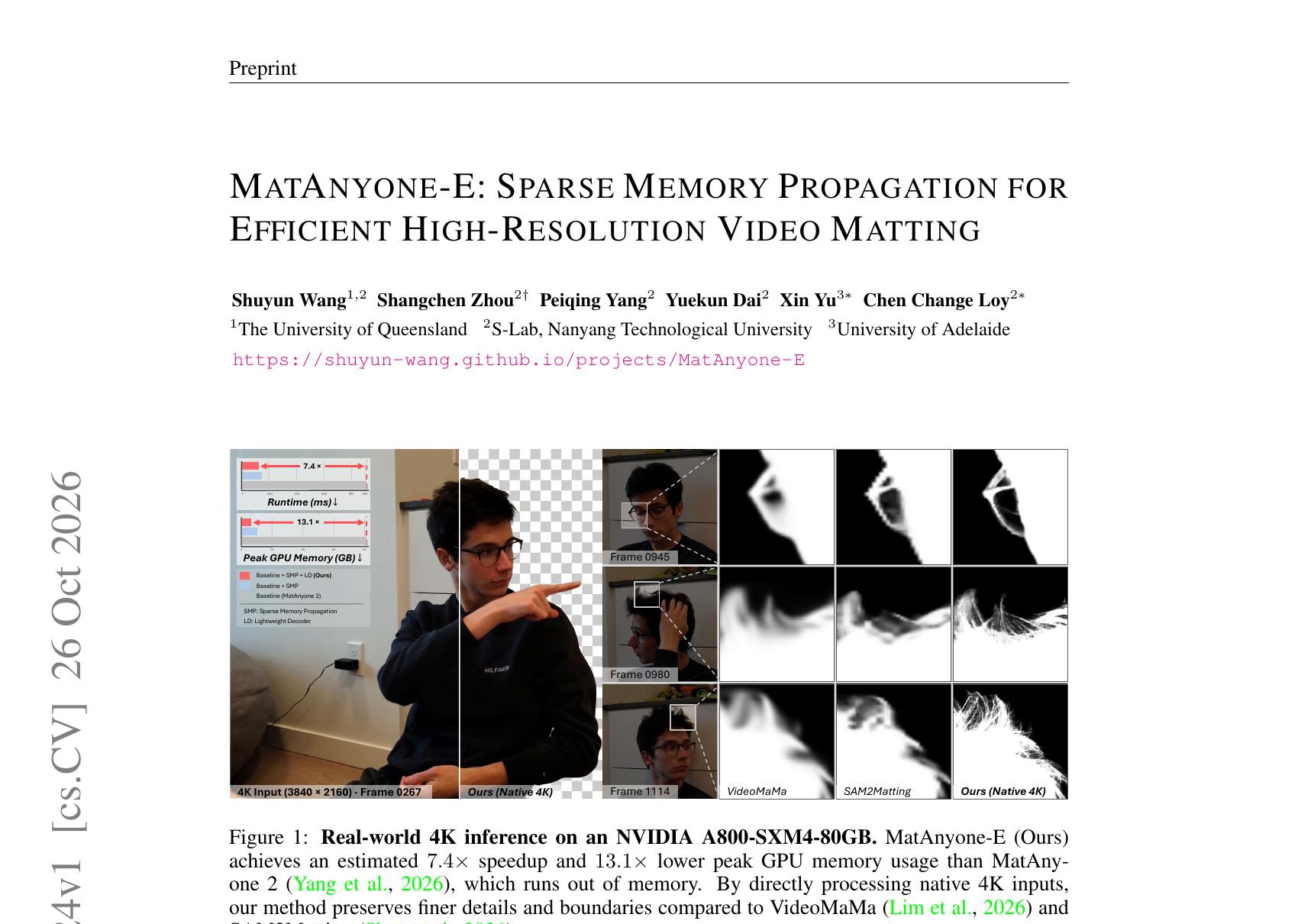
9. MatAnyone-E: Sparse Memory Propagation for Efficient High-Resolution Video Matting
🔑 Keywords: High-resolution video matting, MatAnyone-E, inference speedup, GPU memory, lightweight decoder
💡 Category: Computer Vision
🌟 Research Objective:
– To accelerate high-resolution video matting by selectively applying high-resolution matching to uncertain regions while using a lightweight decoder to maintain quality.
🛠️ Research Methods:
– Proposed a method that identifies uncertain regions for high-resolution matching, performs low-resolution propagation, and utilizes a lightweight decoder to optimize computational efficiency.
💬 Research Conclusions:
– MatAnyone-E achieves a 7.4x inference speedup and significantly reduces GPU memory usage compared to MatAnyone 2, maintaining comparable matting quality and achieving high frame rates at both 1080p and 4K.
👉 Paper link: https://huggingface.co/papers/2610.35724
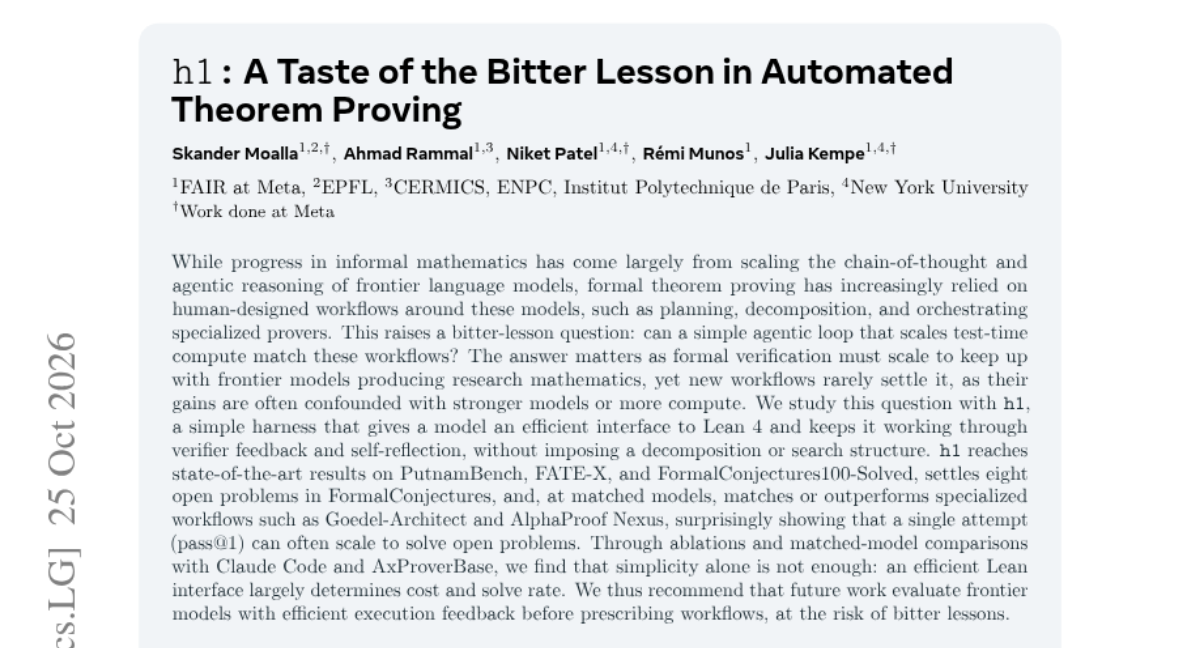
10. h1: A Taste of the Bitter Lesson in Automated Theorem Proving
🔑 Keywords: Lean feedback, formal theorem proving, agentic loop, execution interfaces, AI Native
💡 Category: Knowledge Representation and Reasoning
🌟 Research Objective:
– The study aims to determine if a simple agentic loop with efficient Lean feedback can achieve state-of-the-art results in formal theorem proving without relying on complex human-designed workflows.
🛠️ Research Methods:
– A simple harness named h1 was developed to provide efficient interfaces to Lean 4, allowing models to work through verifier feedback and self-reflection without decomposing or searching structures.
💬 Research Conclusions:
– The research demonstrated that an efficient Lean interface is crucial and can produce competitive results, sometimes outperforming specialized workflows. The study recommends evaluating models with execution feedback before developing complex workflows to prevent bitter lessons.
👉 Paper link: https://huggingface.co/papers/2610.35962
11. Omni-InteractScope: Benchmarking Proactive and Agentic Interaction in Continuous Omnimodal Streams
🔑 Keywords: Omni-LLMs, Omni-InteractScope, query-free assistance, tool invocation, continuous audiovisual interaction
💡 Category: Multi-Modal Learning
🌟 Research Objective:
– To evaluate the reliability of Omnimodal large language models (Omni-LLMs) in continuous audiovisual interaction for timely interventions, covering different aspects such as event-timed tool invocation and query-free assistance.
🛠️ Research Methods:
– Introduction of Omni-InteractScope, a benchmark of 1,479 human-annotated interactions, linking input modalities, event triggers, intervention types, and user needs across eight task groups.
💬 Research Conclusions:
– Current Omni-LLMs show significant limitations in timely tool invocation, query-free reminders, and end-to-end guidance coverage. Existing models only achieve up to 32.0% accuracy in combined timing-and-tool tasks, reminders recall at most 23.0%, and minimal coverage of guidance sequences.
👉 Paper link: https://huggingface.co/papers/2610.35439

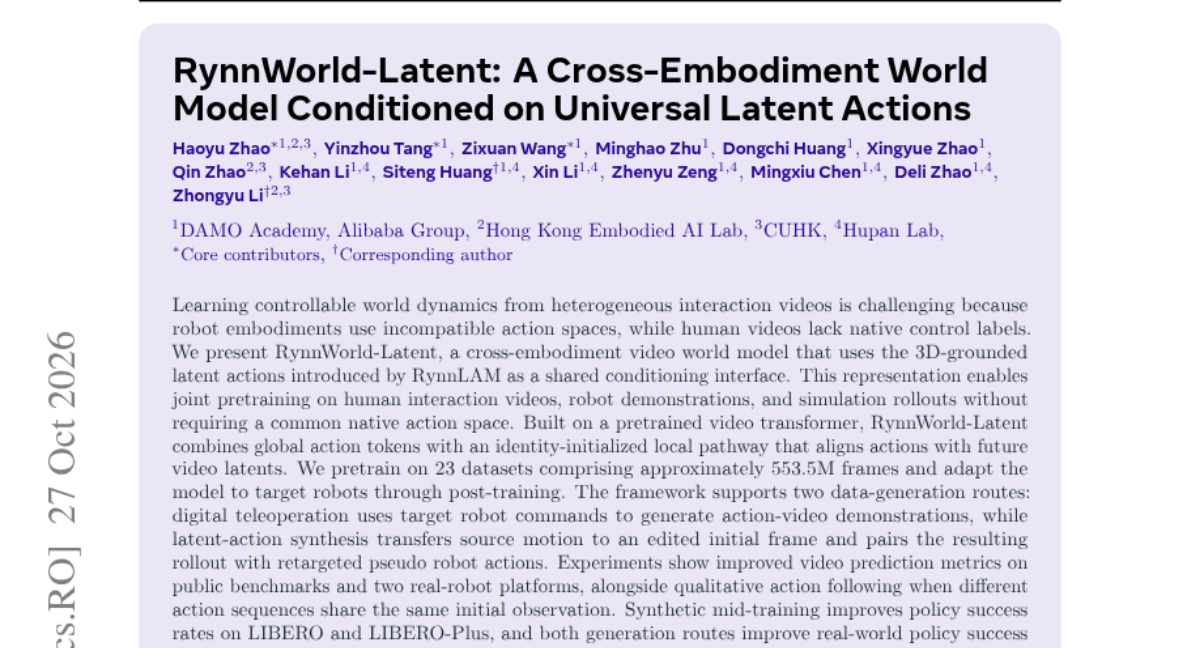
12. RynnWorld-Latent: A Cross-Embodiment World Model Conditioned on Universal Latent Actions
🔑 Keywords: cross-embodiment video world model, 3D-grounded latent actions, digital teleoperation, latent-action synthesis, universal latent actions
💡 Category: Robotics and Autonomous Systems
🌟 Research Objective:
– The study aims to enhance robot policy performance through RynnWorld-Latent by learning cross-embodiment world dynamics using 3D-grounded latent actions.
🛠️ Research Methods:
– Utilizes a cross-embodiment video world model with a framework built on a pretrained video transformer, integrating global action tokens and identity-initialized local pathways. Pretraining involves 23 datasets with approximately 553.5M frames, adapting through post-training.
💬 Research Conclusions:
– Results indicate improved video prediction metrics, action-following quality, and policy success rates on benchmarks and real-robot platforms compared to real-demonstration-only training, supporting universal latent actions as a scalable interface.
👉 Paper link: https://huggingface.co/papers/2610.36791
13. The Lexical Imprint of Pre-training Data
🔑 Keywords: zero-shot accuracy, lexical alignment, unigram cross-entropy, pre-training corpus
💡 Category: Natural Language Processing
🌟 Research Objective:
– Investigate the impact of lexical alignment between pre-training corpora and benchmark targets on zero-shot accuracy, utilizing word-level unigram cross-entropy as a measure.
🛠️ Research Methods:
– Conduct controlled from-scratch pre-training across different corpora and model scales to observe the relationship between lexical alignment and zero-shot accuracy.
💬 Research Conclusions:
– The lexical imprint from pre-training corpora consistently affects zero-shot accuracy, with better alignment (lower UCE) leading to higher accuracy across benchmarks.
– Document and prompt-level adaptations based on lexical alignment result in significant performance improvements.
👉 Paper link: https://huggingface.co/papers/2602.10657
14. SearchHorizonBench: A Benchmark for Search Value in AI Agents
🔑 Keywords: SearchHorizonBench, historical calibration, search gains, value-aware search agents, Brier error
💡 Category: Reinforcement Learning
🌟 Research Objective:
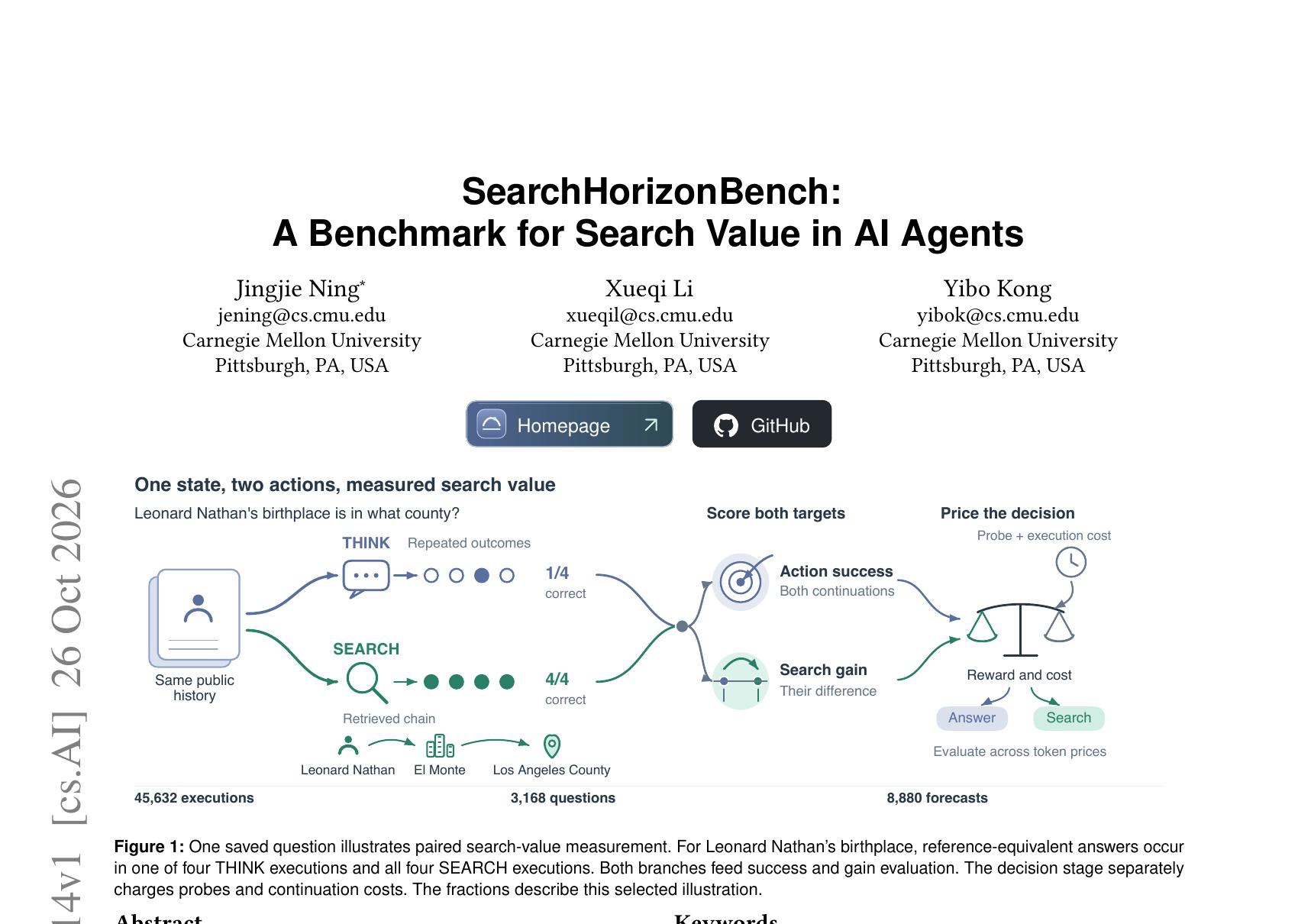
– The study aims to evaluate how AI agents learn to estimate the value of additional search from execution history, introducing SearchHorizonBench as a benchmark.
🛠️ Research Methods:
– The research uses paired continuations and repeated executions to separate expected search gain from generation noise. It leverages historical calibration to assess prediction accuracy and decision utility across various questions and configurations.
💬 Research Conclusions:
– Historical calibration improves prediction accuracy by reducing Brier error by 16.2% but explains less than 2% variance in search gains. Reusable histories and strong baselines establish a foundation for value-aware search agents.
👉 Paper link: https://huggingface.co/papers/2610.34714
15. On the SPOT: Enhancing Speculative Decoding for Diffusion Language Models via Commit-Order Prediction
🔑 Keywords: Diffusion language models, Speculative decoding, SPOT, Dynamic threshold decoding, Throughput
💡 Category: Natural Language Processing
🌟 Research Objective:
– Accelerate diffusion language models by determining token generation order and verifying candidates efficiently to enhance throughput while maintaining exact decoding.
🛠️ Research Methods:
– Introduces a model named Speculating Positions Order Trajectory (SPOT) to predict token generation order, utilizing a tree-based approach for candidate proposals and single pass verification to cut down the decoding passes significantly.
– Implements SPOT-Sets for dynamic threshold decoding that commits several positions in each pass to improve efficiency.
💬 Research Conclusions:
– SPOT significantly reduces decoding passes up to 6.8 times and boosts throughput up to 3.4 times over standard methods in SDAR-8B settings.
– SPOT’s drafter shows successful transfer across multiple models and enhances the throughput of SDAR-8B by 59% over threshold decoding alone, without further training requirements.
👉 Paper link: https://huggingface.co/papers/2610.22543

16. OvisOCR3 Technical Report
🔑 Keywords: OvisOCR3, Multi-teacher distillation, Reinforcement learning, OCR, Vision-language model
💡 Category: Computer Vision
🌟 Research Objective:
– To introduce OvisOCR3, a compact 0.8B vision-language model that unifies diverse OCR tasks, achieving state-of-the-art results.
🛠️ Research Methods:
– OvisOCR3 utilizes multi-teacher distillation and reinforcement learning, trained on both real and synthetic data with domain-balanced mid-training.
💬 Research Conclusions:
– OvisOCR3 demonstrates strong performance across various OCR-related tasks, ranking highly on numerous benchmarks and outperforming other models in different task families.
👉 Paper link: https://huggingface.co/papers/2610.33066
17. Nemotron-Labs-Diffusion-Uni: Elastic Self-Refining Unified Diffusion LLM with Cross-Paradigm On-Policy Distillation
🔑 Keywords: Unified Discrete Diffusion, Visual Understanding, Cross-Paradigm On-Policy Distillation, Progressive Self-Refining Diffusion
💡 Category: Multi-Modal Learning
🌟 Research Objective:
– To propose NLD-Uni, a unified discrete diffusion language model for visual understanding and generation, combining the strengths of autoregressive VLMs and continuous flow models.
🛠️ Research Methods:
– Introduction of a unified cross-paradigm on-policy distillation framework and a novel progressive self-refining diffusion process to enhance both visual understanding and generation.
💬 Research Conclusions:
– NLD-Uni demonstrates state-of-the-art performance on varied tasks such as visual question-answering, multi-modal reasoning, object grounding, text-to-image generation, and image editing, indicating its superiority among unified DLLMs.
👉 Paper link: https://huggingface.co/papers/2610.36466
18. Benchmarking Obstacle-Conditioned Safety in Household Robot Navigation
🔑 Keywords: Obstacle-Conditioned Safe Motion Adaptation, Semantic Sensitivity Index, VLM-based policies, semantic-to-motion grounding, AI Native
💡 Category: Robotics and Autonomous Systems
🌟 Research Objective:
– The study aims to evaluate robot navigation policies’ ability to adapt continuous motion based on obstacle safety semantics and highlights a gap in translating semantic caution into safe movement.
🛠️ Research Methods:
– Introduced OSMA-Bench, a benchmark to test obstacle-conditioned safe motion adaptation across different obstacle types, and proposed the Semantic Sensitivity Index (SSI) to measure appropriate navigation adjustments in speed and smoothness.
💬 Research Conclusions:
– Evaluated VLM-based and vision-language-action policies showed inadequate adaptation of motion considering obstacle safety, although they could recognize safety-relevant obstacles. An additional parameter-inference step improved adaptation in VLM-based policies.
👉 Paper link: https://huggingface.co/papers/2610.34674

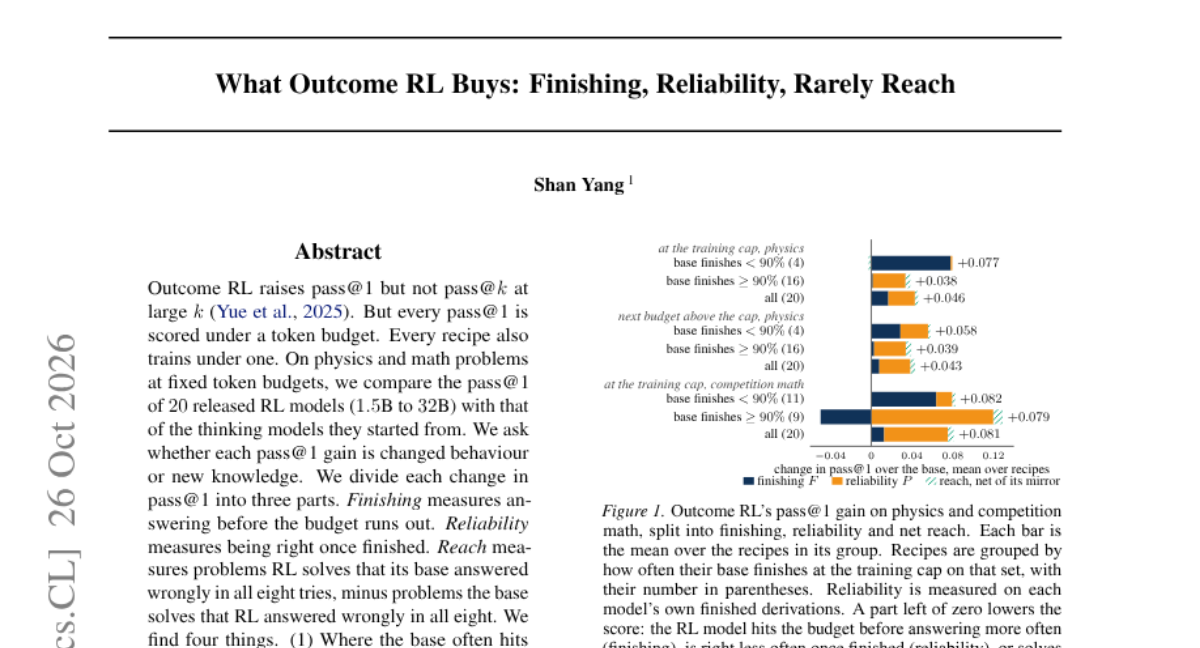
19. What Outcome RL Buys: Finishing, Reliability, Rarely Reach
🔑 Keywords: Reinforcement Learning, pass@1, reliability, token budget, physics
💡 Category: Reinforcement Learning
🌟 Research Objective:
– To investigate how reinforcement learning (RL) improves pass@1 scores in solving physics and math problems under fixed token budgets and to determine whether improvements arise from finishing answers faster, increased reliability, or acquiring new problem-solving knowledge.
🛠️ Research Methods:
– Compared pass@1 outcomes of 20 RL models against their base models, looking into factors like finishing, reliability, and reach across problems from physics and math datasets.
💬 Research Conclusions:
– Main improvements in pass@1 scores are due to faster completion of answers and increased reliability, with minimal gains in expanding problem-solving reach.
– RL models show improved reliability when given sufficient token budgets but rarely solve problems that base models cannot.
– Increased token allocation enables base models to close the finishing gap, and new problem resolution by RL is primarily characterized by finishing, with negligible improvements in reliability.
👉 Paper link: https://huggingface.co/papers/2610.34894
20. Sub-monolayer tracking of molecular states at buried interfaces
🔑 Keywords: Machine learning, Resonant soft X-ray scattering, Molecular orientation, Buried interfaces, Optical modeling
💡 Category: Machine Learning
🌟 Research Objective:
– The paper aims to enhance optical modeling using machine learning to enable quantitative, depth-resolved analysis of molecular orientation and packing at buried interfaces.
🛠️ Research Methods:
– Utilization of a machine learning-optimized optical model to analyze polarized resonant soft X-ray scattering from molecular thin films.
💬 Research Conclusions:
– The study discovers a gradient evolution of molecular orientation and packing from the interface, providing nondestructive insights into buried interfacial formation and challenging existing hypotheses about substrate patterning. These findings offer new possibilities for controlling interfacial states and phenomena in next-generation technologies.
👉 Paper link: https://huggingface.co/papers/2610.31924
21. MLE-World: Predicting Machine Learning Experiment Outcomes with a Learned World Model
🔑 Keywords: AI Research Agents, World Model, Test Time Scaling, Confidence Score, MLE-World
💡 Category: AI Systems and Tools
🌟 Research Objective:
– The study aims to improve the efficiency of AI research agents in solving machine learning tasks by reducing the need for actual program execution through prediction.
🛠️ Research Methods:
– Introduction of MLE-World, a world model finetuned from Qwen3.5-4B that predicts the terminal output of programs, using a single inference call rather than a full execution.
– Development of five Test Time Scaling (TTS) policies: Sequential Revision, Best-of-N, Pairwise Judging, Fusion, and UCB style rules, using the model’s predictions and confidence scores for selection.
💬 Research Conclusions:
– MLE-World was able to match actual terminal outputs on 77.9% of held-out programs, significantly outperforming larger models.
– MLE-World guided TTS policies achieved up to 22.1% higher mean performance compared to agents without a world model, with reduced need for real executions.
👉 Paper link: https://huggingface.co/papers/2610.37175
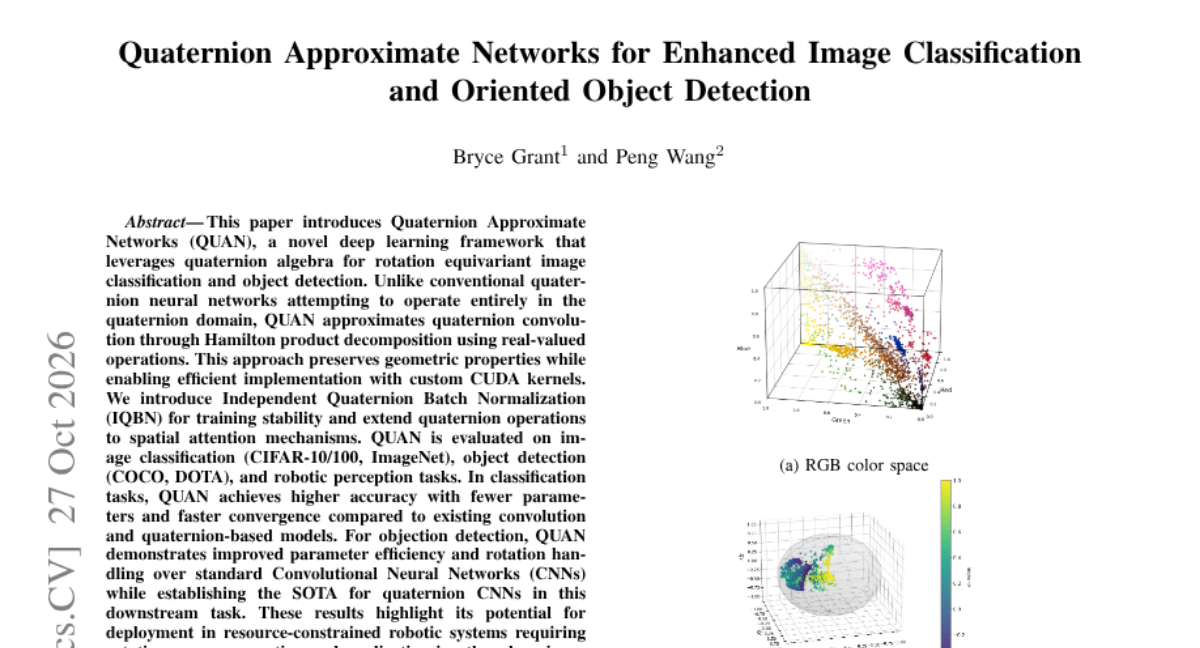
22. Quaternion Approximate Networks for Enhanced Image Classification and Oriented Object Detection
🔑 Keywords: QUAN, quaternion convolution, rotation-equivariant, efficient implementation, Independent Quaternion Batch Normalization
💡 Category: Computer Vision
🌟 Research Objective:
– Introduce Quaternion Approximate Networks (QUAN) as a novel deep learning framework leveraging quaternion algebra for efficient rotation-equivariant image classification and object detection.
🛠️ Research Methods:
– Utilize Hamilton product decomposition with real-valued operations to approximate quaternion convolutions. Implement Independent Quaternion Batch Normalization (IQBN) for stable training and extend operations to spatial attention mechanisms.
💬 Research Conclusions:
– QUAN shows higher accuracy and faster convergence in image classification with fewer parameters compared to conventional models. It improves parameter efficiency and rotation handling in object detection tasks, setting a new state-of-the-art for quaternion CNNs.
👉 Paper link: https://huggingface.co/papers/2509.05512
23. PhysEvolve: Verifier-grounded Self-evolution for Physical Reasoning with Executable Worlds
🔑 Keywords: Causal Physical Reasoning, Vision-Language Models, Self-Evolving, Physics Engine, Counterfactual Simulations
💡 Category: Knowledge Representation and Reasoning
🌟 Research Objective:
– The study aims to enhance vision-language models in causal physical reasoning without relying on human data by using a self-evolving framework validated through a physics engine.
🛠️ Research Methods:
– The research employs a verifier-grounded self-evolving framework where the model proposes executable world programs, validated through simulations and a deterministic physics engine, to generate training problems that surpass conventional dataset limitations.
💬 Research Conclusions:
– The proposed system significantly improves performance on benchmarks such as PhysBench, CausalPhys, and ContPhy, indicating effective zero-shot transfer of causal reasoning principles to complex, unseen dynamics and real-world scenarios.
👉 Paper link: https://huggingface.co/papers/2610.34921

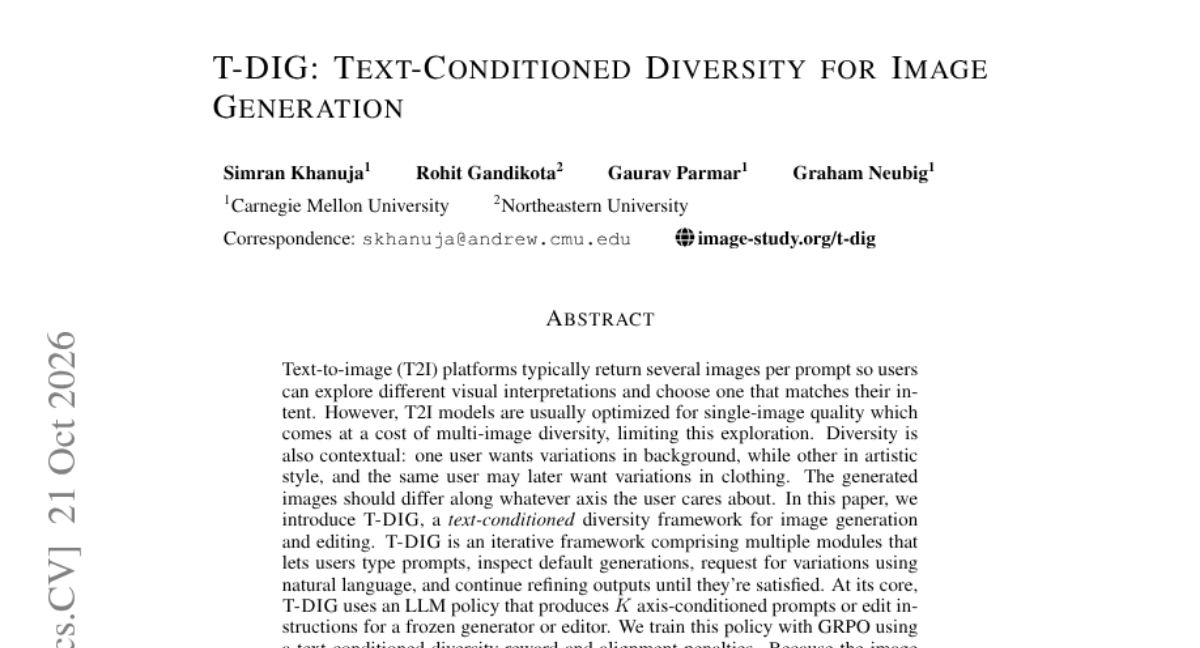
24. T-DIG: Text-Conditioned Diversity for Image Generation
🔑 Keywords: T-DIG, text-conditioned diversity, LLM policy, reinforcement learning, frozen generators
💡 Category: Generative Models
🌟 Research Objective:
– To introduce T-DIG, a framework that enhances text-conditioned diversity in image generation without requiring model retraining.
🛠️ Research Methods:
– Utilization of an LLM policy with reinforcement learning to generate axis-specific image variations.
– Implementation of a text-conditioned diversity reward system, supported by GRPO and alignment penalties.
💬 Research Conclusions:
– T-DIG significantly outperforms existing baselines in improving image diversity while maintaining alignment with initial prompts across various models.
👉 Paper link: https://huggingface.co/papers/2610.29003
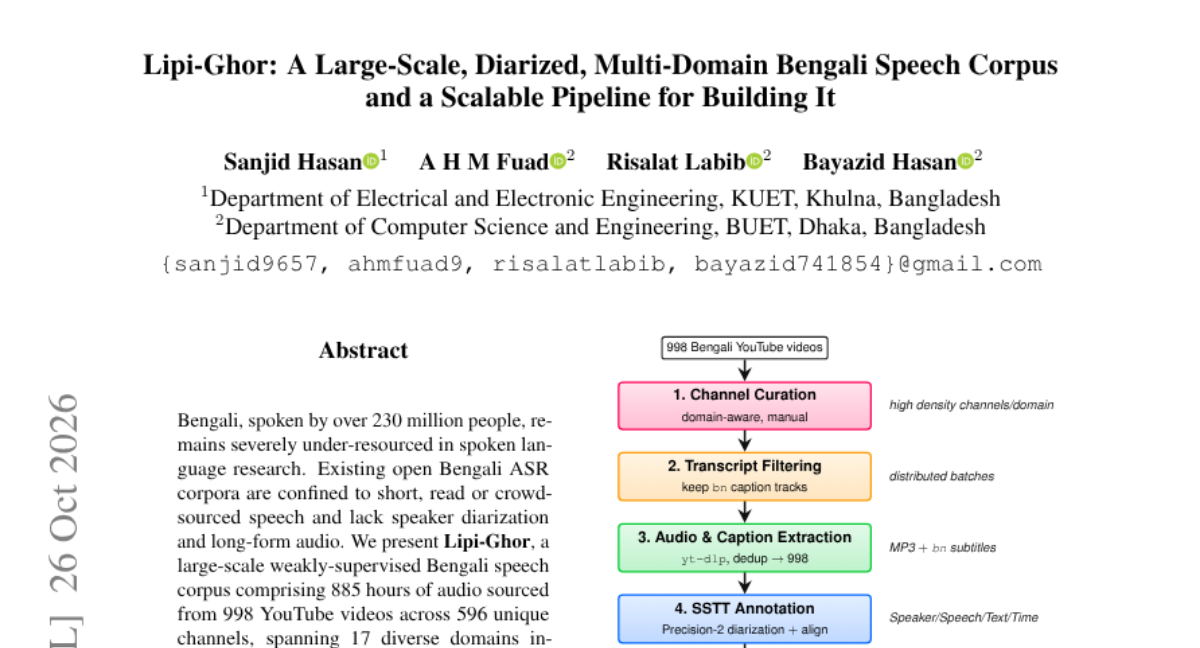
25. Lipi-Ghor: A Large-Scale, Diarized, Multi-Domain Bengali Speech Corpus and a Scalable Pipeline for Building It
🔑 Keywords: Bengali speech corpus, ASR models, speaker diarization, weakly-supervised, zero-shot
💡 Category: Natural Language Processing
🌟 Research Objective:
– The primary objective is to introduce Lipi-Ghor, a large-scale weakly-supervised Bengali speech corpus with long-form and speaker-diarized annotations for benchmarking ASR models.
🛠️ Research Methods:
– The corpus comprises 885 hours of audio from 998 YouTube videos, annotated in SSTT format combining automated diarization with YouTube caption tracks, and evaluated using a gold evaluation split verified through human-in-the-loop correction.
💬 Research Conclusions:
– Lipi-Ghor is the first to provide large-scale speaker-diarized and long-form audio annotations in Bengali, demonstrating its applicability for low-resource languages. The corpus benchmarks ASR models, highlighting consistent degradation on emotive and dialectal content, and offering a replicable pipeline for building similar resources.
👉 Paper link: https://huggingface.co/papers/2610.36184
26.
27. MoveBench: A Rubric-Based Benchmark for Evaluating Large Language Models in Sports and Health Coaching
🔑 Keywords: MoveBench, large language models, sports and health coaching, safety compliance, scientific validity
💡 Category: AI in Healthcare
🌟 Research Objective:
– MoveBench aims to establish a specialized benchmark for evaluating large language models in sports and health coaching, focusing on safety, scientific validity, and personalization.
🛠️ Research Methods:
– The benchmark involves evaluating large language models on both multiple-choice and open-ended task formats, incorporating real-world scenarios and structured rubrics.
💬 Research Conclusions:
– The study highlights significant performance variability among models in safety awareness and personalization, underscoring a vital gap between theoretical knowledge and practical application.
– MoveBench provides a reproducible framework to enhance safe, reliable, context-aware AI-driven coaching systems.
👉 Paper link: https://huggingface.co/papers/2610.26185

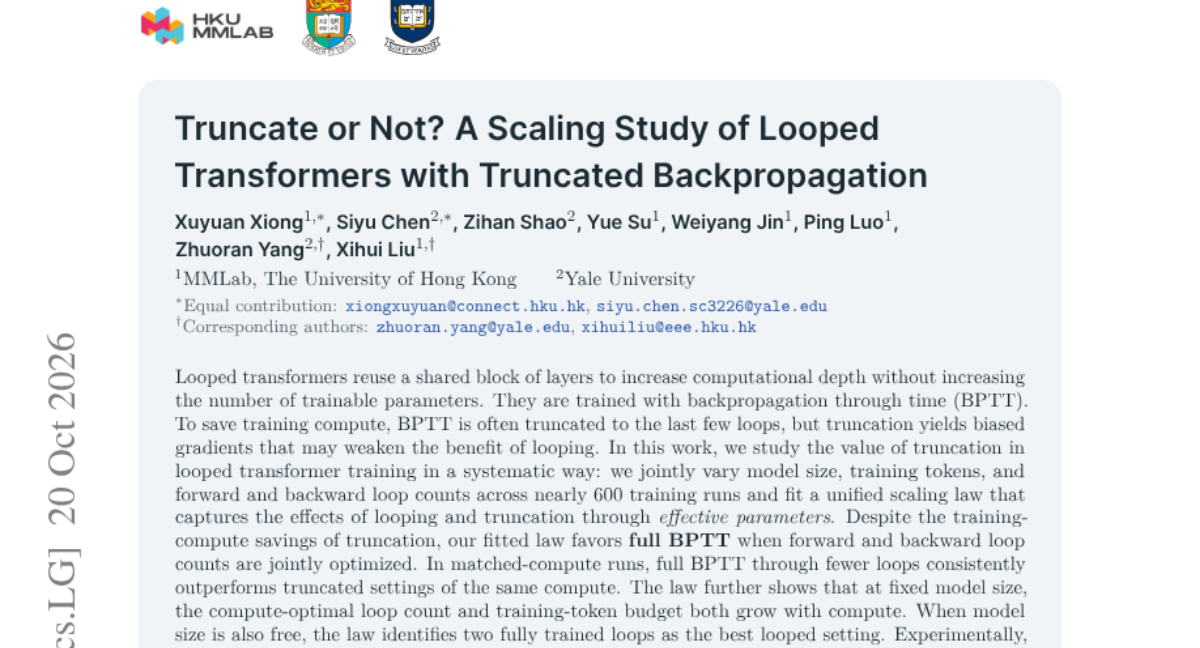
28. Truncate or Not? A Scaling Study of Looped Transformers with Truncated Backpropagation
🔑 Keywords: Looped transformers, backpropagation through time, scaling law, training-compute savings, effective parameters
💡 Category: Machine Learning
🌟 Research Objective:
– The study aims to evaluate the impact of truncation in looped transformer training by adjusting model size, training tokens, and loop counts.
🛠️ Research Methods:
– Conducted nearly 600 training runs with variations in model size, training tokens, and loop counts to fit a unified scaling law that assesses the effects of looping and truncation.
💬 Research Conclusions:
– Full backpropagation through time (BPTT) in matched-compute runs outperforms truncated setups. The optimal configuration is identified as two trained loops, offering significant parameter reduction with minor compute increment.
👉 Paper link: https://huggingface.co/papers/2610.26030
29. AlphaBet: Reinforcement Learning for LLM Event Forecasting Agents
🔑 Keywords: Reinforcement Learning, Large Language Model, Evidence Acquisition, Probability Reporting, Brier Score
💡 Category: Reinforcement Learning
🌟 Research Objective:
– The objective is to improve forecasting accuracy by training a single LLM policy to effectively search, reason, and report forecast probabilities over multiple dates.
🛠️ Research Methods:
– Utilize an agentic reinforcement learning framework called AlphaBet, incorporating Group Relative Policy Optimization and proper scoring rules to train the LLM on multi-date forecasts.
💬 Research Conclusions:
– AlphaBet successfully reduces Brier scores on datasets Forecast-Dojo and FutureX, with performance gains attributed to effective evidence acquisition and probability reporting improvements.
👉 Paper link: https://huggingface.co/papers/2610.22684

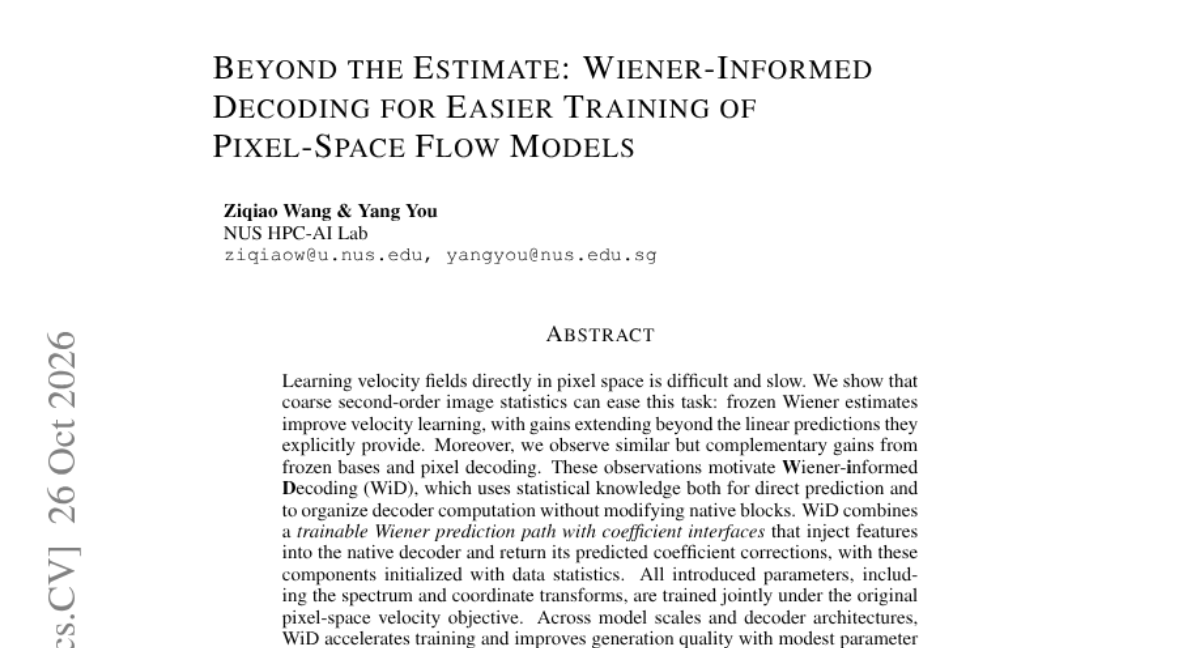
30. Beyond the Estimate: Wiener-Informed Decoding for Easier Training of Pixel-Space Flow Models
🔑 Keywords: Wiener-informed Decoding, velocity fields, second-order image statistics, PixelDiT, FID
💡 Category: Generative Models
🌟 Research Objective:
– This research aims to enhance pixel-space velocity model training and image generation by incorporating statistical predictions into the decoding process.
🛠️ Research Methods:
– The study utilizes Wiener-informed Decoding (WiD) which combines statistical knowledge for direct prediction and decoder computation, involving a trainable Wiener prediction path and coefficient interfaces.
💬 Research Conclusions:
– WiD demonstrates accelerated training and improved generation quality across various model scales, achieving smoother gradient trajectories and effective performance in class-conditional and text-to-image generation.
– On ImageNet 256 x 256, the WiD approach allows PixelDiT-XL to achieve comparable quality to standard methods with significantly fewer training epochs.
👉 Paper link: https://huggingface.co/papers/2610.36192
31. Vision-Language-Action or World-Action? Just Action Models
🔑 Keywords: Just Action Model, foresight loss, vision-language-action, backbone initialization, RoboTwin
💡 Category: Robotics and Autonomous Systems
🌟 Research Objective:
– Investigate decoupling backbone initialization, future observation objectives, and inference machinery to enhance robot control.
🛠️ Research Methods:
– Compare objectives within fixed policy architectures and evaluate foresight loss across different backbone families.
💬 Research Conclusions:
– The Just Action Model (JAM) framework improves robot control success rates on LIBERO and RoboTwin compared to FastWAM and ImageWAM, achieving efficiency by reducing computation costs.
👉 Paper link: https://huggingface.co/papers/2610.37219

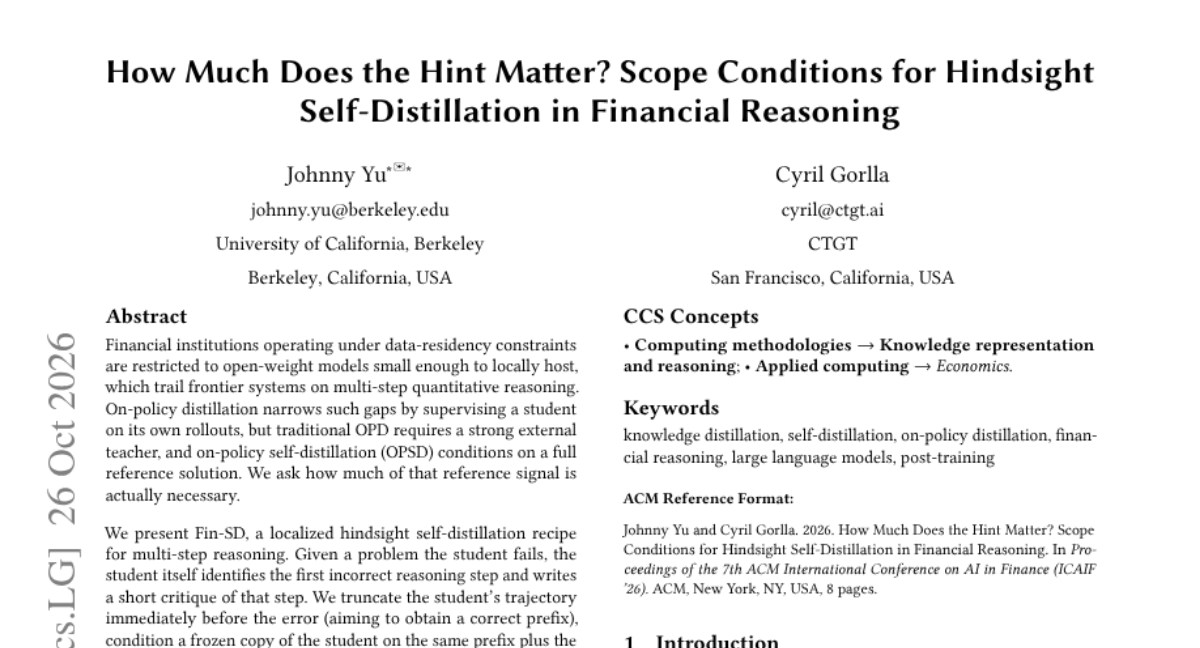
32. How Much Does the Hint Matter? Scope Conditions for Hindsight Self-Distillation in Financial Reasoning
🔑 Keywords: Fin-SD, financial reasoning, on-policy distillation, self-distillation, GPT-OSS
💡 Category: AI in Finance
🌟 Research Objective:
– The study aims to improve local multi-step financial reasoning using Fin-SD by employing self-generated error critiques and truncated correct prefixes to facilitate on-policy distillation without external teachers.
🛠️ Research Methods:
– Fin-SD employs a localized hindsight self-distillation approach. The method involves identifying the first incorrect reasoning step by the model itself, critiquing it, truncating the trajectory to have a correct prefix, and using a hint-conditioned teacher to distill information back into the student model.
💬 Research Conclusions:
– Fin-SD achieves a 3.03 pp accuracy gain on a challenging subset without external hint content being essential.
– The hint provider does not need to be a stronger model than the recipient; hints from a similar model size provide no additional benefits.
– Fin-SD offers comparable accuracy to complete on-policy self-distillation methods while producing fewer tokens.
👉 Paper link: https://huggingface.co/papers/2610.36082
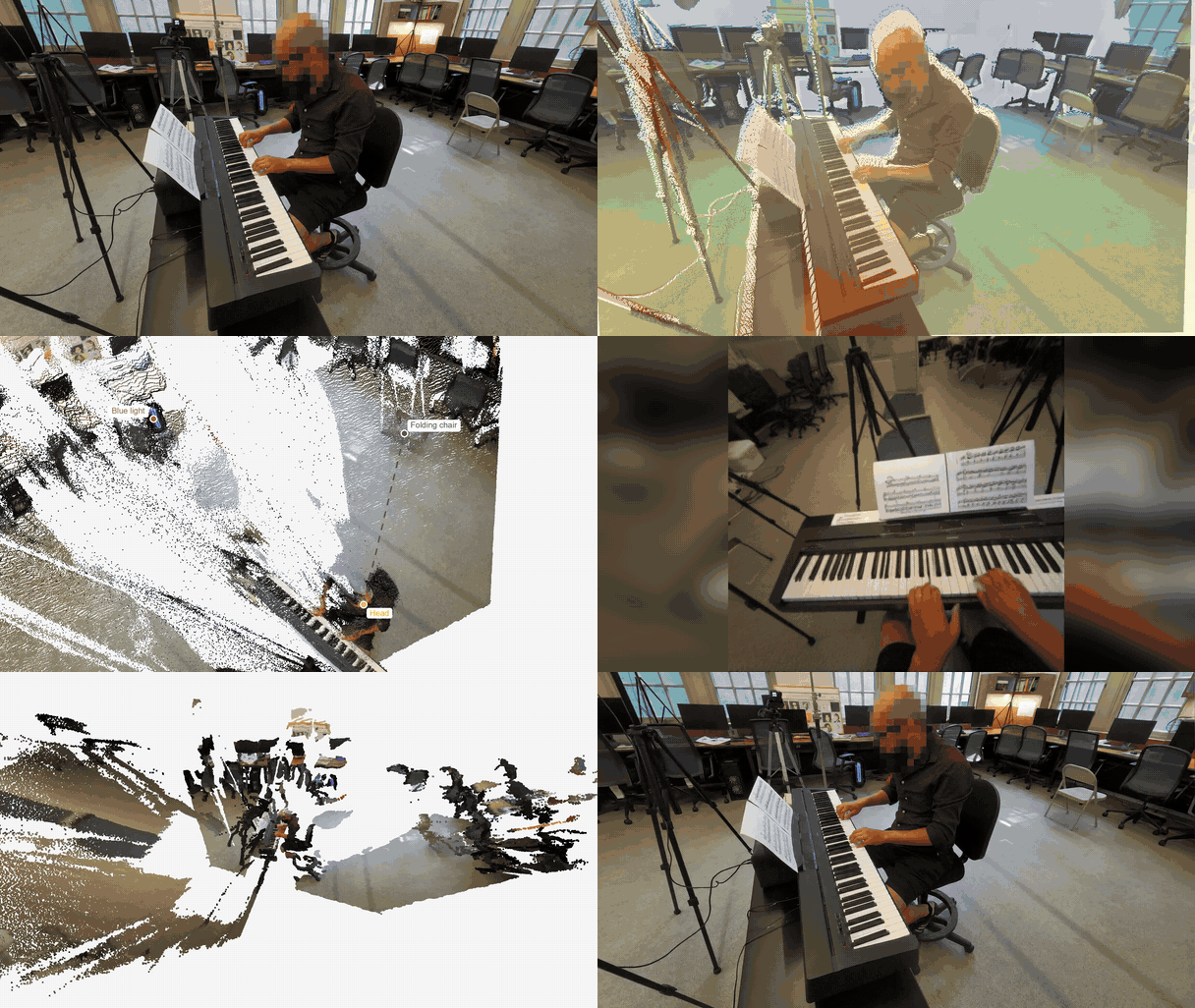
33. Learning and Reasoning with Geometry: How Generation Helps Spatial Understanding
🔑 Keywords: GeoUG, spatial reasoning, geometric supervision, metric-depth generation, adaptive interleaved reasoning
💡 Category: Computer Vision
🌟 Research Objective:
– The study aims to improve spatial reasoning by integrating depth and multi-view generation with adaptive geometric verification during inference.
🛠️ Research Methods:
– Utilization of a multi-scale depth codec for metric-depth generation using a pretrained visual autoencoder.
– Introduction of 3DCueBench to manage geometric difficulty and utilize reinforcement learning for adaptive decision-making in reasoning tasks.
💬 Research Conclusions:
– The GeoUG model demonstrates improved spatial reasoning with high accuracy rates on tests such as CV-Bench-3D and 3DCueBench, optimizing the balance between accuracy gains and generation costs.
👉 Paper link: https://huggingface.co/papers/2610.36022
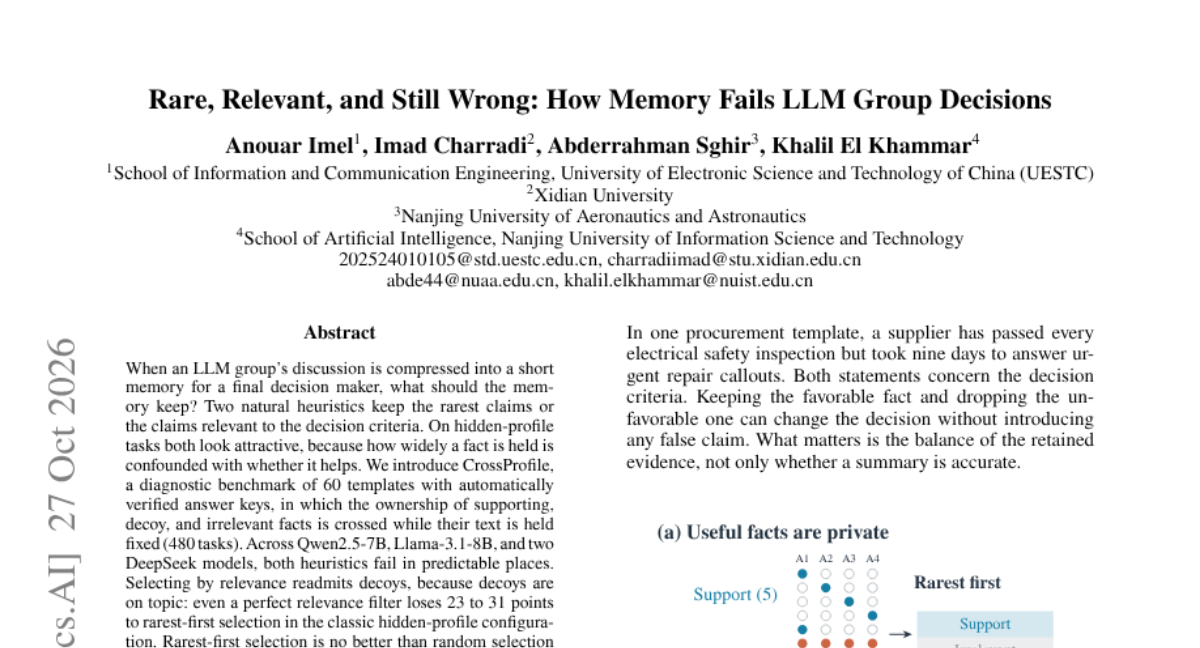
34. Rare, Relevant, and Still Wrong: How Memory Fails LLM Group Decisions
🔑 Keywords: Decoy inclusion, Social-proof bias, CrossProfile, Hidden-profile, LLM
💡 Category: Natural Language Processing
🌟 Research Objective:
– To investigate the failure of traditional memory selection methods in compressing multi-agent discussions for decision-making due to factors such as decoy inclusion and social-proof bias.
🛠️ Research Methods:
– Introduction of CrossProfile, a diagnostic benchmark with 60 templates and 480 tasks, testing models like Qwen2.5-7B and Llama-3.1-8B on their ability to accurately compress discussions by filtering claims based on rarity or relevance.
💬 Research Conclusions:
– Traditional heuristics based on rarity and relevance fail to maintain decision accuracy due to predictable errors and biases.
– Removing or reassigning attribution tags can significantly improve accuracy in hidden-profile tasks.
– Full transcripts can result in lower decision accuracy compared to having no notes at all.
👉 Paper link: https://huggingface.co/papers/2610.37624
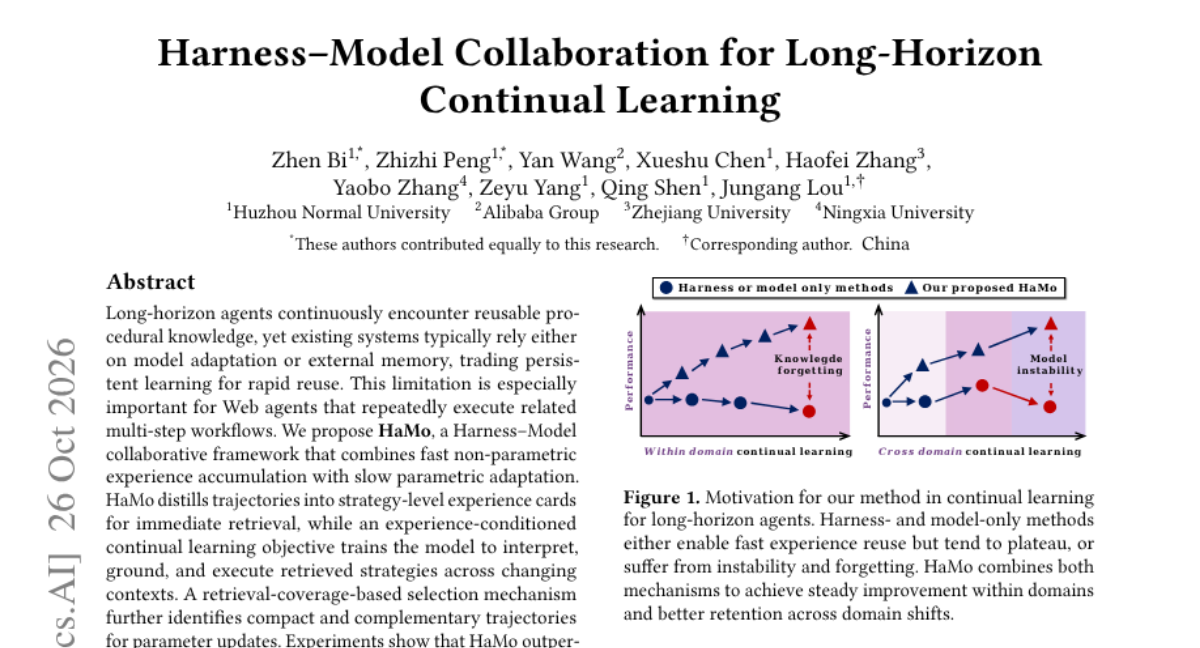
35. Harness-Model Collaboration for Long-Horizon Continual Learning
🔑 Keywords: HaMo, procedural experience, continual learning, cross-task execution, model adaptation
💡 Category: Reinforcement Learning
🌟 Research Objective:
– The research aims to enhance long-horizon web agents’ ability to retain and execute procedural knowledge across multiple tasks by combining rapid retrieval with gradual model adaptation.
🛠️ Research Methods:
– The study proposes a framework named HaMo that combines fast non-parametric experience accumulation with slow parametric adaptation, utilizing strategy-level experience cards and an experience-conditioned continual learning objective.
💬 Research Conclusions:
– HaMo outperforms methods that rely solely on either harness or model adaptation, improving both retention and adaptation within and across domains, while effectively preserving and internalizing procedural experience.
👉 Paper link: https://huggingface.co/papers/2610.34724
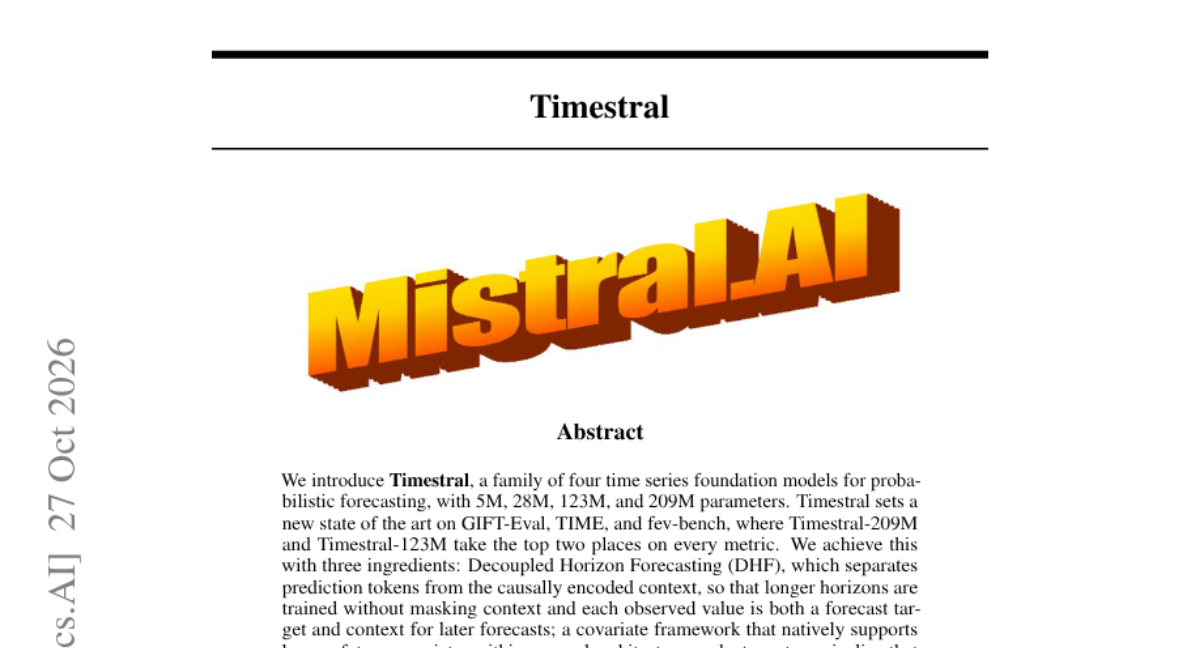
36. Timestral
🔑 Keywords: Time Series Foundation Models, Probabilistic Forecasting, Decoupled Horizon Forecasting, Known-Future Covariates, Synthetic Pretraining
💡 Category: Foundations of AI
🌟 Research Objective:
– The study aims to introduce and evaluate Timestral, a family of time series foundation models for achieving cutting-edge probabilistic forecasting.
🛠️ Research Methods:
– The method involves Decoupled Horizon Forecasting, a covariate framework supporting known-future covariates, and a two-stage training pipeline utilizing synthetic pretraining followed by mixed post-training.
💬 Research Conclusions:
– Timestral models, especially Timestral-209M and Timestral-123M, set a new state of the art across multiple metrics on benchmark datasets like GIFT-Eval.
👉 Paper link: https://huggingface.co/papers/2610.37585
37. Can LLMs Uncover Hidden Physical Laws through Free Exploration?
🔑 Keywords: LLMs, LongChang, simulated worlds, altered physics, GPT-6-Astra
💡 Category: AI Systems and Tools
🌟 Research Objective:
– Explore if LLMs can autonomously discover altered physical laws through simulated experiments.
🛠️ Research Methods:
– Developed the LongChang framework to create simulated worlds with altered physics, where LLMs act as explorers.
💬 Research Conclusions:
– Only GPT-6-Astra among 12 evaluated LLMs showed limited success with a discovery rate of 16.7%, while others did not perform any successful discoveries.
👉 Paper link: https://huggingface.co/papers/2610.37649

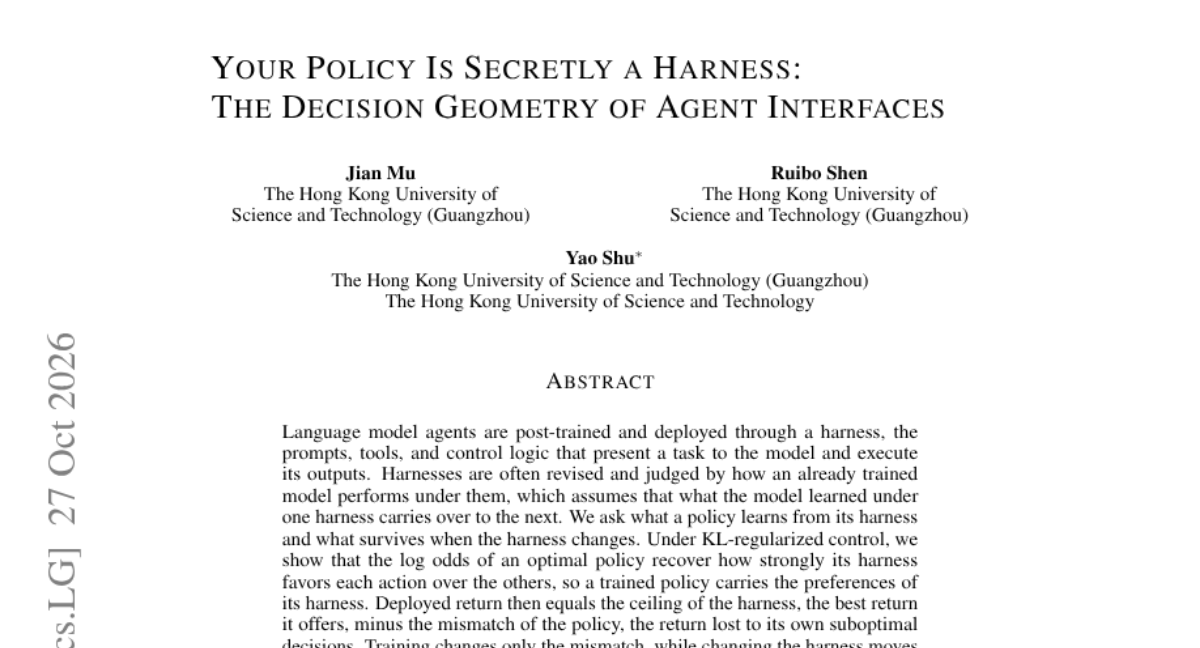
38. Your Policy Is Secretly a Harness: The Decision Geometry of Agent Interfaces
🔑 Keywords: KL-regularized control, harness, optimal policy, policy mismatch, ceiling
💡 Category: Reinforcement Learning
🌟 Research Objective:
– The research aims to explore what a policy learns from its harness and investigates the effects when the harness changes, particularly under KL-regularized control.
🛠️ Research Methods:
– The study utilizes post-training of language model agents with harness, examining changes in performance and potential across different harness setups, such as in MiniWoB++ and Terminal-Bench Lite.
💬 Research Conclusions:
– The research concludes that a policy’s deployed performance is determined by the potential of the harness minus the policy mismatch. Changing the harness impacts both terms, and evaluations using a stronger model as a stand-in for the optimal policy can predict performance gains.
👉 Paper link: https://huggingface.co/papers/2610.37255
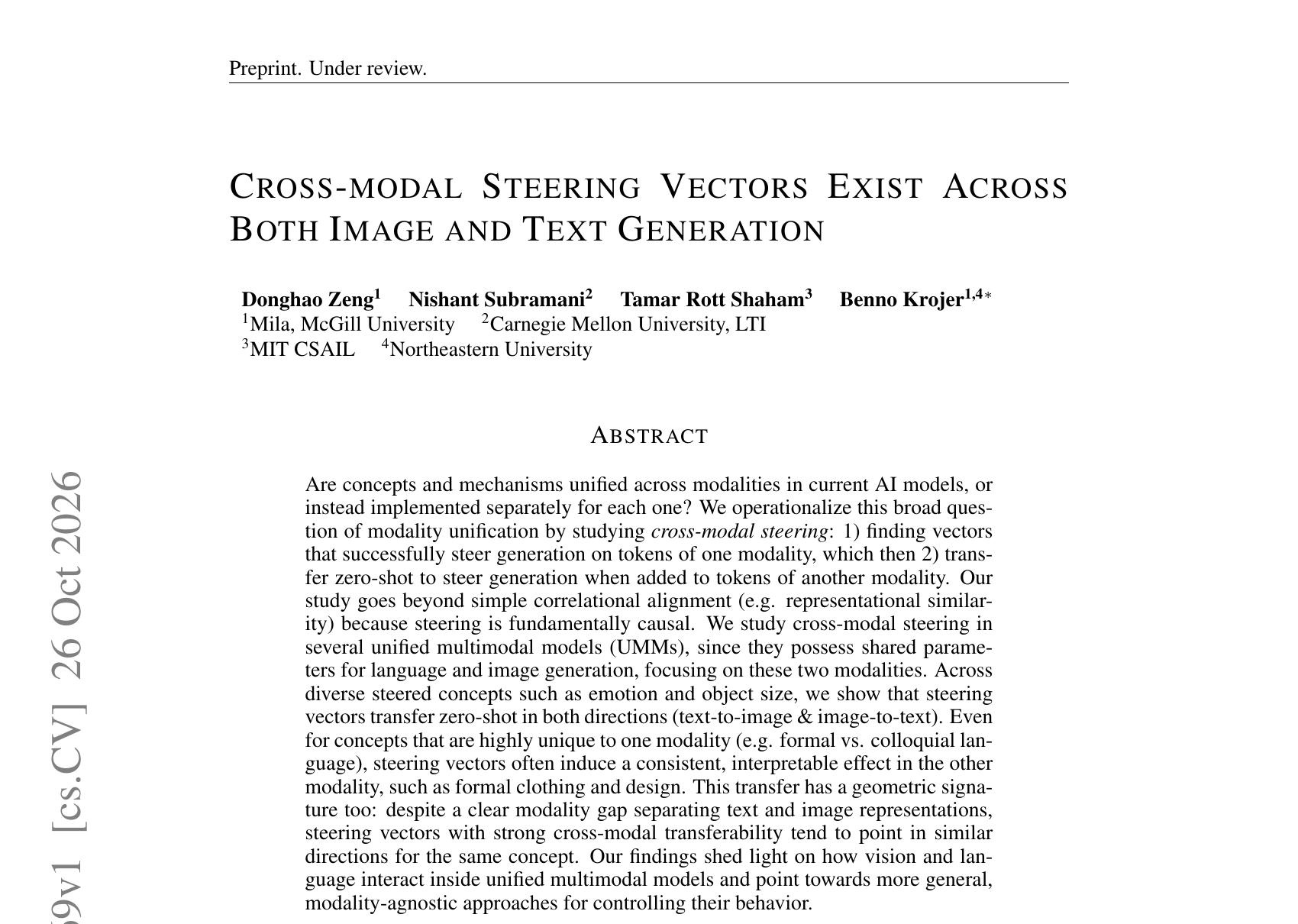
39. Cross-modal Steering Vectors Exist Across Both Image and Text Generation
🔑 Keywords: cross-modal steering, unified multimodal models, modality gap, steering vectors, zero-shot transfer
💡 Category: Multi-Modal Learning
🌟 Research Objective:
– To explore whether concepts and mechanisms are unified across modalities such as text and image in AI models, focusing on cross-modal steering.
🛠️ Research Methods:
– Studying cross-modal steering in various unified multimodal models where vectors steer generation across different modalities with shared parameters.
💬 Research Conclusions:
– Steering vectors exhibit zero-shot transfer between text and image modalities, showing that despite modality gaps, these vectors point in similar directions for the same concept. This highlights potential for modality-agnostic approaches in controlling AI model behavior.
👉 Paper link: https://huggingface.co/papers/2610.36269
40. What Effort Level Should I Choose? On the Economics of Reasoning Effort in LLM Agents
🔑 Keywords: Generative models, Reasoning effort, Inference-time compute, Counterfactual effect, Trajectory behavior
💡 Category: Generative Models
🌟 Research Objective:
– The paper investigates the impact of reasoning effort in generative models, focusing on its role as a credence good and examining how escalating from low effort can enhance cost-efficiency.
🛠️ Research Methods:
– The researchers measure the counterfactual effect of different effort levels on both proprietary and open-weight models across four benchmarks, including single-call reasoning and long-horizon agentic tasks.
💬 Research Conclusions:
– Higher reasoning efforts can increase accuracy but are not consistently effective for tasks solvable by lower effort.
– Greater effort levels incur significantly higher costs without guaranteed improvements in performance.
– A strategy that begins with the lowest effort level and only intensifies upon verified failure achieves comparable or better results at lower costs than fixed high effort.
👉 Paper link: https://huggingface.co/papers/2610.34491
41. Channel Selection for Mixture-of-Experts Decoding Needs No Calibration Data
🔑 Keywords: Mixture-of-Experts, channel selectors, top-k, Prox, ternary sketch
💡 Category: Machine Learning
🌟 Research Objective:
– The main objective is to accelerate Mixture-of-Experts inference by using Prox to replace calibrated thresholds with top-k channel selection, while preserving accuracy.
🛠️ Research Methods:
– Channel selectors predict important channels without the need for calibration data.
– Implementation of a reader using a ternary sketch and a low-rank map derived entirely from model weights to efficiently read channels.
💬 Research Conclusions:
– Top-k channel selection matches or exceeds the calibrated threshold versions’ accuracy without requiring calibration data.
– The proposed method retains 98.1% of full-model accuracy at reduced read budgets and significantly enhances inference speed with Triton kernels.
👉 Paper link: https://huggingface.co/papers/2610.37386

42. EmbeddingGemma 2: Unified and Efficient Multimodal Representations
🔑 Keywords: EmbeddingGemma 2, multimodal embedding, cross-modal, Pareto frontier, resource-flexible
💡 Category: Multi-Modal Learning
🌟 Research Objective:
– Introduce EmbeddingGemma 2, an open multimodal embedding model that unifies representations for text, images, audio, and video.
🛠️ Research Methods:
– Implement simplified per-layer embeddings and a multi-stage curriculum with modality and objective progression to enhance performance across unimodal, cross-modal, and mixed-modal evaluations.
💬 Research Conclusions:
– EmbeddingGemma 2 sets a new Pareto frontier in comprehensive embedding benchmarks, offering flexibility for resource-constrained environments while outperforming larger and specialist models.
👉 Paper link: https://huggingface.co/papers/2610.37364
43. RSI Arena: Towards Recursive Self-Improvement with Human Feedback
🔑 Keywords: RSI Arena, autonomous AI agents, recursive self-improvement, NVIDIA Nemotron 3.5 Lightning, human feedback
💡 Category: Natural Language Processing
🌟 Research Objective:
– Investigate whether AI agents can autonomously train useful language models and enhance them using user feedback through RSI Arena.
🛠️ Research Methods:
– Conducted a two-stage study, where ten models used 1,000 GPU-hours each and $300 in API credit during a shared cluster in the first stage and further refined using comparison records during the second stage.
💬 Research Conclusions:
– While benchmark improvements were modest, eight out of ten models showed preference gains from Stage 1 to Stage 2, highlighting the role of human feedback in model development.
👉 Paper link: https://huggingface.co/papers/2610.33624

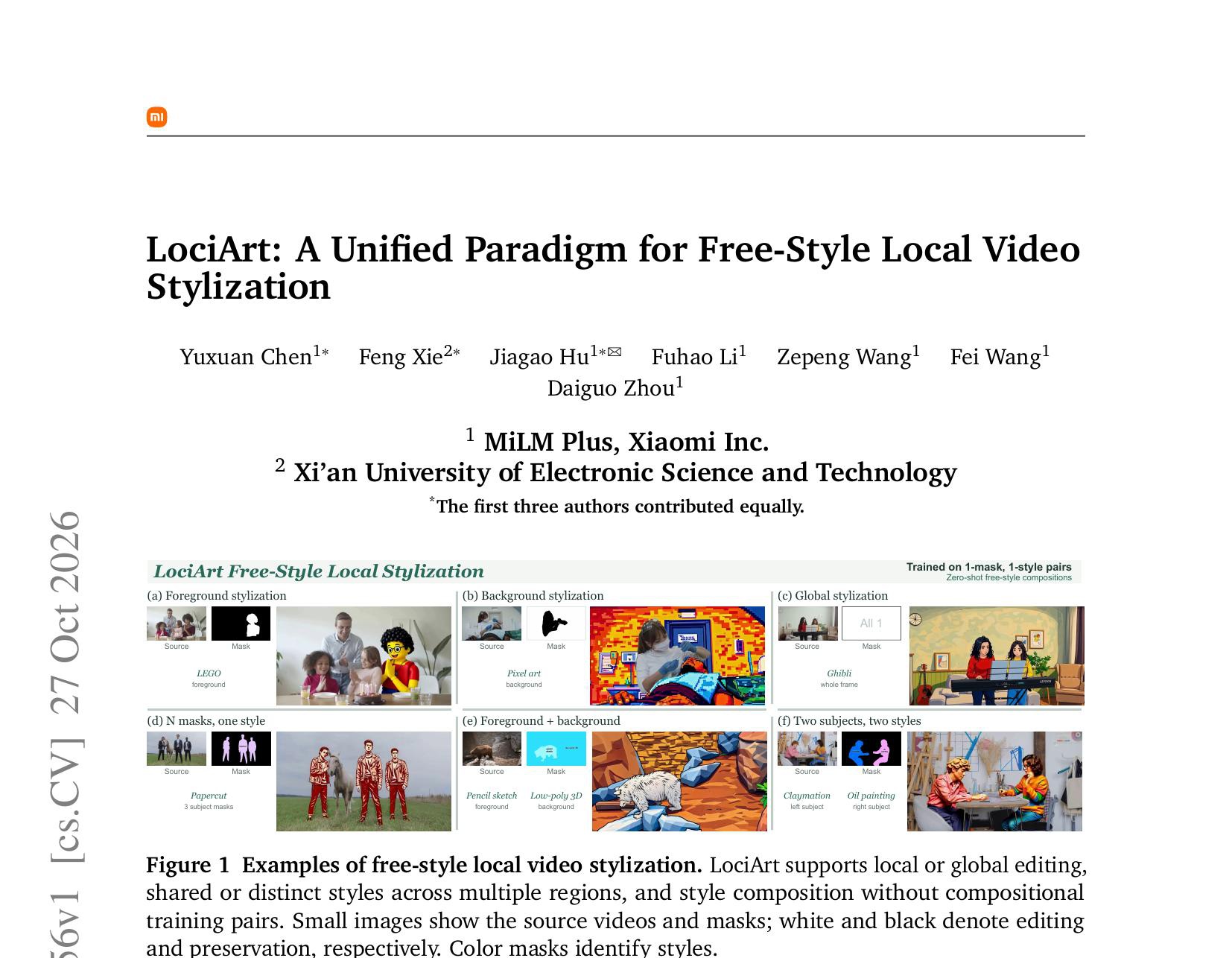
44. LociArt: A Unified Paradigm for Free-Style Local Video Stylization
🔑 Keywords: LociArt, Local Video Stylization, Temporal Consistency, Generative Refinement Networks, LociArt-100K Dataset
💡 Category: Computer Vision
🌟 Research Objective:
– Introduce LociArt, a unified paradigm for precise local video stylization with temporal consistency and region-style control.
🛠️ Research Methods:
– Utilize Generative Refinement Networks (GRN) with a novel polar style-aware mask and complementary representation-geometry conditioning.
– Develop an automated pipeline for paired supervision, utilizing the constructed LociArt-100K Dataset.
💬 Research Conclusions:
– GRNStyle exhibits superior regional style quality and spatial control over existing methods while maintaining temporal consistency.
– Demonstrates the potential for joint stylization of multiple regions using diverse styles, setting a foundation for local video stylization learning and evaluation.
👉 Paper link: https://huggingface.co/papers/2610.36456
45. CodeCap-Bench: Can Code Serve as a Good Video Caption?
🔑 Keywords: Video Captioning, Code Captioning, Temporal Dynamics, Multimodal Models, Video Reconstruction
💡 Category: Multi-Modal Learning
🌟 Research Objective:
– To investigate the efficacy of using executable code as video captions to improve reasoning accuracy and reconstruction fidelity compared to traditional natural language captions.
🛠️ Research Methods:
– Introduced CodeCap-Bench, an evaluation framework with 323 videos across five structured 2D content categories, providing fine-grained annotations and various levels of assessment.
💬 Research Conclusions:
– Code captions provide superior reasoning accuracy and fidelity in video information tasks compared to natural language captions, although current multimodal large language models still face challenges with complex temporal dynamics.
👉 Paper link: https://huggingface.co/papers/2610.37341
46. HABIT-Bench: Evaluating Habit Induction from Longitudinal Weak Evidence in Agent Memory
🔑 Keywords: LLM agent memory systems, user habits, task-oriented dialogue, macro accuracy
💡 Category: Human-AI Interaction
🌟 Research Objective:
– The study introduces HABIT-Bench to evaluate LLM agent memory systems’ ability to infer implicit user habits from sparse dialogue evidence and apply them correctly in long-term interactions.
🛠️ Research Methods:
– Synthetic user histories are constructed from task-oriented dialogue data and controlled habit graphs across domains like food, finance, software, and travel. The assessment involves four-choice tasks and evaluates eight memory methods with specific language models.
💬 Research Conclusions:
– Despite the introduction of HABIT-Bench, LLM agent memory systems show limited success in inferring and applying user habits with a best-achieved macro accuracy of 33.61% across different domains, highlighting the gap between past interaction data access and effective habit inference.
👉 Paper link: https://huggingface.co/papers/2610.24520

47. Hy-Nomas: Towards Free-form Interactive World Generation
🔑 Keywords: Hy-Nomas, video world model, causal attention, AI Native, vision-language Prompt Enhancer
💡 Category: Generative Models
🌟 Research Objective:
– To develop Hy-Nomas, a video world model capable of generating interactive, multi-turn video segments with text and camera control.
🛠️ Research Methods:
– Utilized an 8B diffusion backbone with structured video captions and action-aware causal attention.
– Implemented a vision-language Prompt Enhancer for translating user requests into structured conditions.
💬 Research Conclusions:
– Hy-Nomas demonstrates superior performance over existing world models in generating interactive video worlds.
– Released model weights, code, and benchmarks to facilitate reproducible research in interactive world generation.
👉 Paper link: https://huggingface.co/papers/2610.36729
48. VibeVideoBench: Evaluating Multimodal Agents on Code-Driven Video Generation
🔑 Keywords: VibeVideoBench, MultiModal Agents, code-driven video generation, rendering pipelines, Evaluation
💡 Category: Generative Models
🌟 Research Objective:
– The study aims to evaluate multi-modal agents capable of generating videos through code, specifically focusing on their core requirements fulfillment across varying tasks.
🛠️ Research Methods:
– Implemented VibeVideoBench as a benchmark to assess agents on 239 tasks in English and Chinese, using hierarchical and evidence-based evaluation, including both program and rubric checks.
💬 Research Conclusions:
– Agents GPT-6 Astra and Claude Opus 5.5 performed best, yet many agents faced challenges in time management, leading to incomplete video renders.
– The judges’ rankings of system performance aligned closely with human preferences, indicating reliable benchmarking.
👉 Paper link: https://huggingface.co/papers/2610.35864

49. ChronoReplay: One Answer Interface Is Not Enough for Streaming Spatial Intelligence
🔑 Keywords: ChronoReplay, spatial VLM, interface lock-in, cross-task transfer, inference-time evidence selection
💡 Category: Multi-Modal Learning
🌟 Research Objective:
– The paper aims to address interface lock-in in spatial vision-language models (VLMs) by using ChronoReplay, which replays heterogeneous spatial supervision in a chronological manner to enhance cross-task transfer and improve inference-time evidence selection.
🛠️ Research Methods:
– The methodology includes replaying spatial supervision chronologically, maintaining source-native targets, balancing supervision across different families, and employing adaptive frame selection to enhance inference-time efficacy.
💬 Research Conclusions:
– ChronoReplay resulted in significant performance gains across various benchmarks, such as a 13.41-point gain on OST-Bench, by improving specialization without degrading transferability. The study concludes that effective organization of heterogeneous histories and adaptive evidence selection are critical for enhancing streaming spatial performance.
👉 Paper link: https://huggingface.co/papers/2610.34283