AI Native Product Insights – 2026W12
Based on Product Hunt data, we’ve curated a selection of AI Native applications that demonstrate how AI is being built into the core of modern products. These AI Native solutions showcase new developments in functionality and are exploring fresh ways of human-AI interaction. Let’s dive into these AI Native applications.
1. Stitch 2.0 by Google
Ranking: 1
Upvote: 684
🚀 Product Overview
Stitch 2.0 is an AI-native UI design workspace where natural language and voice drive high-fidelity interface generation and iteration on a single canvas spanning text, images, and code. Context-aware agents help move from intent to production-ready layouts and prototypes quickly, while built-in design systems and a DESIGN.md-style source of truth aim to keep components and patterns consistent across teams.
📊 Evaluation
AI Native Application Modernization: 86/100
The product places model-driven generation and agentic iteration at the center of the design workflow rather than bolting AI onto a traditional editor, which strongly supports modernization of UI creation and handoff. The main execution risk is ensuring determinism and governance for design-system compliance and code quality at scale, but the system-oriented approach (canvas + agents + design artifacts) indicates a mature AI-native architecture.
🔗 Website
https://blog.google/innovation-and-ai/models-and-research/google-labs/stitch-ai-ui-design?ref=producthunt
2. Lightfield
Ranking: 4
Upvote: 597
🚀 Product Overview
Lightfield is an AI-native CRM that auto-builds and continuously updates your pipeline by ingesting emails, meetings, and call context, then turns that captured reality into searchable answers and executable outputs like follow-ups, proposals, and board-ready summaries.
📊 Evaluation
AI Native Application Modernization: 87/100
Lightfield treats AI as the system of record builder and operator, automating CRM creation, enrichment, and workflow execution from unstructured communications; the main modernization gap is the dependency on reliable integrations and governance to ensure accuracy, permissions, and auditability across teams.
🔗 Website
https://lightfield.app/?ref=producthunt

3. Codex Subagents
Ranking: 17
Upvote: 281
🚀 Product Overview
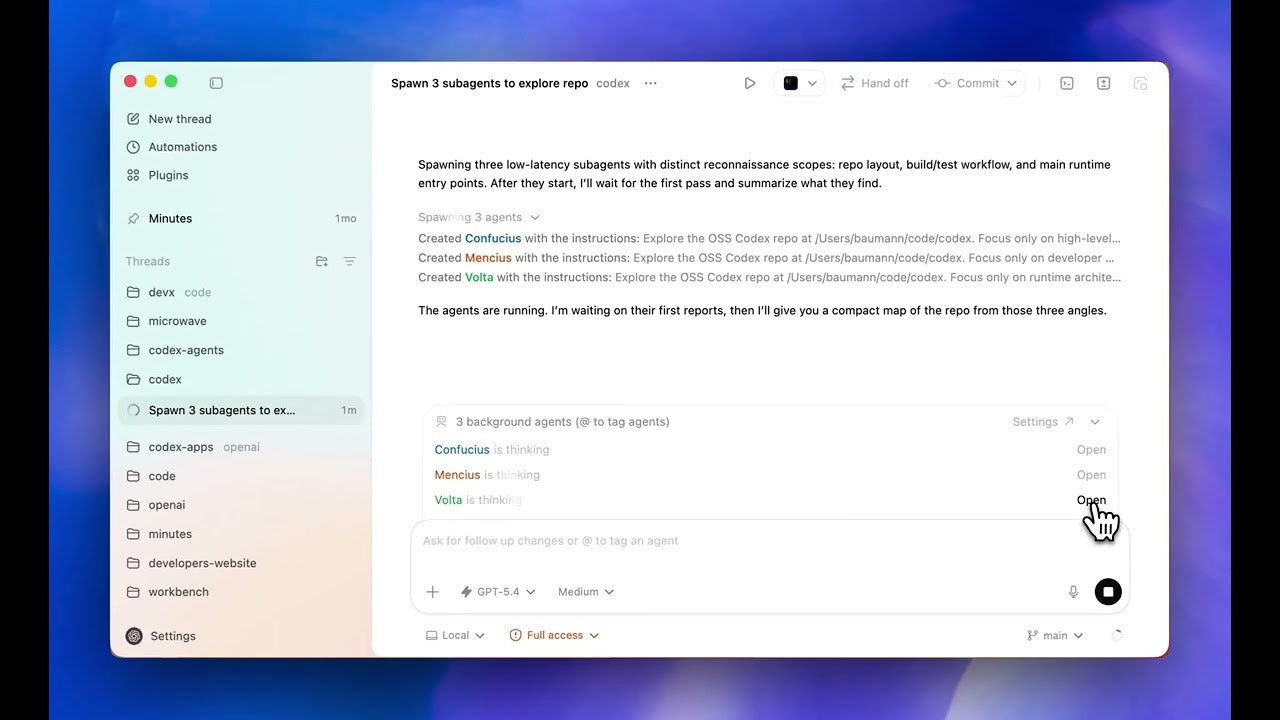
Codex Subagents is an AI-native coding and execution workflow that lets teams spin up parallel, custom agents on top of GPT-5.4 to break down complex tasks into coordinated workstreams, combining strong reasoning with code generation and tool-driven actions across chat, API, and Codex.
📊 Evaluation
AI Native Application Modernization: 90/100
The product is architected around agentic orchestration rather than a single assistant, with scalable model choices (mini/nano) and built-in capabilities like web search and computer use that enable real task completion; modernization potential is high, though outcomes will depend on governance, prompt/tooling discipline, and integration quality in production systems.
🔗 Website
https://openai.com/?ref=producthunt
4. GPT‑5.4 mini and nano
Ranking: 28
Upvote: 281
🚀 Product Overview
GPT‑5.4 mini and nano are lightweight frontier-model variants designed to power AI-first coding and multi-agent systems where latency and cost matter. Delivered through ChatGPT, the API, and Codex, they combine reasoning with tool-using workflows like computer use and web search, enabling developers to build responsive subagents and multimodal execution pipelines with large-context support.
📊 Evaluation
AI Native Application Modernization: 94/100
This launch is highly AI-native because the product is the model layer itself, intended to be orchestrated as the core runtime for agentic apps rather than an add-on feature. The mini and nano options improve practical modernization by making production constraints (speed, throughput, unit economics) first-class, while integrated tool use and coding orientation reduce the glue code needed to move from demos to scalable, automated workflows.
🔗 Website
https://openai.com/?ref=producthunt
Statement: Evaluation results are generated by AI, lack of data support, reference learning only.