China AI Native Industry Insights – 20260920 – Z.ai | MiniMax | Alibaba | more
Today’s digest highlights some of the most compelling advancements from Z.ai, MiniMax, and Alibaba. These developments underscore a broader theme of enhanced efficiency and functionality in AI tools. Z.ai has significantly increased throughput with its GLM-5.3 system supporting the GLM-5.3-Flash, while StepFun introduces a preview of its Step 5 model, boasting a sparse MoE flagship with a striking 600 billion parameters and a 1 million token context window. Furthermore, Alibaba’s introduction of Qwen3.8-LiveTranslate advances real-time speech translation capabilities. Discover more in Today’s China AI Native Industry Insights.
1. Z.ai says GLM-5.3 helped build inference system for GLM-5.3-Flash, tripling throughput
Z.ai reported that its GLM-5.3 model assisted engineers in building and optimizing the inference infrastructure that serves GLM-5.3-Flash. The system moved from its first successful run to production readiness in under two weeks. End-to-end throughput tripled compared with the initial baseline. Z.ai credited the result to dense feedback signals, including local correctness tests, execution traces, microbenchmarks, and end-to-end measurements, which allowed targeted hypothesis testing rather than reliance on aggregate metrics alone.
Read more: https://z.ai/blog/glm-built-its-inference-infrastructure
Video Credit: NotebookLM
2. MiniMax Releases MiniMax Code CLI Tool
MiniMax announced the release of MiniMax Code CLI, a new command-line tool from the company. The announcement was shared via the official MiniMax AI account on September 18, 2026. Further technical details were provided via a linked resource in the announcement. The release adds to MiniMax’s suite of developer-facing AI tools.
Read more: https://github.com/MiniMax-AI/minimax-code
Video Credit: NotebookLM
3. Alibaba’s Qwen Launches Real-Time Speech Translation Model Qwen3.8-LiveTranslate
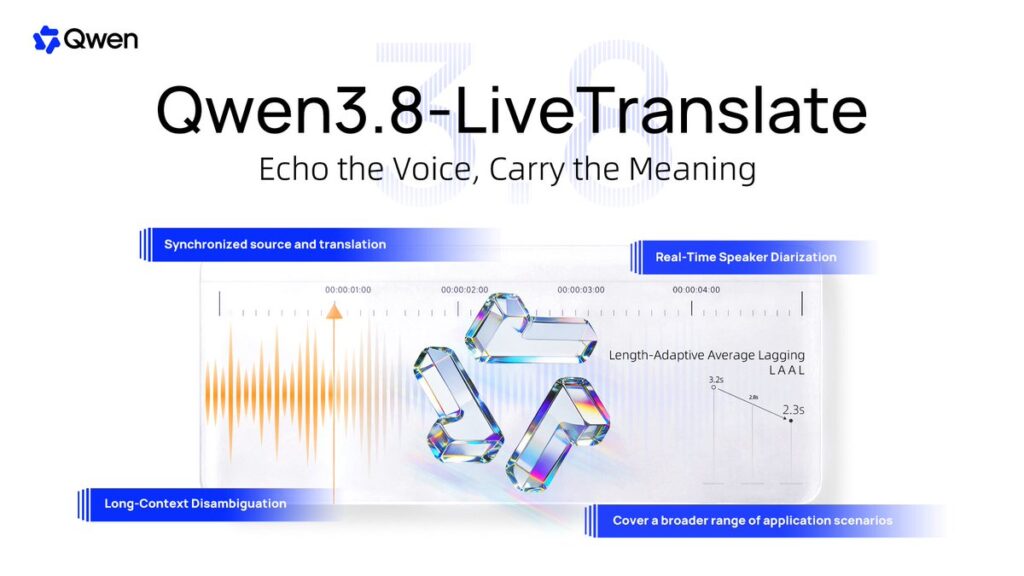
Alibaba’s Qwen team released Qwen3.8-LiveTranslate, a next-generation real-time simultaneous interpretation model built on an Interleave architecture. The model improves faithfulness, fluency, and conciseness while reducing average lagging (LAAL) from 2.8 seconds to 2.3 seconds across 60 languages. New features include real-time speaker diarization with stable voice cloning for multi-party speech, synchronized bilingual on-screen display, and long-context disambiguation that uses conversation history to keep names and terminology consistent. The model is available via Qwen’s blog and QwenCloud.
Read more: https://qwen.ai/blog?id=qwen3.8-livetranslate
Video Credit: The original article
4. StepFun releases Step 5 Preview, a 600B parameter sparse MoE flagship model with 1 million token context window
StepFun announced Step 5 Preview, a flagship foundation model designed for real-world agentic tasks. The model uses a sparse MoE architecture with 600B total parameters and only 27B activated parameters, supports a 1 million token context window, and natively handles text and vision inputs. It ranks among the top three open-source models globally on the Artificial Analysis Intelligence Index with a score of 44, while maintaining a per-task cost that is one-eighth of Claude Opus 5. The company will release the full model weights on October 15, 2026, and the model is already accessible via API and online platforms.
Read more: https://mp.weixin.qq.com/s?__biz=MzkyNTYxNzg5Mg==&mid=2247488120&idx=1&sn=8ba9ac7f0b36682d6262290677c665da&chksm=c0136f8f2faa314e887729c958ba8e9e2a972002d74192b20f5ad85554004190ec62ec1d7f36&scene=0&xtrack=1#rd
Video Credit: The original article
That’s all for today’s China AI Native Industry Insights. Join us at AI Native Foundation Membership Dashboard for the latest insights on AI Native, or follow our linkedin account at AI Native Foundation and our twitter account at AINativeF.