The Great Reconfiguration — Decoding Anthropic’s Definitive Study on AI and the Labour Market
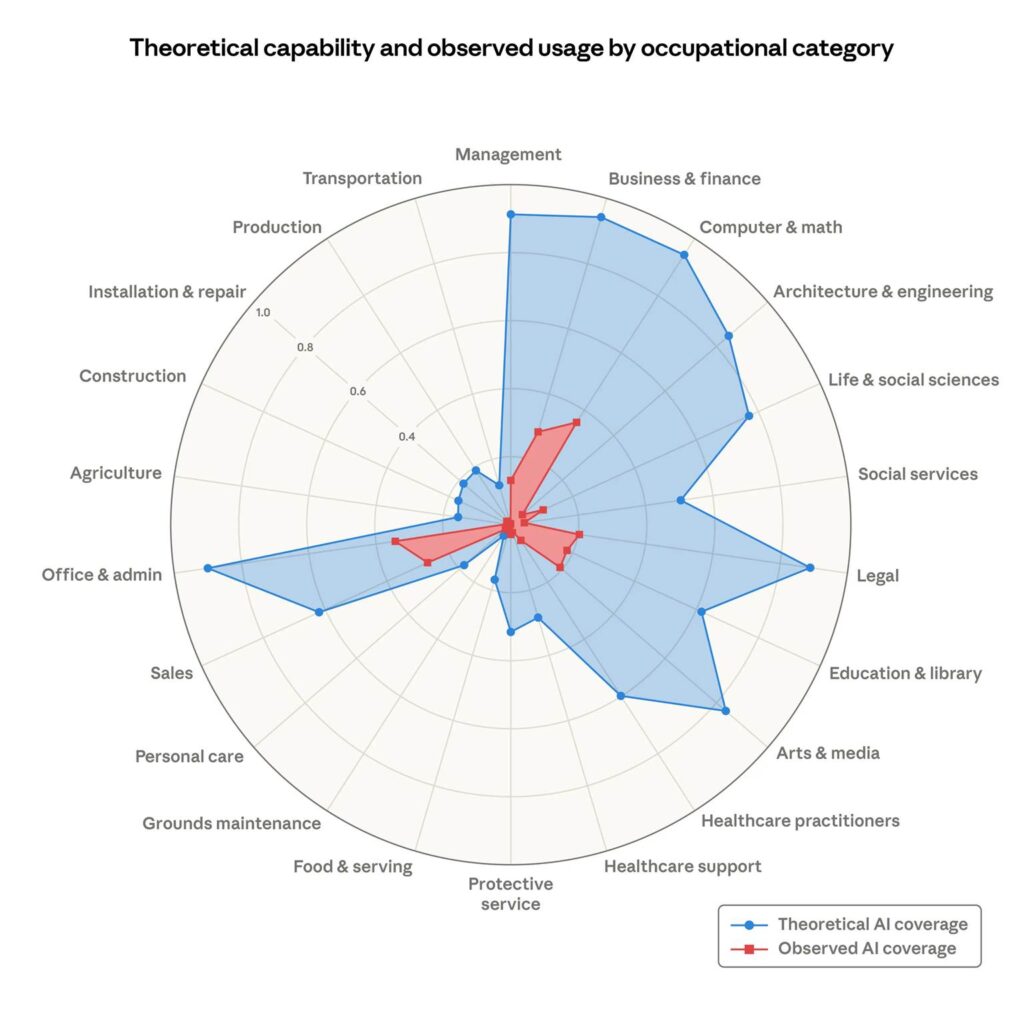
[David’s Note] For too long, the discourse surrounding Artificial Intelligence has oscillated between technophilic utopia and Luddite dread. However, Anthropic’s recent research on Labour Market Impacts provides a sobering, empirical corrective. By shifting the unit of analysis from “jobs” to “tasks”, this report unveils a nuanced architectural shift in how value is created—and compensated—in the age of Large Language Models (LLMs). This week, we go beyond the headlines to explore the structural metamorphosis of the modern workforce.
📍 Key Insights: Three Pillars of the New Economic Reality
The study moves beyond speculative forecasting, offering a granular look at how LLMs intersect with thousands of professional tasks.
1. The Erosion of the ‘Cognitive Moat’
In a departure from the Industrial Revolution, where mechanisation replaced physical toil, the current AI wave is “top-heavy“. The report highlights:
- High-wage, cognitive-intensive roles (such as legal counsel, financial analysis, and software engineering) exhibit the highest “task exposure.”
- Traditional professional barriers—once fortified by years of specialised education—are being bypassed by the generalised reasoning capabilities of LLMs. In short: the more a job relies on processing information, the more vulnerable it is to disruption.
2. From Occupation to Atomic Tasks
The report argues that AI does not “swallow” jobs whole; rather, it deconstructs them.
- Most professions are “bundles” of diverse tasks. While AI may master 20–50% of these, the remaining tasks—those requiring interpersonal nuance, high-stakes moral judgement, and physical dexterity—remain firmly in the human domain.
- The Strategic Shift: The future of work lies not in “doing,” but in “orchestrating” AI-generated outputs while focusing on the non-automatable fringes of complex problem-solving.
3. The Democratisation of Skill and its Discontents
One of the most profound findings is the “levelling effect.” LLMs disproportionately benefit junior or less-experienced staff, effectively narrowing the gap between novices and experts. While this boosts overall productivity, it creates a Wage Paradox: as specialised skills become commoditised through AI, the market premium for those skills may diminish, putting downward pressure on traditional middle-class salaries.
💡 David’s Reflection: Navigating the Shift
This research confirms that the “moat” around one’s career is no longer built on knowledge retention, but on AI-synergy. The most resilient professionals will be those who view LLMs not as a replacement, but as a co-processor—delegating the mundane to the machine to focus on the uniquely human messiness of innovation and empathy.
🛡️ Ethical AI Commentary: On Agency, Equity, and the Social Contract
In light of Anthropic’s findings, we must apply an Ethical AI lens to the unfolding transition:
1. Justice in the Transitional Period If high-value tasks are automated at scale, the resulting efficiency gains must not be hoarded solely by capital owners. A “Human-Centric” transition demands that organisations take active responsibility for upskilling and reskilling programmes. We must ensure that the “productivity dividend” is shared fairly, preventing a further hollowed-out middle class.
2. The Preservation of Human Agency As we outsource cognitive tasks to models, we risk “skill atrophy.” From an ethical standpoint, we must define protected domains—specifically in law, healthcare, and public policy—where “Human-in-the-Loop” is not just a preference, but a moral and safety requirement to ensure accountability.
3. Algorithmic Bias and Opportunity If AI redefines the “ideal” way to perform a task, we must be vigilant that these models do not codify historical biases. We must ensure that “efficiency” does not become a proxy for “homogeneity,” stifling the cognitive diversity that is essential for true human progress.
Closing Thought: The disruption of the labour market is no longer a distant “if,” but an unfolding “how.” As AI masters the logic of our work, our task is to reclaim the soul of it.
For those wishing to scrutinise the empirical data, the full report is available via Anthropic’s research portal: Research: Labour Market Impacts